






中国农业科学 ›› 2026, Vol. 59 ›› Issue (8): 1672-1685.doi: 10.3864/j.issn.0578-1752.2026.08.006
侯慧芝( ), 尹嘉德, 马明生, 刘晓伟, 柳燕兰, 雷康宁
收稿日期:2025-09-23
接受日期:2026-03-19
出版日期:2026-04-21
发布日期:2026-04-21
联系方式:
侯慧芝,E-mail:houhuizhi666@163.com
基金资助:
HOU HuiZhi(), YIN JiaDe, MA MingSheng, LIU XiaoWei, LIU YanLan, LEI KangNing
Received:2025-09-23
Accepted:2026-03-19
Published:2026-04-21
Online:2026-04-21
摘要:
【目的】针对陇东黄土丘陵区传统一年一熟制生产效率低、水热资源利用率不充分的问题,通过引入早熟马铃薯-玉米轮作模式,旨在突破原有种植制度限制,充分挖掘区域水热资源潜力。为进一步优化该新模式的生产效益与可持续性,本研究重点探究不同耕作与施肥措施对马铃薯-玉米一年两熟轮作系统光合特性、水分利用及产量和效益的影响,以期为提升农田周年生产力提供关键技术依据。【方法】于2023—2024年以早熟马铃薯(荷兰15号)和早熟玉米(科沃028)为材料,设置传统旋耕(TT)、传统旋耕+有机肥(TTO)、立式深旋(VT)和立式深旋+有机肥(VTO)4个处理,测定作物地上地下生物量、光合特性、产量及产量构成,计算水分利用效率和经济效益。【结果】与TT相比,VT和VTO处理显著提升了马铃薯成熟期的地上生物量和块茎产量,以及玉米成熟期的茎秆重和穗重。VT和VTO处理分别增加了马铃薯的单穴薯数、单穴薯重和商品薯率,同时提升了玉米的行粒数和百粒重。VTO处理下马铃薯和玉米产量分别达到32 853—33 879和8 289—9 860 kg·hm-2,周年总产量达到15 065—16 431 kg·hm-2(折粮)。相较于TT,VT和VTO处理下马铃薯产量提高21.5%—24.5%和30.4%—36.2%,玉米产量提高4.2%—10.3%和9.3%—16.2%,周年总产量增幅达11.2%—15.4%和17.8%—23.5%。VT和VTO处理还协同增强了作物光合能力,在马铃薯和玉米的关键生育时期,显著提高了叶片相对叶绿素含量(SPAD)值、净光合速率、气孔导度和蒸腾速率,同时降低了胞间CO2浓度,改善了叶片瞬时水分利用效率。VT和VTO处理使马铃薯水分利用效率提升15.4%—19.6%和21.3%—32.5%、玉米水分利用效率提升7.3%—10.4%和13.4%—15.3%,周年降水利用率提高3.0%—3.1%和2.7%—3.4%;VTO和VT周年纯收入较TT处理分别增加19.9%—31.8%和32.7%—40.5%,VTO较VT处理减少6.3%—9.6%。以上指标除经济效益外,VTO处理在其余各项指标上的表现均优于VT,且有更好的土壤改良潜力,可实现农业可持续性。【结论】在陇东黄土丘陵区推广早熟马铃薯-玉米一年两熟制时,立式深旋结合有机肥(VTO)是实现作物产能和生态效益协同优化的最有效途径。该措施不仅为马铃薯-玉米双季栽培制度的稳定实施提供了有力保障,还有助于达成周年“吨粮田”的高产目标。尽管短期内VTO处理的经济效益略低于VT处理,但其在推动区域旱作农业资源高效与可持续利用方面显示出重要的技术支撑价值和长远潜力。
侯慧芝, 尹嘉德, 马明生, 刘晓伟, 柳燕兰, 雷康宁. 耕作与增施有机肥对陇东马铃薯-玉米一年两熟制作物产量和水分利用的影响[J]. 中国农业科学, 2026, 59(8): 1672-1685.
HOU HuiZhi, YIN JiaDe, MA MingSheng, LIU XiaoWei, LIU YanLan, LEI KangNing. Effects of Tillage and Organic Fertilizer Application on Crop Yield and Water Use in a Potato-Maize Double Cropping System in the Longdong Region[J]. Scientia Agricultura Sinica, 2026, 59(8): 1672-1685.
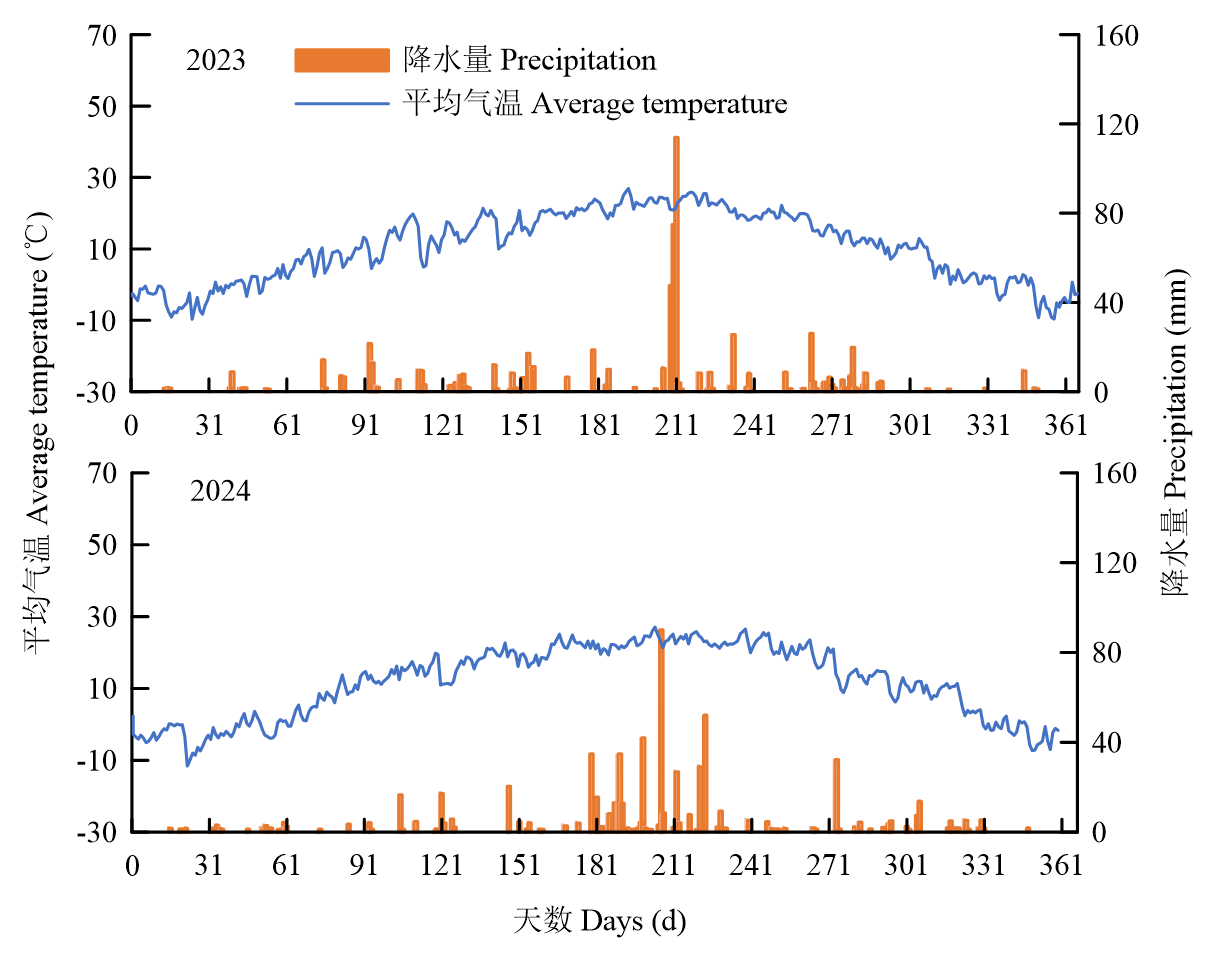
图1
试验区2023—2024降水分布和平均气温变化"
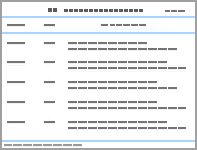
表1
试验处理描述"
| 处理 Treatment | 耕作方式 Tillage method | 有机物料 Organic material |
|---|---|---|
| TT | 传统旋耕 Traditional rotary tillage | 无有机物料 No organic material |
| TTO | 传统旋耕 Traditional rotary tillage | 增施含碳量25%以上的有机肥27 t·hm-2 Apply organic fertilizer with a carbon content of more than 25% at a rate of 27 t·hm-2 |
| VT | 立式深旋耕作 Vertically rotary sub-soiling | 无有机物料 No organic material |
| VTO | 立式深旋耕作 Vertically rotary sub-soiling | 增施含碳量25%以上的有机肥27 t·hm-2 Apply organic fertilizer with a carbon content of more than 25% at a rate of 27 t·hm-2 |
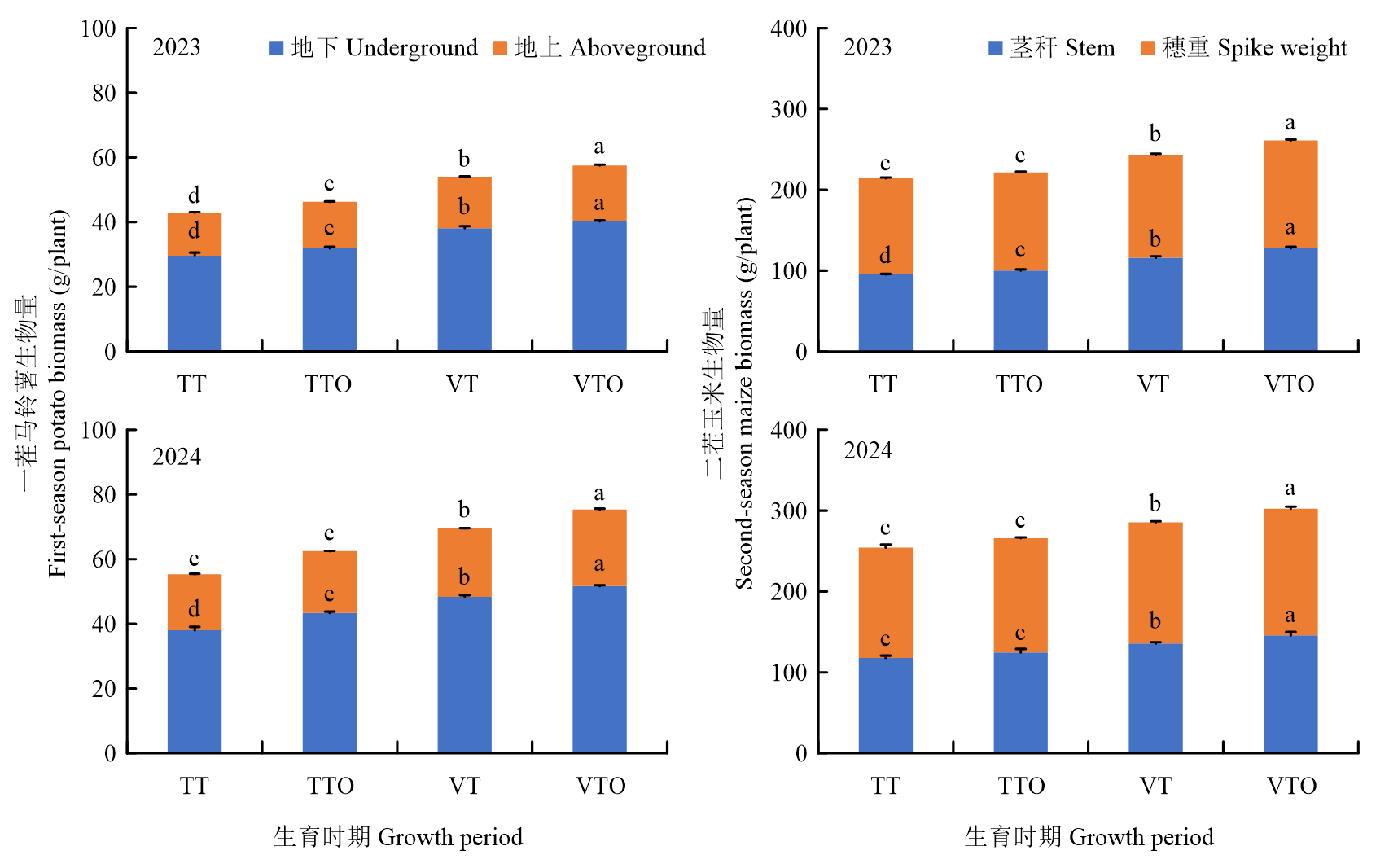
图2
不同处理对一茬马铃薯和二茬玉米成熟期生物量的影响 不同字母代表在0.05水平上差异显著(P<0.05)。下同"
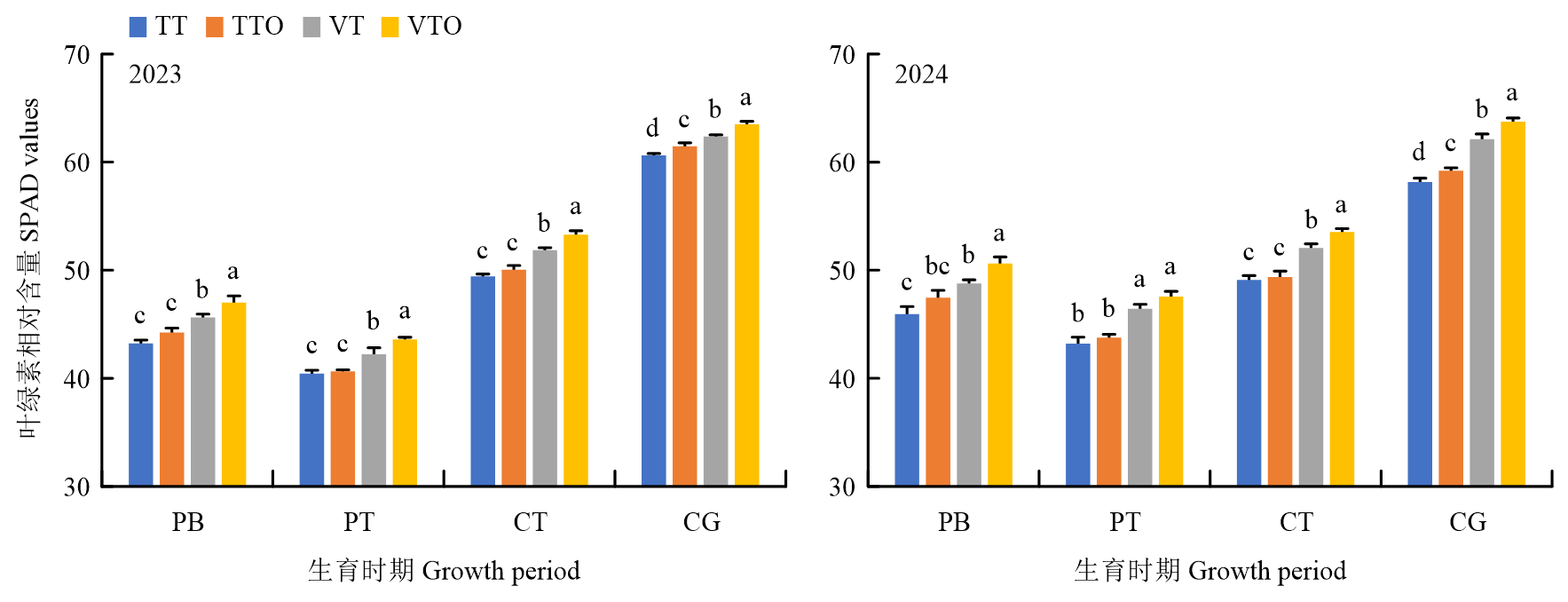
图3
不同处理对马铃薯和玉米关键生育时期叶片SPAD值的影响 PB:马铃薯现蕾期 Bud formation stage of potato;PT:马铃薯块茎膨大期 Tuber bulking stage of potato;CT;玉米抽雄期 Tasseling stage of mazie;CG:玉米籽粒灌浆期 Grain filling stage of maize。下同 The same as below"
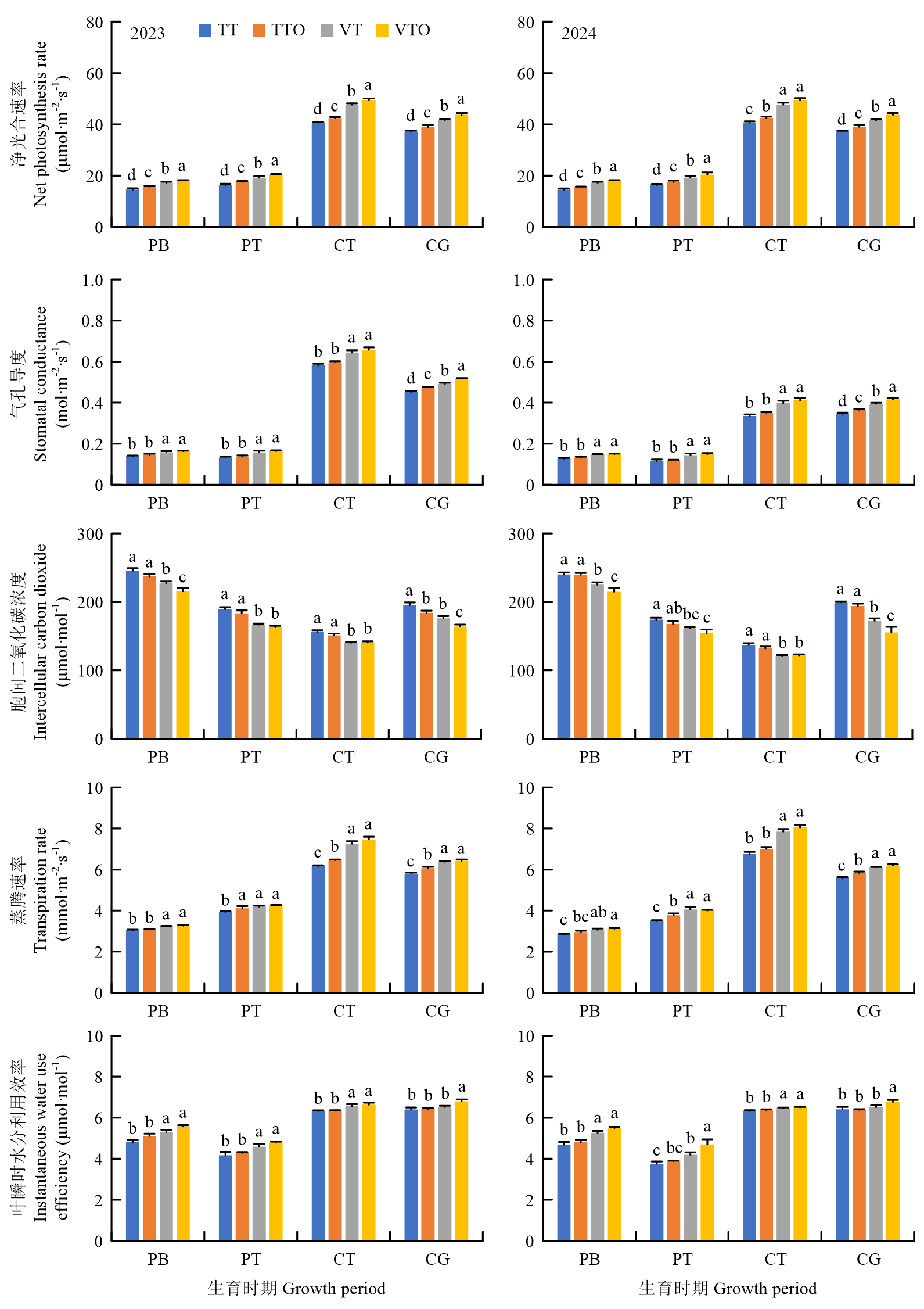
图4
不同处理对马铃薯和玉米关键生育时期光合特性的影响"
表2
不同处理对土壤理化性质的影响"
| 处理 Treatment | 土壤容重 Soil bulk density (g·cm-3) | 土壤有机质 Soil organic matter (g·kg-1) | 土壤碱解氮 Soil alkali-hydrolyzable nitrogen (mg·kg-1) | 土壤有效磷 Soil available phosphorus (mg·kg-1) | 土壤速效钾 Soil available potassium (mg·kg-1) |
|---|---|---|---|---|---|
| TT | 1.35±0.01a | 14.7±0.3c | 74.7±0.6c | 10.6±0.5c | 161.3±6.0b |
| TTO | 1.32±0.01a | 16.0±0.2a | 78.6±0.5b | 12.6±0.8bc | 179.3±6.7a |
| VT | 1.29±0.01b | 15.3±0.1b | 79.3±0.2b | 13.5±0.8ab | 181.7±1.5a |
| VTO | 1.26±0.02b | 16.3±0.2a | 80.9±0.5a | 14.6±1.0a | 192.3±7.0a |
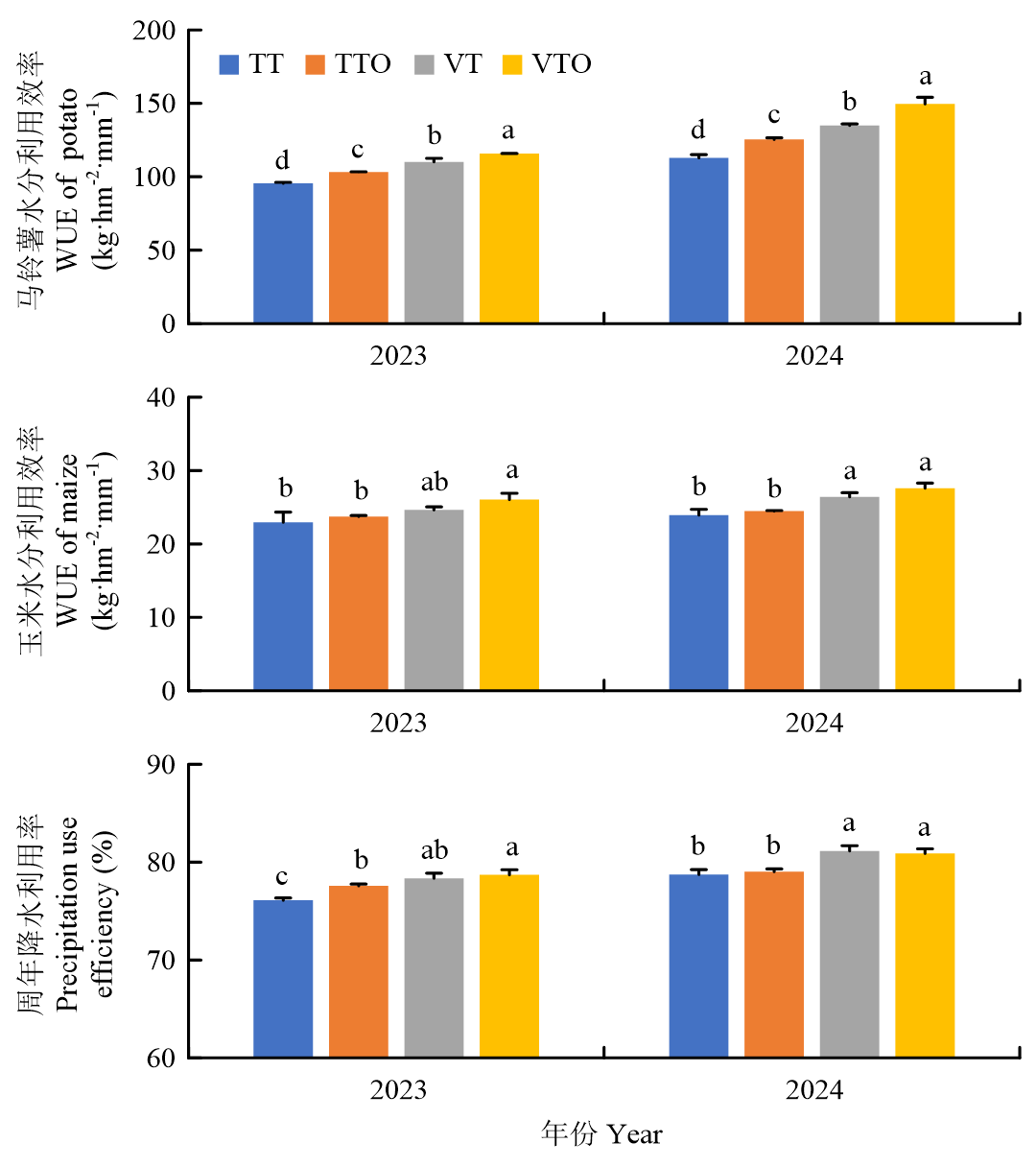
图5
不同处理对马铃薯和玉米水分利用效率及两茬降水利用率的影响"
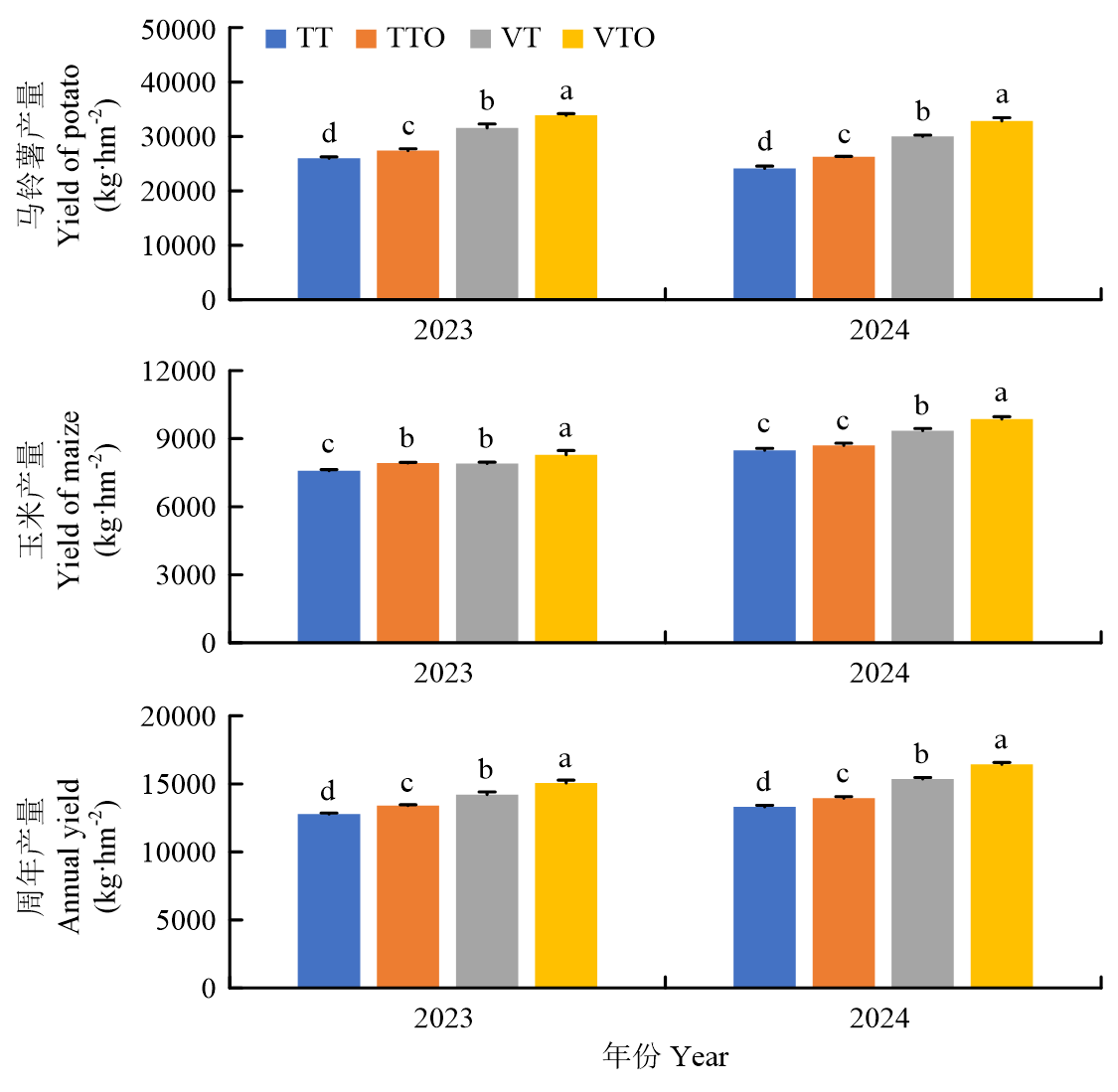
图6
不同处理对马铃薯产量、玉米产量和周年产量的影响"
表3
不同处理对马铃薯和玉米产量构成因素及马铃薯商品薯率的影响"
| 处理 Treatment | 一茬马铃薯 First-season potato | 二茬玉米Second-season maize | ||||||||||
|---|---|---|---|---|---|---|---|---|---|---|---|---|
| 单穴薯数 The number of potatoes per hole | 单穴薯重 Weight of potatoes per hole (g) | 商品薯率 Commercial potato rate (%) | 穗行数 Number of kernel rows per ear | 行粒数 Number of grains per row | 百粒重 100-seed weight (g) | |||||||
| 2023 | 2024 | 2023 | 2024 | 2023 | 2024 | 2023 | 2024 | 2023 | 2024 | 2023 | 2024 | |
| TT | 3.6±0.1b | 3.7±0.0b | 506.3±13.0c | 432.0±8.4c | 86.8±0.7b | 84.9±0.9b | 13.8±0.1b | 14.1±0.2b | 33.5±0.1c | 34.8±0.3c | 31.5±0.3c | 34.2±0.5c |
| TTO | 3.7±0.1ab | 3.7±0.1b | 524.0±4.3c | 456.2±5.4c | 88.1±0.6b | 86.9±2.3b | 13.9±0.1b | 14.1±0.1ab | 33.8±0.1c | 35.9±0.7c | 32.9±0.2b | 34.6±0.4c |
| VT | 4.0±0.2a | 3.8±0.2ab | 547.6±3.4b | 511.7±15.1b | 92.1±0.8a | 92.8±1.1a | 13.9±0.1ab | 14.4±0.2ab | 34.8±0.1b | 37.0±0.2b | 33.3±0.3b | 39.7±0.0b |
| VTO | 4.0±0.2a | 4.1±0.1a | 576.7±6.7a | 560.0±14.0a | 93.3±0.5a | 94.1±0.6a | 14.1±0.1a | 14.5±0.2a | 35.2±0.2a | 38.4±0.4a | 34.8±0.3a | 43.0±0.1a |
表4
不同处理对马铃薯-玉米一年两熟模式经济效益的影响"
| 处理 Treatment | 马铃薯收益 Potato revenue (yuan/hm2) | 玉米收益 Maize revenue (yuan/hm2) | 总投入 Total input cost (yuan/hm2) | 纯收益 Net profit (yuan/hm2) | ||||
|---|---|---|---|---|---|---|---|---|
| 2023 | 2024 | 2023 | 2024 | 2023 | 2024 | 2023 | 2024 | |
| TT | 36377±351b | 33763±633d | 19727±137c | 22060±225c | 30600 | 30600 | 25504±385c | 25223±668c |
| TTO | 38368±464c | 36761±116c | 20605±81b | 22619±264c | 38100 | 38100 | 20872±443d | 21279±365d |
| VT | 44187±1014b | 42018±333b | 20553±146b | 24327±229b | 30900 | 30900 | 33841±1127a | 35444±436a |
| VTO | 47431±437a | 45995±813a | 21552±487a | 25636±280a | 38400 | 38400 | 30583±711b | 33231±832b |
| [1] |
doi: 10.1016/j.eiar.2023.107325 |
| [2] |
doi: 10.54691/fsd.v3i11.5733 |
| [3] |
doi: 10.1016/j.farsys.2024.100083 |
| [4] |
doi: 10.1016/j.fcr.2023.109015 |
| [5] |
doi: 10.3390/agronomy8110268 |
| [6] |
doi: 10.1016/j.asoc.2024.112360 |
| [7] |
梁玉刚, 周晶, 杨琴, 黄璜. 中国南方多熟种植的发展现状、功能及前景分析. 作物研究, 2016, 30(5): 572-578.
|
|
|
|
| [8] |
doi: 10.1016/j.eja.2020.126126 |
| [9] |
doi: 10.1016/j.agrformet.2019.01.009 |
| [10] |
doi: 10.3389/fsufs.2024.1441396 |
| [11] |
doi: 10.3389/fmicb.2025.1493333 |
| [12] |
doi: 10.3389/fpls.2022.999730 |
| [13] |
doi: 10.1016/j.agwat.2024.108721 |
| [14] |
陈昭旭. 不同耕作措施和秸秆还田连续实施对土壤肥力的影响[D]. 呼和浩特: 内蒙古农业大学, 2022.
|
|
|
|
| [15] |
郭罗迪. 不同耕作措施对土壤有机碳、土壤结构及蓄水性能和作物生长的影响[D]. 杨凌: 西北农林科技大学, 2023.
|
|
|
|
| [16] |
李泽坤, 谢军红, 杨通, 董芬榕, 司佳昂, 王海强, 王婷婷. 耕作方法与施氮量对旱作农田土壤团聚体稳定性及玉米产量的影响. 水土保持学报, 2025, 39(4): 313-323.
|
|
|
|
| [17] |
张绪成, 马一凡, 于显枫, 侯慧芝, 王红丽, 方彦杰. 立式深旋耕作对西北半干旱区马铃薯水肥利用和产量的影响. 植物营养与肥料学报, 2021, 27(2): 191-203.
|
|
|
|
| [18] |
董奎军, 张亦涛, 刘瀚文, 张继宗, 王伟军, 温延臣, 雷秋良, 文宏达. 玉米大豆间作减量施氮对当季作物农艺性状、经济效益和后茬小麦产量的影响. 中国农业科学, 2024, 57(22): 4495-4506. doi:10.3864/j.issn.0578-1752.2024.22.009.
|
|
|
|
| [19] |
马小艳, 杨瑜, 黄冬琳, 王朝辉, 高亚军, 李永刚, 吕辉. 小麦化肥减施与不同轮作方式的周年养分平衡及经济效益分析. 中国农业科学, 2022, 55(8): 1589-1603. doi:10.3864/j.issn.0578-1752.2022.08.010.
|
|
|
|
| [20] |
郑凤君, 王雪, 李景, 王碧胜, 宋霄君, 张孟妮, 武雪萍, 刘爽, 席吉龙, 张建诚, 李永山. 免耕条件下施用有机肥对冬小麦土壤酶及活性有机碳的影响. 中国农业科学, 2020, 53(6): 1202-1213. doi:10.3864/j.issn.0578-1752.2020.06.012.
|
|
|
|
| [21] |
卜容燕, 程文龙, 武际, 唐杉, 李敏, 鲁剑巍, 纪根学, 王慧, 朱睿, 蒋发辉, 汤萌萌, 韩上. 有机肥无机肥配施结合深耕提升稻油轮作系统生产力和养分利用效率. 中国农业科学, 2025, 58(16): 3178-3189. doi:10.3864/j.issn.0578-1752.2025.16.003.
|
|
|
|
| [22] |
田慎重, 王瑜, 宁堂原, 董晓霞, 董亮, 郑东峰, 郭洪海. 转变耕作方式对长期旋免耕农田土壤有机碳库的影响. 农业工程学报, 2016, 32(17): 98-105.
|
|
|
|
| [23] |
张绪成, 马一凡, 于显枫, 侯慧芝, 王红丽, 方彦杰. 立式深旋松耕对西北半干旱区土壤水分性状及马铃薯产量的影响. 草业学报, 2018, 27(12): 156-165.
doi: 10.11686/cyxb2018313 |
|
|
|
| [24] |
吴姗薇, 吴金芝, 赵凯男, 张军, 李爽, 黄明, 李友军. 灌溉、耕作和施氮对旱地农田土壤生态化学计量特征的影响. 生态学报, 2024, 44(22): 10377-10390.
|
|
|
|
| [25] |
李海龙, 柴强, 樊志龙, 殷文, 范虹, 何蔚, 孙亚丽, 张明龙, 胡发龙. 少耕及有机肥配施对河西绿洲灌区青贮玉米×拉巴豆系统土壤理化特性及作物产量的影响. 作物学报, 2025, 51(11): 3013-3025.
doi: 10.3724/SP.J.1006.2025.53030 |
|
doi: 10.3724/SP.J.1006.2025.53030 |
|
| [26] |
张瑞福, 陈玉, 孙新丽, 徐志辉, 缪有志, 张楠, 刘东阳, 沈其荣. 中国生物肥料与有机肥料研究三十年: 回顾与展望. 植物营养与肥料学报, 2024, 30(7): 1262-1273.
|
|
|
|
| [27] |
祁小平, 李广, 袁建钰, 常海刚. 保护性耕作对陇中旱作麦田蓄水保墒效果和产量的影响. 干旱区研究, 2022, 39(1): 312-321.
doi: 10.13866/j.azr.2022.01.30 |
|
doi: 10.13866/j.azr.2022.01.30 |
|
| [28] |
侯慧芝, 马明生, 尹嘉德, 刘晓伟, 柳燕兰, 张平良, 雷康宁, 姚小凤, 孙叶, 曹瑞红. 陇东黄土丘陵区早熟马铃薯-粮饲兼用玉米一年两茬种植技术. 寒旱农业科学, 2025, 4(8): 775-778.
|
|
|
|
| [29] |
doi: 10.1016/j.agrformet.2021.108322 |
| [30] |
doi: 10.1016/j.geoderma.2024.116778 |
| [31] |
doi: 10.1016/j.agwat.2018.11.019 |
| [32] |
doi: 10.1590/s0102-053620170112 |
| [33] |
王晓娟, 贾志宽, 梁连友, 丁瑞霞, 王敏, 李涵. 不同有机肥量对旱地玉米光合特性和产量的影响. 应用生态学报, 2012, 23(2): 419-425.
|
|
|
|
| [34] |
杨玉玲, 刘文兆, 王俊, 张益望. 配施钾肥、有机肥对旱地春玉米光合生理特性和产量的影响. 西北农业学报, 2009, 18(3): 116-121.
|
|
|
|
| [35] |
doi: 10.1016/j.fcr.2023.109062 |
| [36] |
doi: 10.1016/j.eja.2024.127166 |
| [37] |
doi: 10.1016/j.resconrec.2023.107114 |
| [38] |
doi: 10.1016/j.agwat.2022.107767 |
| [39] |
doi: 10.1016/j.fcr.2024.109512 |
| [40] |
杨永辉, 武继承, 王洪庆, 郭庆, 何方, 韩伟锋, 潘晓莹. 不同水肥条件对玉米生长发育、产量及水分利用效率的影响. 河南农业科学, 2015, 44(11): 50-54.
|
|
|
| [1] | 陈宣伊, 郭星星, 张向前, 路战远, 刘凌悦, 罗方, 李金龙, 张传玲, 张志青, 车曼青. 间作行比对玉米冠层光环境异质性和光合物质生产的影响[J]. 中国农业科学, 2026, 59(8): 1653-1671. |
| [2] | 王彩玉, 刘小丽, 李文广, 杨文平, 杨珍平, 高志强. 有机肥不同替代比例对土壤多功能性的影响及微生物驱动机制[J]. 中国农业科学, 2026, 59(8): 1712-1726. |
| [3] | 彭廷燊, 陆久焱, 吴美林, 严雨欣, 刘宏周, 南文斌, 秦小健, 李明, 龚俊义, 梁永书. 多年生水稻黄糯2号和长白7号产量相关性状的QTL分析[J]. 中国农业科学, 2026, 59(7): 1361-1379. |
| [4] | 王玉萍, 符质, 孙佳莹, 穆晓萌, 刘慧淋, 郭进云, 宋文菁, 侯雷平, 赵海亮. 苗期施用褪黑素对番茄短期低温胁迫的缓解作用与应用效果评价[J]. 中国农业科学, 2026, 59(7): 1523-1535. |
| [5] | 王佳诺, 陈桂平, 李盼, 王丽萍, 南运有, 何蔚, 樊志龙, 胡发龙, 柴强, 殷文, 赵连豪. 免耕地膜两年覆盖提高绿洲灌区玉米产量的灌浆期光合生理机制[J]. 中国农业科学, 2026, 59(6): 1189-1202. |
| [6] | 周新杰, 任昊, 陈应龙, 张吉旺, 赵斌, 任佰朝, 刘鹏, 王洪章. 过氧化钙对渍涝农田夏玉米根系形态及产量形成的影响[J]. 中国农业科学, 2026, 59(6): 1203-1216. |
| [7] | 何继航, 张擎, 吕相月, 薛吉全, 徐淑兔, 刘建超. 不同保绿型玉米杂交种氮效率评价[J]. 中国农业科学, 2026, 59(6): 1217-1230. |
| [8] | 郭富城, 唐海江, 郝馨怡, 马国林, 杨九菊, 黄霖锋, 田蕾, 王彬, 罗成科. 不同灌溉方式对宁夏盐渍化土壤水盐运移、水稻产量及水分利用效率的影响[J]. 中国农业科学, 2026, 59(4): 750-764. |
| [9] | 郝琨, 陈洪德, 张威, 钟韵, 党美荣, 朱士江, 黄志坤, 金英. 基于柑橘产量、品质及水氮利用的涌泉根灌水氮综合评价[J]. 中国农业科学, 2026, 59(4): 862-873. |
| [10] | 咸青林, 肖鉴珂, 高阿庆, 郜利闯, 刘杨. 种植方式结合测墒补灌下冬小麦产量及水分利用效率[J]. 中国农业科学, 2026, 59(3): 589-601. |
| [11] | 延廷霖, 杜娅丹, 胡笑涛, 王贺, 李晓雁, 王玉明, 牛文全, 谷晓博. 加气滴灌下氮肥有机替代对亏缺灌溉棉花产量和水分利用效率的影响[J]. 中国农业科学, 2026, 59(3): 602-618. |
| [12] | 蔡廷阳, 朱玉鹏, 李瑞东, 吴宗声, 徐一帆, 宋雯雯, 徐彩龙, 吴存祥. 苗期叶损伤对黄淮海夏大豆光合特性、荚果分布及产量形成的影响[J]. 中国农业科学, 2026, 59(2): 292-304. |
| [13] | 张志勇, 谭世超, 熊淑萍, 马新明, 韦一昊, 王小纯. 水氮周年优化对豫北灌区小麦玉米轮作系统产量和氮迁移的影响[J]. 中国农业科学, 2026, 59(2): 336-353. |
| [14] | 吕旭东, 孙世媛, 李亚楠, 刘玉龙, 王艳群, 付鑫, 张佳英, 宁鹏, 彭正萍. 智能机械化分层施肥对麦田根-土养分分布和小麦产量的影响[J]. 中国农业科学, 2026, 59(1): 129-146. |
| [15] | 陆浩, 张明龙, 韩梅, 严清彪, 李正鹏, 殷文, 樊志龙, 胡发龙, 柴强. 绿肥过腹还田协同氮肥减施提高小麦产量和土壤质量[J]. 中国农业科学, 2026, 59(1): 147-160. |
|
||
