






中国农业科学 ›› 2026, Vol. 59 ›› Issue (8): 1653-1671.doi: 10.3864/j.issn.0578-1752.2026.08.005
陈宣伊1,2( ), 郭星星3, 张向前1,2,3(), 路战远1,2,3(), 刘凌悦4, 罗方4, 李金龙4, 张传玲4, 张志青5, 车曼青5
收稿日期:2025-09-08
接受日期:2026-03-23
出版日期:2026-04-21
发布日期:2026-04-21
通信作者:
联系方式:
陈宣伊,E-mail:1014067644@qq.com。
基金资助:
CHEN XuanYi1,2(), GUO XingXing3, ZHANG XiangQian1,2,3(), LU ZhanYuan1,2,3(), LIU LingYue4, LUO Fang4, LI JinLong4, ZHANG ChuanLing4, ZHANG ZhiQing5, CHE ManQing5
Received:2025-09-08
Accepted:2026-03-23
Published:2026-04-21
Online:2026-04-21
摘要:
【目的】阐明玉米大豆间作模式对玉米带冠层光环境异质性及光能利用效率和产量形成的影响,明确大兴安岭沿麓黑土区适宜机械化作业的玉米大豆间作模式,以促进该地区农业生产效率提升。【方法】于2023—2024年在内蒙古大兴安岭沿麓黑土区阿荣旗开展田间试验,以玉米‘益农玉12’和大豆‘东生19’为供试材料,对玉米冠层光环境进行可视化,分析2行玉米-2行大豆(2M2S)、4行玉米-4行大豆(4M4S)、4行玉米-2行大豆(4M2S)、6行玉米-6行大豆(6M6S)、6行玉米-4行大豆(6M4S)、6行玉米-2行大豆(6M2S)6个间作处理的冠层结构、光能利用和产量形成的差异性。【结果】(1)4M4S因增加了边际行进光量且内行光环境得到改善,整体冠层结构指标较好,2M2S次之;4M4S和2M2S在抽雄-吐丝期和灌浆期光能利用效率及光合速率显著高于其余处理。(2)4M4S玉米产量差异与2M2S不显著,大豆产量显著高于2M2S,4M4S土地当量比最高,两年分别为1.61和1.60,其余处理分别在1.31—1.56和1.28—1.53;且4M4S机具适配性更好,结合作业成本,产投比最高,达6.61,分别比其他处理提高7.39%—32.28%。【结论】冠层上层(L160、L200)是间作玉米光环境调控和光合作用发挥作用的关键层位,不同空间行位间,冠层结构、光合特性与产量形成的关联程度存在明显差异,且以边行玉米最为显著。Mantel检验表明,光环境结构与光合效率之间存在较强耦合关系,冠层受光条件的改善能够通过增强光合作用促进产量形成。4M4S受边际效应增强和内行光分布改善,玉米产量与传统2M2S模式差异不显著,但大豆产量显著提高(P<0.05),土地当量比最高、复合产投比更高。在大兴安岭沿麓黑土区,4M4S间作模式能够在增产增效的同时,实现全程机械化作业水平的提升和促进生态农业可持续发展。
陈宣伊, 郭星星, 张向前, 路战远, 刘凌悦, 罗方, 李金龙, 张传玲, 张志青, 车曼青. 间作行比对玉米冠层光环境异质性和光合物质生产的影响[J]. 中国农业科学, 2026, 59(8): 1653-1671.
CHEN XuanYi, GUO XingXing, ZHANG XiangQian, LU ZhanYuan, LIU LingYue, LUO Fang, LI JinLong, ZHANG ChuanLing, ZHANG ZhiQing, CHE ManQing. Impacts of Intercropping Row Patterns on the Heterogeneity of the Light Environment and Photosynthetic Product Production in Maize Canopy[J]. Scientia Agricultura Sinica, 2026, 59(8): 1653-1671.
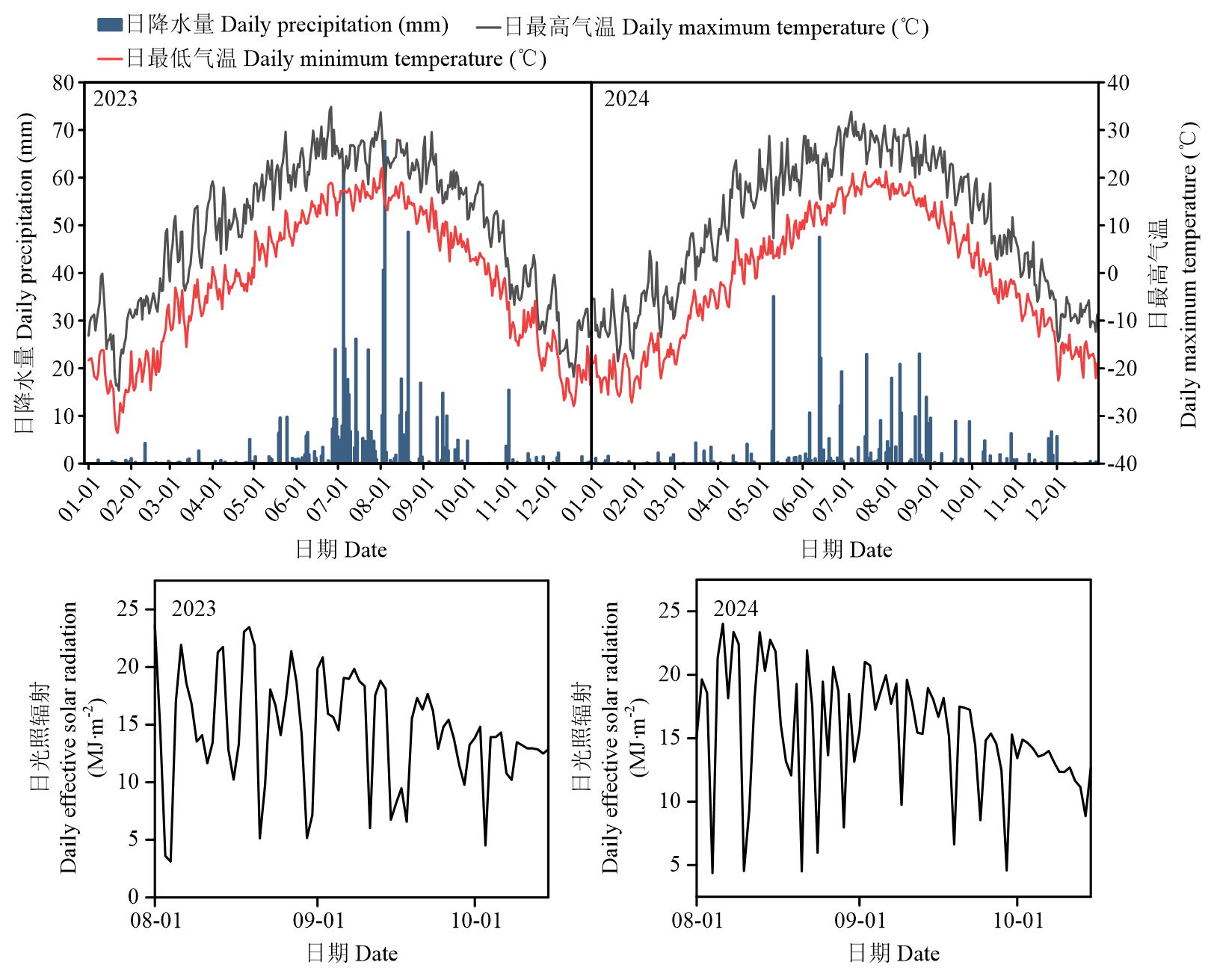
图1
2023—2024年试验地日降水量、日气温和日光辐射变化"

表1
不同处理田间配置实验设计"
| 处理 Treatment | 玉米种植密度 Maize planting density (plants/hm2) | 大豆种植密度 Soybean planting density (plants/hm2) | 带宽 Band width (cm) | 小区种植 面积 Plot planting area (m2) | 玉米大豆 行比 Maize-soybean row ratio | 同垄行距 Same ridge row spacing (cm) | 垄间行距 Row spacing between ridges (cm) | 玉米株距 Maize plant spacing (cm) | 大豆株距 Soybean plant spacing (cm) |
|---|---|---|---|---|---|---|---|---|---|
| 2M2S | 54570 | 127500 | 220 | 880 | 2﹕2 | 45 | 65 | 16.6 | 7.1 |
| 4M4S | 54570 | 127500 | 440 | 1760 | 4﹕4 | 45 | 65 | 16.6 | 7.1 |
| 4M2S | 72765 | 85000 | 330 | 1320 | 4﹕2 | 45 | 65 | 16.6 | 7.1 |
| 6M6S | 54570 | 127500 | 660 | 2640 | 6﹕6 | 45 | 65 | 16.6 | 7.1 |
| 6M4S | 65490 | 102000 | 550 | 2200 | 6﹕4 | 45 | 65 | 16.6 | 7.1 |
| 6M2S | 81855 | 63750 | 440 | 1760 | 6﹕2 | 45 | 65 | 16.6 | 7.1 |
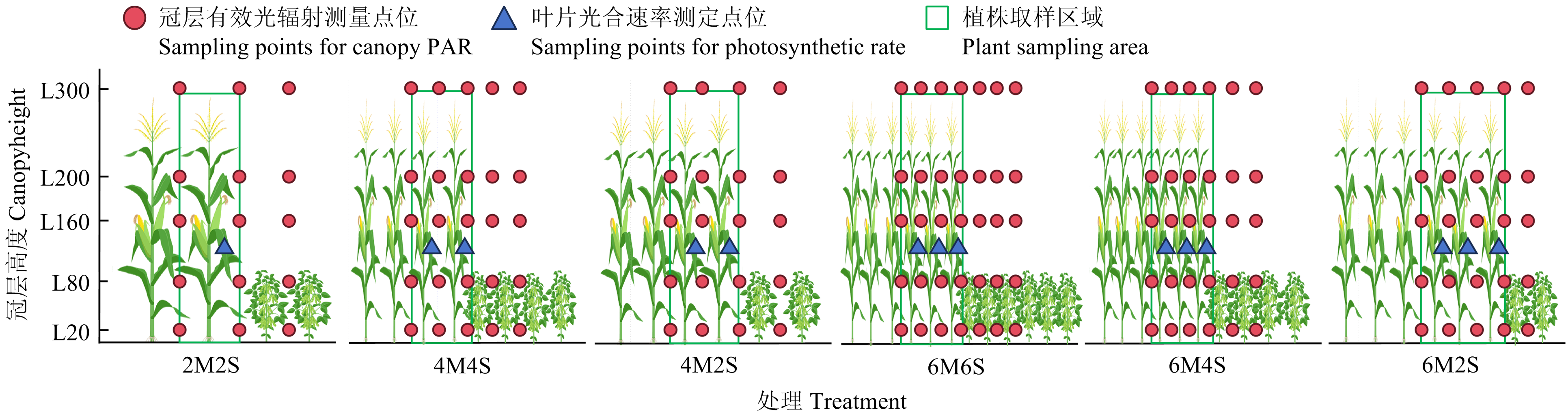
图2
不同间作布局下有效光辐射、叶片光合速率和农艺性状取样位置示意图 2M2S为2行玉米间作2行大豆;4M4S为4行玉米间作4行大豆;4M2S为4行玉米间作2行大豆;6M6S为6行玉米间作6行大豆;6M4S为6行玉米间作4行大豆;6M2S为6行玉米间作2行大豆。L20、L80、L160、L200和L300分别为玉米冠层高度20、80、160、200和300 cm处。下同"
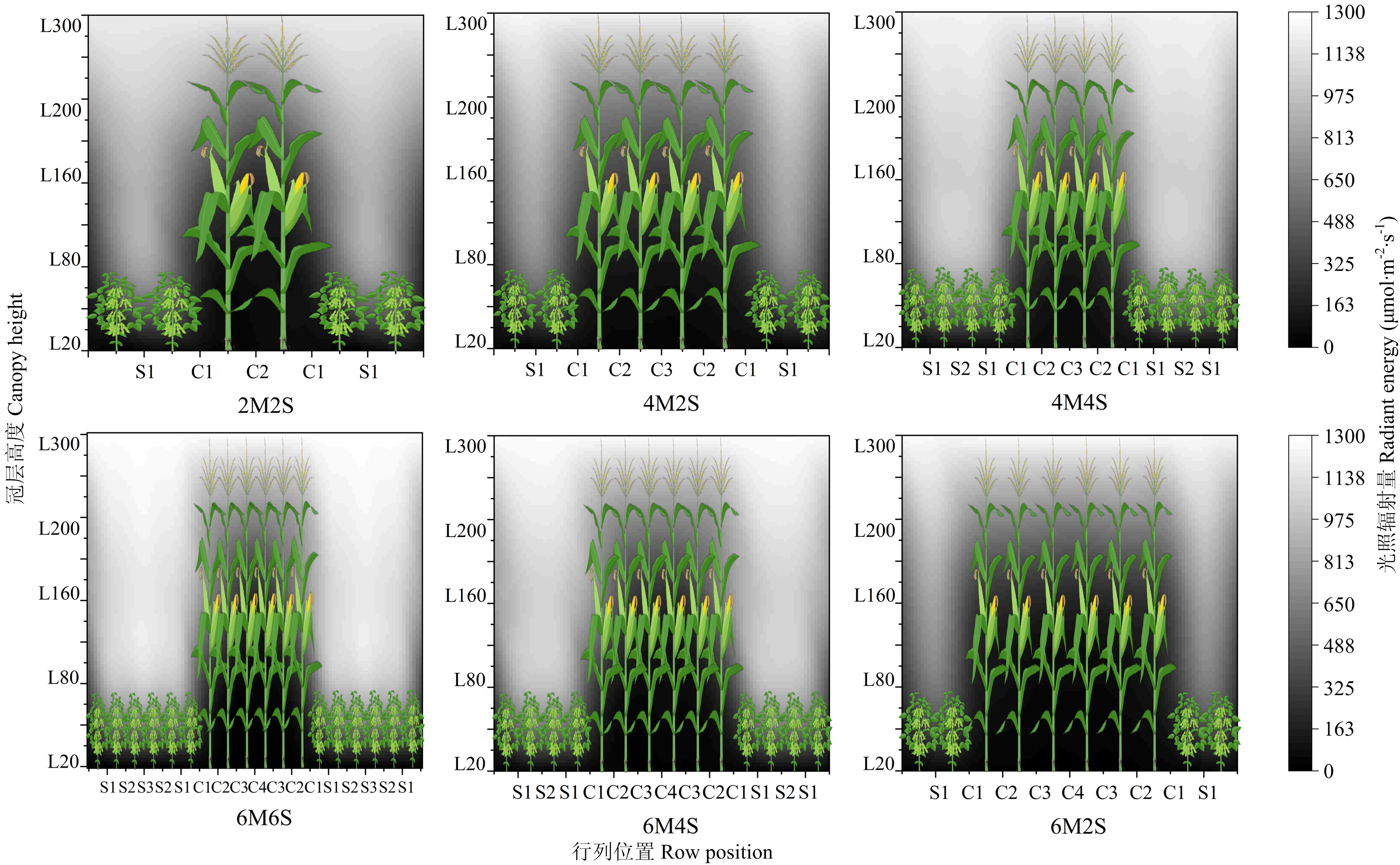
图3
不同间作布局下玉米冠层光辐射分布 在2行玉米间作布局下,C1为玉米边际行外侧、C2为玉米边际行内侧;4行玉米间作布局下,C1为边际行外侧、C2为边际行内侧(内行外侧),C3为内行内侧;6行玉米间作布局下,C1为玉米边际行外侧、C2为玉米边际行内侧(次边际行外侧)、C3为玉米次边际行内侧(内行外侧)、C4为玉米内行内侧。下同"

图4
不同间作布局下玉米群体冠层结构指标 A为冠层透光率,B为消光系数,C为冠层光截获率;雷达图(A/B/C)后从左往右分别为边际行、次边际行和内行的不同高度下相关指标;图中不同处理各点位数据为2年间抽雄-吐丝期和灌浆期均值;不同小写字母间表示存在显著性差异(P<0.05)。下同"
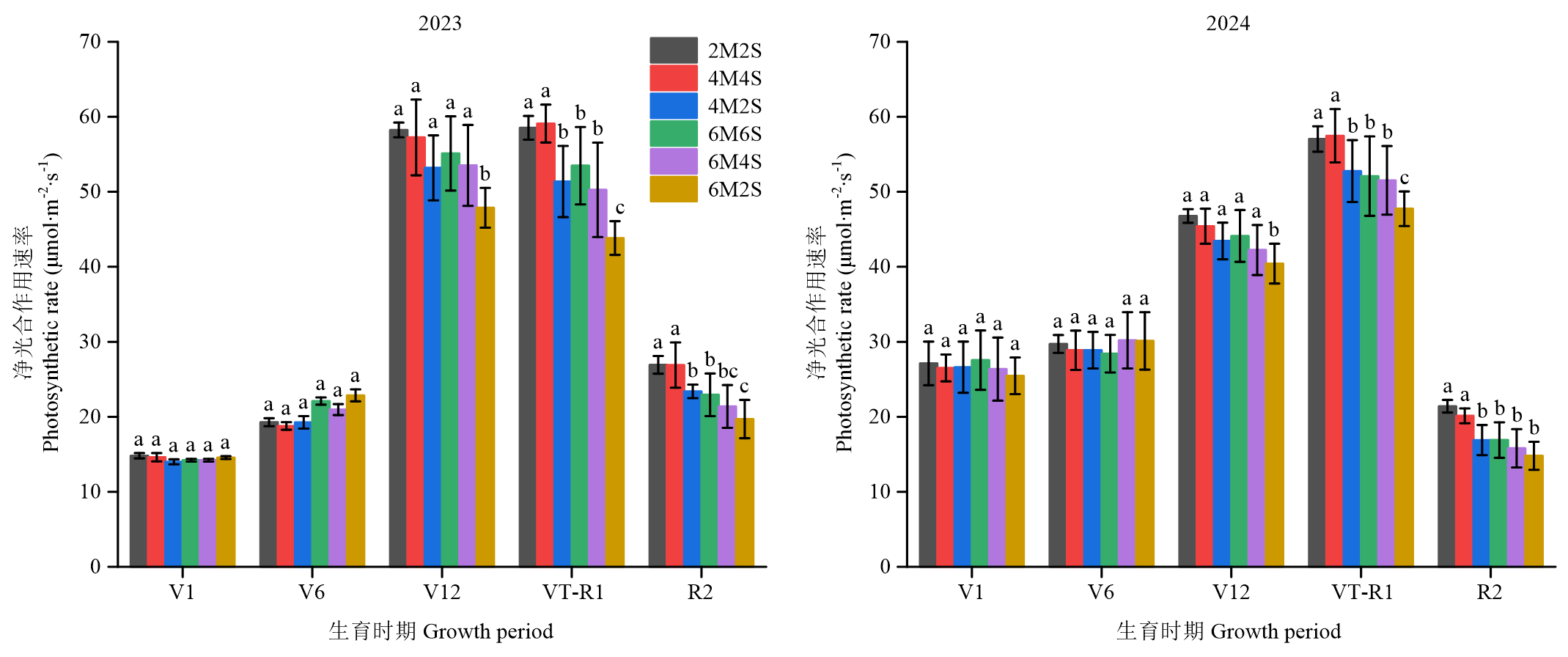
图5
2023—2024年不同间作布局下各生育时期玉米叶片净光合作用速率 该处净光合速率为各处理不同处理各行列玉米叶片光合速率的加权值。V1、V6、V12、VT-R1、R2分别为玉米苗期、拔节期、大喇叭口期、抽雄-吐丝期、灌浆期。下同"
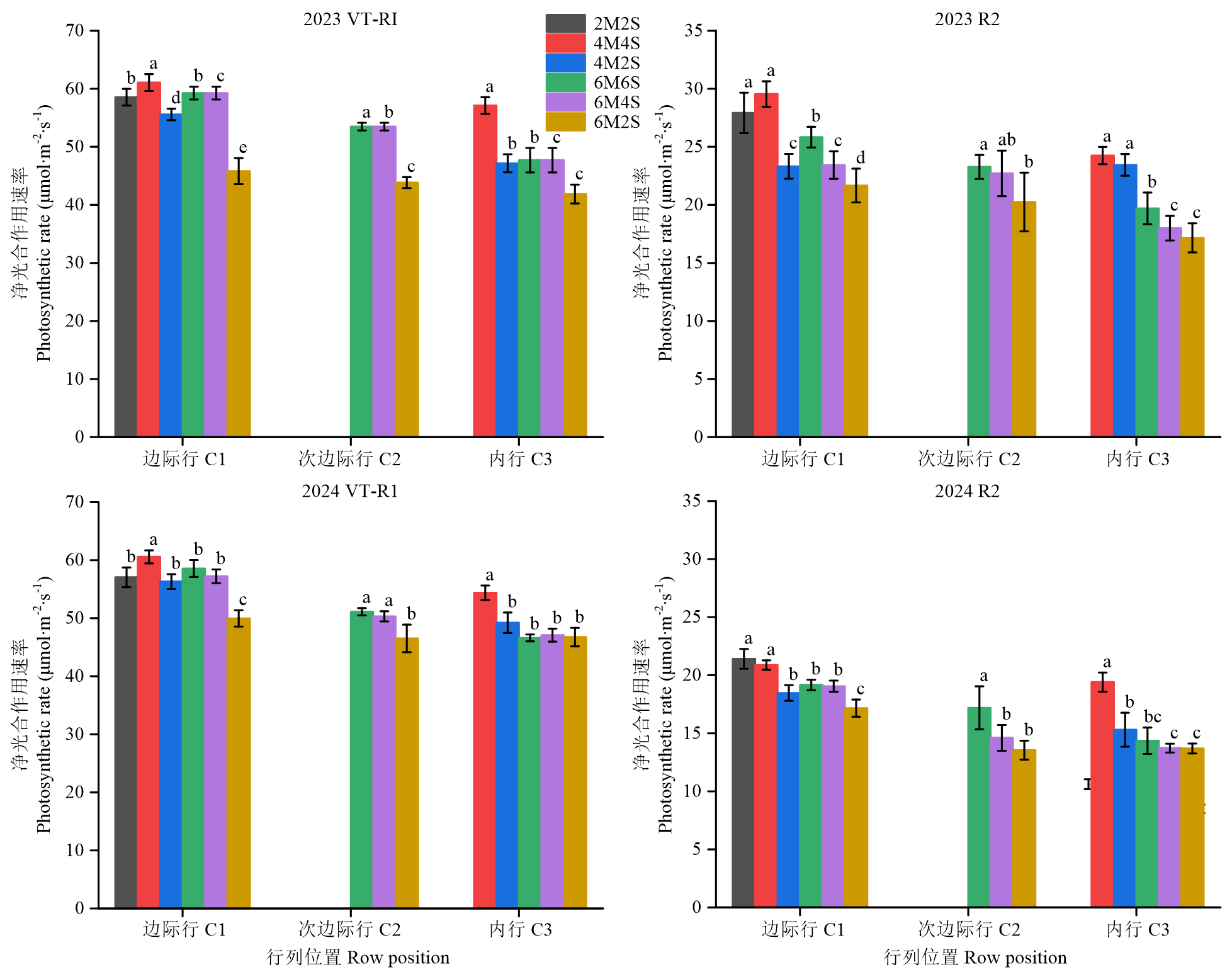
图6
2023—2024年不同间作布局下玉米抽雄-吐丝期和灌浆期行列净光合速率"
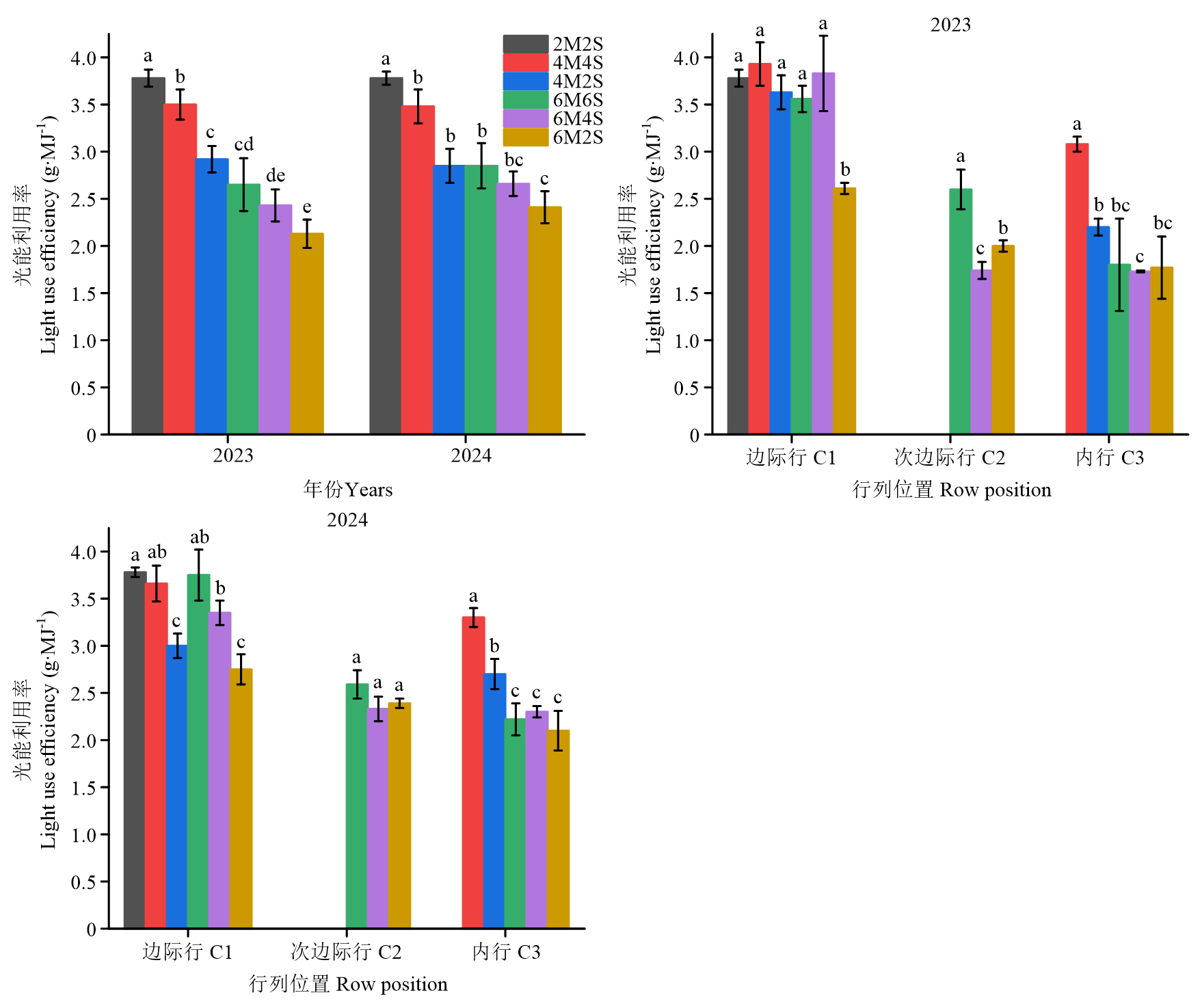
图7
不同间作布局下玉米群体和行列光能利用效率"
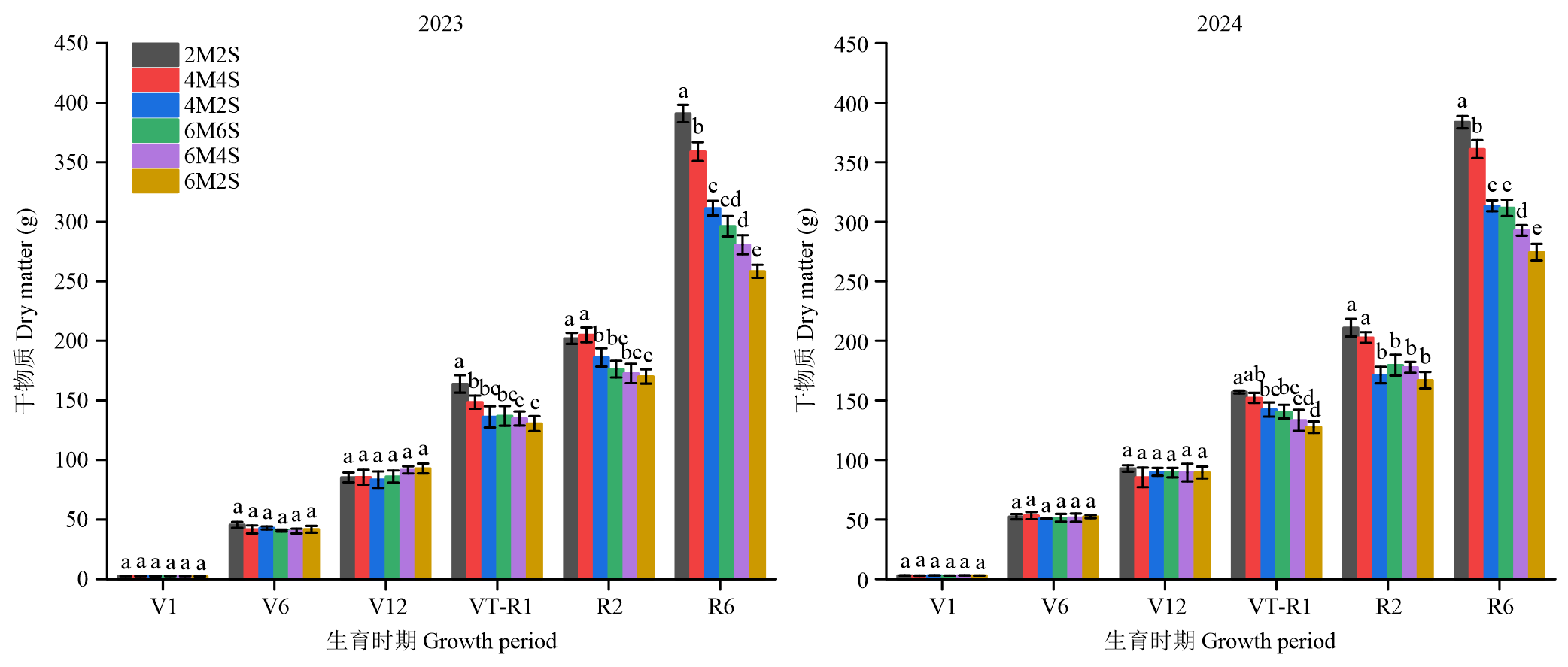
图8
2023-2024年不同间作布局下玉米干物质积累动态变化 R6为玉米成熟期。下同"
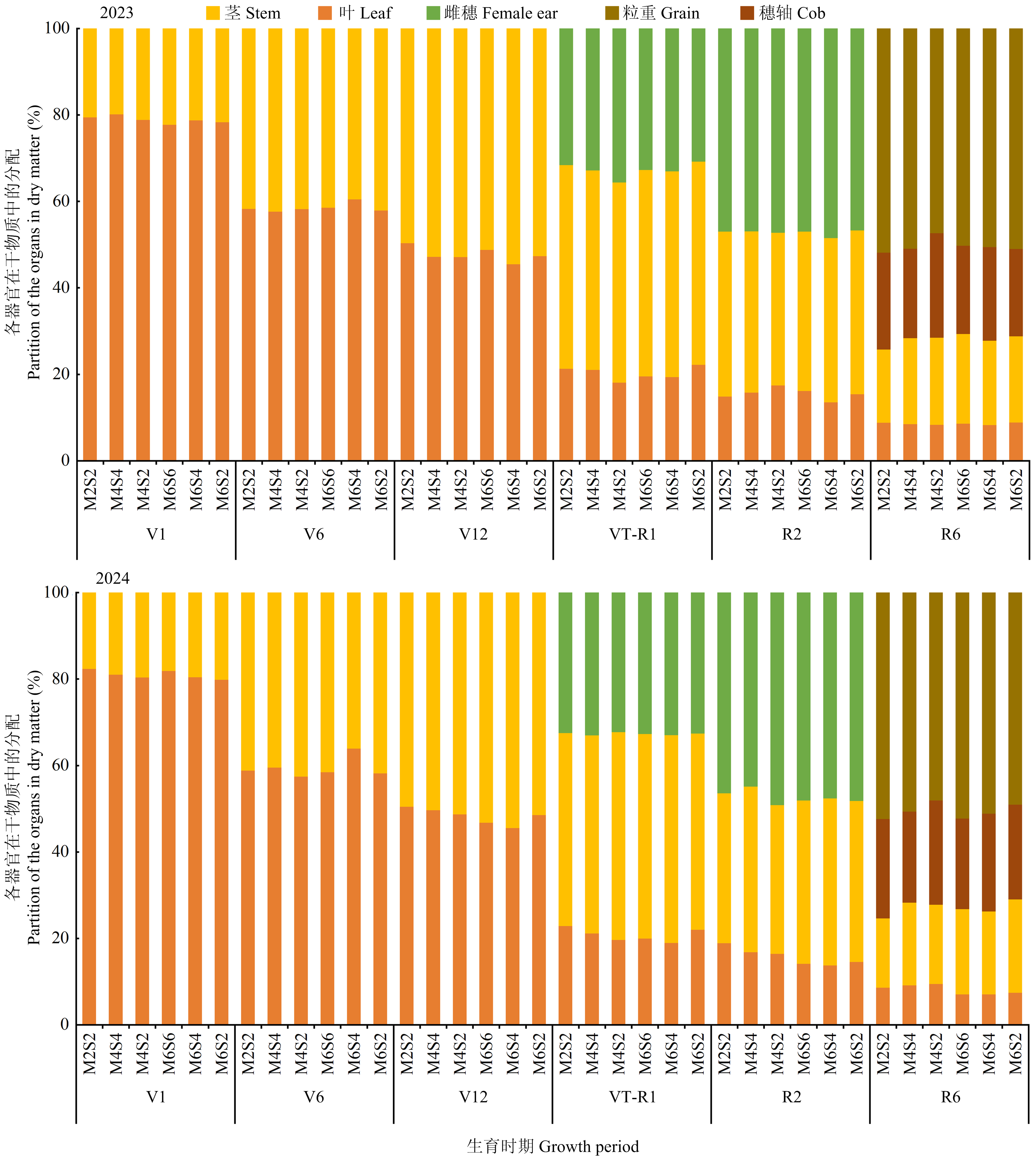
图9
2023—2024年不同间作布局下玉米各器官干物质分配"
表2
间作行比对各行列玉米单株产量和平均行列单株产量的影响"
| 年份 Year | 处理 Treatment | 边际行单株产量 Outer row yield (g) | 次边际行单株产量 Adjacent row yield (g) | 内行产单株产量 Inner row yield (g) | 平均行列单株产量 Mean row yield (g) |
|---|---|---|---|---|---|
| 2023 | 2M2S | 204.56±6.32b | - | - | 204.56±6.32a |
| 4M4S | 208.43±6.90ab | - | 154.86±6.49a | 181.65±6.7b | |
| 4M2S | 180.32±3.73c | - | 118.89±2.43b | 149.61±3.08cd | |
| 6M6S | 214.46±1.38a | 135.38±3.30a | 114.48±1.80c | 154.77±2.16c | |
| 6M4S | 192.54±3.77b | 122.89±2.64b | 115.01±6.60bc | 143.48±4.34d | |
| 6M2S | 145.38±2.46d | 114.88±3.96c | 119.70±3.88b | 126.65±3.43e | |
| 2024 | 2M2S | 198.77±6.77a | - | - | 198.77±6.77a |
| 4M4S | 200.44±5.86a | - | 167.35±3.67a | 183.90±4.77b | |
| 4M2S | 153.90±4.19c | - | 142.78±1.86b | 148.34±3.03cd | |
| 6M6S | 193.10±4.97a | 139.65±8.06a | 137.06±1.81bc | 156.60±4.95c | |
| 6M4S | 171.39±6.39b | 135.51±2.29a | 137.07±5.52bc | 147.99±4.73cd | |
| 6M2S | 150.39±5.90c | 138.97±6.34a | 130.24±4.30c | 139.87±5.51d |
表3
间作行比对玉米、大豆模式产量和土地当量比的影响"
| 处理 | 玉米产量 Maize yield (kg·hm-2) | 大豆产量 Soybean yield (kg·hm-2) | 土地当量比 LER | |||
|---|---|---|---|---|---|---|
| 2023 | 2024 | 2023 | 2024 | 2023 | 2024 | |
| 2M2S | 11534.66±739.70a | 11529.00±576.45a | 971.24±49.21c | 1053.99±30.47c | 1.56 | 1.53 |
| 4M4S | 10157.31±692.43a | 10446.48±522.40a | 1610.65±29.52a | 1606.25±64.27a | 1.61 | 1.60 |
| 4M2S | 11137.63±840.58a | 10481.36±524.07a | 553.91±47.55d | 535.77±60.62d | 1.39 | 1.26 |
| 6M6S | 7778.72±479.19c | 8059.35±268.64c | 1649.01±77.19a | 1635.49±30.72a | 1.36 | 1.36 |
| 6M4S | 9077.41±332.57b | 9402.52±313.42b | 1334.97±94.30b | 1239.96±40.44b | 1.41 | 1.37 |
| 6M2S | 10916.42±566.66a | 11215.46±373.85a | 398.29±40.07e | 384.41±20.61e | 1.31 | 1.28 |
表4
不同间作行比模式2年平均生产、投入及经济效益"
| 处理 Treatment | 复合农资成本 Agricultural supplies (yuan/hm2) | 复合劳动成本 Labor cost (yuan/hm2) | 复合毛利润 Product value (yuan/hm2) | 复合净利润 Net profit (yuan/hm2) | 复合产投比 Profit margin |
|---|---|---|---|---|---|
| 2M2S | 2587.50 | 2075.71 | 28714.52 | 24051.31 | 6.16 |
| 4M4S | 2587.50 | 1728.07 | 28537.68 | 24222.12 | 6.61 |
| 4M2S | 2910.00 | 1931.67 | 25258.07 | 20416.40 | 5.22 |
| 6M6S | 2587.50 | 1690.48 | 23600.77 | 19322.79 | 5.52 |
| 6M4S | 2781.00 | 1773.44 | 24959.73 | 20405.29 | 5.48 |
| 6M2S | 3071.25 | 1964.57 | 25174.99 | 20139.17 | 5.00 |
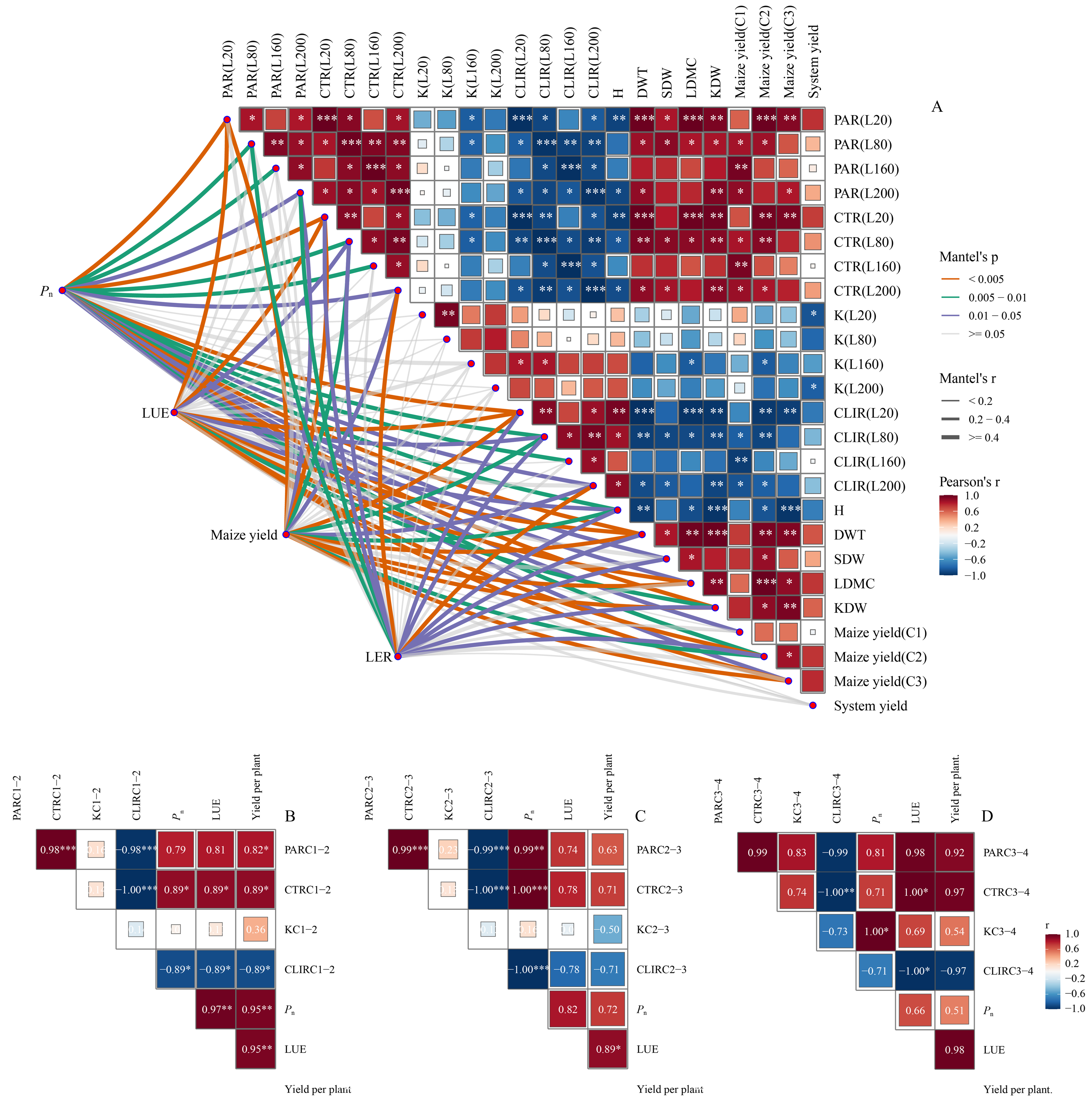
图10
玉米冠层光环境、冠层结构、光合物质生产及产量间相关性分析 图A中展示了玉米带不同冠层高度(L20、L80、L160和L200处)的冠层有效光辐射(PAR)、冠层透光率(CTR)、冠层消光系数(K)、冠层光截获率(CLIR)、株高(H)、全株干重(DWT)、茎干重(SDW)、叶干重(LDMC)、籽粒干重(KDW)、间作外行玉米单株产量(Maize yield(C1))、间作次外行玉米单株产量(Maize yield(C2))、间作内行玉米单株产量(Maize yield(C2))、大豆玉米间作系统产量(System yield)和净光合速率(Pn)、玉米光能利用效率(LUE)、各处理平均玉米单株产量(Maize yield)和土地当量比(LER)间的多矩阵相关性分析。图B、C、D分别展示了玉米带边际行、次边际行和内行的冠层有效光辐射(PAR)、冠层透光率(CTR)、冠层消光系数(K)、冠层光截获率(CLIR)、净光合速率(Pn)、玉米光能利用效率(LUE)和单株产量(Yield per plant)间的相关性分析"
| [1] |
李国景, 罗其友. 我国耕地资源保护与利用体系、挑战与对策. 山西农业大学学报(社会科学版), 2023, 22(6): 9-15.
|
|
|
|
| [2] |
陈源源, 孙艺. 未来30年我国粮食增产潜力与保障能力研究. 四川农业大学学报, 2022, 40(3): 312-318.
|
|
|
|
| [3] |
刘凯, 王欢, 穆月英. 中国大豆进口风险分散及进口来源结构优化: 基于替代性与依赖性视角. 中国油脂, 2025, 50(2): 1-7, 22.
|
|
|
|
| [4] |
陈诗雨. 吉林省农户玉米大豆轮作参与意愿及比价研究[D]. 长春: 吉林大学, 2024.
|
|
|
|
| [5] |
李宗新, 陈源泉, 杨峰, 杨舒淇, 臧华栋, 钱欣, 刘开昌. 黄淮地区玉米大豆复合种植丰产增效技术研发. 中国农业科学, 2025, 58(23): 4837-4840. doi:10.3864/j.issn.0578-1752.2025.23.003.
|
|
|
|
| [6] |
冉漫雪, 孙东宝, 丁军军. 种植模式对作物产量及间作系统种间关系的影响. 干旱地区农业研究, 2024, 42(6): 61-68, 79.
|
|
|
|
| [7] |
pmid: 25866856 |
| [8] |
崔爱花, 刘帅, 黄国勤. 棉田间作系统的农田小气候特征及光合特性. 湖北农业科学, 2021, 60(13): 18-25.
|
|
|
|
| [9] |
李俊祥, 宛志沪. 淮北平原杨-麦间作系统的小气候效应与土壤水分变化研究. 应用生态学报, 2002, 13(4): 390-394.
|
|
|
|
| [10] |
房健, 秦召纪, 于园园, 于宁宁, 赵斌, 刘鹏, 任佰朝, 张吉旺. 大豆玉米带状间作下不同行比配置对作物个体和群体产量及效益的影响. 中国农业科学, 2025, 58(23): 4841-4857. doi:10.3864/j.issn.0578-1752.2025.23.004.
|
|
|
|
| [11] |
doi: 10.1007/s11104-014-2363-7 |
| [12] |
雷雲翔, 应晓成, 沈新平, 刘斌, 蒋敏. 玉米-大豆间作经济与环境效应研究进展. 灌溉排水学报, 2023, 42(S1): 56-60.
|
|
|
|
| [13] |
doi: 10.1016/j.crope.2022.03.009 |
| [14] |
杨姝, 白伟, 蔡倩, 杜桂娟. 玉米‖紫花苜蓿间作群体光分布特征及对植物性状和产量的影响. 作物学报, 2025, 51(9): 2514-2526.
doi: 10.3724/SP.J.1006.2025.53004 |
|
doi: 10.3724/SP.J.1006.2025.53004 |
|
| [15] |
董奎军, 张亦涛, 刘瀚文, 张继宗, 王伟军, 温延臣, 雷秋良, 文宏达. 玉米大豆间作减量施氮对当季作物农艺性状、经济效益和后茬小麦产量的影响. 中国农业科学, 2024, 57(22): 4495-4506. doi:10.3864/j.issn.0578-1752.2024.22.009.
|
|
|
|
| [16] |
李双伟, 朱俊奇,
|
|
doi: 10.12133/j.smartag.SA202202002 |
|
| [17] |
武晶, 陈梦, 汪直华, 杨继芝, 李燕丽, 吴雨珊, 杨文钰. 带状间作不同带间距对玉米光能利用的影响. 中国农业科学, 2023, 56(23): 4648-4659. doi:10.3864/j.issn.0578-1752.2023.23.007.
|
|
|
|
| [18] |
刘席文, 马淑梅, 余常兵, 王淑彬, 魏亚凤, 王小春, 杨文钰. 长江流域田间配置对玉米-大豆带状复合种植群体产量和气候资源利用效率的影响. 四川农业大学学报, 2024, 42(4): 724-734.
|
|
|
|
| [19] |
doi: 10.17221/665/2020-PSE |
| [20] |
袁晓婷, 汤松, 罗凯, 蒋靖怡, 杨文钰, 雍太文. 大豆玉米带状复合种植产量与效益分析: 基于全国16个示范省(市、区)的调查数据. 四川农业大学学报, 2023, 41(5): 834-841, 872.
|
|
|
|
| [21] |
许吟隆, 居辉, 熊伟, 林而达. 气候变化对中国农业影响评估和适应性研究的回顾与展望. 中国农业科学, 2007, 40(S1): 41-48.
|
|
|
|
| [22] |
doi: 10.2134/agronj2009.0409 |
| [23] |
doi: 10.2134/jpa1999.0187 |
| [24] |
武晶. 不同玉米带间距离对带状间作玉米光能利用的影响[D]. 雅安: 四川农业大学, 2023.
|
|
|
|
| [25] |
范虹, 殷文, 柴强. 间作优势的光合生理机制及其冠层微环境特征. 中国生态农业学报(中英文), 2022, 30(11): 1750-1761.
|
|
|
|
| [26] |
高阳, 段爱旺, 刘祖贵, 申孝军. 玉米和大豆条带间作模式下的光环境特性. 应用生态学报, 2008, 19(6): 1248-1254.
|
|
|
|
| [27] |
赵德强, 李彤, 侯玉婷, 元晋川, 廖允成. 玉米大豆间作模式下干物质积累和产量的边际效应及其系统效益. 中国农业科学, 2020, 53(10): 1971-1985. doi:10.3864/j.issn.0578-1752.2020.10.005.
|
|
|
|
| [28] |
doi: 10.1007/s10668-024-04617-2 |
| [29] |
doi: 10.1016/j.cj.2024.10.010 |
| [30] |
陈宣伊, 师晶晶, 张向前, 路战远, 葛国龙, 杜香玉, 陈丽荣, 郝永河. 灌水量对玉米抽雄—吐丝期光合特性及干物质积累的影响. 灌溉排水学报, 2024, 43(9): 39-48.
|
|
|
|
| [31] |
田艺心, 朱金英, 李春燕, 朱冠雄, 高祺, 王春雨, 华方静, 高凤菊. 间作模式对玉米/大豆间作系统光合、产量及种间竞争力的影响. 核农学报, 2025, 39(8): 1775-1785.
doi: 10.11869/j.issn.1000-8551.2025.08.1775 |
|
doi: 10.11869/j.issn.1000-8551.2025.08.1775 |
|
| [32] |
祝庆, 袁超, 张国伟, 许瀚元, 李淑芬, 柴文波, 王军. 玉米品种和密度对大豆玉米间作群体结构和产量的影响. 中国油料作物学报, 2025, 47 (4): 980-992.
doi: 10.19802/j.issn.1007-9084.2025077 |
|
|
|
| [33] |
doi: 10.1038/s41586-024-07669-6 |
| [34] |
吴昊楠, 王学文, 胡静, 吴忠亮, 刘建勋, 李永彬, 杨尚博, 潘睿杰, 勾玲. 大豆-玉米复合间作种植模式对玉米光合特征及产量形成的影响. 西北农林科技大学学报(自然科学版), 2026, 54(2): 33-44.
|
|
|
|
| [35] |
蔡倩, 孙占祥, 郑家明, 王文斌, 白伟, 冯良山, 杨宁, 向午燕, 张哲, 冯晨. 辽西半干旱区玉米大豆间作模式对作物干物质积累分配、产量及土地生产力的影响. 中国农业科学, 2021, 54(5): 909-920. doi:10.3864/j.issn.0578-1752.2021.05.004.
|
|
|
|
| [36] |
杨科, 徐红丽, 许靖宜, 杨新田, 吴玲玲, 杜永娜. 玉米大豆带状复合种植模式产量与效益研究. 安徽农业科学, 2021, 49(17): 40-42.
|
|
|
|
| [37] |
雍太文, 杨文钰. 玉米大豆带状复合种植技术的优势、成效及发展建议. 中国农民合作社, 2022(3): 20-22.
|
|
|
|
| [38] |
刘燕, 陈彬, 于庆旭, 裴亮, 缪友谊, 陈小兵, 谭本垠. 大豆玉米带状复合种植机械化技术与装备研究进展. 中国农机化学报, 2023, 44(1): 39-47.
|
|
doi: 10.13733/j.jcam.issn.20955553.2023.01.006 |
|
| [39] |
江景涛, 王东伟, 杨文卿, 卢玉伦, 王大奇. 我国间作播种机械化技术及装备探析. 江苏农业科学, 2021, 49(14): 40-44.
|
|
|
| [1] | 宋旭辉, 赵雪盈, 赵斌, 任佰朝, 张吉旺, 刘鹏, 任昊. 行比配置对玉米大豆带状复合种植系统冠层光合特性及产量形成的影响[J]. 中国农业科学, 2025, 58(23): 4858-4871. |
| [2] | 房健, 秦召纪, 于园园, 于宁宁, 赵斌, 刘鹏, 任佰朝, 张吉旺. 大豆玉米带状间作下不同行比配置对作物个体和群体产量及效益的影响[J]. 中国农业科学, 2025, 58(23): 4841-4857. |
| [3] | 董勇杰, 张刁亮, 李越, 彭建辰, 胡发龙, 殷文, 柴强, 樊志龙. 不同施氮量下玉米生长及产量对间作豆科绿肥的响应[J]. 中国农业科学, 2024, 57(10): 1900-1914. |
| [4] | 周也莹, 谢子文, 钟培阁, 李双伟, 马韫韬. 基于功能-结构模型的玉米大豆间作不同行向辐射分布研究[J]. 中国农业科学, 2024, 57(10): 1882-1899. |
| [5] | 武晶, 陈梦, 汪直华, 杨继芝, 李燕丽, 吴雨珊, 杨文钰. 带状间作不同带间距对玉米光能利用的影响[J]. 中国农业科学, 2023, 56(23): 4648-4659. |
| [6] | 张玮, 严玲玲, 傅志强, 徐莹, 郭慧娟, 周梦瑶, 龙攀. 播期对湖南省双季稻产量和光热资源利用效率的影响[J]. 中国农业科学, 2023, 56(1): 31-45. |
| [7] | 蔡倩,孙占祥,郑家明,王文斌,白伟,冯良山,杨宁,向午燕,张哲,冯晨. 辽西半干旱区玉米大豆间作模式对作物干物质积累分配、产量及土地生产力的影响[J]. 中国农业科学, 2021, 54(5): 909-920. |
| [8] | 白晶,张春雨,丁相鹏,张吉旺,刘鹏,任佰朝,赵斌. 行距配置和覆反光膜对夏玉米产量及光能利用的影响[J]. 中国农业科学, 2020, 53(19): 3942-3953. |
| [9] | 柏延文,张宏军,朱亚利,郑学慧,杨梅,李从锋,张仁和. 不同株型玉米冠层光氮分布、衰老特征及光能利用对增密的响应[J]. 中国农业科学, 2020, 53(15): 3059-3070. |
| [10] | 赵德强,李彤,侯玉婷,元晋川,廖允成. 玉米大豆间作模式下干物质积累和产量的边际效应及其系统效益[J]. 中国农业科学, 2020, 53(10): 1971-1985. |
| [11] | 高砚亮,孙占祥,白伟,冯良山,杨宁,蔡倩,冯晨,张哲. 辽西半干旱区玉米与花生间作对土地生产力和水分利用效率的影响[J]. 中国农业科学, 2017, 50(19): 3702-3713. |
| [12] | 崔亮,苏本营,杨峰,杨文钰. 带状套作大豆群体冠层光能截获与利用特征[J]. 中国农业科学, 2015, 48(1): 43-54. |
| [13] | . 水稻冠层垂直反射率的品种间差异及其影响因素初步分析[J]. 中国农业科学, 2008, (9): 2868-2872 . |
| [14] | 张瑞华,徐 坤,董灿兴 . 光质对生姜叶片光合特性的影响[J]. 中国农业科学, 2008, 41(11): 3722-3727 . |
| [15] | 刘玉华,张立峰. 不同种植方式土地利用效率的定量评价[J]. 中国农业科学, 2006, 39(01): 57-60 . |
|
||
