






中国农业科学 ›› 2026, Vol. 59 ›› Issue (2): 336-353.doi: 10.3864/j.issn.0578-1752.2026.02.009
张志勇1( ), 谭世超1, 熊淑萍1, 马新明1, 韦一昊1, 王小纯2()
收稿日期:2025-03-08
接受日期:2025-07-28
出版日期:2026-01-16
发布日期:2026-01-22
通信作者:
联系方式:
张志勇,E-mail:zhiyongzhang@henau.edu.cn。
基金资助:
ZHANG ZhiYong1(), TAN ShiChao1, XIONG ShuPing1, MA XinMing1, WEI YiHao1, WANG XiaoChun2()
Received:2025-03-08
Accepted:2025-07-28
Published:2026-01-16
Online:2026-01-22
摘要:
【目的】 针对豫北灌溉区过度施氮和水资源匮乏问题,探究水氮周年优化(水氮减量25%)对小麦玉米轮作系统作物生长与氮素流失的调控效应,以期为豫北灌区麦玉轮作系统绿色生产提供理论依据与技术支撑。【方法】 在河南省安阳市滑县进行了5年(2018—2023年)的田间试验,设置3个水氮耦合处理:当地传统水氮处理(TP,年施氮552.0 kg·hm-2,配合灌水270 mm)、氮肥优化(OF,年施氮414.0 kg·hm-2,配合灌水270 mm)、水氮优化(OWF,年施氮414.0 kg·hm-2,配合灌水202.5 mm)。研究其对作物产量、生物量、籽粒氮积累量、地上部氮积累量、氮收获指数、氮肥偏生产力、氮素吸收效率、土壤水分和硝态氮含量、氮淋溶和径流量以及周年氮平衡的影响。【结果】 OWF处理相较于TP和OF处理对小麦和玉米的年平均产量、生物量、籽粒氮积累量和地上部氮积累量没有显著影响,但分别显著提高氮肥偏生产力31.4%和0.9%,提高氮素吸收效率28.5%和0.1%。产量、生物量、籽粒氮积累量与地上部氮积累量之间存在显著正相关关系。水氮周年优化显著降低了不同生育时期土壤含水量和NO3--N含量,OWF处理相较于TP和OF处理土壤含水量分别显著降低了6.6%和9.6%,NO3--N含量分别显著降低了46.1%和37.9%。小麦季和玉米季分别占年平均氮淋溶量的2.9%和97.1%,TP、OF和OWF处理的年平均氮淋溶量为52.9、45.8和39.6 kg·hm-2,OWF处理相较于TP和OF处理年平均NO3--N淋溶量分别显著降低了25.2%和13.5%、径流量分别显著降低了32.0%和18.1%。豫北灌溉区年平均氮盈余量为60.6 kg·hm-2,OWF处理相较于TP处理的氮盈余量降低了81.9%,相较于OF处理提高了20.8%。【结论】 水氮周年优化可以保证小麦玉米轮作系统作物产量稳定的同时,促进水氮资源有效利用,显著降低轮作系统0—100 cm土层的硝态氮含量,减少了NO3--N的流失,促进了土壤氮素平衡,减少豫北灌溉区面源污染风险,是豫北灌溉区小麦玉米轮作制度绿色高效的水氮管理措施。
张志勇, 谭世超, 熊淑萍, 马新明, 韦一昊, 王小纯. 水氮周年优化对豫北灌区小麦玉米轮作系统产量和氮迁移的影响[J]. 中国农业科学, 2026, 59(2): 336-353.
ZHANG ZhiYong, TAN ShiChao, XIONG ShuPing, MA XinMing, WEI YiHao, WANG XiaoChun. Effects of Annual Water and Nitrogen Optimization on Yield and Nitrogen Migration of Wheat-Maize Rotation System in Irrigation Area of Northern Henan[J]. Scientia Agricultura Sinica, 2026, 59(2): 336-353.
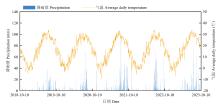
图1
2018—2023年气温和降水量"
表1
试验田土壤基础肥力"
| 处理 Treatment | 有机质 Organic matter (g·kg-1) | 全氮 Total N (g·kg-1) | 全磷 Total P (g·kg-1) | 全钾 Total K (g·kg-1) | 速效磷 Available P (mg·kg-1) | 速效钾 Available K (mg·kg-1) | 硝态氮 NO3--N (mg·kg-1) | 铵态氮 NH4+-N (mg·kg-1) | pH |
|---|---|---|---|---|---|---|---|---|---|
| 传统水氮TP | 22.07 | 1.04 | 1.99 | 7.02 | 15.52 | 340.08 | 16.17 | 12.57 | 6.78 |
| 氮肥优化OF | 22.37 | 0.96 | 1.97 | 6.76 | 16.02 | 342.12 | 14.72 | 13.19 | 6.76 |
| 水氮优化OWF | 21.88 | 0.96 | 2.01 | 6.58 | 14.81 | 343.70 | 14.36 | 13.56 | 6.83 |
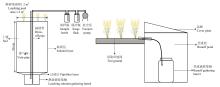
图2
试验田淋溶水和径流水收集装置示意图"
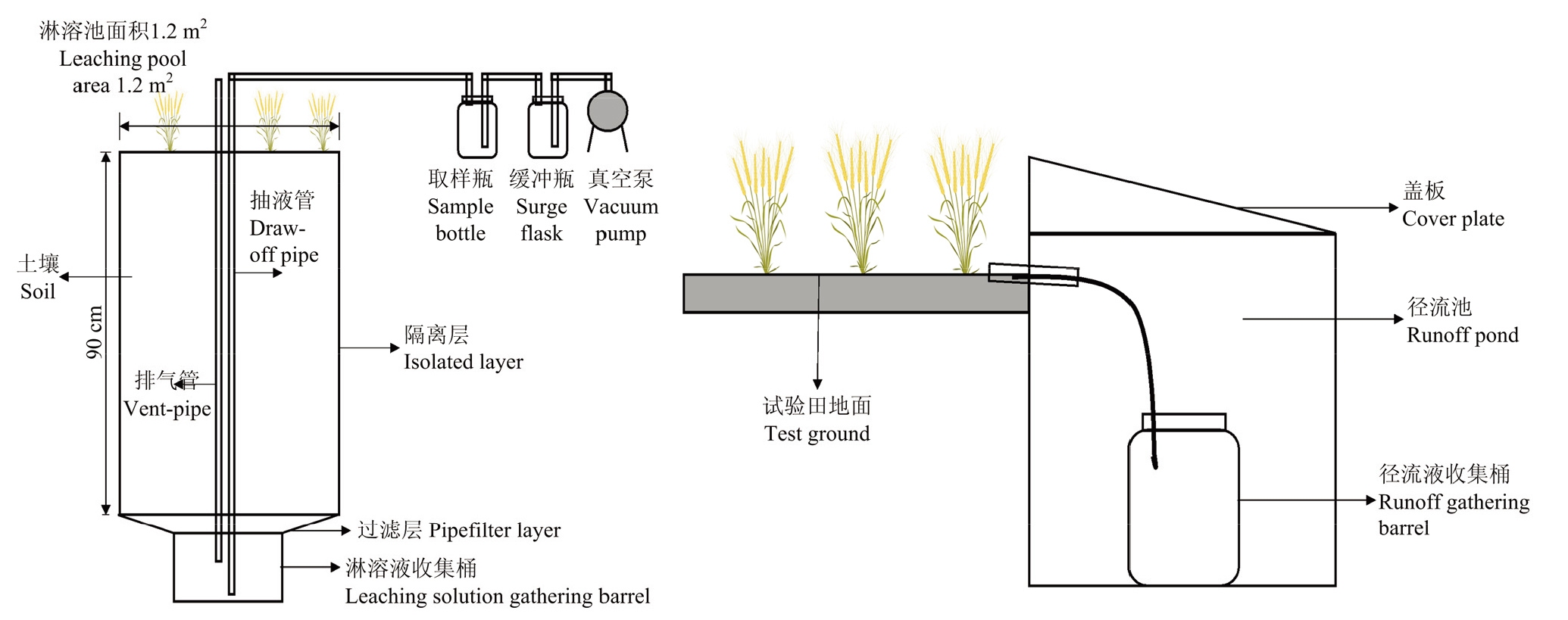
表2
周年施肥方案"
| 种植季 Crop season | 处理 Treatment | 化肥 Fertilizer (kg·hm-2) | ||
|---|---|---|---|---|
| N | P2O5 | K2O | ||
| 小麦 Wheat | TP | 246.0 | 132.0 | 30.0 |
| OF | 184.5 | 99.0 | 22.5 | |
| OWF | 184.5 | 99.0 | 22.5 | |
| 玉米 Maize | TP | 306.0 | 36.0 | 36.0 |
| OF | 229.5 | 27.0 | 27.0 | |
| OWF | 229.5 | 27.0 | 27.0 | |
| 周年 Annual | TP | 552.0 | 168.0 | 66.0 |
| OF | 414.0 | 126.0 | 49.5 | |
| OWF | 414.0 | 126.0 | 49.5 | |
图3
不同水氮处理小麦、玉米和周年产量(a)、地上部生物量(b)、籽粒氮吸收量(c)和地上部氮吸收量(d) 每个数据为平均值±标准差(n=3)。不同小写字母表示不同处理间在0.05水平上差异显著。TP:当地农民的常规做法,年施氮量552.0 kg·hm-2、灌水量270.0 mm;OF:氮肥优化,施氮414.0 kg·hm-2、灌水量270.0 mm;OWF:水氮优化,年施氮量414.0 kg·hm-2、灌水量202.5 mm。下同"

表3
不同水氮处理小麦、玉米和周年产量的方差分析"
| 作物产量 Crop yield | |||
|---|---|---|---|
| 小麦 Wheat | 玉米 Maize | ||
| 年份 Year (Y) | *** | *** | |
| 处理 Treatment (T) | ns | ns | |
| Y×T | ns | ns | |
表4
不同水氮处理小麦和玉米的氮收获指数(NHI)、氮肥偏生产力(NPFP)和氮素利用效率(NUPE)"
| 年份 Years | 处理 Treatment | 氮收获指数 NHI (%) | 氮肥偏生产力 NPFP (kg·kg-1) | 氮素吸收效率 NUPE (kg·kg-1) | ||||||
|---|---|---|---|---|---|---|---|---|---|---|
| 小麦 Wheat | 玉米 Maize | 周年 Annual | 小麦 Wheat | 玉米 Maize | 周年 Annual | 小麦 Wheat | 玉米 Maize | 周年 Annual | ||
| 2018-2019 | TP | 74.14±3.18 a | 69.34±1.34 a | 72.13±1.74 a | 36.55±1.24 b | 65.25±1.56 b | 48.37±0.14 b | 0.96±0.03 b | 0.96±0.06 b | 0.96±0.04 b |
| OF | 73.90±1.70 a | 70.98±0.21 a | 72.70±0.99 a | 48.56±1.97 a | 86.47±1.95 a | 64.17±1.13 a | 1.29±0.044 a | 1.24±0.06 a | 1.27±0.01 a | |
| OWF | 73.42±0.60 a | 70.17±1.69 a | 72.11±0.52 a | 48.11±1.88 a | 87.33±2.90 a | 64.26±0.93 a | 1.27±0.07a | 1.25±0.08 a | 1.26±0.06 a | |
| 2019-2020 | TP | 73.33±1.39 a | 58.05±0.34 a | 71.86±0.66 a | 40.25±1.40 b | 62.35±2.276 b | 49.35±0.84 b | 1.16±0.11 b | 1.35±0.08 b | 1.24±0.05 b |
| OF | 74.95±1.64 a | 57.62±0.68 a | 73.47±1.00 a | 53.36±1.26 a | 80.79±2.02 a | 64.66±1.50a | 1.53±0.169 a | 1.73±0.11 a | 1.61±0.11 a | |
| OWF | 74.60±0.73 a | 60.67±1.53 a | 72.98±0.61 a | 52.61±1.34 a | 83.41±1.22a | 65.29±0.84 a | 1.53±0.12 a | 1.77±0.04 a | 1.63±0.07 a | |
| 2020-2021 | TP | 77.11±0.26 a | 75.45±1.17a | 76.59±0.25 a | 39.18±1.36 b | 37.38±1.11 b | 38.43±1.17 b | 0.90±0.066 b | 0.57±0.027 b | 0.76±0.04 b |
| OF | 76.55±1.50 a | 74.95±1.07 a | 76.06±1.23 a | 52.97±0.74 a | 47.82±2.05 a | 50.85±0.67a | 1.22±0.043 a | 0.73±0.02 a | 1.02±0.02 a | |
| OWF | 75.68±2.19 a | 75.42±1.47 a | 75.61±1.70 a | 52.83±1.59 a | 49.40±0.89 a | 51.42±1.21 a | 1.21±0.09 a | 0.70±0.02 a | 1.00±0.06 a | |
| 2021-2022 | TP | 80.76±0.37 a | 56.12±1.73 a | 68.22±1.03 a | 45.58±2.64 b | 57.24±3.90 b | 50.38±3.15 b | 0.88±0.06 b | 1.30±0.08 b | 1.05±0.06 b |
| OF | 78.92±0.27 a | 58.45±1.81 a | 68.04±0.68 a | 55.98±3.69 a | 74.56±4.38 a | 63.63±3.76a | 1.00±0.04 a | 1.65±0.20 a | 1.27±1.00 a | |
| OWF | 80.54±1.64 a | 58.00±1.98 a | 68.68±0.76 a | 57.87±3.75 a | 73.18±1.087 a | 64.18±2.6 a | 1.03±0.04 a | 1.63±0.07 a | 1.27±0.04 a | |
| 2022-2023 | TP | 74.90±0.16 a | 63.99±3.92 a | 69.37±1.93 a | 38.33±2.75 b | 61.70±0.65 b | 47.95±1.40 b | 0.75±0.05 b | 1.11±0.07 b | 0.89±0.05 b |
| OF | 74.22±3.25 a | 63.54±0.61 a | 68.98±2.08 a | 49.01±1.82 a | 80.40±2.63 a | 61.94±2.08 a | 0.97±0.04 a | 1.36±0.08 a | 1.13±0.02 a | |
| OWF | 75.03±1.71 a | 65.91±3.42 a | 70.42±1.59 a | 48.53±1.23 a | 83.54±0.67 a | 62.95±0.94 a | 0.96±0.01 a | 1.39±0.04 a | 1.14±0.02 a | |
| 方差分析 ANOVA | ||||||||||
| 年份 Year (Y) | *** | *** | *** | *** | *** | *** | *** | *** | *** | |
| 处理 Treatment (T) | ns | ns | ns | *** | *** | *** | *** | *** | *** | |
| Y×T | ns | ns | ns | ns | ns | ns | ns | ns | ns | |
图4
作物产量、地上部生物量、籽粒和地上部氮积累量、氮收获指数、氮肥偏生产力、氮素吸收效率间的相关性"
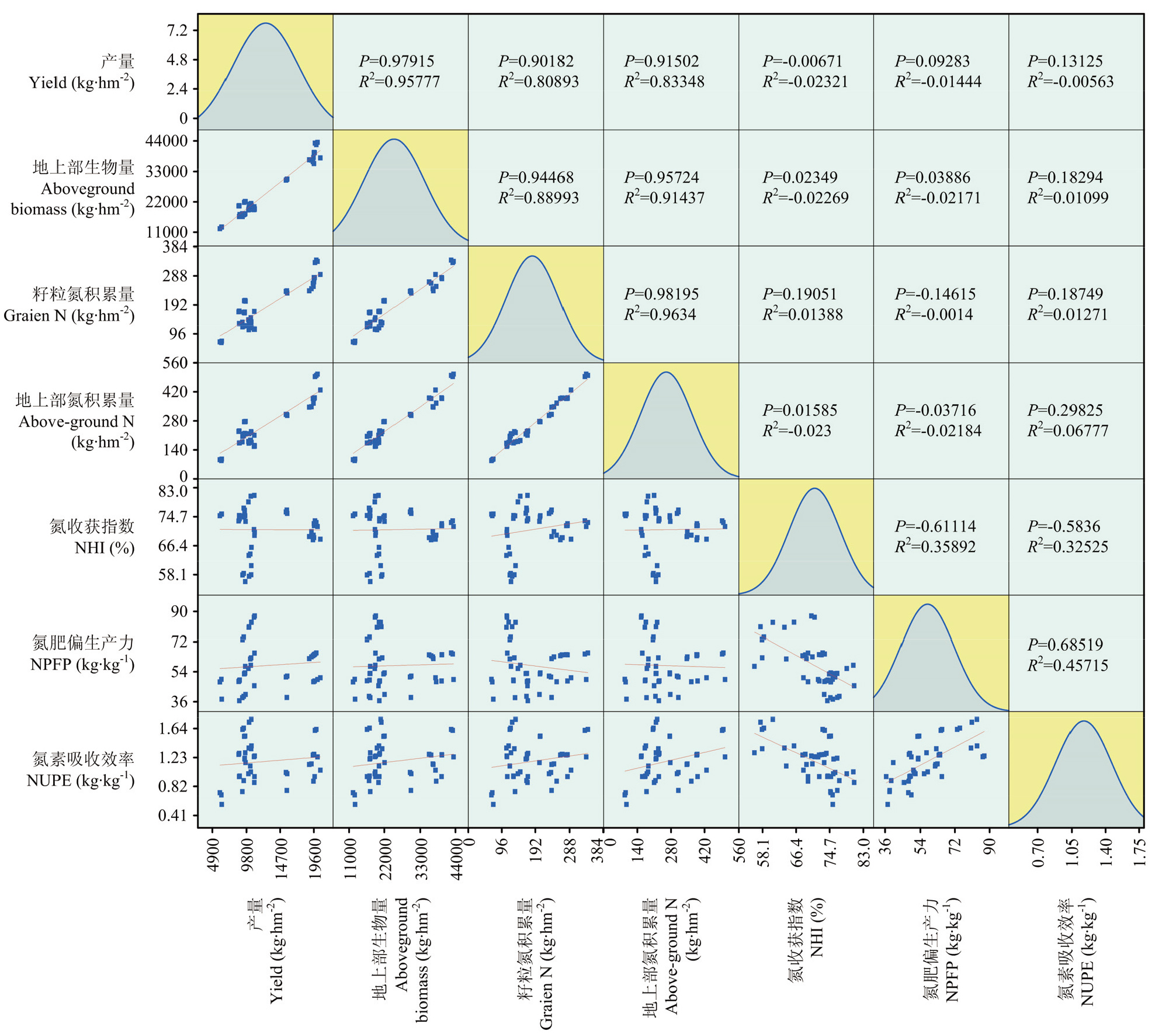
图5
不同水氮处理的土壤水分迁移动态 自上而下的颜色映射图分别代表TP、OF、OWF处理2个周年麦玉轮作系统不同生育时期的土壤干基含水量动态变化;图中颜色从蓝到红色代表土壤含水量数值升高。横坐标字母组合代表麦玉轮作体系不同生育时期,W-RS:小麦返青期、W-JS:小麦拔节期、W-FS:小麦开花期、W-F15:小麦花后15天、W-MS:小麦成熟期、M-GS:玉米灌浆期、M-MS:玉米成熟期。下同"
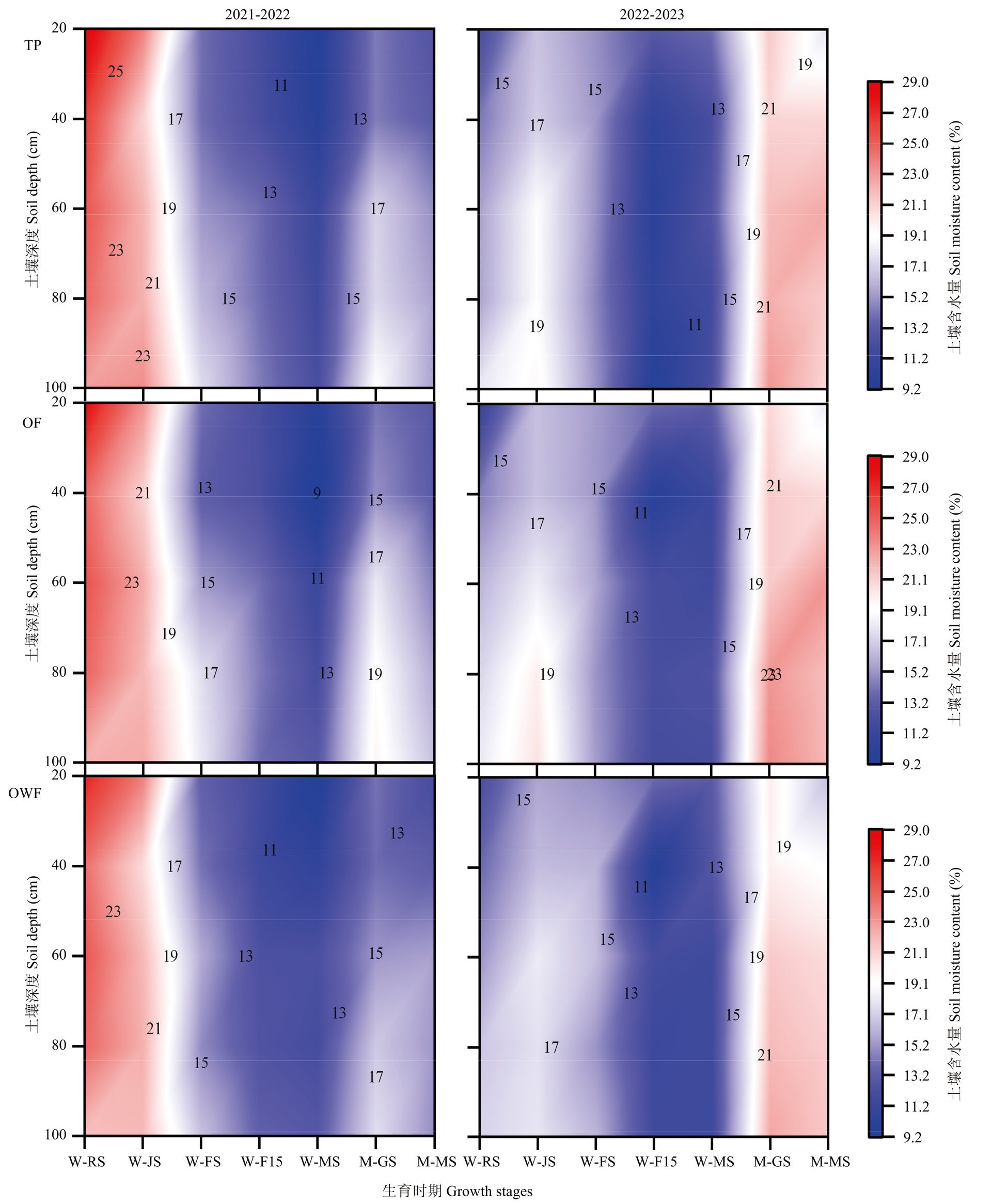
图6
不同水氮处理的土壤硝态氮迁移动态"
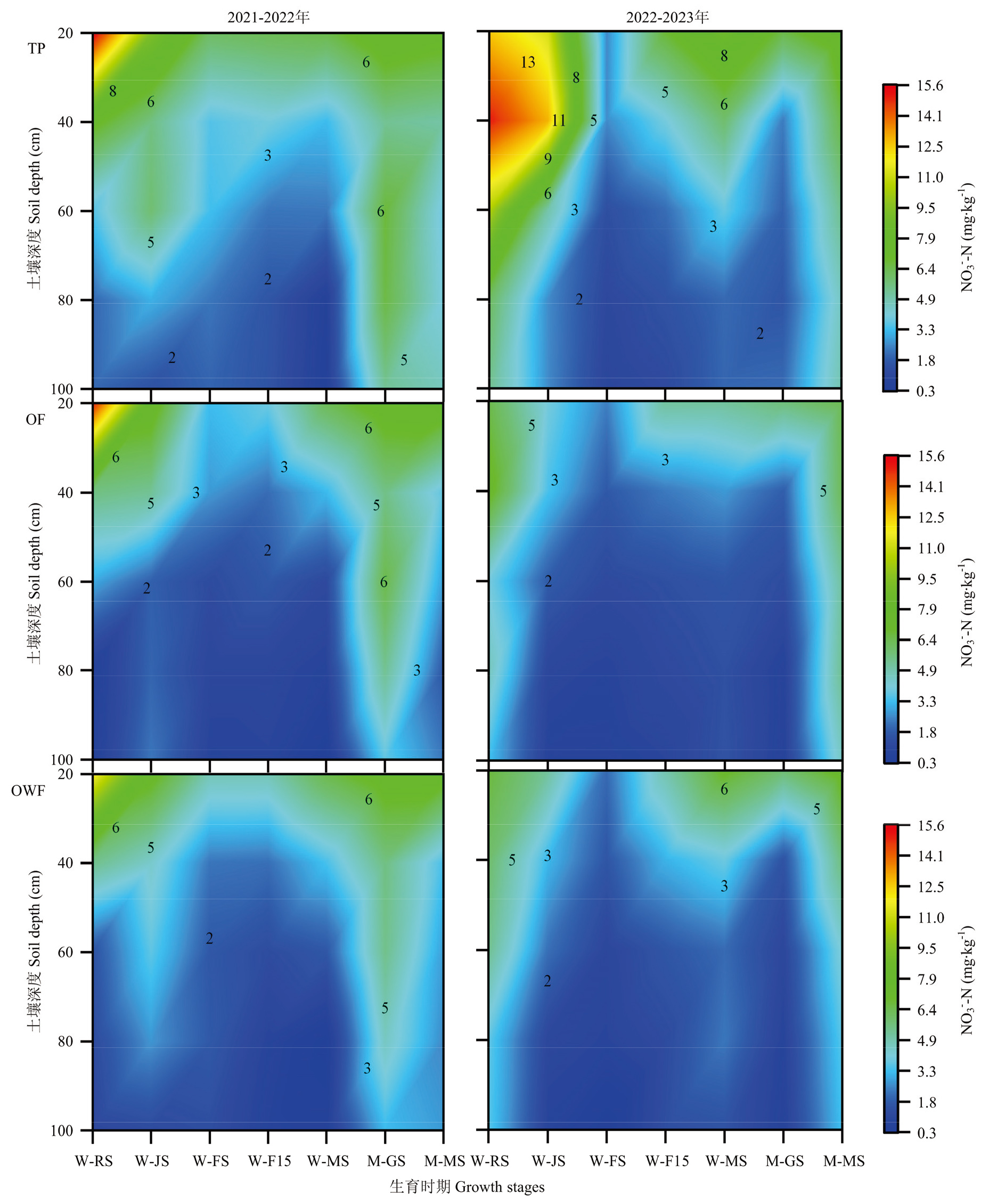
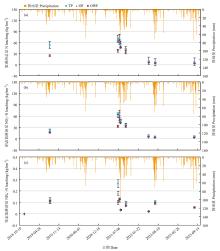
图7
不同水氮处理的氮淋溶总量、硝态氮淋溶量和铵态氮淋溶量"

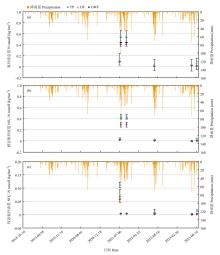
图8
不同水氮处理的氮径流总量、硝态氮径流量、铵态氮径流量"
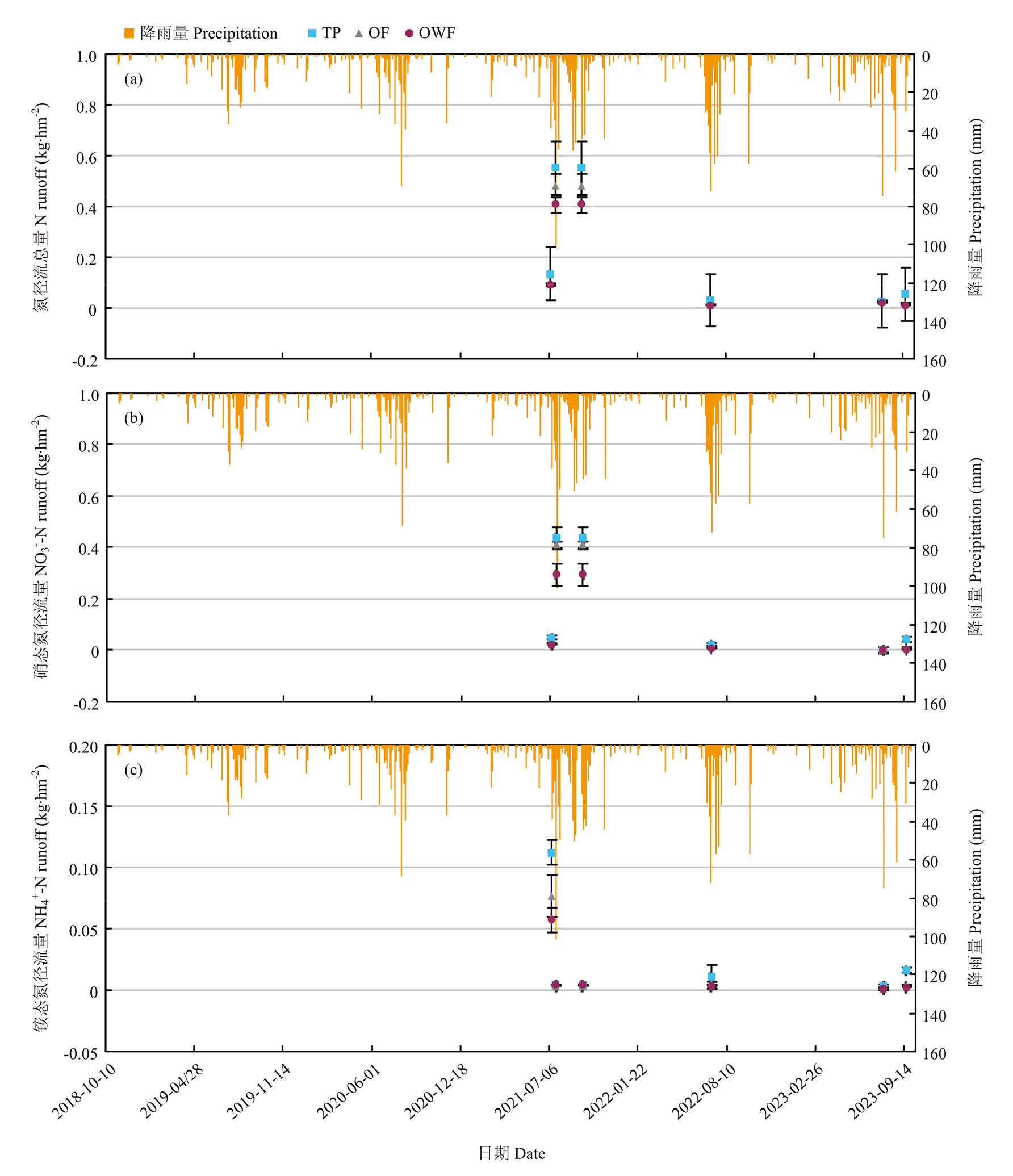
表5
不同水氮处理小麦和玉米季的年平均氮淋溶量、氮径流量和氮流失量"
| 年份 Year | 处理 Treatment | 淋溶 N leaching (kg·hm-2) | 径流 N runoff (kg·hm-2) | 年平均流失量 N annual loss (kg·hm-2) |
|---|---|---|---|---|
| 2018-2019 | TP | 24.20±0.26 a | 0 | 24.20±0.26 a |
| OF | 18.32±0.75 b | 0 | 18.32±0.75 b | |
| OWF | 16.38±1.40 b | 0 | 16.38±1.40 b | |
| 2019-2020 | TP | 0 | 0 | 0 |
| OF | 0 | 0 | 0 | |
| OWF | 0 | 0 | 0 | |
| 2020-2021 | TP | 218.13±15.17 a | 0.61±0.07 a | 218.75±15.24 a |
| OF | 197.26±19.01 ab | 0.54±0.02 ab | 197.80±19.03 ab | |
| OWF | 170.78±17.97 b | 0.45±0.07 b | 171.23±18.03 b | |
| 2021-2022 | TP | 15.40±2.07 a | 0.03±0.01 a | 15.43±2.08 a |
| OF | 9.67±1.77 b | 0.02±0.00 ab | 9.68±1.77 b | |
| OWF | 8.08±1.16 b | 0.01±0.00 b | 8.09±1.17 b | |
| 2022-2023 | TP | 6.79±0.50 a | 0.04±0.01 a | 6.83±0.51a |
| OF | 3.84±0.64 b | 0.01±0.00 b | 3.85±0.64 b | |
| OWF | 2.84±0.31 b | 0.00±0.00 b | 2.84±0.31 b | |
| 周年平均 Annual average | TP | 45.58±3.13 a | 0.14±0.02 a | 45.71±3.15 a |
| OF | 38.41±3.81 b | 0.11±0.01 ab | 38.52±3.82 b | |
| OWF | 31.84±3.81 c | 0.09±0.01 b | 31.94±3.82 c | |
| 方差分析 ANOVA | ||||
| 年份 Year (Y) | *** | *** | *** | |
| 处理 Treatment (T) | *** | *** | *** | |
| Y×T | *** | *** | *** | |
表6
不同水氮处理的周年氮平衡"
| 年份 Year | 处理 Treatment | 氮输入 N input (kg·hm-2) | 氮输出 N output (kg·hm-2) | 氮素表观 盈余量 N balance (kg·hm-2) | 氮素表观 盈亏率 N balance (%) | |||||
|---|---|---|---|---|---|---|---|---|---|---|
| 施氮 Nitrogen | 种子 Seeds | 灌水 Irrigation | 降雨 Rainfall | 作物吸收氮 Crop absorb | 淋溶 Leaching | 径流 Runoff | ||||
| 2018-2019 | TP | 552.00 | 14.30 | 8.31 | 14.69 | 391.08 | 24.20 | 0.00 | 174.02 | 41.90 |
| OF | 414.00 | 14.30 | 8.31 | 14.69 | 388.27 | 18.32 | 0.00 | 44.71 | 11.00 | |
| OWF | 414.00 | 14.30 | 6.24 | 14.69 | 386.80 | 16.38 | 0.00 | 46.05 | 11.42 | |
| 2019-2020 | TP | 552.00 | 14.30 | 6.22 | 7.37 | 505.11 | 0.00 | 0.00 | 74.78 | 14.80 |
| OF | 414.00 | 14.30 | 6.22 | 7.37 | 493.54 | 0.00 | 0.00 | -51.65 | -10.46 | |
| OWF | 414.00 | 14.30 | 4.66 | 7.37 | 498.24 | 0.00 | 0.00 | -57.91 | -11.62 | |
| 2020-2021 | TP | 552.00 | 14.30 | 5.55 | 25.79 | 311.28 | 218.13 | 0.61 | 67.62 | 12.76 |
| OF | 414.00 | 14.30 | 5.55 | 25.79 | 311.30 | 197.26 | 0.54 | -49.46 | -9.72 | |
| OWF | 414.00 | 14.30 | 4.16 | 25.79 | 305.36 | 170.78 | 0.45 | -18.34 | -3.85 | |
| 2021-2022 | TP | 552.00 | 14.30 | 6.79 | 15.50 | 428.22 | 15.40 | 0.03 | 144.94 | 32.67 |
| OF | 414.00 | 14.30 | 6.79 | 15.50 | 387.25 | 9.67 | 0.02 | 53.66 | 13.52 | |
| OWF | 414.00 | 14.30 | 5.09 | 15.50 | 389.84 | 8.08 | 0.01 | 50.96 | 12.81 | |
| 2022-2023 | TP | 552.00 | 14.30 | 3.77 | 23.00 | 365.07 | 6.79 | 0.04 | 221.18 | 59.47 |
| OF | 414.00 | 14.30 | 3.77 | 23.00 | 345.91 | 3.84 | 0.01 | 105.31 | 30.11 | |
| OWF | 414.00 | 14.30 | 2.83 | 23.00 | 348.15 | 2.84 | 0.00 | 103.14 | 29.38 | |
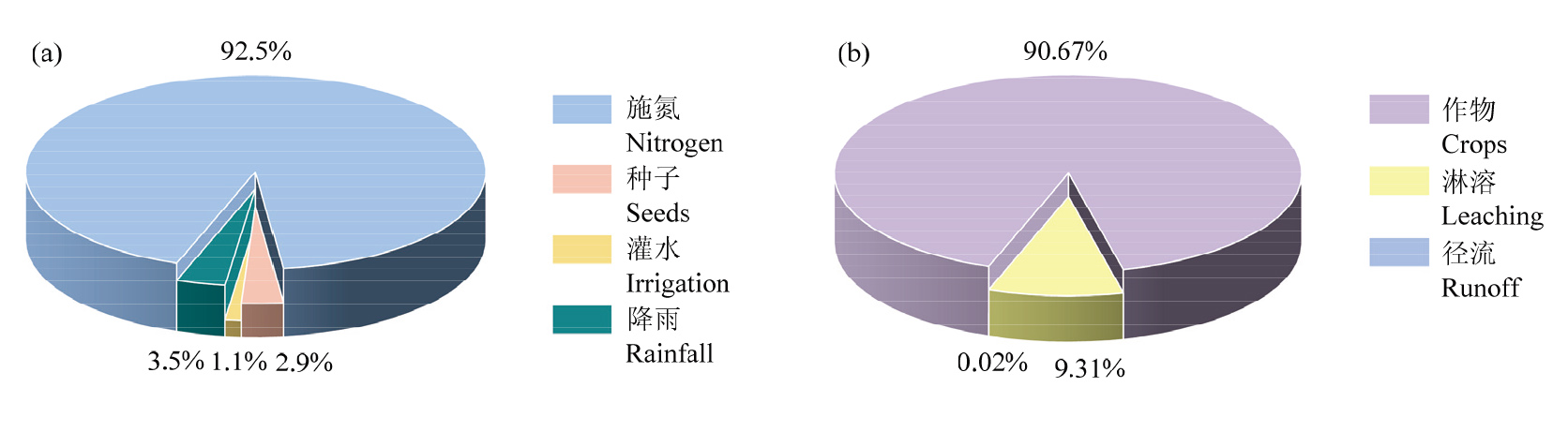
| 年平均 Annual | TP | 552.00 | 14.30 | 6.13 | 17.27 | 400.15 | 52.90 | 0.14 | 136.51 | 30.12 |
| OF | 414.00 | 14.30 | 6.13 | 17.27 | 385.25 | 45.82 | 0.11 | 20.51 | 4.76 | |
| OWF | 414.00 | 14.30 | 6.13 | 17.27 | 385.68 | 39.62 | 0.09 | 24.78 | 6.19 | |
| 方差分析 ANOVA | ||||||||||
| 年份 Year (Y) | *** | *** | *** | *** | *** | |||||
| 处理 Treatment (T) | ns | *** | *** | *** | *** | |||||
| Y×T | *** | *** | *** | *** | *** | |||||
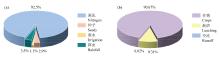
图9
不同水氮处理的周年氮输入量(a)和输出量(b)"
| [1] |
河南省统计局. 2024河南统计年鉴. 北京: 中国统计出版社, 2024.
|
|
Henan Provincial Bureau of Statistics. Henan Statistical Yearbook 2024. Beijing: China Statistics Press, 2024. (in Chinese)
|
|
| [2] |
|
| [3] |
李红, 王西娜, 韦广源, 马永鑫, 田海梅, 王月梅, 钱芝瑾, 谭军利. 节水减氮对宁夏引黄灌区春小麦抗倒伏特性及产量的影响. 中国农业科学, 2024, 57(17): 3424-3439. doi: 10.3864/j.issn.0578-1752.2024.17.009.
|
|
|
|
| [4] |
|
| [5] |
|
| [6] |
|
| [7] |
|
| [8] |
邓浩亮, 潘小番, 兰雪梅, 王勤礼, 肖让, 滕安国, 雷联. 水氮互作对河西绿洲灌区玉豆带状复合种植玉米产量及水氮利用效率的影响. 玉米科学, 2024, 32(7): 73-82.
|
|
|
|
| [9] |
|
| [10] |
李若楠, 武雪萍, 张彦才, 王丽英, 陈丽莉, 翟凤芝. 节水减氮对温室土壤硝态氮与氮素平衡的影响. 中国农业科学, 2016, 49(4): 695-704. doi: 10.3864/j.issn.0578-1752.2016.04.009..
|
|
|
|
| [11] |
赵政鑫, 王晓云, 李府阳, 王锐, 田雅洁, 蔡焕杰. 秸秆还田配施稳定性氮肥对麦玉轮作水氮利用的影响. 农业机械学报, 2023, 54(6): 350-360.
|
|
|
|
| [12] |
张殿凯, 李盼, 范虹, 何蔚, 樊志龙, 胡发龙, 孙亚丽, 谭向念, 殷文, 陈桂平. 西北灌区复种绿肥及减氮条件下春小麦产量及水分利用特征. 中国农业科学, 2024, 57(11): 2189-2201. doi: 10.3864/j.issn.0578-1752.2024.11.011.
|
|
|
|
| [13] |
杨楠, 段琳博, 马静, 蔡焕杰, 彭雄标, 王晓云, 李亮, 张蓬妍, 徐家屯. 基于Hydrus-1D模型的灌区农田土壤水分渗漏和硝态氮淋失特征研究. 干旱地区农业研究, 2023, 41(5): 32-42.
|
|
|
|
| [14] |
|
| [15] |
王晓英, 贺明荣, 刘永环, 张洪华, 李飞, 华芳霞, 孟淑华. 水氮耦合对冬小麦氮肥吸收及土壤硝态氮残留淋溶的影响. 生态学报, 2008, 28(2): 685-694.
|
|
|
|
| [16] |
张皖玉, 张志勇, 张潇斌, 韦一昊, 熊淑萍, 王小纯, 马新明. 不同施氮量对小麦-玉米轮作体系氮素利用的影响. 河南农业大学学报, 2024, 58(4): 562-572.
|
|
|
|
| [17] |
雒文鹤, 师祖姣, 王旭敏, 李军, 王瑞. 节水减氮对土壤硝态氮分布和冬小麦水氮利用效率的影响. 作物学报, 2020, 46(6): 924-936.
|
|
|
|
| [18] |
杜文婷, 雷肖肖, 卢慧宇, 王云凤, 徐佳星, 罗彩霞, 张树兰. 氮肥减量施用对我国三大粮食作物产量的影响. 中国农业科学, 2022, 55(24): 4863-4878. doi: 10.3864/j.issn.0578-1752.2022.24.007.
|
|
|
|
| [19] |
马伯威, 王红光, 李东晓, 李瑞奇, 李雁鸣. 水氮运筹模式对冬小麦产量和水氮生产效率的影响. 麦类作物学报, 2015, 35(8): 1141-1147.
|
|
|
|
| [20] |
|
| [21] |
吕凤莲, 侯苗苗, 张弘弢, 强久次仁, 周应田, 路国艳, 赵秉强, 杨学云, 张树兰. 塿土冬小麦-夏玉米轮作体系有机肥替代化肥比例研究. 植物营养与肥料学报, 2018, 24(1): 22-32.
|
|
|
|
| [22] |
张敏, 刘添, 李亚静, 李翠平, 郭振清, 贾秀领, 杨敏, 秦保平, 安浩军, 蔡瑞国. 减少灌水次数对强筋小麦氮素积累转运和籽粒蛋白质含量的影响. 麦类作物学报, 2019, 39(7): 802-809.
|
|
|
|
| [23] |
姜春霞, 刘化涛, 张伟, 杨柯, 张冬梅, 翟广谦, 王娟玲, 刘恩科. 减量施氮对鲜食玉米产量、氮素利用及土壤硝态氮含量的影响. 中国土壤与肥料, 2022, 59(12): 61-67.
|
|
|
|
| [24] |
|
| [25] |
|
| [26] |
|
| [27] |
|
| [28] |
|
| [29] |
谭德水, 江丽华, 谭淑樱, 徐钰, 郑福丽, 李国生, 刘兆辉. 湖区小麦-玉米轮作模式下不同施肥措施调控氮磷养分流失研究. 土壤学报, 2015, 52(1): 128-137.
|
|
|
|
| [30] |
刘瀚文, 栾好安, 张亦涛, 习斌, 董奎军, 王伟军. 旱地农田氮磷淋溶发生特征研究进展. 中国生态农业学报(中英文), 2024, 32(9): 1520-1533.
|
|
|
|
| [31] |
王宇豪, 王敬宽, 杜海岩, 季晓辉, 柳新伟. 冬闲盐碱地绿肥种植对淡水淋盐土壤及淋溶液碳氮影响. 华北农学报, 2024, 39(1): 143-149.
|
|
|
|
| [32] |
|
| [33] |
|
| [34] |
|
| [1] | 陈桂平, 韦金贵, 郭瑶, 李盼, 王菲儿, 仇海龙, 冯福学, 殷文. 宽窄行与增密对绿洲灌区玉米光合特性及资源利用的协同效应[J]. 中国农业科学, 2026, 59(2): 278-291. |
| [2] | 蔡廷阳, 朱玉鹏, 李瑞东, 吴宗声, 徐一帆, 宋雯雯, 徐彩龙, 吴存祥. 苗期叶损伤对黄淮海夏大豆光合特性、荚果分布及产量形成的影响[J]. 中国农业科学, 2026, 59(2): 292-304. |
| [3] | 吕旭东, 孙世媛, 李亚楠, 刘玉龙, 王艳群, 付鑫, 张佳英, 宁鹏, 彭正萍. 智能机械化分层施肥对麦田根-土养分分布和小麦产量的影响[J]. 中国农业科学, 2026, 59(1): 129-146. |
| [4] | 陆浩, 张明龙, 韩梅, 严清彪, 李正鹏, 殷文, 樊志龙, 胡发龙, 柴强. 绿肥过腹还田协同氮肥减施提高小麦产量和土壤质量[J]. 中国农业科学, 2026, 59(1): 147-160. |
| [5] | 叶美金, 陈家婷, 周界光, 尹丽, 胡欣荣, 兰雨昕, 陈斌, 苏龙兴, 刘家君, 刘天超, 李小雨, 马建. 小麦穗密度主效QTL的鉴定、验证及其遗传效应分析[J]. 中国农业科学, 2026, 59(1): 17-28. |
| [6] | 董桂春, 王子涵, 王树深, 李杰, 霍晓晴, 杨瑞, 周娟, 舒小伟, 李妍, 曹靓婧, 王子瑞, 姚友礼, 黄建晔. 硫包衣缓释肥提升水稻产量及氮肥利用率的技术途径[J]. 中国农业科学, 2026, 59(1): 57-77. |
| [7] | 李云丽, 刁邓超, 刘雅睿, 孙玉晨, 孟祥宇, 邬陈芳, 汪妤, 吴建辉, 李春莲, 曾庆东, 韩德俊, 郑炜君. 小麦苗期耐热性全基因组关联分析[J]. 中国农业科学, 2025, 58(9): 1663-1683. |
| [8] | 蒲丽霞, 张佳芮, 叶建萍, 黄秀兰, 樊高琼, 杨洪坤. 二氢赤霉素与秸秆覆盖对旱地小麦分蘖成穗与产量的影响[J]. 中国农业科学, 2025, 58(9): 1735-1748. |
| [9] | 郭晨荔, 刘扬, 陈燕, 胡伟, 王友华, 周治国, 赵文青. 减氮条件下适当磷肥后移对滴灌棉花产量和磷肥利用效率的影响[J]. 中国农业科学, 2025, 58(9): 1749-1766. |
| [10] | 刘劲松, 伍龙梅, 包晓哲, 刘志霞, 张彬, 杨陶陶. 短期减施氮肥对华南地区早晚兼用型水稻产量和稻米品质的影响[J]. 中国农业科学, 2025, 58(8): 1508-1520. |
| [11] | 韦文华, 李盼, 邵冠贵, 樊志龙, 胡发龙, 范虹, 何蔚, 柴强, 殷文, 赵连豪. 西北灌区青贮玉米产量及品质对减量灌水与有机无机肥配施的响应[J]. 中国农业科学, 2025, 58(8): 1521-1534. |
| [12] | 薛钰琦, 赵继玉, 孙旺胜, 任佰朝, 赵斌, 刘鹏, 张吉旺. 不同氮素形态对夏玉米产量和品质的影响[J]. 中国农业科学, 2025, 58(8): 1535-1549. |
| [13] | 李绍兴, 宋稳锋, 魏泽煜, 周玉玲, 宋李霞, 任可, 马群, 王龙昌. 秸秆与紫云英覆盖对土壤肥力及甘薯产量的影响[J]. 中国农业科学, 2025, 58(8): 1591-1603. |
| [14] | 吴郁, 曲翔汝, 杨丹, 伍芩, 陈国跃, 江千涛, 魏育明, 许强. 广泛非靶向代谢组学解析小麦抗条锈病反应中叶绿体代谢产物[J]. 中国农业科学, 2025, 58(7): 1333-1343. |
| [15] | 王彬, 吴朋浩, 鲁剑巍, 任涛, 丛日环, 陆志峰, 李小坤. 长江中游地区水稻-油菜轮作体系需水特征[J]. 中国农业科学, 2025, 58(7): 1355-1365. |
|
||
