






中国农业科学 ›› 2026, Vol. 59 ›› Issue (8): 1608-1621.doi: 10.3864/j.issn.0578-1752.2026.08.002
王小玮1,2( ), 杜佛力1,2, 闫红财1,2, 郎正东1,2, 党志娟1,2, 李葆春2,3, 汪军成1,2, 马小乐1,2, 王化俊1,2, 张宏1,2, 姚立蓉1,2()
收稿日期:2025-11-04
接受日期:2025-12-15
出版日期:2026-04-21
发布日期:2026-04-21
通信作者:
联系方式:
王小玮,E-mail:1224019863@qq.com。
基金资助:
WANG XiaoWei1,2(), DU FoLi1,2, YAN HongCai1,2, LANG ZhengDong1,2, DANG ZhiJuan1,2, LI BaoChun2,3, WANG JunCheng1,2, MA XiaoLe1,2, WANG HuaJun1,2, ZHANG Hong1,2, YAO LiRong1,2()
Received:2025-11-04
Accepted:2025-12-15
Published:2026-04-21
Online:2026-04-21
摘要:
【目的】干旱是造成小麦减产的重要因素之一,培育强抗旱性小麦种质是当前小麦育种面临的重要挑战。春小麦在保障国家粮食安全方面发挥着至关重要的作用。明确春小麦种质的抗旱性,为春小麦抗旱基因挖掘及种质创新提供依据。【方法】以396份春小麦品种(系)作为供试材料,以正常灌水为对照,干旱胁迫处理下,测定春小麦的灌浆期叶片相对含水量、叶绿素含量、叶面积指数等4个指标,成熟期的株高、穗长、有效分蘖等8个指标,计算各指标的抗旱系数。运用描述性统计、主成分分析、隶属函数法、聚类分析和相关性分析对各春小麦品种(系)进行抗旱性综合评价。【结果】与正常灌水条件相比,干旱胁迫条件下灌浆期和成熟期各指标均降低,其中,小区产量、叶面积指数和生物量降幅较大,叶绿素含量、穗长和叶片相对含水量降幅较小。不同品种(系)的抗旱性存在显著差异。在干旱胁迫下,各相关指标的变异系数为6%—34%;而在正常灌水条件下,各指标的变异系数则为5%—34%。通过对灌浆期4个指标和成熟期8个指标的抗旱系数进行主成分分析,提取了6个主成分,其累计方差贡献率达78.07%。利用隶属函数值计算综合抗旱系数D值,并对D值进行聚类分析,将396份春小麦品种(系)分为5类,并对其进行组间方差分析,发现强抗旱春小麦种质的小区产量最高,且在干旱胁迫下的小区产量降幅最低。同时,对综合抗旱系数D值与12个指标的抗旱系数进行相关性分析,筛选出小穗数、生物量、旗叶面积与有效分蘖可作为春小麦抗旱性鉴定的有效综合评价指标。此外,相关性分析表明,正常灌水条件下,叶片相对含水量与株高、有效分蘖、小穗数、生物量、穗下茎长、小区产量呈极显著正相关,叶绿素含量与千粒重呈极显著正相关,旗叶面积与穗长、千粒重呈极显著正相关;干旱胁迫条件下,叶片相对含水量与生物量、小区产量、千粒重呈极显著正相关,叶面积指数与株高、有效分蘖、小穗数、生物量、穗下茎长、小区产量呈极显著正相关,旗叶面积与穗长、生物量呈极显著正相关,表明春小麦灌浆期的抗旱性指标与成熟期关键农艺指标存在紧密的联系。【结论】筛选出强抗旱春小麦种质20份,其在干旱胁迫下的产量最高且降幅最低,小穗数、生物量、旗叶面积、有效分蘖可作为春小麦抗旱性鉴定的有效综合评价指标。
王小玮, 杜佛力, 闫红财, 郎正东, 党志娟, 李葆春, 汪军成, 马小乐, 王化俊, 张宏, 姚立蓉. 396份春小麦灌浆期和成熟期抗旱性评价[J]. 中国农业科学, 2026, 59(8): 1608-1621.
WANG XiaoWei, DU FoLi, YAN HongCai, LANG ZhengDong, DANG ZhiJuan, LI BaoChun, WANG JunCheng, MA XiaoLe, WANG HuaJun, ZHANG Hong, YAO LiRong. Evaluation of Drought Resistance of 396 Spring Wheat Varieties at Grain Filling Stage and Maturity Stage[J]. Scientia Agricultura Sinica, 2026, 59(8): 1608-1621.

图1
试验地示意图及降雨量统计 A:试验地示意图;B:2024—2025年3—7月降雨量统计"

表1
396份春小麦品种(系)12个指标差异性分析"
| 处理 Treatment | 指标 Index | 最小值 Min | 最大值 Max | 平均值 Mean | 标准差 SD | 变异系数 CV (%) |
|---|---|---|---|---|---|---|
| 正常灌水 Normal irrigation | 叶片相对含水量RWC | 0.64 | 0.92 | 0.82 | 0.05 | 6 |
| 叶绿素含量SPAD | 45.50 | 64.40 | 56.66 | 2.90 | 5 | |
| 叶面积指数LAI | 1.50 | 4.74 | 2.97 | 0.52 | 18 | |
| 旗叶面积FLA (cm2) | 15.87 | 61.51 | 30.14 | 7.08 | 23 | |
| 株高PH (cm) | 54.33 | 118.67 | 79.26 | 7.29 | 9 | |
| 穗长SL (cm) | 7.43 | 12.50 | 9.89 | 0.91 | 9 | |
| 有效分蘖ETN | 1.33 | 6.33 | 3.30 | 0.75 | 23 | |
| 小穗数SN | 22.67 | 89.33 | 46.44 | 11.08 | 24 | |
| 生物量BM (g) | 5.33 | 45.33 | 17.79 | 6.07 | 34 | |
| 穗下茎长ILBS (cm) | 44.50 | 109.83 | 69.36 | 7.30 | 11 | |
| 小区产量PY (g) | 186.00 | 521.10 | 329.38 | 59.41 | 18 | |
| 千粒重TGW (g) | 32.40 | 57.40 | 46.70 | 3.90 | 8 | |
| 干旱胁迫 Drought stress | 叶片相对含水量RWC | 0.20 | 0.98 | 0.74 | 0.09 | 12 |
| 叶绿素含量SPAD | 47.70 | 65.80 | 56.09 | 3.10 | 6 | |
| 叶面积指数LAI | 0.34 | 3.31 | 1.35 | 0.44 | 33 | |
| 旗叶面积FLA (cm2) | 10.34 | 60.31 | 18.93 | 5.02 | 27 | |
| 株高PH (cm) | 44.67 | 83.67 | 65.05 | 6.41 | 10 | |
| 穗长SL (cm) | 6.67 | 12.10 | 9.20 | 0.92 | 10 | |
| 有效分蘖ETN | 1.00 | 4.00 | 2.63 | 0.62 | 24 | |
| 小穗数SN | 12.67 | 60.00 | 34.58 | 8.87 | 26 | |
| 生物量BM (g) | 2.67 | 22.33 | 9.53 | 3.21 | 34 | |
| 穗下茎长ILBS (cm) | 30.50 | 73.00 | 55.76 | 6.49 | 12 | |
| 小区产量PY (g) | 77.00 | 361.00 | 165.09 | 46.60 | 28 | |
| 千粒重TGW (g) | 22.40 | 49.80 | 36.30 | 4.53 | 12 |
表2
灌浆期指标的相关性分析"
| 处理 Treatment | 指标 Index | 叶片相对含水量 RWC | 叶绿素含量 SPAD | 叶面积指数 LAI |
|---|---|---|---|---|
| 正常灌水 Normal irrigation | 叶绿素含量SPAD | 0.09 | ||
| 叶面积指数LAI | -0.04 | -0.70** | ||
| 旗叶面积FLA | 0.17** | -0.13** | 0.25** | |
| 干旱胁迫 Drought stress | 叶绿素含量SPAD | 0.10* | ||
| 叶面积指数LAI | 0.21** | 0.08 | ||
| 旗叶面积FLA | 0.03 | 0.22** | 0.41** |
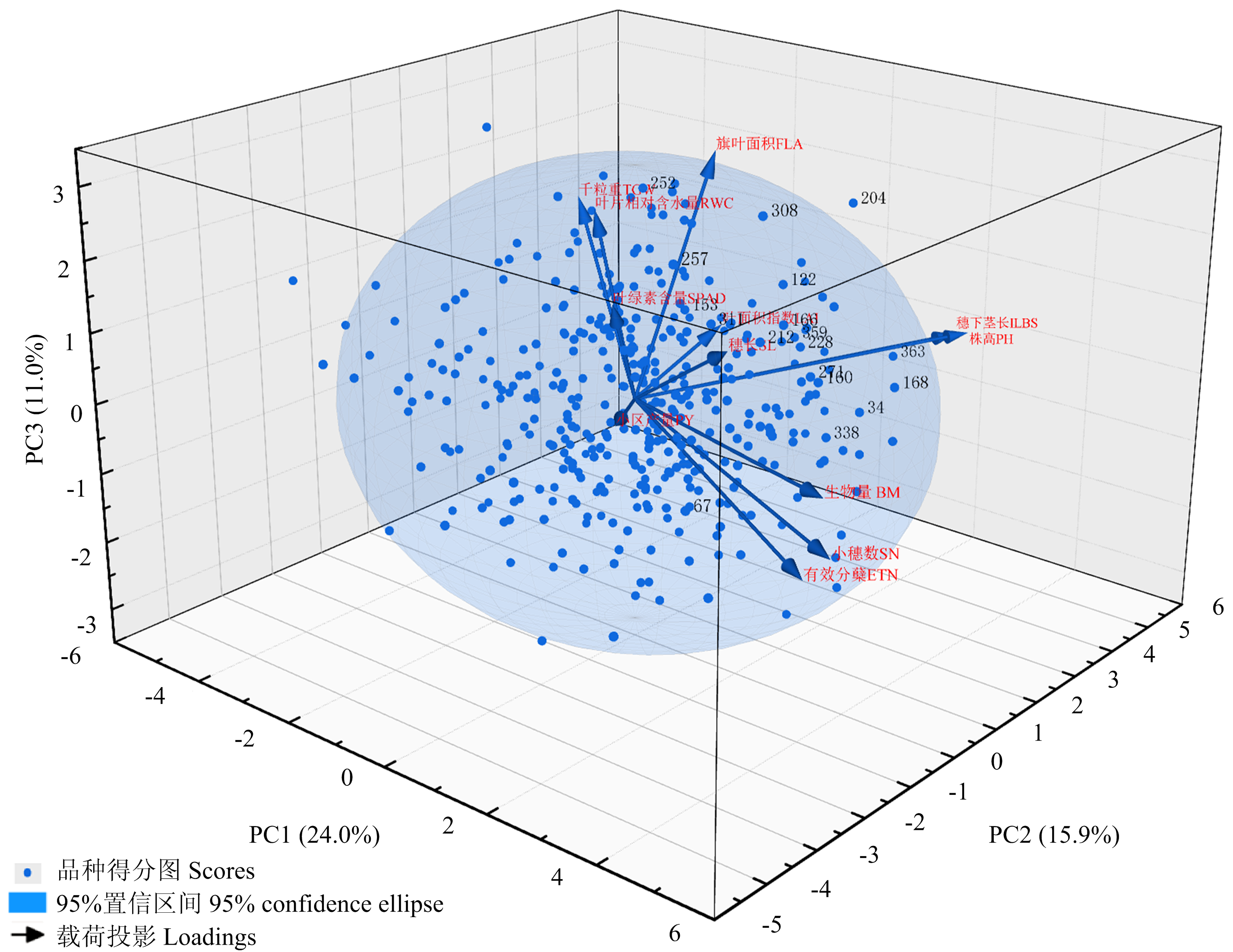
图2
春小麦抗旱系数主成分散点图"
表3
不同供水条件下春小麦各综合指标载荷系数及累计贡献率"
| 指标 Index | 因子载荷Factor loading | |||||
|---|---|---|---|---|---|---|
| PC1 | PC2 | PC3 | PC4 | PC5 | PC6 | |
| 叶片相对含水量RWC | -0.01 | -0.13 | 0.55 | -0.51 | -0.33 | -0.14 |
| 叶绿素含量SPAD | 0.06 | -0.15 | 0.32 | 0.38 | 0.71 | 0.19 |
| 叶面积指数LAI | 0.19 | 0.11 | 0.21 | 0.65 | -0.28 | 0.06 |
| 旗叶面积FLA | 0.17 | 0.11 | 0.68 | 0.31 | 0.21 | -0.03 |
| 株高PH | 0.43 | 0.87 | 0.01 | -0.10 | 0.05 | 0.04 |
| 穗长SL | 0.42 | -0.10 | 0.26 | 0.11 | -0.04 | -0.46 |
| 有效分蘖ETN | 0.85 | -0.29 | -0.16 | -0.05 | 0.07 | 0.08 |
| 小穗数SN | 0.91 | -0.26 | -0.10 | -0.04 | 0.08 | -0.01 |
| 生物量BM | 0.84 | -0.21 | 0.02 | -0.17 | -0.02 | -0.02 |
| 穗下茎长ILBS | 0.37 | 0.90 | -0.01 | -0.12 | 0.06 | 0.11 |
| 小区产量PY | 0.12 | -0.19 | 0.01 | 0.01 | -0.39 | 0.79 |
| 千粒重TGW | -0.14 | -0.05 | 0.54 | -0.43 | 0.37 | 0.26 |
| 方差贡献率Variance contribution rate (%) | 24.00 | 15.91 | 11.00 | 9.99 | 8.88 | 8.27 |
| 累计方差贡献率Cumulative variance contribution rate (%) | 24.00 | 39.91 | 50.91 | 60.91 | 69.80 | 78.07 |

图3
396份不同抗旱性春小麦品种(系)聚类图 Ⅰ:强抗旱群体;Ⅱ:抗旱群体;Ⅲ:弱抗旱群体;Ⅳ:干旱敏感群体;Ⅴ:干旱高敏感群体"
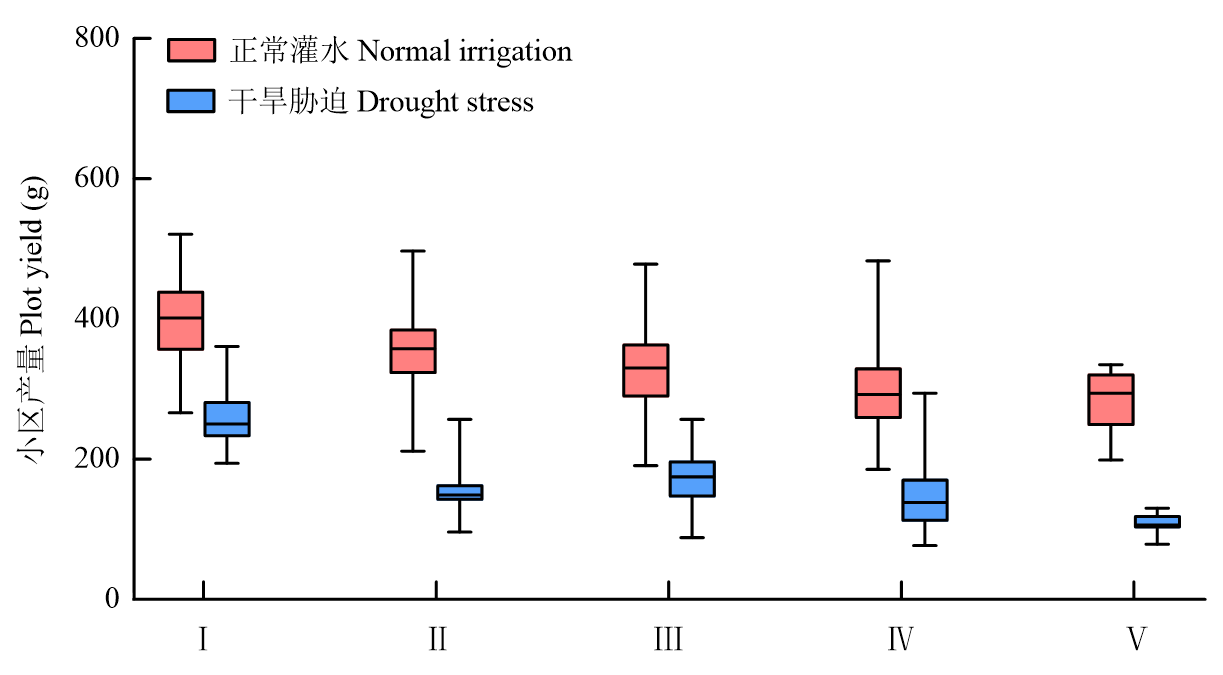
图4
春小麦不同抗旱等级小区产量的差异性分析"
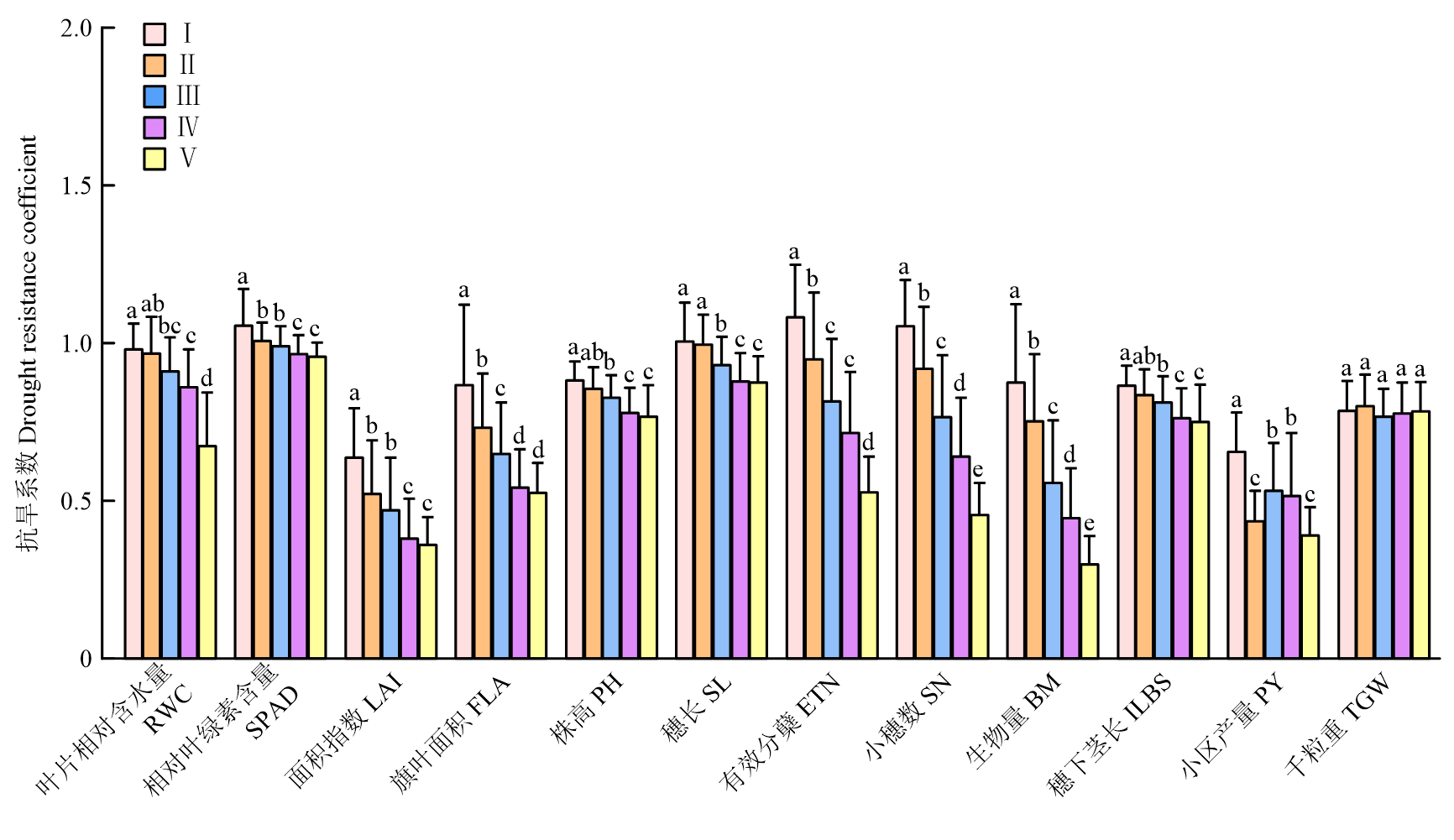
图5
不同抗旱类型春小麦种质各指标抗旱系数比较分析 不同小写字母表示同一测定指标在不同抗旱等级春小麦材料中差异显著(P<0.05)"
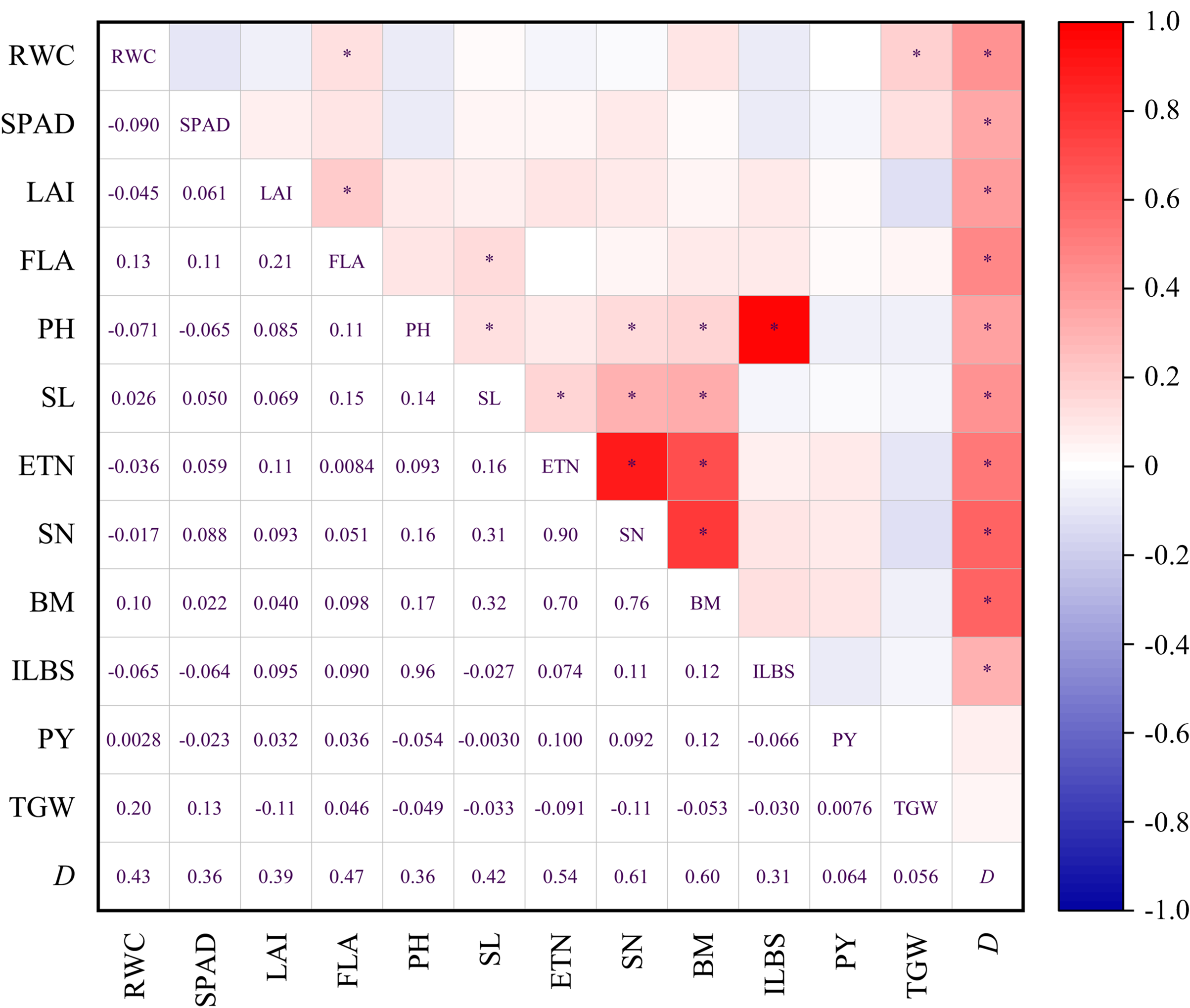
图6
春小麦各指标抗旱系数与综合抗旱系数D值的相关性分析"
表4
春小麦灌浆期指标与成熟期指标的相关性分析"
| 处理 Treatment | 指标 Index | 叶片相对含水量 RWC | 叶绿素含量 SPAD | 叶面积指数 LAI | 旗叶面积 FLA |
|---|---|---|---|---|---|
| 正常灌水 Normal irrigation | 株高PH | 0.15** | -0.10* | 0.12* | -0.05 |
| 穗长SL | -0.03 | 0.04 | 0.09 | 0.34** | |
| 有效分蘖ETN | 0.29** | 0.06 | -0.04 | -0.11* | |
| 小穗数SN | 0.28** | 0.10 | 0.01 | -0.02 | |
| 生物量BM | 0.46** | 0.11* | 0.07 | 0.11* | |
| 穗下茎长ILBS | 0.15** | -0.11* | 0.11* | -0.10 | |
| 小区产量PY | 0.14** | -0.11* | 0.02 | 0.06 | |
| 千粒重TGW | 0.12* | 0.15** | -0.01 | 0.16** | |
| 干旱胁迫 Drought stress | 株高PH | 0.12* | -0.01 | 0.16** | 0.10 |
| 穗长SL | 0.10* | 0.08 | 0.11* | 0.25** | |
| 有效分蘖ETN | 0.01 | 0.10* | 0.21** | -0.01 | |
| 小穗数SN | 0.05 | 0.13* | 0.21** | 0.05 | |
| 生物量BM | 0.13** | 0.07 | 0.19** | 0.14** | |
| 穗下茎长ILBS | 0.10* | -0.03 | 0.16** | 0.08 | |
| 小区产量PY | 0.17** | 0.06 | 0.14** | 0.02 | |
| 千粒重TGW | 0.33** | 0.06 | 0.04 | 0.07 |
| [1] |
doi: 10.3389/fnut.2023.1053196 |
| [2] |
宋新田, 陈春霞, 徐静, 田红心, 周新生, 魏道学, 张杰, 陈军召, 王辉, 马卫红. 我国小麦育种的现状与未来展望. 种业导刊, 2025(4): 7-11.
|
|
|
|
| [3] |
doi: 10.3390/resources11120118 |
| [4] |
doi: 10.3389/fsufs.2020.617009 |
| [5] |
郭珊, 蒋博, 吉雪强. 极端气候对粮食生产的影响及其作用机制: 兼论农地流转的调节与门槛效应. 生态学报, 2025, 45(7): 3169-3182.
|
|
|
|
| [6] |
doi: 10.1155/tswj.v2013.1 |
| [7] |
齐月, 王鹤龄, 王润元, 任三学, 赵花荣. 甘肃省小麦干旱灾害风险评估及区划研究. 气象与环境科学, 2019, 42(4): 33-38.
|
|
|
|
| [8] |
邓振镛, 张强, 赵红岩, 王润元, 史志娟, 方建刚, 李林, 李艳春. 气候暖干化对西北四省(区)农业种植结构的影响及调整方案. 高原气象, 2012, 31(2): 498-503.
|
|
|
|
| [9] |
刘德祥, 赵红岩, 董安祥, 杨苏华. 气候变暖对甘肃夏秋季作物种植结构的影响. 冰川冻土, 2005, 27(6): 806-812.
|
|
|
|
| [10] |
doi: 10.1007/s10725-020-00621-4 |
| [11] |
马玉慧, 张小虎, 马小乐, 司二静, 孟亚雄, 姚立蓉, 王化俊, 汪军成, 李葆春. 干旱胁迫下春小麦品种(系)萌发期抗旱性鉴定与评价. 分子植物育种, 2022, 20(19): 6459-6473.
|
|
|
|
| [12] |
姚宁, 宋利兵, 刘健, 冯浩, 吴淑芳, 何建强. 不同生长阶段水分胁迫对旱区冬小麦生长发育和产量的影响. 中国农业科学, 2015, 48(12): 2379-2389. doi: 10.3864/j.issn.0578-1752.2015.12.011.
|
|
|
|
| [13] |
朱美琛, 马兴立, 余幸, 张丽婷, 高翔, 时明坤, 任永哲, 王志强, 林同保, 辛泽毓. 水分胁迫对小麦幼苗中活性氧与细胞死亡的影响. 西南农业学报, 2019, 32(4): 776-782.
|
|
|
|
| [14] |
doi: 10.1016/j.cj.2017.01.001 |
| [15] |
吴忠东, 王全九. 阶段性缺水对冬小麦耗水特性和叶面积指数的影响. 农业工程学报, 2010, 26(10): 63-68.
|
|
|
|
| [16] |
毕红园, 赵智勇, 曹梦琳, 司冠, 袁嘉玮. 11个小麦品种对干旱胁迫的响应及抗旱性评价. 江苏农业科学, 2023, 51(20): 85-92.
|
|
|
|
| [17] |
王玉斌, 平俊爱, 牛皓, 楚建强, 杜志宏, 吕鑫, 李慧明, 张福耀. 粒用高粱种质中后期抗旱性鉴定筛选与分类指标评价. 中国农业科学, 2019, 52(22): 4039-4052. doi: 10.3864/j.issn.0578-1752.2019.22.009.
|
|
|
|
| [18] |
徐银萍, 潘永东, 刘强德, 姚元虎, 贾延春, 任诚, 火克仓, 陈文庆, 赵锋, 包奇军, 等. 大麦种质资源成株期抗旱性鉴定及抗旱指标筛选. 作物学报, 2020, 46(3): 448-461.
doi: 10.3724/SP.J.1006.2020.91031 |
|
doi: 10.3724/SP.J.1006.2020.91031 |
|
| [19] |
祁旭升, 王兴荣, 许军, 张建平, 米君. 胡麻种质资源成株期抗旱性评价. 中国农业科学, 2010, 43(15): 3076-3087. doi: 10.3864/j.issn.0578-1752.2010.15.004.
|
|
|
|
| [20] |
周全, 路秋梅, 赵张晨, 武宸冉, 符笑歌, 赵玉娇, 韩勇, 蔺怀龙, 陈微林, 牟丽明, 等. 244份春小麦苗期抗旱性的鉴定. 中国农业科学, 2024, 57(9): 1646-1663. doi: 10.3864/j.issn.0578-1752.2024.09.003.
|
|
|
|
| [21] |
doi: 10.1016/j.fcr.2012.09.008 |
| [22] |
柳娜, 张雪婷, 杨长刚, 王世红, 杨文雄. 河西走廊灌区节水抗旱春小麦品种筛选研究. 农业科技通讯, 2019(1): 56-59.
|
|
|
|
| [23] |
王应党, 林坤, 郭凌云, 任自超, 王冲, 葛振勇, 田顺顺, 李思同, 郭凤芝. 小麦抗旱鉴定和评价方法研究进展. 中国种业, 2024(2): 1-8.
|
|
|
|
| [24] |
戴媛, 伏毅, 谭晓荣. 干旱对小麦幼苗Fe、Zn含量的影响. 麦类作物学报, 2009, 29(5): 839-843.
|
|
|
|
| [25] |
王娜, 董建力. 不同旱胁迫对春小麦生育前期抗旱生理性状的影响. 安徽农业科学, 2015, 43(36): 201-202.
|
|
|
|
| [26] |
李华龙, 窦子荷, 蒋腾聪, 冯浩, 于强, 何建强. 水分胁迫对冬小麦冠层辐射截获率和利用效率的影响. 农业机械学报, 2018, 49(9): 226-237.
|
|
|
|
| [27] |
|
| [28] |
doi: 10.1007/s42976-022-00322-w |
| [29] |
方静, 赵小庆, 史功赋, 魏淑丽, 程玉臣, 张向前, 王建国, 马婕, 路战远. 干旱胁迫对不同春小麦田产量及土壤特性的影响. 土壤, 2024, 56(6): 1231-1239.
|
|
|
|
| [30] |
宋维富, 杨雪峰, 赵丽娟, 刘东军, 宋庆杰, 张春利, 辛文利, 肖志敏. 灌浆期干旱对小麦籽粒品质影响研究进展. 安徽农业科学, 2020, 48(4): 18-19, 23.
|
|
|
|
| [31] |
doi: 10.17557/tjfc.834392 |
| [32] |
孟雨, 田文仲, 温鹏飞, 丁志强, 张学品, 贺利, 段剑钊, 刘万代, 郭天财, 冯伟. 基于不同发育阶段协同的小麦品种抗旱性综合评判. 作物学报, 2023, 49(2): 570-582.
doi: 10.3724/SP.J.1006.2023.21008 |
|
doi: 10.3724/SP.J.1006.2023.21008 |
|
| [33] |
兰巨生, 胡福顺, 张景瑞. 作物抗旱指数的概念和统计方法. 华北农学报, 1990, 5(2): 20-25.
doi: 10.3321/j.issn:1000-7091.1990.02.004 |
|
doi: 10.3321/j.issn:1000-7091.1990.02.004 |
|
| [34] |
高宝云, 张军. 9个冬小麦品种对苗期干旱的生理响应及抗旱性评价. 山西农业科学, 2017, 45(3): 340-345, 442.
|
|
|
|
| [35] |
王优信, 延荣, 蔺明月, 符宇, 孟畅, 安浩军, 李晓静, 段会军, 王睿辉. 冀中北小麦品种抗旱性筛选研究. 植物遗传资源学报, 2021, 22(1): 74-82.
doi: 10.13430/j.cnki.jpgr.20200324001 |
|
|
| [1] | 崔节浩, 张萌, 王沁, 于佳妍, 林琨, 李尚泽, 兰恒, 耿艳秋, 张强, 郭丽颖, 邵玺文. 粳稻资源抗倒伏性评价与生理机制[J]. 中国农业科学, 2026, 59(7): 1420-1438. |
| [2] | 焦文娟, 何万龙, 耿洪伟, 白斌, 李剑峰, 程宇坤. 155份春小麦品种(系)条锈病抗性评价与抗病基因分子检测[J]. 中国农业科学, 2026, 59(5): 937-950. |
| [3] | 郝琨, 陈洪德, 张威, 钟韵, 党美荣, 朱士江, 黄志坤, 金英. 基于柑橘产量、品质及水氮利用的涌泉根灌水氮综合评价[J]. 中国农业科学, 2026, 59(4): 862-873. |
| [4] | 王文娟, 师尚礼, 康文娟, 杜媛媛, 殷辰. 干旱胁迫下陇中紫花苜蓿对外源精胺的生理响应[J]. 中国农业科学, 2025, 58(4): 676-691. |
| [5] | 牟树佳, 董莉霞, 李广, 燕振刚, 逯玉兰. 基于鲸鱼算法的旱地春小麦农田土壤N2O排放模型参数优化[J]. 中国农业科学, 2025, 58(3): 537-547. |
| [6] | 仇海龙, 李盼, 张殿凯, 樊志龙, 胡发龙, 陈桂平, 范虹, 何蔚, 殷文, 赵连豪. 西北绿洲灌区麦后复种绿肥对减量施氮春小麦生长及产量的补偿效应[J]. 中国农业科学, 2025, 58(3): 443-459. |
| [7] | 许朵朵, 杜倩倩, 赵理想, 栗燕, 黄淦, 李永华, 逯久幸. 牡丹AP2/ERF转录因子的全基因组分析[J]. 中国农业科学, 2025, 58(23): 5031-5045. |
| [8] | 陈彩锦, 马琳, 蒋庆雪, 刘金晖, 苗童, 张志鹏, 孟翔, 马晓冉, 周昕越, 张建, 刘文辉, 王学敏. 244份饲用燕麦种质资源表型性状遗传多样性分析[J]. 中国农业科学, 2025, 58(23): 4825-4836. |
| [9] | 钱芝瑾, 王西娜, 田海梅, 王月梅, 郝雯悦, 周慧, 谭军利. 引黄灌区连续减施化肥对春小麦籽粒品质稳定性的影响[J]. 中国农业科学, 2025, 58(22): 4703-4717. |
| [10] | 陈天晓, 曹榕, 宋倩楠, 胡亮亮, 王素华, 王丽侠, 程须珍, 陈红霖. 小豆种质资源苗期耐盐性综合评价及耐盐种质筛选[J]. 中国农业科学, 2025, 58(21): 4317-4332. |
| [11] | 唐桂梅, 李卫东, 周宇霞, 孔佑涵, 肖晓玲, 彭颖姝, 张力, 符红艳, 刘洋, 黄国林. 基于表型性状分析蕙兰种质资源遗传多样性[J]. 中国农业科学, 2025, 58(2): 339-354. |
| [12] | 包明芳, 秦燕, 陈彩锦, 张尚沛, 张国辉, 沙晓弟. 111份紫花苜蓿种质资源苗期表型抗旱性鉴定评价[J]. 中国农业科学, 2025, 58(19): 3825-3836. |
| [13] | 张欢欢, 张刁亮, 王晓丽, 陈寒, 邵娟, 殷文, 胡发龙, 柴强, 樊志龙. 绿肥联合麦秸还田对减量施氮春小麦光合特性和产量的影响[J]. 中国农业科学, 2025, 58(17): 3461-3472. |
| [14] | 赵甜甜, 袁剑龙, 卓峰琦, 唐振三, 徐杰, 张峰. 马铃薯全粉品质综合评价及品种筛选[J]. 中国农业科学, 2025, 58(13): 2522-2537. |
| [15] | 曹景文, 聂志刚, 李广, 杨洁. 基于DNDC和NSGA-Ⅲ耦合模型的旱地春小麦稳产减排多目标优化[J]. 中国农业科学, 2025, 58(13): 2538-2551. |
|
||
