






中国农业科学 ›› 2025, Vol. 58 ›› Issue (23): 4825-4836.doi: 10.3864/j.issn.0578-1752.2025.23.002
陈彩锦1,2,3( ), 马琳1(), 蒋庆雪1, 刘金晖1, 苗童1, 张志鹏1, 孟翔1, 马晓冉1, 周昕越1, 张建1,2, 刘文辉2,*(), 王学敏1,*()
收稿日期:2025-06-04
接受日期:2025-08-22
出版日期:2025-12-01
发布日期:2025-12-09
通信作者:
联系方式:
陈彩锦,E-mail:ccj401224@126.com。马琳,E-mail:malin@caas.cn。陈彩锦和马琳为同等贡献作者。
基金资助:
CHEN CaiJin1,2,3(), MA Lin1(), JIANG QingXue1, LIU JinHui1, MIAO Tong1, ZHANG ZhiPeng1, MENG Xiang1, MA XiaoRan1, ZHOU XinYue1, ZHANG Jian1,2, LIU WenHui2,*(), WANG XueMin1,*()
Received:2025-06-04
Accepted:2025-08-22
Published:2025-12-01
Online:2025-12-09
摘要:
【目的】 分析世界范围内饲用燕麦种质资源表型性状的遗传多样性关系,进行聚类分析和综合评价,发掘优异材料,为饲用燕麦种质创制和育种利用提供材料基础和技术支撑。【方法】 以收集的244份国内外饲用燕麦种质为试验材料,2023—2024年在宁夏固原市建植并系统测定株高、茎粗、分蘖数、叶片数、叶长、叶宽、穗长、轮生层数、小穗数、鲜重、干重11个表型性状,综合运用相关性、主成分、隶属函数和层次聚类等方法进行多维度评价。【结果】 表型变异分析显示,11个性状的变异系数分布为12.11%—42.69%,其中,分蘖数、叶长和小穗数的变异系数较高,分别是42.69%、32.90%和32.77%;遗传多样性指数分布为1.408—2.077,其中,小穗数、茎粗和干重的遗传多样性指数较高,分别是2.077、2.075和2.074;相关性分析表明,11个性状之间存在着41对显著或极显著相关关系,与饲用燕麦饲草干重相关性较高的指标依次是鲜重、叶片数、叶宽、轮生层数、株高和小穗数;主成分分析提取出的6个主成分贡献率依次是28.980%、14.833%、12.494%、9.556%、7.495%和6.850%,累计贡献率达80.209%;层次聚类将244份种质资源划分为5个类群,其中,第Ⅱ类群种质茎粗粗、穗长长、轮生层数多,属抗倒伏或高籽粒产量型材料;第Ⅲ类群和第Ⅳ类群种质株高高、叶长、分蘖数多,属高产饲用型材料;第Ⅴ类群种质多叶、叶宽、小穗数多、鲜重/干重高,属高品质饲用型和高籽粒产量型材料。通过隶属函数等分析方法获得种质表型综合评价值(F值),筛选出20份11个综合性状优良的核心种质。【结论】 揭示了244份饲用燕麦种质具有丰富的表型遗传变异及多样性。将244份种质聚为5个不同的类群,可根据不同种质优良特性和育种目标进行选择利用。筛选出As166、As129、As163、As131和As80等20份综合性状优良的饲用燕麦种质。
陈彩锦, 马琳, 蒋庆雪, 刘金晖, 苗童, 张志鹏, 孟翔, 马晓冉, 周昕越, 张建, 刘文辉, 王学敏. 244份饲用燕麦种质资源表型性状遗传多样性分析[J]. 中国农业科学, 2025, 58(23): 4825-4836.
CHEN CaiJin, MA Lin, JIANG QingXue, LIU JinHui, MIAO Tong, ZHANG ZhiPeng, MENG Xiang, MA XiaoRan, ZHOU XinYue, ZHANG Jian, LIU WenHui, WANG XueMin. Genetic Diversity Analysis of Phenotypic Traits of 244 Forage Oat Germplasm Resources[J]. Scientia Agricultura Sinica, 2025, 58(23): 4825-4836.
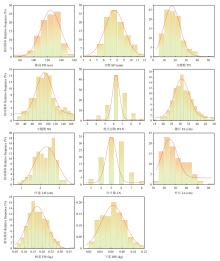
图1
244份饲用燕麦种质资源数量性状频率分布图 PH:株高;SD:茎粗;TN:分蘖数;LN:叶片数;LL:叶长;LW:叶宽;EL:穗长;WLN:轮生层数;NS:小穗数;FW:鲜重;HW:干重。下同"
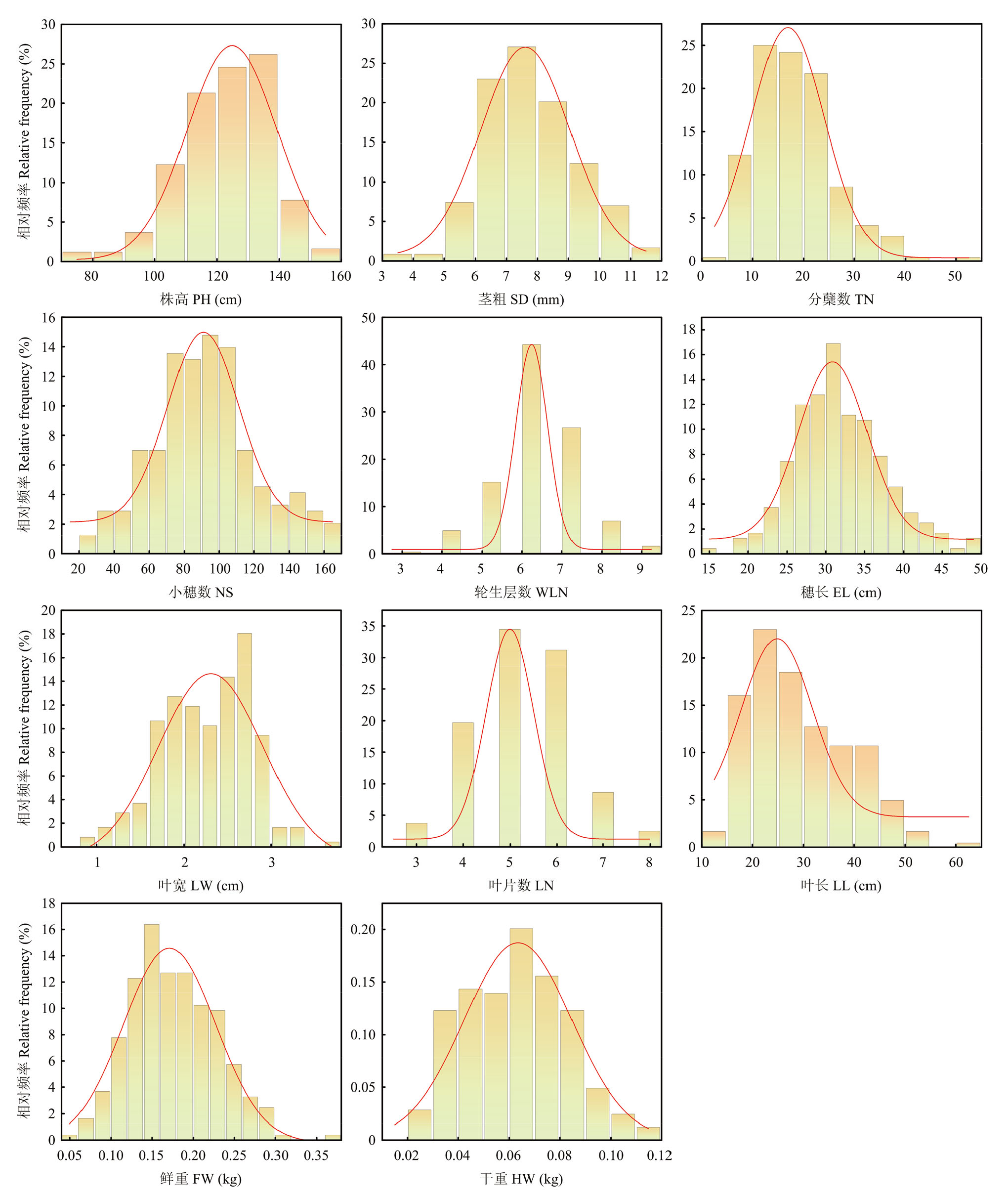

表1
244份饲用燕麦种质资源数量性状的描述性统计表"
| 性状 Character | 最小值 Minimum | 最大值 Maximum | 均值 Mean | 极差 Range | 标准差 SD | 变异系数 CV (%) | 遗传多样性指数 H' |
|---|---|---|---|---|---|---|---|
| 株高PH (cm) | 74.00 | 156.00 | 122.72 | 82.00 | 14.86 | 12.11 | 2.014 |
| 茎粗SD (mm) | 3.80 | 11.64 | 7.81 | 7.84 | 1.49 | 19.02 | 2.075 |
| 分蘖数TN | 3.00 | 52.00 | 17.98 | 49.00 | 7.67 | 42.69 | 2.008 |
| 叶片数LN | 3.00 | 8.00 | 5.29 | 5.00 | 1.07 | 20.23 | 1.474 |
| 叶长LL (cm) | 10.50 | 60.50 | 29.40 | 50.00 | 9.67 | 32.90 | 2.004 |
| 叶宽LW (cm) | 0.80 | 3.60 | 2.21 | 2.80 | 0.50 | 22.67 | 2.039 |
| 穗长EL (cm) | 15.80 | 48.80 | 31.63 | 33.00 | 5.87 | 18.55 | 2.049 |
| 轮生层数WLN | 3.00 | 9.00 | 6.19 | 6.00 | 1.02 | 16.51 | 1.408 |
| 小穗数NS | 21.00 | 167.00 | 92.43 | 146.00 | 30.28 | 32.77 | 2.077 |
| 鲜重FW (kg) | 0.05 | 0.37 | 0.18 | 0.32 | 0.05 | 30.08 | 2.062 |
| 干重HW (kg) | 0.02 | 0.11 | 0.06 | 0.09 | 0.02 | 32.75 | 2.074 |
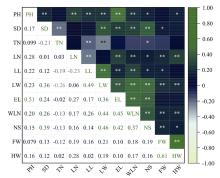
图2
11个数量性状相关性分析图 *和**分别表示性状之间存在显著(P<0.05)和极显著(P<0.01)相关关系"

表2
KMO和Bartlett球形度检验表"
| Kaiser-Meyer-Olkin度量值 Kaiser-Meyer-Olkin measurement value | Bartlett的球形度检验 Bartlett’s sphericity test | ||
|---|---|---|---|
| 0.687 | 近似卡方 Approximate Chi-squared value | 自由度 df | Sig. |
| 658.636 | 55 | 0.000 | |
表3
11个数量性状的主成分分析表"
| 性状 Character | 主成分Principal component | |||||
|---|---|---|---|---|---|---|
| PC1 | PC2 | PC3 | PC4 | PC5 | PC6 | |
| 株高PH | 0.504 | 0.223 | 0.493 | 0.379 | -0.081 | -0.447 |
| 茎粗SD | 0.531 | -0.233 | -0.050 | -0.419 | 0.378 | -0.466 |
| 分蘖数TN | -0.256 | 0.420 | 0.394 | 0.329 | 0.628 | 0.224 |
| 叶片数LN | 0.308 | 0.663 | 0.205 | -0.254 | -0.408 | 0.025 |
| 叶长LL | 0.448 | -0.506 | -0.151 | 0.609 | -0.070 | -0.004 |
| 叶宽LW | 0.745 | -0.325 | -0.098 | 0.083 | -0.014 | 0.099 |
| 穗长EL | 0.679 | 0.088 | 0.493 | 0.012 | -0.069 | 0.034 |
| 轮生层数WLN | 0.673 | -0.084 | 0.107 | -0.041 | -0.068 | 0.485 |
| 小穗数NS | 0.662 | -0.095 | 0.064 | -0.373 | 0.277 | 0.192 |
| 鲜重FW | 0.448 | 0.428 | -0.628 | 0.154 | 0.029 | -0.015 |
| 干重HW | 0.428 | 0.586 | -0.497 | 0.132 | 0.149 | -0.046 |
| 贡献率Contribution rate (%) | 28.980 | 14.833 | 12.494 | 9.556 | 7.495 | 6.850 |
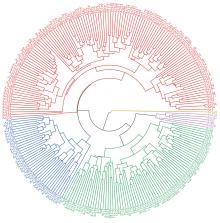
图3
244份饲用燕麦种质资源的聚类分析图"

表4
排名位于前20位的饲用燕麦种质资源"
| 编号 Number | F值 F value | 排位 Rank | 所属类群 Classification group | 编号 Number | F值 F value | 排位 Rank | 所属类群 Classification group | |
|---|---|---|---|---|---|---|---|---|
| As166 | 0.7619 | 1 | Ⅱ | As88 | 0.6609 | 11 | Ⅰ | |
| As129 | 0.7504 | 2 | Ⅰ | As82 | 0.6588 | 12 | Ⅰ | |
| As163 | 0.7338 | 3 | Ⅰ | As47 | 0.6576 | 13 | Ⅰ | |
| As131 | 0.6931 | 4 | Ⅰ | As170 | 0.6569 | 14 | Ⅱ | |
| As80 | 0.6910 | 5 | Ⅳ | As190 | 0.6559 | 15 | Ⅰ | |
| As158 | 0.6760 | 6 | Ⅱ | As157 | 0.6512 | 16 | Ⅰ | |
| As73 | 0.6682 | 7 | Ⅱ | As93 | 0.6476 | 17 | Ⅰ | |
| As49 | 0.6669 | 8 | Ⅰ | As92 | 0.6463 | 18 | Ⅱ | |
| As29 | 0.6654 | 9 | Ⅲ | As78 | 0.6451 | 19 | Ⅲ | |
| As74 | 0.6636 | 10 | Ⅰ | As96 | 0.6435 | 20 | Ⅰ |
| [35] |
doi: 10.3724/SP.J.1006.2014.02128 |
| [36] |
文艺, 方云霞, 胡鹏, 王月影, 侯琳琳, 谭义青, 朱黎欣, 邓雪梅, 曾大力, 张光恒, 等. 水稻窄叶突变体nal12的鉴定与基因精细定位. 中国水稻科学, 2019, 33(3): 219-226.
doi: 10.16819/j.1001-7216.2019.8125 |
|
doi: 10.16819/j.1001-7216.2019.8125 |
|
| [37] |
源朝政, 郑明燕, 鞠乐, 阴志刚, 高小峰, 王虹. 50个月季品种表型多样性分析及综合评价. 天津农业科学, 2022, 28(10): 19-23.
|
|
|
|
| [38] |
王亚飞, 李世景, 徐萍, 张正斌, 景蕊莲. 黄淮和长江中下游冬麦区小麦品种(系)农艺性状及其聚类分析. 中国生态农业学报(中英文), 2020, 28(3): 395-404.
|
|
|
|
| [39] |
王建丽, 刘杰淋, 朱瑞芬, 钟鹏, 尤佳, 邸桂俐, 韩微波, 申忠宝. 28份籽粒苋种质资源的主要农艺性状遗传多样性分析. 草地学报, 2020, 28(4): 1050-1059.
doi: 10.11733/j.issn.1007-0435.2020.04.023 |
|
|
|
| [40] |
张一中, 张晓娟, 梁笃, 郭琦, 范昕琦, 聂萌恩, 王绘艳, 赵文博, 杜维俊, 柳青山. 基于表型性状的高粱育种材料遗传多样性分析及综合评价. 中国农业科学, 2023, 56(15): 2837-2857. doi: 10.3864/j.issn.0578-1752.2023.15.001.
|
|
|
|
| [41] |
王旭成, 王琴, 宋文学, 王星, 王晶, 伏兵哲, 高雪芹. 21份披碱草农艺性状与产量形成的相关性分析. 西北农林科技大学学报(自然科学版), 2023, 51(5): 8-18.
|
|
|
|
| [35] |
张玲, 李晓楠, 王伟, 杨生龙, 李清, 王嘉宇. 水稻株型相关性状的QTL分析. 作物学报, 2014, 40(12): 2128-2135.
doi: 10.3724/SP.J.1006.2014.02128 |
| [34] |
|
|
吴迪, 付文婷, 吴康云, 王楠艺, 邱甜, 何建文. 275份辣椒种质资源表型性状的遗传多样性分析. 中国瓜菜, 2024, 37(9): 47-53.
|
|
| [33] |
|
|
金京花, 李淑芳, 赵亚东, 王迪, 张妤, 金国光, 李鹤南, 全成哲, 张强. 1775份水稻种质资源重要农艺性状遗传多样性研究. 植物遗传资源学报, 2025, 26(3): 481-495.
|
|
| [32] |
|
|
黄雄杰, 刘芳, 李茜, 拉巴, 周青平, 汪辉, 陈有军. 皮燕麦种质资源穗部特征与种子大小性状分析. 草地学报, 2025, 33(5): 1434-1444.
doi: 10.11733/j.issn.1007-0435.2025.05.010 |
|
| [31] |
doi: 10.13430/j.cnki.jpgr.2010.02.009 |
|
张向前, 刘景辉, 齐冰洁, 郭晓霞, 焦伟红. 燕麦种质资源主要农艺性状的遗传多样性分析. 植物遗传资源学报, 2010, 11(2): 168-174.
doi: 10.13430/j.cnki.jpgr.2010.02.009 |
|
| [30] |
|
|
南铭, 赵桂琴, 柴继宽. 黄土高原半干旱区饲用燕麦种质表型性状遗传多样性分析及综合评价. 草地学报, 2017, 25(6): 1197-1205.
doi: 10.11733/j.issn.1007-0435.2017.06.006 |
|
| [29] |
|
|
王娟, 李荫藩, 梁秀芝, 郑敏娜. 北方主栽燕麦品种种质资源形态多样性分析. 作物杂志, 2017(4): 27-32.
|
|
| [28] |
|
|
魏晓羽, 刘红, 瞿辉, 李风童, 袁媛, 刘春贵, 马辉, 张甜, 包建忠, 孙叶. 158份春兰种质资源的表型多样性分析. 植物遗传资源学报, 2022, 23(2): 398-411.
doi: 10.13430/j.cnki.jpgr.20211027001 |
|
| [27] |
doi: 10.11869/j.issn.100-8551.2020.11.2397 |
|
谢向誉, 尚小红, 严华兵, 曹升, 王颖, 肖亮, 陆柳英, 曾文丹. 广西地方食用木薯种质资源遗传多样性分析. 核农学报, 2020, 34(11): 2397-2406.
doi: 10.11869/j.issn.100-8551.2020.11.2397 |
|
| [26] |
doi: 10.3724/SP.J.1006.2012.00829 |
|
胡标林, 万勇, 李霞, 雷建国, 罗向东, 严文贵, 谢建坤. 水稻核心种质表型性状遗传多样性分析及综合评价. 作物学报, 2012, 38(5): 829-839.
|
|
| [25] |
|
|
张馨方, 郭燕, 张树航, 李颖, 刘金雨, 范丽颖, 王广鹏. 210份板栗种质资源坚果表型性状多样性分析. 中国农业大学学报, 2025, 30(1): 90-103.
|
|
| [24] |
|
|
孙佩, 刘佳棽, 杨媛, 王华, 李茂福, 范又维, 朱婷婷, 金万梅. 119份月季品种表型性状多样性及评价. 分子植物育种, 2025, 23(20): 6875-6889.
|
|
| [23] |
|
|
陆彭城, 郑燕, 周小琴, 徐喆, 艾叶, 周育真, 朱尾银, 彭东辉. 45个莲瓣兰品种的表型多样性研究. 热带作物学报, 2021, 42(9): 2518-2525.
doi: 10.3969/j.issn.1000-2561.2021.09.011 |
|
| [22] |
|
|
董胜君, 王若溪, 张皓凯, 陈建华, 刘立新, 于庆福. 不同种源东北杏果实表型性状多样性分析. 植物资源与环境学报, 2020, 29(6): 42-50.
|
|
| [21] |
|
|
侯献飞, 张云, 刘雨馨, 宋贤明, 贾东海, 顾元国, 李强, 苗昊翠, 陈晓露, 扈瑞祥. 基于主要农艺性状的686份红花种质资源遗传多样性分析. 植物遗传资源学报, 2024, 25(9): 1468-1479.
|
|
| [20] |
|
|
曹雪莲, 陈影, 王迪, 唐杰, 谢丽源, 刘理旭. 毛木耳种质资源表型性状遗传多样性分析及综合评价. 核农学报, 2025, 39(2): 228-241.
|
|
| [19] |
|
|
李玉姗, 肖菁, 马越, 田超, 赵连佳, 王帆, 宋羽, 蒋程瑶. 169份番茄种质资源表型性状遗传多样性分析及综合评价. 中国农业科学, 2024, 57(18): 3671-3687. doi: 10.3864/j.issn.0578-1752.2024.18.012.
|
|
| [18] |
|
|
唐桂梅, 李卫东, 周宇霞, 孔佑涵, 肖晓玲, 彭颖姝, 张力, 符红艳, 刘洋, 黄国林. 基于表型性状分析蕙兰种质资源遗传多样性. 中国农业科学, 2025, 58(2): 339-354. doi: 10.3864/j.issn.0578-1752.2025.02.010.
|
|
| [17] |
|
|
郑殿升, 王晓鸣, 张京. 燕麦种质资源描述规范和数据标准. 北京: 中国农业出版社, 2006.
|
|
| [16] |
|
|
罗小婷, 刘行发, 蔡长福, 廖柏林, 张盛钟, 张森行, 蔡邦平. 福建武平朱砂根种质资源表型性状遗传多样性分析. 植物遗传资源学报, 2025, 26(2): 296-308.
|
|
| [15] |
|
|
潘新宇. 聚合草在宁夏三个地区的生长适应性评价[D]. 银川: 宁夏大学, 2023.
|
|
| [14] |
|
|
梁国玲, 刘文辉, 马祥. 590份皮燕麦种质资源穗部性状遗传多样性分析. 草地学报, 2021, 29(3): 495-503.
doi: 10.11733/j.issn.1007-0435.2021.03.010 |
|
| [13] |
|
|
武敬也, 马琳, 吴欣明, 石永红, 陈菲儿, 王学敏, 赵威. 180份饲用燕麦种质资源表型遗传多样性研究. 草地学报, 2023, 31(5): 1501-1510.
doi: 10.11733/j.issn.1007-0435.2023.05.025 |
|
| [12] |
|
|
王凤宇, 梁国玲, 刘文辉. 590份燕麦种质资源营养器官表型性状遗传多样性分析. 草地学报, 2024, 32(1): 158-167.
doi: 10.11733/j.issn.1007-0435.2024.01.017 |
|
| [11] |
|
|
孙艳楠, 路耿新, 唐超, 李冠义, 王欣欣, 时梓涵, 张明飞. 134份皮燕麦种质资源生物学性状遗传多样性分析. 草地学报, 2023, 31(9): 2684-2692.
doi: 10.11733/j.issn.1007-0435.2023.09.012 |
|
| [10] |
|
|
孙艳楠, 路耿新, 李冠义, 王欣欣, 唐超. 燕麦种质资源形态学性状的遗传多样性. 西北植物学报, 2024, 44(1): 112-121.
|
|
| [9] |
doi: 10.1270/jsbbs.59.579 |
| [8] |
|
|
耿小丽, 张榕, 张少平, 李德明, 刘乾, 武慧娟. 130份燕麦种质表型性状多样性分析及评价. 草业科学, 2020, 37(10): 2022-2034.
|
|
| [7] |
|
|
叶雪玲, 甘圳, 万燕, 向达兵, 邬晓勇, 吴琪, 刘长英, 范昱, 邹亮. 饲用燕麦育种研究进展与展望. 草业学报, 2023, 32(2): 160-177.
doi: 10.11686/cyxb2022263 |
|
| [6] |
|
|
魏飒, 张海惠, 焦雪, 宋林轩, 石林青, 胡喜贵. 48份粗山羊草种质资源表型性状多样性分析. 种子, 2023, 42(12): 67-73.
|
|
| [5] |
|
|
周青平, 胡晓炜, 汪辉, 陈有军. 燕麦在维护国家粮食安全中的重要作用. 草业学报, 2024, 33(10): 171-182.
doi: 10.11686/cyxb2023439 |
|
| [4] |
|
|
余静菠, 张慧丽, 李进, 关皓, 周青平, 陈仕勇. 38份饲用燕麦品种苗期磷利用效率综合评价. 草业学报, 2024, 33(11): 161-171.
doi: 10.11686/cyxb2024065 |
|
| [3] |
|
|
任长忠, 胡跃高. 中国燕麦学. 北京: 中国农业出版社, 2013.
|
|
| [2] |
doi: 10.11686/cyxb2023409 |
|
关皓, 许多, 李海萍, 贾志锋, 马祥, 刘文辉, 陈有军, 李欣洋, 黄艳玲, 周青平, 陈仕勇. 高寒地区17个燕麦品种营养品质及瘤胃降解特性研究. 草业学报, 2024, 33(9): 185-198.
doi: 10.11686/cyxb2023409 |
|
| [1] |
|
|
马小龙, 马祥, 琚泽亮, 崔文静, 贾志锋. 氮肥减施与施氮时期对高寒区燕麦光合特性及产量的影响. 草地学报, 2024, 32(10): 3215-3224.
doi: 10.11733/j.issn.1007-0435.2024.10.022 |
| [1] | 吕涛, 孙国清, 郭栋材, 陈全家, 蔡永生, 樊标星, 曲延英, 郑凯. 海岛棉纤维强度QTL紧密连锁InDel分子标记开发及效应评价[J]. 中国农业科学, 2025, 58(9): 1684-1701. |
| [2] | 许朵朵, 杜倩倩, 赵理想, 栗燕, 黄淦, 李永华, 逯久幸. 牡丹AP2/ERF转录因子的全基因组分析[J]. 中国农业科学, 2025, 58(23): 5031-5045. |
| [3] | 魏益民, 周美亮, 唐宇. 荞麦的起源、进化与传播[J]. 中国农业科学, 2025, 58(21): 4305-4316. |
| [4] | 陈天晓, 曹榕, 宋倩楠, 胡亮亮, 王素华, 王丽侠, 程须珍, 陈红霖. 小豆种质资源苗期耐盐性综合评价及耐盐种质筛选[J]. 中国农业科学, 2025, 58(21): 4317-4332. |
| [5] | 徐修远, 张洪志, 徐丽君, 薛玮, 聂莹莹, 郭明英, 李金霞, 赵雅茹, 史明江. 基于13C脉冲标记揭示施氮对牧草光合碳分配的影响[J]. 中国农业科学, 2025, 58(21): 4346-4356. |
| [6] | 刘晓旭, 钟泽鑫, 邱佳仁, 杨春晓, 张永军, 谢文, 张友军, 潘慧鹏. 豆大蓟马不同地理种群线粒体CO1的遗传多样性[J]. 中国农业科学, 2025, 58(21): 4361-4371. |
| [7] | 张帆, 杨青川. 紫花苜蓿育种历史、现状与展望[J]. 中国农业科学, 2025, 58(21): 4471-4481. |
| [8] | 陈永先, 陈瑞江, 都艺芝, 术钧捷, 陈晚霞, 赵梓含, 王季春, 杜康, 张凯. 耐旱甘薯种质资源的筛选与鉴定[J]. 中国农业科学, 2025, 58(2): 214-237. |
| [9] | 唐桂梅, 李卫东, 周宇霞, 孔佑涵, 肖晓玲, 彭颖姝, 张力, 符红艳, 刘洋, 黄国林. 基于表型性状分析蕙兰种质资源遗传多样性[J]. 中国农业科学, 2025, 58(2): 339-354. |
| [10] | 包明芳, 秦燕, 陈彩锦, 张尚沛, 张国辉, 沙晓弟. 111份紫花苜蓿种质资源苗期表型抗旱性鉴定评价[J]. 中国农业科学, 2025, 58(19): 3825-3836. |
| [11] | 郭孟泽, 张磊, 孙平平, 江彪, 闫晋强, 李正男. ToLCNDV广东冬瓜分离物的分子特征及其遗传演化规律[J]. 中国农业科学, 2025, 58(19): 3890-3904. |
| [12] | 任家辉, 孙娟娟, 郝莹璐, 王凤梧, 王靖宇, 张明伟, 李宝涵, 郑成忠, 何竹青, 王照兰. 内蒙古中部地区饲用燕麦品种筛选及青贮品质评价[J]. 中国农业科学, 2025, 58(19): 4026-4038. |
| [13] | 孟姿诺, 付长青, 张玲玉, 高顺娟, 常金华, 崔江慧. 高粱芽苗期耐盐性评价及耐盐种质筛选[J]. 中国农业科学, 2025, 58(16): 3317-3326. |
| [14] | 刘鹏鹏, 李江博, 徐红军, 聂迎彬, 韩新年, 孔德真, 桑伟. 新疆冬小麦品种资源蛋白组分及品质的遗传多样性[J]. 中国农业科学, 2025, 58(15): 2948-2959. |
| [15] | 郑敏华, 陈洛, 邢甲乐, 谢月兰, 姜先芽, 聂帅, 蔡甫格, 巫浩翔, 陆展华, 孙伟, 霍兴, 白嵩, 赵均良, 杨武. 华南籼稻稻瘟病抗性QTL鉴定与候选基因挖掘[J]. 中国农业科学, 2025, 58(14): 2707-2719. |
|
||
