






中国农业科学 ›› 2026, Vol. 59 ›› Issue (3): 602-618.doi: 10.3864/j.issn.0578-1752.2026.03.010
延廷霖1,2( ), 杜娅丹1,2(), 胡笑涛1,2, 王贺1,2, 李晓雁1,2, 王玉明1,2, 牛文全1,3, 谷晓博1,2
收稿日期:2025-03-26
接受日期:2025-05-12
出版日期:2026-02-01
发布日期:2026-01-31
通信作者:
联系方式:
延廷霖,E-mail:2022050968@nwafu.edu.cn。
基金资助:
YAN TingLin1,2(), DU YaDan1,2(), HU XiaoTao1,2, WANG He1,2, LI XiaoYan1,2, WANG YuMing1,2, NIU WenQuan1,3, GU XiaoBo1,2
Received:2025-03-26
Accepted:2025-05-12
Published:2026-02-01
Online:2026-01-31
摘要:
【目的】针对新疆水资源短缺和土壤肥力较低等问题,探究加气滴灌下不同灌水量和有机无机肥不同配比对土壤质量,棉花的生长、产量和水分利用效率的影响,为确定新疆棉花节水高效可持续生产的灌溉施肥模式提供理论依据。【方法】于2023和2024年在新疆生产建设兵团146团地区开展大田试验,在加气滴灌下设置2个灌水量(W1:80%ETC和W2:100%ETC,ETC为作物蒸发蒸腾量)和5个有机无机肥配施比例(OF1:100%化肥,OF2:75%化肥+25%有机肥,OF3:50%化肥+50%有机肥,OF4:25%化肥+75%有机肥,OF5:100%有机肥),研究其对土壤质量指数(SQI)和棉花叶面积指数(LAI)、干物质累积量、产量、水分利用效率(WUE)的影响。【结果】土壤质量指数(SQI)随有机肥占比的提高而增大。与单施化肥相比,有机无机肥配施处理SQI两年平均提高了9.9%—28.8%。亏缺灌溉下土壤含水量和棉花LAI、干物质累积量、产量显著下降,而WUE显著提高。在两种灌溉水平(W1和W2)下,土壤含水量和棉花LAI、干物质累积量均随有机肥占比的增加呈先升后降趋势,W1灌溉水平下W1OF3处理以上指标取得最大值,而W2灌溉水平下W2OF2处理达最大值。与单施化肥OF1相比,有机无机肥配施处理两年土壤含水量、棉花的LAI和干物质累积量分别提高了0.4%—5.2%、4.1%—19.8%和3.7%—18.8%。两年籽棉产量均以W2OF2处理最大,两年平均产量为6 739.99 kg·hm-2,但WUE以W1OF3处理最高,两年平均为1.42 kg·m-3。分别利用隶属函数法、TOPSIS法和灰色关联度分析法对不同处理的SQI、籽棉产量和WUE进行评价,并结合整体差异组合评价模型对棉田SQI、籽棉产量和WUE进行综合评价,确定最优处理为W1OF3。【结论】考虑节水优先,保证产量的同时提高WUE和土壤质量为目标,推荐在加气滴灌下采用80%ETC和50%有机肥+50%化肥作为新疆棉田节水高效生产措施。
延廷霖, 杜娅丹, 胡笑涛, 王贺, 李晓雁, 王玉明, 牛文全, 谷晓博. 加气滴灌下氮肥有机替代对亏缺灌溉棉花产量和水分利用效率的影响[J]. 中国农业科学, 2026, 59(3): 602-618.
YAN TingLin, DU YaDan, HU XiaoTao, WANG He, LI XiaoYan, WANG YuMing, NIU WenQuan, GU XiaoBo. The Impacts of Nitrogen Fertilizer Organic Alternatives Under Aerated Drip Irrigation on Cotton Yield and Water Use Efficiency Under Deficit Irrigation Conditions[J]. Scientia Agricultura Sinica, 2026, 59(3): 602-618.

图1
2023和2024年棉花生育期参考作物蒸发蒸腾量(ET0)、降雨量和气温变化"
表1
不同有机无机配施处理的具体施肥量"
| 施肥水平 Fertilization level | 有机肥Organic fertilizer | 化肥Chemical fertilizer (kg·hm-2) | |||
|---|---|---|---|---|---|
| 替代化肥比例 Proportion of alternative fertilizers (%) | 施肥量 Amount of fertilizer (kg·hm-2) | 尿素 Urea | 磷酸二氢钾 Potassium monobasic phosphate | 农用硫酸钾 Potassium sulfate for agricultural use | |
| OF1 | 0 | 0 | 646.55 | 230.77 | 143.08 |
| OF2 | 25 | 1556.02 | 484.91 | 187.68 | 144.10 |
| OF3 | 50 | 3112.03 | 323.28 | 144.59 | 135.89 |
| OF4 | 75 | 4668.05 | 161.64 | 101.50 | 127.67 |
| OF5 | 100 | 6224.07 | 0 | 58.41 | 119.46 |
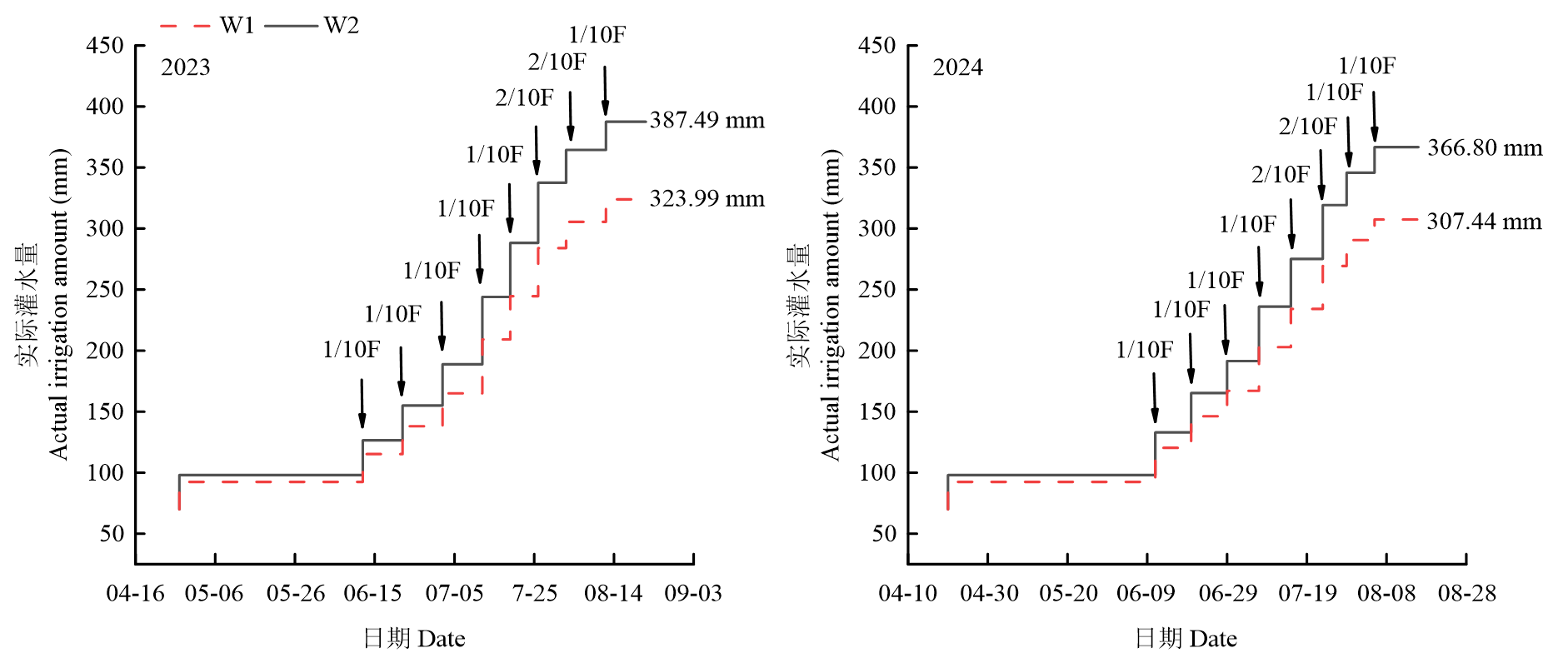
图2
棉花滴灌施肥制度"

图3
2023年和2024年不同处理的土壤质量指数 W1和W2分别表示80%ETC和100%ETC灌水水平(ETC为实际作物蒸发蒸腾量),OF1、OF2、OF3、OF4和OF5分别表示100%化肥、25%有机肥+75%化肥、50%有机肥+50%化肥、75%有机肥+25%化肥和100%有机肥处理。下同。图柱上不同小写字母表示处理间差异显著(P<0.05)"
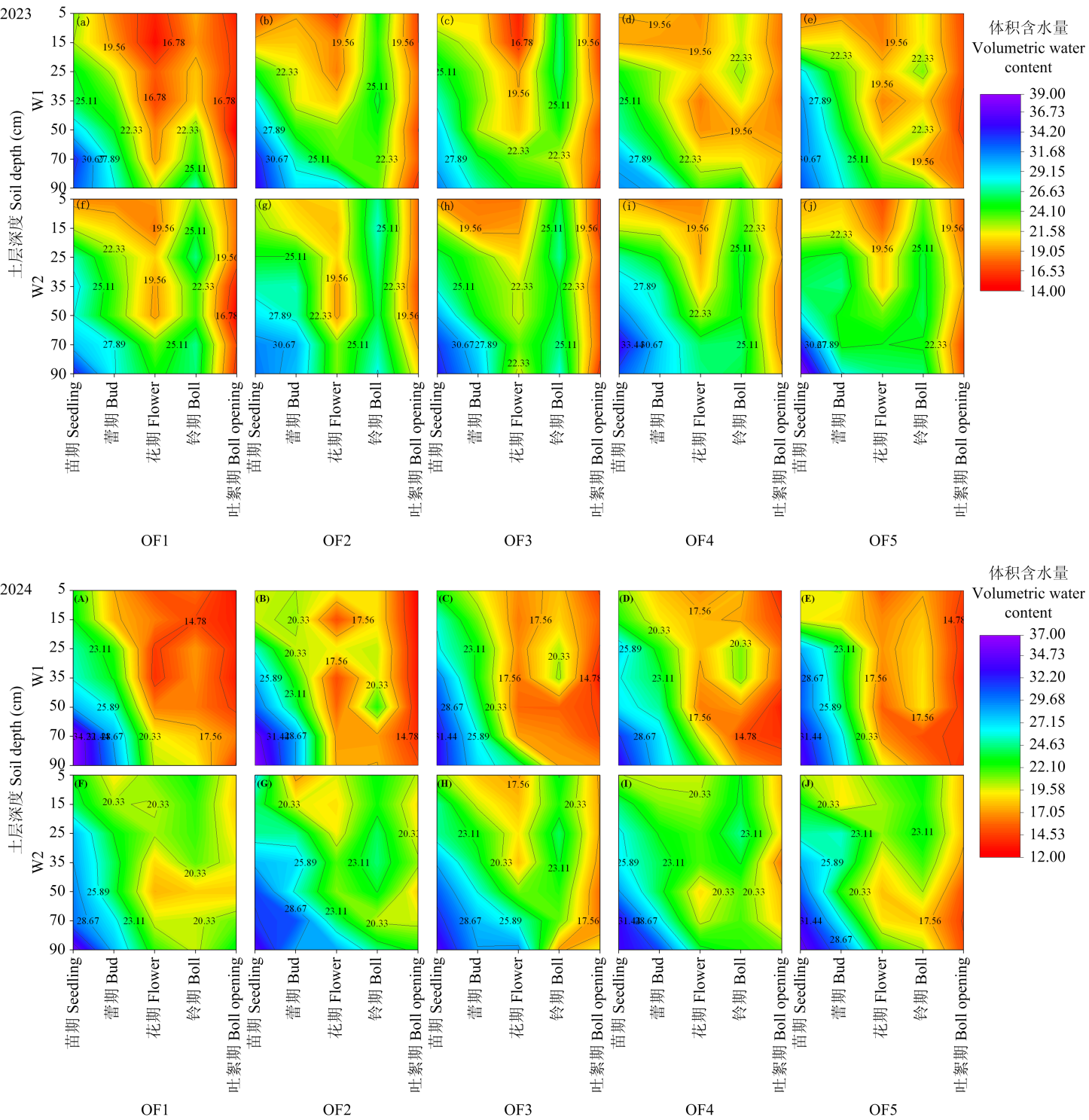
图4
不同灌水量和有机无机肥配施比例对棉花0—100 cm土层含水量的影响"
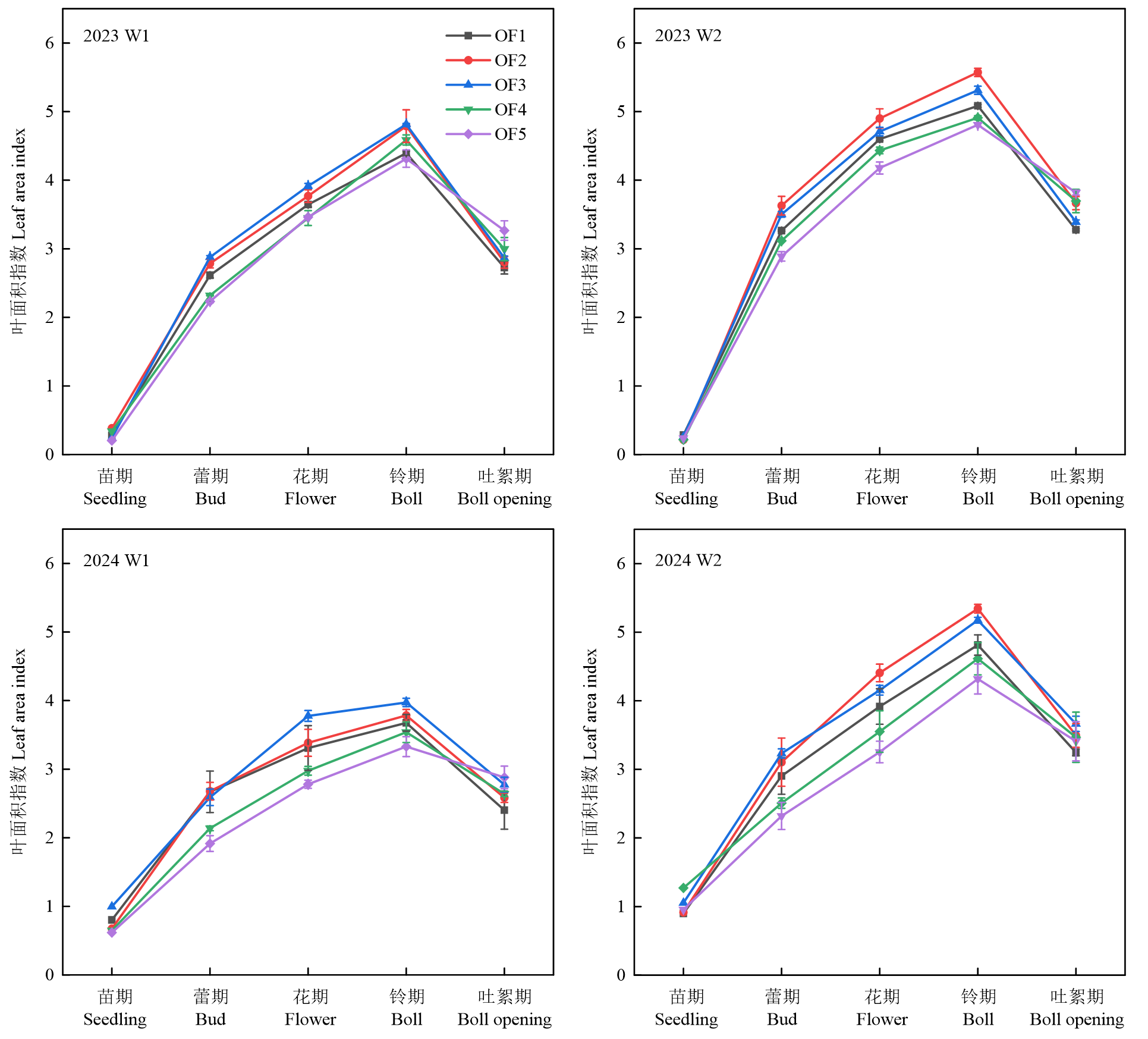
图5
不同灌水量和有机无机肥配施比例对棉花叶面积指数的影响"
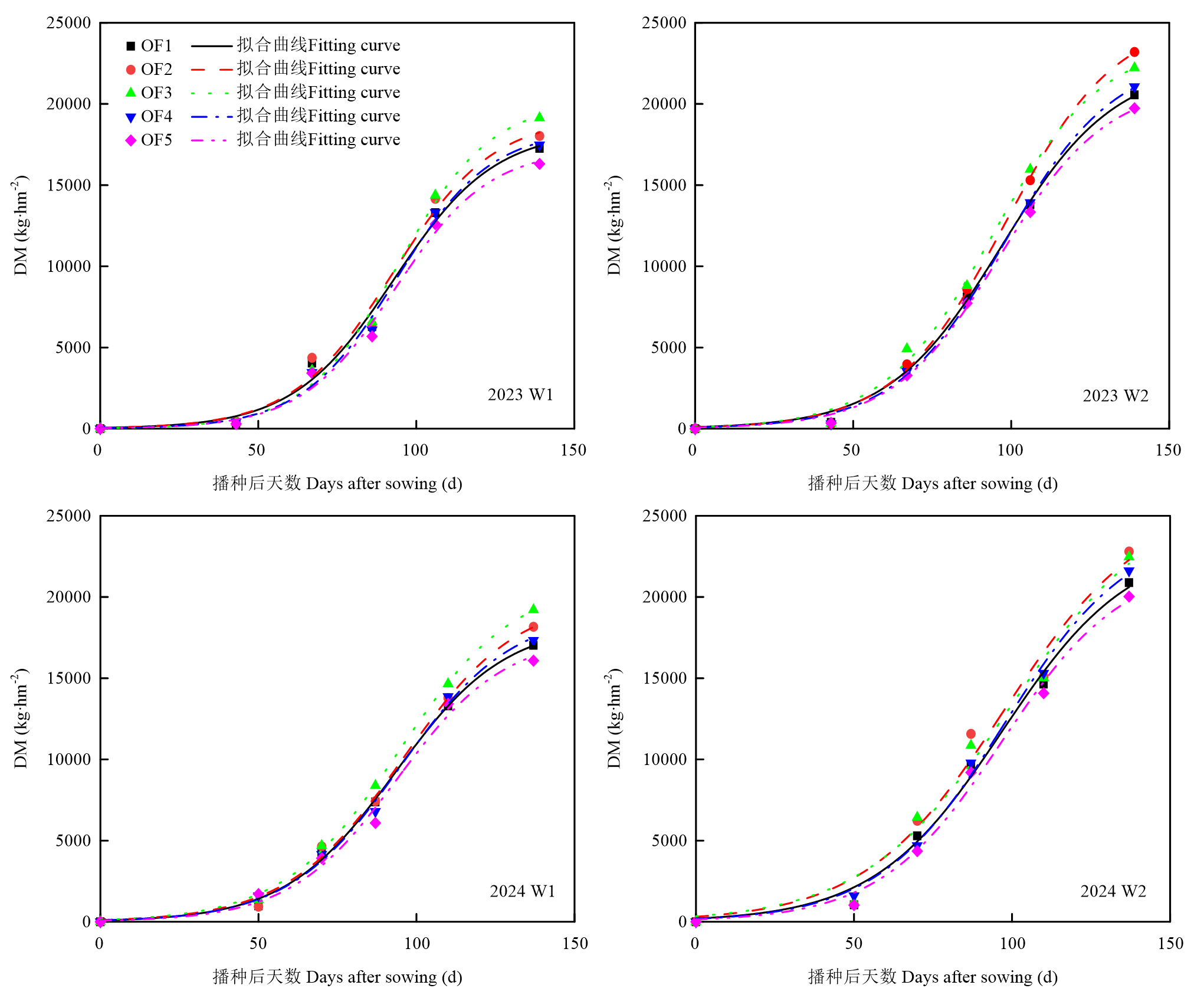
图6
不同处理棉花地上部干物质累积量的Logistic拟合曲线"
表2
不同处理棉花地上部干物质累积量Logistic模型参数"
| 年份 Year | 处理 Treatment | Ymax (kg·hm-2) | R2 | T1 (d) | T2 (d) | T3 (d) | ΔT (d) | Vmax (kg·hm-2·d-1) |
|---|---|---|---|---|---|---|---|---|
| 2023 | W1OF1 | 18384 | 0.983 | 72 | 93 | 113 | 41 | 294 |
| W1OF2 | 19217 | 0.978 | 72 | 93 | 114 | 42 | 303 | |
| W1OF3 | 20440 | 0.985 | 74 | 94 | 115 | 42 | 323 | |
| W1OF4 | 18470 | 0.989 | 74 | 94 | 113 | 39 | 309 | |
| W1OF5 | 17227 | 0.986 | 74 | 93 | 113 | 39 | 290 | |
| W2OF1 | 22073 | 0.997 | 73 | 95 | 117 | 45 | 325 | |
| W2OF2 | 25414 | 0.997 | 75 | 98 | 121 | 46 | 362 | |
| W2OF3 | 23890 | 0.994 | 71 | 94 | 117 | 46 | 345 | |
| W2OF4 | 23012 | 0.998 | 75 | 98 | 121 | 46 | 330 | |
| W2OF5 | 21278 | 0.995 | 74 | 96 | 119 | 45 | 313 | |
| 2024 | W1OF1 | 18395 | 0.996 | 70 | 93 | 116 | 46 | 264 |
| W1OF2 | 20064 | 0.994 | 71 | 96 | 120 | 48 | 273 | |
| W1OF3 | 21063 | 0.998 | 70 | 94 | 119 | 48 | 287 | |
| W1OF4 | 19108 | 0.993 | 72 | 95 | 118 | 46 | 271 | |
| W1OF5 | 17652 | 0.985 | 72 | 94 | 116 | 45 | 260 | |
| W2OF1 | 23468 | 0.997 | 70 | 97 | 124 | 54 | 289 | |
| W2OF2 | 26268 | 0.965 | 68 | 97 | 126 | 58 | 295 | |
| W2OF3 | 25963 | 0.974 | 69 | 99 | 129 | 60 | 287 | |
| W2OF4 | 24397 | 0.994 | 71 | 98 | 124 | 53 | 306 | |
| W2OF5 | 22241 | 0.989 | 71 | 97 | 122 | 51 | 289 |
表3
不同灌水量和有机无机肥配施比例对棉花产量和WUE的影响"
| 处理 Treatment | 单铃重 Boll weight (g) | 单株有效铃数 Effective bolls per plant | 籽棉产量 Seed cotton yield (kg·hm-2) | 作物耗水量 ET (mm) | 水分利用效率 WUE (kg·m-3) | |||||
|---|---|---|---|---|---|---|---|---|---|---|
| 2023 | 2024 | 2023 | 2024 | 2023 | 2024 | 2023 | 2024 | 2023 | 2024 | |
| W1OF1 | 4.86±0.02f | 4.89±0.09e | 6.06±0.12f | 6.49±0.06d | 5347.87±30.89g | 5375.58±99.57g | 418.90g | 398.65f | 1.28±0.01d | 1.35±0.04bc |
| W1OF2 | 4.89±0.02f | 4.90±0.06e | 6.39±0.07e | 6.64±0.04c | 5519.16±32.20f | 5524.19±75.38f | 422.87f | 401.62e | 1.31±0.01b | 1.38±0.03b |
| W1OF3 | 4.90±0.02f | 4.96±0.16e | 6.66±0.19d | 6.72±0.03c | 5857.60±29.94e | 5931.50±39.20d | 424.81e | 406.56d | 1.38±0.01a | 1.46±0.01a |
| W1OF4 | 4.86±0.02e | 4.94±0.02d | 6.46±0.07de | 6.52±0.04d | 5447.96±29.85e | 5498.47±27.04de | 419.47f | 399.22e | 1.30±0.01bc | 1.38±0.01b |
| W1OF5 | 4.76±0.03e | 4.92±0.08cd | 6.35±0.07e | 6.42±0.07d | 5122.58±42.00f | 5197.40±88.62ef | 419.09f | 395.84e | 1.22±0.01f | 1.31±0.03d |
| W2OF1 | 5.33±0.01d | 5.33±0.06bc | 7.11±0.10c | 7.24±0.05b | 6201.28±14.11d | 6200.37±77.33c | 518.97d | 495.64c | 1.19±0.01g | 1.25±0.02e |
| W2OF2 | 5.53±0.10bc | 5.49±0.06ab | 7.51±0.25a | 7.70±0.07a | 6765.12±154.35b | 6714.86±70.26a | 526.72a | 504.48a | 1.28±0.03d | 1.33±0.02cd |
| W2OF3 | 5.40±0.03c | 5.41±0.05ab | 7.45±0.10ab | 7.62±0.10a | 6544.68±39.79a | 6624.83±58.98a | 521.06c | 500.94a | 1.26±0.01e | 1.32±0.02cd |
| W2OF4 | 5.50±0.06ab | 5.37±0.08a | 7.25±0.11bc | 7.33±0.10b | 6381.52±92.01bc | 6226.62±91.73ab | 515.85c | 497.48b | 1.24±0.02ef | 1.25±0.02e |
| W2OF5 | 5.31±0.03a | 5.30±0.09a | 7.18±0.04c | 7.22±0.04b | 6070.97±36.37c | 6058.37±97.66b | 513.23b | 497.28b | 1.18±0.02g | 1.22±0.03f |
| 显著性分析(F值)Significance analysis (F-values) | ||||||||||
| W | 628.88*** | 169.13*** | 380.35*** | 1379.27*** | 923.61*** | 430.57*** | - | - | 192.18*** | 246.68*** |
| OF | 21.75*** | 11.10*** | 12.38*** | 43.35*** | 54.64*** | 23.01*** | - | - | 72.08*** | 46.69*** |
| W×OF | 1.67ns | 0.75ns | 1.58ns | 4.35* | 6.64** | 3.28* | - | - | 14.14*** | 6.76*** |
表4
不同模型对各处理的评价结果"
| 处理 Treatment | 隶属函数 Membership functions | TOPSIS | 灰色关联度 Grey relevance analysis | 综合评价模型 Comprehensive evaluation model | ||||
|---|---|---|---|---|---|---|---|---|
| 评价值 Values | 排序 Rank | 评价值 Values | 排序 Rank | 评价值 Values | 排序 Rank | 评价值 Values | 排序 Rank | |
| W1OF1 | 0.162 | 10 | 0.294 | 10 | 0.420 | 10 | -1.356 | 10 |
| W1OF2 | 0.331 | 8 | 0.418 | 8 | 0.480 | 8 | -0.602 | 8 |
| W1OF3 | 0.595 | 4 | 0.648 | 1 | 0.681 | 1 | 0.986 | 1 |
| W1OF4 | 0.419 | 7 | 0.470 | 6 | 0.507 | 7 | -0.253 | 7 |
| W1OF5 | 0.445 | 6 | 0.437 | 7 | 0.547 | 6 | -0.168 | 6 |
| W2OF1 | 0.320 | 9 | 0.334 | 9 | 0.461 | 9 | -0.878 | 9 |
| W2OF2 | 0.657 | 1 | 0.617 | 2 | 0.671 | 2 | 0.983 | 2 |
| W2OF3 | 0.635 | 2 | 0.583 | 3 | 0.618 | 4 | 0.706 | 3 |
| W2OF4 | 0.544 | 5 | 0.489 | 4 | 0.549 | 5 | 0.124 | 5 |
| W2OF5 | 0.614 | 3 | 0.486 | 5 | 0.623 | 3 | 0.458 | 4 |
表5
不同评价模型评价值的相关性分析"
| 隶属函数 Membership functions | TOPSIS | 灰色关联度 Grey relevance analysis | 均值 Average | |
|---|---|---|---|---|
| 隶属函数 Membership functions | 1.000 | 0.906 | 0.943 | 0.950 |
| TOPSIS | 0.906 | 1.000 | 0.946 | 0.951 |
| 灰色关联度 Grey relevance analysis | 0.943 | 0.946 | 1.000 | 0.963 |
| [1] |
doi: 10.1016/j.indcrop.2021.113710 |
| [2] |
doi: 10.1016/j.fcr.2019.107590 |
| [3] |
李云霞, 范军亮, 关新元, 刘辉, 尹飞虎. 新疆灌区农业节水发展现状与对策建议. 华中农业大学学报, 2024, 43(2): 93-98.
|
|
|
|
| [4] |
李玉, 田宪艺, 王振林, 代兴龙, 董元杰, 贺明荣. 有机肥替代部分化肥对滨海盐碱地土壤改良和小麦产量的影响. 土壤, 2019, 51(6): 1173-1182.
|
|
|
|
| [5] |
李军宏, 王军, 李楠楠, 郝先哲, 时晓娟, 田雨, 石峰, 罗宏海, 杨国正. 无膜棉花产量及其根区温湿盐对灌溉量的响应. 农业工程学报, 2021, 37(12): 134-143.
|
|
|
|
| [6] |
吕宁, 石磊, 戴昱余, 李云霞, 尹飞虎. 新疆盐碱地治理利用研究回顾与启示. 灌溉排水学报, 2024, 43(12): 1-10.
|
|
|
|
| [7] |
邓铭江, 陶汪海, 王全九, 苏李君, 马昌坤, 宁松瑞. 西北现代生态灌区建设理论与技术保障体系构建. 农业机械学报, 2022, 53(8): 1-13.
|
|
|
|
| [8] |
王振华, 韩美琪, 宋利兵, 宗睿, 温越, 武小荻. 加气对西北旱区膜下滴灌棉花生长与水分利用效率的影响. 农业工程学报, 2022, 38(14): 108-116.
|
|
|
|
| [9] |
王振华, 陈潇洁, 吕德生, 李文昊, 王天宇, 魏驰林. 水肥耦合对加气滴灌加工番茄产量及品质的影响. 农业工程学报, 2020, 36(19): 66-75.
|
|
|
|
| [10] |
郭牧婵, 王振华, 刘健, 马占利, 张继红, 秦国鹏, 叶含春, 郑继亮. 加气滴灌和黄腐酸施加对新疆玉米生长及产量的影响. 干旱地区农业研究, 2025, 43(2): 148-159.
|
|
|
|
| [11] |
|
| [12] |
罗宏海, 张宏芝, 陶先萍, 张亚黎, 张旺锋. 膜下滴灌条件下水氮供应对棉花根系及叶片衰老特性的调节. 中国农业科学, 2013, 46(10): 2142-2150. doi: 10.3864/j.issn.0578-1752.2013.10.020.
|
|
|
|
| [13] |
doi: 10.1016/j.fcr.2016.06.003 |
| [14] |
doi: 10.1016/j.agwat.2024.108850 |
| [15] |
doi: 10.1016/j.apsoil.2021.103966 |
| [16] |
doi: 10.1016/j.geoderma.2021.115287 |
| [17] |
韦文华, 李盼, 邵冠贵, 樊志龙, 胡发龙, 范虹, 何蔚, 柴强, 殷文, 赵连豪. 西北灌区青贮玉米产量及品质对减量灌水与有机无机肥配施的响应. 中国农业科学, 2025, 58(8): 1521-1534. doi: 10.3864/j.issn.0578-1752.2025.08.005.
|
|
|
|
| [18] |
程煜, 乔若楠, 丁运韬, 董勤各, 冯浩, 张体彬. 化肥减量和有机替代对重度盐渍土水盐特性及向日葵水氮利用效率的影响. 植物营养与肥料学报, 2021, 27(11): 1981-1992.
|
|
|
|
| [19] |
侯俊, 王帅, 崔士通, 王会刚, 张卫峰. 沙土地有机肥替代化肥与灌溉优化在苜蓿上的耦合效应研究. 中国土壤与肥料, 2018(6): 104-111.
|
|
|
|
| [20] |
杨莹攀, 尹娟, 朱银浩, 李升. 水氮调控对马铃薯产量影响与土壤质量评价研究. 农业机械学报. https://link.cnki.net/urlid/11.1964.s.20240709.1436.015.
|
|
|
|
| [21] |
徐文娴, 郭鑫炜, 吴志祥. 不同施肥方式对海南橡胶园土壤质量的影响. 农业工程学报, 2025, 41(9): 103-112.
|
|
|
|
| [22] |
王宁, 冯克云, 南宏宇, 丛安琪, 张铜会. 水分亏缺下有机无机肥配施比例对棉花水氮利用效率的影响. 中国农业科学, 2023, 56(8): 1531-1546. doi: 10.3864/j.issn.0578-1752.2023.08.009.
|
|
|
|
| [23] |
雷宏军, 臧明, 张振华, 刘欢, 刘智远, 徐建新. 循环曝气压力与活性剂浓度对滴灌带水气传输的影响. 农业工程学报, 2014, 30(22): 63-69.
|
|
|
|
| [24] |
陈世超, 刘文丰, 杜太生. 基于水氮管理与种植结构优化的作物丰产高效管理策略. 农业工程学报, 2022, 38(16): 144-152.
|
|
|
|
| [25] |
胡清阳, 曹红霞, 何子建, 丁邦新, 张浥. 淋洗定额与覆盖方式对北疆棉花生长和产量的影响. 灌溉排水学报, 2022, 41(5): 27-33.
|
|
|
|
| [26] |
李鑫, 张文菊, 邬磊, 任意, 张骏达, 徐明岗. 土壤质量评价指标体系的构建及评价方法. 中国农业科学, 2021, 54(14): 3043-3056. doi: 10.3864/j.issn.0578-1752.2021.14.010.
|
|
|
|
| [27] |
周文涛, 兰天, 潘岳, 公衍丽, 高云悦, 李品芳. 土壤质量评价中少量样本最小数据集的构建: 以内蒙古杭锦旗黄河南岸灌区典型地块为例. 中国农业大学学报, 2022, 27(6): 225-235.
|
|
|
|
| [28] |
doi: 10.15302/J-FASE-2020338 |
| [29] |
胡田田, 何琼, 洪霞, 刘杰, 李鸿祥, 冯璞玉, 王丽, 杨硕欢. 基于模糊Borda组合模型评价番茄产量及品质对水肥供应响应. 农业工程学报, 2019, 35(19): 142-151.
|
|
|
|
| [30] |
doi: 10.1016/j.scitotenv.2023.163247 |
| [31] |
doi: 10.1016/j.jenvman.2024.123673 |
| [32] |
吕轲彦, 陈志君, 李越, 胡敏, 熊云武, 黄冠华. 褐煤有机肥与脱硫石膏联合施用对盐碱土改良和向日葵产量的影响. 农业工程学报, 2023, 39(11): 77-86.
|
|
|
|
| [33] |
王晓娟, 贾志宽, 梁连友, 韩清芳, 杨保平, 丁瑞霞, 崔荣美, 卫婷. 旱地施有机肥对土壤水分和玉米经济效益影响. 农业工程学报, 2012, 28(6): 144-149.
|
|
|
|
| [34] |
王虎兵, 曹红霞, 郝舒雪, 潘小燕. 温室番茄植株养分和光合对水肥耦合的响应及其与产量关系. 中国农业科学, 2019, 52(10): 1761-1771. doi: 10.3864/j.issn.0578-1752.2019.10.009.
|
|
|
|
| [35] |
徐海东, 董合林, 苏丽丽, 徐文修, 唐江华, 陈传信, 张永杰, 胡丽娟. 液态有机肥对滴灌棉花光合特性及产量形成规律的影响. 中国农学通报, 2017, 33(20): 71-77.
doi: 10.11924/j.issn.1000-6850.casb16090116 |
|
doi: 10.11924/j.issn.1000-6850.casb16090116 |
|
| [36] |
徐瑞强, 徐海东, 董合林, 苏丽丽, 唐江华, 徐文修, 范小利. 液态有机肥与氮肥配施对棉花生理特性及产量的影响. 中国农学通报, 2019, 35(13): 42-47.
doi: 10.11924/j.issn.1000-6850.casb18010084 |
|
doi: 10.11924/j.issn.1000-6850.casb18010084 |
|
| [37] |
冯克云, 王宁, 南宏宇, 高建刚. 水分亏缺下化肥减量配施有机肥对棉花光合特性与产量的影响. 作物学报, 2021, 47(1): 125-137.
doi: 10.3724/SP.J.1006.2021.04077 |
|
doi: 10.3724/SP.J.1006.2021.04077 |
|
| [38] |
王振华, 朱延凯, 张金珠, 李文昊, 扁青永. 水氮调控对轻度盐化土滴灌棉花生理特性与产量的影响. 农业机械学报, 2018, 49(6): 296-308.
|
|
|
|
| [39] |
吕凤莲, 侯苗苗, 张弘弢, 强久次仁, 周应田, 路国艳, 赵秉强, 杨学云, 张树兰. 塿土冬小麦-夏玉米轮作体系有机肥替代化肥比例研究. 植物营养与肥料学报, 2018, 24(1): 22-32.
|
|
|
|
| [40] |
鲁伟丹, 李俊华, 罗彤, 陈丽丽, 张磊, 刘硕康. 连续三年不同有机肥替代率对小麦产量及土壤养分的影响. 植物营养与肥料学报, 2021, 27(8): 1330-1338.
|
|
|
|
| [41] |
周慧, 史海滨, 徐昭, 郭珈玮, 付小军, 李正中. 有机无机肥配施对盐渍土供氮特性与作物水氮利用的影响. 农业机械学报, 2020, 51(4): 299-307.
|
|
|
|
| [42] |
doi: 10.1016/j.agwat.2023.108172 |
| [43] |
doi: 10.2134/agronj2017.04.0208 |
| [1] | 彭廷燊, 陆久焱, 吴美林, 严雨欣, 刘宏周, 南文斌, 秦小健, 李明, 龚俊义, 梁永书. 多年生水稻黄糯2号和长白7号产量相关性状的QTL分析[J]. 中国农业科学, 2026, 59(7): 1361-1379. |
| [2] | 李元晶, 袁瑞祥, 李永泰, 孙天歌, 刘峰, 李艳军, 张新宇. 棉花黄萎病菌β-葡萄糖苷酶基因的鉴定及其在致病中的功能[J]. 中国农业科学, 2026, 59(7): 1380-1399. |
| [3] | 王玉萍, 符质, 孙佳莹, 穆晓萌, 刘慧淋, 郭进云, 宋文菁, 侯雷平, 赵海亮. 苗期施用褪黑素对番茄短期低温胁迫的缓解作用与应用效果评价[J]. 中国农业科学, 2026, 59(7): 1523-1535. |
| [4] | 王佳诺, 陈桂平, 李盼, 王丽萍, 南运有, 何蔚, 樊志龙, 胡发龙, 柴强, 殷文, 赵连豪. 免耕地膜两年覆盖提高绿洲灌区玉米产量的灌浆期光合生理机制[J]. 中国农业科学, 2026, 59(6): 1189-1202. |
| [5] | 周新杰, 任昊, 陈应龙, 张吉旺, 赵斌, 任佰朝, 刘鹏, 王洪章. 过氧化钙对渍涝农田夏玉米根系形态及产量形成的影响[J]. 中国农业科学, 2026, 59(6): 1203-1216. |
| [6] | 何继航, 张擎, 吕相月, 薛吉全, 徐淑兔, 刘建超. 不同保绿型玉米杂交种氮效率评价[J]. 中国农业科学, 2026, 59(6): 1217-1230. |
| [7] | 魏圆慧, 余益辉, 李子钧, 丁文杰, 涂文龙, 毛艳玲. 长期施肥对黄泥田土壤有机碳化学结构与固碳细菌群落结构的影响[J]. 中国农业科学, 2026, 59(5): 1020-1033. |
| [8] | 郝琨, 陈洪德, 张威, 钟韵, 党美荣, 朱士江, 黄志坤, 金英. 基于柑橘产量、品质及水氮利用的涌泉根灌水氮综合评价[J]. 中国农业科学, 2026, 59(4): 862-873. |
| [9] | 郭富城, 唐海江, 郝馨怡, 马国林, 杨九菊, 黄霖锋, 田蕾, 王彬, 罗成科. 不同灌溉方式对宁夏盐渍化土壤水盐运移、水稻产量及水分利用效率的影响[J]. 中国农业科学, 2026, 59(4): 750-764. |
| [10] | 咸青林, 肖鉴珂, 高阿庆, 郜利闯, 刘杨. 种植方式结合测墒补灌下冬小麦产量及水分利用效率[J]. 中国农业科学, 2026, 59(3): 589-601. |
| [11] | 蔡廷阳, 朱玉鹏, 李瑞东, 吴宗声, 徐一帆, 宋雯雯, 徐彩龙, 吴存祥. 苗期叶损伤对黄淮海夏大豆光合特性、荚果分布及产量形成的影响[J]. 中国农业科学, 2026, 59(2): 292-304. |
| [12] | 张志勇, 谭世超, 熊淑萍, 马新明, 韦一昊, 王小纯. 水氮周年优化对豫北灌区小麦玉米轮作系统产量和氮迁移的影响[J]. 中国农业科学, 2026, 59(2): 336-353. |
| [13] | 吕旭东, 孙世媛, 李亚楠, 刘玉龙, 王艳群, 付鑫, 张佳英, 宁鹏, 彭正萍. 智能机械化分层施肥对麦田根-土养分分布和小麦产量的影响[J]. 中国农业科学, 2026, 59(1): 129-146. |
| [14] | 陆浩, 张明龙, 韩梅, 严清彪, 李正鹏, 殷文, 樊志龙, 胡发龙, 柴强. 绿肥过腹还田协同氮肥减施提高小麦产量和土壤质量[J]. 中国农业科学, 2026, 59(1): 147-160. |
| [15] | 叶美金, 陈家婷, 周界光, 尹丽, 胡欣荣, 兰雨昕, 陈斌, 苏龙兴, 刘家君, 刘天超, 李小雨, 马建. 小麦穗密度主效QTL的鉴定、验证及其遗传效应分析[J]. 中国农业科学, 2026, 59(1): 17-28. |
|
||
