






中国农业科学 ›› 2026, Vol. 59 ›› Issue (1): 57-77.doi: 10.3864/j.issn.0578-1752.2026.01.005
董桂春1,*( ), 王子涵1, 王树深1,2, 李杰3, 霍晓晴1, 杨瑞1, 周娟1, 舒小伟1,4, 李妍3, 曹靓婧3, 王子瑞3, 姚友礼1, 黄建晔1
收稿日期:2025-05-05
接受日期:2025-11-14
出版日期:2026-01-07
发布日期:2026-01-07
通信作者:
基金资助:
DONG GuiChun1,*(), WANG ZiHan1, WANG ShuShen1,2, LI Jie3, HUO XiaoQing1, YANG Rui1, ZHOU Juan1, SHU XiaoWei1,4, LI Yan3, CAO LiangJing3, WANG ZiRui3, YAO YouLi1, HUANG JianYe1
Received:2025-05-05
Accepted:2025-11-14
Published:2026-01-07
Online:2026-01-07
摘要:
【目的】探究硫包衣缓释肥中缓释氮4个不同释放周期的产品的施用方法,厘清缓释氮产品是单一施用还是组合施用、是否要与速效氮配施、如何优化配施的问题,旨在实现水稻产量和氮肥利用率的协同提高。【方法】于2022—2024年在江苏扬州和常州,以南粳9108与南粳46为供试材料,设计缓释氮产品比较、产品组合筛选、肥料品种比较、缓速掺混配比、速效肥不同施用时期、缓释氮组合配方优选等试验,研究硫包衣缓释肥施用方法对水稻产量形成和氮素吸收利用的影响。【结果】(1)秸秆还田处理的水稻产量较半量还田、不还田处理分别显著提高4.50%、8.88%,氮肥利用率较其他两处理分别提高11.35%、25.64%。(2)缓释氮60 d产品的产量比30、90、120 d产品分别高4.10%、15.68%、19.09%,但低于常规精确定量4.13%;60 d产品氮肥利用率总体而言大于其他缓释氮产品,平均高8.68%;秸秆不还田、半量还田处理略高于常规精确定量处理9.88%、0.93%,全量还田处理低于常规精确定量处理4.57%。(3)缓释氮产品以“3+6+9”组合的产量、氮肥利用率最高,但均低于常规精确定量。(4)缓速掺混配比7﹕3处理的水稻产量、氮素积累量、氮肥利用率均最高,比常规精确定量处理平均分别高4.31%、3.25%、6.15%;在此处理下,速效肥作分蘖肥(生育期中等的品种)或作促花肥(生育期较长的品种),产量、氮素积累量、氮肥利用率均协同提高。产量提高主要是由于在水稻穗数足够的基础上每穗粒数显著增加。(5)缓释氮产品按30 d﹕60 d﹕90 d=1﹕4﹕1掺混时,水稻的产量、氮素积累量、氮肥利用率均为最高,较常规精确定量处理分别增加3.76%、5.66%、13.35%,这与其叶面积系数、库容量、生物产量均显著提高有密切的关系。【结论】缓释氮按30 d﹕60 d﹕90 d=1﹕4﹕1比例混合,缓释氮与速效氮以7﹕3配施,缓释肥一次性基施,速效肥作分蘖肥(生育期150 d左右的品种)或促花肥(生育期160 d以上的品种)一次性施用,产量、氮肥利用率较常规精确定量处理分别增加3.76%、13.35%,是硫包衣缓释肥实现水稻产量和氮肥利用率协同提高比较优化的施用方法。
董桂春, 王子涵, 王树深, 李杰, 霍晓晴, 杨瑞, 周娟, 舒小伟, 李妍, 曹靓婧, 王子瑞, 姚友礼, 黄建晔. 硫包衣缓释肥提升水稻产量及氮肥利用率的技术途径[J]. 中国农业科学, 2026, 59(1): 57-77.
DONG GuiChun, WANG ZiHan, WANG ShuShen, LI Jie, HUO XiaoQing, YANG Rui, ZHOU Juan, SHU XiaoWei, LI Yan, CAO LiangJing, WANG ZiRui, YAO YouLi, HUANG JianYe. Technical Approaches for Enhancing Rice Yield and Nitrogen Use Efficiency with Sulfur-Coated Controlled-Release Fertilizers[J]. Scientia Agricultura Sinica, 2026, 59(1): 57-77.
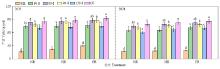
图1
缓释氮(肥)产品比较对水稻产量的影响 NR:秸秆不还田 No straw return;HR:秸秆半量还田 Half straw return;FR:秸秆全量还田 Full straw return;CK:不施肥 No fertilizer;CF:常规精确定量施肥 Conventional precise quantitative fertilization。不同小写字母表示同一时期中不同肥料处理在0.05水平上差异显著 Different lowercase letters indicate significant differences at the 0.05 level between different fertilizer treatments during the same period。下同 The same as below"
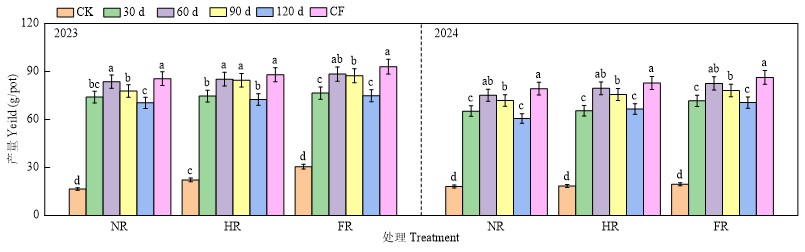
表1
缓释氮(肥)产品比较对水稻产量构成因素的影响"
| 秸秆还田方式 Straw returning method | 肥料处理 Fertilizer treatment | 穗数 Panicle number (×104·hm-2) | 每穗粒数 Spikelets per panicle | 结实率 Seed setting rate (%) | 千粒重 1000-grain weight (g) |
|---|---|---|---|---|---|
| 不还田 No-straw return | 30 d | 37.49b | 93.72b | 85.36a | 23.33a |
| 60 d | 38.88b | 100.86a | 85.42a | 23.73a | |
| 90 d | 38.88b | 99.18a | 81.50b | 23.85a | |
| 120 d | 34.63c | 92.07b | 85.86a | 23.94a | |
| CF | 42.47a | 99.41a | 83.63ab | 23.44a | |
| CK | 11.67d | 73.68c | 84.23ab | 24.27a | |
| 半量还田 Half-straw return | 30 d | 34.94b | 98.20b | 85.95ab | 23.79b |
| 60 d | 38.13a | 107.76a | 84.93ab | 23.67b | |
| 90 d | 37.91a | 107.08a | 82.74b | 23.84b | |
| 120 d | 33.31b | 97.23b | 87.30a | 24.60ab | |
| CF | 40.26a | 106.62a | 83.12b | 24.01ab | |
| CK | 11.83c | 80.75c | 85.02ab | 24.91a | |
| 全量还田 Full-straw return | 30 d | 32.67c | 107.35c | 86.25ab | 24.53ab |
| 60d | 35.66b | 111.89ab | 88.58a | 24.31bc | |
| 90d | 36.73ab | 111.15b | 83.95b | 24.19bc | |
| 120 d | 31.13c | 107.13c | 86.45ab | 25.29a | |
| CF | 38.97a | 115.29a | 84.99b | 23.52c | |
| CK | 13.58d | 86.97d | 84.13b | 24.91ab | |
| F秸秆 Fstraw | 10.33** | 121.45** | 4.09ns | 2.20ns | |
| F肥料 Ffertilizer | 460.56** | 192.23** | 5.55** | 5.74** | |
| F秸秆×肥料 Fstraw×fertilizer | 2.16* | 1.22ns | 0.70ns | 1.02ns | |
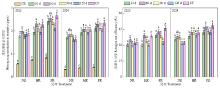
图2
缓释氮(肥)产品对水稻氮素吸收利用的影响 LF:当地习惯施肥 Localized customary fertilization practices;SR:缓释氮肥 Slow-release fertilizer。下同 The same as below"
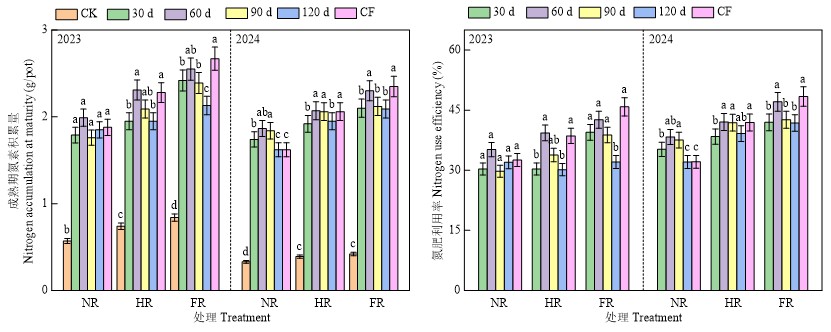
图3
缓释氮(肥)产品组合对水稻产量及氮素吸收利用的影响 2022年CK处理因穗分化期遭遇极端高温,其每穗粒数、结实率、千粒重较常年下降约13%—60%,导致产量等数据过低 In 2022, due to exposure to extreme high temperatures during the panicle differentiation stage, the grains per panicle, seed-setting rate, and thousand-grain weight of the CK treatment decreased by approximately 13% to 60% compared to normal years, resulting in excessively low yield and related data BQF:常规速效肥一次性基施 One-time basal application of conventional quick-release fertilizer。3+6:30+60 d组合施肥 30+60 days combined fertilization;3+9:30+90 d组合施肥 30+90 days combined fertilization;6+9:60+90 d组合施肥 60+90 days combined fertilization;3+6+9:30+60+90 d组合施肥 30+ 60+90 days combined fertilization。下同 The same as below"
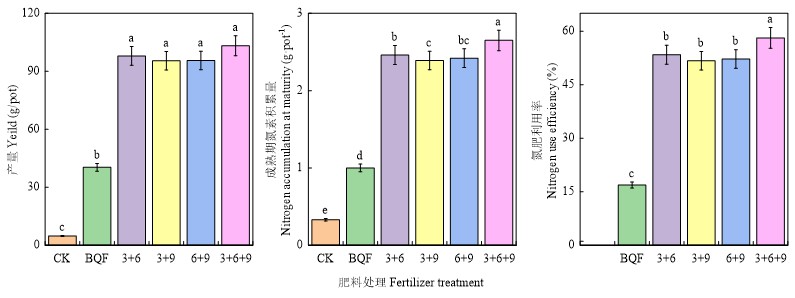
表2
缓释氮(肥)产品组合对水稻产量构成因素的影响"
| 肥料处理 Fertilizer treatment | 产量 Yield (g/pot) | 穗数 Panicle number (×104·hm-2) | 每穗粒数 Spikelets per panicle | 结实率 Seed setting rate (%) | 千粒重 1000-grain weight (g) |
|---|---|---|---|---|---|
| CK | 4.86c | 14.00d | 40.67c | 37.71c | 22.62c |
| BQF | 40.33b | 32.33c | 73.33b | 75.10b | 22.65c |
| 3+6 | 97.96a | 44.50a | 108.76a | 80.49a | 25.15b |
| 3+9 | 95.48a | 40.93b | 110.37a | 81.02a | 26.09ab |
| 6+9 | 95.63a | 38.95b | 111.78a | 83.30a | 26.37ab |
| 3+6+9 | 103.22a | 41.15b | 115.00a | 81.80a | 26.67a |
| F | ** | ** | ** | ** | ** |
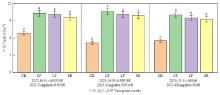
图4
肥料品种对水稻产量的影响"
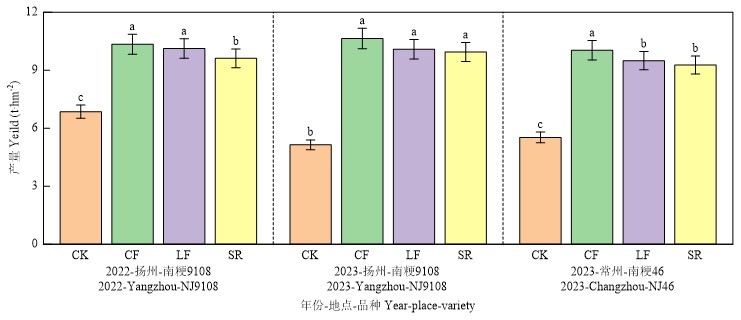
表3
肥料品种对水稻产量构成因素的影响"
| 时间 Year | 地点 Site | 品种 Variety | 肥料处理 Fertilizer treatment | 穗数 Panicle number (×104·hm-2) | 每穗粒数 Spikelets per panicle | 结实率 Seed setting rate (%) | 千粒重 1000-grain weight (g) |
|---|---|---|---|---|---|---|---|
| 2022 | 扬州Yangzhou | 南粳9108 NJ9108 | CK | 269.85c | 119.38b | 86.80b | 24.49b |
| CF | 353.85a | 132.77a | 87.23b | 25.23ab | |||
| LF | 339.15a | 138.08a | 87.43b | 24.76ab | |||
| SR | 297.15b | 135.26a | 93.14a | 25.68a | |||
| F | ** | ** | ** | ns | |||
| 2023 | 扬州Yangzhou | 南粳9108 NJ9108 | CK | 192.15c | 99.47c | 96.74a | 27.78a |
| CF | 340.20a | 118.45b | 95.12b | 27.79a | |||
| LF | 342.30a | 111.82b | 94.84b | 27.77a | |||
| SR | 308.70b | 136.94a | 93.26c | 25.22b | |||
| F | ** | ** | ** | ns | |||
| 2023 | 常州 Changzhou | 南粳46 NJ46 | CK | 15.69c | 101.30b | 91.47a | 25.29a |
| CF | 24.14a | 116.63a | 92.00a | 25.81a | |||
| LF | 23.50b | 116.54a | 91.86a | 25.16a | |||
| SR | 23.22b | 114.23a | 91.68a | 25.41a | |||
| F | ** | ** | ns | ns |
图5
肥料品种对氮素吸收利用的影响"
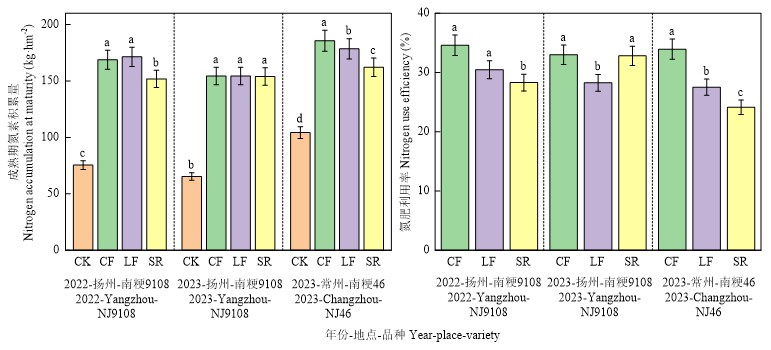
表4
缓速掺混配比试验对水稻产量与构成因素的影响"
| 时间 Year | 地点 Site | 品种 Variety | 肥料处理 Fertilizer treatment | 产量 Yield (t·hm-2) | 穗数 Panicle number (×104·hm-2) | 每穗粒数 Spikelets per panicle | 结实率 Seed setting rate (%) | 千粒重 1000-grain weight (g) | ||||||||
|---|---|---|---|---|---|---|---|---|---|---|---|---|---|---|---|---|
| 2022 | 扬州Yangzhou | 南粳9108 NJ9108 | CK | 6.85d | 269.85d | 119.38b | 86.80d | 24.49b | ||||||||
| CF | 10.34b | 353.85a | 132.77a | 87.23d | 25.23a | |||||||||||
| 7﹕3 | 10.99a | 343.35ab | 139.52a | 89.87c | 25.56a | |||||||||||
| 8﹕2 | 10.40b | 330.75ab | 134.58a | 90.98bc | 25.69a | |||||||||||
| 9﹕1 | 10.03b | 320.25bc | 134.34a | 92.38ab | 25.27a | |||||||||||
| 10﹕0 | 9.61c | 297.15c | 135.26a | 93.14a | 25.68a | |||||||||||
| F | ** | ** | ** | ** | ** | |||||||||||
| 2023 | 扬州Yangzhou | 南粳9108 NJ9108 | CK | 5.14c | 192.15c | 99.47c | 96.74a | 27.78a | ||||||||
| CF | 10.64ab | 340.20a | 118.45b | 95.12a | 27.79a | |||||||||||
| 7﹕3 | 10.74ab | 328.65ab | 132.90a | 92.81b | 26.49bc | |||||||||||
| 8﹕2 | 10.65ab | 326.55ab | 133.73a | 93.10b | 26.16cd | |||||||||||
| 9﹕1 | 10.30ab | 312.90ab | 136.48a | 93.14b | 25.89d | |||||||||||
| 10﹕0 | 9.94b | 308.70b | 136.94a | 93.26b | 25.22e | |||||||||||
| F | ** | ** | ** | ** | ** | |||||||||||
| 2023 | 常州 Changzhou | 南粳46 NJ46 | CK | 5.52e | 235.34d | 101.30e | 91.47c | 25.29a | ||||||||
| CF | 10.03b | 362.04b | 116.63bc | 92.00abc | 25.81a | |||||||||||
| 7﹕3 | 10.50a | 361.93b | 120.52a | 92.56a | 26.01a | |||||||||||
| 8﹕2 | 9.75c | 358.98b | 118.28ab | 91.74bc | 25.03a | |||||||||||
| 9﹕1 | 9.39d | 350.53c | 115.57bc | 92.59a | 25.04a | |||||||||||
| 10﹕0 | 9.27d | 348.33c | 114.23c | 91.68bc | 25.41a | |||||||||||
| F | ** | ** | ** | * | ns | |||||||||||
表5
缓速掺混配比试验对氮素吸收利用的影响"
| 时间 Year | 地点 Site | 品种 Variety | 肥料处理 Fertilizer treatment | 成熟期氮素积累量 Nitrogen accumulation at maturity (kg·hm-2) | 氮肥利用率 Nitrogen use efficiency (%) | 氮素收获指数 Nitrogen harvest index (%) | 氮素籽粒生产效率 Nitrogen grain production efficiency (kg N·kg-1) |
|---|---|---|---|---|---|---|---|
| 2022 | 扬州 Yangzhou | 南粳9108 NJ9108 | CK | 75.45e | 90.79a | 64.55a | |
| CF | 168.88bc | 34.60bc | 64.67b | 61.21a | |||
| 7﹕3 | 178.92a | 38.32a | 63.69b | 61.43a | |||
| 8﹕2 | 171.63b | 35.62b | 62.39b | 60.57a | |||
| 9﹕1 | 163.52c | 32.62c | 61.36b | 61.35a | |||
| 10﹕0 | 151.85d | 28.30d | 63.97b | 63.28a | |||
| F | ** | ** | * | ns | |||
| 2023 | 扬州 Yangzhou | 南粳9108 NJ9108 | CK | 65.39c | 78.61a | 62.34a | |
| CF | 154.46b | 32.99b | 71.34b | 68.96a | |||
| 7﹕3 | 158.86ab | 34.62ab | 69.83bc | 67.61a | |||
| 8﹕2 | 161.66a | 35.66ab | 68.27bc | 65.79a | |||
| 9﹕1 | 159.40ab | 34.82ab | 69.26bc | 64.60a | |||
| 10﹕0 | 154.00b | 32.82b | 64.45c | 64.56a | |||
| F | ** | ns | ** | ns | |||
| 2023 | 常州 Changzhou | 南粳46 NJ46 | CK | 104.24g | 60.24c | 53.91c | |
| CF | 185.69b | 33.94b | 53.31e | 53.99c | |||
| 7﹕3 | 187.79a | 34.83a | 58.97d | 56.37bc | |||
| 8﹕2 | 166.49d | 25.9d | 51.36f | 58.47ab | |||
| 9﹕1 | 158.54f | 22.67f | 61.65b | 59.38a | |||
| 10﹕0 | 162.14e | 24.14e | 67.17a | 56.99ab | |||
| F | ** | ** | ** | ** |
表6
速效肥施用时期对水稻产量及其构成因素的影响"
| 品种 Variety | 肥料处理 Fertilizer treatment | 产量 Yield (t·hm-2) | 穗数 Panicle number (×104·hm-2) | 每穗粒数 Spikelets per panicle | 结实率 Seed setting rate (%) | 千粒重 1000-grain weight (g) |
|---|---|---|---|---|---|---|
| 南粳9108 NJ9108 | CK | 5.14c | 192.15e | 99.47d | 96.74a | 27.78a |
| CF | 10.64ab | 340.20ab | 118.45c | 95.12ab | 27.79a | |
| 6﹕4 TF | 10.98a | 341.25a | 129.17b | 94.71ab | 26.31bc | |
| 6﹕4 BF | 10.88ab | 338.1abc | 132.35ab | 91.43c | 26.58b | |
| 7﹕3 TF | 11.11a | 339.15abc | 135.42ab | 94.66ab | 25.55ef | |
| 7﹕3 BF | 10.74ab | 328.65abcd | 132.90ab | 92.81bc | 26.49bc | |
| 8﹕2 TF | 10.81ab | 327.60abcd | 139.57a | 94.32b | 25.07g | |
| 8﹕2 BF | 10.65ab | 326.55abcd | 133.73ab | 93.10bc | 26.16cd | |
| 9﹕1 TF | 10.48ab | 313.95bcd | 137.95a | 94.32b | 25.64e | |
| 9﹕1 BF | 10.30ab | 312.90cd | 136.48ab | 93.14bc | 25.89de | |
| 10﹕0 | 9.94b | 308.70d | 136.94ab | 93.26bc | 25.22fg | |
| F | ** | ** | ** | ** | ** | |
| 南粳46 NJ46 | CK | 5.52c | 235.34c | 101.30b | 91.47a | 25.29a |
| CF | 10.03a | 362.08a | 116.63a | 92.00a | 25.81a | |
| 6﹕4 TF | 10.46cd | 386.28a | 115.09d | 90.45d | 26.01ab | |
| 6﹕4 PF | 10.88ab | 334.45d | 132.10a | 93.49a | 26.36a | |
| 6﹕4 ETP | 10.61c | 362.21bc | 123.66bc | 92.67b | 25.57bc | |
| 7﹕3 TF | 10.70bc | 372.20b | 124.57b | 89.41e | 25.81ab | |
| 7﹕3 PF | 11.10a | 344.72d | 133.33a | 91.55c | 26.40a | |
| 7﹕3 ETP | 10.90ab | 358.79c | 133.41a | 91.58c | 24.87d | |
| 8﹕2 TF | 10.06e | 369.81b | 119.05cd | 90.95cd | 25.11cd | |
| 8﹕2 PF | 10.30d | 339.54d | 129.89a | 91.06cd | 25.66bc | |
| F | ** | ** | ** | ** | ** |
表7
速效肥施用时期对氮素吸收利用的影响"
| 品种 Variety | 肥料处理 Fertilizer treatment | 成熟期氮素积累量 Nitrogen accumulation at maturity (kg·hm-2) | 氮肥利用率 Nitrogen use efficiency (%) | 氮素收获指数 Nitrogen harvest index (%) | 氮素籽粒生产效率 Nitrogen grain production efficiency (kg N·kg-1) |
|---|---|---|---|---|---|
| 南粳9108 NJ9108 | CK | 65.39b | 78.61a | 62.34a | |
| CF | 154.46b | 32.99b | 71.34b | 68.96a | |
| 6﹕4 TF | 164.34a | 36.65a | 66.82bcd | 66.83a | |
| 6﹕4 BF | 164.24a | 36.61a | 67.72bcd | 66.22a | |
| 7﹕3 TF | 166.13a | 37.31a | 66.88bcd | 66.87a | |
| 7﹕3 BF | 158.86ab | 34.62ab | 69.83bc | 67.61a | |
| 8﹕2 TF | 163.90a | 36.49a | 65.70cd | 65.95a | |
| 8﹕2 BF | 161.66ab | 35.66ab | 68.27bcd | 65.79a | |
| 9﹕1 TF | 161.14ab | 35.46ab | 67.37bcd | 65.01a | |
| 9﹕1 BF | 159.40ab | 34.82ab | 69.26bc | 64.60a | |
| 10﹕0 | 154.00b | 32.82b | 64.45d | 64.56a | |
| F | ** | * | ** | ns | |
| 南粳46 NJ46 | CK | 104.24i | 60.24a | 53.91bc | |
| CF | 185.70g | 33.94a | 53.31g | 53.99bc | |
| 6:4 TF | 187.79f | 34.83f | 56.45c | 55.68ab | |
| 6:4 PF | 206.24b | 42.50b | 54.60f | 53.08c | |
| 6:4 ETP | 186.14g | 34.17g | 57.94b | 56.59a | |
| 7:3 TF | 195.29d | 37.90d | 54.58f | 54.99abc | |
| 7:3 PF | 210.29a | 44.15a | 55.31ef | 52.94c | |
| 7:3 ETP | 204.14c | 41.63c | 56.08cd | 53.40c | |
| 8:2 TF | 177.89h | 30.68h | 55.22ef | 56.42a | |
| 8:2 PF | 191.39e | 36.32e | 55.44de | 53.94bc | |
| F | ** | ** | ** | * |
表8
缓释氮产品组合优化配比对水稻产量的影响"
| 肥料处理 Fertilizer treatment | 产量 Yield (t·hm-2) | 穗数 Panicle number (×104·hm-2) | 每穗粒数 Spikelets per panicle | 结实率 Seed setting rate (%) | 千粒重 1000-grain weight (g) |
|---|---|---|---|---|---|
| CK | 5.32c | 236.36f | 107.71f | 82.27b | 25.36abc |
| CF | 10.10a | 363.64a | 126.67e | 86.93a | 25.22bc |
| 1/6 | 10.04a | 351.52ab | 131.98d | 86.38a | 25.09bc |
| 2/6 | 10.13a | 339.39bc | 133.60d | 88.22a | 25.35abc |
| 3/6 | 10.32a | 333.33bc | 140.13bc | 88.13a | 25.07bc |
| 4/6 | 10.48a | 321.21cd | 144.93a | 88.02a | 25.57ab |
| 5/6 | 9.44b | 309.09de | 141.39b | 87.00a | 24.85c |
| 6/6 | 9.19b | 290.91e | 137.94c | 88.38a | 25.95a |
| F | ** | ** | ** | ** | * |
表9
缓释氮产品组合优化配比对氮素吸收利用的影响"
| 肥料处理 Fertilizer treatment | 成熟期氮素积累量 Nitrogen accumulation at maturity (kg·hm-2) | 氮肥利用率 Nitrogen use efficiency (%) | 氮素收获指数 Nitrogen harvest index (%) | 氮素籽粒生产效率 Nitrogen grain production efficiency (kg N·kg-1) |
|---|---|---|---|---|
| CK | 124.02d | 57.06ab | 42.83a | |
| CF | 215.36abc | 38.06abc | 54.91bcd | 46.91a |
| 1/6 | 212.93abc | 37.05abc | 53.22cd | 47.20a |
| 2/6 | 219.27ab | 39.69ab | 56.73abc | 46.27a |
| 3/6 | 223.16ab | 41.31ab | 52.14d | 46.28a |
| 4/6 | 227.55a | 43.14a | 59.07a | 46.24a |
| 5/6 | 209.81bc | 35.75bc | 56.04abc | 45.12a |
| 6/6 | 203.27c | 33.02c | 56.29abc | 46.27a |
| F | ** | * | ** | ns |
表10
缓释氮产品组合优化配比对源库及物质生产的影响"
| 肥料处理 Fertilizer treatment | 抽穗期高效LAI High efficiency LAI at heading stage | 抽穗期总LAI Total LAI at heading stage | 库容量 Storage capacity (t·hm-2) | 成熟期干物质生产量 Dry matter production at maturity (t·hm-2) | 经济系数 Economic coefficient |
|---|---|---|---|---|---|
| CK | 2.24d | 4.88g | 6.47d | 12.29d | 0.368b |
| CF | 4.82a | 7.29c | 11.62ab | 21.86ab | 0.393ab |
| 1/6 | 4.40b | 6.66d | 11.63ab | 21.40b | 0.399ab |
| 2/6 | 4.98a | 8.25b | 11.50ab | 21.50b | 0.401a |
| 3/6 | 4.23b | 8.18b | 11.71a | 22.05ab | 0.398ab |
| 4/6 | 5.10a | 9.27a | 11.91a | 22.33a | 0.399ab |
| 5/6 | 3.62c | 6.20e | 10.86bc | 21.61ab | 0.372ab |
| 6/6 | 3.44c | 5.71f | 10.42c | 19.96c | 0.391ab |
| F | ** | ** | ** | ** | ns |
| [1] |
赵秉强. 传统化肥增效改性提升产品性能与功能. 植物营养与肥料学报, 2016, 22(1): 1-7.
|
|
|
|
| [2] |
蒋伟勤, 车阳, 李可, 文廷刚, 顾大路, 章安康. 江苏省水稻栽培关键技术应用现状及展望. 江苏农业学报, 2023, 39(2): 567-575.
|
|
|
|
| [3] |
杨蕊, 耿石英, 王小燕. 江汉平原不同氮肥运筹模式下豆麦和稻/麦轮作系统小麦产量和经济效益差异. 应用生态学报, 2020, 31(2): 441-448.
doi: 10.13287/j.1001-9332.202002.022 |
|
|
|
| [4] |
doi: 10.1111/jipb.2007.49.issue-6 |
| [5] |
doi: 10.1626/pps.12.3 |
| [6] |
杜昌文, 周健民. 控释肥料的研制及其进展. 土壤, 2002, 34(3): 127-133.
|
|
|
|
| [7] |
田昌, 周旋, 谢桂先, 刘强, 荣湘民, 张玉平, 谭力彰, 彭建伟. 控释尿素减施对双季稻田氨挥发损失和氮肥利用率的影响. 中国水稻科学, 2018, 32(4): 387-397.
doi: 10.16819/j.1001-7216.2018.8004 |
|
doi: 10.16819/j.1001-7216.2018.8004 |
|
| [8] |
裴晓红, 王成科. 缓释配方肥在水稻生产上的肥效监测试验简报. 上海农业科技, 2023(3): 50-51, 65.
|
|
|
|
| [9] |
丁周宇, 张娜, 舒小伟, 杨英, 王树深, 伏桐, 赵士茹, 王子涵, 周娟, 姚友礼, 季美娣, 董桂春. 栽培措施对水稻氮素吸收利用及稻田尾水氮磷含量的影响. 农业环境科学学报, 2023, 42(9): 2004-2015.
|
|
|
|
| [10] |
doi: 10.3390/agronomy13020448 |
| [11] |
doi: 10.1186/s12870-024-05309-9 pmid: 38951829 |
| [12] |
李世发, 刘元英, 范立春, 韩旭, 刁婥. 缓释肥对水稻生长发育及产量的影响. 东北农业大学学报, 2008, 39(7): 38-43.
|
|
|
|
| [13] |
魏海燕, 李宏亮, 程金秋, 张洪程, 戴其根, 许轲, 霍中洋, 郭保卫, 胡雅杰, 崔培媛. 缓释肥类型与运筹对不同穗型水稻产量的影响. 作物学报, 2017, 43(5):730-740.
|
|
doi: 10.3724/SP.J.1006.2017.00730 |
|
| [14] |
陈云, 李思宇, 朱安, 刘昆, 张亚军, 张耗, 顾骏飞, 张伟杨, 刘立军, 杨建昌. 播种量和穗肥施氮量对优质食味直播水稻产量和品质的影响. 作物学报, 2022, 48(3): 656-666.
doi: 10.3724/SP.J.1006.2022.12012 |
|
doi: 10.3724/SP.J.1006.2022.12012 |
|
| [15] |
doi: 10.3389/fpls.2024.1273774 |
| [16] |
王树深. 缓释肥优化施用对南粳9108产量形成、氮素吸收利用的影响[D]. 扬州: 扬州大学, 2024.
|
|
|
|
| [17] |
邢晓鸣, 李小春, 丁艳锋, 王绍华, 刘正辉, 唐设, 丁承强, 李刚华, 魏广彬. 缓控释肥组配对机插常规粳稻群体物质生产和产量的影响. 中国农业科学, 2015, 48(24): 4892-4902. doi:10.3864/j.issn.0578-1752.2015.24.004.
|
|
|
|
| [18] |
赵丹, 魏景辉, 杨正华, 陈月坤, 宋云霞. 缓控释肥在如东县水稻机插侧深施肥中的应用效果初探. 上海农业科技, 2024(6): 125-127, 132.
|
|
|
|
| [19] |
陈奕霖. 秸秆还田下缓释肥与尿素配施对水稻抗倒性及氮素吸收利用的影响[D]. 长春: 吉林农业大学, 2024.
|
|
|
|
| [20] |
佟欣宇. 缓释氮肥与尿素配施对水稻产量和品质的影响[D]. 长春: 吉林农业大学, 2024.
|
|
|
|
| [21] |
刘媛媛. 新型包膜缓释肥的研制及其性能研究[D]. 南京: 南京理工大学, 2012.
|
|
|
|
| [22] |
陈少杰, 何冰清, 罗宝杰, 蒋琪. 不同缓释肥对杂交水稻产量及群体结构的影响. 中国农学通报, 2024, 40(5): 34-38.
doi: 10.11924/j.issn.1000-6850.casb2023-0187 |
|
doi: 10.11924/j.issn.1000-6850.casb2023-0187 |
|
| [23] |
赵呈明, 费新茹, 郭红, 李进永, 许业, 李玲, 王敏. 缓释肥一次性基施对超级稻盐粳15号产量和品质的影响. 大麦与谷类科学, 2022, 39(5): 48-51.
|
|
|
|
| [24] |
黄小洋, 顾克军, 郭智, 刘红江. 施用缓控释掺混氮肥对水稻产量及氮素吸收利用的影响. 江苏农业科学, 2024, 52(4): 80-85.
|
|
|
|
| [25] |
doi: 10.1016/j.cj.2025.04.008 |
| [26] |
|
| [27] |
于杰, 王秀春, 步艳红. 汉枫缓释肥料在水稻上应用效果. 现代化农业, 2013(6): 22-23.
|
|
|
|
| [28] |
舒小伟, 王树深, 伏桐, 王子涵, 丁周宇, 杨英, 赵士茹, 周娟, 黄建晔, 姚友礼, 王余龙, 董桂春. 小麦秸秆还田后不同水稻品种对简化穗肥施用的响应及其成因. 中国农业科学, 2024, 57(10): 1961-1978. doi:10.3864/j.issn.0578-1752.2024.10.009.
|
|
|
|
| [29] |
周舟, 沈炘垭, 王俊, 刘立军. 控释肥与普通尿素组合对水稻产量、氮肥利用率和米质的影响. 作物杂志, 2024(4): 180-187.
|
|
|
|
| [30] |
董桂春, 陈琛, 袁秋梅, 羊彬, 朱正康, 曹文雅, 仲军, 周娟, 罗刚, 王熠, 黄建晔, 王余龙. 氮肥处理对氮素高效吸收水稻根系性状及氮肥利用率的影响. 生态学报, 2016, 36(3): 642-651.
|
|
|
|
| [31] |
王树深, 罗刚, 舒小伟, 徐萱, 王子涵, 丁周宇, 杨英, 伏桐, 周娟, 姚友礼, 黄建晔, 王余龙, 董桂春. S型控释氮肥运筹对水稻产量形成及氮素利用特征的影响. 安徽农业大学学报, 2024, 51(3): 384-396.
|
|
|
|
| [32] |
王云翔. 不同缓释期氮肥与尿素一次配施对中、晚粳稻群体特征形成的影响[D]. 扬州: 扬州大学, 2023.
|
|
|
|
| [33] |
陈凯, 徐欣欣, 谢小聪, 王慧荣, 施黎云, 陈建民. 缓控释氮肥施用对冷浸田单季晚稻生长和氮肥效率的影响. 浙江农业科学, 2023, 64(12): 2836-2839.
doi: 10.16178/j.issn.0528-9017.20221019 |
|
|
|
| [34] |
张巫军, 段秀建, 杭晓宁, 唐明瑜, 姚雄, 唐永群, 刘强明, 文明, 肖人鹏, 张现伟, 李经勇. 缓控释肥组配对长江上游早熟杂交籼稻再生稻产量和物质积累的影响. 西北农业学报, 2021, 30(1):74-82.
|
|
|
|
| [35] |
解玉洪, 李曰鹏. 国外缓控释肥产业化研究进展与前景. 磷肥与复肥, 2009, 24(4): 87-89, 92.
|
|
|
|
| [36] |
金月, 侯建军, 裴惠民, 冷明珠. 缓释肥一次性基施对浙粳86产量及氮肥利用率的影响. 浙江农业科学, 2022, 63(3): 449-450, 455.
doi: 10.16178/j.issn.0528-9017.20212871 |
|
|
|
| [37] |
丁艳锋, 李刚华, 李伟玮, 高深, 汪瑜辉, 刘正辉, 陈琳, 丁承强, 唐设, 江瑜. 水稻机插缓混一次施肥技术的研发与示范. 中国稻米, 2020, 26(5): 11-15.
doi: 10.3969/j.issn.1006-8082.2020.05.002 |
|
doi: 10.3969/j.issn.1006-8082.2020.05.002 |
|
| [38] |
何荣川. 缓控释肥对水稻氮素吸收利用、产量和品质形成的影响[D]. 南京: 南京农业大学, 2018: 38-46.
|
|
|
|
| [39] |
doi: 10.1016/S2095-3119(20)63406-2 |
| [40] |
邢晓鸣. 高缓控释肥种类及施肥方式对水稻产量、稻田氨挥发及光合物质生产的影响实现[D]. 南京: 南京农业大学, 2015.
|
|
|
|
| [41] |
刘晓淑, 侯翠红, 陈新平, 丁茂, 束维正, 王孟来, 井红权, 张务帅. 无机包裹缓释肥对水稻生长与氮肥利用的影响. 西南大学学报(自然科学版), 2025, 47(1): 83-92.
|
|
|
|
| [42] |
倪艳云, 冯明, 闵思桂, 宋桂香. 缓释肥不同配比对毯苗机插南粳9108产量的影响. 大麦与谷类科学, 2020, 37(1): 30-33.
|
|
|
|
| [43] |
张木, 唐拴虎, 黄巧义, 逄玉万, 易琼, 黄旭, 李苹, 付弘婷. 缓释尿素配施普通尿素对双季稻养分的供应特征. 中国农业科学, 2018, 51(20): 3985-3995. doi:10.3864/j.issn.0578-1752.2018.20.016.
|
|
|
|
| [44] |
黄益孝, 周家昊, 陈照明, 王强, 马军伟, 叶静. 化肥减量配施缓释肥对单季稻产量和氮素吸收利用的影响. 江苏农业科学, 2024, 52(2):57-64.
|
|
|
|
| [45] |
doi: 10.1007/s13593-015-0300-7 |
| [46] |
吕小红, 付立东, 王宇, 隋鑫, 任海, 李旭, 李宝军. 配比施用缓释肥与速效氮肥对机插水稻产量和氮肥利用率的影响. 江苏农业科学, 2016, 44(5):115-118.
|
|
|
|
| [47] |
汪向东, 张长海. 不同新型肥料作基肥对机插双晚常规粳稻分蘖和主要性状的影响. 安徽农业科学, 2022, 50(2): 169-171, 221.
|
|
|
| [1] | 王忠妮, 雷月, 李佳丽, 宫彦龙, 朱速松. ABC转运蛋白OsARG1调控水稻抽穗期的功能[J]. 中国农业科学, 2026, 59(1): 1-16. |
| [2] | 吕旭东, 孙世媛, 李亚楠, 刘玉龙, 王艳群, 付鑫, 张佳英, 宁鹏, 彭正萍. 智能机械化分层施肥对麦田根-土养分分布和小麦产量的影响[J]. 中国农业科学, 2026, 59(1): 129-146. |
| [3] | 陆浩, 张明龙, 韩梅, 严清彪, 李正鹏, 殷文, 樊志龙, 胡发龙, 柴强. 绿肥过腹还田协同氮肥减施提高小麦产量和土壤质量[J]. 中国农业科学, 2026, 59(1): 147-160. |
| [4] | 叶美金, 陈家婷, 周界光, 尹丽, 胡欣荣, 兰雨昕, 陈斌, 苏龙兴, 刘家君, 刘天超, 李小雨, 马建. 小麦穗密度主效QTL的鉴定、验证及其遗传效应分析[J]. 中国农业科学, 2026, 59(1): 17-28. |
| [5] | 费耀莹, 王迪, 唐伟杰, 郭彩丽, 张小虎, 邱小雷, 程涛, 姚霞, 江冲亚, 朱艳, 曹卫星, 郑恒彪. 基于无人机多源影像融合的水稻籽粒蛋白质含量估测[J]. 中国农业科学, 2026, 59(1): 41-56. |
| [6] | 王爱冬, 李瑞杰, 冯向前, 洪卫源, 李子秋, 张晓果, 王丹英, 陈松. 基于多角度成像与机器学习的水稻叶面积精确估算[J]. 中国农业科学, 2025, 58(9): 1719-1734. |
| [7] | 蒲丽霞, 张佳芮, 叶建萍, 黄秀兰, 樊高琼, 杨洪坤. 二氢赤霉素与秸秆覆盖对旱地小麦分蘖成穗与产量的影响[J]. 中国农业科学, 2025, 58(9): 1735-1748. |
| [8] | 郭晨荔, 刘扬, 陈燕, 胡伟, 王友华, 周治国, 赵文青. 减氮条件下适当磷肥后移对滴灌棉花产量和磷肥利用效率的影响[J]. 中国农业科学, 2025, 58(9): 1749-1766. |
| [9] | 韦萍, 潘炬忠, 朱德平, 邵胜雪, 陈珊珊, 韦雅倩, 高维维. OsDREB1J调控水稻籽粒大小的功能研究[J]. 中国农业科学, 2025, 58(8): 1463-1478. |
| [10] | 刘劲松, 伍龙梅, 包晓哲, 刘志霞, 张彬, 杨陶陶. 短期减施氮肥对华南地区早晚兼用型水稻产量和稻米品质的影响[J]. 中国农业科学, 2025, 58(8): 1508-1520. |
| [11] | 韦文华, 李盼, 邵冠贵, 樊志龙, 胡发龙, 范虹, 何蔚, 柴强, 殷文, 赵连豪. 西北灌区青贮玉米产量及品质对减量灌水与有机无机肥配施的响应[J]. 中国农业科学, 2025, 58(8): 1521-1534. |
| [12] | 薛钰琦, 赵继玉, 孙旺胜, 任佰朝, 赵斌, 刘鹏, 张吉旺. 不同氮素形态对夏玉米产量和品质的影响[J]. 中国农业科学, 2025, 58(8): 1535-1549. |
| [13] | 李绍兴, 宋稳锋, 魏泽煜, 周玉玲, 宋李霞, 任可, 马群, 王龙昌. 秸秆与紫云英覆盖对土壤肥力及甘薯产量的影响[J]. 中国农业科学, 2025, 58(8): 1591-1603. |
| [14] | 王彬, 吴朋浩, 鲁剑巍, 任涛, 丛日环, 陆志峰, 李小坤. 长江中游地区水稻-油菜轮作体系需水特征[J]. 中国农业科学, 2025, 58(7): 1355-1365. |
| [15] | 尹波, 于爱忠, 王鹏飞, 杨学慧, 王玉珑, 尚永盼, 张冬玲, 刘亚龙, 李悦, 王凤. 绿肥还田结合氮肥减施对干旱灌区麦田土壤水热特征及小麦产量的影响[J]. 中国农业科学, 2025, 58(7): 1366-1380. |
|
||
