






中国农业科学 ›› 2026, Vol. 59 ›› Issue (3): 589-601.doi: 10.3864/j.issn.0578-1752.2026.03.009
咸青林( ), 肖鉴珂, 高阿庆, 郜利闯, 刘杨()
收稿日期:2025-03-17
接受日期:2025-04-28
出版日期:2026-02-01
发布日期:2026-01-31
通信作者:
联系方式:
咸青林,E-mail:qinglinxian@nwafu.edu.cn。
基金资助:
XIAN QingLin(), XIAO JianKe, GAO AQing, GAO LiChuang, LIU Yang()
Received:2025-03-17
Accepted:2025-04-28
Published:2026-02-01
Online:2026-01-31
摘要:
【背景】提高水分利用效率有利于小麦的可持续生产。垄沟种植和测墒补灌技术均可以显著提高作物水分利用效率。但二者结合能否起到良好的节水效果,从而提升小麦水分利用效率,目前尚不明确。【目的】探索垄沟种植结合测墒补灌对小麦群体、产量和水分利用效率的影响。【方法】进行了为期两年的田间试验,冬小麦品种选用西农20,采用沟播(P1)、垄播(P2)和平作(P3)3种种植方式,结合0—40 cm土层补灌至田间持水量(S40)、0—60 cm土层补灌至田间持水量(S60)和传统漫灌作为对照(SCK)3种灌溉处理。通过测定土壤含水量、冬小麦茎蘖动态、干物质积累量、产量及其构成因素,并计算农田耗水总量、降水利用效率、灌溉水利用效率和总耗水利用效率、边行指数及经济效益来探究种植方式和测墒补灌技术对冬小麦生长发育、产量、水分利用效率和经济效益的影响。【结果】沟播种植方式配合60 cm土层测墒补灌(P1S60)处理的土壤含水量、小麦茎蘖数及干物质积累量与平作传统漫灌处理(P3SCK)无显著差异,并且沟播种植方式利用边际效应提高边行冬小麦的穗数和穗粒数,保证小麦产量不降低的同时,结合0—60 cm土层测墒补灌可以节约灌溉水34.5%,降低农田耗水总量10.8%,使灌溉水利用效率(IWUE)和水分利用效率(WUE)分别提高79.5%和14.7%(两年平均值)。与平作传统漫灌(P3SCK)处理相比,沟播配合0—60 cm土层测墒补灌(P1S60)处理总收入提高3.2%,具有较高的经济潜力。【结论】在综合考虑水资源利用效率、作物产量和收益潜力的情况下,采用沟播种植、0—60 cm土层补水至田间持水量为关中灌区较好的种植模式。
咸青林, 肖鉴珂, 高阿庆, 郜利闯, 刘杨. 种植方式结合测墒补灌下冬小麦产量及水分利用效率[J]. 中国农业科学, 2026, 59(3): 589-601.
XIAN QingLin, XIAO JianKe, GAO AQing, GAO LiChuang, LIU Yang. Effects of Planting Patterns Combined with Soil Moisture Measurement and Supplementary Irrigation on the Yield and Water Use Efficiency of Winter Wheat[J]. Scientia Agricultura Sinica, 2026, 59(3): 589-601.
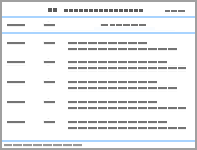
表1
试验地2020和2021年小麦播前土壤容重和田间持水量"
| 土层 Soil layer (cm) | 土壤含水量Water content (%) | 土壤容重Soil bulk density (g·cm-3) | 田间持水量Field capacity (%) | |||
|---|---|---|---|---|---|---|
| 2020 | 2021 | 2020 | 2021 | 2020 | 2021 | |
| 0-10 | 20.45 | 20.87 | 1.55 | 1.67 | 22.53 | 23.06 |
| 10-20 | 19.97 | 20.69 | 1.75 | 1.79 | 22.53 | 20.47 |
| 20-40 | 19.48 | 19.97 | 1.73 | 1.77 | 22.42 | 21.29 |
| 40-60 | 19.70 | 20.23 | 1.68 | 1.69 | 22.68 | 23.48 |
| 60-80 | 20.18 | 21.50 | 1.73 | 1.71 | 25.60 | 24.50 |
| 80-100 | 20.88 | 22.40 | 1.73 | 1.68 | 25.60 | 24.46 |
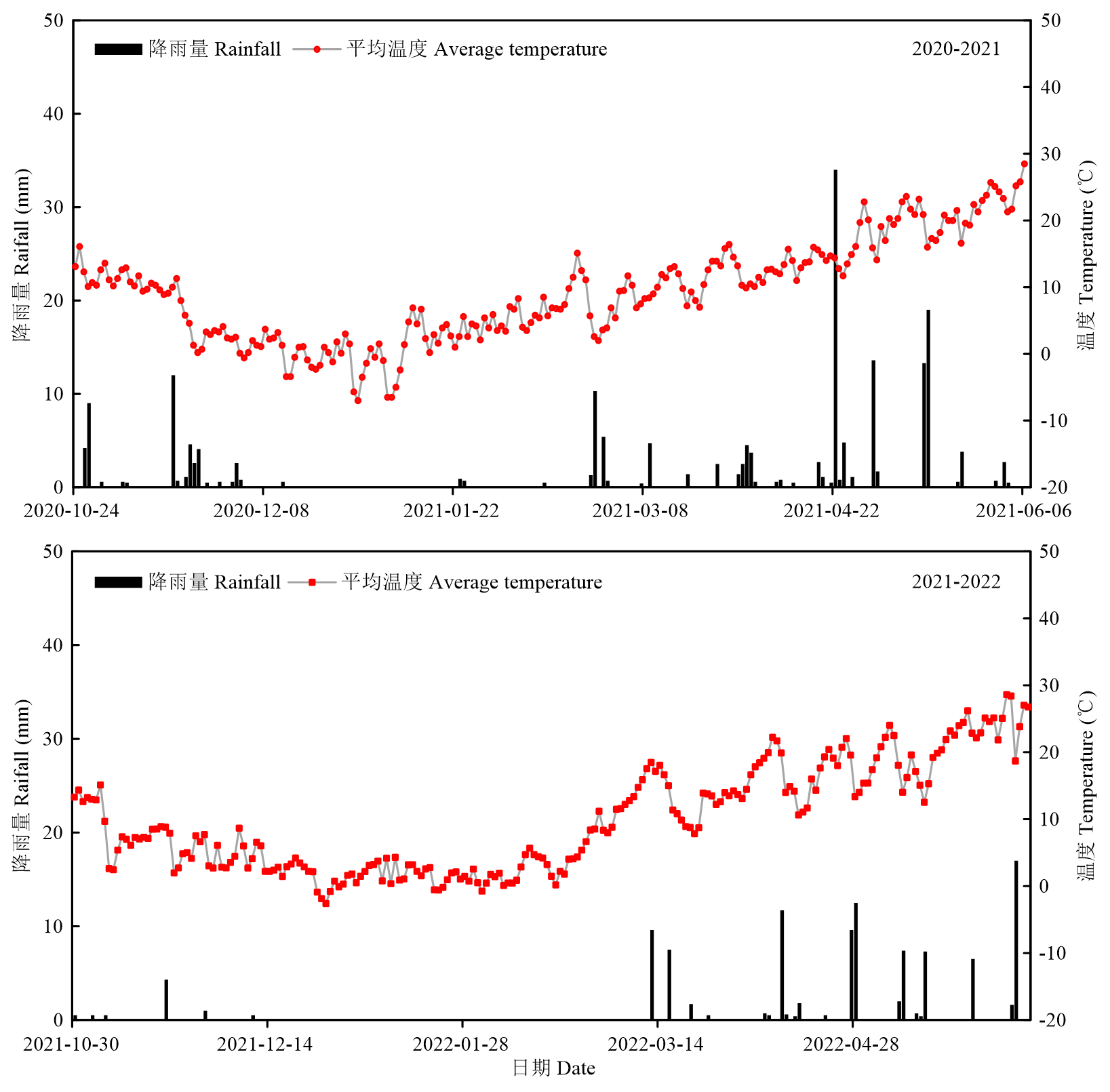
图1
2020—2021年和2021—2022年冬小麦生长季气象数据"
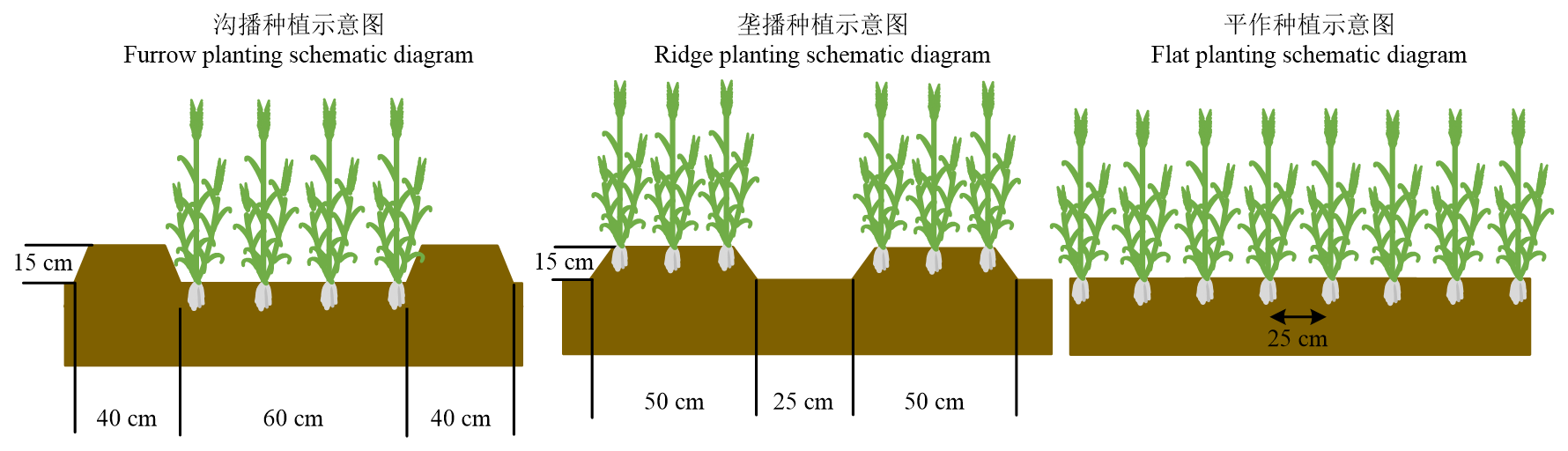
图2
田间种植模式示意图"

图3
2020—2022年冬小麦不同生育时期0—100 cm土层含水量 误差棒表示在P=0.05水平下存在显著差异(n=3)"
表2
2020—2022年不同处理农田0—100 cm土层总耗水量"
| 种植方式 Planting pattern | 测墒补灌 Supplemental irrigation | 2020-2021 | 2021-2022 | ||||||
|---|---|---|---|---|---|---|---|---|---|
| 灌水量 Irrigation (mm) | 土壤贮水 Soil water (mm) | 降水 Precipitation (mm) | 总量 Total amount (mm) | 灌水量 Irrigation (mm) | 土壤贮水 Soil water (mm) | 降水 Precipitation (mm) | 总量 Total amount (mm) | ||
| 沟播 Furrow sowing (P1) | S40 | 35.27de | 128.90bc | 185.20 | 349.37d | 61.72d | 130.08b | 105.00 | 296.80de |
| S60 | 45.42c | 116.55c | 185.20 | 347.17d | 85.50b | 105.89e | 105.00 | 296.39de | |
| SCK | 100.00a | 116.83c | 185.20 | 402.03b | 100.00a | 120.89c | 105.00 | 325.89b | |
| 垄播 Ridge sowing (P2) | S40 | 30.17e | 148.71a | 185.20 | 364.08cd | 48.32e | 142.42a | 105.00 | 295.74de |
| S60 | 39.66d | 144.63ab | 185.20 | 369.49c | 70.42c | 129.83b | 105.00 | 305.25c | |
| SCK | 100.00a | 146.45a | 185.20 | 431.65a | 100.00a | 134.22b | 105.00 | 339.22a | |
| 平作 Flat planting (P3) | S40 | 39.51cd | 126.90c | 185.20 | 351.61d | 62.37d | 121.55c | 105.00 | 288.91e |
| S60 | 53.88b | 113.26c | 185.20 | 352.34cd | 89.67b | 105.33e | 105.00 | 300.00cd | |
| SCK | 100.00a | 117.59c | 185.20 | 402.79b | 100.00a | 113.71d | 105.00 | 318.71b | |
| F值 F value | P | ** | ** | ** | ** | ** | ** | ||
| S | ** | ns | ** | ** | ** | ** | |||
| P×S | ns | ns | ns | ** | ns | ** | |||
表3
2020—2021年种植方式和测墒补灌对冬小麦群体茎蘖动态的影响"
| 种植方式 Planting pattern | 测墒补灌 Supplemental irrigation | 茎蘖数 Tillers number (×104 plant/hm2) | |||
|---|---|---|---|---|---|
| 越冬期 Wintering stage | 拔节期 Jointing stage | 开花期 Anthesis stage | 成熟期 Maturity stage | ||
| 沟播 Furrow sowing (P1) | S40 | 591.11a | 1280.01ab | 740.00c | 486.67a |
| S60 | 1360.01a | 773.34bc | 502.34a | ||
| SCK | 1231.12ab | 766.67bc | 448.00a | ||
| 垄播 Ridge sowing (P2) | S40 | 493.33b | 817.78e | 560.00e | 346.45b |
| S60 | 1026.67d | 653.34d | 334.34b | ||
| SCK | 1044.45cd | 620.00de | 326.33b | ||
| 平作 Flat planting (P3) | S40 | 444.44b | 1208.89b | 846.67ab | 449.34a |
| S60 | 1186.67b | 893.34a | 466.67a | ||
| SCK | 1177.78bc | 793.34bc | 502.00a | ||
| F值 F value | P | ** | ** | ** | ** |
| S | - | ns | ns | ns | |
| P×S | - | * | ns | ns | |
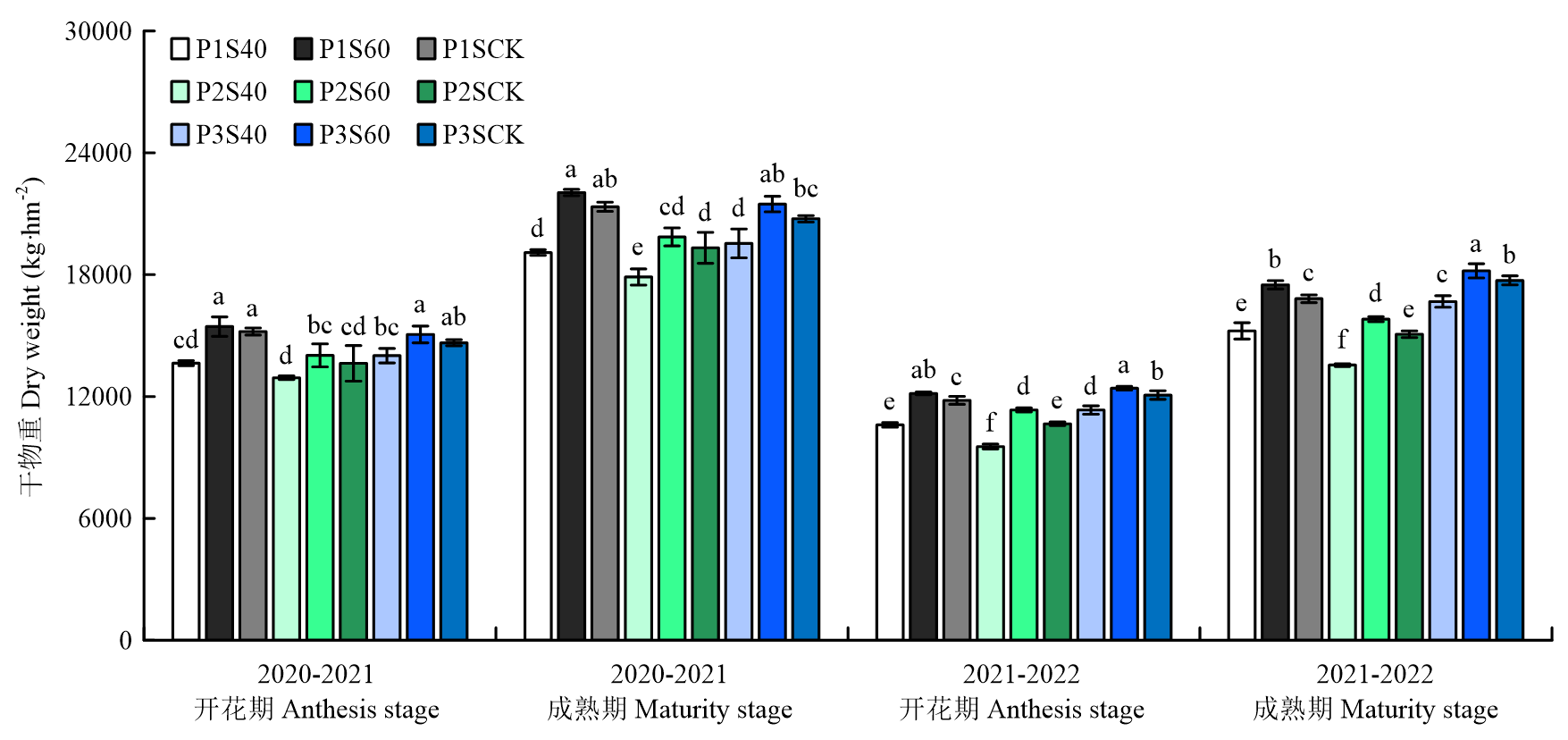
图4
2020—2022年不同生育时期冬小麦地上部干物质积累量 误差棒表示标准差。下同"
表4
2020—2022年不同处理对冬小麦产量及其构成因素的影响"
| 种植方式 Planting pattern | 测墒补灌 Supplemental irrigation | 年份 Year | |||||||
|---|---|---|---|---|---|---|---|---|---|
| 2020-2021 | 2021-2022 | ||||||||
| 穗数 Spike number (×104·hm-2) | 穗粒数 Grain number per spike | 千粒重 1000-grain weight (g) | 产量 Yield (t·hm-2) | 穗数 Spike number (×104·hm-2) | 穗粒数 Grain number per spike | 千粒重 1000-grain weight (g) | 产量 Yield (t·hm-2) | ||
| 沟播 Furrow sowing (P1) | S40 | 486.67a | 45.02abc | 48.29b | 7.61cd | 462.70b | 36.55ab | 52.49ab | 7.27b |
| S60 | 502.34a | 52.75a | 48.72b | 8.83a | 477.40ab | 36.90ab | 50.12bc | 7.49ab | |
| SCK | 448.00a | 46.07abc | 48.47b | 8.33ab | 473.40ab | 39.05ab | 50.06c | 7.42ab | |
| 垄播 Ridge sowing (P2) | S40 | 346.45b | 46.24abc | 49.25ab | 7.24d | 332.95d | 34.58b | 53.15a | 6.18c |
| S60 | 334.34b | 49.74ab | 49.98a | 8.05bc | 384.00c | 38.90ab | 52.35abc | 6.56c | |
| SCK | 326.33b | 49.50ab | 48.62b | 7.96bc | 376.90c | 38.36ab | 52.95a | 6.51c | |
| 平作 Flat planting (P3) | S40 | 449.34a | 45.43abc | 48.46b | 7.75bcd | 477.35ab | 38.97ab | 53.28a | 7.50ab |
| S60 | 466.67a | 43.03bc | 48.63b | 8.76a | 485.35ab | 41.17a | 52.81a | 7.96a | |
| SCK | 502.00a | 40.30c | 48.25b | 8.27abc | 497.30a | 38.30ab | 52.45abc | 7.54ab | |
| F值 F value | P | ** | * | * | ** | ** | ns | * | ** |
| S | ns | ns | ns | * | ** | ns | ns | ** | |
| P×S | ns | ns | ns | ** | ns | ns | ns | ns | |
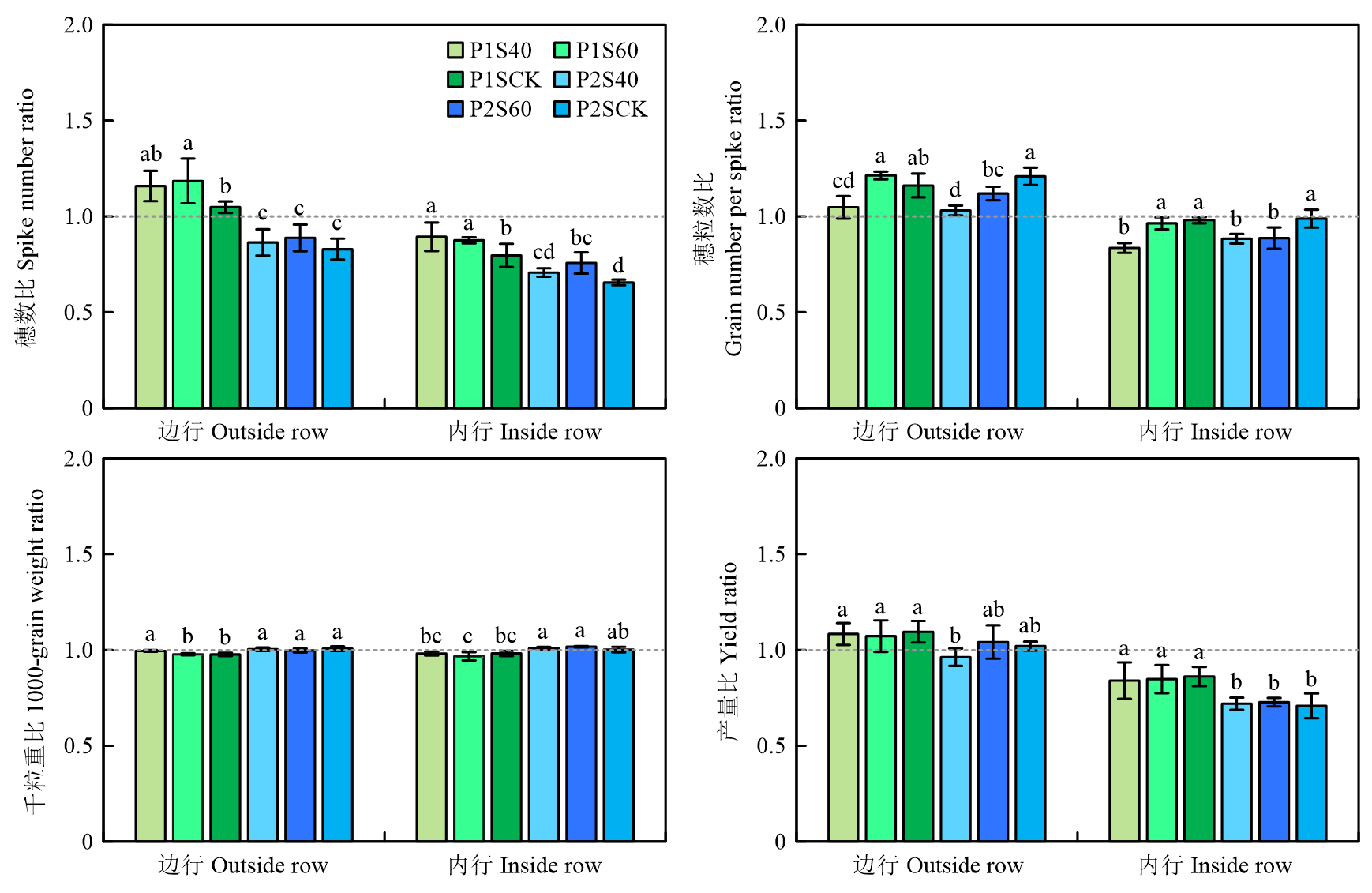
图5
2020—2022年不同处理的外行指数和内行指数"
表5
2020—2022年不同处理对冬小麦灌溉水利用效率(IWUE)、降水利用效率(PWUE)和水分利用效率(WUE)的影响"
| 种植方式 Planting pattern | 测墒补灌 Supplemental irrigation | 年份 Year | ||||||||||||||
|---|---|---|---|---|---|---|---|---|---|---|---|---|---|---|---|---|
| 2020-2021 | 2021-2022 | |||||||||||||||
| PWUE | IWUE | WUE | PWUE | IWUE | WUE | |||||||||||
| 沟播 Furrow sowing (P1) | S40 | 41.07cd | 216.49b | 21.78bc | 69.23b | 118.04a | 24.49abc | |||||||||
| S60 | 47.66a | 196.25b | 25.44a | 71.33ab | 87.60bc | 25.28ab | ||||||||||
| SCK | 44.96ab | 83.26d | 20.70bc | 70.7ab | 74.24d | 22.78cd | ||||||||||
| 垄播 Ridge sowing (P2) | S40 | 39.11d | 240.86a | 19.89cd | 58.85c | 128.24a | 20.90de | |||||||||
| S60 | 43.47bc | 203.65b | 21.79bc | 62.51c | 93.19b | 21.51d | ||||||||||
| SCK | 43.00bc | 79.64d | 18.47d | 62.05c | 65.15d | 19.21e | ||||||||||
| 平作 Flat planting (P3) | S40 | 41.83bcd | 197.82b | 22.05b | 71.41ab | 121.00a | 25.97a | |||||||||
| S60 | 47.33a | 164.76c | 24.92a | 75.77a | 88.87b | 26.53a | ||||||||||
| SCK | 44.66abc | 82.71d | 20.55bc | 71.85ab | 75.44cd | 23.68bc | ||||||||||
| F值 F value | P | ** | ** | ** | ** | ns | ** | |||||||||
| S | ** | ** | ** | ns | ** | ** | ||||||||||
| P×S | ns | * | ns | ns | ns | ns | ||||||||||
表6
不同处理的平均经济效益"
| 种植方式 Planting pattern | 测墒补灌 Supplemental irrigation | 人工成本 LC | 机械成本 MCC | 种子和肥料 成本 SFC | 水费 WC | 总成本 IV | 总收入 OV | 产投比 O/I | 净收入 NI | ||||||||||
|---|---|---|---|---|---|---|---|---|---|---|---|---|---|---|---|---|---|---|---|
| 沟播 Furrow sowing (P1) | S40 | 3600 | 1500 | 3000 | 96.99 | 8196.99 | 24036.16 | 2.930 | 15839.17 | ||||||||||
| S60 | 3600 | 1500 | 3000 | 130.92 | 8230.92 | 26457.32 | 3.210 | 18226.40 | |||||||||||
| SCK | 3600 | 1500 | 3000 | 200.00 | 8300.00 | 25533.16 | 3.080 | 17233.16 | |||||||||||
| 垄播 Ridge sowing (P2) | S40 | 3600 | 1500 | 3000 | 78.49 | 8178.49 | 21701.80 | 2.650 | 13523.31 | ||||||||||
| S60 | 3600 | 1500 | 3000 | 110.08 | 8210.08 | 23698.18 | 2.890 | 15488.10 | |||||||||||
| SCK | 3600 | 1500 | 3000 | 200.00 | 8300.00 | 23424.39 | 2.820 | 15124.39 | |||||||||||
| 平作 Flat planting (P3) | S40 | 1500 | 3000 | 101.88 | 4601.88 | 24685.91 | 5.360 | 20084.03 | |||||||||||
| S60 | 1500 | 3000 | 143.55 | 4643.55 | 27063.24 | 5.823 | 22419.69 | ||||||||||||
| SCK | 1500 | 3000 | 200.00 | 4700.00 | 25638.48 | 5.450 | 20938.48 |
| [1] |
doi: 10.1016/j.fcr.2016.01.013 |
| [2] |
doi: 10.1016/j.agrformet.2018.07.018 |
| [3] |
doi: 10.1016/j.agwat.2020.106347 |
| [4] |
doi: 10.1016/j.fcr.2022.108787 |
| [5] |
doi: 10.1016/j.agwat.2015.12.026 |
| [6] |
doi: 10.1016/j.carbpol.2021.118310 |
| [7] |
doi: 10.1016/j.fcr.2017.08.012 |
| [8] |
doi: 10.1016/j.fcr.2013.07.009 |
| [9] |
doi: 10.1016/j.agwat.2023.108230 |
| [10] |
doi: 10.1016/S2095-3119(13)60337-8 |
| [11] |
doi: 10.1016/j.agwat.2021.107338 |
| [12] |
doi: 10.1016/j.agwat.2020.106444 |
| [13] |
doi: 10.1016/j.agwat.2022.107985 |
| [14] |
杨中帅, 吴金芝, 黄明, 李友军, 付国占, 赵凯男, 张振旺, 侯园泉. 垄沟种植及其施肥优化对旱地小麦产量和水肥利用效率的影响. 华北农学报, 2021, 36(5): 157-166.
doi: 10.7668/hbnxb.20192122 |
|
doi: 10.7668/hbnxb.20192122 |
|
| [15] |
doi: 10.1016/j.fcr.2003.09.003 |
| [16] |
doi: 10.1016/j.agwat.2007.11.010 |
| [17] |
doi: 10.1080/1343943X.2015.1128097 |
| [18] |
doi: 10.1007/s00271-018-0603-y |
| [19] |
秦海英, 高洪泽, 程星, 谢文芳, 王丹. 小麦测墒补灌节水栽培技术试验研究. 农业科技通讯, 2019(9): 77-80.
|
|
|
|
| [20] |
|
| [21] |
程媛媛, 苏娟娟, 景东林. 测墒补灌对邢麦13号耗水特征和子粒产量的影响. 河北农业科学, 2021, 25(4): 22-25, 34.
|
|
|
|
| [22] |
张梅芳, 黄敬尧, 李中蔚, 王坤坤, 李昕悦, 李金才, 宋有洪, 李金鹏. 测墒微喷补灌对小麦花后旗叶生理特性及产量的影响. 安徽农业大学学报, 2022, 49(5): 687-693.
|
|
|
|
| [23] |
doi: 10.1007/s11703-011-1149-4 |
| [24] |
欧行奇, 李新华, 欧阳娟. 中秆高产冬小麦品种小区试验边行产量和内行产量研究. 种子, 2018, 37(10): 106-109.
|
|
|
|
| [25] |
欧行奇, 任秀娟, 李新华, 欧阳娟. 小麦品种边行优势和内行表现对小区产量的影响. 作物杂志, 2019(1): 97-102.
|
|
|
|
| [26] |
doi: 10.3389/fpls.2017.01408 pmid: 28878787 |
| [27] |
doi: 10.1016/j.gene.2017.08.039 |
| [28] |
|
| [29] |
王法宏, 杨洪宾, 徐成忠, 李升东, 司纪升. 垄作栽培对小麦植株形态和产量性状的影响. 作物学报, 2007, 33(6): 1038-1040.
|
|
|
|
| [30] |
doi: 10.1016/j.agwat.2006.04.008 |
| [31] |
doi: 10.1016/S2095-3119(20)63326-3 |
| [32] |
doi: 10.1016/j.still.2016.06.003 |
| [33] |
雒兴刚, 万海元, 安丽蓉, 李永海, 雒兴玉, 张学凯, 梁维云, 朱建强. 垄作条播下春小麦不同品种与施氮量对边行效应、产量与水分利用效率的影响. 作物杂志, 2025(4): 251-258.
|
|
|
|
| [34] |
doi: 10.3390/agronomy10071010 |
| [35] |
doi: 10.1038/s41598-018-24864-4 pmid: 29695748 |
| [36] |
doi: 10.1016/j.fcr.2018.03.005 |
| [37] |
doi: 10.1016/j.scitotenv.2020.139808 |
| [38] |
doi: 10.1016/j.fcr.2019.01.009 |
| [39] |
doi: 10.1016/j.agwat.2019.03.048 |
| [40] |
doi: 10.3390/agronomy13071708 |
| [1] | 朱琦, 贾振鹏, Tahir SHAH, 徐晨晟, 李芷琦, 吕会帅, 朱鹏超, 韦小敏, 黄冬琳, 孙艳妮, 曹卫东, 高亚军, 王朝辉, 张达斌. 绿肥配施增效产品降低旱地麦田温室气体排放及碳足迹[J]. 中国农业科学, 2026, 59(7): 1507-1522. |
| [2] | 郭富城, 唐海江, 郝馨怡, 马国林, 杨九菊, 黄霖锋, 田蕾, 王彬, 罗成科. 不同灌溉方式对宁夏盐渍化土壤水盐运移、水稻产量及水分利用效率的影响[J]. 中国农业科学, 2026, 59(4): 750-764. |
| [3] | 钱瑾, 李映雪, 吴芳, 邹晓晨. 集成光谱降维的冬小麦叶片磷含量估算[J]. 中国农业科学, 2026, 59(4): 781-792. |
| [4] | 孔媛, 崔沙沙, 李美, 李健, 杨思雨, 房锋, 刘帅帅, 刘明平, 曾艳, 高兴祥, 柏连阳. 黄淮海冬小麦田多花黑麦草等5种禾本科杂草时空分布变化规律[J]. 中国农业科学, 2026, 59(4): 807-823. |
| [5] | 延廷霖, 杜娅丹, 胡笑涛, 王贺, 李晓雁, 王玉明, 牛文全, 谷晓博. 加气滴灌下氮肥有机替代对亏缺灌溉棉花产量和水分利用效率的影响[J]. 中国农业科学, 2026, 59(3): 602-618. |
| [6] | 吕旭东, 孙世媛, 李亚楠, 刘玉龙, 王艳群, 付鑫, 张佳英, 宁鹏, 彭正萍. 智能机械化分层施肥对麦田根-土养分分布和小麦产量的影响[J]. 中国农业科学, 2026, 59(1): 129-146. |
| [7] | 蒲丽霞, 张佳芮, 叶建萍, 黄秀兰, 樊高琼, 杨洪坤. 二氢赤霉素与秸秆覆盖对旱地小麦分蘖成穗与产量的影响[J]. 中国农业科学, 2025, 58(9): 1735-1748. |
| [8] | 吐地·依米提, 于洪亮, 王旭, 平晓燕, 吴宜倩, 王崇伟. 草原蘑菇圈对生态系统碳、水通量特征的影响[J]. 中国农业科学, 2025, 58(9): 1804-1815. |
| [9] | 史帆, 李文广, 易树生, 杨娜, 陈玉萌, 郑伟, 张雪辰, 李紫燕, 翟丙年. 有机无机肥配施下旱地麦田土壤有机碳组分含量的变化特征[J]. 中国农业科学, 2025, 58(4): 719-732. |
| [10] | 郑煜, 陈颐, 遆晋松, 史龙飞, 许校博, 李昱霖, 郭瑞. 烟草不同轮作模式碳足迹及经济效益评价[J]. 中国农业科学, 2025, 58(4): 733-747. |
| [11] | 王佳芯, 胡静一, 张巍, 魏骞, 王涛, 王小林, 张雄, 张盼盼. 覆膜方式对间作玉米光合物质生产及水分利用效率的影响[J]. 中国农业科学, 2025, 58(3): 460-477. |
| [12] | 房康睿, 丁世杰, 陈雨珊, 杨秉庚, 郭腾飞, 徐新朋, 赵士诚, 王秀斌, 黄绍敏, 仇少君, 何萍, 周卫. 有机无机肥配施下典型潮土小麦季有机肥氮磷的当季释放率[J]. 中国农业科学, 2025, 58(24): 5234-5246. |
| [13] | 杨舒淇, 赵影星, 钱欣, 张学鹏, 孟维伟, 隋鹏, 李宗新, 陈源泉. 黄淮地区玉米大豆复合种植模式的综合效益评估[J]. 中国农业科学, 2025, 58(23): 4936-4951. |
| [14] | 房健, 秦召纪, 于园园, 于宁宁, 赵斌, 刘鹏, 任佰朝, 张吉旺. 大豆玉米带状间作下不同行比配置对作物个体和群体产量及效益的影响[J]. 中国农业科学, 2025, 58(23): 4841-4857. |
| [15] | 孔玮琳, 高春华, 赵逢涛, 巨飞燕, 李宗新, 赵海军, 刘苹. 施氮量与播后滴灌量对玉米大豆带状复合种植系统产量、经济效益及水分利用特性的影响[J]. 中国农业科学, 2025, 58(23): 4905-4919. |
|
||
