






中国农业科学 ›› 2025, Vol. 58 ›› Issue (23): 4905-4919.doi: 10.3864/j.issn.0578-1752.2025.23.008
• 黄淮地区玉米大豆复合种植丰产增效技术研发 • 上一篇 下一篇
孔玮琳1( ), 高春华2, 赵逢涛2, 巨飞燕2, 李宗新3, 赵海军3, 刘苹1,*()
收稿日期:2025-04-29
接受日期:2025-08-29
出版日期:2025-12-01
发布日期:2025-12-09
通信作者:
联系方式:
孔玮琳,E-mail:tckwl8989@163.com。
基金资助:
KONG WeiLin1(), GAO ChunHua2, ZHAO FengTao2, JU FeiYan2, LI ZongXin3, ZHAO HaiJun3, LIU Ping1,*()
Received:2025-04-29
Accepted:2025-08-29
Published:2025-12-01
Online:2025-12-09
摘要:
【目的】 探究施氮量与播后滴灌量对玉米大豆带状复合种植系统生产力及资源利用效率的调控效应,为黄淮海地区水肥协同优化提供理论基础和技术支撑。【方法】 于2023和2024年,设置不同种植模式(M,玉米单作;S,大豆单作;MS,玉米大豆带状复合种植)、施氮量(N1,120 kg·hm-2;N2,180 kg·hm-2;N3,240kg·hm-2)和播后滴灌量(I1,不灌水;I2,30 mm;I3,60 mm)三因素三水平正交试验,解析叶面积动态、产量、水分利用特性及经济效益对水氮调控的响应。【结果】 玉米和大豆叶面积指数(LAI)均在播后90 d左右达峰值,符合Sine函数变化(拟合度R2>0.967),带状复合种植显著提高玉米LAI,但降低大豆LAI,大豆对水分敏感,播后30 d无滴灌(I1)显著降低单作和带状复合大豆LAI,降幅达13.25%—25.00%和17.73%—24.48%;带状复合最优处理(MSN1I2,120 kg·hm-2+滴灌30 mm)产量达9 063—9 088 kg·hm-2,虽较单作玉米最高产处理(MN2I3,180 kg·hm-2+滴灌60 mm)低3.48%—4.11%,但其土地当量比(land equivalent ratio,LER)持续>1(1.02—1.26),证实土地集约优势;带状复合种植较单作玉米提高0—40 cm耕层土壤蓄水量1.20%—8.64%;带状复合系统平均经济效益较单作玉米、大豆分别提高4.11%—8.04%与49.62%—63.28%,其中MSN1I2处理效益峰值达23 638元/hm2;MSN1I2实现水肥协同增效,灌溉产量效益达3.06 kg·m-3。【结论】 玉米大豆带状复合种植模式下,减氮至120 kg·hm-2耦合播后滴灌30 mm(MSN1I2)可同步优化冠层结构、保障高产稳产、提升经济效益与水肥效率,为区域“减氮增效”提供技术支持。
孔玮琳, 高春华, 赵逢涛, 巨飞燕, 李宗新, 赵海军, 刘苹. 施氮量与播后滴灌量对玉米大豆带状复合种植系统产量、经济效益及水分利用特性的影响[J]. 中国农业科学, 2025, 58(23): 4905-4919.
KONG WeiLin, GAO ChunHua, ZHAO FengTao, JU FeiYan, LI ZongXin, ZHAO HaiJun, LIU Ping. Effects of Nitrogen Application Rate Combined with Drip Irrigation Amount After Sowing on Yield, Economic Benefit, Water Use Characteristics of Maize-Soybean Strip Intercropping Planting System[J]. Scientia Agricultura Sinica, 2025, 58(23): 4905-4919.
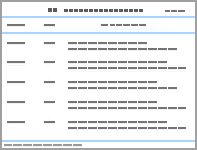
表1
2023—2024年作物播前0—20 cm耕层土壤基本理化性质"
| 年份 Year | pH | 有机质 Organic matter (g·kg-1) | 全氮 Total nitrogen (g·kg-1) | 碱解氮 Alkeline-N (mg·kg-1) | 速效磷 Olsen-P (mg·kg-1) | 速效钾 Olsen-K (mg·kg-1) |
|---|---|---|---|---|---|---|
| 2023 | 5.44 | 13.87 | 0.72 | 70.56 | 13.21 | 142.12 |
| 2024 | 5.79 | 12.65 | 0.86 | 71.67 | 15.74 | 143.68 |
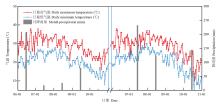
图1
2023—2024年玉米、大豆生育期气象条件"
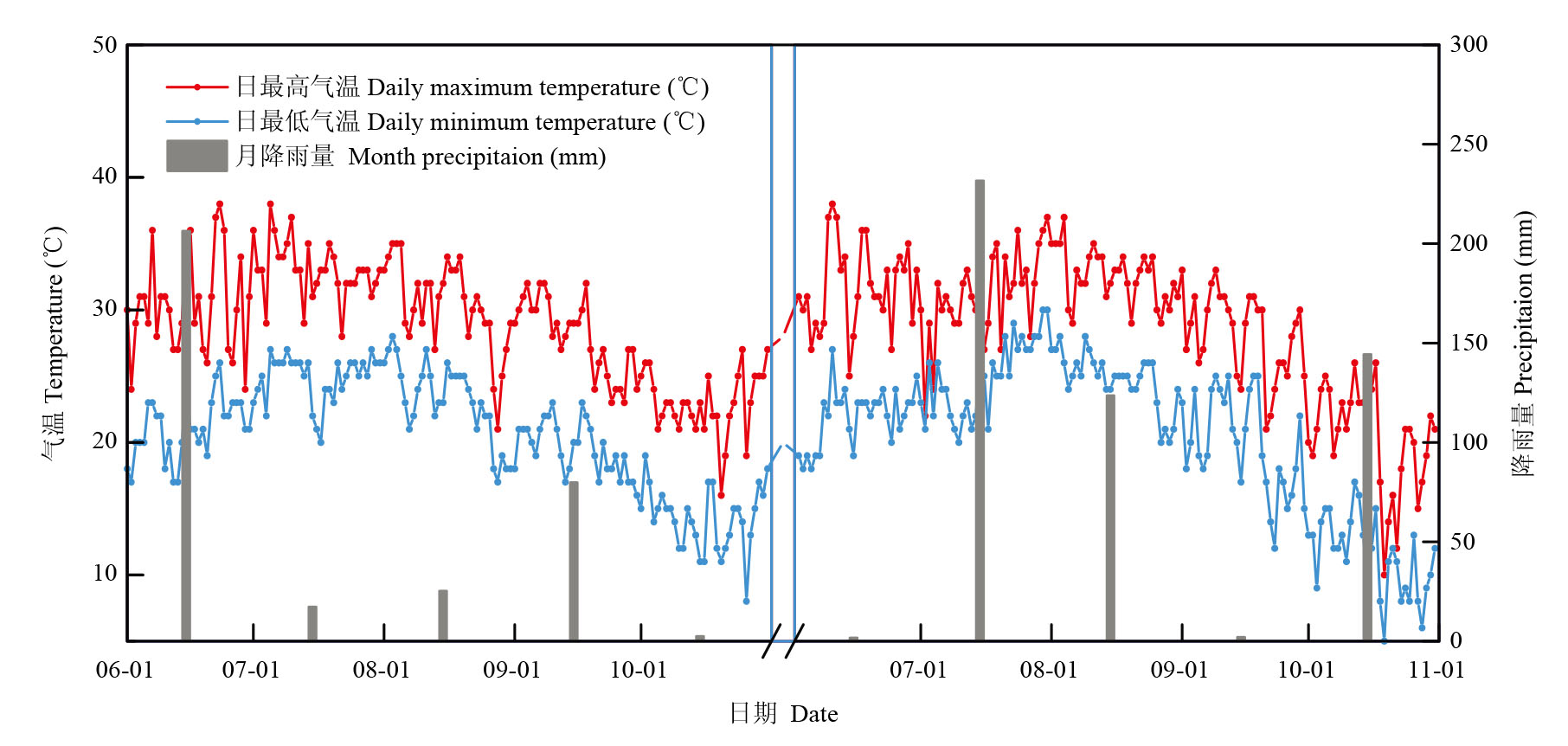
表2
正交试验设计表"
| 处理 Treatment | 种植模式(因子P) Planting pattern (Factor P) | 施氮量(因子N) Nitrogen fertilizer rate (Factor N) (kg N·hm-2) | 灌溉量(因子I) Irrigation amount (Factor I) (mm) |
|---|---|---|---|
| MN1I1 | 玉米单作 Maize monoculture (M) | 120 (N1) | 0 (I1) |
| MN2I3 | 玉米单作Maize monoculture (M) | 180 (N2) | 60 (I3) |
| MN3I2 | 玉米单作Maize monoculture (M) | 240 (N3) | 30 (I2) |
| SN1I3 | 大豆单作Soybean monoculture (S) | 120 (N1) | 60 (I3) |
| SN2I2 | 大豆单作Soybean monoculture (S) | 180 (N2) | 30 (I2) |
| SN3I1 | 大豆单作Soybean monoculture (S) | 240 (N3) | 0 (I1) |
| MSN1I2 | 玉米大豆带状复合种植Maize and soybean intercropping (MS) | 120 (N1) | 30 (I2) |
| MSN2I1 | 玉米大豆带状复合种植Maize and soybean intercropping (MS) | 180 (N2) | 0 (I1) |
| MSN3I3 | 玉米大豆带状复合种植Maize and soybean intercropping (MS) | 240 (N3) | 60 (I3) |
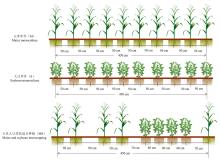
图2
种植模式示意图"
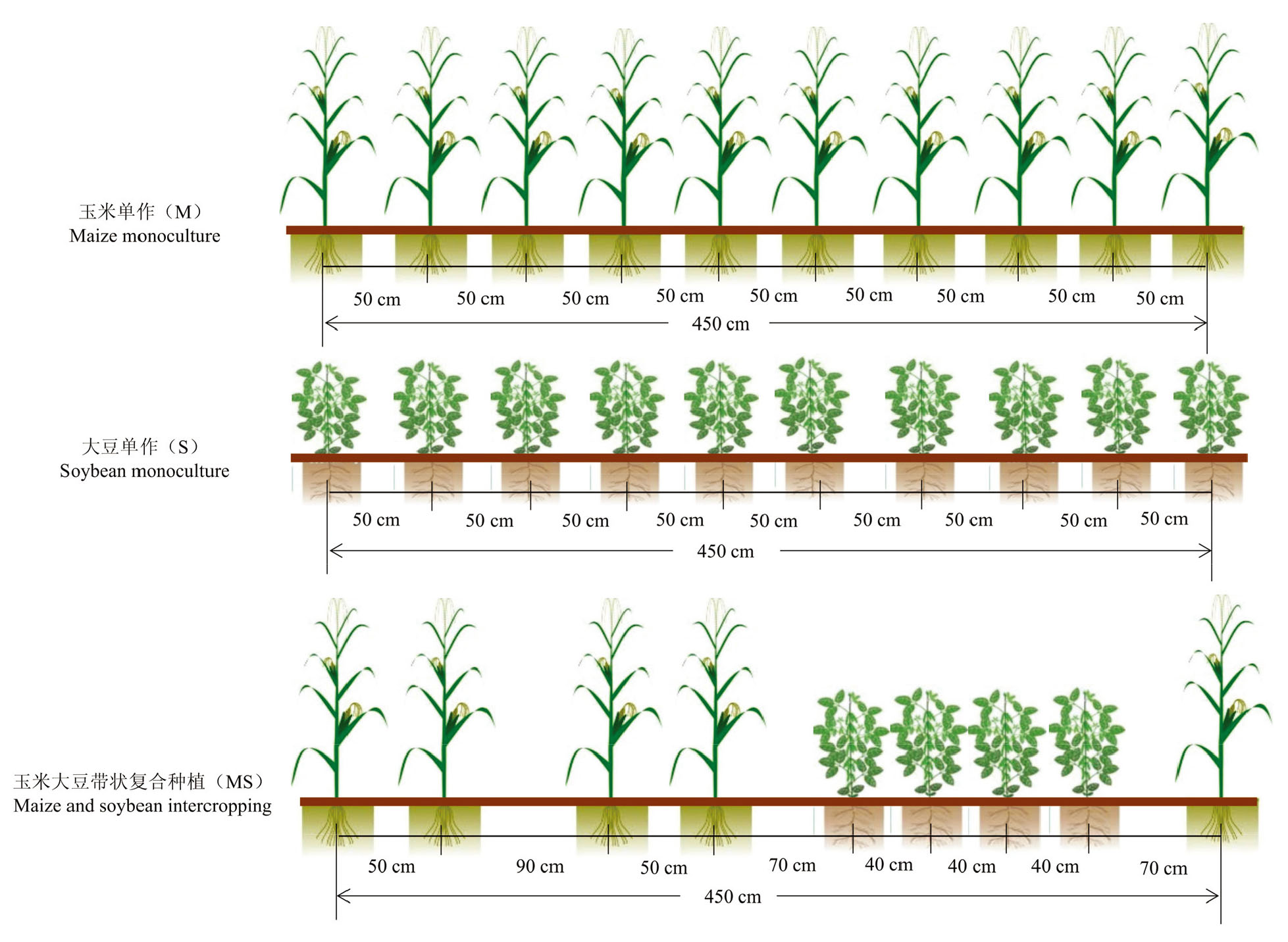
图3
玉米叶面积指数动态拟合示意图"
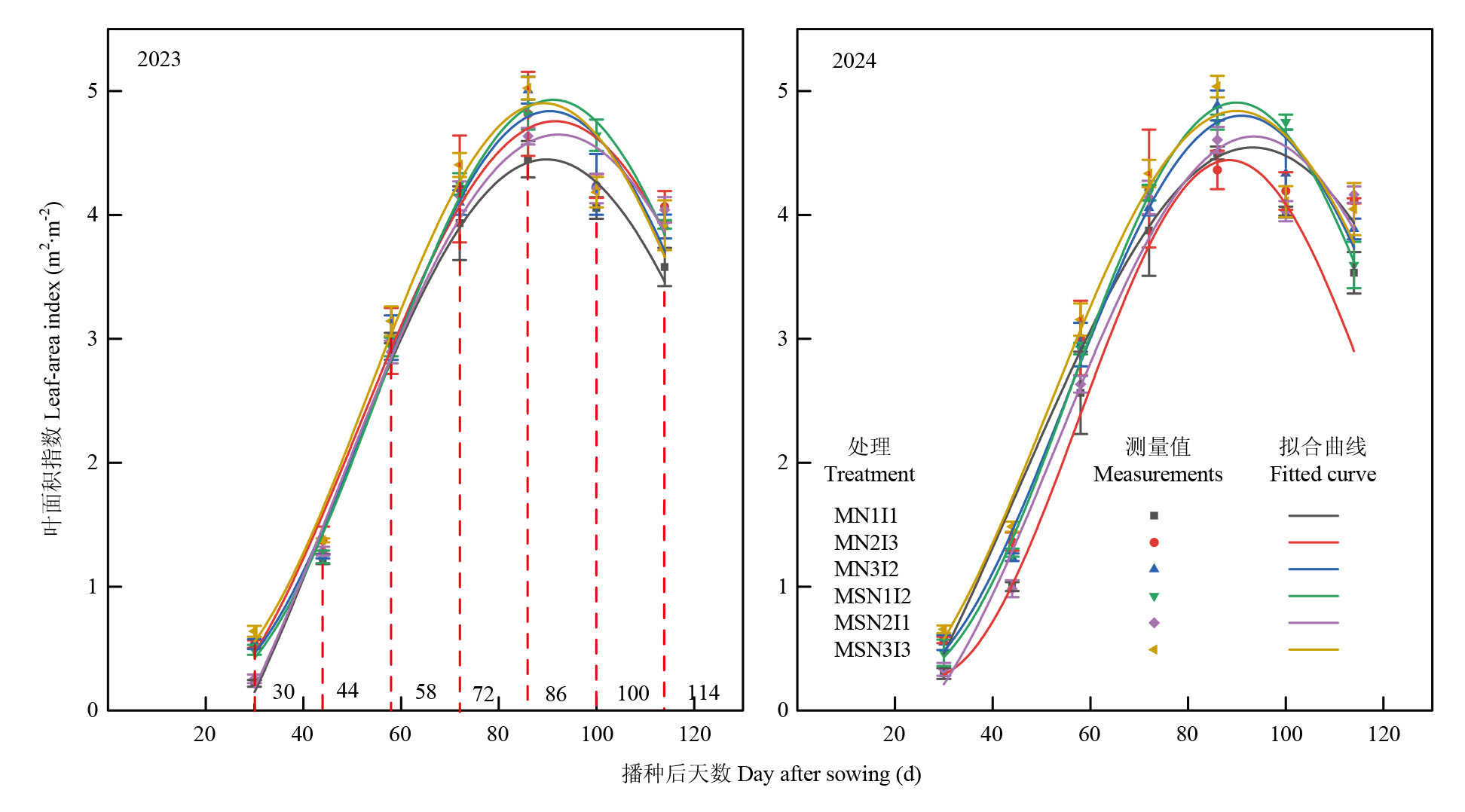
表3
2023和2024年玉米叶面积指数正弦函数拟合参数分析"
| 年份 Year | 处理 Treatment | y0 | xc | w | A | R2 |
|---|---|---|---|---|---|---|
| 2023 | MN1I1 | 1.68 | 46.17 | 87.24 | 2.77 | 0.9899** |
| MN2I3 | 2.30 | 51.49 | 80.08 | 2.46 | 0.9823** | |
| MN3I2 | 2.51 | 54.61 | 71.72 | 2.33 | 0.9808** | |
| MSN1I2 | 2.55 | 55.25 | 71.84 | 2.38 | 0.9953** | |
| MSN2I1 | 1.79 | 47.12 | 90.14 | 2.86 | 0.9869** | |
| MSN3I3 | 2.55 | 53.17 | 72.11 | 2.35 | 0.9749** | |
| 2024 | MN1I1 | 1.78 | 45.14 | 96.20 | 2.77 | 0.9767** |
| MN2I3 | 2.35 | 57.65 | 61.52 | 2.09 | 0.9974** | |
| MN3I2 | 2.52 | 55.09 | 71.75 | 2.29 | 0.9878** | |
| MSN1I2 | 2.59 | 55.87 | 68.11 | 2.32 | 0.9973** | |
| MSN2I1 | 2.17 | 53.31 | 80.29 | 2.47 | 0.9674** | |
| MSN3I3 | 2.42 | 51.26 | 77.35 | 2.42 | 0.9686** |
图4
大豆叶面积指数动态拟合示意图"
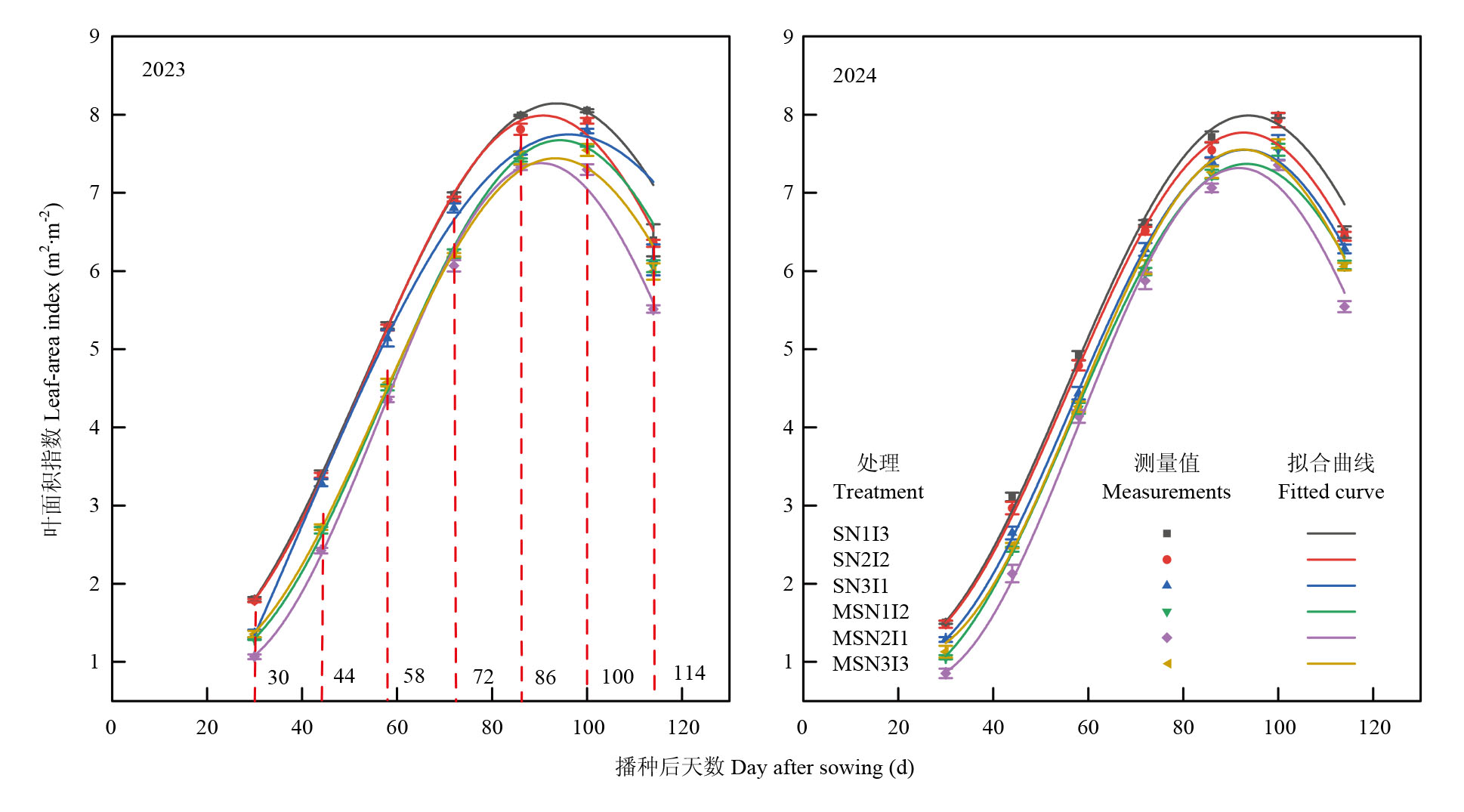
表4
2023和2024年大豆叶面积指数正弦函数拟合参数分析"
| 年份 Year | 处理 Treatment | y0 | xc | w | A | R2 |
|---|---|---|---|---|---|---|
| 2023 | SN1I3 | 4.54 | -111.77 | 82.14 | 3.61 | 0.9997** |
| MN2I2 | 4.59 | -97.28 | 75.22 | 3.40 | 0.9987** | |
| MN3I1 | 2.61 | -189.21 | 114.14 | 5.13 | 0.9974** | |
| MSN1I2 | 4.32 | -93.19 | 75.01 | 3.35 | 0.9995** | |
| MSN2I1 | 4.14 | 56.45 | 67.56 | 3.24 | 0.9990** | |
| MSN3I3 | 4.22 | -94.46 | 75.13 | 3.22 | 0.9985** | |
| 2024 | SN1I3 | 4.53 | -96.85 | 76.23 | 3.46 | 0.9987** |
| MN2I2 | 4.44 | -92.72 | 74.18 | 3.33 | 0.9982** | |
| MN3I1 | 4.27 | -89.15 | 72.86 | 3.28 | 0.9999** | |
| MSN1I2 | 4.05 | -91.79 | 74.07 | 3.31 | 0.9987** | |
| MSN2I1 | 4.03 | -77.28 | 67.63 | 3.28 | 0.9957** | |
| MSN3I3 | 4.32 | -81.07 | 69.47 | 3.23 | 0.9963** |
表5
各因素对作物产量的影响"
| 处理 Treatment | 产量 Yield(kg·hm-2) | |||||||||
|---|---|---|---|---|---|---|---|---|---|---|
| 种植模式(因子P) Planting pattern (FactorP) | 施氮量(因子N) Nitrogen fertilizer rate (Factor N) | 灌溉量(因子I) Irrigation amount (Factor I) | 2023 | 2024 | ||||||
| M | N1 | I1 | 8860.97c | 8344.79d | ||||||
| N2 | I3 | 9462.02a | 9379.11a | |||||||
| N3 | I2 | 9215.53b | 9164.05b | |||||||
| S | N1 | I3 | 3768.85e | 3632.72f | ||||||
| N2 | I2 | 3933.02e | 3748.40f | |||||||
| N3 | I1 | 3297.36f | 2979.07g | |||||||
| MS | N1 | I2 | 9088.27b | 9063.46b | ||||||
| N2 | I1 | 8535.18d | 8145.69e | |||||||
| N3 | I3 | 8849.46c | 8635.35c | |||||||
表6
各因素对作物产量的极差分析"
| 年份 Year | 项目 Item | 源Source | ||
|---|---|---|---|---|
| 种植模式 Planting pattern | 施氮量 Nitrogen fertilizer rate | 灌溉量 Irrigation amount | ||
| 2023 | k1 | 9179.51 | 7239.36 | 6897.84 |
| k2 | 3666.41 | 7310.08 | 7412.27 | |
| k3 | 8824.31 | 7120.79 | 7360.11 | |
| R | 5513.10 | 189.29 | 514.43 | |
| P | 0.01* | 0.25 | 0.04* | |
| 2024 | k1 | 8962.65 | 7013.66 | 6489.85 |
| k2 | 3453.40 | 7091.07 | 7325.30 | |
| k3 | 8614.83 | 6926.15 | 7215.72 | |
| R | 5509.25 | 164.91 | 835.45 | |
| P | 0.01* | 0.67 | 0.06 | |
图5
带状复合种植模式土地当量比 N:施氮量 Nitrogen fertilizer rate;I:灌溉量 Irrigation amount。i=1, 2, 3分别表示因素N和I在第i水平对应的土地当量比(LER) i=1, 2, 3were the average value of land equivalent ratio for 3 levels of each factor, respectively。n.s.表示相关性不显著 n.s. indicates no significant correlation"
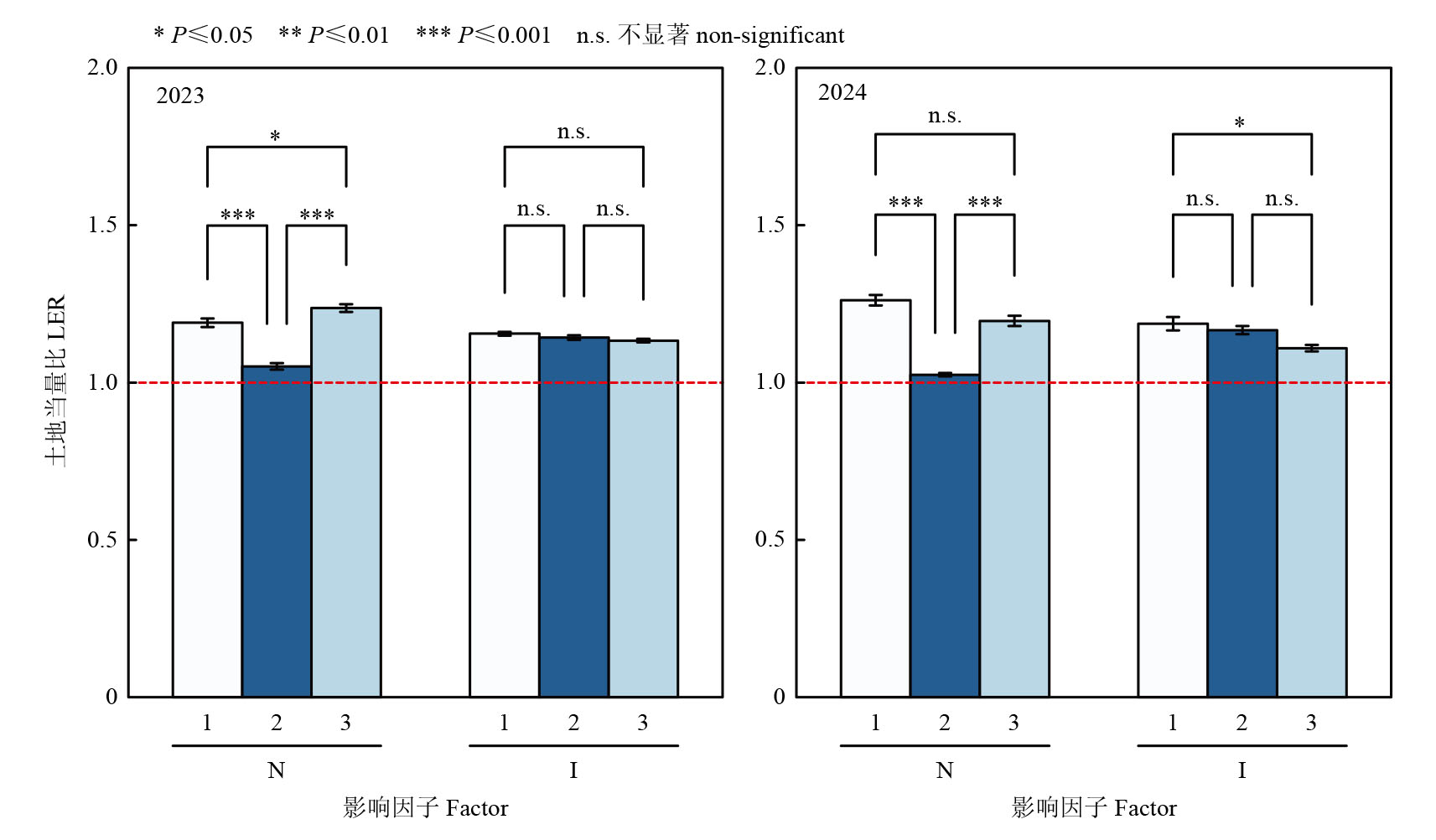
图6
0—100 cm土层成熟期土壤蓄水量 图A和图B图例相同,图C和图D图例相同 Fig.A and B have the same legend, as do fig.C and D"

图7
各处理对不同种植模式田间水分利用效率和灌溉水生产效益的影响 不同小写字母表示在P<0.05水平差异显著 Different lowercase letters indicate significant differences at P<0.05 level"
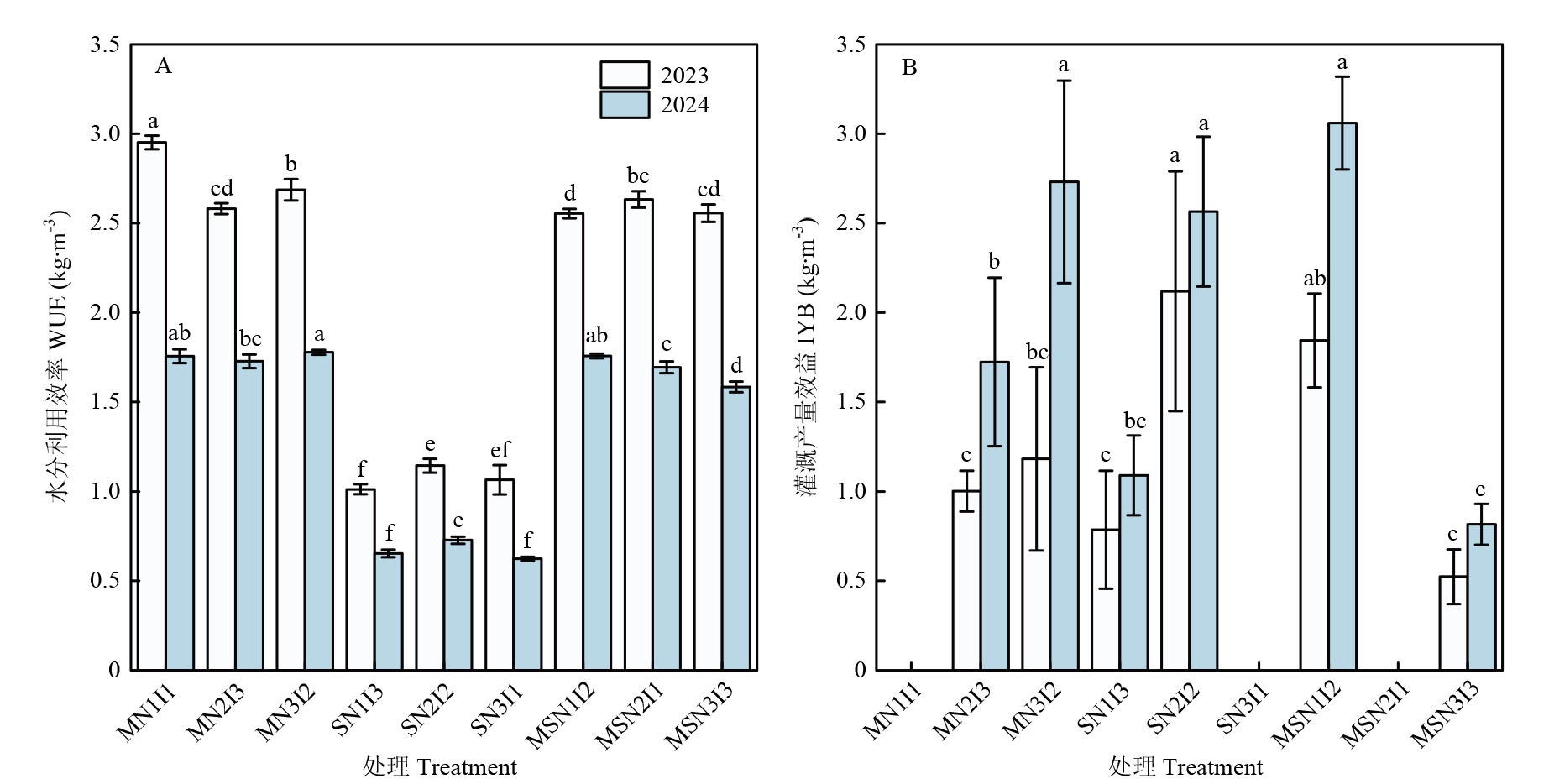
表7
各因素对经济效益的影响"
| 处理 Treatment | 经济效益 Economic benefits (yuan/hm2) | ||||
|---|---|---|---|---|---|
| 种植模式(因子P) Planting pattern (Factor P) | 施氮量(因子N) Nitrogen fertilizer rate (Factor N) | 灌溉量(因子I) Ir Irrigation amount (Factor I) | 2023 | 2024 | |
| M | N1 | I1 | 20538.46c | 14501.93e | |
| N2 | I3 | 21899.63b | 16416.78c | ||
| N3 | I2 | 21117.71c | 15838.37d | ||
| S | N1 | I3 | 15915.03d | 11172.43f | |
| N2 | I2 | 16587.78d | 11349.98f | ||
| N3 | I1 | 8120.90e | 13322.22g | ||
| MS | N1 | I2 | 23637.75a | 18014.22a | |
| N2 | I1 | 21888.51b | 15727.64d | ||
| N3 | I3 | 23038.62a | 16772.18b | ||
表8
各因素对经济效益的极差分析"
| 年份 Year | 项目 Item | 源 Soruce | ||
|---|---|---|---|---|
| 种植模式 Planting pattern | 施氮量 Nitrogen fertilizer rate | 灌溉量 Irrigation amount | ||
| 2023 | k1 | 21185.27 | 20030.41 | 18583.06 |
| k2 | 15275.01 | 20125.31 | 20447.75 | |
| k3 | 22854.96 | 19159.52 | 20284.43 | |
| R | 5513.10 | 189.29 | 514.43 | |
| P | 0.01* | 0.18 | 0.05 | |
| 2024 | k1 | 15585.69 | 14562.86 | 12881.66 |
| k2 | 10312.61 | 14498.13 | 15067.52 | |
| k3 | 16838.01 | 13675.32 | 14787.13 | |
| R | 5509.25 | 164.91 | 835.45 | |
| P | 0.01* | 0.01* | 0.01* | |
| [1] |
李易玲, 彭西红, 陈平, 杜青, 任俊波, 杨雪丽, 雷鹿, 雍太文, 杨文钰. 减量施氮对套作玉米大豆叶片持绿、光合特性和系统产量的影响. 中国农业科学, 2022, 55(9): 1749-1762. doi:10.3864/j.issn.0578-1752.2022.09.005.
|
|
|
|
| [2] |
李海, 沈鹏, 吕凯, 阮贞静, 李梅, 刘廷菊, 安曈昕. 玉米间作大豆行比配置对坡耕地水土流失的影响. 水土保持研究, 2024, 31(4): 11-19.
|
|
|
|
| [3] |
doi: 10.1016/j.still.2025.106696 |
| [4] |
doi: 10.1111/jac.v210.5 |
| [5] |
雷联. 膜下滴灌调亏对制种玉米植株生长、产量和水分利用的影响. 浙江农业学报, 2023, 35(7): 1542-1549.
doi: 10.3969/j.issn.1004-1524.20221365 |
|
doi: 10.3969/j.issn.1004-1524.20221365 |
|
| [6] |
杨立达, 彭新月, 朱文雪, 赵静, 袁晓婷, 林萍, 罗凯, 李易玲, 罗春明, 李雨泽, 杨文钰, 雍太文. 秸秆还田与灌溉方式对大豆玉米带状间作出苗及幼苗生长的影响. 中国农业科学, 2024, 57(17): 3366-3383. doi:10.3864/j.issn.0578-1752.2024.17.005.
|
|
|
|
| [7] |
doi: 10.1016/j.envexpbot.2019.103883 |
| [8] |
doi: 10.1016/j.fcr.2024.109645 |
| [9] |
doi: 10.1016/j.jenvman.2024.120886 |
| [10] |
doi: 10.1016/j.cj.2019.06.010 |
| [11] |
doi: 10.1016/j.fcr.2023.108881 |
| [12] |
杨玲. 宁夏引黄灌区玉米‖大豆对田间水氮利用及作物产量的影响[D]. 杨凌: 西北农林科技大学, 2022.
|
|
|
|
| [13] |
doi: 10.3389/fpls.2024.1437631 |
| [14] |
秦德志, 崔文芳, 陈静, 刘剑, 秦丽, 严海欧. 滴灌下氮肥减量配施生物炭对玉米大豆间作系统光合特性和产量的影响. 大豆科学, 2024, 43(3): 332-341.
|
|
|
|
| [15] |
祝庆, 袁超, 张国伟, 许瀚元, 李淑芬, 柴文波, 王军. 玉米品种和密度对大豆玉米间作群体结构和产量的影响. 中国油料作物学报, 2025, 47(4): 980-992.
doi: 10.19802/j.issn.1007-9084.2025077 |
|
doi: 10.19802/j.issn.1007-9084.2025077 |
|
| [16] |
董奎军, 张亦涛, 刘瀚文, 张继宗, 王伟军, 温延臣, 雷秋良, 文宏达. 玉米大豆间作减量施氮对当季作物农艺性状、经济效益和后茬小麦产量的影响. 中国农业科学, 2024, 57(22): 4495-4506. doi:10.3864/j.issn.0578-1752.2024.22.009.
|
|
|
|
| [17] |
赵方洋, 曹红霞, 马丽娜, 党小文, 万宇, 彭美龄, 李志军. 补充灌溉对黄土高原谷子生长、产量及水分利用效率的影响. 干旱地区农业研究, 2024, 42(5): 44-53, 84.
|
|
|
|
| [18] |
高仁才. 田间配置对玉豆系统光环境、光能利用和产量的影响研究[D]. 雅安: 四川农业大学, 2015.
|
|
|
|
| [19] |
雷志刚, 王业建, 郗浩江, 李铭东, 李召锋, 赵海菊, 韩登旭, 杨杰, 阿布来提·阿布拉, 梁晓玲. 不同青贮玉米品种品质性状与农艺性状的相关分析. 新疆农业科学, 2017, 54(4): 694-699.
|
|
|
|
| [20] |
doi: 10.1016/j.fcr.2020.107819 |
| [21] |
doi: 10.1071/FP19161 pmid: 32375994 |
| [22] |
苏本营, 宋艳霞, 陈圣宾, 杨文钰. 大豆幼苗对套作玉米遮荫环境的光合生理生态响应. 生态学报, 2015, 35(10): 3298-3308.
|
|
|
|
| [23] |
寇红太. 行比配置对膜下滴灌玉米-大豆间作系统水氮光利用及产量的影响[D]. 杨凌: 西北农林科技大学, 2024.
|
|
|
|
| [24] |
doi: 10.1093/plphys/kiac040 pmid: 35134220 |
| [25] |
李多, 王晨, 张明聪, 曹亮, 金喜军, 张玉先, 王孟雪. 大豆苗期水分亏缺对土壤酶活性及微生物多样性的影响. 作物杂志, 2024(2): 148-157.
|
|
|
|
| [26] |
doi: 10.1016/S2095-3119(14)60747-4 |
| [27] |
叶优良, 肖焱波, 黄玉芳, 李隆. 小麦/玉米和蚕豆/玉米间作对水分利用的影响. 中国农学通报, 2008, 24(3): 445-449.
|
|
|
|
| [28] |
pmid: 16211394 |
| [29] |
doi: 10.1038/s41598-024-59916-5 |
| [30] |
doi: 10.1016/j.still.2023.105812 |
| [31] |
王雅梅. 玉米-大豆不同宽幅间作对大豆光合特性和水分利用效率的影响[D]. 北京: 中国农业科学院, 2020.
|
|
|
|
| [32] |
doi: 10.1016/j.jclepro.2021.127282 |
| [33] |
陈世超, 刘文丰, 杜太生. 基于水氮管理与种植结构优化的作物丰产高效管理策略. 农业工程学报, 2022, 38(16): 144-152.
|
|
|
|
| [34] |
邓浩亮, 潘小番, 兰雪梅, 王勤礼, 肖让, 滕安国, 雷联. 水氮互作对河西绿洲灌区玉豆带状复合种植玉米产量及水氮利用效率的影响. 玉米科学, 2024, 32(7): 73-82.
|
|
|
|
| [35] |
doi: 10.3390/su142214940 |
| [36] |
雷雲翔, 陆思豪, 应晓成, 沈新平, 蒋敏. 不同间作方式对玉米/大豆的光合性能、产量和土壤微生态特征的影响. 农业资源与环境学报, 2023, 40(3): 610-618.
|
|
|
|
| [37] |
doi: 10.1016/j.scitotenv.2018.11.376 |
| [38] |
doi: 10.1016/j.agwat.2024.109126 |
| [39] |
岳高红, 黄业昌, 高锡腾, 梅霞, 刘永安, 潘彬荣. 甜玉米/鲜食大豆间作对根际固氮细菌和丛枝菌根真菌的影响. 玉米科学, 2024, 32(5): 67-77.
|
|
|
|
| [40] |
周颖, 陈平, 杜青, 庞婷, 付智丹, 张晓娜, 任建锐, 杨文钰, 雍太文. 不同间套作模式对大豆农艺性状及系统经济效益的影响. 四川农业大学学报, 2018, 36(6): 745-750.
|
|
|
| [1] | 蒲丽霞, 张佳芮, 叶建萍, 黄秀兰, 樊高琼, 杨洪坤. 二氢赤霉素与秸秆覆盖对旱地小麦分蘖成穗与产量的影响[J]. 中国农业科学, 2025, 58(9): 1735-1748. |
| [2] | 郭晨荔, 刘扬, 陈燕, 胡伟, 王友华, 周治国, 赵文青. 减氮条件下适当磷肥后移对滴灌棉花产量和磷肥利用效率的影响[J]. 中国农业科学, 2025, 58(9): 1749-1766. |
| [3] | 刘劲松, 伍龙梅, 包晓哲, 刘志霞, 张彬, 杨陶陶. 短期减施氮肥对华南地区早晚兼用型水稻产量和稻米品质的影响[J]. 中国农业科学, 2025, 58(8): 1508-1520. |
| [4] | 韦文华, 李盼, 邵冠贵, 樊志龙, 胡发龙, 范虹, 何蔚, 柴强, 殷文, 赵连豪. 西北灌区青贮玉米产量及品质对减量灌水与有机无机肥配施的响应[J]. 中国农业科学, 2025, 58(8): 1521-1534. |
| [5] | 薛钰琦, 赵继玉, 孙旺胜, 任佰朝, 赵斌, 刘鹏, 张吉旺. 不同氮素形态对夏玉米产量和品质的影响[J]. 中国农业科学, 2025, 58(8): 1535-1549. |
| [6] | 李绍兴, 宋稳锋, 魏泽煜, 周玉玲, 宋李霞, 任可, 马群, 王龙昌. 秸秆与紫云英覆盖对土壤肥力及甘薯产量的影响[J]. 中国农业科学, 2025, 58(8): 1591-1603. |
| [7] | 尹波, 于爱忠, 王鹏飞, 杨学慧, 王玉珑, 尚永盼, 张冬玲, 刘亚龙, 李悦, 王凤. 绿肥还田结合氮肥减施对干旱灌区麦田土壤水热特征及小麦产量的影响[J]. 中国农业科学, 2025, 58(7): 1366-1380. |
| [8] | 陈桂平, 李盼, 邵冠贵, 吴霞玉, 殷文, 赵连豪, 樊志龙, 胡发龙. 减量灌水与有机无机肥配施对青贮玉米吐丝期后叶片持绿特性的调控作用[J]. 中国农业科学, 2025, 58(7): 1381-1396. |
| [9] | 岳润清, 李文兰, 丁照华, 孟昭东. 转基因复合抗虫耐除草剂玉米LD05的分子特征及抗性评价[J]. 中国农业科学, 2025, 58(7): 1269-1283. |
| [10] | 赵耀, 程前, 徐田军, 刘正, 王荣焕, 赵久然, 陆大雷, 李从锋. 高密度条件下株型改良对春玉米根-冠特征及籽粒产量的影响[J]. 中国农业科学, 2025, 58(7): 1296-1310. |
| [11] | 邹晓威, 夏蕾, 朱晓敏, 孙辉, 周琦, 齐霁, 张亚封, 郑岩, 姜兆远. 基于转录组测序的玉米瘤黑粉菌UM01240过表达菌株诱导玉米抗病性分析[J]. 中国农业科学, 2025, 58(6): 1116-1130. |
| [12] | 严孙辉, 罗程, 陈银基, 庄昕波. 细菌纤维素协同pH偏移处理对大豆分离蛋白凝胶特性与微观结构的影响[J]. 中国农业科学, 2025, 58(6): 1210-1222. |
| [13] | 刘路平, 胡雪洁, 祁金, 陈强, 刘智, 赵田湉, 史晓蕾, 刘兵强, 孟庆民, 张孟臣, 韩天富, 杨春燕. 大豆生育期基因E1和E2的启动子克隆及其表达模式分析[J]. 中国农业科学, 2025, 58(5): 840-850. |
| [14] | 张洪程, 邢志鹏, 张瑞宏, 单翔, 奚小波, 程爽, 翁文安, 胡群, 崔培媛, 魏海燕. 小麦整合化无人化丰产栽培的特征与技术途径[J]. 中国农业科学, 2025, 58(5): 864-876. |
| [15] | 赵彤彤, 谷晓博, 谭川东, 延廷霖, 李晓雁, 常甜, 杜娅丹. 水氮耦合对西北旱区覆膜农田土壤有机碳、氮矿化的影响[J]. 中国农业科学, 2025, 58(5): 929-942. |
|
||
