Scientia Agricultura Sinica ›› 2026, Vol. 59 ›› Issue (8): 1727-1747.doi: 10.3864/j.issn.0578-1752.2026.08.010

• SOIL & FERTILIZER·WATER-SAVING IRRIGATION·AGROECOLOGY & ENVIRONMENT • Previous Articles     Next Articles

Evolution, Practical Logic, and Effectiveness Measurement of China’s Agricultural Non-Point Source Pollution Control Policies

ZOU LiLin()   

  1. School of Public Administration, South China Agricultural University, Guangzhou 510642
  • Received:2025-06-06 Accepted:2025-08-26 Online:2026-04-16 Published:2026-04-21

Abstract:

【Objective】Policies for controlling agricultural non-point source pollution (ANPSP) serve as the primary basis for guiding agricultural environmental governance. A systematic analysis of the policy logic of China’s ANPSP control urgently requires academic attention. This study took 469 ANPSP control policies issued by the State Council and relevant ministries and commissions from 1978 to 2022 as the research object, and systematically analyzed the evolutionary context and practical logic of China’s ANPSP control policies and measures the effectiveness of policy texts. 【Method】Policy text analysis was adopted to clarify the evolutionary path of ANPSP control policies. The Ambiguity-Conflict Model and the Three-Dimensional Theoretical Framework Based on the Institutional Environment were revised and applied to explain the practical logic of these policies, and text mining was used to measure their effectiveness. 【Result】China’s ANPSP control policies have gone through five stages, including the stage of policy incubation, the stage of policy initiation, the stage of policy establishment, the stage of policy adjustment, and the stage of policy deepening, and have basically formed a policy framework characterized by "equal emphasis on macro systems and micro rules, parallel advancement of vertical transmission and horizontal connection, and simultaneous implementation of systematic governance and source control." The logic of formulating and issuing ANPSP control policies followed the sequence of "legislation first, adjustment later, and practice finally." The implementation logic presented differentiated implementation modes and dominant factors in different stages, while the deviation logic stemmed from induced flexibility caused by environmental regulations, government incentives, and subject cognition. The number of ANPSP control policies and their comprehensive force both showed a fluctuating upward trend. Specifically, policy efforts presented a "high first, then low" trend; policy objectives continued to focus on reducing the use of pesticides and chemical fertilizers, promoting the management of livestock and poultry manure, and improving the efficiency of straw utilization; policy measures generally showed the characteristics of administrative regulation > technical support > economic incentive > educational guidance; and the departmental synergy, objective synergy, and measure synergy of relevant policies have all significantly enhanced. 【Conclusion】Since the reform and opening-up, the Chinese government has increasingly advocated to control the ANPSP through policy intervention. It has focused on addressing the drawbacks of adaptability, ambiguity and inducement in such policies by strengthening top-level design, clarifying main responsibilities and improving supporting mechanisms. China has achieved remarkable results in ANPSP control lending by administrative forces, which could provide reference for the optimization and adjustment of ANPSP control policies in developing countries worldwide.

Key words: agricultural non-point source pollution, agricultural policy evolution, effectiveness, ambiguity-conflict model, text mining, China

Table 1

Quantitative criteria of agricultural non-point source pollution control policies’ efforts"

分值 Score 政策力度评分标准 Score criteria of policy efforts
5 全国人民代表大会及其常务委员会颁布的法律
The laws promulgated by the National People’s Congress and its Standing Committee
4 国务院、最高人民法院、最高人民检察院颁布的条例、指令、意见、方案、规定、决定、办法、解释等
The regulations, directives, opinions, plans, provisions, decisions, measures, and interpretations issued by the State Council, the Supreme People’s Court, and the Supreme People’s Procuratorate
3 国务院颁布的暂行条例、暂行规定、通知、规划以及国家部委颁布的条例、决定、规定
The provisional regulations, interim provisions, notices, and plans issued by the State Council, as well as the regulations, decisions, and provisions issued by state ministries and commissions
2 国家部委颁布的意见、办法、方案、指南、决定、细则、条件、标准
The opinions, measures, plans, guidelines, decisions, detailed rules, conditions, and standards issued by state ministries and commissions
1 国务院各部委颁布的通知、公告、规划
The notices, announcements, and plans issued by state ministries and commissions

Table 2

Quantitative criteria of agricultural non-point source pollution control policies’ objectives"

政策目标
Policy objective
分值
Score
政策目标评分标准
Score criteria of policy objectives
树立污染防治理念
Establish the concept of pollution control
5 从立法角度要求加大污染防治宣传,全面提升污染防治意识,并制定了详细的工作方案
From a legislative perspective, it is required to strengthen the publicity of pollution control, comprehensively enhance the awareness of pollution control, and formulate detailed work plans
3 政府十分支持树立污染防治理念,并明确要求制定全面提升污染防治意识的方案或办法
The government strongly supports the establishment of pollution prevention principles and explicitly mandates the development of plans or measures to comprehensively enhance pollution prevention awareness
1 仅提及上述内容,但未出台相关措施办法
It only mentions the above content without introducing any related measures or methods
建立高效节水体系
Build an efficient water-saving system
5 从立法角度对农业节水管理提出了强制性规定,并制定了详细的标准
From a legislative perspective, mandatory regulations on agricultural water management are introduced, along with detailed standards
3 政府十分支持建立高效农业节水体系,并明确要求制定具体的方案或办法
The government strongly supports the establishment of an efficient agricultural water-saving system and explicitly mandates the development of specific plans or measures
1 仅提及上述内容,但未出台相关措施与办法
It only mentions the above content without introducing any related measures or methods
减少农药化肥使用
Reduce the use of pesticides and chemical fertilizers
5 从立法角度对农药化肥生产、管理等环节提出了强制性规定,并制定了详细的减量措施
From a legislative perspective, mandatory regulations are established for the production and management of pesticides and fertilizers, accompanied by detailed measures for the reduction
3 政府十分支持减少农药化肥使用,并明确要求制定相关方案或办法
The government strongly supports reducing the use of pesticides and chemical fertilizers and has explicitly required the formulation of relevant plans or measures
1 仅提及上述内容,但未出台相关措施与办法
It only mentions the above content without introducing any related measures or methods
推进禽畜粪尿治理
Promote the management of livestock and poultry manure
5 从立法角度对畜禽养殖污染防治提出了强制性规定,并制定了标准化管理办法
From a legislative perspective, mandatory regulations are established for the pollution control from livestock and poultry farming, accompanied by the development of detailed standard management procedures
3 政府十分支持推进禽畜养殖污染治理,并明确要求制定的具体方案或办法
The government strongly supports advancing pollution control in livestock and poultry farming and explicitly mandates the development of specific plans or measures
1 仅提及上述内容,但未出台相关措施与办法
It only mentions the above content without introducing any related measures or methods
提高秸秆利用效率
Improve the efficiency of straw utilization
5 从立法角度对秸秆资源化利用提出了强制性规定,并制定了详细的标准
From a legislative perspective, mandatory regulations are established concerning the resource utilization of straws, accompanied by detailed standards
3 政府十分支持开展秸秆资源化利用,并明确要求制定具体方案或办法
The government strongly supports enhancing the resource utilization of straws and mandates the development of specific plans or measures
1 仅提及上述内容,但未出台相关措施与办法
It only mentions the above content without introducing any related measures or methods
推进农业固碳减排
Advance agricultural carbon sequestration and emission reduction
5 从立法角度对推进农业固碳减排提出了强制性规定,并制定了详细的技术标准
From a legislative perspective, mandatory provisions have been put forward for promoting agricultural carbon sequestration and emission reduction, and detailed technical standards have been formulated
3 政府十分支持推进农业固碳减排,并明确要求制定具体方案或办法
The government strongly supports promoting agricultural carbon sequestration and emission reduction, and explicitly requires the formulation of specific plans or measures.
1 仅提及上述内容,但未出台相关措施与办法
It only mentions the above content without introducing any related measures or methods

Table 3

Quantitative criteria of agricultural non-point source pollution control policies’ measures"

政策措施
Policy measure
分值
Score
政策措施评分标准
Score criteria of policy measures
行政规制
Administrative regulations
5 对产生农业面源污染的项目实施严格的行政审批与上级控制,并制定了专门的管理办法
Strict administrative examination and approval and superior control are implemented for projects that generate agricultural non-point source pollution, and special management measures have been formulated
3 制定了关于减少农业面源污染考核、监督、检查的补充性政策或制度
Supplementary policies for the assessment, supervision, and inspection of reducing agricultural pollution have been formulated
1 对相关的管理控制较为松散,或仅谈及上述条款
The management controls related to this issue are relatively lax or only address the aforementioned provisions
经济激励
Economic incentives
5 制定了详细的税收、补贴、罚款等措施,并且针对各项措施列出了明确数额或比例
Detailed measures such as taxation, subsidies, and fines have been formulated, with clear amounts or proportions specified for each measure
3 列出了相关的激励措施,但缺少具体数额或比例
Relevant incentive measures are outlined, but lacking specific amounts or proportions
1 仅提及加强经济激励,但没有具体的举措
Only mention is made of strengthening economic incentives, but there are no specific measures
技术支持
Technical support
5 明确提及研发或推广某项具体的技术,并针对该项技术做出了详细的说明
A specific technology for development or promotion is explicitly mentioned, and detailed explanations are provided for that technology
3 明确提出技术支持,并且针对该项技术做出了较为具体的说明,或列举了多项具体的技术
Technical support is clearly proposed, and specific explanations are given for the technology, or multiple specific technologies are listed
1 仅谈及鼓励相关技术的开发运用
It only mentions encouraging the development and application of relevant technologies
教育引导
Educational guidance
5 明确提出引导农村或农民加强对农业面源污染防治的关注与治理,并制定了具体的方案措施
It clearly proposes to guide rural areas or farmers to strengthen their attention to agricultural pollution control, and formulates specific plans
3 提出加强对农业面源污染防治的宣传,并提出相关引导措施但不够具体
It is proposed to strengthen the publicity on pollution control, and relevant guiding measures are put forward but not specific enough
1 仅提及鼓励对教育宣传措施的运用,但未出台的具体措施
Only the use of educational and publicity measures is mentioned as being encouraged, but no specific measures have been introduced

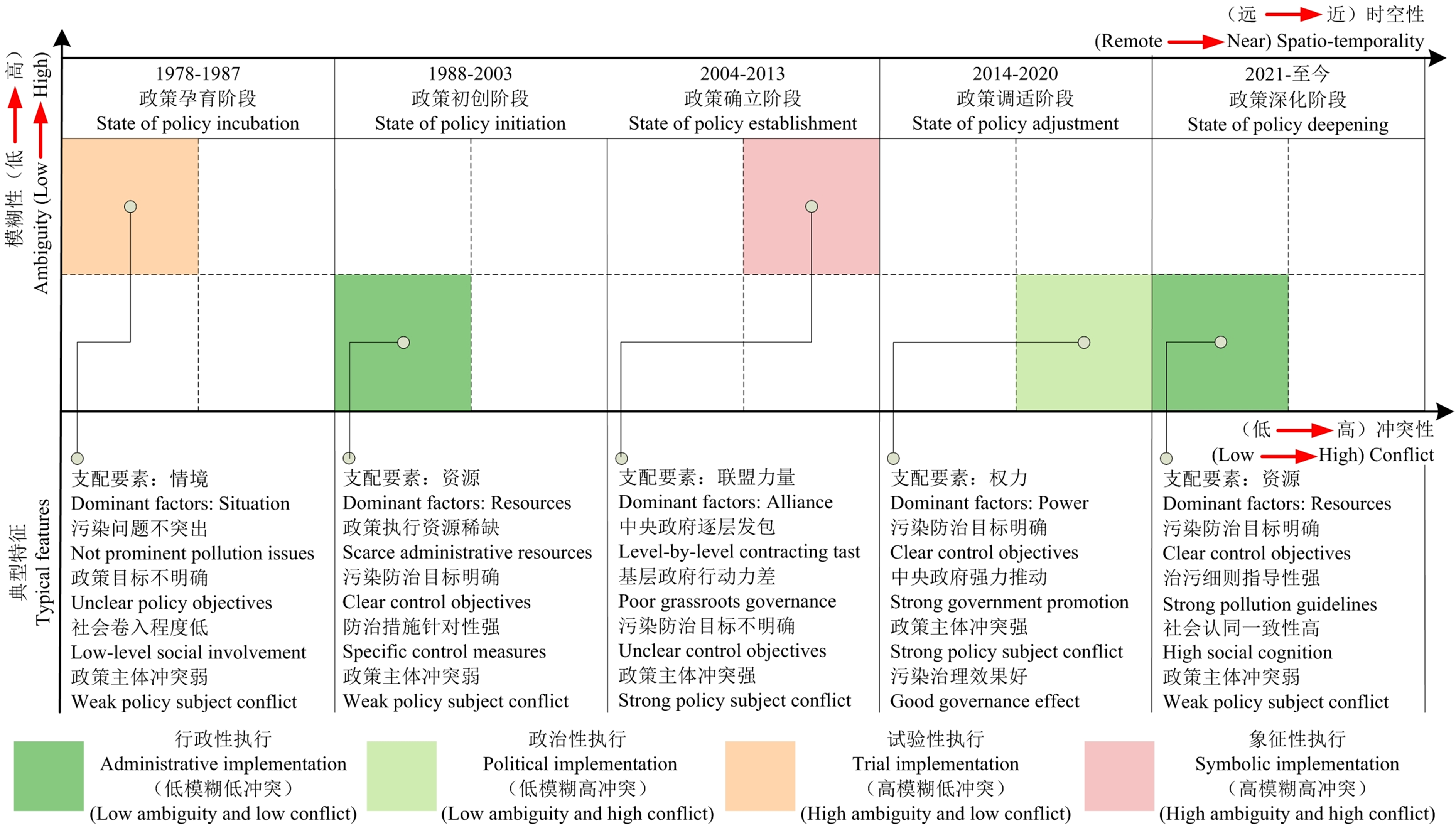
Fig. 1

Evolution trajectory of China’s agricultural non-point source pollution control policies"

Fig. 2

Interpretative framework for the implementation process of China’s agricultural non-point source pollution control policies"

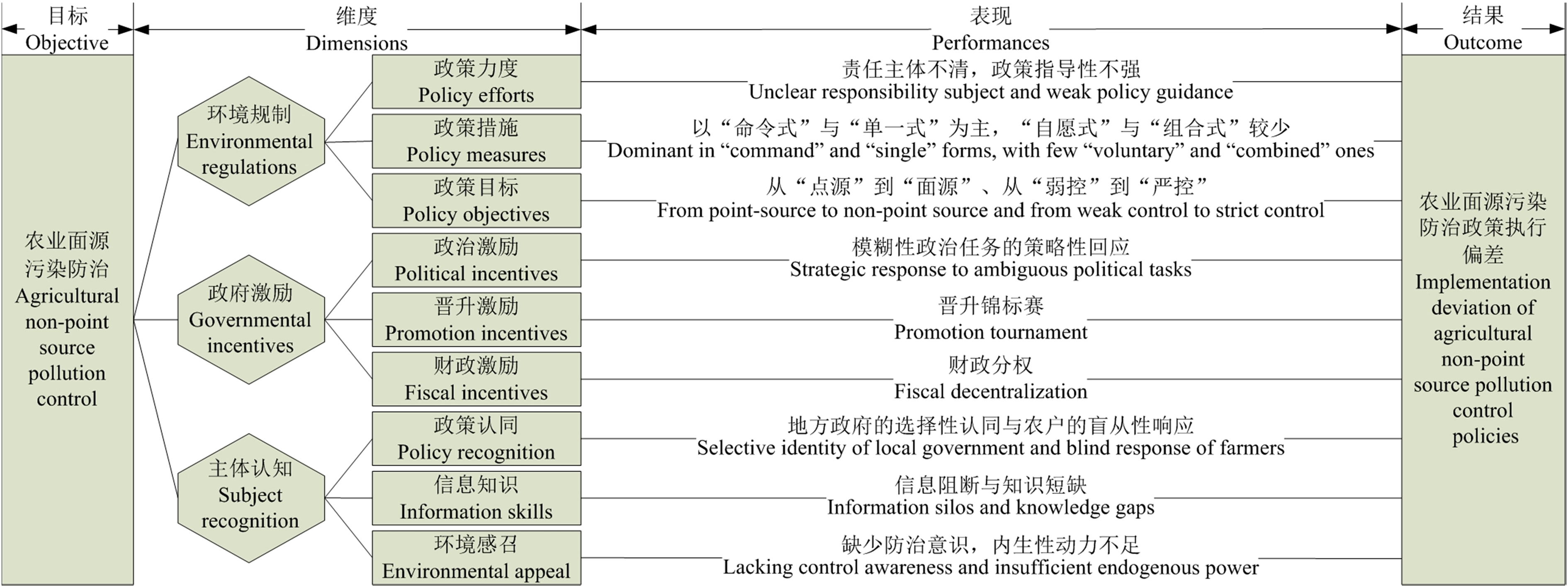
Fig. 3

Deviation logic in the implementation of China’s agricultural non-point source pollution control policies"

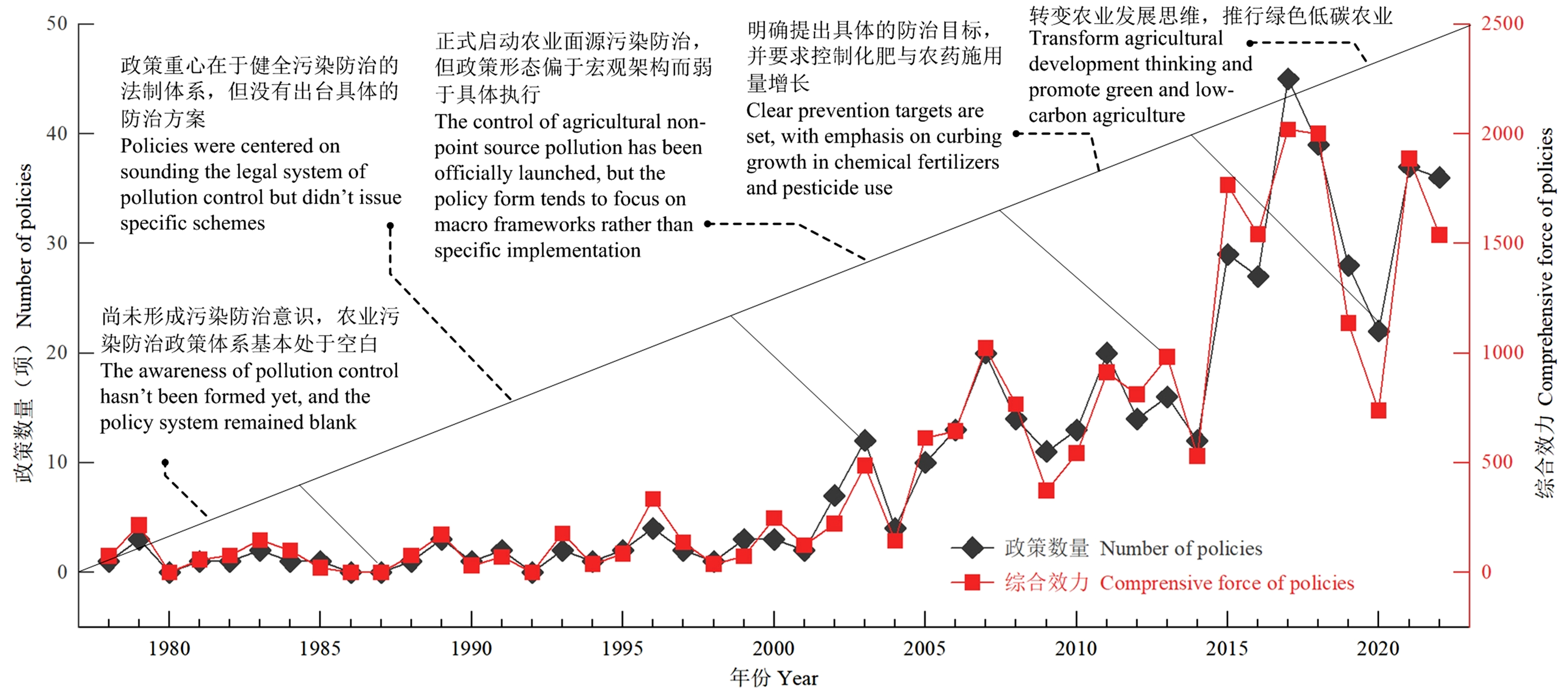
Fig. 4

Evolution trends of the number and comprehensive force of China’s agricultural non-point source pollution control policies"

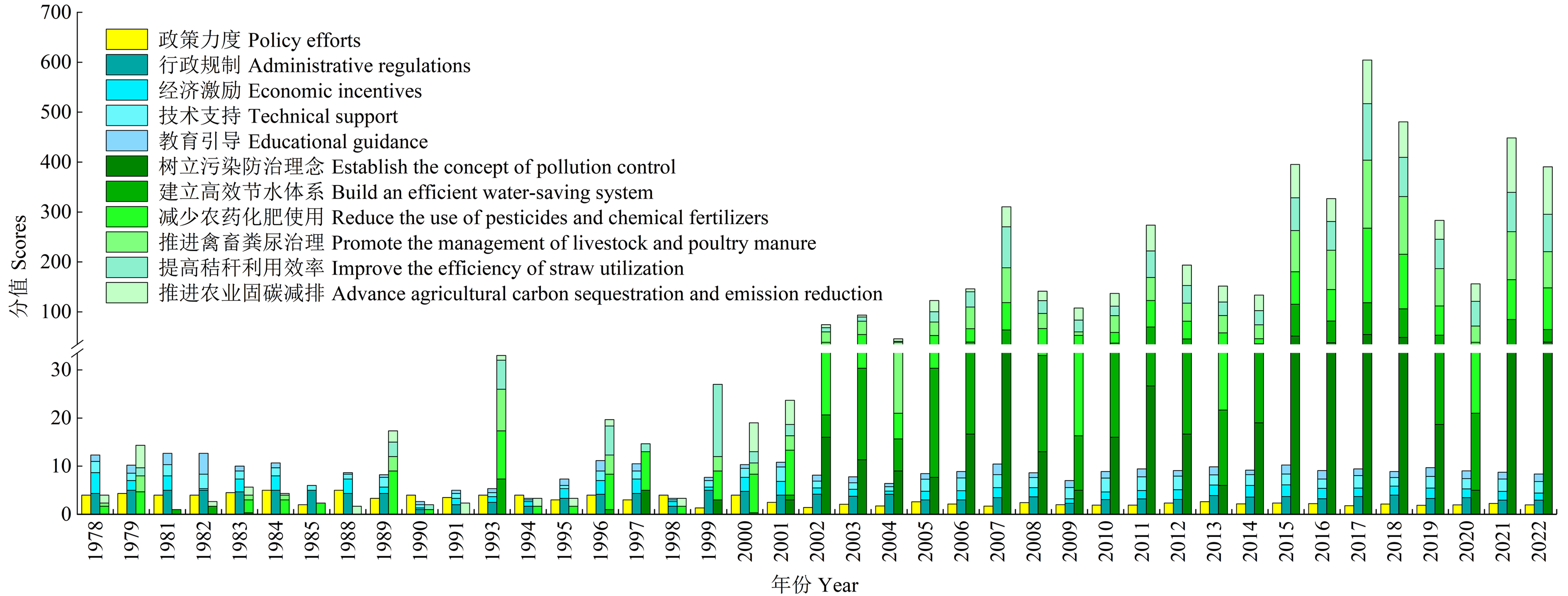
Fig. 5

Evolution trends of efforts, objectives and measures of China’s agricultural non-point source pollution control policies"

Table 4

Departmental synergy degree of China’s agricultural non-point source pollution control policies"

年份
Year
综合协同度
Comprehensive synergy degree
平均协同度
Average synergy degree
年份
Year
综合协同度
Comprehensive synergy degree
平均协同度
Average synergy degree
1978 0 0 2003 4 4.00
1979 0 0 2004 0 0
1981 0 0 2005 10 5.00
1982 0 0 2006 8 8.00
1983 0 0 2007 21 5.25
1984 0 0 2008 8 8.00
1988 0 0 2009 0 0
1989 15 15 2010 8 8.00
1990 0 0 2011 10 3.33
1991 0 0 2012 21 10.50
1993 0 0 2013 17 5.67
1994 0 0 2014 22 4.40
1995 0 0 2015 74 6.17
1996 4 4 2016 28 5.60
1997 0 0 2017 66 6.00
1998 0 0 2018 55 4.23
1999 12 12 2019 103 9.36
2000 0 0 2020 60 6.00
2001 0 0 2021 63 5.25
2002 0 0 2022 86 6.62

Table 5

Objective synergy degree of China’s agricultural non-point source pollution control policies"

年份
Year
目标3&1
Objective
3&1
目标3&2
Objective
3&2
目标3&4
Objective
3&4
目标3&5
Objective
3&5
目标3&6
Objective
3&6
目标4&1
Objective
4&1
目标4&2
Objective
4&2
目标4&5
Objective
4&5
目标4&6
Objective
4&6
目标5&1
Objective
5&1
目标5&2
Objective
5&2
目标5&6
Objective
5&6
1978 0 0 4.44 0 11.11 0 0 0 4.44 0 0 0
1979 0 0 34.22 24.44 45.89 0 0 15.56 21.78 0 0 15.56
1981 0 0 0 0 0 0 0 0 0 0 0 0
1982 0 0 0 0 0 0 0 0 0 0 0 0
1983 0 1.67 5.00 0 11.11 0 1.67 0 0 0 0 0
1984 0 0 15.00 0 5.00 0 0 0 1.67 0 0 0
1988 0 0 0 0 0 0 0 0 0 0 0 0
1989 0 0 27.00 27.00 11.67 0 0 27.00 0 0 0 0
1990 0 0 0 4 0 0 0 0 0 0 0 0
1991 0 0 0 0 0 0 0 0 0 0 0 0
1993 0 140.00 180.00 106.67 15.00 0 122.67 89.33 11.00 0 81.33 13.00
1994 0 0 0 0 11.11 0 0 0 0 0 0 0
1995 0 0 0 0 0 0 0 0 0 0 0 0
1996 0 4.67 29.00 18.33 9.67 0 6 10 7.67 0 3.33 3.33
1997 30.00 0 0 10.00 0 0 0 0 0 16.67 0 0
1998 0 0 0 0 11.11 0 0 0 0 0 0 0
1999 15.00 0 15.00 35.00 0 9.00 0 15.00 0 15.00 0 0
2000 0 5.00 35.00 0 43.33 0 3.89 0 0 0 0 19.44
2001 13.00 4.33 13.00 10.11 21.67 9.00 3.00 7.00 15.00 7.00 2.33 11.67
2002 99.78 12.11 122.67 27.33 29.67 90.78 17.11 35.78 24.78 20.67 7.33 19.11
2003 35.56 133.33 164.00 60.67 4.67 32.33 150.00 44.89 1.67 1.00 28.33 0
2004 23.67 7.22 27.44 6.33 21.67 69.33 72.22 13.00 21.67 7.00 1.67 5.00
2005 44.11 184.67 180.00 84.11 139.33 31.67 202.78 196.22 151.00 22.00 99.33 53.33
2006 70.67 125.78 159.67 133.67 46.00 91.33 194.22 155.00 66.00 53.11 124.44 49.56
2007 224.22 222.33 397.11 422.89 277.44 286.67 249.67 546.00 343.00 271.56 269.67 345.33
2008 94.00 150.22 320.33 111.67 142.00 108.89 181.33 139.89 146.22 38.33 123.33 87.33
2009 13.33 43.67 46.89 115.78 98.56 10.67 36.33 19.22 14.22 4.67 63.78 74.89
2010 36.78 73.00 74.67 79.00 75.44 60.67 174.78 100.11 159.78 31.33 103.67 96.78
2011 188.00 204.89 268.22 227.44 211.33 187.33 254.67 241.56 218.33 105.00 216.78 181.00
2012 83.89 248.11 198.56 158.67 200.67 139.56 220.67 206.89 253.67 86.78 166.67 157.11
2013 34.33 137.78 294.00 122.44 190.00 30.00 173.56 224.11 159.89 21.33 122.67 139.11
2014 44.22 31.00 67.33 66.00 58.67 100.33 89.00 182.67 159.33 94.33 80.00 146.44
2015 314.67 404.89 515.00 421.00 433.44 356.56 418.44 499.00 390.00 260.33 369.00 407.78
2016 324.89 373.67 647.00 586.11 467.67 340.11 432.22 526.67 426.89 302.00 304.67 461.33
2017 378.89 580.22 844.11 744.78 596.67 331.00 491.56 745.11 543.78 314.33 487.56 539.56
2018 256.67 321.22 830.33 570.67 480.67 295.33 472.00 555.33 500.11 259.33 335.33 440.78
2019 63.67 197.44 399.67 420.22 338.78 66.11 170.89 394.67 274.67 43.44 164.44 325.67
2020 8.33 40.67 39.44 43.44 54.00 11.00 35.67 169.33 78.11 16.33 29.56 168.11
2021 230.44 422.89 616.11 433.78 540.67 242.00 393.67 508.56 575.00 169.67 296.56 470.33
2022 179.00 162.44 405.89 464.67 509.78 244.22 191.00 405.11 479.67 178.00 182.89 561.67

Table 6

Measures synergy degree of China’s agricultural non-point source pollution control policies"

年份
Year
措施1&2
Measure
1&2
措施1&3
Measure
1&3
措施1&4
Measure
1&4
措施3&1
Measure
3&1
措施3&2
Measure
3&2
措施3&4
Measure
3&4
年份
Year
措施1&2
Measure
1&2
措施1&3
Measure
1&3
措施1&4
Measure
1&4
措施3&1
Measure
3&1
措施3&2
Measure
3&2
措施3&4
Measure
3&4
1978 75.11 40.44 23.11 40.44 40.44 12.44 2003 214.11 135.44 126.50 135.44 74.33 48.56
1979 131.67 98.33 108.33 98.33 65.44 42.56 2004 18.11 18.78 16.33 18.78 5.89 5.44
1981 60.00 46.67 46.67 46.67 28.00 21.78 2005 204.22 152.56 118.78 152.56 78.11 67.44
1982 6.67 60.00 86.67 60.00 4.00 52.00 2006 316.22 207.11 123.44 207.11 156.67 85.89
1983 100.11 65.44 37.22 65.44 45.44 17.22 2007 294.11 338.22 332.22 338.22 231.22 208.67
1984 75.00 41.67 25.00 41.67 25.00 8.33 2008 320.67 232.89 142.56 232.89 145.22 91.33
1988 65.00 21.67 7.22 21.67 15.00 1.67 2009 66.78 75.33 55.22 75.33 36.67 64.00
1989 83.33 55.00 41.67 55.00 11.67 8.33 2010 212.44 182.22 115.78 182.22 86.22 86.56
1990 1.33 2.67 2.67 2.67 0.89 1.78 2011 218.67 297.89 197.78 297.89 151.11 164.89
1991 28.33 15.00 12.78 15.00 12.33 5.67 2012 288.78 242.56 152.33 242.56 176.56 101.00
1993 41.67 25.00 25.00 25.00 9.67 6.33 2013 531.56 284.78 217.78 284.78 165.22 105.22
1994 6.67 2.22 2.22 2.22 1.33 0.44 2014 266.89 192.78 80.56 192.78 132.44 54.11
1995 67.33 22.44 12.67 22.44 15.33 2.44 2015 759.22 504.89 495.22 504.89 335.11 270.00
1996 250.00 134.44 170.00 134.44 82.67 81.33 2016 575.00 468.56 404.00 468.56 282.89 251.67
1997 107.33 54.00 38.89 54.00 48.67 15.78 2017 649.22 728.11 371.56 728.11 376.56 263.22
1998 6.67 2.22 2.22 2.22 1.33 0.44 2018 765.22 519.33 392.89 519.33 288.11 177.56
1999 10.00 20.00 10.00 20.00 4.44 3.56 2019 438.11 457.78 345.00 457.78 296.78 260.67
2000 204.44 83.33 32.22 83.33 43.33 15.56 2020 283.44 255.89 181.11 255.89 144.78 109.56
2001 102.00 57.67 28.67 57.67 49.11 14.89 2021 621.89 510.89 383.11 510.89 347.00 249.78
2002 40.22 55.78 49.33 55.78 22.78 16.67 2022 377.89 416.33 345.11 416.33 218.78 204.67
[1]
田云, 夏锐, 张星琰. 中国农业面源污染强度测算: 时空分异、动态演进与空间集聚. 环境科学, 2025, 46(9): 5608-5618.
TIAN Y, XIA R, ZHANG X Y. Evaluation of China’s agricultural non-point source pollution intensity: Spatial and temporal differentiation, dynamic evolution and spatial agglomeration. Environmental Science, 2025, 46(9): 5608-5618. (in Chinese)
[2]
罗必良. 新质生产力: 颠覆性创新与基要性变革: 兼论农业高质量发展的本质规定和努力方向. 中国农村经济, 2024(8): 2-26.
LUO B L. New quality productive forces, disruptive innovation, and fundamental change: The essential requirements and striving direction for high-quality development of agriculture. Chinese Rural Economy, 2024(8): 2-26. (in Chinese)
[3]
孟庆雷, 殷宇翔, 王煜昊. 我国农业碳排放的时空演化、脱钩效应及绩效评估. 中国农业科学, 2023, 56(20): 4049-4066. doi: 10.3864/j.issn.0578-1752.2023.20.010.
MENG Q L, YIN Y X, WANG Y H. Spatial-temporal evolution, decoupling effect and performance evaluation of China’s agricultural carbon emissions. Scientia Agricultura Sinica, 2023, 56(20): 4049-4066. doi: 10.3864/j.issn.0578-1752.2023.20.010. (in Chinese)
[4]
金书秦, 沈贵银, 魏珣, 韩允垒. 论农业面源污染的产生和应对. 农业经济问题, 2013(11): 97-102.
JIN S Q, SHEN G Y, WEI X, HAN Y L. On the generation and countermeasures of agricultural non-point source pollution. Issues in Agricultural Economy, 2013(11): 97-102. (in Chinese)
[5]
ZOU L L, LIU Y S, WANG Y S, HU X D. Assessment and analysis of agricultural non-point source pollution loads in China: 1978-2017. Journal of Environmental Management, 2020, 263: 110400.

doi: 10.1016/j.jenvman.2020.110400
[6]
TANG F H M, LENZEN M, MCBRATNEY A, MAGGI F. Risk of pesticide pollution at the global scale. Nature Geoscience, 2021, 14(4): 206-210.

doi: 10.1038/s41561-021-00712-5
[7]
梁志会, 张露, 张俊飚. 土地整治与化肥减量: 来自中国高标准基本农田建设政策的准自然实验证据. 中国农村经济, 2021(4): 123-144.
LIANG Z H, ZHANG L, ZHANG J B. Land consolidation and fertilizer reduction: quasi-natural experimental evidence from China’s well-facilitated capital farmland construction. Chinese Rural Economy, 2021(4): 123-144. (in Chinese)
[8]
伍骏骞, 阎宇, 蒋玉. 时间偏好对农户采纳生物农药意愿的影响: 基于农业技术推广方式的调节作用. 资源科学, 2023, 45(6): 1268-1283.

doi: 10.18402/resci.2023.06.13
WU J Q, YAN Y, JIANG Y. Impact of farmers’ time preference on their adoption intention of bio-pesticides: Based on the moderating effect of agricultural technology extension mode. Resources Science, 2023, 45(6): 1268-1283. (in Chinese)

doi: 10.18402/resci.2023.06.13
[9]
SPRINGMANN M, VAN DINGENEN R, VANDYCK T, LATKA C, WITZKE P, LEIP A. The global and regional air quality impacts of dietary change. Nature Communications, 2023, 14: 6227.

doi: 10.1038/s41467-023-41789-3 pmid: 37802979
[10]
华春林, 张玖弘, 金书秦. 基于文本量化的中国农业面源污染治理政策演进特征分析. 中国农业科学, 2022, 55(7): 1385-1398. doi: 10.3864/j.issn.0578-1752.2022.07.010.
HUA C L, ZHANG J H, JIN S Q. Analysis to evolution characteristics of policies for controlling agricultural non-point source pollution in China: Based on text quantification. Scientia Agricultura Sinica, 2022, 55(7): 1385-1398. doi: 10.3864/j.issn.0578-1752.2022.07.010. (in Chinese)
[11]
金书秦, 邢晓旭. 农业面源污染的趋势研判、政策评述和对策建议. 中国农业科学, 2018, 51(3): 593-600. doi: 10.3864/j.issn.0578-1752.2018.03.016.
JIN S Q, XING X X. Trend analysis, policy evaluation, and recommendations of agricultural non-point source pollution. Scientia Agricultura Sinica, 2018, 51(3): 593-600. doi: 10.3864/j.issn.0578-1752.2018.03.016. (in Chinese)
[12]
芦千文, 姜长云. 欧盟农业农村政策的演变及其对中国实施乡村振兴战略的启示. 中国农村经济, 2018(10): 119-135.
LU Q W, JIANG C Y. The evolution of the European union’s agriculture and rural policies and enlightenment to China’s rural revitalization strategy. Chinese Rural Economy, 2018(10): 119-135. (in Chinese)
[13]
CODERONI S, ESPOSTI R. CAP payments and agricultural GHG emissions in Italy. A farm-level assessment. Science of the Total Environment, 2018, 627: 427-437.

doi: 10.1016/j.scitotenv.2018.01.197
[14]
CZYŻEWSKI B, TROJANEK R, DZIKUĆ M, CZYŻEWSKI A. Cost-effectiveness of the common agricultural policy and environmental policy in country districts: Spatial spillovers of pollution, bio- uniformity and green schemes in Poland. Science of the Total Environment, 2020, 726: 138254.

doi: 10.1016/j.scitotenv.2020.138254
[15]
BALOGH J M. The impacts of agricultural subsidies of Common Agricultural Policy on agricultural emissions: The case of the European Union. Agricultural Economics (Zemědělská Ekonomika), 2023, 69(4): 140-150.

doi: 10.17221/51/2023-AGRICECON
[16]
VOGELER C S. The integration of environmental objectives in the common agricultural policy: Partisan politics in the European Parliament. Zeitschrift für Vergleichende Politikwissenschaft, 2022, 15(4): 551-569.

doi: 10.1007/s12286-021-00496-3
[17]
AGGARWAL P, VYAS S, THORNTON P, CAMPBELL B M, KROPFF M. Importance of considering technology growth in impact assessments of climate change on agriculture. Global Food Security, 2019, 23: 41-48.

doi: 10.1016/j.gfs.2019.04.002
[18]
ANUGA S W, CHIRINDA N, NUKPEZAH D, AHENKAN A, ANDRIEU N, GORDON C. Towards low carbon agriculture: Systematic-narratives of climate-smart agriculture mitigation potential in Africa. Current Research in Environmental Sustainability, 2020, 2: 100015.

doi: 10.1016/j.crsust.2020.100015
[19]
ERJAVEC K, ERJAVEC E. Framing agricultural policy through the EC’s strategies on CAP reforms (1992-2017). Agricultural and Food Economics, 2021, 9(1): 5.

doi: 10.1186/s40100-021-00178-4
[20]
YAO C, YANG Y D, LI C X, SHEN Z J, LI J Q, MEI N, LUO C Z, WANG Y M, ZHANG C, WANG D Y. Heavy metal pollution in agricultural soils from surrounding industries with low emissions: Assessing contamination levels and sources. Science of the Total Environment, 2024, 917: 170610.

doi: 10.1016/j.scitotenv.2024.170610
[21]
石祖梁, 李想, 王久臣, 王飞, 孙仁华, 宋成军. 中国秸秆资源空间分布特征及利用模式. 中国人口·资源与环境, 2018, 28(S1): 202-205.
SHI Z L, LI X, WANG J C, WANG F, SUN R H, SONG C J. Thespatial distribution characteristics and utilization model of crop straw in China. China Population, Resources and Environment, 2018, 28(S1): 202-205. (in Chinese)
[22]
左喆瑜, 付志虎. 绿色农业补贴政策的环境效应和经济效应: 基于世行贷款农业面源污染治理项目的断点回归设计. 中国农村经济, 2021(2): 106-121.
ZUO Z Y, FU Z H. The environmental and economic effects of green agricultural subsidy policies: A regression of discontinuity design based on agricultural non-point source pollution control programs with the world bank’s loan in Guangdong Province. Chinese Rural Economy, 2021(2): 106-121. (in Chinese)
[23]
马九杰, 崔恒瑜. 农业保险发展的碳减排作用: 效应与机制. 中国人口·资源与环境, 2021, 31(10): 79-89.
MA J J, CUI H Y. Effect and mechanism of agricultural insurance on agricultural carbon emission reduction. China Population, Resources and Environment, 2021, 31(10): 79-89. (in Chinese)
[24]
MATLAND R E. Synthesizing the implementation literature: The ambiguity-conflict model of policy implementation. Journal of Public Administration Research and Theory, 1995, 5(2): 145-174.
[25]
王法硕, 王如一. 中国地方政府如何执行模糊性政策: 基于A市“厕所革命”政策执行过程的个案研究. 公共管理学报, 2021, 18(4): 10-21, 166.
WANG F S, WANG R Y. How do Chinese local governments implement ambiguous policy: A case study of the “toilet revolution” policy in the city A. Journal of Public Management, 2021, 18(4): 10-21, 166. (in Chinese)
[26]
林伯强, 邹楚沅. 发展阶段变迁与中国环境政策选择. 中国社会科学, 2014(5): 81-95, 205-206.
LIN B Q, ZOU C Y. Changes in developmental stage and environmental policy options in China. Social Sciences in China, 2014(5): 81-95, 205-206. (in Chinese)
[27]
胡业飞, 崔杨杨. 模糊政策的政策执行研究: 以中国社会化养老政策为例. 公共管理学报, 2015, 12(2): 93-105, 157.
HU Y F, CUI Y Y. Implementation of ambiguous policy: The case of socialized aged care service policy in China. Journal of Public Management, 2015, 12(2): 93-105, 157. (in Chinese)
[28]
袁方成, 范静惠. 政策执行模式的转换及其逻辑: 一个拓展的“模糊-冲突”框架. 中国行政管理, 2022, 38(3): 13-21.
YUAN F C, FAN J H. The transformation of policy implementation mode and its logic: An extended“ambiguity-conflict” framework. Chinese Public Administration, 2022, 38(3): 13-21. (in Chinese)
[29]
陈世香, 邹胜男. 地方政府公共文化政策执行阻滞的生成逻辑: 基于制度环境三维度理论框架的分析. 上海行政学院学报, 2019, 20(3): 25-36.
CHEN S X, ZOU S N. The generative logic of implementation block for local government public cultural policies in China: The analysis of three dimensional theoretical framework based on the institutional enviroment. The Journal of Shanghai Administration Institute, 2019, 20(3): 25-36. (in Chinese)
[30]
KOSTOVA T. Country institutional profiles: concept and measurement. Academy of Management Proceedings, 1997, 1997(1): 180-184.
[31]
李珒. 中央与地方关系视角下环境政策执行偏差及其破解. 东岳论丛, 2020, 41(4): 53-59.
LI J. Deviation of environmental policy implementation and its solution from the perspective of the relationship between central and local governments. Dongyue Tribune, 2020, 41(4): 53-59. (in Chinese)
[32]
彭纪生, 仲为国, 孙文祥. 政策测量、政策协同演变与经济绩效: 基于创新政策的实证研究. 管理世界, 2008, 24(9): 25-36.
PENG J S, ZHONG W G, SUN W X, Policy measurement, policy co-evolution and economic performance: An empirical study based on innovation policy. Journal of Management World, 2008, 24(9): 25-36. (in Chinese)
[33]
张国兴, 张振华, 管欣, 方敏. 我国节能减排政策的措施与目标协同有效吗?: 基于1052条节能减排政策的研究. 管理科学学报, 2017, 20(3): 161-181.
ZHANG G X, ZHANG Z H, GUAN X, FANG M. Is the synergy between measures and objectives of energy conservation and emission reduction policies in China effective?: Research on 1052 energy conservation and emission reduction policies. Journal of Management Sciences in China, 2017, 20(3): 161-181. (in Chinese)
[34]
FUSCO G, CAMPOBASSO F, LAURETI L, FRITTELLI M, VALENTE D, PETROSILLO I. The environmental impact of agriculture: An instrument to support public policy. Ecological Indicators, 2023, 147: 109961.

doi: 10.1016/j.ecolind.2023.109961
[35]
石凯含, 尚杰. 农业面源污染防治政策的演进轨迹、效应评价与优化建议. 改革, 2021(5): 146-155.
SHI K H, SHANG J. Evolution track, effect evaluation and optimization suggestions of agricultural non-point source pollution control policies. Reform, 2021(5): 146-155. (in Chinese)
[36]
丁煌. 政策制定的科学性与政策执行的有效性. 南京社会科学, 2002(1): 38-44.
DING H. On the scientificalness of the policy enactment and the availability of the policy implementation. Social Sciences in Nanjing, 2002(1): 38-44. (in Chinese)
[37]
魏后凯, 刘长全. 中国农村改革的基本脉络、经验与展望. 中国农村经济, 2019(2): 2-18.
WEI H K, LIU C Q. The outline, experiences and prospect of China’s rural reform. Chinese Rural Economy, 2019(2): 2-18. (in Chinese)
[38]
埃莉诺·奥斯特罗姆. 公共事物的治理之道:集体行动制度的演进. 余逊达, 陈旭东, 译. 上海: 上海译文出版社, 2012.
OSTROM E. Governing the Commons:The Evolution of Institutions for Collective Action.YU X D, CHEN X D, Trans. Shanghai: Shanghai Translation Publishing House, 2012. (in Chinese)
[39]
周雪光. 运动型治理机制: 中国国家治理的制度逻辑再思考. 开放时代, 2012(9): 105-125.
ZHOU X G. Sports governance mechanism: Rethinking on the institutional logic of state governance in China. Open Times, 2012(9): 105-125. (in Chinese)
[40]
任丙强. 地方政府环境政策执行的激励机制研究: 基于中央与地方关系的视角. 中国行政管理, 2018, 34(6): 129-135.
REN B Q. The incentive mechanisms of local environmental policy implementation: From the perspective of central-local relations. Chinese Public Administration, 2018, 34(6): 129-135. (in Chinese)
[41]
周黎安. 中国地方官员的晋升锦标赛模式研究. 经济研究, 2007, 42(7): 36-50.
ZHOU L A. Governing China’s local officials: An analysis of promotion tournament model. Economic Research Journal, 2007, 42(7): 36-50. (in Chinese)
[42]
周忠良, 曹丹, 刘观平, 刘颖琪, 沈迟. 公共危机事件中政策认同的构建研究: 基于陕西省的实证分析. 公共行政评论, 2023, 16(5): 125-140.
ZHOU Z L, CAO D, LIU G P, LIU Y Q, SHEN C. Constructing policy identity during a public crisis event: Empirical analysis of Shaanxi Province’s experience. Journal of Public Administration, 2023, 16(5): 125-140. (in Chinese)
[1] YUAN HaoLiang, NIE Jun, LI Peng, LU YanHong, LIAO YuLin, XU ChangXu, LI ZhongYi, CAO WeiDong, ZHANG JiangLin. Effects of Co-Utilization of Chinese Milk Vetch and Rice Straw on Soil Phosphorus Composition and Phosphorus Activation of Paddy Field in Southern China [J]. Scientia Agricultura Sinica, 2026, 59(7): 1480-1491.
[2] GUO HuiTing, SUN YanWen, NIU YiHeng, LI YaPeng, LI JianHua, XU MingGang. Fertilization Significantly Changed Soil Bacterial Diversity and Dominant Microbial Community in Croplands of Northern China—Meta Analysis [J]. Scientia Agricultura Sinica, 2026, 59(1): 114-128.
[3] ZHANG HaoXin, YU ShengYue, LEI QiuLiang, DU XinZhong, ZHANG Jizong, AN MiaoYing, FAN BingQian, LUO JiaFa, LIU HongBin. Simulating Soil Organic Carbon Dynamic Changes in Dryland and Paddy Field of Northeast China Using RothC Model [J]. Scientia Agricultura Sinica, 2025, 58(8): 1564-1578.
[4] ZHAO TongTong, GU XiaoBo, TAN ChuanDong, YAN TingLin, LI XiaoYan, CHANG Tian, DU YaDan. Effects of Water-Nitrogen Coupling on the Mineralization of Organic Carbon and Nitrogen for Mulched Farmland Soils in the Arid Regions of Northwest China [J]. Scientia Agricultura Sinica, 2025, 58(5): 929-942.
[5] ZHANG SiJia, YANG Jie, ZHAO Shuai, LI LiWei, WANG GuiYan. The Impact of Diversified Crops and Wheat-Maize Rotations on Soil Quality in the North China Plain [J]. Scientia Agricultura Sinica, 2025, 58(2): 238-251.
[6] YIN MinHao, CHEN ChiBo, LU YiHeng, TIAN Yun. China's Agricultural Carbon Emission Density: Spatiotemporal Characteristics, Dynamic Evolution, and Spatial Effect [J]. Scientia Agricultura Sinica, 2025, 58(18): 3710-3727.
[7] ZHANG Yang, GAO Yan, ZHANG Yan, HUANG DanDan, CHEN XueWen, ZHANG ShiXiu, LIANG AiZhen. Effects of Residue Return Methods on Nitrogen Mineralization and N-Cycling Functional Genes in Black Soil of Northeast China [J]. Scientia Agricultura Sinica, 2025, 58(10): 1958-1968.
[8] TIAN Yun, WANG XiaoRui, YIN MinHao, ZHANG HuiJie. Re-Evaluation of China’s Agricultural Net Carbon Sink: Current Situation, Spatial-Temporal Pattern and Influencing Factors [J]. Scientia Agricultura Sinica, 2024, 57(22): 4507-4521.
[9] LONG HuaiYu, LU ChangAi, JI HongJie, ZHANG RenLian. A Retrieval System for Great Soil Groups from China’s Provisional Soil Classification System for the 3rd National Soil Census [J]. Scientia Agricultura Sinica, 2024, 57(21): 4264-4275.
[10] CHEN Shi, HUANG YinLan, JIN YunXiang, XU ChengLin, ZOU JinQiu. Agricultural Climatic Factors and Their Thresholds for Winter Wheat Cultivation in Northern China [J]. Scientia Agricultura Sinica, 2024, 57(16): 3142-3153.
[11] YANG WangHua, LIU ZhiJuan, GONG JingJin, FU ZhenZhen, ZHANG TaiLin, ZHANG XiaoLong, SHEN YanJun, YANG XiaoGuang. Drought Risk for Spring Maize in the Future and Response to Climate Change in the Northeast China [J]. Scientia Agricultura Sinica, 2024, 57(12): 2336-2349.
[12] WANG WenJun, LIANG AiZhen, ZHANG Yan, CHEN XueWen, HUANG DanDan. Model Simulation Research of Soil Organic Carbon Dynamics of Long-Term Conservation Tillage in Black Soil [J]. Scientia Agricultura Sinica, 2024, 57(10): 1943-1960.
[13] BAI Bin, ZHANG HuaiZhi, DU JiuYuan, ZHANG XiaoYang, HE Rui, WU Ling, ZHANG Zhe, ZHANG YaoHui, CAO ShiQin, LIU ZhiYong. Current Situation and Strategy of Stripe Rust Resistance Genes Untilization in Winter Wheat Cultivars of Northwestern Oversummering Region for Puccinia striiformis f. sp. tritici in China [J]. Scientia Agricultura Sinica, 2024, 57(1): 4-17.
[14] ZHOU Ying, YANG Peng, WANG LiGang, LEI QiuLiang, ZHANG YaNan. Optimization Path of the Ecological Compensation Mechanism for Conservation Tillage in the Northeast Black Soil Region [J]. Scientia Agricultura Sinica, 2023, 56(22): 4478-4489.
[15] HOU LiangYu, ZHANG ZhenTao, HUANG ZhaoFu, LI LuLu, GUO YaNan, MING Bo, XIE RuiZhi, HOU Peng, XUE Jun, WANG KeRu, LI ShaoKun. Reforming the Cropping System to Achieve Maize Mechanical Grain Harvesting in Northern Huang-Huai-Hai Area of China [J]. Scientia Agricultura Sinica, 2023, 56(19): 3788-3798.
Viewed
Full text


Abstract

Cited

  Shared   
  Discussed   
No Suggested Reading articles found!