Scientia Agricultura Sinica ›› 2025, Vol. 58 ›› Issue (3): 416-430.doi: 10.3864/j.issn.0578-1752.2025.03.002

• CROP GENETICS & BREEDING·GERMPLASM RESOURCES·MOLECULAR GENETICS • Previous Articles     Next Articles

Iron Concentrations in Grain and Its Different Parts of Newly Developed Wheat Varieties (Lines) in China and Influencing Factors

LUO YiNuo1(), LI YanFei1, LI WenHu1, ZHANG SiQi1, MU WenYan1, HUANG Ning1, SUN RuiQing1, DING YuLan1, SHE WenTing1, SONG WenBin1, LI XiaoHan1, SHI Mei1, WANG ZhaoHui1,2   

  1. 1 College of Natural Resources and Environment, Northwest A&F University/Key Laboratory of Plant Nutrition and Agro- Environment in Northwest China, Ministry of Agriculture and Rural Affairs, Yangling 712100, Shaanxi
    2 Northwest A&F University/ State Key Laboratory for Crop Stress Resistanceand High-Efficiency Production, Yangling 712100, Shaanxi
  • Received:2024-07-20 Accepted:2024-09-09 Online:2025-02-01 Published:2025-02-11
  • Contact: WANG ZhaoHui

Abstract:

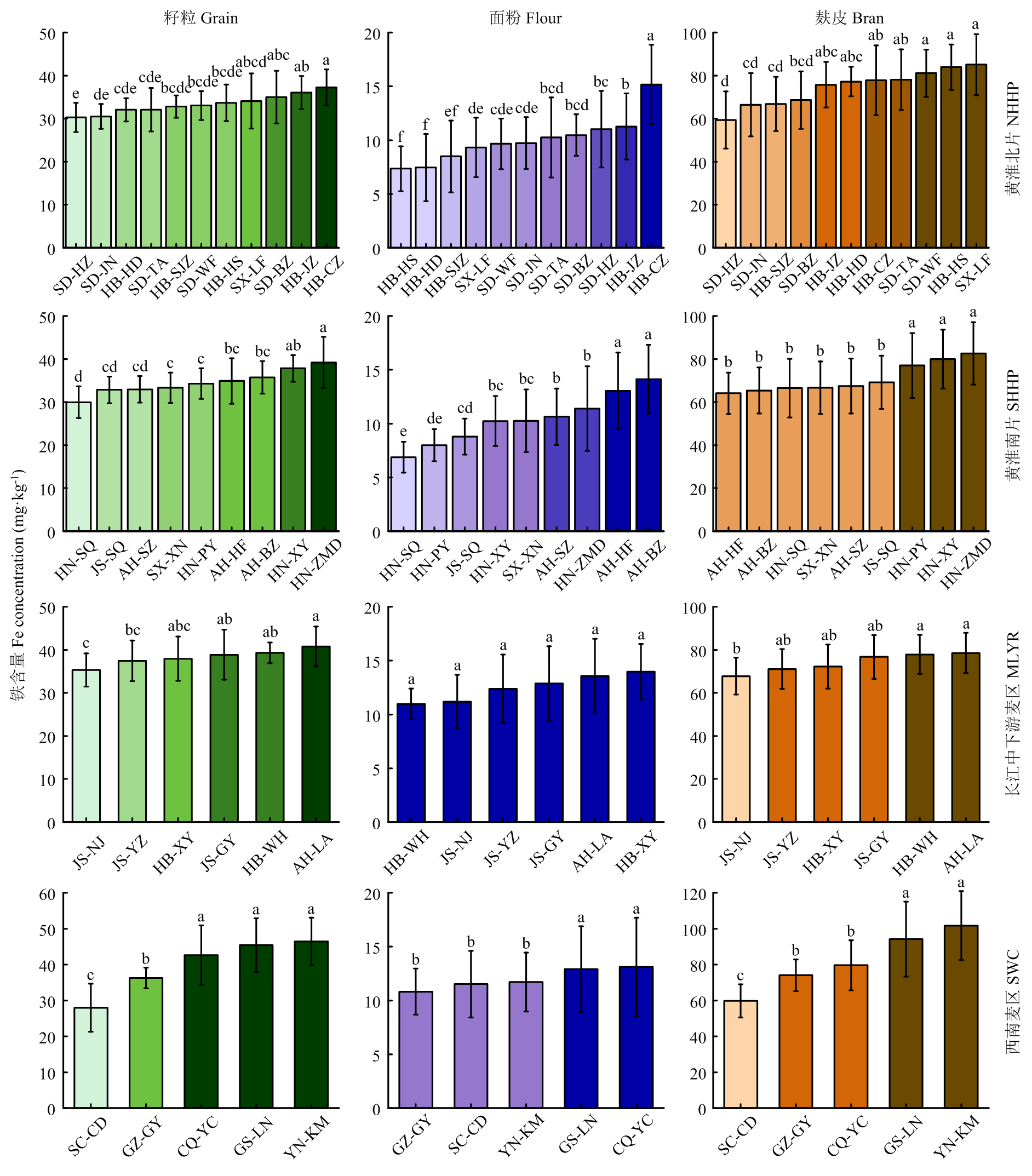
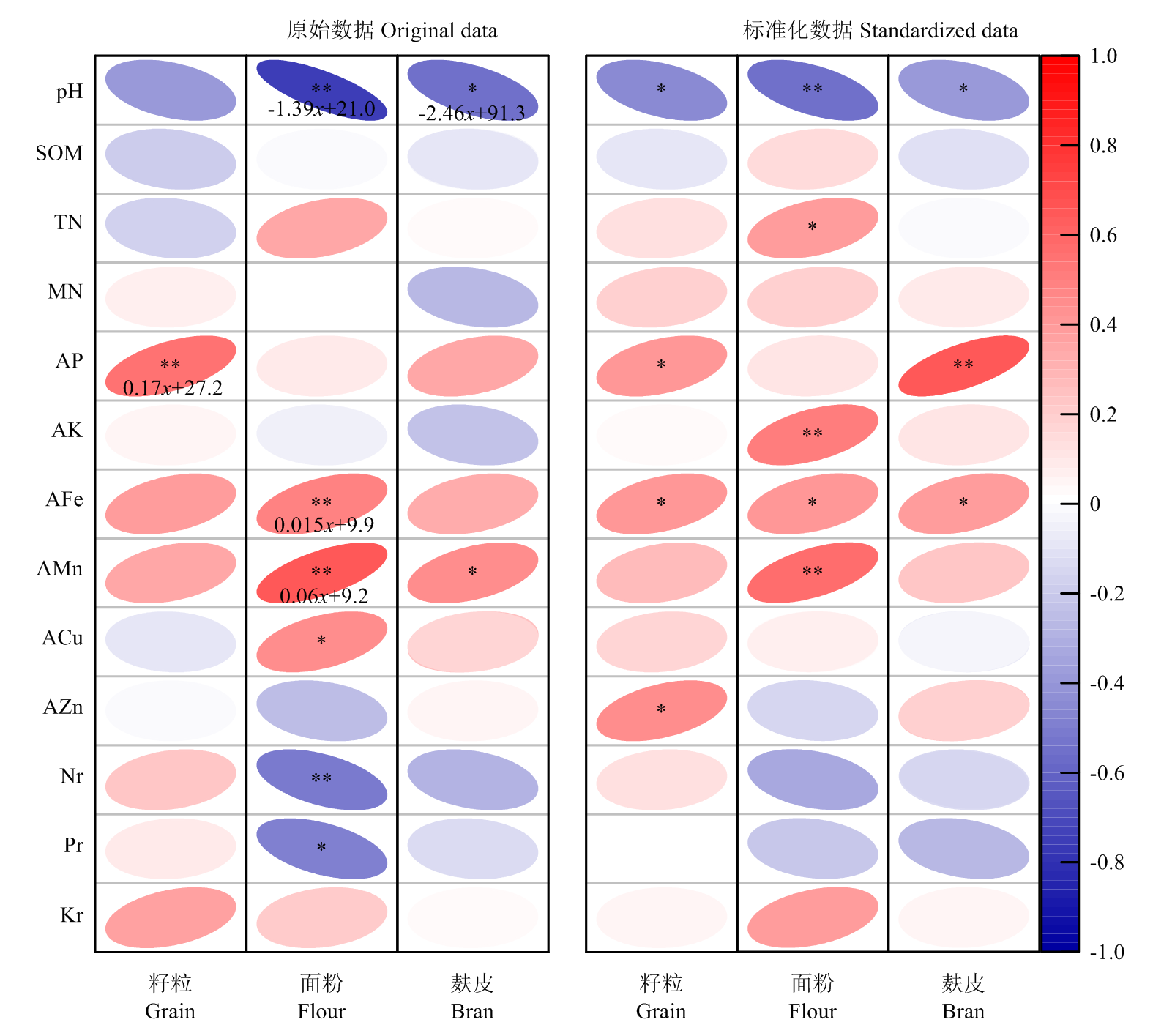
【Objective】 The study aims to measure the iron (Fe) concentration in the grain, flour, and bran of newly developed high-yielding wheat varieties (lines) in major wheat production regions of China. It investigates the impact of yield, yield components, and soil factors on Fe absorption and distribution within the wheat, and determine the effects of these variables on Fe concentrations in its different parts. The objective is to provide a basis for grain Fe nutritional fortification in wheat. 【Method】A study was conducted on 104 newly developed wheat varieties (lines) through multi-point trials across 17 provinces in major wheat production regions of China. The research analyzed Fe concentration in wheat grain, flour and bran, along with yield, yield components, Fe absorption and distribution, soil physicochemical properties, and fertilizer application rates during the 2021-2022 and 2022-2023 growing seasons, to study the Fe concentration in different parts of the grain of newly developed wheat varieties (lines) in China, as well as the absorption and distribution of Fe and environmental influencing factors. 【Result】Significant variations for Fe concentrations were observed in the wheat grain, flour and bran among new varieties (lines) in the major wheat production regions of China,with the range of 20.2-57.1, 2.1-37.5, and 31.2-144.5 mg·kg-1, and the average of 34.6, 10.8, and 72.8 mg·kg-1, respectively. Wheat varieties (lines) in the southern wheat regions exhibited higher Fe concentrations in grains and its different parts compared to that in the northern regions, and the Fe concentration in flour and bran showed a positive correlation with its in grain. For every 1.0 mg·kg-1 increase in grain Fe, flour saw a 0.2 to 0.3 mg·kg-1 rise, and bran experienced a 1.9 to 2.3 mg·kg-1 increase. The Fe concentration in grains was negatively correlated with yield, biomass, and spike number. With each 1.0 t·hm-2 increase in yield, there was a decrease of 1.2 mg·kg-1 in grain Fe concentration. For every 100×104/hm2 increase in spike number, the grain Fe concentration decreased by 0.3 mg·kg-1. The flour Fe concentration showed negative relationship with Fe absorption in grain, straw, glume and bran. The grain Fe concentration was negatively correlated with calcium, and positively with manganese, copper, and zinc. The grain Fe concentrations varied over locations, and different locations contributing 39% to 70% to the variation in grain Fe concentration. Soil pH, available phosphorus, Fe and manganese as major environmental factors affecting Fe nutrition in wheat grains. Grain Fe concentrations were negatively correlated with soil available phosphorus. Meanwhile, flour Fe concentrations were negatively correlated with soil pH, and positively correlated with soil available iron and manganese. 【Conclusion】High-Fe varieties (lines) were found among the newly developed high-yielding wheat varieties (lines) in China. Maintaining stable spike number, regulating soil pH, increasing grain Fe harvest index, soil available phosphorus, iron, manganese and appropriately applying N, P to enhance soil fertility were conducive to achieving a synergistic enhancement of both yield and Fe concentrations in wheat grain and flour.

Key words: wheat, varieties, flour, iron, yield, soil nutrients

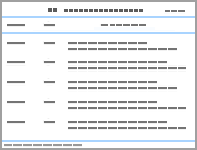
Table 1

The basic physical and chemical properties and fertilization rate of 0-20 cm soil in each wheat region experiment site"

麦区
Region
pH 有机质SOM
(g·kg-1)
土壤全氮TN
(g·kg-1)
有效养分
Available nutrient (mg·kg-1)
施肥量
Fertilizer rate (kg·hm-2)
矿质氮
MN
速效磷
AP
速效钾
AK
有效铁
AFe
有效锰
AMn
有效铜
ACu
有效锌
AZn
N P2O5 K2O
黄淮北片
NHHP
8.4±0.3 23.9±10.3 1.3±0.3 39.3±15.6 34.0±7.0 164.3±15.5 9.2±6.3 11.9±4.3 1.2±0.3 1.9±0.9 288±82.1 158±46.4 71±28.6
黄淮南片
SHHP
8.2±1.4 24.7±12.7 1.4±0.4 27.5±12.6 47.5±16.8 217.6±91.6 33.1±23.5 20.2±16.2 1.3±0.4 0.7±0.8 251±59.2 128±34.8 75±26.6
长江中
下游
MLYR
5.6±0.5 28.1±1.3 1.8±0.2 32.5±13.3 38.3±10.1 161.9±24.0 171.6±55.8 52.2±27.0 3.1±0.8 0.9±0.3 229±39.3 91±25.8 82±22.8
西南
麦区
SWC
6.9±0.6 29.0±5.1 1.6±0.3 17.4±7.1 23.5±9.0 153.2±47.7 66.6±36.8 29.6±8.2 3.5±0.6 1.2±0.2 184±45.2 76±39.7 57±18.8
所有
试验点
ALL
7.3±1.2 25.8±9.4 1.5±0.4 31.1±17.8 36.7±13.9 176.2±66.3 57.6±45.2 25.1±15.6 2.0±1.2 1.4±0.8 249±73.4 123±47.9 72±26.6

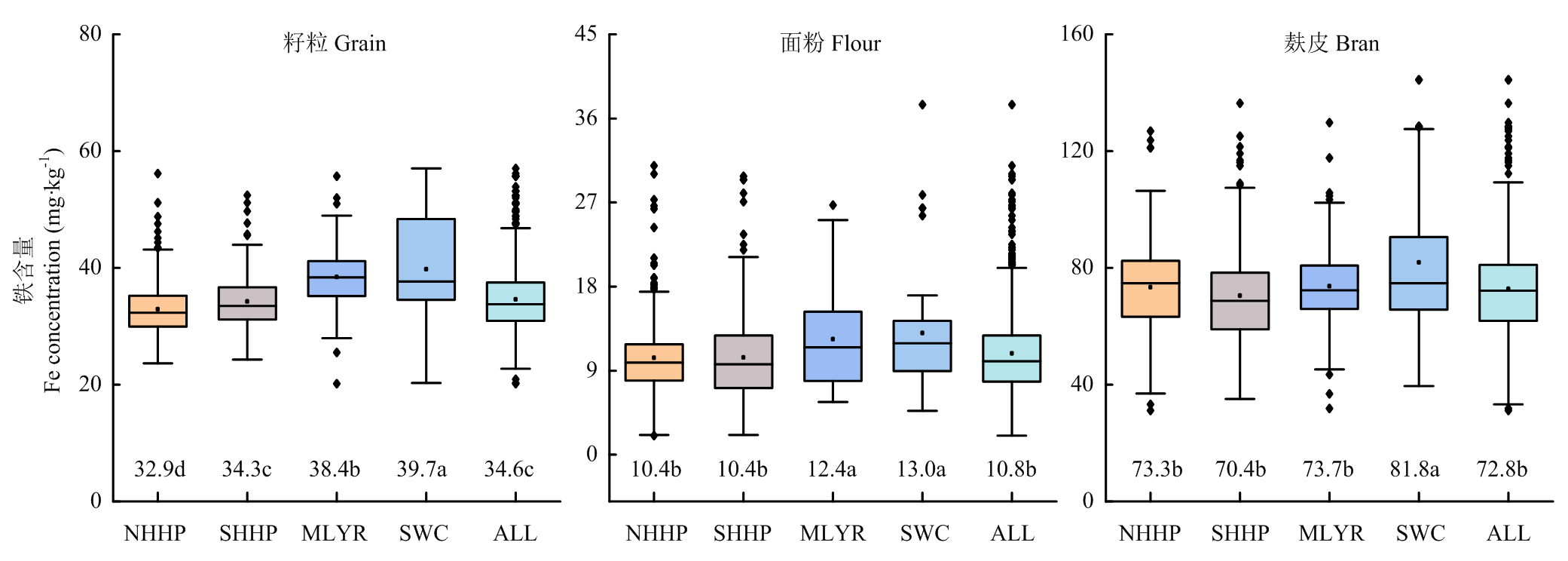
Fig. 1

Iron concentration in grain, flour and bran of newly developed wheat varieties (lines) during 2021 to 2023 in major wheat production regions of China"

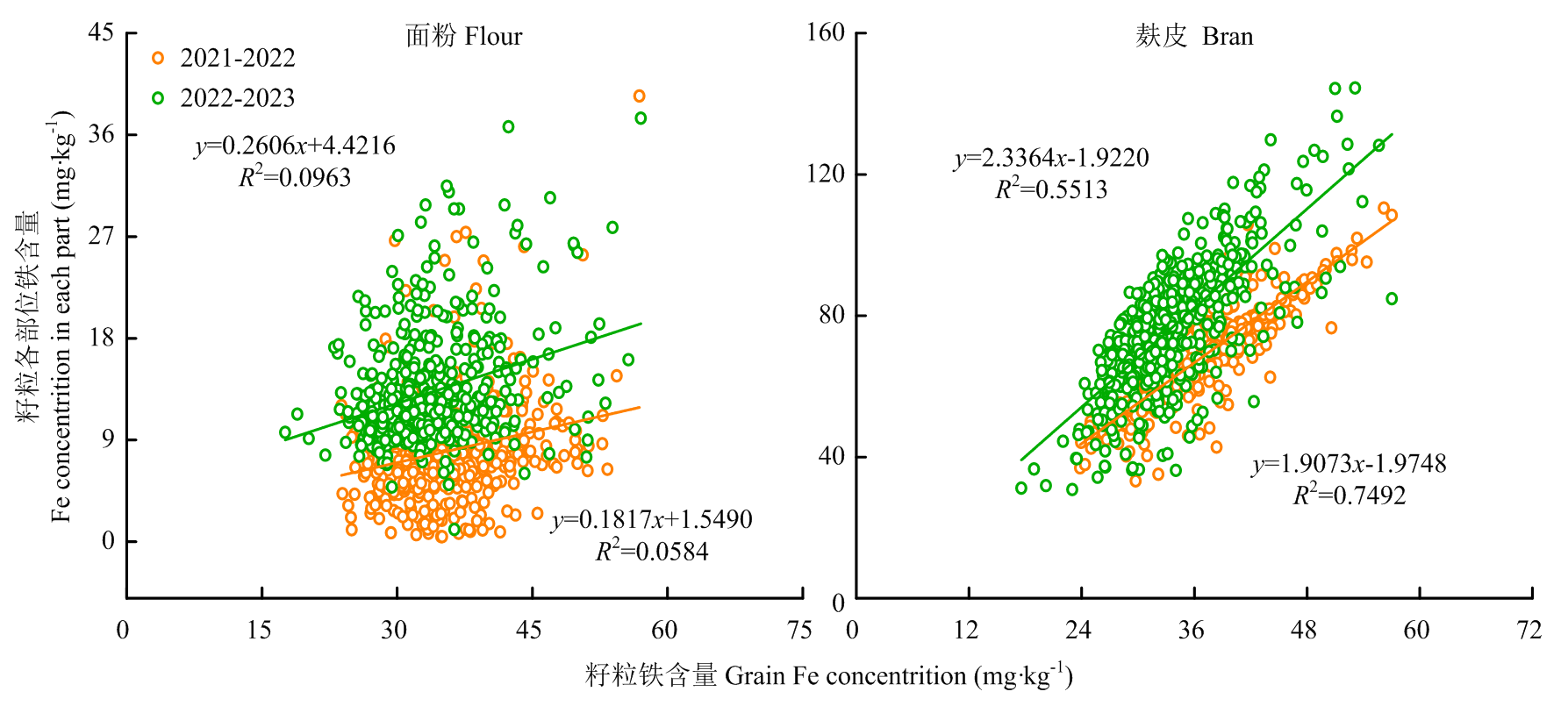
Fig. 2

Relationship of flour and bran Fe concentration to grain Fe concentration among newly developed wheat varieties (lines) during 2021 to 2023 in major wheat production regions of China The number is the two-year average of Fe concentration in grains and its different parts, and different small letters indicates significant difference (P<0.05). The same as below"

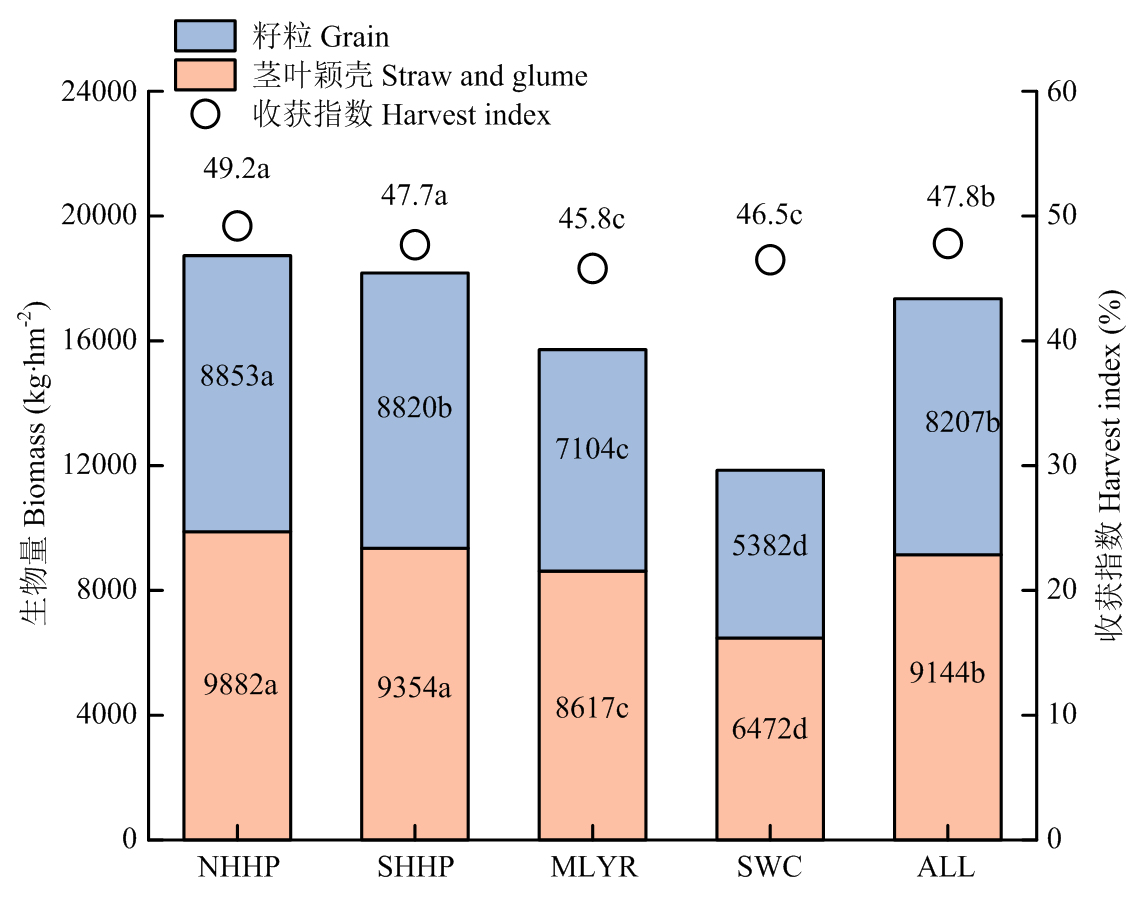
Fig. 3

Averages of yield, biomass and harvest index of newly developed wheat varieties (lines) during 2021 to 2023 in major wheat production regions of China"

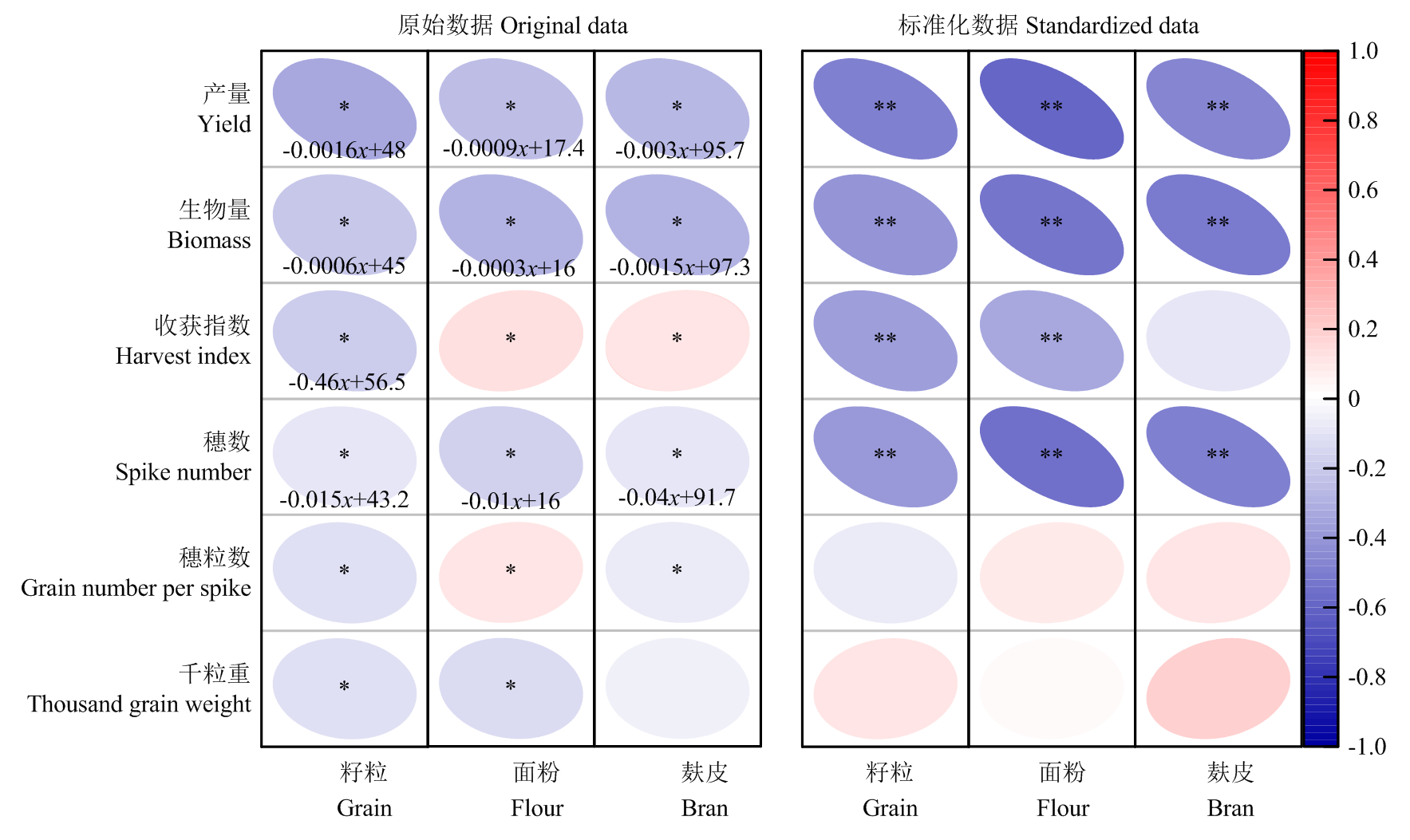
Fig. 4

Relationship of Fe concentration in grains and its different parts to grain yield, biomass, harvest index and yield components among newly developed wheat varieties (lines) during 2021 to 2023 in major wheat production regions of China *: P<0.05; **: P<0.01. The same as below"

Table 2

Average of Fe uptake, harvest index and distribution index of newly developed wheat varieties (lines) during 2021 to 2023 in major wheat production regions of China"

各器官和部位铁吸收分配
Fe uptake, harvest index and distribution index
黄淮北片
NHHP
黄淮南片
SHHP
长江中下游
MLYR
西南麦区
SWC
所有试验点
ALL
籽粒铁吸收量Grain Fe uptake (g·hm-2) 289.7ab 295.7a 271.9c 191.1d 279.8bc
茎叶铁吸收量Straw Fe uptake (g·hm-2) 2256.9a 1998.4ab 1752.6bc 1513.2c 2018.2ab
颖壳铁吸收量Glume Fe uptake (g·hm-2) 294.6b 331.3a 291.5b 149.3c 290.3b
面粉铁吸收量Flour Fe uptake (g·hm-2) 54.1a 55.5a 48.2b 34.4c 51.6ab
麸皮铁吸收量Bran Fe uptake (g·hm-2) 235.8ab 240.4a 225.1b 156.7c 228.5ab
籽粒铁收获指数Grain Fe harvest index (%) 14.5ab 15.0ab 13.8b 15.8a 14.6ab
茎叶铁收获指数Straw Fe harvest index (%) 71.4ab 69.1b 71.8ab 74.1a 71.0b
颖壳铁收获指数Glume Fe harvest index (%) 14.1b 15.9a 14.3ab 10.1c 14.4ab
面粉铁分配指数Flour Fe distribution index (%) 19.6a 19.4a 18.6a 18.5a 19.2a
麸皮铁分配指数Bran Fe distribution index (%) 80.6a 80.6a 82.0a 81.7a 81.0a

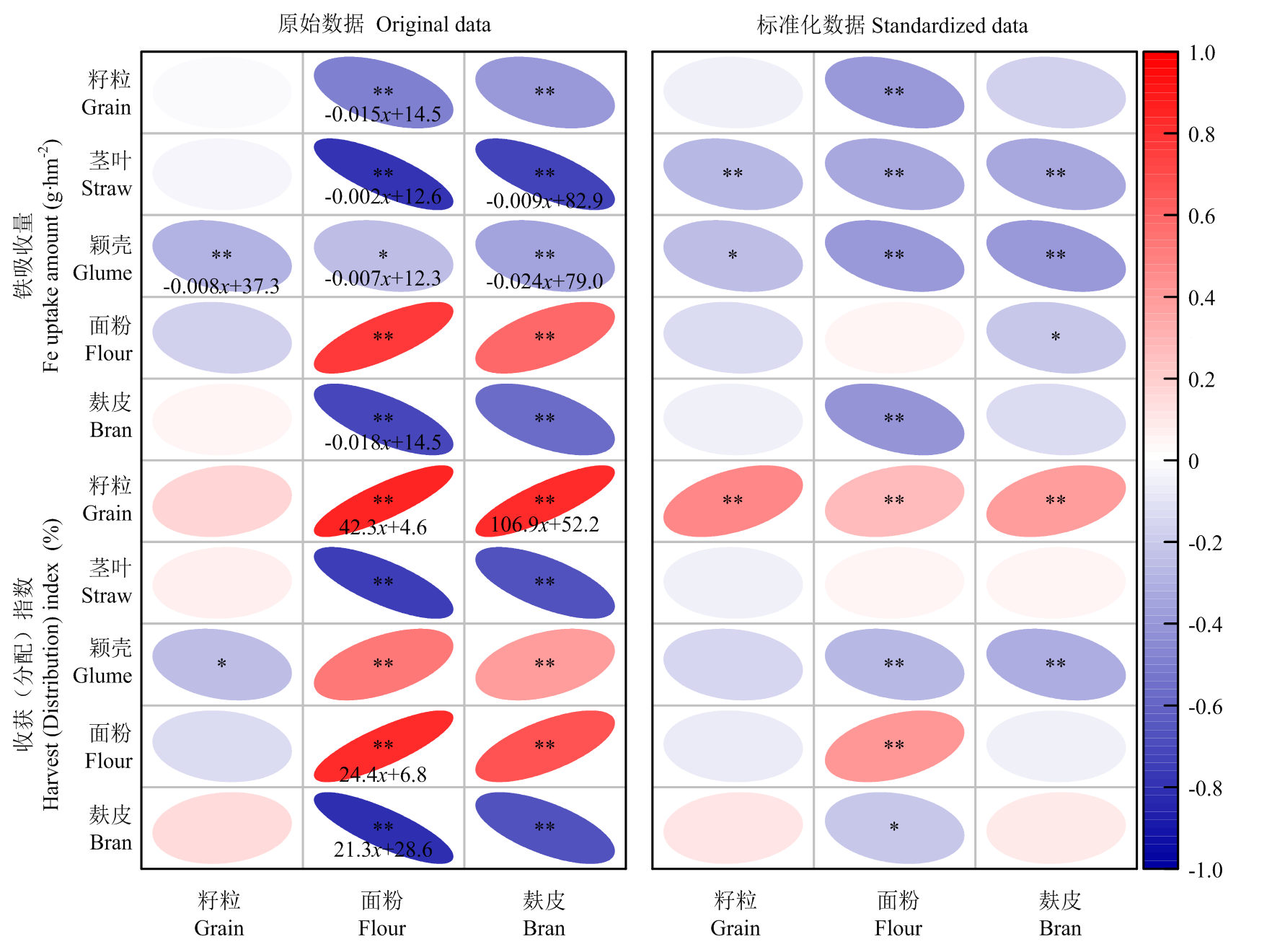
Fig. 5

Relationship between Fe concentrations in grains and its different parts of newly developed wheat varieties (lines) and Fe uptake, harvest index and distribution index in different organs during 2021 to 2023 in major wheat production regions of China"

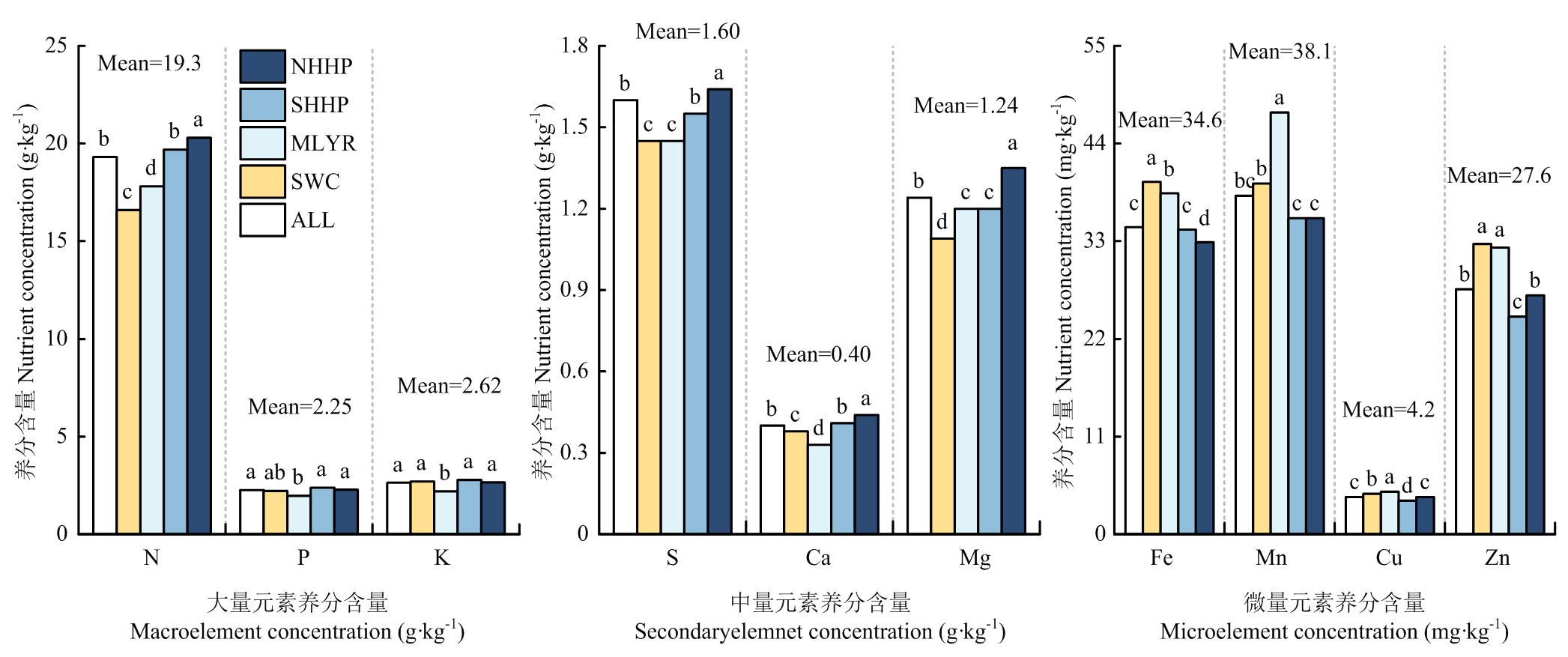
Fig. 6

Average of nutrient elements in grains of newly developed wheat varieties (lines) during 2021 to 2023 in major wheat production regions of China"

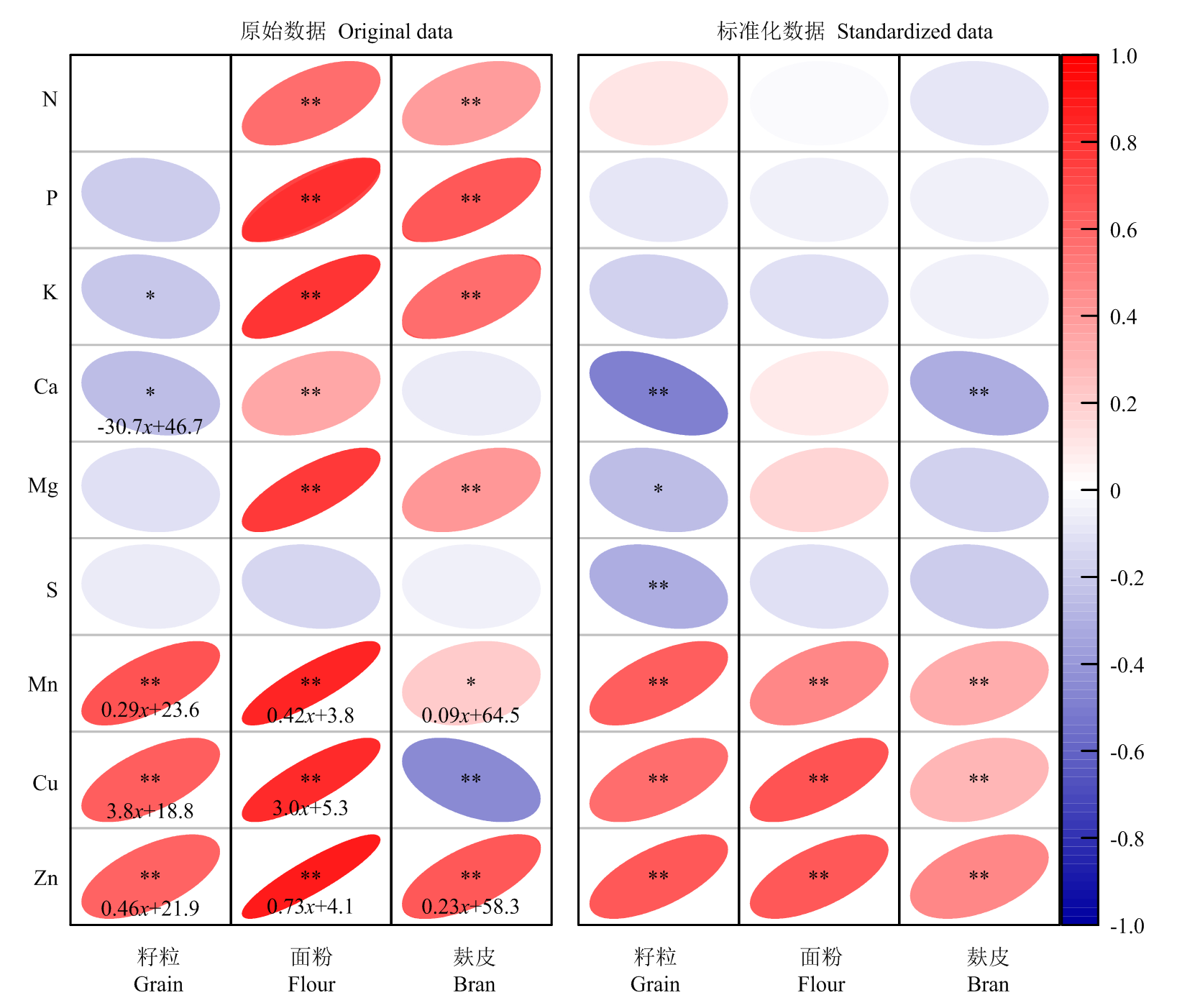
Fig. 7

Relationship of Fe concentration in grains and its different parts to other nutrient concentrations in the corresponding parts for newly developed wheat varieties (lines) during 2021 to 2023 in major wheat production regions of China"

Fig. 8

Ranking and variance analysis of the average of grain, flour and bran Fe concentration in different locations during 2021 to 2023 in major wheat production regions of China NHHP: SD-HZ: Shandong-Heze; SD-JN: Shandong-Jinan; HB-HD: Hebei-Handan; SD-TA: Shandong-Taian; HB-SJZ: Hebei-Shijiazhuang; SD-WF: Shandong-Weifang; HB-HS: Hebei-Hengshui; SX-LF: Shanxi-Linfen; SD-BZ: Shandong-Binzhou; HB-JZ: Hebei-Jinzhou; HB-CZ: Hebei-Cangzhou. SHHP: HN-SQ: Henan-Shangqiu; JS-SQ: Jiangsu-Suqian; AH-SZ: Anhui-Suzhou; SX-XN: Shanxi-Xinong; HN-PY: Henan-Puyang; AH-HF: Anhui-Hefei; AH-BZ: Anhui-Bozhou; HN-XY: Henan-Xingyang; HN-ZMD: Henan-Zhumadian. MLYR: JS-NJ: Jiangsu-Nanjing; JS-YZ: Jiangsu-Yangzhou; HB-XY: Hubei-Xiangyang; JS-GY: Jiangsu-Gaoyou; HB-WH: Hubei-Wuhan; AH-LA: Anhui-Luan. SWC: SC-CD: Sichuan-Chengdu; GZ-GY: Guizhou-Guiyang; CQ-YC: Chongqing-Yongchuan; GS-LN: Gansu-Longnan; YN-KM: Yunnan-Kunming"

Fig. 9

Correlation between Fe concentration in grain, flour and bran of newly developed wheat varieties (lines) and soil factors during 2021 to 2023 in major wheat production regions of China"

Table 3

Soil factor analysis of high Fe (HFe) and low Fe (LFe) sites during 2021 to 2023 in major wheat production regions of China"

部位
Part
分组
Group
铁含量
Fe concentration (mg·kg-1)
土壤pH和有效养分Soil pH and available nutrients (mg·kg-1
pH 有效磷AP 有效铁AFe 有效锰AMn
籽粒
Grain
高铁HFe 38.7±1.2a 5.5±0.1b 42.1±7.0a 202.5±51.0a 41.2±7.1a
低铁LFe 31.3±0.8b 8.5±0.5a 34.2±12.2a 7.4±2.5b 9.4±1.7b
面粉
Flour
高铁HFe 13.0±1.5a 5.9±1.1b 41.2±20.8a 116.7±79.2a 51.9±14.6a
低铁LFe 8.5±1.2b 8.4±0.5a 31.5±7.4a 6.8±2.1b 9.7±2.4b
麸皮
Bran
高铁HFe 80.4±2.1a 5.4±1.4b 65.3±14.7a 156.0±56.6a 44.2±27.2a
低铁LFe 64.7±3.2b 8.6±0.9a 31.2±6.4b 6.8±1.2a 10.6±2.2a
[1]
STEVENS G A, BEAL T, MBUYA M, LUO H, NEUFELD L M. Micronutrient deficiencies among preschool-aged children and women of reproductive age worldwide: A pooled analysis of individual-level data from population-representative surveys. Lancet Global Health, 2022, 10(11): e1590-e1599.

doi: 10.1016/S2214-109X(22)00367-9 pmid: 36240826
[2]
MA G S, JIN Y, LI Y P, ZHAI F Y, KOK F J, JACOBSEN E, YANG X G. Iron and zinc deficiencies in China: What is a feasible and cost- effective strategy? Public Health Nutrition, 2008, 11(6): 632-638.
[3]
褚宏欣. 我国主要麦区麦田土壤及小麦籽粒微量元素的营养评价[D]. 杨凌: 西北农林科技大学, 2022.
CHU H X. Nutritional evaluation on of micro-elements of soil and wheat grain in major wheat production regions of China[D]. Yangling: Northwest A&F University, 2022. (in Chinese)
[4]
LIU H, WANG Z H, LI F, LI K, YANG N, YANG Y, HUANG D, LIANG D, ZHAO H, MAO H, LIU J, QIU W. Grain iron and zinc concentrations of wheat and their relationships to yield in major wheat production areas in China. Field Crops Research, 2014, 156: 151-160.
[5]
GRAHAM R D, WELCH R M, SAUNDERS D A, ORTIZ- MONASTERIO I, BOUIS H E, BONIERBALE M, DE HAAN S, BURGOS G, THIELE G, LIRIA R, MEISNER C A, BEEBE S E, POTTS M J, KADIAN M, HOBBS P R, GUPTA R, TWOMLOW S. Nutritious subsistence food systems. Advances in Agronomy, 2007(92): 1-72.
[6]
CU S T, GUILD G, NICOLSON A, VELU G, SINGH R, STANGOULIS J. Genetic dissection of zinc, iron, copper, manganese and phosphorus in wheat (Triticum aestivum L.) grain and rachis at two developmental stages. Plant Science, 2020, 291: 110338.
[7]
GUO Z K, WANG X S, ZHANG X M, WANG L, WANG R Z, HUI X L, WANG S, CHEN Y L, WHITE P J, SHI M, WANG Z H. Synchrotron X-ray fluorescence technique identifies contribution of node iron and zinc accumulations to the grain of wheat. Journal of Agricultural and Food Chemistry, 2022, 70(30): 9346-9355.
[8]
MORGOUNOV A, FERNEY GOMEZ-BECERRA H, ABUGALIEVA A, DZHUNUSOVA M, YESSIMBEKOVA M, MUMINJANOV H, ZELENSKIY Y, OZTURK L, CAKMAK I. Iron and zinc grain density in common wheat grown in Central Asia. Euphytica, 2007, 155(1/2): 193-203.
[9]
YOUNAS A, SADAQAT H A, KASHIF M, AHMED N, FAROOQ M. Combining ability and heterosis for grain iron biofortification in bread wheat. Journal of the Science of Food and Agriculture, 2020, 100(4): 1570-1576.

doi: 10.1002/jsfa.10165 pmid: 31769035
[10]
YI Q S, WANG Y, YI C, LI L X, CHEN Y L, ZHOU H M, TONG F, LIU L Z, GAO Y, SHI G L. Agronomic and ionomics indicators of high-yield, mineral-dense, and low-Cd grains of wheat (Triticum aestivum L.) cultivars. Ecotoxicology and Environmental Safety, 2023, 261: 115120.
[11]
GARNETT T P, GRAHAM R D. Distribution and remobilization of iron and copper in wheat. Annals of Botany, 2005, 95(5): 817-826.

pmid: 15701664
[12]
ZHANG Y, SONG Q C, YAN J, TANG J W, ZHAO R R, ZHANG Y Q, HE Z H, ZOU C Q, ORTIZ-MONASTERIO I. Mineral element concentrations in grains of Chinese wheat cultivars. Euphytica, 2010, 174(3): 303-313.
[13]
宋奇超. 籽粒高铁锌小麦品系的筛选及环境影响[D]. 北京: 中国农业大学, 2007.
SONG Q C. Screening of high iron and zinc wheat lines and its environmental impact[D]. Beijing: China Agricultural University, 2007 (in Chinese)
[14]
GAO W Z, ZHOU Z R, WANG K, WANG X S, GUO Z K, LI C, WANG Z H, SHI M. Transections staining values analysis reveals iron concentration variation in wheat grain tissues over cultivars and sites. Journal of Cereal Science, 2023, 113: 103729.
[15]
LI M, WANG S X, TIAN X H, LI S, CHEN Y L, JIA Z, LIU K, ZHAO A Q. Zinc and iron concentrations in grain milling fractions through combined foliar applications of Zn and macronutrients. Field Crops Research, 2016, 187: 135-141.
[16]
BEASLEY J T, BONNEAU J P, MORENO-MOYANO L T, CALLAHAN D L, HOWELL K S, TAKO E, TAYLOR J, GLAHN R P, APPELS R, JOHNSON A A T. Multi-year field evaluation of nicotianamine biofortified bread wheat. The Plant Journal, 2022, 109: 1168-1182.
[17]
石荣丽, 张福锁, 邹春琴. 不同基因型小麦铁营养效率差异及其可能机制. 植物营养与肥料学报, 2010, 16(6): 1306-1311.
SHI R L, ZHANG F S, ZOU C Q. Iron efficiency of different wheat genotypes and its main contributed factors. Plant Nutrition and Fertilizer Science, 2010, 16(6): 1306-1311. (in Chinese)
[18]
LIU Z H, WANG H Y, WANG X E, ZHANG G P, CHEN P D, LIU D J. Genotypic and spike positional difference in grain phytase activity, phytate, inorganic phosphorus, iron, and zinc contents in wheat (Triticum aestivum L.). Journal of Cereal Science, 2006, 44(2): 212-219.
[19]
PATACO I, MOURINHO M, OLIVEIRA K, SANTOS C, PELICA J, PAIS I, RAMALHO J, LEITO A, CAMPOS P, LIDON F, PESSOA F. Durum wheat (Triticum durum) biofortification in iron and definition of quality parameters for the industrial production of pasta and #8211: A review. Emirates Journal of Food & Agriculture, 2015, 27(3): 242.
[20]
CHATZAV M, PELEG Z, OZTURK L, YAZICI A, FAHIMA T, CAKMAK I, SARANGA Y. Genetic diversity for grain nutrients in wild emmer wheat: potential for wheat improvement. Annals of Botany, 2010, 105(7): 1211-1220.

doi: 10.1093/aob/mcq024 pmid: 20202969
[21]
巩翰颖, 李明, 刘宏艳, 卢大新. 小麦制粉不同组分中铁锌含量的影响因素探析. 核农学报, 2019, 33(9): 1765-1773.

doi: 10.11869/j.issn.100-8551.2019.09.1765
GONG H Y, LI M, LIU H Y, LU D X. Iron and zinc content variances in wheat milling fractions and their influencing factors. Journal of Nuclear Agricultural Sciences, 2019, 33(9): 1765-1773. (in Chinese)

doi: 10.11869/j.issn.100-8551.2019.09.1765
[22]
KHOKHAR J S, KING J, KING I P, YOUNG S D, FOULKES M J, DE SILVA J, WEERASINGHE M, MOSSA A, GRIFFITHS S, RICHE A B, HAWKESFORD M, SHEWRY P, BROADLEY M R. Novel sources of variation in grain Zinc (Zn) concentration in bread wheat germplasm derived from Watkins landraces. PLoS ONE, 2020, 15(2): e0229107.
[23]
XUE Y F, ZHANG W, LIU D Y, XIA H Y, ZOU C Q. Nutritional composition of iron, zinc, calcium, and phosphorus in wheat grain milling fractions as affected by fertilizer nitrogen supply. Cereal Chemistry, 2016, 93(6): 543-549.
[24]
ZHANG Y, SHI R, REZAUL K M, ZHANG F, ZOU C. Iron and zinc concentrations in grain and flour of winter wheat as affected by foliar application. Journal of Agricultural and Food Chemistry, 2010, 58(23): 12268-12274.

doi: 10.1021/jf103039k pmid: 21073194
[25]
AMIRI R, BAHRAMINEJAD S, SASANI S, JALALI-HONARMAND S, FAKHRI R. Bread wheat genetic variation for grain’s protein, iron and zinc concentrations as uptake by their genetic ability. European Journal of Agronomy, 2015, 67: 20-26.
[26]
FAN M, ZHAO F, FAIRWEATHER-TAIT S J, POULTON P R, DUNHAM S J, MCGRATH S P. Evidence of decreasing mineral density in wheat grain over the last 160 years. Journal of Trace Elements in Medicine and Biology, 2008, 22(4): 315-324.
[27]
MURPHY K M, REEVES P G, JONES S S. Relationship between yield and mineral nutrient concentrations in historical and modern spring wheat cultivars. Euphytica, 2008, 163(3): 381-390.
[28]
PELEG Z, SARANGA Y, YAZICI A, FAHIMA T, OZTURK L, CAKMAK I. Grain zinc, iron and protein concentrations and zinc-efficiency in wild emmer wheat under contrasting irrigation regimes. Plant Soil, 2008, 306(1/2): 57-67.
[29]
MANJUNATH K K, KRISHNA H, DEVATE N B, SUNILKUMAR V P, CHAUHAN D, SINGH S, MISHRA C N, SINGH J B, SINHA N, JAIN N, SINGH G P, SINGH P K. Mapping of the QTLs governing grain micronutrients and thousand kernel weight in wheat (Triticum aestivum L.) using high density SNP markers. Frontiers in Nutrition, 2023, 10.
[30]
HOCAOĞLU O, AKÇURA M, KAPLAN M. Changes in the grain element contents of durum wheat varieties of turkey registered between 1967-2010. Communications in Soil Science and Plant Analysis, 2020, 51(4): 431-439.
[31]
ILYAS M, KHAN M J, MURAD Z, SATTI S Z, ULLAH A. Biofortification of iron in wheat varieties using different methods of application. Gesunde Pflanzen, 2023, 75(5): 2177-2185.
[32]
HARRINGTON S A, CONNORTON J M, NYANGOMA N, MCNELLY R, MORGAN Y, ASLAM M F, SHARP P A, JOHNSON A, UAUY C, BALK J. A two-gene strategy increases iron and zinc concentrations in wheat flour, improving mineral bioaccessibility. Plant Physiology, 2023, 191(1): 528-541.
[33]
KLIKOCKA H, MARKS M. Sulphur and nitrogen fertilization as a potential means of agronomic biofortification to improve the content and uptake of microelements in spring wheat grain DM. Journal of Chemistry, 2018, 2018: 1-12.
[34]
ASTOLFI S, PII Y, TERZANO R, MIMMO T, CELLETTI S, ALLEGRETTA I, LAFIANDRA D, CESCO S. Does Fe accumulation in durum wheat seeds benefit from improved whole-plant sulfur nutrition? Journal of Cereal Science, 2018, 83: 74-82.
[35]
ZUCHI S, CESCO S, ASTOLFI S. High S supply improves Fe accumulation in durum wheat plants grown under Fe limitation. Environmental and Experimental Botany, 2012, 77: 25-32.
[36]
孟翔翔, 李文凤, 沈仁芳, 兰平. 不同磷效率基因型小麦应对缺磷胁迫的表型及相关基因表达的研究. 植物营养与肥料学报, 2021, 27(11): 1883-1893.
MENG X X, LI W F, SHEN R F, LAN P. Time-course response of phenotype and the expression of Pi-starvation responsive genes in high and low Pi-efficient wheat genotypes to Pi starvation. Journal of Plant Nutrition and Fertilizers, 2021, 27(11): 1883-1893. (in Chinese)
[37]
KUTMAN U B, YILDIZ B, CAKMAK I. Improved nitrogen status enhances zinc and iron concentrations both in the whole grain and the endosperm fraction of wheat. Journal of Cereal Science, 2011, 53(1): 118-125.
[38]
CIUDAD-MULERO M, MATALLANA-GONZÁLEZ M C, CALLEJO M J, CARRILLO J M, MORALES P, FERNÁNDEZ-RUIZ V. Durum and Bread Wheat Flours. Preliminary Mineral Characterization and Its Potential Health Claims. Agronomy, 2021, 11(1): 108.
[39]
ZHAO D, LI X, ZHAO L, LI L, ZHANG Y, ZHANG Z, LIU L, XU H, ZHAO W, WU T, SIDDIQUE K H M. Comparison of zinc and iron uptake among diverse wheat germplasm at two phosphorus levels. Cereal Research Communications, 2020, 48(4): 441-448.
[40]
罗一诺, 张慕欣, 高玉, 薛欣, 惠晓丽, 王星舒, 石美, 王朝辉. 旱地石灰性土壤上长期施磷对小麦籽粒铁锰铜锌含量的影响. 植物营养与肥料学报, 2021, 27(11): 1894-1904.
LUO Y N, ZHANG M X, GAO Y, XUE X, HUI X L, WANG X S, SHI M, WANG Z H. Wheat grain Fe, Mn, Cu and Zn contents as affected by long-term P application in dryland calcareous soil. Plant Nutrition and Fertilizer Science, 2021, 27(11): 1894-1904. (in Chinese)
[41]
LI B Y, HUANG S M, WEI M B, ZHANG H L, SHEN A L, XU J M, RUAN X L. Dynamics of soil and grain micronutrients as affected by long-term fertilization in an aquic inceptisol. Pedosphere, 2010, 20(6): 725-735.
[42]
KARAMI M, AFYUNI M, KHOSHGOFTARMANESH A H, PAPRITZ A, SCHULIN R. Grain zinc, iron, and copper concentrations of wheat grown in central iran and their relationships with soil and climate variables. Journal of Agricultural and Food Chemistry, 2009, 57(22): 10876-10882.

doi: 10.1021/jf902074f pmid: 19883069
[43]
OURY F X, LEENHARDT F, RÉMÉSY C, CHANLIAUD E, DUPERRIER B, BALFOURIER F, CHARMET G. Genetic variability and stability of grain magnesium, zinc and iron concentrations in bread wheat. European Journal of Agronomy, 2006, 25(2): 177-185.
[44]
刘晓伟, 宋一蕾, 李珊珊, 张树华, 杨学举, 王殿武, 赵勇. 低钾胁迫对不同品种冬小麦植株元素累积和生物学性状的影响. 河北农业大学学报, 2019, 42(3): 14-21.
LlU X W, SONG Y L, LI S S, ZHANG S H, YANG X J, WANG D W, ZHAO Y. Effect of low potassium stress on element accumulation and biological traits of different winter wheat varieties. Journal of Hebei Agriculture University, 2019, 42(3): 14-21. (in Chinese)
[45]
ZHANG Y Q, DENG Y, CHEN R Y, CUI Z L, CHEN X P, YOST R, ZHANG F S, ZOU C Q. The reduction in zinc concentration of wheat grain upon increased phosphorus-fertilization and its mitigation by foliar zinc application. Plant Soil, 2012, 361(1/2): 143-152.
[1] PENG TingShen, LU JiuYan, WU MeiLin, YAN YuXin, LIU HongZhou, NAN WenBin, QIN XiaoJian, LI Ming, GONG JunYi, LIANG YongShu. QTL Analysis of Yield-Related Traits in Both Huangnuo2# and Changbai7# of Perennial Chinese Rice [J]. Scientia Agricultura Sinica, 2026, 59(7): 1361-1379.
[2] ZHU Qi, JIA ZhenPeng, Tahir SHAH, XU ChenSheng, LI ZhiQi, LÜ HuiShuai, ZHU PengChao, WEI XiaoMin, HUANG DongLin, SUN YanNi, CAO WeiDong, GAO YaJun, WANG ZhaoHui, ZHANG DaBin. Green Manure Crops Combined with Enhanced-Efficiency Products Reduced Greenhouse Gas Emissions and Carbon Footprints in Dryland Wheat Fields [J]. Scientia Agricultura Sinica, 2026, 59(7): 1507-1522.
[3] WANG YuPing, FU Zhi, SUN JiaYing, MU XiaoMeng, LIU HuiLin, GUO JinYun, SONG WenJing, HOU LeiPing, ZHAO HaiLiang. Evaluation of the Mitigating Effect and Application Efficacy of Melatonin Applied at the Seedling Stage on Short-Term Chilling Stress in Tomato Plants [J]. Scientia Agricultura Sinica, 2026, 59(7): 1523-1535.
[4] WANG JiaNuo, CHEN GuiPing, LI Pan, WANG LiPing, NAN YunYou, HE Wei, FAN ZhiLong, HU FaLong, CHAI Qiang, YIN Wen, ZHAO LiaoHao. Photo-Physiological Mechanism at Grain Filling Stage of No-Tillage with Plastic Re-Mulching to Increase Maize Yield in Oasis Irrigation Areas [J]. Scientia Agricultura Sinica, 2026, 59(6): 1189-1202.
[5] ZHOU XinJie, REN Hao, CHEN YingLong, ZHANG JiWang, ZHAO Bin, REN BaiZhao, LIU Peng, WANG HongZhang. Effects of Calcium Peroxide on Root Morphology and Yield Formation of Summer Maize in Waterlogging Farmland [J]. Scientia Agricultura Sinica, 2026, 59(6): 1203-1216.
[6] HE JiHang, ZHANG Qing, LÜ XiangYue, XUE JiQuan, XU ShuTu, LIU JianChao. Evaluation of Nitrogen Efficiency of Different Stay-Green Maize Hybrids [J]. Scientia Agricultura Sinica, 2026, 59(6): 1217-1230.
[7] LI WenHu, LI HaiFeng, DU YuPeng, DING YuLan, LUO YiNuo, LI YuKe, SHE WenTing, ZHANG Feng, TENG Yu, ZHANG SiQi, HUANG Cui, LI XiaoHan, LIU JinShan, WANG ZhaoHui. Regional Differences in Wheat Zinc Uptake and Translocation Responses to Soil Zinc Fertilization [J]. Scientia Agricultura Sinica, 2026, 59(5): 1034-1047.
[8] JIAO WenJuan, HE WanLong, GENG HongWei, BAI Bin, LI JianFeng, CHENG YuKun. Stripe Rust Resistance Evaluation and Molecular Characterization of Yr Genes for 155 Spring Wheat Varieties (Lines) [J]. Scientia Agricultura Sinica, 2026, 59(5): 937-950.
[9] HAO Kun, CHEN HongDe, ZHANG Wei, ZHONG Yun, DANG MeiRong, ZHU ShiJiang, HUANG ZhiKun, JIN Ying. Comprehensive Evaluation of Water-Nitrogen Management Under Surge-Root Irrigation Based on Citrus Yield, Quality, and Water- Nitrogen Use Efficiency [J]. Scientia Agricultura Sinica, 2026, 59(4): 862-873.
[10] CUI ShiYou, CHEN PengJun, MIAO YuanQing, HAN JiJun, SHEN JunMing. Development and Field Evaluation of Glyphosate-Resistant Wheat Germplasm Generated Through EMS Mutagenesis [J]. Scientia Agricultura Sinica, 2026, 59(4): 723-733.
[11] GUO FuCheng, TANG HaiJiang, HAO XinYi, MA GuoLin, YANG JiuJu, HUANG LinFeng, TIAN Lei, WANG Bin, LUO ChengKe. Effects of Different Irrigation Methods on Water-Salt Transport, Rice Yield, and Water Use Efficiency in Saline Soil in Ningxia [J]. Scientia Agricultura Sinica, 2026, 59(4): 750-764.
[12] QIAN Jin, LI YingXue, WU Fang, ZOU XiaoChen. Improved Leaf Phosphorus Content Estimation of Winter Wheat Using Ensemble Hyperspectral Dimensionality Reduction Method [J]. Scientia Agricultura Sinica, 2026, 59(4): 781-792.
[13] KONG Yuan, CUI ShaSha, LI Mei, LI Jian, YANG SiYu, FANG Feng, LIU ShuaiShuai, LIU MingPing, ZENG Yan, GAO XingXiang, BAI LianYang. Spatiotemporal Distribution Dynamics of Five Grass Weed Species Including Lolium multiflorum in Winter Wheat Fields of the Huang- Huai-Hai Region [J]. Scientia Agricultura Sinica, 2026, 59(4): 807-823.
[14] WANG YongSheng, NIU Li, WANG ChangJie, MA LiHua, LIAN XiaoXiao, MENG YaXiong, MA XiaoLe, YAO LiRong, ZHANG Hong, YANG Ke, LI BaoChun, WANG HuaJun, SI ErJing, WANG JunCheng. Genome-Wide Association Study and Candidate Gene Identification for Thousand Grain Weight in Winter Wheat [J]. Scientia Agricultura Sinica, 2026, 59(3): 499-514.
[15] LI XinYi, LI JiaNing, YANG WenPing, XIA Qing, HUO YingRui, HAO ShiHang, HUANG TingMiao, REN YongKang, CHEN Jie, GAO ZhiQiang, YANG ZhenPing. Effects of Post-Anthesis Foliar Zinc Application on Zinc Nutrition in Colored-Grain Wheat [J]. Scientia Agricultura Sinica, 2026, 59(3): 515-527.
Viewed
Full text


Abstract

Cited

  Shared   
  Discussed   
No Suggested Reading articles found!