Scientia Agricultura Sinica ›› 2023, Vol. 56 ›› Issue (17): 3251-3260.doi: 10.3864/j.issn.0578-1752.2023.17.002

;

• SPECIAL FOCUS: HERBICIDE-TOLERANCE COTTON CREATION BY GENETIC TRANSFORMATION AND GENOME EDITING • Previous Articles     Next Articles

Identification of Target Traits and Genetic Stability of Transgenic Cotton GGK2

LIANG ChengZhen(), ZANG YouYi, MENG ZhiGang, WANG Yuan, MUBASHIR Abbas, HE HaiYan, ZHOU Qi, WEI YunXiao, ZHANG Rui(), GUO SanDui()   

  1. Biotechnology Research Institute, Chinese Academy of Agricultural Sciences, Beijing 100081
  • Received:2023-01-17 Accepted:2023-02-23 Online:2023-09-01 Published:2023-09-08
  • Contact: LIANG ChengZhen, ZHANG Rui, GUO SanDui

Abstract:

【Objective】The objective of this study is to confirm the target traits and genetic stability of transgenic glyphosate- resistant cotton GGK2 and provide technical support for its commercialization. 【Method】T3, T4, and T5 transgenic cotton plants GGK2 were subjected to insertion site-specific PCR, Southern blot, ELISA, bioassays in the laboratory and field, analysis of target herbicide tolerance, and investigation of nutritional constituents. 【Result】The results indicated that the target genes, GR79 EPSPS and GAT, were integrated into the cotton genome as single copies and stably inherited in GGK2 plants. In GGK2 cotton, GR79 EPSPS, GAT, and NPTⅡ proteins were expressed at different stages and in different tissues, with relatively high expression levels in the leaves. At the four-leaf stage, bud stage and boll opening stag, the expression levels in leaves were 128.7-192.4 µg·g-1, 24.4-35.0 µg·g-1, and 17.0-23.9 µg·g-1 fresh weight for GR79 EPSPS, GAT, and NPTⅡ, respectively. In the field, transgenic cotton GGK2 tolerated up to four times the recommended medium dose of glyphosate application. No significant differences were observed in agronomic traits and nutritional constituents compared to the control, Coker312. 【Conclusion】These data demonstrate that transgenic cotton GGK2 is genetically stable and highly resistant to herbicides. Therefore, it can be utilized for breeding high-glyphosate- resistant commercial cotton varieties.

Key words: cotton, GGK2, herbicide tolerance, glyphosate, genetic stability

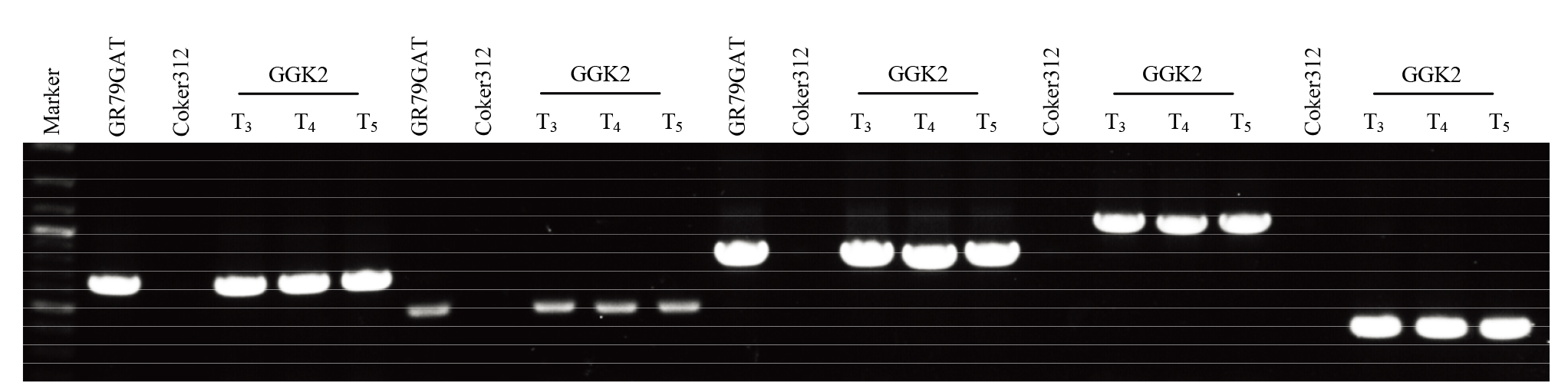
Fig. 1

PCR analysis of the target genes and flanking sequence in the T3 to T5 generation of transgenic cotton GGK2 The amplified fragment size of primers GR79 EPSPS FP + RP, GAT FP + RP, NPTII FP + RP, RB FP+LB RP, and RB FP+LB RP were 645, 466, 760, 810, 420 bp, respectively. Coker312: The Coker312 cotton was used as negative control; DNA Ladder: DNA marker. The GR79GAT plasmid was used as positive control. T3, T4 and T5 refer to the homozygous lines of GGK2 transgenic cotton T3 to T5 generation. The same as below"

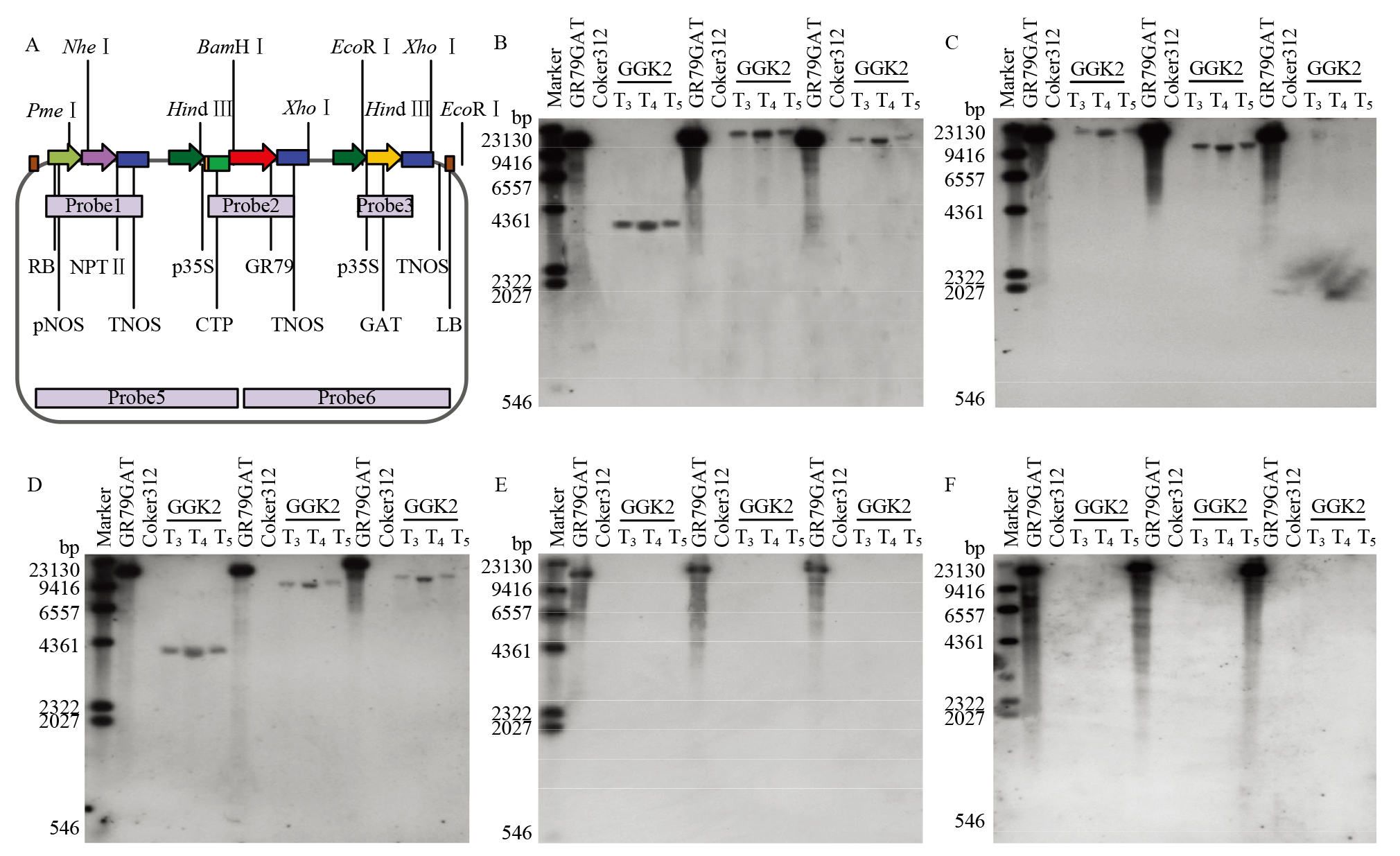
Fig. 2

Southern blot analysis of the target genes in the T3 to T5 generations of transgenic cotton GGK2 A: Schematic representation of the pGR79GAT vector with the position of restriction enzyme and probes. B: Hybridization results of probe 1, genomic DNA was digested by HindⅢ, EcoRⅠ, and BamHⅠ. C: Hybridization results of probe 2, genomic DNA was digested by EcoRⅠ, NheⅠ, and BamHⅠ. D: Hybridization results of probe 3, genomic DNA was digested by HindⅢ, BamHⅠ, and NheⅠ. E: Hybridization results of probe 4, genomic DNA was digested by HindⅢ, EcoRⅠ, and BamHⅠ. F: Hybridization results of probe 5, genomic DNA was digested by HindⅢ, EcoRⅠ, and BamHⅠ"

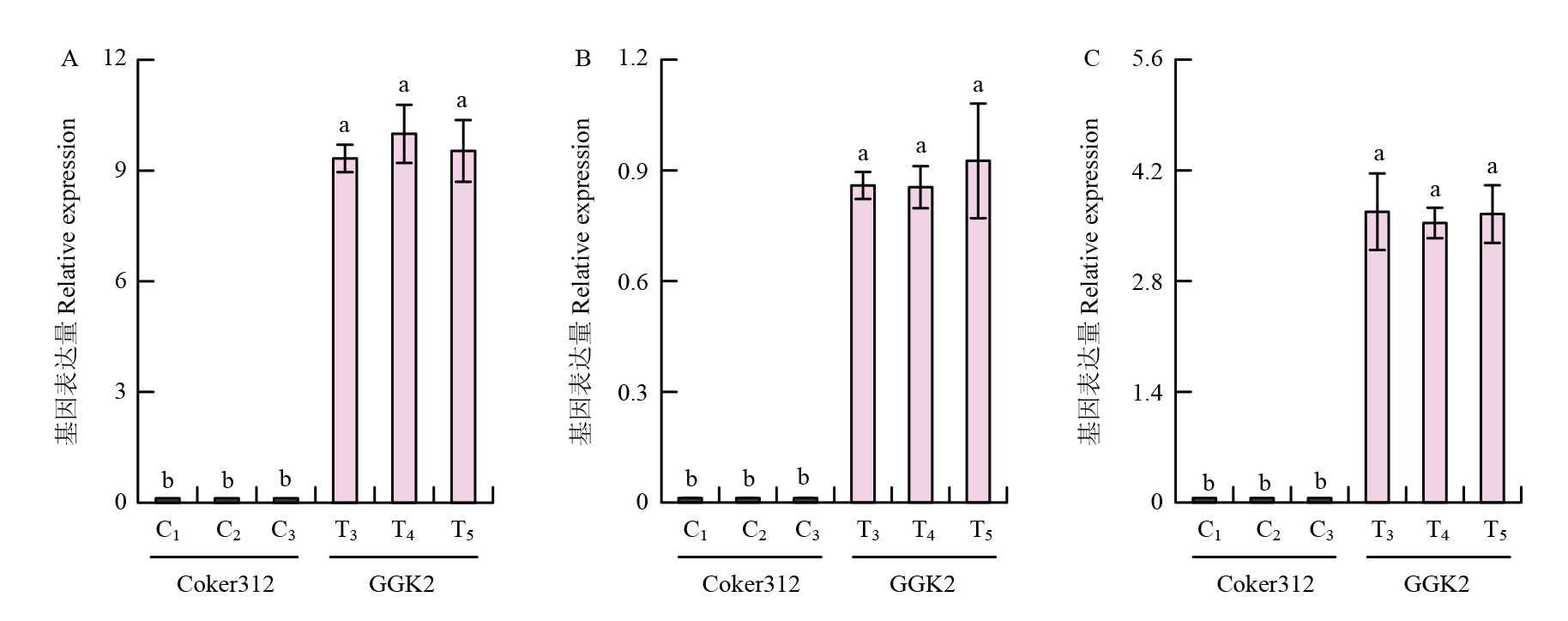
Fig. 3

Expression analysis of the target genes in the T3 to T5 generation of transgenic cotton GGK2 A: GR79 EPSPS; B: GAT; C: NPTII. Different lowercase letters indicate the significant difference among different transgenic lines (P<0.05). The same as below"

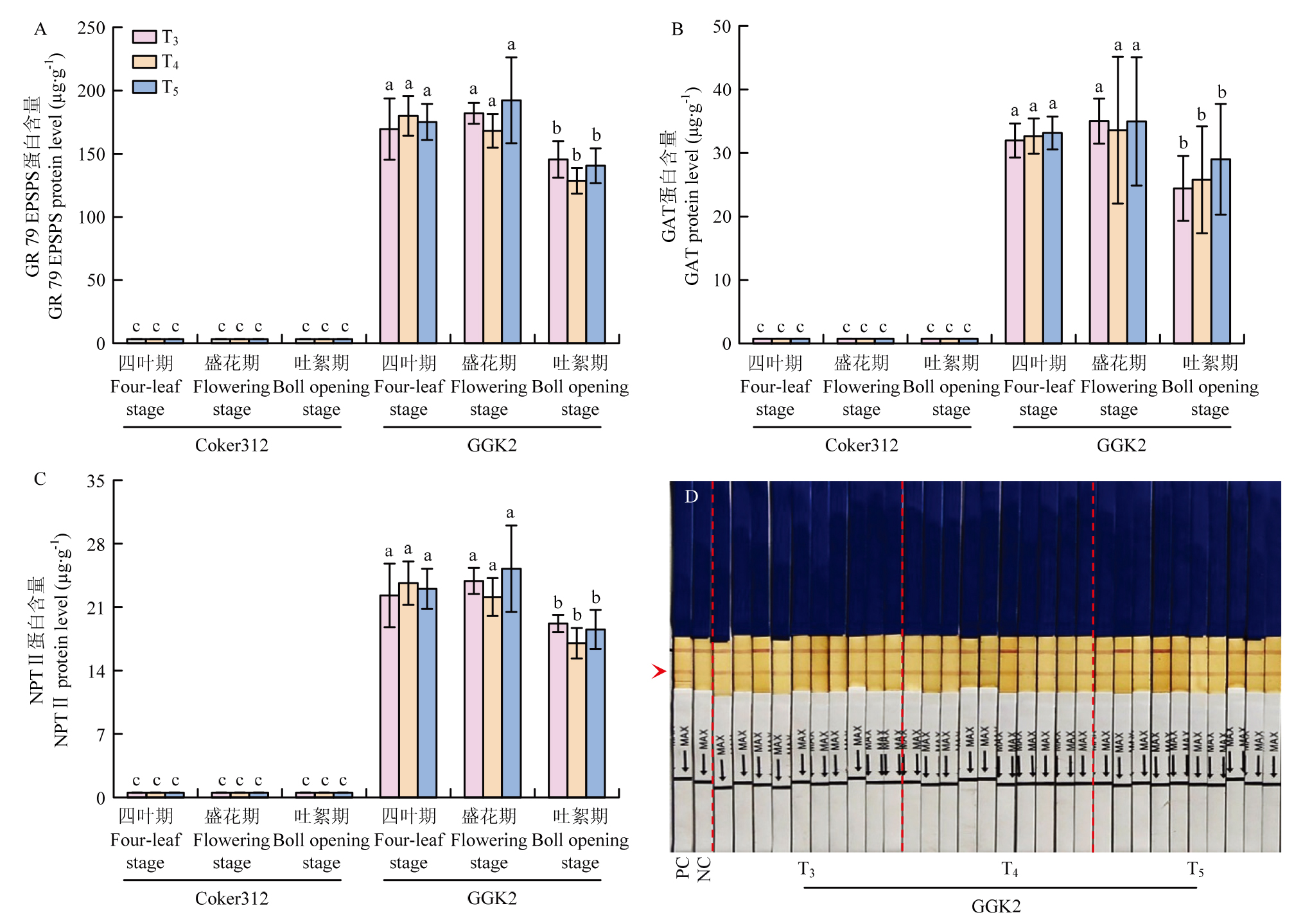
Fig. 4

Expression analysis of the target proteins in the T3 to T5 generation of transgenic cotton GGK2 The expression of GR79 EPSPS (A), GAT (B), and NPTⅡ (C) protein in 4-leaf stage, flowering stage, and boll opening stage. D: ImmunoStrip for the detection of GGK2 cotton in the T3-T5 generations. The arrow indicates the target band. PC: Positive control. NC: Negative control"

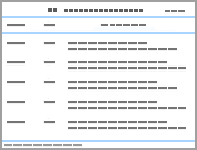
Table 1

Glyphosate tolerance analysis of T3 to T5 transgenic cotton GGK2"

处理时间
Time
性状
Phenotype
喷施物
Spray
柯字棉312
Coker312
GGK2
T3 T4 T5
喷施后2周
Two weeks after spraying
株高
Plant height (cm)
草甘膦Glyphosate / 26.74±1.40 27.44±1.74 28.12±1.41
清水Water 27.34±2.29 27.11±1.08 26.42±1.84 26.72±1.22
叶片受害率
Leaf damage rate (%)
草甘膦Glyphosate 100.00±0.00 0.96±0.10 0.71±0.23 0.82±0.07
清水Water 0.00±0.00 0.00±0.00 0.00±0.00 0.00±0.00
喷施后4周
Four weeks after spraying
株高
Plant height (cm)
草甘膦Glyphosate / 46.88±2.54 47.03±1.22 47.23±3.18
清水Water 47.60±1.92 47.27±0.53 46.93±1.52 48.03±1.39
叶片受害率
Leaf damage rate (%)
草甘膦Glyphosate 100.00±0.00 1.21±0.26 0.83±0.03 1.13±0.11
清水Water 0.00±0.00 0.00±0.00 0.00±0.00 0.00±0.00
/:全部死亡 /: All dead

Table 2

Nutritional composition analysis of T3 to T5 transgenic cotton GGK2"

名称Name 水分
Water content (g/100 g)
灰分
Ash content (g/100 g)
蛋白质
Protein content (g/100 g)
脂肪
Fat content (g/100 g)
T3 T4 T5 T3 T4 T5 T3 T4 T5 T3 T4 T5
GGK2 9.10 8.57 8.84 4.10 4.20 4.10 20.80 20.80 23.90 17.30 16.60 18.20
柯字棉312
Coker312
8.15 8.77 8.37 4.00 4.10 4.20 22.10 21.10 23.60 17.20 17.10 18.10
粗纤维
Coarse fiber content (g/100 g)
维生素E
<BOLD>V</BOLD>itamin E content (mg/100 g)
维生素B2
<BOLD>V</BOLD>itamin B2 content (mg/100 g)
肉豆蔻酸
Myristic chemicing (%)
T3 T4 T5 T3 T4 T5 T3 T4 T5 T3 T4 T5
GGK2 14.40 14.60 17.80 8.48 7.84 7.09 5.96×10⁻² 5.85×10⁻² 5.68×10⁻² 0.59 0.60 0.82
柯字棉312
Coker312
15.50 17.00 15.70 9.71 10.30 13.20 5.75×10⁻² 5.57×10⁻² 5.65×10⁻² 0.69 0.69 0.70
棕榈酸
Palmitic acid (%)
棕榈油酸
Palmitoleic acid (%)
十七烷酸
Heptacosanoic acid (%)
硬脂酸
Stearine acid (%)
T3 T4 T5 T3 T4 T5 T3 T4 T5 T3 T4 T5
GGK2 21.30 21.40 25.40 0.64 0.64 0.75 7.39×10⁻² 7.56×10⁻² 8.17×10⁻² 2.20 2.22 2.56
柯字棉312
Coker312
22.10 22.00 22.10 0.61 0.61 0.61 7.91×10⁻² 7.80×10⁻² 7.85×10⁻² 2.35 2.41 2.37
油酸
Oleic acid (%)
亚油酸
Linoleic acid (%)
十九烷酸
Nonadecanoic acid (%)
亚麻酸
Linolenic acid (%)
T3 T4 T5 T3 T4 T5 T3 T4 T5 T3 T4 T5
GGK2 15.70 15.30 14.60 57.50 57.80 52.60 0.23 0.24 0.18 0.23 0.22 0.16
柯字棉312
Coker312
14.70 14.70 14.60 57.50 57.50 57.60 0.25 0.28 0.26 0.18 0.19 0.18
花生酸
Arachic acid (%)
山嵛酸
Behenic acid (%)
棉酚
Gossypol (mg·kg-1)
植酸酶
Phytase (g·kg-1)
T3 T4 T5 T3 T4 T5 T3 T4 T5 T3 T4 T5
GGK2 0.20 0.19 0.26 0.13 0.13 0.13 5.42×10³ 5.16×10³ 5.45×10³ 28.50 29.10 29.10
柯字棉312
Coker312
0.23 0.22 0.22 0.14 0.14 0.14 5.41×10³ 5.25×10³ 5.39×10³ 30.00 26.40 27.70
[1]
郭三堆, 王远, 孙国清, 金石桥, 周焘, 孟志刚, 张锐. 中国转基因棉花研发应用二十年. 中国农业科学, 2015, 48(17): 3372-3387.

doi: 10.3864/j.issn.0578-1752.2015.17.005
GUO S D, WANG Y, SUN G Q, JIN S Q, ZHOU T, MENG Z G, ZHANG R. Twenty years of research and application of transgenic cotton in China. Scientia Agricultura Sinica, 2015, 48(17): 3372-3387. (in Chinese)
[2]
LIANG C Z, SUN B, MENG Z G, MENG Z H, WANG Y, SUN G Q, ZHU T, LU W, ZHANG W, MALIK W, LIN M, ZHANG R, GUO S D. Co-expression of GR79 EPSPS and GAT yields herbicide-resistant cotton with low glyphosate residues. Plant Biotechnology Journal, 2017, 15(12): 1622-1629.

doi: 10.1111/pbi.2017.15.issue-12
[3]
GAUR R K, SHARMA P. Weed stress in plants//Approaches to Plant Stress and Their Management. Berlin: Springer, 2014.
[4]
HOLM L, PLUCKNETT D L, PANCHO J V, HERBERGER J P. The World’s Worst Weeds. Distribution and Biology. Hawaii, USA: The University Press of Hawaii, Honolulu, 1977.
[5]
李扬汉. 中国杂草志. 北京: 中国农业出版社, 1998.
LI Y H. Weeds in China. Beijing: China Agriculture Press, 1998. (in Chinese)
[6]
李香菊. 近年我国农田杂草防控中的突出问题与治理对策. 植物保护, 2018, 44(5): 77-84.
LI X J. Main problems and management strategies of weeds in agricultural fields in China in recent years. Plant Protection, 2018, 44(5): 77-84. (in Chinese)
[7]
BECKIE H J. Herbicide-resistant weed management: Focus on glyphosate. Pest Management Science, 2011, 67(9): 1037-1048.

doi: 10.1002/ps.2195 pmid: 21548004
[8]
HEAP I. Global perspective of herbicide-resistant weeds. Pest Management Science, 2014, 70(9): 1306-1315.

doi: 10.1002/ps.3696 pmid: 24302673
[9]
DUKE S O, POWLES S B. Glyphosate: A once-in-a-century herbicide. Pest Management Science, 2008, 64(4): 319-325.

doi: 10.1002/ps.1518 pmid: 18273882
[10]
金文涌, 叶凤林, 刘定富, 陆永良, 应继锋. 中美转基因作物产业化最新进展. 中国种业, 2022(9): 1-6.
JIN W Y, YE F L, LIU D F, LU Y L, YING J F. The latest progress of of genetically modified crops industrialization in China and the United States. China Seed Industry, 2022(9): 1-6. (in Chinese)
[11]
张娟娟. 转基因作物产业化发展现状及法规监管问题. 分子植物育种, 2022, 20(22): 7469-7473.
ZHANG J J. Current situation of industrialization of genetically modified crops and regulatory issues. Molecular Plant Breeding, 2022, 20(22): 7469-7473. (in Chinese)
[12]
OWEN M D K. Current use of transgenic herbicide-resistant soybean and corn in the USA. Crop Protection, 2000, 19(8/9/10): 765-771.

doi: 10.1016/S0261-2194(00)00102-2
[13]
WATRUD L S, LEE E H, FAIRBROTHER A, BURDICK C, REICHMAN J R, BOLLMAN M, STORM M, KING G, VAN DE WATER P K. Evidence for landscape-level, pollen-mediated gene flow from genetically modified creeping bentgrass with CP4 EPSPS as a marker. Proceedings of the National Academy of Sciences of the United States of America, 2004, 101(40): 14533-14538.
[14]
蒋田田, 文君慧. 我国抗除草剂转基因作物面临的机遇和挑战. 安徽农业科学, 2021, 49(22): 239-242.
JIANG T T, WEN J H. Opportunities and challenges facing genetically modified herbicide-resistant crops in China. Journal of Anhui Agricultural Sciences, 2021, 49(22): 239-242. (in Chinese)
[15]
YANG Z R, QANMBER G, WANG Z, YANG Z E, LI F G. Gossypium genomics: Trends, scope, and utilization for cotton improvement. Trends in Plant Science, 2020, 25(5): 488-500.

doi: 10.1016/j.tplants.2019.12.011
[16]
HUANG G, HUANG J Q, CHEN X Y, ZHU Y X. Recent advances and future perspectives in cotton research. Annual Review of Plant Biology, 2021, 72: 437-462.

doi: 10.1146/annurev-arplant-080720-113241 pmid: 33428477
[17]
WANG M J, LI J Y, QI Z Y, LONG Y X, PEI L L, HUANG X H, GROVER C E, DU X M, XIA C J, WANG P C, LIU Z P, YOU J Q, TIAN X H, MA Y Z, WANG R P, CHEN X Y, HE X, FANG D D, SUN Y Q, TU L L, JIN S X, ZHU L F, WENDEL J F, ZHANG X L. Genomic innovation and regulatory rewiring during evolution of the cotton genus Gossypium. Nature Genetics, 2022, 54(12): 1959-1971.

doi: 10.1038/s41588-022-01237-2
[18]
MA Z Y, ZHANG Y, WU L Q, ZHANG G Y, SUN Z W, LI Z K, JIANG Y F, KE H F, CHEN B, LIU Z W, GU Q S, WANG Z C, WANG G N, YANG J, WU J H, YAN Y Y, MENG C S, LI L H, LI X X, MO S J, WU N, MA L M, CHEN L T, ZHANG M, SI A J, YANG Z W, WANG N, WU L Z, ZHANG D M, CUI Y R, CUI J, LV X, LI Y, SHI R K, DUAN Y H, TIAN S L, WANG X F. High-quality genome assembly and resequencing of modern cotton cultivars provide resources for crop improvement. Nature Genetics, 2021, 53(9): 1385-1391.

doi: 10.1038/s41588-021-00910-2 pmid: 34373642
[19]
陈佳, 王燕, 白玉兰. 我国棉花产业现状和产出效率分析及对策. 棉花科学, 2022, 44(5): 3-10.
CHEN J, WANG Y, BAI Y L. Current situation and output efficiency analysis and countermeasures of Chinese cotton industry. Cotton Sciences, 2022, 44(5): 3-10. (in Chinese)
[20]
朱玉永, 赵冰梅, 王林. 新疆棉田杂草发生与防除现状及对策. 中国棉花, 2021, 48(2): 1-7.
ZHU Y Y, ZHAO B M, WANG L. Current status of weed occurrence and control in cotton field of Xinjiang and its countermeasures. China Cotton, 2021, 48(2): 1-7. (in Chinese)
[21]
王新玲, 马小艳, 姜伟丽, 任相亮, 马亚杰, 马艳. 杂草与棉花的竞争作用. 棉花学报, 2015, 27(5): 474-480.
WANG X L, MA X Y, JIANG W L, REN X L, MA Y J, MA Y. Review on competition between weeds and cotton. Cotton Science, 2015, 27(5): 474-480. (in Chinese)
[22]
LIANG A M, SHA J Y, LU W, CHEN M, LI L, JIN D, YAN Y L, WANG J, PING S Z, ZHANG W, WANG Y D, LIN M. A single residue mutation of 5-enoylpyruvylshikimate-3-phosphate synthase in Pseudomonas stutzeri enhances resistance to the herbicide glyphosate. Biotechnology Letters, 2008, 30(8): 1397-1401.

doi: 10.1007/s10529-008-9703-8
[23]
DUN B Q, LU W, PING S Z, ZHANG W, CHEN M, XU Y Q, JIN D, ZHAO Z, LIN M. Isolation of a novel glyphosate tolerance N-acetyltransferase gene and expression in E. coli. Chinese High Technology Letter, 2006, 16: 943-947.
[24]
ABID M A, WEI Y X, MENG Z G, WANG Y, YE Y L, WANG Y N, HE H Y, ZHOU Q, LI Y Y, WANG P L, LI X G, YAN L H, MALIK W, GUO S D, CHU C C, ZHANG R, LIANG C Z. Increasing floral visitation and hybrid seed production mediated by beauty mark in Gossypium hirsutum. Plant Biotechnology Journal, 2022, 20(7): 1274-1284.

doi: 10.1111/pbi.v20.7
[25]
WANG Y Q, LIANG C Z, WU S J, ZHANG X Y, TANG J Y, JIAN G L, JIAO G L, LI F G, CHU C C. Significant improvement of cotton Verticillium wilt resistance by manipulating the expression of Gastrodia antifungal proteins. Molecular Plant, 2016, 9(10): 1436-1439.

doi: 10.1016/j.molp.2016.06.013
[26]
李圣彦, 李香银, 李鹏程, 张明俊, 张杰, 郎志宏. 转基因玉米2HVB5的性状鉴定及遗传稳定性分析. 生物技术通报, 2023, 39(1): 21-30.

doi: 10.13560/j.cnki.biotech.bull.1985.2022-0536
LI S Y, LI X Y, LI P C, ZHANG M J, ZHANG J, LANG Z H. Identification of target traits and genetic stability of transgenic maize 2HVB5. Biotechnology Bulletin, 2023, 39(1): 21-30. (in Chinese)
[27]
CARRIÈRE Y, CRICKMORE N, TABASHNIK B E. Optimizing pyramided transgenic Bt crops for sustainable pest management. Nature Biotechnology, 2015, 33(2): 161-168.

doi: 10.1038/nbt.3099 pmid: 25599179
[28]
CARRIÈRE Y, FABRICK J A, TABASHNIK B E. Can Pyramids and seed mixtures delay resistance to bt crops? Trends in Biotechnology, 2016, 34(4): 291-302.

doi: S0167-7799(15)00271-1 pmid: 26774592
[29]
SHENG K, SUN Y, LIU M, CAO Y F, HAN Y F, LI C, MUHAMMAD U, DAUD M K, WANG W R, LI H Z, SAMRANA S, HUI Y X, ZHU S J, CHEN J H, ZHAO T L. A reference-grade genome assembly for Gossypium bickii and insights into its genome evolution and formation of pigment glands and gossypol. Plant Communcations, 2023, 4(1): 100421.
[30]
郑曙峰. 棉花的多功能利用: 大自然对人类的馈赠, 超乎想象的棉花. 中国棉花, 2022, 49(1): 7-9.
ZHENG S F. Multifunctional utilization of cotton: Nature’s gift to humanity, the cotton beyond imagination. China Cotton, 2022, 49(1): 7-9. (in Chinese)
[31]
祁潇哲, 黄昆仑. 转基因食品安全评价研究进展. 中国农业科技导报, 2013, 15(4): 14-19.
QI X Z, HUANG K L. Research progress on safety assessment of genetically modified food. Journal of Agricultural Science and Technology, 2013, 15(4): 14-19. (in Chinese)

doi: 10.3969/j.issn.10080864.2013.04.03
[32]
王友华, 孙国庆, 连正兴. 国内外转基因生物研发新进展与未来展望. 生物技术通报, 2015, 31(3): 223-230.

doi: 10.135601j.cnki.biotech.bull.1985.2015.04.033
WANG Y H, SUN G Q, LIAN Z X. Progress and prospect of the genetically modified organism in the domestic and international. Biotechnology Bulletin, 2015, 31(3): 223-230. (in Chinese)
[33]
BUSI R, VILA-AIUB M M, BECKIE H J, GAINES T A, GOGGIN D E, KAUNDUN S S, LACOSTE M, NEVE P, NISSEN S J, NORSWORTHY J K, RENTON M, SHANER D L, TRANEL P J, WRIGHT T, YU Q, POWLES S B. Herbicide-resistant weeds: From research and knowledge to future needs. Evolutionary Applications, 2013, 6(8): 1218-1221.

doi: 10.1111/eva.12098 pmid: 24478803
[34]
DILL G M, CAJACOB C A, PADGETTE S R. Glyphosate-resistant crops: Adoption, use and future considerations. Pest Management Science, 2008, 64(4): 326-331.

pmid: 18078304
[35]
余国新, 吕海洋, 甘昶春. 新疆棉花成本收益与价格时变特征研究. 价格理论与实践, 2022(2): 116-119, 201.
YU G X, H Y, GAN C C. Research on time-varying characteristics of cost-benefit and price of cotton in Xinjiang. Price: Theory & Practice, 2022(2): 116-119, 201. (in Chinese)
[1] LI YuanJing, YUAN RuiXiang, LI YongTai, SUN TianGe, LIU Feng, LI YanJun, ZHANG XinYu. Identification and Functional Characterization of β-Glucosidase Genes in Verticillium dahliae for Pathogenicity on Cotton [J]. Scientia Agricultura Sinica, 2026, 59(7): 1380-1399.
[2] CUI ShiYou, CHEN PengJun, MIAO YuanQing, HAN JiJun, SHEN JunMing. Development and Field Evaluation of Glyphosate-Resistant Wheat Germplasm Generated Through EMS Mutagenesis [J]. Scientia Agricultura Sinica, 2026, 59(4): 723-733.
[3] YAN TingLin, DU YaDan, HU XiaoTao, WANG He, LI XiaoYan, WANG YuMing, NIU WenQuan, GU XiaoBo. The Impacts of Nitrogen Fertilizer Organic Alternatives Under Aerated Drip Irrigation on Cotton Yield and Water Use Efficiency Under Deficit Irrigation Conditions [J]. Scientia Agricultura Sinica, 2026, 59(3): 602-618.
[4] GUO ChenLi, LIU Yang, CHEN Yan, HU Wei, WANG YouHua, ZHOU ZhiGuo, ZHAO WenQing. Effects of Phosphorus Fertilizer Postpone Under Nitrogen Reduction Condition on Yield, Phosphorus Fertilizer Utilization Efficiency of Drip-Irrigated Cotton [J]. Scientia Agricultura Sinica, 2025, 58(9): 1749-1766.
[5] WANG WeiMeng, WEI YunXiao, TANG YunNi, LIU MiaoMiao, CHEN QuanJia, DENG XiaoJuan, ZHANG Rui. Establishment and Rooting Optimization of Agrobacterium rhizogenes Transformation System in Cotton [J]. Scientia Agricultura Sinica, 2025, 58(8): 1479-1493.
[6] ZHAO YuXuan, MIAO JiYuan, HU Wei, ZHOU ZhiGuo. Effects of Low Temperature at Seedling Stage on Cotton Floral Bud Differentiation and Cotton Plant Yield [J]. Scientia Agricultura Sinica, 2025, 58(7): 1311-1320.
[7] TIAN LiWen, LOU ShanWei, ZHANG PengZhong, DU MingWei, LUO HongHai, LI Jie, PAHATI MaiMaiTi, MA TengFei, ZHANG LiZhen. Analysis of Problems and Pathways for Increasing Cotton Yield per Unit Area in Xinjiang Under Green and Efficient Production Mode [J]. Scientia Agricultura Sinica, 2025, 58(6): 1102-1115.
[8] WANG LiYuan, WANG Hui, WANG MuMu, WANG DongJian, LI RuYu, ZHENG YongSheng, ZHANG Han. Construction and Application of DNA Fingerprint Database for Known Varieties in Upland Cotton DUS Testing [J]. Scientia Agricultura Sinica, 2025, 58(22): 4570-4588.
[9] TANG ChaoYuan, LIU TaoFen, WU YanQin, ZHANG QiPeng, LI ZiLiang, CHEN YunRui, LEI ZhangYing, ZHANG YaLi, ZHANG WangFeng, DU MingWei, YANG MingFeng, TIAN JingShan. Relationship Between Boll Morphological Characteristics and Fiber and Kernel Quality of Gossypium hirsutum L. and Gossypium barbadense L. [J]. Scientia Agricultura Sinica, 2025, 58(15): 2980-2992.
[10] WEN Jin, NING YanFang, QIN Xin, LIU Yuan, ZHANG XiaoLing, ZHU YongHong, TIAN ShiMin, MA YanBin. Resistance Evaluation and Genetic Stability Analysis of Insect- Resistant and Glyphosate-Tolerant Transgenic Cotton Lines [J]. Scientia Agricultura Sinica, 2025, 58(12): 2291-2302.
[11] DONG Ming, QI Hong, ZHANG Qian, WANG Yan, WANG ShuLin, FENG GuoYi, LIANG QingLong, GUO BaoSheng. The Impact of Sowing Methods on the Seed Germination Environment and Cotton Emergence and Growth [J]. Scientia Agricultura Sinica, 2025, 58(12): 2346-2357.
[12] ZHANG YanJun, DAI JianLong, DONG HeZhong. On Multi-Objective Collaborative Cultivation in Cotton Production [J]. Scientia Agricultura Sinica, 2025, 58(10): 1908-1916.
[13] WU YuZhen, HUANG LongYu, ZHOU DaYun, HUANG YiWen, FU ShouYang, PENG Jun, KUANG Meng. Construction of SSR Fingerprint Library and Comprehensive Evaluation for Approved Cotton Varieties in China [J]. Scientia Agricultura Sinica, 2024, 57(8): 1430-1443.
[14] LEI JianFeng, YOU YangZi, ZHANG JinEn, DAI PeiHong, YU Li, DU ZhengYang, LI Yue, LIU XiaoDong. Screening of High-Efficient sgRNA for Targeted Knockout of GhAGL16 Gene in Cotton [J]. Scientia Agricultura Sinica, 2024, 57(6): 1023-1033.
[15] LI KaiLi, WEI YunXiao, CHONG ZhiLi, MENG ZhiGang, WANG Yuan, LIANG ChengZhen, CHEN QuanJia, ZHANG Rui. Red and Blue Light Promotes Cotton Callus Induction and Proliferation [J]. Scientia Agricultura Sinica, 2024, 57(4): 638-649.
Viewed
Full text


Abstract

Cited

  Shared   
  Discussed   
No Suggested Reading articles found!