Scientia Agricultura Sinica ›› 2026, Vol. 59 ›› Issue (17): 3763-3777.doi: 10.3864/j.issn.0578-1752.2026.17.005

• TILLAGE & CULTIVATION·PHYSIOLOGY & BIOCHEMISTRY·AGRICULTURE INFORMATION TECHNOLOGY • Previous Articles     Next Articles

Effects of Drip Application of Biological Enzymes on Growth, Yield and Quality of Cotton

ZHAO FeiFei(), TAN XiWen, MENG ZiYi, CHENG Hao, CHENG Nan, ZHANG XiaoXin, GAO Ang, SONG XingHu, ZHAO Qiang()   

  1. College of Agriculture, Xinjiang Agricultural University/Engineering Research Centre of Cotton, Ministry of Education/Silk Road Economic Belt Cotton High-Quality and Efficient Collaborative Innovation Centre, Urumqi 830052
  • Received:2026-02-02 Accepted:2026-04-30 Online:2026-09-03 Published:2026-09-03
  • Contact: ZHAO Qiang

Abstract:

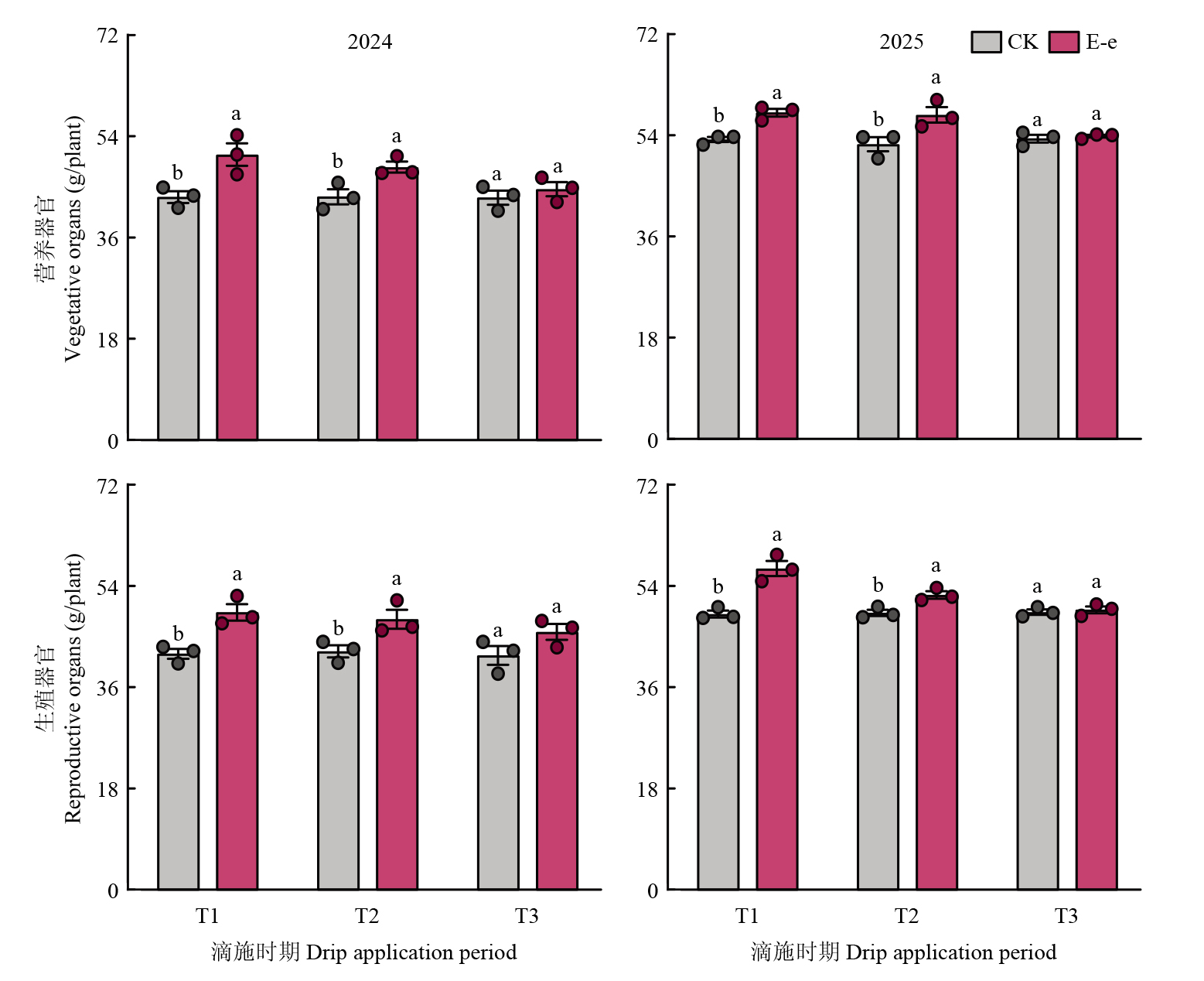
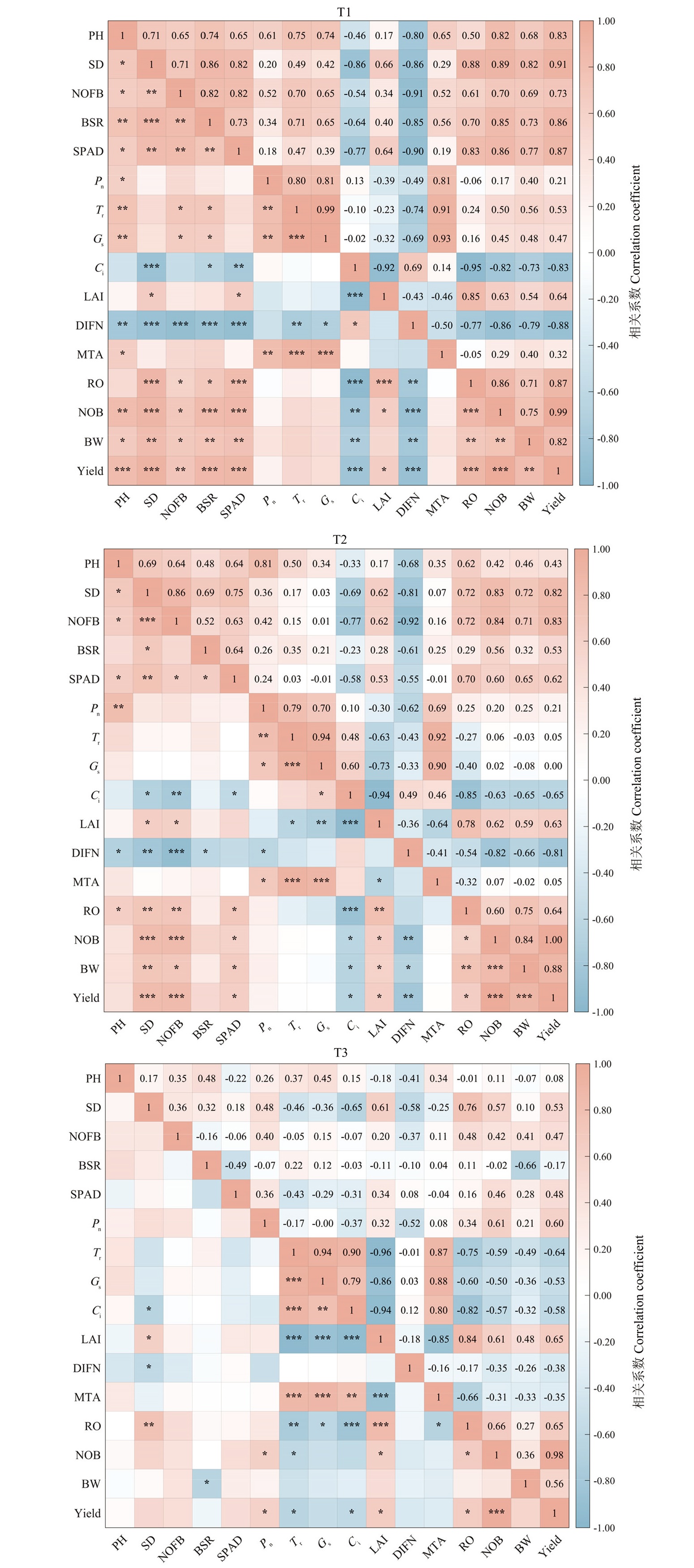
【Objective】In response to the issue of insufficient endogenous enzyme activity in Xinjiang cotton field soils limiting cotton growth and development, the study investigated the effects of foliar application of exogenous bio-enzymes at different growth stages on cotton growth and the formation of yield and quality, clarifying their regulatory effects and suitable application periods.【Method】Field experiments were conducted in Shawan City, Xinjiang in 2024 and 2025, using Zhongmian 7700 as the experimental material. Set three drip application periods: bud stage (T1), initial flowering stage (T2), and full bell stage (T3), applying 30 kg·hm-2 of bio-enzyme with irrigation, with clear water as the control (CK). The effects of drip-applied bioenzyme at different growth stages on cotton agronomic traits, canopy parameters, photosynthetic parameters, dry matter accumulation, yield and its components, and fiber quality were analyzed.【Result】Compared with the CK, the application of bioenzymes at the T1 stage significantly increased the cotton plant height, stem thickness, and number of fruit branches, with a boll-setting rate increase of 20.7%-28.4%, and optimized canopy parameters, specifically showing a 12.2%-26.4% increase in leaf area index, a 14.8%-16.0% increase in average leaf inclination angle, and a 29.4%-30.5% decrease in canopy openness, thereby improving the population light distribution. At the same time, bioenzyme treatment at the T1 stage significantly enhanced leaf photosynthetic capacity, with net photosynthetic rate increasing by 30.0%-39.1%, and intercellular CO2 concentration significantly decreasing by 13.3%-14.9%, which was more conducive to the transport of assimilates to reproductive organs. In terms of yield composition, bioenzyme treatment at the T1 stage simultaneously increased the number of bolls per unit area (11.0%-15.0%) and the single boll weight (1.6%-2.9%), with seed cotton yields reaching 7 196.2 and 7 754.7 kg·hm-2 over two years, respectively, representing an increase of 14.1%-16.9% compared with CK; the average fiber length in the upper half, breaking strength, and uniformity index of fibers were also improved. Correlation analysis further indicated that applying bio-enzymes at the bud stage (T1) showed a highly significant positive correlation with cotton plant height, stem thickness, boll set rate, relative chlorophyll content (SPAD value), reproductive organ dry matter, boll number, and seed cotton yield, while canopy openness and intercellular CO2 concentration showed a highly significant negative correlation; the regulatory effect at the initial flowering stage (T2) was weaker, and the effect at the full boll stage (T3) was not significant, indicating that the regulatory effect of bio-enzymes on cotton has a clear period-dependent characteristic.【Conclusion】The period of foliar application of biological enzymes had a significant regulatory effect on cotton growth and yield formation. Applying 30 kg·hm-2 of biological enzymes during the bud stage could optimize canopy parameters, enhance photosynthetic capacity, and promote the accumulation of dry matter in reproductive organs, achieving a coordinated increase in bolls per unit area and individual boll weight, ultimately improving seed cotton yield, which was the suitable period for applying biological enzymes in cotton fields in Xinjiang.

Key words: cotton, bioenzymes, fertility period, yield, fiber quality

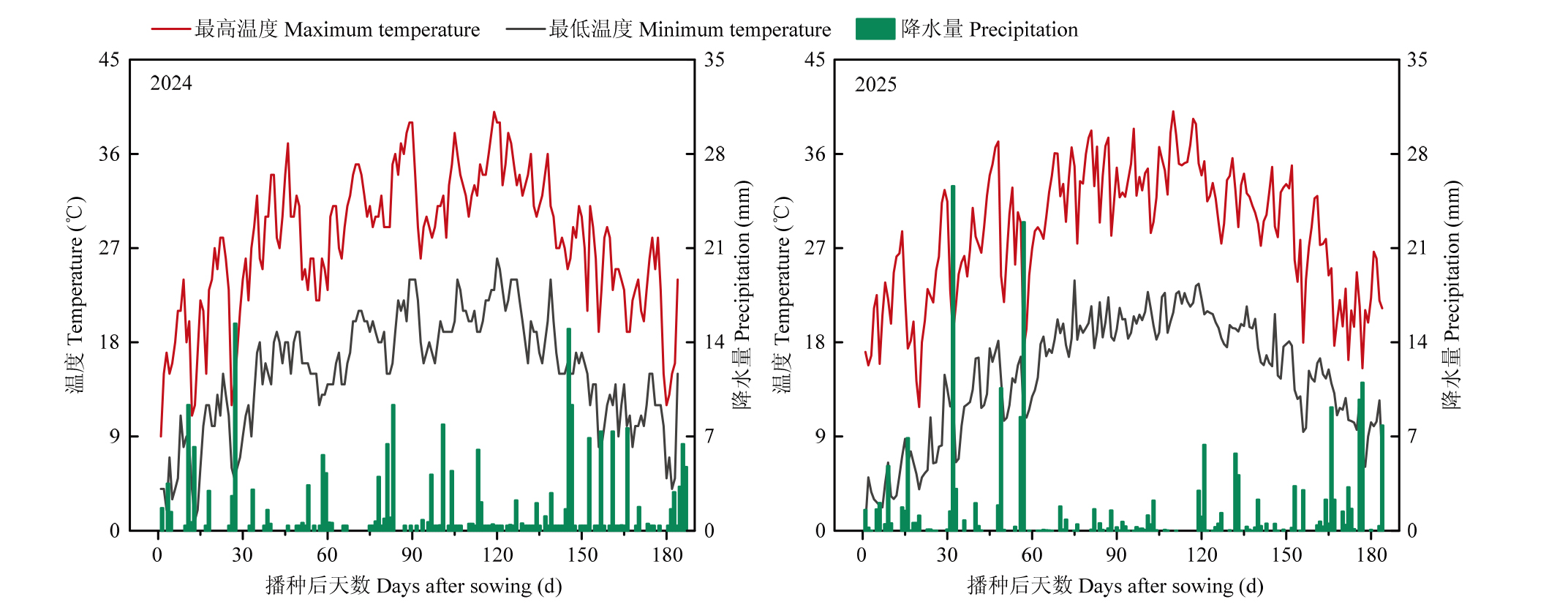
Fig. 1

Dynamic of precipitation and average air temperature in the study area in 2024 and 2025"

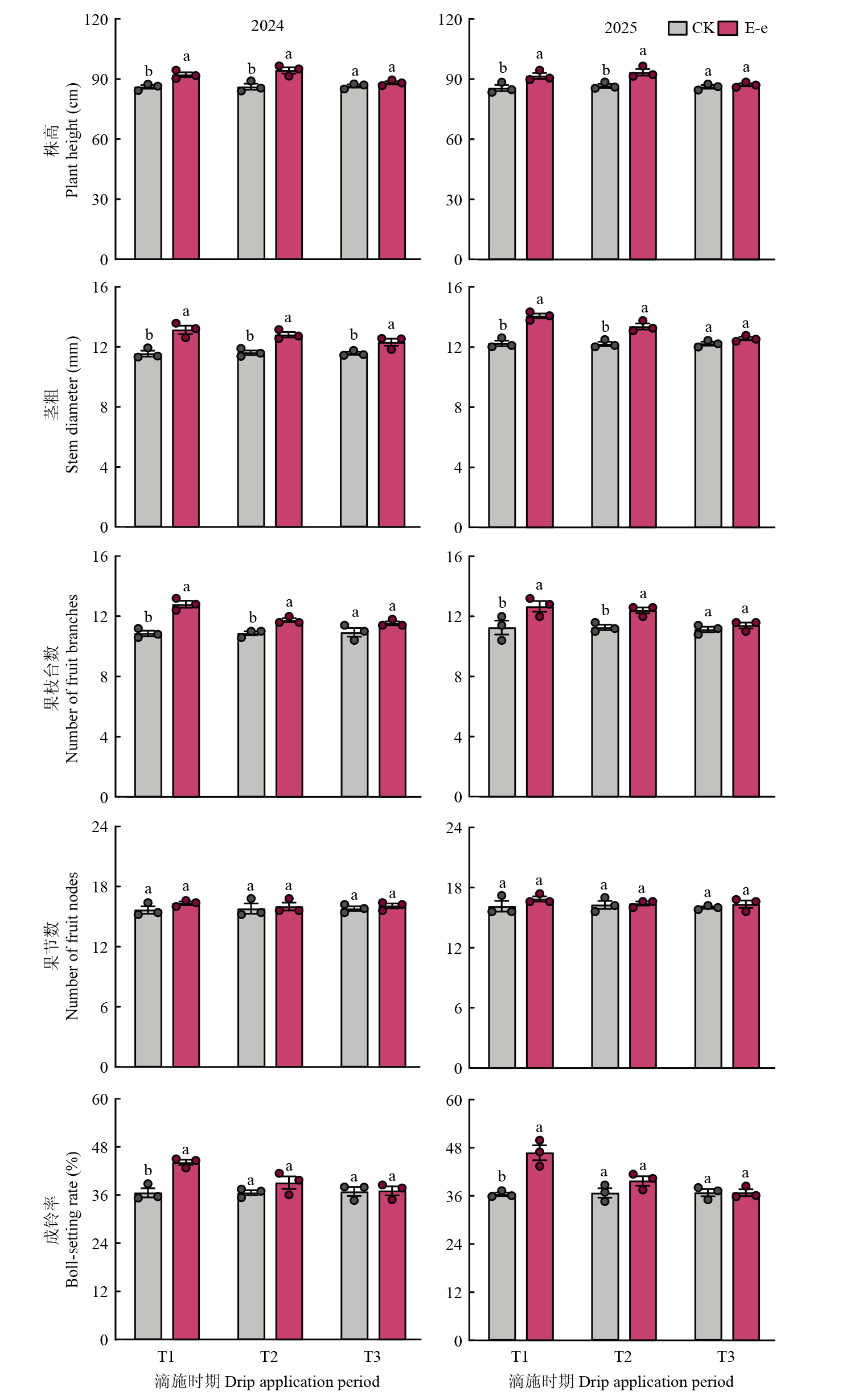
Fig. 2

Effects of drip application of biological enzymes at different stages on agronomic traits of cotton Different lowercase letters in the figure caption indicate significant differences between treatments (P<0.05). T1, T2, and T3 represent the bud stage, early flowering stage, and full bloom stage, respectively. CK and E-e represent water and biological enzymes, respectively. The same as below"

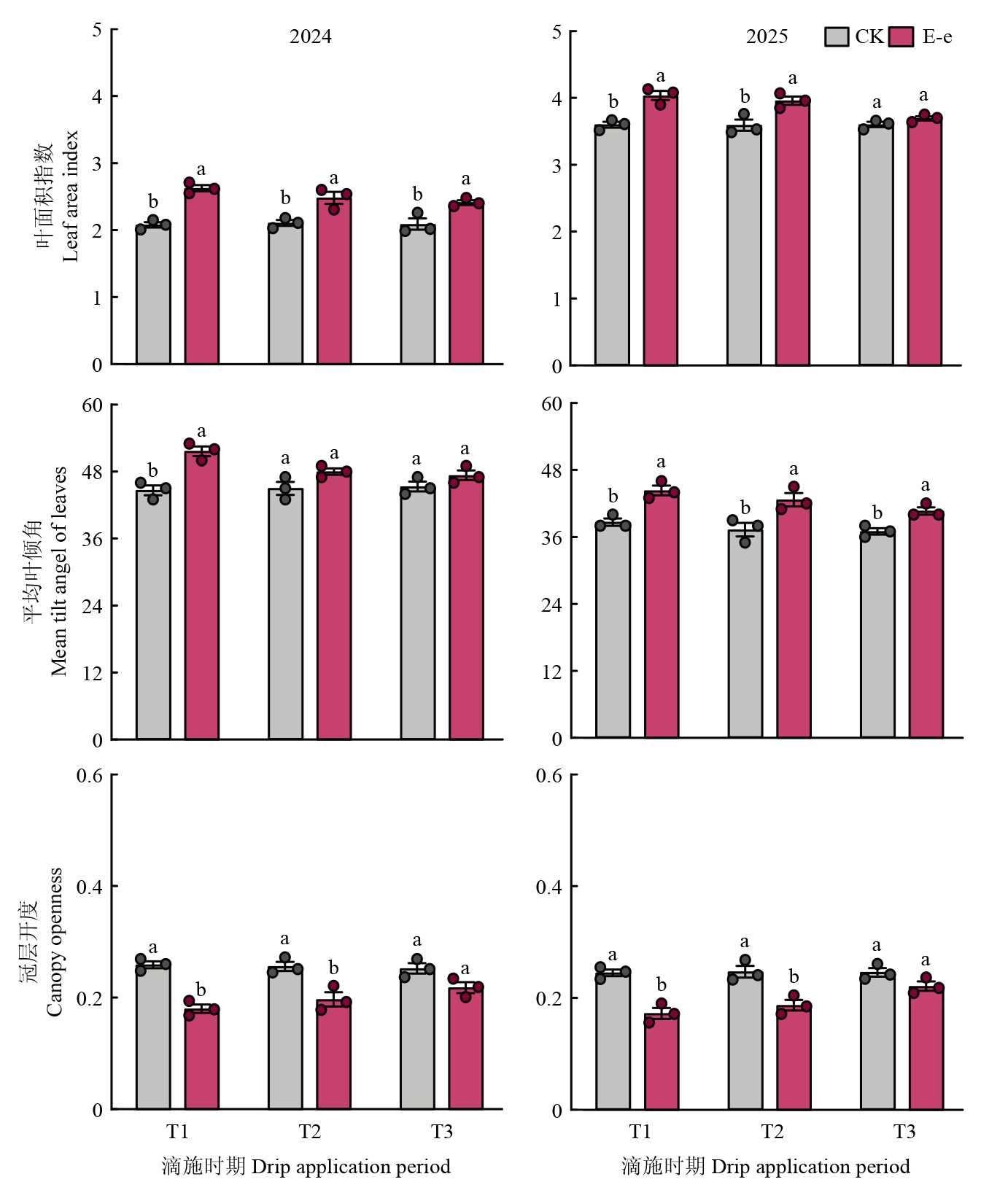
Fig. 3

Effects of applying bioenzymes at different periods on cotton canopy parameters"

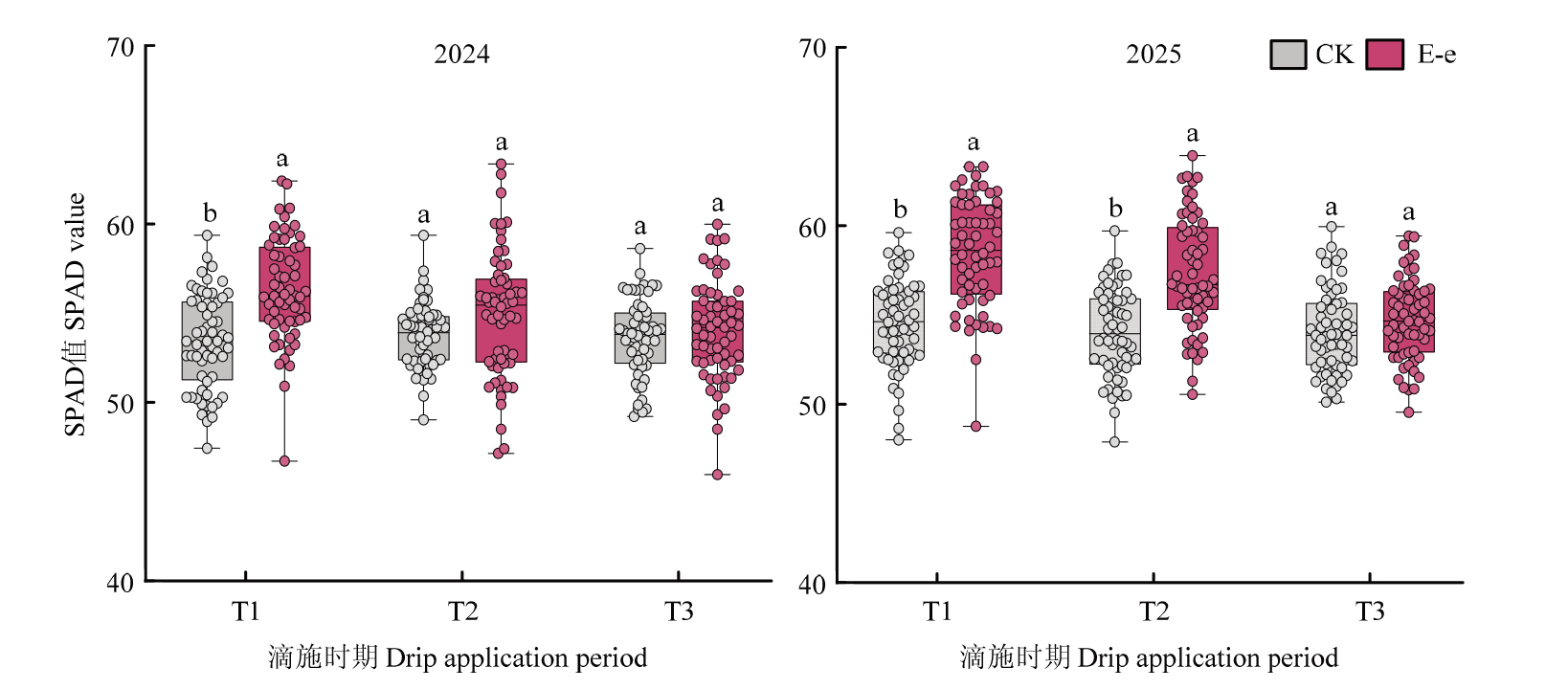
Fig. 4

Effects of drip application of biological enzymes at different stages on SPAD value of cotton"

Fig. 5

Effects of drip application of biological enzymes at different stages on photosynthetic characteristics of cotton"

Fig. 6

Effects of drip application of biological enzymes at different stages on dry matter accumulation of cotton"

Table 1

Effects of drip application of biological enzymes at different stages on cotton yield and its components"

年份
Year
处理
Treatment
收获株数
Number of harvested plants (×10
4·hm-2)
单位面积铃数
Number of bolls (×10
4·hm-2)
单铃重
Single boll weight

(g)
籽棉产量
Seed cotton yield (kg·hm
-2)
皮棉产量
Lint cotton yield (kg·hm
-2)
2024 T1 CK 20.8±0.26a 114.0±1.69c 5.5±0.01c 6304.9±89.00c 2747.2±54.72c
E-e 20.8±0.28a 126.5±1.43a 5.7±0.02a 7196.2±94.98a 3151.5±19.85a
T2 CK 20.8±0.18a 113.9±1.41c 5.5±0.01c 6309.2±92.58c 2730.0±33.51c
E-e 20.9±0.15a 121.5±1.91b 5.6±0.03b 6820.7±119.92b 2995.8±40.36ab
T3 CK 20.8±0.13a 113.8±1.38c 5.5±0.01c 6307.0±63.27c 2726.6±77.18c
E-e 20.7±0.30a 118.1±1.19bc 5.6±0.03bc 6579.3±73.02bc 2865.9±80.83bc
2025 T1 CK 20.2±0.22a 118.4±1.79c 5.6±0.02a 6631.1±97.65c 2896.0±59.17c
E-e 20.3±0.23a 136.2±1.79a 5.7±0.03a 7754.7±68.24a 3411.4±76.60a
T2 CK 20.1±0.35a 118.1±1.92c 5.6±0.02a 6604.0±129.93c 2869.7±54.06c
E-e 20.2±0.30a 127.7±3.16b 5.7±0.01a 7220.6±187.78b 3152.4±66.18b
T3 CK 20.2±0.25a 117.9±1.34c 5.6±0.02a 6598.7±50.10c 2876.4±25.42c
E-e 20.3±0.40a 123.0±2.64bc 5.6±0.06a 6886.7±188.95c 3011.1±89.62bc
两年平均
Two-year average
T1 CK 20.5 116.2 5.6 6468.0 2821.6
E-e 20.6 131.4 5.7 7475.5 3281.5
T2 CK 20.5 116.0 5.6 6456.6 2799.9
E-e 20.5 124.6 5.7 7020.7 3074.1
T3 CK 20.5 115.9 5.6 6452.9 2801.5
E-e 20.5 120.6 5.6 6733.0 2938.5

Table 2

Effects of drip application of biological enzymes at different stages on cotton fiber quality"

年份
Year
处理
Treatment
上半部平均长度
Upper half mean length
(mm)
断裂比强度
Fiber strength
(cN·tex-1)
整齐度指数
Uniformity index
(%)
马克隆值
Micronaire value
2024 T1 CK 29.1±0.11b 30.3±0.57b 84.5±0.25bc 5.1±0.07a
E-e 31.0±0.62a 32.1±0.42a 86.0±0.07a 4.9±0.02a
T2 CK 29.3±0.15b 30.3±0.41b 84.5±0.12bc 5.0±0.02a
E-e 29.4±0.04b 30.5±0.33ab 84.4±0.11bc 5.0±0.06a
T3 CK 29.1±0.32b 29.9±0.79b 84.3±0.27c 5.1±0.06a
E-e 29.7±0.23b 30.9±0.14ab 85.1±0.27b 5.0±0.05a
2025 T1 CK 30.2±0.31b 30.1±0.39a 86.1±0.51a 5.1±0.09ab
E-e 31.3±0.22a 31.0±0.28a 86.6±0.17a 4.9±0.03b
T2 CK 30.2±0.39b 30.0±0.54a 85.8±0.21a 5.1±0.04ab
E-e 30.6±0.04ab 30.6±0.18a 86.3±0.26a 4.9±0.08ab
T3 CK 30.2±0.36b 30.0±0.19a 86.1±0.54a 5.1±0.05a
E-e 30.5±0.13ab 30.3±0.25a 86.1±0.21a 5.0±0.04ab
两年平均
Two-year average
T1 CK 29.7 30.2 85.3 5.1
E-e 31.2 31.6 86.3 4.9
T2 CK 29.8 30.2 85.2 5.1
E-e 30.0 30.6 85.4 5.0
T3 CK 29.7 30.0 85.2 5.1
E-e 30.1 30.6 85.6 5.0

Fig. 7

The correlation between cotton growth and development and yield indicators PH: Plant height; SD: Stem diameter; NOFB: Number of fruit branches; BSR: Boll-setting rate; SPAD: SPAD value; Pn: Net photosynthetic rate; Tr: Transpiration rate; Gs: Stomatal conductance; Ci: Intercellular CO2 concentration; LAI: Leaf area index; DIFN: Canopy openness; MTA: Mean tilt angle of leaves; RO: Reproductive organs; NOB: Number of bolls; BW: Boll weight; Yield: Seed cotton yield. Red indicates positive correlation, blue indicates negative correlation, the deeper the color, the stronger the correlation, the lighter the color, the weaker the correlation. * indicated significance (*: P<0. 05, **: P<0. 01, ***: P<0. 001)"

[1]
祝宏辉, 张颖. 新疆农田生态系统服务价值变化及影响因素分析[J]. 石河子大学学报(自然科学版), 2020, 38(3): 340-346.
Zhu H H, Zhang Y. Analysis of changes in farmland ecosystem services value and its influencing factors in Xinjiang[J]. Journal of Shihezi University (Natural Science), 2020, 38(3): 340-346. (in Chinese)
[2]
火勋国, 杜鸿君, 孙帅, 张山清, 王森, 郭燕云, 王雪姣. 新气候态下新疆棉花种植气候适宜性区划[J]. 沙漠与绿洲气象, 2025, 19(4): 37-45.
Huo X G, Du H J, Sun S, Zhang S Q, Wang S, Guo Y Y, Wang X J. Climate suitability zoning for cotton cultivation in Xinjiang under the new climate regime[J]. Desert and Oasis Meteorology, 2025, 19(4): 37-45. (in Chinese)
[3]
郭振威, 李永山, 王慧, 陈梦妮, 范巧兰, 杨娜, 席吉龙, 张建诚. 长期棉花秸秆还田和施用有机肥对棉田土壤养分含量和酶活性的影响[J]. 中国生态农业学报(中英文), 2023, 31(6): 877-884.
Guo Z W, Li Y S, Wang H, Chen M N, Fan Q L, Yang N, Xi J L, Zhang J C. Effects of long-term cotton straw return and application of manure on soil nutrients and enzyme activity in cotton fields[J]. Chinese Journal of Eco-Agriculture, 2023, 31(6): 877-884. (in Chinese)
[4]
高旭梅, 刘娟, 张前兵, 罗宏海, 谷天佐, 张旺锋. 耕作措施对新疆绿洲长期连作棉田土壤微生物、酶活性的影响[J]. 石河子大学学报(自然科学版), 2011, 29(2): 145-152.
Gao X M, Liu J, Zhang Q B, Luo H H, Gu T Z, Zhang W F. Effects of tillage practices on soil microbial and enzyme activity in long-term continuous cotton of Xinjiang oasis[J]. Journal of Shihezi University (Natural Science), 2011, 29(2): 145-152. (in Chinese)
[5]
李海燕, 刘航, 王天硕, 韩晓军, 赵丹, 王子胜, 吴晓东. 棉花连作障碍的主要问题及缓解措施[J]. 农业开发与装备, 2024(4): 133-135.
Li H Y, Liu H, Wang T S, Han X J, Zhao D, Wang Z S, Wu X D. The main problems and mitigation measures of cotton continuous cropping obstacles[J]. Agricultural Development and Equipments, 2024(4): 133-135. (in Chinese)
[6]
余梦梦, 程李洋, 常相杰, 杨晓娟, 李帅, 米家怡, 李俊华. 不同生物有机肥用量对棉花生长、土壤养分及土壤酶活性的影响[J]. 中国土壤与肥料, 2025(7): 80-89.
Yu M M, Cheng L Y, Chang X J, Yang X J, Li S, Mi J Y, Li J H. Effects of different dosages of bio-organic fertilizers on cotton growth, soil nutrients and soil enzyme activities[J]. Soil and Fertilizer Sciences in China, 2025(7): 80-89. (in Chinese)
[7]
赵翔, 曾成才, 张庭军, 蔡杨, 蔡鑫, 赵亚娥. 三种微生物菌剂对新疆连作棉田障碍消减的作用[J]. 新疆农业科学, 2025, 62(12): 2950-2959.
Zhao X, Zeng C C, Zhang T J, Cai Y, Cai X, Zhao Y E. Effects of three microbial agents on reducing obstacles in continuous cropping cotton fields in Xinjiang[J]. Xinjiang Agricultural Sciences, 2025, 62(12): 2950-2959. (in Chinese)
[8]
刘善江, 夏雪, 陈桂梅, 卯丹, 车升国, 李亚星. 土壤酶的研究进展[J]. 中国农学通报, 2011, 27(21): 1-7.
Liu S J, Xia X, Chen G M, Mao D, Che S G, Li Y X. Study progress on functions and affecting factors of soil enzymes[J]. Chinese Agricultural Science Bulletin, 2011, 27(21): 1-7. (in Chinese)

doi: 10.11924/j.issn.1000-6850.2011-0787
[9]
Li Y H, Fang X W, Shen C N, Jiang W C, Huang S, Ma G L. Review of bio-enzyme for soil improvement[J]. Biogeotechnics, 2026, 4(1): 100143.

doi: 10.1016/j.bgtech.2024.100143
[10]
Han W, He M. The application of exogenous cellulase to improve soil fertility and plant growth due to acceleration of straw decomposition[J]. Bioresource Technology, 2010, 101(10): 3724-3731.

doi: 10.1016/j.biortech.2009.12.104 pmid: 20096567
[11]
Dinh V P, Tran-Vu H A, Tran T, Duong B N, Dang-Thi N M, Phan-Van H L, Tran T K, Huynh V H, Nguyen T P, Nguyen T Q. Improving soil quality and crop yields using enhancing sustainable rice straw management through microbial enzyme treatments[J]. Environmental Health Insights, 2024, 18: 11786302241283001.
[12]
李飒, 聂俊华. 添加外源纤维素酶对土壤原生纤维素酶活性的影响[J]. 山东农业科学, 2010, 42(7): 56-58.
Li S, Nie J H. Effects of exogenous cellulase on native soil cellulase activity[J]. Shandong Agricultural Sciences, 2010, 42(7): 56-58. (in Chinese)
[13]
张丽娟, 曲继松, 朱倩楠, 吴涛. 不同剂量外源纤维素酶对设施土壤生物活性与番茄生长的影响[J]. 植物营养与肥料学报, 2017, 23(4): 1089-1094.
Zhang L J, Qu J S, Zhu Q N, Wu T. Effects of exogenous cellulase with different dosages on the biological activity and tomato growth in greenhouse soil[J]. Journal of Plant Nutrition and Fertilizers, 2017, 23(4): 1089-1094. (in Chinese)
[14]
王洪江, 许健, 于运凯, 方涛. “彩特美”细胞酶制剂对密植栽培大豆生育及产量的影响[J]. 大豆科学, 2011, 30(6): 1060-1061.
Wang H J, Xu J, Yu Y K, Fang T. Effects of cell enzyme preparation on growth and yield of solid-seeded soybean[J]. Soybean Science, 2011, 30(6): 1060-1061. (in Chinese)
[15]
黄鑫慧, 高佳, 任佰朝, 赵斌, 刘鹏, 张吉旺. 植酶Q9对大田遮阴夏玉米产量形成的影响[J]. 中国农业科学, 2019, 52(19): 3309-3322. DOI:10.3864/j.issn.0578-1752.2019.19.003.
Huang X H, Gao J, Ren B C /Z, Zhao B, Liu P, Zhang J W. Effects of phytase Q9 on yield formation of summer maize shading in the field[J]. Scientia Agricultura Sinica, 2019, 52(19): 3309-3322. DOI:10.3864/j.issn.0578-1752.2019.19.003. (in Chinese)
[16]
邓廷彬, 管青霞, 杨阳, 李小云. 叶面喷施不同浓度超敏蛋白复合酶对黄芪品质和产量的影响[J]. 农业科技与信息, 2025, 22(10): 22-26.
Deng T B, Guan Q X, Yang Y, Li X Y. Effects of spraying different concentrations of hypersensitivity protein complex enzyme on the quality and yield of Astragalus membranaceus[J]. Information of Agricultural Science and Technology, 2025, 22(10): 22-26. (in Chinese)
[17]
琚绍煊, 时向东, 王骏, 王俊, 刘路路, 蔡兴华, 郭文龙, 丁松爽. 外源复合酶制剂对发酵后茄芯烟叶品质的影响[J]. 山东农业科学, 2023, 55(6): 69-76.
Ju S X, Shi X D, Wang J, Wang J, Liu L L, Cai X H, Guo W L, Ding S S. Effect of exogenous complex enzyme preparation on quality of filler tobacco leaves after fermentation[J]. Shandong Agricultural Sciences, 2023, 55(6): 69-76. (in Chinese)
[18]
王义凡, 段风霞, 王玉娟. 不同种类生物肥对小麦产量的影响[J]. 农业科技创新, 2025, (23): 39-41.
Wang Y F, Duan F X, Wang Y J. Effects of different kinds of bio-fertilizers on wheat yield[J]. The Farmers Consultant, 2025, (23): 39-41. (in Chinese)
[19]
魏宇鹏. “彩特美”细胞酶叶面营养剂在水稻上的应用效果[J]. 现代化农业, 2017(2): 31-32.
Wei Y P. Effects of applying 'CaiTeMei' cell enzyme foliar nutrient on rice[J]. Modernizing Agriculture, 2017(2): 31-32. (in Chinese)
[20]
穆允良, 白婧, 车淑静. 彩特美细胞酶叶面营养剂在玉米大豆上应用效果[J]. 现代化农业, 2015(5): 22-22, 23.
Mu Y L, Bai J, Che S J. Application effect of CaiTeMei cell enzyme foliar nutrition agent on corn and soybean[J]. Modernizing Agriculture, 2015(5): 22-22, 23. (in Chinese)
[21]
邹鹏飞, 原保忠, 胡晓东, 王允. 蕾期涝渍胁迫对盆栽棉花生长和产量特性的影响[J]. 灌溉排水学报, 2017, 36(9): 7-12.
Zou P F, Yuan B Z, Hu X D, Wang Y. Effect of flooding and waterlogging at squaring stage on growth and yield of cotton studied using pot experiment[J]. Journal of Irrigation and Drainage, 2017, 36(9): 7-12. (in Chinese)
[22]
代健敏, 何庆雨, 谢玲, 窦巧巧, 张巨松. 氮肥后移对花铃期水分亏缺棉花产量的补偿效应研究[J]. 干旱区研究, 2022, 39(3): 986-995.

doi: 10.13866/j.azr.2022.03.32
Dai J M, He Q Y, Xie L, Dou Q Q, Zhang J S. Compensation effect of nitrogen fertilizer post-shift on water-deficient cotton yield at different stages[J]. Arid Zone Research, 2022, 39(3): 986-995. (in Chinese)

doi: 10.13866/j.azr.2022.03.32
[23]
齐文婷, 薛皓文, 王政钧, 王航, 马晓鹏, 肖娟, 王建东. 花铃期不同灌溉处理对棉花光合特性和产量的影响[J]. 棉花学报, 2024, 36(4): 340-352.
Qi W T, Xue H W, Wang Z J, Wang H, Ma X P, Xiao J, Wang J D. Effects of different irrigation treatments at flowering and boll setting stage on photosynthetic characteristics and yield of cotton[J]. Cotton Science, 2024, 36(4): 340-352. (in Chinese)
[24]
潘俊杰, 付秋萍, 阿布都卡依木·阿布力米提, 马英杰. 蕾期和花铃期不同灌水下限对滴灌棉花产量的影响[J]. 干旱地区农业研究, 2019, 37(5): 27-32.
Pan J J, Fu Q P, Abudoukayimu A, Ma Y J. Effects of irrigation limits at bud stage and flowering stage on yield of drip irrigation cotton[J]. Agricultural Research in the Arid Areas, 2019, 37(5): 27-32. (in Chinese)
[25]
陈玉梁, 石有太, 罗俊杰, 李忠旺, 厚毅清, 王蒂. 干旱胁迫对彩色棉花农艺、品质性状和水分利用效率的影响[J]. 作物学报, 2013, 39(11): 2074-2082.

doi: 10.3724/SP.J.1006.2013.02074
Chen Y L, Shi Y T, Luo J J, Li Z W, Hou Y Q, Wang D. Effect of drought stress on agronomic traits, quality, and WUE in different colored upland cotton varieties (lines)[J]. Acta Agronomica Sinica, 2013, 39(11): 2074-2082. (in Chinese)
[26]
Findenegg G R, Nelemans J A. The effect of phytase on the availability of P from myo-inositol hexaphosphate (phytate) for maize roots[J]. Plant and Soil, 1993, 154(2): 189-196.
[27]
韩玮. 还田秸秆配施外源酶效应研究[D]. 泰安: 山东农业大学, 2006.
Han W. Study on the effects of outer enzymes applied in straws[D]. Taian: Shandong Agricultural University, 2006. (in Chinese)
[28]
桑贤强, 尤忠明, 周益民, 邹利军, 石磊, 胡玲. 超敏蛋白复合酶在小麦上的应用效果及应用技术[J]. 上海农业科技, 2021(1): 106-107, 115.
Sang X Q, You Z M, Zhou Y M, Zou L J, Shi L, Hu L. The application effect and application technology of hypersensitive protein complex enzyme in wheat[J]. Shanghai Agricultural Science and Technology, 2021(1): 106-107, 115. (in Chinese)
[29]
姜辉, 赵军胜, 王家宝, 陈莹, 高明伟, 王秀丽. 棉花叶形种质资源研究及应用进展[J]. 棉花学报, 2015, 27(1): 89-94.

doi: Y2015/V27/I1/89
Jiang H, Zhao J S, Wang J B, Chen Y, Gao M W, Wang X L. Review of researches and utilizations on germplasms with different leaf shapes in cotton[J]. Cotton Science, 2015, 27(1): 89-94. (in Chinese)
[30]
赵后秀, 郝先哲, 石峰, 李军宏, 梁琪, 王潭刚, 田立文, 罗宏海, 王军. 有机液体肥对棉花冠层特征、产量和品质的影响[J]. 新疆农业科学, 2024, 61(3): 556-564.

doi: 10.6048/j.issn.1001-4330.2024.03.004
Zhao H X, Hao X Z, Shi F, Li J H, Liang Q, Wang T G, Tian L W, Luo H H, Wang J. Effects of organic liquid fertilizer on canopy characteristics, yield and quality of cotton[J]. Xinjiang Agricultural Sciences, 2024, 61(3): 556-564. (in Chinese)
[31]
冯德党, 张振荣, 叶玉, 曾国浩, 李坤林, 杨丽琼, 马鹤. 土壤保水增肥生物酶对昆明紫长茄生长的影响[J]. 云南农业科技, 2020(2): 9-11.
Feng D D, Zhang Z R, Ye Y, Zeng G H, Li K L, Yang L Q, Ma H. Effects of soil water-holding and fertilizer-increasing biological enzymes on the growth of purple long eggplant in Kunming. Yunnan Nongye Keji[J]. Yunnan Agricultural Science and Technology, 2020(2): 9-11. (in Chinese)
[32]
谢章书, 谢学方, 屠小菊, 刘爱玉, 董合忠, 周仲华. 植物激素对棉花蕾铃脱落的调控研究进展[J]. 作物学报, 2025, 51(1): 1-29.

doi: 10.3724/SP.J.1006.2025.44122
Xie Z S, Xie X F, Tu X J, Liu A Y, Dong H Z, Zhou Z H. Research progress in phytohormone regulation of square and boll shedding in cotton[J]. Acta Agronomica Sinica, 2025, 51(1): 1-29. (in Chinese)
[33]
吴曜廷, 刘丹然, 李润杰, 陈敬悦, 杨军, 李作森, 徐晨元. 微生物酶制剂对上部烟叶醇化品质的影响[J]. 安徽农业科学, 2024, 52(18): 166-170.
Wu Y T, Liu D R, Li R J, Chen J Y, Yang J, Li Z S, Xu C Y. Effects of microbial enzyme preparations on the aging quality of upper tobacco leaves[J]. Journal of Anhui Agricultural Sciences, 2024, 52(18): 166-170. (in Chinese)
[34]
尤忠明, 胡玲, 周益民, 邹利军, 石磊. 超敏蛋白复合酶在茶树上的施用效果及应用技术[J]. 上海农业科技, 2021(2): 98-100.
You Z M, Hu L, Zhou Y M, Zou L J, Shi L. The application effect and application technology of hypersensitivity protein complex enzyme in tea plant[J]. Shanghai Agricultural Science and Technology, 2021(2): 98-100. (in Chinese)
[35]
苏天潮, 银永安, 陈林, 丁志强, 杨红卫, 刘小武. 新禾丰肥料在膜下滴灌棉花上应用研究[J]. 新疆农垦科技, 2015, 38(5): 60-62, 63.
Su T C, Yin Y A, Chen L, Ding Z Q, Yang H W, Liu X W. Study on the application of Xinhefeng fertilizer on drip irrigation cotton under film[J]. Xinjiang Farm Research of Science and Technology, 2015, 38(5): 60-62, 63. (in Chinese)
[36]
张旺锋, 李蒙春, 勾玲, 杜亮. 北疆高产棉花养分吸收特性的研究[J]. 棉花学报, 1998, 10(2): 88-95.
Zhang W F, Li M C, Gou L, Du L. Study on the nutrient absorbtion characters of cotton with higher productivity in north Xinjiang[J]. Cotton Science, 1998, 10(2): 88-95. (in Chinese)
[1] ZHANG WenJiao, WEI JiaZhi, ZHOU YaRong, YANG HaoRan, GUO RongXin, MA JunFeng, YANG JiaHui, WANG CaiXiang, SU JunJi. Functional Identification and Breeding Evolution Analysis of the Key Gene GhPDF1 for Fruit Branch Angle in Upland Cotton [J]. Scientia Agricultura Sinica, 2026, 59(9): 1836-1847.
[2] BAI JingJing, ZHANG YuChen, NI ZiJie, GAO JiaYong, LIU WeiYang, GAI DongSheng, WANG YuHang, HE JiaQing, ZHANG Qiang, SHAO XiWen, WU Ying, GENG YanQiu, GUO LiYing. Effects of Different Irrigation Volumes on Lodging Resistance Characteristics and Yield of Rice in Northeast China [J]. Scientia Agricultura Sinica, 2026, 59(9): 1848-1868.
[3] CAI QiaoHong, ZHOU Tian, SU Ming, HONG ZiQiang, LI FanGuo, LI Tong, WANG Hua, KANG JianHong, WU HongLiang. Effects of Nitrogen Reduction and Potassium Enhancement Fertilization Mode on Photosynthetic Fluorescence Characteristics and Photosynthetic Product Accumulation of Maize in Ningxia Yellow Irrigation Area [J]. Scientia Agricultura Sinica, 2026, 59(9): 1869-1886.
[4] ZHU Pei, ZHAO Yao, BAI Yan, ZHANG JinKui, LI Mei, LONG JinJia, YANG Long, LUO LiYa, XU BenBo, XU JinSong, ZHANG XueKun. Physiological Regulation of Pydiflumetofen on Rapeseed (Brassica napus) and Its Combined Effect with Prochloraz [J]. Scientia Agricultura Sinica, 2026, 59(9): 1903-1915.
[5] CHEN XuanYi, GUO XingXing, ZHANG XiangQian, LU ZhanYuan, LIU LingYue, LUO Fang, LI JinLong, ZHANG ChuanLing, ZHANG ZhiQing, CHE ManQing. Impacts of Intercropping Row Patterns on the Heterogeneity of the Light Environment and Photosynthetic Product Production in Maize Canopy [J]. Scientia Agricultura Sinica, 2026, 59(8): 1653-1671.
[6] HOU HuiZhi, YIN JiaDe, MA MingSheng, LIU XiaoWei, LIU YanLan, LEI KangNing. Effects of Tillage and Organic Fertilizer Application on Crop Yield and Water Use in a Potato-Maize Double Cropping System in the Longdong Region [J]. Scientia Agricultura Sinica, 2026, 59(8): 1672-1685.
[7] PENG TingShen, LU JiuYan, WU MeiLin, YAN YuXin, LIU HongZhou, NAN WenBin, QIN XiaoJian, LI Ming, GONG JunYi, LIANG YongShu. QTL Analysis of Yield-Related Traits in Both Huangnuo2# and Changbai7# of Perennial Chinese Rice [J]. Scientia Agricultura Sinica, 2026, 59(7): 1361-1379.
[8] LI YuanJing, YUAN RuiXiang, LI YongTai, SUN TianGe, LIU Feng, LI YanJun, ZHANG XinYu. Identification and Functional Characterization of β-Glucosidase Genes in Verticillium dahliae for Pathogenicity on Cotton [J]. Scientia Agricultura Sinica, 2026, 59(7): 1380-1399.
[9] WANG YuPing, FU Zhi, SUN JiaYing, MU XiaoMeng, LIU HuiLin, GUO JinYun, SONG WenJing, HOU LeiPing, ZHAO HaiLiang. Evaluation of the Mitigating Effect and Application Efficacy of Melatonin Applied at the Seedling Stage on Short-Term Chilling Stress in Tomato Plants [J]. Scientia Agricultura Sinica, 2026, 59(7): 1523-1535.
[10] WANG JiaNuo, CHEN GuiPing, LI Pan, WANG LiPing, NAN YunYou, HE Wei, FAN ZhiLong, HU FaLong, CHAI Qiang, YIN Wen, ZHAO LiaoHao. Photo-Physiological Mechanism at Grain Filling Stage of No-Tillage with Plastic Re-Mulching to Increase Maize Yield in Oasis Irrigation Areas [J]. Scientia Agricultura Sinica, 2026, 59(6): 1189-1202.
[11] ZHOU XinJie, REN Hao, CHEN YingLong, ZHANG JiWang, ZHAO Bin, REN BaiZhao, LIU Peng, WANG HongZhang. Effects of Calcium Peroxide on Root Morphology and Yield Formation of Summer Maize in Waterlogging Farmland [J]. Scientia Agricultura Sinica, 2026, 59(6): 1203-1216.
[12] HE JiHang, ZHANG Qing, LÜ XiangYue, XUE JiQuan, XU ShuTu, LIU JianChao. Evaluation of Nitrogen Efficiency of Different Stay-Green Maize Hybrids [J]. Scientia Agricultura Sinica, 2026, 59(6): 1217-1230.
[13] HAO Kun, CHEN HongDe, ZHANG Wei, ZHONG Yun, DANG MeiRong, ZHU ShiJiang, HUANG ZhiKun, JIN Ying. Comprehensive Evaluation of Water-Nitrogen Management Under Surge-Root Irrigation Based on Citrus Yield, Quality, and Water- Nitrogen Use Efficiency [J]. Scientia Agricultura Sinica, 2026, 59(4): 862-873.
[14] GUO FuCheng, TANG HaiJiang, HAO XinYi, MA GuoLin, YANG JiuJu, HUANG LinFeng, TIAN Lei, WANG Bin, LUO ChengKe. Effects of Different Irrigation Methods on Water-Salt Transport, Rice Yield, and Water Use Efficiency in Saline Soil in Ningxia [J]. Scientia Agricultura Sinica, 2026, 59(4): 750-764.
[15] YAN TingLin, DU YaDan, HU XiaoTao, WANG He, LI XiaoYan, WANG YuMing, NIU WenQuan, GU XiaoBo. The Impacts of Nitrogen Fertilizer Organic Alternatives Under Aerated Drip Irrigation on Cotton Yield and Water Use Efficiency Under Deficit Irrigation Conditions [J]. Scientia Agricultura Sinica, 2026, 59(3): 602-618.
Viewed
Full text


Abstract

Cited

  Shared   
  Discussed   
No Suggested Reading articles found!