Scientia Agricultura Sinica ›› 2025, Vol. 58 ›› Issue (16): 3245-3255.doi: 10.3864/j.issn.0578-1752.2025.16.008

;

• SPECIAL FOCUS: NUTRIENT MANAGEMENT FOR ANNUAL RICE-RAPESEED ROTATION • Previous Articles     Next Articles

Characteristics of Potassium Utilization and Crop Yield Formation in Rice-Rapeseed Rotation System Under Different Potassium Fertilizer Application Rates

GAO ZiYi1(), WU HaiYa2, LIU JunQuan2, CUI Xin1, LIU AiHua1, FANG YaTing1, REN Tao1, LI XiaoKun1,*(), LU JianWei1   

  1. 1 College of Resources and Environment, Huazhong Agricultural University/Key Laboratory of Arable Land Conservation (Middle and Lower Reaches of Yangtze River), Ministry of Agriculture and Rural Affairs/Microelement Research Center, Huazhong Agricultural University, Wuhan 430070
    2 Bureau of Agriculture and Rural Affairs, Wuxue City, Huanggang 435401, Hubei
  • Received:2025-04-14 Accepted:2025-05-28 Online:2025-08-11 Published:2025-08-11
  • Contact: LI XiaoKun

Abstract:

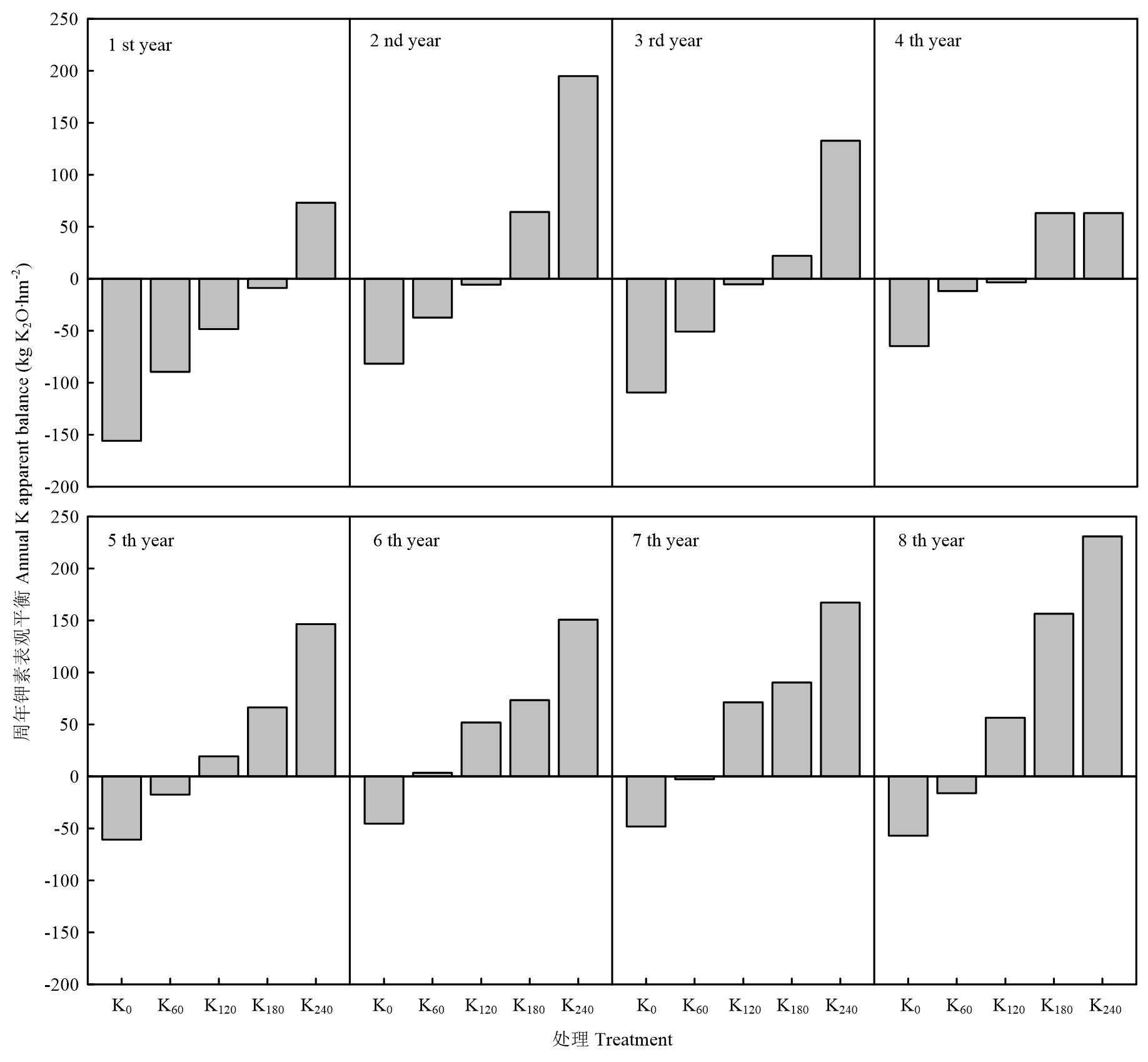
【Objective】The aim of this study was to investigate the effects of potassium (K) fertilizer application rates on crop productivity, K utilization, and apparent K balance under the rice-rapeseed rotation system in the Yangtze River Basin, so as to provide a scientific basis for the rational application and distribution of potassium fertilizer in the rice-rapeseed rotation system.【Method】A field experiment was carried out from 2016 in Wuxue City, Hubei Province, China. Five treatments were set up with 0 (K0), 60 (K60), 120 (K120), 180 (K180) and 240 (K240) kg K2O·hm-2, respectively. The crop yield, K uptake, K fertilizer utilization and apparent K balance were studied from 2016 to 2024.【Result】K fertilization significantly increased crop yield and aboveground K uptake, with the increase in rapeseed yield and aboveground K uptake being greater than that of rice. Compared with K0, K application significantly increased rice and rapeseed yield by 18.1%-32.7% and 46.7%-93.1%, respectively, and K uptake by 72.3%-240.1% and 124.6%-512.2%, respectively. K fertilization significantly reduced yield stability index of rapeseed yield by 24.2%-41.2%, and markedly increased yield sustainability index (SYI) by 23.2%-45.7%. The yield stability index of rice yield across all treatments was lower than that of rapeseed, and SYI was comparatively higher. The annual energy yield under the K0 treatment exhibited a progressive decline with each successive year of crop rotation. The increase in rapeseed yield was primarily attributed to an increase in pod number and seed number, whereas in rice, it was mainly due to an increase in effective panicles and filled grains per panicle. As the K fertilizer application rates increased, the proportion of K uptake in rapeseed within the annual system rose, with the average K uptake ratio between rice and rapeseed being 3:2. The agronomy efficiency and the recovery efficiency of K fertilizer in rice were on average 4.5 kg·kg-1 and 2.5 percentage points higher than those in rapeseed, respectively. Conversely, the K fertilizer dependency of rapeseed was 11.6 percentage points higher than that of rice. K application shifted the annual K apparent balance from deficit to surplus. When the K fertilizer application rate increased to 180 kg K2O·hm-2 during the rice season, the K balance transitioned from deficit to surplus, while in the rapeseed season, 60 kg K2O·hm-2 was required to achieve surplus. Fitting with a linear-plus-plateau model, the optimal K fertilizer application rates were determined to be 102 kg K2O·hm-2 for the rice season and 147 kg K2O·hm-2 for the rapeseed season. 【Conclusion】In summary, the application of potassium fertilizer increased the yield of rapeseed better than that of rice. The recommended annual potassium fertilizer application rate for the rice-rapeseed rotation system was 250 kg K2O·hm-2, with the fertilization ratio between the rice season and the rapeseed season being approximately 2:3.

Key words: rice-rapeseed rotation, yield, potassium uptake, potassium fertilizer utilization, apparent potassium balance, linear-plus- plateau model

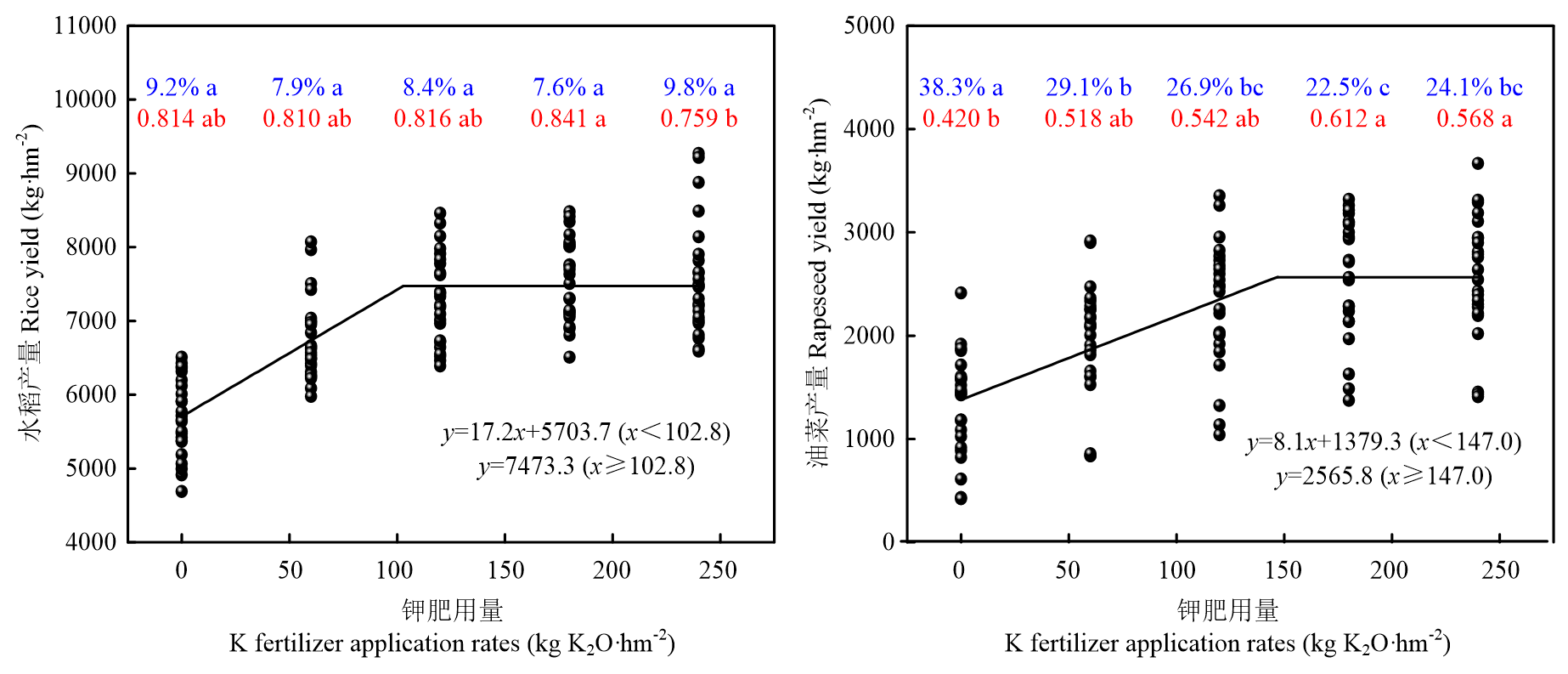
Fig. 1

Optimum potassium fertilizer application rates under rice-rapeseed rotation The blue and red data represent yield stability index and yield sustainability index (average value for 8 years), respectively. Values followed by different letters in the same row indicate significant differences between treatments at 0.05 level"

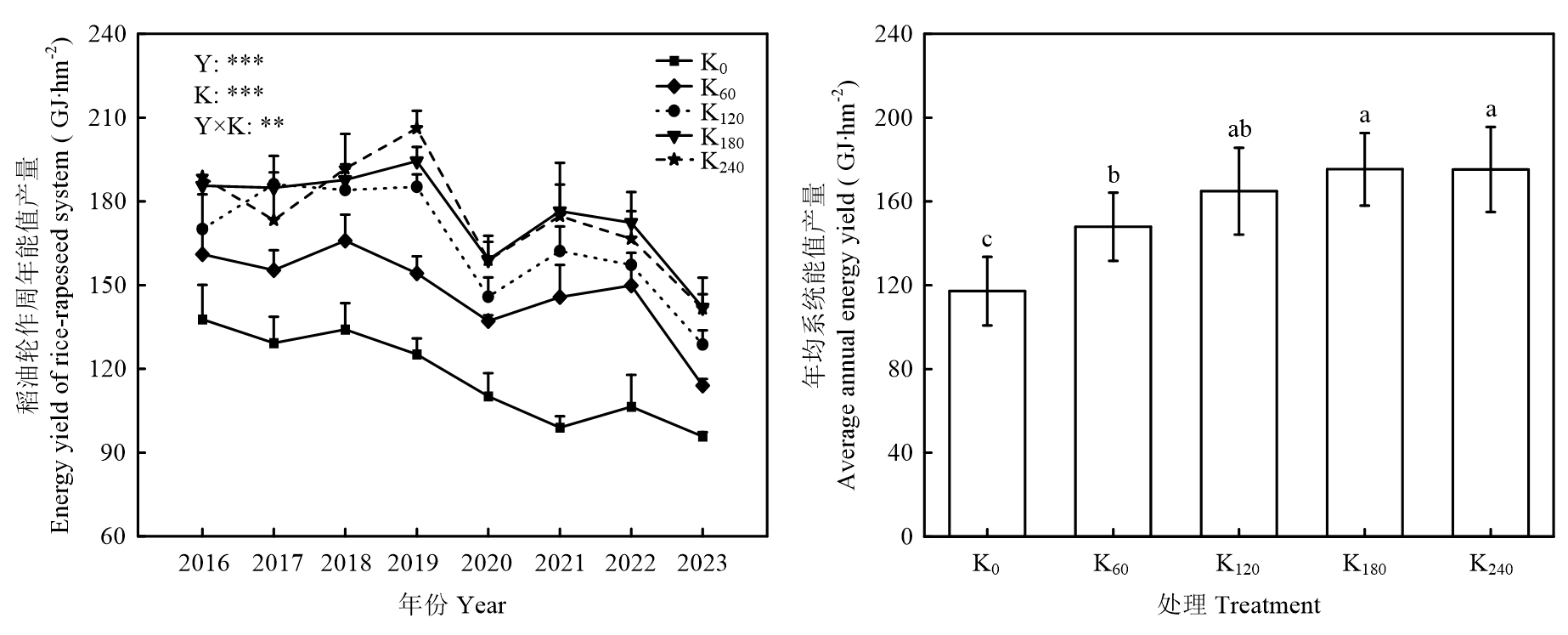
Fig. 2

Effects of potassium fertilizer application rates on energy yield of rice-rapeseed rotation system K0, K60, K120, K180, K240 indicate K fertilization application rates 0, 60, 120, 180, 240 kg K2O·hm-2, respectively. The data are presented as the means ± standard deviation of three replicates. The different lowercase letters indicate significant difference between treatments at 0.05 level. ** and *** indicate significant differences at P<0.01 and P<0.001 levels, respectively. The same as below"

Table 1

Effects of potassium fertilizer application rates on yield components of rice and rapeseed (average value for 8 years)"

处理
Treatment
水稻 Rice 油菜 Rapeseed
有效穗数
No. of effective panicles (×104·hm-2)
每穗实粒数
No. of filled grains per panicle
千粒重
1000-grain weight
(g)
单株角果数
Pod number
(No./plant)
每角粒数
Seed number
(No./pod)
千粒重
1000-seed weight
(g)
K0 237.2±0.2b 111.7±1.0c 23.45±0.37c 152.2±6.6c 16.1±0.8c 4.01±0.29a
K60 241.8±8.6b 128.9±3.7b 24.30±0.11b 174.7±10.5c 19.6±1.4b 4.06±0.10a
K120 260.4±6.6a 139.7±2.3a 24.62±0.28ab 228.9±24.9b 20.6±1.6ab 3.86±0.20ab
K180 268.5±5.5a 143.8±3.2a 24.84±0.21a 311.2±32.9a 21.7±0.7a 3.75±0.10ab
K240 265.9±15.8a 139.4±2.1a 24.36±0.06b 302.7±35.1a 21.9±0.8a 3.66±0.04b
AVONA
钾肥用量
Potassium rate (K)
10.39*** 74.24*** 31.33*** 104.17*** 37.39*** 8.78***
年份Year (Y) 24.54*** 23.42*** 79.91*** 70.19*** 46.40*** 387.99***
K×Y 0.94 ns 2.05** 0.81 ns 2.21** 1.97* 1.96*

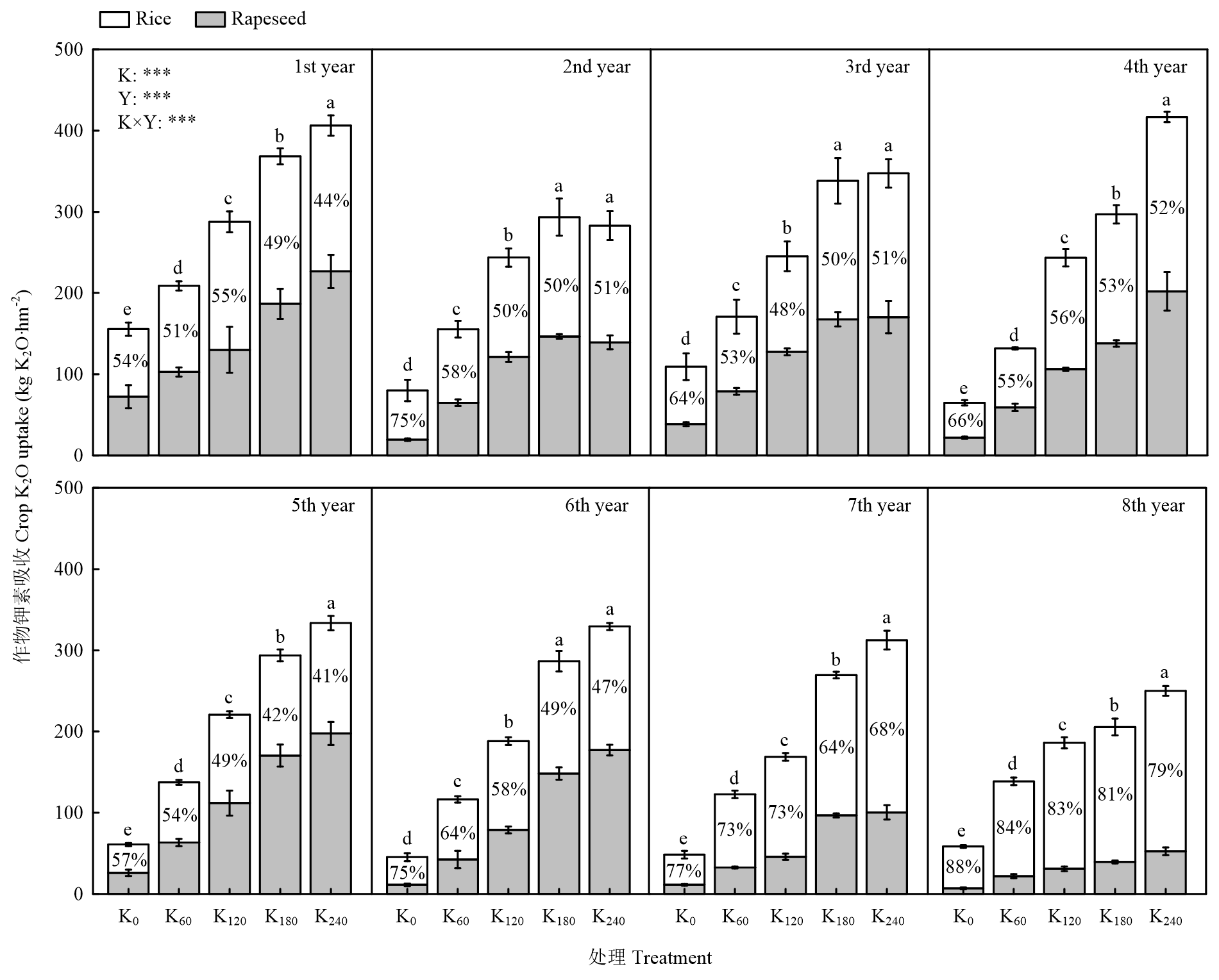
Fig. 3

Potassium uptake and distribution of rice-rapeseed rotation system under different potassium application rates Values in the columns indicate the percentage of rice K2O uptake in the annual rice-rapeseed system. The different lowercase letters indicate significant difference in annual K2O uptake between treatments at 0.05 level"

Table 2

Potassium fertilizer use efficiency of rice and rapeseed (average value for 8 years)"

处理
Treatment
水稻 Rice 油菜 Rapeseed
农学效率
Agronomy efficiency (kg·kg-1)
回收利用率
Recovery
efficiency (%)
肥料依赖性
Fertilizer dependency (%)
农学效率
Agronomy
efficiency (kg·kg-1)
回收利用率
Recovery
efficiency (%)
肥料依赖性
Fertilizer dependency (%)
K0
K60 17.2 62.7 53.6 10.4 53.7 69.9
K120 13.3 64.2 69.8 8.1 56.7 82.3
K180 10.2 58.5 77.6 6.9 61.6 87.4
K240 7.8 51.9 82.2 5.1 55.2 90.3
平均 Average 12.1 59.3 70.8 7.6 56.8 82.4

Table 3

Effects of potassium fertilizer application rates on the apparent potassium balance (average value for 8 years)"

处理 Treatment 水稻 Rice (kg K2O·hm-2) 油菜 Rapeseed (kg K2O·hm-2) 周年 Annual (kg K2O·hm-2)
K0 -52.0±5.2 -25.9±0.9 -77.9±4.4
K60 -29.7±1.3 1.9±0.4 -27.8±1.6
K120 -9.0±5.0 26.0±3.5 17.0±7.0
K180 22.6±7.1 43.3±7.5 65.9±14.5
K240 63.4±6.4 81.5±3.6 145.0±8.5

Fig. 4

Annual K apparent balance of rice-rapeseed rotation system under different potassium treatments"

[1]
HUANG J D, CAO X Y, KUAI J, CHENG H, ZUO Q S, DU H, PENG S B, HUANG J L, DENG N Y. Evaluation of production capacity for rice-rapeseed cropping system in China. Field Crops Research, 2023, 293: 108842.
[2]
LI D X, LI T, GU J, WANG Y L, CHEN X Q, LU D J, TAO Y Y, CUI Z L, CHEN X P, LU J W, NIE J, WANG H Y, ZHOU J M. Potassium resources management systems in Chinese agriculture: Yield gaps and environmental costs. Resources, Conservation and Recycling, 2024, 202: 107397.
[3]
范明生, 江荣风, 张福锁, 吕世华, 刘学军. 水旱轮作系统作物养分管理策略. 应用生态学报, 2008, 19(2): 424-432.
FAN M S, JIANG R F, ZHANG F S, S H, LIU X J. Nutrient management strategy of paddy rice-upland crop rotation system. Chinese Journal of Applied Ecology, 2008, 19(2): 424-432. (in Chinese)
[4]
亓昭英, 屈小荣, 杜双江, 鲍荣华, 商立鹏. 2019年我国钾肥行业运行情况及未来5年发展趋势分析. 磷肥与复肥, 2020, 35(4): 1-5.
QI Z Y, QU X R, DU S J, BAO R H, SHANG L P. Analysis on the operation of potash fertilizer industry in 2019 and its development trend in the next five years. Phosphate & Compound Fertilizer, 2020, 35(4): 1-5. (in Chinese)
[5]
周卫, 艾超, 易可可. 新阶段植物营养学的研究重点. 植物营养与肥料学报, 2024, 30(7): 1243-1252.
ZHOU W, AI C, YI K K. Research focus of plant nutrition and fertilizer science in new stage. Journal of Plant Nutrition and Fertilizers, 2024, 30(7): 1243-1252. (in Chinese)
[6]
DE BANG T C, HUSTED S, LAURSEN K H, PERSSON D P, SCHJOERRING J K. The molecular-physiological functions of mineral macronutrients and their consequences for deficiency symptoms in plants. New Phytologist, 2021, 229(5): 2446-2469.

doi: 10.1111/nph.17074 pmid: 33175410
[7]
ÖBORN I, ANDRIST-RANGEL Y, ASKEKAARD M, GRANT C A, WATSON C A, EDWARDS A C. Critical aspects of potassium management in agricultural systems. Soil Use and Management, 2005, 21(s1): 102-112.
[8]
薛欣欣. 水稻钾素营养特性及钾肥高效施用技术研究[D]. 武汉: 华中农业大学, 2016.
XUE X X. Study on the characteristics of potassium nutrition and high-efficient application technologies of potassium fertilizer in rice[D]. Wuhan: Huazhong Agricultural University, 2016. (in Chinese)
[9]
郜紫依, 鲁剑巍, 任涛, 丛日环, 陆志峰, 张洋洋, 廖世鹏, 李小坤. 水稻百公斤籽粒养分吸收量及其影响因素整合分析. 植物营养与肥料学报, 2023, 29(9): 1587-1596.
GAO Z Y, LU J W, REN T, CONG R H, LU Z F, ZHANG Y Y, LIAO S P, LI X K. Integrative analysis of nutrient uptakes for 100 kg-grain production of rice and the impact factors. Journal of Plant Nutrition and Fertilizers, 2023, 29(9): 1587-1596. (in Chinese)
[10]
陈森用, 汤杨, 张兵兵, 刘海疆, 熊飞, 徐凯旋, 魏武, 游庆, 鲁明星, 石磊. 长江中游地区不同钾肥用量对油菜生物量、产量和养 分吸收利用的影响. 中国油料作物学报, 2024, 46(2): 312-323.

doi: 10.19802/j.issn.1007-9084.2022276
CHEN S Y, TANG Y, ZHANG B B, LIU H J, XIONG F, XV K X, WEI W, YOU Q, LU M X, SHI L. Effects of potassium fertilizer rates on biomass, yield, and nutrients absorption and utilization of oilseed rape in the middle reaches of the Yangtze River. Chinese Journal of Oil Crop Sciences, 2024, 46(2): 312-323. (in Chinese)
[11]
ZHOU W, LV T F, CHEN Y, WESTBY A P, REN W J. Soil physicochemical and biological properties of paddy-upland rotation: A review. The Scientific World Journal, 2014, 2014: 856352.
[12]
丛日环, 李小坤, 鲁剑巍, 周六凤, 姜存仓, 廖志文. 不同水分状况对红壤和黄褐土速效钾含量的影响. 植物营养与肥料学报, 2009, 15(5): 1072-1077.
CONG R H, LI X K, LU J W, ZHOU L F, JIANG C C, LIAO Z W. Effects of water conditions on available potassium contents in red soil and yellow-cinnamon soil. Plant Nutrition and Fertilizer Science, 2009, 15(5): 1072-1077. (in Chinese)
[13]
王筝, 鲁剑巍, 张文君, 李小坤. 田间土壤钾素有效性影响因素及其评估. 土壤, 2012, 44(6): 898-904.
WANG Z, LU J W, ZHANG W J, LI X K. Influential factors on soil available potassium evaluation in agriculture. Soils, 2012, 44(6): 898-904. (in Chinese)
[14]
王伟妮, 鲁剑巍, 鲁明星, 李小坤, 李云春, 李慧. 湖北省早、中、晚稻施磷增产效应及磷肥利用率研究. 植物营养与肥料学报, 2011, 17(4): 795-802.
WANG W N, LU J W, LU M X, LI X K, LI Y C, LI H. Effect of phosphorus fertilizer application and phosphorus use efficiency of early, middle and late rice in Hubei Province. Plant Nutrition and Fertilizer Science, 2011, 17(4): 795-802. (in Chinese)
[15]
闫湘, 金继运, 梁鸣早. 我国主要粮食作物化肥增产效应与肥料利用效率. 土壤, 2017, 49(6): 1067-1077.
YAN X, JIN J Y, LIANG M Z. Fertilizer use efficiencies and yield-increasing rates of grain crops in China. Soils, 2017, 49(6): 1067-1077. (in Chinese)
[16]
吴良泉, 武良, 崔振岭, 陈新平, 张福锁. 中国水稻区域氮磷钾肥推荐用量及肥料配方研究. 中国农业大学学报, 2016, 21(9): 1-13.
WU L Q, WU L, CUI Z L, CHEN X P, ZHANG F S. Studies on recommended nitrogen, phosphorus and potassium application rates and special fertilizer formulae for different rice production regions in China. Journal of China Agricultural University, 2016, 21(9): 1-13. (in Chinese)
[17]
鲁剑巍, 任涛, 丛日环, 李小坤, 张洋洋. 我国油菜施肥状况及施肥技术研究展望. 中国油料作物学报, 2018, 40(5): 712-720.

doi: 10.7505/j.issn.1007-9084.2018.05.014
LU J W, REN T, CONG R H, LI X K, ZHANG Y Y. Prospects of research on fertilization status and technology of rapeseed in China. Chinese Journal of Oil Crop Sciences, 2018, 40(5): 712-720. (in Chinese)
[18]
YADAV R L, DWIVEDI B S, PANDEY P S. Rice-wheat cropping system: assessment of sustainability under green manuring and chemical fertilizer inputs. Field Crops Research, 2000, 65(1): 15-30.
[19]
曹馨元, 杜明利, 王宇诚, 陈欣华, 陈佳欣, 凌霄霞, 黄见良, 彭少兵, 邓南燕. 稻油系统周年产量差及形成因素探究: 以湖北省武穴市为例. 作物学报, 2024, 50(5): 1287-1299.

doi: 10.3724/SP.J.1006.2024.32030
CAO X Y, DU M L, WANG Y C, CHEN X H, CHEN J X, LING X X, HUANG J L, PENG S B, DENG N Y. Evaluation of annual yield gap and yield limiting factors in rice-rapeseed cropping system: An example from Wuxue city, Hubei province, China. Acta Agronomica Sinica, 2024, 50(5): 1287-1299. (in Chinese)
[20]
QUEMADA M, LASSALETTA L. Fertilizer dependency: A new indicator for assessing the sustainability of agrosystems beyond nitrogen use efficiency. Agronomy for Sustainable Development, 2024, 44(5): 44.
[21]
LU D J, LI C Z, SOKOLWSKI E, MAGEN H, CHEN X Q, WANG H Y, ZHOU J M. Crop yield and soil available potassium changes as affected by potassium rate in rice-wheat systems. Field Crops Research, 2017, 214: 38-44.
[22]
张鑫尧, 王箫璇, 陈磊, 张敏, 惠晓丽, 柴如山, 郜红建, 罗来超. 钾肥减施对稻麦轮作区作物产量和品质的影响. 植物营养与肥料学报, 2022, 28(4): 575-588.
ZHANG X Y, WANG X X, CHEN L, ZHANG M, HUI X L, CHAI R S, GAO H J, LUO L C. Effects of potassium fertilizer reduction on crop grain yield and quality under rice-wheat rotation. Journal of Plant Nutrition and Fertilizers, 2022, 28(4): 575-588. (in Chinese)
[23]
肖克, 唐静, 李继福, 邹家龙, 朱建强. 长期水稻-冬油菜轮作模式下钾肥的适宜用量. 作物学报, 2017, 43(8): 1226-1233.
XIAO K, TANG J, LI J F, ZOU J L, ZHU J Q. Optimum amount of potassium fertilizer applied under continuous rice-rapeseed rotation. Acta Agronomica Sinica, 2017, 43(8): 1226-1233. (in Chinese)
[24]
马力, 杨林章, 沈明星, 夏立忠, 李运东, 刘国华, 殷士学. 基于长期定位试验的典型稻麦轮作区作物产量稳定性研究. 农业工程学报, 2011, 27(4): 117-124.
MA L, YANG L Z, SHEN M X, XIA L Z, LI Y D, LIU G H, YIN S X. Study on crop yield stability in a typical region of rice-wheat rotation based on long-term fertilization experiment. Transactions of the Chinese Society of Agricultural Engineering, 2011, 27(4): 117-124. (in Chinese)
[25]
徐鸣爽, 王敏羽, 张万洋, 戴志刚, 李旭春, 李小坤. 水稻基础地力贡献率及其影响因素分析. 中国土壤与肥料, 2023(5): 183-189.
XU M S, WANG M Y, ZHANG W Y, DAI Z G, LI X C, LI X K. The contribution rate of indigenous productive forces of paddy soil and analysis of its influencing factors. Soil and Fertilizer Sciences in China, 2023(5): 183-189. (in Chinese)
[26]
侯云鹏, 刘志全, 尹彩侠, 孔丽丽, 李前, 张磊, 王立春, 徐新朋. 长期秸秆还田下基于东北水稻高产和钾素平衡的钾肥用量研究. 植物营养与肥料学报, 2020, 26(11): 2020-2031.
HOU Y P, LIU Z Q, YIN C X, KONG L L, LI Q, ZHANG L, XU X P. Optimum amount of potassium fertilizer based on high yield and soil potassium balance under straw return in rice production region of northeast China. Journal of Plant Nutrition and Fertilizer, 2020, 26(11): 2020-2031. (in Chinese)
[27]
冀宏杰, 张怀志, 张维理, 田昌玉. 我国农田土壤钾平衡研究进展与展望. 中国生态农业学报, 2017, 25(6): 920-930.
JI H J, ZHANG H Z, ZHANG W L, TIAN C Y. Farmland potassium balance in China: A review. Chinese Journal of Eco-Agriculture, 2017, 25(6): 920-930. (in Chinese)
[28]
唐旭, 计小江, 李超英, 吴春艳, 杨生茂, 刘玉学, 吕豪豪, 陈义. 水稻-大麦长期轮作体系钾肥效率及土壤钾素平衡. 中国农业科学, 2014, 47(1): 90-99. doi: 10.3864/j.issn.0578-1752.2014.01.010.
TANG X, JI X J, LI C Y, WU C Y, YANG S M, LIU Y X, H H, CHEN Y. Study on potassium use efficiency and apparent soil potassium balance under long-term rice-barley rotation. Scientia Agricultura Sinica, 2014, 47(1): 90-99. doi: 10.3864/j.issn.0578-1752.2014.01.010. (in Chinese)
[29]
张磊, 张维乐, 鲁剑巍, 戴志刚, 易妍睿, 丛日环. 秸秆还田条件下不同供钾能力土壤水稻、油菜、小麦钾肥减量研究. 中国农业科学, 2017, 50(19): 3745-3756. doi: 10.3864/j.issn.0578-1752.2017.19.011.
ZHANG L, ZHANG W L, LU J W, DAI Z G, YI Y R, CONG R H. Study of optimum potassium reducing rate of rice, wheat and oilseed rape under different soil K supply levels with straw incorporation. Scientia Agricultura Sinica, 2017, 50(19): 3745-3756. doi: 10.3864/j.issn.0578-1752.2017.19.011. (in Chinese)
[30]
HAN T F, HUANG J, LIU K L, FAN H Z, SHI X J, CHEN J, JIANG X J, LIU G R, LIU S J, ZHANG L, XU Y M, FENG G, ZHANG H M. Soil potassium regulation by changes in potassium balance and iron and aluminum oxides in paddy soils subjected to long-term fertilization regimes. Soil and Tillage Research, 2021, 214: 105168.
[1] PENG TingShen, LU JiuYan, WU MeiLin, YAN YuXin, LIU HongZhou, NAN WenBin, QIN XiaoJian, LI Ming, GONG JunYi, LIANG YongShu. QTL Analysis of Yield-Related Traits in Both Huangnuo2# and Changbai7# of Perennial Chinese Rice [J]. Scientia Agricultura Sinica, 2026, 59(7): 1361-1379.
[2] WANG YuPing, FU Zhi, SUN JiaYing, MU XiaoMeng, LIU HuiLin, GUO JinYun, SONG WenJing, HOU LeiPing, ZHAO HaiLiang. Evaluation of the Mitigating Effect and Application Efficacy of Melatonin Applied at the Seedling Stage on Short-Term Chilling Stress in Tomato Plants [J]. Scientia Agricultura Sinica, 2026, 59(7): 1523-1535.
[3] WANG JiaNuo, CHEN GuiPing, LI Pan, WANG LiPing, NAN YunYou, HE Wei, FAN ZhiLong, HU FaLong, CHAI Qiang, YIN Wen, ZHAO LiaoHao. Photo-Physiological Mechanism at Grain Filling Stage of No-Tillage with Plastic Re-Mulching to Increase Maize Yield in Oasis Irrigation Areas [J]. Scientia Agricultura Sinica, 2026, 59(6): 1189-1202.
[4] ZHOU XinJie, REN Hao, CHEN YingLong, ZHANG JiWang, ZHAO Bin, REN BaiZhao, LIU Peng, WANG HongZhang. Effects of Calcium Peroxide on Root Morphology and Yield Formation of Summer Maize in Waterlogging Farmland [J]. Scientia Agricultura Sinica, 2026, 59(6): 1203-1216.
[5] HE JiHang, ZHANG Qing, LÜ XiangYue, XUE JiQuan, XU ShuTu, LIU JianChao. Evaluation of Nitrogen Efficiency of Different Stay-Green Maize Hybrids [J]. Scientia Agricultura Sinica, 2026, 59(6): 1217-1230.
[6] GUO FuCheng, TANG HaiJiang, HAO XinYi, MA GuoLin, YANG JiuJu, HUANG LinFeng, TIAN Lei, WANG Bin, LUO ChengKe. Effects of Different Irrigation Methods on Water-Salt Transport, Rice Yield, and Water Use Efficiency in Saline Soil in Ningxia [J]. Scientia Agricultura Sinica, 2026, 59(4): 750-764.
[7] HAO Kun, CHEN HongDe, ZHANG Wei, ZHONG Yun, DANG MeiRong, ZHU ShiJiang, HUANG ZhiKun, JIN Ying. Comprehensive Evaluation of Water-Nitrogen Management Under Surge-Root Irrigation Based on Citrus Yield, Quality, and Water- Nitrogen Use Efficiency [J]. Scientia Agricultura Sinica, 2026, 59(4): 862-873.
[8] YAN TingLin, DU YaDan, HU XiaoTao, WANG He, LI XiaoYan, WANG YuMing, NIU WenQuan, GU XiaoBo. The Impacts of Nitrogen Fertilizer Organic Alternatives Under Aerated Drip Irrigation on Cotton Yield and Water Use Efficiency Under Deficit Irrigation Conditions [J]. Scientia Agricultura Sinica, 2026, 59(3): 602-618.
[9] YANG Rui, CHEN JingDong, HUANG Ying, XIE LingLi, ZHANG XueKun, ZHOU DengWen, LIU QingYun, XU JinSong, XU BenBo. Genetic Improvement and Configuration Analysis of High-Yield Rapeseed Lines in the Upper Reaches of the Yangtze River [J]. Scientia Agricultura Sinica, 2026, 59(2): 250-264.
[10] CHEN GuiPing, WEI JinGui, GUO Yao, LI Pan, WANG FeiEr, QIU HaiLong, FENG FuXue, YIN Wen. Synergistic Effects of Wide-Narrow Row and Density Enhancement on the Photosynthetic Characteristics and Resource Utilization of Maize in Oasis Irrigation Areas [J]. Scientia Agricultura Sinica, 2026, 59(2): 278-291.
[11] CAI TingYang, ZHU YuPeng, LI RuiDong, WU ZongSheng, XU YiFan, SONG WenWen, XU CaiLong, WU CunXiang. Effects of Leaf-Cutting at Seedling Stage on Photosynthetic Characteristics, Pod Distribution and Yield Formation in Soybean in the Huang-Huai-Hai Region [J]. Scientia Agricultura Sinica, 2026, 59(2): 292-304.
[12] ZHANG ZhiYong, TAN ShiChao, XIONG ShuPing, MA XinMing, WEI YiHao, WANG XiaoChun. Effects of Annual Water and Nitrogen Optimization on Yield and Nitrogen Migration of Wheat-Maize Rotation System in Irrigation Area of Northern Henan [J]. Scientia Agricultura Sinica, 2026, 59(2): 336-353.
[13] LÜ XuDong, SUN ShiYuan, LI YaNan, LIU YuLong, WANG YanQun, FU Xin, ZHANG JiaYing, NING Peng, PENG ZhengPing. Effects of Intelligent Mechanized Layered Fertilization on Root-Soil Nutrient Distribution and Yield in Wheat Fields [J]. Scientia Agricultura Sinica, 2026, 59(1): 129-146.
[14] LU Hao, ZHANG MingLong, HAN Mei, YAN QingBiao, LI ZhengPeng, YIN Wen, FAN ZhiLong, HU FaLong, CHAI Qiang. Green Manure Returning via Sheep Digest with Nitrogen Fertilizer Reduction are Beneficial to Improve Wheat Yield and Soil Quality at Qinghai-Tibet Plateau [J]. Scientia Agricultura Sinica, 2026, 59(1): 147-160.
[15] YE MeiJin, CHEN JiaTing, ZHOU JieGuang, YIN Li, HU XinRong, LAN YuXin, CHEN Bin, SU LongXing, LIU JiaJun, LIU TianChao, LI XiaoYu, MA Jian. Identification, Validation and Genetic Effect Analysis of Major QTL for Spike Density in Wheat [J]. Scientia Agricultura Sinica, 2026, 59(1): 17-28.
Viewed
Full text


Abstract

Cited

  Shared   
  Discussed   
No Suggested Reading articles found!