






中国农业科学 ›› 2026, Vol. 59 ›› Issue (16): 3541-3555.doi: 10.3864/j.issn.0578-1752.2026.16.006
邓军1,2( ), 艾静2, 王禹童2, 刀静梅2, 赵勇2, 叶松2, 邓燕3(), 张福锁1()
收稿日期:2026-01-15
接受日期:2026-05-14
出版日期:2026-08-16
发布日期:2026-08-17
通信作者:
联系方式:
邓军,E-mail:dj@yaas.org.cn。
基金资助:
DENG Jun1,2(), AI Jing2, WANG YuTong2, DAO JingMei2, ZHAO Yong2, YE Song2, DENG Yan3(), ZHANG FuSuo1()
Received:2026-01-15
Accepted:2026-05-14
Published:2026-08-16
Online:2026-08-17
摘要:
【目的】 揭示长期连作蔗地土壤化学性质的分异特征及其与产量的关系,识别制约甘蔗产量提升的关键土壤因子,为蔗地可持续管理提供科学依据。【方法】 采用空间代替时间试验,分析不同连作种植年限CK(0 a)、T1(1 a)、T2(10—19 a)、T3(20—29 a)和T4(>35 a)下甘蔗产量及0—60 cm土壤剖面(0—20、20—40、40—60 cm)的化学性质(pH、有机质、速效氮磷钾及全量、有效态微量元素等)演变规律。采用因子分析法、相关系数法及内梅罗指数法评价土壤综合肥力(IFI)。最后,运用极端梯度提升(XGBoost)和随机森林(RF)2种机器学习模型,量化土壤化学指标对甘蔗产量的相对重要性。【结果】 (1)长期连作导致甘蔗产量显著下降(P<0.05),连作>35 a处理较CK降幅达13.68%,并引发土壤化学性质的劣化。(2)长期连作导致土壤酸化加剧,且具有显著的土层特异性。与CK比,连作>20 a土壤pH均值降至4.60;土壤亚表层(20—40 cm)酸化最严重,连作20—29 a和>35 a处理下该层pH较CK显著下降。(3)土壤养分呈现明显的“表聚性”和部分元素的累积效应。0—20 cm表层土中有机质、全氮、全磷、碱解氮、速效磷显著高于其他层;随连作年限延长,速效钾、有效锌出现显著积累,其中表层增幅分别为320.47%和164.13%。(4)土壤综合肥力指数随土层深度增加而显著递减,虽长期连作提升表层土的平均肥力,但加剧深层土肥力的不稳定性与空间异质性。(5)XGBoost和RF模型分析一致表明,20—40 cm土层的pH是决定甘蔗产量的首要限制因子,其重要性贡献率远超表层速效养分及其他指标。【结论】 长期连作下蔗地土壤呈现表层养分富集、亚表层严重酸化的时空分布特征,20—40 cm土层的酸化是制约甘蔗生产力提升的核心障碍因子。生产实践中应从表土层施肥转向针对亚表层土壤酸化的深层改良与调控。
邓军, 艾静, 王禹童, 刀静梅, 赵勇, 叶松, 邓燕, 张福锁. 长期连作蔗地土壤养分时空分异特征的产量限制因子识别[J]. 中国农业科学, 2026, 59(16): 3541-3555.
DENG Jun, AI Jing, WANG YuTong, DAO JingMei, ZHAO Yong, YE Song, DENG Yan, ZHANG FuSuo. Identification of Yield-Limiting Factors Associated with Spatiotemporal Differentiation of Soil Nutrients in Long-Term Continuous Sugarcane Cultivation Fields[J]. Scientia Agricultura Sinica, 2026, 59(16): 3541-3555.
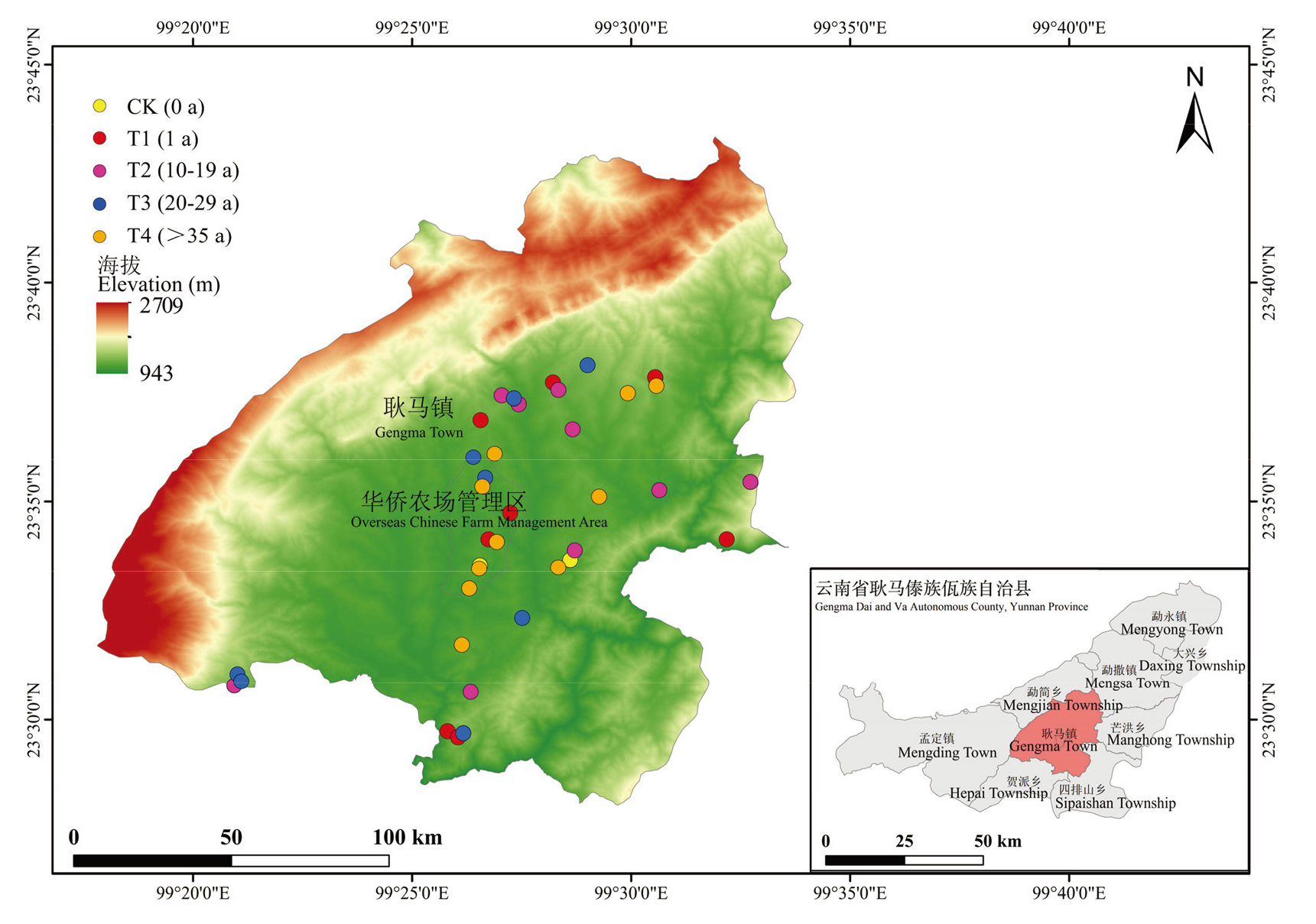
图1
采样点分布图"
表1
耿马镇蔗区不同年代甘蔗施肥情况调度表"
| 年份 Year | 肥料类型 Fertilizer type | 常规施肥次数及施肥量 Fertilization schedule and application rate | 施肥总量 Total fertilizer applied (kg·hm-2) | 氮磷钾养分总投入量 Total NPK input (kg·hm-2) |
|---|---|---|---|---|
| 2016—2022 | 复合肥(总养分44%,N-P2O5-K2O=26-12-6) Compound fertilizer (total nutrients 44%, N- P2O5-K2O = 26-12-6) | 一次性施肥:肥料全部用于基肥施用 Single application: all applied as basal fertilizer | 1 200 | 528 |
| 2004—2015 | 复合肥(总养分25%,N-P2O5-K2O=10- 10-5)+尿素(含N 46%) Compound fertilizer (total nutrients 25%, N-P2O5-K2O = 10-10-5) + urea (46% N) | 二次施肥:基肥施1 200 kg·hm-2复合肥,追肥施600 kg·hm-2尿素 Two applications: basal application of 1 200 kg·hm-2 compound fertilizer; topdressing with 600 kg·hm-2urea | 1 800 | 576 |
| 1980—2003 | 尿素(含N 46%)+过磷酸钙或钙镁磷肥(含P2O5 12%)+氯化钾(含K2O 60%) Urea (46% N) + single superphosphate or calcium magnesium phosphate (12% P2O5) + potassium chloride (60% K2O) | 三次施肥:基肥施300 kg·hm-2尿素+750 kg·hm-2过磷酸钙或钙镁磷肥+300 kg·hm-2氯化钾,第一次追肥施600 kg·hm-2尿素,第二次追肥施300 kg·hm-2尿素 Three applications: basal application of 300 kg·hm-2 urea +750 kg·hm-2 single superphosphate or calcium magnesium phosphate+300 kg·hm-2 potassium chloride; first topdressing: 600 kg·hm-2 urea; second topdressing: 300 kg·hm-2 urea | 2 250 | 822 |
表2
土壤各属性分级标准值"
| 分级 Grade | 有机质含量 Organic matter content (g·kg-1) | 全氮含量 Total nitrogen content (g·kg-1) | 全磷含量 Total phosphorus content (g·kg-1) | 全钾含量 Total potassium content (g·kg-1) | 碱解氮含量 Alkali-hydrolyzable nitrogen content (mg·kg-1) | 速效磷含量 Available phosphorus content (mg·kg-1) | 速效钾含量 Available potassium content (mg·kg-1) | pH | |
|---|---|---|---|---|---|---|---|---|---|
| >7 | <7 | ||||||||
| Xa | 10 | 0.75 | 0.4 | 5 | 60 | 3 | 40 | 8.5 | 4.5 |
| Xc | 20 | 1.50 | 0.6 | 20 | 120 | 10 | 100 | 8.0 | 5.5 |
| Xp | 30 | 2.00 | 1.0 | 25 | 180 | 20 | 150 | 7.5 | 6.5 |
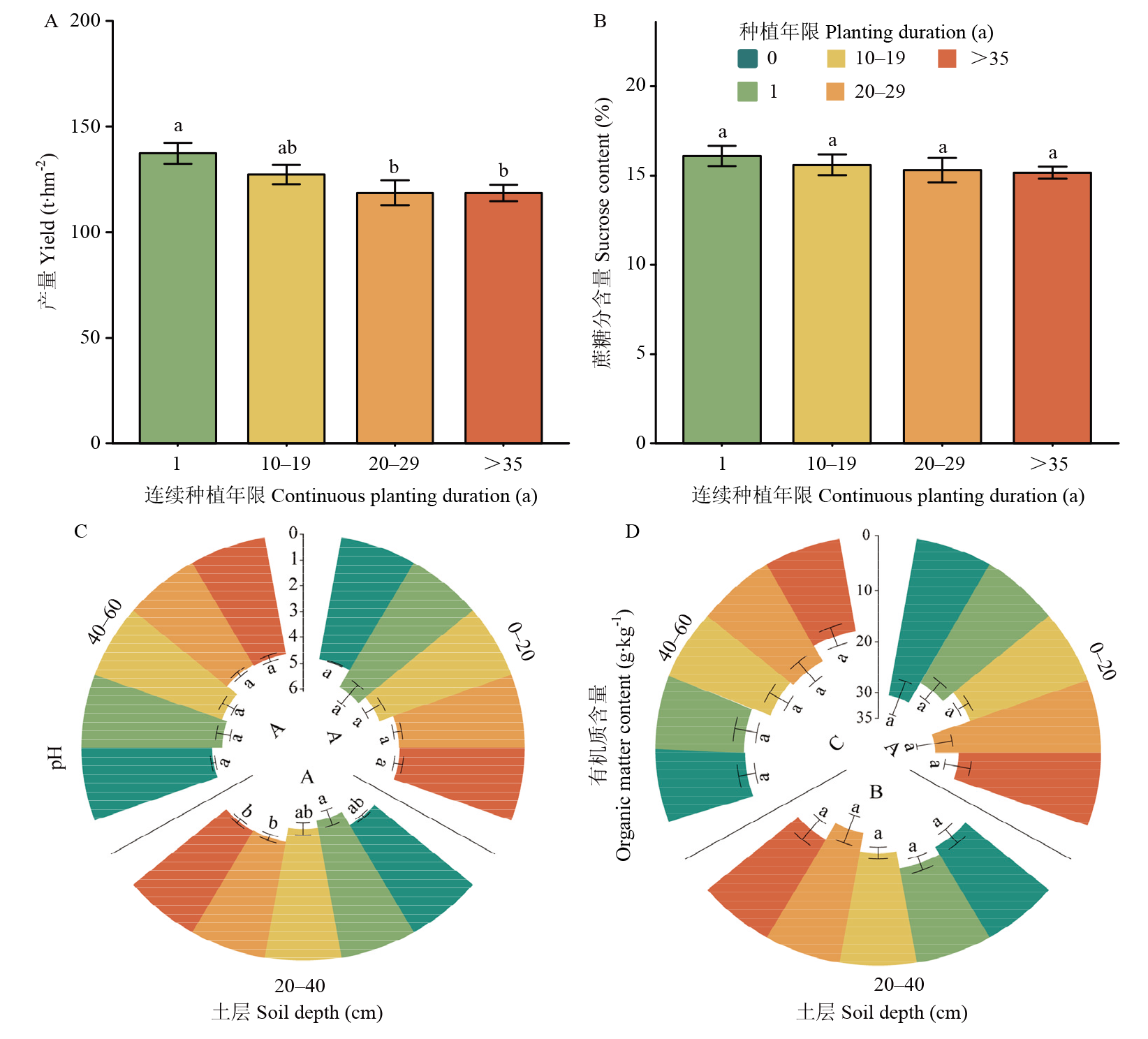
图2
不同连作年限下甘蔗产量(A)、蔗糖分(B)和不同土层土壤pH(C)及有机质含量(D) 不同小写字母表示同一指标不同连作年限间差异显著(P<0.05)。0 a表示未种植甘蔗的对照土壤,1、10—19、20—29、>35 a分别表示连作1年、10—19年、20—29年和35年及以上;A、B、C分别表示0—20、20—40、40—60 cm土层显著性差异。下同"
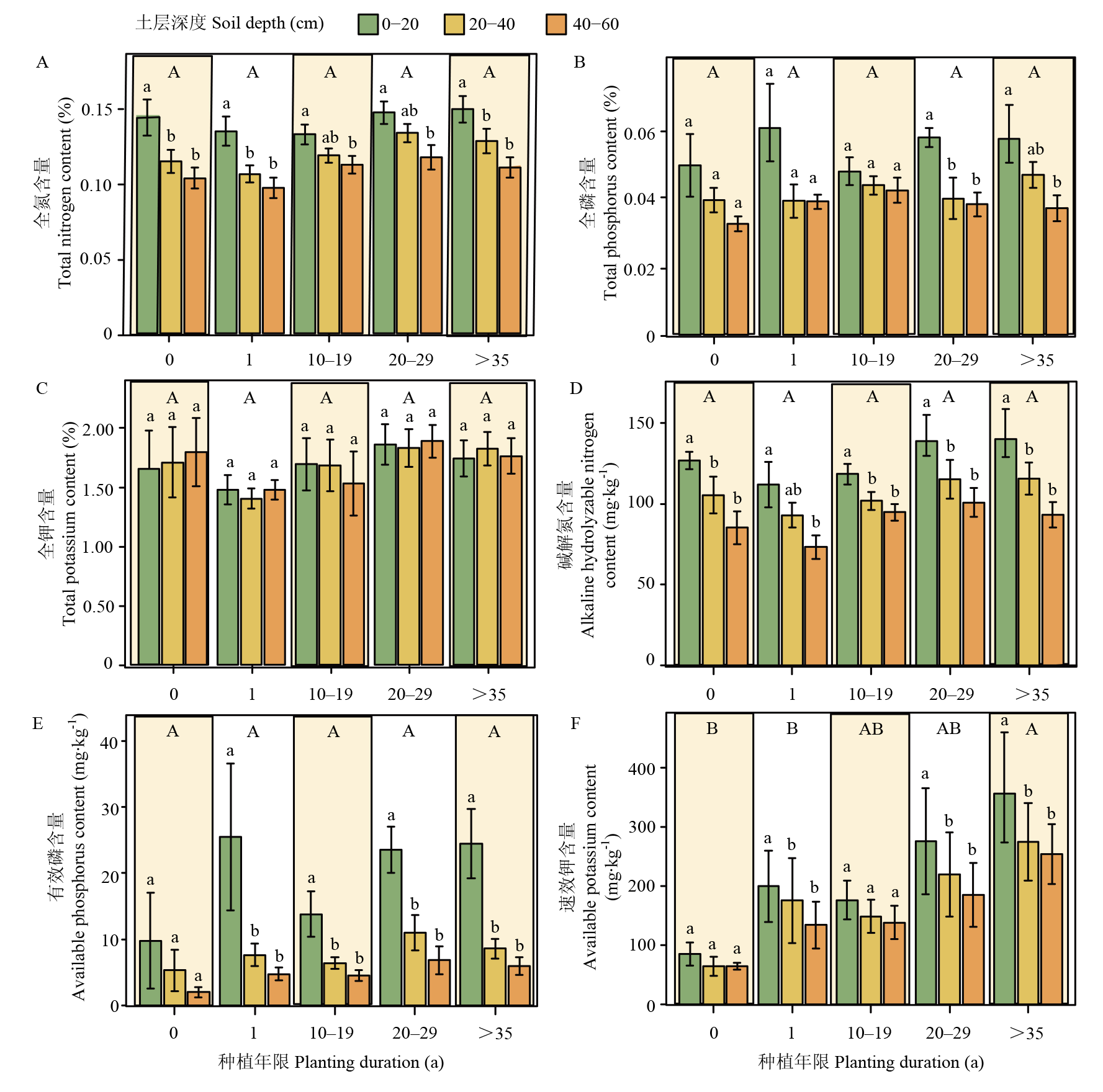
图3
不同连作年限下各土层土壤大量元素含量"
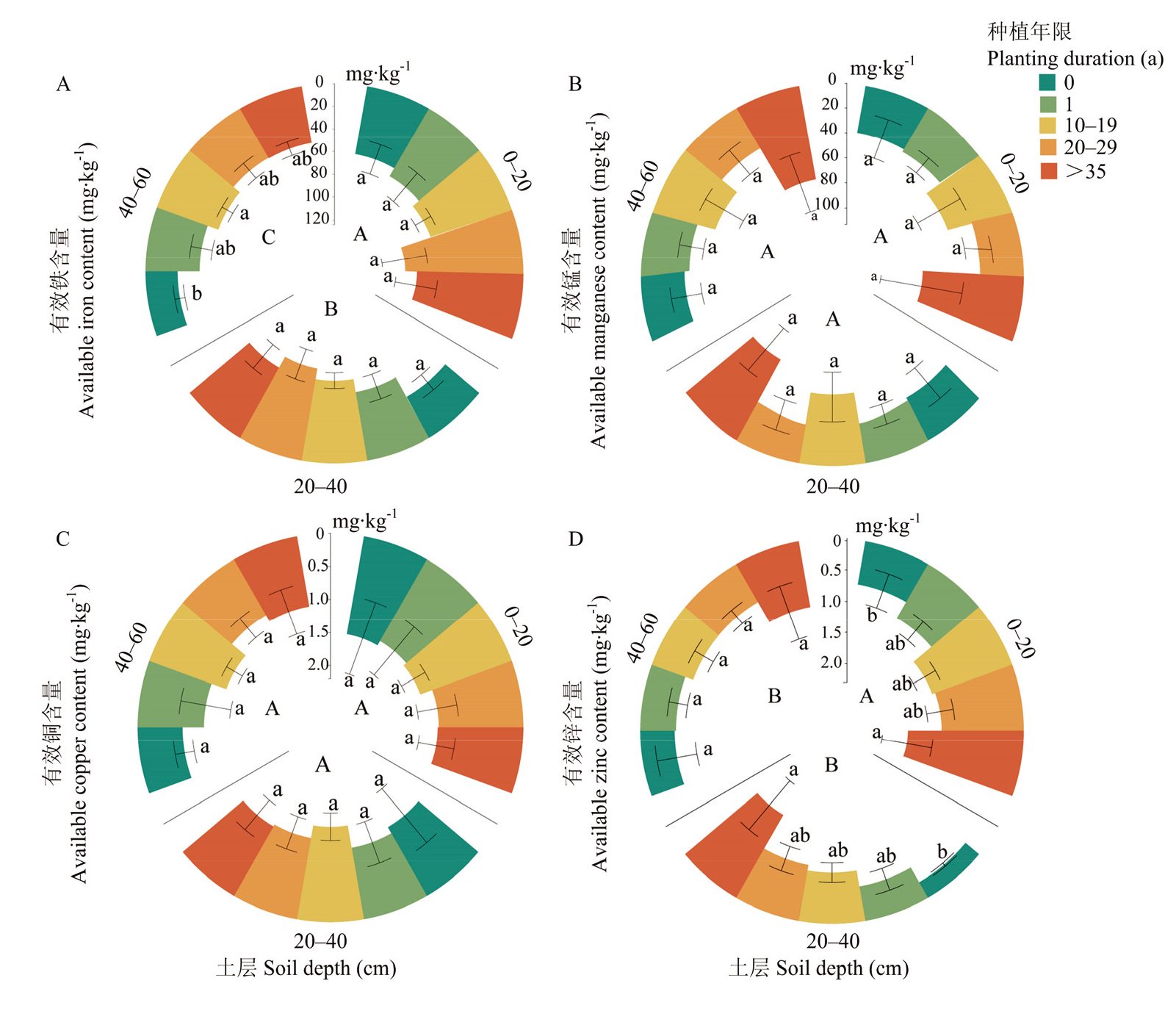
图4
不同连作年限下各土层土壤微量元素含量"
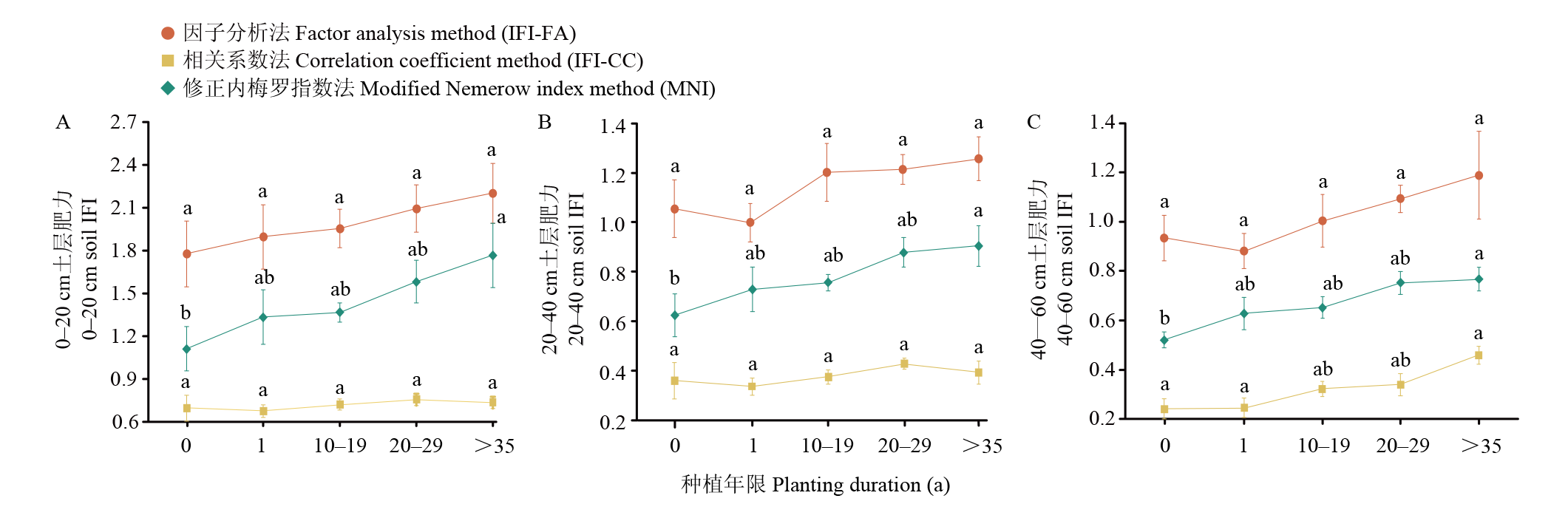
图5
不同连作年限0—20、20—40和40—60 cm土层土壤肥力"
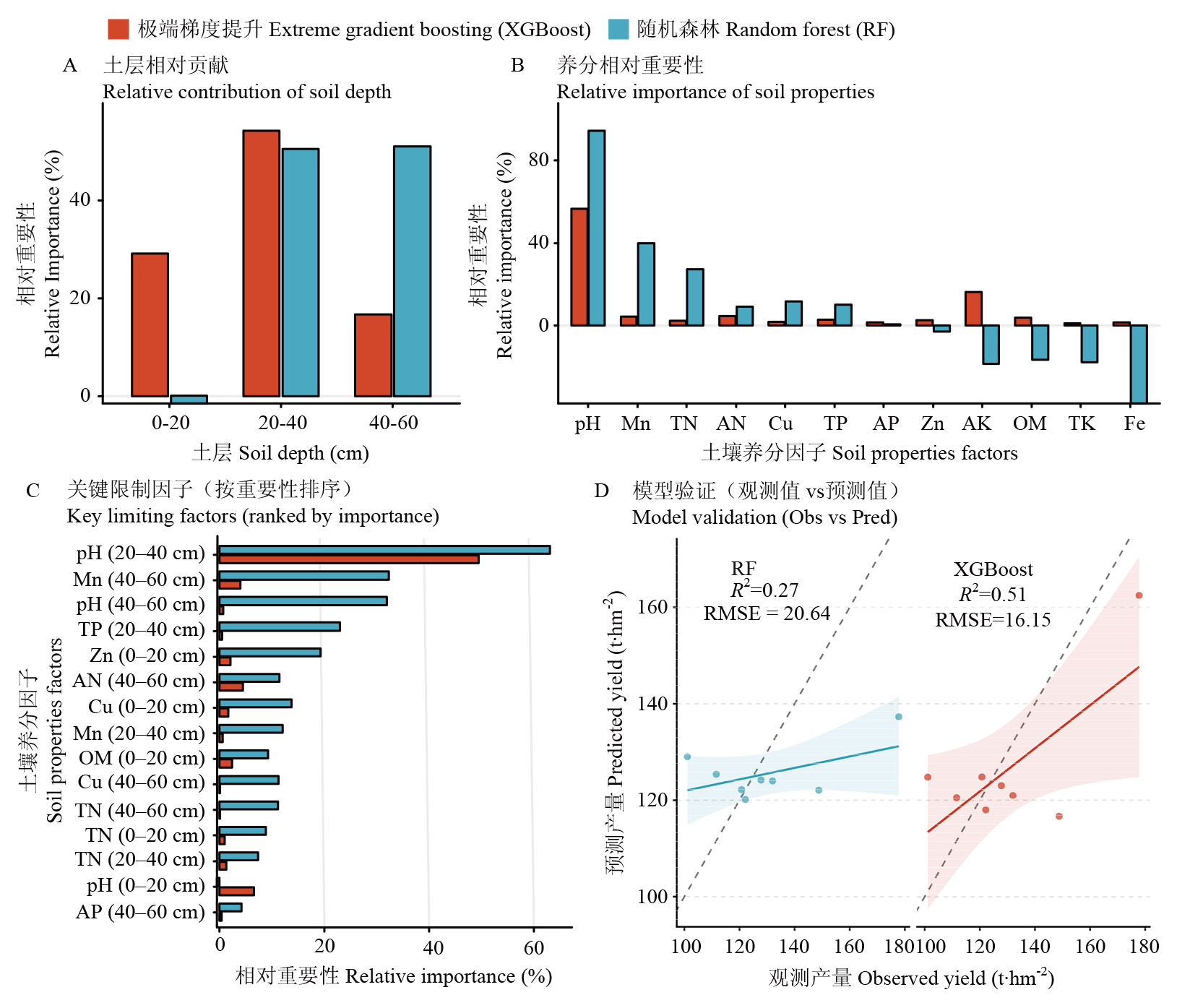
图6
基于XGBoost和RF的甘蔗产量预测模型性能比较及土壤驱动因子重要性 A:不同土层对产量预测的相对重要性贡献;B:各土壤养分指标的相对重要性:OM:有机质;TN:全氮;TP:全磷;TK:全钾;AN:碱解氮;AP:有效磷;AK:速效钾,Fe:有效态铁,Mn;有效态锰,Cu;有效态铜;Zn:有效态锌;C:关键限制因子的重要性排序,变量名称后缀数字表示所属土层深度(如“AN_20—40”表示20—40 cm土层的碱解氮);D:模型预测值与实测值的拟合验证,虚线为1﹕1参考线,实线为线性拟合线,阴影区域为95%置信区间,R2为决定系数,RMSE为均方根误差(t·hm-2)。橙色代表XGBoost模型,蓝色代表RF模型"
| [1] |
doi: 10.1111/j.1467-7652.2009.00491.x pmid: 20388126 |
| [2] |
李杨瑞. 现代甘蔗学[M]. 北京: 中国农业出版社, 2010.
|
|
|
|
| [3] |
|
| [4] |
吴静妮. 土壤理化性质与甘蔗连作障碍的相关性研究[D]. 南宁: 广西大学, 2016.
|
|
|
|
| [5] |
doi: 10.1038/nature01014 |
| [6] |
|
| [7] |
杨阳, 李海亮, 马凯丽, 虞凡枫, 牛世全. 连作对党参根际土壤理化性质、微生物活性及群落特征的影响[J]. 环境科学, 2023, 44(11): 6387-6398.
|
|
|
|
| [8] |
doi: 10.1126/science.1182570 pmid: 20150447 |
| [9] |
doi: 10.1007/BF00009558 |
| [10] |
doi: 10.1007/s11104-024-07051-5 |
| [11] |
doi: 10.1023/A:1010760720215 |
| [12] |
卜明娜, 杨习文, 滕政凯, 胡乃月, 张烁, 王春艳, 杨键, 梁文宪, 马文奇, 贺德先, 周苏玫. 不同灌水条件下分层施肥对土壤养分垂直分布与小麦根系生长和功能的影响[J]. 中国农业科学, 2024, 57(11): 2125-2142. DOI: 10.3864/j.issn.0578-1752.2024.11.007.
|
|
|
|
| [13] |
赵引, 李国安, 夏江宝, 薄丽媛, 毛晓敏. 覆膜和灌水量对制种玉米根系分布及产量的影响[J]. 农业工程学报, 2022, 38(15): 104-114.
|
|
|
|
| [14] |
匡自有, 刀静梅, 杨绍林, 艾静, 王禹童, 张仲富, 李如丹, 邓军, 赵勇. 甘蔗及其近缘种质斑茅和割手密不同生长角度根系分布及宿根性分析[J]. 热带作物学报, 2025, 46(3): 648-661.
doi: 10.3969/j.issn.1000-2561.2025.03.013 |
|
|
|
| [15] |
罗俊, 林兆里, 阙友雄, 张华, 李诗燕, 罗会, 张才芳, 陈建峰. 不同耕整地方式对甘蔗耕层结构特性及产量的影响[J]. 中国生态农业学报, 2018, 26(6): 824-836.
|
|
|
|
| [16] |
doi: 10.1016/j.fcr.2005.01.017 |
| [17] |
罗俊, 林兆里, 阙友雄, 李诗燕, 姚坤存, 姜永, 张华, 陈建峰. 耕作深度对蔗地土壤物理性状及甘蔗产量的影响[J]. 应用生态学报, 2019, 30(2): 405-412.
doi: 10.13287/j.1001-9332.201902.010 |
|
doi: 10.13287/j.1001-9332.201902.010 |
|
| [18] |
|
| [19] |
doi: 10.1016/j.geoderma.2013.09.016 |
| [20] |
|
| [21] |
doi: 10.1111/jec.2010.98.issue-4 |
| [22] |
鲍士旦. 土壤农化分析[M]. 3版. 北京: 中国农业出版社, 2000.
|
|
|
|
| [23] |
骆东奇, 白洁, 谢德体. 论土壤肥力评价指标和方法[J]. 土壤与环境, 2002, 11(2): 202-205.
|
|
|
|
| [24] |
陈均权, 马驰远, 胡鑫, 李朵, 郭艳琦, 刘灿, 周凯, 郑太辉. 有机无机肥配施调控红壤稻田土壤肥力、生态化学计量特征及产量[J]. 中国农业科学, 2025, 58(23): 4952-4965. DOI: 10.3864/j.issn.0578-1752.2025.23.011.
|
|
|
|
| [25] |
郑立臣, 宇万太, 马强, 王永宝. 农田土壤肥力综合评价研究进展[J]. 生态学杂志, 2004, 23(5): 156-161.
|
|
|
|
| [26] |
赵蛟, 徐梦洁, 庄舜尧, 林振清. 基于模糊综合评价法的建瓯市毛竹林地土壤肥力评价[J]. 土壤通报, 2018, 49(6): 1428-1435.
|
|
|
|
| [27] |
doi: 10.1016/j.geoderma.2008.12.015 |
| [28] |
doi: 10.1016/S0167-8809(01)00174-8 |
| [29] |
王远鹏, 黄晶, 孙钰翔, 柳开楼, 周虎, 韩天富, 都江雪, 蒋先军, 陈金, 张会民. 近35年红壤稻区土壤肥力时空演变特征: 以进贤县为例[J]. 中国农业科学, 2020, 53(16): 3294-3306. DOI: 10.3864/j.issn.0578-1752.2020.16.008.
|
|
|
|
| [30] |
全国土壤普查办公室. 中国土壤[M]. 北京: 中国农业出版社, 1998.
|
|
National Soil Census Office. Chinese Soil[M]. Beijing: China Agriculture Press, 1998. (in Chinese)
|
|
| [31] |
doi: 10.3390/microorganisms9102008 |
| [32] |
pmid: 20662149 |
| [33] |
苏浩, 张锐澎, 吴思炫, 姚槐应, 李雅颖. 连作障碍产生机理及防控现状[J]. 土壤, 2024, 56(2): 242-254.
|
|
|
|
| [34] |
苏亚飞, 包文彬, 李彦生, 于镇华, 刘晓冰. 农田土壤酸化: 原理、危害及缓解措施[J]. 土壤与作物, 2025, 14(1): 1-14.
|
|
|
|
| [35] |
徐仁扣, 李科伟. 基于铝化学行为的土壤酸化与调控研究[J]. 土壤, 2025, 57(6): 1252-1261.
|
|
|
|
| [36] |
doi: 10.1146/arplant.1978.29.issue-1 |
| [37] |
doi: 10.1007/s10705-020-10074-w |
| [38] |
doi: 10.1016/j.scitotenv.2017.08.020 |
| [39] |
doi: 10.1016/j.still.2020.104866 |
| [40] |
doi: 10.1007/s11104-004-1158-7 |
| [41] |
张福锁, 王激清, 张卫峰, 崔振岭, 马文奇, 陈新平, 江荣风. 中国主要粮食作物肥料利用率现状与提高途径[J]. 土壤学报, 2008, 45(5): 915-924.
|
|
|
|
| [42] |
doi: 10.1081/CSS-100104098 |
| [43] |
doi: 10.1071/S96047 |
| [44] |
杨俐苹, 金继运, 白由路, 黄绍文, 程明芳. 土壤养分综合系统评价法与平衡施肥技术研究回顾与展望[J]. 中国农业科学, 2007, 40(增刊): 3156-3162.
doi: 10.3864/j.issn.0578-1752.nykx-200740-3156 |
|
|
|
| [45] |
doi: 10.1080/03650340500098006 |
| [46] |
|
| [1] | 钱瑾, 李映雪, 吴芳, 邹晓晨. 集成光谱降维的冬小麦叶片磷含量估算[J]. 中国农业科学, 2026, 59(4): 781-792. |
| [2] | 丁倩, 何丽莲, 钱禛锋, 吴期滨, 赵昌祖, 林佩霞, 农韦优, 王誉洁, 张媛媛, 阙友雄, 李富生. 不同甘蔗品种/系脱叶性综合评价及叶鞘离区细胞形态和生理差异分析[J]. 中国农业科学, 2026, 59(15): 3315-3327. |
| [3] | 叶嘉怡, 邬奇峰, 王嘉林, 周燕, 马晓敏, 梁辰飞, 秦华, 陈俊辉. 调理剂与有机肥配施对酸性稻田土壤性质及水稻产量的影响[J]. 中国农业科学, 2026, 59(14): 3121-3131. |
| [4] | 费耀莹, 王迪, 唐伟杰, 郭彩丽, 张小虎, 邱小雷, 程涛, 姚霞, 江冲亚, 朱艳, 曹卫星, 郑恒彪. 基于无人机多源影像融合的水稻籽粒蛋白质含量估测[J]. 中国农业科学, 2026, 59(1): 41-56. |
| [5] | 王爱冬, 李瑞杰, 冯向前, 洪卫源, 李子秋, 张晓果, 王丹英, 陈松. 基于多角度成像与机器学习的水稻叶面积精确估算[J]. 中国农业科学, 2025, 58(9): 1719-1734. |
| [6] | 曹士亮, 张建国, 于滔, 杨耿斌, 李文跃, 马雪娜, 孙艳杰, 韩微波, 唐贵, 单大鹏. 基于机器学习的玉米自交系杂种优势类群研究[J]. 中国农业科学, 2025, 58(2): 203-213. |
| [7] | 刘静, 汪泓, 张磊, 肖玖军, 吴建高, 龚明冲. 基于高光谱的辣椒叶片氮素含量反演[J]. 中国农业科学, 2025, 58(2): 252-265. |
| [8] | 韩林蒲, 马纪龙, 齐勇杰, 高嘉琪, 谢铁娜, 贾彪. 无人机多光谱参数与Shapley分析融合的青贮玉米生物量估算[J]. 中国农业科学, 2025, 58(18): 3632-3647. |
| [9] | 霍润霞, 方娅婷, 张艳科, 吴海亚, 刘桂生, 李小坤, 任涛, 陆志峰, 丛日环, 鲁剑巍. 长期秸秆还田条件下化肥减量对稻稻油轮作系统作物产量和土壤肥力的影响[J]. 中国农业科学, 2025, 58(16): 3267-3279. |
| [10] | 赵勇, 张仲富, 王禹童, 艾静, 刘家勇, 吴建明, 邓军, 张跃彬. 施钾对根际土壤微生物群落和甘蔗生长的影响[J]. 中国农业科学, 2025, 58(13): 2630-2644. |
| [11] | 吴期滨, 谢婉婕, 钟惠, 冯春燕, 潘浩然, 齐浥颖, 张积森, 王恒波. 甘蔗抗褐锈病Bru1区域的鉴定及候选抗病基因的功能分析[J]. 中国农业科学, 2024, 57(5): 855-867. |
| [12] | 赵勇, 艾静, 王禹童, 张仲富, 杨洪岂, 李加群, 郭兆建, 刘海俊, 覃伟, 邓军, 张跃彬. 丘陵山地不同种植模式下甘蔗主栽品种生产的潜力[J]. 中国农业科学, 2024, 57(19): 3743-3757. |
| [13] | 郝磊晓, 褚楚, 温佩佩, 彭松悦, 杨卓, 邹慧颖, 樊懿楷, 王海童, 刘文举, 王东薇, 刘维华, 杨俊华, 赵娟, 李委奇, 温万, 周佳敏, 张淑君. 基于中红外光谱的中国荷斯坦牛牛奶中钠钾镁含量预测模型的建立[J]. 中国农业科学, 2024, 57(14): 2862-2873. |
| [14] | 冀建华, 吕真真, 刘淑珍, 侯红乾, 刘益仁, 刘秀梅, 李絮花, 蓝贤瑾. 长期施用化肥对南方稻田土壤酸化和盐基离子损失的影响[J]. 中国农业科学, 2024, 57(13): 2599-2611. |
| [15] | 石浩磊, 曹红霞, 张伟杰, 朱珊, 何子建, 张泽. 基于无人机多光谱的棉花多生育期叶面积指数反演[J]. 中国农业科学, 2024, 57(1): 80-95. |
|
||
