






中国农业科学 ›› 2026, Vol. 59 ›› Issue (14): 3121-3131.doi: 10.3864/j.issn.0578-1752.2026.14.010
叶嘉怡1,2( ), 邬奇峰3, 王嘉林1,2, 周燕1,2, 马晓敏1,2, 梁辰飞1,2, 秦华1,2, 陈俊辉1,2()
收稿日期:2025-09-04
接受日期:2025-10-16
出版日期:2026-07-16
发布日期:2026-07-21
通信作者:
联系方式:
叶嘉怡,E-mail:yejiayi0206@163.com。
基金资助:
YE JiaYi1,2(), WU QiFeng3, WANG JiaLin1,2, ZHOU Yan1,2, MA XiaoMin1,2, LIANG ChenFei1,2, QIN Hua1,2, CHEN JunHui1,2()
Received:2025-09-04
Accepted:2025-10-16
Published:2026-07-16
Online:2026-07-21
摘要:
【目的】探究连续3年低剂量土壤调理剂单施及其与有机肥配施对酸性稻田土壤化学性质、酶活性和水稻产量的影响,为南方红黄壤区酸性稻田土壤肥力提升提供依据。【方法】进行田间试验,设置8个处理:不施肥对照(CK0)、常规施肥对照(CK1)、矿物源土壤调理剂(0.75 t·hm-2)+常规施肥(M)、有机源土壤调理剂(1.2 t·hm-2)+常规施肥(O)、矿物和有机调理剂配施+常规施肥(MO)及后三者分别与有机肥配施(4.5 t·hm-2)(MF、OF和MOF)处理。调理剂和有机肥每年施用一次,连续施用3年后测定土壤化学、生物学性质和水稻产量。【结果】与CK0和CK1相比,其余处理均显著提高了土壤pH,降低了交换性H+、交换性Al3+和交换性酸含量。与CK1相比,MF、OF和MOF处理显著提高了土壤有机质含量,且MOF处理显著提高了有效磷、速效钾、微生物量碳氮含量和水稻产量。相比CK1,MF和OF处理显著降低了酸性磷酸酶活性,MOF处理显著降低了向量角度,表明降低了微生物磷限制。冗余分析表明,土壤交换性酸、交换性H+和Al3+与酸性磷酸酶活性正相关,而有机质、pH、碱解氮、微生物量碳、有效磷与其呈负相关,交换性酸降低和养分提高是改变酶活性的关键因子。相关性分析表明,水稻产量与有机质、碱解氮、有效磷和微生物量碳呈显著正相关,与交换性酸和向量角度呈显著负相关。结构方程模型进一步表明,土壤有机质和交换性酸含量变化可通过影响微生物量碳和磷限制影响水稻产量,其共同解释了62%产量变异。土壤有机质对水稻产量具有显著的正效应,而交换性酸和向量角度对水稻产量具有较强的负效应。【结论】连续3年施用低剂量矿物源、有机源土壤调理剂,及调理剂与有机肥配施,均能降低土壤潜性酸、提高土壤有机质和速效养分含量、降低微生物磷限制,且以调理剂与有机肥配施处理的水稻增产效果最优,可作为南方红壤降酸培肥的有效措施。
叶嘉怡, 邬奇峰, 王嘉林, 周燕, 马晓敏, 梁辰飞, 秦华, 陈俊辉. 调理剂与有机肥配施对酸性稻田土壤性质及水稻产量的影响[J]. 中国农业科学, 2026, 59(14): 3121-3131.
YE JiaYi, WU QiFeng, WANG JiaLin, ZHOU Yan, MA XiaoMin, LIANG ChenFei, QIN Hua, CHEN JunHui. Effects of Soil Conditioners and Organic Fertilizer Application on Enzyme Activity and Rice Yield in an Acid Paddy Soil[J]. Scientia Agricultura Sinica, 2026, 59(14): 3121-3131.
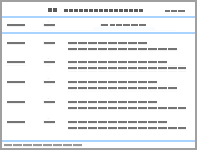
表1
试验各处理土壤调理剂的用量"
| 编号 Number | 处理 Treatment | 矿物源调理剂 Mineral conditioner (t·hm-2) | 有机源调理剂 Organic conditioner (t·hm-2) | 有机肥 Organic fertilizer (t·hm-2) |
|---|---|---|---|---|
| CK0 | 无调理剂、不施肥Without fertilization and soil conditioner | 0 | 0 | 0 |
| CK1 | 无调理剂,常规施肥Without soil conditioner, traditional fertilization | 0 | 0 | 0 |
| M | 矿物源调理剂+常规施肥Mineral soil conditioner + Traditional fertilization | 0.75 | 0 | 0 |
| O | 有机源调理剂+常规施肥Organic soil conditioner + Traditional fertilization | 0 | 1.2 | 0 |
| MO | 矿物源调理剂+有机源调理剂+常规施肥 Mineral soil conditioner + Organic soil conditioner + Traditional fertilization | 0.75 | 1.2 | 0 |
| MF | 矿物源调理剂+有机肥+常规施肥 Mineral soil conditioner + Organic fertilizer + Traditional fertilization | 0.75 | 0 | 4.5 |
| OF | 有机源调理剂+有机肥+常规施肥 Organic soil conditioner + Organic fertilizer + Traditional fertilization | 0 | 1.2 | 4.5 |
| MOF | 矿物源调理剂+有机源调理剂+有机肥+常规施肥 Mineral soil conditioner + Organic soil conditioner + Organic fertilizer + Traditional fertilization | 0.75 | 1.2 | 4.5 |
表2
土壤调理剂与有机肥的化学性质"
| pH | 有机质 SOM (%) | 全氮 N (%) | 全磷 P2O5 (%) | 全钾 K2O (%) | 氧化钙 CaO (%) | 氧化镁 MgO (%) | 氧化硅 SiO2 (%) | |
|---|---|---|---|---|---|---|---|---|
| 矿物源调理剂Mineral conditioner | 10.5 | — | 0.14 | 0.05 | 0.12 | 40.0 | 10.5 | 25.5 |
| 有机源调理剂Organic conditioner | 10.0 | 20.0 | 0.36 | 0.32 | 0.10 | 20.0 | 8.0 | — |
| 有机肥Organic fertilizer | 7.7 | 40.0 | 2.50 | 1.80 | 1.50 | — | — | — |
表3
不同调理剂处理下土壤化学性质、微生物量和水稻产量的变化"
| 处理 Treatment | pH | 有机质 SOM (g·kg-1) | 碱解氮 AN (mg·kg-1) | 有效磷 AP (mg·kg-1) | 速效钾 AK (mg·kg-1) | ||||||
|---|---|---|---|---|---|---|---|---|---|---|---|
| CK0 | 5.37±0.08c | 22.21±1.92b | 92.08±16.33b | 13.35±1.83d | 75.67±10.50c | ||||||
| CK1 | 5.67±0.11c | 23.24±1.91b | 102.28±14.99ab | 16.29±1.96cd | 94.67±12.22bc | ||||||
| M | 6.24±0.32b | 26.11±3.85ab | 108.19±18.57ab | 17.20±1.32bcd | 105.33±13.01ab | ||||||
| O | 6.64±0.22ab | 27.23±3.40ab | 110.16±18.80ab | 18.35±4.57abcd | 108.67±17.01ab | ||||||
| MO | 6.63±0.42ab | 27.66±2.99ab | 117.58±5.33ab | 24.19±4.27ab | 117.67±18.58ab | ||||||
| MF | 6.85±0.12a | 28.98±2.36a | 126.32±19.93a | 22.10±4.50abc | 108.33±21.50ab | ||||||
| OF | 6.71±0.22ab | 29.36±3.04a | 119.06±21.21ab | 23.36±3.80abc | 121.00±11.79ab | ||||||
| MOF | 6.90±0.40a | 30.22±3.18a | 130.56±14.09a | 24.79±5.96a | 128.33±8.39a | ||||||
| 处理Treatment | 微生物量碳 MBC (mg·kg-1) | 微生物量氮 MBN (mg·kg-1) | 交换性酸 EA (cmol·kg-1) | 交换性H+ EH (cmol·kg-1) | 交换性Al3+ EAl (cmol·kg-1) | 水稻产量 Rice yield (t·hm-2) | |||||
| CK0 | 246.51±90.36d | 12.65±3.79e | 0.80±0.07a | 0.45±0.03a | 0.35±0.05a | 8.50±0.46c | |||||
| CK1 | 293.11±20.98cd | 19.14±4.69de | 0.40±0.06b | 0.16±0.03b | 0.24±0.04b | 9.22±0.66bc | |||||
| M | 299.95±49.50cd | 28.09±5.11bc | 0.11±0.06c | 0.07±0.04c | 0.04±0.02c | 10.05±0.99ab | |||||
| O | 362.00±103.02bcd | 29.56±3.32abc | 0.08±0.03c | 0.04±0.01c | 0.04±0.03c | 10.11±0.75ab | |||||
| MO | 481.86±99.96ab | 32.32±2.01ab | 0.10±0.06c | 0.06±0.04c | 0.05±0.03c | 10.56±0.79ab | |||||
| MF | 497.06±43.94ab | 23.15±6.12cd | 0.05±0.02c | 0.03±0.02c | 0.02±0.01c | 10.25±0.75ab | |||||
| OF | 397.91±42.25bc | 25.53±1.23bcd | 0.09±0.03c | 0.07±0.02c | 0.02±0.01c | 10.64±0.56ab | |||||
| MOF | 599.62±95.37a | 36.43±3.23a | 0.06±0.03c | 0.03±0.03c | 0.03±0.02c | 11.11±0.99a | |||||
表4
不同调理剂处理对土壤酶活性、化学计量特征和水稻产量的影响"
| 处理 Treatment | β-葡萄糖苷酶 BG (nmol·g-1·h-1) | 纤维二糖水解酶 CB (nmol·g-1·h-1) | β-N-乙酰氨基葡萄糖苷酶NAG (nmol·g-1·h-1) | 亮氨酸氨基酞酶 LAP (nmol·g-1·h-1) | 酸性磷酸酶 PHOS (nmol·g-1·h-1) |
|---|---|---|---|---|---|
| CK0 | 98.82±8.17a | 6.52±1.03a | 31.23±4.70a | 8.42±0.52a | 156.60±6.92a |
| CK1 | 82.22±7.50bc | 4.69±0.59b | 33.64±12.34a | 7.57±1.01ab | 132.28±2.50bc |
| M | 81.79±10.04bc | 4.71±0.78b | 35.03±11.65a | 7.66±0.92ab | 130.95±12.77bc |
| O | 82.35±8.41bc | 4.58±0.66b | 35.64±9.66a | 7.21±0.88ab | 123.37±9.91bc |
| MO | 97.38±6.69ab | 5.07±1.00b | 40.48±7.84a | 7.34±0.62ab | 136.97±4.90b |
| MF | 74.21±8.78c | 4.21±0.48b | 39.66±7.96a | 6.63±0.65b | 109.00±5.99de |
| OF | 76.80±9.89c | 3.97±0.92b | 41.99±11.88a | 6.31±0.69b | 104.57±4.76e |
| MOF | 95.46±9.17ab | 4.37±0.85b | 42.97±9.55a | 6.72±0.34b | 119.86±9.60cd |
| 处理 Treatment | 酶碳氮比 Enzyme C/N | 酶碳磷比 Enzyme C/P | 酶氮磷比 Enzyme N/P | 向量长度 Vector length | 向量角度 Vector angle (°) |
| CK0 | 1.27±0.06a | 0.92±0.02b | 0.73±0.03b | 0.83±0.03a | 61.03±1.50c |
| CK1 | 1.22±0.10a | 0.91±0.02b | 0.75±0.07ab | 0.79±0.05a | 59.81±3.04bc |
| M | 1.20±0.05a | 0.91±0.02b | 0.77±0.05ab | 0.78±0.02a | 59.41±2.48ab |
| O | 1.20±0.09a | 0.93±0.03ab | 0.78±0.04ab | 0.79±0.07a | 58.31±0.52ab |
| MO | 1.20±0.05a | 0.94±0.01ab | 0.78±0.04ab | 0.81±0.03a | 57.89±1.74ab |
| MF | 1.14±0.06a | 0.93±0.02ab | 0.81±0.03ab | 0.76±0.05a | 56.42±1.28ab |
| OF | 1.14±0.11a | 0.94±0.02ab | 0.83±0.06a | 0.76±0.08a | 55.11±2.60ab |
| MOF | 1.18±0.04a | 0.96±0.00a | 0.81±0.03ab | 0.81±0.02a | 55.83±1.12a |
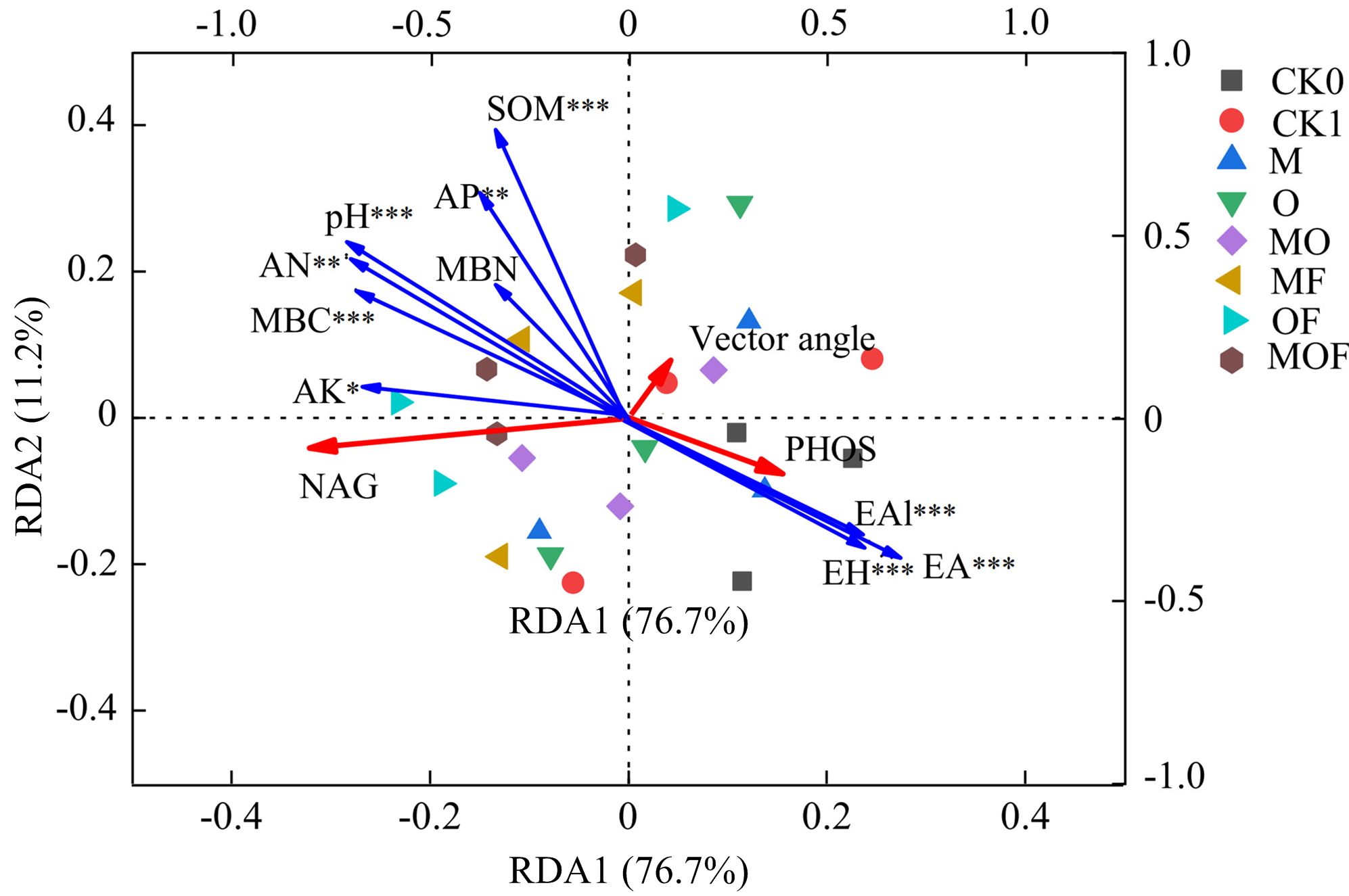
图1
土壤理化性质与土壤酶活性的冗余分析 NAG:β-N-乙酰基氨基葡萄糖苷酶;PHOS:酸性磷酸酶;Vector angle:向量角度。*:P<0.05,**:P<0.01,***:P<0.001"
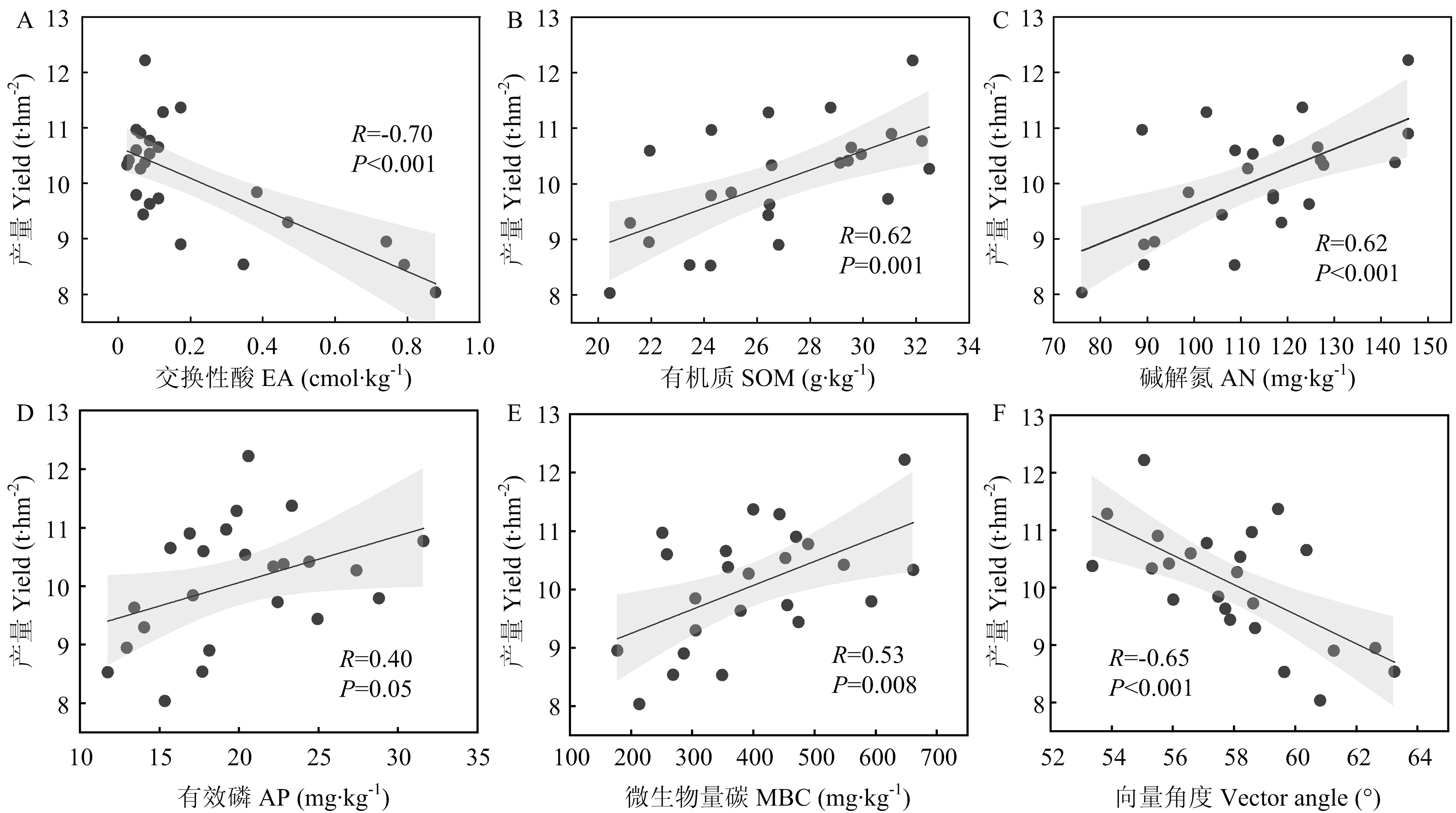
图2
水稻产量与土壤化学性质、酶活性的相关性"
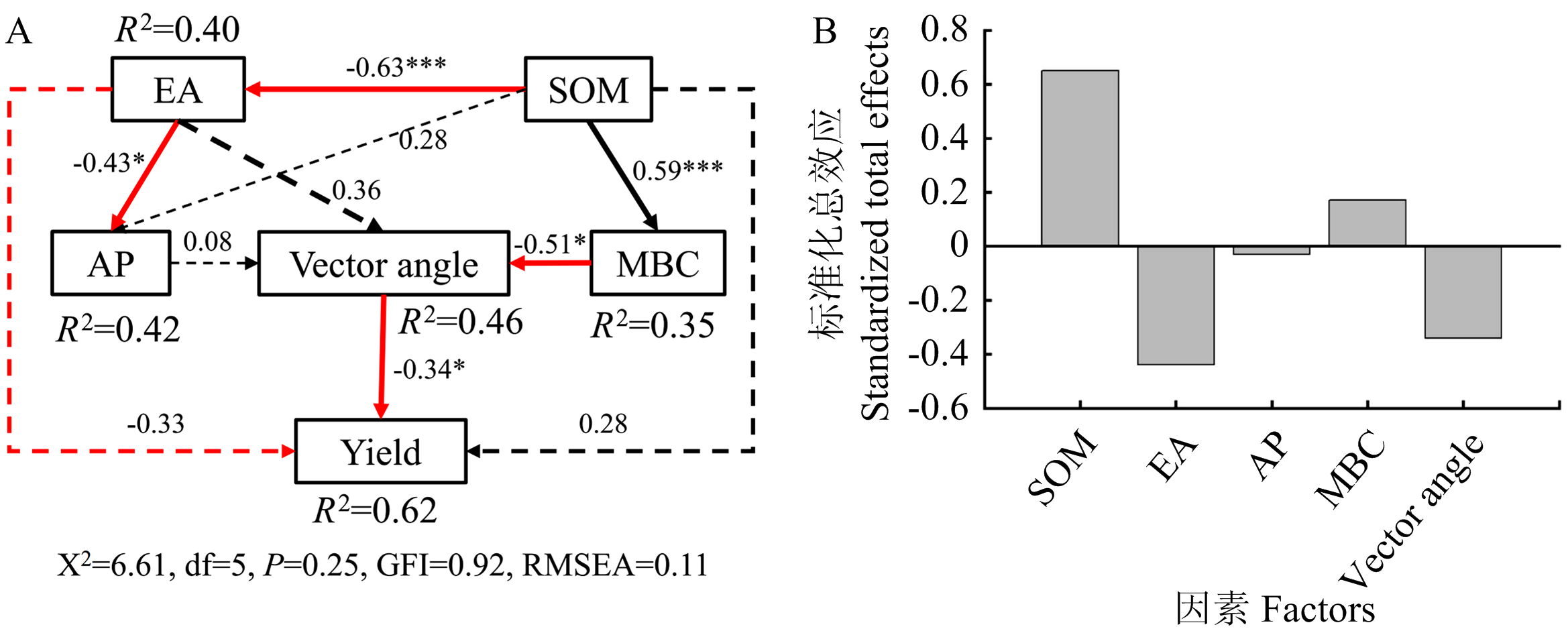
图3
结构方程模型分析影响水稻产量的主要因素(A)与途径及标准化效应(B) 红色箭头表示负相关,黑色箭头表示正相关。线条粗细代表相关性系数"
| [1] |
徐仁扣, 李九玉, 周世伟, 徐明岗, 沈仁芳. 我国农田土壤酸化调控的科学问题与技术措施[J]. 中国科学院院刊, 2018, 33(2): 160-167.
|
|
|
|
| [2] |
韩天富, 柳开楼, 黄晶, 马常宝, 郑磊, 王慧颖, 曲潇林, 任意, 于子坤, 张会民. 近30年中国主要农田土壤pH时空演变及其驱动因素[J]. 植物营养与肥料学报, 2020, 26(12): 2137-2149.
|
|
|
|
| [3] |
丁文成, 宋大利, 周卫. 我国耕地质量主控因素及提升策略[J]. 植物营养与肥料学报, 2024, 30(8): 1580-1594.
|
|
|
|
| [4] |
冀建华, 吕真真, 刘淑珍, 侯红乾, 刘益仁, 刘秀梅, 李絮花, 蓝贤瑾. 长期施用化肥对南方稻田土壤酸化和盐基离子损失的影响[J]. 中国农业科学, 2024, 57(13): 2599-2611. DOI: 10.3864/j.issn.0578-1752.2024.13.008.
|
|
|
|
| [5] |
赵学强, 潘贤章, 马海艺, 董晓英, 车景, 王超, 时玉, 柳开楼, 沈仁芳. 中国酸性土壤利用的科学问题与策略[J]. 土壤学报, 2023, 60(5): 1248-1263.
|
|
|
|
| [6] |
doi: 10.1016/j.apsoil.2023.105242 |
| [7] |
冀建华, 李絮花, 刘秀梅, 侯红乾, 刘益仁, 吕真真, 蓝贤瑾, 陈剑秋. 硅钙钾镁肥对南方稻田土壤酸性和盐基离子动态变化的影响[J]. 应用生态学报, 2019, 30(2): 583-592.
doi: 10.13287/j.1001-9332.201902.024 |
|
|
|
| [8] |
胡天睿, 蔡泽江, 王伯仁, 张璐, 文石林, 朱建强, 徐明岗. 有机肥替代化学氮肥提升红壤抗酸化能力[J]. 植物营养与肥料学报, 2022, 28(11): 2052-2059.
|
|
|
|
| [9] |
朱道奇, 张志华, 包鑫丰, 顾祝禹, 涂圣梅, 邱承帆. 有机肥配施土壤调理剂改善土壤理化性质提高水稻产量[J]. 中南农业科技, 2024, 45(4): 6-9.
|
|
|
|
| [10] |
吴文利, 康亚龙, 曾少敏, 王中华, 胡小璇, 安祥瑞, 江尚焘, 谢昶琰, 黄新忠, 董彩霞, 徐阳春. 生物有机肥配施硅钾钙改良剂对酸性红壤梨园土壤肥力及产量的影响[J]. 南京农业大学学报, 2021, 44(2): 305-314.
|
|
|
|
| [11] |
doi: 10.1016/j.scitotenv.2022.152918 |
| [12] |
doi: 10.1023/A:1016541114786 |
| [13] |
doi: 10.1038/nature08632 |
| [14] |
doi: 10.1016/j.soilbio.2015.10.019 |
| [15] |
doi: 10.1016/j.scitotenv.2018.12.289 |
| [16] |
王传杰, 王齐齐, 徐虎, 高洪军, 朱平, 徐明岗, 张文菊. 长期施肥下农田土壤-有机质-微生物的碳氮磷化学计量学特征[J]. 生态学报, 2018, 38(11): 3848-3858.
|
|
|
|
| [17] |
doi: 10.1016/j.still.2025.106617 |
| [18] |
于金珠, 吴辰晨, 姬浩楠, 李松昊, 邬奇峰, 秦华, 陈俊辉. 矿物调理剂对丘陵红壤天目小香薯产量和酶生态化学计量特征的影响[J]. 浙江农林大学学报, 2023, 40(3): 531-539.
|
|
|
|
| [19] |
鲁如坤. 土壤农业化学分析方法[M]. 北京: 中国农业科学技术出版社, 2000.
|
|
|
|
| [20] |
doi: 10.1007/s00374-021-01574-0 |
| [21] |
doi: 10.1016/j.geoderma.2019.06.037 |
| [22] |
杨右君, 冯浪佳, 任科润, 王进进, 张玉龙, 李文彦, 李永涛, 胡峥. 6种土壤调理剂对酸性水稻土改良效果的综合评价[J]. 农业资源与环境学报, 2026, 43(1): 153-162.
|
|
|
|
| [23] |
龚玲婷, 石林, 蔡如梦. 矿物质调理剂对土壤养分含量及植物营养吸收的影响[J]. 土壤, 2019, 51(5): 916-922.
|
|
|
|
| [24] |
doi: 10.1080/26395940.2024.2323689 |
| [25] |
doi: 10.1016/j.still.2019.104382 |
| [26] |
doi: 10.1007/s11368-016-1380-y |
| [27] |
郭春雷, 李娜, 彭靖, 高天一, 马凌云, 韩晓日. 秸秆直接还田及炭化还田对土壤酸度和交换性能的影响[J]. 植物营养与肥料学报, 2018, 24(5): 1205-1213.
|
|
|
|
| [28] |
doi: 10.1016/j.soilbio.2009.10.014 |
| [29] |
赵婧, 王亚男, 曾希柏, 文炯, 温云杰, 吴翠霞, 郑重. 不同改良措施对第四纪红壤酶活性的影响[J]. 土壤学报, 2022, 59(4): 1160-1176.
|
|
|
|
| [30] |
doi: 10.1016/j.soilbio.2018.05.001 |
| [31] |
宁玉菲, 魏亮, 魏晓梦, 祝贞科, 袁红朝, 葛体达, 吴金水. 长期施肥稻田土壤胞外酶活性对底物可利用性的响应特征[J]. 环境科学, 2020, 41(6): 2852-2860.
|
|
|
|
| [32] |
doi: 10.1016/j.soilbio.2012.11.009 |
| [33] |
王昭仪, 脱云飞, 刘香凝, 石小兰, 丁明净, 黎建强, 向萍, 何霞红, 杨启良. 土壤养分和酶活性及三七产量、皂苷含量对水肥耦合的响应[J]. 植物营养与肥料学报, 2023, 29(12): 2332-2344.
|
|
|
|
| [34] |
魏翠翠, 刘小飞, 林成芳, 李先锋, 李艳, 郑裕雄. 凋落物输入改变对亚热带两种米槠次生林土壤酶活性的影响[J]. 植物生态学报, 2018, 42(6): 692-702.
doi: 10.17521/cjpe.2017.0247 |
|
doi: 10.17521/cjpe.2017.0247 |
| [1] | 侯慧芝, 尹嘉德, 马明生, 刘晓伟, 柳燕兰, 雷康宁. 耕作与增施有机肥对陇东马铃薯-玉米一年两熟制作物产量和水分利用的影响[J]. 中国农业科学, 2026, 59(8): 1672-1685. |
| [2] | 王彩玉, 刘小丽, 李文广, 杨文平, 杨珍平, 高志强. 有机肥不同替代比例对土壤多功能性的影响及微生物驱动机制[J]. 中国农业科学, 2026, 59(8): 1712-1726. |
| [3] | 魏文龙, 王林林, 陈晓丽, 武凌彬, 李录芳, 解云婷, 王江文. 有机替代和地膜覆盖对旱地小麦根系生长、产量和水分利用效率的影响[J]. 中国农业科学, 2026, 59(11): 2340-2357. |
| [4] | 吕旭东, 孙世媛, 李亚楠, 刘玉龙, 王艳群, 付鑫, 张佳英, 宁鹏, 彭正萍. 智能机械化分层施肥对麦田根-土养分分布和小麦产量的影响[J]. 中国农业科学, 2026, 59(1): 129-146. |
| [5] | 陈均权, 马驰远, 胡鑫, 李朵, 郭艳琦, 刘灿, 周凯, 郑太辉. 有机无机肥配施调控红壤稻田土壤肥力、生态化学计量特征及产量[J]. 中国农业科学, 2025, 58(23): 4952-4966. |
| [6] | 吴文琪, 焦阳, 惠家祯, 王绪锋, 郭博森, 沈玉芳. 不同有机物料配施化肥对土壤肥力和玉米产量的影响[J]. 中国农业科学, 2025, 58(23): 4966-4978. |
| [7] | 谢海鹏, 林俊旭, 刘勇, 麦贤俊, 罗丰, 王学武, 谢文, 李少卡, 孔祥义, 吴小燕. 施用不同有机肥对贝莱斯芽孢杆菌SD13防控豇豆枯萎病的影响[J]. 中国农业科学, 2025, 58(21): 4405-4420. |
| [8] | 张海睿, 贾昂元, 高奇奇, 韩哲群, 南珊珊, 段碧华, 武雪萍. 生物炭配施黄腐酸对滨海盐碱地土壤理化性质、酶活性和多功能性的影响[J]. 中国农业科学, 2025, 58(20): 4178-4188. |
| [9] | 李月琪, 麻仲花, 苏明, 刘昊, 马风兰, 马小英, 李涛, 李清云, 张丹, 刘吉利, 吴娜. 不同耕作方式下盐碱地玉米光合物质生产能力对有机肥用量的响应[J]. 中国农业科学, 2025, 58(19): 3872-3889. |
| [10] | 方娅婷, 赵剑, 盛倩男, 李凯旭, 王祥华, 张洋洋, 朱俊, 丛日环, 陆志峰, 李小坤, 任涛, 鲁剑巍. 长期化肥和有机物料投入对稻油轮作作物产量和养分利用的影响[J]. 中国农业科学, 2025, 58(16): 3164-3177. |
| [11] | 卜容燕, 程文龙, 武际, 唐杉, 李敏, 鲁剑巍, 纪根学, 王慧, 朱睿, 蒋发辉, 汤萌萌, 韩上. 有机肥无机肥配施结合深耕提升稻油轮作系统生产力和养分利用效率[J]. 中国农业科学, 2025, 58(16): 3178-3189. |
| [12] | 宣泽鹏, 冯慧瑶, 陈美淇, 徐基胜, 刘梦璇, 赵炳梓, 张佳宝. 秸秆还田配施化肥对土壤生态系统多功能性的影响[J]. 中国农业科学, 2025, 58(14): 2821-2837. |
| [13] | 杜嘉琪, 张紫薇, 王若飞, 黎星, 郭红艳, 杨硕, 冯成, 何堂庆, Giri Bhoopander, 张学林. 有机肥替代化肥与丛枝菌根真菌互作对砂姜黑土和潮土N2O排放的影响[J]. 中国农业科学, 2025, 58(1): 101-116. |
| [14] | 高娅菲, 赵媛博, 徐玲, 孙嘉悦, 夏煜轩, 薛丹, 武海雯, 宁航, 吴安驰, 吴林. 冷浸田改种泥炭藓显著增加土壤有机碳含量且降低胞外酶活性[J]. 中国农业科学, 2024, 57(8): 1533-1546. |
| [15] | 马荣辉, 杨武杰, 于蕾, 杨泽龙, 王健, 郭跃升. 山东省作物秸秆和畜禽粪尿有机肥资源现状及替代化肥潜力分析[J]. 中国农业科学, 2024, 57(4): 721-739. |
|
||
