






中国农业科学 ›› 2026, Vol. 59 ›› Issue (8): 1639-1652.doi: 10.3864/j.issn.0578-1752.2026.08.004
李志威1,2( ), 王子琪2,3, 高亚蒙2, 高润红4, 陈雪2, 杨铸2,5, 阚文杰2,5, 蹇双灵2, 严胜男2, 汤才国1,2,5(), 吴丽芳1,2,3,5()
收稿日期:2025-09-09
接受日期:2026-02-22
出版日期:2026-04-21
发布日期:2026-04-21
通信作者:
联系方式:
李志威,E-mail:1269344077@qq.com。
基金资助:
LI ZhiWei1,2(), WANG ZiQi2,3, GAO YaMeng2, GAO RunHong4, CHEN Xue2, YANG Zhu2,5, KAN WenJie2,5, JIAN ShuangLing2, YAN ShengNan2, TANG CaiGuo1,2,5(), WU LiFang1,2,3,5()
Received:2025-09-09
Accepted:2026-02-22
Published:2026-04-21
Online:2026-04-21
摘要:
【目的】探究不同光质组合对大麦(Hordeum vulgare L.)生长发育、光合生理特性、关键开花基因表达和单株籽粒形成的影响,以优化光质配比,实现一年多代的育种技术配置,推动快速育种技术在大麦中的应用。【方法】在人工可控环境条件下,对春性二棱啤酒大麦品种花22和盐麦3号在6种LED光谱组合下进行培养,包括白光(white,W)、红光(red,R,λmax≈660 nm)、蓝光(blue,B,λmax≈450 nm)以及红蓝组合光(1R﹕1B、1R﹕3B和3R﹕1B)。通过全生育期关键节点监测、光合生理指标测定以及关键开花基因转录水平的荧光定量PCR(qRT-PCR)分析,结合穗粒数、千粒重,运用熵权TOPSIS法对不同光质组合的“加速效果”进行综合评价。【结果】在白光处理下,虽然花22和盐麦3号分别可在50和44 d完成一代,但单株穗粒数较少,发芽率较低;而3R﹕1B组合在保障大麦快速生长的同时(花22,56 d完成一代;盐麦3号,49 d完成一代),显著提高了单株穗粒数和种子发芽率。同时,随着蓝光比例的增加,大麦全生育期延长,叶片叶绿素相对含量(SPAD值)、光合参数和叶绿素荧光参数均降低。荧光定量PCR结果表明,白光、3R﹕1B和红光能上调HvFT1、HvBM3、HvAP1等开花促进因子转录水平、下调开花负调控因子HvRAV2-like的转录水平,促进植株的发育。【结论】3R﹕1B光谱在保障大麦快速生长发育的同时显著提高籽粒产量,获得最优周年加代效果。本研究可为大麦的快速育种技术提供理论依据。
李志威, 王子琪, 高亚蒙, 高润红, 陈雪, 杨铸, 阚文杰, 蹇双灵, 严胜男, 汤才国, 吴丽芳. 不同光质对大麦加速生长和光合特性的影响[J]. 中国农业科学, 2026, 59(8): 1639-1652.
LI ZhiWei, WANG ZiQi, GAO YaMeng, GAO RunHong, CHEN Xue, YANG Zhu, KAN WenJie, JIAN ShuangLing, YAN ShengNan, TANG CaiGuo, WU LiFang. Effects of Different Light Quality on Growth Acceleration and Photosynthetic Characteristics of Barley[J]. Scientia Agricultura Sinica, 2026, 59(8): 1639-1652.
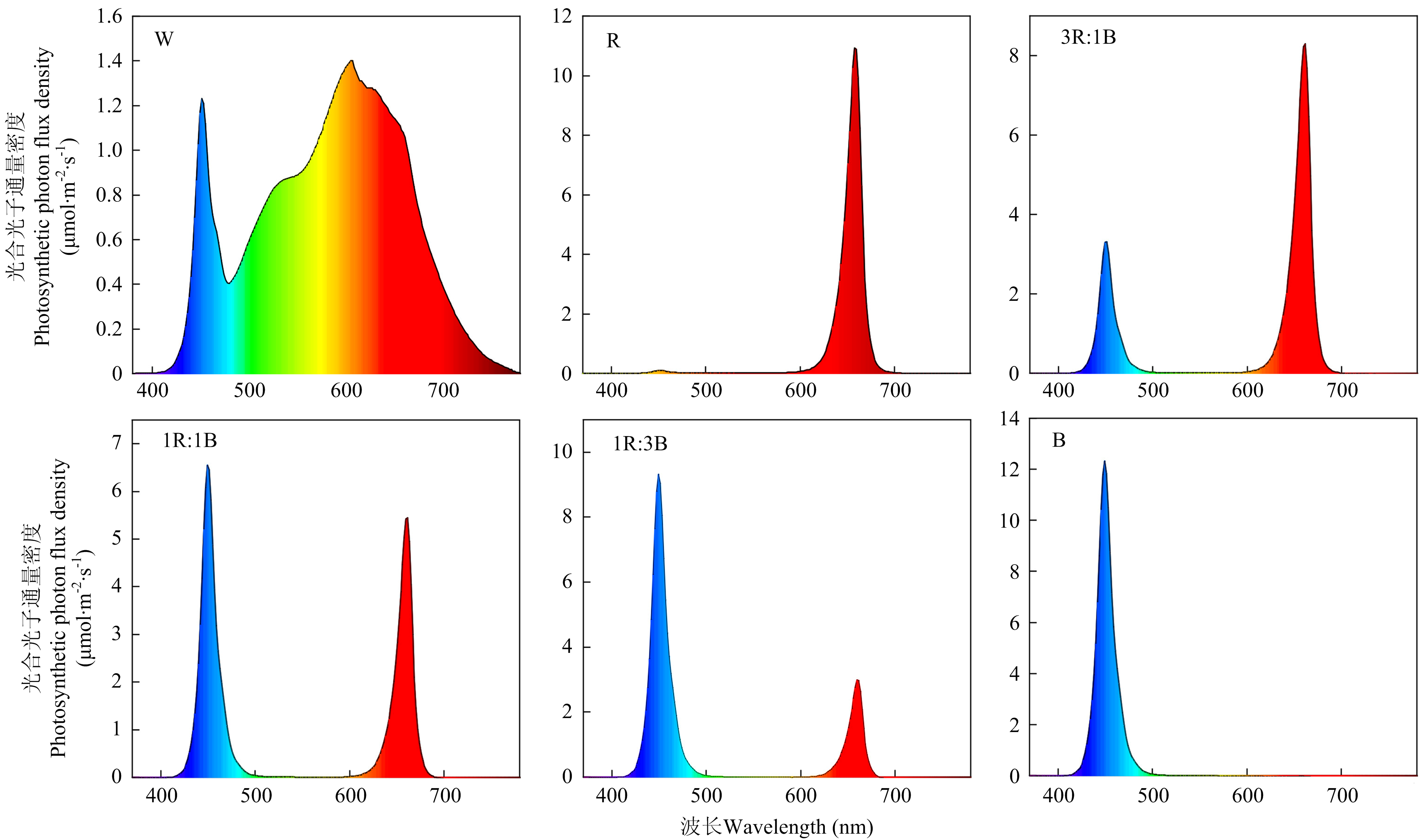
图1
试验采用的光谱比例图"
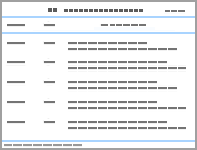
表1
qRT-PCR中各基因的特异性引物"
| 基因Gene name | 正向引物Forward primer (5′→3′) | 反向引物Reverse primer (5′→3′) |
|---|---|---|
| HvFT1 | GGCGGCAATGAGATGAGGA | GGAAGAGCACGAGCACGAA |
| HvBM3 | TGAGTGGAGCAACAACAAGC | GCCTTCAGGTGGAGTCGTAT |
| HvBM8 | GGCGAAGATTGAGACCATACAG | TGCCTCTCCACCAGTTCCT |
| HvAP1 | CGAGTTCTCCACCGAGTCAT | TGTCTCAACCTTCGCCTTCA |
| HvRAV2-like | GTATTGGAACAGCAGCCAGAG | CCGAGCAGGAGAACACGAT |
| HvAGL | CATCGGCATCATCATCTTCTCC | CCTTCTCCACTGGCACTCTT |
| HvActin | CCAGGTATCGCTGACCGTAT | GCTGAGTGAGGCTAGGATGG |
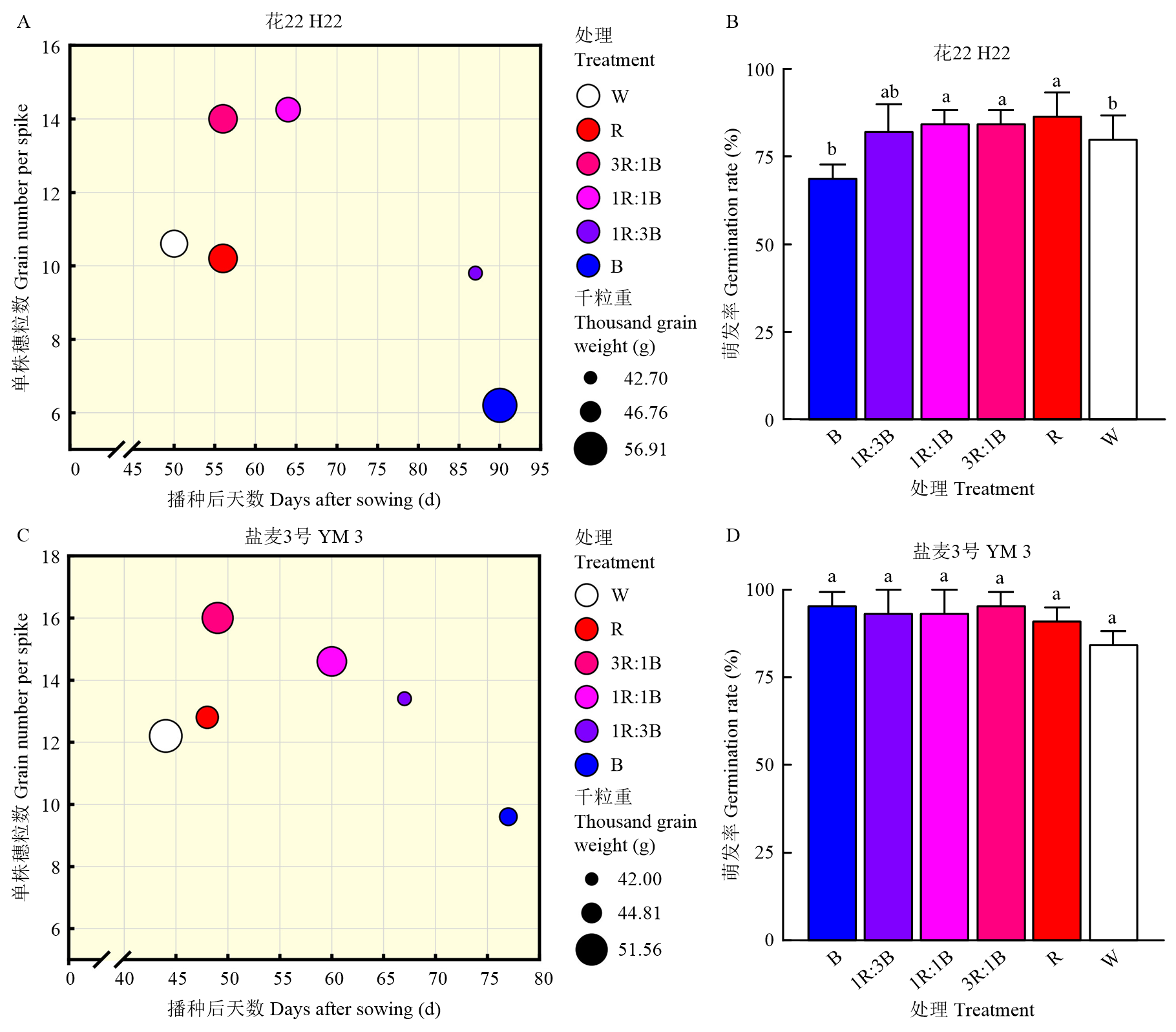
图2
不同光质处理下2个大麦品种全生育期、穗粒数、千粒重和萌发率 不同小写字母表示同一品种不同处理间差异显著(P<0.05)。下同"
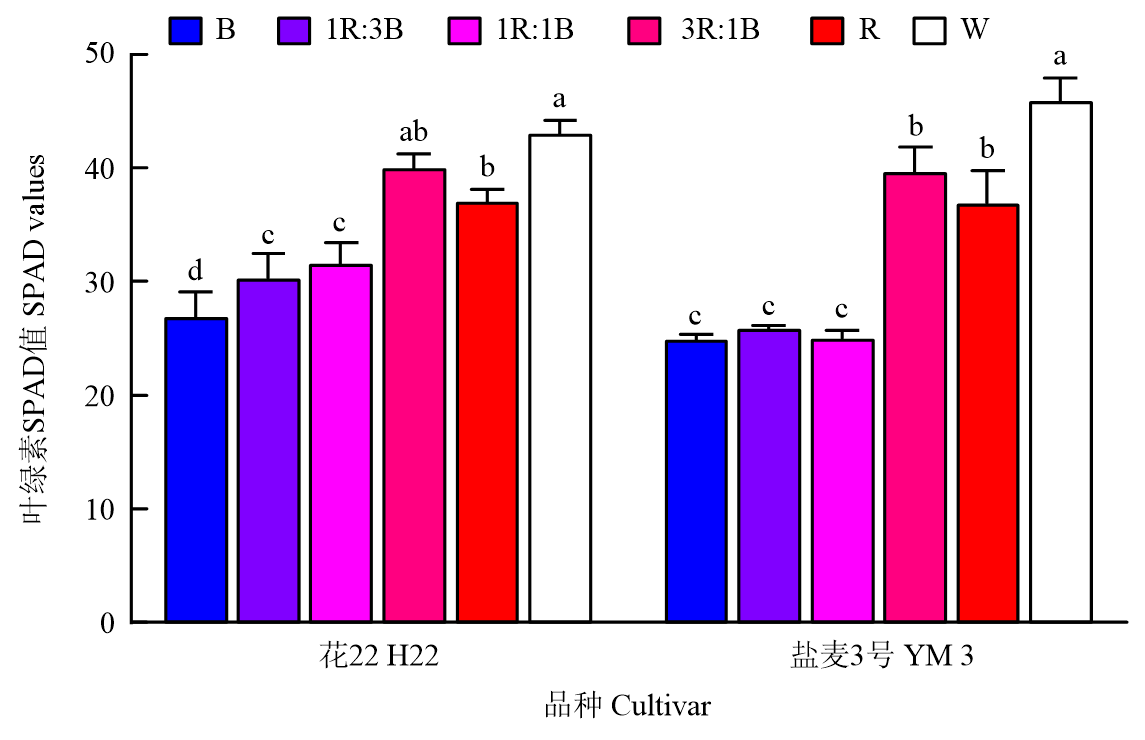
图3
不同光质处理大麦叶片SPAD值"
表2
花22在不同光质处理下的叶绿素荧光参数"
| 处理 Treatment | 项目Item | |||||
|---|---|---|---|---|---|---|
| 最大荧光比例 Fm/Fo | 潜在光化学活性 Fv/Fo | 最大光化学效率Fv/Fm | 实际光化学量子产量ΦPo | 有效光化学量子产量ΦEo | 热耗散量子产额 ΦDo | |
| W | 5.52±0.33a | 4.60±0.27a | 0.82±0.01a | 0.82±0.01a | 0.53±0.04a | 0.18±0.01b |
| R | 5.31±0.23a | 4.31±0.23b | 0.81±0.01ab | 0.81±0.01ab | 0.50±0.04ab | 0.19±0.01b |
| 3R﹕1B | 5.27±0.16a | 4.23±0.18b | 0.81±0.01ab | 0.81±0.01ab | 0.46±0.04b | 0.19±0.01b |
| 1R﹕1B | 4.82±0.18b | 3.82±0.18c | 0.79±0.02c | 0.79±0.02c | 0.41±0.03c | 0.21±0.01a |
| 1R﹕3B | 4.76±0.20b | 3.72±0.17c | 0.79±0.01c | 0.79±0.01c | 0.41±0.04c | 0.21±0.01a |
| B | 4.94±0.11b | 3.91±0.08c | 0.79±0.00bc | 0.79±0.00bc | 0.4±0.03c | 0.20±0.00a |
表3
盐麦3号在不同光质处理下的叶绿素荧光参数"
| 处理 Treatment | 项目Item | |||||
|---|---|---|---|---|---|---|
| 最大荧光比例 Fm/Fo | 潜在光化学活性 Fv/Fo | 最大光化学效率Fv/Fm | 实际光化学量子产量ΦPo | 有效光化学量子产量ΦEo | 热耗散量子产额 ΦDo | |
| W | 5.39±0.36a | 4.47±0.31a | 0.82±0.01a | 0.82±0.01a | 0.46±0.07a | 0.18±0.01b |
| R | 5.00±0.23a | 4.00±0.23b | 0.80±0.01ab | 0.80±0.01ab | 0.46±0.06a | 0.19±0.01b |
| 3R﹕1B | 5.06±0.32a | 4.06±0.32b | 0.80±0.01ab | 0.80±0.01b | 0.42±0.05b | 0.19±0.01b |
| 1R﹕1B | 4.54±0.19b | 3.54±0.19c | 0.78±0.01c | 0.78±0.01c | 0.37±0.03bc | 0.22±0.01a |
| 1R﹕3B | 4.40±0.28b | 3.40±0.28c | 0.77±0.02c | 0.77±0.02c | 0.35±0.04c | 0.22±0.01a |
| B | 4.55±0.23b | 3.55±0.23c | 0.78±0.01c | 0.78±0.01c | 0.33±0.08d | 0.22±0.01a |
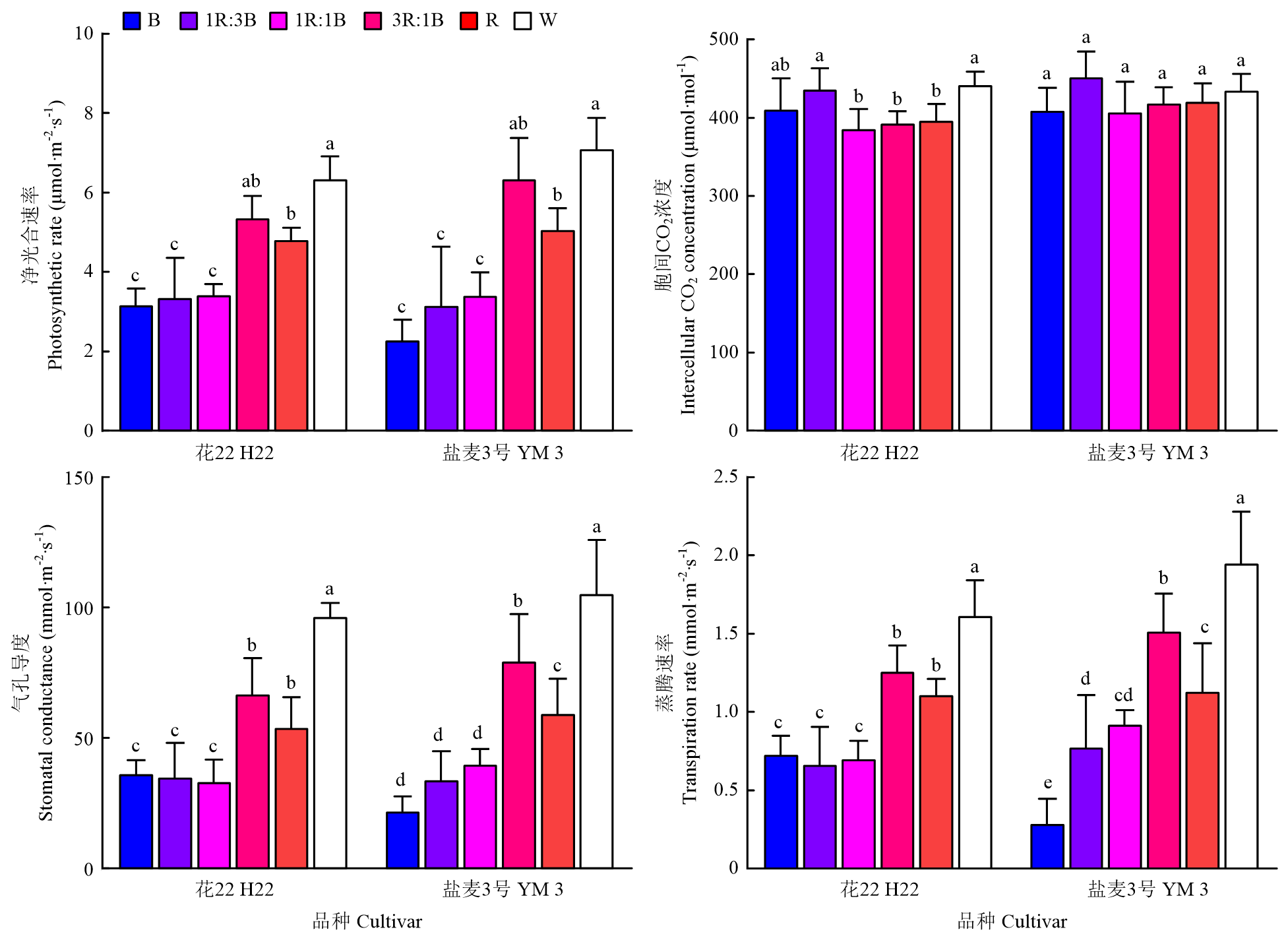
图4
不同光质处理的光合作用相关指标测定"
表4
基于熵权的指标权重"
| 品种Cultivar | 指标Parameter | 类型Criterion type | 信息熵Entropy | 权重Weight |
|---|---|---|---|---|
| 花22 H22 | 全生育期Whole growth period | 负向Negative | 0.8216 | 0.4256 |
| 单株穗粒数Grain number per spike | 正向Positive | 0.8744 | 0.2996 | |
| 千粒重Thousand grain weight | 正向Positive | 0.8848 | 0.2747 | |
| 盐麦3号 YM3 | 全生育期Whole growth period | 负向Negative | 0.8665 | 0.3516 |
| 单株穗粒数Grain number per spike | 正向Positive | 0.8794 | 0.3175 | |
| 千粒重Thousand grain weight | 正向Positive | 0.8743 | 0.3309 |
表5
不同光质处理下TOPSIS综合评价"
| 品种Cultivar | 处理Treatment | 正理想解距离D+ | 负理想解距离D- | 相对接近度Ci | 排序Rank | |||||
|---|---|---|---|---|---|---|---|---|---|---|
| 花22 H22 | W | 0.184 | 0.481 | 0.724 | 2 | |||||
| R | 0.191 | 0.430 | 0.693 | 3 | ||||||
| 3R﹕1B | 0.121 | 0.495 | 0.804 | 1 | ||||||
| 1R﹕1B | 0.217 | 0.424 | 0.661 | 4 | ||||||
| 1R﹕3B | 0.508 | 0.138 | 0.213 | 6 | ||||||
| B | 0.521 | 0.275 | 0.345 | 5 | ||||||
| 盐麦3号 YM3 | W | 0.189 | 0.500 | 0.726 | 2 | |||||
| R | 0.228 | 0.388 | 0.630 | 4 | ||||||
| 3R﹕1B | 0.060 | 0.531 | 0.898 | 1 | ||||||
| 1R﹕1B | 0.192 | 0.413 | 0.683 | 3 | ||||||
| 1R﹕3B | 0.431 | 0.217 | 0.334 | 5 | ||||||
| B | 0.518 | 0.122 | 0.191 | 6 | ||||||
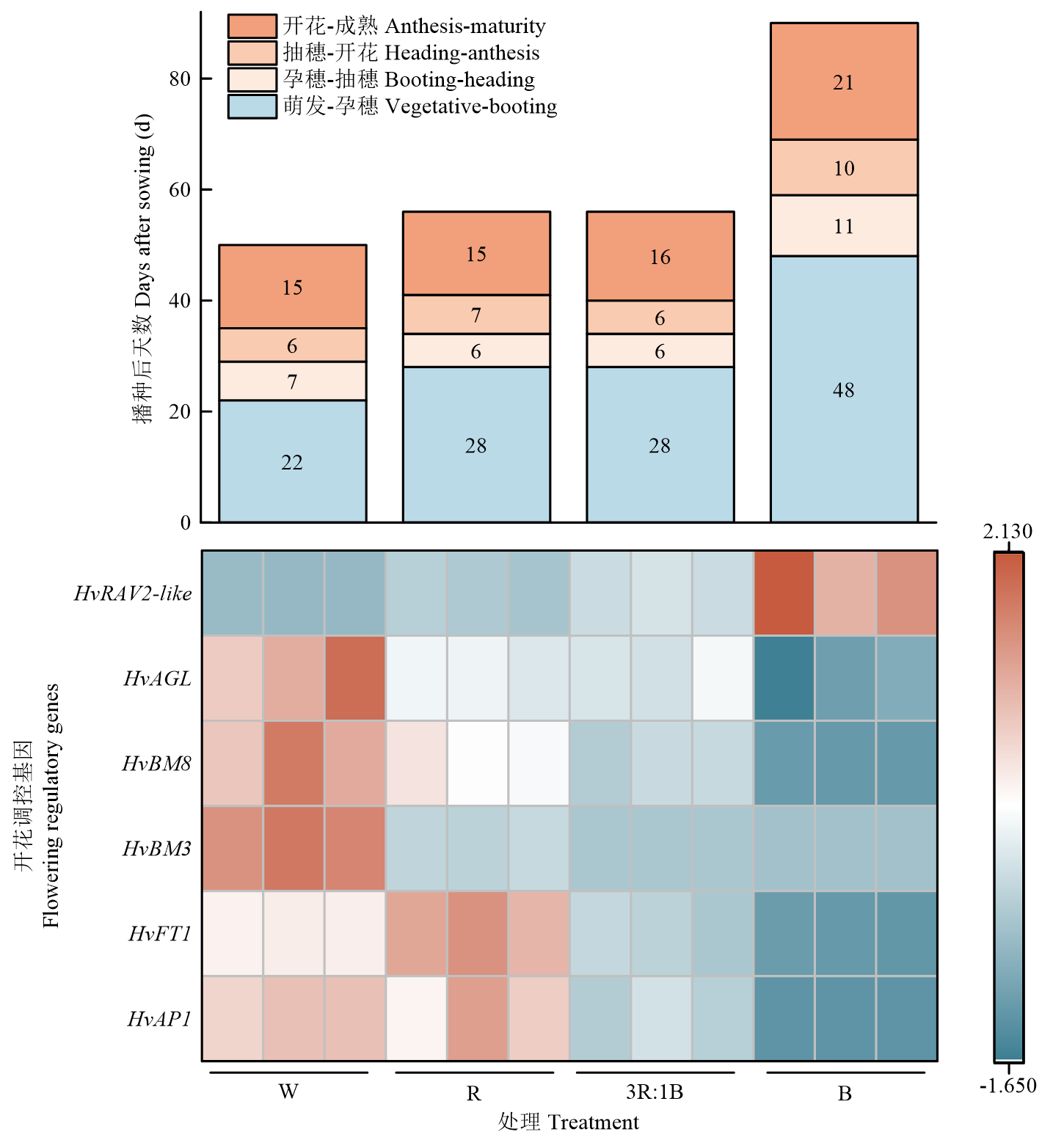
图5
不同光质处理开花调控基因的相对表达量和全生育期"
| [1] |
中国农业科学院作物科学研究所, 国家大麦青稞产业技术体系. 中国大麦品种志: 1986-2015. 北京: 中国农业科学技术出版社, 2018.
|
|
National Barley and Highland Barley Industrial Technology System. The Record of Barley Varieties in China. Beijing: China Agricultural Science and Technology Press, 2018. (in Chinese)
|
|
| [2] |
杨涛. 大麦新品种技术标准化提升大麦产业的发展. 第十六届中国标准化论坛论文集. 郑州: 中国标准化协会, 2019: 622-624.
|
|
|
|
| [3] |
房裕东, 韩天富. 作物快速育种技术研究进展. 作物杂志, 2019(2): 1-7.
|
|
|
|
| [4] |
doi: 10.1038/s41477-017-0083-8 pmid: 29292376 |
| [5] |
doi: 10.1146/arplant.2021.72.issue-1 |
| [6] |
doi: 10.1126/science.1091761 pmid: 14963328 |
| [7] |
doi: 10.1016/j.stress.2025.100747 |
| [8] |
doi: 10.1104/pp.123.1.39 pmid: 10806223 |
| [9] |
doi: 10.1186/s12870-020-02416-1 |
| [10] |
doi: 10.1007/s00344-022-10724-z |
| [11] |
doi: 10.1002/csc2.v61.2 |
| [12] |
时向东, 王林枝, 满晓丽, 刘喜庆, 王旭锋. 不同光质对烤烟漂浮育苗中烟苗生长发育及光合特性的影响. 中国烟草学报, 2013, 19(1): 43-46.
|
|
|
|
| [13] |
戴云花, 刘周斌, 杨莎, 毛莲珍, 邹学校, 欧立军. 不同光质对辣椒叶色黄化突变体光合生理特性的影响研究. 西北植物学报, 2023, 43(4): 601-610.
|
|
|
|
| [14] |
李亚婷, 贾世琦, 姚立蓉, 张宏, 司二静, 杨轲, 孟亚雄, 马小乐, 李葆春, 王化俊, 郭刚刚, 汪军成. 2000—2024年全国审定(登记)皮大麦品种的选育及特征特性分析. 作物杂志, 2025(4): 65-74.
|
|
|
|
| [15] |
施晓钟, 黄俭, 陆宪华. 啤酒大麦“花22”特征特性及高产栽培技术. 上海农业科技, 2007(5): 51-52.
|
|
|
|
| [16] |
doi: 10.1007/s11120-006-9077-5 pmid: 17342446 |
| [17] |
doi: 10.1093/jexbot/51.345.659 |
| [18] |
袁梦, 金则新, 孙中帅, 陈超. 不同光照强度对长果秤锤树光合特性的影响. 福建林业科技, 2024, 51(4): 24-31.
|
|
|
|
| [19] |
王琳, 赵红艳, 杜宪臣, 郭希蕾, 郭庆梅. 基于熵权TOPSIS法综合评价三个玫瑰果用新品种果实质量. 中药材, 2023, 46(8): 1858-1864.
|
|
|
|
| [20] |
doi: 10.1007/s10681-013-0909-z |
| [21] |
doi: 10.1016/j.molp.2022.06.012 |
| [22] |
doi: 10.3389/fpls.2018.00605 |
| [23] |
李金苗, 罗天宇, 刘玮, 冯星宇, 喻苏琴. LED光质对猴樟幼苗生长和光合特性的影响. 安徽农业大学学报, 2023, 50(3): 396-401.
|
|
|
|
| [24] |
闫萌萌, 王铭伦, 王洪波, 王月福, 赵长星. 光质对花生幼苗叶片光合色素含量及光合特性的影响. 应用生态学报, 2014, 25(2): 483-487.
|
|
|
|
| [25] |
doi: 10.1038/282424a0 |
| [26] |
doi: 10.1093/jxb/erz563 pmid: 31872212 |
| [27] |
doi: S0981-9428(17)30242-5 pmid: 28759847 |
| [28] |
doi: 10.1007/s11120-018-0589-6 |
| [29] |
徐凯, 郭延平, 张上隆. 不同光质对草莓叶片光合作用和叶绿素荧光的影响. 中国农业科学, 2005, 38(2): 369-375.
|
|
|
|
| [30] |
高登国, 于捷, 邹志荣, 曹凯, 鲍恩财, 孟力力, 李士照, 叶林. 不同红光与远红光比值对盐胁迫下番茄光合能力的影响. 安徽农业大学学报, 2021, 48(4): 578-583.
|
|
|
|
| [31] |
doi: 10.1105/tpc.15.00203 pmid: 26307377 |
| [32] |
doi: 10.1104/pp.113.222570 pmid: 24014575 |
| [33] |
doi: 10.1038/ncomms1810 |
| [34] |
doi: 10.1093/plphys/kiab255 pmid: 34618136 |
| [35] |
doi: 10.1007/s00425-008-0711-7 pmid: 18297307 |
| [36] |
doi: 10.1104/pp.20.00562 |
| [37] |
doi: 10.3389/fpls.2022.1048770 |
| [38] |
doi: 10.1016/j.jphotobiol.2023.112673 |
| [39] |
doi: 10.1080/17429145.2021.1876258 |
| [40] |
doi: 10.3390/plants8040093 |
| [41] |
段青青, 张禄祺, 张自坤, 王静静, 常培培, 张洪勇, 贺洪军. 补光时间及光质对温室甜椒生长及产量品质的影响. 农业工程学报, 2019, 35(24): 213-222.
|
|
|
|
| [42] |
doi: 10.3390/agronomy10071042 |
| [43] |
doi: 10.1016/j.scienta.2017.07.053 |
| [44] |
doi: 10.1016/j.fcr.2013.05.016 |
| [1] | 蔡廷阳, 朱玉鹏, 李瑞东, 吴宗声, 徐一帆, 宋雯雯, 徐彩龙, 吴存祥. 苗期叶损伤对黄淮海夏大豆光合特性、荚果分布及产量形成的影响[J]. 中国农业科学, 2026, 59(2): 292-304. |
| [2] | 陈鸽, 谷雨, 文炯, 傅岳峰, 何兮, 李薇, 周峻宇, 刘琼峰, 吴海勇. 冬闲杂草还田对水稻光合物质生产和产量的影响[J]. 中国农业科学, 2025, 58(4): 647-659. |
| [3] | 王佳芯, 胡静一, 张巍, 魏骞, 王涛, 王小林, 张雄, 张盼盼. 覆膜方式对间作玉米光合物质生产及水分利用效率的影响[J]. 中国农业科学, 2025, 58(3): 460-477. |
| [4] | 张向昆, 李佳莹, 乔如梦, 何静蕾, 王莉, 师校欣, 杜国强. 不同锌水平下GFabV对‘阳光玫瑰’葡萄光合效率及光合相关基因表达的影响[J]. 中国农业科学, 2025, 58(24): 5190-5200. |
| [5] | 张欢欢, 张刁亮, 王晓丽, 陈寒, 邵娟, 殷文, 胡发龙, 柴强, 樊志龙. 绿肥联合麦秸还田对减量施氮春小麦光合特性和产量的影响[J]. 中国农业科学, 2025, 58(17): 3461-3472. |
| [6] | 杨文娟, 高嘉诚, 王艳婷, 李妍, 郭铭, 汪军成, 孟亚雄, 王化俊, 司二静. 条纹病菌效应蛋白Pg00778调控对大麦致病力的作用[J]. 中国农业科学, 2025, 58(15): 3020-3035. |
| [7] | 徐佳鑫, 华楠, 王永强, 徐浩, 刘震, 赵小锐, 李悦, 陈启蔚, 叶林. 响应曲面法优化水肥药耦合对辣椒生长、光合特性及根腐病的影响[J]. 中国农业科学, 2025, 58(14): 2869-2884. |
| [8] | 赵凯男, 丁豪, 刘阿康, 姜宗昊, 陈广周, 冯波, 王宗帅, 李华伟, 司纪升, 张宾, 毕香君, 李勇, 李升东, 王法宏. 氮肥减量后移改善植株光合特性提高麦-玉周年产量及经济效益[J]. 中国农业科学, 2024, 57(5): 868-884. |
| [9] | 张爱红, 杨菲, 赵元业, 赵怡涵, 邸垫平, 苗洪芹. 大麦黄条点花叶病毒致病性及流行风险[J]. 中国农业科学, 2024, 57(23): 4686-4697. |
| [10] | 雷新慧, 吴怡欣, 王家乐, 陶金才, 万晨茜, 王孟, 高小丽, 冯佰利, 高金锋. 种植密度与施肥水平对甜荞光合特性、产量及抗倒伏的影响[J]. 中国农业科学, 2024, 57(2): 264-277. |
| [11] | 谷闻东, 刘春娟, 李邦, 刘畅, 周宇飞. 外源色氨酸对低氮胁迫下高粱苗期叶片碳氮平衡和衰老特性的影响[J]. 中国农业科学, 2023, 56(7): 1295-1310. |
| [12] | 常春义, 曹元, Ghulam Mustafa, 刘红艳, 张羽, 汤亮, 刘兵, 朱艳, 姚霞, 曹卫星, 刘蕾蕾. 白粉病对小麦光合特性的影响及病害严重度的定量模拟[J]. 中国农业科学, 2023, 56(6): 1061-1073. |
| [13] | 熊伟仡, 徐开未, 刘明鹏, 肖华, 裴丽珍, 彭丹丹, 陈远学. 不同氮用量对四川春玉米光合特性、氮利用效率及产量的影响[J]. 中国农业科学, 2022, 55(9): 1735-1748. |
| [14] | 肖璐婷,李秀红,刘栗君,叶发银,赵国华. 淀粉粒径对大麦淀粉物化特性的影响[J]. 中国农业科学, 2022, 55(5): 1010-1024. |
| [15] | 徐珂,樊志龙,殷文,赵财,于爱忠,胡发龙,柴强. 氮肥后移及间作对玉米光合特性的耦合效应[J]. 中国农业科学, 2022, 55(21): 4131-4143. |
|
||
