






中国农业科学 ›› 2026, Vol. 59 ›› Issue (7): 1492-1506.doi: 10.3864/j.issn.0578-1752.2026.07.009
许杨浩峻1,2( ), 陈丽明1,2,3(), 杨世奇1,2, 唐奕凡1,2, 谭雪明1,2, 曾勇军1,2, 潘晓华1,2, 曾研华1,2()
收稿日期:2025-06-03
接受日期:2025-07-22
出版日期:2026-04-08
发布日期:2026-04-08
通信作者:
联系方式:
许杨浩峻,E-mail:15879387370@163.com。陈丽明,E-mail:23067@jdzu.edu.cn。许杨浩峻和陈丽明为同等贡献作者。
基金资助:
XU YangHaoJun1,2(), CHEN LiMing1,2,3(), YANG ShiQi1,2, TANG YiFan1,2, TAN XueMing1,2, ZENG YongJun1,2, PAN XiaoHua1,2, ZENG YanHua1,2()
Received:2025-06-03
Accepted:2025-07-22
Published:2026-04-08
Online:2026-04-08
摘要:
【目的】长期秸秆直接还田改善土壤物理和化学性质,有利于土壤碳氮固持,但各土层存在差异性,本研究旨在探究土壤不同深度有机碳、养分与团聚体的变化特征。【方法】依托2009年建立的长期秸秆还田定位试验平台,以双季稻为研究对象,设置4个处理,分别为秸秆不还田无肥对照(CK)与等量氮磷钾养分投入下单施化肥处理(F)、秸秆烧灰还田(SBR)和秸秆直接还田(SR),于2021年取样分析土壤物理性状、团聚体结构、各土层碳氮及速效养分含量,并测定双季稻产量。【结果】与CK相比,各施肥处理均能够改善土壤理化性质和碳氮含量。相较于SBR、F处理,SR处理显著提高双季稻田土壤的含水量和总孔隙度,同时降低土壤容重,其中早稻降幅12.0%—17.3%,晚稻降幅10.7%—16.0%;SR处理显著增加双季稻田0—15 cm土层大团聚体(>2 mm)含量和土壤团聚体平均质量直径、几何直径,利于促进大团聚体的形成和稳定,且以0—5 cm土层的效果最为显著。SR处理还显著提高了0—30 cm各土层的有机碳含量和10—30 cm土层全氮含量,而SBR与F处理间的有机碳和全氮含量总体差异不明显。SR处理显著提高0—10 cm土层铵态氮、碱解氮和有效磷等速效养分含量,但硝态氮含量仅早稻季的0—10 cm土层显著提高。此外,相比F处理,SR显著提高晚稻季各土层缓效钾含量,从而促进晚稻产量显著提高。【结论】总体来说,秸秆直接还田有利于提高双季稻田0—15 cm土层大团聚体含量,促进0—10 cm土壤速效养分以及深层土壤有机碳、全氮和缓效钾含量的提高并达到稳产丰产效果。
许杨浩峻, 陈丽明, 杨世奇, 唐奕凡, 谭雪明, 曾勇军, 潘晓华, 曾研华. 长期秸秆还田对双季稻田不同土层有机碳、养分和团聚体的影响[J]. 中国农业科学, 2026, 59(7): 1492-1506.
XU YangHaoJun, CHEN LiMing, YANG ShiQi, TANG YiFan, TAN XueMing, ZENG YongJun, PAN XiaoHua, ZENG YanHua. Effects of Long-Term Different Straw Returning Methods on Soil Organic Carbon, Nutrients and Aggregate Formation in Different Soil Layers of Double Cropping Rice Field[J]. Scientia Agricultura Sinica, 2026, 59(7): 1492-1506.

表1
长期秸秆还田对双季稻田0—15 cm土层土壤基本性质的影响"
| 季别 Season | 处理 Treatment | 含水量 Moisture content (%) | 容重 Soil bulk density (g·cm-3) | 总孔隙度 Total porosity (%) | 毛管孔隙度 Capillary porosity (%) | 非毛管孔隙度 Noncapillary porosity (%) |
|---|---|---|---|---|---|---|
| 早稻 Early rice | CK | 69.2±2.43b | 0.88±0.01a | 64.9±0.41b | 54.6±1.03bc | 10.4±0.73ab |
| F | 68.4±3.02b | 0.84±0.04a | 66.1±1.39b | 53.6±1.07c | 12.5±1.06a | |
| SBR | 67.4±2.20b | 0.84±0.02a | 66.2±0.76b | 55.8±0.76b | 10.5±1.12ab | |
| SR | 74.2±3.07a | 0.75±0.01b | 69.3±0.72a | 59.3±0.60a | 10.0±1.31b | |
| 晚稻 Late rice | CK | 64.6±0.07b | 0.87±0.01a | 65.3±0.26c | 56.1±0.49a | 9.2±0.75b |
| F | 64.3±3.19b | 0.83±0.01a | 66.6±0.39b | 53.3±1.95a | 13.4±1.60ab | |
| SBR | 64.2±2.24b | 0.83±0.02a | 66.5±0.71b | 53.5±2.12a | 13.0±2.56ab | |
| SR | 69.3±3.30a | 0.75±0.01b | 69.2±0.23a | 52.1±2.93a | 17.1±3.15a |
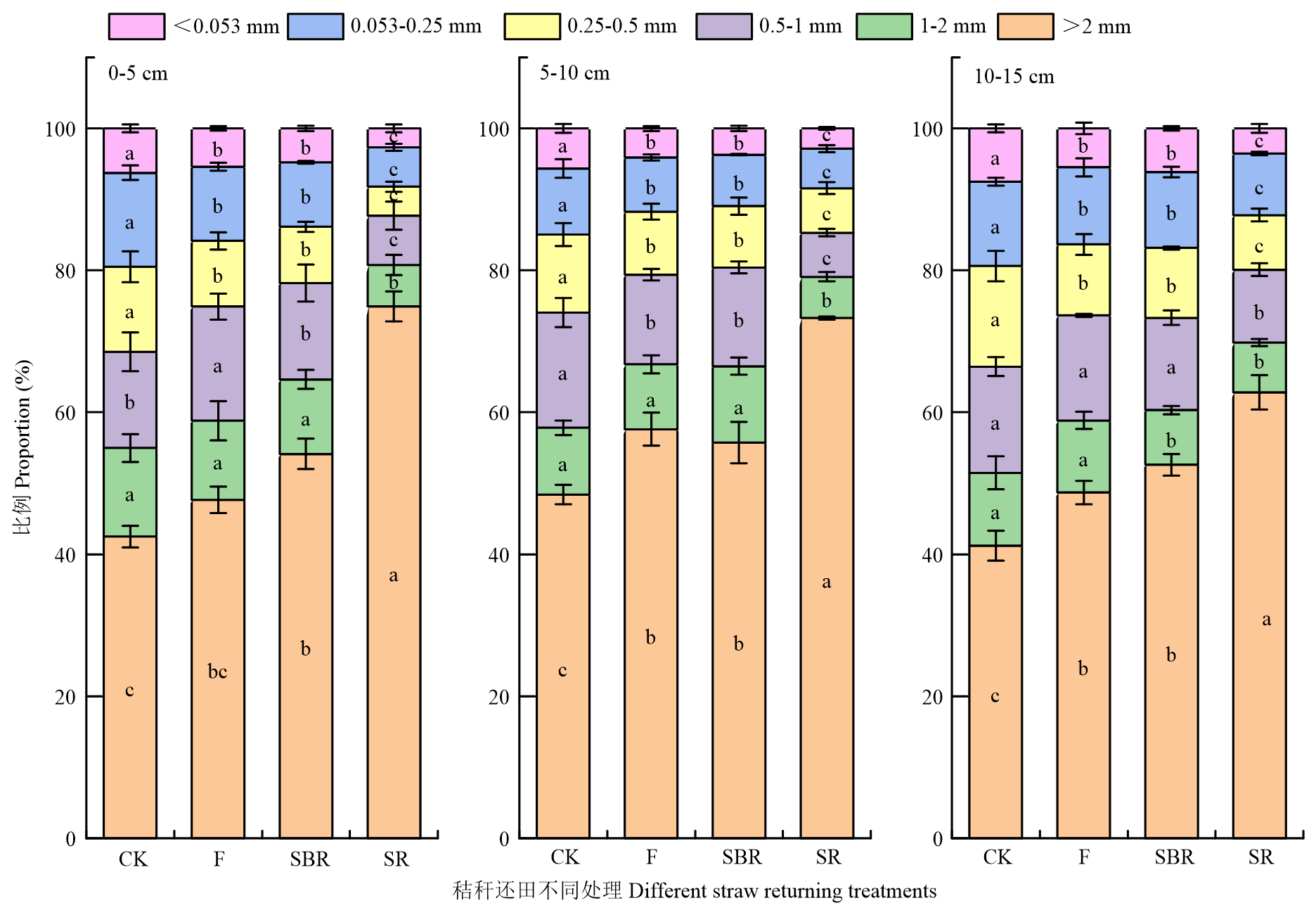
图1
长期秸秆还田对晚稻成熟期0—15 cm土层团聚体组成的影响 统计分析为不同处理在同一土层的方差分析。数据为平均值±标准误差。误差棒上不同的小写字母表示同一土层的处理间差异显著(P<0.05)。下同"
表2
长期秸秆还田对周年土壤团聚体稳定性的影响"
| 土层 Soil layer (cm) | 处理 Treatment | 平均质量直径 Mass weight diameter mm (MWD) | 几何平均直径 Geometric mean diameter mm (GMD) |
|---|---|---|---|
| 0-5 | CK | 1.22±0.09c | 0.79±0.12d |
| F | 1.29±0.09c | 0.89±0.11c | |
| SBR | 1.40±0.09b | 0.99±0.09b | |
| SR | 1.66±0.08a | 1.35±0.12a | |
| 5-10 | CK | 1.32±0.05c | 0.88±0.05c |
| F | 1.43±0.04b | 1.05±0.02b | |
| SBR | 1.45±0.03b | 1.06±0.03b | |
| SR | 1.65±0.01a | 1.31±0.03a | |
| 10-15 | CK | 1.18±0.02c | 0.74±0.04c |
| F | 1.29±0.04b | 0.88±0.04b | |
| SBR | 1.32±0.03b | 0.89±0.04b | |
| SR | 1.48±0.03a | 1.10±0.03a |
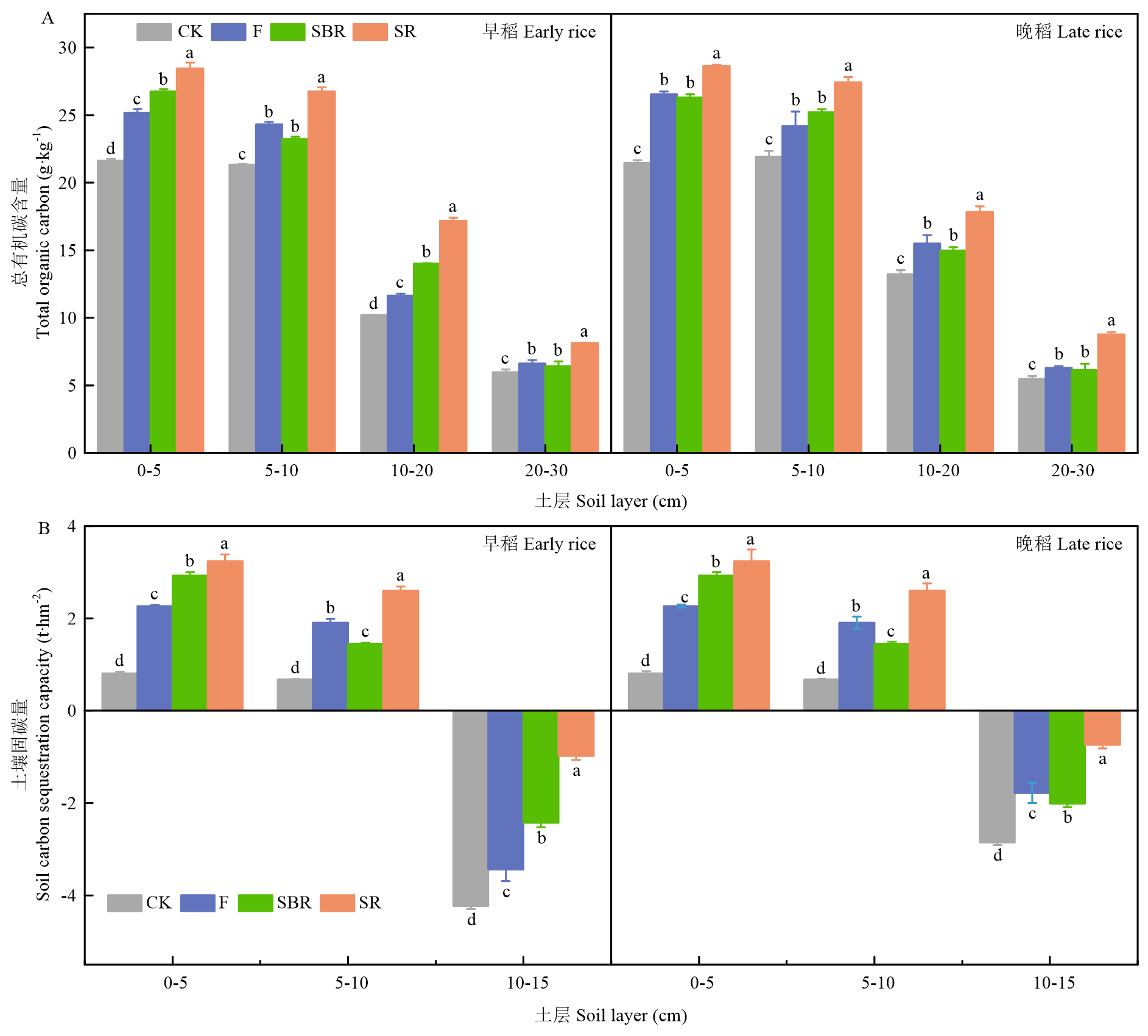
图2
长期秸秆还田对双季稻田不同土层总有机碳含量和固碳量的影响"
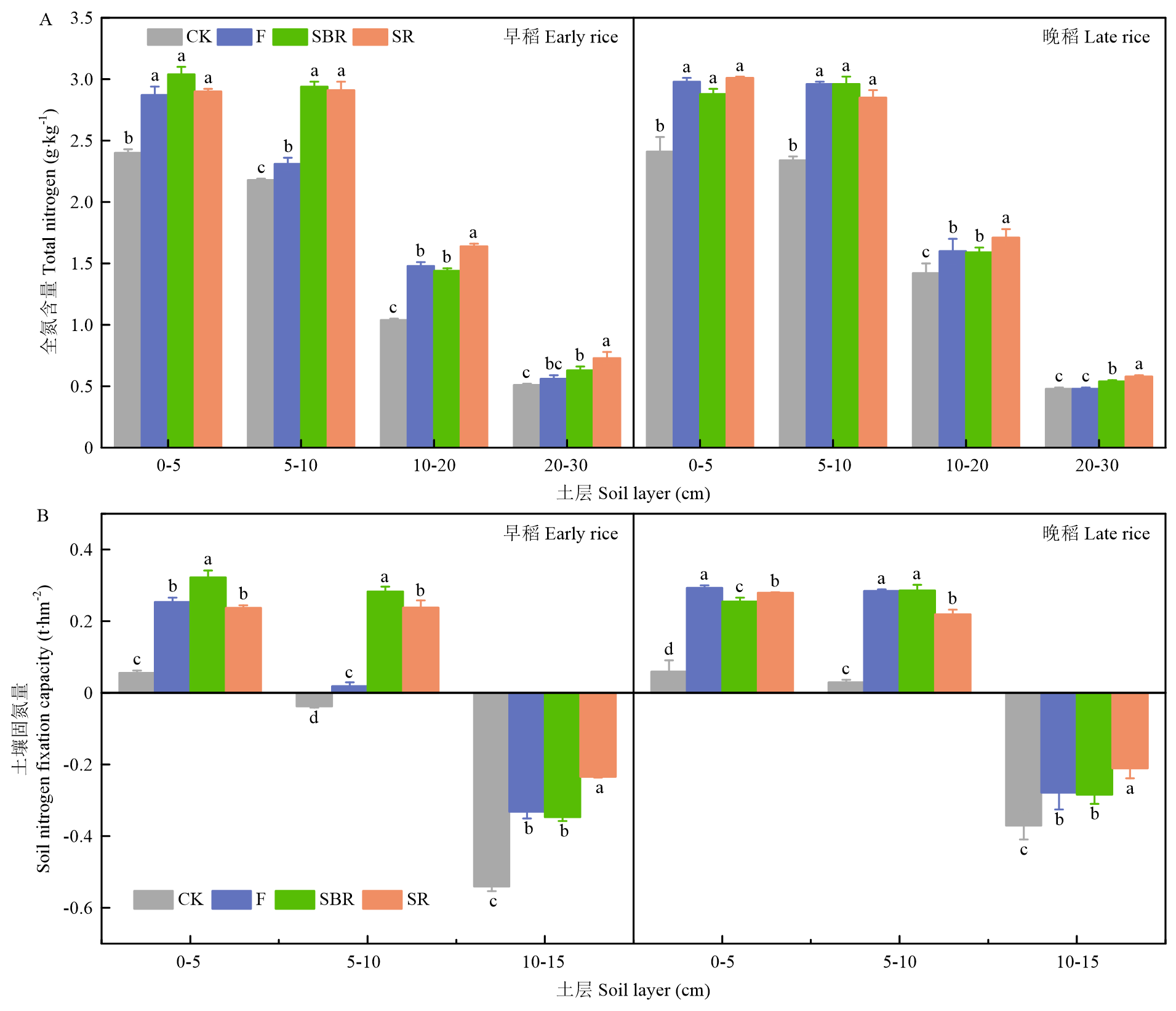
图3
长期秸秆还田对双季稻田不同土层全氮含量和固氮量的影响"
表3
秸秆还田对早稻田不同土层的pH、碳氮比和氮磷钾养分含量的影响"
| 土层 Soil layer (cm) | 处理 Treatment | pH | 碳氮比 C/N | 铵态氮 NH4+-N (mg·kg-1) | 硝态氮 NO3--N (mg·kg-1) | 碱解氮 AN (mg·kg-1) | 有效磷 AP (mg·kg-1) | 速效钾 AK (mg·kg-1) | 缓效钾 SAK (mg·kg-1) |
|---|---|---|---|---|---|---|---|---|---|
| 0-5 | CK | 5.45±0.01a | 9.0±0.12b | 11.86±1.32d | 0.19±0.05b | 215.4±5.67c | 5.4±0.03d | 46.3±1.59d | 147.3±1.47b |
| F | 5.23±0.01c | 8.8±0.12b | 16.12±0.94c | 0.17±0.03b | 299.9±8.03a | 20.1±0.46b | 89.4±2.47b | 204.2±7.83a | |
| SBR | 5.16±0.01d | 8.8±0.13b | 21.68±0.80b | 0.17±0.05b | 251.0±5.20b | 19.0±0.25c | 94.0±1.47a | 221.1±8.76a | |
| SR | 5.38±0.02b | 9.8±0.15a | 26.30±1.16a | 0.30±0.03a | 280.1±10.55a | 22.7±0.56a | 74.4±3.18c | 214.6±1.73a | |
| 5-10 | CK | 5.55±0.03a | 9.8±0.04b | 6.40±0.29c | 0.12±0.01b | 202.2±7.63c | 5.7±0.88d | 40.9±0.47d | 180.1±7.19c |
| F | 5.36±0.01b | 10.5±0.17a | 15.93±1.86b | 0.18±0.05ab | 166.7±3.16b | 12.2±0.10c | 103.2±7.63b | 199.2±6.72b | |
| SBR | 5.29±0.02c | 7.9±0.16d | 12.43±0.55b | 0.14±0.02b | 254.9±0.52a | 16.8±0.99b | 124.0±1.47a | 202.6±4.50b | |
| SR | 5.44±0.05b | 9.2±0.20c | 20.27±1.91a | 0.22±0.05a | 263.3±13.05a | 21.8±1.26a | 91.7±1.10c | 225.5±6.90a | |
| 10-20 | CK | 5.95±0.01a | 9.8±0.12b | 3.20±0.16c | 0.19±0.03a | 92.5±4.01c | 5.8±0.46b | 39.0±0.45d | 247.8±12.60b |
| F | 5.88±0.02b | 7.9±0.10c | 4.05±0.43b | 0.15±0.06a | 102.0±8.22b | 7.9±0.45a | 85.1±1.64b | 245.8±7.68b | |
| SBR | 5.74±0.04c | 9.7±0.21b | 4.36±0.59b | 0.18±0.03a | 134.6±8.64a | 7.9±0.13a | 108.3±0.87a | 245.7±11.96b | |
| SR | 5.89±0.01b | 10.5±0.10a | 6.36±0.94a | 0.17±0.0a | 123.0±8.35a | 8.2±0.19a | 77.3±1.65c | 279.5±6.62a | |
| 20-30 | CK | 6.06±0.10a | 11.7±0.46ab | 1.67±0.30d | 0.04±0.03b | 54.3±0.65c | 3.5±0.25c | 38.4±1.02d | 170.7±8.26c |
| F | 5.98±0.06a | 11.8±0.67a | 3.06±0.26b | 0.10±0.05ab | 61.8±0.83b | 4.4±0.39b | 64.2±0.63b | 203.0±7.84b | |
| SBR | 5.91±0.08a | 10.3±0.84b | 2.55±0.42c | 0.10±0.01ab | 81.1±19.99a | 4.7±0.17b | 82.7±1.84a | 218.1±9.93b | |
| SR | 6.00±0.02a | 11.2±0.72ab | 6.27±0.34a | 0.14±0.02a | 71.9±2.18a | 5.4±0.42a | 46.4±1.07c | 240.5±5.04a |
表4
秸秆还田对晚稻田不同土层的pH、碳氮比和氮磷钾养分含量的影响"
| 土层深度 Soil layer (cm) | 处理 Treatment | pH | 碳氮比 C/N | 铵态氮 NH4+-N (mg·kg-1) | 硝态氮 NO3--N (mg·kg-1) | 碱解氮 AN (mg·kg-1) | 有效磷 AP (mg·kg-1) | 速效钾 AK (mg·kg-1) | 缓效钾 SAK (mg·kg-1) |
|---|---|---|---|---|---|---|---|---|---|
| 0-5 | CK | 5.21±0.01b | 8.9±0.52a | 4.20±0.30d | 0.02±0.01b | 189.4±5.80c | 3.1±0.40b | 54.0±0.35c | 251.3±6.00b |
| F | 5.23±0.01b | 8.9±0.05a | 8.09±0.70b | 0.08±0.01a | 254.3±4.56b | 17.9±0.97a | 129.5±5.71a | 269.4±7.51a | |
| SBR | 5.30±0.01a | 9.1±0.18a | 5.53±0.36c | 0.07±0.01a | 249.6±12.2b | 17.3±0.74a | 137.9±3.61a | 279.9±8.12a | |
| SR | 5.29±0.00a | 9.5±0.06a | 15.81±0.80a | 0.08±0.02a | 275.6±6.30a | 17.0±0.43a | 103.1±8.23b | 274.0±3.19a | |
| 5-10 | CK | 5.21±0.02c | 9.4±0.30a | 3.47±0.23d | 0.04±0.02b | 152.2±10.6b | 4.1±0.90c | 41.7±1.64d | 253.9±2.79c |
| F | 5.24±0.02c | 8.2±0.37b | 8.25±0.35b | 0.06±0.02a | 243.0±13.5a | 14.6±0.94b | 100.6±4.27b | 288.8±14.7b | |
| SBR | 5.30±0.01b | 8.5±0.14b | 4.14±0.31c | 0.07±0.02a | 242.0±14.1a | 14.5±0.30b | 139.9±3.41a | 303.6±8.42b | |
| SR | 5.40±0.03a | 9.6±0.12a | 9.14±0.16a | 0.09±0.03a | 240.4±2.25a | 16.1±0.43a | 87.3±1.25c | 326.0±12.1a | |
| 10-20 | CK | 6.09±0.08b | 9.4±0.42a | 3.11±0.12b | 0.04±0.01b | 87.9±3.46c | 4.1±0.64d | 40.0±0.76d | 283.6±9.01d |
| F | 5.72±0.01d | 9.7±0.91a | 4.14±0.68b | 0.05±0.05a | 119.4±10.8b | 6.7±0.34b | 87.6±2.08b | 332.4±6.69c | |
| SBR | 6.00±0.02c | 9.4±0.13a | 3.62±0.14b | 0.04±0.01a | 120.1±4.29b | 5.7±0.31c | 109.4±3.62a | 354.6±15.7b | |
| SR | 6.26±0.03a | 10.4±0.38a | 5.15±0.49a | 0.06±0.01a | 139.3±4.18a | 7.7±0.19a | 76.9±2.92c | 372.2±4.92a | |
| 20-30 | CK | 6.98±0.02a | 11.3±0.35b | 2.44±0.38b | 0.05±0.02b | 27.2±0.38b | 2.3±0.29b | 40.8±1.40c | 168.1±11.0c |
| F | 6.38±0.02c | 13.0±0.56a | 3.26±0.38a | 0.06±0.02a | 47.7±0.94a | 2.3±0.18b | 77.3±1.36a | 271.2±16.5b | |
| SBR | 6.35±0.02c | 11.3±0.70b | 3.03±0.19a | 0.06±0.03a | 48.2±6.30a | 2.6±0.19ab | 72.4±2.58a | 272.7±11.1b | |
| SR | 6.68±0.02b | 13.1±0.38a | 3.31±0.26a | 0.06±0.01a | 47.2±4.68a | 3.0±0.22ab | 51.0±4.42b | 331.3±7.43a |
表5
长期秸秆还田对双季稻田水稻产量和构成因子的影响"
| 季别 Season | 处理 Treatment | 有效穗数 Effective panicle number (×104·hm-2) | 每穗粒数 Spikelet number per panicle | 结实率 Grain filling (%) | 千粒重 1000-grain weight (g) | 产量 Grain yields (t·hm-2) |
|---|---|---|---|---|---|---|
| 早稻 Early rice | CK | 163.6±4.98b | 80.5±9.60b | 86.3±1.30a | 23.0±0.40a | 3.08±0.09b |
| F | 309.7±11.81a | 145.4±7.13a | 77.7±4.68b | 22.8±0.09a | 7.39±0.04a | |
| SBR | 319.7±10.74a | 142.3±9.31a | 76.6±4.52b | 22.3±0.44a | 7.52±0.11a | |
| SR | 305.5±13.82a | 141.4±4.68a | 79.7±0.78b | 23.2±0.23a | 7.69±0.15a | |
| 晚稻 Late rice | CK | 174.7±8.13c | 146.1±6.49b | 91.5±1.58a | 22.3±0.47a | 5.46±0.33c |
| F | 225.6±2.560b | 183.3±4.26a | 88.0±1.82ab | 22.4±0.28a | 8.79±0.11b | |
| SBR | 240.9±1.27a | 185.9±8.16a | 84.3±1.06b | 22.2±0.47a | 9.37±0.16a | |
| SR | 247.1±9.04a | 179.6±0.70a | 85.9±2.72b | 22.3±0.21a | 9.27±0.17a |
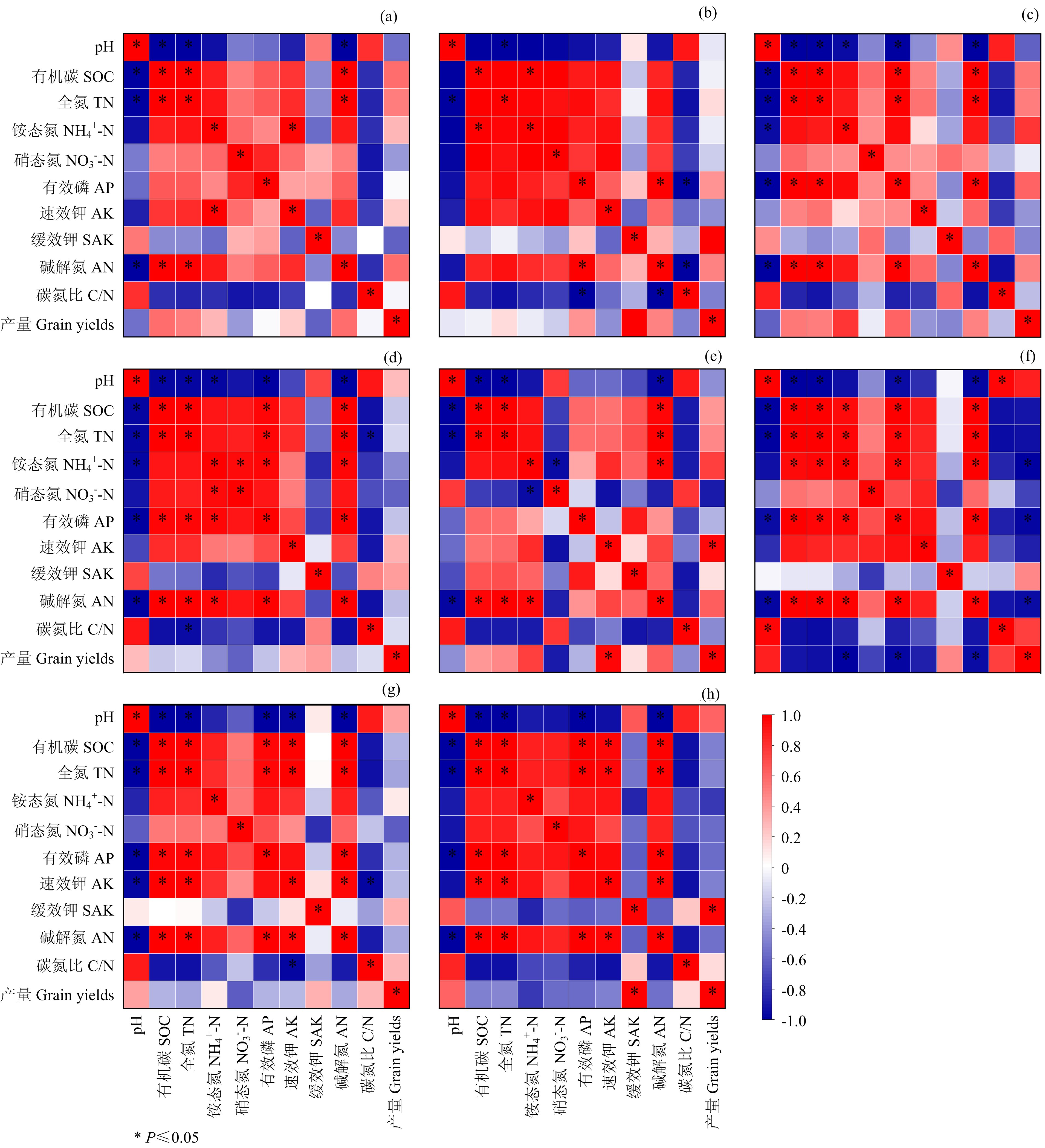
图4
水稻产量与土壤性质之间的相关性 a—d分别表示早稻季CK、F、SBR和SR处理的产量与土壤性质之间的相关性,e—h分别表示晚稻季CK、F、SBR和SR处理的产量与土壤性质之间的相关性"
| [1] |
吴健成, 刘卿, 汪翠存, 陆汝华, 刘艳, 曹强, 田永超, 朱艳, 曹卫星, 刘小军. 秸秆还田与氮肥施用对稻田温室气体排放的影响. 生态学报, 2024, 44(12): 5328-5339.
|
|
|
|
| [2] |
胡聪聪, 李红宇, 孙显龙, 王童, 赵海成, 范名宇, 张巩亮. 秸秆还田与氮肥运筹对寒地水稻光合特性和产量的影响. 作物杂志, 2025(1): 1-11.
|
|
|
|
| [3] |
丛宏斌, 姚宗路, 赵立欣, 孟海波, 王久臣, 霍丽丽, 袁艳文, 贾吉秀, 谢腾, 吴雨浓. 中国农作物秸秆资源分布及其产业体系与利用路径. 农业工程学报, 2019, 35(22): 132-140.
|
|
|
|
| [4] |
王金武, 唐汉, 王金峰. 东北地区作物秸秆资源综合利用现状与发展分析. 农业机械学报, 2017, 48(5): 1-21.
|
|
|
|
| [5] |
余坤, 冯浩, 李正鹏, 王增丽. 秸秆还田对农田土壤水分与冬小麦耗水特征的影响. 农业机械学报, 2014, 45(10): 116-123.
|
|
|
|
| [6] |
doi: 10.1016/j.agee.2013.11.019 |
| [7] |
陈丽明. 长期秸秆还田下双季稻田土壤碳氮转化特征及其微生物学机制[D]. 南昌: 江西农业大学, 2023.
|
|
|
|
| [8] |
doi: 10.1016/0167-1987(91)90111-A |
| [9] |
管彤彤, 张燕, 陶海宁, 董秀, 沈禹颖. 绿肥还田对土壤有机碳组分及碳转化酶活性的影响. 中国农业科学, 2024, 57(14): 2791-2802. doi: 10.3864/j.issn.0578-1752.2024.14.008.
|
|
|
|
| [10] |
YADVINDER-SINGH, BIJAY-SINGH,
|
| [11] |
|
| [12] |
王士超. 典型黑土区有机物料提升土壤碳氮固持的协同效应机制[D]. 北京: 中国农业科学院, 2019.
|
|
|
|
| [13] |
doi: 10.1016/j.agwat.2024.108687 |
| [14] |
doi: 10.1016/j.scitotenv.2023.168282 |
| [15] |
doi: 10.1038/nature13809 |
| [16] |
鲁如坤. 土壤农业化学分析方法. 北京: 中国农业科学技术出版社, 2000: 35-50.
|
|
|
|
| [17] |
doi: 10.1016/S2095-3119(13)60565-1 |
| [18] |
doi: 10.1016/j.catena.2019.03.015 |
| [19] |
doi: 10.2136/sssaj1986.03615995005000030017x |
| [20] |
鲁晨妮, 陈菊根, 程旺大, 沈亚强, 曹奎荣, 张红梅, 王保君, 陈贵. 嘉兴市长期秸秆还田水稻产量和土壤肥力的调查. 浙江农业科学, 2021, 62(7): 1285-1287.
doi: 10.16178/j.issn.0528-9017.20210706 |
|
|
|
| [21] |
王凤仁. 秸秆直接和炭化还田对稻田土壤团聚体碳氮磷化学计量比及水稻氮磷养分利用的影响[D]. 兰州: 甘肃农业大学, 2023.
|
|
|
|
| [22] |
doi: 10.1016/j.still.2019.02.014 |
| [23] |
李彤, 王梓廷, 刘露, 廖允成, 刘杨, 韩娟. 保护性耕作对西北旱区土壤微生物空间分布及土壤理化性质的影响. 中国农业科学, 2017, 50(5): 859-870. doi: 10.3864/j.issn.0578-1752.2017.05.009.
|
|
|
|
| [24] |
doi: 10.1016/j.biombioe.2007.01.012 |
| [25] |
doi: 10.1016/j.jia.2023.06.011 |
| [26] |
马玉洁, 李旭, 翟英芳, 李敬宇, 付鑫, 彭正萍. 秸秆还田方式和施氮量对土壤有机碳组分及酶活性的影响. 中国农业科学, 2025(12): 2397-2410. doi: 10.3864/j.issn.0578-1752.2025.12.010.
|
|
|
|
| [27] |
张春华, 王宗明, 居为民, 任春颖. 松嫩平原玉米带土壤碳氮比的时空变异特征. 环境科学, 2011, 32(5): 1407-1414.
|
|
|
|
| [28] |
车品高, 陈国徽, 曹国军, 高冰可, 陈艳芳, 熊文, 应治宏, 周庆友. 稻油轮作下秸秆还田对土壤养分和作物产量的影响. 作物学报, 2024, 50(12): 3118-3128.
doi: 10.3724/SP.J.1006.2024.32045 |
|
doi: 10.3724/SP.J.1006.2024.32045 |
|
| [29] |
王越, 况福虹, 马胜兰, 王艳强, 李兰, 唐家良, 朱波. 秸秆粉碎和焚烧还田对石灰性紫色土耕层土壤孔隙和有机碳的影响. 农业环境科学学报, 2022, 41(3): 526-536, 693.
|
|
|
|
| [30] |
武际, 郭熙盛, 鲁剑巍, 万水霞, 王允青, 许征宇, 张晓玲. 不同水稻栽培模式下小麦秸秆腐解特征及对土壤生物学特性和养分状况的影响. 生态学报, 2013, 33(2): 565-575.
|
|
doi: 10.5846/stxb |
|
| [31] |
高永祥, 李若尘, 张民, 周洪印, 郑文魁, 陈德清, 刘之广. 秸秆还田配施控释掺混尿素对玉米产量和土壤肥力的影响. 土壤学报, 2021, 58(6): 1507-1519.
|
|
|
|
| [32] |
王光华, 赵英, 周德瑞, 杨谦. 解磷菌的研究现状与展望. 生态环境, 2003, 12(1): 96-101.
|
|
|
|
| [33] |
柳开楼, 都江雪, 马常宝, 曲潇琳, 韩天富, 刘淑军, 黄晶, 李亚贞, 申哲, 张璐, 李冬初, 张会民. 中国主要旱作粮食耕地土壤钾素的时空演变特征. 土壤学报, 2023, 60(3): 673-684.
|
|
|
|
| [34] |
李佳男. 长期秸秆还田下pHBA与硝态氮影响棉苗根系生长发育的生理与分子机制[D]. 淮阴: 淮阴工学院, 2023.
|
|
|
|
| [35] |
doi: 10.1080/03650340.2018.1490726 |
| [36] |
陈春兰, 陈安磊, 魏文学, 张文钊, 傅心赣, 周华军, 秦红灵. 长期施肥对红壤稻田剖面土壤碳氮累积的影响. 水土保持研究, 2021, 28(2): 14-20.
|
|
|
|
| [37] |
黄继川, 彭智平, 于俊红, 李文英, 林志军, 吴雪娜, 杨林香. 接种菌剂条件下玉米秸秆还田对玉米产量、品质和土壤肥力的影响. 热带作物学报, 2011, 32(11): 2020-2024.
|
|
|
| [1] | 李星宇, 黄容, 鲜一鸣, 田娇娇, 马晓瑾, 杨乔茜, 李冰, 王昌全. 稻田土壤不同粒级团聚体有机碳组分及CO2排放对长期施肥的响应[J]. 中国农业科学, 2026, 59(6): 1255-1271. |
| [2] | 张海睿, 贾昂元, 高奇奇, 韩哲群, 南珊珊, 段碧华, 武雪萍. 生物炭配施黄腐酸对滨海盐碱地土壤理化性质、酶活性和多功能性的影响[J]. 中国农业科学, 2025, 58(20): 4178-4188. |
| [3] | 韩哲群, 苏莹, 高奇奇, 刘美英, 贾昂元, 张海睿, 南珊珊, 徐勤政, 王强, 王利军, 武雪萍. 智能滴灌水肥耦合模式实现土壤节水控盐与向日葵产量品质协同提升[J]. 中国农业科学, 2025, 58(20): 4158-4177. |
| [4] | 张斯佳, 杨杰, 赵帅, 李莉威, 王贵彦. 华北平原多样化作物与小麦-玉米轮作对土壤质量的影响[J]. 中国农业科学, 2025, 58(2): 238-251. |
| [5] | 陈会鲜, 何文, 阮丽霞, 黄小娟, 兰秀, 蔡兆琴, 李恒锐, 黄珍玲, 韦婉羚, 梁振华, 李天元, 曹升, 李喜弟, 韦均参. 间作大豆对木薯生长及连作土壤特性的影响[J]. 中国农业科学, 2025, 58(11): 2176-2189. |
| [6] | 韩潇杰, 任志杰, 李双静, 田培培, 卢素豪, 马耕, 王丽芳, 马冬云, 赵亚南, 王晨阳. 不同施氮量对土壤团聚体碳氮含量及小麦产量的影响[J]. 中国农业科学, 2024, 57(9): 1766-1778. |
| [7] | 孙悦, 任科宇, 邹洪琴, 高洪军, 张水清, 李德近, 李冰洁, 廖楚芊, 段英华, 徐明岗. 黑土与潮土铁氧化物结合态有机碳对长期秸秆还田的响应[J]. 中国农业科学, 2024, 57(19): 3823-3834. |
| [8] | 王飞, 李清华, 何春梅, 游燕玲, 黄毅斌. 长期施肥对黄泥田土壤团聚体中氮素积累和有机氮组成的影响[J]. 中国农业科学, 2023, 56(9): 1718-1728. |
| [9] | 马胜兰, 况福虹, 林洪羽, 崔俊芳, 唐家良, 朱波, 蒲全波. 秸秆还田量对川中丘陵冬小麦-夏玉米轮作体系土壤物理特性的影响[J]. 中国农业科学, 2023, 56(7): 1344-1358. |
| [10] | 孙涛, 冯晓敏, 高新昊, 邓艾兴, 郑成岩, 宋振伟, 张卫建. 多样化种植对土壤团聚体组成及其有机碳和全氮含量的影响[J]. 中国农业科学, 2023, 56(15): 2929-2940. |
| [11] | 郭鑫虎, 马静, 李仲峰, 初金鹏, 徐海成, 贾殿勇, 代兴龙, 贺明荣. 长期定位条件下栽培模式对麦田土壤理化性质和氮素平衡的影响[J]. 中国农业科学, 2023, 56(12): 2262-2273. |
| [12] | 郑凤君, 王雪, 李生平, 刘晓彤, 刘志平, 卢晋晶, 武雪萍, 席吉龙, 张建诚, 李永山. 免耕覆盖下土壤水分、团聚体稳定性及其有机碳分布对小麦产量的协同效应[J]. 中国农业科学, 2021, 54(3): 596-607. |
| [13] | 苗芳芳,勉有明,普雪可,吴春花,周永瑾,侯贤清. 耕作覆盖对宁南旱区土壤团粒结构及马铃薯水分利用效率的影响[J]. 中国农业科学, 2021, 54(11): 2366-2376. |
| [14] | 李小磊,张玉军,申凤敏,姜桂英,刘芳,柳开楼,刘世亮. 长期施肥对红壤性水稻土不同土层活性有机质及碳库管理指数的影响[J]. 中国农业科学, 2020, 53(6): 1189-1201. |
| [15] | 赵卫松,郭庆港,李社增,王培培,鹿秀云,苏振贺,张晓云,马平. 花铃期棉花黄萎病抗病与感病品种对 土壤细菌群落结构的影响[J]. 中国农业科学, 2020, 53(5): 942-954. |
|
||
