






中国农业科学 ›› 2026, Vol. 59 ›› Issue (6): 1255-1271.doi: 10.3864/j.issn.0578-1752.2026.06.009
李星宇( ), 黄容(), 鲜一鸣, 田娇娇, 马晓瑾, 杨乔茜, 李冰, 王昌全
收稿日期:2025-05-16
接受日期:2025-07-22
出版日期:2026-03-16
发布日期:2026-03-24
通信作者:
联系方式:
李星宇,E-mail:1937613592@qq.com。
基金资助:
LI XingYu(), HUANG Rong(), XIAN YiMing, TIAN JiaoJiao, MA XiaoJin, YANG QiaoXi, LI Bing, WANG ChangQuan
Received:2025-05-16
Accepted:2025-07-22
Published:2026-03-16
Online:2026-03-24
摘要:
【目的】研究稻田土壤在不同施肥条件下,不同粒级土壤团聚体有机碳(OC)及其组分和CO2排放的动态变化特征,并分析其影响因素,从团聚体视角为稻田土壤固碳减排提供科学依据。【方法】以稻田土壤为研究对象,通过室内培养试验,采用重铬酸钾容量法、物理分离法和顶空定期采气-气相色谱法等,对比分析不同施肥处理(不施肥,CK;常规施肥,NPK;50%有机替代氮肥,HOM)下各粒级团聚体(<0.25 mm、0.25—1 mm、1—2 mm)中OC及其组分分布特征、CO2排放特征。【结果】(1)NPK处理较CK减少了1—2 mm团聚体OC含量,HOM处理的团聚体OC含量较NPK处理增加了5.8%—29.4%;施肥(NPK和HOM)增加了0.25—1 mm和1—2 mm团聚体颗粒态有机碳(POC)含量,较CK分别增加了37.4%和79.6%、4.3%和47.8%;同时,HOM处理促进了矿质结合态有机碳(MAOC)从1—2 mm向<0.25 mm团聚体的周转;(2)不同粒级团聚体中POC、MAOC与OC的相关性存在差异,在<0.25 mm团聚体中,POC和MAOC均与OC呈显著正相关;在0.25—1 mm团聚体中,MAOC与OC呈显著正相关;在1—2 mm团聚体中,POC与OC呈显著正相关;(3)培养期间,<0.25 mm团聚体的CO2累积排放量最低,较0.25—1 mm和1—2 mm团聚体显著降低了51.0%—83.7%和23.1%—89.9%;与NPK相比,HOM处理显著降低了<0.25 mm和0.25—1 mm团聚体中CO2累积排放量,分别减少146.27和364.27 g·kg-1,这与HOM处理有机碳组分变化和增加了团聚体pH、碳氮比(C/N)有关。【结论】不同施肥方式改变了土壤不同粒级团聚体中OC及其组分分布特征和CO2排放量。其中,有机替代促进了团聚体OC的积累,增加了0.25—1 mm和1—2 mm团聚体的POC含量,促进了MAOC从1—2 mm向<0.25 mm团聚体的周转,且较常规施肥显著降低了<0.25 mm和0.25—1 mm团聚体的CO2排放量。总的来说,50%有机替代氮肥有利于减少稻田土壤<0.25 mm和0.25—1 mm团聚体的CO2排放量,提高有机碳稳定性。
李星宇, 黄容, 鲜一鸣, 田娇娇, 马晓瑾, 杨乔茜, 李冰, 王昌全. 稻田土壤不同粒级团聚体有机碳组分及CO2排放对长期施肥的响应[J]. 中国农业科学, 2026, 59(6): 1255-1271.
LI XingYu, HUANG Rong, XIAN YiMing, TIAN JiaoJiao, MA XiaoJin, YANG QiaoXi, LI Bing, WANG ChangQuan. Characteristics of Organic Carbon Fractions and Carbon Dioxide Emissions of Different Size Aggregates in Rice Field Soils in Response to Long-Term Fertilization[J]. Scientia Agricultura Sinica, 2026, 59(6): 1255-1271.
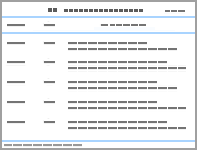
表1
土壤基本理化性质"
| pH | 有机质 Organic matter (g·kg-1) | 全氮 Total nitrogen (g·kg-1) | 全磷 Total phosphorus (g·kg-1) | 全钾 Total potassium (g·kg-1) | 碱解氮 Available nitrogen (mg·kg-1) | 速效磷 Available phosphorus (mg·kg-1) | 速效钾 Available potassium (mg·kg-1) |
|---|---|---|---|---|---|---|---|
| 6.63 | 28.40 | 1.40 | 0.88 | 22.25 | 113.00 | 8.50 | 53.00 |
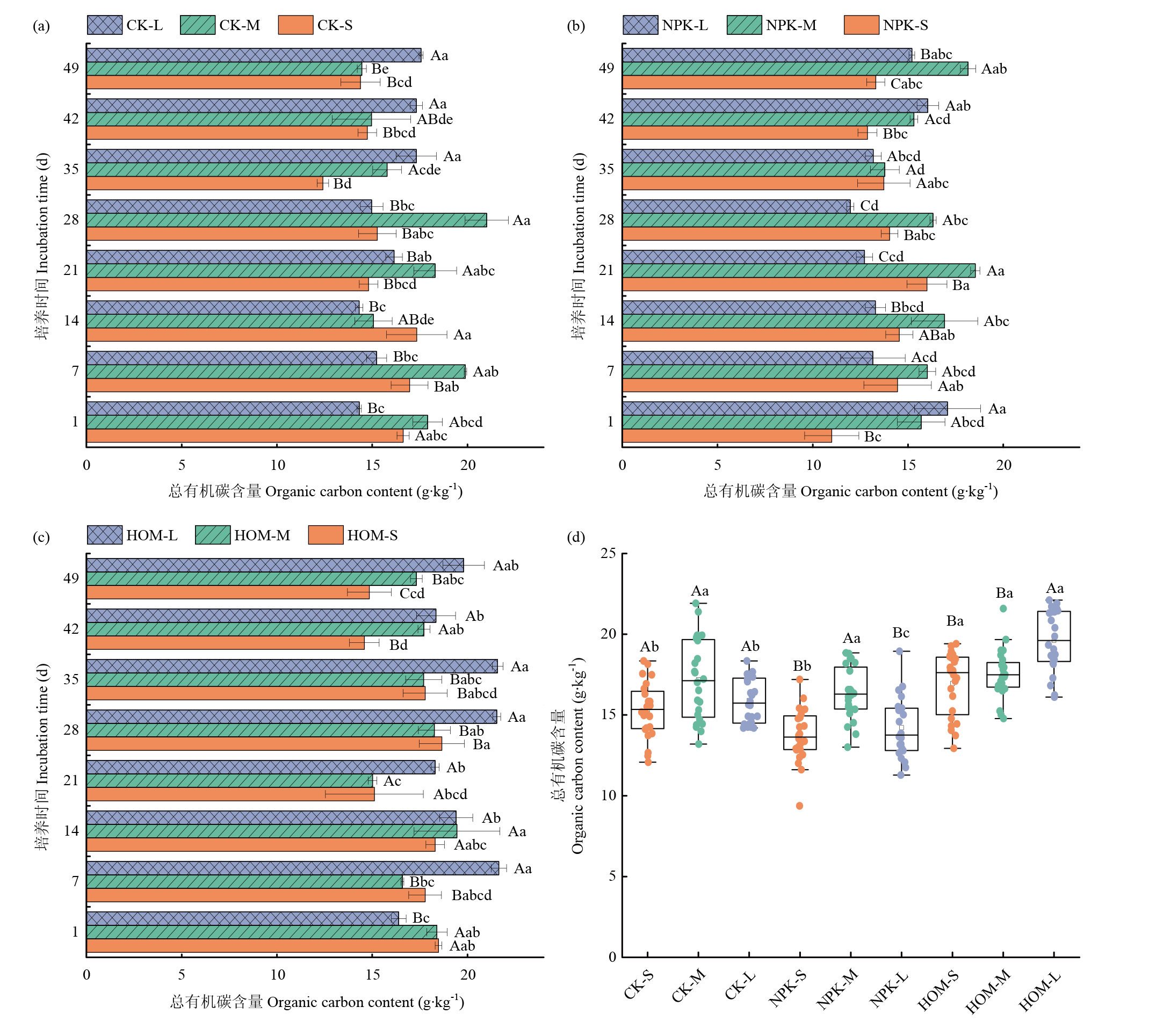
图1
不同施肥处理下不同粒级团聚体有机碳含量 条状图(a—c)中不同大写字母表示同一培养时间和施肥处理下不同粒级团聚体中有机碳含量的差异显著,不同小写字母表示同一粒级团聚体和施肥处理下不同培养时间节点的差异显著 P<0.05);箱线图(d)中不同大写字母表示同一施肥处理下不同粒级团聚体间的差异显著,不同小写字母表示同一粒级团聚体不同施肥的差异显著(P<0.05)"
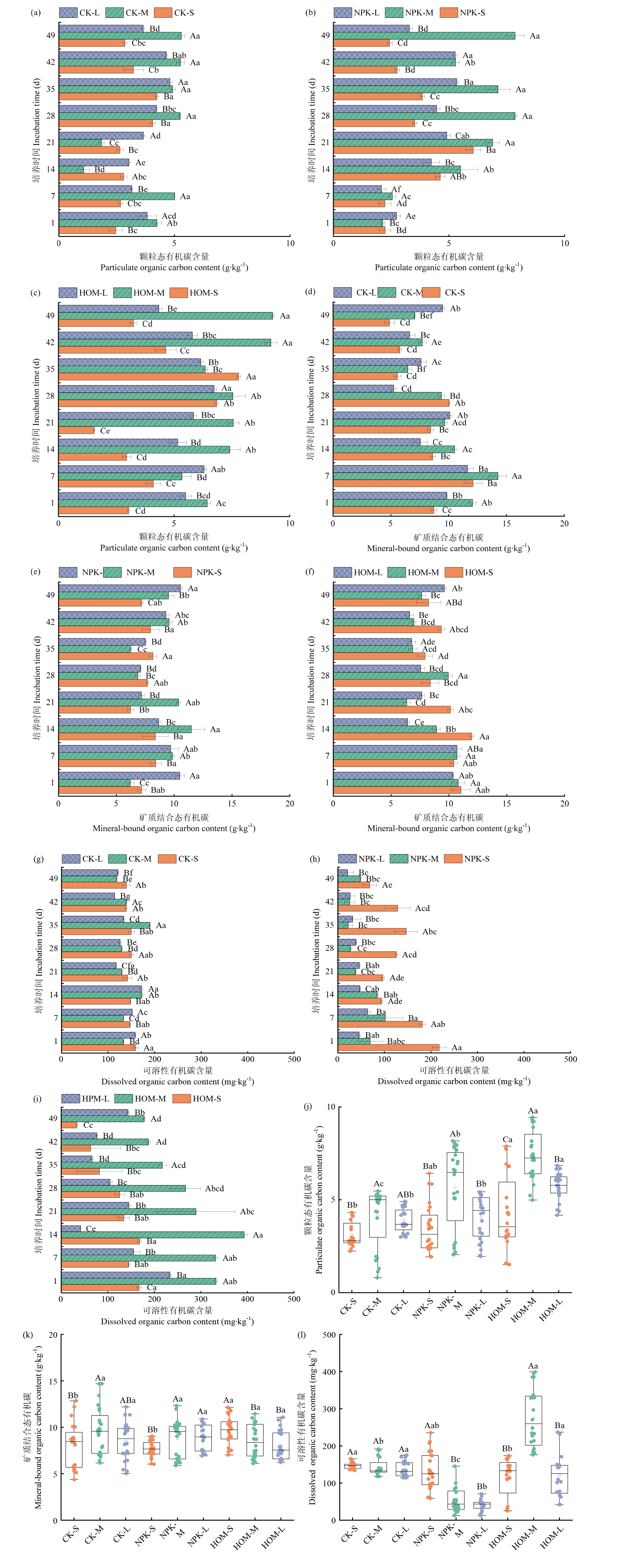
图2
不同施肥处理下不同粒级团聚体中POC、MAOC和DOC含量 条状图(a—i)中不同大写字母表示同一培养时间和施肥处理下不同粒级团聚体组分有机碳含量的差异显著,不同小写字母表示同一粒级和施肥处理下不同培养时间节点的差异显著(P<0.05);箱线图(j—l)中不同大写字母表示同一施肥处理下不同粒级团聚体间的差异显著,不同小写字母表示同一粒级下不同施肥处理间的差异显著(P<0.05)"
表2
团聚体有机碳及其组分影响因子的方差分析"
| 培养时间 Incubation time, T | 施肥措施 Fertilization, F | 团聚体粒级 Size of aggregates, S | 培养时间× 施肥措施 T×F | 施肥措施× 团聚体粒级 F×S | 团聚体粒级× 培养时间 S×T | 培养时间×施肥措施× 团聚体粒级 T×F×S | |
|---|---|---|---|---|---|---|---|
| OC | P=0.001 | P<0.0001 | P<0.0001 | P<0.0001 | P<0.0001 | P<0.0001 | P<0.0001 |
| POC | P<0.0001 | P<0.0001 | P<0.0001 | P<0.0001 | P<0.0001 | P<0.0001 | P<0.0001 |
| MAOC | P<0.0001 | P<0.0001 | P<0.0001 | P<0.0001 | P<0.0001 | P<0.0001 | P<0.0001 |
| DOC | P<0.0001 | P<0.0001 | P<0.0001 | P<0.0001 | P<0.0001 | P<0.0001 | P<0.0001 |
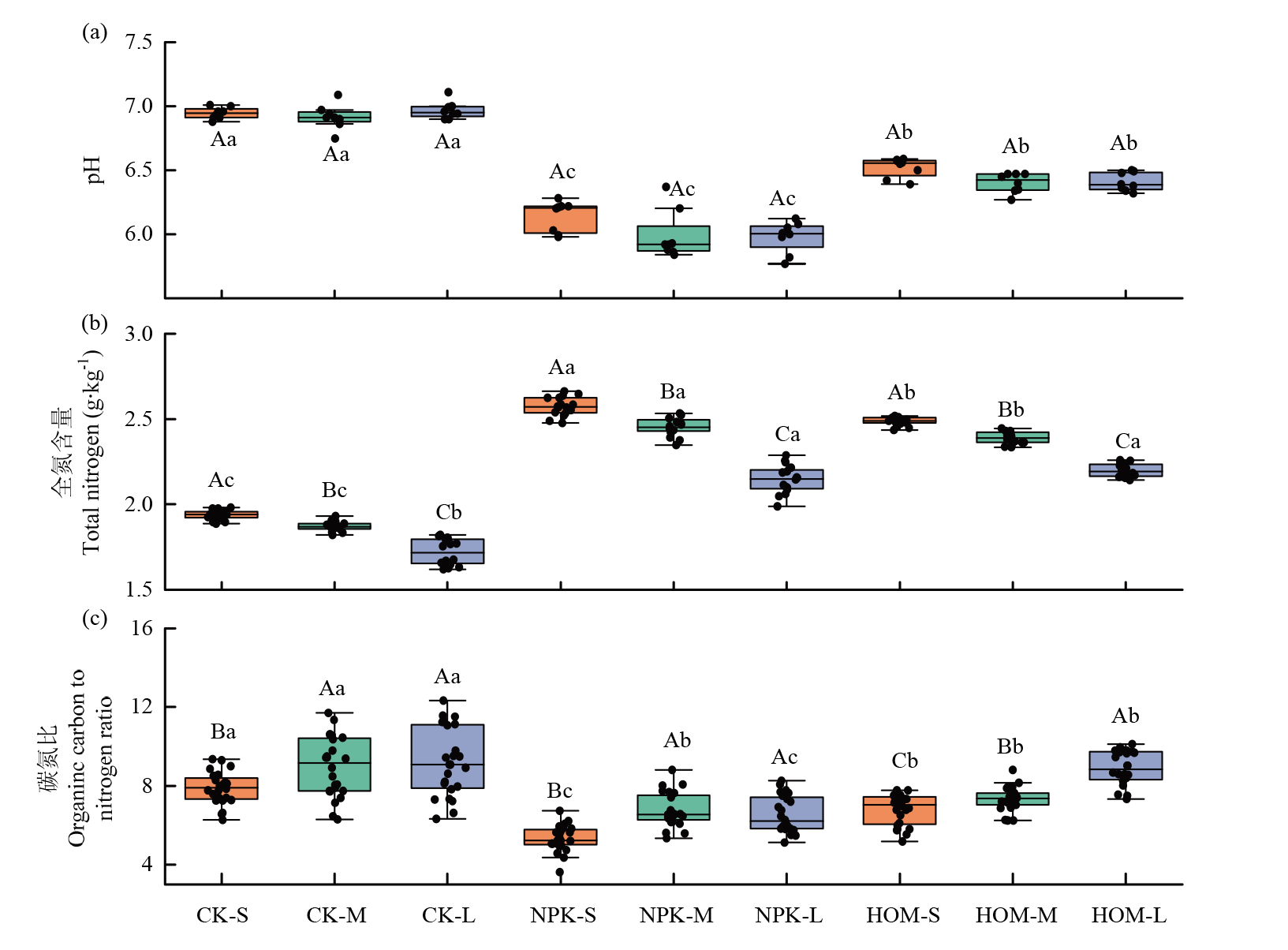
图3
不同施肥处理下不同粒级团聚体土壤pH(a)、TN(b)和C/N(c) 不同大写字母表示同一施肥处理下不同粒级团聚体间差异显著,不同小写字母表示同一粒级团聚体不同施肥间差异显著(P<0.05)"
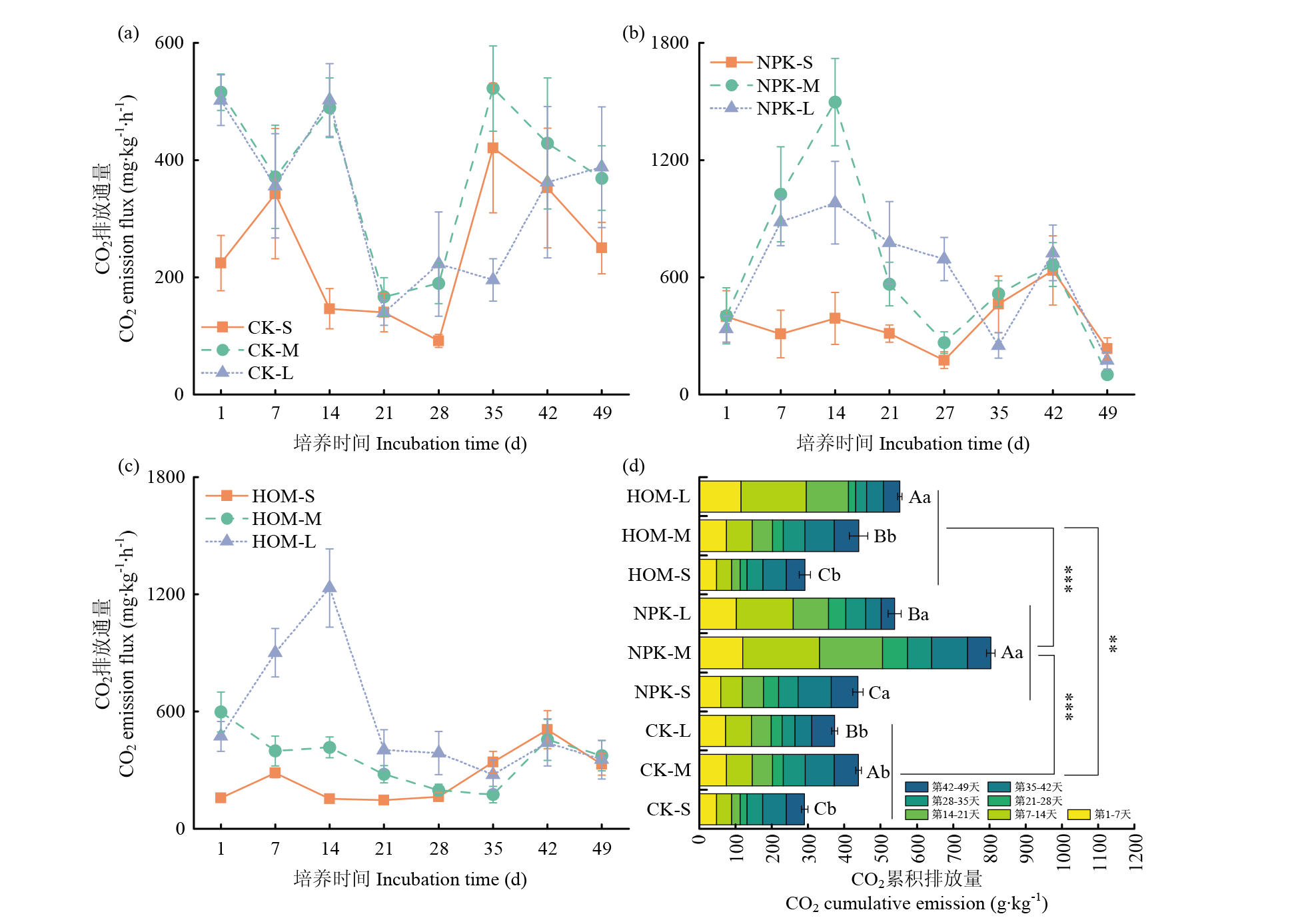
图4
不同施肥处理下不同粒级团聚体CO2排放速率及累积排放量 图d中不同大写字母表示同一施肥处理下不同粒级团聚体CO2累积排放量差异显著,不同小写字母表示同一粒级团聚体下不同施肥间CO2累积排放量差异显著;*表示不同施肥处理CO2累积排放量差异显著(P<0.05)"
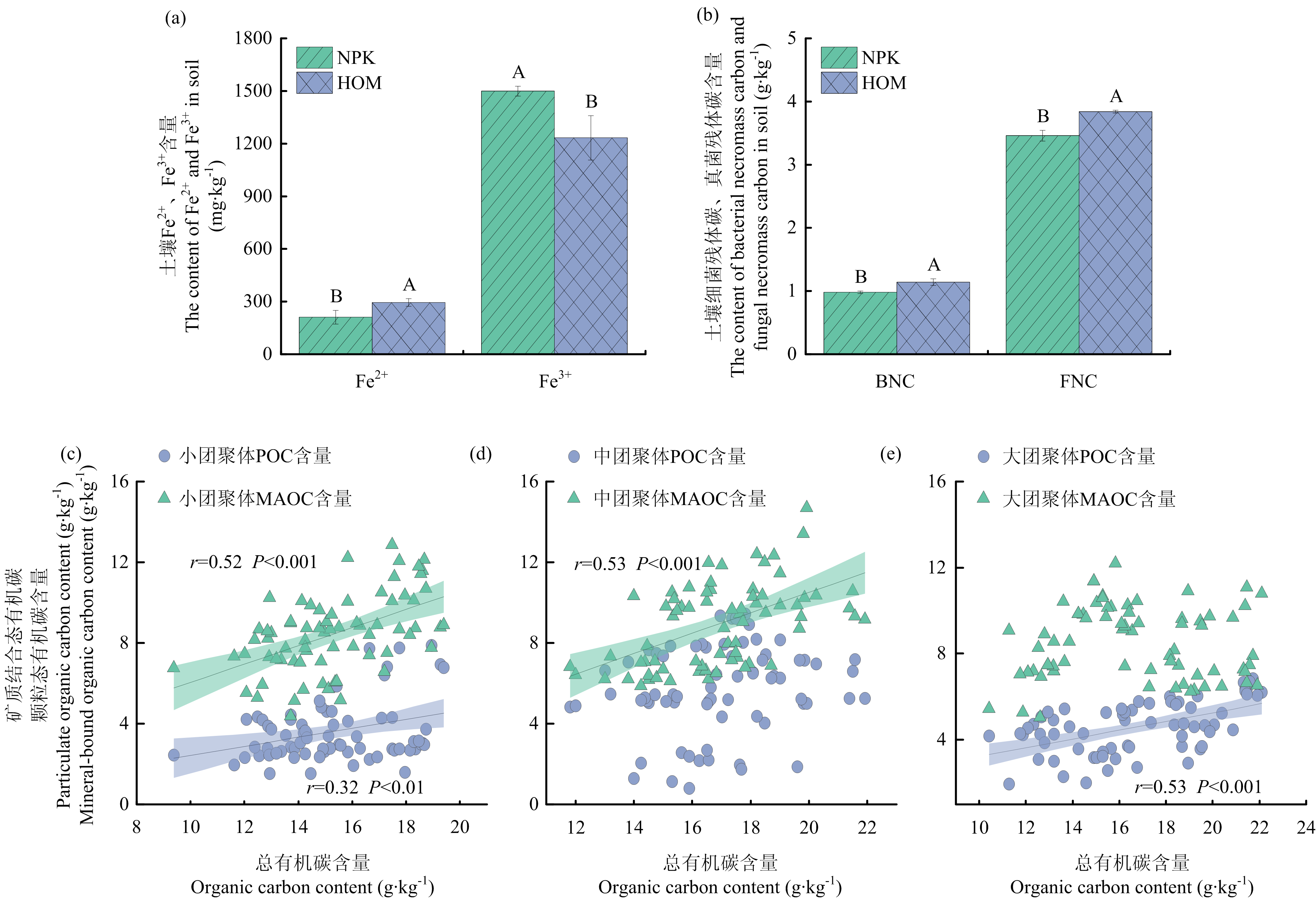
图5
不同施肥处理土壤铁形态(a)和微生物残体的变化(b)以及不同粒级团聚体中OC与POC、MAOC的线性关系(c—e)"
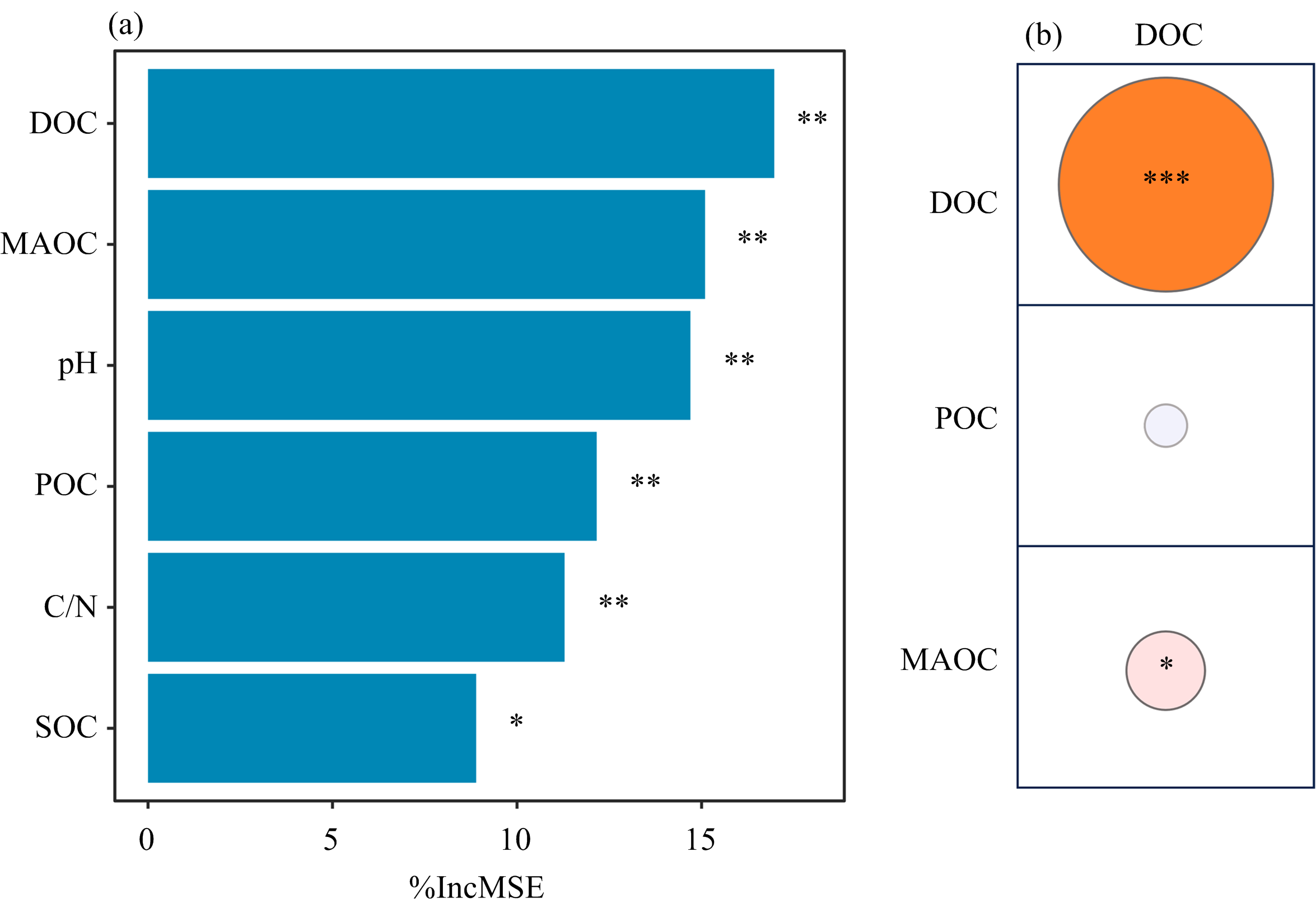
图6
土壤因子对团聚体CO2排放的随机森林分析(a),DOC与POC、MAOC之间的spearman分析(b)"
| [1] |
doi: 10.5194/essd-15-5301-2023 |
| [2] |
|
| [3] |
张昊鑫, 于晟玥, 雷秋良, 杜新忠, 张继宗, 安妙颖, 樊秉乾, 罗加法, 刘宏斌. 基于RothC模型的东北旱地和稻田土壤有机碳动态变化模拟研究. 中国农业科学, 2025, 58(8): 1564-1578. doi: 10.3864/j.issn.0578-1752.2025.08.008.
|
|
|
|
| [4] |
doi: 10.1016/j.scitotenv.2023.165430 |
| [5] |
doi: 10.1016/j.still.2025.106828 |
| [6] |
doi: 10.1016/j.still.2004.03.008 |
| [7] |
何志腾, 夏栋, 罗婷, 蒋佳媛, 赵冰琴, 付亮, 吴琼. 鄂西喀斯特小流域土地利用变化对土壤团聚体稳定性及有机碳储量的影响. 中国水土保持科学(中英文), 2025, 23(1): 200-210.
|
|
|
|
| [8] |
doi: 10.1016/j.soilbio.2024.109354 |
| [9] |
doi: 10.1016/j.jenvman.2020.110894 |
| [10] |
doi: 10.1016/j.soilbio.2019.04.019 |
| [11] |
doi: 10.1016/j.geoderma.2016.03.008 |
| [12] |
于雯霏, 王佩佩, 刘俊娥, 周正朝, 游犇. 黄土高原典型植被根系对土壤团聚体及其有机碳组分的影响. 水土保持学报, 2023, 37(6): 246-254.
|
|
|
|
| [13] |
doi: 10.1038/s41467-024-49743-7 |
| [14] |
doi: 10.1016/j.soilbio.2024.109454 |
| [15] |
doi: 10.1038/s41467-025-57354-z |
| [16] |
薛志婧, 李霄云, 焦磊, 杨阳, 窦艳星, 王宝荣, 黄倩, 刘春晖, 屈婷婷, 周正朝, 安韶山. 土壤矿质结合态有机碳形成及稳定机制的研究进展. 水土保持学报, 2023, 37(5): 12-23.
|
|
|
|
| [17] |
doi: 10.1111/gcb.15604 pmid: 33742519 |
| [18] |
唐开钊, 张君耀, 吴聪, 王帅, 廖文娟, 尹力初, 周卫军, 崔浩杰. 不同坡位柑橘园土壤团聚体矿物结合态有机碳矿化特征. 土壤学报, 2024, 61(6): 1639-1652.
|
|
|
|
| [19] |
doi: 10.1126/sciadv.adv9482 |
| [20] |
doi: 10.3390/plants12030630 |
| [21] |
doi: 10.1111/gcb.14859 pmid: 31587451 |
| [22] |
汪洋, 杨殿林, 王丽丽, 赵建宁, 刘红梅, 谭炳昌, 王慧, 王明亮, 黄进, 张小福. 农田管理措施对土壤有机碳周转及微生物的影响. 农业资源与环境学报, 2020, 37(3): 340-352.
|
|
|
|
| [23] |
王鸣腾, 曾冲, 李帅, 蔡迦铭, 楚静雅, 周明远, 王宜伦, 苗玉红, 李刚, 刘雪峰, 李岚涛. 不同发酵方式猪粪堆肥配施化肥对夏玉米土壤理化特性及NH3挥发影响研究. 中国生态农业学报(中英文), 2025, 33(8): 1492-1505.
|
|
|
|
| [24] |
李桂花, 郭俊娒, 姜慧敏, 张建峰. 有机肥和秸秆炭分别替代部分尿素和秸秆降低黑土温室效应的效果. 植物营养与肥料学报, 2018, 24(6): 1566-1573.
|
|
|
|
| [25] |
|
| [26] |
doi: 10.1016/j.soilbio.2025.109945 |
| [27] |
鲍士旦. 土壤农化分析. 北京: 中国农业出版社, 2023.
|
|
|
|
| [28] |
陈小梅, 刘菊秀, 邓琦, 褚国伟, 周国逸, 张德强. 降水变率对森林土壤有机碳组分与分布格局的影响. 应用生态学报, 2010, 21(5): 1210-1216.
|
|
|
|
| [29] |
周国朋, 曹卫东, 白金顺, 聂军, 徐昌旭, 曾闹华, 高嵩涓, 王艳秋, 志水胜好. 多年紫云英-双季稻下不同施肥水平对两类水稻土有机质及可溶性有机质的影响. 中国农业科学, 2016, 49(21): 4096-4106. doi: 10.3864/j.issn.0578-1752.2016.21.004.
|
|
|
|
| [30] |
doi: 10.1111/gcb.v30.12 |
| [31] |
李彬彬, 武兰芳. 土壤温室气体排放对C/N的响应. 农业环境科学学报, 2018, 37(9): 2067-2078.
|
|
|
|
| [32] |
马静, 陆昕昱, 宋俊杰, 孙丽英. 有机肥和生物菌剂对菜地土壤N2O排放及土壤团聚体的影响. 农业环境科学学报, 2026, 45(1): 251-261.
|
|
|
|
| [33] |
李天娇, 张乃于, 申文艳, 宋天昊, 刘红芳, 刘晓燕, 张秀芝, 彭畅, 杨劲峰, 张淑香. 长期施肥对黑土和棕壤团聚体稳定性的影响及驱动因素. 中国农业科学, 2024, 57(19): 3835-3847. doi: 10.3864/j.issn.0578-1752.2024.19.010.
|
|
|
|
| [34] |
doi: 10.1023/A:1009738307837 |
| [35] |
doi: 10.1016/j.still.2018.08.008 |
| [36] |
doi: 10.1007/s00374-007-0207-9 |
| [37] |
doi: 10.1016/j.soilbio.2022.108756 |
| [38] |
孟延荣, 白存琳, 赵广伟, 牛向雯, 佘维维, 张宇清, 秦树高, 杨婧, 姜雅文, 黎明杰, 冯薇. 毛乌素沙地生物结皮覆盖土壤中微生物残体碳贡献及其影响因素. 土壤学报, 2025, 62(5): 330-340.
|
|
|
|
| [39] |
崔宇鸿, 叶绍明, 卢志锋, 燕羽, 蒋晨阳. 不同连栽代次桉树人工林土壤团聚体中有机碳组分的积累和转化. 北京林业大学学报, 2024, 46(10): 42-52.
|
|
|
|
| [40] |
闫桂菀, 董文斌, 李忠义, 韦彩会, 唐红琴, 邓羽松, 张宇亭, 何铁光. 绿肥覆盖对果园土壤团聚体及有机碳组分的影响. 应用生态学报, 2024, 35(12): 3427-3434.
doi: 10.13287/j.1001-9332.202412.012 |
|
doi: 10.13287/j.1001-9332.202412.012 |
|
| [41] |
doi: 10.1016/j.geoderma.2024.116883 |
| [42] |
doi: 10.1016/S0038-0717(00)00179-6 |
| [43] |
龙世平, 廖超林, 陈山, 彭斯文, 宁尚辉, 杨红武, 祝利, 梅光军, 曹明锋. 湘西北烤烟和玉米连作田土壤团聚体碳特征比较. 中国烟草科学, 2021, 42(3): 44-49.
|
|
|
|
| [44] |
doi: 10.3390/agronomy12051101 |
| [45] |
doi: 10.1016/j.soilbio.2015.10.017 |
| [46] |
doi: 10.1016/j.soilbio.2018.01.031 |
| [47] |
doi: 10.1007/s00374-024-01803-2 |
| [48] |
肖可青, 李心男, 邢稳, 冯孟熙, 张铭, 赵瑶, 朱永官. 土壤“矿物碳泵(MnCP)”介导有机碳的固存与稳定机制. 土壤学报, 2025, 62(3): 595-609.
|
|
|
|
| [49] |
苟宁倢, 李冰, 王昌全, 钟文挺, 王科, 孙娟. 成都平原稻蒜轮作年限对土壤养分及有机碳库稳定性的影响. 土壤通报, 2024, 55(6): 1657-1665.
|
|
|
|
| [50] |
许天宇, 彭军, 刘旭东, 王豪楠. 细粒沉积物搬运机理研究进展[J/OL]. 沉积学报. doi:10.14027/j.issn.1000-0550.2024.117.
|
|
|
|
| [51] |
doi: 10.1038/ngeo1138 |
| [52] |
doi: 10.1038/s41598-022-22064-9 pmid: 36284223 |
| [53] |
张毅, 刘颖, 程存刚, 李燕青, 李壮. 牛粪与化肥配施比例对苹果园土壤有机碳库和酶活性的影响. 中国农业科学, 2024, 57(20): 4107-4118. doi: 10.3864/j.issn.0578-1752.2024.20.015.
|
|
|
|
| [54] |
史帆, 李文广, 易树生, 杨娜, 陈玉萌, 郑伟, 张雪辰, 李紫燕, 翟丙年. 有机无机肥配施下旱地麦田土壤有机碳组分含量的变化特征. 中国农业科学, 2025, 58(4): 719-732. doi: 10.3864/j.issn.0578-1752.2025.04.008.
|
|
|
|
| [55] |
杨继芬, 李永梅, 李春培, 芦美, 赵吉霞. 大豆玉米间作提高红壤团聚体中真菌群落结构和多样性. 植物营养与肥料学报, 2023, 29(5): 889-899.
|
|
|
|
| [56] |
doi: 10.1016/j.soilbio.2023.109095 |
| [57] |
doi: 10.1002/imt2.142 pmid: 38868232 |
| [58] |
doi: 10.1016/j.geoderma.2021.115342 |
| [59] |
陈晓芬, 刘明, 江春玉, 吴萌, 李忠佩. 不同施肥处理红壤性水稻土团聚体有机碳矿化特征. 中国农业科学, 2018, 51(17): 3325-3334. doi: 10.3864/j.issn.0578-1752.2018.17.008.
|
|
|
|
| [60] |
doi: 10.1016/j.soilbio.2025.109819 |
| [1] | 许杨浩峻, 陈丽明, 杨世奇, 唐奕凡, 谭雪明, 曾勇军, 潘晓华, 曾研华. 长期秸秆还田对双季稻田不同土层有机碳、养分和团聚体的影响[J]. 中国农业科学, 2026, 59(7): 1492-1506. |
| [2] | 魏圆慧, 余益辉, 李子钧, 丁文杰, 涂文龙, 毛艳玲. 长期施肥对黄泥田土壤有机碳化学结构与固碳细菌群落结构的影响[J]. 中国农业科学, 2026, 59(5): 1020-1033. |
| [3] | 张卫建, 严圣吉, 尚子吟, 唐志伟, 吴柳格, 李佳锐, 陈浩天, 邓艾兴, 张俊, 张鑫, 郑成岩, 宋振伟. 稻田甲烷不完全源于水稻种植的人为贡献[J]. 中国农业科学, 2026, 59(4): 824-833. |
| [4] | 王仁卓, 李玥颖, 黄绍敏, 姜桂英, 张琦, 刘超麟, 杨锦, 王梦茹, 王贝贝, 刘芳, 郭斗斗, 介晓磊, 宋练, 刘世亮. 长期有机无机肥配施对潮土细菌群落结构、生态网络及关键物种的影响[J]. 中国农业科学, 2026, 59(2): 354-367. |
| [5] | 张昊鑫, 于晟玥, 雷秋良, 杜新忠, 张继宗, 安妙颖, 樊秉乾, 罗加法, 刘宏斌. 基于RothC模型的东北旱地和稻田土壤有机碳动态变化模拟研究[J]. 中国农业科学, 2025, 58(8): 1564-1578. |
| [6] | 白雨欣, 刘灵芝, 安婷婷, 李双异, 汪景宽. 长期不同施肥对棕壤细菌群落结构和碳代谢功能的影响[J]. 中国农业科学, 2025, 58(8): 1579-1590. |
| [7] | 史帆, 李文广, 易树生, 杨娜, 陈玉萌, 郑伟, 张雪辰, 李紫燕, 翟丙年. 有机无机肥配施下旱地麦田土壤有机碳组分含量的变化特征[J]. 中国农业科学, 2025, 58(4): 719-732. |
| [8] | 张方方, 宋启龙, 高娜, 白炬, 李阳, 岳善超, 李世清. 长期覆盖对黄土高原春玉米产量、土壤碳氮组分和碳氮库相关指数的影响[J]. 中国农业科学, 2025, 58(3): 507-519. |
| [9] | 于茹, 李玉义, 曹巨峰, 马俊, 常芳弟, 宋佳珅, 张宏媛, 李晓彬, 李浩若, 张华, 王婧. 施肥管理对麦后复种绿肥盐碱土碳组分与小麦产量的影响[J]. 中国农业科学, 2025, 58(20): 4189-4202. |
| [10] | 张斯佳, 杨杰, 赵帅, 李莉威, 王贵彦. 华北平原多样化作物与小麦-玉米轮作对土壤质量的影响[J]. 中国农业科学, 2025, 58(2): 238-251. |
| [11] | 袁慧琳, 李雅莹, 顾文杰, 徐培智, 卢钰升, 孙丽丽, 周昌敏, 黎婉玲, 仇荣亮. 长期施用新鲜与腐熟畜禽粪肥土壤溶解性有机质与微生物群落的特征及其关联性[J]. 中国农业科学, 2025, 58(2): 307-325. |
| [12] | 郭斗斗, 张珂珂, 黄绍敏, 宋晓, 张水清, 岳克, 丁世杰, 郭腾飞. 长期不同施肥对潮土磷吸附解吸特性的影响[J]. 中国农业科学, 2025, 58(14): 2805-2820. |
| [13] | 路鹏, 冯佳, 李莉, 杨莉, 杨雷, 吕德智, 薛彦飞. 长期施肥小麦根际与非根际土壤的磷组分及其有效性[J]. 中国农业科学, 2025, 58(12): 2382-2396. |
| [14] | 韩潇杰, 任志杰, 李双静, 田培培, 卢素豪, 马耕, 王丽芳, 马冬云, 赵亚南, 王晨阳. 不同施氮量对土壤团聚体碳氮含量及小麦产量的影响[J]. 中国农业科学, 2024, 57(9): 1766-1778. |
| [15] | 胡丹丹, 宋惠洁, 段英华, 吴艳, 胡志华, 徐小林, 张文菊, 何小林, 柳开楼, 苏鹏, 黄群招. 长期施肥对红壤双季稻系统氮素盈亏和土壤碱解氮的影响[J]. 中国农业科学, 2024, 57(24): 4907-4918. |
|
||
