






中国农业科学 ›› 2026, Vol. 59 ›› Issue (5): 1048-1059.doi: 10.3864/j.issn.0578-1752.2026.05.010
严艳鸽( ), 张水勤, 许猛, 徐久凯, 李燕婷, 赵秉强, 袁亮()
收稿日期:2025-04-20
接受日期:2025-05-19
出版日期:2026-03-01
发布日期:2026-03-06
通信作者:
联系方式:
严艳鸽,E-mail:yange6356@163.com。
基金资助:
YAN YanGe(), ZHANG ShuiQin, XU Meng, XU JiuKai, LI YanTing, ZHAO BingQiang, YUAN Liang()
Received:2025-04-20
Accepted:2025-05-19
Published:2026-03-01
Online:2026-03-06
摘要:
【目的】 糖类化合物能调控土壤氮素的转化过程。然而,不同聚合度葡聚糖对氮素转化的影响尚不清楚。本研究着重探究葡聚糖改性尿素在石灰性潮土中的氮素转化特征,深入分析葡聚糖的聚合度与氮素有效性的关系,并揭示其作用机制,旨在为不同聚合度葡聚糖在尿素中的高效应用提供理论基础。【方法】 将葡萄糖、麦芽糖、低聚麦芽糖和聚葡萄糖分别按1%的添加量加入到熔融尿素中制得对应的葡萄糖改性尿素(单糖,GU)、麦芽糖改性尿素(2聚,MU)、低聚麦芽糖改性尿素(≈5聚,OU)和聚葡萄糖改性尿素(≈20聚,PU)。设置不施肥处理(CK)、施用普通尿素处理(U)和不同聚合度葡聚糖改性尿素6个处理,采用土壤培养的方法研究不同聚合度葡聚糖改性尿素的氮素转化特征,并结合普通尿素和葡聚糖改性尿素13C核磁共振波谱的化学结构特征,揭示不同聚合度葡聚糖及其结构变化对尿素转化的影响机制。【结果】 (1)葡聚糖改性尿素中含有席夫碱结构的物质;(2)与U处理相比,葡聚糖改性尿素延缓尿素水解,土壤中酰胺态氮含量平均提高15.3%—37.1%,OU处理最高;(3)施入氮肥后,U处理的脲酶活性在第1 天达到峰值,而葡聚糖改性尿素处理的脲酶活性则在培养第2天达到峰值;(4)葡聚糖改性尿素的氨挥发累积量较U处理降低2.2%—12.9%。随着葡聚糖聚合度的增加,氨挥发累积量表现出逐渐增加的态势;(5)培养结束时,葡聚糖改性尿素处理土壤中硝态氮含量提高了14.1%—30.5%,当葡聚糖聚合度增加时,土壤中硝态氮含量先增加后降低,聚合度为3.35时,硝态氮含量最高。【结论】 葡聚糖改性尿素能延缓尿素水解,降低氨挥发损失量,提高培养后期土壤中的硝态氮含量。其中,GU(单体)减少氨挥发的效果最好,中聚合度(3.35聚)的葡聚糖提高土壤中硝态氮含量的效果最好。
严艳鸽, 张水勤, 许猛, 徐久凯, 李燕婷, 赵秉强, 袁亮. 葡聚糖改性尿素在潮土中的转化特征[J]. 中国农业科学, 2026, 59(5): 1048-1059.
YAN YanGe, ZHANG ShuiQin, XU Meng, XU JiuKai, LI YanTing, ZHAO BingQiang, YUAN Liang. Transformation Characteristics of Dextran-Modified Urea in Fluvo- Aquic Soil[J]. Scientia Agricultura Sinica, 2026, 59(5): 1048-1059.
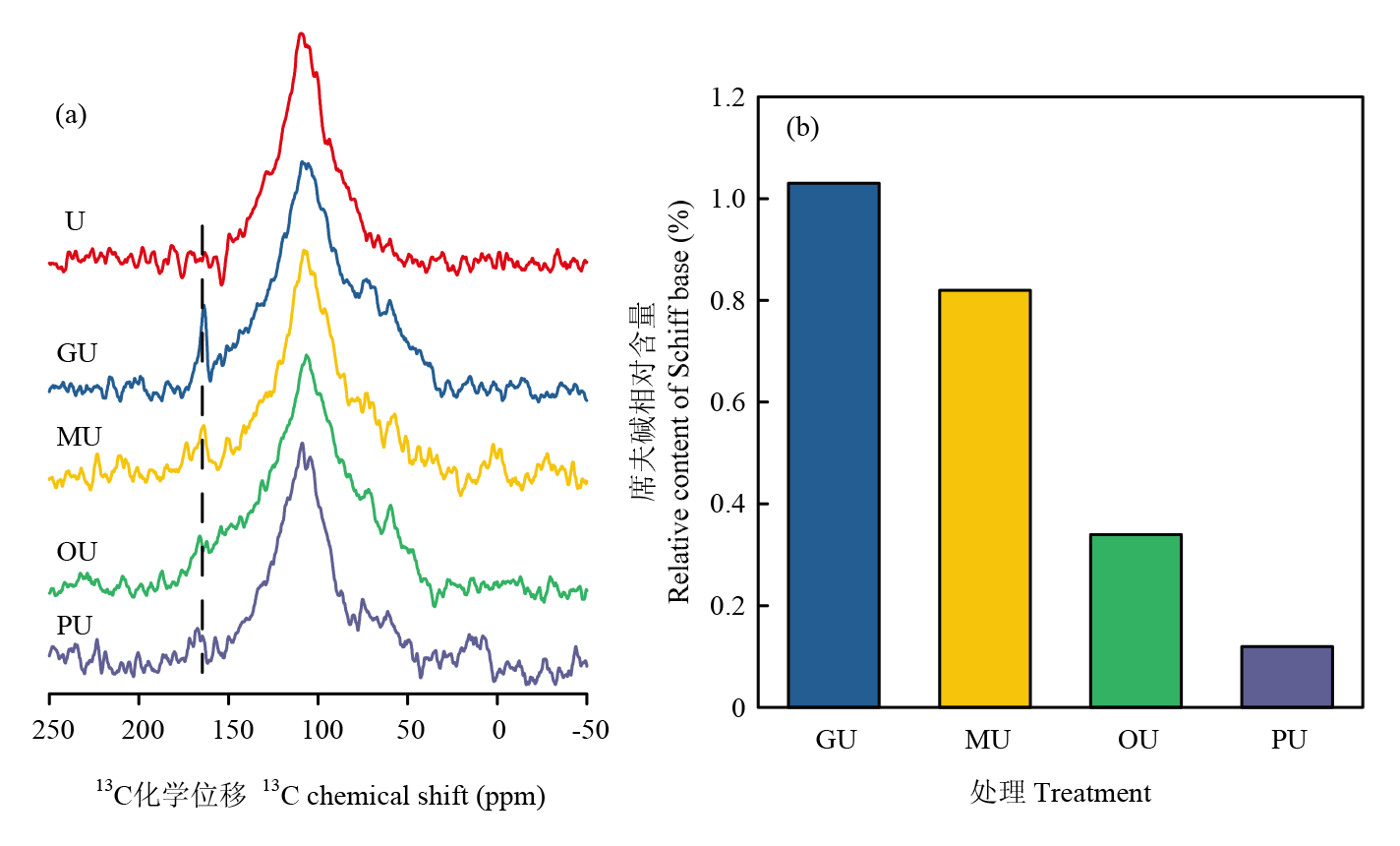
图1
葡聚糖改性尿素的13C核磁共振波谱(a)及席夫碱相对含量(b)"
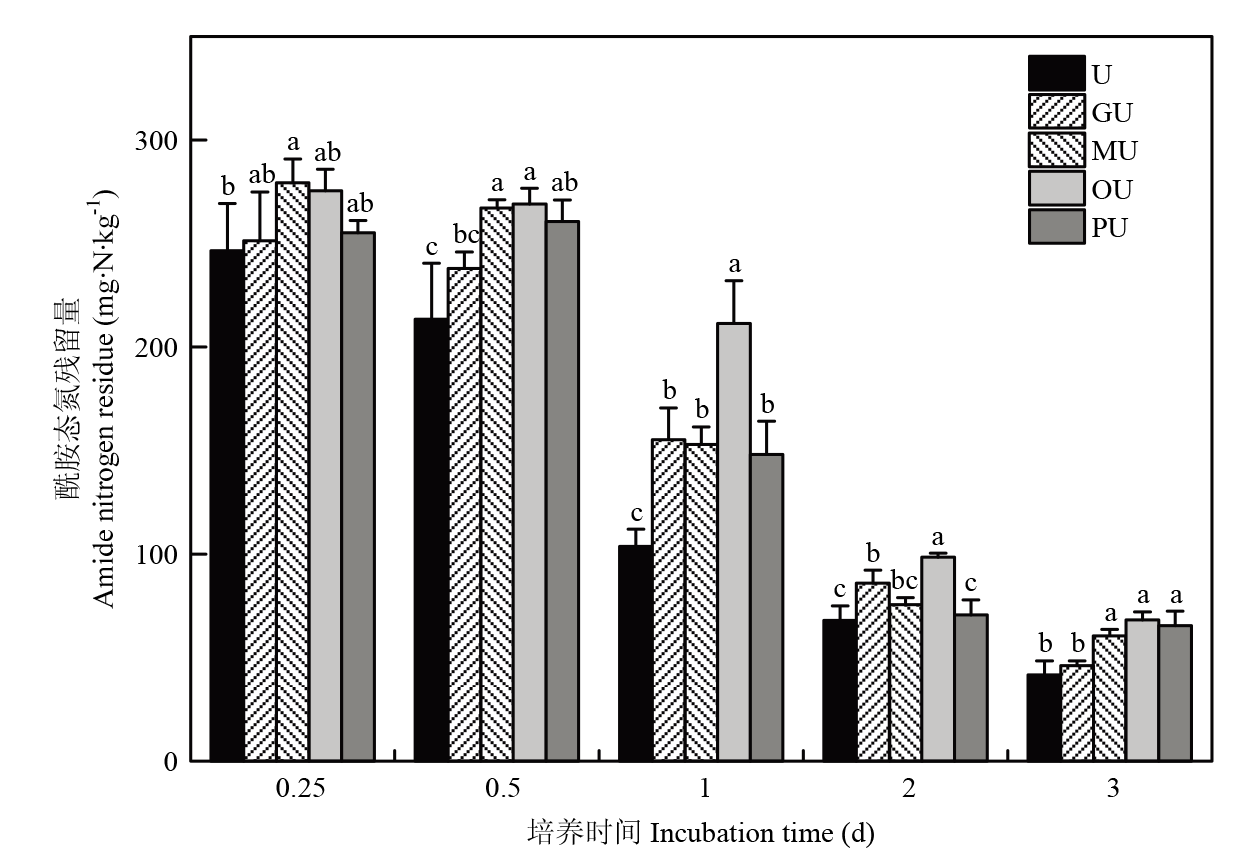
图2
不同处理土壤酰胺态氮残留量 图柱上不同小写字母表示同一培养时间不同处理间差异显著(P<0.05)。下同"

表1
不同处理土壤铵态氮含量"
| 处理 Treatment | 培养时间Incubation time (d) | |||||||||
|---|---|---|---|---|---|---|---|---|---|---|
| 0.25 | 0.5 | 1 | 2 | 3 | 5 | 7 | 14 | 21 | 28 | |
| CK | 1.84b | 1.71c | 1.54d | 3.82d | 4.71d | 3.48c | 2.39b | 2.56b | 2.26a | 2.53a |
| U | 39.76a | 45.44b | 73.92a | 141.85a | 237.75ab | 173.06a | 10.56a | 2.74ab | 2.46a | 2.36a |
| GU | 40.05a | 47.81a | 64.71c | 87.10c | 244.24a | 151.34b | 10.59a | 2.97ab | 2.33a | 2.16a |
| MU | 40.00a | 48.12a | 68.51b | 115.27b | 226.53c | 162.10ab | 9.97a | 2.71ab | 2.23a | 2.44a |
| OU | 39.08a | 46.61ab | 69.82b | 139.60a | 246.49a | 177.57a | 13.28a | 3.17a | 2.14a | 2.34a |
| PU | 39.21a | 45.79b | 63.79d | 108.34b | 229.67bc | 162.01ab | 11.00a | 2.84ab | 2.35a | 2.42a |
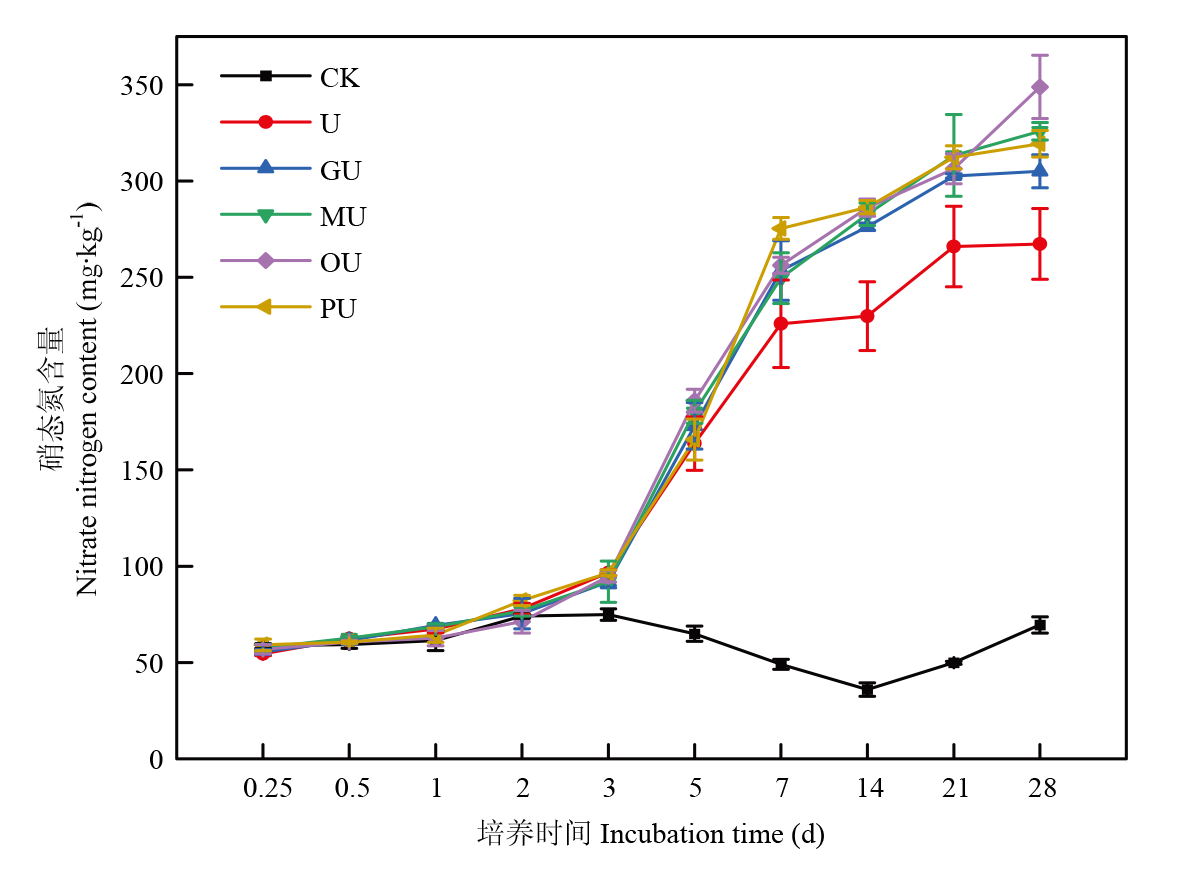
图3
不同处理土壤硝态氮含量"

图4
葡聚糖改性尿素对氨挥发速率和氨挥发累积量的影响"

图5
不同处理土壤脲酶活性"

图6
席夫碱含量与氨挥发累积量和硝态氮含量的回归性分析"
表2
不同处理土壤pH值"
| 处理 Treatment | 培养时间Incubation time (d) | |||||||||
|---|---|---|---|---|---|---|---|---|---|---|
| 0.25 | 0.5 | 1 | 2 | 3 | 5 | 7 | 14 | 21 | 28 | |
| CK | 8.02b | 8.03a | 8.06b | 8.14a | 8.08b | 8.05a | 8.05a | 8.10a | 7.97a | 8.03a |
| U | 8.13a | 8.07a | 8.30a | 8.14a | 8.15b | 7.86bc | 7.86b | 7.89b | 7.73b | 7.78b |
| GU | 8.02b | 8.02a | 8.09b | 8.12a | 8.12b | 7.82bc | 7.93b | 7.89b | 7.67b | 7.66b |
| MU | 7.97b | 8.08a | 8.17b | 8.04b | 8.09b | 7.81c | 7.85b | 7.90b | 7.63b | 7.78b |
| OU | 8.11a | 8.04a | 8.10b | 7.95c | 8.08b | 7.82c | 7.86b | 7.93b | 7.66b | 7.67b |
| PU | 8.02b | 8.02a | 8.28a | 8.05b | 7.95a | 7.89b | 7.91b | 7.86b | 7.70b | 7.77b |
| [1] |
doi: 10.1016/j.resconrec.2024.107995 |
| [2] |
袁亮, 赵秉强, 林治安, 温延臣, 李燕婷. 增值尿素对小麦产量、氮肥利用率及肥料氮在土壤剖面中分布的影响. 植物营养与肥料学报, 2014, 20(3): 620-628.
|
|
|
|
| [3] |
|
| [4] |
中华人民共和国农业农村部. 三大粮食作物化肥利用率稳步提升. https://www.moa.gov.cn/xw/zwdt/202501/t20250114_6469150.htm.
|
|
Ministry of Agriculture and Rural Affairs of the People's Republic of China. The fertilizer use efficiency of the three major grain crops has steadily increased. https://www.moa.gov.cn/xw/zwdt/202501/t20250114_6469150.htm. (in Chinese)
|
|
| [5] |
doi: 10.1016/j.scitotenv.2023.162555 |
| [6] |
赵秉强, 袁亮. 我国绿色高效化肥产品创新与产业发展. 植物营养与肥料学报, 2023, 29(11): 2143-2149.
|
|
|
|
| [7] |
赵秉强. 传统化肥增效改性提升产品性能与功能. 植物营养与肥料学报, 2016, 22(1): 1-7.
|
|
|
|
| [8] |
徐鹏, 邬磊, 胡金丽, 蒋梦蝶, 赵劲松, 胡荣桂. 添加葡萄糖、乙酸、草酸对红壤旱地土壤氮素矿化及反硝化的影响. 环境科学学报, 2017, 37(12): 4740-4746.
|
|
|
|
| [9] |
马启翔, 李伟, 潘开文, 张林, 王彦杰. 持续碳源添加对油松和连香树林地土壤氮转化的影响. 应用与环境生物学报, 2013, 19(3): 426-433.
|
|
doi: 10.3724/SP.J.1145.2013.00426 |
|
| [10] |
董冬玉, 王丹婷, 马红亮, 张睿颖, 江玲, 杨红玉. 添加葡萄糖对中亚热带阔叶林土壤氮转化的影响. 土壤, 2019, 51(1): 19-24.
|
|
|
|
| [11] |
doi: 10.1016/j.soilbio.2025.109738 |
| [12] |
邵兴芳, 徐明岗, 张文菊, 黄敏, 周显, 朱平, 高洪军. 长期有机培肥模式下黑土碳与氮变化及氮素矿化特征. 植物营养与肥料学报, 2014, 20(2): 326-335.
|
|
|
|
| [13] |
吕殿青, 张树兰, 杨学云. 外加碳、氮对土壤氮矿化、固定与激发效应的影响. 植物营养与肥料学报, 2007, 13(2): 223-229.
|
|
|
|
| [14] |
牟全生, 杨敏, 王裕成, 包鹏杰, 雷敬敬, 陈浩, 王海霞, 杨继涛. 脱脂牛乳体系中乳蛋白-葡萄糖美拉德反应程度及产物功能性质研究. 食品工业科技, 2019, 40(12): 1-6.
|
|
|
|
| [15] |
王彬, 袁亮, 张水勤, 林治安, 赵秉强, 李燕婷. 尿素融合葡萄糖对潮土中尿素的水解及相关酶活性的影响. 植物营养与肥料学报, 2020, 26(10): 1827-1837.
|
|
|
|
| [16] |
张英强, 袁亮, 张水勤, 李燕婷, 王立艳, 赵秉强. 葡萄糖改性尿素的反应特征及其对尿素转化率的影响. 植物营养与肥料学报, 2022, 28(2): 325-333.
|
|
|
|
| [17] |
张文清, 吕伟娇, 陈强, 李辉信. 不同分子量壳聚糖对土壤碳、氮及呼吸的影响. 生态学报, 2006, 26(4): 1280-1284.
|
|
|
|
| [18] |
王秋平, 杨晓君, 王宇杰, 阿卜杜萨拉木·阿卜杜卡迪尔. 不同分子量壳聚糖型SO2缓释材料性能研究. 食品工业科技, 2020, 41(2): 183-188.
|
|
|
|
| [19] |
王琳, 周晓丽, 马银丽, 巨晓棠, 吉艳芝, 张丽娟. 铵态氮源和碳源对土壤N2O、CO2释放的影响. 农业资源与环境学报, 2016, 33(1): 23-28.
|
|
|
|
| [20] |
严艳鸽, 张水勤, 李燕婷, 赵秉强, 袁亮. 葡聚糖改性尿素对冬小麦产量和肥料氮去向的影响. 中国农业科学, 2023, 56(2): 287-299. doi: 10.3864/j.issn.0578-1752.2023.02.007.
|
|
|
|
| [21] |
王朝辉, 刘学军, 巨晓棠, 张福锁. 田间土壤氨挥发的原位测定: 通气法. 植物营养与肥料学报, 2002, 8(2): 205-209.
|
|
|
|
| [22] |
周佳, 孙勇, 唐传球, 饶贞学, 甘露. 对二甲氨基苯甲醛比色法测定溶液中的尿素. 化学与生物工程, 2014, 31(2): 75-78.
|
|
|
|
| [23] |
王如海, 钱薇, 朱小芳, 蒋倩, 王曦, 倪俊, 韩勇, 俞元春. 流动注射法同时测定水中的氮磷指标. 分析试验室, 2013, 32(12): 32-36.
|
|
|
|
| [24] |
pmid: 11180943 |
| [25] |
刘廷国, 杨凌霄, 周彬, 黄劲松, 陆志敏, 李斌. 壳聚糖与尿素的相互作用及其应用研究进展. 离子交换与吸附, 2012, 28(2): 183-192.
|
|
|
|
| [26] |
廖俊健, 倪铁林, 廖浩然, 黄焯轩, 钱永盛, 陈敏, 卢其明. 4-取代基苯胺棉酚席夫碱的合成及脲酶抑制作用研究. 安徽农业大学学报, 2015, 42(4): 627-631.
|
|
|
|
| [27] |
李运彤, 董婧雯, 芦瑶, 谷易桐, 商超男, 刘芙瑶, 辛雨, 井长玲, 由忠录. 基于双席夫碱配体的两个锰(Ⅲ)配合物的合成、晶体结构和抑制脲酶活性. 无机化学学报, 2018, 34(6): 1192-1198.
|
|
|
|
| [28] |
doi: 10.1016/j.foodchem.2013.08.044 |
| [29] |
doi: 10.1007/s00374-007-0237-3 |
| [30] |
刘超, 秦仕华, 闫茹, 李仕蓉, 许巧玲, 乔志伟. 基于宏基因组学探究碳氮联合激发Arthrobacter参与关键碳代谢促进植物生长的研究. 中国土壤与肥料, 2025(1): 53-61.
|
|
|
|
| [31] |
赵丽芳, 袁亮, 张水勤, 赵秉强, 林治安, 李燕婷. 锌与尿素结合对锌有效性及尿素转化的影响. 中国农业科学, 2021, 54(16): 3461-3472. doi: 10.3864/j.issn.0578-1752.2021.16.009.
|
|
|
|
| [32] |
张英强, 张水勤, 李燕婷, 赵秉强, 袁亮. 不同含羧基有机酸改性尿素在石灰性潮土中的转化特征. 中国农业科学, 2022, 55(17): 3355-3364. doi: 10.3864/j.issn.0578-1752.2022.17.008.
|
|
|
|
| [33] |
王静, 王磊, 刘耀斌, 章欢, 张辉, 汪吉东, 吴建燕, 张永春. 长期施氮肥对黄棕壤微生物生物性状的影响及其调控因素. 中国生态农业学报(中英文), 2021, 29(5): 833-843.
|
|
|
|
| [34] |
巩闪闪, 刘晓静, 张志勇, 马新明, 孔玉华. 不同施氮措施对冬小麦农田土壤酶活性和氮转化的影响. 生态环境学报, 2020, 29(11): 2215-2222.
doi: 10.16258/j.cnki.1674-5906.2020.011.009 |
|
|
|
| [35] |
王薇, 李东坡, 王术, 武志杰, 张玉兰. 缓/控释尿素在稻田土壤中养分释放与转化特点及脲酶响应. 水土保持学报, 2010, 24(2): 116-121, 145.
|
|
|
|
| [36] |
doi: 10.1007/s00374-008-0334-y |
| [37] |
熊淑萍, 车芳芳, 马新明, 王小纯, 安帅, 李燕强. 氮肥形态对冬小麦根际土壤氮素生理群活性及无机氮含量的影响. 生态学报, 2012, 32(16): 5138-5145.
|
|
doi: 10.5846/stxb |
|
| [38] |
doi: 10.1016/j.soilbio.2014.03.023 |
| [39] |
徐丽萍, 王旭, 侯晓娜, 刘红芳, 保万魁, 孙蓟锋. 脲酶抑制剂NBPT对三种类型土壤中UAN氮溶液氮素转化和氨挥发的影响. 中国土壤与肥料, 2022, (3): 126-136.
|
|
|
|
| [40] |
doi: 10.1016/j.scitotenv.2018.12.450 |
| [41] |
doi: 10.1016/j.still.2024.106165 |
| [42] |
doi: 10.1002/jeq2.20130 pmid: 33016443 |
| [43] |
doi: 10.1016/j.soilbio.2024.109495 |
| [44] |
doi: 10.1007/s11430-020-9705-9 |
| [45] |
谭凤翔, 余元善, 邹宇晓, 廖森泰, 刘袆帆, 王琴, 胡腾根, 肖更生. 酶法水解桑叶多糖制备低聚糖及其抑菌活性研究. 蚕业科学, 2024, 50(2): 127-138.
|
|
|
|
| [46] |
阳金龙, 赵岩, 陆文静, 王洪涛. 玉米秸秆超临界预处理与水解. 清华大学学报(自然科学版), 2010, 50(9): 1408-1411.
|
|
|
|
| [47] |
刘刚, 张恒, 孙恒, 朱洪霞, 张煜函, 朱庆增, 苑世领. 碱/脲水溶液体系中纤维素包合物构型及纤维素与溶剂分子间相互作用力的分子动力学模拟. 高等学校化学学报, 2018, 39(4): 714-720.
doi: 10.7503/cjcu20170683 |
|
|
|
| [48] |
doi: 10.1016/j.cej.2023.141296 |
| [1] | 王仁卓, 李玥颖, 黄绍敏, 姜桂英, 张琦, 刘超麟, 杨锦, 王梦茹, 王贝贝, 刘芳, 郭斗斗, 介晓磊, 宋练, 刘世亮. 长期有机无机肥配施对潮土细菌群落结构、生态网络及关键物种的影响[J]. 中国农业科学, 2026, 59(2): 354-367. |
| [2] | 房康睿, 丁世杰, 陈雨珊, 杨秉庚, 郭腾飞, 徐新朋, 赵士诚, 王秀斌, 黄绍敏, 仇少君, 何萍, 周卫. 有机无机肥配施下典型潮土小麦季有机肥氮磷的当季释放率[J]. 中国农业科学, 2025, 58(24): 5234-5246. |
| [3] | 郭斗斗, 张珂珂, 黄绍敏, 宋晓, 张水清, 岳克, 丁世杰, 郭腾飞. 长期不同施肥对潮土磷吸附解吸特性的影响[J]. 中国农业科学, 2025, 58(14): 2805-2820. |
| [4] | 王世纪, 李玥颖, 陈琛, 姜桂英, 刘超麟, 朱长伟, 杨锦, 王梦茹, 介晓磊, 刘芳, 刘世亮. 豫北潮土区豆麦轮作周年氨挥发及作物产量变化特征[J]. 中国农业科学, 2025, 58(13): 2614-2629. |
| [5] | 杜嘉琪, 张紫薇, 王若飞, 黎星, 郭红艳, 杨硕, 冯成, 何堂庆, Giri Bhoopander, 张学林. 有机肥替代化肥与丛枝菌根真菌互作对砂姜黑土和潮土N2O排放的影响[J]. 中国农业科学, 2025, 58(1): 101-116. |
| [6] | 李连燚, 王世纪, 姜桂英, 李洋, 杨锦, 朱宣霖, 朱长伟, 王仁卓, 刘芳, 介晓磊, 刘世亮. 轮耕促进豫北潮土区小麦根系生长和产量增加[J]. 中国农业科学, 2024, 57(18): 3626-3641. |
| [7] | 王宇, 宋一凡, 张荣, 牟海萌, 孙丽芳, 付凯霞, 武紫君, 黄青青, 徐应明, 李鸽子, 王永华, 郭天财. 土壤施用钝化剂与复合微生物肥对冬小麦镉积累的影响[J]. 中国农业科学, 2024, 57(1): 126-141. |
| [8] | 严艳鸽, 张水勤, 李燕婷, 赵秉强, 袁亮. 葡聚糖改性尿素对冬小麦产量和肥料氮去向的影响[J]. 中国农业科学, 2023, 56(2): 287-299. |
| [9] | 张灵菲, 马垒, 李玉东, 郑福丽, 魏建林, 谭德水, 崔秀敏, 李燕. 有机物料与化肥长期配施对小麦玉米轮作潮土细菌群落和酶活性的影响[J]. 中国农业科学, 2023, 56(19): 3843-3855. |
| [10] | 严艳鸽, 张水勤, 李燕婷, 赵秉强, 袁亮. 葡聚糖改性磷肥对冬小麦产量和肥料利用率的影响[J]. 中国农业科学, 2023, 56(12): 2317-2328. |
| [11] | 赵政鑫,王晓云,田雅洁,王锐,彭青,蔡焕杰. 未来气候条件下秸秆还田和氮肥种类对夏玉米产量及土壤氨挥发的影响[J]. 中国农业科学, 2023, 56(1): 104-117. |
| [12] | 张学林, 吴梅, 何堂庆, 张晨曦, 田明慧, 李晓立, 侯小畔, 郝晓峰, 杨青华, 李潮海. 秸秆分解对两种类型土壤无机氮和氧化亚氮排放的影响[J]. 中国农业科学, 2022, 55(4): 729-742. |
| [13] | 伊英杰, 韩坤, 赵斌, 刘国利, 林佃旭, 陈国强, 任昊, 张吉旺, 任佰朝, 刘鹏. 长期不同施肥措施冬小麦-夏玉米轮作体系周年氨挥发损失的差异[J]. 中国农业科学, 2022, 55(23): 4600-4613. |
| [14] | 张英强,张水勤,李燕婷,赵秉强,袁亮. 不同含羧基有机酸改性尿素在石灰性潮土中的转化特征[J]. 中国农业科学, 2022, 55(17): 3355-3364. |
| [15] | 徐芳蕾,张杰,李阳,张伟伟,薄其飞,李世清,岳善超. 施肥方式对黄土高原旱作春玉米农田土壤氨挥发的影响[J]. 中国农业科学, 2022, 55(12): 2360-2371. |
|
||
