






中国农业科学 ›› 2026, Vol. 59 ›› Issue (20): 4517-4530.doi: 10.3864/j.issn.0578-1752.2026.20.007
李若楠1( ), 史建硕1, 贾舟1, 蒋龙刚1, 王丽英1(), 艾超2(), 孙璇1, 翟凤芝1
收稿日期:2025-12-29
接受日期:2026-04-20
出版日期:2026-10-16
发布日期:2026-10-21
通信作者:
联系方式:
李若楠,E-mail:liruonan2004@163.com。
基金资助:
LI RuoNan1(), SHI JianShuo1, JIA Zhou1, JIANG LongGang1, WANG LiYing1(), AI Chao2(), SUN Xuan1, ZHAI FengZhi1
Received:2025-12-29
Accepted:2026-04-20
Published:2026-10-16
Online:2026-10-21
摘要:
【目的】通过中长期定位试验探究猪粪配合秸秆替代部分化肥菜地土壤固碳特征及养分增效效应,为菜地土壤有机质管理与养分协同固碳方案的制定提供科学支撑。【方法】选取定位试验前期所得蔬菜生产较适宜有机替代模式—猪粪配合秸秆替代50%化肥氮,对比分析设施和露地栽培下种植9—10年土壤有机质含量和碳储量的变化,剖析外源碳施入土壤后的固存效率,探究中长期蔬菜产量、土壤养分供应及盈余状况。【结果】在0—20 cm土层,采用猪粪配合秸秆替代部分化肥能显著提高土壤有机质含量,种植9—10年土壤有机质含量升至接近(露地)或超过(设施)中等肥力水平阈值(20 g·kg-1),有机质含量随外源碳累积施入量的增加呈非线性增长(P<0.05),累积施入碳 48.5 t·hm-2(露地)和80.3 t·hm-2(设施)时有机质变幅趋缓;各季土壤有机碳储量均显著高于单施化肥模式,其中露地栽培在种植7年后有机碳储量趋于稳定;9—10年外源碳净固存速率为1.5 t·hm-2·a-1(露地)和1.9 t·hm-2·a-1(设施),外源碳净固存效率为14.8%(设施)和18.4%(露地);净固存效率随有机质含量的增加呈二次函数响应(P<0.05),当有机质含量为16.5 g·kg-1(露地)和19.6 g·kg-1(设施)时,净固存效率达到峰值。在20—40 cm土层,9—10年后猪粪配合秸秆替代部分化肥处理的土壤有机质含量显著增加,设施栽培下有机质含量与外源碳累积施入量间呈二次函数响应(P<0.05);设施栽培有机碳储量总体呈现积累,而露地栽培较基础水平无显著变化。综合0—40 cm土体,种植5—6年外源碳净固存速率和净固存效率显著高于9—10年,9—10年外源碳净固存效率为20.7%(设施)和22.9%(露地),栽培方式间无显著差异。猪粪配合秸秆替代化肥处理能显著提升0—20 cm土层有效磷含量,显著降低20—40 cm土层硝态氮含量。蔬菜产量与氮、磷吸收改善,尤其露地栽培促进养分吸收效果显著,每形成1 000 kg产量氮素盈余0.87 kg(露地)和2.47 kg(设施),露地栽培氮素盈余较单施化肥下降显著,设施栽培施氮量下调潜力较大。【结论】两种栽培方式下猪粪配合秸秆替代部分化肥均能实现土壤固碳、氮磷供应与利用改善及稳产增产。设施栽培较好地协同了SOM提升目标(至中肥力水平)与高效固碳,但施氮量仍有下调空间。露地栽培SOM随外源碳的持续施入过早进入平台期,外源碳净固存效率对SOM的响应更敏感,土壤固碳潜力受限。有机替代方案的制定应兼顾长期与短期目标,以协同长期稳定高效固碳与短期养分平衡供应。
李若楠, 史建硕, 贾舟, 蒋龙刚, 王丽英, 艾超, 孙璇, 翟凤芝. 猪粪配施秸秆替代化肥对蔬菜地土壤固碳及养分增效的作用[J]. 中国农业科学, 2026, 59(20): 4517-4530.
LI RuoNan, SHI JianShuo, JIA Zhou, JIANG LongGang, WANG LiYing, AI Chao, SUN Xuan, ZHAI FengZhi. Partial Replacement of Chemical Fertilizers with Pig Manure and Straw Enhances Soil Carbon Sequestration and Nutrient Availability in Vegetable Production[J]. Scientia Agricultura Sinica, 2026, 59(20): 4517-4530.
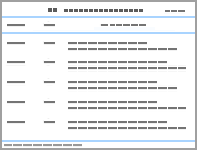
表1
猪粪配合秸秆替代化肥模式周年养分施用量"
| 有机物料种类 Types of organic materials | 设施 Greenhouse | 露地 Open-field | ||||||
|---|---|---|---|---|---|---|---|---|
| N | P2O5 | K2O | C | N | P2O5 | K2O | C | |
| 猪粪 Pig manure | 207.4 | 242.1 | 157.2 | 1958.5 | 114.5 | 140.8 | 87.6 | 1082.9 |
| 秸秆 Straw | 259.1 | 85.8 | 446.7 | 11154.9 | 149.4 | 53.7 | 282.1 | 6837.3 |
| 化肥 Mineral fertilizer | 583.5 | 197.1 | 521.1 | 0 | 336.1 | 105.5 | 380.3 | 0 |

图1
猪粪配合秸秆替代化肥对不同栽培方式0—40 cm土体SOM含量的影响 图柱上不同小写字母表示施肥模式间差异达到显著水平(P<0.05)"
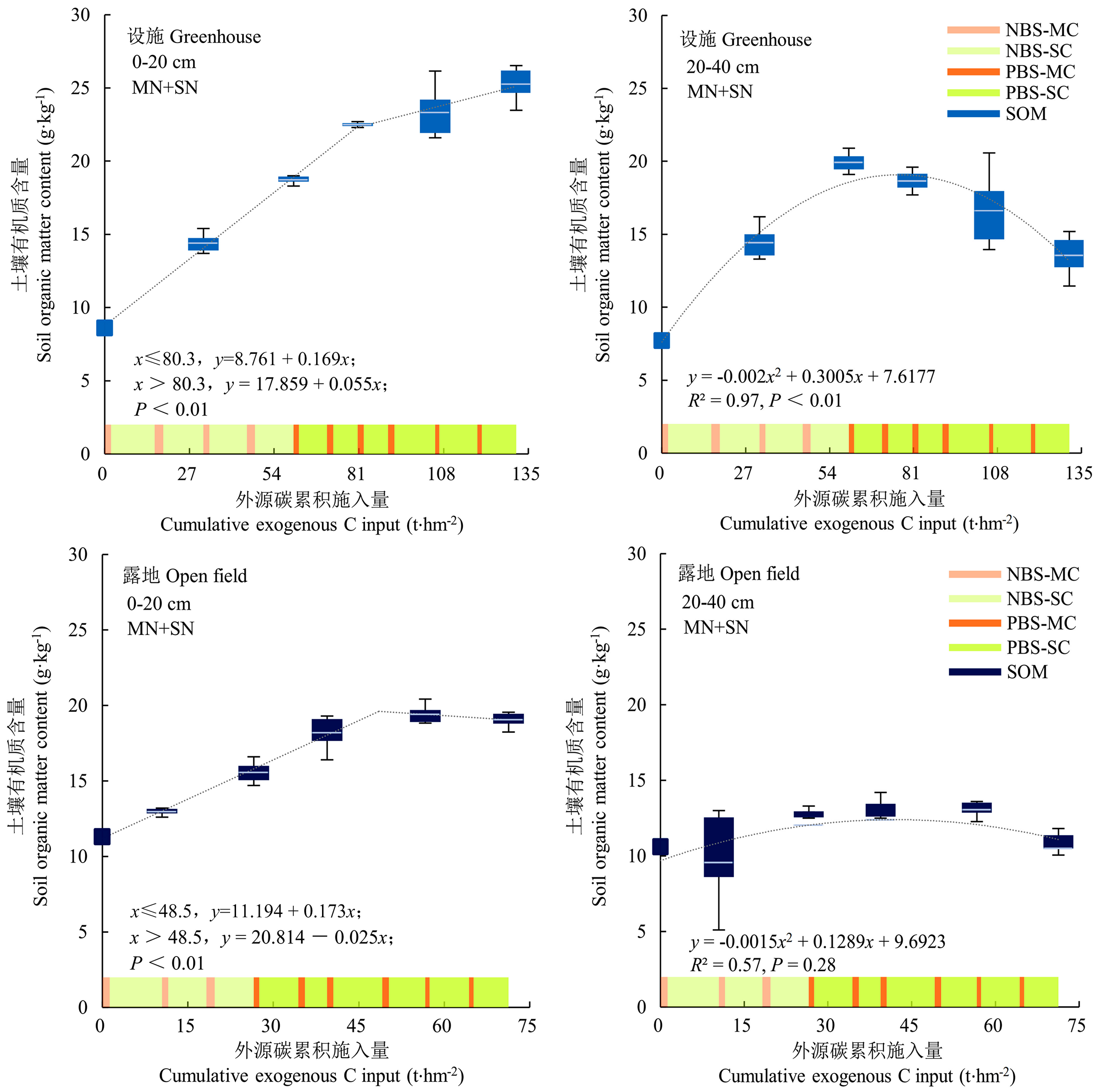
图2
猪粪配合秸秆替代化肥不同栽培方式0—40 cm土体SOM含量与外源碳累积施入量的关系 NBS-MC和NBS-SC分别代表替代N情况下猪粪和秸秆施入的碳。PBS-MC和PBS-SC分别代表替代P情况下猪粪和秸秆施入的碳"

图3
猪粪配合秸秆替代化肥不同栽培方式0—40 cm土层SOC储量变化 图中深色柱体对应Y轴年际间SOC累积量。虚线柱体对应Y轴年际间SOC消耗量。浅色柱体代表已有SOC库储量。虚线代表基础SOC库水平。红/蓝背景色为2019年SOC库水平。图柱上不同小写字母表示施肥模式间差异达到显著水平(P<0.05)"
表2
猪粪配合秸秆替代化肥不同栽培方式土壤SOC固存速率和固存效率"
| 土层 Soil layer (cm) | 指标 Indicator | 至2015年From experiment initiation to 2015 | 至2019年From experiment initiation to 2019 | ||
|---|---|---|---|---|---|
| 设施Greenhouse | 露地Open-field | 设施Greenhouse | 露地Open-field | ||
| 0-20 | CSR (t·hm-2·a-1) | 3.1 a A | 2.1 a A | 1.9 a B | 1.5 a A |
| CSE (%) | 23.0 a A | 27.2 a A | 14.8 a B | 18.4 a A | |
| 0-40 | CSR (t·hm-2·a-1) | 5.4 a A | 3.0 b A | 2.7 a B | 1.8 a B |
| CSE (%) | 40.1 a A | 38.4 a A | 20.7 a B | 22.9 a B | |

图4
猪粪配合秸秆替代化肥不同栽培方式0—20 cm土层碳固存效率与SOM含量的关系"

图5
猪粪配合秸秆替代化肥对不同栽培方式0—40 cm土层硝态氮含量的影响 图中横线和柱子上部数据代表平均值。不同小写字母表示施肥模式间差异达到显著水平(P<0.05)"
表3
猪粪配合秸秆替代化肥对不同栽培方式0—40 cm土层有效磷、速效钾和EC的影响"
| 指标 Indicator | 土层 Soil layer (cm) | 设施Greenhouse | 露地Open-field | ||
|---|---|---|---|---|---|
| MN+SN | CN | MN+SN | CN | ||
| 有效磷 Olsen-P (mg·kg-1) | 0-20 | 69.9 a | 48.5 b | 35.7 a | 31.9 b |
| 20-40 | 28.4 a | 15.6 b | 21.6 a | 19.8 a | |
| 速效钾 Soil available potassium (mg·kg-1) | 0-20 | 316.0 a | 320.8 a | 229.8 a | 237.2 a |
| 20-40 | 269.2 a | 191.8 b | 153.3 a | 141.4 a | |
| EC (μs·cm-1) | 0-20 | 654.2 a | 782.6 a | 276.1 a | 386.7 a |
| 20-40 | 428.5 a | 469.3 a | 208.9 b | 278.4 a | |
表4
猪粪配合秸秆替代化肥对不同栽培方式蔬菜周年产量与单位产量养分盈余量的影响"
| 指标 Indicator | 设施Greenhouse | 露地Open-field | |||
|---|---|---|---|---|---|
| MN+SN | CN | MN+SN | CN | ||
| 产量Yield (t·hm-2·a-1) | 225.5 a | 217.1 b | 190.8 a | 176.9 a | |
| 每形成1 000 kg产量的养分盈余量 Nutrient surplus per 1 000 kg of yield (kg) | N | 2.47 a | 2.60 a | 0.87 b | 1.08 a |
| P | 0.68 b | 0.74 a | 0.32 a | 0.41 a | |
| K | 1.48 b | 1.76 a | 0.68 a | 1.06 a | |

图6
猪粪配合秸秆替代化肥对不同栽培方式蔬菜周年养分吸收量的影响 不同小写字母表示施肥模式间差异达到显著水平(P<0.05)"
| [1] |
耕地地力主要指标分级诊断: DB 13/T 5406-2021[S]. https://std.samr.gov.cn/db/search/stdDBDetailed?id=CAD33277870FE843E05397BE0A0A611F.
|
|
Graded diagnosis of main indicators of cultivated land fertility: DB13/T 5406-2021[S]. https://std.samr.gov.cn/db/search/stdDBDetailed?id=CAD33277870FE843E05397BE0A0A611F. (in Chinese)
|
|
| [2] |
徐明岗, 段英华, 白珊珊, 张文菊, 孙楠. 基于长期定位试验的土壤健康研究与展望[J]. 植物营养与肥料学报, 2024, 30(7): 1253-1261.
|
|
|
|
| [3] |
刘蕾, 张运龙, 张俊伶, 王凌, 孙世友. 微生物介导的土壤颗粒态-矿物结合态有机碳动态研究进展[J]. 土壤学报, 2026, 63(4): 1219-1229.
|
|
|
|
| [4] |
刘红叶, 宋汶珈, 杨尧钰, 张锡岩, 母玉祥, 魏珉, 张大龙. 设施蔬菜土壤障碍特征、诱因及其生态防控技术研究进展[J]. 中国蔬菜, 2025(5): 32-43.
|
|
|
|
| [5] |
doi: 10.1016/j.envpol.2020.116143 |
| [6] |
doi: 10.1016/j.fcr.2025.109831 |
| [7] |
doi: 10.1016/j.scitotenv.2025.180097 |
| [8] |
doi: 10.1016/j.envres.2025.123008 |
| [9] |
doi: 10.1016/j.still.2023.105955 |
| [10] |
doi: 10.1016/j.spc.2023.11.019 |
| [11] |
doi: 10.1016/S2095-3119(21)63715-2 |
| [12] |
doi: 10.1016/j.still.2019.04.009 |
| [13] |
doi: 10.3390/agronomy15020396 |
| [14] |
doi: 10.1016/j.jia.2024.02.017 |
| [15] |
doi: 10.3389/fpls.2024.1486817 |
| [16] |
doi: 10.1111/gcb.v30.8 |
| [17] |
黄绍文, 唐继伟, 李春花, 张怀志, 袁硕. 我国蔬菜化肥减施潜力与科学施用对策[J]. 植物营养与肥料学报, 2017, 23(6): 1480-1493.
|
|
|
|
| [18] |
doi: 10.1016/j.resconrec.2025.108400 |
| [19] |
鲁如坤. 土壤农业化学分析方法[M]. 北京: 中国农业科学技术出版社, 2000.
|
|
|
|
| [20] |
黄绍文, 王玉军, 金继运, 唐继伟. 我国主要菜区土壤盐分、酸碱性和肥力状况[J]. 植物营养与肥料学报, 2011, 17(4): 906-918.
|
|
|
|
| [21] |
doi: 10.1016/j.agee.2023.108723 |
| [22] |
doi: 10.1016/j.crope.2023.10.003 |
| [23] |
doi: 10.1016/j.scitotenv.2023.161865 |
| [24] |
doi: S0956-053X(20)30254-3 pmid: 32460108 |
| [25] |
郎漫, 钟文, 张君岳, 毛涛, 李梦, 张馨予, 李平. 秸秆和畜禽粪便添加对黑土氮初级转化和固持特征的影响[J]. 植物营养与肥料学报, 2025, 31(6): 1086-1094.
|
|
|
|
| [26] |
徐久凯, 袁亮, 温延臣, 张水勤, 李燕婷, 李海燕, 赵秉强. 畜禽有机肥氮在冬小麦季对化肥氮的相对替代当量[J]. 中国农业科学, 2023, 56(2): 300-313. DOI: 10.3864/j.issn.0578-1752.2023.02.008.
|
|
|
|
| [27] |
doi: 10.1016/j.agrformet.2024.109937 |
| [28] |
doi: 10.1016/j.still.2025.106766 |
| [29] |
doi: 10.1023/A:1016125726789 |
| [30] |
doi: 10.1016/j.jia.2023.09.012 |
| [31] |
doi: 10.1111/fec.v36.6 |
| [32] |
张维理,
|
|
|
|
| [33] |
doi: 10.1016/j.scitotenv.2023.169479 |
| [34] |
doi: 10.1016/j.apsoil.2025.106170 |
| [35] |
doi: 10.1016/j.geoderma.2021.115110 |
| [36] |
doi: 10.1016/j.scitotenv.2022.155420 |
| [37] |
doi: 10.1016/j.agee.2024.109467 |
| [1] | 李星宇, 黄容, 鲜一鸣, 田娇娇, 马晓瑾, 杨乔茜, 李冰, 王昌全. 稻田土壤不同粒级团聚体有机碳组分及CO2排放对长期施肥的响应[J]. 中国农业科学, 2026, 59(6): 1255-1271. |
| [2] | 魏圆慧, 余益辉, 李子钧, 丁文杰, 涂文龙, 毛艳玲. 长期施肥对黄泥田土壤有机碳化学结构与固碳细菌群落结构的影响[J]. 中国农业科学, 2026, 59(5): 1020-1033. |
| [3] | 王仁卓, 李玥颖, 黄绍敏, 姜桂英, 张琦, 刘超麟, 杨锦, 王梦茹, 王贝贝, 刘芳, 郭斗斗, 介晓磊, 宋练, 刘世亮. 长期有机无机肥配施对潮土细菌群落结构、生态网络及关键物种的影响[J]. 中国农业科学, 2026, 59(2): 354-367. |
| [4] | 韩小雨, 朱玉萍, 刘红芳, 孙志梅, 张秀芝, 高洪军, 彭畅, 张淑香. 长期施肥措施下黑土活性碳组分和碳水解酶的动态变化[J]. 中国农业科学, 2026, 59(18): 4092-4104. |
| [5] | 邓军, 艾静, 王禹童, 刀静梅, 赵勇, 叶松, 邓燕, 张福锁. 长期连作蔗地土壤养分时空分异特征的产量限制因子识别[J]. 中国农业科学, 2026, 59(16): 3541-3555. |
| [6] | 王方洁, 徐久凯, 张水勤, 许猛, 李燕婷, 韩娟娟, 孟凡龙, 张静, 叶新新, 赵秉强, 袁亮. 长期单施有机肥和化肥对土壤氮库组分及供氮能力的影响[J]. 中国农业科学, 2026, 59(16): 3591-3604. |
| [7] | 王冰洁, 秦诗涵, 李德成, 胡文友, 姜军, 迟凤琴, 张超, 张久明, 徐英德, 汪景宽. 黑龙江省嫩江市土壤容重空间分布格局及传递函数构建[J]. 中国农业科学, 2025, 58(9): 1791-1803. |
| [8] | 白雨欣, 刘灵芝, 安婷婷, 李双异, 汪景宽. 长期不同施肥对棕壤细菌群落结构和碳代谢功能的影响[J]. 中国农业科学, 2025, 58(8): 1579-1590. |
| [9] | 袁慧琳, 李雅莹, 顾文杰, 徐培智, 卢钰升, 孙丽丽, 周昌敏, 黎婉玲, 仇荣亮. 长期施用新鲜与腐熟畜禽粪肥土壤溶解性有机质与微生物群落的特征及其关联性[J]. 中国农业科学, 2025, 58(2): 307-325. |
| [10] | 霍润霞, 方娅婷, 张艳科, 吴海亚, 刘桂生, 李小坤, 任涛, 陆志峰, 丛日环, 鲁剑巍. 长期秸秆还田条件下化肥减量对稻稻油轮作系统作物产量和土壤肥力的影响[J]. 中国农业科学, 2025, 58(16): 3267-3279. |
| [11] | 郭斗斗, 张珂珂, 黄绍敏, 宋晓, 张水清, 岳克, 丁世杰, 郭腾飞. 长期不同施肥对潮土磷吸附解吸特性的影响[J]. 中国农业科学, 2025, 58(14): 2805-2820. |
| [12] | 路鹏, 冯佳, 李莉, 杨莉, 杨雷, 吕德智, 薛彦飞. 长期施肥小麦根际与非根际土壤的磷组分及其有效性[J]. 中国农业科学, 2025, 58(12): 2382-2396. |
| [13] | 胡丹丹, 宋惠洁, 段英华, 吴艳, 胡志华, 徐小林, 张文菊, 何小林, 柳开楼, 苏鹏, 黄群招. 长期施肥对红壤双季稻系统氮素盈亏和土壤碱解氮的影响[J]. 中国农业科学, 2024, 57(24): 4907-4918. |
| [14] | 申文艳, 张乃于, 李天娇, 宋天昊, 张秀芝, 彭畅, 刘红芳, 张淑香, 段碧华. 长期施肥黑土phoD微生物群落特征及其对有机磷组分的影响[J]. 中国农业科学, 2024, 57(20): 4082-4093. |
| [15] | 李天娇, 张乃于, 申文艳, 宋天昊, 刘红芳, 刘晓燕, 张秀芝, 彭畅, 杨劲峰, 张淑香. 长期施肥对黑土和棕壤团聚体稳定性的影响及驱动因素[J]. 中国农业科学, 2024, 57(19): 3835-3847. |
|
||
