






中国农业科学 ›› 2026, Vol. 59 ›› Issue (16): 3591-3604.doi: 10.3864/j.issn.0578-1752.2026.16.009
王方洁1,2( ), 徐久凯2, 张水勤2, 许猛2, 李燕婷2, 韩娟娟2, 孟凡龙2, 张静2, 叶新新1(), 赵秉强2, 袁亮2()
收稿日期:2025-10-11
接受日期:2026-03-04
出版日期:2026-08-16
发布日期:2026-08-17
通信作者:
联系方式:
王方洁,E-mail:wangfangjie8864@163.com。
基金资助:
WANG FangJie1,2(), XU JiuKai2, ZHANG ShuiQin2, XU Meng2, LI YanTing2, HAN JuanJuan2, MENG FanLong2, ZHANG Jing2, YE XinXin1(), ZHAO BingQiang2, YUAN Liang2()
Received:2025-10-11
Accepted:2026-03-04
Published:2026-08-16
Online:2026-08-17
摘要:
【目的】 土壤氮库组成是反映土壤可持续生产力的重要指标,通过量化土壤氮库组分变化与有机肥、化肥用量的响应关系,明确有机肥和化肥对土壤中不同氮素组分的培育特征,为土壤培肥和优化农田土壤氮素管理提供理论依据。【方法】 以有机肥与化肥不同用量长期定位监测试验(始于2006年)为平台,有机肥和化肥均设置10个施氮肥水平(以N计,每季作物施氮量分别为0、60、120、180、240、300、360、420、500、600 kg·hm-2)。种植制度为冬小麦-夏玉米一年两熟制。2024年夏玉米成熟期取植株样品,测定玉米生物量、籽粒产量和氮含量。夏玉米收获后,采集0—20 cm土层土样,测定土壤全氮、无机氮含量,采用Bremner法测定土壤有机氮组分含量。【结果】 (1)两种肥料处理的土壤全氮含量随施氮量增加均呈线性增长。与不施肥处理相比,施用有机肥和化肥土壤全氮含量提高幅度分别为19.1%—273.5%和8.8%—25.0%。随施氮量增加,施用两种肥料的土壤硝态氮含量均显著增加。等氮量下,有机肥处理土壤硝态氮含量显著高于化肥,为其1.44—5.17倍,但铵态氮差异不显著。(2)对于土壤有机氮组分,有机肥处理的酸解总氮(THN)与非酸解态氮(NHN)含量均随施氮量增加而增加。化肥处理的THN含量亦随施氮量增加而升高,但处理间无显著差异。在酸解氮组分中,酸解铵态氮(AN)、氨基酸态氮(AAN)及氨基糖态氮(ASN)含量在有机肥与化肥处理中均随施氮量增加而增加。然而,酸解未知氮(HUN)含量变化趋势相反,有机肥处理随施氮量增加而上升,化肥处理则呈下降趋势。线性拟合结果表明,化肥处理的NHN与施氮量无显著相关性。两种肥料处理下各有机氮组分含量均与施氮量呈显著线性正相关,其中化肥处理的HUN与施氮量呈显著线性负相关。长期施用有机肥和化肥改变了各酸解氮组分占土壤全氮的比例,化肥处理的占比为AN(28.3%—32.5%)AAN(25.1%—29.5%)>HUN(5.9%—10.0%)>ASN(2.6%—3.5%);有机肥处理的占比为AAN(23.7%—31.4%)>AN(19.6%—27.6%)>HUN(7.9%—12.6%)>ASN(2.3%—3.2%)。(3)相关性分析表明,AN、AAN和ASN与夏玉米地上部氮吸收量呈极显著正相关(P<0.01)。【结论】 在华北平原冬小麦-夏玉米轮作体系下,与长期单施化肥相比,长期施用有机肥能够显著提高土壤氮库容量;在酸解有机氮中,有机肥处理显著增加了酸解铵态氮、氨基酸态氮、氨基糖态氮和酸解未知氮含量,从而提高土壤供氮能力。酸解铵态氮、氨基酸态氮、氨基糖态氮与夏玉米地上部氮吸收呈极显著正相关,是夏玉米吸收利用的潜在有效氮源。
王方洁, 徐久凯, 张水勤, 许猛, 李燕婷, 韩娟娟, 孟凡龙, 张静, 叶新新, 赵秉强, 袁亮. 长期单施有机肥和化肥对土壤氮库组分及供氮能力的影响[J]. 中国农业科学, 2026, 59(16): 3591-3604.
WANG FangJie, XU JiuKai, ZHANG ShuiQin, XU Meng, LI YanTing, HAN JuanJuan, MENG FanLong, ZHANG Jing, YE XinXin, ZHAO BingQiang, YUAN Liang. Effects of Long-Term Single Application of Organic and Chemical Fertilizers on Soil Nitrogen Pool Components and Nitrogen Supply Capacity[J]. Scientia Agricultura Sinica, 2026, 59(16): 3591-3604.
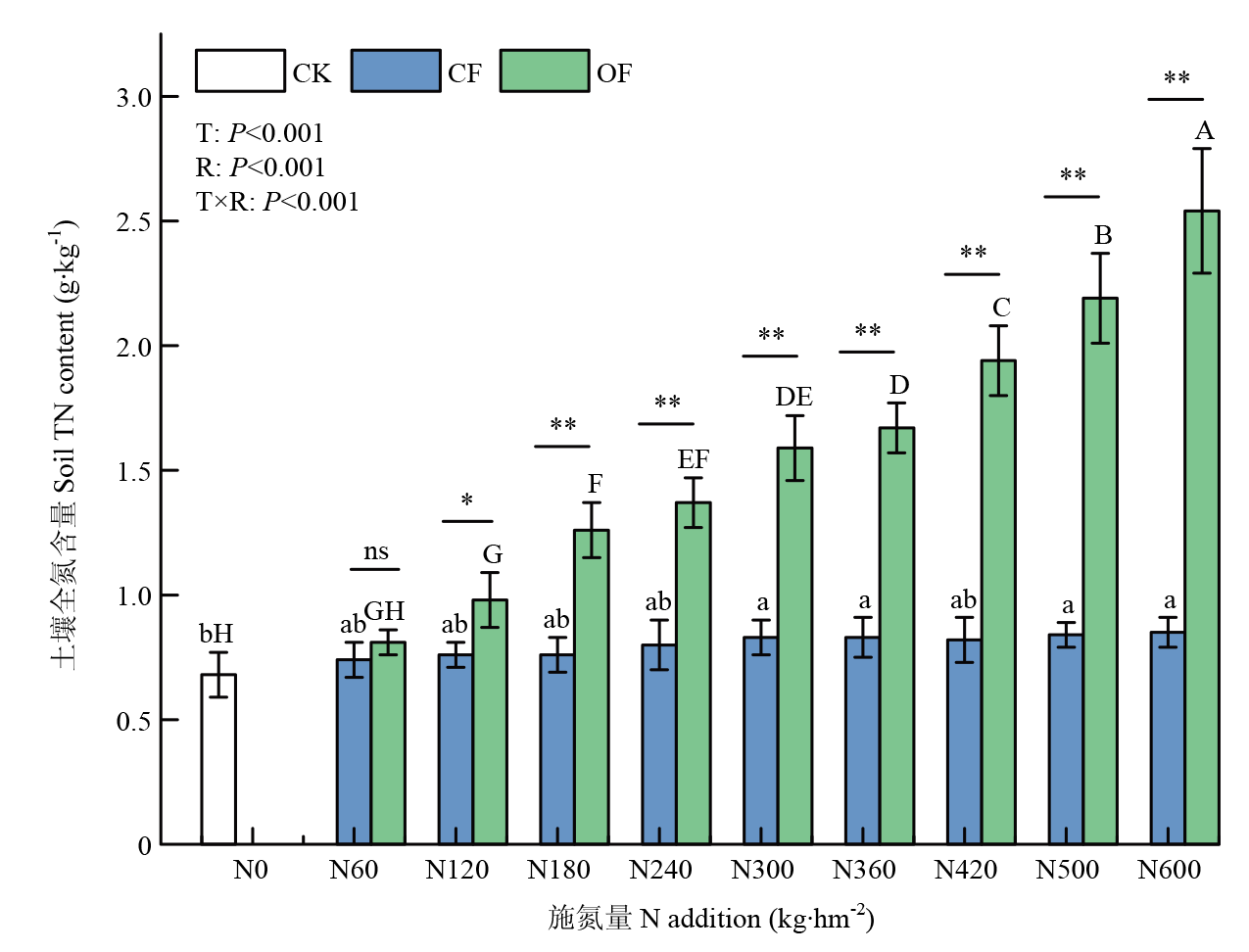
图1
不同施肥处理对土壤全氮含量的影响 CK为不施肥对照处理,CF为施化肥处理,OF为施有机肥处理。柱上不同小写字母表示化肥处理在不同施氮水平间差异显著(P<0.05);柱上大写字母表示有机肥处理在不同施氮水平间差异显著(P<0.05);T代表肥料类型,R代表施氮量,T×R代表肥料类型和施氮量的交互作用。**,*和ns分别代表等氮量下,有机肥和化肥处理在0.01,0.05水平差异显著和无显著影响。下同"
表1
不同施肥处理土壤氮库组分含量与氮肥用量的关系"
| 土壤氮组分 Soil nitrogen compositions | 函数关系 Function relation | |
|---|---|---|
| 化肥 Chemical fertilizer | 有机肥 Organic fertilizer | |
| 全氮 TN (g·kg-1) | y=0.0002x+0.72,R2=0.32*** | y=0.0031x+0.65,R2=0.96*** |
| 硝态氮 NO3--N (mg·kg-1) | y=0.0440x-2.860,R2=0.77*** | y =0.1092x-7.826,R2=0.91*** |
| 铵态氮 NH4+-N (mg·kg-1) | y=0.0028x+4.67,R2=0.39*** | y=0.0040x+5.01,R2=0.55*** |
| 酸解总氮 THN (mg·kg-1) | y=0.25x+465.74,R2=0.54*** | y=1.85x+433.02,R2=0.96*** |
| 非酸解氮 NHN (mg·kg-1) | — | y=1.24x+212.47,R2=0.95*** |
| 酸解铵态氮 AN (mg·kg-1) | y=0.12x+205.23,R2=0.71*** | y=0.49x+199.78,R2=0.93*** |
| 氨基酸态氮 AAN (mg·kg-1) | y=0.14x+169.82,R2=0.76*** | y=0.93x+150.94,R2=0.91*** |
| 氨基糖态氮 ASN (mg·kg-1) | y=0.02x+17.60,R2=0.76*** | y=0.10x+12.53,R2=0.91*** |
| 酸解未知氮 HUN (mg·kg-1) | y=-0.03x+73.08,R2=0.24** | y=0.32x+69.77,R2=0.84*** |
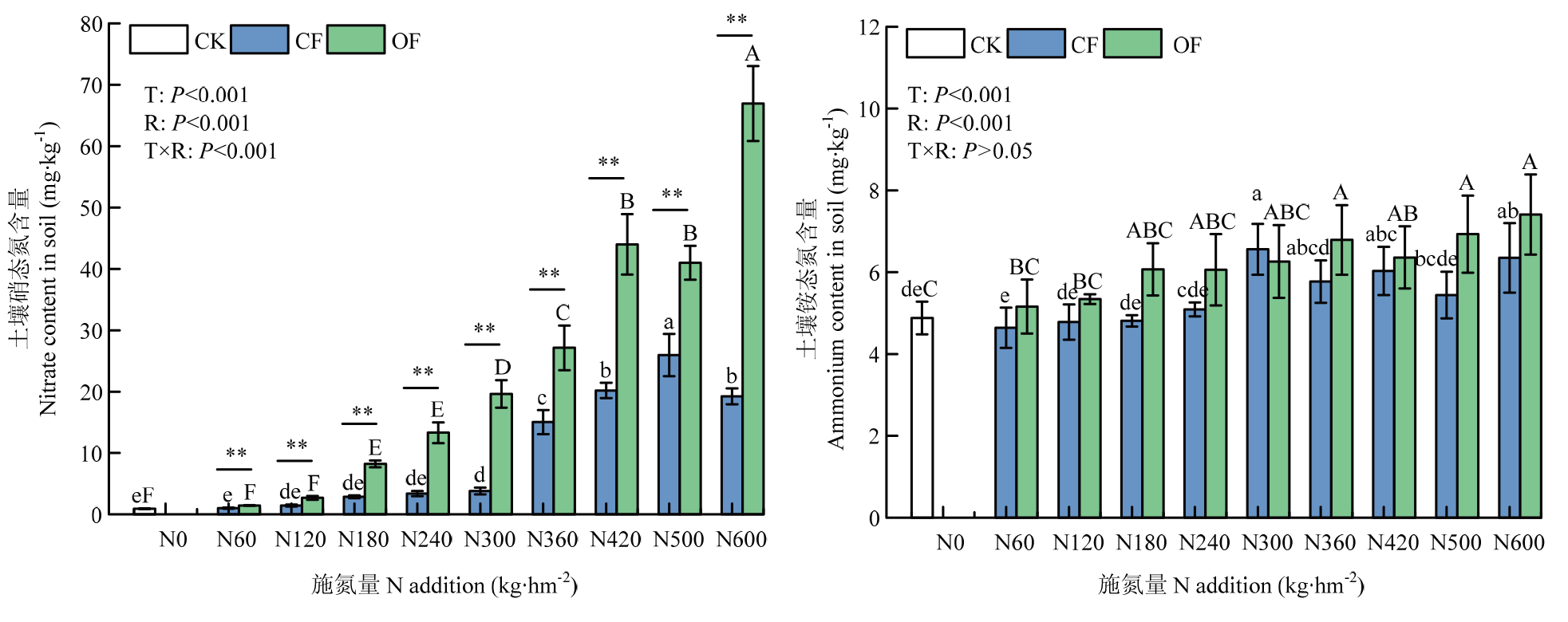
图2
不同施肥处理对土壤无机氮组分含量的影响"
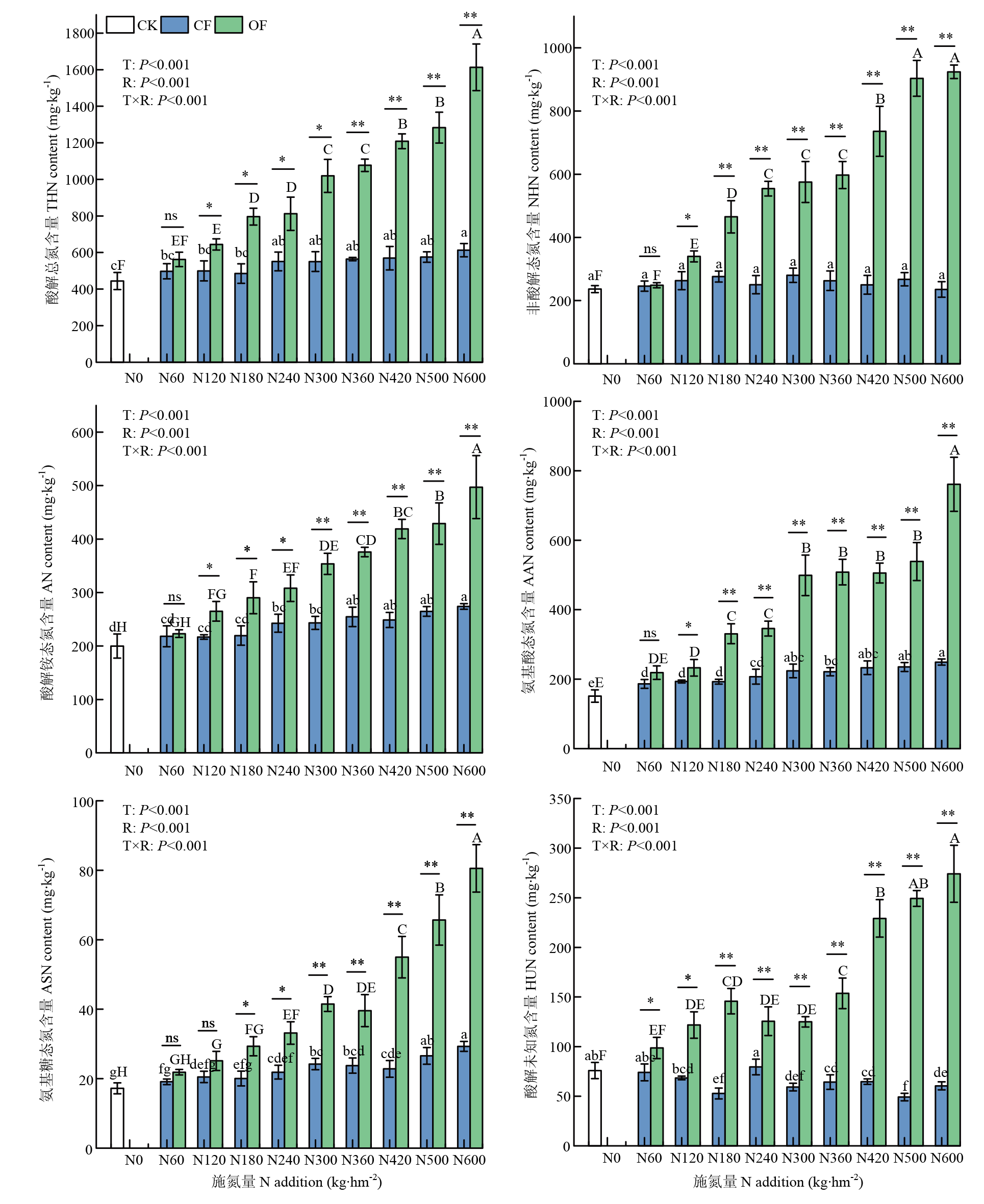
图3
不同施肥处理对土壤有机氮组分含量的影响"
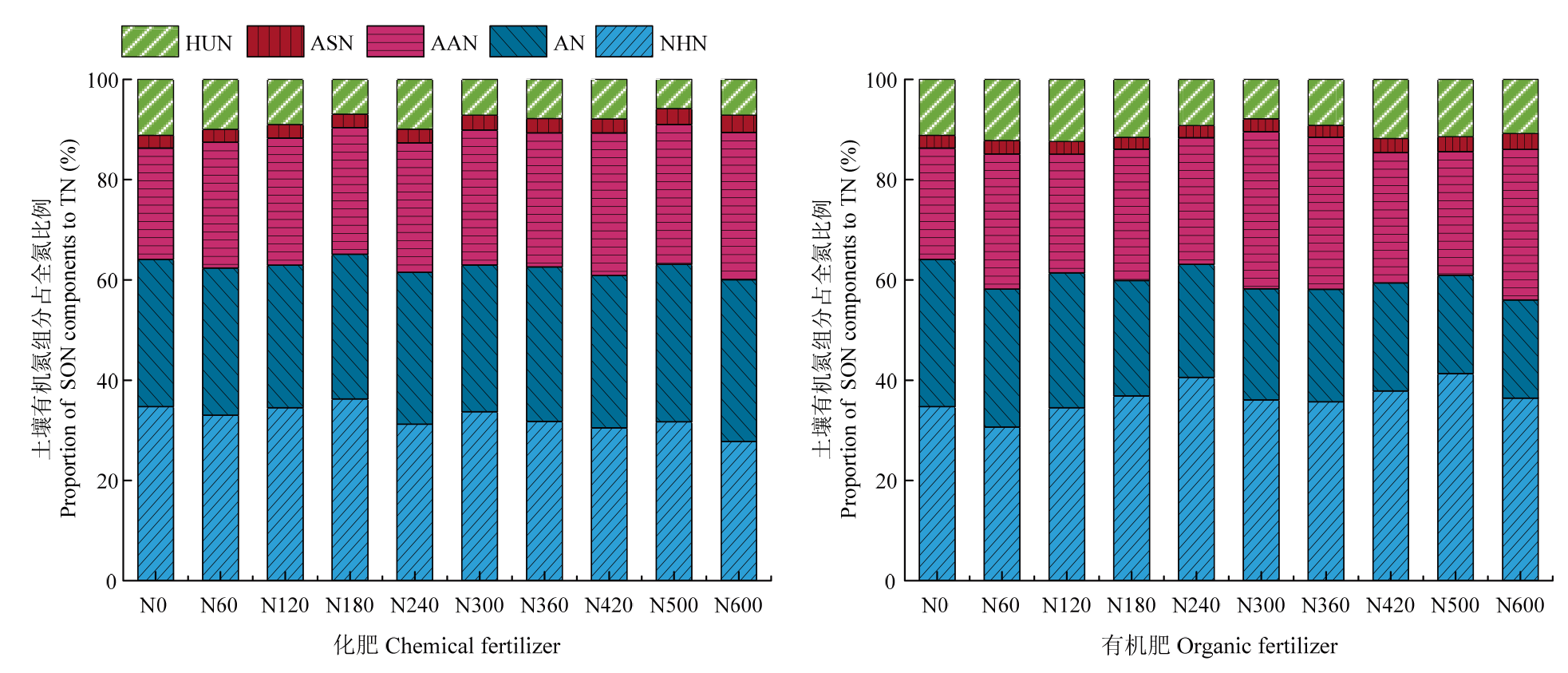
图4
不同施肥处理土壤有机氮组分含量占全氮比例 NHN:非酸解氮Non-acid hydrolyzable N;AN:酸解铵态氮Acid hydrolyzed ammonium N;AAN:氨基酸态氮Amino acid N;ASN:氨基糖态氮Amino sugar N;HUN:酸解未知氮Acid hydrolyzed unknown N。图6同 The same as Table 6"
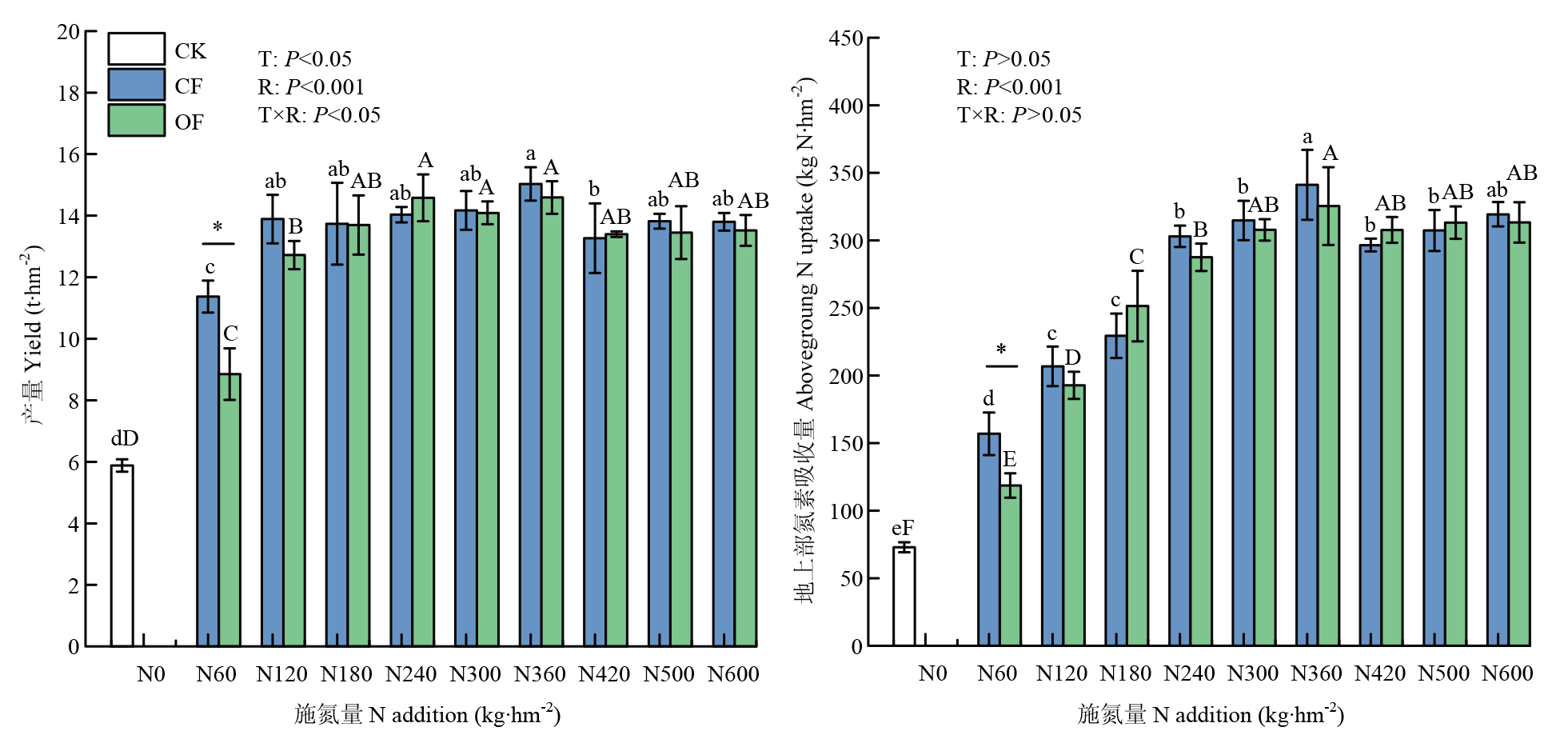
图5
不同施肥处理夏玉米产量与地上部氮吸收量 地上部氮素吸收量为籽粒和秸秆氮吸收量之和"
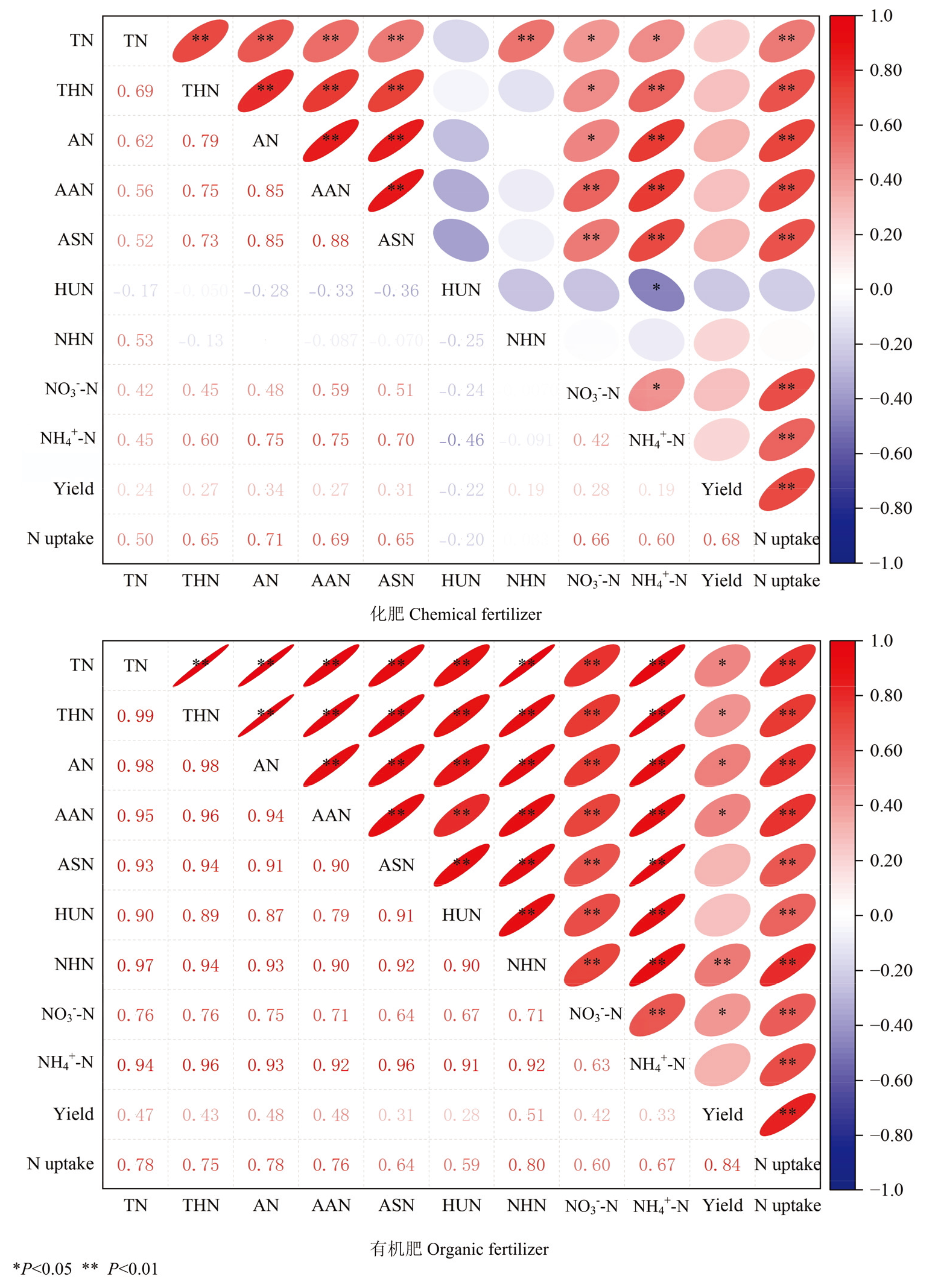
图6
土壤氮库组分与玉米产量、地上部氮吸收量的相关性 图中数值为各土壤指标间 Pearson 相关系数,*、**分别表示相关达到0.05、0.01显著水平;红色、蓝色分别表示正相关、负相关;椭圆越扁长表示相关性的绝对值越大"
| [1] |
吕超群, 田汉勤, 黄耀. 陆地生态系统氮沉降增加的生态效应[J]. 植物生态学报, 2007, 31(2): 205-218.
doi: 10.17521/cjpe.2007.0025 |
|
doi: 10.17521/cjpe.2007.0025 |
|
| [2] |
doi: 10.1111/gcb.14908 pmid: 31789452 |
| [3] |
doi: 10.1016/j.geoderma.2016.07.022 |
| [4] |
doi: 10.1016/j.still.2017.03.008 |
| [5] |
doi: 10.1002/jpln.v179.1 |
| [6] |
doi: 10.1016/j.scitotenv.2016.02.020 |
| [7] |
董姝含, 吕慧捷, 周锋, 张效琛, 何红波, 张旭东, 张威. 玉米土壤有机氮组分的生长季动态变化及其对当季和长期秸秆还田的响应[J]. 生态学杂志, 2022, 41(1): 73-80.
|
|
|
|
| [8] |
伍玉鹏, 邓婵娟, 姜炎彬, 胡荣桂. 长期施肥对水稻土有机氮组分及氮素矿化特性的影响[J]. 农业环境科学学报, 2015, 34(10): 1958-1964.
|
|
|
|
| [9] |
宋震震, 李絮花, 李娟, 林治安, 赵秉强. 有机肥和化肥长期施用对土壤活性有机氮组分及酶活性的影响[J]. 植物营养与肥料学报, 2014, 20(3): 525-533.
|
|
|
|
| [10] |
张珂珂, 宋晓, 郭斗斗, 黄晨晨, 岳克, 张水清, 黄绍敏. 长期施肥措施下潮土土壤碳氮及小麦产量稳定性的变化特征[J]. 华北农学报, 2021, 36(3): 142-149.
doi: 10.7668/hbnxb.20191883 |
|
doi: 10.7668/hbnxb.20191883 |
|
| [11] |
王娟, 吕家珑, 徐明岗, 段英华, 王伯仁, 黄晶. 长期不同施肥下红壤氮素的演变特征[J]. 中国土壤与肥料, 2010(1): 1-6.
|
|
|
|
| [12] |
温延臣, 李燕青, 袁亮, 李娟, 李伟, 林治安, 赵秉强. 长期不同施肥制度土壤肥力特征综合评价方法[J]. 农业工程学报, 2015, 31(7): 91-99.
|
|
|
|
| [13] |
赵丹丹, 王俊, 付鑫. 长期定位施肥对旱作农田土壤全氮及其组分的影响[J]. 水土保持学报, 2016, 30(4): 303-307.
|
|
|
|
| [14] |
杜健, 张建文, 贾改秀, 赵安宇, 马丽君, 索东让, 邹悦, 孙宁科. 长期不同施肥对灌漠土土壤氮素的影响[J]. 华北农学报, 2025, 40(4): 157-165.
doi: 10.7668/hbnxb.20195561 |
|
doi: 10.7668/hbnxb.20195561 |
|
| [15] |
张玉树, 丁洪, 王飞, 郑祥洲, 翁伯琦, 林诚, 张晶. 长期施用不同肥料的土壤有机氮组分变化特征[J]. 农业环境科学学报, 2014, 33(10): 1981-1986.
|
|
|
|
| [16] |
doi: 10.17221/160/2024-PSE |
| [17] |
doi: 10.2136/sssaj2008.0233 |
| [18] |
李萌, 王昌全, 李冰, 杨娟, 李喜喜, 游来勇, 李一丁. 猪粪替代氮肥对稻麦轮作条件下土壤有机氮组分的影响[J]. 土壤, 2016, 48(3): 449-454.
|
|
|
|
| [19] |
姜慧敏, 李树山, 张建峰, 杨俊诚, 李玲玲, 张水勤, 郭俊娒, 刘恋, 谢义琴, 王峰源. 外源化肥氮素在土壤有机氮库中的转化及关系[J]. 植物营养与肥料学报, 2014, 20(6): 1421-1430.
|
|
|
|
| [20] |
李树山, 杨俊诚, 姜慧敏, 张建峰, 李玲玲, 张水勤, 潘攀, 郭俊娒, 刘恋. 有机无机肥氮素对冬小麦季潮土氮库的影响及残留形态分布[J]. 农业环境科学学报, 2013, 32(6): 1185-1193.
|
|
|
|
| [21] |
doi: 10.4141/cjss86-060 |
| [22] |
肖伟伟, 范晓晖, 杨林章, 孙波. 长期定位施肥对潮土有机氮组分和有机碳的影响[J]. 土壤学报, 2009, 46(2): 274-280.
|
|
|
|
| [23] |
焦亚鹏, 齐鹏, 王晓娇, 武均, 姚一铭, 蔡立群, 张仁陟. 施氮量对农田土壤有机氮组分及酶活性的影响[J]. 中国农业科学, 2020, 53(12): 2423-2434. DOI: 10.3864/j.issn.0578-1752.2020.12.010.
|
|
|
|
| [24] |
沈其荣, 史瑞和. 不同土壤有机氮的化学组分及其有效性的研究[J]. 土壤通报, 1990, 21(2): 54-57.
|
|
|
|
| [25] |
吴汉卿, 张玉龙, 张玉玲, 邹洪涛, 虞娜. 土壤有机氮组分研究进展[J]. 土壤通报, 2018, 49(5): 1240-1246.
|
|
|
|
| [26] |
丁世杰, 黄绍敏, 张水清, 郭斗斗, 宋晓, 张珂珂, 岳克, 郭腾飞. 长期施肥下土壤氮素指标与小麦/玉米产量关系研究[J]. 核农学报, 2025, 39(1): 157-169.
doi: 10.11869/j.issn.1000-8551.2025.01.0157 |
|
doi: 10.11869/j.issn.1000-8551.2025.01.0157 |
|
| [27] |
徐晓峰, 刘迪, 付森林, 陈文亮. 小麦玉米轮作体系农田土壤有机氮组分对施氮量的响应[J]. 植物营养与肥料学报, 2023, 29(4): 628-639.
|
|
|
|
| [28] |
|
| [29] |
doi: 10.1016/j.still.2007.02.006 |
| [30] |
doi: 10.1016/j.still.2009.09.003 |
| [31] |
doi: 10.1016/j.soilbio.2022.108892 |
| [32] |
郝晓晖, 刘守龙, 童成立, 苏以荣, 吴金水, 胡荣桂. 长期施肥对两种稻田土壤微生物量氮及有机氮组分的影响[J]. 中国农业科学, 2007, 40(4): 757-764.
|
|
|
|
| [33] |
doi: 10.1038/s43016-023-00888-6 pmid: 38053005 |
| [34] |
郭勇, 文丽, 石丽红, 张腊梅, 程凯凯, 李超, 郑华斌, 唐海明. 长期不同施肥模式对大麦-双季稻田根际土壤有机氮组分的影响[J]. 土壤, 2024, 56(2): 273-280.
|
|
|
|
| [35] |
张金波, 程谊, 蔡祖聪. 土壤调配氮素迁移转化的机理[J]. 地球科学进展, 2019, 34(1): 11-19.
doi: 10.11867/j.issn.1001-8166.2019.01.0011 |
|
doi: 10.11867/j.issn.1001-8166.2019.01.0011 |
|
| [36] |
doi: 10.1111/ejss.2018.69.issue-3 |
| [37] |
高鹏, 雷星宇, 鲁耀雄, 张拓, 龙世平, 崔新卫, 彭福元. 有机氮部分替代化学氮肥对土壤有机氮组分的影响[J]. 中国土壤与肥料, 2023(10): 11-18.
|
|
|
|
| [38] |
石丽红, 唐海明, 孙耿, 孙梅, 龙泽东, 文丽, 程凯凯, 罗尊长. 长期不同施肥模式对双季稻田土壤酸解有机氮组分的影响[J]. 应用生态学报, 2022, 33(12): 3345-3351.
doi: 10.13287/j.1001-9332.202212.011 |
|
|
|
| [39] |
姬景红, 张玉龙, 黄毅, 虞娜, 张玉玲. 灌溉方法对保护地土壤有机氮组分及剖面分布的影响[J]. 水土保持学报, 2007, 21(6): 99-104.
|
|
|
|
| [40] |
党亚爱, 王国栋, 李世清. 黄土高原典型土壤有机氮组分剖面分布的变化特征[J]. 中国农业科学, 2011, 44(24): 5021-5030. DOI: 10.3864/j.issn.0578-1752.2011.24.007.
|
|
|
|
| [41] |
doi: 10.1016/j.molstruc.2011.05.035 |
| [42] |
富东英, 田秀平, 薛菁芳, 韩晓日. 长期施肥与耕作对白浆土有机态氮组分的影响[J]. 农业环境科学学报, 2005, 24(6): 1127-1131.
|
|
|
|
| [43] |
doi: 10.1007/s00374-018-1288-3 |
| [44] |
王媛, 周建斌, 梁斌, 刘东娜. 不同栽培模式和施氮量对小麦-玉米轮作体系土壤供氮特性的影响[J]. 植物营养与肥料学报, 2010, 16(6): 1351-1357.
|
|
|
|
| [45] |
李响, 何红波, 张威, 吕慧捷, 张旭东, 郑立臣, 田福林, 李红. 外源无机氮素形态对土壤氨基糖动态的影响[J]. 应用生态学报, 2012, 23(5): 1153-1158.
|
|
|
|
| [46] |
潘占东, 蔡雪梅, 蔡立群, 董博, 武均, 张仁陟. 田间老化生物质炭对黄土高原旱作农田土壤有机氮组分的影响[J]. 植物营养与肥料学报, 2023, 29(12): 2219-2231.
|
|
|
|
| [47] |
罗如熠, 张世熔, 徐小逊, 李婷. 黑河下游湿地土壤有机氮组分剖面的分布特征[J]. 生态学报, 2015, 35(4): 956-964.
|
|
|
|
| [48] |
李玥, 余亚琳, 张欣, 杨青城, 曾宇晴, 韩晓日, 杨劲峰. 连续施用炭基肥及生物炭对棕壤有机氮组分的影响[J]. 生态学杂志, 2017, 36(10): 2903-2909.
|
|
|
|
| [49] |
吴汉卿, 杜世宇, 王丹阳, 薛飞, 张玉玲, 邹洪涛, 张玉龙, 虞娜. 设施土壤有机氮组分及番茄产量对水氮调控的响应[J]. 植物营养与肥料学报, 2019, 25(5): 805-813.
|
|
|
|
| [50] |
李菊梅, 李生秀. 可矿化氮与各有机氮组分的关系[J]. 植物营养与肥料学报, 2003, 9(2): 158-164.
|
|
|
|
| [51] |
doi: 10.2136/sssaj2006.0401 |
| [1] | 侯慧芝, 尹嘉德, 马明生, 刘晓伟, 柳燕兰, 雷康宁. 耕作与增施有机肥对陇东马铃薯-玉米一年两熟制作物产量和水分利用的影响[J]. 中国农业科学, 2026, 59(8): 1672-1685. |
| [2] | 王彩玉, 刘小丽, 李文广, 杨文平, 杨珍平, 高志强. 有机肥不同替代比例对土壤多功能性的影响及微生物驱动机制[J]. 中国农业科学, 2026, 59(8): 1712-1726. |
| [3] | 李星宇, 黄容, 鲜一鸣, 田娇娇, 马晓瑾, 杨乔茜, 李冰, 王昌全. 稻田土壤不同粒级团聚体有机碳组分及CO2排放对长期施肥的响应[J]. 中国农业科学, 2026, 59(6): 1255-1271. |
| [4] | 魏圆慧, 余益辉, 李子钧, 丁文杰, 涂文龙, 毛艳玲. 长期施肥对黄泥田土壤有机碳化学结构与固碳细菌群落结构的影响[J]. 中国农业科学, 2026, 59(5): 1020-1033. |
| [5] | 王仁卓, 李玥颖, 黄绍敏, 姜桂英, 张琦, 刘超麟, 杨锦, 王梦茹, 王贝贝, 刘芳, 郭斗斗, 介晓磊, 宋练, 刘世亮. 长期有机无机肥配施对潮土细菌群落结构、生态网络及关键物种的影响[J]. 中国农业科学, 2026, 59(2): 354-367. |
| [6] | 叶嘉怡, 邬奇峰, 王嘉林, 周燕, 马晓敏, 梁辰飞, 秦华, 陈俊辉. 调理剂与有机肥配施对酸性稻田土壤性质及水稻产量的影响[J]. 中国农业科学, 2026, 59(14): 3121-3131. |
| [7] | 魏文龙, 王林林, 陈晓丽, 武凌彬, 李录芳, 解云婷, 王江文. 有机替代和地膜覆盖对旱地小麦根系生长、产量和水分利用效率的影响[J]. 中国农业科学, 2026, 59(11): 2340-2357. |
| [8] | 白雨欣, 刘灵芝, 安婷婷, 李双异, 汪景宽. 长期不同施肥对棕壤细菌群落结构和碳代谢功能的影响[J]. 中国农业科学, 2025, 58(8): 1579-1590. |
| [9] | 王钊, 张冰, 董思奇, 胡雨翕, 齐书宇, 冯国忠, 高强, 周雪. 长期施用氮肥对黑土和风沙土根际微生物群落结构及功能的影响[J]. 中国农业科学, 2025, 58(3): 520-536. |
| [10] | 陈均权, 马驰远, 胡鑫, 李朵, 郭艳琦, 刘灿, 周凯, 郑太辉. 有机无机肥配施调控红壤稻田土壤肥力、生态化学计量特征及产量[J]. 中国农业科学, 2025, 58(23): 4952-4966. |
| [11] | 钱芝瑾, 王西娜, 田海梅, 王月梅, 郝雯悦, 周慧, 谭军利. 引黄灌区连续减施化肥对春小麦籽粒品质稳定性的影响[J]. 中国农业科学, 2025, 58(22): 4703-4717. |
| [12] | 谢海鹏, 林俊旭, 刘勇, 麦贤俊, 罗丰, 王学武, 谢文, 李少卡, 孔祥义, 吴小燕. 施用不同有机肥对贝莱斯芽孢杆菌SD13防控豇豆枯萎病的影响[J]. 中国农业科学, 2025, 58(21): 4405-4420. |
| [13] | 袁慧琳, 李雅莹, 顾文杰, 徐培智, 卢钰升, 孙丽丽, 周昌敏, 黎婉玲, 仇荣亮. 长期施用新鲜与腐熟畜禽粪肥土壤溶解性有机质与微生物群落的特征及其关联性[J]. 中国农业科学, 2025, 58(2): 307-325. |
| [14] | 李月琪, 麻仲花, 苏明, 刘昊, 马风兰, 马小英, 李涛, 李清云, 张丹, 刘吉利, 吴娜. 不同耕作方式下盐碱地玉米光合物质生产能力对有机肥用量的响应[J]. 中国农业科学, 2025, 58(19): 3872-3889. |
| [15] | 方娅婷, 赵剑, 盛倩男, 李凯旭, 王祥华, 张洋洋, 朱俊, 丛日环, 陆志峰, 李小坤, 任涛, 鲁剑巍. 长期化肥和有机物料投入对稻油轮作作物产量和养分利用的影响[J]. 中国农业科学, 2025, 58(16): 3164-3177. |
|
||
