






中国农业科学 ›› 2026, Vol. 59 ›› Issue (18): 4092-4104.doi: 10.3864/j.issn.0578-1752.2026.18.011
韩小雨1,2( ), 朱玉萍2, 刘红芳2, 孙志梅1(), 张秀芝3, 高洪军3, 彭畅3, 张淑香2()
收稿日期:2025-10-31
接受日期:2026-01-24
出版日期:2026-09-16
发布日期:2026-09-20
通信作者:
联系方式:
韩小雨,E-mail:h13287895753@163.com。
基金资助:
HAN XiaoYu1,2(), ZHU YuPing2, LIU HongFang2, SUN ZhiMei1(), ZHANG XiuZhi3, GAO HongJun3, PENG Chang3, ZHANG ShuXiang2()
Received:2025-10-31
Accepted:2026-01-24
Published:2026-09-16
Online:2026-09-20
摘要:
【目的】探究长期不同施肥措施下土壤活性碳组分和碳水解酶的变化特征,为提升东北黑土肥力和优化施肥策略提供理论依据。【方法】依托吉林省公主岭市自1989年开始的黑土长期定位施肥试验,设置施氮钾肥(NK)、氮磷钾肥(NPK)、氮磷钾+秸秆(NPKS)、氮磷钾+有机肥(NPKM)4个处理,以不施肥(CK)为对照,测定不同施肥处理的土壤养分、淀粉酶(AMY)、蔗糖酶(SUC)、纤维二糖水解酶(CBH)、β-1,4-葡萄糖苷酶(βG)、颗粒有机碳(POC)、易氧化有机碳(EOC)、可溶性有机碳(DOC)及微生物量碳(MBC)含量。结合方差分析、相关分析、Mantel检验及偏最小二乘路径模型分析其变化特征及相关联系。【结果】与CK相比,NPKM处理对土壤有机碳及活性有机碳组分的提升最为全面,土壤有机碳含量(SOC)增加6.7 g·kg-1,POC、EOC、MBC及DOC含量分别显著提高2.5 g·kg-1、3.0 g·kg-1、97.5 mg·kg-1 和14.1 mg·kg-1,活性碳几何平均数大幅提升50.1%。NPKS处理下SOC、POC和MBC含量也显著提高了2.3 g·kg-1、1.5 g·kg-1和93.0 mg·kg-1。相比之下,NPK与NK处理均降低了POC、MBC含量,活性碳几何平均数分别降低24.7%与26.8%。碳库管理指数仅NPKM处理较CK显著提升55.9%,NK处理使碳库活度显著降低33.6%。在酶活性方面,与CK相比,所有施肥处理均提高了AMY活性,其中,NK与NPK处理还显著提高了CBH和βG活性,且NK处理的增幅最大,CBH增加167.3 μmol·g-1·h-1,βG增加457.7 μmol·g-1·h-1。在土壤养分方面,与CK相比,NPKM处理显著提高了土壤全氮(TN)、全磷(TP)、有效磷(AP)和速效钾(AK)含量,分别增加0.72 g·kg-1、1.85 g·kg-1、148.9 mg·kg-1和402.1 mg·kg-1。NK处理则导致pH显著下降2个单位,TP含量降低0.2 g·kg-1。此外,NK处理提高了土壤C∶P和N∶P,而其他施肥处理普遍降低了C∶N、C∶P和N∶P。相关性与路径分析表明,土壤TN、TP、AP和AK对POC、EOC及MBC的积累具有直接促进作用。而较高的C∶P和N∶P会通过激发CBH和βG活性,加速碳分解与矿化,从而抑制POC、EOC和MBC的积累。【结论】长期化肥配施有机肥不仅提高了土壤养分含量、还通过优化养分平衡和调节碳水解酶活性增加了土壤活性有机碳含量,是实现东北黑土地力提升的最优施肥策略。
韩小雨, 朱玉萍, 刘红芳, 孙志梅, 张秀芝, 高洪军, 彭畅, 张淑香. 长期施肥措施下黑土活性碳组分和碳水解酶的动态变化[J]. 中国农业科学, 2026, 59(18): 4092-4104.
HAN XiaoYu, ZHU YuPing, LIU HongFang, SUN ZhiMei, ZHANG XiuZhi, GAO HongJun, PENG Chang, ZHANG ShuXiang. Dynamics of Black Soil Labile Carbon Fractions and Carbon- Hydrolyzing Enzymes Under Long-Term Fertilization Regimes[J]. Scientia Agricultura Sinica, 2026, 59(18): 4092-4104.
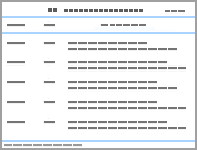
表1
长期定位试验施肥概况"
| 处理 Treatment | 化肥投入 Inorganic fertilizer input N-P-K (kg∙hm-2) | 有机物料投入 Organic material input N-P-K (kg∙hm-2) |
|---|---|---|
| CK | 0-0-0 | 0-0-0 |
| NK | 165-0-68 | 0-0-0 |
| NPK | 165-36-68 | 0-0-0 |
| NPKS | 112-36-68 | 53-6-77 |
| NPKM | 50-36-68 | 115-39-77 |
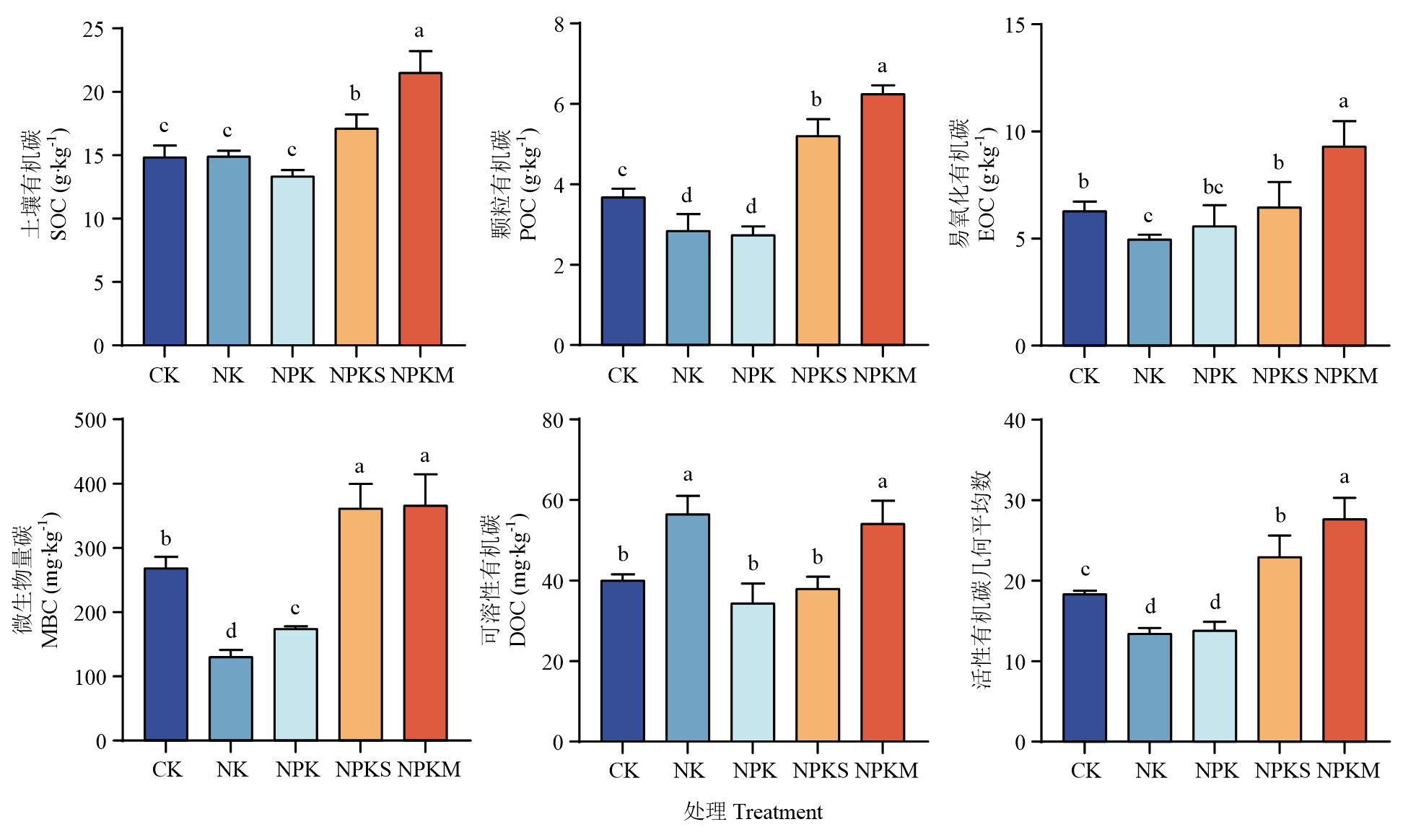
图1
不同施肥措施对土壤碳库组分的影响 图柱上不同小写字母表示各处理在0.05水平上差异显著。下同"
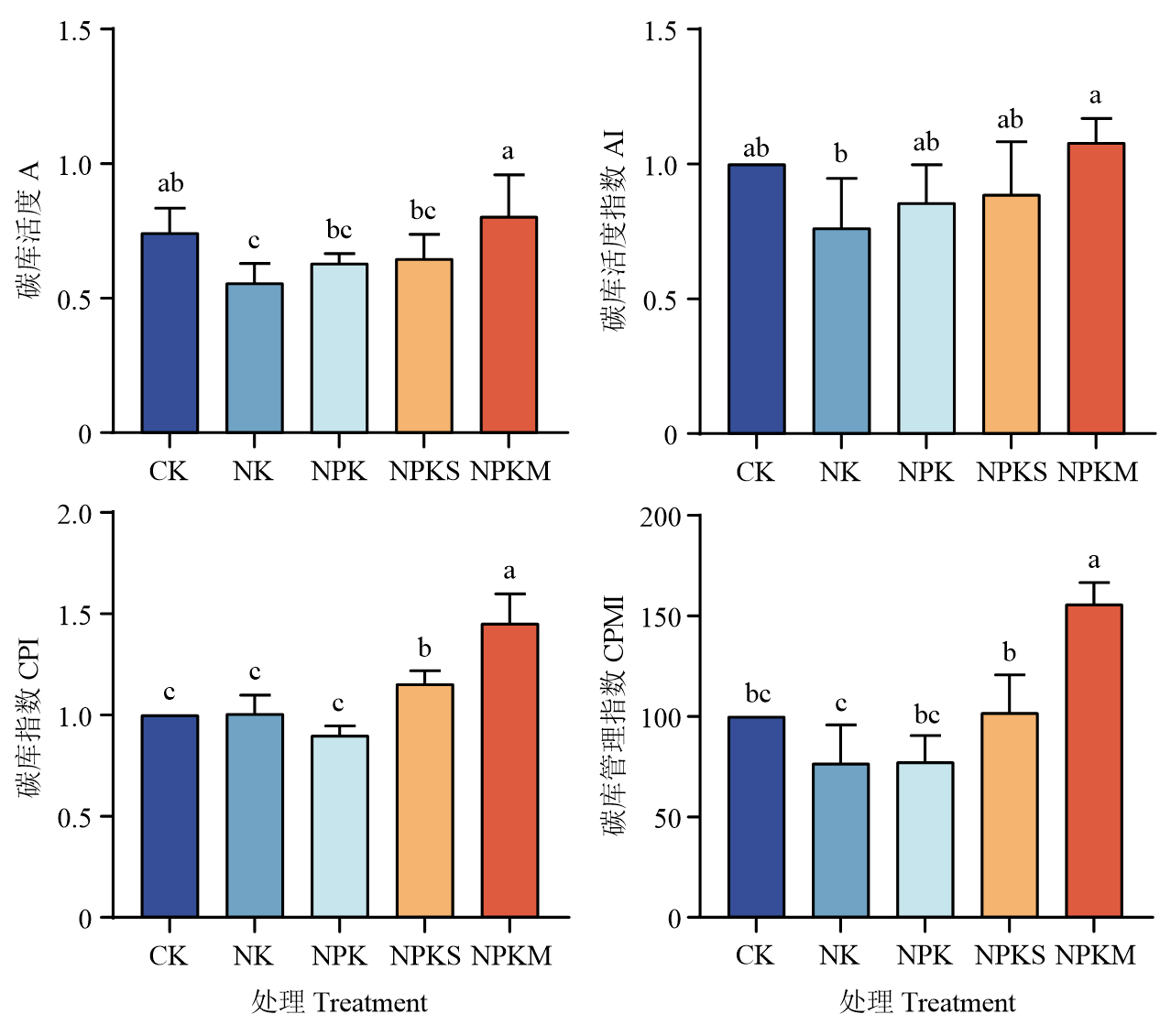
图2
不同施肥措施对土壤碳库质量的影响"
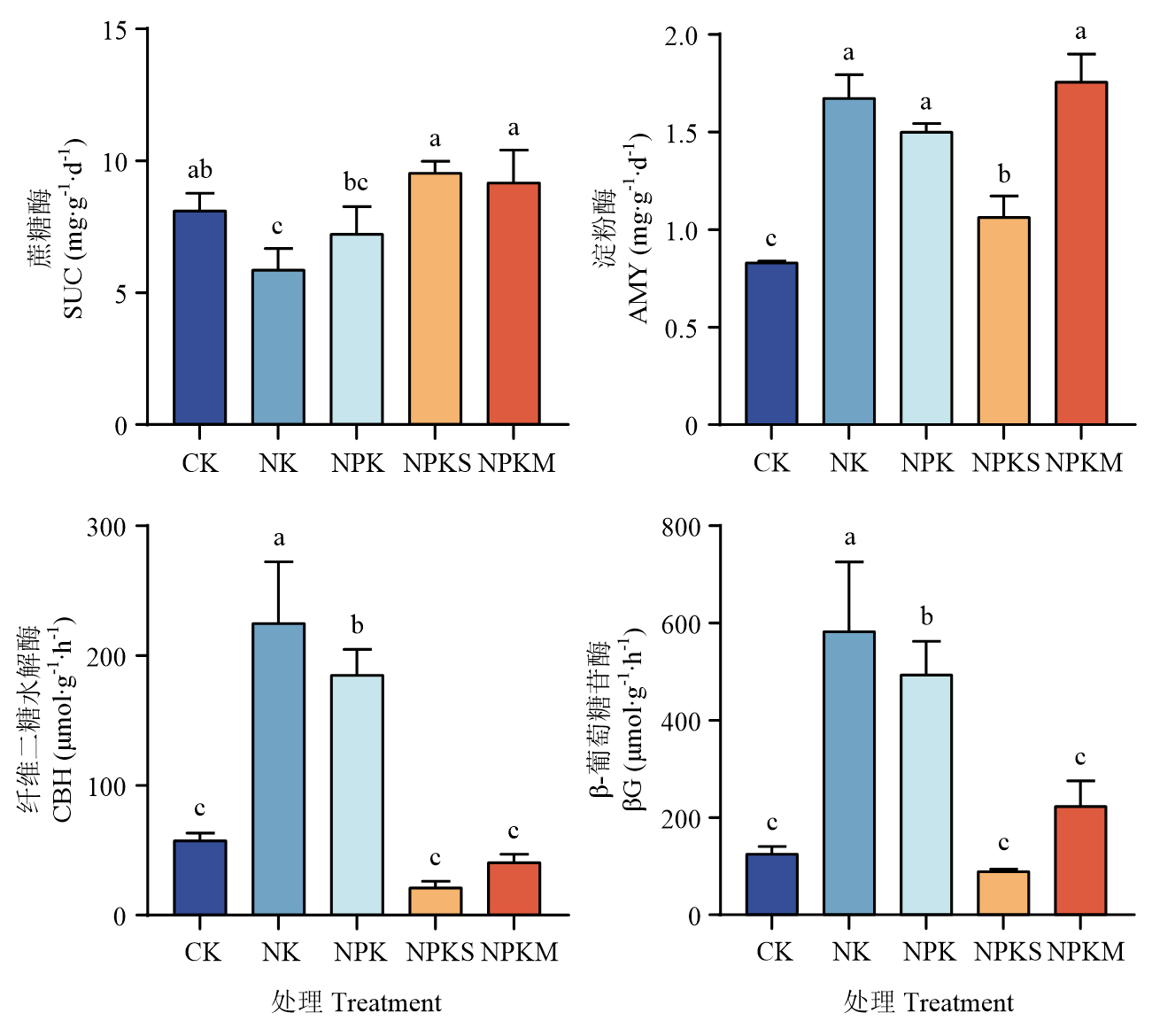
图3
不同施肥措施对土壤碳水解酶活性的影响"
表2
不同施肥措施对土壤养分的影响"
| 处理 | 酸碱度 pH | 全氮 TN (g∙kg-1) | 全磷 TP (g∙kg-1) | 全钾 TK (g∙kg-1) | 有效磷 AP (mg∙kg-1) | 速效钾 AK (mg∙kg-1) | 碳氮比 C:N | 碳磷比 C:P | 氮磷比 N:P |
|---|---|---|---|---|---|---|---|---|---|
| CK | 7.76±0.32a | 1.25±0.04cd | 1.03±0.04c | 20.61±0.45a | 7.39±0.51d | 191.30±8.77b | 11.87±0.78a | 14.45±1.47b | 1.22±0.06b |
| NK | 5.76±0.13d | 1.36±0.02bc | 0.84±0.05d | 20.54±0.60a | 8.41±1.16d | 208.03±10.48b | 11.00±0.15b | 17.74±1.01a | 1.61±0.08a |
| NPK | 6.44±0.14c | 1.22±0.04d | 1.13±0.04c | 20.61±0.28a | 26.22±0.91b | 202.01±8.92b | 10.95±0.07b | 11.80±0.34c | 1.08±0.02c |
| NPKS | 7.92±0.04a | 1.45±0.08b | 1.51±0.05b | 20.58±0.16a | 17.46±1.1c | 209.71±6.05b | 11.85±0.28a | 11.32±0.44c | 0.96±0.04d |
| NPKM | 7.30±0.19b | 1.97±0.12a | 2.88±0.13a | 21.22±0.16a | 156.33±10.42a | 255.89±17.57a | 10.91±0.19b | 7.47±0.24d | 0.68±0.01e |

图4
土壤养分与碳组分和碳库稳定性的Mantel分析(a)和相关性分析(b) SOC:土壤有机碳,TN:全氮,TP:全磷,TK:全钾,AP:有效磷,AK:速效钾,CBH:纤维二糖水解酶,βG:β-1,4-葡萄糖苷酶,SUC:蔗糖酶,AMY:淀粉酶,A:碳库活度,AI:碳库活度指数,CPI:碳库指数,CPMI:碳库管理指数,POC:颗粒有机碳,EOC:易氧化有机碳,MBC:微生物量碳,DOC:可溶性有机碳。下同"

图5
土壤养分、酶活性对土壤有机碳组分和碳库管理指数的影响路径"
| [1] |
|
| [2] |
樊军, 郝明德. 黄土高原旱地轮作与施肥长期定位试验研究Ⅱ.土壤酶活性与土壤肥力[J]. 植物营养与肥料学报, 2003, 9(2): 146-150.
|
|
|
|
| [3] |
doi: 10.1016/j.soilbio.2011.03.017 |
| [4] |
doi: 10.1016/j.catena.2018.07.023 |
| [5] |
史帆, 李文广, 易树生, 杨娜, 陈玉萌, 郑伟, 张雪辰, 李紫燕, 翟丙年. 有机无机肥配施下旱地麦田土壤有机碳组分含量的变化特征[J]. 中国农业科学, 2025, 58(4): 719-732. DOI: 10.3864/j.issn.0578-1752.2025.04.008.
|
|
|
|
| [6] |
徐烨红, 巴雯雯, 王炫清, 陆超, 罗佳, 马艳. 设施土壤溶解性有机质含量和质量对不同碳组分有机肥的响应[J]. 土壤学报. https://link.cnki.net/urlid/32.1119.P.20250402.1543.006.
|
|
|
|
| [7] |
doi: 10.1186/s12870-025-06128-2 pmid: 39865269 |
| [8] |
孙赫阳, 万忠梅, 刘德燕, 廖霞, 丁维新. 有机肥与无机肥配施对潮土N2O排放的影响[J]. 环境科学, 2020, 41(3): 1474-1481.
|
|
|
|
| [9] |
何伟, 王会, 韩飞, 胡国庆, 娄燕宏, 宋付朋, 潘红, 魏猛, 诸葛玉平. 长期施用有机肥显著提升潮土有机碳组分[J]. 土壤学报, 2020, 57(2): 425-445.
|
|
|
|
| [10] |
张瑞, 张贵龙, 姬艳艳, 李刚, 常泓, 杨殿林. 不同施肥措施对土壤活性有机碳的影响[J]. 环境科学, 2013, 34(1): 277-282.
|
|
|
|
| [11] |
doi: 10.1071/AR9951459 |
| [12] |
张嫒, 郑朝霞, 赵志远, 冯天宇, 郑伟, 翟丙年. 有机无机肥长期配施对果园土壤碳库及温室气体排放的影响[J]. 环境科学, 2023, 44(10): 5823-5831.
|
|
|
|
| [13] |
郭亚军, 邱慧珍, 张玉娇, 张建斌, 王友玲, 张春红, Anning Dominic Kwadwo. 不同施肥方式对马铃薯农田土壤有机碳组分和碳库管理指数的影响[J]. 土壤通报, 2021, 52(4): 912-919.
|
|
|
|
| [14] |
冯继广, 张秋芳, 袁霞, 朱彪. 氮磷添加对土壤有机碳的影响: 进展与展望[J]. 植物生态学报, 2022, 46(8): 855-870.
doi: 10.17521/cjpe.2021.0358 |
|
doi: 10.17521/cjpe.2021.0358 |
|
| [15] |
滕臻, 曹小青, 孙孟瑶, 李培玺, 徐小牛. 不同生态恢复模式对巢湖湖滨湿地土壤活性碳库及其管理指数的影响[J]. 生态环境学报, 2019, 28(4): 752-760.
doi: 10.16258/j.cnki.1674-5906.2019.04.014 |
|
doi: 10.16258/j.cnki.1674-5906.2019.04.014 |
|
| [16] |
doi: 10.1016/j.soilbio.2014.03.023 |
| [17] |
doi: 10.1016/j.soilbio.2016.01.016 |
| [18] |
章磊, 徐祎萌, 白美霞, 周燕, 秦华, 徐秋芳, 陈俊辉. 生物质炭配施有机物料对红壤碳组分及酶生态化学计量特征的影响[J]. 浙江农林大学学报, 2024, 41(3): 506-516.
|
|
|
|
| [19] |
doi: 10.1016/j.soilbio.2012.11.009 |
| [20] |
doi: 10.1016/S0038-0717(03)00165-2 |
| [21] |
doi: 10.1016/S0038-0717(03)00123-8 |
| [22] |
doi: 10.1007/s10533-013-9849-x |
| [23] |
鲍士旦. 土壤农化分析[M]. 3版. 北京: 中国农业出版社, 2000.
|
|
|
|
| [24] |
doi: 10.2136/sssaj1992.03615995005600030017x |
| [25] |
|
| [26] |
doi: 10.1016/0038-0717(87)90052-6 |
| [27] |
关松荫. 土壤酶及其研究法[M]. 北京: 农业出版社, 1986.
|
|
|
|
| [28] |
季若彤, 解雪峰, 贾振毅,
|
|
|
|
| [29] |
钟泽坤. 增温和降雨改变对黄土丘陵区撂荒草地土壤碳循环关键过程的影响[D]. 杨凌: 西北农林科技大学, 2021.
|
|
|
|
| [30] |
doi: 10.1007/s11427-023-2432-9 |
| [31] |
doi: 10.1007/s11104-010-0626-5 |
| [32] |
doi: 10.1016/j.soilbio.2013.01.011 |
| [33] |
doi: 10.2134/jeq2011.0451 pmid: 22565271 |
| [34] |
doi: 10.1007/s11157-018-9466-1 |
| [35] |
doi: 10.1126/science.1182570 pmid: 20150447 |
| [36] |
doi: 10.1111/gcb.12475 pmid: 24273056 |
| [37] |
doi: 10.1021/acscatal.4c01083 |
| [38] |
doi: 10.1080/00380768.2023.2175178 |
| [39] |
郭超, 盛茂银, 何宇, 王霖娇, 石庆龙, 罗娜娜. 土地利用方式对西南喀斯特土壤碳、氮、磷化学计量特征及酶活性的影响[J]. 土壤通报, 2023, 54(2): 382-391.
|
|
|
|
| [40] |
doi: 10.1111/gcb.2013.19.issue-4 |
| [41] |
李天娇, 张乃于, 申文艳, 宋天昊, 刘红芳, 刘晓燕, 张秀芝, 彭畅, 杨劲峰, 张淑香. 长期施肥对黑土和棕壤团聚体稳定性的影响及驱动因素[J]. 中国农业科学, 2024, 57(19): 3835-3847. DOI: 10.3864/j.issn.0578-1752.2024.19.010.
|
|
|
|
| [42] |
doi: 10.1016/j.soilbio.2010.04.003 |
| [43] |
李金垚, 潘雯, 王佳, 薛亮, 张显松, 李生. 土壤活性有机碳及碳库管理指数对石漠化治理措施的响应[J]. 林业科学研究, 2022, 35(5): 156-163.
|
|
|
|
| [44] |
哈文秀, 周金星, 庞丹波, 关颖慧, 崔明. 岩溶区不同恢复方式下土壤有机碳组分及酶活性研究[J]. 北京林业大学学报, 2019, 41(2): 1-11.
|
|
|
|
| [45] |
于贵瑞, 高扬, 王秋凤, 刘世荣, 申卫军. 陆地生态系统碳-氮-水循环的关键耦合过程及其生物调控机制探讨[J]. 中国生态农业学报, 2013, 21(1): 1-13.
|
|
|
|
| [46] |
宁川川, 王建武, 蔡昆争. 有机肥对土壤肥力和土壤环境质量的影响研究进展[J]. 生态环境学报, 2016, 25(1): 175-181.
doi: 10.16258/j.cnki.1674-5906.2016.01.026 |
|
|
|
| [47] |
高鹏, 崔新卫, 聂新星, 朱校奇, 鲁耀雄, 彭福元. 中药渣有机肥施用对土壤理化性质及枳壳产质量的影响[J]. 中国土壤与肥料, 2022(10): 73-80.
|
|
|
|
| [48] |
王旭, 李斐, 赵世翔. 冻融交替对土壤CO2排放影响的研究进展[J]. 土壤通报, 2022, 53(3): 728-737.
|
|
|
|
| [49] |
doi: 10.1016/j.jece.2021.105440 |
| [50] |
doi: 10.1016/j.agee.2015.09.038 |
| [51] |
于兆丰, 方明晴, 唐硕, 孙铭轩, 欧阳俊芃. 苏北县域农田土壤碳库的剖面变化特征分析[J]. 地理科学研究, 2022, 11(3): 290-295.
|
|
doi: 10.12677/GSER.2022.113030 |
|
| [52] |
王传杰, 王齐齐, 徐虎, 高洪军, 朱平, 徐明岗, 张文菊. 长期施肥下农田土壤-有机质-微生物的碳氮磷化学计量学特征[J]. 生态学报, 2018, 38(11): 3848-3858.
|
|
|
|
| [53] |
doi: 10.1038/nature08632 |
| [54] |
doi: 10.1016/j.soilbio.2004.09.014 |
| [55] |
申文艳. 长期施肥下黑土磷转化微生物特征及其对磷组分的影响[D]. 北京: 北京农学院, 2025.
|
|
|
|
| [56] |
doi: 10.1111/nph.2012.196.issue-1 |
| [1] | 李星宇, 黄容, 鲜一鸣, 田娇娇, 马晓瑾, 杨乔茜, 李冰, 王昌全. 稻田土壤不同粒级团聚体有机碳组分及CO2排放对长期施肥的响应[J]. 中国农业科学, 2026, 59(6): 1255-1271. |
| [2] | 魏圆慧, 余益辉, 李子钧, 丁文杰, 涂文龙, 毛艳玲. 长期施肥对黄泥田土壤有机碳化学结构与固碳细菌群落结构的影响[J]. 中国农业科学, 2026, 59(5): 1020-1033. |
| [3] | 刘梦阳, 刘洁, 陈翔, 王擎运, 罗来超, 齐永波, 田达, 李金才, 柴如山. 长期秸秆还田对砂姜黑土团聚体结构及磷组分分布的影响[J]. 中国农业科学, 2026, 59(3): 575-588. |
| [4] | 延廷霖, 杜娅丹, 胡笑涛, 王贺, 李晓雁, 王玉明, 牛文全, 谷晓博. 加气滴灌下氮肥有机替代对亏缺灌溉棉花产量和水分利用效率的影响[J]. 中国农业科学, 2026, 59(3): 602-618. |
| [5] | 王仁卓, 李玥颖, 黄绍敏, 姜桂英, 张琦, 刘超麟, 杨锦, 王梦茹, 王贝贝, 刘芳, 郭斗斗, 介晓磊, 宋练, 刘世亮. 长期有机无机肥配施对潮土细菌群落结构、生态网络及关键物种的影响[J]. 中国农业科学, 2026, 59(2): 354-367. |
| [6] | 王方洁, 徐久凯, 张水勤, 许猛, 李燕婷, 韩娟娟, 孟凡龙, 张静, 叶新新, 赵秉强, 袁亮. 长期单施有机肥和化肥对土壤氮库组分及供氮能力的影响[J]. 中国农业科学, 2026, 59(16): 3591-3604. |
| [7] | 李畅, 任凤玲, 张路平, 王树会, 乔磊, 孙楠, 徐明岗. 化肥有机肥配施提升东北黑土区土壤肥力水平并促进玉米高产的效应与主控因素[J]. 中国农业科学, 2026, 59(11): 2405-2419. |
| [8] | 王冰洁, 秦诗涵, 李德成, 胡文友, 姜军, 迟凤琴, 张超, 张久明, 徐英德, 汪景宽. 黑龙江省嫩江市土壤容重空间分布格局及传递函数构建[J]. 中国农业科学, 2025, 58(9): 1791-1803. |
| [9] | 韦文华, 李盼, 邵冠贵, 樊志龙, 胡发龙, 范虹, 何蔚, 柴强, 殷文, 赵连豪. 西北灌区青贮玉米产量及品质对减量灌水与有机无机肥配施的响应[J]. 中国农业科学, 2025, 58(8): 1521-1534. |
| [10] | 白雨欣, 刘灵芝, 安婷婷, 李双异, 汪景宽. 长期不同施肥对棕壤细菌群落结构和碳代谢功能的影响[J]. 中国农业科学, 2025, 58(8): 1579-1590. |
| [11] | 陈桂平, 李盼, 邵冠贵, 吴霞玉, 殷文, 赵连豪, 樊志龙, 胡发龙. 减量灌水与有机无机肥配施对青贮玉米吐丝期后叶片持绿特性的调控作用[J]. 中国农业科学, 2025, 58(7): 1381-1396. |
| [12] | 史帆, 李文广, 易树生, 杨娜, 陈玉萌, 郑伟, 张雪辰, 李紫燕, 翟丙年. 有机无机肥配施下旱地麦田土壤有机碳组分含量的变化特征[J]. 中国农业科学, 2025, 58(4): 719-732. |
| [13] | 王钊, 张冰, 董思奇, 胡雨翕, 齐书宇, 冯国忠, 高强, 周雪. 长期施用氮肥对黑土和风沙土根际微生物群落结构及功能的影响[J]. 中国农业科学, 2025, 58(3): 520-536. |
| [14] | 马鹤逍, 葛国龙, 张向前, 路战远, 王满秀, 戎美仁, 师晶晶, 张德健, 孙雪萍. 不同作物轮作系统对土壤易氧化有机碳和碳库活度差异性的影响[J]. 中国农业科学, 2025, 58(24): 5201-5215. |
| [15] | 房康睿, 丁世杰, 陈雨珊, 杨秉庚, 郭腾飞, 徐新朋, 赵士诚, 王秀斌, 黄绍敏, 仇少君, 何萍, 周卫. 有机无机肥配施下典型潮土小麦季有机肥氮磷的当季释放率[J]. 中国农业科学, 2025, 58(24): 5234-5246. |
|
||
