






中国农业科学 ›› 2026, Vol. 59 ›› Issue (11): 2405-2419.doi: 10.3864/j.issn.0578-1752.2026.11.008
李畅1,2( ), 任凤玲2,3, 张路平2, 王树会2, 乔磊2, 孙楠2(), 徐明岗1,2()
收稿日期:2025-10-16
接受日期:2025-11-26
出版日期:2026-06-01
发布日期:2026-06-03
通信作者:
联系方式:
李畅,E-mail:iamlichang@163.com。
基金资助:
LI Chang1,2(), REN FengLing2,3, ZHANG LuPing2, WANG ShuHui2, QIAO Lei2, SUN Nan2(), XU MingGang1,2()
Received:2025-10-16
Accepted:2025-11-26
Published:2026-06-01
Online:2026-06-03
摘要:
【目的】选取单施氮磷钾化肥(NPK)、化肥有机肥配施(NPKM)和单施有机肥(M)3种施肥模式为对象,综合考虑不同土壤类型、质地、pH及初始土壤有机碳(SOC)含量等背景条件,定量分析其对土壤肥力关键指标及玉米产量的影响程度与主控因素,为减缓黑土退化和玉米高产稳产提供科学依据。【方法】基于东北地区2000-2025年间发表的施肥对土壤肥力和产量影响的75篇文献、477组数据,采用Meta分析方法,从不同土壤类型、质地、pH及初始SOC含量4个方面定量阐述了相比NPK,NPKM和M处理对东北黑土理化性质、生物学特征及玉米产量的影响程度。并通过主成分分析及随机森林模型,明确不同土壤指标对土壤肥力指数和玉米产量的重要性。【结果】相比NPK,NPKM处理显著降低土壤容重(BD),平均降低6.2%,其中在pH<6.5条件下的降幅最大(12.3%)。相较于NPK,NPKM对SOC提升幅度为24.0%,在初始SOC含量<20 g·kg-1时增幅最大(30.6%),并随着初始SOC含量增高,SOC提升幅度变小。相比NPK,NPKM显著增加了碱解氮(AN)、有效磷(AP)和速效钾(AK)含量,其中在pH 6.5—7.0条件下增幅更大。玉米产量,NPKM处理平均增产超过25%,在pH 6.5—7.0时增幅最大(43.7%)。M处理对SOC的平均提升幅度为21.1%,在初始SOC含量<20 g·kg-1时增幅最大(42.5%),但随着初始SOC含量的增加其提升效应逐渐减弱。并且在部分条件下表现为降低全磷(TP,12.6%)或全钾(TK,3.7%)。NPKM和M处理的土壤肥力指数分别达0.7和0.6,均处于Ⅱ级高肥力水平。主成分分析和随机森林结果均表明,SOC是玉米增产的核心因子,其中NPKM处理的玉米增产影响因素为SOC、全氮(TN)、土壤微生物量碳(SMBC)和BD,累计解释率为60.2%;M处理玉米增产主要影响因素为SOC、BD、pH、SMBC和微生物量氮(SMBN),累计解释率为63.6%。【结论】在东北黑土区,NPKM处理可显著降低BD,提升SOC、养分含量(TN、TP、TK、AN、AP、AK)、微生物量(SMBC、SMBN)及玉米产量,综合效应优于M处理。本研究明确了NPKM对东北黑土区土壤肥力与玉米产量的定量效应,同时也明确了SOC是NPKM处理下土壤肥力和玉米产量的核心驱动指标,提出了该施肥方式是提升黑土肥力和玉米高产稳产的最佳施肥方式。
李畅, 任凤玲, 张路平, 王树会, 乔磊, 孙楠, 徐明岗. 化肥有机肥配施提升东北黑土区土壤肥力水平并促进玉米高产的效应与主控因素[J]. 中国农业科学, 2026, 59(11): 2405-2419.
LI Chang, REN FengLing, ZHANG LuPing, WANG ShuHui, QIAO Lei, SUN Nan, XU MingGang. Effects and Dominant Controlling Factors of the Combined Application of Organic and Chemical Fertilizers on Elevating Soil Fertility and Maize Yield in the Black Soil Region of Northeast China[J]. Scientia Agricultura Sinica, 2026, 59(11): 2405-2419.
表1
中国东北黑土区试验点分布"
| 省份 Province | 试验点数量 Number of experimental sites |
|---|---|
| 黑龙江省Heilongjiang Province | 37 |
| 吉林省Jilin Province | 20 |
| 辽宁省Liaoning Province | 28 |
| 内蒙古自治区 Inner Mongolia Autonomous Region | 5 |
表2
不同施肥处理下土壤肥力指标与玉米产量的变量分类及分组定义"
| 解释变量 Categorical explanatory variables | 分组 Groups |
|---|---|
| 施肥方式 Fertilization | 单施化肥NPK 化肥有机肥配施NPKM 单施有机肥M |
| 土壤类型 Soil types | 黑土 Black soil 棕壤Brown soil |
| 土壤质地 Soil textures | 壤土Loam 黏土Clay |
| 土壤pH水平 Soil pH levels | 酸性Acidic(pH<6.5) 中性Neutral(pH 6.5-7.5) 碱性Alkaline(pH>7.5) |
| 起始SOC含量 Initial SOC contents | 较低水平Low SOC level SOC<20 g·kg-1 中水平Moderate SOC level SOC 20-30 g·kg-1 较高水平High SOC level SOC>30 g·kg-1 |
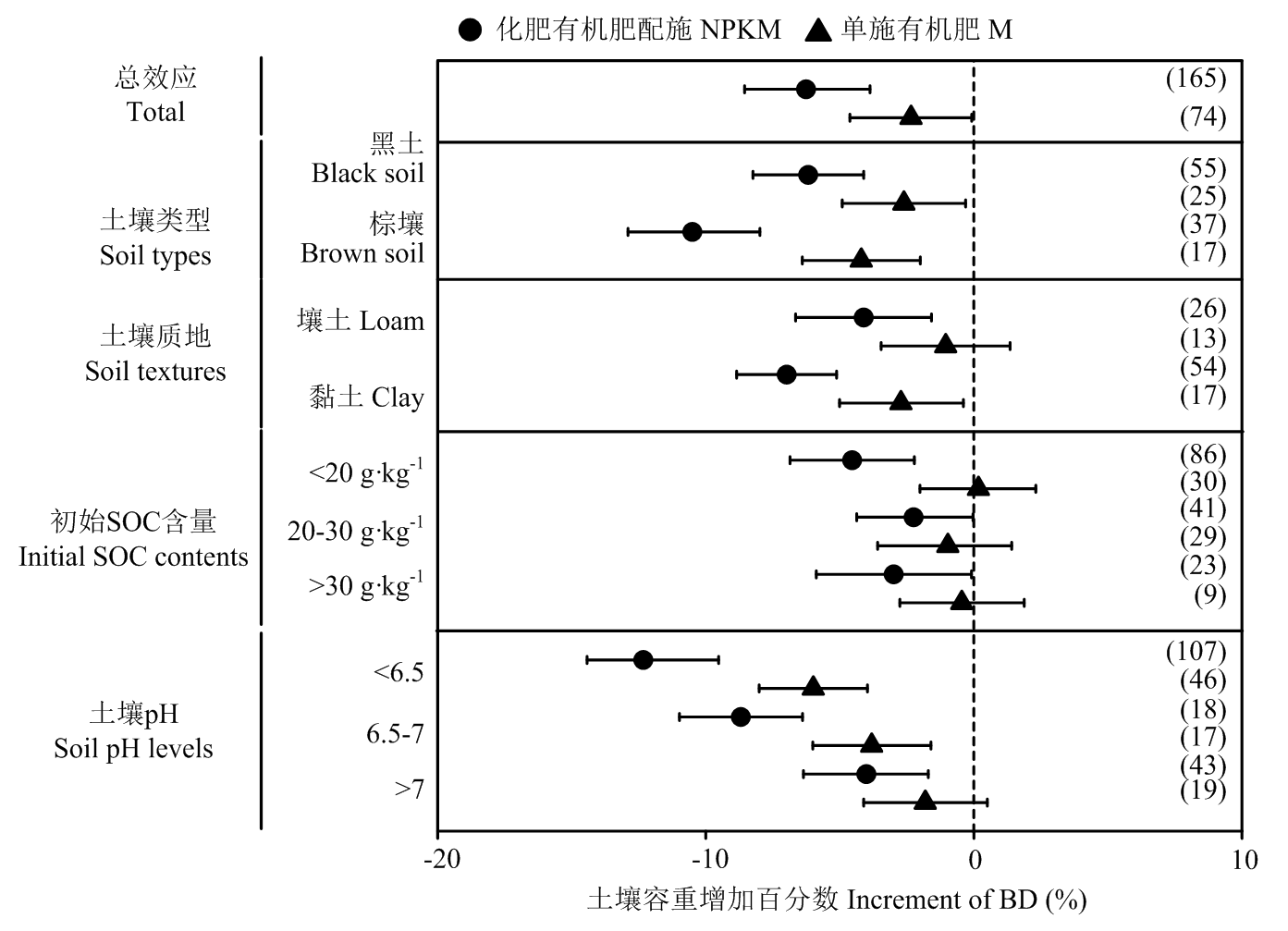
图1
相比NPK处理, 不同土壤类型、土壤质地、土壤pH 和初始 SOC 含量条件下不同施肥方式对土壤容重的影响"
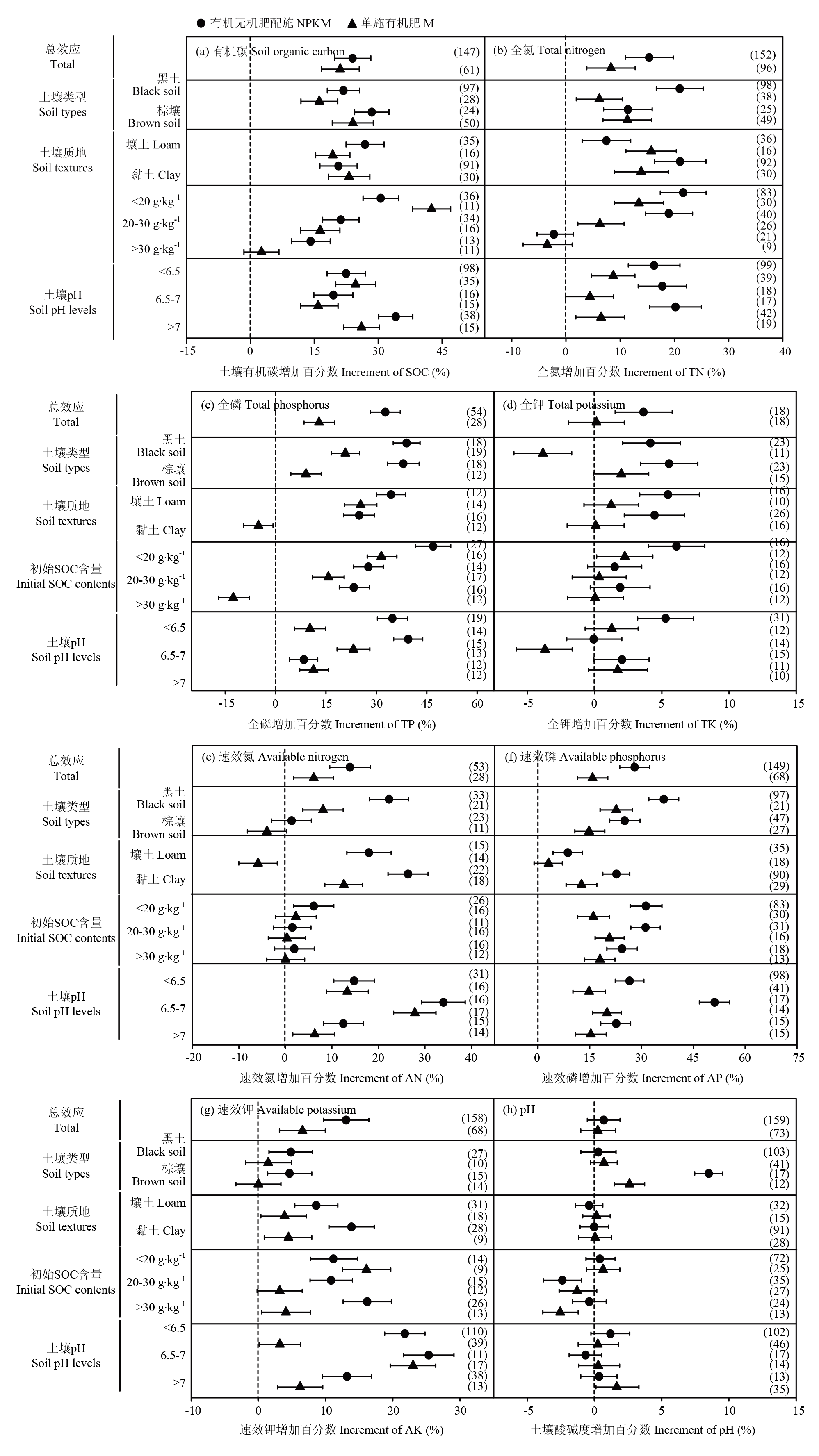
图2
相比NPK处理,不同土壤类型、土壤质地、土壤pH 和初始 SOC 含量下不同施肥方式对土壤化学指标的影响"
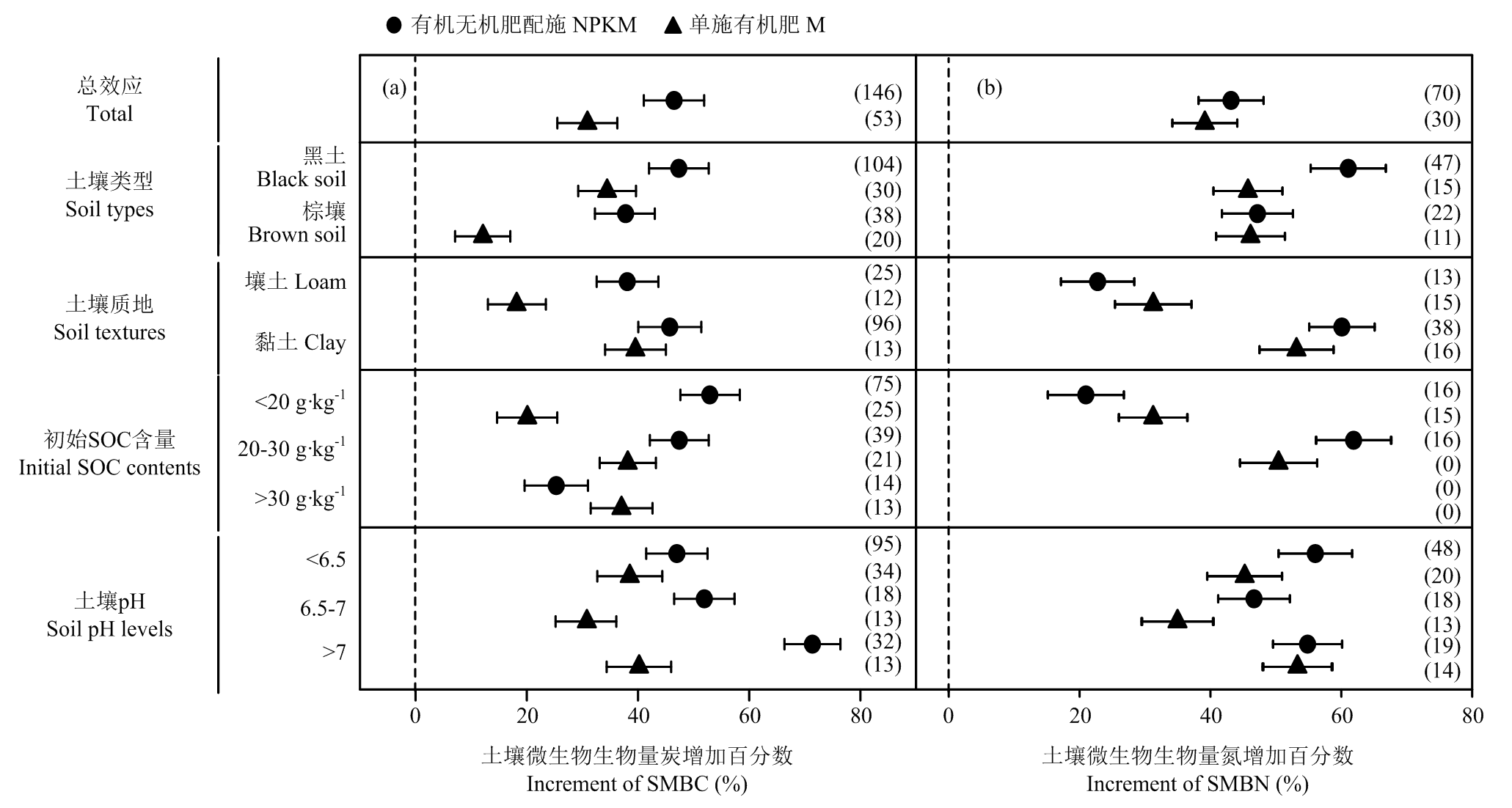
图3
相比NPK处理, 不同土壤类型、土壤质地、土壤pH和初始 SOC 含量条件下不同施肥方式对土壤微生物量碳(a)和微生物量氮(b)的影响"
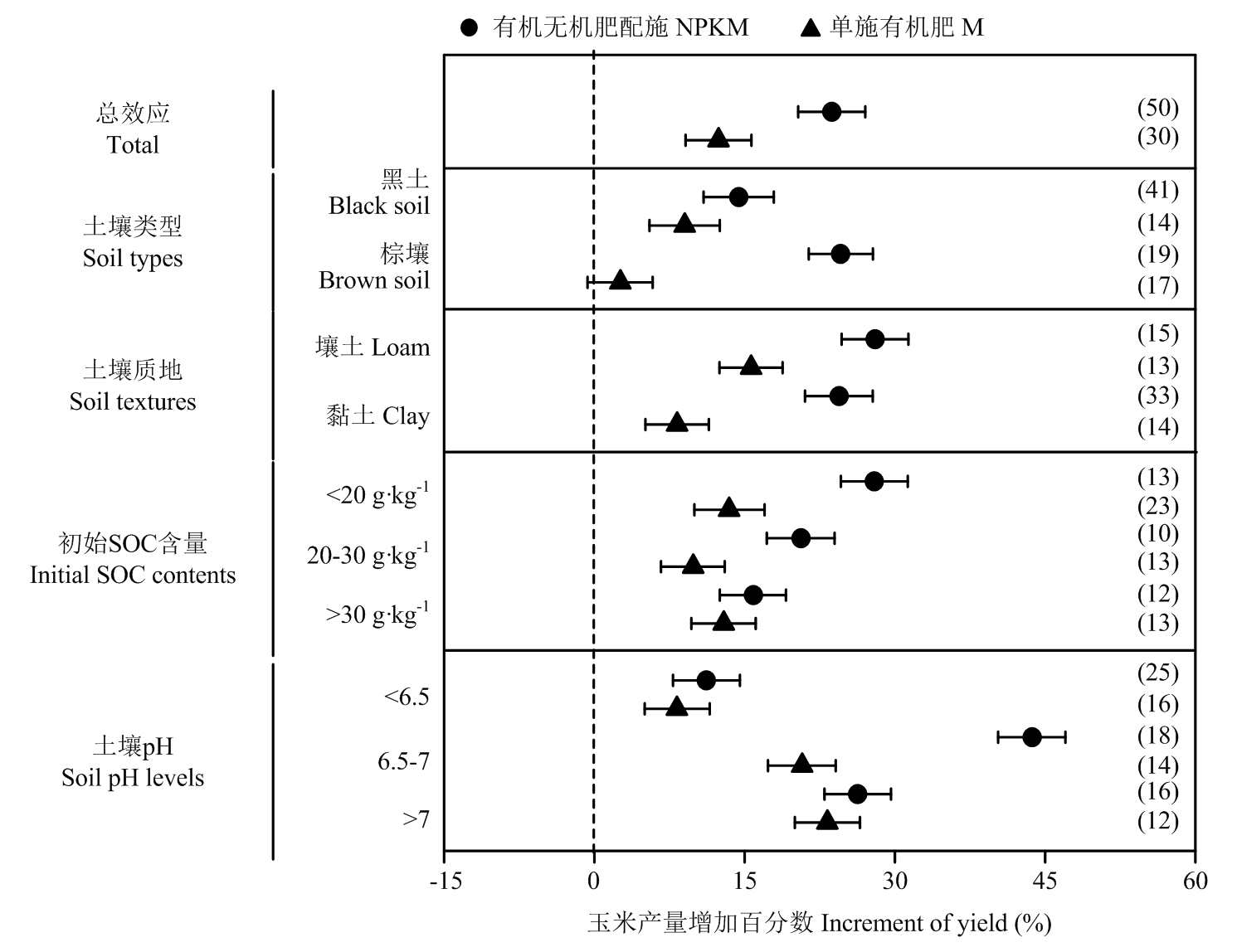
图4
相比NPK处理, 不同土壤类型、土壤质地、土壤pH 和初始 SOC 含量条件下不同施肥方式对玉米产量的影响"
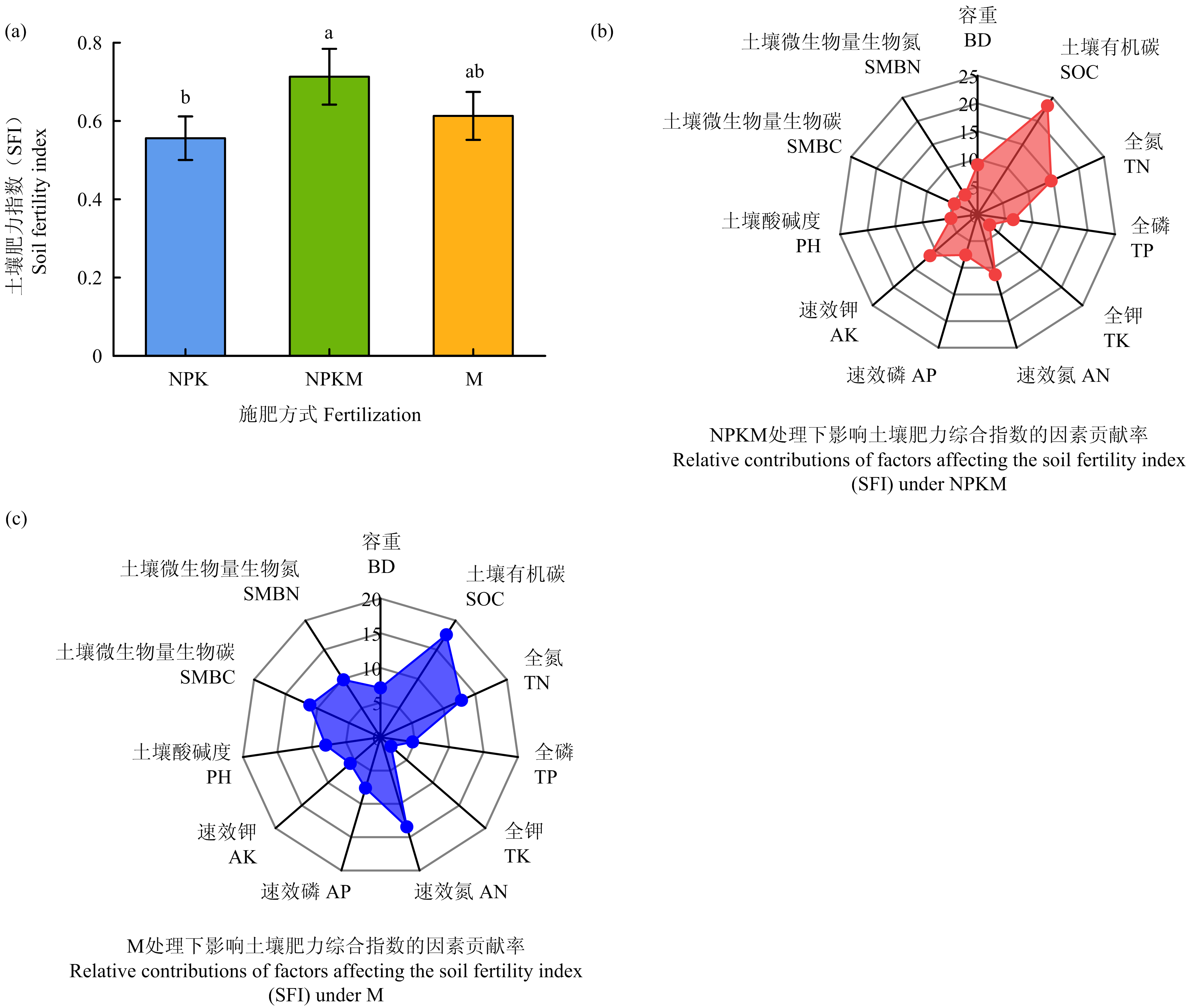
图5
不同施肥处理的土壤肥力综合指数及主要贡献因子权重"
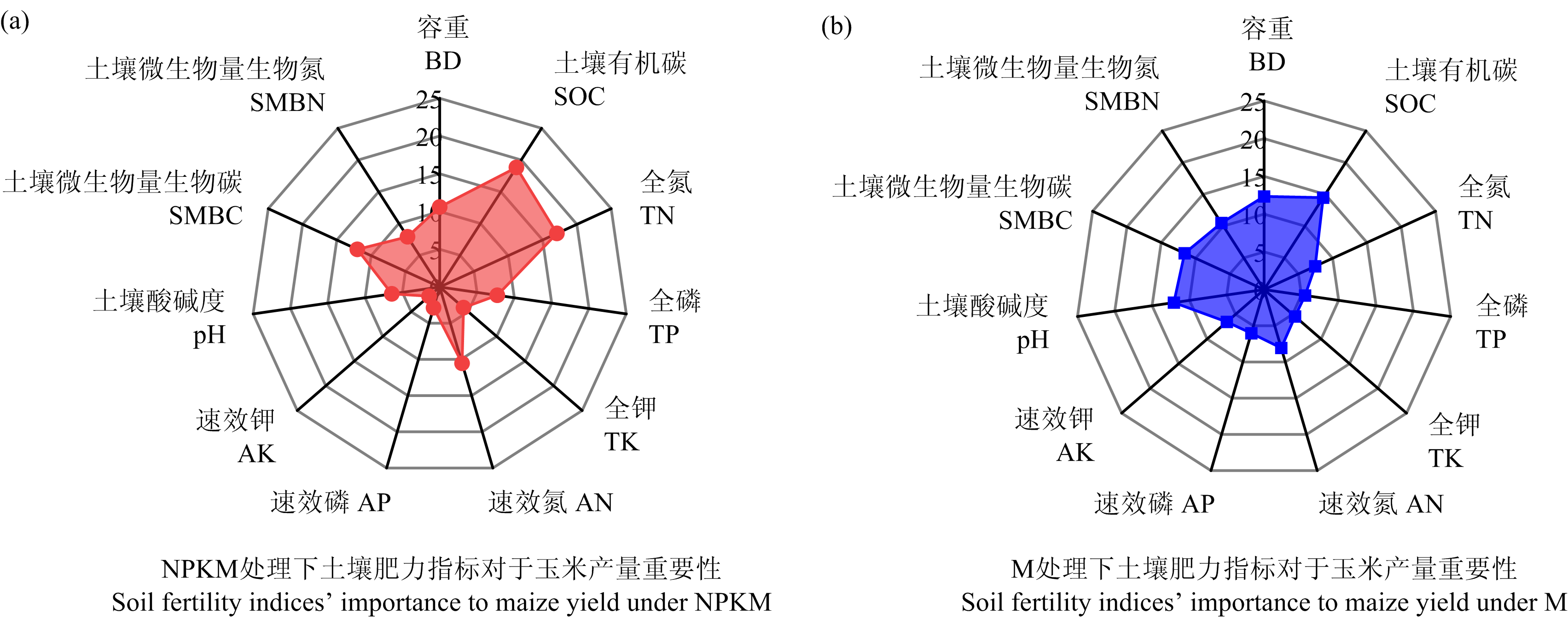
图6
不同施肥处理的土壤肥力指标对于玉米产量的重要性"
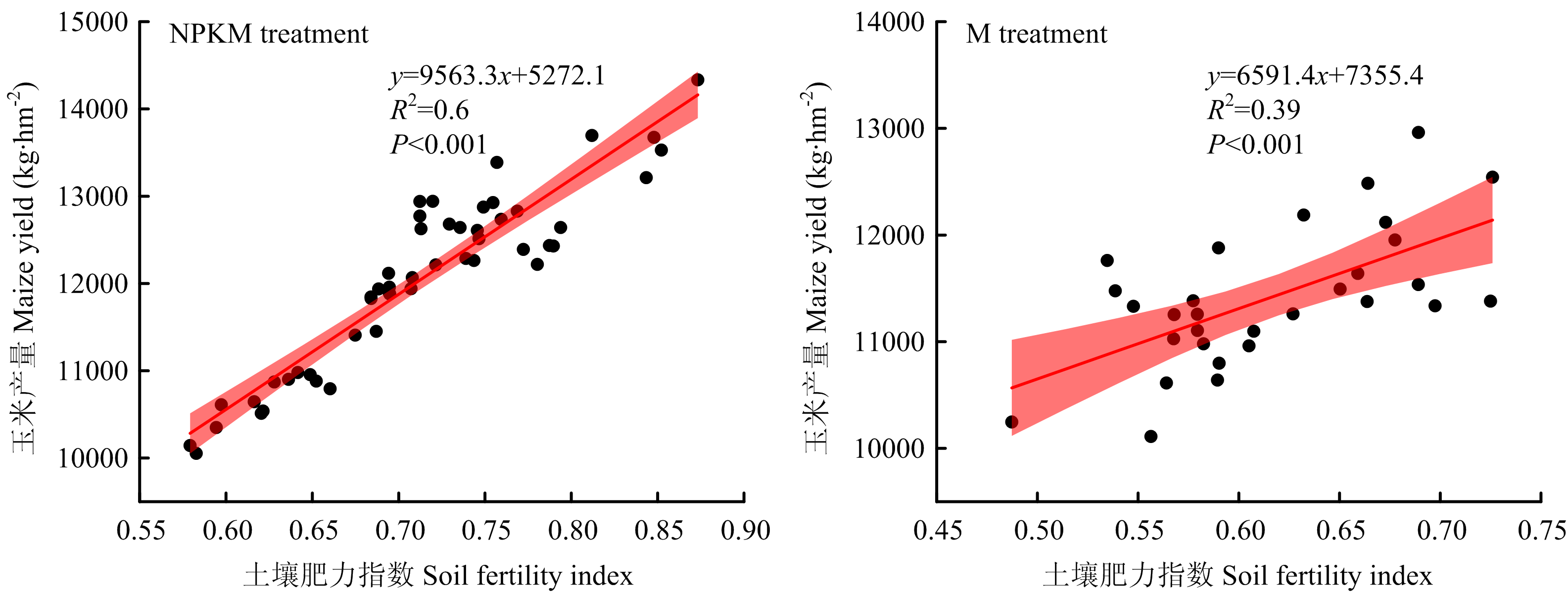
图7
NPKM和M处理的土壤肥力指数与玉米产量的关系"
| [1] |
doi: 10.1111/gcb.2012.18.issue-11 |
| [2] |
李保国, 刘忠, 黄峰, 杨晓光, 刘志娟, 万炜, 汪景宽, 徐英德, 李子忠, 任图生. 巩固黑土地粮仓保障国家粮食安全. 中国科学院院刊, 2021, 36(10): 1184-1193.
|
|
|
|
| [3] |
doi: 10.1016/j.soilbio.2015.12.012 |
| [4] |
doi: 10.4141/cjss2010-058 |
| [5] |
doi: 10.1002/jsfa.2016.96.issue-4 |
| [6] |
doi: 10.1111/sum.v36.3 |
| [7] |
doi: 10.1088/1748-9326/ab9388 |
| [8] |
doi: 10.17221/394/2020-PSE |
| [9] |
|
| [10] |
任科宇, 徐明岗, 张露, 段英华, 王伯仁. 我国不同区域粮食作物产量对有机肥施用的响应差异. 农业资源与环境学报, 2021, 38(1): 143-150.
|
|
|
|
| [11] |
于跃跃, 郭宁, 闫实, 姜言娇, 韩宝, 吴万军, 贾小红. 有机肥替代化肥对土壤肥力和玉米产量的影响. 中国土壤与肥料, 2021(3): 148-154.
|
|
|
|
| [12] |
焉莉, 王寅, 冯国忠, 杜晓晴, 刘烁然, 操梦颖, 高强. 不同施肥管理对东北黑土区氮损失的影响. 农业环境科学学报, 2016, 35(9): 1816-1823.
|
|
|
|
| [13] |
蔡宏光, 米国华, 张秀芝, 任军, 冯国忠, 高强. 不同施肥方式对东北黑土连续玉米种植氮平衡的影响. 植物营养与肥料学报, 2012, 18(1): 89-97.
|
|
|
|
| [14] |
谢钧宇, 张慧芳, 罗云琪, 孟会生, 张杰, 洪坚平, 徐明岗. 连续7年施有机肥和化肥提高复垦土壤上玉米产量的驱动因子. 农业工程学报, 2024, 40(1): 150-160.
|
|
|
|
| [15] |
王周, 李强, 彭畅, 姚颜莹, 朱天润, 焦云飞, 张秀芝, 高纪超, 高洪军. 有机肥氮替代50%化肥氮有效改善吉林省中部地区黑土团聚体性状. 植物营养与肥料学报, 2024, 30(12): 2247-2257.
|
|
|
|
| [16] |
李圆宾, 李鹏, 王舒华, 徐璐瑶, 邓建军, 焦加国. 稻麦轮作体系下有机肥施用对作物产量和土壤性质影响的整合分析. 应用生态学报, 2021, 32(9): 3231-3239.
doi: 10.13287/j.1001-9332.202109.024 |
|
|
|
| [17] |
李忠芳, 徐明岗, 张会民, 张文菊, 高静. 长期施肥下中国主要粮食作物产量的变化. 中国农业科学, 2009, 42(7): 2407-2414. doi: 10.3864/j.issn.0578-1752.2009.07.020.
|
|
|
|
| [18] |
查燕, 武雪萍, 张会民, 蔡典雄, 朱平, 高洪军. 长期有机无机配施黑土土壤有机碳对农田基础地力提升的影响. 中国农业科学, 2015, 48(23): 4649-4659. doi: 10.3864/j.issn.0578-1752.2015.23.006.
|
|
|
|
| [19] |
魏猛, 张爱君, 诸葛玉平, 李洪民, 唐忠厚, 陈晓光. 长期不同施肥对黄潮土区玉米产量稳定性的影响. 华北农学报, 2016, 31(6): 171-176.
doi: 10.7668/hbnxb.2016.06.027 |
|
doi: 10.7668/hbnxb.2016.06.027 |
|
| [20] |
邹文秀, 邱琛, 韩晓增, 郝翔翔, 刘晓洁, 陆欣春, 严君, 陈旭. 长期施用有机肥对黑土土壤肥力和玉米产量的影响. 土壤与作物, 2020, 9(4): 407-418.
|
|
|
|
| [21] |
doi: 10.3390/agriculture14030480 |
| [22] |
doi: 10.3389/fenvs.2023.1173509 |
| [23] |
刘忆莹, 裴久渤, 汪景宽. 东北典型黑土区耕地有机质与pH的空间分布规律及其相互关系. 农业资源与环境学报, 2019, 36(6): 738-743.
|
|
|
|
| [24] |
GB/T 33469—2016. 土壤质量等级. 北京: 中国标准出版社, 2016.
|
|
GB/T 33469—2016. Soil Quality Grade, Beijing: China Standards Press, 2016. (in Chinese)
|
|
| [25] |
doi: 10.1890/0012-9658(1999)080[1150:TMAORR]2.0.CO;2 |
| [26] |
|
| [27] |
朱燕君, 施祖益, 史行健, 郝云迪, 郭晓行, 权铁林, 龙泉,
|
|
|
|
| [28] |
|
| [29] |
doi: 10.1371/journal.pone.0085993 |
| [30] |
doi: 10.1016/j.still.2019.104485 |
| [31] |
doi: 10.1016/j.fcr.2025.109946 |
| [32] |
doi: 10.1016/j.soilbio.2025.109796 |
| [33] |
doi: 10.1038/s41598-021-82739-7 pmid: 33750809 |
| [34] |
doi: 10.1371/journal.pone.0318417 |
| [35] |
doi: 10.3390/app142411673 |
| [36] |
doi: 10.1525/bio.2010.60.9.8 |
| [37] |
doi: 10.1016/j.soilbio.2023.109223 |
| [38] |
doi: 10.1016/j.catena.2025.108985 |
| [39] |
doi: 10.1038/ismej.2010.58 |
| [40] |
doi: 10.1023/A:1004213929699 |
| [41] |
doi: 10.1016/j.still.2024.106355 |
| [42] |
doi: 10.1016/j.agee.2025.109657 |
| [43] |
doi: 10.1016/j.apsoil.2024.105684 |
| [44] |
doi: 10.3390/agronomy15051029 |
| [45] |
doi: 10.1016/j.agwat.2018.07.002 |
| [46] |
doi: 10.1016/j.still.2025.106533 |
| [47] |
doi: 10.1016/j.soilbio.2024.109428 |
| [48] |
doi: 10.1016/j.apsoil.2019.05.003 |
| [49] |
doi: 10.1016/j.still.2024.106346 |
| [50] |
doi: 10.1007/s42773-025-00473-z |
| [51] |
doi: 10.1016/j.soilbio.2010.02.009 |
| [52] |
doi: 10.1111/gcb.2013.19.issue-4 |
| [53] |
doi: 10.3389/fmicb.2022.856355 |
| [54] |
doi: 10.1016/j.ejsobi.2009.02.005 |
| [55] |
doi: 10.1186/s40538-024-00721-7 |
| [56] |
|
| [57] |
doi: 10.1016/j.apsoil.2025.106112 |
| [58] |
doi: 10.3390/microorganisms13050959 |
| [59] |
doi: 10.1016/j.geoderma.2025.117426 |
| [60] |
doi: 10.1016/j.apsoil.2025.105992 |
| [1] | 温玉斌, 白珊珊, 蔡泽江, 孙楠, 徐明岗. 有机物料对土壤微生物量的影响及其酸度调节机理[J]. 中国农业科学, 2026, 59(4): 834-849. |
| [2] | 刘梦阳, 刘洁, 陈翔, 王擎运, 罗来超, 齐永波, 田达, 李金才, 柴如山. 长期秸秆还田对砂姜黑土团聚体结构及磷组分分布的影响[J]. 中国农业科学, 2026, 59(3): 575-588. |
| [3] | 王冰洁, 秦诗涵, 李德成, 胡文友, 姜军, 迟凤琴, 张超, 张久明, 徐英德, 汪景宽. 黑龙江省嫩江市土壤容重空间分布格局及传递函数构建[J]. 中国农业科学, 2025, 58(9): 1791-1803. |
| [4] | 王钊, 张冰, 董思奇, 胡雨翕, 齐书宇, 冯国忠, 高强, 周雪. 长期施用氮肥对黑土和风沙土根际微生物群落结构及功能的影响[J]. 中国农业科学, 2025, 58(3): 520-536. |
| [5] | 张方方, 宋启龙, 高娜, 白炬, 李阳, 岳善超, 李世清. 长期覆盖对黄土高原春玉米产量、土壤碳氮组分和碳氮库相关指数的影响[J]. 中国农业科学, 2025, 58(3): 507-519. |
| [6] | 马鹤逍, 葛国龙, 张向前, 路战远, 王满秀, 戎美仁, 师晶晶, 张德健, 孙雪萍. 不同作物轮作系统对土壤易氧化有机碳和碳库活度差异性的影响[J]. 中国农业科学, 2025, 58(24): 5201-5215. |
| [7] | 吴文琪, 焦阳, 惠家祯, 王绪锋, 郭博森, 沈玉芳. 不同有机物料配施化肥对土壤肥力和玉米产量的影响[J]. 中国农业科学, 2025, 58(23): 4966-4978. |
| [8] | 吴勇, 文雪, 王天舒, 黄炎炎, 孟熠黎, 姜红宇, 毕利东, 吴会军, 尧水红. 黑土区坡耕地地形因子和垄作方式对土壤养分和肥力指数的影响[J]. 中国农业科学, 2025, 58(18): 3676-3689. |
| [9] | 董云棋, 黄建, 柴以潇, 杨世超, 王敏, 孟旭升, 郭世伟. 不同施肥模式稻油轮作周年产量及土壤肥力的变化[J]. 中国农业科学, 2025, 58(16): 3201-3219. |
| [10] | 张旸, 高燕, 张延, 黄丹丹, 陈学文, 张士秀, 梁爱珍. 秸秆还田方式对东北黑土氮素矿化和氮循环功能基因的影响[J]. 中国农业科学, 2025, 58(10): 1958-1968. |
| [11] | 杜嘉琪, 张紫薇, 王若飞, 黎星, 郭红艳, 杨硕, 冯成, 何堂庆, Giri Bhoopander, 张学林. 有机肥替代化肥与丛枝菌根真菌互作对砂姜黑土和潮土N2O排放的影响[J]. 中国农业科学, 2025, 58(1): 101-116. |
| [12] | 申文艳, 张乃于, 李天娇, 宋天昊, 张秀芝, 彭畅, 刘红芳, 张淑香, 段碧华. 长期施肥黑土phoD微生物群落特征及其对有机磷组分的影响[J]. 中国农业科学, 2024, 57(20): 4082-4093. |
| [13] | 李天娇, 张乃于, 申文艳, 宋天昊, 刘红芳, 刘晓燕, 张秀芝, 彭畅, 杨劲峰, 张淑香. 长期施肥对黑土和棕壤团聚体稳定性的影响及驱动因素[J]. 中国农业科学, 2024, 57(19): 3835-3847. |
| [14] | 刘雅杰, 张天娇, 张向前, 路战远, 刘战勇, 程玉臣, 武迪, 李金龙. 秸秆还田下耕作方式对黑土活性有机碳组分及碳库管理指数的影响[J]. 中国农业科学, 2024, 57(17): 3408-3423. |
| [15] | 栗海鹏, 杜武焰, 吴涵茜, 张杰, 孟会生, 洪坚平, 徐明岗, 郝鲜俊, 高文俊. 不同有机肥对煤矿复垦区土壤养分及细菌群落结构的影响[J]. 中国农业科学, 2024, 57(16): 3207-3219. |
|
||
