






中国农业科学 ›› 2026, Vol. 59 ›› Issue (6): 1272-1285.doi: 10.3864/j.issn.0578-1752.2026.06.010
李永娟1,2( ), 张悦彤1,2, 王艺博1,2, 赵长江1,2,3, 宋洁1,3, 陈雪丽4, 姚钦1,2,3()
收稿日期:2025-05-02
接受日期:2025-07-22
出版日期:2026-03-16
发布日期:2026-03-24
通信作者:
联系方式:
李永娟,E-mail:leeyongjuanj@163.com。
基金资助:
LI YongJuan1,2(), ZHANG YueTong1,2, WANG YiBo1,2, ZHAO ChangJiang1,2,3, SONG Jie1,3, CHEN XueLi4, YAO Qin1,2,3()
Received:2025-05-02
Accepted:2025-07-22
Published:2026-03-16
Online:2026-03-24
摘要:
【目的】分析连作与轮作条件下生物炭对土壤固氮微生物功能基因群落结构及多样性的影响,为东北黑土区退化土壤的可持续改良和不同耕作制度下生物炭的精准施用提供理论依据。【方法】基于生物炭施用长期定位试验,采集连作与轮作条件下大豆成熟期生物炭施用量分别为0(B0)、5 t·hm-2(B5)、15 t·hm-2(B15)和25 t·hm-2(B25)处理的土壤样品,采用荧光定量PCR方法和Illumina Miseq高通量测序技术分析土壤固氮微生物nifH基因绝对丰度和群落结构多样性。【结果】连作、轮作条件下生物炭施用均提高了土壤pH、全氮(TN)、全磷(TP)、碱解氮(AN)、速效磷(AP)和速效钾(AK)含量,但降低了土壤全钾(TK)含量。生物炭施用显著影响了固氮微生物nifH基因绝对丰度,连作和轮作条件下高量生物炭B25处理的固氮微生物nifH基因丰度比B0处理分别提升了40.3%和149.6%,且轮作条件下整体丰度显著高于连作条件,主要受全量氮、磷、钾(TN、TP、TK)及速效养分(AN、AP、AK)的综合调控。另外,连作和轮作条件下,施加适量生物炭(B15)可以显著提高固氮微生物nifH基因群落丰富度和多样性。冗余分析表明,生物炭可通过影响土壤化学性质间接驱动土壤固氮微生物nifH基因群落结构变化。固氮微生物nifH基因群落组成中的优势菌纲为α-变形菌纲(Alphaproteobacteria),其中优势菌属为慢生根瘤菌属(Bradyrhizobium),其相对丰度随着生物炭施用量的增加而上升。连作条件下B15处理慢生根瘤菌属(Bradyrhizobium)相对丰度最高,轮作条件下B25处理相对丰度最高,但与理化性质无显著相关性。而第二优势菌属斯克尔曼氏菌属(Skermanella)与碱解氮和速效磷含量呈极显著正相关,与全氮含量显著正相关。【结论】生物炭通过调控土壤养分含量优化固氮微生物nifH基因群落多样性,改善群落结构和组成,提升连作、轮作系统养分利用效率,实现土壤生态系统的良性循环。
李永娟, 张悦彤, 王艺博, 赵长江, 宋洁, 陈雪丽, 姚钦. 生物炭施用对大豆轮连作系统土壤固氮微生物nifH基因丰度及群落组成的影响[J]. 中国农业科学, 2026, 59(6): 1272-1285.
LI YongJuan, ZHANG YueTong, WANG YiBo, ZHAO ChangJiang, SONG Jie, CHEN XueLi, YAO Qin. Effects of Biochar Application on the Abundance and Community Composition of Nitrogen-Fixing Microbial nifH Gene in Soybean Rotation and Continuous Cropping Systems[J]. Scientia Agricultura Sinica, 2026, 59(6): 1272-1285.

表1
连作和轮作条件下生物炭对土壤氮素养分的影响"
| 处理 Treatment | 总有机氮 TON (g·kg-1) | 全氮 TN (g·kg-1) | 碱解氮 AN (mg·kg-1) | 硝态氮 NO3--N (mg·kg-1) | 铵态氮 NH4+-N (mg·kg-1) | |
|---|---|---|---|---|---|---|
| 连作 Continuous cropping | B0 | 0.61±0.02b | 1.45±0.04d | 85.81±0.53c | 2.08±0.01a | 92.63±1.00a |
| B5 | 0.63±0.02a | 1.56±0.02c | 86.39±2.11ab | 2.12±0.37a | 81.59±0.84c | |
| B15 | 0.61±0.64a | 1.62±0.03b | 90.59±1.99b | 1.97±0.32a | 82.67±2.46c | |
| B25 | 0.68±0.02a | 1.71±0.02a | 99.46±3.86a | 2.06±0.23a | 88.50±0.91b | |
| 轮作 Crop rotation | B0 | 0.65±0.02ab | 1.82±0.00a | 118.48±2.78b | 2.00±0.18c | 78.92±1.40bc |
| B5 | 0.63±0.01b | 1.73±0.01b | 121.28±2.78ab | 4.45±0.24a | 74.82±4.17c | |
| B15 | 0.69±0.00a | 1.83±0.03a | 122.21±0.53ab | 4.42±0.29a | 88.45±0.36a | |
| B25 | 0.65±0.05ab | 1.79±0.04a | 123.61±1.07a | 2.91±0.27b | 82.74±1.51b | |
表2
连作和轮作条件下生物炭对土壤理化性质的影响"
| 试验处理 Treatment | pH | 含水量 W (%) | 总有机碳 TOC (g·kg-1) | 全磷 TP (g·kg-1) | 全钾 TK (g·kg-1) | 速效磷 AP (mg·kg-1) | 速效钾 AK (mg·kg-1) | |
|---|---|---|---|---|---|---|---|---|
| 连作 Continuous cropping | B0 | 8.44±0.01a | 16.50±0.05a | 1.86±0.10ab | 0.67±0.02d | 19.21±0.26a | 7.45±0.31d | 304.00±2.65c |
| B5 | 8.45±0.01a | 16.53±0.05a | 1.78±0.04b | 0.99±0.04a | 17.48±0.41b | 9.38±0.12c | 285.00±1.73d | |
| B15 | 8.37±0.00b | 16.66±0.01a | 1.81±0.04b | 0.82±0.02c | 16.34±0.42c | 14.57±0.35b | 356.67±3.21b | |
| B25 | 8.43±0.01a | 16.28±0.07b | 1.94±0.03a | 0.87±0.03b | 16.80±0.43bc | 18.19±1.00a | 401.67±4.73a | |
| 轮作 Crop rotation | B0 | 8.38±0.01b | 16.32±0.02c | 2.02±0.04b | 0.87±0.05b | 17.90±0.37a | 22.62±0.39c | 344.67±2.08c |
| B5 | 8.40±0.01b | 16.99±0.01b | 2.07±0.03b | 0.84±0.03b | 15.20±0.45c | 15.44±0.22d | 327.00±3.46d | |
| B15 | 8.41±0.02b | 16.63±0.30bc | 2.28±0.07a | 1.05±0.05a | 16.14±0.15b | 35.75±1.16b | 357.67±4.04b | |
| B25 | 8.43±0.01a | 17.47±0.11a | 2.02±0.06b | 1.06±0.03a | 15.68±0.12bc | 41.05±1.76a | 397.67±3.51a | |
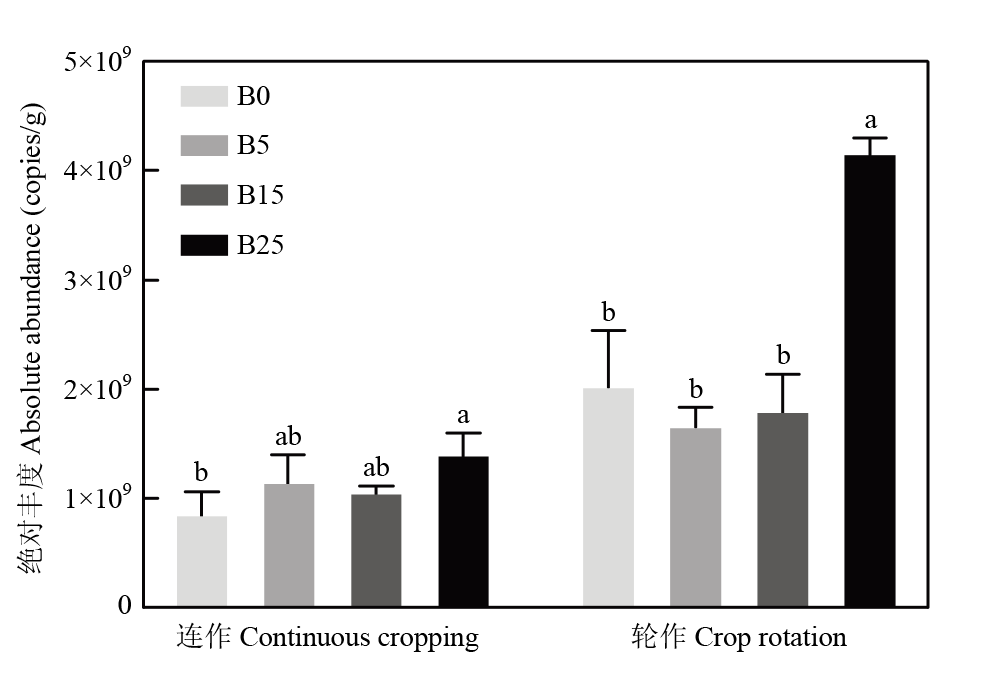
图1
生物炭对固氮微生物nifH基因绝对丰度的影响"
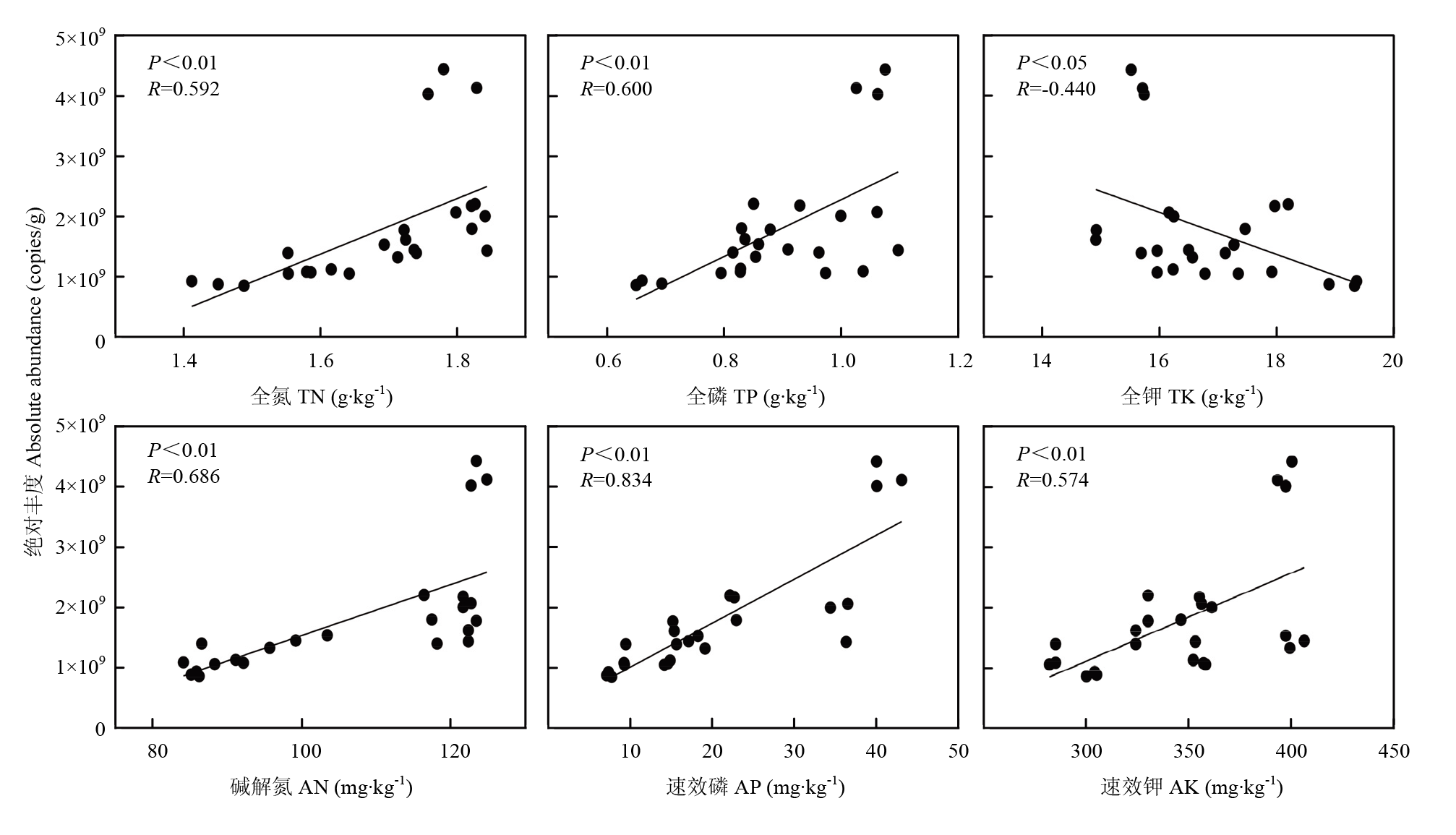
图2
固氮微生物nifH基因丰度与土壤化学性质相关性"
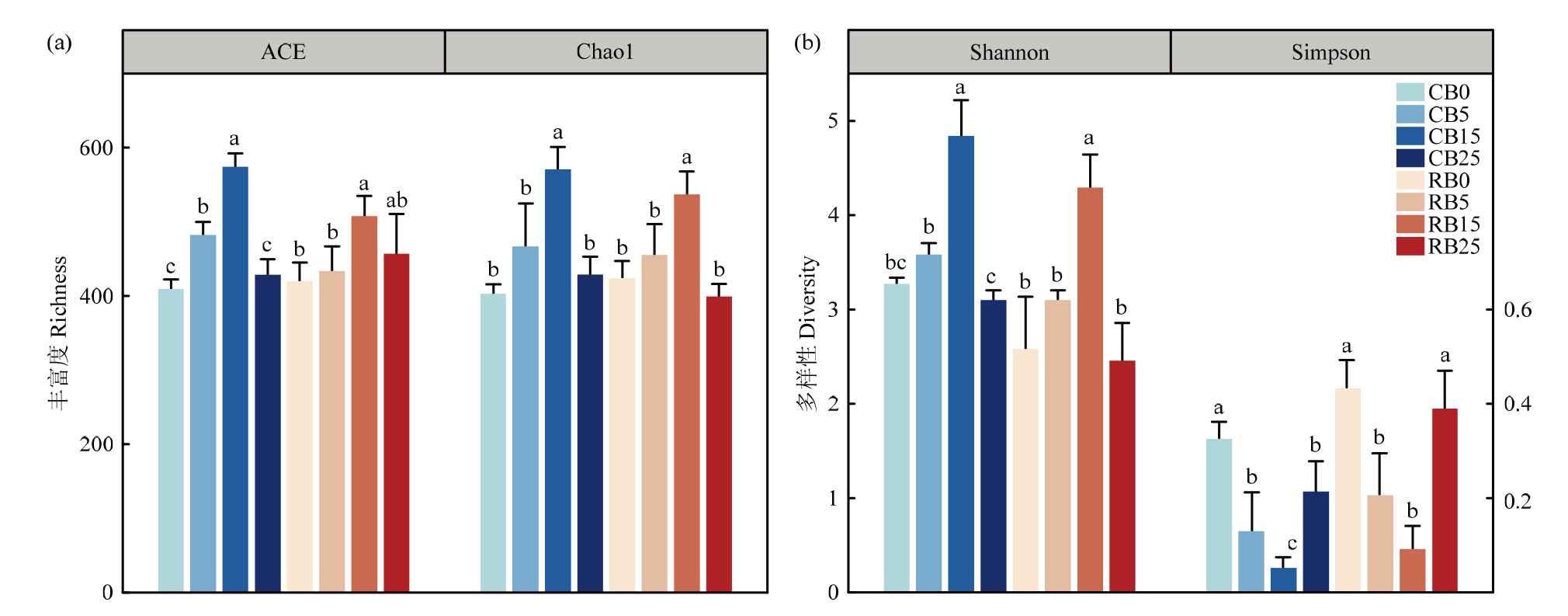
图3
不同处理土壤固氮微生物nifH基因α多样性 CB0、CB5、CB15、CB25表示连作条件下生物炭不同添加量处理;RB0、RB5、RB15、RB25表示轮作条件下生物炭不同添加量处理。下同"
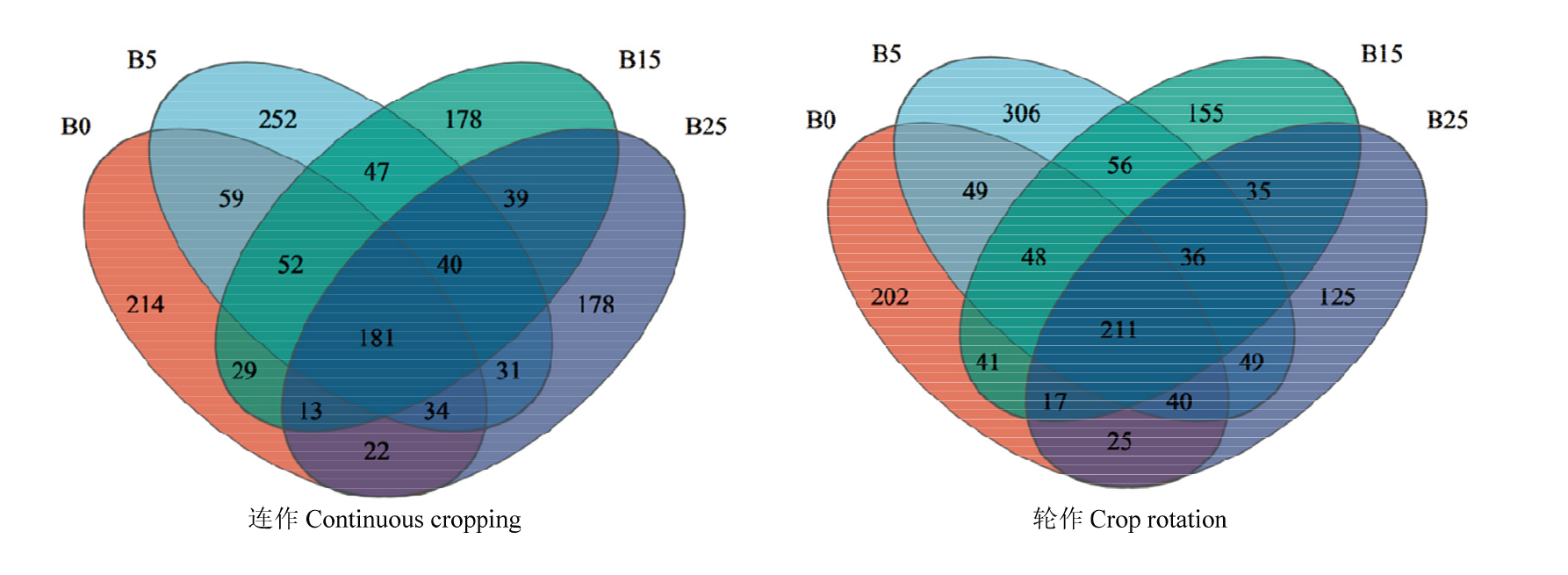
图4
固氮微生物nifH基因韦恩图"
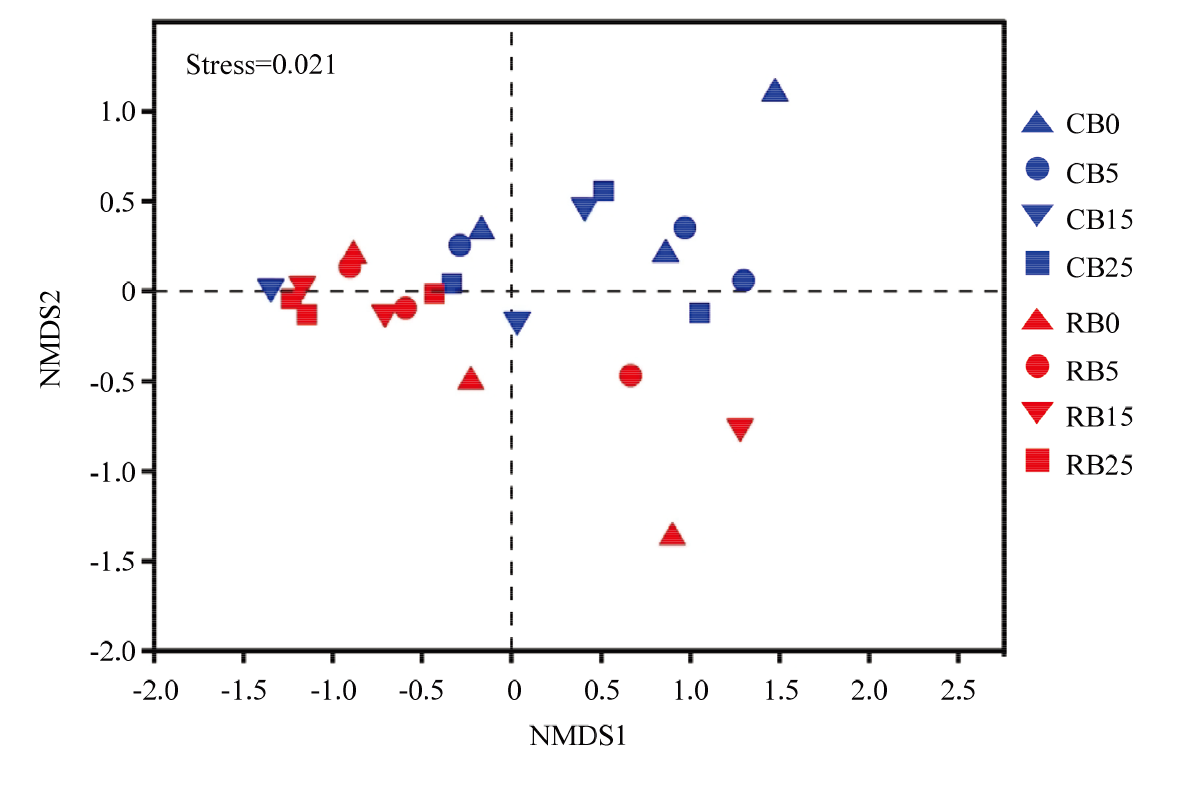
图5
固氮微生物nifH基因群落结构变化"
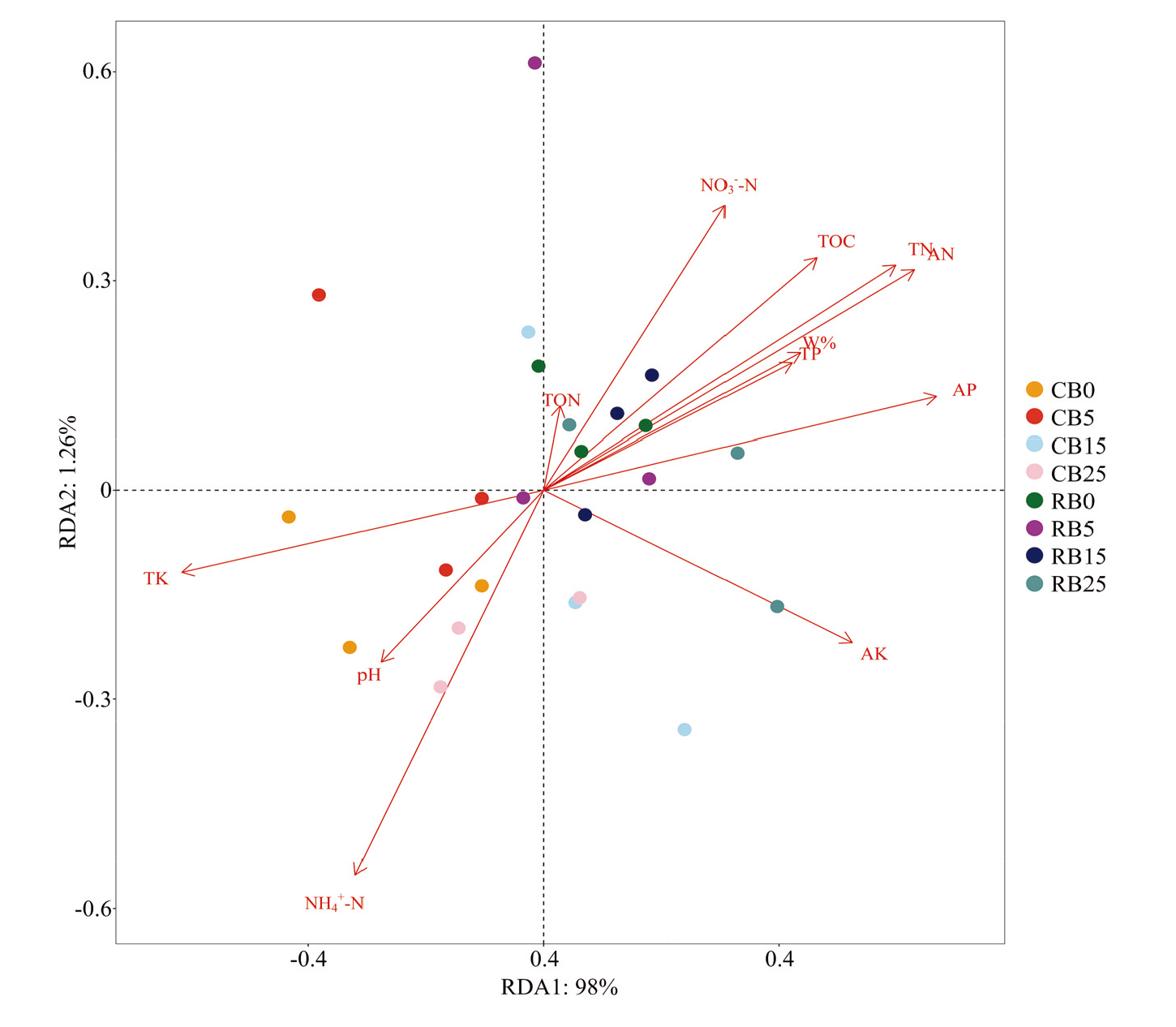
图6
固氮微生物nifH基因群落与土壤化学性质RDA分析"
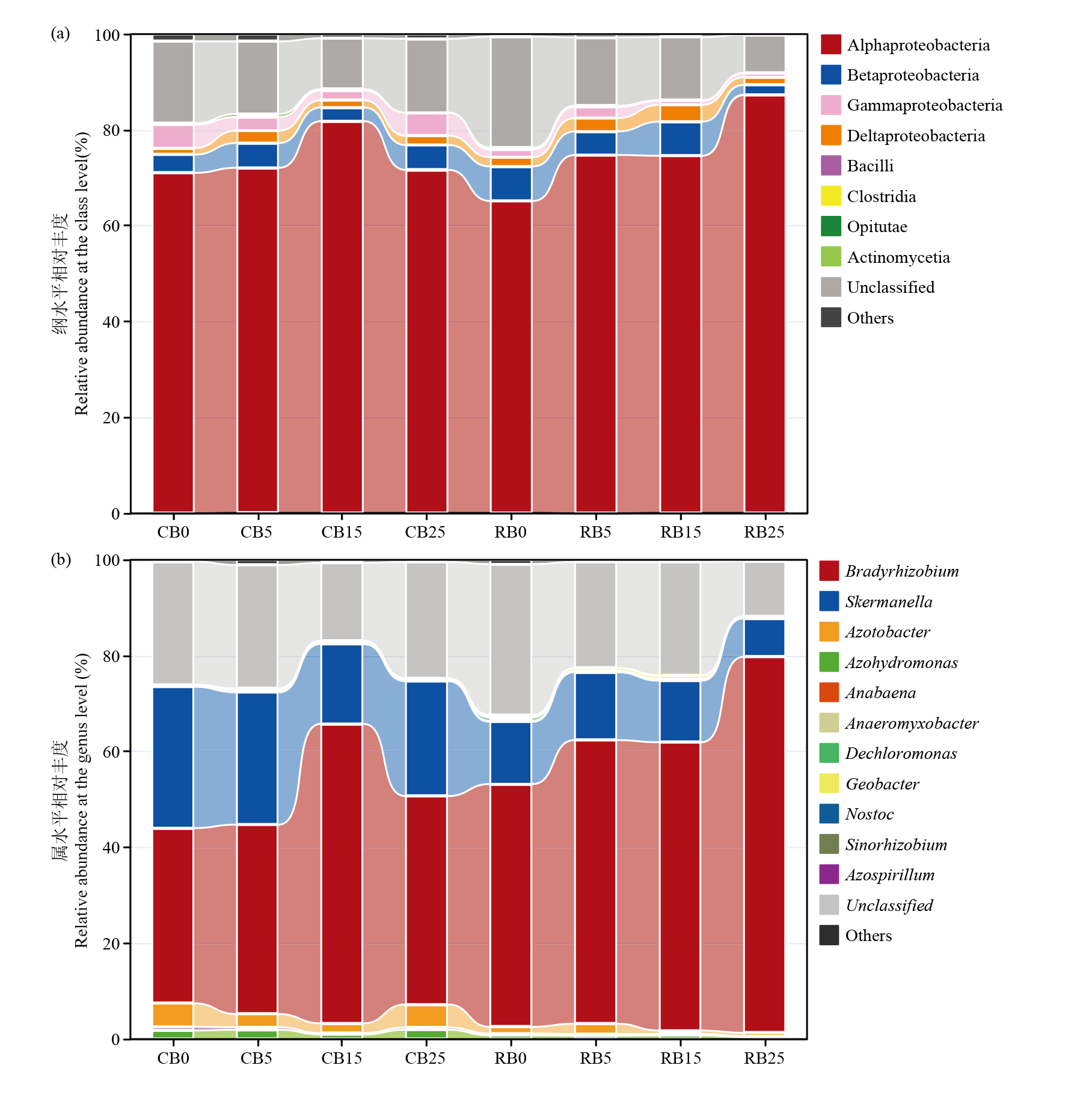
图7
固氮微生物nifH基因纲水平相对丰度(a)和属水平相对丰度(b)"

图8
固氮微生物nifH基因属水平群落共现性网络分析 网络中的节点数根据群落中的属水平着色,节点大小与该物种的相对丰度成正比,边代表物种间的相关性,红线表示正相关,绿线表示负相关"
表3
生物炭不同施用量下固氮微生物nifH基因属水平群落网络拓扑参数"
| 参数 Parameter | 处理 Treatment | |||
|---|---|---|---|---|
| B0 | B5 | B15 | B25 | |
| 节点Node | 208 | 260 | 219 | 222 |
| 边数Edge | 1470 | 2041 | 2357 | 2157 |
| 模块化Modularity | 0.56 | 0.53 | 0.45 | 0.44 |
| 图密度Density | 0.07 | 0.06 | 0.10 | 0.09 |
| 平均度Average degree | 14.14 | 15.70 | 21.53 | 19.43 |
| 平均路径长度Average path length | 3.96 | 4.25 | 3.26 | 3.76 |
| 平均聚类系数Average clustering coefficient | 0.54 | 0.53 | 0.55 | 0.58 |
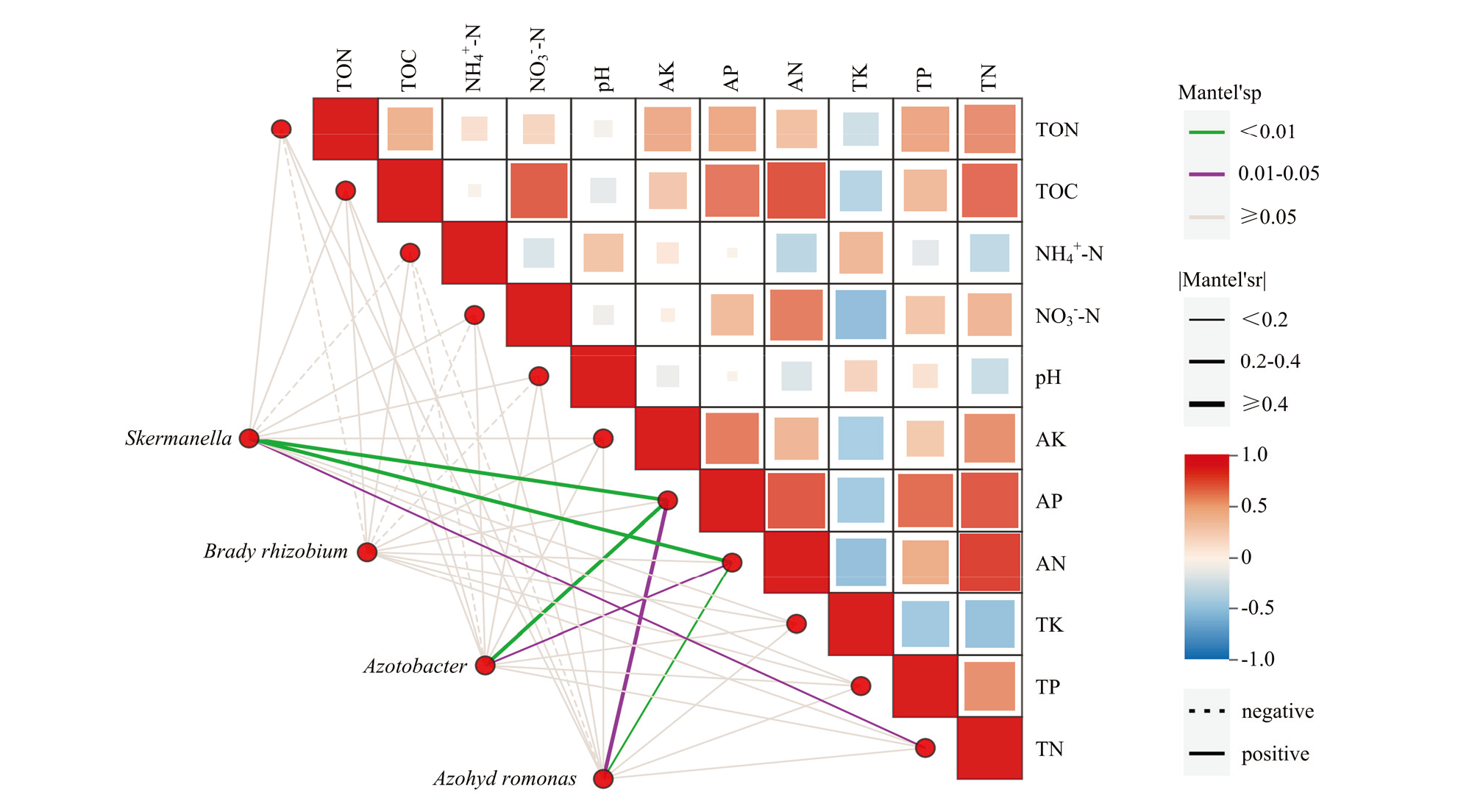
图9
固氮菌属水平群落与化学性质相关性"
| [1] |
兰鸿珠, 胡文革, 杨扬, 何园, 高岩. 艾比湖湿地盐节木土壤固氮微生物群落结构和丰度的环境异质性特点. 微生物学通报, 2019, 46(7): 1597-1610.
|
|
|
|
| [2] |
梁锦鹏, 陈玉蓝, 王勇, 罗琳, 雷善钰, 杨沁閻, 陈强, 辜运富. 攀西高原不同轮作制度下土壤固氮微生物nifH基因多样性与群落结构特征. 微生物学通报, 2023, 50(1): 118-130.
|
|
|
|
| [3] |
李荣. 黑土地保护与耕地质量提升. 腐植酸, 2023(1): 13-22.
|
|
|
|
| [4] |
张相锋, 杨晓绒, 焦子伟. 生物炭在连作障碍治理中的应用综述. 现代园艺, 2018(19): 82-85.
|
|
|
|
| [5] |
郑超, 刘扬, 陶羽, 杨丽华, 冯福应, 陈玉萍. 中央戈壁石下生物土壤结皮固氮细菌群落结构和多样性. 微生物学通报, 2021, 48(6): 1920-1929.
|
|
|
|
| [6] |
doi: 10.1111/geb.v29.12 |
| [7] |
张胜男, 高海燕, 闫德仁, 黄海广. 沙漠生物土壤结皮演替对微生物群落结构和土壤酶活力的影响. 中国沙漠, 2023, 43(3): 178-187.
doi: 10.7522/j.issn.1000-694X.2022.00121 |
|
doi: 10.7522/j.issn.1000-694X.2022.00121 |
|
| [8] |
徐晔, 张金池, 王广林, 庄家尧. 固氮酶的研究进展. 生物学杂志, 2011, 28(4): 61-64.
|
|
|
|
| [9] |
孙海航, 官会林, 王旭, 王童, 李泓霖, 彭文洁, 刘柏桢, 樊芳玲. 生物炭对三七连作土壤性质及真菌群落的影响. 生物技术通报, 2023, 39(2): 221-231.
doi: 10.13560/j.cnki.biotech.bull.1985.2022-0583 |
|
|
|
| [10] |
doi: 10.1038/s41598-019-48611-5 |
| [11] |
王翰琨, 吴永波, 刘俊萍, 薛建辉. 生物炭对土壤氮循环及其功能微生物的影响研究进展. 生态与农村环境学报, 2022, 38(6): 689-701.
|
|
|
|
| [12] |
张星, 张晴雯, 刘杏认, 徐莹春, 任建强. 施用生物炭对农田土壤氮素转化关键过程的影响. 中国农业气象, 2015, 36(6): 709-716.
|
|
|
|
| [13] |
谭春玲, 刘洋, 黄雪刚, 张峻源, 罗文浩. 生物炭对土壤微生物代谢活动的影响. 中国生态农业学报(中英文), 2022, 30(3): 333-342.
|
|
|
|
| [14] |
王文慧, 蒋志慧, 张纪, 张有利, 郭永霞, 邓杰, 靳亚忠, 李春霞. 生物炭对大豆根际土壤酶活性及产量的影响. 中国土壤与肥料, 2023(6): 147-153.
|
|
|
|
| [15] |
doi: 10.1016/j.scitotenv.2024.171641 |
| [16] |
doi: 10.1016/j.scitotenv.2019.133984 |
| [17] |
鲍士旦. 土壤农化分析. 3 版. 北京: 中国农业出版社, 2007.
|
|
|
|
| [18] |
张旸, 高燕, 张延, 黄丹丹, 陈学文, 张士秀, 梁爱珍. 秸秆还田方式对东北黑土氮素矿化和氮循环功能基因的影响. 中国农业科学, 2025, 58(10): 1958-1968. doi: 10.3864/j.issn.0578-1752.2025.10.008.
|
|
|
|
| [19] |
陈玉真, 王峰, 吴志丹, 张文锦, 翁伯琦, 尤志明. 林地转变为茶园对土壤固氮菌群落结构及多样性的影响. 应用与环境生物学报, 2020, 26(5): 1096-1106.
|
|
|
|
| [20] |
唐行灿, 陈金林. 生物炭对土壤理化和微生物性质影响研究进展. 生态科学, 2018, 37(1): 192-199.
|
|
|
|
| [21] |
黄康. 不同热解温度秸秆生物炭还田培肥土壤及其固碳潜力的研究[D]. 武汉: 华中农业大学, 2022.
|
|
|
|
| [22] |
刘悦, 黎子涵, 邹博, 孙圣仪, 郭鉴增, 孙彩霞. 生物炭影响作物生长及其与化肥混施的增效机制研究进展. 应用生态学报, 2017, 28(3): 1030-1038.
doi: 10.13287/j.1001-9332.201703.035 |
|
doi: 10.13287/j.1001-9332.201703.035 |
|
| [23] |
冯露. 复合菌剂配施生物炭对黑土磷、钾转化机制的影响[D]. 哈尔滨: 东北农业大学, 2022.
|
|
|
|
| [24] |
doi: 10.1186/s40538-023-00508-2 |
| [25] |
doi: 10.1016/j.agee.2023.108582 |
| [26] |
王冰, 赵闪闪, 秦治家, 高强, 娄玉杰, 刘淑霞. 生物质炭对黑土吸附-解吸硝态氮性能的影响. 农业环境科学学报, 2016, 35(1): 115-121.
|
|
|
|
| [27] |
张启莉, 肖玲, 李涛, 马薇, 何佶弦, 顾会战. 烤烟油菜轮作及平衡施肥下土壤氮素动态变化研究. 湖北农业科学, 2022, 61(15): 98-102.
|
|
|
|
| [28] |
赵炎, 袁新生, 唐瑞杰, 邵晓辉, 李凯凯, 文昌丽, 陈绮琦, 伍延正, 孟磊, 汤水荣. 添加生物炭对琼北地区双季稻田生物固氮的影响. 环境科学, 2022, 43(12): 5819-5831.
|
|
|
|
| [29] |
代金霞, 姚佳妮, 刘爽, 苏建宇, 张钧杰. 荒漠灌木林土壤nifH基因丰度及固氮微生物群落组成特征. 北京林业大学学报, 2024, 46(11): 43-52.
|
|
|
|
| [30] |
doi: 10.1016/j.scitotenv.2018.05.238 |
| [31] |
doi: 10.1016/j.soilbio.2016.08.001 |
| [32] |
陈坤. 秸秆和生物炭施用对田间固氮微生物群落和花生生物固氮的影响研究[D]. 沈阳: 沈阳农业大学, 2022.
|
|
|
|
| [33] |
doi: 10.3389/fmicb.2021.658668 |
| [34] |
doi: 10.3389/fmicb.2019.00508 pmid: 30930882 |
| [35] |
李艺, 张海春, 刘媛, 韦姣腾, 王聪, 梁映, 刘可慧, 于方明. 泗顶矿区剖层土固氮微生物群落结构和丰度. 中国环境科学, 2022, 42(4): 1819-1828.
|
|
|
|
| [36] |
doi: 10.1016/j.soilbio.2017.03.005 |
| [37] |
doi: 10.1007/s42773-022-00133-6 |
| [38] |
doi: 10.1016/j.scitotenv.2020.141084 |
| [39] |
doi: 10.1016/j.envres.2023.115895 |
| [40] |
王峰, 常云妮, 吕永铭, 陈玉真, 孙君, 吴志丹, 余文权. 田间老化生物质炭对茶园土壤氮素形态和细菌群落的影响. 茶叶学报, 2024, 65(4): 33-43.
|
|
|
|
| [41] |
王晓菲, 罗珠珠, 李玲玲, 牛伊宁, 孙鹏洲, 海龙, 李林芝. 黄土高原不同种植年限苜蓿土壤固氮微生物群落结构和丰度特征. 中国生态农业学报(中英文), 2023, 31(5): 665-676.
|
|
|
|
| [42] |
张胜男, 杨杉杉, 高海燕, 张雷, 闫德仁, 魏一凡. 沙蓬(Agriophyllum squarrosum)根际固氮菌群落结构特征. 中国沙漠, 2024, 44(4): 174-183.
doi: 10.7522/j.issn.1000-694X.2024.00031 |
|
|
| [1] | 王亚菲, 闫鹏, 薛金涛, 董学瑞, 孟凡琦, 郭丽娜, 罗艺, 张娟, 董志强, 卢霖. 乙烯利-甜菜碱-水杨酸合剂对高温胁迫下玉米根系建构、生理功能和产量的影响[J]. 中国农业科学, 2026, 59(7): 1439-1455. |
| [2] | 王佳诺, 陈桂平, 李盼, 王丽萍, 南运有, 何蔚, 樊志龙, 胡发龙, 柴强, 殷文, 赵连豪. 免耕地膜两年覆盖提高绿洲灌区玉米产量的灌浆期光合生理机制[J]. 中国农业科学, 2026, 59(6): 1189-1202. |
| [3] | 周新杰, 任昊, 陈应龙, 张吉旺, 赵斌, 任佰朝, 刘鹏, 王洪章. 过氧化钙对渍涝农田夏玉米根系形态及产量形成的影响[J]. 中国农业科学, 2026, 59(6): 1203-1216. |
| [4] | 何继航, 张擎, 吕相月, 薛吉全, 徐淑兔, 刘建超. 不同保绿型玉米杂交种氮效率评价[J]. 中国农业科学, 2026, 59(6): 1217-1230. |
| [5] | 李思源, 李鸿萍, 常洪庆, 张森焱, 栗思佳, 崔欣飞, 乔泼, 曾波, 刘桂珍, 刘天学, 汤继华, 李潮海. 增密对不同株高玉米品种产量和农艺性状动态变化的影响[J]. 中国农业科学, 2026, 59(5): 967-984. |
| [6] | 董金龙, 赵莹, 余海兵, 吕建晔, 秦佳琦, 梁晨, 明博, 李少昆. 多模型解析玉米籽粒容重的营养品质贡献度与区域异质性[J]. 中国农业科学, 2026, 59(5): 985-995. |
| [7] | 刘方东, 孙磊, 王吴彬, 赵晋铭, 盖钧镒. 我国大豆种植制度的变更和生态栽培区划调整的建议[J]. 中国农业科学, 2026, 59(3): 486-498. |
| [8] | 陈桂平, 韦金贵, 郭瑶, 李盼, 王菲儿, 仇海龙, 冯福学, 殷文. 宽窄行与增密对绿洲灌区玉米光合特性及资源利用的协同效应[J]. 中国农业科学, 2026, 59(2): 278-291. |
| [9] | 蔡廷阳, 朱玉鹏, 李瑞东, 吴宗声, 徐一帆, 宋雯雯, 徐彩龙, 吴存祥. 苗期叶损伤对黄淮海夏大豆光合特性、荚果分布及产量形成的影响[J]. 中国农业科学, 2026, 59(2): 292-304. |
| [10] | 张志勇, 谭世超, 熊淑萍, 马新明, 韦一昊, 王小纯. 水氮周年优化对豫北灌区小麦玉米轮作系统产量和氮迁移的影响[J]. 中国农业科学, 2026, 59(2): 336-353. |
| [11] | 王仁卓, 李玥颖, 黄绍敏, 姜桂英, 张琦, 刘超麟, 杨锦, 王梦茹, 王贝贝, 刘芳, 郭斗斗, 介晓磊, 宋练, 刘世亮. 长期有机无机肥配施对潮土细菌群落结构、生态网络及关键物种的影响[J]. 中国农业科学, 2026, 59(2): 354-367. |
| [12] | 王峰, 常云妮, 吴志丹, 孙君, 江福英, 陈玉真, 余文权. 长期施氮对茶园土壤真菌多样性、功能类群及群落构建的影响[J]. 中国农业科学, 2026, 59(2): 368-385. |
| [13] | 吴琼, 谢香庭, 王磊, 牟勇, 李进伟. 转基因大豆DBN8205转化体特异性定量PCR方法的研发和验证[J]. 中国农业科学, 2026, 59(1): 29-40. |
| [14] | 韦文华, 李盼, 邵冠贵, 樊志龙, 胡发龙, 范虹, 何蔚, 柴强, 殷文, 赵连豪. 西北灌区青贮玉米产量及品质对减量灌水与有机无机肥配施的响应[J]. 中国农业科学, 2025, 58(8): 1521-1534. |
| [15] | 薛钰琦, 赵继玉, 孙旺胜, 任佰朝, 赵斌, 刘鹏, 张吉旺. 不同氮素形态对夏玉米产量和品质的影响[J]. 中国农业科学, 2025, 58(8): 1535-1549. |
|
||
