Scientia Agricultura Sinica ›› 2026, Vol. 59 ›› Issue (15): 3237-3251.doi: 10.3864/j.issn.0578-1752.2026.15.001

• CROP GENETICS & BREEDING·GERMPLASM RESOURCES·MOLECULAR GENETICS • Previous Articles     Next Articles

Functional Characterization and Molecular Marker Development of the Wheat Transcription Factor Gene TaWRKY65-3A

ZHANG YanFei1(), WU ZiYue1, XUE ZhiWei4, MA DongYun1, KANG GuoZhang1, FENG Wei1, XIE YingXin1, JING RuiLian2, WANG WanZhang3, MAO XinGuo2(), WANG ChenYang1()   

  1. 1 College of Agriculture, Henan Agricultural University/National Wheat Engineering Technology Research Center, Zhengzhou 450046
    2 Institute of Crop Sciences, Chinese Academy of Agricultural Sciences/State Key Laboratory of Crop Gene Resources and Breeding, Beijing 100081
    3 College of Mechanical & Electrical Engineering, Henan Agricultural University, Zhengzhou 450046
    4 Anyang Academy of Agricultural Sciences, Anyang 455000, Henan
  • Received:2025-12-12 Accepted:2026-02-06 Online:2026-08-01 Published:2026-08-03
  • Contact: MAO XinGuo, WANG ChenYang

Abstract:

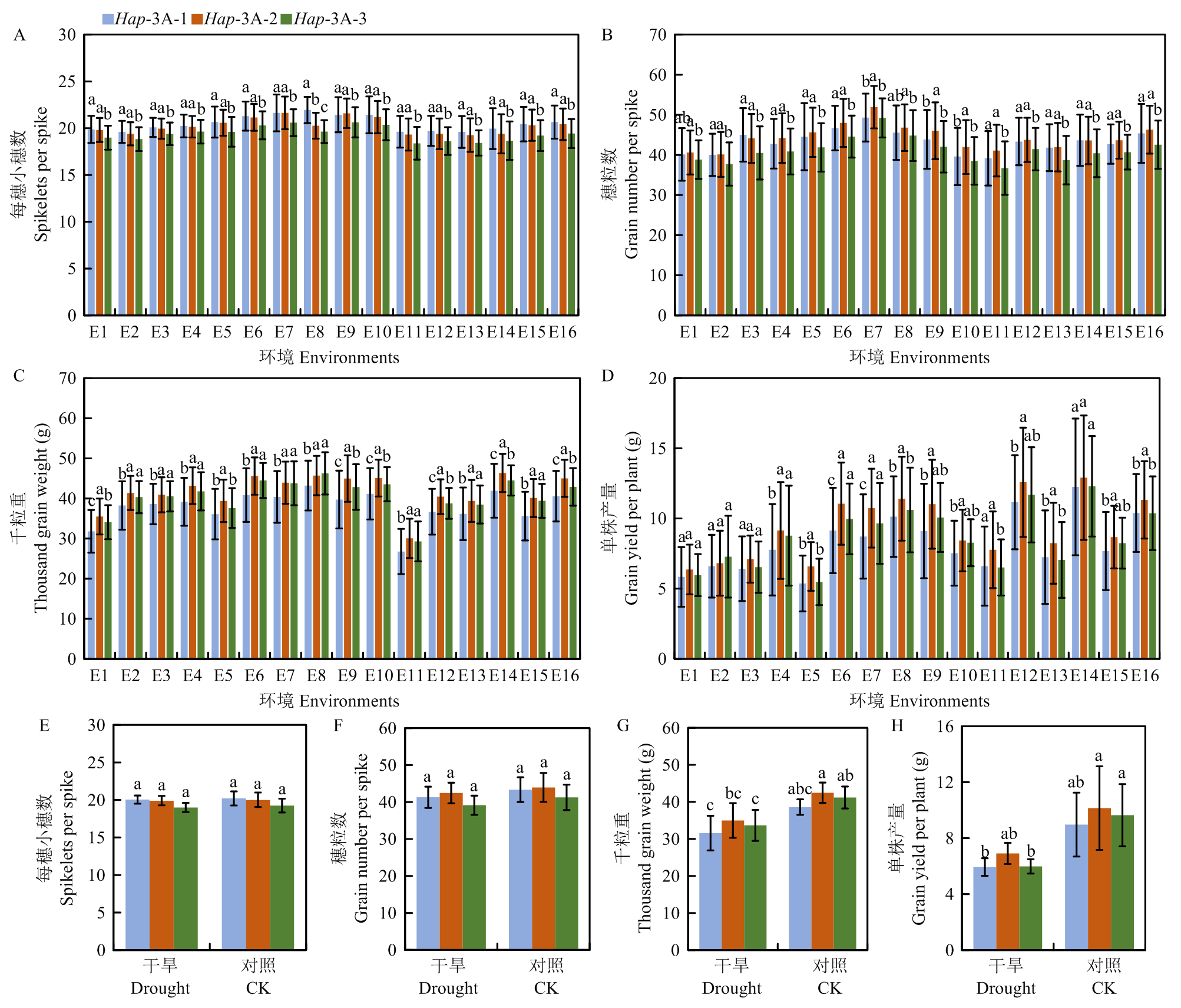
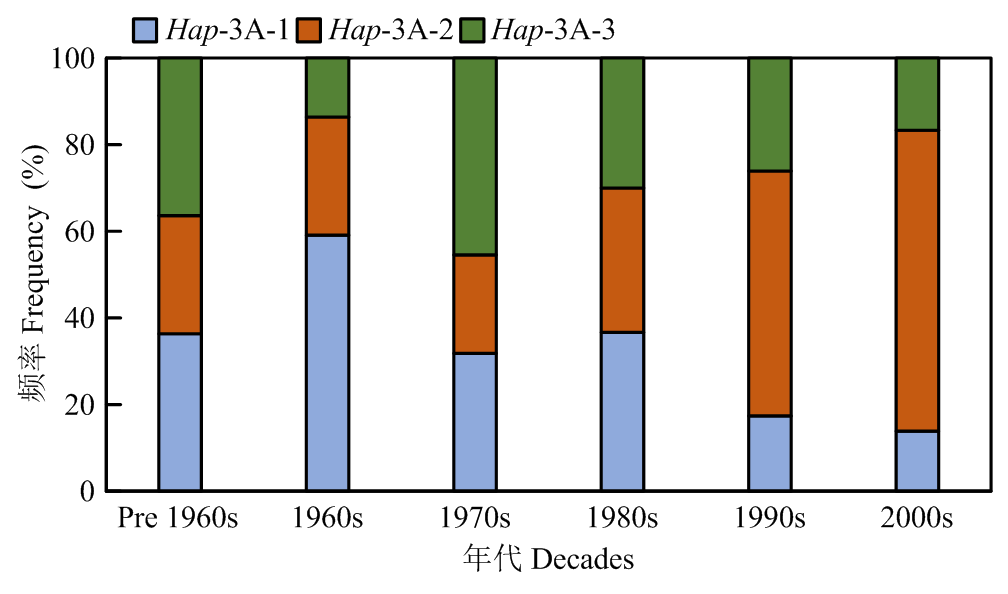
【Objective】WRKY transcription factors are the plant-specific transcription factor families, and play a crucial role in plant growth, development, nutrient uptake, and response to biotic and abiotic stresses. Characterized the function of the wheat transcription factor gene TaWRKY65-3A and developed the molecular markers, providing genetic resources for wheat germplasm improvement through molecular breeding in this research.【Method】The sequence of TaWRKY65-3A was cloned from the cDNA of wheat variety Hanxuan 10. The domains were analyzed via the SMART website. The expression patterns of TaWRKY65-3A gene were analyzed by qRT-PCR under phytohormone ABA treatments, PEG and NaCl stresses. Predicted the polymorphisms of TaWRKY65-3A through the Wheat Genome Variation Joint Database, and validated them by using 21 wheat germplasms with rich genetic diversity and further developed molecular markers. Association analysis between TaWRKY65-3A haplotypes and phenotypic traits was carried out in a natural population consisting of 323 wheat accessions. The haplotype of 189 modern wheat cultivars from different released years were analyzed, aiming to clarify the selection trends of superior haplotypes during wheat breeding in China.【Result】TaWRKY65-3A is 1 998 bp in full length, comprising 2 exons and 1 intron, and harbors the characteristic WRKY domain and a C2H2-type zinc finger motif typical of the WRKY transcription factor family. The promoter region of TaWRKY65-3A contains a variety of cis-acting elements, including hormone-responsive elements, (e.g., to abscisic acid and methyl jasmonate) and stress-responsive elements (e.g., to drought and low temperature). Moreover, the expressions of TaWRKY65-3A was influenced by ABA, PEG and NaCl stresses. Six SNPs were identified in the TaWRKY65-3A region, forming three haplotypes: Hap-3A-1, Hap-3A-2, and Hap-3A-3. dCAPS markers were developed at positions of 1 265 bp (G/C) in the coding sequence and 1 658 bp (T/C) in the non-coding sequence, which were significantly associated with thousand-kernel weight, yield per plant, spikelet number per spike, and kernel number per spike across multiple environments. Notably, the haplotype Hap-3A-2 was demonstrated to be significantly correlated with higher spikelet number per spike, a great kernel number per spike, a higher thousand-kernel weight, and a higher yield per plant in multiple environments, including drought, high temperature, and the combined stress of drought and high temperature, and it was positively selected during wheat breeding in China.【Conclusion】TaWRKY65-3A gene responded to phytohormones ABA, PEG and NaCl stress, and were significantly correlated with spikelet number per spike, kernel number per spike, thousand-kernel weight and yield per plant under various environments such as drought, high temperature, and the combined stress of drought and high temperature. Hap-3A-2 is the favorable haplotype with higher spikelet number per spike, more kernel number per spike, higher thousand-kernel weight, and higher yield per plant. The molecular markers of dCAPS developed in this study provide valuable tools for marker-assisted breeding, facilitating the selection of germplasm with superior yield-related traits.

Key words: wheat, transcription factor, TaWRKY65-3A, yield, dCAPS marker, haplotype

Table 1

Primers used in this study"

引物名称 Prime name 引物序列 Sequences (5´-3´) 用途 Usage
TaWRKY65-qF CATCGAGGTGCACGACGAT TaWRKY65表达
Expression of TaWRKY65
TaWRKY65-qR GCGGCCGTGTCGACCTC
TaActin-qF CTCCCTCACAACAACAACCGC
TaActin-qR TACCAGGAACTTCCATACCAAC
OsActin-qF AGTAGTCTCGCCCTGCTTCA
OsActin-qR TTCGCCACTTTGTTCTCAACT
TaWRKY65-1300GFP-F CCAAATCGACTCTAGAATGGACGGCGAGTGGAGC 亚细胞定位
Subcellular localization
TaWRKY65-1300GFP-R TGCTCACCATGGTACCCGTCATGGCTGTGCCCTC
TaWRKY65-3A-1265F TTGACCCCTCCTGCCATT 开发分子标记
Developing the molecular markers
TaWRKY65-3A-1265R GCTCGTTCTTCCGACTCCAT
TaWRKY65-3A-1658F GCTTTTGTTGGTTAGTTTTCTCAC
TaWRKY65-3A-1658R GGGTTTGTATCCCTCTCAATCTC
TaWRKY65-3A-dCAPS-Sma I-1265F CTCGTCCGGAAGGAGCCCGG
TaWRKY65-3A-dCAPS-Sma I-1265R GTCGCCCGAGCCAGC
TaWRKY65-3A-dCAPS-Sac I-1658F AAGCATCTTAGAGGCGGAGCT
TaWRKY65-3A-dCAPS-Sac I-1658R TGGTCCAAACAAATGAATAAAAAC

Fig. 1

Analysis of TaWRKY65-3A gene sequence and protein structure A: Diagram of TaWRKY65-3A gene structure. Black rectangles indicate exons; B: Alignment of TaWRKY65-3A proteins. The red rectangular box indicates the WRKY Domain and C2H2 finger domain; C: The prediction of TaWRKY65-3A secondary structure; D: Phylogenetic tree of plant WRKYs. TaWRKY65-3A is labeled with blue square. At: Arabidopsis thaliana; Do: Dichanthelium oligosanthes; Hv: Hordeum vulgare; Lp: Lolium perenne; Ob: Oryza brachyantha; Os: Oryza sativa; Pt: Populus trichocarpa; Pm: Panicum miliaceum; Pv: Panicum virgatum; Sb: Sorghum bicolor; Si: Setaria italica; Ta: Triticum aestivum; Td: T. dicoccoides; Tu: T. urartu; Zm: Zea mays; E: Subcellular localization of TaWRKY65-3A in tobacco leaves"

Table 2

Putative cis-acting regulatory elements in the promoter region of TaWRKY65-3A"

顺式作用元件 Cis-acting element 数量 Numbers 生物学功能 Biological function
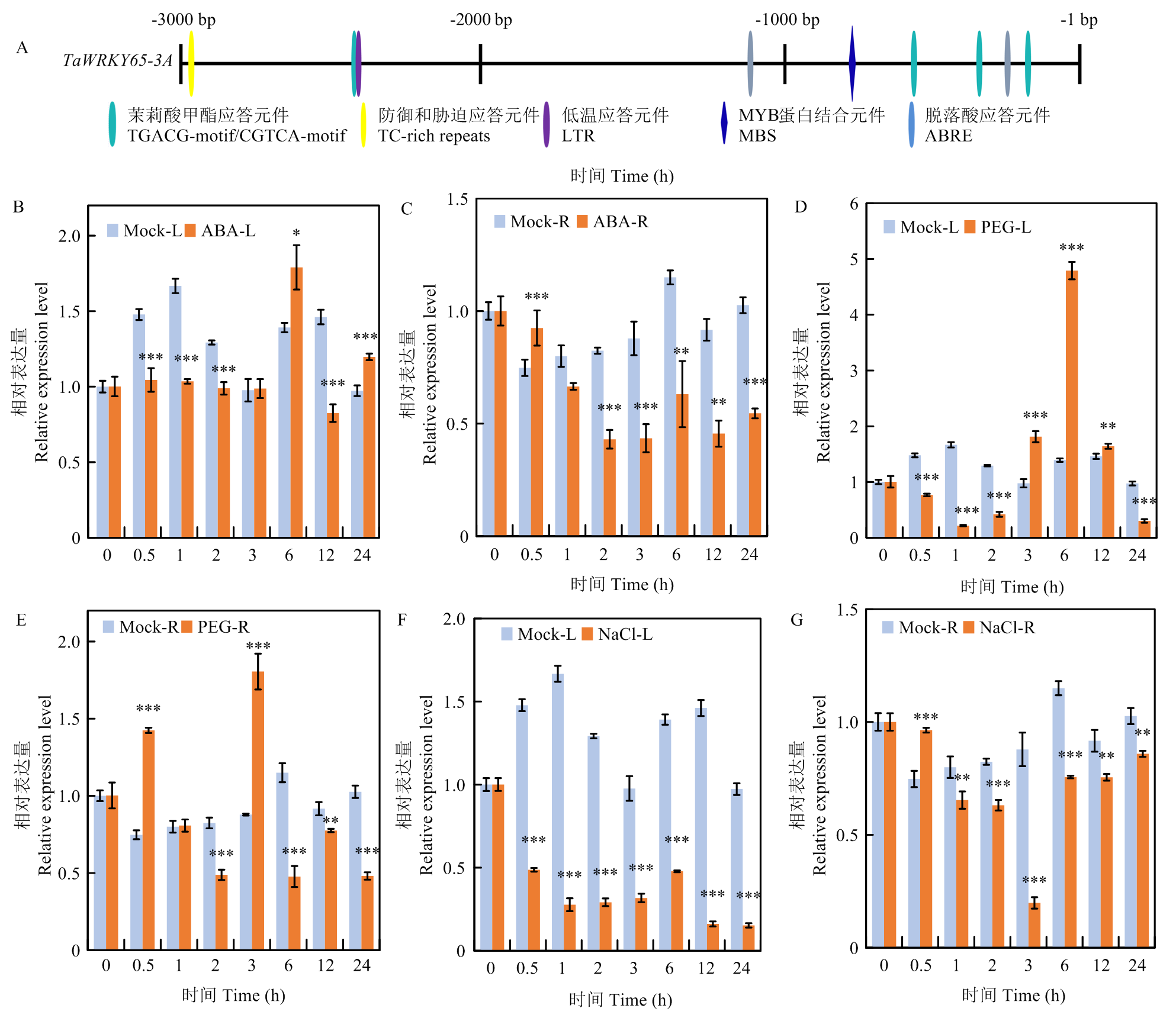
TGACG-motif 5 茉莉酸甲酯应答元件Cis-acting regulatory element involved in the MeJA-responsiveness
CGTCA-motif 5 茉莉酸甲酯应答元件Cis-acting regulatory element involved in the MeJA-responsiveness
ABRE 2 脱落酸应答元件Cis-acting element involved in the abscisic acid responsiveness
TC-rich repeats 1 防御和胁迫应答元件Cis-acting element involved in defense and stress responsiveness
LTR 1 低温应答元件Cis-acting element involved in low-temperature responsiveness
MBS 1 MYB蛋白结合元件MYB protein binding element

Fig. 2

The cis-acting elements in the TaWRKY65-3A promoter and expression patterns of TaWRKY65-3A under different stress conditions A: Distributions of various cis-acting regulatory elements in the promoter regions of TaWRKY65-3A in the reference genome of Chinese Spring; B, C: 50 µmol·L-1 ABA treatment. D, E: 16.1% PEG6000 treatment; F, G: 250 mmol·L-1 NaCl treatment. L: leaf, R: Root. *: P<0.05; **: P<0.01; ***: P<0.001. The same as below"

Table 3

Prediction of variation information in the TaWRKY65-3A gene"

位置Sites (bp) 样本数量
Number of samples
占总样本百分比
Percentage of total samples (%)
809 1265 1658 1684 1758 1887
T G T T G A 40 27.6
T C T C A A 58 40.0
C G C C G G 24 16.6
T C T C G A 4 2.8
T C T T G A 2 1.4
T C T T A A 2 1.4
C G T T G G 2 1.4
T G C C G G 1 0.7
C G T C G G 1 0.7
C G C C G A 1 0.7
/ / / / / / 10 6.9
合计Total 145 100

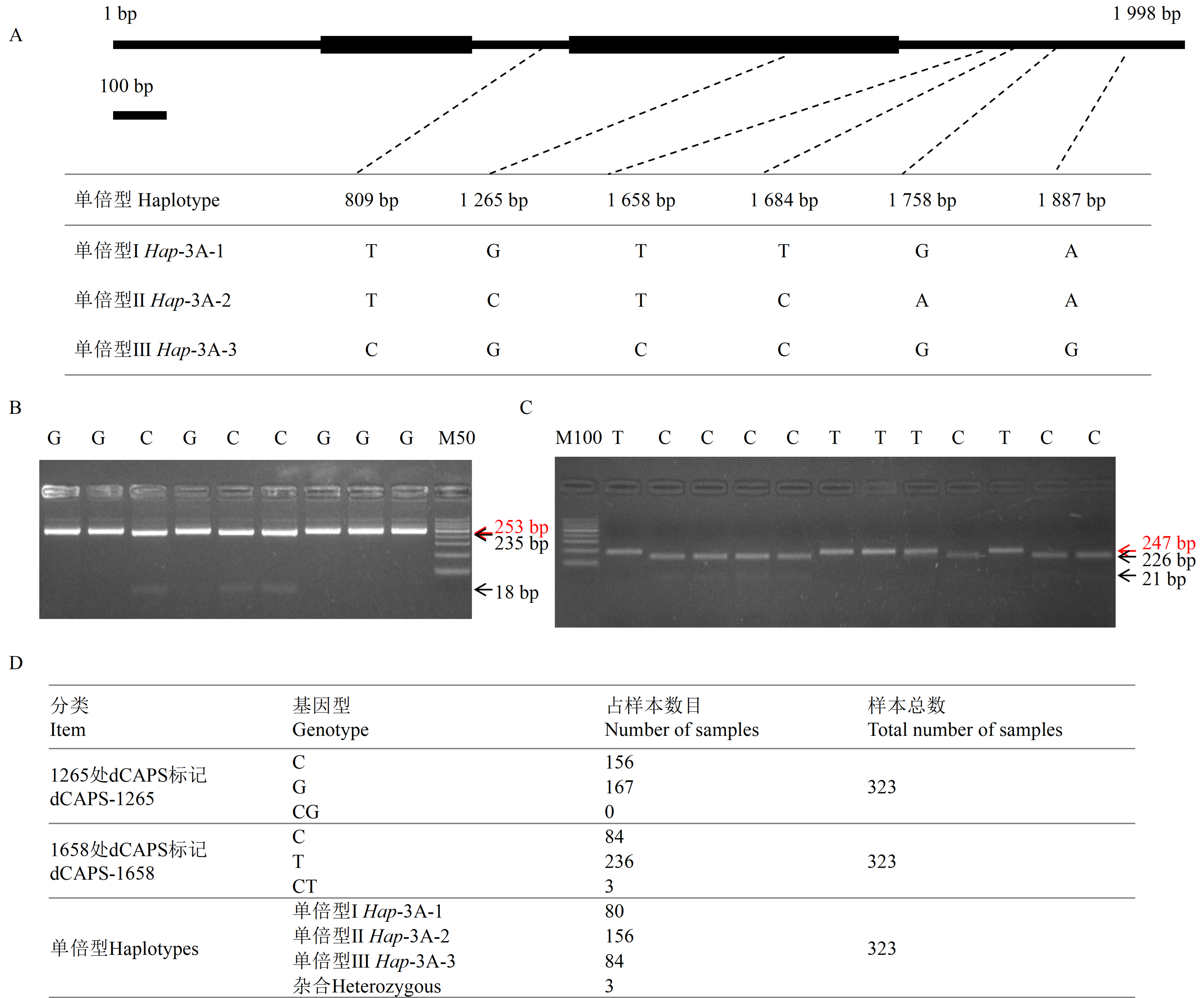
Fig. 3

Allelic variation and dCAPS marker genotyping of TaWRKY65-3A A: The allelic variations and haplotypes of TaWRKY65-3A. Black rectangles represent exons, and black lines indicate intron or UTR sequences; B: dCAPS marker dCAPS-1265 at 1265 bp; C: dCAPS marker dCAPS-1658 at 1658 bp; D: The number of samples per genotype within a natural population of 323 individuals"

Table 4

Association analysis between TaWRKY65-3A marker and the yield traits in a natural population of wheat"

环境
Environments
年份
Years
地点
Sites
处理
Treatments
性状(P值)Traits (P value)
dCAPS-1265 dCAPS-1658
千粒重
Thousand grain weight
单株产量
Grain yield per plant
穗粒数
Grain number per spike
每穗小穗数
Spikelets per spike
E1 2015 顺义
SY
DS+HT 0.0030** 0.6016ns 0.1759ns 0.0005***
E2 DS 0.0107* 0.5323ns 0.0043** 0.0035**
E3 WW+HT 0.0772ns 0.3067ns 0.0002*** 0.0007***
E4 WW 0.0001*** 0.1644ns 0.0347* 0.0008***
E5 2016 顺义
SY
DS+HT 0.0433* 0.0001*** 0.0086** 0.0006***
E6 DS 0.0007*** 0.0019** 0.0044** 0.0013**
E7 WW+HT 0.0624ns 0.0075** 0.0547ns 0.0037**
E8 WW 0.5628ns 0.0274* 0.2390ns 0.0179*
E9 昌平
CP
WW 0.0003*** 0.0088** 0.0053** 0.0149*
E10 DS 0.0010** 0.1856ns 0.0260* 0.1182ns
E11 2017 顺义
SY
DS+HT 0.3325ns 0.0035** 0.0011** 0.0032**
E12 DS 0.0010** 0.0055** 0.1369ns 0.0069**
E13 WW+HT 0.1806ns 0.0054** 0.0025** 0.0133*
E14 WW 0.0001*** 0.0549ns 0.0040** 0.1279ns
E15 昌平
CP
DS 0.0017** 0.0169* 0.0008*** 0.0020**
E16 WW 0.0001*** 0.0264* 0.0104* 0.0072**

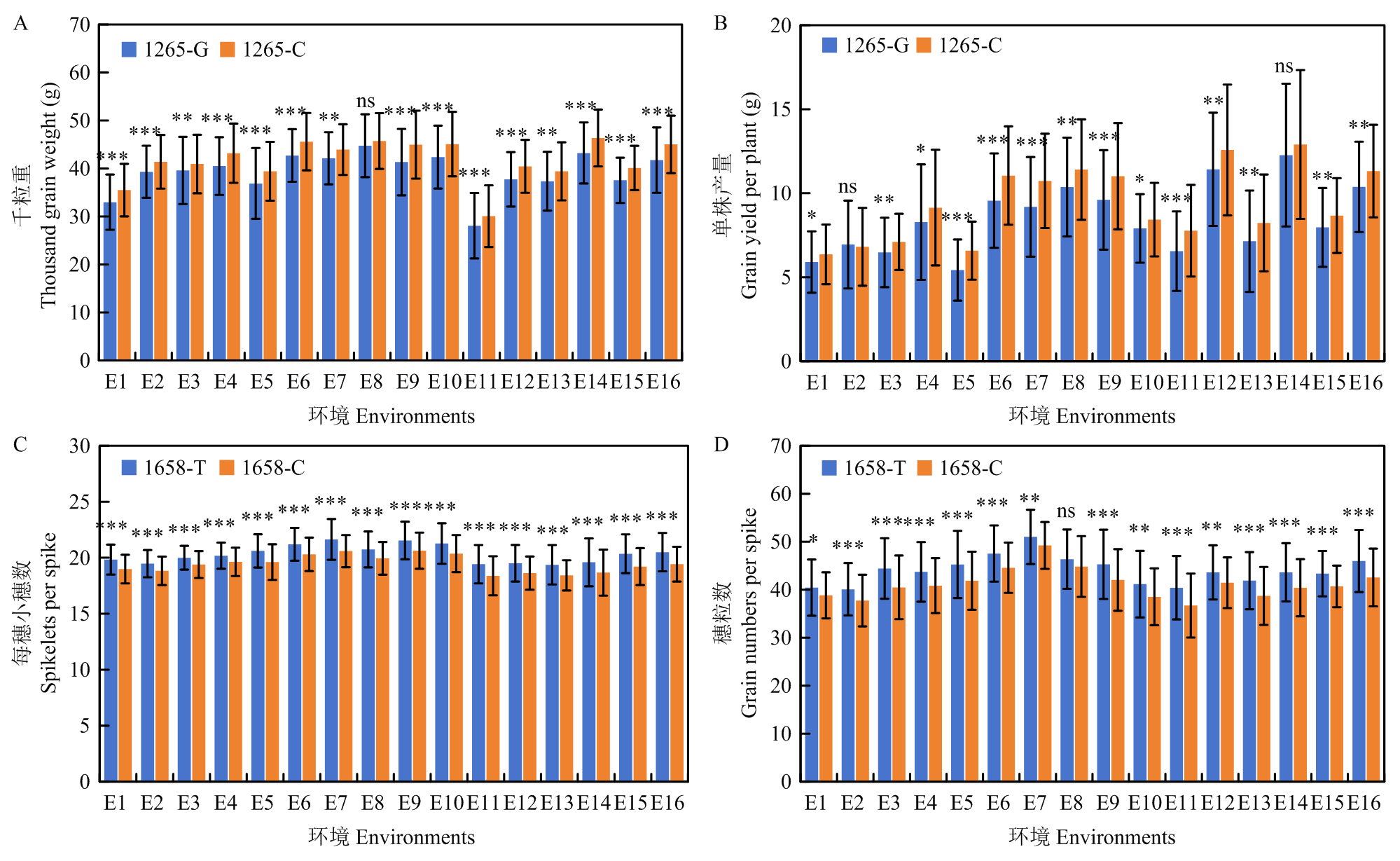
Fig. 4

Association analysis between dCAPS-1265 and dCAPS-1658 markers and yield trait comparisons under 16 environments"

Fig. 5

Association analysis between the three haplotypes of TaWRKY65-3A and yield trait comparisons under 16 environments The different lowercase letters indicate that significant differences under the same environment at P<0.05 level"

Fig. 6

Frequency distribution of three TaWRKY65-3A haplotypes in modern varieties released in different decades"

[1]
Shiferaw B, Smale M, Braun H J, Duveiller E, Reynolds M, Muricho G. Crops that feed the world 10. Past successes and future challenges to the role played by wheat in global food security[J]. Food Security, 2013, 5(3): 291-317.
[2]
Lesk C, Rowhani P, Ramankutty N. Influence of extreme weather disasters on global crop production[J]. Nature, 2016, 529(7584): 84-87.
[3]
Dreher K, Callis J. Ubiquitin, hormones and biotic stress in plants[J]. Annals of Botany, 2007, 99(5): 787-822.
[4]
Ko J H, Yang S H, Han K H. Upregulation of an Arabidopsis RING-H2 gene, XERICO confers drought tolerance through increased abscisic acid biosynthesis[J]. The Plant Journal, 2006, 47(3): 343-355.
[5]
Jiang J J, Ma S H, Ye N H, Jiang M, Cao J S, Zhang J H. WRKY transcription factors in plant responses to stresses[J]. Journal of Integrative Plant Biology, 2017, 59(2): 86-101.
[6]
Chen L G, Song Y, Li S J, Zhang L P, Zou C S, Yu D Q. The role of WRKY transcription factors in plant abiotic stresses[J]. Biochimica et Biophysica Acta, 2012, 1819(2): 120-128.
[7]
Qin W Q, Wang N, Yin Q, Li H L, Wu A M, Activation tagging identifies WRKY14 as a repressor of plant thermomorphogenesis in Arabidopsis[J]. Molecular Plant, 2022, 15(11): 1725-1743.
[8]
Su T, Xu Q, Zhang F C, Chen Y, Li L Q, Wu W H, Chen Y F. WRKY42 modulates phosphate homeostasis through regulating phosphate translocation and acquisition in Arabidopsis[J]. Plant Physiology, 2015, 167(4): 1579-1591.
[9]
Yang X Q, Zhang K A, Nvsvrot T, Zhang Y, Cai G H, Huang L Y, Ren W Y, Ding Y W, Hammond J P, Shi L, Wang N. Phosphate (Pi) stress-responsive transcription factors PdeWRKY6 and PdeWRKY65 regulate the expression of PdePHT1;9 to modulate tissue Pi concentration in poplar[J]. The Plant Journal, 2022, 111(6): 1753-1767.
[10]
Bai H, Si H L, Zang J P, Pang X, Yu L, Cao H Z, Xing J H, Zhang K, Dong J G. Comparative proteomic analysis of the defense response to Gibberella stalk rot in maize and reveals that ZmWRKY83 is involved in plant disease resistance[J]. Frontiers in Plant Science, 2021, 12: 694973.
[11]
Yan J W, Li J, Zhang H P, Liu Y, Zhang A Y. ZmWRKY104 positively regulates salt tolerance by modulating ZmSOD4 expression in maize[J]. The Crop Journal, 2022, 10(2): 555-564.
[12]
Zhao L L, Yan J W, Xiang Y, Sun Y, Zhang A Y. ZmWRKY104 transcription factor phosphorylated by ZmMPK6 functioning in ABA-induced antioxidant defense and enhance drought tolerance in maize[J]. Biology, 2021, 10(9): 893.
[13]
Fang X, Li W, Yuan H T, Chen H W, Bo C, Ma Q, Cai R H. Mutation of ZmWRKY86 confers enhanced salt stress tolerance in maize[J]. Plant Physiology and Biochemistry, 2021, 167: 840-850.
[14]
Fu J Y, Liu Q, Wang C, Liang J, Liu L J, Wang Q. ZmWRKY79 positively regulates maize phytoalexin biosynthetic gene expression and is involved in stress response[J]. Journal of Experimental Botany, 2018, 69(3): 497-510.
[15]
Wang X T, Zeng J, Li Y, Rong X L, Sun J T, Sun T, Li M, Wang L Z, Feng Y, Chai R H, Chen M J, Chang J L, Li K X, Yang G X, He G Y. Expression of TaWRKY44, a wheat WRKY gene, in transgenic tobacco confers multiple abiotic stress tolerances[J]. Frontiers in Plant Science, 2015, 6: 615.
[16]
Wang C, Deng P Y, Chen L L, Wang X T, Ma H, Hu W, Yao N C, Feng Y, Chai R H, Yang G X, He G Y. A wheat WRKY transcription factor TaWRKY10 confers tolerance to multiple abiotic stresses in transgenic tobacco[J]. PLoS ONE, 2013, 8(6): e65120.
[17]
Gao H M, Wang Y F, Xu P, Zhang Z B. Overexpression of a WRKY transcription factor TaWRKY2 enhances drought stress tolerance in transgenic wheat[J]. Frontiers in Plant Science, 2018, 9: 997.
[18]
Niu C F, Wei W, Zhou Q Y, Tian A G, Hao Y J, Zhang W K, Ma B, Lin Q, Zhang Z B, Zhang J S, Chen S Y. Wheat WRKY genes TaWRKY2 and TaWRKY19 regulate abiotic stress tolerance in transgenic Arabidopsis plants[J]. Plant, Cell & Environment, 2012, 35(6): 1156-1170.
[19]
于永昂, 睢晓湉, 张蕾, 张夏冰. 小麦转录因子TaWRKY28基因克隆与抗旱性分析[J]. 西北农林科技大学学报(自然科学版), 2022, 50(4): 32-41.
Yu Y A, Sui X T, Zhang L, Zhang X B. Cloning and function against drought stress of TaWRKY28 transcription factor gene[J]. Journal of Northwest A & F University (Natural Science Edition), 2022, 50(4): 32-41.(in Chinese)
[20]
Ding Z J, Yan J Y, Li C X, Li G X, Wu Y R, Zheng S J. Transcription factor WRKY46 modulates the development of Arabidopsis lateral roots in osmotic/salt stress conditions via regulation of ABA signaling and auxin homeostasis[J]. The Plant Journal, 2015, 84(1): 56-69.
[21]
Qin Y X, Tian Y C, Liu X Z. A wheat salinity-induced WRKY transcription factor TaWRKY93 confers multiple abiotic stress tolerance in Arabidopsis thaliana[J]. Biochemical and Biophysical Research Communications, 2015, 464(2): 428-433.
[22]
He G H, Xu J Y, Wang Y X, Liu J M, Li P S, Chen M, Ma Y Z, Xu Z S. Drought-responsive WRKY transcription factor genes TaWRKY1 and TaWRKY33 from wheat confer drought and/or heat resistance in Arabidopsis[J]. BMC Plant Biology, 2016, 16(1): 116.
[23]
Hu Z R, Wang R, Zheng M, Liu X B, Meng F, Wu H L, Yao Y Y, Xin M M, Peng H R, Ni Z F, Sun Q X. TaWRKY51 promotes lateral root formation through negative regulation of ethylene biosynthesis in wheat (Triticum aestivum L.)[J]. The Plant Journal, 2018, 96(2): 372-388.
[24]
Li Y Y, Zhang Y F, Li C N, Chen X, Yang L L, Zhang J, Wang J Y, Li L, Reynolds M P, Jing R L, Mao X G, Wang C Y. Transcription factor TaWRKY51 is a positive regulator in root architecture and grain yield contributing traits[J]. Frontiers in Plant Science, 2021, 12: 734614.
[25]
Li L, Peng Z, Mao X G, Wang J Y, Chang X P, Reynolds M, Jing R L. Genome-wide association study reveals genomic regions controlling root and shoot traits at late growth stages in wheat[J]. Annals of Botany, 2019, 124(6): 993-1006.
[26]
张紫慧, 张艳菲, 李龙, 李超男, 王景一, 杨德龙, 毛新国, 景蕊莲. 小麦烯醇化酶基因TaENO1-5B在多种环境下对株高与穗粒数的调控[J]. 中国农业科学, 2024, 57(14): 2717-2731. DOI: 10.3864/j.issn.0578-1752.2024.14.002.
Zhang Z H, Zhang Y F, Li L, Li C N, Wang J Y, Yang D L, Mao X G, Jing R L. Wheat enolase gene TaENO1-5B involved in regulating plant height and grain number per spike in multiple environments[J]. Scientia Agricultura Sinica, 2024, 57(14): 2717-2731. DOI: 10.3864/j.issn.0578-1752.2024.14.002.(in Chinese)
[27]
Zhang Y F, Wang J Y, Li Y Y, Zhang Z H, Yang L L, Wang M, Zhang Y N, Zhang J, Li C N, Li L, Reynolds M P, Jing R L, Wang C Y, Mao X G. Wheat TaSnRK2.10 phosphorylates TaERD15 and TaENO1 and confers drought tolerance when overexpressed in rice[J]. Plant Physiology, 2023, 191(2): 1344-1364.
[28]
景蕊莲, 昌小平. 用渗透胁迫鉴定小麦种子萌发期抗旱性的方法分析[J]. 植物遗传资源学报, 2003, 4(4): 292-296.
Jing R L, Chang X P. Methods for identifying drought resistance at germination stage of wheat by osmotic stress[J]. Journal of Plant Genetic Resources, 2003, 4(4): 292-296.(in Chinese)
[29]
Eulgem T, Rushton P J, Robatzek S, Somssich I E. The WRKY superfamily of plant transcription factors[J]. Trends in Plant Science, 2000, 5(5): 199-206.
[30]
卢源达, 陈玲, 杜云龙, 刘学思, 柯学, 赵建屛, 吴洪钦, 刘鑫, 李玉琢, 朱文强, 邢世军, 程在全, 钟巧芳. 不同禾本科作物中ZmWRKY79同源基因的鉴定与分析[J]. 西南农业学报, 2023, 36(3): 522-531.
Lu Y D, Chen L, Du Y L, Liu X S, Ke X, Zhao J P, Wu H Q, Liu X, Li Y Z, Zhu W Q, Xing S J, Cheng Z Q, Zhong Q F. Identification and analysis of ZmWRKY79 homologous genes in different gramineal crops[J]. Southwest China Journal of Agricultural Sciences, 2023, 36(3): 522-531.(in Chinese)
[31]
Javed T, Gao S J. WRKY transcription factors in plant defense[J]. Trends in Genetics, 2023, 39(10): 787-801.
[32]
Yang L, Fang S Y, Liu L, Zhao L R, Chen W Q, Li X, Xu Z Y, Chen S D, Wang H P, Yu D Q. WRKY transcription factors: Hubs for regulating plant growth and stress responses[J]. Journal of Integrative Plant Biology, 2025, 67(3): 488-509.
[33]
Zhang Y J, Wang L J. The WRKY transcription factor superfamily: Its origin in eukaryotes and expansion in plants[J]. BMC Evolutionary Biology, 2005, 5(1): 1.
[34]
Chen F, Hu Y, Vannozzi A, Wu K C, Cai H Y, Qin Y, Mullis A, Lin Z G, Zhang L S. The WRKY transcription factor family in model plants and crops[J]. Critical Reviews in Plant Sciences, 2017, 36(5/6): 311-335.
[35]
Ma Z M, Hu L J. WRKY transcription factor responses and tolerance to abiotic stresses in plants[J]. International Journal of Molecular Sciences, 2024, 25(13): 6845.
[36]
Chen X J, Li C, Wang H, Guo Z J. WRKY transcription factors: Evolution, binding, and action[J]. Phytopathology Research, 2019, 1(1): 13.
[37]
Yu Y, Song T Q, Wang Y K, Zhang M F, Li N, Yu M, Zhang S X, Zhou H W, Guo S H, Bu Y N, Wang T T, Xiang J S, Zhang X K. The wheat WRKY transcription factor TaWRKY1-2D confers drought resistance in transgenic Arabidopsis and wheat (Triticum aestivum L.)[J]. International Journal of Biological Macromolecules, 2023, 226: 1203-1217.
[38]
Qiu Y P, Yu D Q. Over-expression of the stress-induced OsWRKY45 enhances disease resistance and drought tolerance in Arabidopsis[J]. Environmental and Experimental Botany, 2009, 65(1): 35-47.
[39]
Du P, Wang Q, Yuan D Y, Chen S S, Su Y N, Li L, Chen S, He X J. WRKY transcription factors and OBERON histone‐binding proteins form complexes to balance plant growth and stress tolerance[J]. The EMBO Journal, 2023, 42(19): EMBJ2023113639.
[40]
Chen J N, Yin Y H. WRKY transcription factors are involved in brassinosteroid signaling and mediate the crosstalk between plant growth and drought tolerance[J]. Plant Signaling & Behavior, 2017, 12(11): e1365212.
[41]
Li C, Guan J, Liang W H, Yao S, He L, Wei X D, Zhao L, Zhou L H, Zhao C F, Zhao Q Y, Zhu Z, Huang S D, Wang C L, Zhang Y D, Lu K, Chen T. OsWRKY72 enhances salt tolerance in rice via SKC1-mediated Na+ regulation[J]. Plant Stress, 2025, 17: 100962.
[42]
Du C, Ma B J, Wu Z G, Li N N, Zheng L L, Wang Y C. Reaumuria trigyna transcription factor RtWRKY23 enhances salt stress tolerance and delays flowering in plants[J]. Journal of Plant Physiology, 2019, 239: 38-51.
[43]
Gu L J, Ma Q, Zhang C, Wang C C, Wei H L, Wang H T, Yu S X. The cotton GhWRKY91 transcription factor mediates leaf senescence and responses to drought stress in transgenic Arabidopsis thaliana[J]. Frontiers in Plant Science, 2019, 10: 1352.
[44]
Fan L J, Niu Z Q, Shi G F, Song Z Y, Yang Q Q, Zhou S, Wang L. WRKY22 transcription factor from Iris laevigata regulates flowering time and resistance to salt and drought[J]. Plants, 2024, 13(9): 1191.
[1] BAI JingJing, ZHANG YuChen, NI ZiJie, GAO JiaYong, LIU WeiYang, GAI DongSheng, WANG YuHang, HE JiaQing, ZHANG Qiang, SHAO XiWen, WU Ying, GENG YanQiu, GUO LiYing. Effects of Different Irrigation Volumes on Lodging Resistance Characteristics and Yield of Rice in Northeast China [J]. Scientia Agricultura Sinica, 2026, 59(9): 1848-1868.
[2] CAI QiaoHong, ZHOU Tian, SU Ming, HONG ZiQiang, LI FanGuo, LI Tong, WANG Hua, KANG JianHong, WU HongLiang. Effects of Nitrogen Reduction and Potassium Enhancement Fertilization Mode on Photosynthetic Fluorescence Characteristics and Photosynthetic Product Accumulation of Maize in Ningxia Yellow Irrigation Area [J]. Scientia Agricultura Sinica, 2026, 59(9): 1869-1886.
[3] ZHU Pei, ZHAO Yao, BAI Yan, ZHANG JinKui, LI Mei, LONG JinJia, YANG Long, LUO LiYa, XU BenBo, XU JinSong, ZHANG XueKun. Physiological Regulation of Pydiflumetofen on Rapeseed (Brassica napus) and Its Combined Effect with Prochloraz [J]. Scientia Agricultura Sinica, 2026, 59(9): 1903-1915.
[4] WANG XiaoWei, DU FoLi, YAN HongCai, LANG ZhengDong, DANG ZhiJuan, LI BaoChun, WANG JunCheng, MA XiaoLe, WANG HuaJun, ZHANG Hong, YAO LiRong. Evaluation of Drought Resistance of 396 Spring Wheat Varieties at Grain Filling Stage and Maturity Stage [J]. Scientia Agricultura Sinica, 2026, 59(8): 1608-1621.
[5] CHEN XuanYi, GUO XingXing, ZHANG XiangQian, LU ZhanYuan, LIU LingYue, LUO Fang, LI JinLong, ZHANG ChuanLing, ZHANG ZhiQing, CHE ManQing. Impacts of Intercropping Row Patterns on the Heterogeneity of the Light Environment and Photosynthetic Product Production in Maize Canopy [J]. Scientia Agricultura Sinica, 2026, 59(8): 1653-1671.
[6] HOU HuiZhi, YIN JiaDe, MA MingSheng, LIU XiaoWei, LIU YanLan, LEI KangNing. Effects of Tillage and Organic Fertilizer Application on Crop Yield and Water Use in a Potato-Maize Double Cropping System in the Longdong Region [J]. Scientia Agricultura Sinica, 2026, 59(8): 1672-1685.
[7] WANG CaiYu, LIU XiaoLi, LI WenGuang, YANG WenPing, YANG ZhenPing, GAO ZhiQiang. Effects of Different Substitution Rates of Organic Fertilizers on Soil Multifunctionality and Its Microbial Driving Mechanisms [J]. Scientia Agricultura Sinica, 2026, 59(8): 1712-1726.
[8] PENG TingShen, LU JiuYan, WU MeiLin, YAN YuXin, LIU HongZhou, NAN WenBin, QIN XiaoJian, LI Ming, GONG JunYi, LIANG YongShu. QTL Analysis of Yield-Related Traits in Both Huangnuo2# and Changbai7# of Perennial Chinese Rice [J]. Scientia Agricultura Sinica, 2026, 59(7): 1361-1379.
[9] ZHU Qi, JIA ZhenPeng, Tahir SHAH, XU ChenSheng, LI ZhiQi, LÜ HuiShuai, ZHU PengChao, WEI XiaoMin, HUANG DongLin, SUN YanNi, CAO WeiDong, GAO YaJun, WANG ZhaoHui, ZHANG DaBin. Green Manure Crops Combined with Enhanced-Efficiency Products Reduced Greenhouse Gas Emissions and Carbon Footprints in Dryland Wheat Fields [J]. Scientia Agricultura Sinica, 2026, 59(7): 1507-1522.
[10] WANG YuPing, FU Zhi, SUN JiaYing, MU XiaoMeng, LIU HuiLin, GUO JinYun, SONG WenJing, HOU LeiPing, ZHAO HaiLiang. Evaluation of the Mitigating Effect and Application Efficacy of Melatonin Applied at the Seedling Stage on Short-Term Chilling Stress in Tomato Plants [J]. Scientia Agricultura Sinica, 2026, 59(7): 1523-1535.
[11] WANG JiaNuo, CHEN GuiPing, LI Pan, WANG LiPing, NAN YunYou, HE Wei, FAN ZhiLong, HU FaLong, CHAI Qiang, YIN Wen, ZHAO LiaoHao. Photo-Physiological Mechanism at Grain Filling Stage of No-Tillage with Plastic Re-Mulching to Increase Maize Yield in Oasis Irrigation Areas [J]. Scientia Agricultura Sinica, 2026, 59(6): 1189-1202.
[12] ZHOU XinJie, REN Hao, CHEN YingLong, ZHANG JiWang, ZHAO Bin, REN BaiZhao, LIU Peng, WANG HongZhang. Effects of Calcium Peroxide on Root Morphology and Yield Formation of Summer Maize in Waterlogging Farmland [J]. Scientia Agricultura Sinica, 2026, 59(6): 1203-1216.
[13] HE JiHang, ZHANG Qing, LÜ XiangYue, XUE JiQuan, XU ShuTu, LIU JianChao. Evaluation of Nitrogen Efficiency of Different Stay-Green Maize Hybrids [J]. Scientia Agricultura Sinica, 2026, 59(6): 1217-1230.
[14] CAO HaiShun, ZHOU DongYuan, WANG Rui, SHI ZhaoWan, WU TingQuan, ZHANG ChangYuan. Identification of Short Hypocotyl Cucumber Germplasm Under Low Light Stress and QTL Mapping of the Trait [J]. Scientia Agricultura Sinica, 2026, 59(6): 1286-1301.
[15] LI WenHu, LI HaiFeng, DU YuPeng, DING YuLan, LUO YiNuo, LI YuKe, SHE WenTing, ZHANG Feng, TENG Yu, ZHANG SiQi, HUANG Cui, LI XiaoHan, LIU JinShan, WANG ZhaoHui. Regional Differences in Wheat Zinc Uptake and Translocation Responses to Soil Zinc Fertilization [J]. Scientia Agricultura Sinica, 2026, 59(5): 1034-1047.
Viewed
Full text


Abstract

Cited

  Shared   
  Discussed   
No Suggested Reading articles found!