Scientia Agricultura Sinica ›› 2026, Vol. 59 ›› Issue (2): 427-440.doi: 10.3864/j.issn.0578-1752.2026.02.015

• ANIMAL SCIENCE·VETERINARY SCIENCE • Previous Articles     Next Articles

Analysis of Body Size Traits During Growth and Development and Comparison of Meat Quality and Flavor Between 13 and 16 Weeks Lueyang Black-Bone Chickens

LI Yun(), ZHANG Fan, ZHOU YongQi, QIAO ZhiHao, LIU YanLi()   

  1. College of Animal Science, Northwest A &F University, Yangling 712100, Shaanxi
  • Received:2025-03-13 Accepted:2025-12-25 Online:2026-01-16 Published:2026-01-22
  • Contact: LIU YanLi

Abstract:

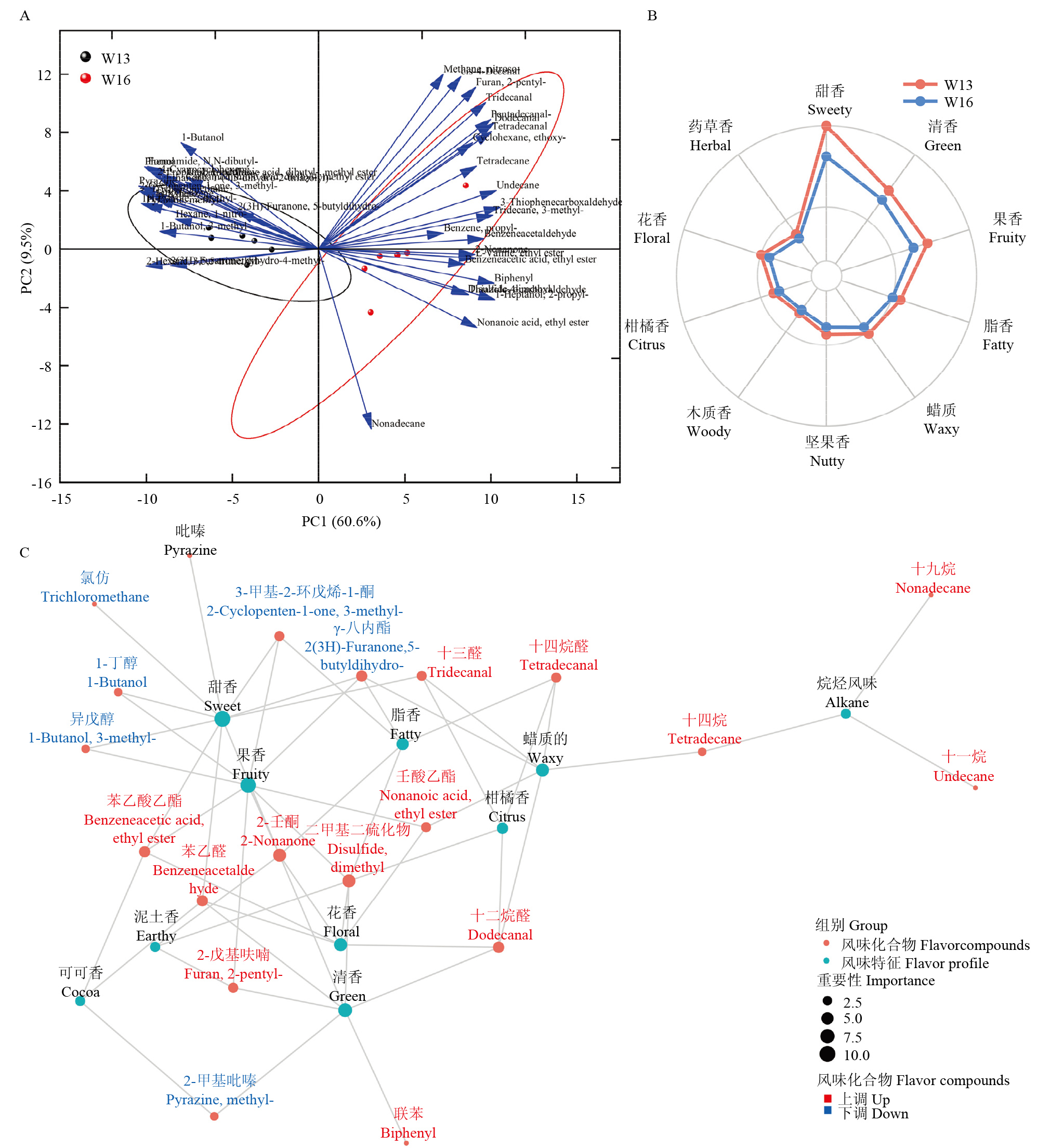
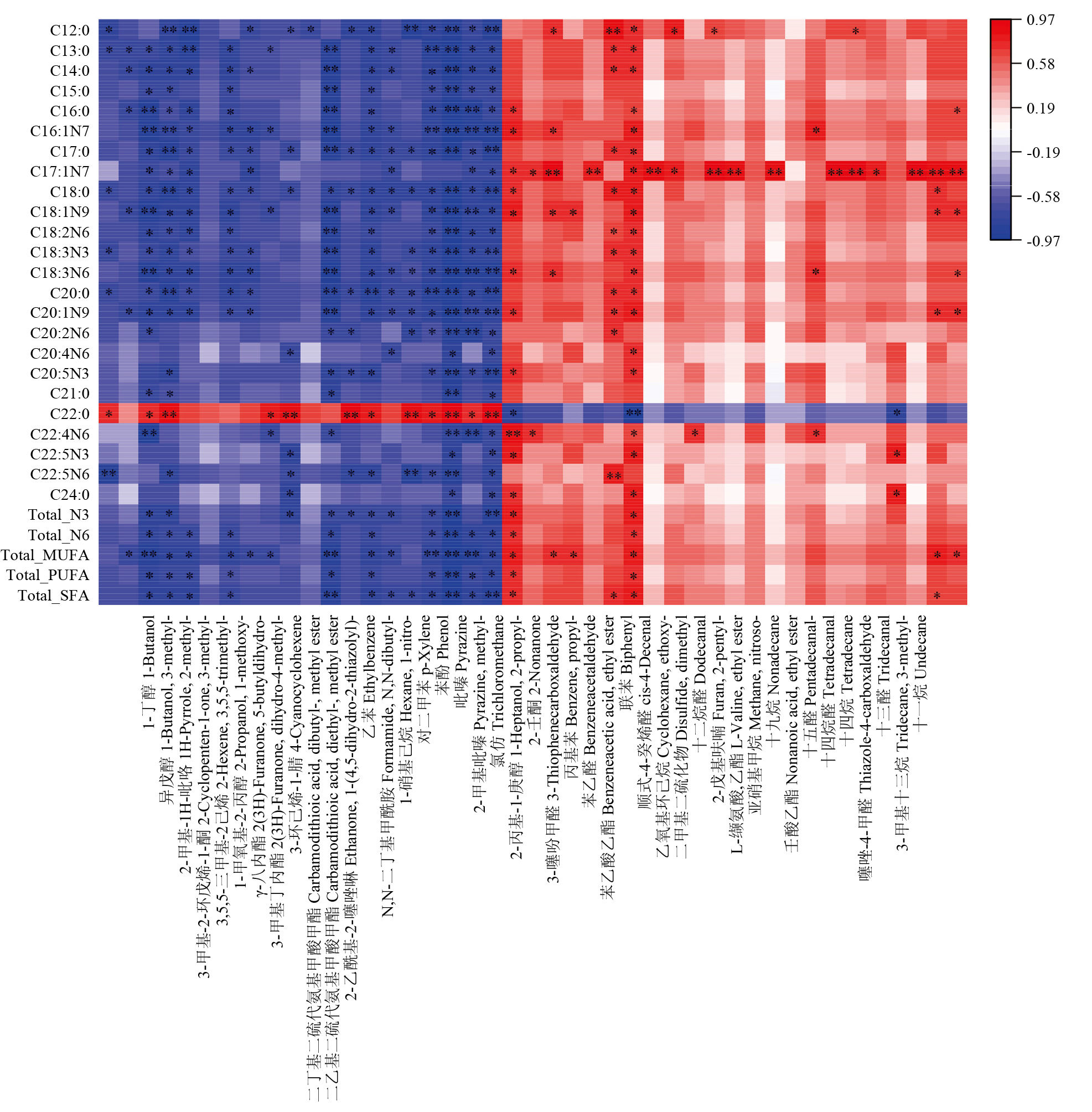
【Objective】 The meat of Lueyang black-bone chickens is delicious and nutritious, and has the value of medicine and food therapy, which has a special flavor. However, there are few studies on its flavor substances, especially the lack of systematic sensory flavor analysis. This study provided the theoretical basis for the selection of marketing time of Lueyang black-bone chickens by analyzing the body size traits in the growth and development and comparing the flavor differences of breast muscles. 【Method】 The experiment selected 30 Lueyang black-bone chickens randomly, and the body weight and body sizes at the age of 3, 6, 8, 10, 13, and 16 weeks were measured to analyze dynamic growth and development process. At 13 and 16 weeks of age, 10 chickens were randomly selected for slaughter for collecting the chest muscle and analyzing their volatile flavor substances by comprehensive two-dimensional gas chromatography and time-of-flight mass spectrometry (GC×GC-TOF MS) combined with multivariate data. 【Result】 The growth rate of Lueyang black-bone chickens was faster before 13 weeks, and there was a significant difference in body weight and body size (P<0.05), while the growth rate slowed down after 13 weeks, there was no significant difference in body weight between 13 and 16 weeks (P>0.05). Body size indexes (chest width, chest depth, keel length, etc.) also tended to be stable after 13 weeks (P>0.05). The results of the meat quality analysis showed that there was no significant difference in pH, shear force and dripping loss between 13 and 16 weeks (P>0.05), indicating that the 13 weeks had reached physiological maturity. The results of flavoromics analysis showed that 642 and 660 flavor substances were identified in the chest muscle of 13 and 16 weeks Lueyang black-bone chickens respectively, among which alcohols, aldehydes, esters and hydrocarbons were the main components. Sensory analysis showed that the breast muscles of 13 weeks Lueyang black-bone chickens were significantly better than those of 16 weeks in aroma note types of sweety, green and fruity, and this difference was closely related to fatty acid composition. 43 key differential flavor substances were further screened, and Phenol, Pyrazine, 2-Cyclopenten-1-one, 3-methyl- and Trichloromethane were found to be the main volatile compounds responsible for the flavor difference between 13 and 16 weeks chest muscles. Correlation analysis showed, 1H-pyrrole,2-methyl-, 2-Cyclopenten-1-one,3-methyl-, 2-Hexene,3,5,5- trimethyl-, 2(3H)-Furanone,5-butyldihydro-, Ethanone,1-(4,5-dihydro-2-thiazolyl)-, Formamide, N, N-dibutyl-, Phenol, Pyrazine, Pyrazine, methyl- and Trichloromethane (green and fruity substances) were significantly negative correlation with the total amount of fatty acids, and 1-Heptanol,2-propyl- and Biphenyl (lipid fragrance precursor substance) were significantly positive correlation with the total amount of fatty acids (|r|>0.5,P<0.05). 【Conclusion】 The chest muscle at 13 weeks had a more obvious floral, fruity, and sweety aroma. The higher fatty acids content in the chest muscle at 16 weeks might be richer after cooking. Considering the growth rate, flavor characteristics and breeding cost, it was possible to market the Lueyang black-bone chickens at 13 weeks of age in advance.

Key words: Lueyang black-bone chickens, chest muscle, flavoromics, volatile organic compounds, listing date

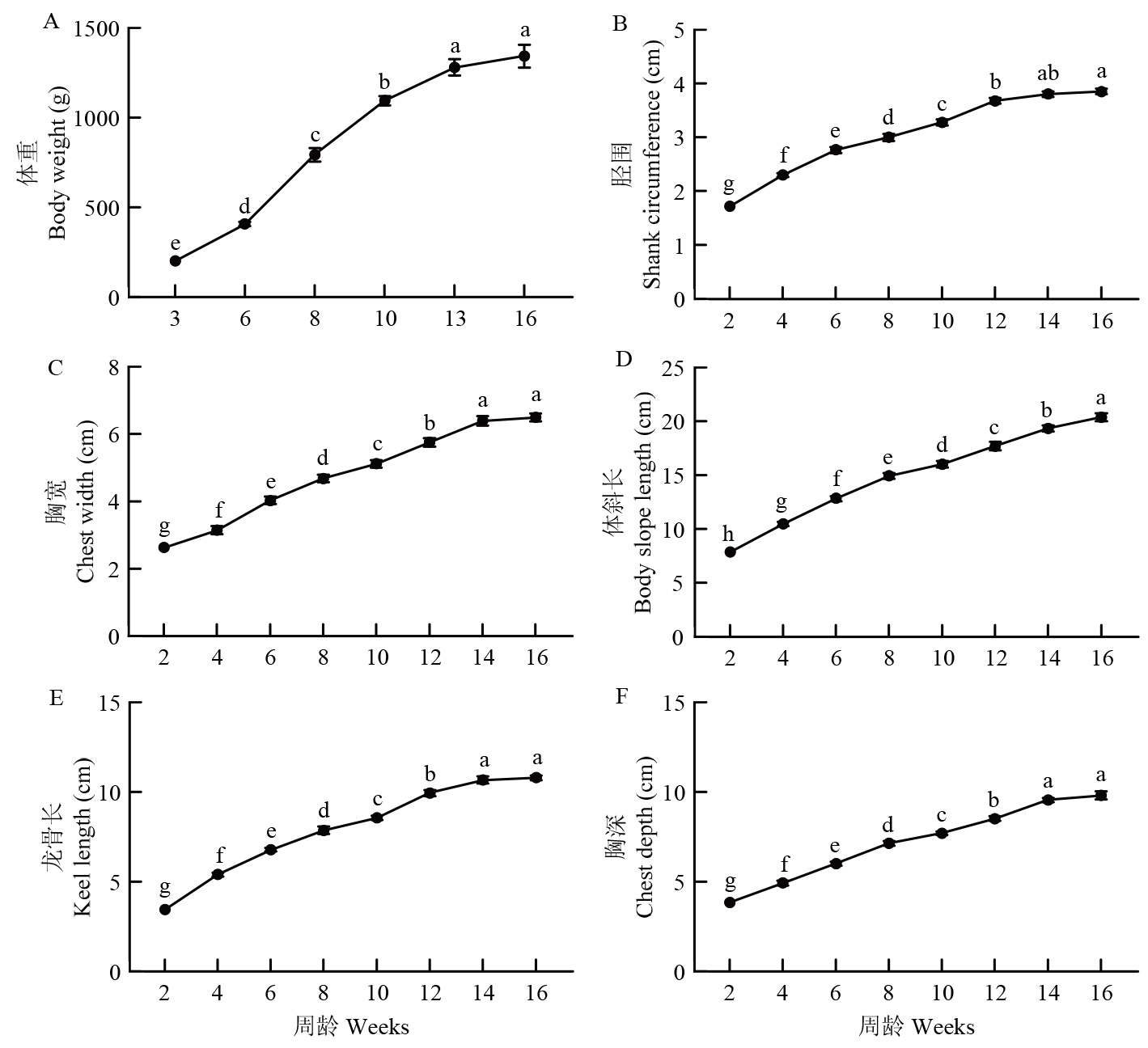
Fig. 1

Comparison of phenotypic character at different growth stages A: Body weight; B: Shank circumference; C: Chest width; D: Chest depth; E: Keel length; F: Body slope length. The same letter indicates no significant difference between the two groups (P>0.05), and the different letter indicates significant difference (P<0.05)"

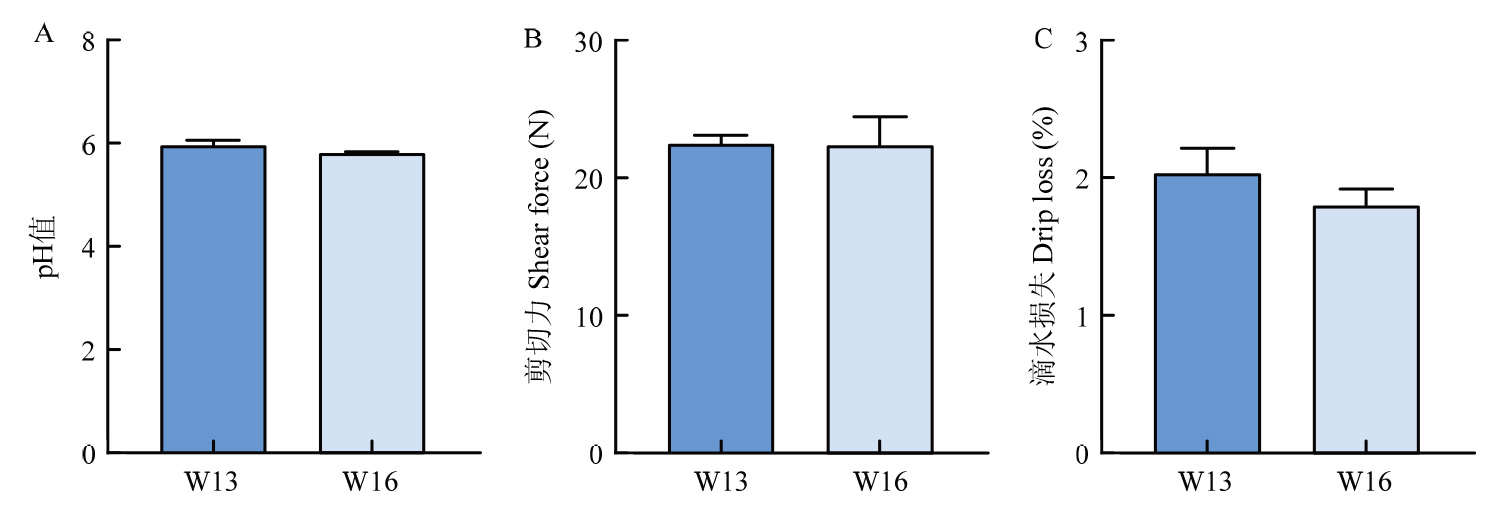
Fig. 2

Comparison of meat quality at 13 and 16 weeks"

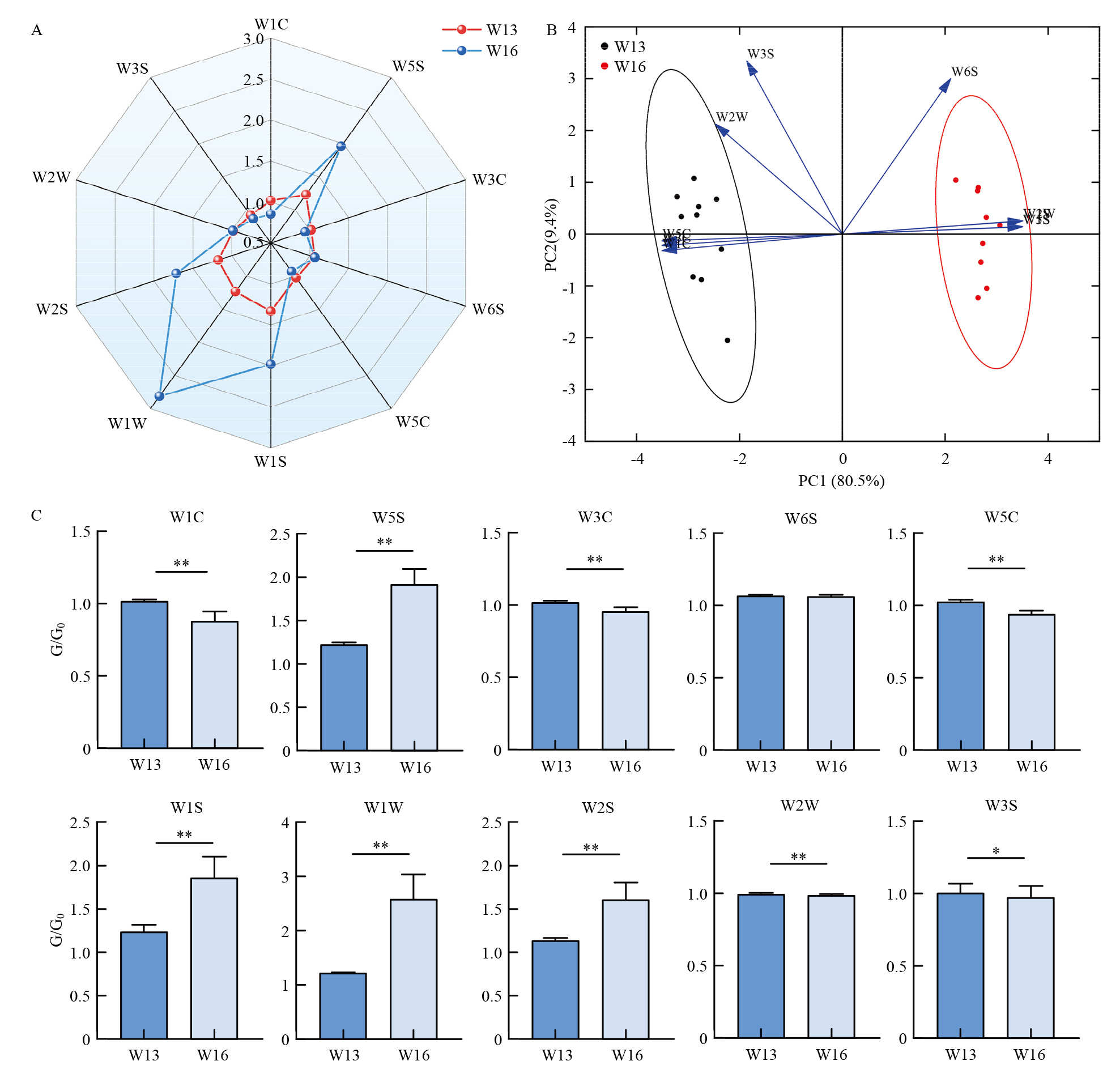
Fig. 3

The results of electronic nose at 13 and 16 weeks A: Radar map; B: PCA correlation analysis; C: Sensor response values. * indicates P<0.05, and ** indicates P<0.01"

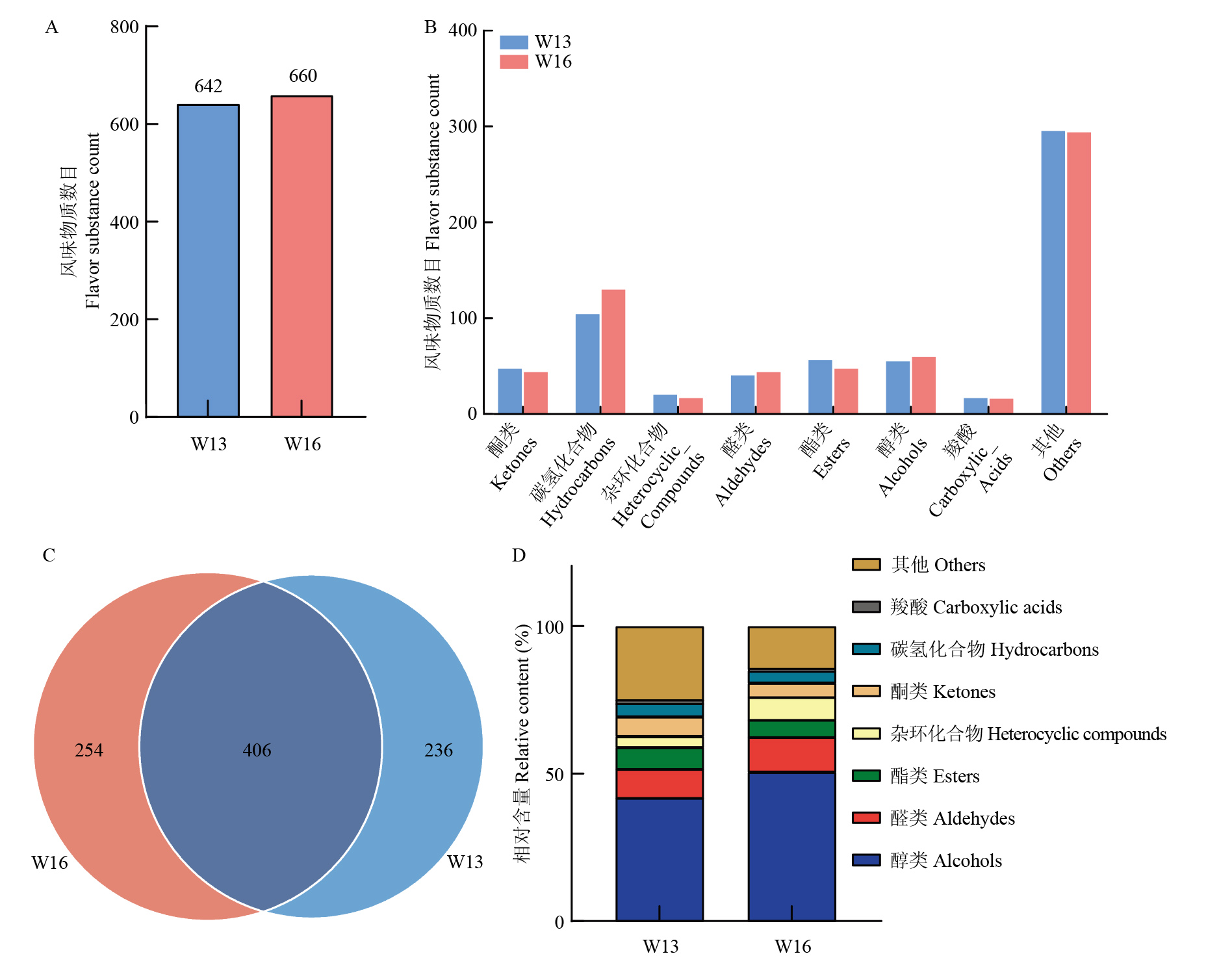
Fig. 4

The results of flavoromics at 13 and 16 weeks A: Flavor substance count; B: The type of flavor substance; C: Veen of flavor substance count; D: The relative content of flavor substance"

Fig. 5

Comparison of differential compounds at 13 and 16 weeks A: Differential compounds count; B: OPLS-DA Score plot (R2X = 0.465, R2Y = 0.999, Q2 = 0.722); C: A heat map for the differential compounds (VIP>1 & P<0.05)"

Table 1

43 differential flavor compounds"

名称
Name
VIP值
VIP value
P
P value
感官风味
Sensory flavor
上调化合物 Up compound
十四烷醛 Tetradecanal 1.501 0.028 花香, 柑橘皮香, 熏香, 脂香, 蜡质的 Floral, citrus peel, incense, fatty, waxy
十三醛 Tridecanal 1.508 0.028 花香, 新鲜的, 醛香, 肥皂感, 甜香 Floral, fresh, aldehydic, soapy, sweety
顺式-4-癸烯醛 cis-4-Decenal 1.517 0.026 /
2-丙基-1-庚醇 1-Heptanol, 2-propyl 1.978 0.001 /
十二烷醛 Dodecanal 1.682 0.010 清香, 醛香, 花香, 柑橘香, 蜡质的 Green, aldehydic, floral, citrus, waxy
噻唑-4-甲醛 Thiazole-4-carboxaldehyde 1.644 0.012 /
苯乙醛 Benzeneacetaldehyde 1.804 0.025 清甜的, 清香, 可可香, 花香, 甜香 Honey, green, cocoa, floral, sweety
十五醛 Pentadecanal 1.485 0.030 /
3-噻吩甲醛 3-Thiophenecarboxaldehyde 1.673 0.015 /
联苯 Biphenyl 1.699 0.012 天竺葵花香, 强烈的气味, 清香, 玫瑰香 Geranium, pungent, green, rose
苯乙酸乙酯 Benzeneacetic acid, ethyl ester 1.979 0.001 清甜的, 玫瑰香, 花香, 果香, 甜香 Honey, rose, floral, fruity, sweety
丙基苯 Benzene, propyl- 1.489 0.031 /
壬酸乙酯 Nonanoic acid, ethyl ester 1.701 0.009 果香, 玫瑰香, 酒香, 天然的, 蜡质的 Fruity, rose, wine, natural, waxy
L-缬氨酸,乙酯 L-Valine, ethyl ester 1.643 0.014 /
乙氧基环己烷 Cyclohexane, ethoxy 1.638 0.018 /
十四烷 Tetradecane 1.394 0.044 烷烃风味, 温和的, 蜡质的 Alkane, mild, waxy
十一烷 Undecane 1.622 0.020 烷烃风味 Alkane
十九烷 Nonadecane 1.480 0.033 烷烃风味, 清淡的 Alkane, bland
3-甲基十三烷 Tridecane, 3-methyl 1.849 0.002 /
2-壬酮 2-Nonanone 1.591 0.017 药草香, 清香, 新鲜的, 肥皂感, 甜香 Herbal, green, fresh, soapy, sweety
2-戊基呋喃 Furan, 2-pentyl 1.480 0.032 果香, 青豆气味, 泥土香, 果蔬香, 似黄油风味
Fruity, green bean, earthy, vegetable, butter
亚硝基甲烷 Methane, nitroso 2.006 <0.001 /
二甲基二硫化物 Disulfide, dimethyl 1.543 0.022 果香, 清香, 腐臭味, 坚果香, 柑橘香Fruity, green, putrid, nutty, citrus
下调化合物 Down compounds
二乙基二硫代氨基甲酸甲酯
Carbamodithioic acid, diethyl-, methyl ester
1.472 0.027 /
3,5,5-三甲基-2-己烯 2-Hexene, 3,5,5-trimethyl 1.905 0.015 /
二丁基二硫代氨基甲酸甲酯
Carbamodithioic acid, dibutyl-, methyl ester
2.002 0.007 /
异戊醇 1-Butanol, 3-methyl 1.505 0.028 果香, 麦芽香, 烧焦味, 威士忌风味, 酒精气味
Fruity, malt, burnt, whiskey, alcoholic
2-甲基吡嗪 Pyrazine, methyl 1.896 0.001 清香, 巧克力感, 可可香, 烘焙香气, 烤花生香
Green, chocolate, cocoa, roasted, peanut
2-甲基-1H-吡咯 1H-Pyrrole, 2-methyl 1.943 0.011 /
3-环己烯-1-腈 4-Cyanocyclohexene 1.812 0.003 /
苯酚 Phenol 2.128 <0.001 塑料味, 橡胶味, 酚类风味 Plastic, rubber, phenolic
3-甲基-2-环戊烯-1-酮 2-Cyclopenten-1-one, 3-methyl 2.095 <0.001 果香, 脂香, 甜香 Fruity, fatty, sweety
1-硝基己烷 Hexane, 1-nitro 1.919 0.001 /
氯仿 Trichloromethane 2.056 <0.001 甜香, 强烈的气味, 令人窒息的 Sweety, etherous, suffocating
吡嗪 Pyrazine 2.111 <0.001 榛子风味, 强烈的气味, 大麦香, 烘焙香气, 甜香
Hazelnut, pungent, barley, roasted, sweety
γ-八内酯 2(3H)-Furanone, 5-butyldihydro 1.434 0.036 椰子风味, 奶制的, 甜香, 脂香, 蜡质的Coconut, dairy, sweety, fatty, waxy
3-甲基丁内酯 2(3H)-Furanone, dihydro-4-methyl 1.683 0.009 /
2-乙酰基-2-噻唑啉
Ethanone, 1-(4,5-dihydro-2-thiazolyl)
1.784 0.024 碎粒感, 坚果香, 烘焙香气, 面包风味, 爆米花气味
Chip, nutty, roasted, bread, popcorn
N,N-二丁基甲酰胺 Formamide, N,N-dibutyl 1.972 0.001 /
乙苯 Ethylbenzene 1.967 0.001 /
对二甲苯 p-Xylene 1.719 0.026 /
1-甲氧基-2-丙醇 2-Propanol, 1-methoxy 1.721 0.031 轻盈的, 氨味 Etherish, ammonia
1-丁醇 1-Butanol 1.494 0.026 果香, 甜香, 药味, 杂醇油, 油腻的 Fruity, sweety, medicine, fusel, oily

Fig. 6

Correlation plot between differential compounds and sensory flavor characteristics A: PCA correlation analysis; B: Sensory radar map; C: The relationship between the main flavor substances and different aroma types."

Table 2

The quantitative results of 29 differential fatty acids"

名称 Name W13 (µg·g-1) W16 (µg·g-1) PP value
C12:0 0.4755 1.2610 0.007
C13:0 0.0538 0.1261 0.002
C14:0 9.4432 38.7423 <0.001
C15:0 2.2350 6.2193 0.004
C16:0 765.9851 1289.0877 0.004
C16:1N7 62.3954 296.9428 <0.001
C17:0 4.1644 16.2919 <0.001
C17:1N7 12.2400 18.4608 0.032
C18:0 306.5123 1158.2118 <0.001
C18:1N9 864.6827 1962.8961 0.001
C18:2N6 637.8241 1520.0949 0.001
C18:3N3 6.3606 39.1177 0.001
C18:3N6 2.8909 9.2185 <0.001
C20:0 2.9312 10.0755 <0.001
C20:1N9 6.9957 25.2541 <0.001
C20:2N6 23.3284 43.9469 0.008
C20:4N6 552.9604 770.6073 0.016
C20:5N3 0.3705 2.0093 0.003
C21:0 0.1340 0.3431 0.008
C22:0 16.7759 8.4232 <0.001
C22:4N6 142.5059 201.4007 0.010
C22:5N3 73.8491 103.0261 0.015
C22:5N6 46.1703 68.9706 0.006
C24:0 2.3222 3.1934 0.020
Total_N3 83.7879 146.8207 0.001
Total_N6 1451.1665 2656.9755 0.001
Total_MUFA 1061.3986 2460.2975 <0.001
Total_PUFA 1534.9544 2803.7962 0.001
Total_SFA 1111.3972 2532.6446 <0.001

Fig. 7

Heat map of the correlation between differential compounds and differential fatty acids"

[1]
孟维一, 古瑾, 徐淇淇, 马燕红, 李莹莹, 郭文萍, 王守伟. 顶空气相色谱-离子迁移谱分析不同部位和品种猪肉的挥发性风味化合物. 食品科学, 2021, 42(24): 206-212.
MENG W Y, GU J, XU Q Q, MA Y H, LI Y Y, GUO W P, WANG S W. Volatile flavor compounds in pork meat from different carcass locations and breeds by gas chromatography-ion mobility spectrometry. Food Science, 2021, 42(24): 206-212. (in Chinese)
[2]
YU Y M, CHEN S, NIE Y, XU Y. Optimization of an intra-oral solid- phase microextraction (SPME) combined with comprehensive two- dimensional gas chromatography-time-of-flight mass spectrometry (GC × GC-TOFMS) method for oral aroma compounds monitoring of Baijiu. Food Chemistry, 2022, 385: 132502.

doi: 10.1016/j.foodchem.2022.132502
[3]
HUANG Q, DONG K, WANG Q, HUANG X, WANG G Z, AN F P, LUO Z, LUO P. Changes in volatile flavor of yak meat during oxidation based on multi-omics. Food Chemistry, 2022, 371: 131103.

doi: 10.1016/j.foodchem.2021.131103
[4]
周晓倩, 李晓贝, 张艳梅, 周昌艳, 任佳丽, 赵晓燕. 基于GC-IMS和GC×GC-ToF-MS技术分析产地对羊肚菌挥发性风味成分的影响. 中国农业科学, 2024, 57(22): 4553-4567. doi: 10.3864/j.issn.0578-1752.2024.22.013.
ZHOU X Q, LI X B, ZHANG Y M, ZHOU C Y, REN J L, ZHAO X Y. Effects of origin on the volatile flavor components of morels based on GC-IMS and GC×GC-ToF-MS. Scientia Agricultura Sinica, 2024, 57(22): 4553-4567. doi: 10.3864/j.issn.0578-1752.2024.22.013. (in Chinese)
[5]
MAO Y, LIU Q, SHAO J W, YANG L, ZHANG X W. Flavoromics analysis of passion fruit-roasted chicken. Foods, 2024, 13(14): 2221.

doi: 10.3390/foods13142221
[6]
LI H H, GENG W H, HARUNA S A, ZHOU C G, WANG Y, OUYANG Q, CHEN Q S. Identification of characteristic volatiles and metabolomic pathway during pork storage using HS-SPME-GC/MS coupled with multivariate analysis. Food Chemistry, 2022, 373(Pt A): 131431.
[7]
XU Y, CHEN Y P, DENG S L, LI C B, XU X L, ZHOU G H, LIU Y. Application of sensory evaluation, GC-ToF-MS, and E-nose to discriminate the flavor differences among five distinct parts of the Chinese blanched chicken. Food Research International, 2020, 137: 109669.

doi: 10.1016/j.foodres.2020.109669
[8]
张淑雅, 张纪桥, 蔡瑛婕, 曹敞, 张建华, 张建勤. 不同日龄略阳乌鸡肉品质对比与最佳上市日龄分析. 中国畜牧兽医, 2022, 49(6): 2165-2175.

doi: 10.16431/j.cnki.1671-7236.2022.06.017
ZHANG S Y, ZHANG J Q, CAI Y J, CAO C, ZHANG J H, ZHANG J Q. Comparison of meat quality and analysis of the best listing date of lueyang black-bone chickens at different ages. China Animal Husbandry & Veterinary Medicine, 2022, 49(6): 2165-2175. (in Chinese)
[9]
LI X Y, HA M, WARNER R D, DUNSHEA F R. Meta-analysis of the relationship between collagen characteristics and meat tenderness. Meat Science, 2022, 185: 108717.

doi: 10.1016/j.meatsci.2021.108717
[10]
刘俊霞, 赵萍, 金晶, 金文刚, 姜鹏飞. 基于气相色谱-离子迁移谱结合化学计量学分析大鲵肉冷藏期间挥发性成分. 食品与发酵工业, 2022, 48(22): 269-278.

doi: 10.13995/j.cnki.11-1802/ts.030169
LIU J X, ZHAO P, JIN J, JIN W G, JIANG P F. Analysis of volatile components in giant salamander meat during cold storage based on gas chromatography-ion mobility spectrometer and chemometrics. Food and Fermentation Industries, 2022, 48(22): 269-278. (in Chinese)

doi: 10.13995/j.cnki.11-1802/ts.030169
[11]
黄颖妍, 王迪, 李彬, 李林, 曾子悠, 虞洁, 梅绍锋. 不同油脂对麻黄肉鸡生长性能、屠宰性能和肉品质的影响. 中国畜牧杂志, 2023, 59(09): 293-297.
HUANG Y Y, WANG D, LI B, LI L, ZENG Z Y, YU J, MEI S F. Effects of different oils and fats on growth performance, slaughter performance and meat quality of ephedra broilers. Chinese Journal of Animal Science, 2023, 59(09): 293-297. (in Chinese)
[12]
于鑫, 周贵同, 赵子怡, 何文, 张玉斌. 不同年龄甘南牦牛肉品质变化分析及安全性评价. 食品与发酵工业, 2025(14): 9-16.

doi: 10.13995/j.cnki.11-1802/ts.041113
YU X, ZHOU G T, ZHAO Z Y, HE W, ZHANG Y B. Analysis of quality change and safety evaluation of Gannan yak meat of different ages. Food and Fermentation Industries, 2025(14): 9-16. (in Chinese)
[13]
张诗泉, 刘永峰, 葛鑫禹, 张朵朵, 侯晨梓. 鸭肉宰后成熟过程中食用品质、营养品质及嫩度变化研究. 食品与发酵工业, 2023, 49(15): 236-242.

doi: 10.13995/j.cnki.11-1802/ts.032891
ZHANG S Q, LIU Y F, GE X Y, ZHANG D D, HOU C Z. Changes in edible quality,nutritional quality,and tenderness during post-slaughter maturation of duck meat. Food and Fermentation Industries, 2023, 49(15): 236-242. (in Chinese)
[14]
王昱苏, 孟兰奇, 郭烨, 查恩辉. 热加工方式对鸡肉风味的影响. 保鲜与加工, 2022, 22(12): 44-52.
WANG Y S, MENG L Q, GUO Y, ZHA E H, Effect of thermal processing method on chicken flavor. Storage and Process, 2022, 22(12): 44-52. (in Chinese)
[15]
WANG Y, WANG Y, WANG P, XUU M, CHE Z M, LIU P. Quality change of spicy diced chicken during storage. Science and Technology of Food Industry, 2022, 43(18): 346-358.
[16]
LUO N, LIU L, YUAN X Y, JIN Y X, ZHAO G P, WEN J, CUI H X. A comparison of different tissues identifies the main precursors of volatile substances in chicken meat. Frontiers in Physiology, 2022, 13: 927618.

doi: 10.3389/fphys.2022.927618
[17]
XU N, YE J J, LI L Y, WANG X M, WANG P, HAN M Y, XU X L. Exploration of flavor and taste of soft-boiled chicken at different post-mortem aging time: Based on GC-IMS and multivariate statistical analysis. Food Bioscience, 2021, 43: 101326.

doi: 10.1016/j.fbio.2021.101326
[18]
孙旺斌, 付琪, 薛瑞林, 王伟萍, 张骞, 冯平. 不同枣粉水平对陕北白绒山羊肉挥发性风味物质的影响. 动物营养学报, 2021, 33(10): 5664-5676.

doi: 10.3969/j.issn.1006-267x.2021.10.026
SUN W B, FU Q, XUE R L, WANG W P, ZHANG Q, FENG P. Effects of different levels of jujube powder on volatile flavor substances of north Shaanxi white cashmere goat meat. Chinese Journal of Animal Nutrition, 2021, 33(10): 5664-5676. (in Chinese)
[19]
刘宇航, 刘圈炜, 孙瑞萍, 赵桂苹, 张旭丽, 王秀萍, 魏立民, 冯鑫. 不同饲养方式对文昌鸡肉质性状、脂肪酸、氨基酸及挥发性风味物质的影响. 饲料研究, 2024, 47(22): 34-40.
LIU Y H, LIU Q W, SUN R P, ZHAO G P, ZHANG X L, WANG X P, WEI L P, FENG X. Effects of different feeding methods on meat quality traits, fatty acids, amino acids and volatile flavor compounds of Wenchang chicken. Feed Research, 2024, 47(22): 34-40. (in Chinese)
[20]
马晶, 陈麒雯, 赵梦雅, 仝鹏琰, 杨小军, 杨欣, 龙芳羽. 不同调味类腌制对略阳乌鸡肉干质构及挥发性风味的影响. 中国食品添加剂, 2023(5): 216-223.
MA J, CHEN Q W, ZHAO M Y, TONG P Y, YANG X J, YANG X, LONG F Y. Effects of different marination on texture and volatile flavor of Lueyang black-bone chicken jerky. China Food Additives, 2023(5): 216-223. (in Chinese)
[21]
施周旻, 王晓洁, 高悦, 刘娟, 崔月花. 糯米发酵前后成品粽子风味物质变化分析. 食品研究与开发, 2024, 45(11): 185-194.
SHI Z M, WANG X J, GAO Y, LIU J, CUI Y H. Changes of Flavor Substances in Finished Zongzi before and after Glutinous Rice Fermentation. Food Research and Development, 2024, 45(11): 185-194. (in Chinese)
[22]
SHAHIDI F, HOSSAIN A. Role of lipids in food flavor generation. Molecules, 2022, 27(15): 5014.

doi: 10.3390/molecules27155014
[23]
姜家帅, 孙进华, 蒋守群, 阮栋. 鸡肉挥发性风味物质成分、形成机制及脂质调控研究进展. 动物营养学报, 2023, 35(9): 5465-5474.

doi: 10.12418/CJAN2023.503
JIANG J S, SUN J H, JIANG S Q, RUAN D. Research progress on components,formation mechanism and lipid regulation of volatile flavor substances in chicken. Chinese Journal of Animal Nutrition, 2023, 35(9): 5465-5474. (in Chinese)
[24]
郑月, 李加加, 王腾, 王文武, 张庆永, 刘登勇. 不同品种乌鸡加工德州扒鸡营养品质及风味物质组成分析研究. 食品与发酵工业, 2024, 50(03): 276-282.
ZHENG Y, LI J J, WANG T, WANG W W, ZHANG Q Y, LIU D Y. Nutritional quality and flavor substance composition of Dezhou braised chicken with different varieties of silky fowl. Food and Fermentation Industries, 2024, 50(03): 276-282. (in Chinese)
[25]
袁华根, 罗有文, 高峰. 品种、 日龄因素对鸡肉挥发性风味的影响. 中国饲料, 2022(20): 25-28.
YUAN H G, LUO Y W, GAO F. The effects of breed,age on the chicken meat flavor. China Feed, 2022(20): 25-28. (in Chinese)
[26]
顾赛麒, 王涣淇, 冯媛, 黎君鸿, 周振毅, 鲍嵘斌, 戴王力, 陈玉峰, 周绪霞, 丁玉庭. 高铁肌红蛋白对腌腊鱼脂质氧化与挥发性风味的影响. 水产学报, 2023(4): 180-191.
GU S Q, WANG H Q, FENG Y, LI J H, ZHOU Z Y, BAO R B, DAI W L, CHEN Y F, ZHOU X X, DING Y T. Effects of ferrimyoglobin on lipid oxidation and volatile flavor of preserved fish. Journal of Fisheries of China, 2023(4): 180-191. (in Chinese)
[27]
GU W, WEI Y H, FU X J, GU R H, CHEN J L, JIAN J Y, HUANG L J, YUAN C M, GUAN W L, HAO X J. HS-SPME/GC × GC-TOFMS- based flavoromics and antimicrobial properties of the aroma components of Zanthoxylum motuoense. Foods, 2023, 12(11): 2225.
[28]
汪冬冬, 唐垚, 伍亚龙, 张伟, 陈功, 张文学, 张其圣. 泡菜细菌多样性和风味成分研究进展. 食品与发酵工业, 2021, 47(21): 296-302.

doi: 10.13995/j.cnki.11-1802/ts.028083
WANG D D, TANG Y, WU Y L, ZHANG W, CHEN G, ZHANG W X, ZHANG Q S. Advances on bacterial diversity and flavor of Paocai. Food and Fermentation Industries, 2021, 47(21): 296-302. (in Chinese)

doi: 10.13995/j.cnki.11-1802/ts.028083
[29]
梁森, 房子林, 李培, 田红玉, 孙宝国. 噻唑类食品香料的研究进展. 食品科学技术学报, 2022, 40(6): 26-36, 51.
LIANG S, FANG Z L, LI P, TIAN H Y, SUN B G. Research progress of thiazole flavor compounds. Journal of Food Science and Technology, 2022, 40(6): 26-36, 51. (in Chinese)
[30]
DUIS M L, CONKLIN G, BAE T, CM SMITH C M, A JEANKJUK A. Saturated and unsaturated N-alkylamides having taste and aroma enhancing effects in seasoning compositions: US, CN201110054062. 7[P]. 2011-09-21.
[31]
余远江, 庞一扬, 袁桃静, 赵笑颍, 刘小玲. 基于电子鼻、 HS-GC-IMS和HS-SPME-GCMS分析五种水产原料的风味特征. 食品工业科技, 2021(19): 106-117.
YU Y J, PANG Y Y, YUAN T J, ZHAO X Y, LIU X L. Analysis of flavor characteristics of five aquatic raw materials based on electronic nose, HS-GC-IMS and HS-SPME-GC-MS. Science and Technology of Food Industry, 2021(19): 106-117. (in Chinese)
[32]
周宇科, 郑传洋, 任汐月, 胡勇. 不同产地花生酱的挥发性风味成分比较分析. 现代食品科技, 2023, 39(4): 297-310.
ZHOU Y K, ZHENG C Y, REN X Y, HU Y. Comparative analysis demonstrates changes in volatile flavor components in peanut butter from different origins. Modern Food Science and Technology, 2023, 39(4): 297-310. (in Chinese)
[33]
林珮璇, 张宏婧, 陈继承. 丙氨酸和丁二酮Maillard反应形成烷基吡嗪化合物动力学分析. 食品科学, 2022, 43(2): 41-47.
LIN P X, ZHANG H J, CHEN J C. Kinetic studies on the formation of alkylpyrazines from maillard reaction between alanine and butanedione. Food Science, 2022, 43(2): 41-47. (in Chinese)

doi: 10.7506/spkx1002-6630-20201225-294
[34]
徐振飞, 崔焕先, 梁万鹏, 豆丽萍, 刘刚, 赵福平, 赵桂苹. 不同饲养方式对京星黄鸡103屠宰性能和肉品质的影响. 动物营养学报, 2022, 34(7): 4331-4339.

doi: 10.3969/j.issn.1006-267x.2022.07.024
XU Z F, CUI H X, LIANG W P, DOU L P, LIU G, ZHAO F P, ZHAO G P. Effects of different feeding patterns on slaughter performance and meat quality of Jingxing-Yellow 103 Chickens. Chinese Journal of Animal Nutrition, 2022, 34(7): 4331-4339. (in Chinese)
[1] XU Le, ZHANG DeQuan, GU MingHui, YANG Qi, LI ShaoBo, CHEN PengYu, LI Xin, CHEN Li. Analysis of Discriminate Volatilome of Lamb Under Various Chinese- Style Cooking [J]. Scientia Agricultura Sinica, 2024, 57(24): 4964-4977.
[2] LIU Qiang,LIU JiWei,TIAN Tian,YAN Wei,LIU Bing,ZHAO SiQi,HU QiuHui,DING Chao. Dynamic Analysis for the Characteristics of Flavor Fingerprints for Brown Rice in Short-Term Storage Under High Temperature Stress [J]. Scientia Agricultura Sinica, 2021, 54(2): 379-391.
[3] CHEN JingShi,HUANG YuYang,XIANG Jie,GUO QingHua,LI ShiGui,GU JinGang. Carbon Source Metabolism of Trichoderma afroharzianum with High-Yield of Antifungal Volatile Organic Compounds [J]. Scientia Agricultura Sinica, 2020, 53(22): 4601-4612.
[4] WANG EnZhao,FAN FenLiang,LI YanLing,LIU XiongDuo,LU YuQiu,SONG ALin. Noncontact Inhibitory of Volatile Organic Compounds from Rice Root Bacteria on Rhizopus microsporus [J]. Scientia Agricultura Sinica, 2020, 53(10): 1986-1996.
[5] Jing WANG, JianMin CAO, DeXin CHEN, Jun QIU, XiaoQiang WANG, Chao FENG, WenJing WANG. Antimicrobial Effect and Components Analysis of Volatile Organic Compounds from Bacillus pumilus AR03 [J]. Scientia Agricultura Sinica, 2018, 51(10): 1908-1919.
Viewed
Full text


Abstract

Cited

  Shared   
  Discussed   
No Suggested Reading articles found!