Scientia Agricultura Sinica ›› 2026, Vol. 59 ›› Issue (21): 4784-4801.doi: 10.3864/j.issn.0578-1752.2026.21.006

• TILLAGE & CULTIVATION·PHYSIOLOGY & BIOCHEMISTRY·AGRICULTURE INFORMATION TECHNOLOGY • Previous Articles     Next Articles

Analysis and Countermeasure of Xinjiang Cotton Industry Status and Its Influencing Factors

TIAN LiWen1(), ZHANG Sheng3, TIAN CongHua1, MA Ting4, CUI JianPing1, FANG YanFei1, LUO HongHai2(), LOU ShanWei1()   

  1. 1 Cotton Research Institute, Xinjiang Uyghur Autonomous Region Academy of Agricultural Sciences/National Cotton Engineering Technology Research Center/Xinjiang Cotton Technology Innovation Center, Urumqi 830091
    2 Shihezi University, College of Agriculture, Shihezi 832003, Xinjiang
    3 Office of Xinjiang Uygur Autonomous Region Cotton Industry Development Leading Group, Urumqi 830002
    4 Xinjiang Uygur Autonomous Region Rural Industry Development Center, Urumqi 830046
  • Received:2026-03-10 Accepted:2026-06-08 Online:2026-11-01 Published:2026-11-06
  • Contact: LUO HongHai, LOU ShanWei

Abstract:

This paper systematically reviewed the development status and key influencing factors of the cotton industry in Xinjiang, aiming to provide the decision-making references for industrial transformation, upgrading, and high-quality development. Based on statistical data from 2014 to 2025 and authoritative public sources, a multidimensional analysis was conducted along the entire industrial chain—covering cotton cultivation, processing, and textiles—and encompassing natural resources, technological progress, policies and institutions, the market environment, and socio-economic conditions, thereby identifying the core factors and their mechanisms in each dimension. The results indicated that in 2025, total cotton output in Xinjiang reached 6.165 million tons, with high-quality cotton accounting for 72.3%, forming an industrial development pattern characterized by “continuous expansion in scale, stable spatial distribution, and simultaneous quality improvement”. Benefiting from the agglomeration effect of the relocation of the textile industry from eastern China to Xinjiang, a complete cotton industrial chain integrating cultivation, spinning, weaving, dyeing, and garment manufacturing has been established, with the gross output value of the entire chain exceeding 220 billion yuan; the scale of the textile industry has continued to expand, and the share of locally produced cotton processed within Xinjiang has steadily increased. The influencing factors were interdependent and mutually restrictive. Although water resources impose rigid constrained on the scale of the industry, Xinjiang possesses unique natural resource advantages in sunlight and land, and was strongly supported by technological and policy assistance—notably, the cotton target price subsidy has formed a stable “fixed every three years” mechanism that promoted industrial transformation. Currently, Xinjiang's cotton industry still lacks pricing dominance and industry influence in international markets, facing both opportunities and challenges in the international competitive and trade environment, while cotton cultivation costs continue to rise.The Xinjiang cotton industry was at a critical stage of profound transformation from a “scale-expansion model” to a “quality-efficiency model”. To achieve the 2026 regulatory target of a cotton planting area of (240±3.3)×104 hm2, under the premise of prioritizing the interests of basic farming households, efforts should focus on reducing low-quality and low-efficiency cotton fields, areas of groundwater over-extraction, and illegally reclaimed land. It was also recommended to synergistically strengthen technological empowerment, improve the policy system, promote green transformation, and expand international markets, thereby striving to build a modern full industrial system of cotton cultivation and textile and apparel that was the world’s largest in scale, most complete in chain, and leading in quality and efficiency, and driving the Xinjiang cotton industry toward higher quality and greater sustainability.

Key words: Xinjiang cotton, industrial development status, influencing factors, high-quality development, whole industrial chain

Table 1

Changes in cotton production scale in Xinjiang (2014-2025)"

年份
Year
播种面积
Sown area
(×104 hm2)
总产量
Total yield
(×104 t)
单产
Yield per unit area
(kg·hm-2)
占全国产量比重
Percentage of production in the national total yield (%)
2014 195.32 367.7 1882.5 59.5
2015 190.43 350.3 1839.6 64.5
2016 200.56 410.2 2045.3 67.3
2017 196.31 408.2 2079.3 74.4
2018 221.78 511.1 2304.6 83.8
2019 254.05 500.2 1969.1 84.9
2020 233.54 516.1 2210.3 87.3
2021 250.61 512.9 2046.4 89.5
2022 241.56 539.1 2231.8 90.2
2023 236.93 511.2 2157.8 91.0
2024 249.03 568.6 2284.0 92.2
2025 259.17 616.5 2379.0 92.8

Table 2

Changes in main quality indicators of Xinjiang cotton (2014-2025)"

年份
Year
长度28 mm及以上占比
Percentage of varieties with fiber length of 28mm or above (%)
长度29 mm及以上占比
Percentage of varieties with fiber length of 29 mm or above (%)
马克隆值A+B级占比
Percentage of varieties with Micronaire value grade A+B (%)
断裂比强度≥29.0
Fiber strength (Proportion of strong and above 29.0 cN/tex, %)
优质棉占比
Percentage of high-quality varieties (%)
2014 87.3 36.4 88.5 21.9 —
2015 75.4 31.6 62.1 28.8 —
2016 93.5 54.8 79.7 23.9 —
2017 93.2 54.2 80.6 26.5 —
2018 95.8 60.6 82.8 42.1 —
2019 91.2 54.6 72.7 38.8 —
2020 79.4 24.2 68.1 19.9 —
2021 96.3 49.7 86.3 62.3 —
2022 93.5 53.2 90.4 64.8 —
2023 97.8 56.1 92.1 64.6 —
2024 98.1 58.2 93.1 63.3 64.6
2025 98.5 60.3 96.2 72.3 72.3

Table 3

Changes in main indicators of Xinjiang's textile industry (2020-2025)"

年份
Year
纱锭规模
Spindle scale (×104 spindles)
织机数量
Number of looms (×104)
布产量
Cloth output (×108 m)
备案纺织服装企业
Registered textile and apparel enterprises
规上企业工业增加值
Industrial added value of enterprises (×108 yuan)
全产业链总产值
Total output value of the entire industry chain (×108 yuan)
2020 2038 1.68 4.9 2400 371 —
2021 2146 — 6.8 2700 438 —
2022 2215 — 8.5 3100 506 —
2023 2449 3.48 13.8 3500 573 —
2024 2910 6.24 24.9 3920 620 —
2025 3010 6.80 32.6 4100 710 2200
2020—2025年增幅
Increase from 2020 to 2025 (%)
47.7 304.8 565.3 70.8 91.4 —

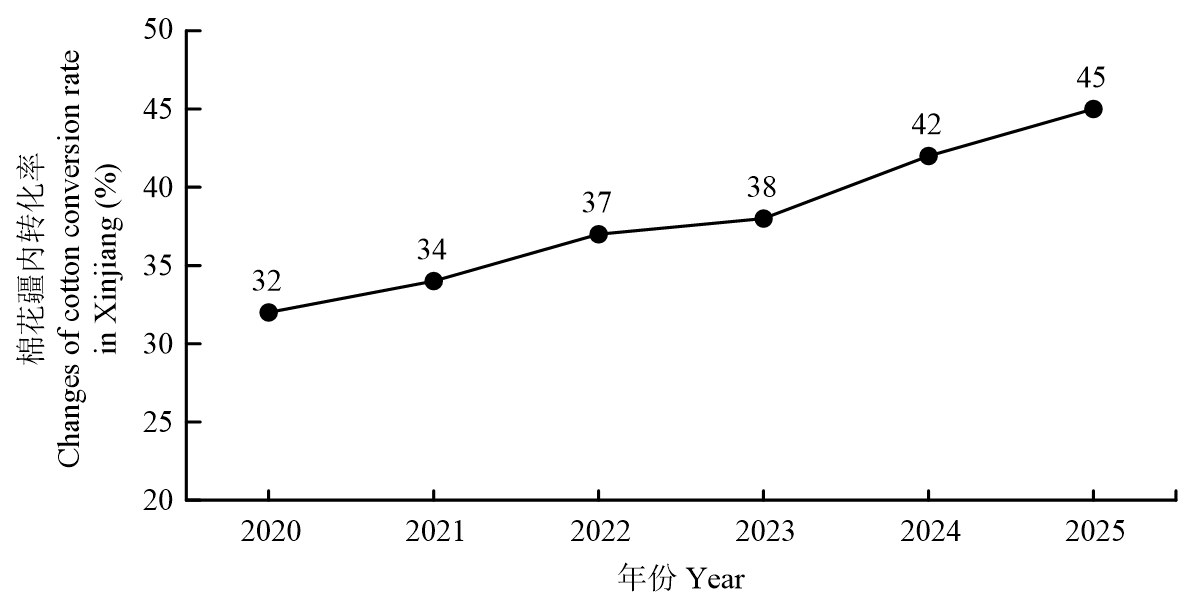
Fig. 1

Changes of cotton conversion rate in Xinjiang from 2020 to 2025 Sources of data: Government Work Report of the Xinjiang Uygur Autonomous Region"

Table 4

Analytical framework for factors influencing Xinjiang's cotton industry development"

维度
Dimension
主要因素
Main factor
作用机制
Mechanism of action
自然资源
Natural resources
受光热条件、水土资源、气候变化约束
Constraints imposed by solar thermal conditions, water and soil resources, and climate change
奠定产业发展的基本条件,界定生产活动的资源边界
Establish the fundamental conditions for industrial development and delineate the resource boundaries for production activities
技术进步
Technological progress
良种研发推广、机械化智能化装备应用、栽培技术创新
Research and promotion of improved varieties, application of mechanized and intelligent equipment, and innovation in cultivation techniques
突破资源约束瓶颈,提升生产效率与产品质量
Break through the bottleneck of resource constraints and enhance production efficiency and product quality
政策制度
Policy regime
目标价格补贴、种植规模调控、纺织产业扶持政策
Target price subsidies, regulation of planting scale, and supportive policies for the textile industry
引导资源优化配置,形成产业发展的合理激励与约束机制
Guide the optimal allocation of resources and form a reasonable incentive and restraint mechanism for industrial development
市场环境
Market environment
棉花价格波动、下游消费需求变化、国际竞争与贸易环境
Cotton price fluctuations, changes in downstream consumer demand, international competition and trade environment
影响甚至决定产业市场竞争力与价值实现路径,以及产业发展效益与空间
Influence and even determine the competitiveness and value realization path of the industrial market, as well as the benefits and space for industrial development
社会经济
Socioeconomic
劳动力成本与供给、作物比较效益、就业吸纳能力
Labor cost and supply, comparative benefits of crops, and employment absorption capacity
筑牢产业发展的社会基础,影响产业可持续发展能力
Build a solid social foundation for industrial development and influence the sustainable development capacity of the industry

Table 5

Changes in cotton mechanization level in Xinjiang (2015, 2020, 2025)"

年份
Year
综合机械化率
Comprehensive mechanization rate (%)
机采率
Mechanized picking rate (%)
采棉机保有量
Cotton picker inventory (units)
2015 85.2 30.0 2000
2020 93.6 75.0 5000
2025 97.5 92.0 8500

Table 6

Changes in Xinjiang seed cotton purchase price (2022-2025)"

年份
Year
籽棉收购均价
Average purchase price of seed cotton (yuan/kg)
较2022年增长率
Growth rate compared with 2022 (%)
主要特征
Main feature
2022 6.03 — 价低惜售,交售期明显推后
Selling at a low price but reluctant to part with, with the delivery date noticeably postponed
2023 7.14 +18.4 低开高走、后小幅度回落
Opening low and rising high, followed by a slight decline
2024 6.45 +7.0 高开后,总体呈低走平稳态势
After opening higher, it generally trended lower and then stabilized
2025 6.19 +2.7 产量创新高Yield hits a new high level

Table 7

Comparison of strengths and weaknesses in cotton production in India, the United States, and Australia under international competition and trade conditions"

国家
Country
优势
Advantage
劣势
Disadvantage
印度
India
品种资源丰富,官方发布184个作物新品种。劳动力资源丰富且成本低,生产成本约1.86美元/kg,手工采摘费约0.106美元/kg,纺织业平均时薪约0.38美元。约占全球棉花出口比8%,政府提供最低支持价格(MSP),保障了棉农收益。传统手工采摘有助于减少棉花加工时纤维机械损伤,含杂率<2%,回潮率<8%
The country boasts abundant variety resources, with 184 new crop varieties officially released. It also enjoys abundant labor resources at a low cost, with a production cost of approximately $1.86/kg, a manual harvesting fee of about $0.106/kg, and an average hourly wage in the textile industry of about $0.38. The country accounts for approximately 8% of global cotton exports, and the government provides a minimum support price (MSP) to safeguard the income of cotton farmers. Traditional manual harvesting reduces mechanical damage to cotton fibers during processing, with a trash content of less than 2% and a moisture regain of less than 8%
转基因技术长期未更新,新品种商业化需2—3年,转化慢。高度依赖人工,限制规模化发展,再加上棉田管理水平低,以及多地出现劳动力短缺问题,单产低(约435 kg·hm-2)推高了单位成本,国内棉价有时高于国际棉价。品质一致性差,污染和不洁操作使价值损失15%—20%
Genetic modification technology has not been updated for a long time, and it takes 2-3 years for new varieties to be commercialized, resulting in slow transformation. It is highly dependent on manual labor, which limits large-scale development. Coupled with low management levels in cotton fields and labor shortages in many places, low yields (about 435 kg·hm-2) have pushed up unit costs, and domestic cotton prices are sometimes higher than international cotton prices. Poor quality consistency, pollution, and unclean operations cause a loss of 15%— 20% in value
美国
America
转基因技术领先,普及率极高,2024年转基因棉花品种覆盖率达93%。机械化率100%,劳动力投入仅为中国人工成本的1/5;据2023年的数据,美国生产50 kg皮棉仅需0.5个工作日,机械采摘成本约1200元/hm2,生产成本约83美分/磅,约占全球棉花出口比35.8%,纤维品质类型丰富,且一致性和可纺性好
With leading transgenic technology and an extremely high penetration rate, the coverage of transgenic cotton varieties reached 93% in 2024. The mechanization rate stands at 100%, and labor input is only 1/5 of China's labor cost. According to data from 2023, it takes only 0.5 working days to produce 50 kg lint cotton in the United States, with a mechanical harvesting cost of about 80 yuan per 666.67 m2 and a production cost of about 83 cents per pound
种植成本不断攀升,单产水平约885 kg·hm-2,棉农仍面临亏损,棉农严重依赖作物保险和补贴来弥补损失。虽然美棉有完善的分级体系和持续现代化的管理技术,但频繁的天气变化使其品质稳定性受到挑战,全球市场的份额受到巴西棉挑战
The cost of cultivation continues to rise, with a yield level of approximately 885 kg·hm-2. Cotton farmers still face losses, heavily relying on crop insurance and subsidies to compensate for their losses. Despite the well-established grading system and continuously modernized management techniques of U.S. cotton, frequent weather changes challenge its quality stability, and its global market share is threatened by Brazilian cotton
澳大利亚
Australia
具有“国家级”科研体系,品种精,单产水平高,约2010 kg/hm2;纤维高品质、高一致性,纤维长度28—32 mm,纤维强度普遍在29 cN/tex以上,马克隆值适中(3.5—4.9),非常适合纺60支、80支以上的中高支包漂纱。100%的机械化收获,较高的用水效率,总生产成本7000—8000澳元/hm2,约占全球棉花出口量的8%
It boasts a "national-level" scientific research system, featuring refined varieties and high yield levels, approximately 2010 kg·hm-2; high-quality and consistent fibers, with fiber length ranging from 28-32 mm, fiber strength generally above 29 cN/tex, and a moderate micronaire value (3.5-4.9), making it highly suitable for spinning medium and high-count yarn with counts of 60 and 80 or more. It achieves 100% mechanized harvesting, high water use efficiency, and a total production cost of 7000-8000 Australian dollars per hectare, accounting for approximately 8% of global cotton exports
需在品种研发、灌溉系统、精准农业技术上进行持续的巨额投入,棉花产业高度依赖灌溉,产出受市场与异常天气影响,波动剧烈;生产加工成本高,轧花厂工人的时薪高达人民币150元;由于纺织加工业的缺位,原棉直接出口,其受激烈的国际市场竞争承压
Continuous and substantial investments are required in variety research and development, irrigation systems, and precision agriculture technologies. The cotton industry is highly dependent on irrigation, and its output is subject to drastic fluctuations due to market and abnormal weather conditions. The production and processing costs are high, with the hourly wage for workers in cotton ginning factories reaching up to 150 yuan. Due to the absence of the textile processing industry, raw cotton is exported directly, which puts it under pressure from fierce competition in the international market
[1]
邱星翔, 徐爱武, 梁燕, 蒋玲玲, 李翼然, 尚斌. 棉花公检数据应用的现状及改进建议[J]. 中国棉花加工, 2026(3): 24-26.
Qiu X X, Xu A W, Liang Y, Jiang L L, Li Y R, Shang B. Present situation and improvement suggestions of cotton public inspection data application[J]. China Cotton Processing, 2026(3): 24-26. (in Chinese)
[2]
娄善伟, 田立文, 罗宏海, 杜明伟, 林涛, 杨涛, 张鹏忠. 新疆棉花优质高产关键生产技术分析[J]. 中国农业科学, 2023, 56(14): 2673-2685. DOI: 10.3864/j.issn.0578-1752.2023.14.004.
Lou S W, Tian L W, Luo H H, Du M W, Lin T, Yang T, Zhang P Z. Analysis on key production techniques of cotton with good quality and high yield in Xinjiang[J]. Scientia Agricultura Sinica, 2023, 56(14): 2673-2685. DOI: 10.3864/j.issn.0578-1752.2023.14.004. (in Chinese)
[3]
国家统计局. 2025年棉花产量公告[R]. 北京: 国家统计局, 2025. https://www.stats.gov.cn/sj/zxfb/202512/t20251226_1962156.html.
National Bureau of Statistics. 2025 Cotton Production Announcement[R]. Beijing: National Bureau of Statistics, 2025. https://www.stats.gov.cn/sj/zxfb/202512/t20251226_1962156.html. (in Chinese)
[4]
刘毅. 新疆日报. 2025年新疆棉花总产首破600万t大关总产单产连续32年位居全国第一[N/OL]. (2026-01-08). https://www.xinjiang.gov.cn/xinjiang/bmdt/202601/957e6c61b1494f908704744001df38d0.shtml.
Liu Y. Xinjiang Daily.Xinjiang's total cotton production exceeded 6 million tons for the first time in 2025, with its yield per unit area ranking first in China for 32 consecutive years[N/OL]. (2026-01-08). https://www.xinjiang.gov.cn/xinjiang/bmdt/202601/957e6c61b1494f908704744001df38d0.shtml. (in Chinese)
[5]
王志, 李国锋, 田忠良, 裴要果, 刘向, 郑海艳, 曹吉强. 新疆机采棉品质研究现状及其影响因素分析[J]. 棉纺织技术, 2025, 53(10): 14-20.
Wang Z, Li G F, Tian Z L, Pei Y G, Liu X, Zheng H Y, Cao J Q. Research status of Xinjiang machine-picked cotton quality and its influencing factor analysis[J]. Cotton Textile Technology, 2025, 53(10): 14-20. (in Chinese)
[6]
王冰. 新疆棉花和纺织业发展成绩喜人[N]. 中国纺织报, 2025-03-17( 1).
Wang B. Xinjiang's cotton and textile industry has achieved remarkable progress[N]. China Textile News, 2025-03-17( 1). (in Chinese)
[7]
毛树春, 李鹏程, 程思贤, 张正贵, 李鑫, 田立文, 高雷, 王占彪. 新疆绿洲棉花发展的成就、贡献、经验与展望: 写在新疆维吾尔自治区成立70周年之际[J]. 中国棉花, 2025, 52(10): 1-17.
Mao S C, Li P C, Cheng S X, Zhang Z G, Li X, Tian L W, Gao L, Wang Z B. Achievements contributions, experiences, and perspective of cotton production in Xinjiang Oasis: On the occasion of the 70th anniversary of the establishment of the Xinjiang Uygur Autonomous Region[J]. China Cotton, 2025, 52(10): 1-17. (in Chinese)
[8]
胡仁巴. 新疆全力推动纺织服装产业做强做大[EB/OL]. (2025-09-02). https://www.peopleapp.com/column/30050158942-500007068122.
Hu R B. Xinjiang is making all-out efforts to strengthen and expand the textile and apparel industry[EB/OL]. (2025-09-02). https://www.peopleapp.com/column/30050158942-500007068122. (in Chinese)
[9]
阿拉尔经济技术开发区. 解读 | 新疆“十大产业集群”之棉花和纺织服装产业集[EB/OL]. (2025-06-06). https://mp.weixin.qq.com/s__biz=MzA5Njg2OTUyNQ==&mid=2655992169&idx=2&sn=ee14d78c78e5daf4e363b6c9b95266d9&chksm=8a0b29cb0119dd3d5bed342c925f61c9da41f42206849fc945488d332a44a37f93ed8ac57ae3&scene=27.
Alar Economic andTechnological Development Zone. Interpretation | Xinjiang's' Top Ten Industrial Clusters' -Cotton and Textile & Apparel Industry Cluster[EB/OL]. (2025-06-06). https://mp.weixin.qq.com/s__biz=MzA5Njg2OTUyNQ==&mid=2655992169&idx=2&sn=ee14d78c78e5daf4e363b6c9b95266d9&chksm=8a0b29cb0119dd3d5bed342c925f61c9da41f42206849fc945488d332a44a37f93ed8ac57ae3&scene=27. (in Chinese)
[10]
陈建萍. 新疆发展棉花全产业链面临难得窗口期[N]. 人民政协报, 2025-09-23( 9).
Chen J P. Xinjiang's cotton industry chain development faces a rare window of opportunity[N]. CPPCC Daily, 2025-09-23( 9). (in Chinese)
[11]
同花顺财经. 2026新疆纺织大调整:植棉减10% 全国纺织业要洗牌?[EB/OL]. (2025-12-29). http://field.10jqka.com.cn/20251229/c673593480.shtml.
TongHuaShun Finance. 2026 Xinjiang Textile Industry Adjustment:Cotton Planting to Reduce by 10% - Will the National Textile Sector Face a Major Restructuring[EB/OL]. (2025-12-29). http://field.10jqka.com.cn/20251229/c673593480.shtml. (in Chinese)
[12]
中国棉花信息网. 我在新疆 | 植棉面积调整方向出炉意向发生变化了吗?[EB/OL]. (2026-1-13). https://news.sohu.com/a/975626771_121123906.
China Cotton Information Network. I am in Xinjiang | Has the direction of cotton planting area adjustment changed[EB/OL]. (2026-1-13). https://news.sohu.com/a/975626771_121123906. (in Chinese)
[13]
Zhu J Y, Chen Y N, Li Z, Duan W L, Fang G H, Wang C, He G C, Wei W. Using film-mulched drip irrigation to improve the irrigation water productivity of cotton in the Tarim River Basin, central Asia[J]. Remote Sensing, 2023, 15(18): 4615.

doi: 10.3390/rs15184615
[14]
王俊铎, 崔豫疆, 梁亚军, 龚照龙, 郑巨云, 李雪源. 新疆棉花生产优势区域分析[J]. 新疆农业科学, 2024, 61(增刊1): 60-69.
Wang J D, Cui Y J, Liang Y J, Gong Z L, Zheng J Y, Li X Y. Xinjiang cotton production advantageous regional layout scheme[J]. Xinjiang Agricultural Sciences, 2024, 61(S1): 60-69. (in Chinese)

doi: 10.6048/j.issn.1001-4330.2024.S1.007
[15]
阿布都伟力·买合普拉, 刘胜强. 打造全国优质农牧产品重要供给基地[EB/OL]. (2026-02-13). https://xjrb.ts.cn/xjrb/20260213/app_254260.html.
Abuduweili Maihepula, Liu S Q. Establishing a National Key Supply Base for High-Quality Agricultural and Livestock Products[EB/OL]. Xinjiang Daily. (2026-02-13). https://xjrb.ts.cn/xjrb/20260213/app_254260.html. (in Chinese)
[16]
田立文, 罗宏海, 房彦飞, 娄善伟, 石峰, 张滋林. 新疆细绒棉品质现状及提升建议[J]. 中国棉花, 2025, 52(8): 13-17.
Tian L W, Luo H H, Fang Y F, Lou S W, Shi F, Zhang Z L. Quality status and improvement suggestions of Xinjiang upland cotton[J]. China Cotton, 2025, 52(8): 13-17. (in Chinese)
[17]
博州人民政府. 博州棉花质量补贴创历史新高[EB/OL]. (2025-08-27). https://www.xjboz.gov.cn/xjboz/c126036/202506/b8503066297d4bfdafada07dd1d17629.shtml.
People's Government of Bozhou Prefecture. Cotton quality subsidies in Bozhou reach a record high[EB/OL]. (2025-08-27). https://www.xjboz.gov.cn/xjboz/c126036/202506/b8503066297d4bfdafada07dd1d17629.shtml. (in Chinese)
[18]
喀什实信棉业有限责任公司. 2025年度棉花公证检验数据[EB/OL]. http://lb.dybcotton.com/producer/goodslist/764 producer_id =764&page=2.
Kashgar Shixin Cotton Industry Co., Ltd. Cotton Notarization and Inspection Data for the Year 2025 [EB/OL]. http://lb.dybcotton.com/producer/goodslist/764 producer_id =764&page=2. (in Chinese)
[19]
新疆维吾尔自治区发展和改革委员会. 关于2025年度自治区棉花目标价格改革加工企业的公示[EB/OL]. 新疆维吾尔自治区发展和改革委员会, 2025. https://xjdrc.xinjiang.gov.cn/guestweb5/html/searchResult.htmlsiteCode=6500000038&searchWord=%E5%85%B3%E4%BA%8E2025%E5%B9%B4%E5%BA%A6%E8%87%AA%E6%B2%BB%E5%8C%BA%E6%A3%89%E8%8A%B1%E7%9B%AE%E6%A0%87%E4%BB%B7%E6%A0%BC%E6%94%B9%E9%9D%A9%E5%8A%A0%E5%B7%A5%E4%BC%81%E4%B8%9A%E7%9A%84%E5%85%AC%E7%A4%BA.
Development and Reform Commission of Xinjiang Uygur Autonomous Region. Public Notice on the 2025 Cotton Target Price Reform for Processing Enterprises of the Autonomous Region[EB/OL]. Development and Reform Commission of Xinjiang Uygur Autonomous Region, 2025. https://xjdrc.xinjiang.gov.cn/guestweb5/html/searchResult.htmlsiteCode=6500000038&searchWord=%E5%85%B3%E4%BA%8E2025%E5%B9%B4%E5%BA%A6%E8%87%AA%E6%B2%BB%E5%8C%BA%E6%A3%89%E8%8A%B1%E7%9B%AE%E6%A0%87%E4%BB%B7%E6%A0%BC%E6%94%B9%E9%9D%A9%E5%8A%A0%E5%B7%A5%E4%BC%81%E4%B8%9A%E7%9A%84%E5%85%AC%E7%A4%BA. (in Chinese)
[20]
王子健. 棉花期货一周简评[R/OL]. 北京: 格林大华期货有限公司, 2026-04-18. https://www.gldhqh.com.cn/plugins/editor/ewebeditor/upload/2026/04/17/20260417153322653.pdf#2#2.
Wang Z J. Weekly Brief on Cotton Futures[R/OL]. Beijing: Green Dahua Futures Co., Ltd.2026-04-18. https://www.gldhqh.com.cn/plugins/editor/ewebeditor/upload/2026/04/17/20260417153322653.pdf#2#2. (in Chinese)
[21]
市场监管总局. 新疆棉花质量达近六年来最好水平[EB/OL]. (2025-01-17). https://www.samr.gov.cn/xw/zj/art/2025/art_48e188c00fd-f46e89c64f83d6ad34e5c.html.
State Administration for Market Regulation: Cotton quality in Xinjiang has reached its best level in nearly six years.[EB/OL]. (2025-01-17). https://www.samr.gov.cn/xw/zj/art/2025/art_48e188c00fd-f46e89c64f83d6ad34e5c.html. (in Chinese)
[22]
田立文, 刘连涛, 徐志武, 倪国陵, 张娜, 王为然, 于娴, 郭蕾, 吴洪涛, 王同仁, 席育贤. 一种低机械纤维损伤的机采棉加工生产方法: CN114703550B[P]. 2023-04-21.
Tian L W, Liu L T, Xu Z W, Ni G L, Zhang N, Wang WR, Yu X, Guo L, Wu H T, Wang T R, Xi Y X. A low-mechanical-damage processing method for mechanically harvested cotton: CN114703550B[P]. 2023-04-21. (in Chinese)
[23]
李岚. 新疆稳步推进棉花质量补贴工作[N/OL]. 2025-07-19. http://www.cmrnn.com.cn/content/2025-07/18/content_274226.html.
Li L. Xinjiang is steadily advancing its cotton quality subsidy program[N/OL]. 2025-07-19. http://www.cmrnn.com.cn/content/2025-07/18/content_274226.html. (in Chinese)
[24]
魏婉. 新疆棉花质量水平再创新高优质棉占比超70%[EB/OL]. (2026-01-23). https://news.youth.cn/jsxw/202601/t20260123_16478544.htm.
Wei W. Cotton quality in Xinjiang has reached a new record high, with high-quality cotton accounting for over 70% of total production[EB/OL].(2026-01-23). https://news.youth.cn/jsxw/202601/t20260123_16478544.htm. (in Chinese)
[25]
全球纺织网. 新疆纺织服装产业五大集群产值超2200亿!国内最大产业王国诞生[EB/OL]. (2026-01-21). https://www.tnc.com.cn/info/c-001001-d-3756589.html.
Global Textile Network. The total output value of Xinjiang's textile industry exceeded 220 billion yuan, with five major clusters targeting a 60% conversion rate within the region[EB/OL]. (2026-01-21). https://www.tnc.com.cn/info/c-001001-d-3756589.html. (in Chinese)
[26]
新疆纺织调研行(一): 从规模优势到价值提升, 新疆纺织加快延链补链强链[N/OL]. (2025-08-11). https://news.10jqka.com.cn/20250811/c670272557.shtml.
Xinjiang Textile Industry Research Tour (Part 1): From Scale Advantages to Value Enhancement—Xinjiang Textile Sector Accelerates Supply Chain Extension, Completion, and Strengthening[N/OL]. (2025-08-11). https://news.10jqka.com.cn/20250811/c670272557.shtml. (in Chinese)
[27]
中国农业科学院棉花研究所, 中国农业科学院西部农业研究中心. 中国新疆绿洲棉花发展研究[M]. 北京: 中国农业出版社, 2025, 43-49.
Cotton Research Institute of the Chinese Academy of Agricultural Sciences, Western Agricultural Research Center of the Chinese Academy of Agricultural Sciences. Study on Cotton Development in Oasis of Xinjiang, China[M]. Beijing: China Agriculture Press, 2025, 43-49. (in Chinese)
[28]
梁勇: 锚定优势, 政策赋能, 开启高质量发展新篇章[J]. 中国纺织, 2025(增刊6): 21-23.
Liang yong: Anchoring advantages, empowering policies and opening a new chapter of high-quality development[J]. China Textile, 2025(S6): 21-23. (in Chinese)
[29]
新疆维吾尔自治区人民政府.新疆纺织服装产业中长期发展规划(2026—2035年)[Z]. 2026-02-26.
People's Government of the Xinjiang Uygur Autonomous Region.Medium-and Long-Term Development Plan for the Textile and Apparel Industry in Xinjiang(2026—2035)[Z]. 2026-02-26. (in Chinese)
[30]
艾尔肯·吐尼亚孜. 2026年新疆维吾尔自治区政府工作报告[R]. 乌鲁木齐: 新疆维吾尔自治区人民政府, 2026-01-27.
Aierken Tuniyazi. 2026 Government work report of the Xinjiang Uygur Autonomous Region[R]. Urumqi: The People's Government of the Xinjiang Uygur Autonomous Region, 2026-01-27. (in Chinese)
[31]
苗红萍, 王晓伟, 田聪华, 李志, 张玉新, 戴俊生. 塔里木河流域棉花生产与布局演变特征及驱动因素分析[J]. 新疆农业科学, 2024, 61(增刊1): 217-226.
Miao H P, Wang X W, Tian C H, Li Z, Zhang Y X, Dai J S. Evolution characteristics and driving factors of cotton production and distribution in Tarim River basin[J]. Xinjiang Agricultural Sciences, 2024, 61(S1): 217-226. (in Chinese)

doi: 10.6048/j.issn.1001-4330.2024.S1.033
[32]
郭燕云, 王雪姣, 王婷, 彭冬梅. 2025年新疆棉花生长气象条件分析[J]. 中国棉花, 2026, 53(8): 1-5.
Guo Y Y, Wang X J, Wang T, Peng D M. Analysis of weather conditions for cotton growth in Xinjiang in 2025[J]. China Cotton, 2026, 53(8): 1-5. (in Chinese)
[33]
李云霞, 范军亮, 关新元, 刘辉, 尹飞虎. 新疆灌区农业节水发展现状与对策建议[J]. 华中农业大学学报, 2024, 43(2): 93-98.
Li Y X, Fan J L, Guan X Y, Liu H, Yin F H. Status and countermeasures of agricultural water saving development in irrigation areas of Xinjiang[J]. Journal of Huazhong Agricultural University, 2024, 43(2): 93-98. (in Chinese)
[34]
王雨菡, 邓淼鑫, 武宇欣, 郭思梦, 汪数辰, 李鹏程, 张正贵, 潘占磊, 李鑫, 李军宏, 孙桂兰, 翟梦华, 赵文琪, 张要朋, 王坤锋, 王立志, 李存东, 王剑, 王占彪. 气候变暖背景下极端温度对棉花产量的影响: 以新疆为例[J]. 中国生态农业学报(中英文), 2025, 33(7): 1348-1359.
Wang Y H, Deng M X, Wu Y X, Guo S M, Wang S C, Li P C, Zhang Z G, Pan Z L, Li X, Li J H, Sun G L, Zhai M H, Zhao W Q, Zhang Y P, Wang K F, Wang L Z, Li C D, Wang J, Wang Z B. Impacts of extreme temperatures on cotton yields in the context of climate warming: A case study of Xinjiang[J]. Chinese Journal of Eco-Agriculture, 2025, 33(7): 1348-1359. (in Chinese)
[35]
赵霞, 李茂春, 李萍, 刘海蓉. 2021年新疆阿克苏棉花减产的气象原因分析及灾害防御措施[J]. 中国棉花, 2023, 50(12): 70-73.

doi: 10.11963/cc20230067
Zhao X, Li M C, Li P, Liu H R. Analysis of meteorological causes and disaster prevention measures of cotton production reductionin Aksu Prefecture of Xinjiang in 2021[J]. Chinese cotton, 2023, 50(12): 70-73. (in Chinese)
[36]
乌鲁木齐海关. 2024年1-12月新疆进出口商品统计[Z]. 2025.
Urumqi Customs. Statistical Data on Import and Export Commodities in Xinjiang from January to December 2024 [Z]. 2025. (in Chinese)
[37]
Su Y, Wang X P. Innovation of agricultural economic management in the process of constructing smart agriculture by big data[J]. Sustainable Computing: Informatics and Systems, 2021, 31: 100579.

doi: 10.1016/j.suscom.2021.100579
[38]
Jia F F, Zeng D, Zhou B, Lv T B, Li W H, Chen T, Xiao Y, Li Y K. Water-fertilizer optimization significantly improved cotton yield under dry-sowing and wet-emergence pattern: The case study in arid area of Southern Xinjiang, China[J]. Agricultural Water Management, 2025, 322(C): 109998.
[39]
谭湘丽. 新疆塔城地区2022—2024年棉花质量追溯监测数据分析[J]. 中国棉花, 2025, 52(11): 56-59.
Tan X L. Analysis of cotton quality traceability monitoring data in Tacheng Prefecture, Xinjiang from 2022 to 2024[J]. China Cotton, 2025, 52(11): 56-59. (in Chinese)
[40]
中国纺织工业联合会. 新疆纺织产业仍大有可为,一场产业链对接活动探寻未来路径[EB/OL]. (2025-11-19). https://cntac.org.cn/zixun/hangye/202511/t20251119_4396854.html.
China Textile Industry Federation. The textile industry in Xinjiang still has great potential, and an industrial chain docking activity is exploring future paths.[EB/OL]. (2025-11-19). https://cntac.org.cn/zixun/hangye/202511/t20251119_4396854.html. (in Chinese)
[41]
梁勇. 争取新疆棉花产业国际话语权和定价权[N]. 人民政协报, 2025-03-07.
Liang Y. Striving for International Discourse Power and Pricing Authority in Xinjiang Cotton Industry[N]. People's Political Consultative Daily, 2025-03-07. (in Chinese)
[42]
中国棉花协会. 2025年中国棉花产业发展白皮书[R]. 重庆: 中国棉花协会, 2026.
China Cotton Sssociation. 2025 white paper on china cotton industry development[R]. Chongqing: China cotton association, 2026. (in Chinese)
[43]
陶拴科. 新疆棉花产业升级: 科技重塑生产链, 市场驱动新变革[J]. 棉花科学, 2025, 47(5): 1-2.
Tao S K. Upgrading of cotton industry in Xinjiang: Technology remodels production chain and market drives new changes[J]. Cotton Sciences, 2025, 47(5): 1-2. (in Chinese)
[44]
Huynh H, Wojdyla W, Van Dyk C, Yang Z Y, Chi T. Transparent threads: Understanding how U.S. consumers respond to traceable information in fashion[J]. Sustainability, 2024, 16(12): 5010.

doi: 10.3390/su16125010
[45]
新疆日报. 增速居全国第一新疆年度外贸进出口总值首破5000亿元[EB/OL]. (2026-01-26). https://xjdrc.xinjiang.gov.cn/xjfgw/c112381/202601/f7ed16b618244d66854b2751a5461f2a.shtml.
Xinjiang Daily. The growth rate ranks first in the country, with Xinjiang's annual total value of foreign trade imports and exports exceeding 500 billion yuan for the first time[EB/OL]. (2026-01-26). https://xjdrc.xinjiang.gov.cn/xjfgw/c112381/202601/f7ed16b618244d66854b2751a5461f2a.shtml. (in Chinese)
[46]
环球时报. 亩均人力成本降至5年前一半, 全国政协委员梁勇: AI将进一步提升新疆棉竞争力[N/OL]. (2025-03-03). https://news.ifeng.com/c/8hSN69qjlbh.
Global Times. Per-mu Labor Cost Drops to Half of 5 Years Ago, CPPCC National Committee Member Liang Yong: AI Will Further Enhance the Competitiveness of Xinjiang Cotton[N/OL]. Phoenix Net, (2025-03-03). https://news.ifeng.com/c/8hSN69qjlbh. (in Chinese)
[47]
何丽娟. 基于新疆棉农植棉意愿分析的棉花补贴政策选择[D]. 阿拉尔: 塔里木大学, 2022.
He L J. Cotton subsidy policy selection based on the analysis of cotton planting willingness of Xinjiang cotton farmers[D]. Ala'er: Tarim University, 2022. (in Chinese)
[48]
张泓. 新疆绿洲棉花生产布局变化特征及其驱动因素研究[J]. 安徽农业科学, 2023, 51(11): 186-194, 200.
Zhang H. Study on the evolution characteristics and driving factors of cotton production layout in Xinjiang oasis[J]. Journal of Anhui Agricultural Sciences, 2023, 51(11): 186-194, 200. (in Chinese)
[49]
田立文, 崔建平, 马辉, 朱明慧, 房彦飞, 娄善伟. 新疆长绒棉生产发展状况及其影响因素分析[J]. 棉花学报, 2025, 37(4): 321-334.
Tian L W, Cui J P, Ma H, Zhu M H, Fang Y F, Lou S W. Analysis of the development status and its influencing factors of sea island cotton production in Xinjiang[J]. Cotton Science, 2025, 37(4): 321-334. (in Chinese)
[50]
刘虹斐, 唐京亚, 张平. 新疆棉的国际竞争力比较分析[J]. 商场现代化, 2021(14): 24-26.
Liu H F, Tang J Y, Zhang P. Comparative analysis of international competitiveness of Xinjiang cotton[J]. Market Modernization, 2021(14): 24-26. (in Chinese)
[51]
于雅雯, 余国新, 魏敬周. 供给侧改革背景下新疆棉花生产布局空间变化及影响因素分析[J]. 干旱区资源与环境, 2019, 33(5): 74-80.
Yu Y W, Yu G X, Wei J Z. Analysis of spatial distribution and influencing factors of cotton production layout in Xinjiang under the backdrop of supply side reform[J]. Journal of Arid Land Resources and Environment, 2019, 33(5): 74-80. (in Chinese)
[52]
余笠, 关雪莹, 张长江, 盖豪, 陈雨冰, 肖璐瑶, 赵胜军, 林奕铼. 我国棉纺织全产业链纤维生产需求的现状、趋势与对策[J]. 浙江大学学报(农业与生命科学版), 2026, 52(3): 410-422.
Yu L, Guan X Y, Zhang C J, Gai H, Chen Y B, Xiao L Y, Zhao S J, Lin Y L. Current status, trends, and strategies of fiber production and demand in China’s entire cotton textile industry chain[J]. Journal of Zhejiang University (Agriculture & Life Sciences), 2026, 52(3): 410-422. (in Chinese)
[53]
李国锋, 王莉, 王睿雯, 周继琛, 张文泰. 新疆棉花和纺织服装产业集群发展现状、人才需求及专业群建设[J]. 纺织科技进展, 2025, 47(12): 14-17.
Li G F, Wang L, Wang R W, Zhou J C, Zhang W T. The development status, talent demand, and professional group construction of Xinjiang’s cotton and textile and apparel industry cluster[J]. Progress in Textile Science & Technology, 2025, 47(12): 14-17. (in Chinese)
[1] LUO HaiQin, LUO RenLin, LIU TingHui, GUO WeiLong, ZENG ZiXian, ZHU Bo. Progress, Challenges, and Strategies in Lodging Resistance Research of Gramineous Crops [J]. Scientia Agricultura Sinica, 2026, 59(8): 1587-1607.
[2] YAO Yi, ZHANG SiYu, HAO SiQi, LI ShuangYi, SUN LiangJie, CHEN JingYu, AN TingTing, WANG JingKuan. Spatial Variation Characteristics and Influencing Factors of Soil Organic Matter Fractions in Drylands of the Songnen Plain [J]. Scientia Agricultura Sinica, 2026, 59(21): 4854-4864.
[3] TIAN Yun, WANG XiaoRui, YIN MinHao, ZHANG HuiJie. Re-Evaluation of China’s Agricultural Net Carbon Sink: Current Situation, Spatial-Temporal Pattern and Influencing Factors [J]. Scientia Agricultura Sinica, 2024, 57(22): 4507-4521.
[4] TIAN Yun, YIN Minhao, ZHANG Huijie. Spatial-Temporal Pattern, Influencing Factors and Spatial Spillover Effect of Rural Energy Carbon Emissions in China [J]. Scientia Agricultura Sinica, 2023, 56(13): 2547-2562.
[5] FangJie LI,JianQiang REN,ShangRong WU,ZhongXin CHEN,NingDan ZHANG. Spatio-Temporal Variations of Winter Wheat Planting Frequency and Their Analysis of Influencing Factors in Henan Province [J]. Scientia Agricultura Sinica, 2020, 53(9): 1773-1794.
[6] TIAN Yun,WANG MengChen. Research on Spatial and Temporal Difference of Agricultural Carbon Emission Efficiency and Its Influencing Factors in Hubei Province [J]. Scientia Agricultura Sinica, 2020, 53(24): 5063-5072.
[7] ZHAO QingYue,XU ShiJie,ZHANG WuShuai,ZHANG Zhe,YAO Zhi,CHEN XinPing,ZOU ChunQin. Spatial Regional Variability and Influential Factors of Soil Fertilities in the Major Regions of Maize Production of China [J]. Scientia Agricultura Sinica, 2020, 53(15): 3120-3133.
[8] ZHU XiaoYu,XU DaWei,XIN XiaoPing,SHEN BeiBei,DING Lei,WANG Xu,CHEN BaoRui,YAN RuiRui. The Spatial-Temporal Distribution of Different Grassland Types in Hulunber Grassland Based on Remote Sensing from 1992 to 2015 [J]. Scientia Agricultura Sinica, 2020, 53(13): 2715-2727.
[9] ZHANG Ling-E, SHUANG Wen-Yuan, YUN An-Ping, NIU Ling-An, HU Ke-Lin. Spatio-temporal Variability and the Influencing Factors of Soil Available Potassium in 30 Years in Quzhou County, Hebei Province [J]. Scientia Agricultura Sinica, 2014, 47(5): 923-933.
[10] HUANG Ming, WANG Lu-Sha. A Review of the Antioxidant Peptides Derived from Animal Protein [J]. Scientia Agricultura Sinica, 2013, 46(22): 4763-4773.
[11] LI Hong-Liang, LI Yong, ZHOU Mi, ZHANG Hong-Yong, SHI Zhe-Mei, MENG Xiu-Xiang. Variables Determining Average the Annual Musk Production in   Captive Alpine Musk Deer [J]. Scientia Agricultura Sinica, 2012, 45(3): 522-528.
[12] LI Li-min,WU Lin,HAO Qing-sheng.

An Empirical Study on Consumers’ Intention and Influence Factors on Blueberry Products —On the Basis of Survey of Customers in Jilin Province

[J]. Scientia Agricultura Sinica, 2011, 44(2): 423-431 .
[13] PANG Su,LI Ting-xuan,WANG Yong-dong,YU Hai-ying,GUO Qi-ling,CHEN Dong-ming
. Spatial Variability and Influencing Factors of the Concentrations of Cu, Zn, and Cr in Cropland Soil on County Scales
[J]. Scientia Agricultura Sinica, 2010, 43(4): 737-743 .
[14] . The Estrus Cycle, Diestrus and the Related Influencing Factors in Female Alpine Musk Deer (Moschus sifanicus) in Captivity
[J]. Scientia Agricultura Sinica, 2009, 42(5): 1783-1788 .
[15] ,,,,,. Soil Phosphorus Release to the Water Bodies in the Upland Fields of Yellow Soil Areas and the Influencing Factors [J]. Scientia Agricultura Sinica, 2006, 39(01): 118-124 .
Viewed
Full text


Abstract

Cited

  Shared   
  Discussed   
No Suggested Reading articles found!