Scientia Agricultura Sinica ›› 2026, Vol. 59 ›› Issue (20): 4517-4530.doi: 10.3864/j.issn.0578-1752.2026.20.007

• SOIL & FERTILIZER·WATER-SAVING IRRIGATION·AGROECOLOGY & ENVIRONMENT • Previous Articles     Next Articles

Partial Replacement of Chemical Fertilizers with Pig Manure and Straw Enhances Soil Carbon Sequestration and Nutrient Availability in Vegetable Production

LI RuoNan1(), SHI JianShuo1, JIA Zhou1, JIANG LongGang1, WANG LiYing1(), AI Chao2(), SUN Xuan1, ZHAI FengZhi1   

  1. 1 Institute of Agricultural Resources and Environment, Hebei Academy of Agricultural and Forestry Sciences, Shijiazhuang 050051
    2 Institute of Agricultural Resources and Regional Planning, Chinese Academy of Agricultural Sciences, Beijing 100081
  • Received:2025-12-29 Accepted:2026-04-20 Online:2026-10-16 Published:2026-10-21
  • Contact: WANG LiYing, AI Chao

Abstract:

【Objective】Based on a long-term field experiment, this study aimed to investigate the effects of partial substitution of chemical fertilizer with pig manure plus straw on soil carbon sequestration and nutrient improvement in vegetable fields, so as to provide a scientific basis for soil organic matter (SOM) management and developing carbon sequestration strategies in vegetable production systems.【Method】Based on the optimal organic substitution regime identified in the earlier studies of the long-term experiment—replacing 50% of chemical fertilizer nitrogen (N) with pig manure combined with straw (MN+SN), this study comparatively analyzed changes in SOM content and carbon stocks over 9-10 years of vegetable cultivation under greenhouse and open-field conditions, assessed the sequestration efficiency of exogenous carbon inputs, and examined medium- to long-term crop yield, soil nutrient supply, and nutrient budget dynamics.【Result】In the 0-20 cm soil layer, MN+SN significantly increased SOM content, reaching near (open-field) or exceeding (greenhouse) the medium fertility threshold (20 g·kg-1) after 9-10 years of cultivation. SOM content increased nonlinearly with cumulative exogenous carbon (C) inputs (P<0.05), with the rate of increase slowing after cumulative C inputs of 48.5 t·hm-2 (open-field) and 80.3 t·hm-2 (greenhouse). Soil organic carbon (SOC) stocks under MN+SN were consistently higher than that under the mineral fertilizer-only treatment (CN) across all seasons, stabilizing after 7 years under open-field conditions. The net carbon sequestration rates (CSR) under MN+SN over 9-10 years were 1.5 t·hm-2·a-1 (open-field) and 1.9 t·hm-2·a-1 (greenhouse), with net sequestration efficiencies (CSE) of 18.4% (open-field) and 14.8% (greenhouse). CSE under MN+SN exhibited a quadratic response to SOM content (P<0.05), peaking at SOM levels of 16.5 g·kg-1 (open-field) and 19.6 g·kg-1 (greenhouse). In the 20-40 cm soil layer, SOM content significantly increased after 9-10 years under MN+SN, with a quadratic relationship between SOM content and cumulative exogenous carbon inputs under greenhouse conditions (P<0.05). SOC stocks generally accumulated in greenhouse systems but showed no significant change from baseline levels under open-field conditions. Across the 0-40 cm soil profile, CSR and CSE at 5-6 years were significantly higher than at 9-10 years, with CSE of 20.7% (greenhouse) and 22.9% (open-field) at 9-10 years, showing no significant difference between cultivation systems. Compared with CN, MN+SN significantly increased available phosphorus in the 0-20 cm layer and reduced nitrate nitrogen in the 20-40 cm layer, while improving vegetable yield and nitrogen and phosphorus uptake, particularly under open-field conditions. N surplus per 1 000 kg yield was 0.87 kg (open-field) and 2.47 kg (greenhouse); open-field cultivation significantly reduced N surplus compared with CN, whereas greenhouse cultivation still exhibited substantial potential for reducing N inputs.【Conclusion】Under both cultivation systems, MN+SN achieved soil carbon sequestration, improved N and phosphorus supply and utilization, and maintained or increased yields. Greenhouse cultivation better balanced the goal of elevating SOM to medium fertility levels with efficient C sequestration, though N input rates remained reducible. Under open-field cultivation, SOM plateaued prematurely with continued exogenous C inputs, CSE showed greater sensitivity to SOM levels, and soil C sequestration potential was constrained. Organic substitution strategies should integrate long-term and short-term objectives to synergize sustained efficient C sequestration with balanced nutrient supply.

Key words: organic substitution, long-term field experiment, soil organic matter, soil carbon stock, carbon sequestration efficiency, nutrient balance, vegetable field, open-field, greenhouse

Table 1

Annual nutrient application rates in integrated manure and straw substitution regime (kg·hm-2)"

有机物料种类
Types of organic materials
设施 Greenhouse 露地 Open-field
N P2O5 K2O C N P2O5 K2O C
猪粪 Pig manure 207.4 242.1 157.2 1958.5 114.5 140.8 87.6 1082.9
秸秆 Straw 259.1 85.8 446.7 11154.9 149.4 53.7 282.1 6837.3
化肥 Mineral fertilizer 583.5 197.1 521.1 0 336.1 105.5 380.3 0

Fig. 1

Effects of substituting chemical fertilizer with pig manure and straw on SOM content at 0-40 cm depth under different cultivation practices Different lowercase letters indicate differences between fertilization regimes have reached a significant level (P<0.05)"

Fig. 2

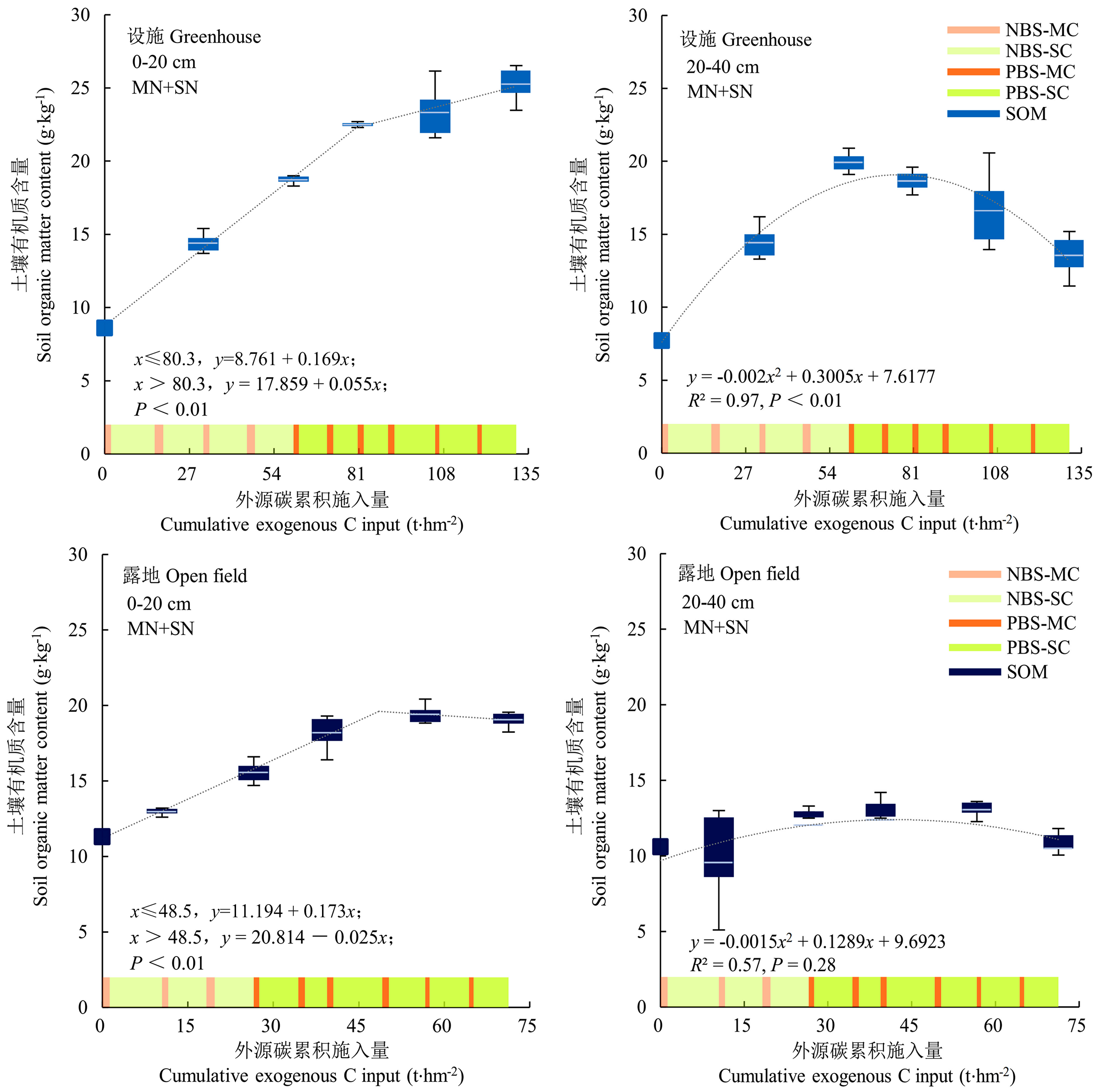
Relationship between SOM content in the 0-40 cm depth and cumulative exogenous C input under different cultivation practices involving integrated pig manure and straw substitution regime NBS-MC and NBS-SC represent the C input from pig manure and straw under substitution on an N basis, respectively. PBS-MC and PBS-SC represent the C input from pig manure and straw under substitution on a P basis, respectively"

Fig. 3

Effects of substituting chemical fertilizer with pig manure and straw on changes in SOC stocks at 0-40 cm soil layer under different cultivation practices The dark-colored bars indicate net SOC accumulation amount between consecutive years, corresponding to the Y‑axis. The dashed bars indicate net SOC depletion amount between consecutive years. The light-colored bars represent the existing SOC stock. The dashed line represents the baseline level of SOC pool. The red/blue background shading indicates the SOC stock level in 2019. Different lowercase letters indicate differences between fertilization regimes have reached a significant level (P<0.05)"

Table 2

SOC accumulation rate and net exogenous carbon sequestration efficiency in integrated pig manure and straw substitution regime"

土层
Soil layer (cm)
指标
Indicator
至2015年From experiment initiation to 2015 至2019年From experiment initiation to 2019
设施Greenhouse 露地Open-field 设施Greenhouse 露地Open-field
0-20 CSR (t·hm-2·a-1) 3.1 a A 2.1 a A 1.9 a B 1.5 a A
CSE (%) 23.0 a A 27.2 a A 14.8 a B 18.4 a A
0-40 CSR (t·hm-2·a-1) 5.4 a A 3.0 b A 2.7 a B 1.8 a B
CSE (%) 40.1 a A 38.4 a A 20.7 a B 22.9 a B

Fig. 4

Relationship between soil carbon sequestration efficiency (CSE) and organic matter content at 0-20 cm depth under different cultivation practices using integrated pig manure and straw substitution regime"

Fig. 5

Effects of substituting chemical fertilizer with pig manure and straw on soil nitrate nitrogen content at 0-40 cm soil layer under different cultivation practices The horizontal lines and the values at the top of the columns represent the mean values. Different lowercase letters indicate differences between fertilization regimes have reached a significant level (P<0.05)"

Table 3

Effects of substituting chemical fertilizer with pig manure and straw on soil available P and K contents and salinity at 0-40 cm soil layer under different cultivation practices"

指标
Indicator
土层
Soil layer (cm)
设施Greenhouse 露地Open-field
MN+SN CN MN+SN CN
有效磷
Olsen-P (mg·kg-1)
0-20 69.9 a 48.5 b 35.7 a 31.9 b
20-40 28.4 a 15.6 b 21.6 a 19.8 a
速效钾
Soil available potassium (mg·kg-1)
0-20 316.0 a 320.8 a 229.8 a 237.2 a
20-40 269.2 a 191.8 b 153.3 a 141.4 a
EC
(μs·cm-1)
0-20 654.2 a 782.6 a 276.1 a 386.7 a
20-40 428.5 a 469.3 a 208.9 b 278.4 a

Table 4

Effects of substituting chemical fertilizer with pig manure and straw on annual yield and nutrient surplus per unit of yield under different cultivation practices"

指标
Indicator
设施Greenhouse 露地Open-field
MN+SN CN MN+SN CN
产量Yield (t·hm-2·a-1) 225.5 a 217.1 b 190.8 a 176.9 a
每形成1 000 kg产量的养分盈余量
Nutrient surplus per 1 000 kg of yield (kg)
N 2.47 a 2.60 a 0.87 b 1.08 a
P 0.68 b 0.74 a 0.32 a 0.41 a
K 1.48 b 1.76 a 0.68 a 1.06 a

Fig. 6

Effects of substituting chemical fertilizer with pig manure and straw on annual vegetable nutrient uptakes under different cultivation practices Different lowercase letters indicate differences between fertilization regimes have reached a significant level (P<0.05)"

[1]
耕地地力主要指标分级诊断: DB 13/T 5406-2021[S]. https://std.samr.gov.cn/db/search/stdDBDetailed?id=CAD33277870FE843E05397BE0A0A611F.
Graded diagnosis of main indicators of cultivated land fertility: DB13/T 5406-2021[S]. https://std.samr.gov.cn/db/search/stdDBDetailed?id=CAD33277870FE843E05397BE0A0A611F. (in Chinese)
[2]
徐明岗, 段英华, 白珊珊, 张文菊, 孙楠. 基于长期定位试验的土壤健康研究与展望[J]. 植物营养与肥料学报, 2024, 30(7): 1253-1261.
Xu M G, Duan Y H, Bai S S, Zhang W J, Sun N. Research and prospects for soil health based on long-term experiments in arable land of China[J]. Journal of Plant Nutrition and Fertilizers, 2024, 30(7): 1253-1261. (in Chinese)
[3]
刘蕾, 张运龙, 张俊伶, 王凌, 孙世友. 微生物介导的土壤颗粒态-矿物结合态有机碳动态研究进展[J]. 土壤学报, 2026, 63(4): 1219-1229.
Liu L, Zhang Y L, Zhang J L, Wang L, Sun S Y. Research progress on soil particulate versus mineral-associated organic carbon dynamics mediated by microorganisms[J]. Acta Pedologica Sinica, 2026, 63(4): 1219-1229. (in Chinese)
[4]
刘红叶, 宋汶珈, 杨尧钰, 张锡岩, 母玉祥, 魏珉, 张大龙. 设施蔬菜土壤障碍特征、诱因及其生态防控技术研究进展[J]. 中国蔬菜, 2025(5): 32-43.
Liu H Y, Song W J, Yang Y Y, Zhang X Y, Mu Y X, Wei M, Zhang D L. Research progress on the characteristics, inducement and ecological control technology of soil obstacle in protected vegetable production[J]. China Vegetables, 2025(5): 32-43. (in Chinese)
[5]
Liu B, Wang X Z, Ma L, Chadwick D, Chen X P. Combined applications of organic and synthetic nitrogen fertilizers for improving crop yield and reducing reactive nitrogen losses from China’s vegetable systems: a meta-analysis[J]. Environmental Pollution, 2021, 269: 116143.

doi: 10.1016/j.envpol.2020.116143
[6]
Meng X Y, Liu S R, Zou J L, Osborne B. The effect of substituting inorganic fertilizer with manure on soil N2O and CH4 emissions and crop yields: A global meta-analysis[J]. Field Crops Research, 2025, 326: 109831.

doi: 10.1016/j.fcr.2025.109831
[7]
Denoncourt C, Chantigny M H, Angers D A, Maillard É, Halde C. Animal manure application promotes nitrogen and organic carbon accumulation in soil organic matter fractions: A global meta- analysis[J]. Science of the Total Environment, 2025, 996: 180097.

doi: 10.1016/j.scitotenv.2025.180097
[8]
Wang P, Liu J, Liu Y, Mo L D, Hu J X, Qi Z M, He Y, Jiang Q J. Unlocking the potential of microbial necromass for enhancing soil carbon sequestration: A global perspective on cropland management using meta-analysis[J]. Environmental Research, 2025, 286: 123008.

doi: 10.1016/j.envres.2025.123008
[9]
Xu X T, Bi R Y, Song M X, Dong Y B, Jiao Y, Wang B X, Xiong Z Q. Organic substitutions enhanced soil carbon stabilization and reduced carbon footprint in a vegetable farm[J]. Soil and Tillage Research, 2024, 236: 105955.

doi: 10.1016/j.still.2023.105955
[10]
Xu X T, Bi R Y, Song M X, Wang B X, Dong Y B, Zhang Q Q, Xiong Z Q. Optimizing organic substitution: Balancing carbon sequestration and priming effects of a six-year field experiment for sustainable vegetable production[J]. Sustainable Production and Consumption, 2024, 44: 14-24.

doi: 10.1016/j.spc.2023.11.019
[11]
Zhang Y J, Gao W, Luan H A, Tang J W, Li R N, Li M Y, Zhang H Z, Huang S W. Effects of a decade of organic fertilizer substitution on vegetable yield and soil phosphorus pools, phosphatase activities, and the microbial community in a greenhouse vegetable production system[J]. Journal of Integrative Agriculture, 2022, 21(7): 2119-2133.

doi: 10.1016/S2095-3119(21)63715-2
[12]
Luan H A, Gao W, Huang S W, Tang J W, Li M Y, Zhang H Z, Chen X P. Partial substitution of chemical fertilizer with organic amendments affects soil organic carbon composition and stability in a greenhouse vegetable production system[J]. Soil and Tillage Research, 2019, 191: 185-196.

doi: 10.1016/j.still.2019.04.009
[13]
Wang Y L, Wang L X, Li R N, Wang H, Wu G H, Wen X Y, Huang S W, Wang X B, Liu C J. Long-term organic substitution regimes affect open-field vegetable yields and soil organic carbon stability by regulating soil labile organic carbon fractions’ changes[J]. Agronomy, 2025, 15(2): 396.

doi: 10.3390/agronomy15020396
[14]
Yuan S, Li R N, Zhang Y J, Luan H A, Tang J W, Wang L Y, Ji H J, Huang S W. Effects of long-term partial substitution of inorganic fertilizer with pig manure and/or straw on nitrogen fractions and microbiological properties in greenhouse vegetable soils[J]. Journal of Integrative Agriculture, 2024, 23(6): 2083-2098.

doi: 10.1016/j.jia.2024.02.017
[15]
Ma L, Li R N, Luan H A, Tang J W, Wang L Y, Guo T F, Huang S W. Impacts of long-term different fertilization regimes on microbial utilization of straw-derived carbon in greenhouse vegetable soils: Insights from its ecophysiological roles and temperature responses[J]. Frontiers in Plant Science, 2024, 15: 1486817.

doi: 10.3389/fpls.2024.1486817
[16]
Yin Y L, Chen Z, Gong H Q, He K, Miao Q, Tian X S, Wang Z H, Wang Y C, Zheng H F, Cui Z L. Soil organic carbon formation efficiency from straw/stover and manure input and its drivers: Estimates from long-term data in global croplands[J]. Global Change Biology, 2024, 30(8): e17460.

doi: 10.1111/gcb.v30.8
[17]
黄绍文, 唐继伟, 李春花, 张怀志, 袁硕. 我国蔬菜化肥减施潜力与科学施用对策[J]. 植物营养与肥料学报, 2017, 23(6): 1480-1493.
Huang S W, Tang J W, Li C H, Zhang H Z, Yuan S. Reducing potential of chemical fertilizers and scientific fertilization countermeasure in vegetable production in China[J]. Journal of Plant Nutrition and Fertilizer, 2017, 23(6): 1480-1493. (in Chinese)
[18]
Li W L, Zhuang M H, Feng L, Wei W, Xia L L, Yang Y. Carbon and reactive nitrogen footprint of greenhouse versus open-field vegetable production in China[J]. Resources, Conservation and Recycling, 2025, 221: 108400.

doi: 10.1016/j.resconrec.2025.108400
[19]
鲁如坤. 土壤农业化学分析方法[M]. 北京: 中国农业科学技术出版社, 2000.
Lu R K. Methods of Soil Agrochemical Analysis[M]. Beijing: China Agricultural Science and Technology Press, 2000. (in Chinese)
[20]
黄绍文, 王玉军, 金继运, 唐继伟. 我国主要菜区土壤盐分、酸碱性和肥力状况[J]. 植物营养与肥料学报, 2011, 17(4): 906-918.
Huang S W, Wang Y J, Jin J Y, Tang J W. Status of salinity, pH and nutrients in soils in main vegetable production regions in China[J]. Journal of Plant Nutrition and Fertilizers, 2011, 17(4): 906-918. (in Chinese)
[21]
Ren F L, Zhang R Q, Sun N, Li Y L, Xu M G, Zhang F S, Xu W. Patterns and driving factors of soil organic carbon sequestration efficiency under various manure regimes across Chinese croplands[J]. Agriculture, Ecosystems & Environment, 2024, 359: 108723.

doi: 10.1016/j.agee.2023.108723
[22]
Islam M U, Jiang F H, Halder M, Liu S, Peng X H. Impact of straw return combined with different fertilizations on soil organic carbon stock in upland wheat and maize croplands in China: A meta-analysis[J]. Crop and Environment, 2023, 2(4): 233-241.

doi: 10.1016/j.crope.2023.10.003
[23]
Li S L, Cui Y X, Xia Z Q, Zhang X H, Zhou C R, An S Y, Zhu M M, Gao Y, Yu W T, Ma Q. Microbial nutrient limitations limit carbon sequestration but promote nitrogen and phosphorus cycling: A case study in an agroecosystem with long-term straw return[J]. Science of the Total Environment, 2023, 870: 161865.

doi: 10.1016/j.scitotenv.2023.161865
[24]
Wang X L, Yang Z L, Liu X, Huang G Q, Xiao W H, Han L J. The composition characteristics of different crop straw types and their multivariate analysis and comparison[J]. Waste Management, 2020, 110: 87-97.

doi: S0956-053X(20)30254-3 pmid: 32460108
[25]
郎漫, 钟文, 张君岳, 毛涛, 李梦, 张馨予, 李平. 秸秆和畜禽粪便添加对黑土氮初级转化和固持特征的影响[J]. 植物营养与肥料学报, 2025, 31(6): 1086-1094.
Lang M, Zhong W, Zhang J Y, Mao T, Li M, Zhang X Y, Li P. Gross N transformation and retention characteristics of black soil as affected by straw and livestock manure application[J]. Journal of Plant Nutrition and Fertilizers, 2025, 31(6): 1086-1094. (in Chinese)
[26]
徐久凯, 袁亮, 温延臣, 张水勤, 李燕婷, 李海燕, 赵秉强. 畜禽有机肥氮在冬小麦季对化肥氮的相对替代当量[J]. 中国农业科学, 2023, 56(2): 300-313. DOI: 10.3864/j.issn.0578-1752.2023.02.008.
Xu J K, Yuan L, Wen Y C, Zhang S Q, Li Y T, Li H Y, Zhao B Q. Nitrogen fertilizer replacement value of livestock manure in the winter wheat growing season[J]. Scientia Agricultura Sinica, 2023, 56(2): 300-313. DOI: 10.3864/j.issn.0578-1752.2023.02.008. (in Chinese)
[27]
Yao Z S, Wang Y Q, Wang R, Wang X G, Wang Y, Zheng X H, Liu C Y, Zhu B, Zhou M H, Liu Y, Butterbach-Bahl K. Long-term straw return to a wheat-maize system results in topsoil organic C saturation and increased yields while no stimulating or reducing yield-scaled N2O and NO emissions[J]. Agricultural and Forest Meteorology, 2024, 349: 109937.

doi: 10.1016/j.agrformet.2024.109937
[28]
Li X, Yang X N, Li J Y, Wang J, Fu X, Peng Z P, Dang H K. Inefficient C sequestration with long term high-level straw return as linked to protected C pools saturation on the North China Plain[J]. Soil and Tillage Research, 2026, 255: 106766.

doi: 10.1016/j.still.2025.106766
[29]
Six J, Conant R T, Paul E A, Paustian K. Stabilization mechanisms of soil organic matter: Implications for C-saturation of soils[J]. Plant and Soil, 2002, 241(2): 155-176.

doi: 10.1023/A:1016125726789
[30]
Bai J S, Zhang S Q, Huang S M, Xu X P, Zhao S C, Qiu S J, He P, Zhou W. Effects of the combined application of organic and chemical nitrogen fertilizer on soil aggregate carbon and nitrogen: A 30-year study[J]. Journal of Integrative Agriculture, 2023, 22(11): 3517-3534.

doi: 10.1016/j.jia.2023.09.012
[31]
Sokol N W, Whalen E D, Jilling A, Kallenbach C, Pett-Ridge J, Georgiou K. Global distribution, formation and fate of mineral- associated soil organic matter under a changing climate: A trait-based perspective[J]. Functional Ecology, 2022, 36(6): 1411-1429.

doi: 10.1111/fec.v36.6
[32]
张维理, KOLBE H, 张认连, 冀宏杰. 农田土壤有机碳管理与有机质平衡算法[J]. 中国农业科学, 2020, 53(2): 332-345. DOI: 10.3864/j.issn.0578-1752.2020.02.008.
Zhang W L, Kolbe H, Zhang R L, Ji H J. Soil organic carbon management and farmland organic matter balance method[J]. Scientia Agricultura Sinica, 2020, 53(2): 332-345. DOI: 10.3864/j.issn.0578-1752.2020.02.008. (in Chinese)
[33]
Yang X Y, Wang Y S, Wang X T, Niu T X, Ali Abid A, Aioub A A A, Zhang Q C. Contrasting fertilization response of soil phosphorus forms and functional bacteria in two newly reclaimed vegetable soils[J]. Science of the Total Environment, 2024, 912: 169479.

doi: 10.1016/j.scitotenv.2023.169479
[34]
Zhang Y J, Gao W, Huang S W, Li C Y, Tang J W, Zhang Q, Li M Y, Wang Y L, Ai C. Long-term manure and straw addition enhance protistan diversity and stimulate soil microbial interactions and nutrient mineralization in vegetable field[J]. Applied Soil Ecology, 2025, 212: 106170.

doi: 10.1016/j.apsoil.2025.106170
[35]
Chen X, Jin M C, Duan P, Mejia J, Chu W Y, Ye X X, Cao X Y, Schmidt-Rohr K, Thompson M L, Gao H J, Mao J D. Structural composition of immobilized fertilizer N associated with decomposed wheat straw residues using advanced nuclear magnetic resonance spectroscopy combined with 13C and 15N labeling[J]. Geoderma, 2021, 398: 115110.

doi: 10.1016/j.geoderma.2021.115110
[36]
Wang F L, Liu Y, Liang B, Liu J, Zong H Y, Guo X H, Wang X X, Song N N. Variations in soil aggregate distribution and associated organic carbon and nitrogen fractions in long-term continuous vegetable rotation soil by nitrogen fertilization and plastic film mulching[J]. Science of the Total Environment, 2022, 835: 155420.

doi: 10.1016/j.scitotenv.2022.155420
[37]
Wang Y N, Yao Y Z, Han B B, Willcock S, Storkey J, Dong X Z, Zhong Y Y, Wang X Z, Deng Y, Zhang W, Li Q R, Chen X P, Li Z L. Nature-based nutrient management through returning agricultural organic waste enhances soil aggregate organic carbon stability[J]. Agriculture, Ecosystems & Environment, 2025, 381: 109467.

doi: 10.1016/j.agee.2024.109467
[1] ZHU Qi, JIA ZhenPeng, Tahir SHAH, XU ChenSheng, LI ZhiQi, LÜ HuiShuai, ZHU PengChao, WEI XiaoMin, HUANG DongLin, SUN YanNi, CAO WeiDong, GAO YaJun, WANG ZhaoHui, ZHANG DaBin. Green Manure Crops Combined with Enhanced-Efficiency Products Reduced Greenhouse Gas Emissions and Carbon Footprints in Dryland Wheat Fields [J]. Scientia Agricultura Sinica, 2026, 59(7): 1507-1522.
[2] LI XingYu, HUANG Rong, XIAN YiMing, TIAN JiaoJiao, MA XiaoJin, YANG QiaoXi, LI Bing, WANG ChangQuan. Characteristics of Organic Carbon Fractions and Carbon Dioxide Emissions of Different Size Aggregates in Rice Field Soils in Response to Long-Term Fertilization [J]. Scientia Agricultura Sinica, 2026, 59(6): 1255-1271.
[3] YANG Yan, JIANG LiHua, LI Ni, SHI Jing, TAN DeShui, LIU YuMin, ZHAO HuanYu, XU Yu. Water and Fertilizer Management for Reducing Nitrogen Leaching in Facility Vegetable Fields and Achieving Concurrent Yield Increase and Efficiency Improvement [J]. Scientia Agricultura Sinica, 2026, 59(4): 850-861.
[4] ZHANG Han, LI JingLai, ZHANG YuQi, GUO Jian, LI Xing, LI Tao. Effects of Light Quality and Photoperiod on Growth, Yield, and Quality of Substrate-Cultivated Strawberry in a Chinese Solar Greenhouse [J]. Scientia Agricultura Sinica, 2026, 59(20): 4531-4546.
[5] DIAO QiYu, LIU YunLong. Greenhouse Gas Emissions from China’s Agrifood System and Methane Mitigation Pathways in Ruminants [J]. Scientia Agricultura Sinica, 2026, 59(20): 4603-4616.
[6] JIA Peng, TU Yan, ZHANG NaiFeng, DIAO QiYu. Research Methods and Application Evaluation of Methane Inhibitors for Ruminants [J]. Scientia Agricultura Sinica, 2026, 59(20): 4630-4641.
[7] DENG Jun, AI Jing, WANG YuTong, DAO JingMei, ZHAO Yong, YE Song, DENG Yan, ZHANG FuSuo. Identification of Yield-Limiting Factors Associated with Spatiotemporal Differentiation of Soil Nutrients in Long-Term Continuous Sugarcane Cultivation Fields [J]. Scientia Agricultura Sinica, 2026, 59(16): 3541-3555.
[8] WANG BingJie, QIN ShiHan, LI DeCheng, HU WenYou, JIANG Jun, CHI FengQin, ZHANG Chao, ZHANG JiuMing, XU YingDe, WANG JingKuan. Spatial Distribution Pattern and Transfer Function Construction of Soil Bulk Density in Nenjiang City, Heilongjiang Province [J]. Scientia Agricultura Sinica, 2025, 58(9): 1791-1803.
[9] ZHANG Han, ZHANG YuQi, LI JingLai, XU Hong, LI WeiHuan, LI Tao. Effects of LED Supplementary Lighting on Production and Leaf Physiological Properties of Substrate-Cultivated Strawberry in Chinese Solar Greenhouse [J]. Scientia Agricultura Sinica, 2025, 58(5): 975-990.
[10] GUO Song, HAN Lei, WANG Yuan, WANG ZiJun, QIAN ZiHui, LU JiaMing, ZHAO Can, WANG WeiLing, XU Ke, ZHANG HongCheng, YANG FengPing, HUO ZhongYang. Effect of One-Time Side Deep Application Ratios of Controlled-Release Nitrogen Fertilizer and Common Urea to Rice Yield, Nitrogen Fertilizer Efficiency and Carbon Emission Reduction [J]. Scientia Agricultura Sinica, 2025, 58(24): 5216-5233.
[11] HUO RunXia, FANG YaTing, ZHANG YanKe, WU HaiYa, LIU GuiSheng, LI XiaoKun, REN Tao, LU ZhiFeng, CONG RiHuan, LU JianWei. Effects of Fertilizer Reduction on Crop Yield and Soil Fertility Under Long-Term Straw-Return Conditions in Rice-Rice-Rapeseed Rotations [J]. Scientia Agricultura Sinica, 2025, 58(16): 3267-3279.
[12] CAO JingWen, NIE ZhiGang, LI Guang, YANG Jie. Multi-Objective Optimization of Stable Yield and Emission Reduction of Dryland Spring Wheat Based on DNDC and NSGA-Ⅲ. Coupling Model [J]. Scientia Agricultura Sinica, 2025, 58(13): 2538-2551.
[13] SUN JianFei, CHENG Kun. A Review of Soil Carbon Sequestration and Greenhouse Gas Emissions Quantification in Cropland [J]. Scientia Agricultura Sinica, 2025, 58(11): 2190-2205.
[14] GAO ShangJie, LIU XingRen, LI YingChun, LIU XiaoWan. Effects of Biochar and Straw Return on Greenhouse Gas Emissions and Global Warming Potential in the Farmland [J]. Scientia Agricultura Sinica, 2024, 57(5): 935-949.
[15] QIU HaiHua, KUAI LeiXin, ZHANG Lu, LIU LiSheng, WEN ShiLin, CAI ZeJiang. Characteristics of Acidity and Nutrient Changes in Red Soil After Conversion of Paddy Field to Dry Land and Vegetable Field [J]. Scientia Agricultura Sinica, 2024, 57(3): 525-538.
Viewed
Full text


Abstract

Cited

  Shared   
  Discussed   
No Suggested Reading articles found!