Scientia Agricultura Sinica ›› 2026, Vol. 59 ›› Issue (18): 4183-4194.doi: 10.3864/j.issn.0578-1752.2026.18.017

• ANIMAL SCIENCE·VETERINARY SCIENCE • Previous Articles    

Genome-Wide Association Study Identifies Candidate Genes Associated with Breast Muscle Water-Holding Capacity in Lindian Chickens

SUN ChangSheng(), WANG Xu, MU Fang, BAI Xue, SU ZhiYong, WANG YuXiang, LI YuMao, ZHANG WenPeng, LUAN Peng, WANG Ning, LENG Li()   

  1. Key Laboratory of Chicken Genetics and Breeding, Ministry of Agriculture and Rural Affairs/Key Laboratory of Animal Genetics, Breeding and Reproduction, Education Department of Heilongjiang Province/College of Animal Science and Technology, Northeast Agricultural University, Harbin 150030
  • Received:2025-12-29 Accepted:2026-08-11 Online:2026-09-16 Published:2026-09-20
  • Contact: LENG Li

Abstract:

【Background】Water-holding capacity of chicken meat is an important index to evaluate meat quality, which directly affects meat tenderness, juiciness, processing loss and commodity value. As a high-quality local chicken breed in Northeast China, Lindian chicken is characterized by strong stress resistance and good meat flavor, but the genetic basis of its breast muscle water-holding capacity traits is still unclear.【Objective】The purpose of this study was to analyze the genetic mechanism of breast muscle water-holding capacity in Lindian chicken based on genome-wide association analysis (GWAS), and to explore relevant molecular markers and candidate genes, so as to provide a theoretical basis for molecular breeding.【Method】In this study, a total of 441 male Lindian chickens at 150 days of age were used. Blood samples were collected from the wing vein, after which the chickens were slaughtered and the left pectoral muscles were collected for the measurement of drip loss, cooking loss, and pressing loss. Genotype data were obtained by 10 × whole genome resequencing, and a high-quality SNP set was obtained by FASTP quality control, BWA alignment, GATK variant calling and PLINK screening. Principal component analysis was used to evaluate the population structure, and significant principal components were incorporated into the model as covariates. Based on GEMMA software, linear mixed model and multivariate linear mixed model were used for single-trait and multi-trait GWAS, respectively, and Bonferroni correction was used to determine the genome-wide significance threshold. The genes in the 40 kb region upstream and downstream of the significant SNPs were annotated, and combined with GO annotation and KEGG enrichment analysis, the biological functions and regulatory networks of candidate genes were systematically analyzed.【Result】The average drip loss, cooking loss and pressing loss of breast muscle of Lindian chicken were 2.92 %, 20.14 % and 18.73 %, respectively, and the phenotypes of the three were approximately normally distributed. Correlation analysis showed that there was a significant positive correlation between the three water-holding capacity traits. The correlation coefficient between drip loss and pressing loss was 0.996 (P < 0.001), the correlation coefficient between cooking loss and pressing loss was 0.975 (P < 0.001), and the correlation coefficient between drip loss and cooking loss was 0.964 (P < 0.001). A total of 28 SNPs significantly associated with water-holding capacity were identified by single-trait GWAS, of which 7 SNPs significantly associated with drip loss were annotated to ADTRP and EXT1 genes. Seven SNPs significantly associated with cooking loss were annotated to SLC25A21, CMPK1, CIB2 and DPY19L3 genes. The 14 SNPs significantly associated with pressing loss were annotated to 6 genes, including PCDH9, NUDT13, CDH2 and CALN1. A total of 28 SNPs significantly associated with breast muscle water-holding capacity were identified and annotated to 9 genes such as ILDR1, EXT1, and SLC25A21. Combining the two analysis results, it was found that EXT1, CMPK1, SLC25A21 and CDH2 were identified in both single-trait and multi-trait GWAS. Functional enrichment analysis showed that candidate genes were mainly enriched in functional items and signaling pathways such as nucleotide metabolism, intercellular adhesion regulation, glycosaminoglycan biosynthesis-heparan sulfate / heparin pathway, nucleotide metabolism pathway and cell adhesion molecules.【Conclusion】In this study, combined single-trait and multi-trait GWAS identified EXT1, CMPK1, SLC25A21 and CDH2 as candidate genes associated with breast muscle water-holding capacity in Lindian chickens. These genes may serve as important candidate genes for improving breast muscle water-holding capacity in Lindian chicken breeding.

Key words: lindian chicken, breast muscle water-holding capacity, genome-wide association study, SNPs, candidate genes

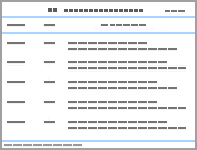
Table 1

Statistical results of phenotypic values for breast muscle water-holding capacity traits in Lindian chicken"

胸肌保水性指标
Breast muscle water-holding capacity trait
样品数量
Number of samples
最大值
Max
最小值
Min
平均值
Mean
标准差
SD
变异系数
CV (%)
滴水损失Drip loss (%) 413 7.15 0.29 2.92 1.27 43
蒸煮损失Cooking loss (%) 412 31.18 6.32 20.14 4.22 21
压榨损失Pressing loss (%) 412 35.28 2.21 18.73 5.77 31

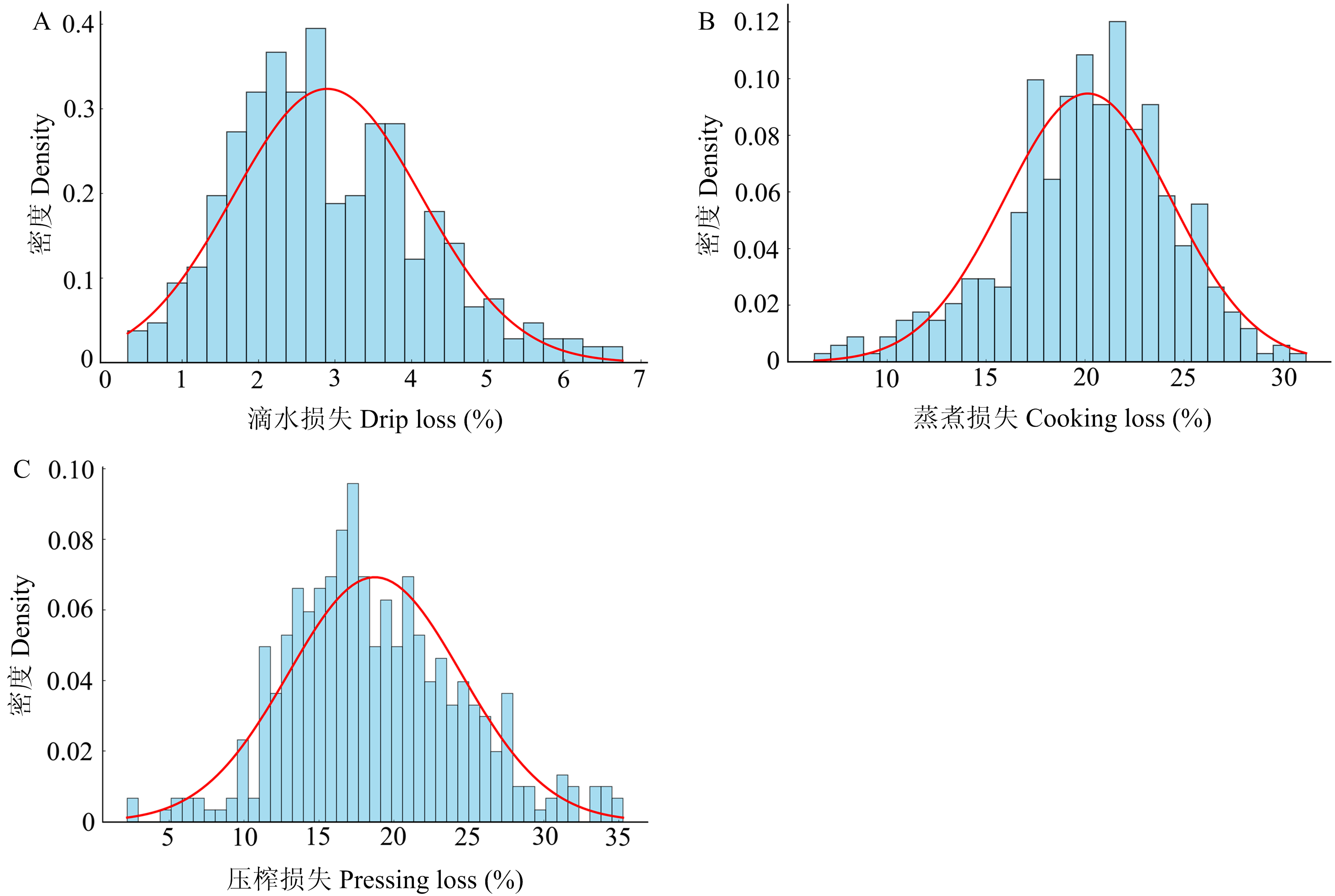
Fig. 1

Frequency distribution histogram of phenotypic values for breast muscle water-holding capacity traits in Lindian chicken A: Frequency distribution histogram of drip loss; B: Frequency distribution histogram of cooking loss; C: Frequency distribution histogram of pressing loss"

Fig. 2

Scatterplot of principal component analysis of population genetic structure in Lindian chicken"

Table 2

Group principal component analysis"

PC 1 2 3 4 5 6 7 8 9 10
PP value 0.010 0.065 0.075 0.063 0.160 0.176 0.262 0.172 0.163 0.586

Fig. 3

Manhattan plot and Q-Q plot from the single-trait GWAS for Lindian chicken breast muscle water-holding capacity A: Manhattan plot and Q-Q plot from GWAS of drip loss; B: Manhattan plot and Q-Q plot from GWAS of cooking loss; C: Manhattan plot and Q-Q plot from GWAS of pressing loss"

Table 3

Information on significant SNPs annotated to candidate genes for Lindian chicken breast muscle water-holding capacity trait"

保水性指标
Water-holding capacity index
染色体
Chromosome
位置
Position
等位基因
Genotype
MAF Beta P
P value
基因
Gene
功能区域
Functional region
滴水损失
Drip loss
2 62675771 G/A 0.080 1.02 6.09×10⁻⁷ ADTRP 内含子Intron
2 62681511 T/C 0.058 1.18 1.64×10⁻⁷ ADTRP 3′UTR
2 62681846 G/C 0.059 1.08 6.73×10⁻⁷ ADTRP 3′UTR
2 135004833 G/A 0.324 0.53 4.26×10⁻⁷ EXT1 内含子Intron
2 135004849 G/A 0.325 0.53 3.16×10⁻⁷ EXT1 内含子Intron
蒸煮损失
Cooking loss
5 36471798 C/T 0.266 2.05 2.38×10⁻⁷ SLC25A21 内含子Intron
5 36472098 C/G 0.267 1.97 5.42×10⁻⁷ SLC25A21 内含子Intron
8 21669313 A/G 0.060 3.64 7.70×10⁻⁸ CMPK1 外显子Exon
10 3865806 A/G 0.232 -1.92 6.97×10⁻⁷ CIB2 内含子Intron
11 9481641 G/C 0.198 2.07 7.58×10⁻⁷ DPY19L3 内含子Intron
压榨损失
Pressing loss
1 159485028 A/T 0.113 -4.50 9.48×10⁻⁸ PCDH9 内含子Intron
6 11889674 C/T 0.270 -2.85 4.81×10⁻⁷ NUDT13 内含子Intron
9 9677460 T/C 0.137 -3.75 9.62×10⁻⁷ DNER 外显子Exon
9 9684053 T/C 0.133 -3.90 4.71×10⁻⁷ DNER 内含子Intron
9 14827644 C/T 0.233 3.04 9.90×10⁻⁷ FYTTD1 内含子Intron
9 14828049 A/G 0.203 3.38 3.30×10⁻⁷ FYTTD1 内含子Intron
9 14828371 T/A 0.199 3.44 1.43×10⁻⁷ FYTTD1 内含子Intron
9 14828634 C/A 0.206 3.22 4.83×10⁻⁷ FYTTD1 外显子Exon
9 14829028 G/A 0.205 3.29 3.56×10⁻⁷ FYTTD1 外显子Exon
9 14829103 T/C 0.204 3.31 4.59×10⁻⁷ FYTTD1 外显子Exon
10 14641961 G/C 0.066 -5.50 7.49×10⁻⁷ CDH2 外显子Exon
19 1421788 T/C 0.126 -4.02 5.26×10⁻⁷ CALN1 外显子Exon
19 1421822 T/C 0.124 -4.12 2.81×10⁻⁷ CALN1 外显子Exon

Fig. 4

Correlation heat map of Lindian chicken breast muscle water-holding capacity traits"

Fig. 5

Manhattan plot and Q-Q plot from the multi-trait GWAS for Lindian chicken breast muscle water-holding capacity"

Table 4

Significant SNPs annotated to candidate genes in the multi-trait GWAS"

染色体Chromosome 位置Position 等位基因Genotype MAF Beta PP value 基因Gene 功能区域Functional region
1 83511182 C/G 0.054 6.38×10⁻² 8.77×10⁻⁷ ILDR1 内含子Intron
2 135035915 C/G 0.228 -3.73×10⁻¹ 8.97×10⁻⁷ EXT1 外显子Exon
5 36471533 A/G 0.292 1.02 7.02×10⁻⁷ SLC25A21 内含子Intron
5 36471798 C/T 0.267 1.09 2.23×10⁻⁷ SLC25A21 内含子Intron
5 36472098 C/G 0.268 1.13 7.71×10⁻⁷ SLC25A21 内含子Intron
5 36546467 C/T 0.499 9.64×10⁻¹ 1.12×10⁻⁷ MIPOL1 内含子Intron
8 21669313 A/G 0.060 1.16 1.95×10⁻⁷ CMPK1 外显子Exon
10 13036134 G/A 0.426 7.56×10⁻¹ 4.59×10⁻⁸ ABHD2 外显子Exon
10 13036139 G/A 0.429 7.15×10⁻¹ 1.17×10⁻⁷ ABHD2 外显子Exon
10 13036165 G/A 0.443 6.54×10⁻¹ 4.50×10⁻⁷ ABHD2 外显子Exon
10 13036430 T/C 0.429 6.45×10⁻¹ 8.04×10⁻⁷ ABHD2 外显子Exon
10 13036909 T/C 0.433 6.79×10⁻¹ 3.25×10⁻⁷ ABHD2 外显子Exon
10 13037648 A/G 0.476 -7.34×10⁻¹ 1.75×10⁻⁷ ABHD2 外显子Exon
10 13044147 G/A 0.374 6.46×10⁻¹ 8.12×10⁻⁷ ABHD2 外显子Exon
10 13044332 T/G 0.369 6.64×10⁻¹ 2.57×10⁻⁷ ABHD2 外显子Exon
10 13044836 C/T 0.480 5.98×10⁻¹ 1.44×10⁻⁷ ABHD2 外显子Exon
10 13051936 C/T 0.457 -6.66×10⁻¹ 2.72×10⁻⁷ ABHD2 外显子Exon
10 13053118 A/G 0.328 -7.22×10⁻¹ 8.55×10⁻⁷ ABHD2 外显子Exon
10 13088937 T/A 0.473 7.27×10⁻¹ 4.77×10⁻⁷ MFGE8 内含子Intron
10 13089070 G/C 0.473 7.12×10⁻¹ 8.82×10⁻⁸ MFGE8 内含子Intron
10 13092789 G/A 0.480 6.79×10⁻¹ 2.91×10⁻⁷ MFGE8 内含子Intron
10 13390772 G/A 0.296 8.68×10⁻¹ 2.74×10⁻⁷ NTRK3 内含子Intron
10 14641858 C/T 0.477 -8.64×10⁻¹ 4.40×10⁻⁷ CDH2 内含子Intron
10 14681952 T/G 0.216 -1.08 3.38×10⁻⁷ CDH2 3′UTR

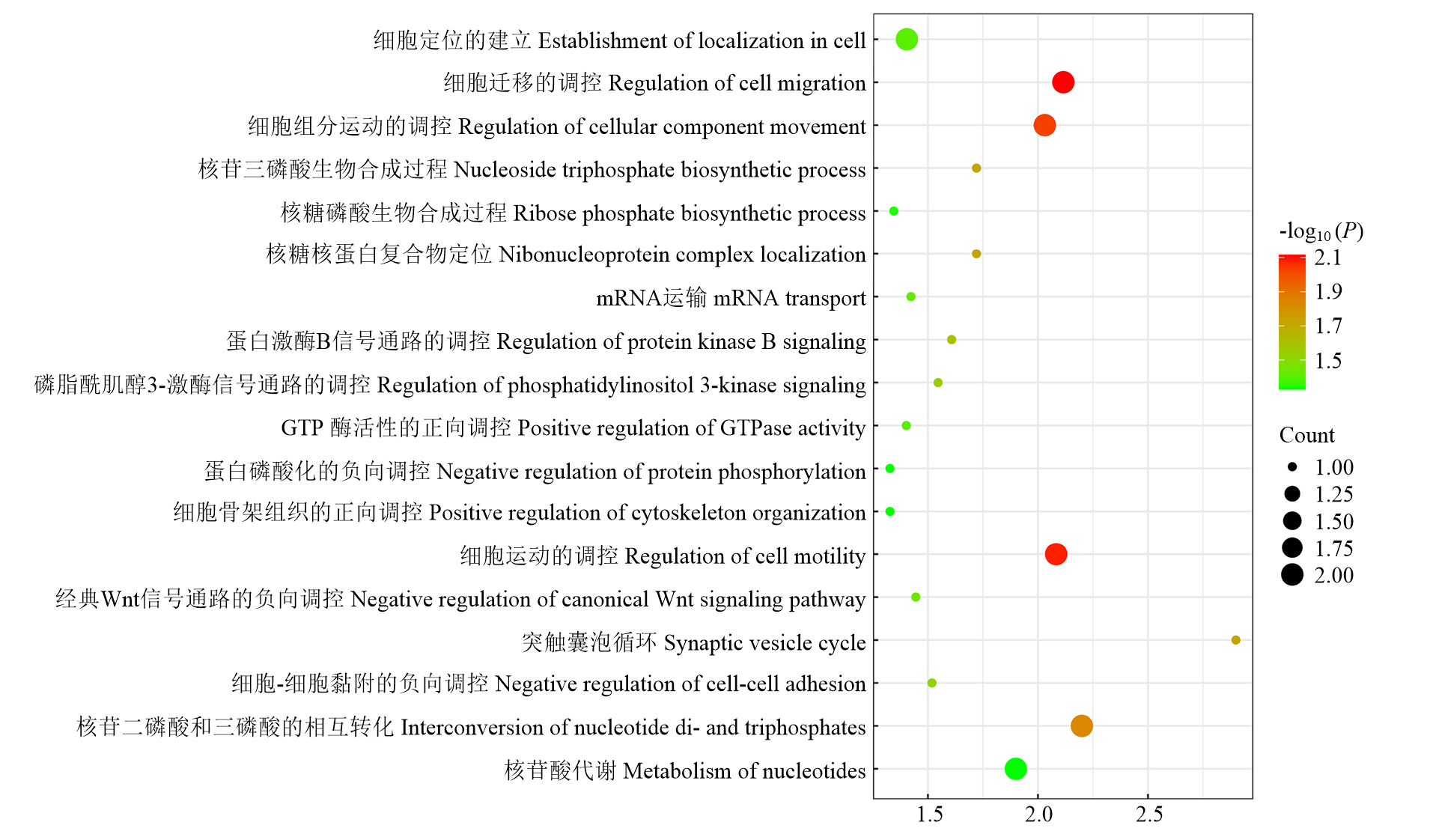
Fig. 6

GO biological function annotation"

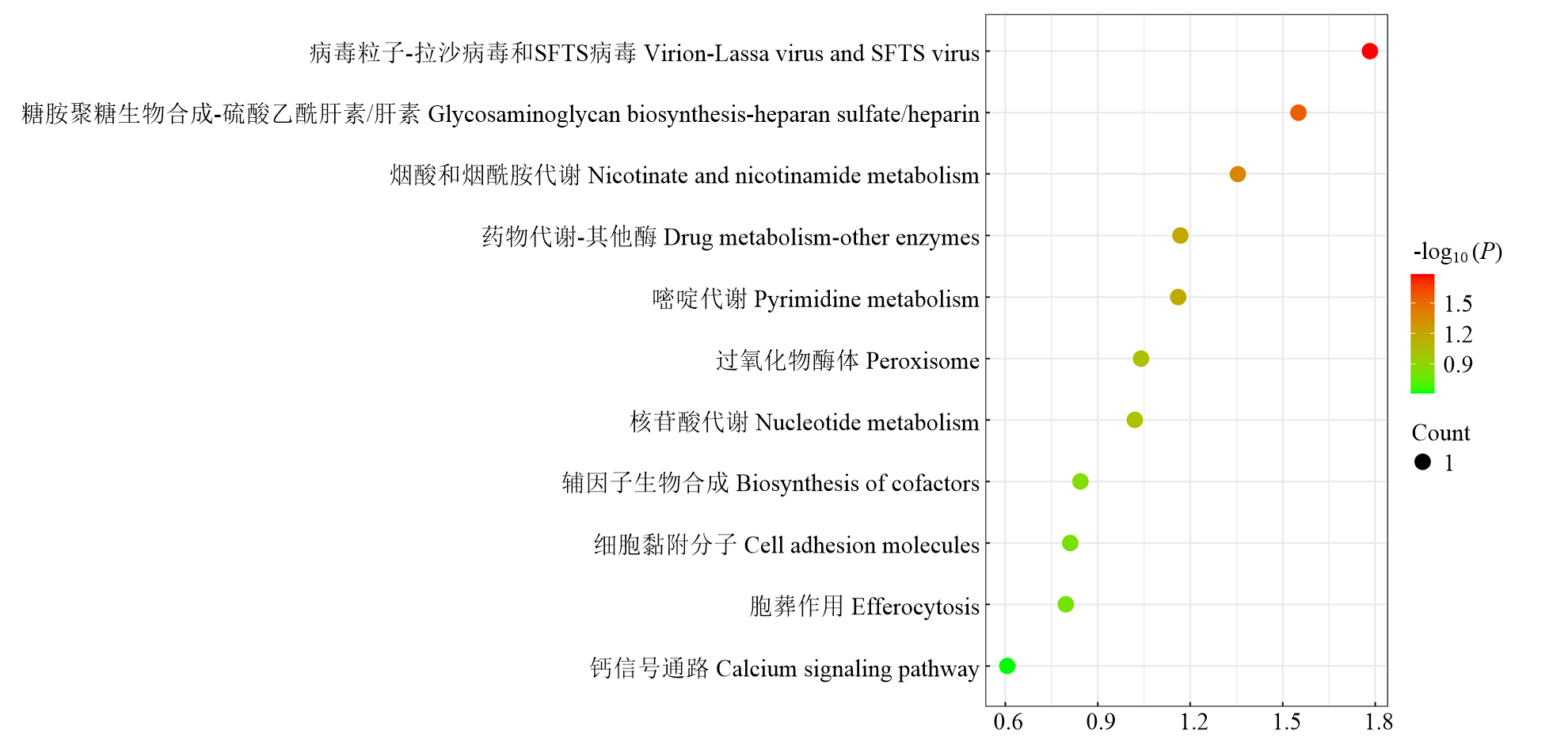
Fig. 7

KEGG pathway enrichment analysis"

[1]
Du Y F, Ding Q L, Li Y M, Fang W R. Identification of differentially expressed genes and pathways for myofiber characteristics in soleus muscles between chicken breeds differing in meat quality[J]. Animal Biotechnology, 2017, 28(2): 83-93.

doi: 10.1080/10495398.2016.1206555 pmid: 27623936
[2]
Sun Y F, Zhao G P, Liu R R, Zheng M Q, Hu Y D, Wu D, Zhang L, Li P, Wen J. The identification of 14 new genes for meat quality traits in chicken using a genome-wide association study[J]. BMC Genomics, 2013, 14(1): 458.

doi: 10.1186/1471-2164-14-458
[3]
Fan C Y, Shan Y J, Zhang M, Tu Y J, Ji G G, Ju X J, Shu J T, Liu Y F. Genome-wide association study of myofiber type composition traits in a yellow-feather broiler population[J]. Poultry Science, 2025, 104(1): 104634.

doi: 10.1016/j.psj.2024.104634
[4]
杨丽娟, 陈丝雨, 赵薇, 朱玲, 郭磊, 马丽娜, 马瑞敏, 张娟. 全基因组重测序揭示静原鸡羽色的遗传机制[J]. 中国农业科学, 2026, 59(6): 1348-1360. DOI: 10.3864/j.issn.0578-1752.2026.06.015.
Yang L J, Chen S Y, Zhao W, Zhu L, Guo L, Ma L N, Ma R M, Zhang J. Whole-genome resequencing reveals the genetic mechanisms underlying feather coloration in Jingyuan chicken[J]. Scientia Agricultura Sinica, 2026, 59(6): 1348-1360. DOI: 10.3864/j.issn.0578-1752.2026.06.015. (in Chinese)
[5]
姜宏正, 杨德智, 马中华, 荀文娟, 侯冠彧, 施力光. 儋州鸡胸肌肉色性状全基因组关联分析[J]. 中国畜牧杂志, 2022, 58(6): 117-122.
Jiang H Z, Yang D Z, Ma Z H, Xun W J, Hou G Y, Shi L G. Genome-wide association study of meat color traits in Danzhou chickens[J]. Chinese Journal of Animal Science, 2022, 58(6): 117-122. (in Chinese)
[6]
江彦, 刘青, 王琤韡. 泰和乌骨鸡滴水损失率的分析研究[J]. 江西饲料, 2017(6): 5, 10.
Jiang Y, Liu Q, Wang C W. Analysis and study on drip loss rate of Taihe silky fowl[J]. Jiangxi Feed, 2017(6): 5, 10. (in Chinese)
[7]
王珏, 樊艳凤, 唐修君, 马丽娜, 葛庆联, 陆俊贤, 杨星星, 丁红梅, 高玉时, 龚道清. 不同品种肉鸡屠宰性能及肌肉品质的比较分析[J]. 中国家禽, 2020, 42(7): 13-17.
Wang J, Fan Y F, Tang X J, Ma L N, Ge Q L, Lu J X, Yang X X, Ding H M, Gao Y S, Gong D Q. Comparative analysis on slaughter characters and meat quality in different breeds of broilers[J]. China Poultry, 2020, 42(7): 13-17. (in Chinese)
[8]
翁嘉静, 付少萌, 付家敏, 侯睛, 瞿彬, 黄婷婷, 梁好琴, 王琤韡. 不同品种鸡肉品质的比较分析[J]. 湖南饲料, 2022(2): 23-25.
Weng J J, Fu S M, Fu J M, Hou J, Qu B, Huang T T, Liang H Q, Wang C W. Comparative analysis on the quality of different chicken breeds[J]. Hunan Feed, 2022(2): 23-25. (in Chinese)
[9]
邹强, 尹超琼, 陈垅, 汪正熙, 张琼, 王卫. 不同养殖模式对固始鸡肉质特性的影响研究[J]. 中国家禽, 2017, 39(8): 36-39.
Zou Q, Yin C Q, Chen L, Wang Z X, Zhang Q, Wang W. Effect of different breeding modes on meat quality of Gushi chicken[J]. China Poultry, 2017, 39(8): 36-39. (in Chinese)
[10]
闫世雄, 李颜攸, 胡梅, 柏毅承, 杨敏, 豆腾飞, 陈瑾, 贾俊静. 茶花鸡、科宝肉鸡肉质性状及营养风味的分析和评价[J]. 黑龙江畜牧兽医, 2023(7): 1-6, 14.
Yan S X, Li Y Y, Hu M, Bai Y C, Yang M, Dou T F, Chen J, Jia J J. Analysis and evaluation of meat quality traits and nutritional flavor of Chahua chicken and Cobb broiler[J]. Heilongjiang Animal Science and Veterinary Medicine, 2023(7): 1-6, 14. (in Chinese)
[11]
沈啸, 樊艳凤, 唐修君, 陆俊贤, 葛庆联, 唐梦君, 王珏, 高玉时. 不同生长速度肉鸡肌肉品质比较[J]. 中国家禽, 2021, 43(5): 8-13.
Shen X, Fan Y F, Tang X J, Lu J X, Ge Q L, Tang M J, Wang J, Gao Y S. Comparison of meat quality of broilers with different growth rate[J]. China Poultry, 2021, 43(5): 8-13. (in Chinese)
[12]
Cheng Q F, Sun D W. Factors affecting the water holding capacity of red meat products: A review of recent research advances[J]. Critical Reviews in Food Science and Nutrition, 2008, 48(2): 137-159.

doi: 10.1080/10408390601177647 pmid: 18274969
[13]
Purslow P P. Contribution of collagen and connective tissue to cooked meat toughness: Some paradigms reviewed[J]. Meat Science, 2018, 144: 127-134.

doi: S0309-1740(18)30048-2 pmid: 29636208
[14]
Hughes J M, Oiseth S K, Purslow P P, Warner R D. A structural approach to understanding the interactions between colour, water-holding capacity and tenderness[J]. Meat Science, 2014, 98(3): 520-532.

doi: 10.1016/j.meatsci.2014.05.022 pmid: 25034451
[15]
Li H, Chapla D, Amos R A, Ramiah A, Moremen K W, Li H L. Structural basis for heparan sulfate co-polymerase action by the EXT1-2 complex[J]. Nature Chemical Biology, 2023, 19(5): 565-574.

doi: 10.1038/s41589-022-01220-2 pmid: 36593275
[16]
Huff-Lonergan E, Lonergan S M. Mechanisms of water-holding capacity of meat: The role of postmortem biochemical and structural changes[J]. Meat Science, 2005, 71(1): 194-204.

doi: 10.1016/j.meatsci.2005.04.022 pmid: 22064064
[17]
Turnbull J, Powell A, Guimond S. Heparan sulfate: Decoding a dynamic multifunctional cell regulator[J]. Trends in Cell Biology, 2001, 11(2): 75-82.

pmid: 11166215
[18]
Farrugia B L, Melrose J. The glycosaminoglycan side chains and modular core proteins of heparan sulphate proteoglycans and the varied ways they provide tissue protection by regulating physiological processes and cellular behaviour[J]. International Journal of Molecular Sciences, 2023, 24(18): 14101.

doi: 10.3390/ijms241814101
[19]
Olde Engberink R H G, de Vos J, van Weert A, Zhang Y H, van Vlies N, van den Born B H, Titze J M, van Bavel E, Vogt L. Abnormal sodium and water homeostasis in mice with defective heparan sulfate polymerization[J]. PLoS ONE, 2019, 14(7): e0220333.
[20]
司健芳, 张静, 高爽, 马佳荣, 曹松敏, 李亚蕾, 罗瑞明. 秦川牛宰后成熟过程中线粒体Tu翻译延长因子对牛肉持水性的影响[J]. 食品科学, 2025, 46(1): 1-10.
Si J F, Zhang J, Gao S, Ma J R, Cao S M, Li Y L, Luo R M. Effect of mitochondrial Tu translation elongation factor on water-holding capacity of Qinchuan cattle meat during postmortem aging[J]. Food Science, 2025, 46(1): 1-10. (in Chinese)

doi: 10.1111/jfds.1981.46.issue-1
[21]
陈淑娴, 叶向晖, 王叙, 金坚. CMPK1蛋白与阿霉素引起的多药耐药的相关性研究[J]. 中国药理学通报, 2017, 33(6): 788-792.
Chen S X, Ye X H, Wang X, Jin J. Relationship between CMPK1 protein and ADM caused multidrug resistance[J]. Chinese Pharmacological Bulletin, 2017, 33(6): 788-792. (in Chinese)
[22]
Topalis D, Nogueira T C, De Schutter T, El Amri C, Krečmerová M, Naesens L, Balzarini J, Andrei G, Snoeck R. Resistance to the nucleotide analogue cidofovir in HPV(+) cells: A multifactorial process involving UMP/CMP kinase 1[J]. Oncotarget, 2016, 7(9): 10386-10401.

doi: 10.18632/oncotarget.7006 pmid: 26824416
[23]
李叶, 鲁文洁, 王海蓉, 杨啸吟, 刘昀阁, 梁荣蓉, 毛衍伟, 张一敏, 朱立贤. 牛肉宰后成熟过程中细胞自噬的变化分析[J]. 食品科学, 2024, 45(15): 214-221.

doi: 10.7506/spkx1002-6630-20240109-093
Li Y, Lu W J, Wang H R, Yang X Y, Liu Y G, Liang R R, Mao Y W, Zhang Y M, Zhu L X. Changes in autophagy during postmortem aging of beef[J]. Food Science, 2024, 45(15): 214-221. (in Chinese)

doi: 10.7506/spkx1002-6630-20240109-093
[24]
Baldi G, Yen C N, Daughtry M R, Bodmer J, Bowker B C, Zhuang H, Petracci M, Gerrard D E. Exploring the factors contributing to the high ultimate pH of broiler pectoralis major muscles affected by wooden breast condition[J]. Frontiers in Physiology, 2020, 11: 343.

doi: 10.3389/fphys.2020.00343 pmid: 32457639
[25]
Aliani M, Farmer L J, Kennedy J T, Moss B W, Gordon A. Post-slaughter changes in ATP metabolites, reducing and phosphorylated sugars in chicken meat[J]. Meat Science, 2013, 94(1): 55-62.

doi: 10.1016/j.meatsci.2012.11.032 pmid: 23376434
[26]
Hu S S, Han Y, Tan T Y, Chen H, Gao J W, Wang L, Yang M H, Zhao L, Wang Y Q, Ding Y Q, Wang S. SLC25A21 downregulation promotes KRAS-mutant colorectal cancer progression by increasing glutamine anaplerosis[J]. JCI Insight, 2023, 8(21): e167874.
[27]
Su X, Bai M, Shang Y Q, Du Y, Xu S, Lin X L, Xiao Y Z, Zhang Y, Chen H M, Zhang A H. Slc25a21 in cisplatin-induced acute kidney injury: A new target for renal tubular epithelial protection by regulating mitochondrial metabolic homeostasis[J]. Cell Death & Disease, 2024, 15: 891.
[28]
Boczonadi V, King M S, Smith A C, Olahova M, Bansagi B, Roos A, Eyassu F, Borchers C, Ramesh V, Lochmüller H, Polvikoski T, Whittaker R G, Pyle A, Griffin H, Taylor R W, Chinnery P F, Robinson A J, Kunji E R S, Horvath R. Mitochondrial oxodicarboxylate carrier deficiency is associated with mitochondrial DNA depletion and spinal muscular atrophy-like disease[J]. Genetics in Medicine, 2018, 20(10): 1224-1235.

doi: 10.1038/gim.2017.251 pmid: 29517768
[29]
Araya C, Häkkinen H M, Carcamo L, Cerda M, Savy T, Rookyard C, Peyriéras N, Clarke J D W. Cdh2 coordinates Myosin-II dependent internalisation of the zebrafish neural plate[J]. Scientific Reports, 2019, 9: 1835.

doi: 10.1038/s41598-018-38455-w pmid: 30755665
[30]
Wu P F, Zhang X C, Zhang G X, Chen F X, He M L, Zhang T, Wang J Y, Xie K Z, Dai G J. Transcriptome for the breast muscle of Jinghai yellow chicken at early growth stages[J]. PeerJ, 2020, 8: e8950.
[31]
Tasoniero G, Bowker B, Stelzleni A, Zhuang H, Rigdon M, Thippareddi H. Use of blade tenderization to improve wooden breast meat texture[J]. Poultry Science, 2019, 98(9): 4204-4211.

doi: 10.3382/ps/pez163 pmid: 30939195
[32]
Farber C R, Kelly S A, Baruch E, Yu D, Hua K J, Nehrenberg D L, de Villena F P, Buus R J, Garland T Jr, Pomp D. Identification of quantitative trait loci influencing skeletal architecture in mice: Emergence of Cdh11 as a primary candidate gene regulating femoral morphology[J]. Journal of Bone and Mineral Research, 2011, 26(9): 2174-2183.

doi: 10.1002/jbmr.436 pmid: 21638317
[33]
Liu Z X, Bai Y B, Chen Z C, Niu Y M, Jia X, Li L, Shi B G, Zhao Z D, Hu J, Luo Y Z, Wang J Q, Liu X, Li S B, Zhao F F. Cloning and transcriptional activity analysis of the bovine CDH11 gene promoter: Transcription factors Sp1 and GR regulate bovine CDH11 expression[J]. Animals, 2025, 15(9): 1217.

doi: 10.3390/ani15091217
[1] LONG Xi, CHAI Jie, ZHANG Liang, PAN Yu, TU Zhi, ZHANG LiJuan, ZHANG LiDan, TANG YiTong, GUO ZongYi, PAN HongMei. Analysis of Population Structure and Selection Signals of Huchuan Mountain Pigs Based on Whole-Genome SNPs [J]. Scientia Agricultura Sinica, 2026, 59(8): 1809-1824.
[2] YE MeJin, WU Lei, MD NAHIBUZZAMAN Lohani, YIN Li, HU XinRong, LIU YaXi, JIANG YunFeng, CHEN GuoYue, PU ZhiEn, LI Yang, LI Ting, ZOU YaYa, WU JiaYi, MA Jian. Genome-Wide Association Study-Based Identification of Loci Controlling Mature Embryo Size in Chinese Wheat Landraces and Their Genetic Effects Analysis [J]. Scientia Agricultura Sinica, 2026, 59(6): 1157-1171.
[3] WANG YongSheng, NIU Li, WANG ChangJie, MA LiHua, LIAN XiaoXiao, MENG YaXiong, MA XiaoLe, YAO LiRong, ZHANG Hong, YANG Ke, LI BaoChun, WANG HuaJun, SI ErJing, WANG JunCheng. Genome-Wide Association Study and Candidate Gene Identification for Thousand Grain Weight in Winter Wheat [J]. Scientia Agricultura Sinica, 2026, 59(3): 499-514.
[4] GUAN PanFeng, LI MengXin, WAN ZiDong, GE Shuai, WANG XinYan, CUI DongJie, CHI Qing, SUN Hao, MA RuoNan, LI Bing, XU HangBo, ZHANG ShiJie, GUO ShuQing, LU JiaLing, JIAO Zhen, ZHU YuPan, WEI WenHui. QTL Mapping and Candidate Gene Analysis of Flag Leaf Size in Common Wheat (Triticum aestivum L.) [J]. Scientia Agricultura Sinica, 2026, 59(18): 3949-3972.
[5] JIANG Jing, WANG GaoFu, SUN XiaoYan, LI Jie, CHEN CanCan, LIU LiangJia, LIU HongYu, LI NianFu, REN HangXing, LÜ ShiPeng. Genome-Wide Association Analysis of Dorsal Black Stripe Trait in Youzhou Dark Goat [J]. Scientia Agricultura Sinica, 2026, 59(17): 3920-3932.
[6] WANG HaoDong, WANG Peng, WU YuXuan, ZHANG Qin, WANG QiaoYun, GUO LiJian, YANG DeLong, CHEN Tao. Genome-Wide Association Study and Candidate Gene Identification for Grain Number per Spike in Dryland Wheat (Triticum aestivum L.) [J]. Scientia Agricultura Sinica, 2026, 59(17): 3712-3729.
[7] REN MinPeng, ZHANG XiFei, GE HuaLiang, GENG LiYing, LI XiangLong, YU BaoJun, WANG KunYang, ZHANG ChuanSheng. Identification of Candidate Genes Associated with Black-Tailed and White-Tailed Plumage Traits in B380 Chickens Based on Multi- Omics Analysis [J]. Scientia Agricultura Sinica, 2026, 59(16): 3673-3686.
[8] CHEN ShengQi, LIU JinYang, HUANG JiaLi, LIU XiaoCen, ZHAO ShuoQian, LIN Yun, XUE ChenChen, YAN Qiang, CHEN JingBin, WU RanRan, CHEN Xin, CHENG JinPing, YUAN XingXing. Whole Genome Association Study of Protein and Threonine Content in Mung Bean Seeds and Development of KASP Molecular Marker [J]. Scientia Agricultura Sinica, 2026, 59(13): 2789-2801.
[9] YE MeiJin, WANG TongZhu, CHEN Bin, LOHANI Md Nahibuzzaman, CHEN JiaTing, HU XinRong, YIN Li, WANG Chao, ZHANG HaoPeng, YANG Xia, WANG JiaLin, YAO QiFu, DING PuYang, WANG Feng, LI XiaoYu, MA Jian. Genetic Dissection of Stem Internode Length and Its Effects in Wheat Based on a Genome-Wide Association Study [J]. Scientia Agricultura Sinica, 2026, 59(12): 2551-2562.
[10] MIAO JunJie, XIE PingHua, LIAO XiaoHua, MAO HuiRong, XIE ChongChong, ZHOU Jing, TAN HongLi, WU LiPing, WANG YaNan, OUYANG Jing, YAN XueMing, CHEN Hao. The Whole Genome Data Revealed the Characteristics of Germplasm Resource and Genetic Diversity of Fengcheng Ducks [J]. Scientia Agricultura Sinica, 2026, 59(11): 2513-2525.
[11] LIU ZhiYu, CHEN YiJie, YU Huan, SHEN MaoTing, QIU LiJuan, WANG Jun. QTL Mapping and Genomic Selection of Stay-Green in Soybean (Glycine max L.) [J]. Scientia Agricultura Sinica, 2026, 59(10): 2075-2087.
[12] LI YunLi, DIAO DengChao, LIU YaRui, SUN YuChen, MENG XiangYu, WU ChenFang, WANG Yu, WU JianHui, LI ChunLian, ZENG QingDong, HAN DeJun, ZHENG WeiJun. Genome-Wide Association Study of Heat Tolerance at Seedling Stage in A Wheat Natural Population [J]. Scientia Agricultura Sinica, 2025, 58(9): 1663-1683.
[13] ZHOU GuangFei, MA Liang, MA Lu, ZHANG ShuYu, ZHANG HuiMin, SONG XuDong, ZHANG ZhenLiang, LU HuHua, HAO DeRong, MAO YuXiang, XUE Lin, CHEN GuoQing. Genome-Wide Association Study of Husk Traits in Maize [J]. Scientia Agricultura Sinica, 2025, 58(3): 431-442.
[14] LI Ming, CHENG YuKun, BAI Bin, LEI Bin, GENG HongWei. Genome-Wide Association Study on Spike Architecture Traits and Elite Haplotype Mining in Winter Wheat [J]. Scientia Agricultura Sinica, 2025, 58(18): 3583-3597.
[15] XIANG AiHui, BAI RongJi, HAO YuQiong, ZHAO JiaJia, WU BangBang, LI XiaoHua, ZHENG XingWei, GUAN PanFeng, ZHENG Jun. Identification of Dwarf Genes and Mining of Plant Height Genetic Loci in Shanxi Wheat [J]. Scientia Agricultura Sinica, 2025, 58(17): 3372-3388.
Viewed
Full text


Abstract

Cited

  Shared   
  Discussed   
No Suggested Reading articles found!