Scientia Agricultura Sinica ›› 2025, Vol. 58 ›› Issue (2): 291-306.doi: 10.3864/j.issn.0578-1752.2025.02.007

• SOIL & FERTILIZER·WATER-SAVING IRRIGATION·AGROECOLOGY & ENVIRONMENT • Previous Articles     Next Articles

Yield Components and Soil Factors Affecting Zinc Concentration in Wheat Grain and Flour in Major Wheat Production Regions of China

SUN RuiQing1(), DANG HaiYan1, SHE WenTing1, WANG XingShu1, CHU HongXin1, WANG Tao1, DING YuLan1, LUO YiNuo1, XU JunFeng1, LI XiaoHan1, WANG ZhaoHui1,2   

  1. 1 College of Natural Resources and Environment, Northwest A&F University/Key Laboratory of Plant Nutrition and Agro-Environment in Northwest China, Ministry of Agriculture and Rural Affairs, Yangling 712100, Shaanxi
    2 State Key Laboratory of Crop Stress Biology in Arid Areas, Northwest A&F University, Yangling 712100, Shaanxi
  • Received:2024-02-09 Accepted:2024-06-04 Online:2025-01-21 Published:2025-01-21
  • Contact: WANG ZhaoHui

Abstract:

【Objective】 This study was to clarify differences of zinc (Zn) concentration in wheat grain and flour and the corresponding affecting factors over major wheat production regions, with the purpose to provide the theoretical basis for improving the Zn nutritional quality of wheat grain in China. 【Method】During 2020-2021 and 2021-2022 wheat growing seasons, 421 wheat and soil samples were collected from major wheat production regions in 17 provinces and autonomous regions of China, to explore the relationship of Zn concentration in wheat grain, flour and bran with wheat yield, yield components and soil properties.【Result】The average Zn concentration of the wheat grain, flour and bran was 28.1, 10.8 and 60.6 mg·kg-1, respectively, with 94.8% of grain and 89.5% of flour samples could not meet with the recommended Zn concentration of 40 mg·kg-1 for grain and 15 mg·kg-1 for flour by nutritionists. The highest grain Zn concentration was observed in rice-wheat region (RW), followed by that in wheat-maize regions (MW) and dryland wheat region (DW), and the lowest was in spring-wheat region (SW). In rice-wheat region, the lower pH promoted the activation of soil Zn, and its availability was significantly higher than that in other regions, the lowered phosphorus fertilizer application rate was also conducive to Zn absorption and its translocation from root to the aboveground, and the average Zn concentration in wheat grains and flour was therefore as high as 31.5 and 12.2 mg·kg-1, respectively. In wheat-maize region, the soil fertility was higher, so that the yield was significantly greater than that in other wheat regions, resulting in relatively lower Zn concentrations in wheat grains and flour, which were 27.1 and 10.3 mg·kg-1, respectively. In dryland wheat region, the higher soil pH limited soil Zn availability and wheat Zn absorption, leading to the grain and flour Zn concentration being relatively lower as 26.5 and 10.1 mg·kg-1, respectively. In spring-wheat region, since the soil available Zn concentration was significantly lower than that in other wheat regions, which was not conducive to Zn absorption by wheat and its accumulation in grain, and therefore the Zn concentrations in grain and flour were the lowest as 24.6 and 9.4 mg·kg-1, respectively, while Zn concentration decreased significantly with the increase of 1000-grain weight.【Conclusion】 Therefore, in order to improve the Zn concentration of wheat grains and flour, it was not only necessary to improve the soil pH, available Zn level and reasonable nitrogen and phosphorus fertilizer application, but also jointly to optimize the yield components to improve the wheat yield and grain and flour Zn concentration.

Key words: wheat, grain, flour, bran, Zn concentration, soil pH, soil available Zn

Table 1

Basic physicochemical properties of 0-20 cm soil layer in various wheat production regions of China"

麦区
Wheat region
pH 有机质
SOM
(g·kg-1)
全氮
TN
(g·kg-1)
有效养分 Available nutrient (mg·kg-1)
硝态氮
NO3--N
铵态氮
NH4+-N
有效磷
AP
速效钾
AK
有效铁
AFe
有效锰
AMn
有效铜
ACu
有效锌
AZn
春麦区SW 7.7 38.1 1.9 21.9 3.7 34.7 217.4 51.2 13.1 1.2 0.6
旱作区DW 8.5 19.7 1.1 21.2 4.5 38.9 282.5 8.9 11.6 1.4 1.2
麦玉区MW 7.5 22.3 1.3 38.1 7.0 45.6 202.8 35.8 25.0 1.6 1.4
稻麦区RW 6.6 26.7 1.6 15.5 8.6 35.1 176.3 134.4 40.6 3.1 1.4
全国 All 7.4 24.9 1.4 28.1 6.9 40.7 205.4 62.8 26.8 1.9 1.3

Fig. 1

Sample size distributions of Zn concentration of wheat grain (a), flour (b) and bran (c) of the two growing seasons in 2020-2022 in the major wheat production regions of China"

Fig. 2

Correlation analysis of grain Zn concentration and wheat flour, bran of the two growing seasons in 2020-2022 in major wheat production regions of China"

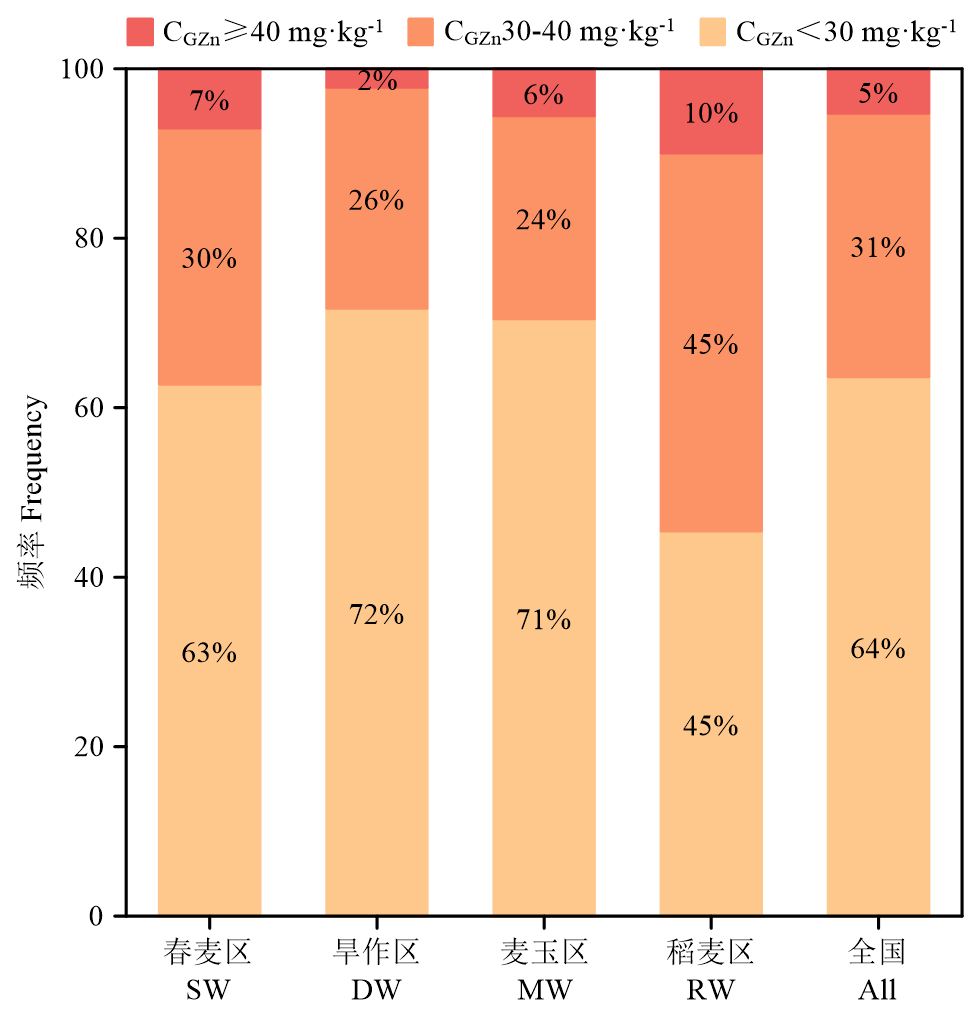
Fig. 3

Classification of wheat grain Zn concentration in major wheat production regions of China"

Table 2

The Zn uptake and Zn distribution indexes of various organs and grain fractions of wheat with different grain Zn levels of the two growing seasons in 2020-2022 in major wheat production regions of China"

麦区
Region
籽粒锌含量水平
Grain Zn level
锌含量Zn concentration (mg·kg-1) 锌吸收量Zn uptake (g·hm-2) 锌分配指数Zn distribution index (%)
茎叶
Straw
颖壳
Chaff
籽粒
Grain
面粉
Flour
麸皮
Bran
茎叶
Straw
颖壳
Chaff
籽粒
Grain
面粉
Flour
麸皮
Bran
茎叶
Straw
颖壳
Chaff
籽粒
Grain
面粉
Flour
麸皮
Bran
春麦区
SW
(27-13-3)1)
低 Low 4.2 b 5.0 c 17.9 7.4 c 37.3 c 13.9 c 9.8 c 96.8 b 24.9 a 79.3 a 11.0 c 8.1 a 80.8 a 26.9 a 73.1 a
偏低 Relative low 8.8 a 11.6 b 34.3 11.9 b 77.1 b 37.9 b 24.2 b 143.9 ab 31.6 a 121.3 a 18.0 b 11.3 a 70.6 b 22.1 a 77.9 a
适中 Moderate 12.0 a 18.8 a 45.3 16.0 a 99.3 a 70.0 a 36.9 a 152.0 a 36.1 a 131.6 a 26.5 a 13.9 a 59.6 c 22.3 a 77.7 a
平均 Mean 6.1 AB 8.0 B 24.6 C 9.4 B 53.7 B 25.1 A 16.1 A 114.9 C 27.7 C 95.7 D 14.2 A 9.5 A 76.3 B 25.1 A 74.9 A
旱作区
DW
(33-12-1)
低 Low 5.6 a 5.4 b 23.1 8.7 c 50.3 c 26.6 a 13.5 a 145.1 b 36.8 b 130.6 a 13.1 a 7.3 a 79.6 a 24.5 a 75.5 a
偏低 Relative low 6.0 a 8.9 ab 34.3 13.1 b 74.3 b 28.9 a 19.1 a 215.5 ab 55.5 ab 170.8 a 10.7 a 7.0 a 82.3 a 26.0 a 74.0 a
适中 Moderate 5.2 a 9.5 a 44.0 20.2 a 88.2 a 26.7 a 19.6 a 247.4 a 72.2 a 180.9 a 9.1 a 6.7 a 84.2 a 28.5 a 71.5 a
平均 Mean 5.7 B 6.4 C 26.5 BC 10.1 B 57.4 B 27.2 A 15.1 A 165.7 B 42.4 B 142.2 C 12.4 AB 7.2 B 80.4 A 25.0 A 75.0 A
麦玉区
MW
(153-52-6)
低 Low 5.5 b 6.8 c 24.4 9.4 c 52.5 c 30.1 b 17.3 a 198.3 c 50.7 b 175.0 b 81.5 a 11.6 a 6.9 a 26.0 a 74.0 a
偏低 Relative low 6.9 b 9.1 b 33.2 12.4 b 72.7 b 36.0 ab 21.9 a 269.2 b 67.4 a 221.5 a 82.8 a 10.7 a 6.5 a 25.5 a 74.5 a
适中 Moderate 10.2 a 12.8 a 44.3 17.0 a 95.8 a 49.5 a 22.3 a 311.9 a 80.3 a 227.6 a 81.3 a 13.2 a 5.6 a 27.7 a 72.3 a
平均 Mean 6.0 B 7.1 BC 27.1 B 10.3 B 58.7 B 32.1 A 18.6 A 219 A 55.7 A 188 A 11.4 B 6.8 B 81.8 A 25.9 A 74.1 A
稻麦区
RW
(55-54-12)
低 Low 5.7 c 7.2 c 25.8 10.6 c 53.7 c 19.5 b 12.4 b 152.3 c 40.9 b 138.8 b 11.0 b 6.6 a 82.4 a 26.8 a 73.2 a
偏低 Relative low 7.7 b 9.8 b 34.2 12.7 b 74.7 b 29.1 a 15.2 b 197.0 b 47.0 b 179.6 a 12.1 b 6.4 a 81.5 a 23.4 a 76.6 a
适中 Moderate 13.0 a 18.4 a 40.3 17.5 a 98.9 a 37.5 a 30.4 a 241.2 a 61.0 a 211.8 a 13.0 a 8.8 a 78.2 a 25.9 a 74.1 a
平均 Mean 7.3 A 9.5 A 31.5 A 12.2 A 67.6 A 25.6 A 15.4 A 181 B 45.6 B 164.2 B 11.7 B 6.8 B 81.6 A 25.2 A 74.8 A
全国
All
(268-131-22)
低 Low 5.4 c 6.2 c 23.9 9.4 c 50.9 c 25.8 b 15.1 b 172.5 b 44.5 b 152.6 b 11.6 b 7.0 b 81.4 a 26.1 a 73.9 a
偏低 Relative low 7.3 b 9.5 b 33.8 12.5 b 74.1 b 32.9 b 19.0 b 222.3 a 54.7 a 188.8 a 12.0 b 7.0 b 81.0 a 24.4 a 75.6 a
适中 Moderate 11.8 a 16.6 a 44.8 17.3 a 97.6 a 43.6 a 27.5 a 233.9 a 56.9 a 196.7 a 14.7 a 8.5 a 76.7 b 26.1 a 73.9 a
平均 Mean 6.4 7.8 28.1 10.8 60.6 28.9 17.0 191.2 48.3 166.2 11.9 7.1 81.0 25.5 74.5

Fig. 4

Correlation analysis of Zn concentration in wheat grain fractions and yield, yield components of the two growing seasons in 2020-2022 in China CGZn: The concentration of grain Zn; CFZn: The concentration of flour Zn; CBZn: The concentration of bran Zn. The same below. In the regression equation, x represents yield and yield components, and y represents the Zn concentration in grain, flour and bran, respectively. **: P≤0.01;*: P≤0.05. HI: Harvest index; SN: Spike number; GNPS: Grain number per spike; TKW: 1000-grain weight"

Table 3

Wheat yield and yield components from different levels of grain Zn concentration of the two growing seasons in 2020- 2022 in major wheat production regions of China"

麦区
Wheat region
籽粒锌水平
Grain Zn level
产量
Yield
(t·hm-2)
生物量
Biomass
(t·hm-2)
收获指数
Harvest index (%)
穗数
Spike number
(×104·hm-2)
穗粒数
Grain number per spike
千粒重
Thousand grain weight (g)
春麦区
SW
(27-13-3)
低 Low 5.6 a 10.9 a 51.9 a 400.5 a 33.5 a 45.7 a
偏低 Relative low 4.2 a 10.4 a 40.4 b 409.1 a 24.3 b 33.9 b
适中 Moderate 3.5 a 11.2 a 32.2 c 305.3 a 18.2 b 30.4 b
平均 Mean 5.0 C 10.8 C 47.1 B 396.4 C 29.6 A 41.0 B
旱作区
DW
(33-12-1)
低 Low 6.2 a 12.7 a 48.7 a 455.7 a 32.5 a 45.2 a
偏低 Relative low 6.3 a 13.2 a 48.4 a 496.7 a 32.9 a 42.1 a
适中 Moderate 5.6 a 12.8 a 43.9 a 386.8 a 27.7 a 40.3 a
平均 Mean 6.2 B 12.8 B 48.5 B 464.9 B 32.5 A 44.3 A
麦玉区
MW
(153-52-6)
低 Low 8.1 a 15.8 a 52.5 a 691.0 a 29.5 a 46.2 a
偏低 Relative low 8.2 a 15.9 a 52.4 a 669.9 a 33.0 a 45.6 a
适中 Moderate 7.0 a 13.8 a 51.1 a 511.8 a 34.3 a 43.7 a
平均 Mean 8.1 A 15.7 A 52.5 A 680.7 A 30.5 A 45.9 A
稻麦区
RW
(55-54-12)
低 Low 5.9 a 11.1 a 53.6 a 448.9 a 31.5 a 44.8 a
偏低 Relative low 5.8 a 11.2 a 52.5 a 497.0 a 33.0 a 44.0 ab
适中 Moderate 5.3 a 10.0 a 54.3 a 406.7 a 31.2 a 41.6 b
平均 Mean 5.8 B 11.0 C 53.2 A 466.2 BC 32.1 A 44.1 A
全国
All
(268-131-22)
低 Low 7.2 a 13.9 a 52.2 a 583.1 a 30.7 a 45.7 a
偏低 Relative low 6.6 a 13.1 a 50.9 a 556.9 a 32.1 a 43.5 a
适中 Moderate 5.5 b 11.3 b 50.0 a 420.6 b 30.1 a 40.6 b
平均 Mean 6.9 13.6 51.7 566.4 31.1 44.7

Fig. 5

Correlation analysis of Zn concentration in wheat grain fractions and main soil physicochemical properties of the two growing seasons in 2020-2022 in major wheat production regions of China In the regression equation, x represents the main soil fertility factors, and y represents the Zn concentration in grain, flour and bran, respectively. **: P≤0.01;*: P≤0.05"

Table 4

The main fertility factors of soils with different levels of grain Zn concentration of the two growing seasons in 2020-2022 in major wheat production regions of China"

麦区
Wheat
region
籽粒锌含量水平
Grain Zn level
pH 有机质
SOM
(g·kg-1)
全氮
TN
(g·kg-1)
硝态氮
NO3--N
(mg·kg-1)
铵态氮
NH4+-N
(mg·kg-1)
有效磷
AP
(mg·kg-1)
速效钾
AK
(mg·kg-1)
有效铁
AFe
(mg·kg-1)
有效锰
AMn
(mg·kg-1)
有效铜
ACu
(mg·kg-1)
有效锌
AZn
(mg·kg-1)
有效硫
AS
(mg·kg-1)
氮肥
N
(kg·hm-2)
磷肥
P2O5
(kg·hm-2)
钾肥
K2O
(kg·hm-2)
春麦区
SW
(27-13-3)
低 Low 8.5 a 22.7 b 1.3 b 23.4 a 3.4 a 40.0 a 243.8 a 13.3 b 9.8 a 1.5 a 0.5 b 50.4 a 284.0 a 142.0 a 18.0 a
偏低 Relative low 6.4 b 62.4 a 3.1 a 21.3 a 3.8 a 21.2 a 158.2 a 109.3 a 18.2 a 0.8 b 0.6 b 18.2 a 149.3 a 118.2 a 36.7 a
适中 Moderate 5.9 b 71.1 a 2.9 a 10.7 a 5.4 a 45.8 a 236.2 a 140.6 a 20.7 a 1.4 ab 1.2 a 18.6 a 72.0 a 72.0 a 41.3 a
平均 Mean 7.7 B 38.1 A 1.9 A 21.9 AB 3.7 B 34.7 A 217.4 B 51.2 B 13.1 C 1.2 B 0.6 B 40.6 A 158.1 A 131.6 A 23.6 C
旱作区
DW
(33-12-1)
低 Low 8.5 a 19.9 a 1.1 a 17.2 b 4.7 a 36.2 a 267.7 a 9.2 a 11.0 a 1.3 a 1.1 a 22.1 a 177.9 b 130.4 a 40.3 a
偏低 Relative low 8.5 a 19.5 a 1.0 a 26.1 b 3.7 a 45.9 a 321.2 a 8.7 a 13.4 a 1.6 a 1.5 a 30.9 a 179.9 b 135.7 a 42.6 a
适中 Moderate 8.2 b 16.6 a 0.8 a 94.2 a 7.1 a 42.4 a 307.1 a 4.4 a 13.4 a 0.8 a 0.9 a 16.8 a 308.9 a 202.2 a 78.8 a
平均 Mean 8.5 A 19.7 C 1.1 C 21.2 AB 4.5 AB 38.9 A 282.5 A 8.9 C 11.6 C 1.4 B 1.2 A 24.3 B 181.5 B 133.5 A 41.8 BC
麦玉区
MW
(153-52-6)
低 Low 7.5 a 22.2 a 1.3 a 36.2 a 7.4 a 45.2 a 203.1 a 34.5 a 23.0 a 1.6 a 1.3 a 26.2 a 233.5 a 127.8 a 78.6 a
偏低 Relative low 7.5 a 22.5 a 1.3 a 47.0 a 6.1 a 44.8 a 197.6 a 36.1 a 29.7 a 1.5 a 1.5 a 23.0 a 452.4 a 114.8 a 79.1 a
适中 Moderate 7.2 a 22.3 a 1.2 a 12.2 a 5.6 a 64.5 a 237.4 a 67.0 a 36.9 a 2.0 a 1.9 a 16.0 a 173.3 a 100.9 a 45.9 a
平均 Mean 7.5 B 22.3 BC 1.3 C 38.1 A 7.0 AB 45.6 A 202.8 B 35.8 BC 25.0 B 1.6 B 1.4 A 25.1 B 282.3 A 124.8 A 77.9 A
稻麦区
RW
(55-54-12)
低 Low 6.8 a 24.4 a 1.5 a 10.3 b 6.7 a 34.3 a 161.7 a 105.2 b 40.4 b 3.0 ab 1.1 a 14.1 a 181.1 a 68.1 a 60.6 a
偏低 Relative low 6.6 a 27.0 a 1.7 a 18.8 ab 10.6 a 36.3 a 191.0 a 141.5 b 35.6 b 2.9 b 1.3 a 16.3 a 172.4 a 69.4 a 62.6 a
适中 Moderate 5.6 a 36.0 a 1.6 a 24.2 a 8.3 a 33.1 a 177.4 a 236.1 a 64.1 a 4.2 ab 2.8 b 19.8 a 144.7 a 57.2 a 54.4 a
平均 Mean 6.6 C 26.7 B 1.6 B 15.5 B 8.6 A 35.1 A 176.3 B 134.4 A 40.6 A 3.1 A 1.4 A 15.7 B 173.9 B 67.6 B 60.8 AB
全国
All
(268-131-22)
低 Low 7.6 a 22.5 c 1.3 b 27.3 a 6.5 a 41.3 a 206.7 a 43.8 c 23.8 b 1.8 b 1.2 b 25.7 a 221.0 a 117.0 a 62.8 a
偏低 Relative low 7.1 a 28.1 b 1.6 a 30.8 a 7.5 a 39.0 a 202.3 a 84.7 b 29.5 b 2.0 b 1.3 b 20.5 a 184.2 ab 98.3 ab 64.4 a
适中 Moderate 6.2 b 36.2 a 1.6 a 22.3 a 7.1 a 43.8 a 207.7 a 166.4 a 48.5 a 3.1 a 2.3 a 18.4 a 152.5 b 75.4 b 52.3 a
平均 Mean 7.4 24.9 1.4 28.1 6.9 40.7 205.4 62.8 26.8 1.9 1.3 23.7 207.2 109.7 62.8
[1]
MARET W, SANDSTEAD H H. Zinc requirements and the risks and benefits of zinc supplementation. Journal of Trace Elements in Medicine and Biology, 2006, 20(1): 3-18.

doi: 10.1016/j.jtemb.2006.01.006 pmid: 16632171
[2]
NIKOLIC M, NIKOLIC N, KOSTIC L, PAVLOVIC J, BOSNIC P, STEVIC N, SAVIC J, HRISTOV N. The assessment of soil availability and wheat grain status of zinc and iron in Serbia: implications for human nutrition. The Science of the Total Environment, 2016, 553: 141-148.

doi: S0048-9697(16)30313-8 pmid: 26925726
[3]
MA G S, JIN Y, LI Y P, ZHAI F Y, KOK F J, JACOBSEN E, YANG X G. Iron and zinc deficiencies in China: what is a feasible and cost-effective strategy? Public Health Nutrition, 2008, 11(6): 632-638.

doi: 10.1017/S1368980007001085 pmid: 17894916
[4]
GUPTA N, RAM H, KUMAR B. Mechanism of Zinc absorption in plants: uptake, transport, translocation and accumulation. Reviews in Environmental Science and Bio/Technology, 2016, 15(1): 89-109.
[5]
FAO. Food fortification-World Health Organization. 2021.
[6]
HARRINGTON S A, CONNORTON J M, NYANGOMA N I M, MCNELLY R, MORGAN Y M L, ASLAM M F, SHARP P A, JOHNSON A A T, UAUY C, BALK J. A two-gene strategy increases iron and zinc concentrations in wheat flour, improving mineral bioaccessibility. Plant Physiology, 2023, 191(1): 528-541.
[7]
XUE Y F, YUE S C, ZHANG Y Q, CUI Z L, CHEN X P, YANG F C, CAKMAK I, MCGRATH S P, ZHANG F S, ZOU C Q. Grain and shoot zinc accumulation in winter wheat affected by nitrogen management. Plant and Soil, 2012, 361(1): 153-163.
[8]
ZHANG Y Q, DENG Y, CHEN R Y, CUI Z L, CHEN X P, YOST R, ZHANG F S, ZOU C Q. The reduction in zinc concentration of wheat grain upon increased phosphorus-fertilization and its mitigation by foliar zinc application. Plant and Soil, 2012, 361(1): 143-152.
[9]
惠晓丽, 王朝辉, 罗来超, 马清霞, 王森, 戴健, 靳静静. 长期施用氮磷肥对旱地冬小麦籽粒产量和锌含量的影响. 中国农业科学, 2017, 50(16): 3175-3185. doi: 10.3864/j.issn.0578-1752.2017.16.012.
HUI X L, WANG Z H, LUO L C, MA Q X, WANG S, DAI J, JIN J J. Winter wheat grain yield and Zn concentration affected by long-term N and P application in dryland. Scientia Agricultura Sinica, 2017, 50(16): 3175-3185. doi: 10.3864/j.issn.0578-1752.2017.16.012. (in Chinese)
[10]
CAKMAK I, KUTMAN U B. Agronomic biofortification of cereals with zinc: A review. European Journal of Soil Science, 2018, 69(1): 172-180.
[11]
黄婷苗. 我国主要麦区小麦籽粒锌含量差异的营养与作物原因分析[D]. 杨凌: 西北农林科技大学, 2020.
HUANG T M. Nutritional and crop mechanism analysis for difference in grain zinc concentration of wheat in major growing regions of China[D]. Yangling: Northwest A&F University, 2020. (in Chinese)
[12]
SACHDEV P, LINDSAY W L, DEB D L. Activity measurements of zinc in soils of different pH using EDTA. Geoderma, 1992, 55(3/4): 247-257.
[13]
LI B Y, ZHOU D M, CANG L, ZHANG H L, FAN X H, QIN S W. Soil micronutrient availability to crops as affected by long-term inorganic and organic fertilizer applications. Soil and Tillage Research, 2007, 96(1/2): 166-173.
[14]
MINER G L, DELGADO J A, IPPOLITO J A, JOHNSON J J, KLUTH D L, STEWART C E. Wheat grain micronutrients and relationships with yield and protein in the U.S. Central Great Plains. Field Crops Research, 2022, 279: 108453.
[15]
LIU H, WANG Z H, LI F C, LI K Y, YANG N, YANG Y E, HUANG D L, LIANG D L, ZHAO H B, MAO H, LIU J S, QIU W H. Grain iron and zinc concentrations of wheat and their relationships to yield in major wheat production areas in China. Field Crops Research, 2014, 156: 151-160.
[16]
刘慧. 我国主要麦区小麦籽粒产量和关键营养元素含量评价及调控[D]. 杨凌: 西北农林科技大学, 2016.
LIU H. Evaluation and regulation of wheat grain yield and critical nutrient concentrations in major wheat production areas in China[D]. Yangling: Northwest A&F University, 2016. (in Chinese)
[17]
GUTTIERI M J, BAENZIGER P S, FRELS K, CARVER B, ARNALL B, WATERS B M. Variation for grain mineral concentration in a diversity panel of current and historical great Plains hard winter wheat germplasm. Crop Science, 2015, 55(3): 1035-1052.
[18]
WANG S, WANG Z H, LI S S, DIAO C P, LIU L, HUI X L, HUANG M, LUO L C, HE G, CAO H B, YU R, MALHI S S. Identification of high-yield and high-Zn wheat cultivars for overcoming “yield dilution” in dryland cultivation. European Journal of Agronomy, 2018, 101: 57-62.
[19]
JIANG L N, MA J L, WANG X J, LIU G G, ZHU Z L, QI C Y, ZHANG L F, LI C X, WANG Z M, HAO B Z. Grain zinc and iron concentrations of Chinese wheat landraces and cultivars and their responses to foliar micronutrient applications. Journal of Integrative Agriculture, 2022, 21(2): 532-541.

doi: 10.1016/S2095-3119(21)63614-6
[20]
XIA H Y, LI X J, QIAO Y T, XUE Y H, YAN W, MA L, ZHAO Q Y, KONG L G, XUE Y F, CUI Z L, VAN DER WERF W. Dissecting the relationship between yield and mineral nutriome of wheat grains in double cropping as affected by preceding crops and nitrogen application. Field Crops Research, 2023, 293: 108845.
[21]
王卉楠. 富锌小麦馒头加工过程中品质变化的研究[D]. 泰安: 山东农业大学, 2019.
WANG H N. Study on the quality change in the process of zinc-rich wheat steamed bread making[D]. Taian: Shandong Agricultural University, 2019. (in Chinese)
[22]
CALDELAS C, REZZOUK F Z, GUTIÉRREZ N A, DIEZ-FRAILE M C, ORTEGA J L A. Interaction of genotype, water availability, and nitrogen fertilization on the mineral content of wheat grain. Food Chemistry, 2023, 404(Pt A): 134565.
[23]
张晨, 彭志兵, 罗艳玲. 超级微波消解-ICP-MS法同时测定谷物及其制品中27种微量元素. 粮食科技与经济, 2022, 47(5): 79-86.
ZHANG C, PENG Z B, LUO Y L. Determination of 27 microelements in grain and grain products super microwave digestion coupled with inductively coupled plasma mass spectrometry. Food Science and Technology and Economy, 2022, 47(5): 79-86. (in Chinese)
[24]
黄宁, 王朝辉, 王丽, 马清霞, 张悦悦, 张欣欣, 王瑞. 我国主要麦区主栽高产品种产量差异及其与产量构成和氮磷钾吸收利用的关系. 中国农业科学, 2020, 53(1): 81-93. doi: 10.3864/j.issn.0578-1752.2020.01.008.
HUANG N, WANG Z H, WANG L, MA Q X, ZHANG Y Y, ZHANG X X, WANG R. Yield variation of winter wheat and its relationship to yield components, NPK uptake and utilization of leading and high yielding wheat cultivars in main wheat production regions of China. Scientia Agricultura Sinica, 2020, 53(1): 81-93. doi: 10.3864/j.issn.0578-1752.2020.01.008. (in Chinese)
[25]
李小涵, 党海燕, 董昭芸, 王星舒, 高玉, 王朝辉, 石美. 测定土壤有效性铁锰铜锌的影响因素及优化方法. 实验技术与管理, 2022, 39(9): 76-80.
LI X H, DANG H Y, DONG Z Y, WANG X S, GAO Y, WANG Z H, SHI M. Factors affecting determination of soil available microelement elements and optimization method. Experimental Technology and Management, 2022, 39(9): 76-80. (in Chinese)
[26]
CHEN X P, ZHANG Y Q, TONG Y P, XUE Y F, LIU D Y, ZHANG W, DENG Y, MENG Q F, YUE S C, YAN P, CUI Z L, SHI X J, GUO S W, SUN Y X, YE Y L, WANG Z H, JIA L L, MA W Q, HE M R, ZHANG X Y, KOU C L, LI Y T, TAN D S, CAKMAK I, ZHANG F S, ZOU C Q. Harvesting more grain zinc of wheat for human health. Scientific Reports, 2017, 7(1): 7016.
[27]
LIU Z H, WANG H Y, WANG X E, XU H Y, GAO D R, ZHANG G P, CHEN P D, LIU D J. Effect of wheat pearling on flour phytase activity, phytic acid, iron, and zinc content. LWT - Food Science and Technology, 2008, 41(3): 521-527.
[28]
ZHANG Y Q, SHI R L, REZAUL K M, ZHANG F S, ZOU C Q. Iron and zinc concentrations in grain and flour of winter wheat as affected by foliar application. Journal of Agricultural and Food Chemistry, 2010, 58(23): 12268-12274.

doi: 10.1021/jf103039k pmid: 21073194
[29]
TANG J W, ZOU C Q, HE Z H, SHI R L, ORTIZ-MONASTERIO I, QU Y Y, ZHANG Y. Mineral element distributions in milling fractions of Chinese wheats. Journal of Cereal Science, 2008, 48(3): 821-828.
[30]
SINGH S P, VOGEL-MIKUŠ K, VAVPETIČ P, JEROMEL L, PELICON P, KUMAR J, TULI R. Spatial X-ray fluorescence micro-imaging of minerals in grain tissues of wheat and related genotypes. Planta, 2014, 240(2): 277-289.

doi: 10.1007/s00425-014-2084-4 pmid: 24817589
[31]
褚宏欣, 牟文燕, 党海燕, 王涛, 孙蕊卿, 侯赛宾, 黄婷苗, 黄倩楠, 石美, 王朝辉. 我国主要麦区小麦籽粒微量元素含量及营养评价. 作物学报, 2022, 48(11): 2853-2865.

doi: 10.3724/SP.J.1006.2022.11099
CHU H X, MU W Y, DANG H Y, WANG T, SUN R Q, HOU S B, HUANG T M, HUANG Q N, SHI M, WANG Z H. Evaluation on concentration and nutrition of micro-elements in wheat grains in major wheat production regions of China. Acta Agronomica Sinica, 2022, 48(11): 2853-2865. (in Chinese)
[32]
BROWN K H, HAMBIDGE K M, RANUM P, GROUP Z F W. Zinc fortification of cereal flours: current recommendations and research needs. Food and Nutrition Bulletin, 2010, 31(Suppl. 1): 62-74.
[33]
CAKMAK I, KALAYCI M, KAYA Y, TORUN A A, AYDIN N, WANG Y, ARISOY Z, ERDEM H, YAZICI A, GOKMEN O, OZTURK L, HORST W J. Biofortification and localization of zinc in wheat grain. Journal of Agricultural and Food Chemistry, 2010, 58(16): 9092-9102.

doi: 10.1021/jf101197h pmid: 23654236
[34]
ZHAO Q Y, XU S J, ZHANG W S, ZHANG Z, YAO Z, CHEN X P, ZOU C Q. Identifying key drivers for geospatial variation of grain micronutrient concentrations in major maize production regions of China. Environmental Pollution, 2020, 266(Pt 2): 115114.
[35]
LOPEZ H W, LEENHARDT F, COUDRAY C, REMESY C. Minerals and phytic acid interactions: is it a real problem for human nutrition? International Journal of Food Science & Technology, 2002, 37(7): 727-739.
[36]
DE BRIER N, GOMAND S V, DONNER E, PATERSON D, SMOLDERS E, DELCOUR J A, LOMBI E. Element distribution and iron speciation in mature wheat grains (Triticum aestivum L.) using synchrotron X-ray fluorescence microscopy mapping and X-ray absorption near-edge structure (XANES) imaging. Plant, Cell & Environment, 2016, 39(8): 1835-1847.
[37]
GUO Z K, ZHANG X M, WANG L, WANG X S, WANG R Z, HUI X L, WANG S, WANG Z H, SHI M. Selecting high zinc wheat cultivars increases grain zinc bioavailability. Journal of Agricultural and Food Chemistry, 2021, 69(38): 11196-11203.

doi: 10.1021/acs.jafc.1c03166 pmid: 34528796
[38]
SHEWRY P R, HASSALL K L, GRAUSGRUBER H, ANDERSSON A A M, LAMPI A M, PIIRONEN V, RAKSZEGI M, WARD J L, LOVEGROVE A. Do modern types of wheat have lower quality for human health? Nutrition Bulletin, 2020, 45(4): 362-373.
[39]
MORGOUNOV A, GÓMEZ-BECERRA H F, ABUGALIEVA A, DZHUNUSOVA M, YESSIMBEKOVA M, MUMINJANOV H, ZELENSKIY Y, OZTURK L, CAKMAK I. Iron and zinc grain density in common wheat grown in Central Asia. Euphytica, 2007, 155(1): 193-203.
[40]
SHUKLA G, SHARMA S, GAURAV A, SHARMA S. Physiological role and biofortification of zinc in wheat (Triticum aestivum L.). Plant Physiology Reports, 2022, 27(4): 665-679.
[41]
王子腾, 耿元波, 梁涛. 中国农田土壤的有效锌含量及影响因素分析. 中国土壤与肥料, 2019(6): 55-63.
WANG Z T, GENG Y B, LIANG T. Temporal and spatial difference and influencing factors analysis of soil available Zn of farmland in China. Soil and Fertilizer Sciences in China, 2019(6): 55-63. (in Chinese)
[42]
李晓靖. 氮肥和前茬作物对小麦籽粒产量和氮、锌等矿质营养元素累积的影响[D]. 济南: 山东师范大学, 2023.
LI X J. Effects of nitrogen fertilizer and preceding crops on grain yield and accumulation of mineral nutrients such as nitrogen and zinc in wheat[D]. Jinan: Shandong Normal University, 2023. (in Chinese)
[43]
ZHAO Q Y, CAO W Q, CHEN X P, STOMPH T J, ZOU C Q. Global analysis of nitrogen fertilization effects on grain zinc and iron of major cereal crops. Global Food Security, 2022, 33: 100631.
[44]
MONTOYA M, VALLEJO A, RECIO J, GUARDIA G, ALVAREZ J M. Zinc-nitrogen interaction effect on wheat biofortification and nutrient use efficiency. Journal of Plant Nutrition and Soil Science, 2020, 183(2): 169-179.
[45]
XUE Y F, ZHANG W, LIU D Y, YUE S C, CUI Z L, CHEN X P, ZOU C Q. Effects of nitrogen management on root morphology and zinc translocation from root to shoot of winter wheat in the field. Field Crops Research, 2014, 161: 38-45.
[46]
GUO J H, LIU X J, ZHANG Y, SHEN J L, HAN W X, ZHANG W F, CHRISTIE P, GOULDING K W T, VITOUSEK P M, ZHANG F S. Significant acidification in major Chinese croplands. Science, 2010, 327(5968): 1008-1010.

doi: 10.1126/science.1182570 pmid: 20150447
[47]
CAKMAK I, PFEIFFER W H, MCCLAFFERTY B. Review: biofortification of durum wheat with zinc and iron. Cereal Chemistry, 2010, 87(1): 10-20.
[48]
HALDAR M, MANDAL L N. Effect of phosphorus and zinc on the growth and phosphorus, zinc, copper, iron and manganese nutrition of rice. Plant and Soil, 1981, 59(3): 415-425.
[49]
赵荣芳, 邹春琴, 张福锁. 长期施用磷肥对冬小麦根际磷、锌有效性及其作物磷锌营养的影响. 植物营养与肥料学报, 2007, 13(3): 368-372.
ZHAO R F, ZOU C Q, ZHANG F S. Effects of long-term P fertilization on P and Zn availability in winter wheat rhizoshpere and their nutrition. Plant Nutrition and Fertilizer Science, 2007, 13(3): 368-372. (in Chinese)
[50]
武际, 尹恩, 郭熙盛. 不同磷锌组合对小麦磷锌含量、积累与分配的影响. 土壤通报, 2010, 41(6): 1444-1448.
WU J, YIN E, GUO X S. Effects of different rates of P and Zn combination on phosphorus and zinc content, absorption and distribution of wheat. Chinese Journal of Soil Science, 2010, 41(6): 1444-1448. (in Chinese)
[51]
ZHANG W, LIU D Y, LIU Y M, CUI Z L, CHEN X P, ZOU C Q. Zinc uptake and accumulation in winter wheat relative to changes in root morphology and mycorrhizal colonization following varying phosphorus application on calcareous soil. Field Crops Research, 2016, 197: 74-82.
[1] XU YangHaoJun, CHEN LiMing, YANG ShiQi, TANG YiFan, TAN XueMing, ZENG YongJun, PAN XiaoHua, ZENG YanHua. Effects of Long-Term Different Straw Returning Methods on Soil Organic Carbon, Nutrients and Aggregate Formation in Different Soil Layers of Double Cropping Rice Field [J]. Scientia Agricultura Sinica, 2026, 59(7): 1492-1506.
[2] ZHU Qi, JIA ZhenPeng, Tahir SHAH, XU ChenSheng, LI ZhiQi, LÜ HuiShuai, ZHU PengChao, WEI XiaoMin, HUANG DongLin, SUN YanNi, CAO WeiDong, GAO YaJun, WANG ZhaoHui, ZHANG DaBin. Green Manure Crops Combined with Enhanced-Efficiency Products Reduced Greenhouse Gas Emissions and Carbon Footprints in Dryland Wheat Fields [J]. Scientia Agricultura Sinica, 2026, 59(7): 1507-1522.
[3] WANG JiaNuo, CHEN GuiPing, LI Pan, WANG LiPing, NAN YunYou, HE Wei, FAN ZhiLong, HU FaLong, CHAI Qiang, YIN Wen, ZHAO LiaoHao. Photo-Physiological Mechanism at Grain Filling Stage of No-Tillage with Plastic Re-Mulching to Increase Maize Yield in Oasis Irrigation Areas [J]. Scientia Agricultura Sinica, 2026, 59(6): 1189-1202.
[4] ZHOU XinJie, REN Hao, CHEN YingLong, ZHANG JiWang, ZHAO Bin, REN BaiZhao, LIU Peng, WANG HongZhang. Effects of Calcium Peroxide on Root Morphology and Yield Formation of Summer Maize in Waterlogging Farmland [J]. Scientia Agricultura Sinica, 2026, 59(6): 1203-1216.
[5] LI WenHu, LI HaiFeng, DU YuPeng, DING YuLan, LUO YiNuo, LI YuKe, SHE WenTing, ZHANG Feng, TENG Yu, ZHANG SiQi, HUANG Cui, LI XiaoHan, LIU JinShan, WANG ZhaoHui. Regional Differences in Wheat Zinc Uptake and Translocation Responses to Soil Zinc Fertilization [J]. Scientia Agricultura Sinica, 2026, 59(5): 1034-1047.
[6] JIAO WenJuan, HE WanLong, GENG HongWei, BAI Bin, LI JianFeng, CHENG YuKun. Stripe Rust Resistance Evaluation and Molecular Characterization of Yr Genes for 155 Spring Wheat Varieties (Lines) [J]. Scientia Agricultura Sinica, 2026, 59(5): 937-950.
[7] LI SiYuan, LI HongPing, CHANG HongQing, ZHANG SenYan, LI SiJia, CUI XinFei, QIAO Po, ZENG Bo, LIU GuiZhen, LIU TianXue, TANG JiHua, LI ChaoHai. Effects of Density Increase on Dynamic Change of Yield and Agronomic Traits of Maize Cultivars with Different Plant Heights [J]. Scientia Agricultura Sinica, 2026, 59(5): 967-984.
[8] WEN YuBin, BAI ShanShan, CAI ZeJiang, SUN Nan, XU MingGang. Effects of Organic Materials on Soil Microbial Biomass and Its Acidity Regulation Mechanism [J]. Scientia Agricultura Sinica, 2026, 59(4): 834-849.
[9] CUI ShiYou, CHEN PengJun, MIAO YuanQing, HAN JiJun, SHEN JunMing. Development and Field Evaluation of Glyphosate-Resistant Wheat Germplasm Generated Through EMS Mutagenesis [J]. Scientia Agricultura Sinica, 2026, 59(4): 723-733.
[10] QIAN Jin, LI YingXue, WU Fang, ZOU XiaoChen. Improved Leaf Phosphorus Content Estimation of Winter Wheat Using Ensemble Hyperspectral Dimensionality Reduction Method [J]. Scientia Agricultura Sinica, 2026, 59(4): 781-792.
[11] KONG Yuan, CUI ShaSha, LI Mei, LI Jian, YANG SiYu, FANG Feng, LIU ShuaiShuai, LIU MingPing, ZENG Yan, GAO XingXiang, BAI LianYang. Spatiotemporal Distribution Dynamics of Five Grass Weed Species Including Lolium multiflorum in Winter Wheat Fields of the Huang- Huai-Hai Region [J]. Scientia Agricultura Sinica, 2026, 59(4): 807-823.
[12] WANG YongSheng, NIU Li, WANG ChangJie, MA LiHua, LIAN XiaoXiao, MENG YaXiong, MA XiaoLe, YAO LiRong, ZHANG Hong, YANG Ke, LI BaoChun, WANG HuaJun, SI ErJing, WANG JunCheng. Genome-Wide Association Study and Candidate Gene Identification for Thousand Grain Weight in Winter Wheat [J]. Scientia Agricultura Sinica, 2026, 59(3): 499-514.
[13] LI XinYi, LI JiaNing, YANG WenPing, XIA Qing, HUO YingRui, HAO ShiHang, HUANG TingMiao, REN YongKang, CHEN Jie, GAO ZhiQiang, YANG ZhenPing. Effects of Post-Anthesis Foliar Zinc Application on Zinc Nutrition in Colored-Grain Wheat [J]. Scientia Agricultura Sinica, 2026, 59(3): 515-527.
[14] XIAN QingLin, XIAO JianKe, GAO AQing, GAO LiChuang, LIU Yang. Effects of Planting Patterns Combined with Soil Moisture Measurement and Supplementary Irrigation on the Yield and Water Use Efficiency of Winter Wheat [J]. Scientia Agricultura Sinica, 2026, 59(3): 589-601.
[15] ZHANG ZhiYong, TAN ShiChao, XIONG ShuPing, MA XinMing, WEI YiHao, WANG XiaoChun. Effects of Annual Water and Nitrogen Optimization on Yield and Nitrogen Migration of Wheat-Maize Rotation System in Irrigation Area of Northern Henan [J]. Scientia Agricultura Sinica, 2026, 59(2): 336-353.
Viewed
Full text


Abstract

Cited

  Shared   
  Discussed   
No Suggested Reading articles found!