Scientia Agricultura Sinica ›› 2024, Vol. 57 ›› Issue (14): 2815-2826.doi: 10.3864/j.issn.0578-1752.2024.14.010

• SOIL & FERTILIZER·WATER-SAVING IRRIGATION·AGROECOLOGY & ENVIRONMENT • Previous Articles     Next Articles

Response of Wheat Zinc Nutrition to Zinc Fertilization into Soils with Variable Available Zinc

HUANG TingMiao1,2(), LU NaiKun1, XIE BingQiang1, CAO HanBing3, QIAO YueJing1, YANG ZhenPing1, GAO ZhiQiang1, LI TingLiang3()   

  1. 1 College of Agronomy, Shanxi Agricultural University/Ministerial and Provincial Co-Innovation Centre for Endemic Crops Production with High-quality and Efficiency in Loess Plateau, Taigu 030801, Shanxi
    2 College of Natural Resources and Environment, Northwest A&F University/Key Laboratory of Plant Nutrition and Agro-Environment in Northwest China, Ministry of Agriculture and Rural Affairs, Yangling 712100, Shaanxi
    3 College of Resources and Environment, Shanxi Agricultural University, Taigu 030801, Shanxi
  • Received:2024-02-08 Accepted:2024-04-08 Online:2024-07-16 Published:2024-07-24
  • Contact: LI TingLiang

Abstract:

【Objective】 The objective of this study was to clarify the response of soil available zinc (Zn) and wheat grain Zn concentration to soil Zn fertilization under different Zn supply field conditions, and to explore the Zn fertilizer regulation measures for grain Zn fortification based on soil available Zn, so as to provide a scientific basis for optimizing Zn fertilizer application and achieving wheat grain with high-yield and high-quality. 【Method】 The two-year location-fixed field experiments with five Zn fertilizer application rates of 0, 6, 12, 18, and 24 kgZn·hm-2 were carried out at Taigu (high-Zn field) and Wanrong (low-Zn field) of Shanxi Province in the eastern Loess Plateau, respectively. The wheat grain yield and Zn concentration, Zn uptake and its translocation and distribution in the aerial part, as well as soil available Zn were investigated in the high- and low-Zn fields. 【Result】 Grain yield was not affected by Zn fertilizer rates in both high- and low-Zn fields. In high-Zn field, a slight increase in grain Zn concentration was observed with the increase of Zn fertilizer rates. For grain Zn concentration, no significant difference existed among all treatments in the first year, while it was increased by 2.4%-11.0% for Zn fertilization treatments as compared with that of no Zn fertilization in the second year. The grain Zn concentration was higher than 40 mg·kg-1 for all treatments. Compared with Zn application, the Zn transfer factor from straw to grain and grain Zn portioning index were decreased by 23.9%-37.9% and 4.3%-13.1%, respectively, and more than 20% of shoot Zn still remained in the stems and leaves at wheat harvest. In low-Zn field, the grain Zn concentration and Zn uptake in each organ increased with increasing Zn rates, whereas the opposite trend was observed for Zn transfer factor from straw to grain. Compared with no Zn application, the grain Zn concentration averaged two years increased by 9.4%-23.1%, while the Zn transfer factor from straw to grain decreased by 13.5%-24.5%, but no obvious difference was found for Zn portioning index among five Zn rates. In both high- and low-Zn fields, the soil available Zn increased significantly with the added Zn fertilizer. The regression analysis showed that soil available Zn slightly increased grain Zn concentration, and the increase with available Zn could be described by a quadratic function in high-Zn field, and the linear-with-plateau model showed that the grain Zn plateau of 34.76 mg·kg-1 was reached at the soil available Zn of 4.12 mg·kg-1. 【Conclusion】 Therefore, for the purpose of achieving desirable grain Zn concentration of 40 mg·kg-1 in the wheat monoculture aera of eastern Loess Plateau, it could be considered that higher soil available Zn played a critical role in the high-Zn field, and soil Zn fertilization could be considered to increase soil available Zn up to 4 mg·kg-1 first, and then other agronomic measures such as foliar Zn application should not be ignored to address the gap between the current grain Zn concentration and the recommended value in the low-Zn field.

Key words: wheat, soil Zn application, soil available Zn, grain Zn concentration, Zn translocation and distribution, Loess Plateau

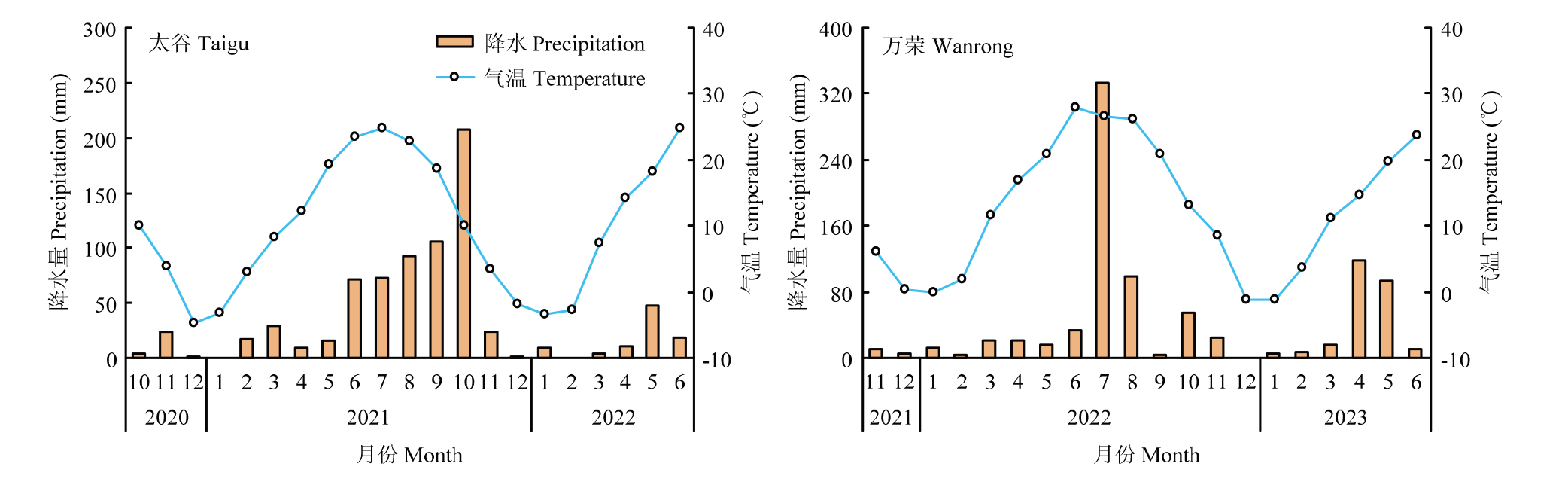
Fig. 1

Monthly precipitation and average temperature at Taigu and Wanrong county during experimental period"

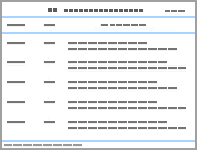
Table 1

Basic physicochemical properties at 0-20 cm soil layer before wheat sowing at two sites"

试验点
Experimental site
pH 有机质
Organic matter
(g·kg-1)
全氮
Total N
(g·kg-1)
矿质氮
Mineral N
(mg·kg-1)
有效磷
Olsen-P
(mg·kg-1)
速效钾
Available K
(mg·kg-1)
有效锌
Available Zn
(mg·kg-1)
太谷 Taigu 8.43 25.9 11.3 48.3 19.5 151.2 8.11
万荣 Wanrong 8.44 9.71 0.58 6.17 8.15 115.6 0.51

Fig. 2

Grain yield affected by Zn fertilizer rates applied into soil under conditions of high- and low-Zn wheat fields, respectively Zn0, Zn6, Zn12, Zn18, Zn24 indicate Zn fertilizer application rates of 0, 6, 12, 18, 24 kg Zn·hm-2, respectively. The same as below. Different lowercase letters above the bars indicate significant difference among five treatments level in the same year (P<0.05)"

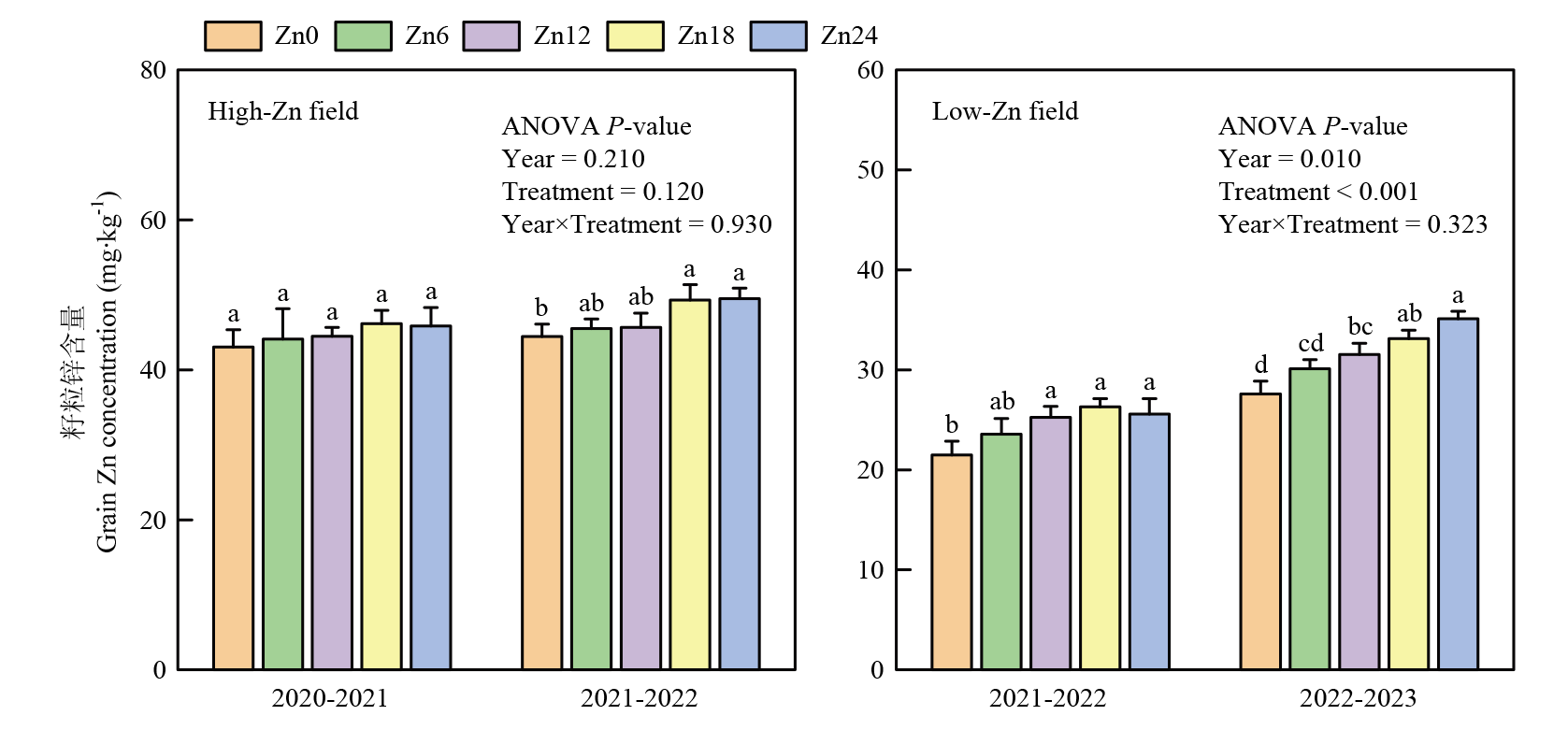
Fig. 3

Grain Zn concentration affected by Zn fertilizer rates applied into soil under conditions of high- and low-Zn wheat fields, respectively"

Fig. 4

Zn accumulation in each organ of wheat aerial part affected by Zn fertilizer rates applied into soil under conditions of high- and low-Zn wheat fields, respectively Different uppercase and lowercase letters indicate significant difference within Zn accumulation in aerial part and each organ among five treatments at the 0.05 probability level in the same year, respectively"

Table 2

Zn transfer factor from straw to grain and Zn portioning index affected by different Zn fertilizer rates applied into soil under conditions of high- and low-Zn wheat fields, respectively"

小麦种植
Wheat
growing
处理
Treatment
锌转运系数 Zn transfer factor 锌分配指数 Zn portioning index (%)
(秸秆-籽粒) (Straw-grain) 籽粒 Grain 茎叶 Stem 颖壳 Glume
高锌田块
High-Zn field
低锌田块
Low-Zn field
高锌田块
High-Zn field
低锌田块
Low-Zn field
高锌田块
High-Zn field
低锌田块
Low-Zn field
高锌田块
High-Zn field
低锌田块
Low-Zn field
第1年
The first year
Zn0 2.17 a 6.21 a 65.40 a 84.64 a 25.92 a 9.29 a 8.68 a 6.06 a
Zn6 1.71 a 5.24 ab 61.31 a 82.75 a 31.75 a 11.67 a 6.94 a 5.58 a
Zn12 1.93 a 4.85 b 61.80 a 82.85 a 30.79 a 11.06 a 7.41 a 6.09 a
Zn18 1.85 a 4.91 b 60.12 a 81.97 a 32.01 a 12.43 a 7.87 a 5.60 a
Zn24 1.85 a 4.49 b 63.99 a 81.31 a 28.61 a 12.98 a 7.40 a 5.71 a
第2年
The second year
Zn0 2.72 a 4.82 a 75.58 a 77.24 a 17.97 b 14.20 a 6.45 a 8.56 a
Zn6 2.07 b 4.30 ab 71.74 ab 75.55 a 21.94 ab 14.76 a 6.32 a 9.69 a
Zn12 2.06 b 3.74 b 69.71 ab 74.40 a 23.44 ab 16.14 a 6.86 a 9.45 a
Zn18 2.05 b 4.02 ab 72.31 ab 74.25 a 20.79 ab 15.06 a 6.90 a 10.69 a
Zn24 1.69 b 3.84 ab 65.66 b 73.63 a 27.99 a 15.45 a 6.35 a 10.93 a
变异来源 Source of variations
年份Year NS NS * NS * * NS *
处理Treatment NS * NS NS NS NS NS NS
年份×处理
Year×Treatment
NS NS NS NS NS NS NS NS

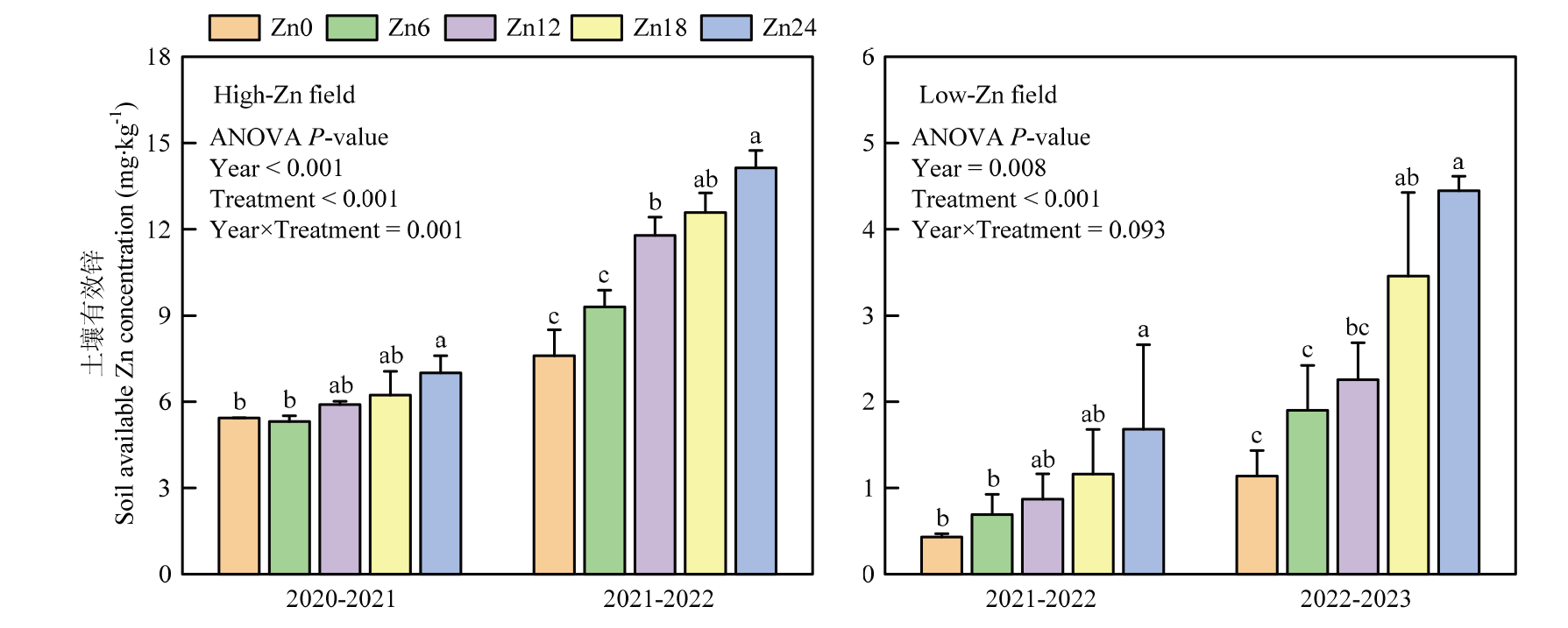
Fig. 5

Soil available Zn concentration at 0-20 cm soil layer affected by Zn fertilizer rates applied into soil under conditions of high- and low-Zn wheat fields, respectively Different lowercase letters above the bars indicate significant difference among five treatments level in the same year P<0.05"

Fig. 6

Relationships of grain Zn concentration and soil available Zn content at 0-20 cm soil layer under conditions of high- and low-Zn wheat fields, respectively"

[1]
STEVENS G A, BEAL T, MBUYA M N N, LUO H Q, NEUFELD L M, GROUP G M D R. Micronutrient deficiencies among preschool-aged children and women of reproductive age worldwide: A pooled analysis of individual-level data from population- representative surveys. The Lancet Global Health, 2022, 10(11): 1590-1599.
[2]
MCCLUNG J P. Iron, zinc, and physical performance. Biological Trace Element Research, 2019, 188(1): 135-139.

doi: 10.1007/s12011-018-1479-7 pmid: 30112658
[3]
ZHAO F J. Soil and human health. European Journal of Soil Science, 2018, 69(1): 158.
[4]
CHEN X P, ZHANG Y Q, TONG Y P, XUE Y F, LIU D Y, ZHANG W, DENG Y, MENG Q F, YUE S C, YAN P, CUI Z L, SHI X J, GUO S W, SUN Y X, YE Y L, WANG Z H, JIA L L, MA W Q, HE M R, ZHANG X Y, KOU C L, LI Y T, TAN D S, CAKMAK I, ZHANG F S, ZOU C Q. Harvesting more grain zinc of wheat for human health. Scientific Reports, 2017, 7(1): 7016.
[5]
褚宏欣, 牟文燕, 党海燕, 王涛, 孙蕊卿, 侯赛宾, 黄婷苗, 黄倩楠, 石美, 王朝辉. 我国主要麦区小麦籽粒微量元素含量及营养评价. 作物学报, 2022, 48(11): 2853-2865.

doi: 10.3724/SP.J.1006.2022.11099
CHU H X, MU W Y, DANG H Y, WANG T, SUN R Q, HOU S B, HUANG T M, HUANG Q N, SHI M, WANG Z H. Evaluation on concentration and nutrition of micro-elements in wheat grains in major wheat production regions of China. Acta Agronomica Sinica, 2022, 48(11): 2853-2865. (in Chinese)
[6]
ZHAO A Q, ZHANG L S, NING P, CHEN Q, WANG B N, ZHANG F X, YANG X B, ZHANG Y L. Zinc in cereal grains: concentration, distribution, speciation, bioavailability, and barriers to transport from roots to grains in wheat. Critical Reviews in Food Science and Nutrition, 2022, 62(28): 7917-7928.
[7]
HUANG T M, HUANG Q N, SHE X, MA X L, HUANG M, CAO H B, HE G, LIU J S, LIANG D L, MALHI S S, WANG Z H. Grain zinc concentration and its relation to soil nutrient availability in different wheat cropping regions of China. Soil and Tillage Research, 2019, 191: 57-65.
[8]
LI C, GUO Z K, WANG X S, MA Y, LIU J S, SHI M, ZHANG D, MALHI S S, SIDDIQUE K H M, WANG Z H. Field-scale studies quantify limitations for wheat grain zinc biofortification in dryland areas. European Journal of Agronomy, 2023, 142: 126687.
[9]
CHEN Y L, MI H Z, ZHANG Y H, ZHANG G Y, LI C, YE Y, ZHANG R R, SHI J L, LI Z H, TIAN X H, WANG Y H. Impact of ZnSO4 and ZnEDTA applications on wheat Zn biofortification, soil Zn fractions and bacterial community: significance for public health and agroecological environment. Applied Soil Ecology, 2022, 176: 104484.
[10]
李孟华, 王朝辉, 李强, 戴健, 高雅洁, 靳静静, 曹寒冰, 王森. 低锌旱地土施锌肥对小麦产量和锌利用的影响. 农业环境科学学报, 2013, 32(11): 2168-2174.
LI M H, WANG Z H, LI Q, DAI J, GAO Y J, JIN J J, CAO H B, WANG S. Effects of soil Zn application on grain yield and Zn utilization of wheat in Zn-deficient dryland soils. Journal of Agro-Environment Science, 2013, 32(11): 2168-2174. (in Chinese)
[11]
LIU D Y, ZHANG W, PANG L L, ZHANG Y Q, WANG X Z, LIU Y M, CHEN X P, ZHANG F S, ZOU C Q. Effects of zinc application rate and zinc distribution relative to root distribution on grain yield and grain Zn concentration in wheat. Plant and Soil, 2017, 411(1): 167-178.
[12]
VAN EYNDE E, BREURE M S, CHIKOWO R, NJOROGE S, COMANS R N J, HOFFLAND E. Soil zinc fertilisation does not increase maize yields in 17 out of 19 sites in Sub-Saharan Africa but improves nutritional maize quality in most sites. Plant and Soil, 2023, 490(1): 67-91.
[13]
ZOU C Q, ZHANG Y Q, RASHID A, RAM H, SAVASLI E, ARISOY R Z, ORTIZ-MONASTERIO I, SIMUNJI S, WANG Z H, SOHU V, HASSAN M, KAYA Y, ONDER O, LUNGU O, MUJAHID M Y, JOSHI A K, ZELENSKIY Y, ZHANG F S, CAKMAK I. Biofortification of wheat with zinc through zinc fertilization in seven countries. Plant and Soil, 2012, 361(1): 119-130.
[14]
褚宏欣, 党海燕, 王涛, 孙蕊卿, 侯赛宾, 黄倩楠, 李小涵, 王朝辉, 黄婷苗. 我国主要麦区土壤有效铁锰铜锌丰缺状况评价及影响因素. 土壤学报, 2024, 61(1): 129-139.
CHU H X, DANG H Y, WANG T, SUN R Q, HOU S B, HUANG Q N, LI X H, WANG Z H, HUANG T M. Evaluations and influencing factors of soil available Fe, Mn, Cu and Zn concentrations in major wheat production regions of China. Acta Pedologica Sinica, 2024, 61(1): 129-139. (in Chinese)
[15]
黄婷苗, 王朝辉, 黄倩楠, 侯赛宾. 黄淮麦区小麦籽粒锌含量差异原因与调控. 土壤学报, 2021, 58(6): 1496-1506.
HUANG T M, WANG Z H, HUANG Q N, HOU S B. Causes and regulation of variation of zinc concentration in wheat grains produced in Huanghuai wheat production region of China. Acta Pedologica Sinica, 2021, 58(6): 1496-1506. (in Chinese)
[16]
KUTMAN U B, YILDIZ B, CAKMAK I. Effect of nitrogen on uptake, remobilization and partitioning of zinc and iron throughout the development of durum wheat. Plant and Soil, 2011, 342(1): 149-164.
[17]
鲍士旦. 土壤农化分析. 3版. 北京: 中国农业出版社, 2000.
BAO S D. Soil and Agricultural Chemistry Analysis. 3rd ed. Beijing: China Agriculture Press, 2000. (in Chinese)
[18]
WANG J W, MAO H, ZHAO H B, HUANG D L, WANG Z H. Different increases in maize and wheat grain zinc concentrations caused by soil and foliar applications of zinc in Loess Plateau, China. Field Crops Research, 2012, 135: 89-96.
[19]
WANG Z M, LIU Q, PAN F, YUAN L X, YIN X B. Effects of increasing rates of zinc fertilization on phytic acid and phytic acid/zinc molar ratio in zinc bio-fortified wheat. Field Crops Research, 2015, 184: 58-64.
[20]
CAKMAK I, KALAYCI M, KAYA Y, TORUN A A, AYDIN N, WANG Y, ARISOY Z, ERDEM H, YAZICI A, GOKMEN O, OZTURK L, HORST W J. Biofortification and localization of zinc in wheat grain. Journal of Agricultural and Food Chemistry, 2010, 58(16): 9092-9102.

doi: 10.1021/jf101197h pmid: 23654236
[21]
王孝忠, 田娣, 邹春琴. 锌肥不同施用方式及施用量对我国主要粮食作物增产效果的影响. 植物营养与肥料学报, 2014, 20(4): 998-1004.
WANG X Z, TIAN D, ZOU C Q. Yield responses of the main cereal crops to the application approaches and rates of zinc fertilizer in China. Journal of Plant Nutrition and Fertilizers, 2014, 20(4): 998-1004. (in Chinese)
[22]
李昭敏. 优化施磷配施锌硒肥改善旱地冬小麦籽粒锌硒营养的效果研究[D]. 杨凌: 西北农林科技大学, 2023.
LI Z M. Effect of optimal phosphorus application combined with zinc and selenium fertilizer on zinc and selenium nutrition of dryland winter wheat grain[D]. Yangling: Northwest A&F University, 2023. (in Chinese)
[23]
MARSCHNER H, MARSCHNER P. Marschner’s Mineral Nutrition of Higher Plants. 3rd ed. Amsterdam: Academic Press, 2012.
[24]
OLSEN L I, PALMGREN M G. Many rivers to cross: the journey of zinc from soil to seed. Frontiers in Plant Science, 2014, 5: 30.

doi: 10.3389/fpls.2014.00030 pmid: 24575104
[25]
陈艳龙, 贾舟, 师江澜, 刘珂, 王少霞, 田霄鸿. 秸秆还田对石灰性土壤Zn扩散迁移及形态转化的影响. 土壤学报, 2018, 55(3): 721-733.
CHEN Y L, JIA Z, SHI J L, LIU K, WANG S X, TIAN X H. Effect of straw return on diffusion, translocation and transformation of zinc in calcareous soil. Acta Pedologica Sinica, 2018, 55(3): 721-733. (in Chinese)
[26]
INAGAKI T M, DE MORAES SÁ J C, TORMENA C A, DRANSKI A, MUCHALAK A, BRIEDIS C, DE OLIVEIRA FERREIRA, GIAROLA N F B, DA SILVA A P. Mechanical and biological chiseling impacts on soil organic C stocks, root growth, and crop yield in a long-term no-till system. Soil and Tillage Research, 2021, 211: 104993.
[27]
张勇, 郝元峰, 张艳, 何心尧, 夏先春, 何中虎. 小麦营养和健康品质研究进展. 中国农业科学, 2016, 49(22): 4284-4298. doi: 10.3864/j.issn.0578-1752.2016.22.003.
ZHANG Y, HAO Y F, ZHANG Y, HE X Y, XIA X C, HE Z H. Progress in research on genetic improvement of nutrition and health qualities in wheat. Scientia Agricultura Sinica, 2016, 49(22): 4284-4298. doi: 10.3864/j.issn.0578-1752.2016.22.003. (in Chinese)
[28]
ZHANG Y, SONG Q C, YAN J, TANG J W, ZHAO R R, ZHANG Y Q, HE Z H, ZOU C Q, ORTIZ-MONASTERIO I. Mineral element concentrations in grains of Chinese wheat cultivars. Euphytica, 2010, 174(3): 303-313.
[29]
YANG J, XU J F, WANG Z L, ZHANG X M, GUO Z K, WANG L, LIU C R, SUN Q, LI C, CHEN Y L, SHI M, WANG Z H. High-Zn wheat alleviates P-Zn antagonism by improving Zn activation, acquisition, and translocation at key growth stages. Field Crops Research, 2023, 304: 109149.
[30]
GUO Z K, ZHANG X M, WANG L, WANG X S, WANG R Z, HUI X L, WANG S, WANG Z H, SHI M. Selecting high zinc wheat cultivars increases grain zinc bioavailability. Journal of Agricultural and Food Chemistry, 2021, 69(38): 11196-11203.

doi: 10.1021/acs.jafc.1c03166 pmid: 34528796
[31]
LIU D Y, ZHANG W, YAN P, CHEN X P, ZHANG F S, ZOU C Q. Soil application of zinc fertilizer could achieve high yield and high grain zinc concentration in maize. Plant and Soil, 2017, 411(1): 47-55.
[32]
CAKMAK I, KUTMAN U B. Agronomic biofortification of cereals with zinc: A review. European Journal of Soil Science, 2018, 69(1): 172-180.
[33]
KUTMAN U B, KUTMAN B Y, CEYLAN Y, ALI OVA E, CAKMAK I. Contributions of root uptake and remobilization to grain zinc accumulation in wheat depending on post-anthesis zinc availability and nitrogen nutrition. Plant and Soil, 2012, 361(1): 177-187.
[34]
LIU D Y, LIU Y M, ZHANG W, CHEN X P, ZOU C Q. Zinc uptake, translocation, and remobilization in winter wheat as affected by soil application of Zn fertilizer. Frontiers in Plant Science, 2019, 10: 426.
[35]
SPEROTTO R A, RICACHENEVSKY F K, WILLIAMS L E, VASCONCELOS M W, MENGUER P K. From soil to seed: micronutrient movement into and within the plant. Frontiers in Plant Science, 2014, 5: 438.

doi: 10.3389/fpls.2014.00438 pmid: 25250035
[36]
XIA H Y, WANG L, QIAO Y T, KONG W L, XUE Y H, WANG Z S, KONG L G, XUE Y F, SIZMUR T. Elucidating the source-sink relationships of zinc biofortification in wheat grains: A review. Food and Energy Security, 2020, 9(4): 243.
[37]
CHEN Y L, SHI J L, DONG J, WU Y H, LI C, YE Y, TIAN X, WANG Y H. Synergistic improvement of soil organic carbon storage and wheat grain zinc bioavailability by straw return in combination with Zn application on the Loess Plateau of China. Catena, 2021, 197: 104920.
[38]
YANG N, WANG Z H, GAO Y J, ZHAO H B, LI K Y, LI F C, MALHI S S. Effects of planting soybean in summer fallow on wheat grain yield, total N and Zn in grain and available N and Zn in soil on the Loess Plateau of China. European Journal of Agronomy, 2014, 58: 63-72.
[39]
刘苡轩, 黄冬琳, 刘娜, 姚致远, 尹丹, 蒙元永, 赵护兵, 高亚军, 王朝辉. 渭北旱塬豆科绿肥提高冬小麦籽粒锌的效应与影响因素研究. 中国农业科学, 2018, 51(21): 4030-4039. doi: 10.3864/j.issn.0578-1752.2018.21.003.
LIU Y X, HUANG D L, LIU N, YAO Z Y, YIN D, MENG Y Y, ZHAO H B, GAO Y J, WANG Z H. The increasing effect and influencing factors of leguminous green manure on wheat grain Zn in Weibei highland. Scientia Agricultura Sinica, 2018, 51(21): 4030-4039. doi: 10.3864/j.issn.0578-1752.2018.21.003. (in Chinese)
[40]
DIMKPA C O, ANDREWS J, SANABRIA J, BINDRABAN P S, SINGH U, ELMER W H, GARDEA-TORRESDEY J L, WHITE J C. Interactive effects of drought, organic fertilizer, and zinc oxide nanoscale and bulk particles on wheat performance and grain nutrient accumulation. The Science of the Total Environment, 2020, 722: 137808.
[41]
REHMAN A, FAROOQ M, OZTURK L, ASIF M, SIDDIQUE K H M. Zinc nutrition in wheat-based cropping systems. Plant and Soil, 2018, 422(1): 283-315.
[42]
赵娜, 赵护兵, 鱼昌为, 曹群虎, 李敏, 曹卫东, 高亚军. 旱地豆科绿肥腐解及养分释放动态研究. 植物营养与肥料学报, 2011, 17(5): 1179-1187.
ZHAO N, ZHAO H B, YU C W, CAO Q H, LI M, CAO W D, GAO Y J. Nutrient releases of leguminous green manures in rainfed lands. Plant Nutrition and Fertilizer Science, 2011, 17(5): 1179-1187. (in Chinese)
[1] ZHU Qi, JIA ZhenPeng, Tahir SHAH, XU ChenSheng, LI ZhiQi, LÜ HuiShuai, ZHU PengChao, WEI XiaoMin, HUANG DongLin, SUN YanNi, CAO WeiDong, GAO YaJun, WANG ZhaoHui, ZHANG DaBin. Green Manure Crops Combined with Enhanced-Efficiency Products Reduced Greenhouse Gas Emissions and Carbon Footprints in Dryland Wheat Fields [J]. Scientia Agricultura Sinica, 2026, 59(7): 1507-1522.
[2] LI WenHu, LI HaiFeng, DU YuPeng, DING YuLan, LUO YiNuo, LI YuKe, SHE WenTing, ZHANG Feng, TENG Yu, ZHANG SiQi, HUANG Cui, LI XiaoHan, LIU JinShan, WANG ZhaoHui. Regional Differences in Wheat Zinc Uptake and Translocation Responses to Soil Zinc Fertilization [J]. Scientia Agricultura Sinica, 2026, 59(5): 1034-1047.
[3] JIAO WenJuan, HE WanLong, GENG HongWei, BAI Bin, LI JianFeng, CHENG YuKun. Stripe Rust Resistance Evaluation and Molecular Characterization of Yr Genes for 155 Spring Wheat Varieties (Lines) [J]. Scientia Agricultura Sinica, 2026, 59(5): 937-950.
[4] CUI ShiYou, CHEN PengJun, MIAO YuanQing, HAN JiJun, SHEN JunMing. Development and Field Evaluation of Glyphosate-Resistant Wheat Germplasm Generated Through EMS Mutagenesis [J]. Scientia Agricultura Sinica, 2026, 59(4): 723-733.
[5] QIAN Jin, LI YingXue, WU Fang, ZOU XiaoChen. Improved Leaf Phosphorus Content Estimation of Winter Wheat Using Ensemble Hyperspectral Dimensionality Reduction Method [J]. Scientia Agricultura Sinica, 2026, 59(4): 781-792.
[6] KONG Yuan, CUI ShaSha, LI Mei, LI Jian, YANG SiYu, FANG Feng, LIU ShuaiShuai, LIU MingPing, ZENG Yan, GAO XingXiang, BAI LianYang. Spatiotemporal Distribution Dynamics of Five Grass Weed Species Including Lolium multiflorum in Winter Wheat Fields of the Huang- Huai-Hai Region [J]. Scientia Agricultura Sinica, 2026, 59(4): 807-823.
[7] WANG YongSheng, NIU Li, WANG ChangJie, MA LiHua, LIAN XiaoXiao, MENG YaXiong, MA XiaoLe, YAO LiRong, ZHANG Hong, YANG Ke, LI BaoChun, WANG HuaJun, SI ErJing, WANG JunCheng. Genome-Wide Association Study and Candidate Gene Identification for Thousand Grain Weight in Winter Wheat [J]. Scientia Agricultura Sinica, 2026, 59(3): 499-514.
[8] LI XinYi, LI JiaNing, YANG WenPing, XIA Qing, HUO YingRui, HAO ShiHang, HUANG TingMiao, REN YongKang, CHEN Jie, GAO ZhiQiang, YANG ZhenPing. Effects of Post-Anthesis Foliar Zinc Application on Zinc Nutrition in Colored-Grain Wheat [J]. Scientia Agricultura Sinica, 2026, 59(3): 515-527.
[9] XIAN QingLin, XIAO JianKe, GAO AQing, GAO LiChuang, LIU Yang. Effects of Planting Patterns Combined with Soil Moisture Measurement and Supplementary Irrigation on the Yield and Water Use Efficiency of Winter Wheat [J]. Scientia Agricultura Sinica, 2026, 59(3): 589-601.
[10] ZHANG ZhiYong, TAN ShiChao, XIONG ShuPing, MA XinMing, WEI YiHao, WANG XiaoChun. Effects of Annual Water and Nitrogen Optimization on Yield and Nitrogen Migration of Wheat-Maize Rotation System in Irrigation Area of Northern Henan [J]. Scientia Agricultura Sinica, 2026, 59(2): 336-353.
[11] LÜ XuDong, SUN ShiYuan, LI YaNan, LIU YuLong, WANG YanQun, FU Xin, ZHANG JiaYing, NING Peng, PENG ZhengPing. Effects of Intelligent Mechanized Layered Fertilization on Root-Soil Nutrient Distribution and Yield in Wheat Fields [J]. Scientia Agricultura Sinica, 2026, 59(1): 129-146.
[12] LU Hao, ZHANG MingLong, HAN Mei, YAN QingBiao, LI ZhengPeng, YIN Wen, FAN ZhiLong, HU FaLong, CHAI Qiang. Green Manure Returning via Sheep Digest with Nitrogen Fertilizer Reduction are Beneficial to Improve Wheat Yield and Soil Quality at Qinghai-Tibet Plateau [J]. Scientia Agricultura Sinica, 2026, 59(1): 147-160.
[13] YE MeiJin, CHEN JiaTing, ZHOU JieGuang, YIN Li, HU XinRong, LAN YuXin, CHEN Bin, SU LongXing, LIU JiaJun, LIU TianChao, LI XiaoYu, MA Jian. Identification, Validation and Genetic Effect Analysis of Major QTL for Spike Density in Wheat [J]. Scientia Agricultura Sinica, 2026, 59(1): 17-28.
[14] LI YunLi, DIAO DengChao, LIU YaRui, SUN YuChen, MENG XiangYu, WU ChenFang, WANG Yu, WU JianHui, LI ChunLian, ZENG QingDong, HAN DeJun, ZHENG WeiJun. Genome-Wide Association Study of Heat Tolerance at Seedling Stage in A Wheat Natural Population [J]. Scientia Agricultura Sinica, 2025, 58(9): 1663-1683.
[15] PU LiXia, ZHANG JiaRui, YE JianPing, HUANG XiuLan, FAN GaoQiong, YANG HongKun. The Combined Effects of 16, 17-Dihydro Gibberellin A5 and Straw Mulching on Tillering and Grain Yield of Dryland Wheat [J]. Scientia Agricultura Sinica, 2025, 58(9): 1735-1748.
Viewed
Full text


Abstract

Cited

  Shared   
  Discussed   
No Suggested Reading articles found!