Scientia Agricultura Sinica ›› 2023, Vol. 56 ›› Issue (19): 3747-3758.doi: 10.3864/j.issn.0578-1752.2023.19.004

;

• SPECIAL FOCUS: GENE FUNCTION AND BREEDING IN COTTON • Previous Articles     Next Articles

Cloning and Functional Characterization of GhCPR5 in Disease Resistance of Gossypium hirsutum

XU FuChun1,2(), ZHAO JingRuo2(), ZHANG ZhenNan2, HU GaiYuan2, LONG Lu2()   

  1. 1 Changzhi Medical College, Changzhi 046000, Shanxi
    2 School of Life Sciences, Henan University/National Key Laboratory of Cotton Bio-Breeding and Integrated Utilization, Kaifeng 475000, Henan
  • Received:2023-05-05 Accepted:2023-06-12 Online:2023-10-01 Published:2023-10-08
  • Contact: LONG Lu

Abstract:

【Objective】This study on the function and mechanism of GhCPR5 in response to Verticillium dahliae (V. dahliae) and Botrytis cinerea (B. cinerea) in cotton analysed nucleotide sequence, protein structure, expression pattern, and biological function to provide a theoretical basis and genetic resources for cotton disease resistance and breeding mechanism research. 【Method】GhCPR5 was identified from the unpublished transcriptome data of cotton responses to V. dahliae infection. The full-length coding sequence of GhCPR5 was amplified from upland cotton TM-1. The conserved domain, protein structure, and phylogenetic relationship of GhCPR5 and homologous genes were analysed using bioinformatics techniques. Real-time fluorescence quantitative PCR (qPCR) was used to analyse the GhCPR5 expression patterns in cotton roots, stems, leaves, ovules, fibres, and petals, and the induced expression of GhCPR5 by V. dahliae infection. The silencing fragments of GhCPR5 were amplified and inserted into the VIGS vector to generate the gene silencing construct TRV:CPR5. GhCPR5-silencing plants were created via Agrobacterium-mediated transformation methods. RT-PCR and qPCR were used to analyse the silencing efficiency of GhCPR5 in TRV:CPR5 plants. TRV:00 and TRV:CPR5 plants were inoculated with V. dahliae and B. cinerea, respectively, to analyse the difference in resistance in TRV:00 and TRV:CPR5 plants in response to pathogens. To analyse defence signal pathways involving GhCPR5, the expression levels of defence-related genes in TRV:00 and TRV:CPR5 plants were detected by qPCR. 【Result】The GhCPR5 cloned from G. hirsutum TM-1 is 1 683 bp long and encodes a 560 amino acid protein. The relative molecular weight and isoelectric point of GhCPR5 are 62.883 kDa and 9.01, respectively. Multiple-sequence alignment and phylogenetic analysis showed that GhCPR5 is highly homologous with the CPR5 of Durio zibethinus and Theobroma cacao. Furthermore, the C-terminals of GhCPR5 and CPR5 of other species are highly conserved and contain 4-5 transmembrane domains. The GhCPR5 expression level was induced by V. dahliae infection and is highest in leaves and lowest in stems. Under normal conditions, no significant developmental differences were observed between the GhCPR5-silencing plants, TRV:CPR5, and the TRV:00 control plants. After inoculation with V. dahliae, the rate of disease and the disease index of TRV:CPR5 plants were significantly higher than those of the control plants. Analysis of detached leaves inoculated with V. dahliae and B. cinerea and lactophenol-trypan blue staining showed that the lesions on the leaves of TRV:CPR5 plants were much bigger than those of TRV:00 plants, indicating that silencing GhCPR5 made cotton less resistant to V. dahliae and B. cinerea. In addition, the JAZ1 expression levels in TRV:CPR5 plants were significantly higher than in TRV:00 plants, whereas the PR3, PR4, and PR5 expression levels were markedly lower in TRV:CPR5 plants. 【Conclusion】GhCPR5 positively regulates cotton disease resistance; the downregulated expression of GhCPR5 significantly reduced cotton resistance to V. dahliae and B. cinerea.

Key words: cotton, disease resistance protein, Verticillium dahliae, Botrytis cinerea, gene expression

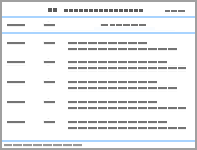
Table 1

Primers used in this study"

引物名称Primer name 引物序列Primer sequence (5′-3′)
VIGS-GhCPR5-F CGGGGTACCGATGTTGATCGGCCTTCTGT
VIGS-GhCPR5-R CGCGGATCCGCAACTCAGCCTGTCCTGT
qRT-GhCPR5-F TCTGTGGTTTGGCTGGGAAGT
qRT-GhCPR5-R GGCATAAGACCGCACAATAAGG
qRT-JAZ1-F AGCCTCAAAAAGGAAGACCTCAAAC
qRT-JAZ1-R TGGCTGCTCAATCACCATAGTAATC
qRT-JAZ3-F TGATTTTGCTCAAGGAGATAACGCT
qRT-JAZ3-R TGATTGCCTACTCGTTGCCTGT
qRT-NPR1-F CTAGCTTGCGGAGGGATTGATACC
qRT-NPR1-R GAGATGGCTGACCTGTCAAACTGC
qRT-PR3-F ACTCCACAATCACCGAAGCCAT
qRT-PR3-R GCATTCCAACCCTTACCACATTC
qRT-PR4-F CAGGAGAAGGAGCGACTGTGA
qRT-PR4-R TCCCACATCCAAATCTAACCC
qRT-PR5-F AAGGAGTCCACCACAATCACCG
qRT-PR5-R CTGGCACTGCTATGGCTCGTAT

Fig. 1

Protein sequence analysis of GhCPR5 in cotton A: Alignment of the amino acids of GhCPR5 with homologous in Arabidopsis thaliana. AT5G64930: AtCPR5, Gh_A02G1287/Gh_D03G0427: GhCPR5 on A and D genomes in upland cotton; CPR5: amplified sequence of GhCPR5. B: Phylogenetic tree of GhCPR5 and CPR5 of other plant species. Dz: Durio zibethinus, XP_022739926, Tc: Theobroma cacao, XP_007048101, Me: Manihot esculenta, XP_021633464, Cs: Camellia sinensis, XP_028102180, At: Arabidopsis thaliana, AT5G64930, Sb: Sorghum bicolor, XP_002454622, Zm: Zea mays, NP_001146273, Os: Oryza sativa, XP_015643035, Vv: Vitis vinifera, XP_002280314, Pt: Populus trichocarpa, XP_006380467, Hs: Hibiscus syriacus, XP_039044948, Gm: Glycine max, XP_006581733. C: Prediction of the transmembrane domains (TMs) of GhCPR5 protein"

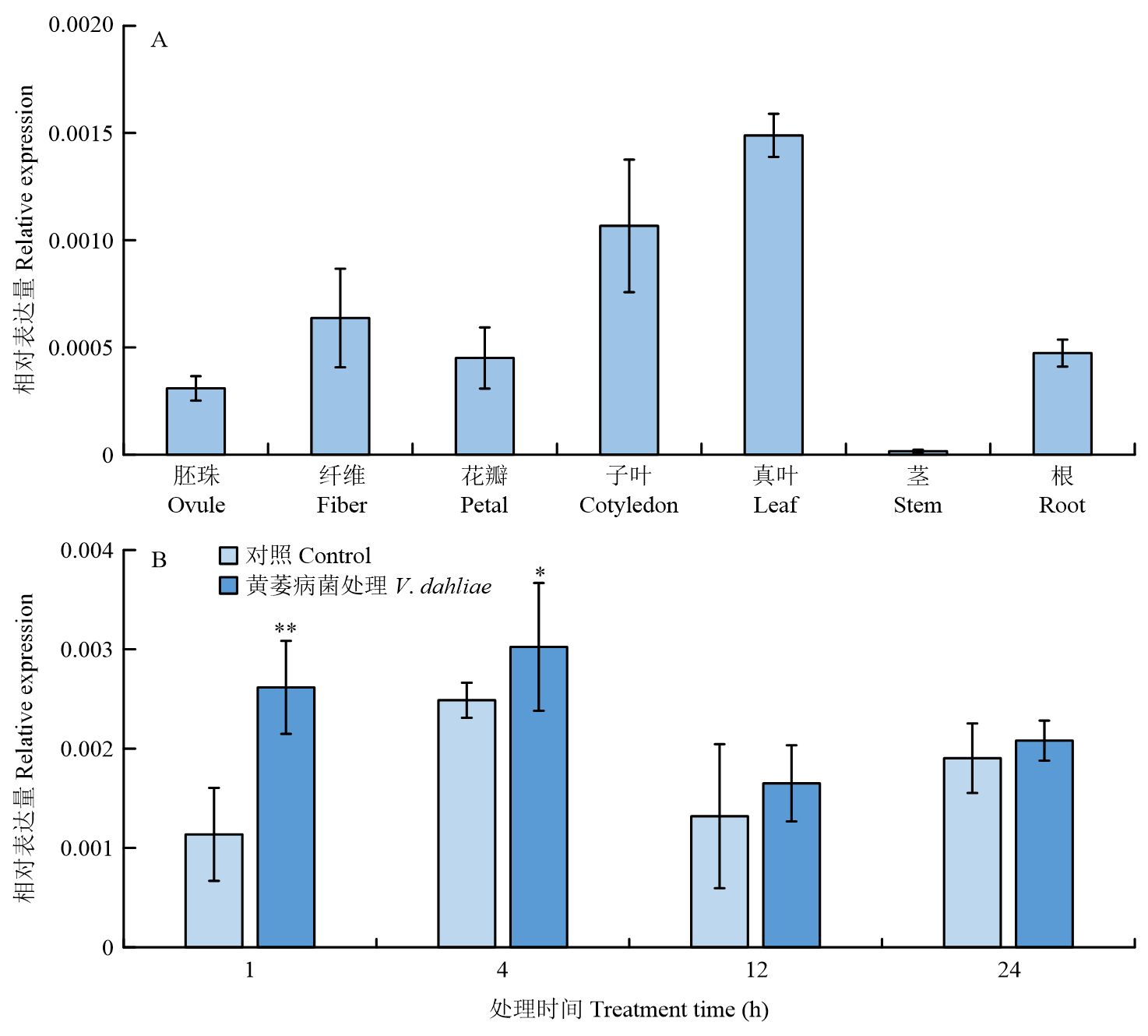
Fig. 2

Expression pattern of GhCPR5 in cotton A: Expression patterns of GhCPR5 in different tissues of cotton; B: The expression level of GhCPR5 after V. dahliae inoculation. * and **: Significant differences and extremely significant differences at P<0.05 and P<0.01. The same as below"

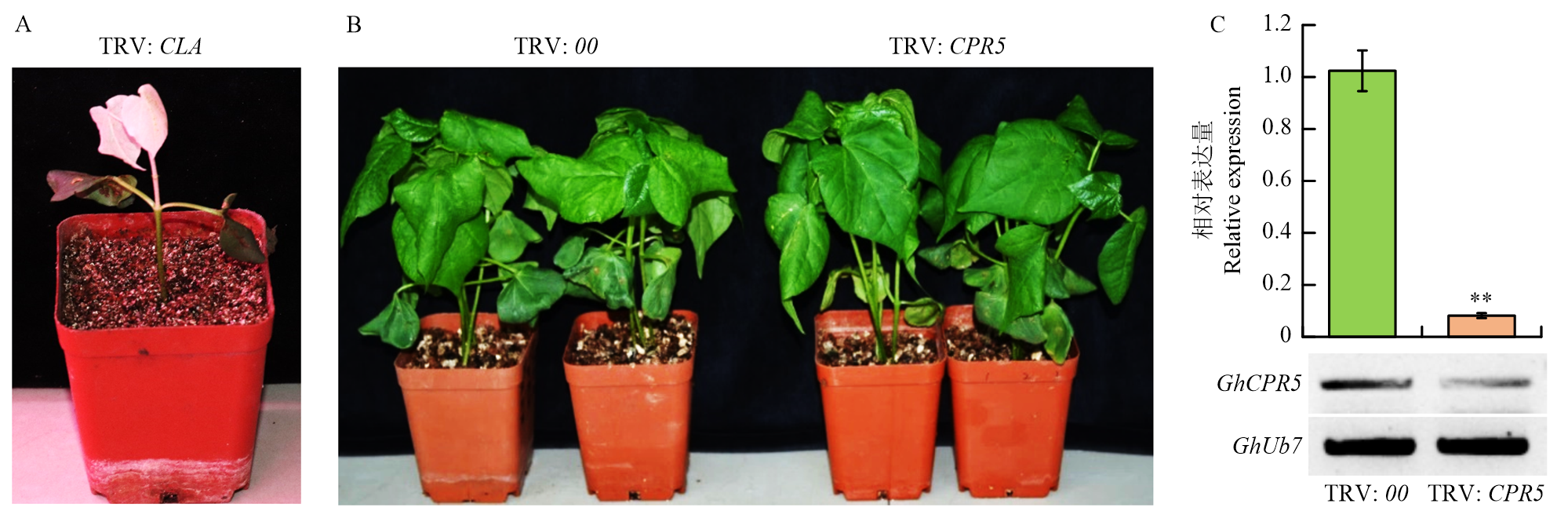
Fig. 3

Creating GhCPR5 silencing plants by VIGS technique in cotton A: Albino phenotype of TRV:CLA plants; B: Phenotypic analysis of control plants TRV:00 and GhCPR5 gene silencing plants TRV:CPR5; C: RT-PCR and qRT-PCR analysis of the silencing efficiency of GhCPR5"

Fig. 4

The analysis disease resistance of TRV:00 and TRV:CPR5 plants A: The disease symptoms of TRV:00 and TRV:CPR5 plants on day 9 after infected by V. dahliae; B: Photos of the cross section of stems of TRV:00 and TRV:CPR5 plants after infected for 9 days by V. dahliae; C: Fungal recovery assays of TRV:00 and TRV:CPR5 plants on day 9 after infected by V. dahliae; D: The calculation of diseased plant percentage of TRV:00 and TRV:CPR5 plants in different days following V. dahliae inoculation; E: Disease index statistics of TRV:00 and TRV:CPR5 plants after V. dahliae inoculation"

Fig. 5

The resistance assay of TRV:00 and TRV:CPR5 leaves to different pathogens A: The lesion expansion of V. dahliae on TRV:00 and TRV:CPR5 leaves at 3 d; B: The calculation of the lesion size on detached leaves of TRV:00 and TRV:CPR5 generated by V. dahliae infection; C: Trypan blue staining of the hyphae and dead cells on TRV:00 and TRV:CPR5 leaves after inoculation of V. dahliae; D: Phenotypic analysis of TRV:00 and TRV:CPR5 detached leaves after inoculation with B. cinerea; E: The calculation of lesion size on TRV:00 and TRV:CPR5 detached leaves after inoculation with B. cinerea for 4 d; F: Trypan blue staining of the hyphae and dead cells on TRV:00 and TRV:CPR5 leaves after inoculation of B. cinerea"

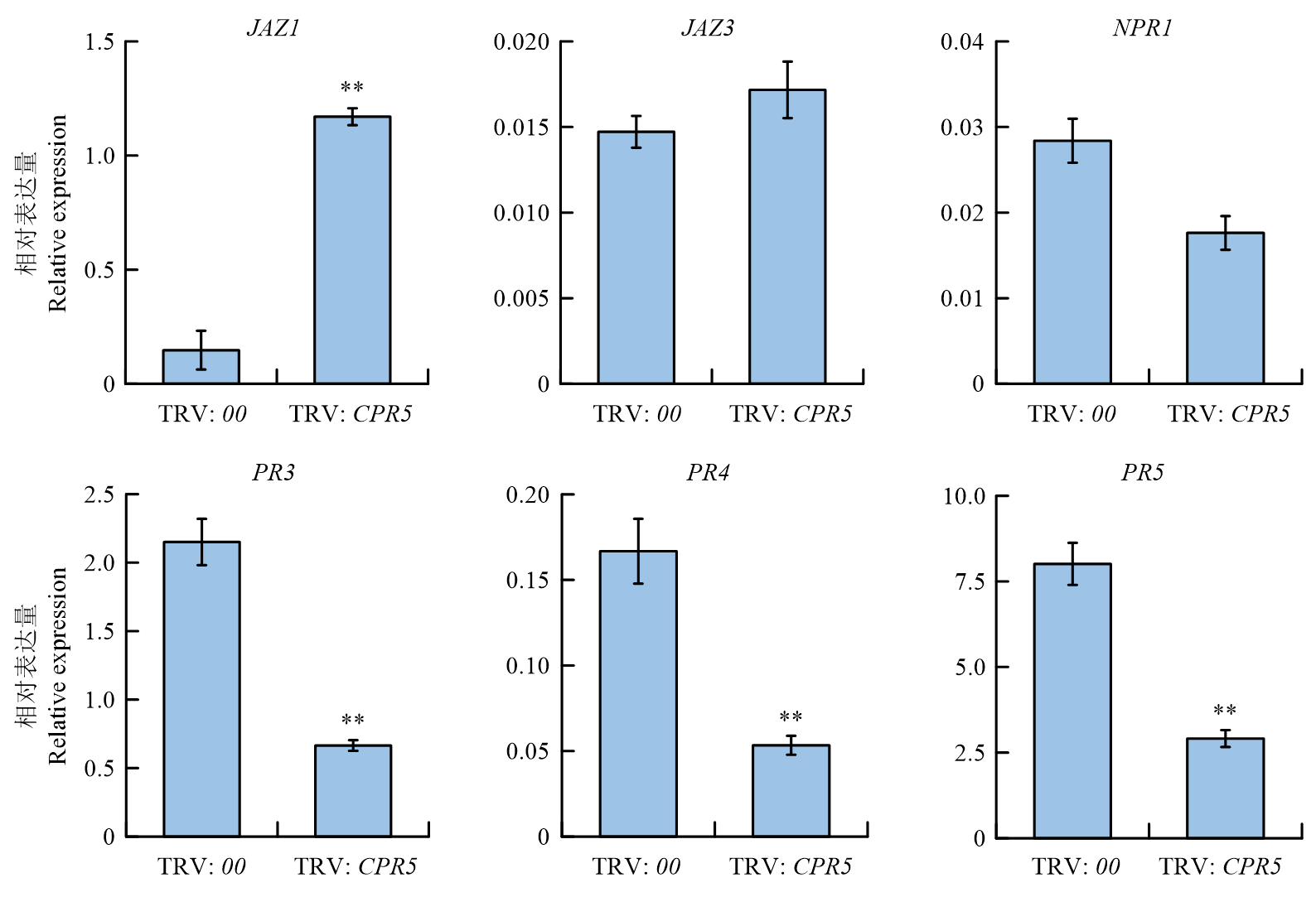
Fig. 6

Expression analyze of defense-related genes in TRV:00 and TRV:CPR5 plants by qRT-PCR"

[1]
SHABAN M, MIAO Y H, ULLAH A, KHAN A Q, MENGHWAR H, KHAN A H, AHMED M M, TABASSUM M A, ZHU L F. Physiological and molecular mechanism of defense in cotton against Verticillium dahliae. Plant Physiology and Biochemistry, 2018, 125: 193-204.

doi: 10.1016/j.plaphy.2018.02.011
[2]
ZHANG J, HU H L, WANG X N, YANG Y H, ZHANG C J, ZHU H Q, SHI L, TANG C M, ZHAO M W. Dynamic infection of Verticillium dahliae in upland cotton. Plant Biology, 2020, 22(1): 90-105.

doi: 10.1111/plb.v22.1
[3]
LUO X M, XIE C J, DONG J Y, YANG X Y, SUI A P. Interactions between Verticillium dahliae and its host: Vegetative growth, pathogenicity, plant immunity. Applied Microbiology and Biotechnology, 2014, 98(16): 6921-6932.

doi: 10.1007/s00253-014-5863-8
[4]
ZHANG X Y, CHENG W H, FENG Z D, ZHU Q H, SUN Y Q, LI Y J, SUN J. Transcriptomic analysis of gene expression of Verticillium dahliae upon treatment of the cotton root exudates. BMC Genomics, 2020, 21(1): 155.

doi: 10.1186/s12864-020-6448-9
[5]
XU L, ZHU L F, TU L L, LIU L L, YUAN D J, JIN L, LONG L, ZHANG X L. Lignin metabolism has a central role in the resistance of cotton to the wilt fungus Verticillium dahliae as revealed by RNA-Seq-dependent transcriptional analysis and histochemistry. Journal of Experimental Botany, 2011, 62(15): 5607-5621.

doi: 10.1093/jxb/err245 pmid: 21862479
[6]
GAO W, LONG L, ZHU L F, XU L, GAO W H, SUN L Q, LIU L L, ZHANG X L. Proteomic and virus-induced gene silencing (VIGS) analyses reveal that gossypol, brassinosteroids, and jasmonic acid contribute to the resistance of cotton to Verticillium dahliae. Molecular & Cellular Proteomics, 2013, 12(12): 3690-3703.

doi: 10.1074/mcp.M113.031013
[7]
HU Q, MIN L, YANG X Y, JIN S X, ZHANG L, LI Y Y, MA Y Z, QI X W, LI D Q, LIU H B, LINDSEY K, ZHU L F, ZHANG X L. Laccase GhLac1 modulates broad spectrum biotic stress tolerance via manipulating phenylpropanoid pathway and jasmonic acid synthesis. Plant Physiology, 2018, 176(2): 1808-1823.

doi: 10.1104/pp.17.01628
[8]
ZHANG Y, WU L Z, WANG X F, CHEN B, ZHAO J, CUI J, LI Z K, YANG J, WU L Q, WU J H, ZHANG G Y, MA Z Y. The cotton laccase gene GhLAC15 enhances Verticillium wilt resistance via an increase in defence induced lignification and lignin components in the cell walls of plants. Molecular Plant Pathology, 2019, 20(3): 309-322.

doi: 10.1111/mpp.2019.20.issue-3
[9]
MA Q, WANG N H, MA L, LU J H, WANG H T, WANG C C, YU S X, WEI H L. The cotton BEL1-like transcription factor GhBLH7-D06 negatively regulates the defense response against Verticillium dahliae. International Journal of Molecular Sciences, 2020, 21(19): 7126.

doi: 10.3390/ijms21197126
[10]
XIAO S H, HU Q, SHEN J L, LIU S M, YANG Z G, CHEN K, KLOSTERMAN S J, JAVORNIK B, ZHANG X L, ZHU L F. GhMYB4 downregulates lignin biosynthesis and enhances cotton resistance to Verticillium dahliae. Plant Cell Reports, 2021, 40(4): 735-751.

doi: 10.1007/s00299-021-02672-x
[11]
HU Q, XIAO S H, WANG X R, AO C W, ZHANG X L, ZHU L F. GhWRKY1-like enhances cotton resistance to Verticillium dahliae via an increase in defense induced lignification and S monolignol content. Plant Science, 2021, 305: 110833.

doi: 10.1016/j.plantsci.2021.110833
[12]
SONG Y, LIU L L, WANG Y D, VALKENBURG D J, ZHANG X L, ZHU L F, THOMMA B P H J. Transfer of tomato immune receptor Ve1 confers Ave1 dependent Verticillium resistance in tobacco and cotton. Plant Biotechnology Journal, 2018, 16(2): 638-648.

doi: 10.1111/pbi.2018.16.issue-2
[13]
SONG R R, LI J P, XIE C J, JIAN W, YANG X Y. An overview of the molecular genetics of plant resistance to the Verticillium wilt pathogen Verticillium dahliae. International Journal of Molecular Sciences, 2020, 21(3): 1120.

doi: 10.3390/ijms21031120
[14]
SHABAN M, KHAN A H, NOOR E, MALIK W, ALI H M W, SHEHZAD M, AKRAM U, QAYYUM A. A 13-lipoxygenase, GhLOX2, positively regulates cotton tolerance against Verticillium dahliae through JA-mediated pathway. Gene, 2021, 796/797: 145797.

doi: 10.1016/j.gene.2021.145797
[15]
LIU S C, SUN R B, ZHANG X J, FENG Z L, WEI F, ZHAO L H, ZHANG Y L, ZHU L F, FENG H J, ZHU H Q. Genome wide analysis of OPR family genes in cotton identified a role for GhOPR9 in Verticillium dahliae resistance. Genes, 2020, 11(10): 1134.

doi: 10.3390/genes11101134
[16]
WANG G N, WANG X F, ZHANG Y, YANG J, LI Z K, WU L Z, WU J H, WU N, LIU L X, LIU Z W, ZHANG M, WU L Q, ZHANG G Y, MA Z Y. Dynamic characteristics and functional analysis provide new insights into long non-coding RNA responsive to Verticillium dahliae infection in Gossypium hirsutum. BMC Plant Biology, 2021, 21(1): 68.

doi: 10.1186/s12870-021-02835-8
[17]
LONG L, XU F C, ZHAO J R, LI B, XU L, GAO W. GbMPK3 overexpression increases cotton sensitivity to Verticillium dahliae by regulating salicylic acid signaling. Plant Science, 2020, 292: 110374.

doi: 10.1016/j.plantsci.2019.110374
[18]
YOSHIDA S, ITO M, NISHIDA I, WATANABE A. Identification of a novel gene HYS1/CPR5 that has a repressive role in the induction of leaf senescence and pathogen-defence responses in Arabidopsis thaliana. The Plant Journal, 2002, 29(4): 427-437.

doi: 10.1046/j.0960-7412.2001.01228.x
[19]
VAN D J. CPR5 modulates plant immunity via RNA processing. The Plant Cell, 2022, 34(5): 1437-1438.

doi: 10.1093/plcell/koac060 pmid: 35226104
[20]
BOWLING S A, CLARKE J D, LIU Y, KLESSIG D F, DONG X. The cpr5 mutant of Arabidopsis expresses both NPR1-dependent and NPR1-independent resistance. The Plant Cell, 1997, 9(9): 1573-1584.
[21]
BOCH J, VERBSKY M L, ROBERTSON T L, LARKIN J C, KUNKEL B N. Analysis of resistance gene-mediated defense responses in Arabidopsis thaliana plants carrying a mutation in CPR5. Molecular Plant-Microbe Interactions, 1998, 11(12): 1196-1206.

doi: 10.1094/MPMI.1998.11.12.1196
[22]
JING H C, ANDERSON L, STURRE M J G, HILLE J, DIJKWEL P P. Arabidopsis CPR5 is a senescence-regulatory gene with pleiotropic functions as predicted by the evolutionary theory of senescence. Journal of Experimental Botany, 2007, 58(14): 3885-3894.

doi: 10.1093/jxb/erm237
[23]
GAO G L, ZHANG S C, WANG C F, YANG X, WANG Y Q, SU X J, DU J J, YANG C W. Arabidopsis CPR5 independently regulates seed germination and postgermination arrest of development through LOX pathway and ABA signaling. PLoS ONE, 2011, 6(4): e19406.

doi: 10.1371/journal.pone.0019406
[24]
MENG Z, RUBERTI C, GONG Z Z, BRANDIZZI F. CPR5 modulates salicylic acid and the unfolded protein response to manage tradeoffs between plant growth and stress responses. The Plant Journal, 2017, 89(3): 486-501.

doi: 10.1111/tpj.13397 pmid: 27747970
[25]
PENG S, GUO D B, GUO Y, ZHAO H Y, MEI J, HAN Y K, GUAN R, WANG T H, SONG T, SUN K K, LIU Y H, MAO T, CHANG H, XUE J S, CAI Y F, CHEN D, WANG S. Constitutive expresser of pathogenesis-related genes 5 is an RNA-binding protein controlling plant immunity via an RNA processing complex. The Plant Cell, 2022, 34(5): 1724-1744.

doi: 10.1093/plcell/koac037 pmid: 35137215
[26]
CHEN J C, SUI X Y, MA B R, LI Y T, LI N, QIAO L F, YU Y C, DONG C H. Arabidopsis CPR5 plays a role in regulating nucleocytoplasmic transport of mRNAs in ethylene signaling pathway. Plant Cell Reports, 2022, 41(4): 1075-1085.

doi: 10.1007/s00299-022-02838-1 pmid: 35201411
[27]
WANG H, UMER M J, LIU F, CAI X Y, ZHENG J, XU Y C, HOU Y Q, ZHOU Z L. Genome-wide identification and characterization of CPR5 genes in Gossypium reveals their potential role in trichome development. Frontiers in Genetics, 2022, 13: 921096.

doi: 10.3389/fgene.2022.921096
[28]
TAMURA K, STECHER G, PETERSON D, FILIPSKI A, KUMAR S. MEGA6: Molecular evolutionary genetics analysis version 6.0. Molecular Biology and Evolution, 2013, 30(12): 2725-2729.

doi: 10.1093/molbev/mst197 pmid: 24132122
[29]
LONG L, LIU J, GAO Y, XU F C, ZHAO J R, LI B, GAO W. Flavonoid accumulation in spontaneous cotton mutant results in red coloration and enhanced disease resistance. Plant Physiology and Biochemistry, 2019, 143: 40-49.

doi: S0981-9428(19)30327-4 pmid: 31479881
[30]
FRADIN E F, ZHANG Z, JUAREZ AYALA J C, CASTROVERDE C D M, NAZAR R N, ROBB J, LIU C M, THOMMA B P H J. Genetic dissection of Verticillium wilt resistance mediated by tomato Ve1. Plant Physiology, 2009, 150(1): 320-332.

doi: 10.1104/pp.109.136762
[31]
GAO W, LONG L, XU L, LINDSEY K, ZHANG X L, ZHU L F. Suppression of the homeobox gene HDTF1 enhances resistance to Verticillium dahliae and Botrytis cinerea in cotton. Journal of Integrative Plant Biology, 2016, 58(5): 503-513.

doi: 10.1111/jipb.v58.5
[32]
KIRIK V, BOUYER D, SCHÖBINGER U, BECHTOLD N, HERZOG M, BONNEVILLE J M, HÜLSKAMP M. CPR5 is involved in cell proliferation and cell death control and encodes a novel transmembrane protein. Current Biology, 2001, 11(23): 1891-1895.

pmid: 11728314
[33]
刘锋, 舒曦, 郑艳华, 黎梓君, 阳成伟, 王亚琴. 水稻CPR5基因参与氧化胁迫响应. 热带亚热带植物学报, 2013, 21(4): 305-314.
LIU F, SHU X, ZHENG Y H, LI Z J, YANG C W, WANG Y Q. Involvement of rice CPR5 in response to oxidative stress. Journal of Tropical and Subtropical Botany, 2013, 21(4): 305-314. (in Chinese)
[34]
MA M M, LI M, ZHOU R F, YU J B, WU Y, ZHANG X L, WANG J L, ZHOU J M, LIANG X X. CPR5 positively regulates pattern- triggered immunity via a mediator protein. Journal of Integrative Plant Biology, 2023, 65(7): 1613-1619.

doi: 10.1111/jipb.v65.7
[35]
WANG Y, MOSTAFA S, ZENG W, JIN B. Function and mechanism of jasmonic acid in plant responses to abiotic and biotic stresses. International Journal of Molecular Sciences, 2021, 22(16): 8568.

doi: 10.3390/ijms22168568
[36]
AMEYE M, AUDENAERT K, DE ZUTTER N, STEPPE K, VAN MEULEBROEK L, VANHAECKE L, DE VLEESSCHAUWER D, HAESAERT G, SMAGGHE G. Priming of wheat with the green leaf volatile Z-3-hexenyl acetate enhances defense against Fusarium graminearum but boosts deoxynivalenol production. Plant Physiology, 2015, 167(4): 1671-1684.

doi: 10.1104/pp.15.00107
[37]
LIU D, ZHAO Q, CUI X, CHEN R, LI X, QIU B, GE F. A transcriptome analysis uncovers Panax notoginseng resistance to Fusarium solani induced by methyl jasmonate. Genes Genomics, 2019, 41(12): 1383-1396.

doi: 10.1007/s13258-019-00865-z
[38]
HE X, ZHU L F, WASSAN G M, WANG Y J, MIAO Y H, SHABAN M, HU H Y, SUN H, ZHANG X L. GhJAZ2 attenuates cotton resistance to biotic stresses via the inhibition of the transcriptional activity of GhbHLH171. Molecular Plant Pathology, 2018, 19(4): 896-908.

doi: 10.1111/mpp.12575 pmid: 28665036
[1] LI YuanJing, YUAN RuiXiang, LI YongTai, SUN TianGe, LIU Feng, LI YanJun, ZHANG XinYu. Identification and Functional Characterization of β-Glucosidase Genes in Verticillium dahliae for Pathogenicity on Cotton [J]. Scientia Agricultura Sinica, 2026, 59(7): 1380-1399.
[2] WANG JiaNuo, CHEN GuiPing, LI Pan, WANG LiPing, NAN YunYou, HE Wei, FAN ZhiLong, HU FaLong, CHAI Qiang, YIN Wen, ZHAO LiaoHao. Photo-Physiological Mechanism at Grain Filling Stage of No-Tillage with Plastic Re-Mulching to Increase Maize Yield in Oasis Irrigation Areas [J]. Scientia Agricultura Sinica, 2026, 59(6): 1189-1202.
[3] CUI ShiYou, CHEN PengJun, MIAO YuanQing, HAN JiJun, SHEN JunMing. Development and Field Evaluation of Glyphosate-Resistant Wheat Germplasm Generated Through EMS Mutagenesis [J]. Scientia Agricultura Sinica, 2026, 59(4): 723-733.
[4] YAN TingLin, DU YaDan, HU XiaoTao, WANG He, LI XiaoYan, WANG YuMing, NIU WenQuan, GU XiaoBo. The Impacts of Nitrogen Fertilizer Organic Alternatives Under Aerated Drip Irrigation on Cotton Yield and Water Use Efficiency Under Deficit Irrigation Conditions [J]. Scientia Agricultura Sinica, 2026, 59(3): 602-618.
[5] LIAO TingLu, SHI YaFei, XIAO DongHao, SHE YangMengFei, GUO FuCheng, YANG JiuJu, TANG HaiJiang, LUO ChengKe. The Effect of Exogenous Nitroprusside on Sugar Metabolism in Rice Seedlings Under Alkaline Stress [J]. Scientia Agricultura Sinica, 2026, 59(2): 265-277.
[6] GUO ChenLi, LIU Yang, CHEN Yan, HU Wei, WANG YouHua, ZHOU ZhiGuo, ZHAO WenQing. Effects of Phosphorus Fertilizer Postpone Under Nitrogen Reduction Condition on Yield, Phosphorus Fertilizer Utilization Efficiency of Drip-Irrigated Cotton [J]. Scientia Agricultura Sinica, 2025, 58(9): 1749-1766.
[7] WANG WeiMeng, WEI YunXiao, TANG YunNi, LIU MiaoMiao, CHEN QuanJia, DENG XiaoJuan, ZHANG Rui. Establishment and Rooting Optimization of Agrobacterium rhizogenes Transformation System in Cotton [J]. Scientia Agricultura Sinica, 2025, 58(8): 1479-1493.
[8] ZHAO YuXuan, MIAO JiYuan, HU Wei, ZHOU ZhiGuo. Effects of Low Temperature at Seedling Stage on Cotton Floral Bud Differentiation and Cotton Plant Yield [J]. Scientia Agricultura Sinica, 2025, 58(7): 1311-1320.
[9] TIAN LiWen, LOU ShanWei, ZHANG PengZhong, DU MingWei, LUO HongHai, LI Jie, PAHATI MaiMaiTi, MA TengFei, ZHANG LiZhen. Analysis of Problems and Pathways for Increasing Cotton Yield per Unit Area in Xinjiang Under Green and Efficient Production Mode [J]. Scientia Agricultura Sinica, 2025, 58(6): 1102-1115.
[10] ZHANG TianYu, LI Bai, ZANG JinPing, CAO HongZhe, DONG JinGao, XING JiHong, ZHANG Kang. Genome-Wide Identification and Expression Analysis of HMG Family Genes in Botrytis cinerea [J]. Scientia Agricultura Sinica, 2025, 58(4): 704-718.
[11] ZHANG LinLin, GONG Rui, CUI YanLing, ZHONG XiongHui, LI Ye, LI RanHong, QIAN ZongWei. Effect Analysis of SmWRKY30 in Eggplant Resistance to Ralstonia solanacearum by Virus Induced Gene Silencing (VIGS) [J]. Scientia Agricultura Sinica, 2025, 58(3): 548-563.
[12] ZHANG XiangKun, LI JiaYing, QIAO RuMeng, HE JingLei, WANG Li, SHI XiaoXin, DU GuoQiang. Effects of GFabV Under Different Zn Levels on Photosynthetic Efficiency and Photosynthesis-Related Gene Expression of ‘Shine Muscat’ Grapevine [J]. Scientia Agricultura Sinica, 2025, 58(24): 5190-5200.
[13] WANG LiYuan, WANG Hui, WANG MuMu, WANG DongJian, LI RuYu, ZHENG YongSheng, ZHANG Han. Construction and Application of DNA Fingerprint Database for Known Varieties in Upland Cotton DUS Testing [J]. Scientia Agricultura Sinica, 2025, 58(22): 4570-4588.
[14] DING Ning, QI EnFang, JIA XiaoXia, HUANG Wei, MA LiRong, LI JianWu, YAN RuNan. Screening and Identification of miRNAs in Potato Seedlings in Response to High Temperature Stress [J]. Scientia Agricultura Sinica, 2025, 58(22): 4589-4602.
[15] ZHANG Jie, HU ChenXi, QI JianBo, ZHANG YongTai, CHEN YiBo, ZHANG YongJi. Effects of Exogenous Zeatin on Photosynthetic Parameter, Antioxidant System and Expression of Genes Related to Zeatin Synthesis in Pepper Under Low-Temperature Combined with Low-Light Stress [J]. Scientia Agricultura Sinica, 2025, 58(19): 3959-3969.
Viewed
Full text


Abstract

Cited

  Shared   
  Discussed   
No Suggested Reading articles found!