Scientia Agricultura Sinica ›› 2026, Vol. 59 ›› Issue (13): 2776-2788.doi: 10.3864/j.issn.0578-1752.2026.13.002

• CROP GENETICS & BREEDING·GERMPLASM RESOURCES·MOLECULAR GENETICS • Previous Articles     Next Articles

Development and Application of InDel Marker Detection Technology for Field Identification of Maize Inbred Lines

WANG Rui1(), HU LiPing1(), ZHAO Wei1, LIU ZhiHao1, ZHANG MingQi1, QING XiangYu1, XU LiWen1, HUO YongXue1, GE JianRong1, TIAN HongLi1, YI HongMei1, LIU YaWei1, JIANG Bin2, WU MingSheng3, KUANG Meng4, WANG FengGe1()   

  1. 1 Maize Research Institute, Beijing Academy of Agriculture and Forestry Sciences/Key Laboratory for Innovative Application of Crop DNA Fingerprinting, Ministry of Agriculture and Rural Affairs (Jointly Established by the Ministry and the Province)/Beijing Key Laboratory of Maize DNA Fingerprinting and Molecular Breeding, Beijing 100097
    2 Shenzhen Weixing Software Co., Ltd., Shenzhen 518000, Guangdong
    3 Beijing Seed Management Station, Beijing 100044
    4 National Nanfan Research Institute (Sanya), Chinese Academy of Agricultural Sciences, Sanya 572024, Hainan
  • Received:2025-11-24 Accepted:2026-02-20 Online:2026-07-01 Published:2026-07-01
  • Contact: WANG FengGe

Abstract:

【Objective】Variety identification is vital for the security of agricultural production and integrity of seed markets. Current molecular approaches for identification of crop varieties predominantly require specialized laboratory equipment, resulting in relatively slow turnaround times and high costs. The Maize Point-of-Genuineness (M-POG) identification kit aims to extend variety identification from the laboratory to the field, address the lack of rapid on-site detection methods, and support the establishment of a rapid, efficient, and traceable molecular detection system for the modern seed industry. 【Method】Candidate InDel loci from the MaizeIDP50K chip were screened using a stepwise dichotomous partitioning method in combination with a dynamic optimization algorithm. Nine maize elite inbred lines and three closely related maize varieties were used to design dominant and co-dominant primers, which were evaluated by conducting quantitative real-time PCR and fluorescence capillary electrophoresis. An optimal combination algorithm was used to screen and determine the core set of loci. Based on the cycle threshold (Ct) value for the dominant primer for the core markers, a barcode conversion mechanism suitable for field detection was established. The detection thresholds were set using the core loci fingerprints of 2 270 maize inbred lines. The consistency and single sample detection efficiency were evaluated by comparison with the traditional method for variety identification using simple sequence repeat (SSR) markers, thereby verifying the accuracy and practicability of the M-POG method. 【Result】Eighty InDel candidate loci from the chip were screened for which 76 pairs of dominant primers were designed. Among these loci, 31 high quality loci showed clear qPCR amplification curves, high repeatability, and uniform amplification efficiency. Ultimately, 16 highly discriminative core loci were identified, achieving a variety recognition rate of 95.83% across the 2 270 inbred lines. The fingerprint detection threshold for each locus was calculated; loci with Ct<28 were classified as dominant type (coded as 1), and those with Ct>30 were classified as recessive type (coded as 0), enabling generation of a DNA fingerprinting for M-POG detection. Pairwise comparisons among the 2 270 inbred lines revealed that 98.29% of the pairs of lines differed at four or more loci. A comparative analysis between the M-POG method and the SSR molecular marker method, conducted using elite inbred lines and closely related varieties, showed that the samples were consistently discriminated by both methods in 90.91% of the comparisons. This result demonstrated the reliability of the M-POG method. Thus, the M-POG approach enables efficient screening of genetically dissimilar inbred lines, thereby substantially reducing the number of samples requiring further laboratory analysis. The complete field detection process required only 42 min, approximately one-quarter of the time required by standard identification procedures. 【Conclusion】Sixteen core InDel loci were selected for the M-POG method, achieving a variety recognition rate exceeding 95%. Based on the InDel on-site detection results, the minimum number of differential loci required for variety discrimination was determined. Development of the M-POG kit enables rapid and accurate identification of maize inbred lines in the field.

Key words: variety identification, maize, InDel marker, field test, nucleic acid detection technology, quantitative real-time PCR

Fig. 1

Characterization of M-POG candidate loci A: Distribution of candidate loci on maize chromosomes; B: the proportion of different variant sizes of the candidate loci; C: the MAF distribution of candidate loci"

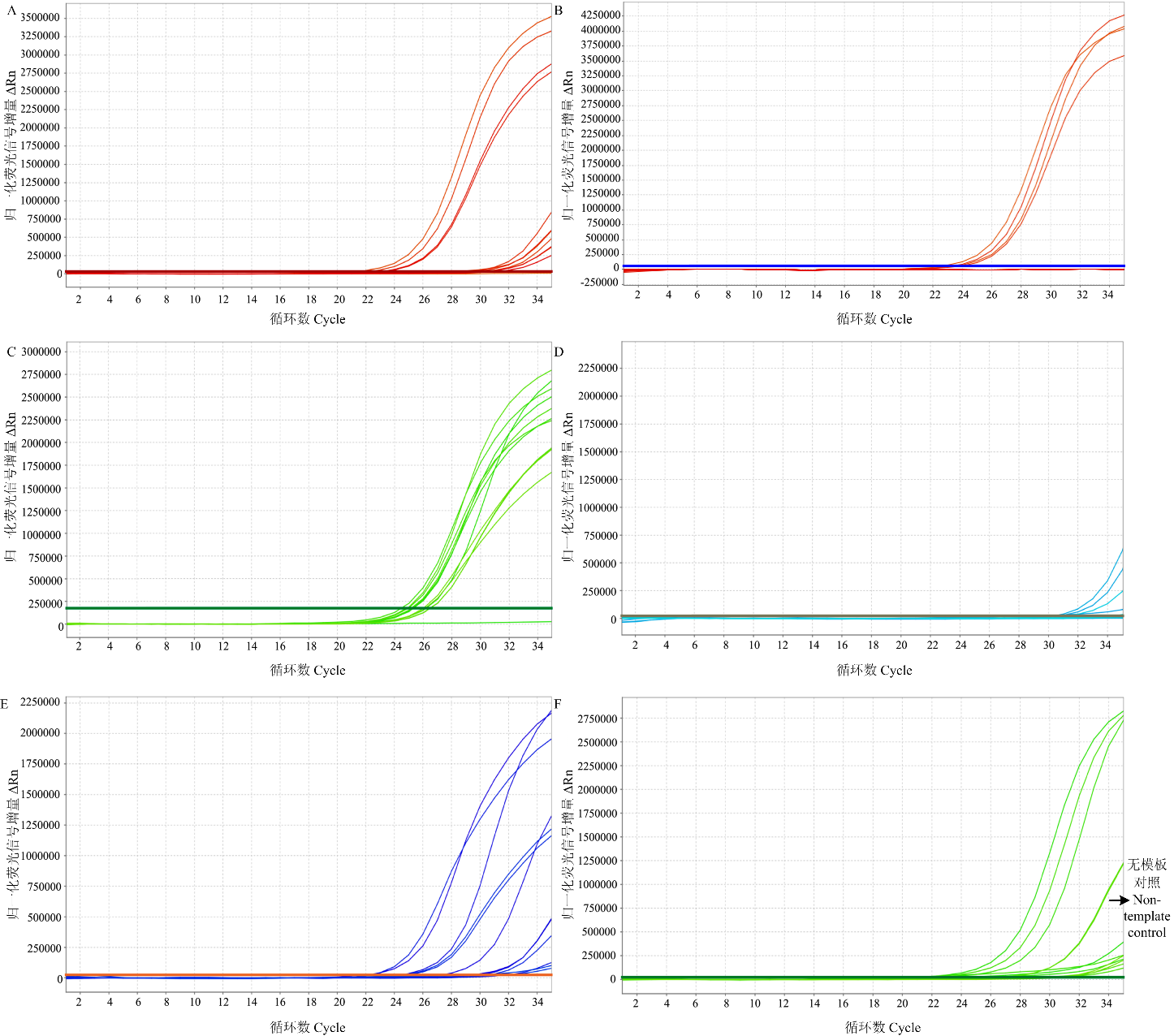
Fig. 2

Amplification results of dominant primers A, B: Working dominant primers showing clear discrimination between dominant and recessive amplicons; C: Failed design, no recessive amplicon; D: Failed design, no dominant amplicon; E: Failed design, poor discrimination between dominant and recessive amplicons; F: Failed design, fluorescence in no-template control (NTC) due to primer-dimer formation"

Table 1

Statistics on the amplification results of co-dominant and dominant primers"

样品
Sample
C-KT12 C-KT16 C-KT20
共显性-
等位基因
Co-dominant alleles
显性-Ct值
Dominant-Ct value
现场检测DNA指纹
On-site DNA fingerprinting
共显性-
等位基因
Co-dominant alleles
显性-Ct值
Dominant-Ct value
现场检测
DNA指纹
On-site DNA fingerprinting
共显性-
等位基因
Co-dominant alleles
显性-Ct值
Dominant-Ct value
现场检测
DNA指纹
On-site DNA fingerprinting
京92
Jing92
334/334 35.0 0 154/154 24.5 1 257/257 24.6 1
京724
Jing724
334/334 35.0 0 154/154 24.1 1 253/253 35.0 0
LX9801 338/338 24.7 1 154/154 24.9 1 257/257 25.4 1
黄早四
HuangZaoSi
338/338 25.1 1 146/146 32.2 0 257/257 25.6 1
郑58
Zheng58
338/338 23.2 1 154/154 24.3 1 257/257 24.6 1
综3
Zong3
338/338 24.4 1 154/154 24.8 1 253/253 35.0 0
齐319
Qi319
338/338 24.3 1 154/154 25.3 1 253/253 33.1 0
掖478
Ye478
338/338 22.7 1 146/146 32.5 0 257/257 23.5 1
昌7-2
Chang7-2
334/334 35.0 0 154/154 24.5 1 257/257 24.1 1
样品A
Sample A
338/338 24.6 1 154/154 24.2 1 257/257 24.3 1
样品B
Sample B
338/338 23.7 1 146/146 33.1 0 257/257 24.5 1
样品C
Sample C
338/338 24.1 1 154/154 23.9 1 253/253 34.7 0

Table 2

Information table for M-POG core loci"

引物编号
Primer number
位点名称
Name of the loci
染色体
Chr.
染色体位置
Chromosome position (bp)
InDel变异
InDel variation
MAF 引物序列
Primer sequence (5′-3′)
KT01 YJ02939 1 278976599 -/CGCG 0.49 F:CCTTGCTTCCGTGCCGCGCG
R:CCGCTTTCCTTTAATTTGTCAGGAT
KT02 YJ45925 2 24653642 -/ATGA 0.44 F:TTCAAATGTGGTGACCCACCCATGA
R:GACCAAACACGCTTAATCTAGAAGT
KT03 YJ08646 2 88426353 -/AGAAACAGTC 0.49 F:CACATTAAGTATGCTGACTGTTTCT
R:GAAGATCTTGAGACACTGCAAA
KT04 YJ09625 3 172717920 -/ACACAACT 0.45 F:TAGTGCAGTTCCACCTTTCATCTTGTGTAAGTTGT
R:AGTGTAAAATCTAGAGCCCACTACT
KT05 YJ12830 3 124035057 -/TTG 0.49 F:TAGCCTAACATTGTGGCGATTCAA
R:CCGTAATTCCTTAAAAACGTACCCA
KT06 YJ13716 4 192970579 -/AGTTAG 0.49 F:TGAGCAGCATTATTGCACTCTAACT
R:CATTATCAAGGGTTTCTACAGGGGA
KT07 YJ61195 5 14612889 -/TGAC 0.42 F:CTTTGGATCAGTCATAGGGGTCA
R:AGAAAAGTGAACATGGAGAGTGC
KT08 YJ61195 5 15209041 -/TTGATG 0.49 F:TGAAGCGAGAGGATCAACATCAA
R:CTCTTTCTGGTTTTAAAGACGTGCT
KT09 YJ64216 6 159829453 -/ACAGT 0.43 F:GGGTCTTGGATCGTAATGTACTGT
R:CTCCCAGCTAGCTCCATTGG
KT10 YJ21432 6 3240073 -/TTG 0.40 F:CACACCAGCGTGACAACCAA
R:CTTCCTCAACCAATTCCACACTTAT
KT11 YJ22927 6 138858575 -/AAT 0.49 F:AGTATATGTAGGGGGAATCCACTTATT
R:GTGTAATCGTATAGACATCGACCCA
KT12 YJ22725 6 132187454 -/ATGCACTG 0.49 F:GAGCTTGCCGTGCATCAGTG
R:GGCATAGGAGAGTGTACATAGCTAG
KT13 YJ25969 7 151285049 -/CGGAG 0.45 F:CTAAACCATGGAATCGGAGGCTC
R:TAGTCAAAAAGGACGACAGCATG
KT14 YJ29113 8 159528845 -/TTGCTTG 0.43 F:GAATGAAGCCGCTAAACCAAGCAA
R:AAGTAGAGAACAAACACTAGAGGGG
KT15 YJ31022 9 113082501 -/TGT 0.48 F:CTACGAAGCTGAATGTCAACAACA
R:ATGGAGTAGTGTTCGATCCATCG
KT16 YJ34143 10 145370739 -/ATA 0.49 F:AGGTAGGACTGGAGGTTCAAATTAT
R:GGCAAACATGCATAGATCTGATGAA

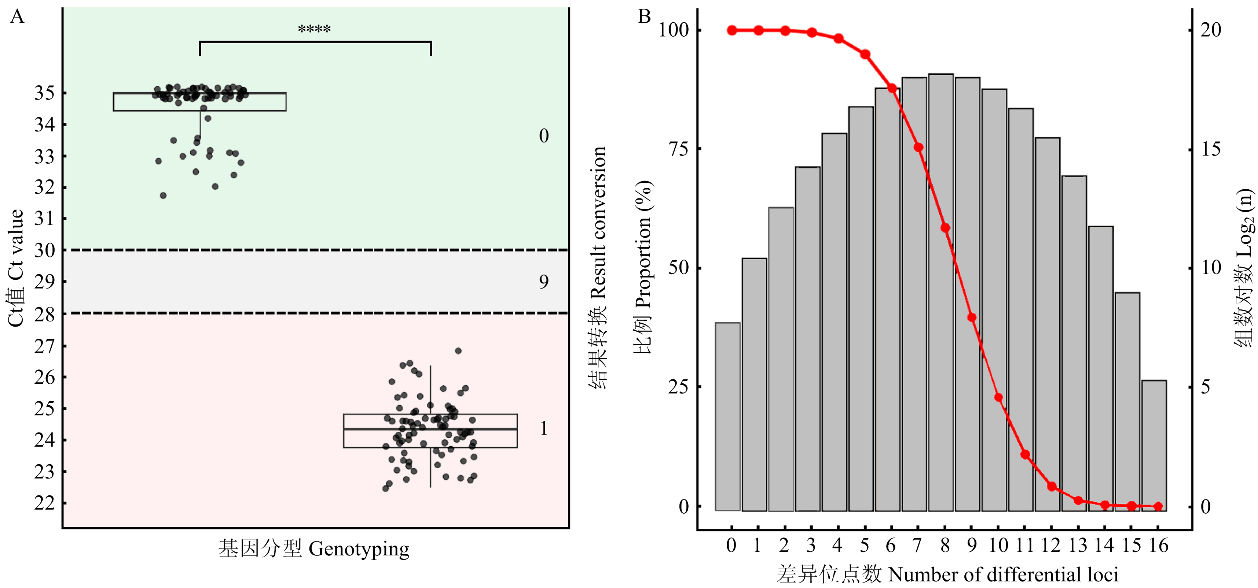
Fig. 3

Conversion rules for M-POG barcodes and establishment of judgment thresholds A: Ct-based conversion of core primer results; B: pairwise comparison of differential core loci among 1 886 inbred lines. ****: Significant difference at P<0.001 level"

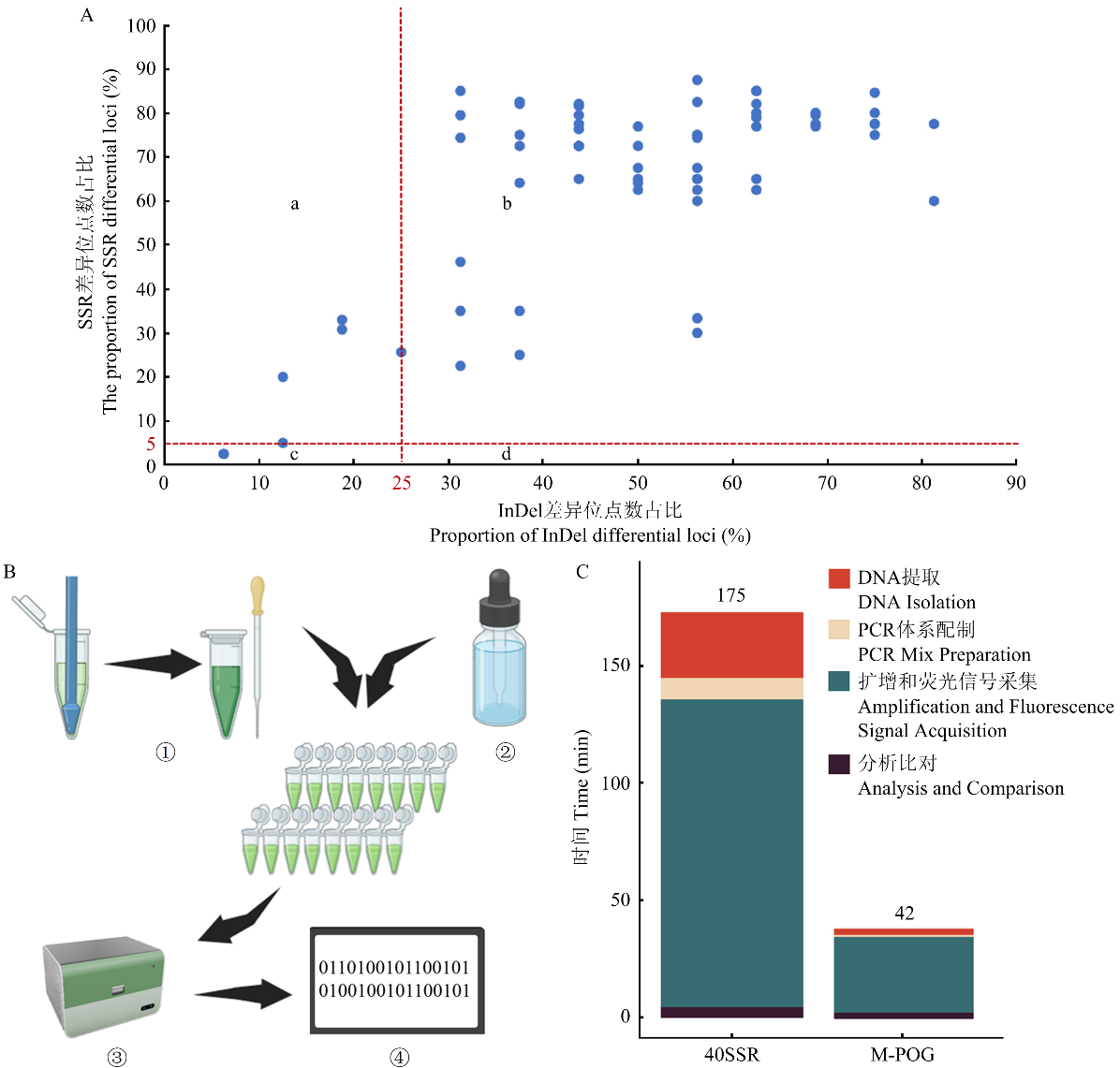
Fig. 4

Comparison of the M-POG kit and the standard method: results, workflow and time efficiency A: Percentage of differential loci in pairwise comparisons of 12 inbred lines using M-POG versus 40 SSR loci; B: Identification process of M-POG Kit: ① DNA extraction, ② PCR mixture preparation, ③ qPCR, ④ Analysis and comparison; C: The comparison of detection time between two identification methods"

[1]
王磊, 刘丽军, 宋敏. 基于种业市场份额的中国种业国际竞争力分析[J]. 中国农业科学, 2014(4): 796-805. DOI: 10.3864/j.issn.0578-1752.2014.04.020.
Wang L, Liu L J, Song M. Analysis of international competitive ability of seed industry in China based on the market share[J]. Scientia Agricultura Sinica, 2014(4): 796-805. DOI: 10.3864/j.issn.0578-1752.2014.04.020. (in Chinese)
[2]
史越英. 中国种业的市场规模与竞争力分析[J]. 分子植物育种, 2022, 20(19): 6598-6601.
Shi Y Y. Analysis on the market size and competitiveness of China’s seed industry[J]. Molecular Plant Breeding, 2022, 20(19): 6598-6601. (in Chinese)
[3]
杨扬, 田红丽, 易红梅, 刘亚维, 任洁, 王蕊, 王璐, 赵久然, 王凤格. 中国玉米品种保护现状分析[J]. 中国农业科学, 2020, 53(6): 1095-1107. DOI: 10.3864/j.issn.0578-1752.2020.06.002.
Yang Y, Tian H L, Yi H M, Liu Y W, Ren J, Wang R, Wang L, Zhao J R, Wang F G. Analysis of the current status of protection of maize varieties in China[J]. Scientia Agricultura Sinica, 2020, 53(6): 1095-1107. DOI: 10.3864/j.issn.0578-1752.2020.06.002. (in Chinese)
[4]
杨扬. 中国玉米品种审定现状分析[J]. 中国农业科学, 2014, 47(22): 4360-4370. DOI: 10.3864/j.issn.0578-1752.2014.22.002.
Yang Y. Analysis of the current situation of accredited maize varieties in China[J]. Scientia Agricultura Sinica, 2014, 47(22): 4360-4370. DOI: 10.3864/j.issn.0578-1752.2014.22.002. (in Chinese)
[5]
戴景瑞, 鄂立柱. 我国玉米育种科技创新问题的几点思考[J]. 玉米科学, 2010, 18(1): 1-5.
Dai J R, Scientific and technological innovation of maize breeding in China[J]. Journal of Maize Sciences, 2010, 18(1): 1-5. (in Chinese)
[6]
李菊丹. 论UPOV1991对中国植物新品种保护的影响及对策[J]. 河北法学, 2015, 33(12): 98-112.
Li J D. Study on the impact of UPOV1991 on China’s protection system of plant variety and its strategy[J]. Hebei Law Science, 2015, 33(12): 98-112. (in Chinese)
[7]
李菊丹, 尹锋林. 实质性派生品种判定国际实践及其借鉴[J]. 安徽农业科学, 2013, 41(2): 930-934, 940.
Li J D, Yin F L. The international practice of criterion for judging essential derived varieties and its reference[J]. Journal of Anhui Agricultural Sciences, 2013, 41(2): 930-934, 940. (in Chinese)
[8]
李菊丹, 陈红. 新《种子法》对我国植物新品种保护的积极作用与局限[J]. 法学杂志, 2016, 37(7): 70-78.
Li J D, Chen H. On improvements and limitations of seed law in China’s plant variety protection[J]. Law Science Magazine, 2016, 37(7): 70-78. (in Chinese)
[9]
孙世贤, 王凤格, 赵久然, 杨国航. 玉米品种试验中DNA指纹检测进展和品种管理对策[J]. 玉米科学, 2009, 17(6): 127-131.
Sun S X, Wang F G, Zhao J R, Yang G H. Progress of DNA fingerprint identification in maize variety test and advice to recent variety management[J]. Journal of Maize Sciences, 2009, 17(6): 127-131. (in Chinese)
[10]
王凤格, 易红梅, 赵久然, 田红丽, 任洁, 葛建镕, 王璐. 玉米真实性SSR鉴定标准的研制及应用[J]. 玉米科学, 2016, 24(4): 61-66.
Wang F G, Yi H M, Zhao J R, Tian H L, Ren J, Ge J R, Wang L. Development and application of maize authenticity identification standard by SSR technology[J]. Journal of Maize Sciences, 2016, 24(4): 61-66. (in Chinese)
[11]
李艳清, 陈哲凯. 玉米种子的品种真实性和纯度的田间小区种植鉴定[J]. 种子科技, 2012, 30(6): 36-37.
Li Y Q, Chen Z K. Identification of authenticity and purity of maize seeds in field plot planting[J]. Seed Science & Technology, 2012, 30(6): 36-37. (in Chinese)
[12]
刘敏轩, 王赟文, 韩建国. 种子真实性及品种纯度蛋白质电泳鉴定技术研究进展[J]. 种子, 2006, 25(7): 54-57.
Liu M X, Wang Y W, Han J G. Study on protein electrophoresis identification technology of seed genuiness and varietal purity[J]. Seed, 2006, 25(7): 54-57. (in Chinese)
[13]
王凤格, 易红梅, 赵久然, 孙世贤, 杨国航, 任洁, 王璐. DNA指纹技术在玉米区域试验品种真实性及一致性检测中的应用[J]. 分子植物育种, 2016, 14(2): 456-461.
Wang F G, Yi H M, Zhao J R, Sun S X, Yang G H, Ren J, Wang L. The application of DNA fingerprint technology in maize varieties' authenticity and consistency identification in maize regional test[J]. Molecular Plant Breeding, 2016, 14(2): 456-461. (in Chinese)
[14]
辛景树, 郭景伦, 张软斌. 几种常用分子标记技术在种子纯度和品种真实性鉴定方面的比较与分析[J]. 种子, 2005, 24(1): 58-60.
Xin J S, Guo J L, Zhang R B. Comparison and analysis of several commonly used molecular marker techniques in seed purity and variety authenticity identification[J]. Seed, 2005, 24(1): 58-60. (in Chinese)
[15]
Wang F G, Tian H L, Zhao J R, Yu H, Wang L, Song W. Development and characterization of a core set of SSR markers for fingerprinting analysis of Chinese maize varieties[J]. Maydica, 2011, 56(1): 7-18.
[16]
于新艳, 王凤格, 赵久然, 王玺, 匡猛. SSR标记及其在玉米研究中的应用[J]. 安徽农业科学, 2007, 35(7): 1918-1920.
Yu X Y, Wang F G, Zhao J R, Wang X, Kuang M. SSR marker and its application to maize[J]. Journal of Anhui Agricultural Sciences, 2007, 35(7): 1918-1920. (in Chinese)
[17]
Tian H L, Wang F G, Zhao J R, Yi H M, Wang L, Wang R, Yang Y, Song W. Development of maizeSNP3072, a high-throughput compatible SNP array, for DNA fingerprinting identification of Chinese maize varieties[J]. Molecular Breeding, 2015, 35(6): 136.
[18]
Tian H L, Yang Y, Wang R, Fan Y M, Yi H M, Jiang B, Wang L, Ren J, Xu L W, Zhang Y L, Ge J R, Liu Y W, Wang F G, Zhao J R. Screening of 200 core SNPs and the construction of a systematic SNP-DNA standard fingerprint database with more than 20, 000 maize varieties[J]. Agriculture, 2021, 11(7): 597.
[19]
李雪, 田红丽, 王凤格, 赵久然, 李云伏, 王蕊, 扬扬, 易红梅. SSR和SNP两种标记技术在玉米品种真实性鉴定中的比较分析[J]. 分子植物育种, 2014, 12(5): 1000-1004.
Li X, Tian H L, Wang F G, Zhao J R, Li Y F, Wang R, Yang Y, Yi H M. Comparison of SSR and SNP markers in maize varieties genuineness identification[J]. Molecular Plant Breeding, 2014, 12(5): 1000-1004. (in Chinese)
[20]
田红丽, 杨扬, 范亚明, 易红梅, 王蕊, 金石桥, 晋芳, 张云龙, 刘亚维, 王凤格, 赵久然. 用于玉米品种真实性鉴定的最优核心SNP位点集的研发[J]. 作物学报, 2024, 50(5): 1115-1123.
Tian H L, Yang Y, Fan Y M, Yi H M, Wang R, Jin S Q, Jin F, Zhang Y L, Liu Y W, Wang F G, Zhao J R. Development of an optimal core SNP loci set for maize variety genuineness identification[J]. Acta Agronomica Sinica, 2024, 50(5): 1115-1123. (in Chinese)
[21]
张茗起, 王蕊, 张春宵, 孙擘, 任洁, 李淑芳, 王璐, 朱少喜, 张江斌, 施昕晨, 王海杰, 张云龙, 田红丽, 赵怡锟, 匡猛, 王元东, 易红梅, 李晓辉, 王凤格. 吉林省玉米种质资源SSR和SNP分子身份证的构建及应用[J]. 中国农业科学, 2024, 57(2): 236-249. DOI: 10.3864/j.issn.0578-1752.2024.02.002.
Zhang M Q, Wang R, Zhang C X, Sun B, Ren J, Li S F, Wang L, Zhu S X, Zhang J B, Shi X C, Wang H J, Zhang Y L, Tian H L, Zhao Y K, Kuang M, Wang Y D, Yi H M, Li X H, Wang F G. The construction and application of SSR and SNP molecular ID for maize germplasm resources of Jilin Province[J]. Scientia Agricultura Sinica, 2024, 57(2): 236-249. DOI: 10.3864/j.issn.0578-1752.2024.02.002. (in Chinese)
[22]
王凤格, 赵久然, 田红丽, 杨扬, 易红梅. 农作物品种DNA指纹库构建研究进展[J]. 分子植物育种, 2015, 13(9): 2118-2126.
Wang F G, Zhao J R, Tian H L, Yang Y, Yi H M. The progress of the crop varieties DNA fingerprint database construction[J]. Molecular Plant Breeding, 2015, 13(9): 2118-2126. (in Chinese)
[23]
赵久然, 王凤格, 易红梅, 田红丽, 杨扬. 我国玉米品种标准DNA指纹库构建研究及应用进展[J]. 作物杂志, 2015(2): 1-6, 170.
Zhao J R, Wang F G, Yi H M, Tian H L, Yang Y. Progress of construction of Chinese maize varieties standard DNA fingerprint database[J]. Crops, 2015(2): 1-6, 170. (in Chinese)
[24]
王凤格, 杨扬, 易红梅, 赵久然, 任洁, 王璐, 葛建镕, 江彬, 张宪晨, 田红丽, 侯振华. 中国玉米审定品种标准SSR指纹库的构建[J]. 中国农业科学, 2017, 50(1): 1-14. DOI: 10.3864/j.issn.0578-1752.2017.01.001.
Wang F G, Yang Y, Yi H M, Zhao J R, Ren J, Wang L, Ge J R, Jiang B, Zhang X C, Tian H L, Hou Z H. Construction of an SSR-based standard fingerprint database for corn variety authorized in China[J]. Scientia Agricultura Sinica, 2017, 50(1): 1-14. DOI: 10.3864/j.issn.0578-1752.2017.01.001. (in Chinese)
[25]
陈正杰, 宛永璐, 钟文娟, 陈四维, 周永航, 石盛佳, 蒋理, 戢沛城, 杨泽湖, 毛正轩, 牟方生. 基于大豆基因组重测序的InDel标记开发及应用[J]. 植物遗传资源学报, 2021, 22(3): 815-833.
Chen Z J, Wan Y L, Zhong W J, Chen S W, Zhou Y H, Shi S J, Jiang L, Ji P C, Yang Z H, Mao Z X, Mou F S. Development and application of soybean in del markers based on whole-genome resequencing datasets[J]. Journal of Plant Genetic Resources, 2021, 22(3): 815-833. (in Chinese)
[26]
孙宽, 张素华, 朱如心, 赵书民, 李成涛. 新一代遗传标记: InDel研究进展[J]. 法医学杂志, 2013, 29(2): 134-139, 143.
Sun K, Zhang S H, Zhu R X, Zhao S M, Li C T. Progress in InDel as a new generation of genetic marker[J]. Journal of Forensic Medicine, 2013, 29(2): 134-139, 143. (in Chinese)
[27]
齐兰, 黄丽云, 杨玉娟, 尹永梅, 张雨洁, 刘帆. 应用SSR和InDel标记鉴定槟榔杂交子代的真实性[J]. 分子植物育种, 2025, 23(8): 2663-2668.
Qi L, Huang L Y, Yang Y J, Yin Y M, Zhang Y J, Liu F. Application of SSR and InDel markers for authenticity identification of hybrid progeny in Areca catechu[J]. Molecular Plant Breeding, 2025, 23(8): 2663-2668. (in Chinese)
[28]
张体付, 葛敏, 韦玉才, 赵涵. 玉米功能性Insertion/ Deletion(InDel)分子标记的挖掘及其在杂交种纯度鉴定中的应用[J]. 玉米科学, 2012, 20(2): 64-68.
Zhang T F, Ge M, Wei Y C, Zhao H. Discovery for maize function insertion/deletion (InDel) polymorphic marker and its implication in purity identification of maize hybrid seeds[J]. Journal of Maize Sciences, 2012, 20(2): 64-68. (in Chinese)
[29]
赵春芳, 赵庆勇, 吕远大, 陈涛, 姚姝, 赵凌, 周丽慧, 梁文化, 朱镇, 王才林, 张亚东. 半糯粳稻品种核心标记的筛选及DNA指纹图谱的构建[J]. 中国农业科学, 2022, 55(23): 4567-4582. DOI: 10.3864/j.issn.0578-1752.2022.23.001.
Zhao C F, Zhao Q Y, Y D, Chen T, Yao S, Zhao L, Zhou L H, Liang W H, Zhu Z, Wang C L, Zhang Y D. Screening of core markers and construction of DNA fingerprints of semi-waxy Japonica rice varieties[J]. Scientia Agricultura Sinica, 2022, 55(23): 4567-4582. DOI: 10.3864/j.issn.0578-1752.2022.23.001. (in Chinese)
[30]
王嘉, 曾召琼, 梁建秋, 于晓波, 吴海英, 张明荣. 基于全基因组重测序的大豆分子标记开发及籽粒蛋白质含量QTL定位[J]. 中国农业科学, 2019, 52(16): 2743-2757. DOI: 10.3864/j.issn.0578-1752.2019.16.001.
Wang J, Zeng Z Q, Liang J Q, Yu X B, Wu H Y, Zhang M R. Development new molecular markers for quantitative trait locus (QTL) analysis of the seed protein content based on whole genome re-sequencing in soybean[J]. Scientia Agricultura Sinica, 2019, 52(16): 2743-2757. DOI: 10.3864/j.issn.0578-1752.2019.16.001. (in Chinese)
[31]
冯健起, 王培云, 蔡亚平, 丁聪, 王惠云, 生园园. 利用InDel标记鉴定汴早九号大白菜杂交种纯度[J]. 中国瓜菜, 2023, 36(12): 33-38.
Feng J Q, Wang P Y, Cai Y P, Ding C, Wang H Y, Sheng Y Y. Hybrid purity identification of Chinese cabbage Bianzao No.9 by InDel marker[J]. China Cucurbits and Vegetables, 2023, 36(12): 33-38. (in Chinese)
[32]
蒲伟军, 谭冰兰, 贺丹晨, 张盼, 李玉斌, 朱莉. 利用重测序技术开发高粱InDel分子标记[J]. 生物技术进展, 2023, 13(5): 730-741.
Pu W J, Tan B L, He D C, Zhang P, Li Y B, Zhu L. Development of InDel molecular markers in sorghum using re-sequencing technology[J]. Current Biotechnology, 2023, 13(5): 730-741. (in Chinese)
[33]
刘小丰, 王洪, 刘梦雨, 朱世平, 江东, 曹立, 余歆. 性状鉴别联合InDel标记检测快速鉴定柑桔品种[J]. 中国南方果树, 2024, 53(1): 1-8.
Liu X F, Wang H, Liu M Y, Zhu S P, Jiang D, Cao L, Yu X. Rapid identification of Citrus varieties using DUS testing combined with InDel marker[J]. South China Fruits, 2024, 53(1): 1-8. (in Chinese)
[34]
Xia S Q, Pan J F, Dai D S, Dai Z, Yang M S, Yi C Q. Design of portable electrochemiluminescence sensing systems for point-of- care-testing applications[J]. Chinese Chemical Letters, 2023, 34(5): 107799.
[35]
李嘉颖, 吴珑婕, 石康琦, 宋露露, 田咏梅, 何磊良. 面向即时检测的便携式生物传感器研究进展[J]. 分析科学学报, 2023, 39(6): 725-731.
Li J Y, Wu L J, Shi K Q, Song L L, Tian Y M, He L L. Research advances in portable biosensors for point-of- care testing[J]. Journal of Analytical Science, 2023, 39(6): 725-731. (in Chinese)
[36]
蔡语铮, 郭歌, 温广陌, 郭倚成, 李天歌, 赵培均, 王田林. 现场即时检测技术在真菌毒素检测中的研究进展[J]. 食品研究与开发, 2024, 45(11): 202-208.
Cai Y Z, Guo G, Wen G M, Guo Y C, Li T G, Zhao P J, Wang T L. Point-of-care testing in mycotoxins detection: A review[J]. Food Research and Development, 2024, 45(11): 202-208. (in Chinese)
[37]
Zou Y P, Mason M G, Wang Y L, Wee E, Turni C, Blackall P J, Trau M, Botella J R. Nucleic acid purification from plants, animals and microbes in under 30 seconds[J]. PLoS Biology, 2017, 15(11): e2003916.
[38]
孙擘, 王蕊, 霍永学, 葛建镕, 匡猛, 王凤格. 适于多物种的通用尾巴序列设计及通用体系的建立[J]. 生物技术通报, 2024, 40(5): 94-102.
Sun B, Wang R, Huo Y X, Ge J R, Kuang M, Wang F G. Design of universal tailed-sequence and establishment of the universal system suitable for multiple species[J]. Biotechnology Bulletin, 2024, 40(5): 94-102. (in Chinese)
[39]
Yang Y, Tian H L, Wang R, Wang L, Yi H M, Liu Y W, Xu L W, Fan Y M, Zhao J R, Wang F G. Variety discrimination power: An appraisal index for loci combination screening applied to plant variety discrimination[J]. Frontiers in Plant Science, 2021, 12: 566796.
[40]
Xue Y J, Zhao Y K, Zhang Y L, Wang R, Li X H, Liu Z H, Wang W W, Zhu S X, Fan Y M, Xu L W, Zhao W, Zhao J R, Wang F G. Insights into the genomic divergence of maize heterotic groups in China[J]. Journal of Integrative Plant Biology, 2025, 67(6): 1467-1486.
[41]
Liu Z H, Zhao Y K, Zhang Y L, Xu L W, Zhou L, Yang W G, Zhao H, Zhao J R, Wang F G. Development of Omni InDel and supporting database for maize[J]. Frontiers in Plant Science, 2023, 14: 1216505.
[1] CAI QiaoHong, ZHOU Tian, SU Ming, HONG ZiQiang, LI FanGuo, LI Tong, WANG Hua, KANG JianHong, WU HongLiang. Effects of Nitrogen Reduction and Potassium Enhancement Fertilization Mode on Photosynthetic Fluorescence Characteristics and Photosynthetic Product Accumulation of Maize in Ningxia Yellow Irrigation Area [J]. Scientia Agricultura Sinica, 2026, 59(9): 1869-1886.
[2] CHEN XuanYi, GUO XingXing, ZHANG XiangQian, LU ZhanYuan, LIU LingYue, LUO Fang, LI JinLong, ZHANG ChuanLing, ZHANG ZhiQing, CHE ManQing. Impacts of Intercropping Row Patterns on the Heterogeneity of the Light Environment and Photosynthetic Product Production in Maize Canopy [J]. Scientia Agricultura Sinica, 2026, 59(8): 1653-1671.
[3] HOU HuiZhi, YIN JiaDe, MA MingSheng, LIU XiaoWei, LIU YanLan, LEI KangNing. Effects of Tillage and Organic Fertilizer Application on Crop Yield and Water Use in a Potato-Maize Double Cropping System in the Longdong Region [J]. Scientia Agricultura Sinica, 2026, 59(8): 1672-1685.
[4] ZHAO SiJie, REN JiaXin, NAN JiangLei, WANG XingYun, CHENG WeiNing. Relationships Between Secondary Metabolite Contents and Related Gene Expression in Maize Leaves and Their Resistance to Spodoptera frugiperda [J]. Scientia Agricultura Sinica, 2026, 59(8): 1686-1696.
[5] WANG YaFei, YAN Peng, XUE JinTao, DONG XueRui, MENG FanQi, GUO LiNa, LUO Yi, ZHANG Juan, DONG ZhiQiang, LU Lin. Effects of Ethephon-Glycine Betaine-Salicylic Acid Mixture on Root System Architecture, Physiological Function and Yield of Maize Under Heat Stress [J]. Scientia Agricultura Sinica, 2026, 59(7): 1439-1455.
[6] WANG JiaNuo, CHEN GuiPing, LI Pan, WANG LiPing, NAN YunYou, HE Wei, FAN ZhiLong, HU FaLong, CHAI Qiang, YIN Wen, ZHAO LiaoHao. Photo-Physiological Mechanism at Grain Filling Stage of No-Tillage with Plastic Re-Mulching to Increase Maize Yield in Oasis Irrigation Areas [J]. Scientia Agricultura Sinica, 2026, 59(6): 1189-1202.
[7] ZHOU XinJie, REN Hao, CHEN YingLong, ZHANG JiWang, ZHAO Bin, REN BaiZhao, LIU Peng, WANG HongZhang. Effects of Calcium Peroxide on Root Morphology and Yield Formation of Summer Maize in Waterlogging Farmland [J]. Scientia Agricultura Sinica, 2026, 59(6): 1203-1216.
[8] HE JiHang, ZHANG Qing, LÜ XiangYue, XUE JiQuan, XU ShuTu, LIU JianChao. Evaluation of Nitrogen Efficiency of Different Stay-Green Maize Hybrids [J]. Scientia Agricultura Sinica, 2026, 59(6): 1217-1230.
[9] LI YongJuan, ZHANG YueTong, WANG YiBo, ZHAO ChangJiang, SONG Jie, CHEN XueLi, YAO Qin. Effects of Biochar Application on the Abundance and Community Composition of Nitrogen-Fixing Microbial nifH Gene in Soybean Rotation and Continuous Cropping Systems [J]. Scientia Agricultura Sinica, 2026, 59(6): 1272-1285.
[10] LI SiYuan, LI HongPing, CHANG HongQing, ZHANG SenYan, LI SiJia, CUI XinFei, QIAO Po, ZENG Bo, LIU GuiZhen, LIU TianXue, TANG JiHua, LI ChaoHai. Effects of Density Increase on Dynamic Change of Yield and Agronomic Traits of Maize Cultivars with Different Plant Heights [J]. Scientia Agricultura Sinica, 2026, 59(5): 967-984.
[11] DONG JinLong, ZHAO Ying, YU HaiBing, LÜ JianYe, QIN JiaQi, LIANG Chen, MING Bo, LI ShaoKun. Multi-Model Elucidating of Nutritional Quality Contributions to Maize Kernel Test Weight and Regional Heterogeneity [J]. Scientia Agricultura Sinica, 2026, 59(5): 985-995.
[12] CHEN GuiPing, WEI JinGui, GUO Yao, LI Pan, WANG FeiEr, QIU HaiLong, FENG FuXue, YIN Wen. Synergistic Effects of Wide-Narrow Row and Density Enhancement on the Photosynthetic Characteristics and Resource Utilization of Maize in Oasis Irrigation Areas [J]. Scientia Agricultura Sinica, 2026, 59(2): 278-291.
[13] ZHANG ZhiYong, TAN ShiChao, XIONG ShuPing, MA XinMing, WEI YiHao, WANG XiaoChun. Effects of Annual Water and Nitrogen Optimization on Yield and Nitrogen Migration of Wheat-Maize Rotation System in Irrigation Area of Northern Henan [J]. Scientia Agricultura Sinica, 2026, 59(2): 336-353.
[14] MA PengLong, WANG MeiWen, LI XingZhu, SHANG WanTing, LIU Dan, MA XinRou, WANG Jing, JIANG ChunJi, ZHAO XinHua, WANG XiaoGuang. Effects of Potassium Dihydrogen Phosphate on Membrane System Damage, Defense Mechanisms and Yield in Peanut Under Intercropping with Maize [J]. Scientia Agricultura Sinica, 2026, 59(13): 2802-2814.
[15] MA XiaoYing, QU XiaoYu, LI Tao, LIU WeiFan, LIU Hao, MA FengLan, WAN MengHu, WU Na, LIU JiLi. Analysis of Physiological and Metabolic Response Mechanisms in Maize Varieties with Different Salt Tolerances Under Salt Stress [J]. Scientia Agricultura Sinica, 2026, 59(13): 2815-2827.
Viewed
Full text


Abstract

Cited

  Shared   
  Discussed   
No Suggested Reading articles found!