Scientia Agricultura Sinica ›› 2026, Vol. 59 ›› Issue (3): 556-574.doi: 10.3864/j.issn.0578-1752.2026.03.007

• PLANT PROTECTION • Previous Articles     Next Articles

Construction of an RNAi-Enhanced Metarhizium anisopliae Targeting PxGNBP3 and Its Immunoregulatory Mechanism in Plutella xylostella

YAN WenYing1(), ZHANG YuanZhen1(), WU HongXin1, PANG Rui1, CHEN ZePeng2, JIN FengLiang1(), XU XiaoXia1()   

  1. 1 College of Plant Protection, South China Agricultural University/State Key Laboratory of Green Pesticide, Guangzhou 510642
    2 China National Tobacco Corporation Guangdong Provincial Branch, Guangzhou 510610
  • Received:2025-10-13 Accepted:2025-11-18 Online:2026-02-01 Published:2026-01-31
  • Contact: JIN FengLiang, XU XiaoXia

Abstract:

【Objective】Gram-negative binding proteins (GNBPs), also known as β-1,3-glucan recognition proteins, represent a class of crucial pattern recognition receptors (PRRs) in insects and play pivotal roles in the innate immune response. This study aimed to systematically identify members of the PxGNBP gene family in the diamondback moth (Plutella xylostella), analyze their structural characteristics and expression patterns, as well as screen and validate key target genes. The findings are expected to reveal the innate immune mechanisms and evolutionary adaptations of P. xylostella in response to pathogenic infection, thereby providing theoretical foundations and potential targets for the development of novel biological control. 【Method】Based on the whole-genome data of P. xylostella, members of the PxGNBP gene family were identified. Bioinformatic approaches were comprehensively employed to analyze their structural characteristics and evolutionary relationships, and AlphaFold3 was used to predict their three-dimensional structures. In addition, combined with public transcriptome data and quantitative real-time polymerase chain reaction (RT-qPCR) technology, the expression patterns of these family members in different tissues and post-infection with Beauveria bassiana and Metarhizium anisopliae were detected. Recombinant M. anisopliae strains carrying pSilent-PxGNBP3 were constructed. The expression levels of PxGNBP3 and downstream antimicrobial peptide genes post-infection were determined via RT-qPCR, and the pathogenicity of different strains against P. xylostella was evaluated using bioassays. 【Result】A total of 10 PxGNBP members were identified in P. xylostella. Among them, PxβGRP4 is located on chromosome 22 and belongs to the glucanase subfamily, while the remaining 9 members are located on chromosome 29 and belong to the PRR subfamily. Phylogenetic and chromosome location analyses suggested the occurrence of tandem duplication events within this gene family. Conserved motif analysis indicated that the N-terminal domain of PxGNBP exhibited lower conservation compared to the C-terminal domain. Except for PxβGRP4, the key catalytic sites of glucanase in other members were mutated. Three-dimensional structure predictions revealed that all members, except PxβGRP4 and PxβGRP3, possessed the typical GNBP protein structure; the C-terminus of PxβGRP3 contained a structural fragment that was similar but not identical to Carbohydrate-binding module 39 (CBM39). Expression profile analysis demonstrated that most members exhibited a time-series expression pattern of first increasing and then decreasing after infection with the two fungi. RNA interference (RNAi) assays showed that the recombinant M. anisopliae strains could effectively suppress the expression of PxGNBP3, leading to a significant reduction in antimicrobial peptide expression levels and a decrease in host survival rate. Moreover, the virulence of recombinant strains was significantly higher than that of the wild-type strain and enhanced with increasing concentration. 【Conclusion】Ten members of the GNBP gene family were identified in P. xylostella, with PxβGRP3 and PxGNBP3-2 showing structural specificity. This gene family exhibited a time-series regulatory expression pattern in response to fungal infection. In vivo functional validation of PxGNBP3 via RNAi was successfully achieved using the constructed recombinant M. anisopliae strains. The results provide important insights for elucidating the innate immune mechanisms of P. xylostella and developing novel targets for biological control.

Key words: Gram-negative binding protein (GNBP), Plutella xylostella, Metarhizium anisopliae, RNAi, biological control

Table 1

The primer sequences used in this study"

基因Gene 引物及序列Primer and sequence (5′-3′) 基因Gene 引物及序列Primer and sequence (5′-3′)
PxβGRP4 PxβGRP4_F: CGTTATGGCAGCAAGATG PxGNBP3 PxGNBP3-Xho I F1: GCG CTCGAGCGGAACACAAGATTGCTTTG
PxβGRP4_R: TTACGACCGTTCCAGAAG PxGNBP3-Hind III R1: GCC AAGCTTTCAAGTTGCCTCTGGCTGT
PxβGRP3 PxβGRP3_F: GTATACGGCAACGGTCGCTA PxGNBP3-Kpn I F2: GCC GGTACCCGGAACACAAGATTGCTTTG
PxβGRP3_R: AATCGTTCGATCCGCCTACC PxGNBP3-Sph I R2: GCC GCATGCTCAAGTTGCCTCTGGCTGT
PxGNBP3-1 PxGNBP3-1_R: CAGCAGCCAATAGCGGTTTC GFP GFP-Xho I F1: CCG CTCGAGATGGTGAGCAAGGGCGAG
PxGNBP3-1_F: TGGCTACAAACCAGGGCATT GFP-Hind III R1: AGC AAGCTTTACTTGTACAGCTCGTCCATGCC
PxGNBP3-2 PxGNBP3-2_R: AACTCCTTGTTCCACTCTTC GFP-Kpn I F2: CGG GGTACCATGGTGAGCAAGGGCGAG
PxGNBP3-2_F: GACGGTAACTACGCATCC GFP-Sph I R2: ACAT GCATGCTACTTGTACAGCTCGTCCATGCC
PxGNBP3-3 PxGNBP3-3_R: ATCATTGGACCCACCGACAC Moricin Mor-qF: GTCAACGTCAACGCCCTCAAG
PxGNBP3-3_F: GACCTCAGGGACACAACTGG Mor-qR: GTCCACCCCTGGCACTGTCTA
PxGNBP3 PxGNBP3_R: ATACTATGAGGTCTGGTGTC Lysozyme1 Lys1-qF: CGCATTGTCTGAAGGGAAGGT
PxGNBP3_F: CAAGATTACGGCAATAAGGT Lys1-qR: TTGATCTGGAACAGCCCGTAG
PxGNBP3-5 PxGNBP3-5_R: TGTTCTCGGTGTCATTCG Lysozyme2 Lys2-qF: CCCTGAAAGTAGTTGCTGGAT
PxGNBP3-5_F: CGCAGATTGAGGCACTAT Lys2-qR: GCCTCTACACGGCTTCGTTAT
PxGNBP3-6 PxGNBP3-6_R: CCGTTGGTTGTTGTTCCT Cecropin1 Cep1-qF: TATACATTATTTAACCCGTAAAT
PxGNBP3-6_F: CTGGTCATCTCCGTATGTG Cep1-qR: GTCGCTGTCATCGGACAAGCCAC
PxGNBP2 PxGNBP2_R: GCATGTGTTGGTTAAGTCC Cecropin2 Cep2-qF: CATCACGGATGTGCTGTCCCACT
PxGNBP2_F: TCCTGAAGAGCCTGATTATC Cep2-qR: GGAATAAAAGATTCCAATTTCAA
PxβGRP1 PxβGRP1_R: CGACGAATCCTTCAACAGT Cecropin3 Cep3-qF: TACTTCTTCTTCACGGTTGTCG
PxβGRP1_F: TCCAGAGACATCACCAGAC Cep3-qR: CCCAATATGCTGGATGCTTGTC
RPS13 RPS13-F: TCAGGCTTATTCTCGTCG Gloverin Glo-qF: TGTGCCGTGGCTCAAGTTTC
RPS13-R: GCTGTGCTGGATTCGTAC Glo-qR: CCTGACGGTAGCCCGCCTTA

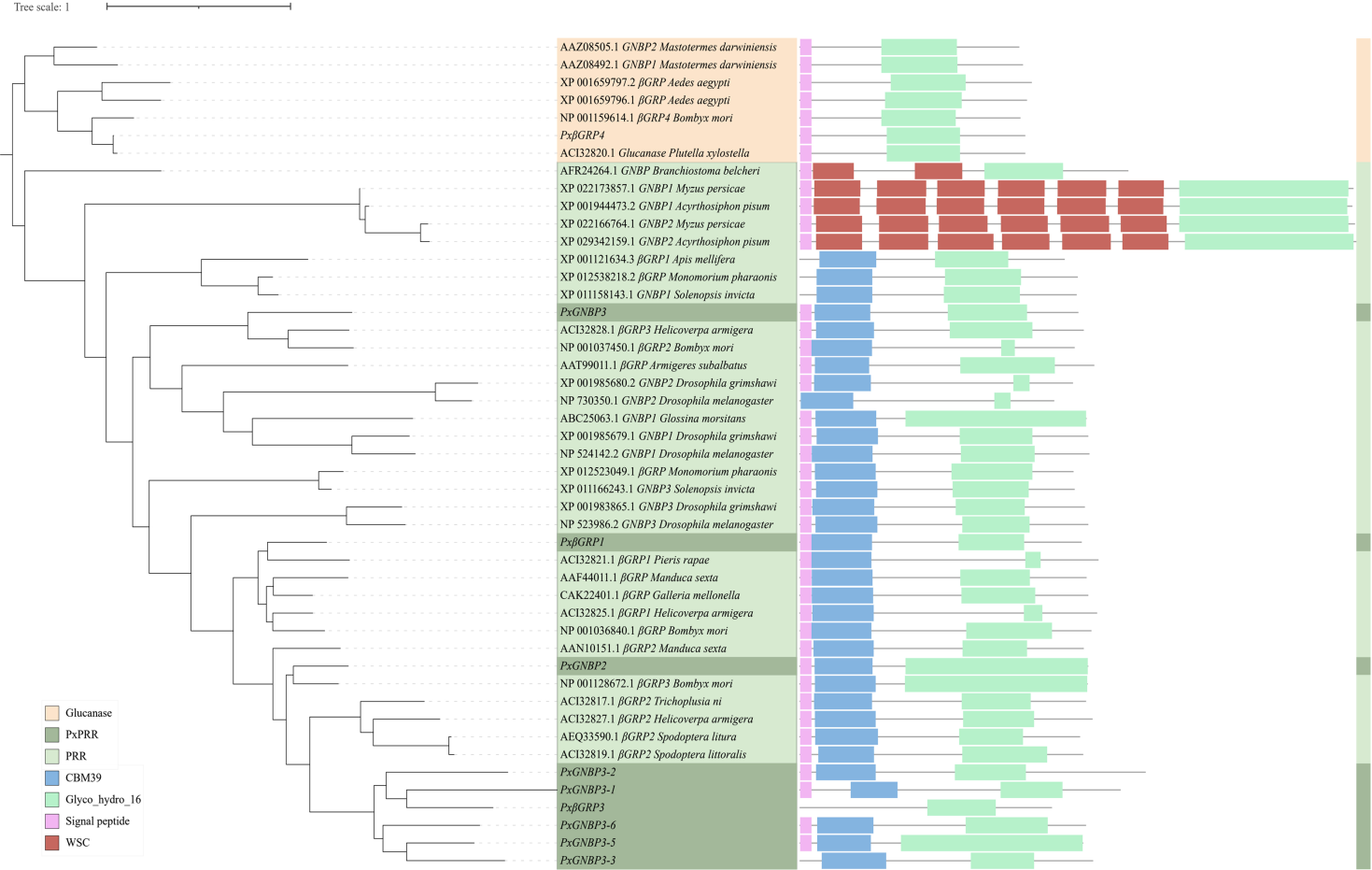
Fig. 1

Phylogenetic tree of GNBP proteins from P. xylostella and other insects"

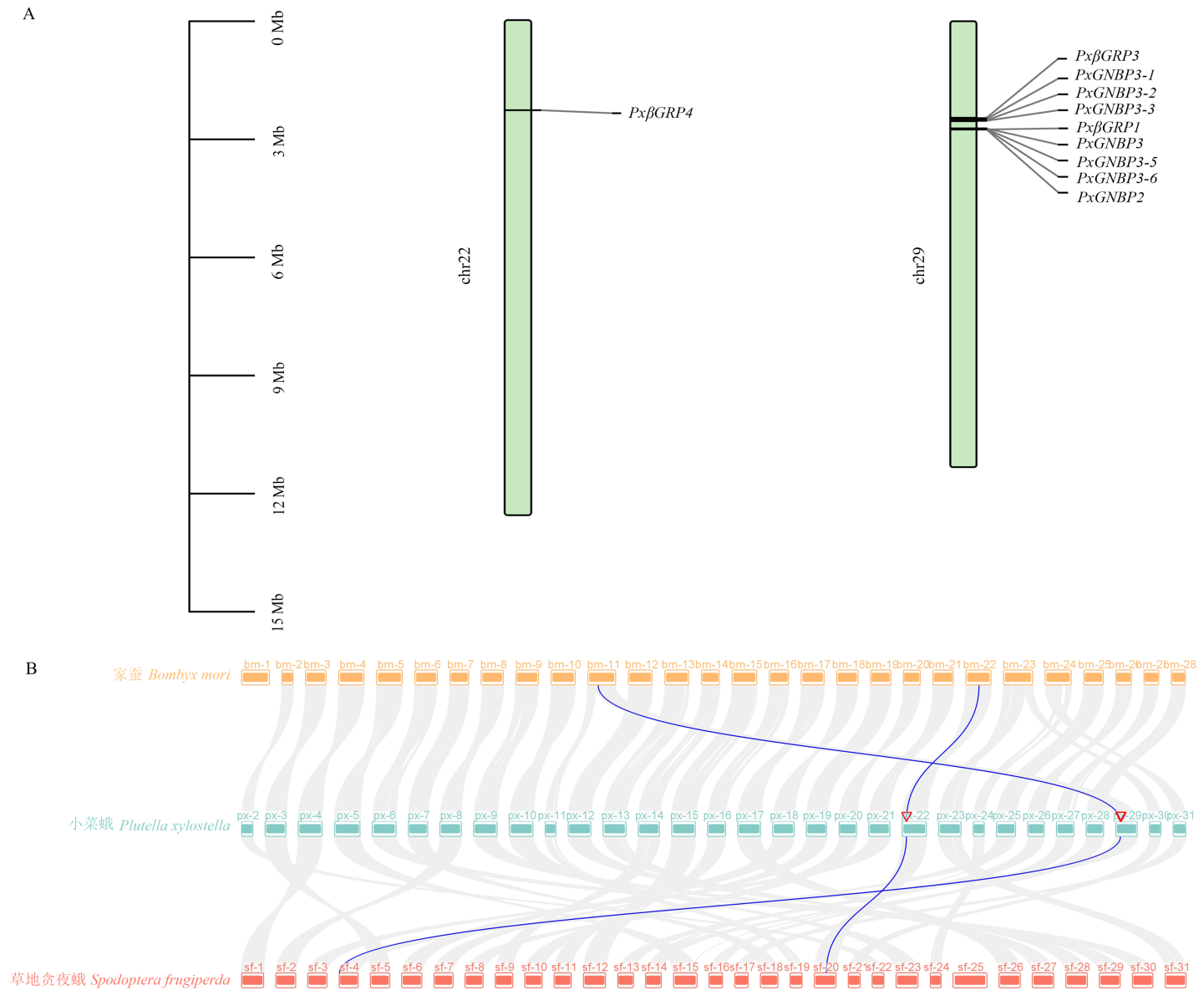
Fig. 2

Chromosome localization (A) and collinearity analysis (B) of GNBP gene family in P. xylostella"

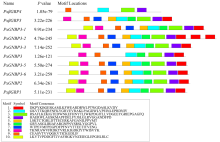
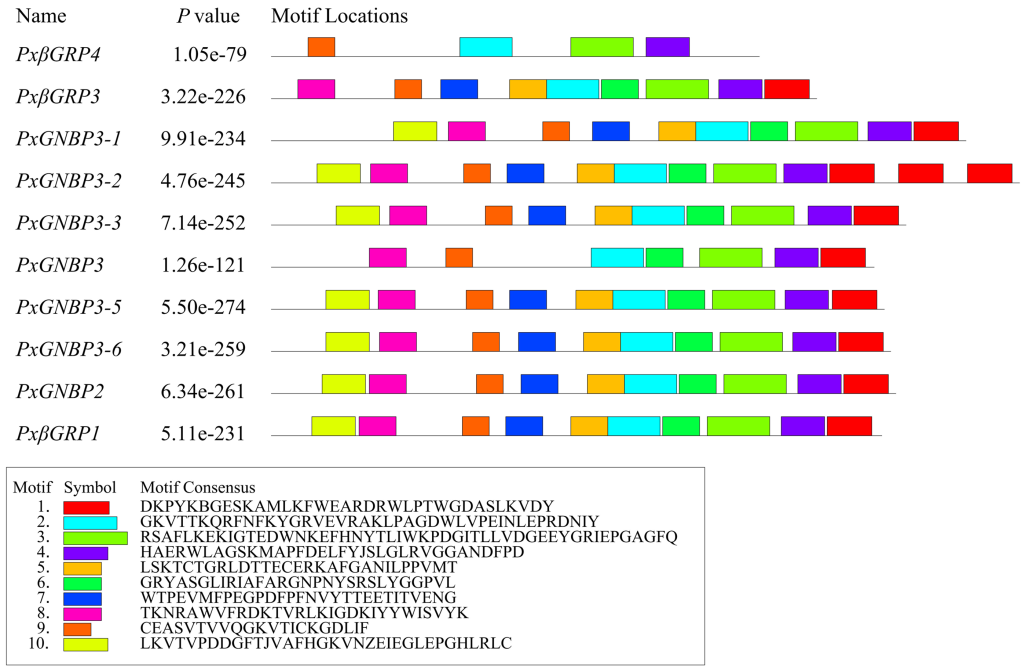
Fig. 3

Conserved motif of P. xylostella GNBP family genes"

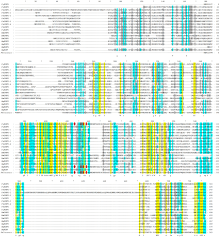
Fig. 4

Multiple sequence alignment of P. xylostella GNBP family genes Those highlighted with a red background are the key structural sites of the glucanase GH16 domain"

Fig. 5

Protein three-dimensional structures of GNBP family gene members from P. xylostella The region previously identified as the GH16 domain;红色Red:前期鉴定为信号肽的区域The region previously identified as the signal peptide"

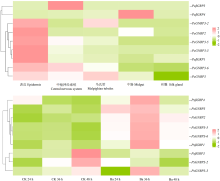
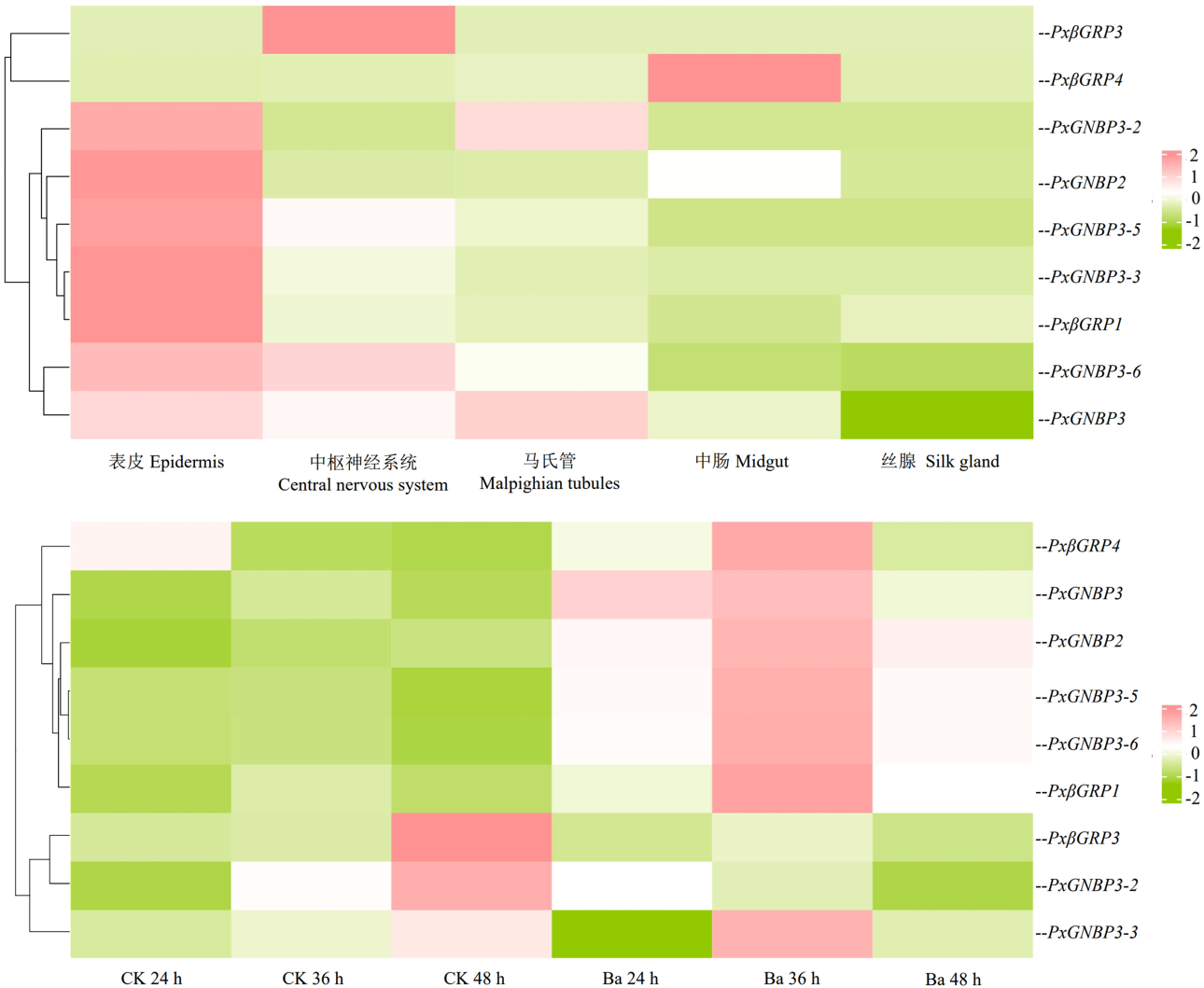
Fig. 6

Temporal expression of GNBP family genes in P. xylostella of different tissues and following B. bassiana infection"

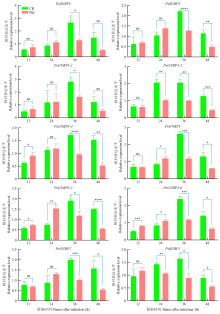
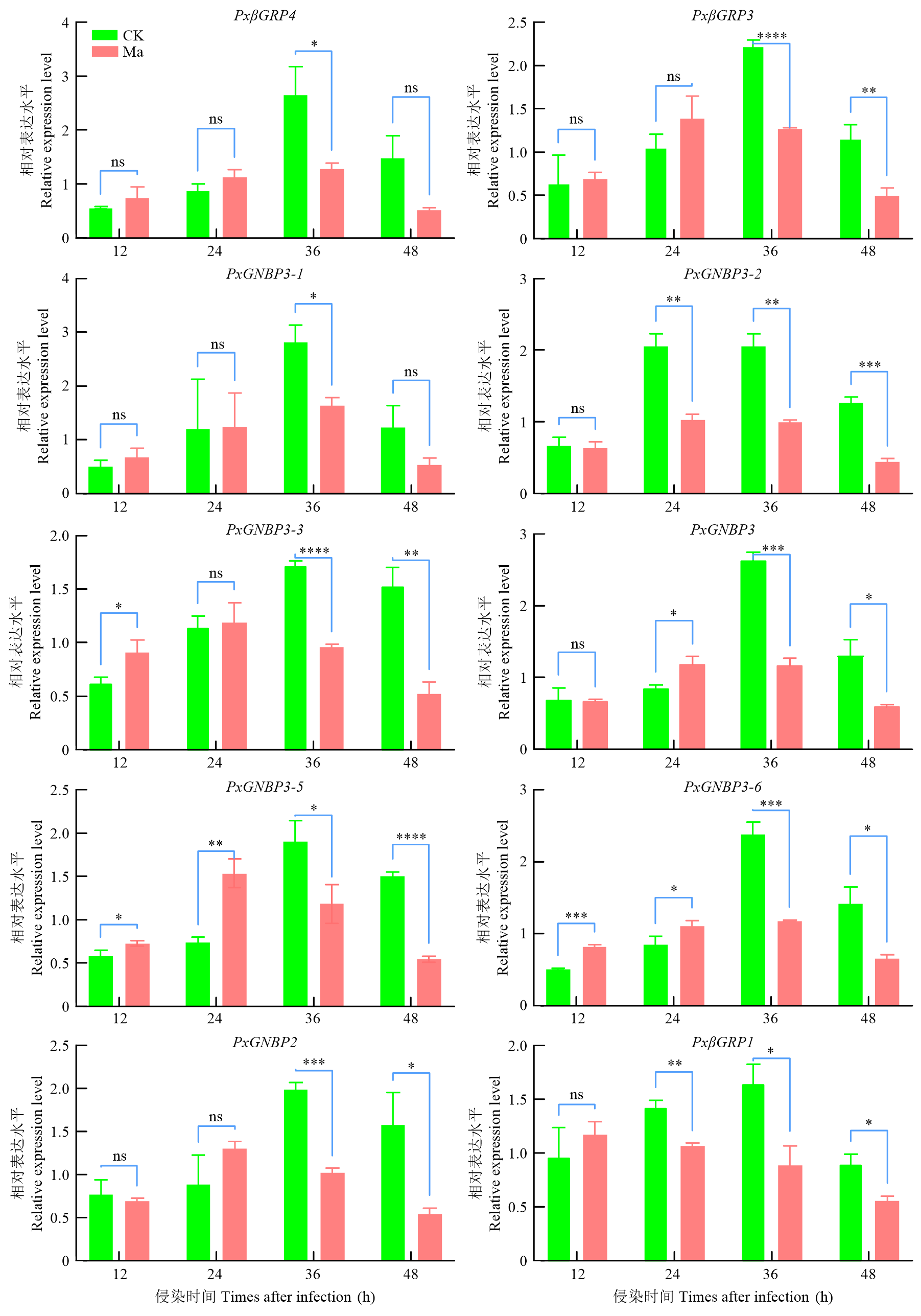
Fig. 7

Expression patterns of GNBP family genes in P. xylostella in response to M. anisopliae infection"

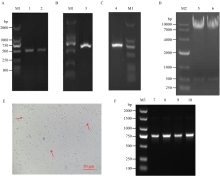
Fig. 8

The construction of recombinant strains of M. anisopliae based on RNAi"

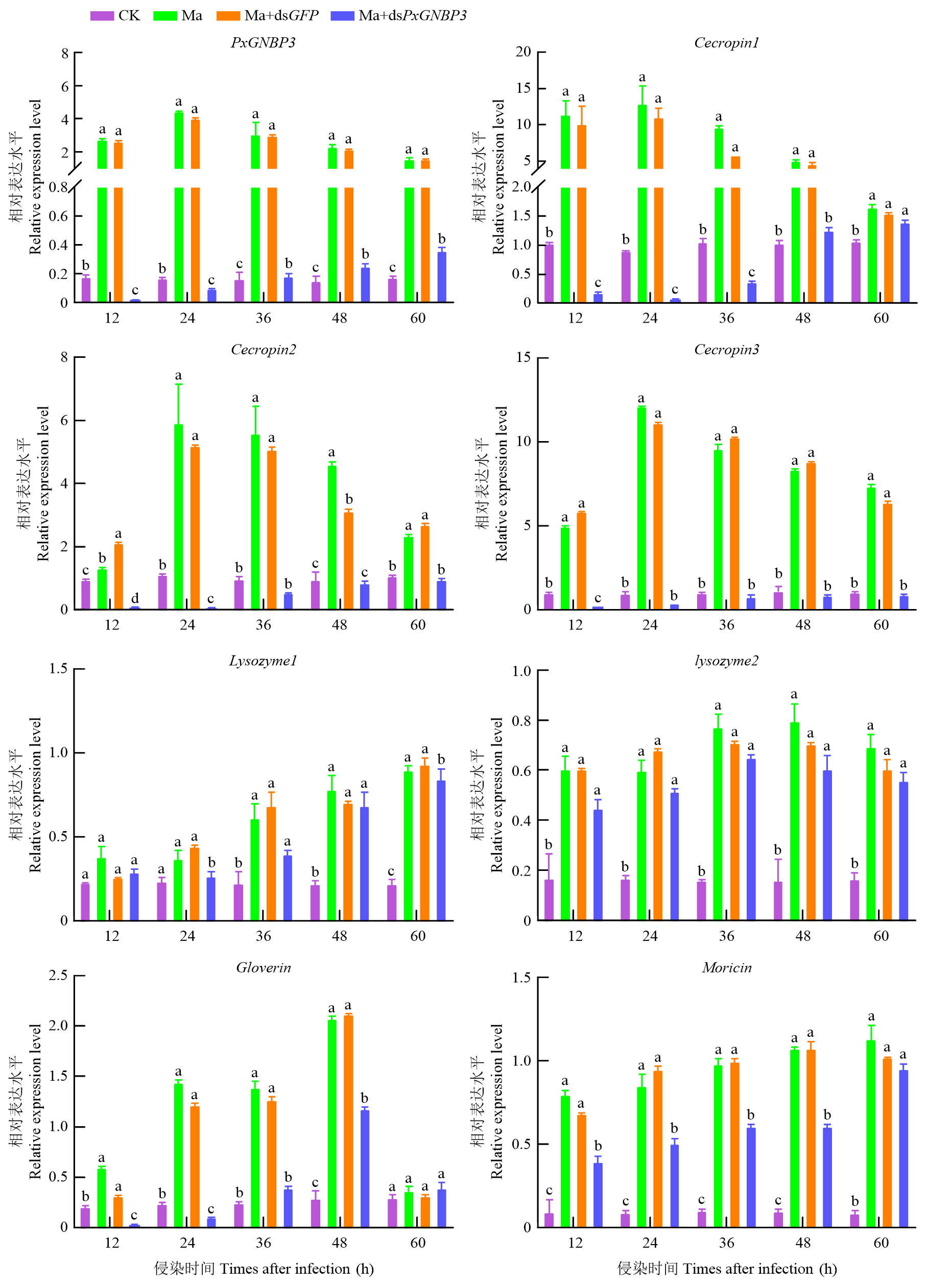
Fig. 9

Expression levels of antimicrobial peptide genes in P. xylostella after infection with different Metarhizium strains"

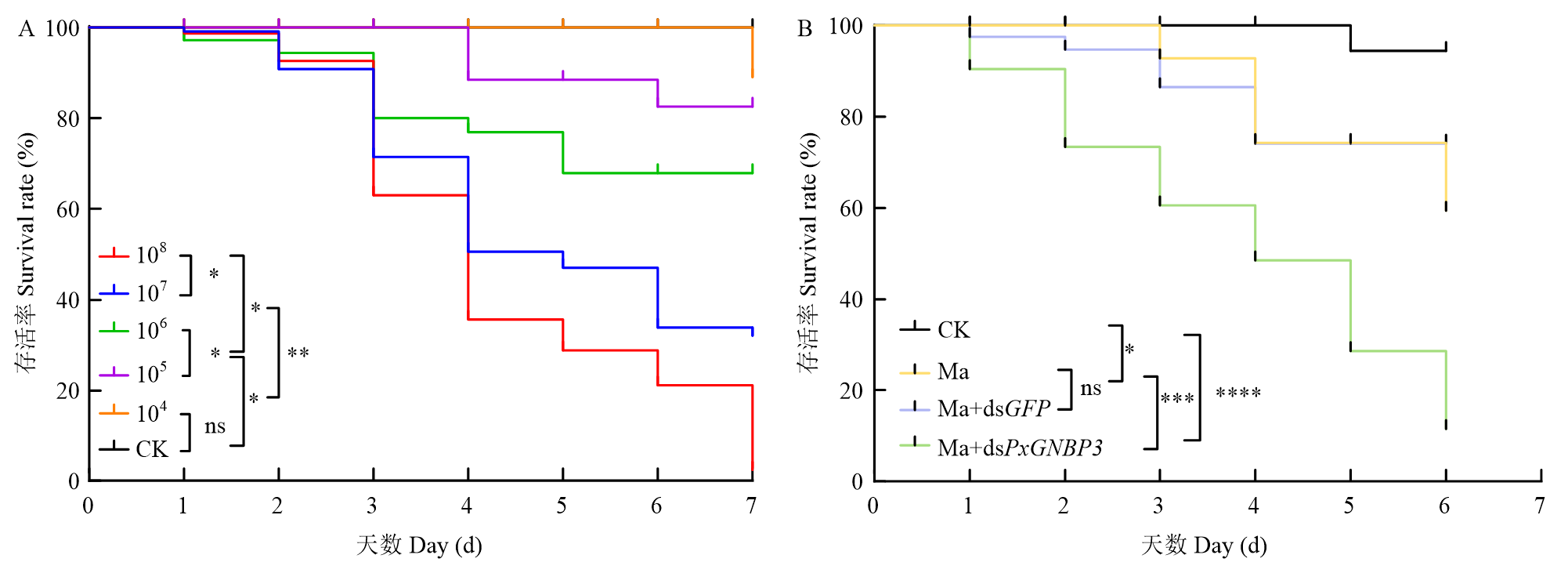
Fig. 10

Toxicity of different M. anisopliae strains to P. xylostella"

[1]
FURLONG M J, WRIGHT D J, DOSDALL L M. Diamondback moth ecology and management: Problems, progress, and prospects. Annual Review of Entomology, 2013, 58: 517-541.

doi: 10.1146/annurev-ento-120811-153605 pmid: 23020617
[2]
RAO X, ZHAN M, PAN Y, LIU S, YANG P, YANG L, YU X. Immune functions of insect βGRPs and their potential application. Developmental and Comparative Immunology, 2018, 83: 80-88.

doi: 10.1016/j.dci.2017.12.007
[3]
KURATA S. Recognition of infectious non-self and activation of immune responses by peptidoglycan recognition protein (PGRP)- family members in Drosophila. Developmental and Comparative Immunology, 2004, 28(2): 89-95.

doi: 10.1016/S0145-305X(03)00121-6
[4]
LEE H, KWON H, PARK J, KUROKAWA K, LEE B L. N-terminal GNBP homology domain of Gram-negative binding protein 3 functions as a beta-1,3-glucan binding motif in Tenebrio molitor. BMB Reports, 2009, 42(8): 506-510.

doi: 10.5483/BMBRep.2009.42.8.506
[5]
TAKAHASI K, OCHIAI M, HORIUCHI M, KUMETA H, OGURA K, ASHIDA M, INAGAKI F. Solution structure of the silkworm βGRP/GNBP3 N-terminal domain reveals the mechanism for β-1,3-glucan-specific recognition. Proceedings of the National Academy of Sciences of the United States of America, 2009, 106(28): 11679-11684.
[6]
HUGHES A L. Evolution of the βGRP/GNBP/β-1,3-glucanase family of insects. Immunogenetics, 2012, 64(7): 549-558.

doi: 10.1007/s00251-012-0610-8
[7]
CAO Z, CAO J, VLASENKO V, BAKUMENKO O, LI W. Molecular characterization and functional analysis of a beta-1,3-glucan recognition protein from oriental fruit moth Grapholita molesta (Lepidoptera: Tortricidae). Archives of Insect Biochemistry and Physiology, 2024, 115(1): e22068.

doi: 10.1002/arch.v115.1
[8]
BI J, MA X, JIANG Y, LIU P, GAO R, ZHAO T, YUAN X, HAO H, LI B, WANG Y. RNA interference-mediated silencing of GNBP2 reduces the immunity of stored pest Tribolium castaneum against bacteria. Pesticide Biochemistry and Physiology, 2025, 208: 106230.

doi: 10.1016/j.pestbp.2024.106230
[9]
HUANG W J, XU X X, FREED S, ZHENG Z H, WANG S, REN S X, JIN F L. Molecular cloning and characterization of a β-1,3-glucan recognition protein from Plutella xylostella (L.). New Biotechnology, 2015, 32(2): 290-299.

doi: 10.1016/j.nbt.2015.01.002
[10]
曹苗苗. GNBP3介导小菜蛾免疫反应的功能研究[D]. 广州: 华南农业大学, 2018.
CAO M M. Functional research of immune response about PxGNBP3 in Plutella xylostella (L.)[D]. Guangzhou: South China Agricultural University, 2018. (in Chinese)
[11]
鞠雯燕. 小菜蛾GNBP2调控抗菌肽表达的研究[D]. 广州: 华南农业大学, 2018.
JU W Y. Study on the regulation of antimicrobial peptide expression by GNBP2 in Plutella xylostella (L.)[D]. Guangzhou: South China Agricultural University, 2018. (in Chinese)
[12]
裘晖, 吴振强, 梁世中. 金龟子绿僵菌及其杀虫机理. 农药, 2004, 43(8): 342-345.
QIU H, WU Z Q, LIANG S Z. Metarhizium anisopliae and its insecticidal mechanism. Agrochemicals, 2004, 43(8): 342-345. (in Chinese)
[13]
HAN J H, JIN B R, KIM J J, LEE S Y. Virulence of entomopathogenic fungi Metarhizium anisopliae and Paecilomyces fumosoroseus for the microbial control of Spodoptera exigua. Mycobiology, 2014, 42(4): 385-390.

doi: 10.5941/MYCO.2014.42.4.385
[14]
CHEN X R, LI L, HU Q B, ZHANG B W, WU W, JIN F L, JIANG J X. Expression of dsRNA in recombinant Isaria fumosorosea strain targets the TLR7 gene in Bemisia tabaci. BMC Biotechnology, 2015, 15: 64.

doi: 10.1186/s12896-015-0170-8
[15]
MINH B Q, SCHMIDT H A, CHERNOMOR O, SCHREMPF D, WOODHAMS M D, VON HAESELER A, LANFEAR R. IQ-TREE 2: New models and efficient methods for phylogenetic inference in the genomic era. Molecular Biology and Evolution, 2020, 37(5): 1530-1534.

doi: 10.1093/molbev/msaa015 pmid: 32011700
[16]
INNAN H, KONDRASHOV F. The evolution of gene duplications: Classifying and distinguishing between models. Nature Reviews Genetics, 2010, 11(2): 97-108.

doi: 10.1038/nrg2689 pmid: 20051986
[17]
BAILEY T L, BODEN M, BUSKE F A, FRITH M, GRANT C E, CLEMENTI L, REN J, LI W W, NOBLE W S. MEME SUITE: Tools for motif discovery and searching. Nucleic Acids Research, 2009, 37: W202-W208.
[18]
包顺才, 卢雪, 侯晓晖. 昆虫先天免疫调控机制的研究进展. 寄生虫与医学昆虫学报, 2024, 31(2): 115-122.
BAO S C, LU X, HOU X H. Research progress on innate immunity regulatory mechanisms in insects. Acta Parasitologica et Medica Entomologica Sinica, 2024, 31(2): 115-122. (in Chinese)
[19]
ZHAO L, NIU J, FENG D, WANG X, ZHANG R. Immune functions of pattern recognition receptors in Lepidoptera. Frontiers in Immunology, 2023, 14: 1203061.

doi: 10.3389/fimmu.2023.1203061
[20]
JI J, ZHOU L, XU Z, MA L, LU Z. Two atypical Gram-negative bacteria-binding proteins are involved in the antibacterial response in the pea aphid (Acyrthosiphon pisum). Insect Molecular Biology, 2021, 30(4): 427-435.

doi: 10.1111/imb.v30.4
[21]
BI J, LIU P, GAO R, JIANG Y, ZHANG C, ZHAO T, GAO L, WANG Y. Silencing Gram-negative bacteria binding protein 1 decreases the immunity of Tribolium castaneum against bacteria. International Journal of Biological Macromolecules, 2024, 264: 130631.

doi: 10.1016/j.ijbiomac.2024.130631
[22]
XIE X, WANG D, LI B, LIANG G, CHEN X, XING D, ZHAO T, ZHOU X, LI C. Aedes aegypti beta-1,3-glucan-binding protein inhibits dengue and ZIKA virus replication. Biomedicines, 2024, 12(1): 88.

doi: 10.3390/biomedicines12010088
[23]
ZHANG Y, YAN J, XIE Y, WANG X, REN F, BIAN H, SUN J. β-1,3-Glucan recognition protein can inhibit the proliferation of Bombyx mori cytoplasmic polyhedrosis virus. Insects, 2025, 16(4): 431.

doi: 10.3390/insects16040431
[24]
FENG K, JIANG D, LUO J, TANG F. OfGNBP silencing enhances the toxicity of Serratia marcescens Bizio (SM1) to Odontotermes formosanus (Shiraki). Pesticide Biochemistry and Physiology, 2023, 189: 105306.

doi: 10.1016/j.pestbp.2022.105306
[25]
MENZEL F, MORSBACH S, MARTENS J H, RÄDER P, HADJAJE S, POIZAT M, ABOU B. Communication versus waterproofing: The physics of insect cuticular hydrocarbons. Journal of Experimental Biology, 2019, 222(23): jeb210807.
[26]
靳良. 苏云金芽胞杆菌Cry蛋白与桃蚜和小菜蛾体内蛋白的互作研究[D]. 泉州: 华侨大学, 2023.
JIN L. Study on the interaction between Bacillus thuringiensis Cry proteins and proteins in Myzus persicae and Plutella xylostella[D]. Quanzhou: Huaqiao University, 2023. (in Chinese)
[27]
陈诗涵. 金龟子绿僵菌MaHGM202303对草地贪夜蛾的生防潜力研究[D]. 昆明: 云南农业大学, 2024.
CHEN S H. Study on the biocontrol potential of Metarhizium anisopliae MaHGM202303 against Spodoptera frugiperda[D]. Kunming: Yunnan Agricultural University, 2024. (in Chinese)
[28]
李林, 张元珍, 鄢文英, 曾路, 庞锐, 许小霞, 金丰良. miR-6497-x在调控小菜蛾对真菌感染反应中的作用. 中国农业科学, 2025, 58(8): 1550-1563. doi: 10.3864/j.issn.0578-1752.2025.08.007.
LI L, ZHANG Y Z, YAN W Y, ZENG L, PANG R, XU X X, JIN F L. The role of miR-6497-x in regulating the reaction of Plutella xylostella to fungal infection. Scientia Agricultura Sinica, 2025, 58(8): 1550-1563. doi: 10.3864/j.issn.0578-1752.2025.08.007. (in Chinese)
[29]
CHEN K K, LU Z Q. Immune responses to bacterial and fungal infections in the silkworm, Bombyx mori. Developmental & Comparative Immunology, 2018, 83: 3-11.
[30]
LEMAITRE B, NICOLAS E, MICHAUT L, REICHHART J M, HOFFMANN J A. The dorsoventral regulatory gene Cassette spätzle/ Toll/cactus controls the potent antifungal response in Drosophila adults. Cell, 1996, 86(6): 973-983.

doi: 10.1016/S0092-8674(00)80172-5
[31]
吴志鹏, 童应华. 球孢白僵菌和金龟子绿僵菌对红火蚁工蚁的致病力测定. 森林与环境学报, 2020, 40(1): 99-105.
WU Z P, TONG Y H. Pathogenicity determination of Beauveria bassiana and Metarhizium anisopliae against Solenopsis invicta workers. Journal of Forest and Environment, 2020, 40(1): 99-105. (in Chinese)
[32]
FLETCHER S J, REEVES P T, HOANG B T, MITTER N. A perspective on RNAi-based biopesticides. Frontiers in Plant Science, 2020, 11: 51.

doi: 10.3389/fpls.2020.00051 pmid: 32117388
[33]
HU J, XIA Y X. Increased virulence in the locust-specific fungal pathogen Metarhizium acridum expressing dsRNAs targeting the host F1F0-ATPase subunit genes. Pest Management Science, 2019, 75(1): 180-186.

doi: 10.1002/ps.2019.75.issue-1
[1] LI Lin, ZHANG YuanZhen, YAN WenYing, ZENG Lu, PANG Rui, XU XiaoXia, JIN FengLiang. The Role of miR-6497-x in Regulating the Reaction of Plutella xylostella to Fungal Infection [J]. Scientia Agricultura Sinica, 2025, 58(8): 1550-1563.
[2] CHEN ErHu, TANG JingJie, HU ShunJie, TANG PeiAn. The Roles of Heat Shock Protein Genes CfHsp70-1 and CfHsp70-2 in Enhancing the High-Temperature Tolerance after Heat Acclimation in Cryptolestes ferrugineus [J]. Scientia Agricultura Sinica, 2025, 58(5): 918-928.
[3] CONG QiQi, ZHANG JingYi, MENG XiangLong, DAI PengBo, LI Bo, HU TongLe, WANG ShuTong, CAO KeQiang, WANG YaNan. Identification of Hypovirus in Apple Ring Rot Fungus Botryosphaeria dothidea and Detection of Virus-Carrying Status in China [J]. Scientia Agricultura Sinica, 2025, 58(3): 478-492.
[4] XIE HaiPeng, LIN JunXu, LIU Yong, MAI XianJun, LUO Feng, WANG XueWu, XIE Wen, LI ShaoKa, KONG XiangYi, WU XiaoYan. Effects of Different Organic Fertilizers on the Control of Cowpea Wilt by Bacillus velezensis SD13 [J]. Scientia Agricultura Sinica, 2025, 58(21): 4405-4420.
[5] LIU HaoKai, FENG YouNa, LI Jing, LIANG Qian. Insecticidal Active Components and Mechanisms of Essential Oils from Illicium verum and Curcuma phaeocaulis Against Plutella xylostella [J]. Scientia Agricultura Sinica, 2025, 58(19): 3905-3918.
[6] XIAO ZhuoDan, QIAO JiaZheng, GAO YuLan, SHANG ZhangYin, LIU Huai, WANG Jia. Silencing of Cytochrome P450 Genes CYP6CY53 and CYP302A1 in Aphis craccivora Enhances the Sensitivity to Flonicamid [J]. Scientia Agricultura Sinica, 2025, 58(18): 3664-3675.
[7] HU JiaYan, SHEN ZhiHan, WEN LiHui, YU JiaHao, ZHANG YuJun, JIANG DongHua. Identification and Evaluation of Biocontrol Actinomycetes Against Xanthomonas oryzae pv. oryzicola for Disease Suppression and Growth Promotion in Rice [J]. Scientia Agricultura Sinica, 2025, 58(17): 3434-3450.
[8] YANG WenJuan, GAO JiaCheng, WANG YanTing, LI Yan, GUO Ming, WANG JunCheng, MENG YaXiong, WANG HuaJun, SI ErJing. Function of Effector Pg00778 Regulation on the Pathogenicity of Pyrenophora graminea to Barley [J]. Scientia Agricultura Sinica, 2025, 58(15): 3020-3035.
[9] ZHAO LinLin, HE YuXi, PENG JieLi, WANG Xu, MA Jia, ZHANG XiuMin, HU Dong. Streptomyces TOR3209 and Its Volatile Organic Compounds Enhance Tobacco Resistance to Fusarium equiseti [J]. Scientia Agricultura Sinica, 2025, 58(11): 2162-2175.
[10] CHEH ErHu, YUAN GuoQing, CHEN Yan, CHEN MengQiu, SUN ShengYuan, TANG PeiAn. Mitochondrial Protein-Coding Genes Nad5, Nad6 and Atp6 are Involved in Phosphine Resistance of Cryptolestes ferrugineus [J]. Scientia Agricultura Sinica, 2024, 57(9): 1722-1733.
[11] LIAO XinLin, GUO Xin, YANG JiXue, SHAO JiaZhu, YUAN XinYu, HU JiaYan, CHEN XiaoXiao, JIANG DongHua. Screening of Actinomycetes Against Ralstonia solanacearum and Its Disease Prevention Function [J]. Scientia Agricultura Sinica, 2024, 57(7): 1319-1334.
[12] LUO LiDan, CHEN JiaMing, AN Qi, LIU Lei, SUN QinZhe, LIU Huan, WANG SenShan, SONG LiWen. Effects of Extreme High Temperature on Trehalose Content and Trehalose Transporter Gene in Tetranychus truncatus [J]. Scientia Agricultura Sinica, 2024, 57(6): 1091-1101.
[13] ZHAO YiYan, GUO HongFang, LIU WeiMin, ZHAO XiaoMing, ZHANG JianZhen. Effects of Apolipophorin on Ovarian Development and Lipid Deposition in Locusta migratoria [J]. Scientia Agricultura Sinica, 2024, 57(4): 711-720.
[14] LI ChuXin, SONG ChenHu, ZHOU JinHuan, LI JiaXin, WANG XinLiang, TIAN XuBin, SONG Zhen. Research on Prevention and Control Technology of Citrus Yellow Vein Clearing Virus Based on VIGS [J]. Scientia Agricultura Sinica, 2024, 57(22): 4473-4482.
[15] YUAN GuoQing, CHEN ErHu, TANG PeiAn. The Mechanisms of Mitochondrial Protein-Coding Genes ND6 and ATP6 in Regulating Cold Tolerance of Cryptolestes ferrugineus [J]. Scientia Agricultura Sinica, 2024, 57(22): 4483-4494.
Viewed
Full text


Abstract

Cited

  Shared   
  Discussed   
No Suggested Reading articles found!