






中国农业科学 ›› 2026, Vol. 59 ›› Issue (12): 2591-2605.doi: 10.3864/j.issn.0578-1752.2026.12.005
杨静雯1( ), 常力匀1, 卢伟岸1, 王海华3, 姜英1, 张雯1, 宫香伟1(), 吕国华2()
收稿日期:2025-12-08
接受日期:2026-04-07
出版日期:2026-06-16
发布日期:2026-06-16
通信作者:
联系方式:
杨静雯,E-mail:15845368402@163.com。
基金资助:
YANG JingWen1(), CHANG LiYun1, LU WeiAn1, WANG HaiHua3, JIANG Ying1, ZHANG Wen1, GONG XiangWei1(), LÜ GuoHua2()
Received:2025-12-08
Accepted:2026-04-07
Published:2026-06-16
Online:2026-06-16
摘要:
【目的】种子处理可增强植物对非生物胁迫的耐受力,探讨种子处理对干旱胁迫下玉米苗期生长状况及养分吸收的调控效应,拟为玉米高产高效抗逆栽培提供依据。【方法】采用盆栽试验,设置对照(CK)、超声(US)、超声+多糖(US+OS)、超声+微生物(US+B)和综合技术(超声+多糖+微生物,IPM)5个种子处理,解析模拟干旱胁迫下玉米苗期农艺性状、光合生理、抗氧化酶活性、养分吸收等参数变化特征,结合Mantel检验与随机森林,分析指标间的潜在关系及影响玉米养分吸收的关键参数。【结果】种子处理可显著改善玉米株高与叶面积,玉米根长、根表面积、根体积和根直径均有不同程度地增加。与对照相比,轻度干旱、中度干旱和重度干旱条件下玉米根系干重分别提高69.23%— 171.15%、59.09%—218.18%和93.84%—264.52%,差异达显著水平(P<0.05)。种子处理显著调节了干旱胁迫下玉米叶片叶绿素相对含量和气体交换参数,增加了叶片与根系的抗氧化酶活性,改善了光合物质生产和生理代谢能力,叶片与根系养分吸收有所上升,其中超声+微生物处理增加效果最好,干旱胁迫下玉米叶片和根系的氮吸收提高31.59%— 59.21%和39.79%—82.35%,磷吸收提高33.70%—69.94%和51.66%—88.69%,钾吸收提高47.71%—78.17%和57.59%— 108.08%。Mantel检验与随机森林结果表明,种子处理通过改善多个生长参数,综合提升玉米抗旱能力,其中生物量、叶面积和株高等形态特征是影响玉米氮、磷、钾等养分吸收的关键参数。【结论】种子处理通过调节干旱胁迫下玉米苗期地上农艺性状和根系形态特征,提高植株光合生理代谢和抗氧化酶活性,促进养分吸收与物质积累,其中超声+微生物处理适合北方旱地农田玉米生产。
杨静雯, 常力匀, 卢伟岸, 王海华, 姜英, 张雯, 宫香伟, 吕国华. 种子处理对模拟干旱胁迫玉米苗期生长与养分吸收的调控效应[J]. 中国农业科学, 2026, 59(12): 2591-2605.
YANG JingWen, CHANG LiYun, LU WeiAn, WANG HaiHua, JIANG Ying, ZHANG Wen, GONG XiangWei, LÜ GuoHua. Effects of Seed Treatment on Growth and Nutrient Uptake of Maize at the Seedling Stage Under Simulated Drought Stress[J]. Scientia Agricultura Sinica, 2026, 59(12): 2591-2605.

图1
干旱胁迫20 d种子处理对玉米苗期地上植株表型的影响"

图2
干旱胁迫下种子处理对玉米苗期株高和叶面积的影响 D代表干旱胁迫,S代表种子处理。小写字母表示在5%水平上的差异显著性。*代表在0.05水平下差异显著,**代表在0.01水平下差异显著。下同"

图3
干旱胁迫20 d种子处理对玉米苗期根系表型的影响"

图4
干旱胁迫下种子处理对玉米苗期根系形态特征的影响"
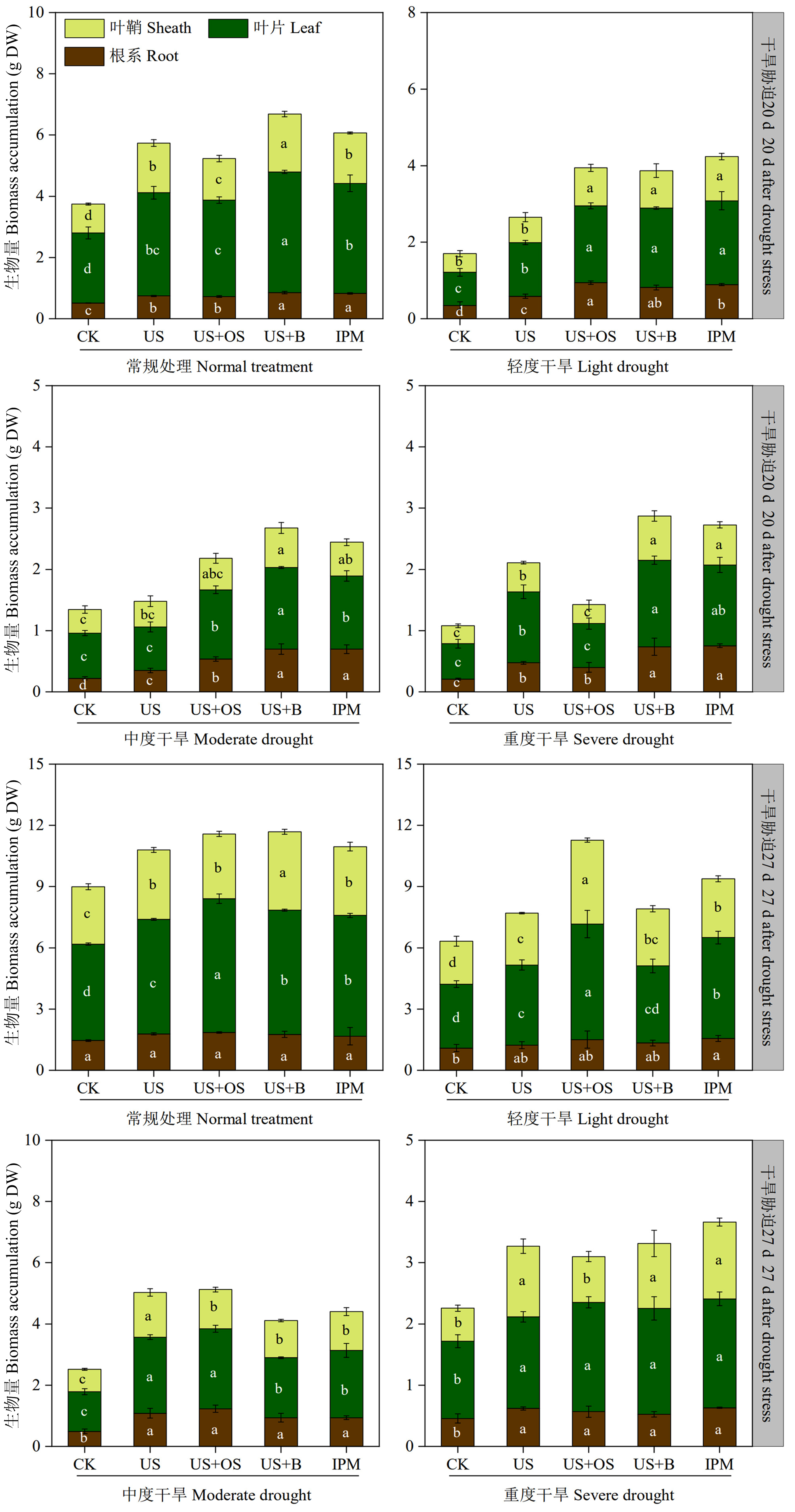
图5
干旱胁迫下种子处理对玉米苗期生物量的影响"

图6
干旱胁迫下种子处理对玉米苗期叶片叶绿素相对含量的影响"
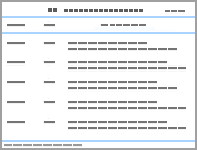
表1
干旱胁迫下种子处理对玉米苗期叶片光合特性的影响"
| 干旱胁迫 Drought stress | 种子处理 Seed treatment | 干旱胁迫20 d Drought stress for 20 d | 干旱胁迫27 d Drought stress for 27 d | ||||||
|---|---|---|---|---|---|---|---|---|---|
| 净光合速率 Pn (μmol·m-2·s-1) | 气孔导度 Gs (μmol·m-2·s-1) | 胞间CO2 浓度Ci (μmol·mol-1) | 蒸腾速率 Tr (mmol·m-2·s-1) | 净光合速率 Pn (μmol·m-2·s-1) | 气孔导度 Gs (μmol·m-2·s-1) | 胞间CO2 浓度Ci (μmol·mol-1) | 蒸腾速率 Tr (mmol·m-2·s-1) | ||
| 常规处理 Normal treatment | CK | 20.53±0.59c | 0.08±0.01c | 21.80±1.75c | 2.73±0.40c | 35.60±0.53c | 0.36±0.04a | 150.33±9.81a | 10.38±0.45ab |
| US | 26.43±2.03b | 0.30±0.03a | 25.70±2.76ab | 4.47±0.60b | 41.70±0.89a | 0.36±0.03a | 155.00±2.00a | 11.28±0.68a | |
| US+OS | 30.37±2.58b | 0.15±0.01b | 24.50±1.16ab | 5.62±0.14a | 38.83±1.01b | 0.30±0.04a | 123.67±1.15b | 8.66±0.94c | |
| US+B | 36.57±1.79a | 0.18±0.01b | 25.20±1.82a | 4.50±0.40b | 37.70±1.31b | 0.29±0.02a | 125.00±1.15b | 8.83±0.42c | |
| IPM | 35.07±1.37a | 0.18±0.01b | 22.80±1.78bc | 6.62±0.75a | 39.00±0.56b | 0.33±0.08a | 150.33±1.53a | 9.95±0.07b | |
| 轻度干旱 Light drought | CK | 30.77±0.90c | 0.16±0.01b | 44.00±3.57d | 3.96±0.43c | 19.77±0.85c | 0.15±0.01b | 99.13±9.42c | 6.44±0.90b |
| US | 37.60±2.01b | 0.21±0.02ab | 51.77±1.25c | 5.44±0.41b | 26.30±1.97a | 0.20±0.01a | 122.27±4.56b | 7.83±0.42a | |
| US+OS | 39.90±1.64ab | 0.23±0.02a | 58.57±1.61ab | 5.66±0.38ab | 23.30±1.15b | 0.20±0.02a | 146.67±11.15a | 8.00±0.81a | |
| US+B | 42.20±0.61a | 0.23±0.01a | 62.30±2.34a | 6.17±0.26a | 24.33±1.36ab | 0.16±0.01b | 99.07±3.00c | 6.91±0.15ab | |
| IPM | 39.37±1.25b | 0.22±0.01a | 54.97±1.08bc | 5.62±0.2ab | 22.23±1.40bc | 0.15±0.01b | 106.17±9.25c | 6.45±0.55b | |
| 中度干旱 Moderate drought | CK | 27.40±1.71c | 0.17±0.01bc | 22.63±1.07d | 3.36±0.23c | 20.07±0.25d | 0.14±0.01ab | 67.03±3.80ab | 5.99±0.83a |
| US | 36.83±1.29b | 0.16±0.02c | 30.43±0.71c | 5.07±0.29a | 23.63±0.42bc | 0.14±0.01ab | 47.03±3.03d | 5.94±0.39a | |
| US+OS | 34.40±1.10b | 0.16±0.02c | 46.63±1.99a | 4.34±0.08b | 22.47±1.27c | 0.13±0.01b | 75.03±3.87a | 5.70±0.39c | |
| US+B | 36.47±2.02b | 0.21±0.03b | 42.60±2.10b | 4.95±0.18a | 25.73±1.27a | 0.15±0.01a | 55.30±7.38cd | 6.36±0.42a | |
| IPM | 39.63±0.29a | 0.24±0.02a | 42.10±1.59b | 5.09±0.10a | 24.83±1.25ab | 0.14±0.01ab | 62.80±7.26bc | 5.72±0.55a | |
| 重度干旱 Severe drought | CK | 25.83±1.60c | 0.17±0.01c | 38.20±0.62d | 5.44±0.17c | 19.13±0.80c | 0.13±0.05b | 69.77±0.55ab | 4.49±0.83c |
| US | 34.57±2.12b | 0.19±0.01c | 44.00±2.43c | 6.46±0.49b | 29.33±0.75a | 0.14±0.02ab | 65.10±2.82c | 5.34±0.36bc | |
| US+OS | 41.53±2.06a | 0.34±0.03a | 44.70±1.73c | 7.51±0.30a | 24.70±0.26b | 0.15±0.01ab | 85.43±4.06a | 5.83±0.48ab | |
| US+B | 41.33±0.21a | 0.27±0.01b | 55.43±1.84a | 7.92±0.58a | 24.40±0.66b | 0.15±0.02ab | 72.50±4.8ab | 6.06±0.43ab | |
| IPM | 33.93±1.91b | 0.20±0.02c | 50.93±1.76b | 5.34±0.11c | 28.57±0.01a | 0.18±0.01a | 73.60±4.49ab | 6.71±0.55a | |
| ANOVA | |||||||||
| 干旱胁迫Drought stress | ** | ** | ** | ** | ** | ** | ** | ** | |
| 种子处理Seed treatment | ** | ** | ** | ** | ** | ns | ** | * | |
| 干旱胁迫×种子处理 Drought stress ×Seed treatment | ** | ** | ** | ** | ** | * | ** | ** | |

图7
干旱胁迫20 d种子处理对玉米苗期抗氧化酶活性的影响"

图8
干旱胁迫下种子处理对玉米苗期养分吸收的影响"
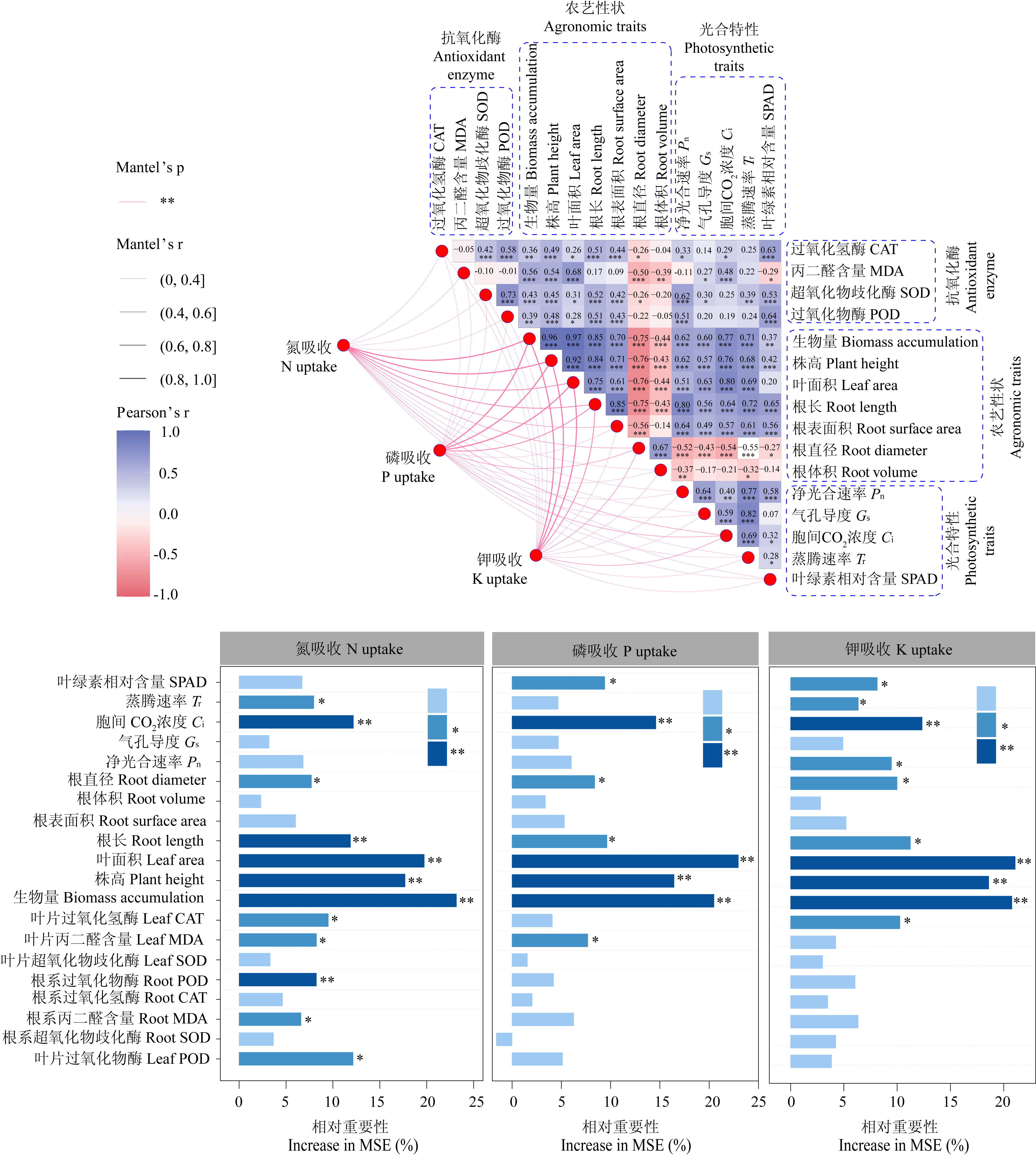
图9
玉米苗期农艺性状、抗氧化酶、光合特性与养分吸收的Mantel检验及随机森林分析"
| [1] |
doi: 10.1016/j.gloplacha.2023.104326 |
| [2] |
doi: 10.1186/s12870-024-05413-w pmid: 39054427 |
| [3] |
doi: 10.1021/acs.est.4c13531 |
| [4] |
doi: 10.1111/emi.v24.8 |
| [5] |
doi: 10.3389/fmicb.2021.783475 |
| [6] |
姜雅文, 解文艳, 何久兴, 龚民, 霍秋燕, 杨浠, 韩伟, 吕国华. 微生物种子包衣促进干旱条件下小麦种子萌发及幼苗生长. 中国农业气象, 2025, 46(5): 609-618.
|
|
doi: 10.3969/j.issn.1000-6362.2025.05.002 |
|
| [7] |
doi: 10.3390/plants9101375 |
| [8] |
赵艳军, 王宝军, 刘婧, 魏盼, 秦海峰, 梁镇海. 超声对小麦种子萌发特性的生物学效应研究. 种子, 2012, 31(9): 112-114.
|
|
|
|
| [9] |
郭丹钊, 王斌, 朱彬. 干旱胁迫条件下细菌多糖对玉米苗期抗旱性的影响. 安徽农业科学, 2007, 35(34): 11050-11051.
|
|
|
|
| [10] |
doi: 10.1016/j.eja.2018.01.017 |
| [11] |
|
| [12] |
doi: 10.1016/j.agwat.2025.109727 |
| [13] |
|
| [14] |
韩雪, 高馨竹, 龚伟军, 宋金钊, 赵良洲, 李海燕. 微生物种子包衣的应用与研究进展. 微生物学通报, 2023, 50(12): 5534-5547.
|
|
|
|
| [15] |
罗晟, 赵泽文, 任新宇, 魏宏宇, 马雅静, 潘起涛, 李荣同, 龚国胜, 程新. 屎肠球菌胞外多糖对镉胁迫下水稻种子萌发及幼苗生长的影响. 农业环境科学学报, 2020, 39(9): 1888-1899.
|
|
|
|
| [16] |
王荣荣, 陈天鹏, 尹豪杰, 蒋桂英. 不同抗旱性春小麦根系生长对干旱胁迫的响应及滴灌复水补偿效应. 中国农业科学, 2023, 56(24): 4826-4841. doi:10.3864/j.issn.0578-1752.2023.24.003.
|
|
|
|
| [17] |
doi: 10.1073/pnas.1915902116 pmid: 31776251 |
| [18] |
柳嘉怡,
|
|
|
|
| [19] |
闫振华, 刘东尧, 贾绪存, 杨琴, 陈艺博, 董朋飞, 王群. 花期高温干旱对玉米雄穗发育、生理特性和产量影响. 中国农业科学, 2021, 54(17): 3592-3608. doi:10.3864/j.issn.0578-1752.2021.17.004.
|
|
|
|
| [20] |
doi: 10.1016/j.still.2025.106876 |
| [21] |
doi: 10.1016/j.scienta.2019.108667 |
| [22] |
张思聪, 孔雷蕾, 唐湘如. 超声波预处理对作物种子及幼苗的影响综述. 安徽农业科学, 2017, 45(21): 11-12, 43.
|
|
|
|
| [23] |
doi: 10.1093/plcell/koae055 pmid: 38382086 |
| [24] |
doi: 10.34133/bmef.0112 |
| [25] |
doi: 10.1016/j.indcrop.2024.120280 |
| [26] |
doi: 10.1111/tpj.v111.2 |
| [27] |
宫香伟, 刘春娟, 冯乃杰, 郑殿峰, 王畅. S3307和DTA-6对大豆不同冠层叶片光合特性及产量的影响. 植物生理学报, 2017, 53(10): 1867-1876.
|
|
|
|
| [28] |
齐先科, 李淼, 李彩虹, 渠琛玲. 介质阻挡放电低温等离子体处理对小麦种子活力及幼苗生理的影响. 农业工程学报, 2024, 40(1): 301-309.
|
|
|
|
| [29] |
doi: 10.1016/j.plaphy.2024.109145 |
| [30] |
王慧, 王冬梅, 张泽洲, 任怀新, 黄薇, 谢正丰. 外源褪黑素对干旱胁迫下黑麦草和苜蓿抗氧化能力及养分吸收的影响. 应用生态学报, 2022, 33(5): 1311-1319.
doi: 10.13287/j.1001-9332.202205.004 |
|
doi: 10.13287/j.1001-9332.202205.004 |
|
| [31] |
doi: 10.1021/acs.est.3c07339 |
| [32] |
栗晗, 江尚焘, 彭海英, 李培根, 顾长宜, 张金莲, 陈廷速, 徐阳春, 沈其荣, 董彩霞. 接种土著和外源AM真菌对杜梨抗旱性的影响及其适应机制. 中国农业科学, 2024, 57(1): 159-172. doi:10.3864/j.issn.0578-1752.2024.01.011.
|
|
|
|
| [33] |
doi: 10.1016/j.tplants.2025.04.007 |
| [34] |
doi: 10.1007/s11427-024-2876-0 |
| [35] |
doi: 10.1016/j.fbio.2024.104360 |
| [36] |
|
| [37] |
doi: 10.1016/j.cj.2023.02.009 |
| [1] | 罗欣欣, 余秋华, 张淑贞, 张千, 周志华, 李小坤, 陆志峰, 丛日环, 鲁剑巍. 不同类型粪肥替减氮肥对稻油轮作系统作物产量和养分吸收的影响[J]. 中国农业科学, 2026, 59(11): 2420-2433. |
| [2] | 宋裕祯, Bheel Chander Kumar, 张颖星, 王跃, Santra Dipak Kumar, 曹晓宁, 王瑞云. 黍子NF-Y基因家族的鉴定及PmNF-YA8的功能分析[J]. 中国农业科学, 2026, 59(10): 2088-2108. |
| [3] | 陈桂平, 李盼, 邵冠贵, 吴霞玉, 殷文, 赵连豪, 樊志龙, 胡发龙. 减量灌水与有机无机肥配施对青贮玉米吐丝期后叶片持绿特性的调控作用[J]. 中国农业科学, 2025, 58(7): 1381-1396. |
| [4] | 王文娟, 师尚礼, 康文娟, 杜媛媛, 殷辰. 干旱胁迫下陇中紫花苜蓿对外源精胺的生理响应[J]. 中国农业科学, 2025, 58(4): 676-691. |
| [5] | 杨龙, 张学昆, 陈爱武, 李莓, 程泰, 马伍慧, 许本波, 徐劲松. 油菜品种、越冬调控和病虫害防控对直播油菜产量的影响[J]. 中国农业科学, 2025, 58(21): 4333-4345. |
| [6] | 吴东明, 徐靖, 袁佳美, 王珂璇, 李玉义, 何萍, 张建峰, 宋大利, 高淼, 周卫. 一株根际促生菌Myroides odoratimimus PJ-3的分离、鉴定及其耐盐碱和玉米促生性能评价[J]. 中国农业科学, 2025, 58(20): 4131-4143. |
| [7] | 包明芳, 秦燕, 陈彩锦, 张尚沛, 张国辉, 沙晓弟. 111份紫花苜蓿种质资源苗期表型抗旱性鉴定评价[J]. 中国农业科学, 2025, 58(19): 3825-3836. |
| [8] | 董云棋, 黄建, 柴以潇, 杨世超, 王敏, 孟旭升, 郭世伟. 不同施肥模式稻油轮作周年产量及土壤肥力的变化[J]. 中国农业科学, 2025, 58(16): 3201-3219. |
| [9] | 熊志豪, 刘君权, 叶琳, 朱丹丹, 侯素素, 方娅婷, 丛日环, 任涛, 李小坤, 鲁剑巍. 稻油轮作系统秸秆直接还田与焚烧还田的作物产量和养分表观平衡特征[J]. 中国农业科学, 2025, 58(16): 3293-3303. |
| [10] | 刘文龙, 常译方, 李文宇, 孙丽娟, 郑长英. 蛹期干旱胁迫对韭菜迟眼蕈蚊交配及虱螨脲敏感性的影响[J]. 中国农业科学, 2025, 58(14): 2793-2804. |
| [11] | 张颖, 石婷瑞, 曹瑞, 潘文秋, 宋卫宁, 王利, 聂小军. ICARDA引进-小麦苗期抗旱性的全基因组关联分析[J]. 中国农业科学, 2024, 57(9): 1658-1673. |
| [12] | 何永强, 张金盔, 徐劲松, 丁晓雨, 程勇, 许本波, 张学昆. 14-羟基芸苔素甾醇生长调节剂对油菜生长和产量的影响[J]. 中国农业科学, 2024, 57(8): 1444-1454. |
| [13] | 王语, 张渝鹏, 朱冠亚, 廖航烯, 侯文峰, 高强, 王寅. 局部供氮对干旱胁迫下玉米苗期生长发育和水氮利用的影响[J]. 中国农业科学, 2024, 57(5): 919-934. |
| [14] | 张荣, 刘淋茹, 付凯霞, 武紫君, 宋一凡, 王璐媛, 侯阁阁, 贺利, 冯伟, 段剑钊, 王永华, 郭天财. 干旱胁迫下外源褪黑素对冬小麦小花发育及碳营养代谢的调控[J]. 中国农业科学, 2024, 57(23): 4644-4657. |
| [15] | 石德杨, 李艳红, 王飞飞, 夏德君, 矫岩林, 孙妮娜, 赵健. 高密度下扩行缩株对夏玉米干物质与养分积累、转运的调控效应[J]. 中国农业科学, 2024, 57(23): 4658-4672. |
|
||
