






中国农业科学 ›› 2026, Vol. 59 ›› Issue (12): 2606-2622.doi: 10.3864/j.issn.0578-1752.2026.12.006
徐宾灿1( ), 马瑜蔓1, 邹冉1, 胡洁2, 余强毅1, 吴文斌1, 周清波1, 史云1, 宋茜1()
收稿日期:2025-10-31
接受日期:2026-05-12
出版日期:2026-06-16
发布日期:2026-06-16
通信作者:
联系方式:
徐宾灿,E-mail:xbc998866@163.com。
基金资助:
XU BinCan1(), MA YuMan1, ZOU Ran1, HU Jie2, YU QiangYi1, WU WenBin1, ZHOU QingBo1, SHI Yun1, SONG Qian1()
Received:2025-10-31
Accepted:2026-05-12
Published:2026-06-16
Online:2026-06-16
摘要:
【背景】营养元素对于油菜的生长、产量和品质至关重要。快速、无损地监测油菜冠层营养水平对于精准营养诊断和生长评估具有重要意义。虽然光谱遥感技术已成为替代传统实验室方法的高效方案,但在面对油菜冠层复杂光谱环境时,常规方法难以有效精细挖掘特异性特征信息,限制了多营养元素同步监测的精度。【目的】通过探究油菜营养元素高光响应机制,构建油菜叶片6种营养元素硼(B)、氮(N)、磷(P)、钾(K)、钙(Ca)、硫(S)的定量估算模型并提升其估算精度,分析不同建模方法对营养元素估算的影响,为油菜精准营养元素管理提供参考依据。【方法】基于油菜关键生育时期高光谱数据与叶片营养含量,采用分数阶微分(FOD)技术增强光谱特征信号,并系统对比偏最小二乘回归(PLSR)、支持向量回归(SVR)和随机森林回归(RFR)3种机器学习算法的营养元素估算模型精度。【结果】FOD光谱相较原始光谱模型R 2提高13%—30%,且训练集与测试集性能差异最小(平均ΔR 2=0.09),特别是高阶FOD(>1.0)有效凸显了红边斜率等细微特征并消除了基线漂移,使得N和B的最佳模型R 2分别达到0.89和0.87。在3种算法中,RFR表现最为稳健(不同营养元素测试集R 2为0.48—0.89),且其筛选的敏感波段(如蛋白质和叶绿素吸收区)与作物生理机制高度吻合。空间制图揭示营养元素异质性分布特征,证实模型对田间微环境的解析能力。【结论】通过提出并验证FOD-RFR耦合方法体系,可有效解析油菜全生育期多营养元素的细微光谱特征,实现精度显著提升的非破坏性同步估算。该方法体系不仅实现了油菜多营养元素的差异化协同估算,也为大田作物复杂生化参数的遥感监测提供了可借鉴参考价值。
徐宾灿, 马瑜蔓, 邹冉, 胡洁, 余强毅, 吴文斌, 周清波, 史云, 宋茜. 基于无人机高光谱分数阶微分的油菜营养元素含量估算[J]. 中国农业科学, 2026, 59(12): 2606-2622.
XU BinCan, MA YuMan, ZOU Ran, HU Jie, YU QiangYi, WU WenBin, ZHOU QingBo, SHI Yun, SONG Qian. Estimating Rapeseed Nutrient Content Using Fractional-Order Differentiation of UAV-Based Hyperspectral Data[J]. Scientia Agricultura Sinica, 2026, 59(12): 2606-2622.

图1
研究区地理位置 A:甘肃省地理位置图;B:试验田卫星影像位置图;C:试验田无人机实拍全景图;D:试验田小区分布图"

图2
研究技术路线图"

图3
分数阶微分处理结果"
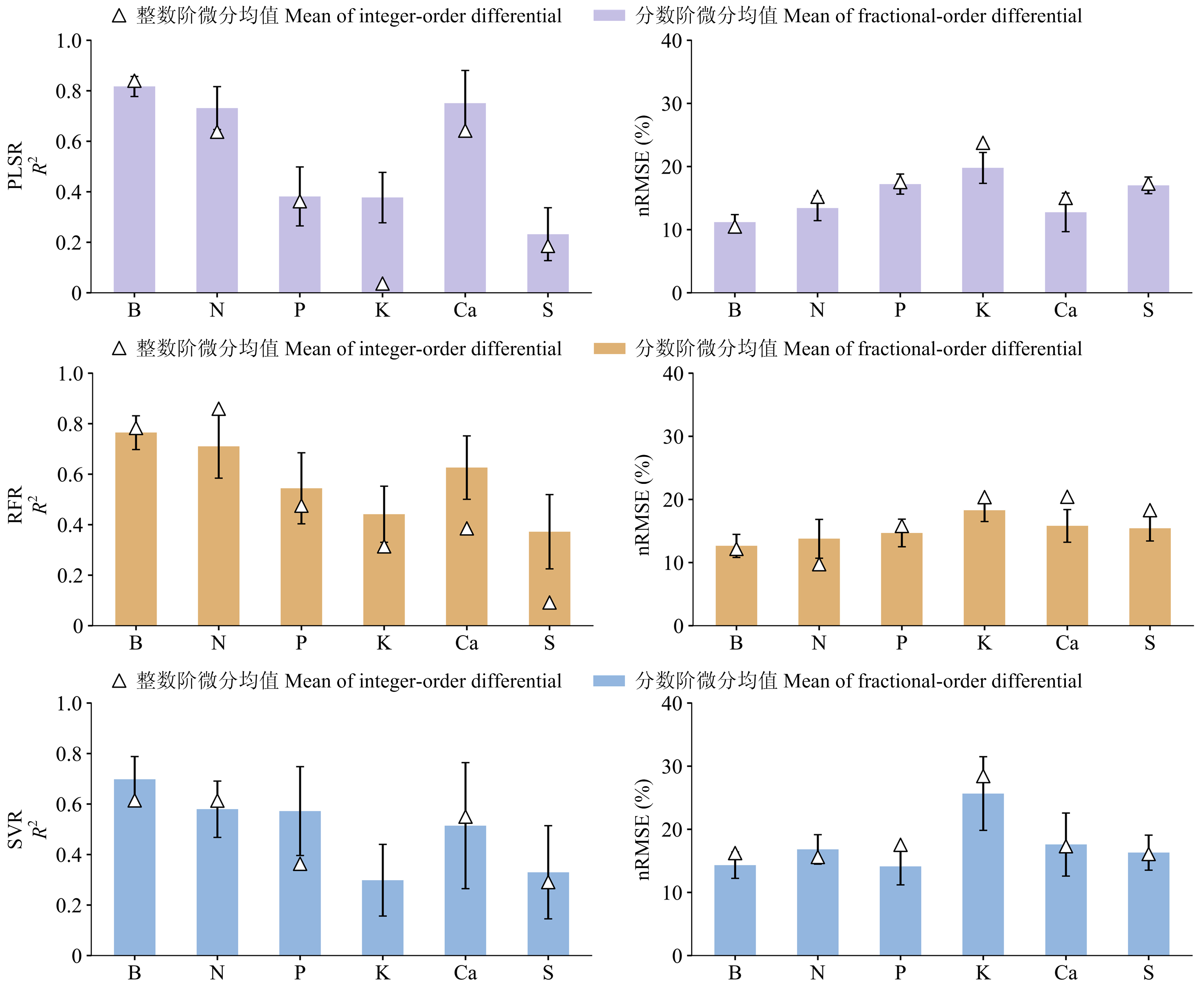
图4
油菜叶片营养元素不同估算模型性能 图中柱状图为0.1—2.0阶FOD处理共20组光谱数据输入模型后的测试集性能均值,误差棒为标准差"

图5
3种算法的优选模型性能"

表1
油菜不同营养元素的最佳估算模型"
| 营养元素 Nutrient | 阶数 Order | 模型 Model | 训练集 Training set | 测试集 Testing set | ||
|---|---|---|---|---|---|---|
| R2 | nRMSE (%) | R2 | nRMSE (%) | |||
| B | 0 | RFR | 0.95 | 6.67 | 0.71 | 14.09 |
| 1.8 | 0.96 | 5.80 | 0.87 | 9.30 | ||
| N | 0 | RFR | 0.95 | 6.49 | 0.68 | 14.89 |
| 2.0 | 0.97 | 5.00 | 0.89 | 8.51 | ||
| P | 0 | SVR | 0.91 | 8.29 | 0.60 | 14.29 |
| 0.5 | 0.83 | 10.83 | 0.76 | 12.21 | ||
| K | 0 | RFR | 0.91 | 8.48 | 0.53 | 16.89 |
| 1.9 | 0.93 | 2.80 | 0.60 | 13.41 | ||
| Ca | 0 | RFR | 0.86 | 11.14 | 0.64 | 13.21 |
| 1.1 | 0.86 | 11.18 | 0.79 | 11.86 | ||
| S | 0 | RFR | 0.73 | 11.00 | 0.59 | 12.31 |
| 1.0 | 0.53 | 13.88 | 0.48 | 20.75 | ||

图6
各营养元素最佳模型的敏感波段"

图7
油菜叶片不同营养元素含量空间分布图"
| [1] |
doi: 10.1016/j.fcr.2017.01.018 |
| [2] |
方振, 刘鹏凌. 我国三大油料作物产能提升的源泉. 中国油料作物学报, 2025, 47(2): 243-259.
doi: 10.19802/j.issn.1007-9084.2024294 |
|
|
|
| [3] |
袁久东. 春油菜需肥规律及化肥减量效应研究[D]. 杨凌: 西北农林科技大学, 2019.
|
|
|
|
| [4] |
doi: 10.1080/01904167.2019.1648674 |
| [5] |
doi: 10.1038/s41598-021-00639-2 pmid: 34702918 |
| [6] |
doi: S0048-3575(18)30021-X pmid: 30033008 |
| [7] |
doi: 10.1007/s42106-024-00302-6 |
| [8] |
doi: 10.1016/j.compag.2023.108356 |
| [9] |
doi: 10.1186/s13007-023-01024-y pmid: 37189108 |
| [10] |
doi: 10.1016/j.isprsjprs.2021.06.017 pmid: 36203652 |
| [11] |
doi: 10.1016/j.compag.2024.108675 |
| [12] |
doi: 10.1016/j.compag.2020.105786 |
| [13] |
杨福芹, 陈日强, 刘杨, 陈鑫鑫, 肖一博, 李昌浩, 王平, 冯海宽. 利用无人机高光谱监测马铃薯生物量及植株氮含量. 光谱学与光谱分析, 2025, 45(6): 1729-1738.
|
|
|
|
| [14] |
栗方亮, 孔庆波, 张青. 基于光谱指数的琯溪蜜柚叶片钙素含量估测模型研究. 中国农业科学, 2025, 58(7): 1321-1332. doi:10.3864/j.issn.0578-1752.2025.07.006.
|
|
|
|
| [15] |
doi: 10.1016/j.eja.2022.126727 |
| [16] |
宋耀邦, 宣传忠, 唐朝辉, 张涛, 李琦. 基于无人机高光谱和机器学习的荒漠草原地上生物量估算. 农业工程学报, 2025, 41(4): 135-143.
|
|
|
|
| [17] |
苏红军. 高光谱遥感影像降维: 进展、挑战与展望. 遥感学报, 2022, 26(8): 1504-1529.
|
|
|
|
| [18] |
马瑜蔓, 段博, 徐宾灿, 邹冉, 石宇辰, 余强毅, 史云, 陆苗, 吴文斌, 宋茜. 基于分数阶微分和无人机高光谱指数优选的油菜产量预测. 农业工程学报, 2025, 41(10): 166-175.
|
|
|
|
| [19] |
doi: 10.1016/j.indcrop.2018.02.051 |
| [20] |
doi: 10.1080/01431161.2022.2068359 |
| [21] |
王清华, 朱格格, 方雯, 刘诗诗, 鲁剑巍. 基于高光谱遥感的油菜叶片氮磷养分含量诊断. 作物学报, 2025, 51(5): 1326-1337.
doi: 10.3724/SP.J.1006.2025.44157 |
|
doi: 10.3724/SP.J.1006.2025.44157 |
|
| [22] |
徐佳佳, 于磊, 傅根深, 燕李鹏, 黄庆丰, 唐雪海. 基于冠层尺度高光谱分数阶微分的薄壳山核桃叶片氮素含量估测. 遥感学报, 2025, 29(5): 1164-1178.
|
|
doi: 10.11834/jrs.20243454 |
|
| [23] |
doi: 10.1016/j.compag.2024.109017 |
| [24] |
丁松滔, 张霞, 尚坤, 李儒, 孙伟超. 基于分数阶微分的土壤重金属高光谱遥感图像反演. 遥感学报, 2023, 27(9): 2191-2205.
|
|
|
|
| [25] |
曾佳辉, 段四波, 姚艳敏, 阎波杰, 韩文静. 结合分数阶微分和异常值识别的土壤有机质高光谱反演研究. 中国农业信息, 2023, 35(4): 11-25.
|
|
|
|
| [26] |
汪杰, 孙孝林, 伍丹华, 周亚男, 刘畅, 曹越, 汤叶涛, 张美薇, 王晓晴, 曾令涛, 崔宇培. 高密度植被覆盖区基于无人机高光谱数据的农田土壤有机质反演. 光谱学与光谱分析, 2025, 45(10): 2885-2896.
|
|
|
|
| [27] |
尚天浩, 陈睿华, 张俊华, 王怡婧. 基于分数阶微分联合光谱指数估算银川平原土壤有机质含量. 应用生态学报, 2023, 34(3): 717-725.
doi: 10.13287/j.1001-9332.202303.020 |
|
doi: 10.13287/j.1001-9332.202303.020 |
|
| [28] |
王瑾杰, 丁建丽, 葛翔宇, 张喆, 韩礼敬. 分数阶微分技术在机载高光谱数据估算土壤含水量中的应用. 光谱学与光谱分析, 2022, 42(11): 3559-3567.
|
|
|
|
| [29] |
邵丽冰, 陈奕云, 徐璐, 洪永胜. 基于分数阶微分的土壤含水量高光谱响应特征与估测模型构建. 测绘地理信息, 2022, 47(S1): 131-136.
|
|
|
|
| [30] |
郭松, 舒田, 刘春艳, 冯恩英, 王文静, 蒋丹垚. 基于分数阶微分的葡萄叶片SPAD值高光谱遥感反演研究. 西南农业学报, 2024, 37(2): 446-456.
|
|
|
|
| [31] |
唐国强, 刘梦云, 蒋丹垚, 宋正华, 常庆瑞. 基于分数阶微分的猕猴桃叶片叶绿素含量估算. 江苏农业学报, 2025, 41(2): 335-344.
|
|
|
|
| [32] |
郑智康, 常庆瑞, 姜时雨, 符欣彤, 李铠, 张子娟, 莫海洋. 基于无人机高光谱分数阶微分玉米SPAD值估算. 东北农业大学学报, 2023, 54(2): 66-74.
|
|
|
|
| [33] |
郭发旭, 冯全, 杨森, 杨婉霞. 基于无人机高光谱的马铃薯冠层叶片全氮含量反演. 浙江农业学报, 2023, 35(8): 1904-1914.
doi: 10.3969/j.issn.1004-1524.20221475 |
|
|
|
| [34] |
doi: 10.3390/agriculture13051017 |
| [35] |
doi: 10.1016/j.microc.2023.109129 |
| [36] |
唐子竣, 向友珍, 王辛, 张威, 李志军, 张富仓, 陈俊英. 利用相关矩阵法优化光谱指数的冬油菜氮素营养诊断. 农业工程学报, 2023, 39(17): 97-106.
|
|
|
|
| [37] |
刘静, 汪泓, 张磊, 肖玖军, 吴建高, 龚明冲. 基于高光谱的辣椒叶片氮素含量反演. 中国农业科学, 2025, 58(2): 252-265. doi:10.3864/j.issn.0578-1752.2025.02.004.
|
|
|
|
| [38] |
黄林峰. 基于多尺度光谱技术的梨树养分检测方法研究[D]. 南京: 南京林业大学, 2024.
|
|
|
|
| [39] |
doi: 10.1016/j.isprsjprs.2023.10.003 |
| [40] |
doi: 10.1016/j.compag.2016.11.008 |
| [41] |
doi: 10.1016/j.rse.2023.113567 |
| [42] |
doi: 10.1016/j.compag.2023.108504 |
| [43] |
秦嘉海. 河西走廊荒漠化土壤资源及生物改土培肥的效应. 农村生态环境, 2004, 20(1): 34-36.
|
|
|
|
| [44] |
崔云玲, 马忠明, 杨君林, 俄胜哲. 甘肃省土壤养分丰缺状况及肥效研究进展. 中国农学通报, 2010, 26(21): 182-185.
|
|
doi: 10.11924/j.issn.1000-6850.2010-1065 |
|
| [45] |
赵良菊, 肖洪浪, 刘晓宏, 郭天文. 甘肃省河西地区灌漠土养分限制因子研究. 干旱地区农业研究, 2003, 21(2): 50-53.
|
|
|
|
| [46] |
doi: 10.1016/j.sigpro.2014.05.026 |
| [47] |
doi: 10.1016/j.rse.2022.113314 |
| [48] |
李岚涛, 汪善勤, 任涛, 马驿, 魏全全, 高雯晗, 鲁剑巍. 基于高光谱的冬油菜叶片磷含量诊断模型. 农业工程学报, 2016, 32(14): 209-218.
|
|
|
|
| [49] |
doi: 10.1016/j.compag.2024.108905 |
| [50] |
doi: 10.1016/j.compag.2023.107671 |
| [51] |
doi: 10.1016/j.plaphy.2021.06.015 pmid: 34214782 |
| [52] |
王玉娜, 李粉玲, 王伟东, 陈晓凯, 常庆瑞. 基于无人机高光谱的冬小麦氮素营养监测. 农业工程学报, 2020, 36(22): 31-39.
|
|
|
|
| [53] |
doi: 10.1021/acs.est.7b01210 |
| [54] |
程潜, 李斌, 张振乾, 官春云, 王悦, 陈浩, 方希林, 杨鑫. 不同硼用量下油菜冠层反射光谱与叶绿素含量间定量关系. 西南农业学报, 2018, 31(10): 2127-2134.
|
|
|
|
| [55] |
doi: 10.1016/j.jag.2024.104063 |
| [56] |
|
| [57] |
doi: 10.1016/j.rse.2020.111758 |
| [1] | 郭月, 张云龙, 刘德才, 王俊禹, 刘湟捷, 邵晓琪, 彭琦, 于仕程, 祁余容, 高建芹, 张洁夫, 胡茂龙. 油菜5N对ALS抑制剂类除草剂的交互抗性机理[J]. 中国农业科学, 2026, 59(9): 1887-1902. |
| [2] | 祝培, 赵耀, 白岩, 张金盔, 李莓, 龙金佳, 杨龙, 罗丽娅, 许本波, 徐劲松, 张学昆. 氟唑菌酰羟胺对油菜的生理调控作用及其与咪鲜胺的复配效应[J]. 中国农业科学, 2026, 59(9): 1903-1915. |
| [3] | 朱琦, 贾振鹏, Tahir SHAH, 徐晨晟, 李芷琦, 吕会帅, 朱鹏超, 韦小敏, 黄冬琳, 孙艳妮, 曹卫东, 高亚军, 王朝辉, 张达斌. 绿肥配施增效产品降低旱地麦田温室气体排放及碳足迹[J]. 中国农业科学, 2026, 59(7): 1507-1522. |
| [4] | 苏一帆, 杨瞻旭, 王迪, 冒俊呈, 魏萌萌, 陈泽, 白欣冉, 楚天歌, 马昌宁, 乔明菲, 孙权, 胡大刚. 2, 4-表油菜素内酯对苹果果实采后贮藏性能的影响[J]. 中国农业科学, 2026, 59(7): 1536-1551. |
| [5] | 刘海卿, 金姣姣, 孙万仓, 柴鹏, 祁伟亮, 杨刚, 李婵, 骆雪梅, 苏芸芸, 秦雪雪. 甘蓝型冬油菜越冬期矮生长点形态建成及多激素调控机制[J]. 中国农业科学, 2026, 59(5): 951-966. |
| [6] | 钱瑾, 李映雪, 吴芳, 邹晓晨. 集成光谱降维的冬小麦叶片磷含量估算[J]. 中国农业科学, 2026, 59(4): 781-792. |
| [7] | 申丽琼, 何林丽, 刘倪, 陆俊杏, 朱波, 张涛. 钾营养水平对油菜苗期抗湿害能力及内源激素平衡的影响[J]. 中国农业科学, 2026, 59(3): 528-542. |
| [8] | 杨锐, 陈敬东, 黄郢, 谢伶俐, 张学昆, 周登文, 刘清云, 徐劲松, 许本波. 长江上游油菜高产品系遗传改良与构型分析[J]. 中国农业科学, 2026, 59(2): 250-264. |
| [9] | 罗欣欣, 余秋华, 张淑贞, 张千, 周志华, 李小坤, 陆志峰, 丛日环, 鲁剑巍. 不同类型粪肥替减氮肥对稻油轮作系统作物产量和养分吸收的影响[J]. 中国农业科学, 2026, 59(11): 2420-2433. |
| [10] | 费耀莹, 王迪, 唐伟杰, 郭彩丽, 张小虎, 邱小雷, 程涛, 姚霞, 江冲亚, 朱艳, 曹卫星, 郑恒彪. 基于无人机多源影像融合的水稻籽粒蛋白质含量估测[J]. 中国农业科学, 2026, 59(1): 41-56. |
| [11] | 栗方亮, 孔庆波, 张青. 基于光谱指数的琯溪蜜柚叶片钙素含量估测模型研究[J]. 中国农业科学, 2025, 58(7): 1321-1332. |
| [12] | 王彬, 吴朋浩, 鲁剑巍, 任涛, 丛日环, 陆志峰, 李小坤. 长江中游地区水稻-油菜轮作体系需水特征[J]. 中国农业科学, 2025, 58(7): 1355-1365. |
| [13] | 张亚封, 董伟进, 李启云, 路杨, 张正坤, 隋丽. 球孢白僵菌与钾元素互作对番茄果实品质的影响[J]. 中国农业科学, 2025, 58(6): 1131-1144. |
| [14] | 梁雪, 姜艳, 危常州, 薛冰, 李芳芳, 崔怡蕊, 张夏然. 基于无人机遥感的玉米农田土壤水分诊断模型研究[J]. 中国农业科学, 2025, 58(23): 4979-4992. |
| [15] | 杜泰峰, 周媛媛, 秦桢, 李爱贤, 王庆美, 张立明, 侯夫云. 外源油菜素内酯减轻SPVD对甘薯块根萌芽的抑制作用[J]. 中国农业科学, 2025, 58(22): 4628-4637. |
|
||
