






中国农业科学 ›› 2026, Vol. 59 ›› Issue (7): 1523-1535.doi: 10.3864/j.issn.0578-1752.2026.07.011
王玉萍1,2( ), 符质1, 孙佳莹1, 穆晓萌1, 刘慧淋1, 郭进云1, 宋文菁1, 侯雷平1, 赵海亮1,3()
收稿日期:2025-11-11
接受日期:2026-01-09
出版日期:2026-04-08
发布日期:2026-04-08
通信作者:
联系方式:
王玉萍,E-mail:yupinghigh@126.com。
基金资助:
WANG YuPing1,2(), FU Zhi1, SUN JiaYing1, MU XiaoMeng1, LIU HuiLin1, GUO JinYun1, SONG WenJing1, HOU LeiPing1, ZHAO HaiLiang1,3()
Received:2025-11-11
Accepted:2026-01-09
Published:2026-04-08
Online:2026-04-08
摘要:
【目的】针对不利气象条件下园艺设施内极易出现的短期低温胁迫问题,探究外源褪黑素对设施番茄抗寒能力的影响,为褪黑素在设施蔬菜生产中的应用提供理论依据。【方法】以‘合作909’番茄为试验材料,于三叶一心时分别浇灌清水或200 μmol·L-1的褪黑素溶液,5 d后将上述2组各一半的幼苗移至昼/夜温度为12 ℃/7 ℃的环境下进行为期12 d的低温处理,剩余幼苗生长于常温环境,期间测定各处理幼苗形态与叶绿素荧光参数、光合色素与矿质元素含量。为期12 d的苗期温度处理结束后,各组幼苗定植于生长环境一致的日光温室,并监测形态参数、物候期和产量品质等指标。【结果】苗期低温导致番茄幼苗叶片光合色素含量下降、光合性能减弱、矿质元素吸收受阻、植株生长受到抑制,且苗期低温的影响会持续至整个生长期,导致番茄定植后生长速度长期滞后于常温对照,物候期延长、产量下降。外源褪黑素的施用提高了番茄幼苗对N、P、K、Fe元素的吸收能力,减缓了光合色素水平的下降,维持了叶片的光合性能,显著缓解了苗期低温对番茄幼苗生长的抑制作用;同时褪黑素的施用促进了番茄幼苗在定植后的恢复与生长。【结论】苗期低温抑制了番茄幼苗的生长,并且不利影响会持续于番茄定植后的整个生长期;施用褪黑素通过调控养分吸收、维持叶片光合性能,有效缓解了低温对番茄生长发育的不利影响。
王玉萍, 符质, 孙佳莹, 穆晓萌, 刘慧淋, 郭进云, 宋文菁, 侯雷平, 赵海亮. 苗期施用褪黑素对番茄短期低温胁迫的缓解作用与应用效果评价[J]. 中国农业科学, 2026, 59(7): 1523-1535.
WANG YuPing, FU Zhi, SUN JiaYing, MU XiaoMeng, LIU HuiLin, GUO JinYun, SONG WenJing, HOU LeiPing, ZHAO HaiLiang. Evaluation of the Mitigating Effect and Application Efficacy of Melatonin Applied at the Seedling Stage on Short-Term Chilling Stress in Tomato Plants[J]. Scientia Agricultura Sinica, 2026, 59(7): 1523-1535.
表1
低温胁迫下外源褪黑素对番茄幼苗生长的影响"
| 处理 Treatment | 株高 Plant height (cm) | 茎粗 Stem diameter (mm) | 地上部鲜重 Fresh weight of the aboveground portion (g) | 地下部鲜重 Fresh weight of the Underground portion (g) | 根冠比(鲜重) root-shoot ratio (fresh) | 地上部干重 Dry weight of the aboveground portion (g) | 地下部干重 Dry weight of the Underground portion (g) | 根冠比(干重) Root-shoot ratio (dry) |
|---|---|---|---|---|---|---|---|---|
| NW | 20.55±1.31a | 4.79±0.13a | 9.7717±0.6828a | 1.3850±0.2331a | 0.1412±0.0172c | 0.6978±0.0334a | 0.1547±0.0154a | 0.2221±0.0244a |
| NM | 20.17±0.60a | 4.82±0.11a | 10.4117±0.3810a | 1.4023±0.2490a | 0.1415±0.0217c | 0.7043±0.0227a | 0.1573±0.0520a | 0.2223±0.0087a |
| CW | 17.30±1.16b | 4.25±0.15b | 6.0267±0.5166c | 1.0450±0.2545c | 0.1722±0.0326b | 0.3700±0.0492c | 0.0608±0.0181c | 0.1637±0.0418a |
| CM | 16.02±1.45b | 4.68±0.11a | 7.0483±0.4390b | 1.4983±0.2188b | 0.2121±0.0219a | 0.4710±0.0469b | 0.0897±0.0215b | 0.1935±0.0533a |
表2
低温胁迫下外源褪黑素对番茄幼苗光合系统能量分配和比活性的影响"
| 处理 Treatment | 光化学 效率 ϕPo | 捕获的激子将电子传递到电子传递链中超过QA的其他电子受体的概率 ψo | 用于电子传递的量子产额 ϕEo | 用于热耗散的量子比率 ϕDo | 以吸收光能为基础的性能指数 PIABS | 单位反应中心吸收的光能 ABS/RC | 单位反应中心捕获的用于还原QA的能量 TRO/RC | 单位反应中心捕获的用于电子传递的能量 ETO/RC | 单位反应中心耗散掉的能量 DIO/RC |
|---|---|---|---|---|---|---|---|---|---|
| NW | 0.8313±0.0015a | 0.6050±0.0131a | 0.5030±0.0106a | 0.1687±0.0015c | 3.3300±0.2174a | 2.2713±0.0204bc | 1.8883±0.0167b | 1.1420±0.0142a | 0.3827±0.0047c |
| NM | 0.8327±0.0029a | 0.5963±0.0057a | 0.4963±0.0060a | 0.1673±0.0029c | 3.3180±0.1241a | 2.2137±0.0790c | 1.8420±0.0665b | 1.0993±0.0490a | 0.3710±0.0140c |
| CW | 0.8027±0.0038c | 0.4870±0.0330b | 0.3907±0.0249c | 0.1973±0.0038a | 1.5753±0.0386c | 2.6223±0.0181a | 2.0720±0.0576a | 1.0650±0.0026b | 0.5197±0.0110a |
| CM | 0.8200±0.0017b | 0.5300±0.0144b | 0.4347±0.0122b | 0.1800±0.0017b | 2.1760±0.1071b | 2.3643±0.0761b | 1.9390±0.0653b | 1.0280±0.0570b | 0.4257±0.0102b |
表3
低温胁迫下外源褪黑素对番茄幼苗叶绿素含量的影响"
| 处理 Treatment | 叶绿素a含量 Chla content (mg∙g-1) | 叶绿素b含量 Chlb content (mg∙g-1) | 叶绿素a/叶绿素b Chla/Chlb | 叶绿素总量 Chl total content (mg∙g-1) | 类胡萝卜素含量 Caro content (mg∙g-1) | 类胡萝卜素/总叶绿素 Caro/Chl |
|---|---|---|---|---|---|---|
| NW | 2.4309±0.0658a | 0.9660±0.0285a | 2.5184±0.1167a | 3.3969±0.0634a | 0.4054±0.0399a | 0.1192±0.0101a |
| NM | 2.5491±0.1416a | 1.0215±0.1022a | 2.5035±0.1345a | 3.5706±0.2393a | 0.4333±0.0201a | 0.1216±0.0069a |
| CW | 1.7220±0.1003c | 0.7635±0.0102b | 2.2544±0.1020a | 2.4855±0.1105c | 0.2796±0.0248b | 0.1124±0.0074a |
| CM | 2.0065±0.0580b | 0.8861±0.1271ab | 2.2947±0.3198a | 2.8926±0.1688b | 0.3396±0.0387b | 0.1181±0.0203a |
表4
低温胁迫下外源褪黑素对番茄幼苗元素吸收与分配的影响"
| 元素 Element | 处理 Treatment | ||||
|---|---|---|---|---|---|
| NW | NM | CW | CM | ||
| N (mg∙g-1) | 根 Root | 5.9956±0.2521b | 8.3182±0.8611a | 6.4246±0.2057b | 8.2142±0.3278a |
| 茎 Steam | 5.4807±0.0989b | 8.1412±0.1441a | 4.5758±0.2791c | 7.6545±0.5695a | |
| 叶 Leaf | 12.0020±0.8710c | 15.7524±0.3158a | 11.5167±0.2578c | 14.6880±0.3306b | |
| P (mg∙g-1) | 根 Root | 1.5870±0.0933b | 1.7730±0.0472a | 1.2313±0.0592c | 1.4881±0.0127b |
| 茎 Steam | 1.6560±0.0423b | 1.8993±0.0642a | 1.4310±0.0580c | 1.4464±0.0256c | |
| 叶 Leaf | 3.0090±0.0785c | 3.8817±0.0490a | 2.7879±0.0496d | 3.5689±0.0307b | |
| K (mg∙g-1) | 根 Root | 1.0376±0.0361c | 1.5284±0.0279b | 1.4409±0.0630b | 1.9870±0.1194a |
| 茎 Steam | 4.5644±0.1820c | 5.2527±0.0638a | 3.4670±0.0278d | 4.9394±0.1523b | |
| 叶 Leaf | 3.2997±0.0551c | 4.4587±0.1492a | 4.1916±0.0757b | 4.3844±0.1144ab | |
| Ca (mg∙g-1) | 根 Root | 0.0251±0.0032c | 0.0231±0.0012c | 0.0554±0.0021b | 0.1304±0.0012a |
| 茎 Steam | 0.0437±0.0032c | 0.0362±0.0024d | 0.0644±0.0059b | 0.1283±0.0024a | |
| 叶 Leaf | 0.0346±0.0021c | 0.0356±0.0030c | 0.0554±0.0036b | 0.1318±0.0036a | |
| Na (mg∙g-1) | 根 Root | 1.4057±0.1030a | 1.1973±0.0289b | 1.2005±0.0281b | 0.8183±0.0421c |
| 茎 Steam | 0.9698±0.0565a | 0.7287±0.0113b | 0.6831±0.0596b | 0.5528±0.0160c | |
| 叶 Leaf | 0.6113±0.0624b | 0.5322±0.0331b | 0.7377±0.0697a | 0.5897±0.0106b | |
| Mg (mg∙g-1) | 根 Root | 0.7545±0.0033b | 0.8196±0.0016a | 0.7012±0.0135c | 0.6124±0.0077c |
| 茎 Steam | 0.5010±0.0088b | 0.4960±0.0034b | 0.5510±0.0044a | 0.4095±0.0209c | |
| 叶 Leaf | 0.6299±0.0034b | 0.7170±0.0307a | 0.6896±0.0062b | 0.6928±0.0055b | |
| Fe (μg∙g-1) | 根 Root | 76.1050±1.3000c | 56.6050±2.6000d | 166.6667±13.0864b | 403.2567±9.8434a |
| 茎 Steam | 107.3000±6.5000c | 142.4000±20.8000b | 86.9350±3.9688c | 220.3975±12.9975a | |
| 叶 Leaf | 151.0667±5.4123b | 119.8667±9.8434c | 151.9333±7.9431b | 333.9267±24.1553a | |
| Zn (μg∙g-1) | 根 Root | 67.8480±2.5692a | 34.9117±1.3595c | 44.0133±2.6600b | 31.0567±3.8914c |
| 茎 Steam | 61.4200±1.7399a | 38.1767±2.6381b | 38.1767±1.8059b | 33.2333±0.7474c | |
| 叶 Leaf | 71.6067±1.4947a | 37.8800±0.7852c | 43.4183±1.4017b | 31.3517±2.8301d | |
| Cu (μg∙g-1) | 根 Root | 26.1500±1.3150c | 62.9950±1.3150a | 44.5725±0.7875b | 45.3600±3.1600b |
| 茎 Steam | 84.0500±1.3150a | 72.2083±4.5582b | 44.5725±3.9475c | 45.8883±4.5582c | |
| 叶 Leaf | 38.9600±1.6714b | 88.8767±9.2412a | 24.8333±2.6325c | 36.1150±3.8189b | |
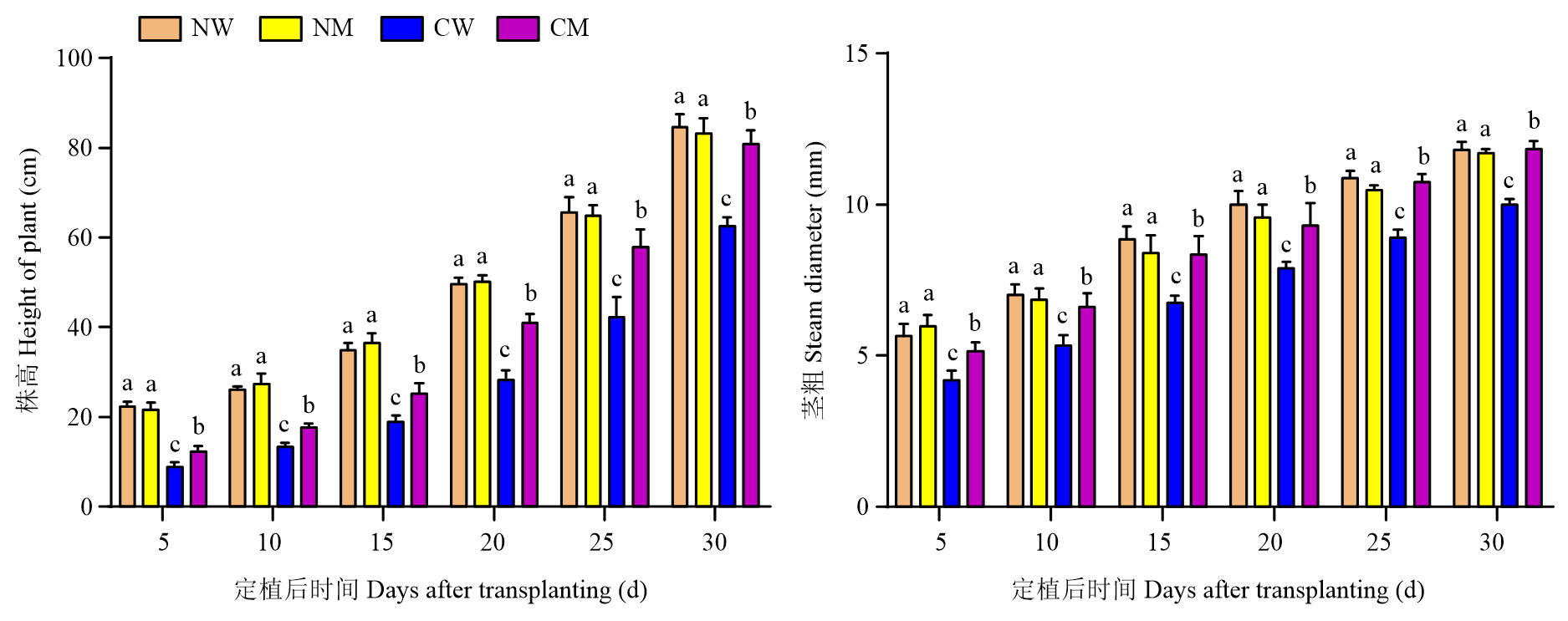
图1
苗期低温期间施用外源褪黑素对番茄定植后株高和茎粗的影响"
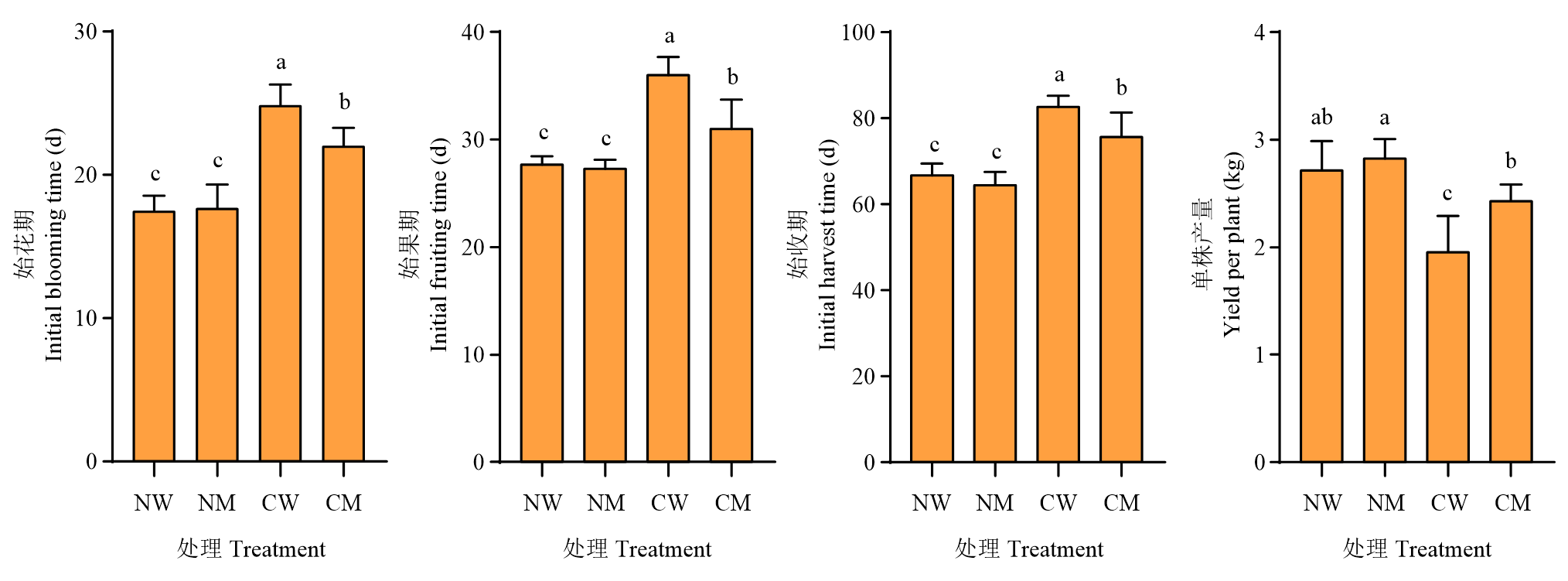
图2
苗期低温期间施用外源褪黑素对番茄定植后物候期和产量的影响"
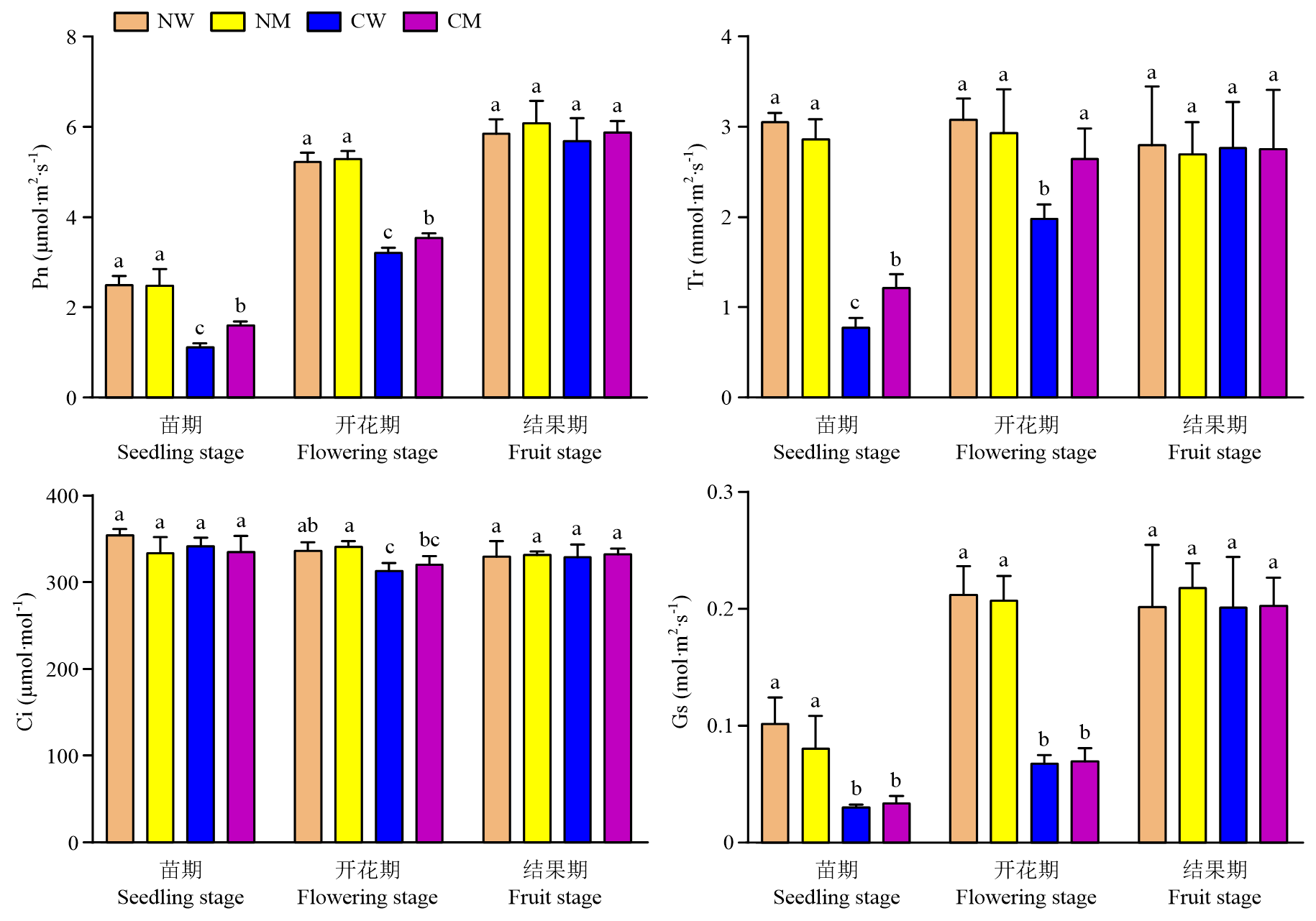
图3
苗期低温期间施用外源褪黑素对番茄定植后光合参数的影响"
表5
苗期低温施用外源褪黑素对番茄果实品质的影响"
| 处理 Treatment | 可溶性固形物 Soluble solid content (%) | 可溶性糖 Soluble sugar (%) | 可滴定酸 Titratable acid (%) | 糖酸比 sugar-acid ratio (%) | 可溶性蛋白 Soluble protein (μg·g-1) | 维生素C Vitamin C (μg·g-1) | 番茄红素 Lycopene (μg·g-1) | 硝酸盐 Nitrate (μg·g-1) |
|---|---|---|---|---|---|---|---|---|
| NW | 4.0667±0.0577b | 1.9663±0.0461a | 0.0986±0.0085c | 20.0588±2.1072a | 61.7372±2.9823d | 268.9472±7.3435a | 52.5123±4.7705c | 291.5463±8.3237a |
| NM | 4.4333±0.1155a | 1.5209±0.1423b | 0.1042±0.0032c | 14.6330±1.8501b | 72.4852±2.6852c | 255.4904±8.8308a | 59.4133±3.7443b | 241.5625±0.5468c |
| CW | 4.2333±0.0577b | 1.8081±0.1449ab | 0.1210±0.0032b | 14.9347±0.8132b | 77.9383±2.9068b | 260.7205±10.8083a | 58.0400±1.1257bc | 265.8959±7.5944b |
| CM | 4.1333±0.1528b | 1.8452±0.3000ab | 0.1340±0.0056a | 13.7392±1.7639b | 92.8844±1.9347a | 226.7403±4.4330b | 67.5555±1.9608a | 258.1169±7.4534b |
| [1] |
|
| [2] |
李天来. 我国设施蔬菜科技创新方向与任务. 园艺学报, 2025, 52(4): 1-2.
|
|
|
|
| [3] |
刘霓红, 蒋先平, 程俊峰, 李惠玲, 李苇, 薛坤鹏, 侯露, 熊征. 国外有机设施园艺现状及对中国设施农业可持续发展的启示. 农业工程学报, 2018, 34(15): 1-9.
|
|
|
|
| [4] |
赵海亮, 左璐, 张璐, 郭天宇, 张毅, 李小靖, 胡晓辉, 王玉萍. 低温胁迫下外源褪黑素对番茄幼苗光抑制的缓解效应. 应用生态学报, 2023, 34(1): 151-159.
doi: 10.13287/j.1001-9332.202301.015 |
|
|
|
| [5] |
doi: 10.3390/cells14020110 |
| [6] |
doi: 10.32615/bp.2022.008 |
| [7] |
秦东玲, 李钊, 尉菊萍, 杨文一, 白冰, 刘宇龙, 张倩, 杨德光. 作物抗冷性及其化学控制机理研究进展. 作物杂志, 2016(4): 26-35.
|
|
|
|
| [8] |
贾湘璐, 粟智勇, 赵文军, 蓝永, 刘秀, 欧阳子龙. 低温对植物生理的影响及生长调节剂的缓解作用研究进展. 热带农业科学, 2025, 45(4): 177-188.
|
|
|
|
| [9] |
许辰雨, 张倩, 杜利霞. 油菜素内酯对植物生长发育影响的研究进展. 草学, 2025(1): 17-21, 27.
|
|
|
|
| [10] |
束胜, 汤园园, 罗佳音, 孙锦, 袁颖辉, 钟珉, 郭世荣. 外源24-表油菜素内酯对亚低温弱光胁迫下番茄叶片碳同化和抗氧化代谢的影响. 植物生理学报, 2016, 52(8): 1295-1304.
|
|
|
|
| [11] |
安晟民. 油菜素内酯通过脱落酸合成以及SRT1介导的组蛋白去乙酰化调控番茄耐冷性的机制[D]. 杭州: 浙江大学, 2023.
|
|
|
|
| [12] |
|
| [13] |
doi: 10.1016/j.scienta.2022.111007 |
| [14] |
林佳怡, 陈强, 张磊, 刘宏鑫, 郑晓明, 逄洪波. 褪黑素在植物低温胁迫中的研究进展. 生物技术通报, 2025, 41(7): 37-48.
doi: 10.13560/j.cnki.biotech.bull.1985.2024-1061 |
|
|
|
| [15] |
高俊凤. 植物生理学实验指导. 北京: 高等教育出版社, 2006.
|
|
|
|
| [16] |
鲍士旦. 土壤农化分析. 3版. 北京: 中国农业出版社, 2000.
|
|
|
|
| [17] |
张连富, 丁霄霖. 番茄红素简便测定方法的建立. 食品与发酵工业, 2001, 27(3): 51-55.
|
|
|
|
| [18] |
doi: 10.1002/ps.v80.11 |
| [19] |
doi: 10.1111/jipb.12706 |
| [20] |
doi: 10.1104/pp.106.093948 pmid: 17208957 |
| [21] |
|
| [22] |
doi: 10.3389/fpls.2017.00134 pmid: 28223997 |
| [23] |
doi: 10.1371/journal.pone.0221687 |
| [24] |
臧祎娜, 张德闪, 李海港, 程凌云, 张朝春, 申建波. 褪黑素调控根系生长和根际互作的机制研究进展. 植物营养与肥料学报, 2019, 25(4): 671-682.
|
|
|
|
| [25] |
doi: 10.1111/nph.17074 pmid: 33175410 |
| [26] |
doi: 10.1016/j.still.2025.106451 |
| [27] |
束胜, 胡晓辉, 王玉, 张润花, 袁颖辉, 陈长军, 施露, 郭世荣. 蔬菜作物逆境生理与抗逆栽培研究进展. 南京农业大学学报, 2022, 45(6): 1087-1098.
|
|
|
|
| [28] |
doi: 10.3390/plants13030383 |
| [29] |
doi: 10.1016/j.jplph.2017.06.008 |
| [30] |
doi: 10.3390/ijms19123896 |
| [31] |
doi: 10.3390/antiox11112143 |
| [32] |
doi: 10.1016/j.tplants.2021.11.005 |
| [33] |
徐健钦, 陈旭蕾, 于福同. 不同铵硝配比条件下BPDS-Fe(Ⅱ)对玉米幼苗耐低铁胁迫差异的影响. 中国农业科学, 2017, 50(7): 1223-1233. doi:10.3864/j.issn.0578-1752.2017.07.005.
|
|
|
|
| [34] |
doi: 10.1111/ppl.v176.5 |
| [35] |
doi: 10.3389/fpls.2016.01814 pmid: 27999581 |
| [36] |
doi: 10.1007/s12298-023-01395-5 |
| [37] |
doi: 10.1016/j.plaphy.2021.08.031 |
| [38] |
doi: 10.1007/s10343-022-00684-5 |
| [39] |
doi: 10.1016/j.scienta.2023.112494 |
| [40] |
doi: 10.1007/s00344-020-10122-3 |
| [41] |
doi: 10.1186/s12870-024-04793-3 pmid: 38331770 |
| [42] |
doi: 10.1007/s00299-023-03116-4 pmid: 38200224 |
| [43] |
doi: 10.1016/j.jplph.2021.153581 |
| [44] |
|
| [45] |
|
| [1] | 陈宣伊, 郭星星, 张向前, 路战远, 刘凌悦, 罗方, 李金龙, 张传玲, 张志青, 车曼青. 间作行比对玉米冠层光环境异质性和光合物质生产的影响[J]. 中国农业科学, 2026, 59(8): 1653-1671. |
| [2] | 侯慧芝, 尹嘉德, 马明生, 刘晓伟, 柳燕兰, 雷康宁. 耕作与增施有机肥对陇东马铃薯-玉米一年两熟制作物产量和水分利用的影响[J]. 中国农业科学, 2026, 59(8): 1672-1685. |
| [3] | 彭廷燊, 陆久焱, 吴美林, 严雨欣, 刘宏周, 南文斌, 秦小健, 李明, 龚俊义, 梁永书. 多年生水稻黄糯2号和长白7号产量相关性状的QTL分析[J]. 中国农业科学, 2026, 59(7): 1361-1379. |
| [4] | 王佳诺, 陈桂平, 李盼, 王丽萍, 南运有, 何蔚, 樊志龙, 胡发龙, 柴强, 殷文, 赵连豪. 免耕地膜两年覆盖提高绿洲灌区玉米产量的灌浆期光合生理机制[J]. 中国农业科学, 2026, 59(6): 1189-1202. |
| [5] | 周新杰, 任昊, 陈应龙, 张吉旺, 赵斌, 任佰朝, 刘鹏, 王洪章. 过氧化钙对渍涝农田夏玉米根系形态及产量形成的影响[J]. 中国农业科学, 2026, 59(6): 1203-1216. |
| [6] | 何继航, 张擎, 吕相月, 薛吉全, 徐淑兔, 刘建超. 不同保绿型玉米杂交种氮效率评价[J]. 中国农业科学, 2026, 59(6): 1217-1230. |
| [7] | 吴媛媛, 吕书文, 张子君, 王涛, 张逸鸣, 卜令超, 邹庆道, 姜晶. 番茄果实果脐大小性状主基因+多基因遗传分析[J]. 中国农业科学, 2026, 59(5): 1060-1069. |
| [8] | 郝琨, 陈洪德, 张威, 钟韵, 党美荣, 朱士江, 黄志坤, 金英. 基于柑橘产量、品质及水氮利用的涌泉根灌水氮综合评价[J]. 中国农业科学, 2026, 59(4): 862-873. |
| [9] | 郭富城, 唐海江, 郝馨怡, 马国林, 杨九菊, 黄霖锋, 田蕾, 王彬, 罗成科. 不同灌溉方式对宁夏盐渍化土壤水盐运移、水稻产量及水分利用效率的影响[J]. 中国农业科学, 2026, 59(4): 750-764. |
| [10] | 延廷霖, 杜娅丹, 胡笑涛, 王贺, 李晓雁, 王玉明, 牛文全, 谷晓博. 加气滴灌下氮肥有机替代对亏缺灌溉棉花产量和水分利用效率的影响[J]. 中国农业科学, 2026, 59(3): 602-618. |
| [11] | 蔡廷阳, 朱玉鹏, 李瑞东, 吴宗声, 徐一帆, 宋雯雯, 徐彩龙, 吴存祥. 苗期叶损伤对黄淮海夏大豆光合特性、荚果分布及产量形成的影响[J]. 中国农业科学, 2026, 59(2): 292-304. |
| [12] | 张志勇, 谭世超, 熊淑萍, 马新明, 韦一昊, 王小纯. 水氮周年优化对豫北灌区小麦玉米轮作系统产量和氮迁移的影响[J]. 中国农业科学, 2026, 59(2): 336-353. |
| [13] | 吕旭东, 孙世媛, 李亚楠, 刘玉龙, 王艳群, 付鑫, 张佳英, 宁鹏, 彭正萍. 智能机械化分层施肥对麦田根-土养分分布和小麦产量的影响[J]. 中国农业科学, 2026, 59(1): 129-146. |
| [14] | 陆浩, 张明龙, 韩梅, 严清彪, 李正鹏, 殷文, 樊志龙, 胡发龙, 柴强. 绿肥过腹还田协同氮肥减施提高小麦产量和土壤质量[J]. 中国农业科学, 2026, 59(1): 147-160. |
| [15] | 叶美金, 陈家婷, 周界光, 尹丽, 胡欣荣, 兰雨昕, 陈斌, 苏龙兴, 刘家君, 刘天超, 李小雨, 马建. 小麦穗密度主效QTL的鉴定、验证及其遗传效应分析[J]. 中国农业科学, 2026, 59(1): 17-28. |
|
||
