






中国农业科学 ›› 2026, Vol. 59 ›› Issue (7): 1420-1438.doi: 10.3864/j.issn.0578-1752.2026.07.004
崔节浩( ), 张萌, 王沁, 于佳妍, 林琨, 李尚泽, 兰恒, 耿艳秋, 张强, 郭丽颖(), 邵玺文()
收稿日期:2025-08-12
接受日期:2026-03-18
出版日期:2026-04-08
发布日期:2026-04-08
通信作者:
联系方式:
崔节浩,E-mail:cuijiehao0626@163.com。
基金资助:
CUI JieHao(), ZHANG Meng, WANG Qin, YU JiaYan, LIN Kun, LI ShangZe, LAN Heng, GENG YanQiu, ZHANG Qiang, GUO LiYing(), SHAO XiWen()
Received:2025-08-12
Accepted:2026-03-18
Published:2026-04-08
Online:2026-04-08
摘要:
【目的】倒伏问题制约着水稻产业的发展。本研究筛选抗倒性强的粳稻品种及粳稻抗倒伏鉴定关键指标,进一步选取不同抗倒性粳稻,比较其理化性质差异,可为抗倒伏粳稻品种选育提供优质亲本资源,并为优化育种策略及解析抗倒伏栽培调控机制提供理论依据。【方法】以50份粳稻种质资源为试验材料,测定其14个抗倒伏性状。通过遗传多样性指数分析和综合评价,将50份粳稻种质资源进行评级分类,并运用灰色关联分析筛选出抗倒伏能力鉴定的关键指标。在此基础上,进一步选取具有不同抗倒伏能力类型粳稻品种:九稻325(抗倒型)、吉玉粳(较抗倒型)和五优稻4号(倒伏敏感型)作为试验材料,系统分析其茎秆特性、物质代谢及基因表达特征,深入探讨粳稻抗倒伏的生理机制。【结果】50份粳稻品种抗倒伏能力性状变异系数在5.38%—21.08%,遗传多样性指数在1.76—2.06,通过主成分分析,提取到4个主成分利用隶属函数法计算综合评价D值,D值范围在0.12—0.72。通过聚类分析,将50份粳稻种质资源分为3类:第1类为抗倒型品种(30%);第2类为较抗倒型品种(32%);第3类为倒伏敏感型品种(38%)。灰色关联分析表明,水稻基部第二节间(N2)长度和N2壁厚与抗倒伏能力综合评价D值关联程度最高。穗重、水稻基部第三节间(N3)长、N2长和N2节间壁厚与粳稻产量关联程度最高。与倒伏敏感型品种相比,抗倒型和较抗倒型粳稻品种的N2节间长度分别显著降低37.02%和9.09%,同时大维管束面积增加20.55%和6.81%,皮层厚度提高15.04%和12.86%。纤维素合成酶基因和木质素合成酶基因表达上调,导致纤维素含量增加37.30%和9.19%,木质素含量提高49.32%和17.71%。其中愈创木基木质素(G型)和紫丁香基木质素(S型)木质素单体占92.36%—93.90%。【结论】筛选出九稻325、庆林168、哈粳稻1号等抗倒伏性状优良的种质资源,N2节间长度和N2节间壁厚可作为高产抗倒伏能力评价鉴定关键指标。与倒伏敏感型粳稻品种相比,抗倒型和较抗倒型粳稻品种通过上调纤维素和木质素合成酶相关基因的表达水平,促进纤维素、木质素单体和木质素的生物合成,同时积累更高的淀粉和可溶性糖含量,优化了茎秆的物理及解剖结构特征,从而提高了粳稻抗倒伏能力。
崔节浩, 张萌, 王沁, 于佳妍, 林琨, 李尚泽, 兰恒, 耿艳秋, 张强, 郭丽颖, 邵玺文. 粳稻资源抗倒伏性评价与生理机制[J]. 中国农业科学, 2026, 59(7): 1420-1438.
CUI JieHao, ZHANG Meng, WANG Qin, YU JiaYan, LIN Kun, LI ShangZe, LAN Heng, GENG YanQiu, ZHANG Qiang, GUO LiYing, SHAO XiWen. Evaluation of Lodging Resistance and Its Physiological Mechanisms in Japonica Rice Resources[J]. Scientia Agricultura Sinica, 2026, 59(7): 1420-1438.
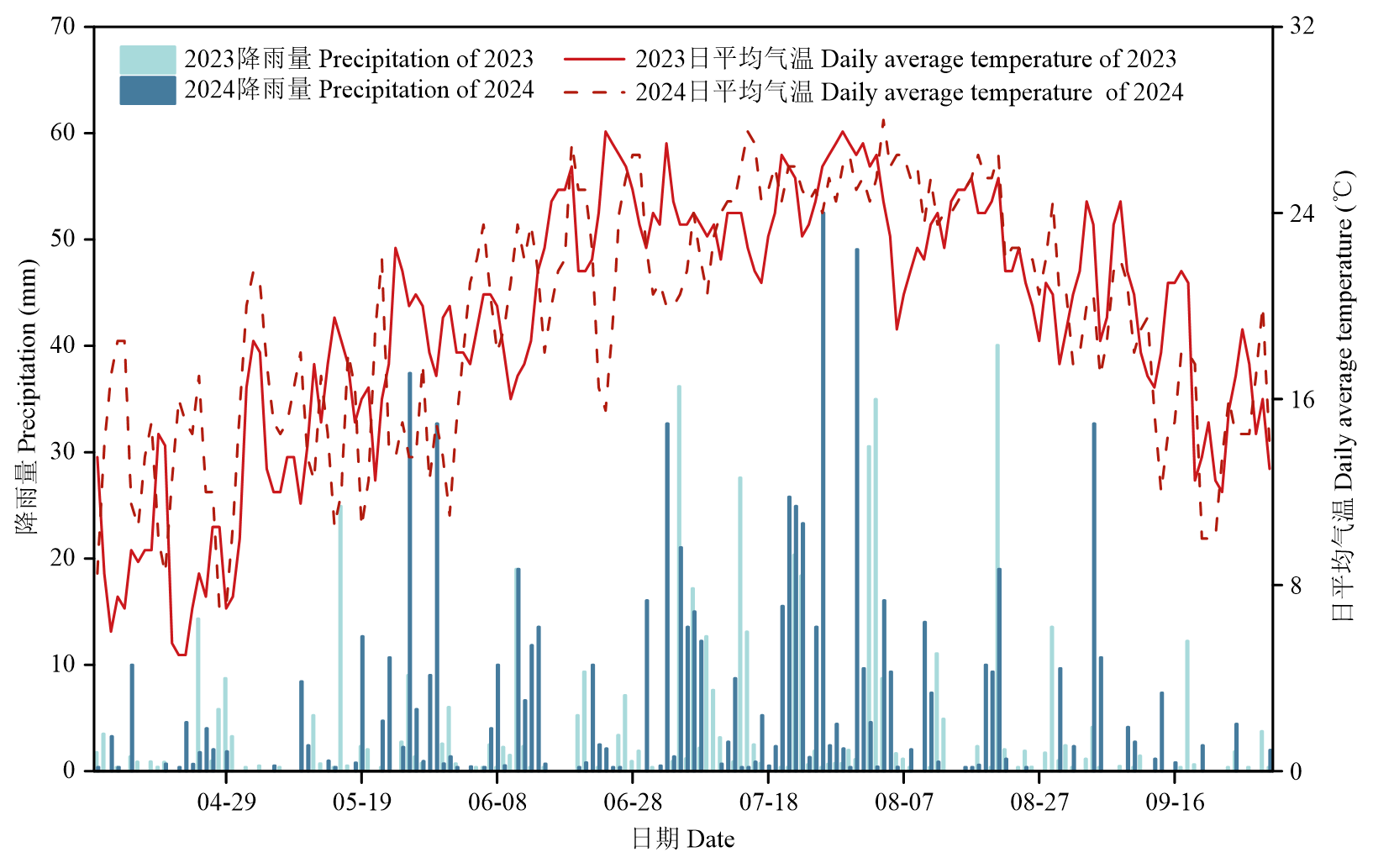
图1
2023—2024年水稻生育期内日平均温度和降雨量"

表1
纤维素和木质素合成途径中关键基因引物及探针的序列"
| 基因名称 Gene name | 序列-F Forward Primer (3′-5′) | 序列-R Reverse Primer (5′-3′) |
|---|---|---|
| OsCesA1 | ttgacttgcacgatcgatacg | tcccacataaactggaccctg |
| OsCesA3 | gcatttttgctactggcatcc | tccctggaacaaagcaaagag |
| OsCesA4 | gttcgatggcattgatcgca | ccacataaaccggaccttgga |
| OsCesA7 | ccggatggatgattcttgttg | cccccaaaacacttttatccc |
| OsCesA8 | tgttgaaggtgctggattcga | tgagagtggaggcaacaaacg |
| OsCesA9 | aggccatccatgtcatcagct | ttgaaccccgttaggatgtcc |
| Os4CL3 | gccgtctcctcgtgtaac | ttggccttagctgctttt |
| OsCAD2 | cgaccagaagtttgtggtgaa | gaagtgcttcagtgggctgta |
| OsCAD7 | tcaccggggtggtgaccgag | ccgccgcaggtgttcaccat |
| OsPAL | accgcttcgtgtatcttcag | aaggatggaatcgagtagca |
| OsCOMT | gaaggtggtggtggtggagt | gcgttggcgtagatgtaggtg |
表2
50份粳稻抗倒伏性状分析"
| 性状 Trait | 变化范围 Range | 平均值 Mean | 标准差 Mean square | 变异系数 CV (%) | 遗传多样性指数 H' |
|---|---|---|---|---|---|
| 重心高 Height center of gravity (cm) | 38.11—47.31 | 42.61 | 2.29 | 5.38 | 2.05 |
| 株高 Plant height (cm) | 87.22—118.77 | 98.09 | 7.01 | 7.15 | 1.93 |
| N2长 Length of N2 (cm) | 5.68—10.10 | 7.49 | 0.89 | 11.86 | 1.98 |
| N3长 Length of N3 (cm) | 11.59—19.29 | 15.31 | 1.71 | 11.14 | 2.06 |
| N4长 Length of N4 (cm) | 18.32—27.52 | 21.64 | 2.03 | 9.37 | 1.92 |
| N5长 Length of N5 (cm) | 23.26—39.94 | 32.68 | 3.37 | 10.32 | 1.96 |
| 穗长 Panicle length (cm) | 17.64—30.79 | 20.39 | 2.19 | 10.75 | 1.76 |
| N2重 Weight of N2 (g) | 1.83—4.54 | 2.75 | 0.57 | 20.86 | 1.97 |
| N3—N5重 Weight of N3-N5 (g) | 4.61—11.30 | 7.37 | 1.55 | 21.08 | 2.05 |
| 穗重 Panicle weight (g) | 3.35—5.89 | 4.48 | 0.67 | 14.99 | 2.06 |
| N2抗折力 F of N2 (kg) | 0.72—1.88 | 1.36 | 0.24 | 17.87 | 2.04 |
| 茎鞘干重 Dry weight of stem sheath (g) | 1.09—2.41 | 1.76 | 0.28 | 15.74 | 1.97 |
| N2节间壁厚 Wall thickness of N2 (mm) | 0.58—1.08 | 0.76 | 0.09 | 11.25 | 1.89 |
| 产量 Yield ( t·hm-2) | 6600.85—11450.39 | 8971.33 | 1067.61 | 11.90 | 2.06 |
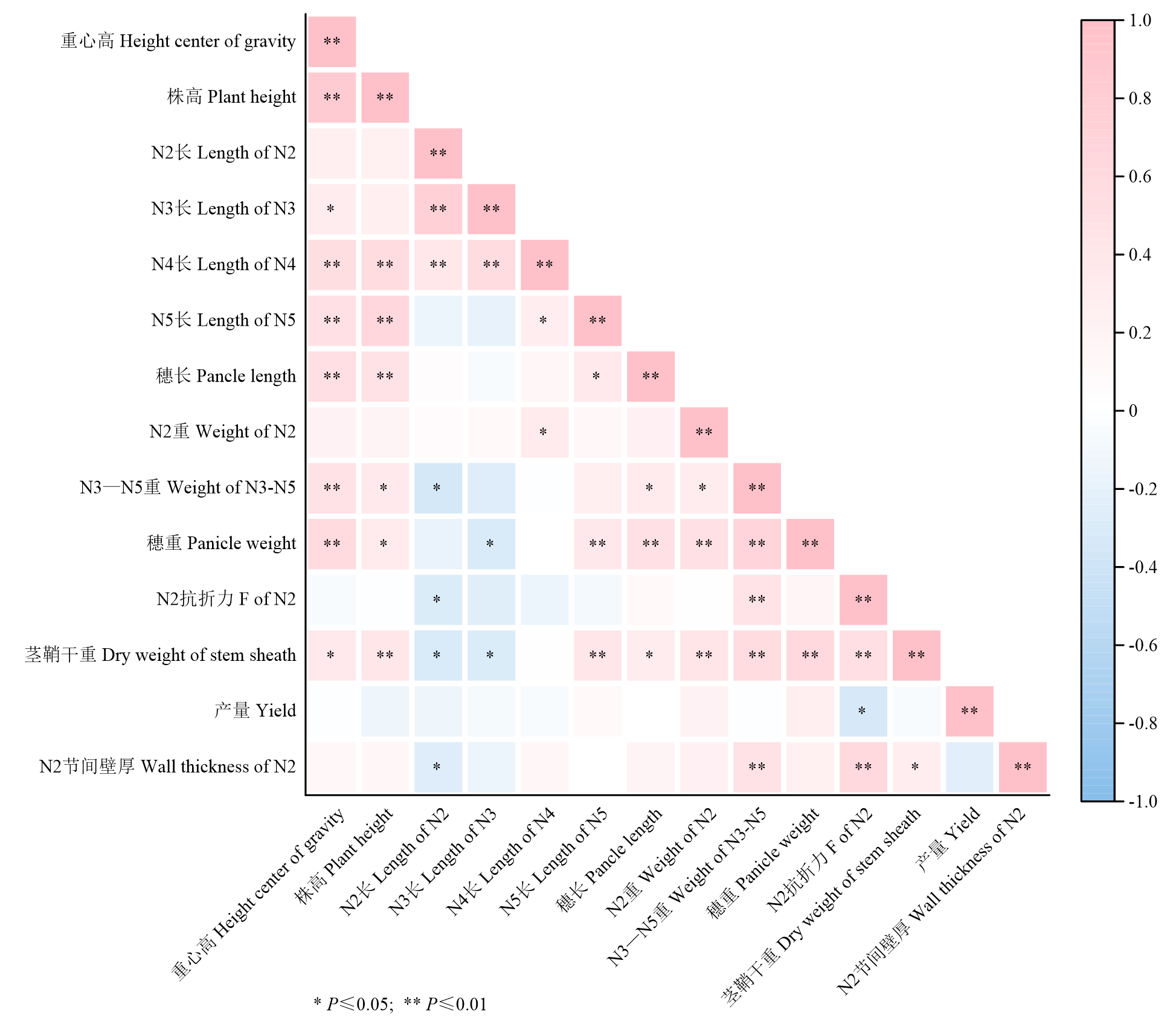
图2
50份粳稻资源抗倒伏能力指标相关性分析"
表3
各指标主成分特征值和累计贡献率"
| 初始特征值 Initial eigenvalue | 提取载荷平方和 The sum of the load squares was extracted | |||||
|---|---|---|---|---|---|---|
| 成分 Ingredient | 总计 Total | 方差百分比 Percentage of variance | 累积 Accumulation (%) | 总计 Total | 方差百分比 Percentage of variance | 累积 Accumulation (%) |
| 1 | 4.36 | 31.12 | 31.12 | 4.36 | 31.12 | 31.12 |
| 2 | 3.04 | 21.70 | 52.82 | 3.04 | 21.70 | 52.82 |
| 3 | 1.74 | 12.43 | 65.24 | 1.74 | 12.42 | 65.24 |
| 4 | 1.23 | 8.78 | 74.02 | 1.23 | 8.78 | 74.02 |
| 5 | 0.86 | 6.14 | 80.16 | |||
| 6 | 0.69 | 4.91 | 85.07 | |||
| 7 | 0.60 | 4.31 | 89.37 | |||
| 8 | 0.45 | 3.24 | 92.61 | |||
| 9 | 0.30 | 2.17 | 94.78 | |||
| 10 | 0.25 | 1.80 | 96.58 | |||
| 11 | 0.21 | 1.49 | 98.07 | |||
| 12 | 0.14 | 0.98 | 99.05 | |||
| 13 | 0.09 | 0.63 | 99.68 | |||
| 14 | 0.05 | 0.32 | 100 | |||
表4
主成分系数、特征值和贡献率"
| 指标 Index | 成分1 C1 | 成分2 C2 | 成分3 C3 | 成分4 C4 |
|---|---|---|---|---|
| 重心高 Height center of gravity (cm) | 0.18 | 0.16 | -0.01 | -0.12 |
| 株高 Plant height (cm) | 0.17 | 0.17 | 0.04 | -0.27 |
| N2长 Length of N2 (cm) | -0.03 | 0.26 | 0.11 | 0.13 |
| N3长 Length of N3 (cm) | -0.03 | 0.27 | 0.18 | 0.21 |
| N4长 Length of N4 (cm) | 0.08 | 0.23 | 0.12 | 0.10 |
| N5长 Length of N5 (cm) | 0.14 | 0.05 | -0.21 | -0.39 |
| 穗长 Panicle length (cm) | 0.14 | 0.03 | -0.05 | -0.10 |
| N2重 Weight of N2 (g) | 0.12 | 0.03 | -0.06 | 0.59 |
| N3—N5重 Weight of N3-N5 (g) | 0.17 | -0.12 | 0.05 | 0.06 |
| 穗重 Panicle weight (g) | 0.18 | -0.06 | -0.19 | 0.17 |
| N2节间抗折力 F of N2 (kg) | 0.08 | -0.18 | 0.36 | 0.04 |
| 茎鞘干重 Dry weight of stem sheath (g) | 0.17 | -0.11 | 0.02 | 0.04 |
| 产量 Yield (t·hm-2) | 0 | 0 | -0.44 | 0.32 |
| N2节间壁厚 Wall thickness of N2 (mm) | 0.10 | -0.11 | 0.33 | 0.15 |
| 特征值 Characteristic values | 4.36 | 3.04 | 1.74 | 1.23 |
| 贡献率 Contribution rates (%) | 31.12 | 21.70 | 12.43 | 8.78 |
| 累计贡献率 Cumulative contribution | 31.12 | 52.82 | 65.24 | 74.02 |
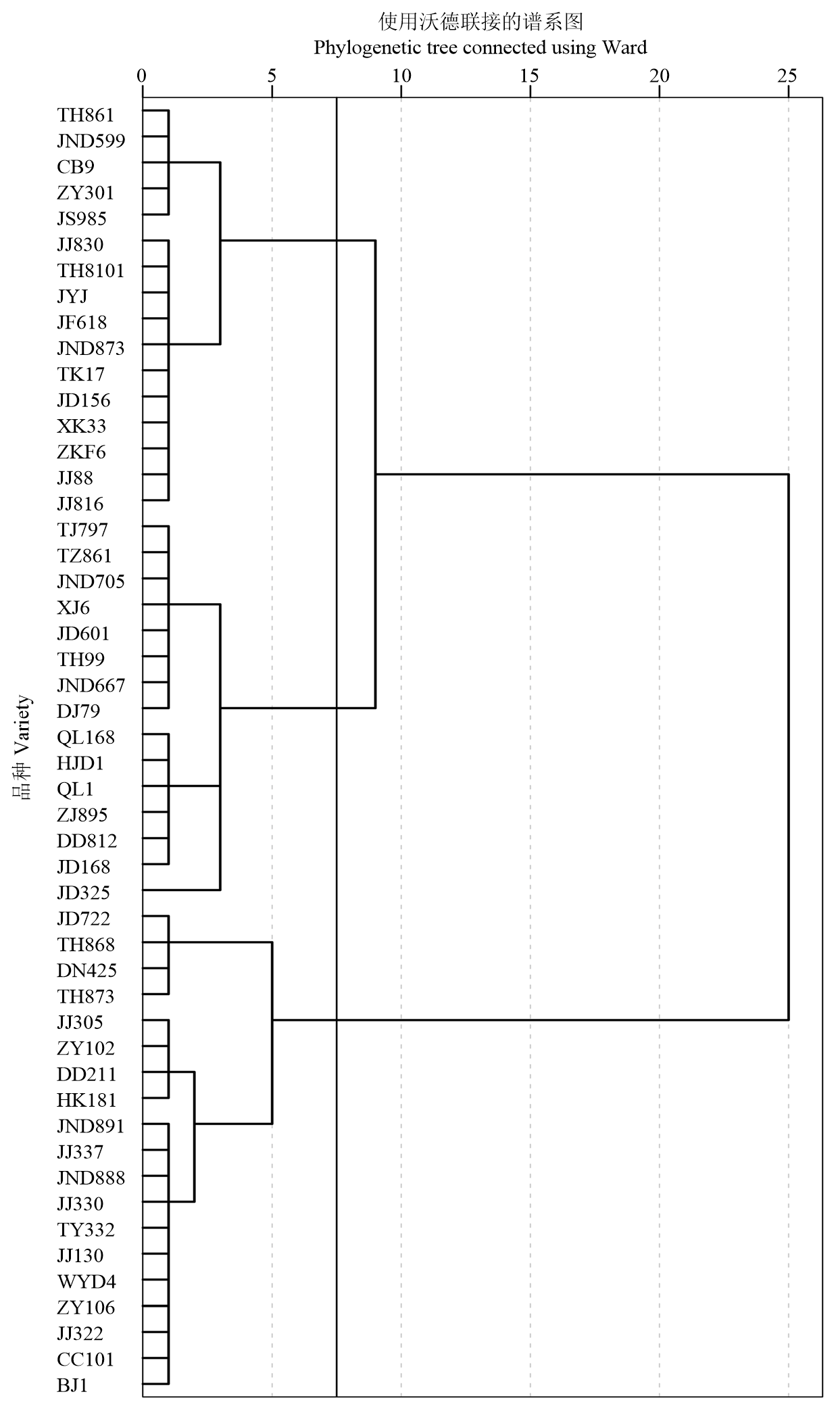
图3
不同粳稻品种D值聚类分析图 TH861:通禾861;JND599:吉农大599;CB9:长白9;ZY301:众赢301;JS985吉盛985;JJ830:吉粳830;TH8101:通禾8101;JYJ:吉玉粳;JF618:吉丰618;JND873:吉农大873;TK17:通科17;JD156:吉大156;XK33:新科33;ZKF6:中科发6;JJ88:吉粳88;JJ816:吉粳816;TJ797:通粳797;TZ861:通泽861;JND705:吉农大705;XJ6:旭粳6;JD601:九稻601;TH99:通禾99;JND667:吉农大667;DJ79:东粳79;QL168:庆林168;HJD1:哈粳稻1;QL1:庆林1号;ZJ895:珍粳895;DD812:东稻812;JD168:佳稻168;JD325:九稻325;JD722:九稻722;TH868:通禾868;DN425:东农425;TH873:通禾873;JJ305:吉粳305;ZY102:中亚102;DD211:东稻211;HK181:宏科181;JND891:吉农大891;JJ337:吉粳337;JND888:吉农大888;JJ330:吉粳330;TY332:通院332;JJ130:吉粳130;WYD4:五优稻4;ZY106:中亚106;JJ332:吉粳332;CC101:春承101;BJ1:白粳1"
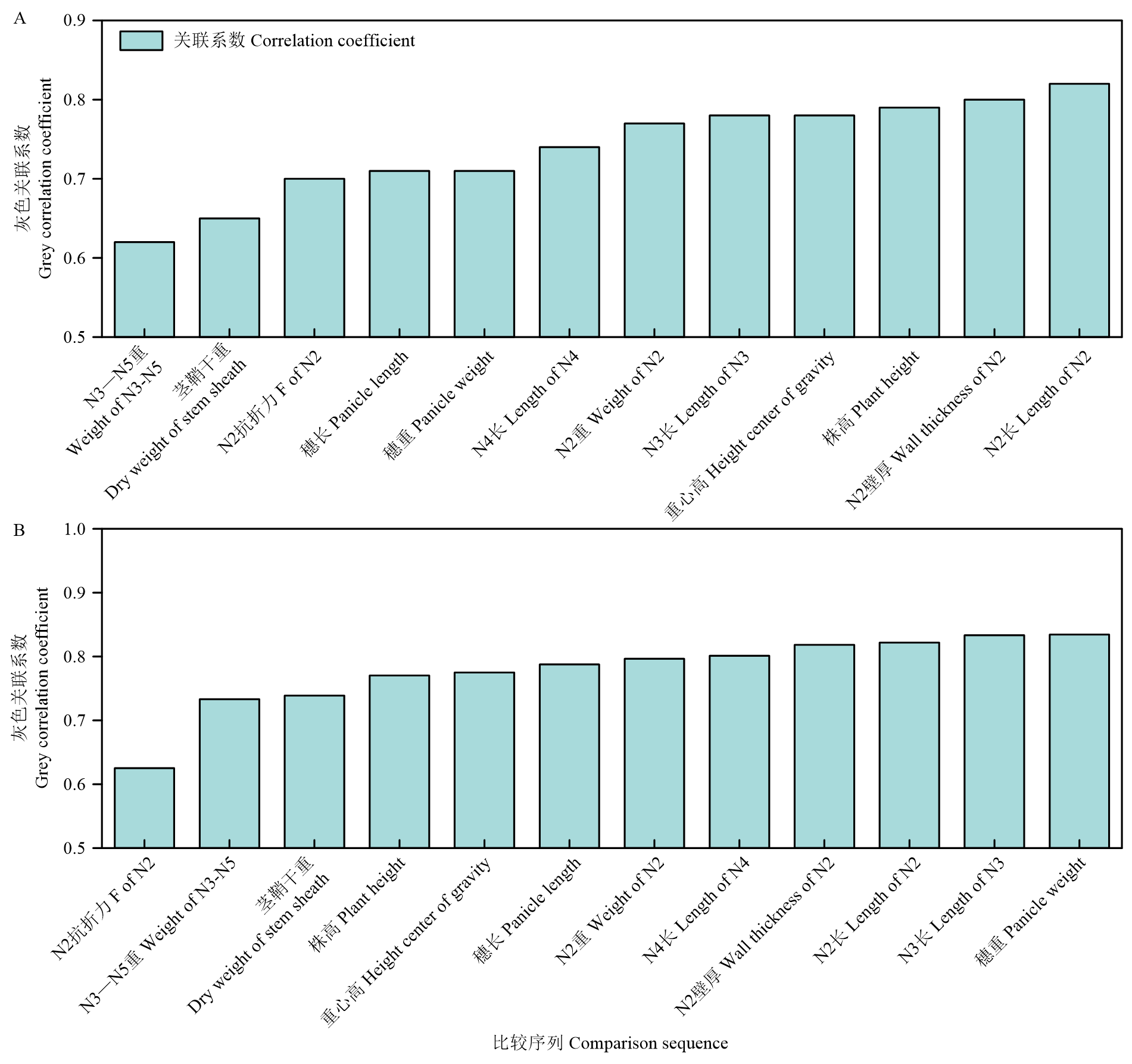
图4
灰色关联度分析 A:D值与参考序列灰色关联度分析图;B:产量与参考序列灰色关联度分析图"
表5
不同抗倒性粳稻品种田间倒伏类型、倒伏分级及倒伏率"
| 年份 Year | 品种 Variety | 倒伏类型 Lodging type | 倒伏分级 Lodging grade | 分级倒伏率 Graded lodging rate (%) | 实际总倒伏率 Actual total lodging rate (%) |
|---|---|---|---|---|---|
| 2023 | 九稻325 JD325 | 无倒伏 No lodging | 0 | 0 | 0 |
| 吉玉粳 JYJ | 茎倒伏 Stem lodging | 1 | 8.14 | 24.92 | |
| 2 | 11.67 | ||||
| 3 | 5.11 | ||||
| 五优稻4号 WYD4 | 茎倒伏 Stem lodging | 1 | 11.72 | 72.17 | |
| 2 | 25.67 | ||||
| 3 | 34.78 | ||||
| 2024 | 九稻325 JD325 | 无倒伏 No lodging | 0 | 0 | 0 |
| 吉玉粳 JYJ | 茎倒伏 Stem lodging | 1 | 7.36 | 20.12 | |
| 2 | 9.94 | ||||
| 3 | 2.82 | ||||
| 五优稻4号 WYD4 | 茎倒伏 Stem lodging | 1 | 10.23 | 77.15 | |
| 2 | 38.42 | ||||
| 3 | 28.50 |
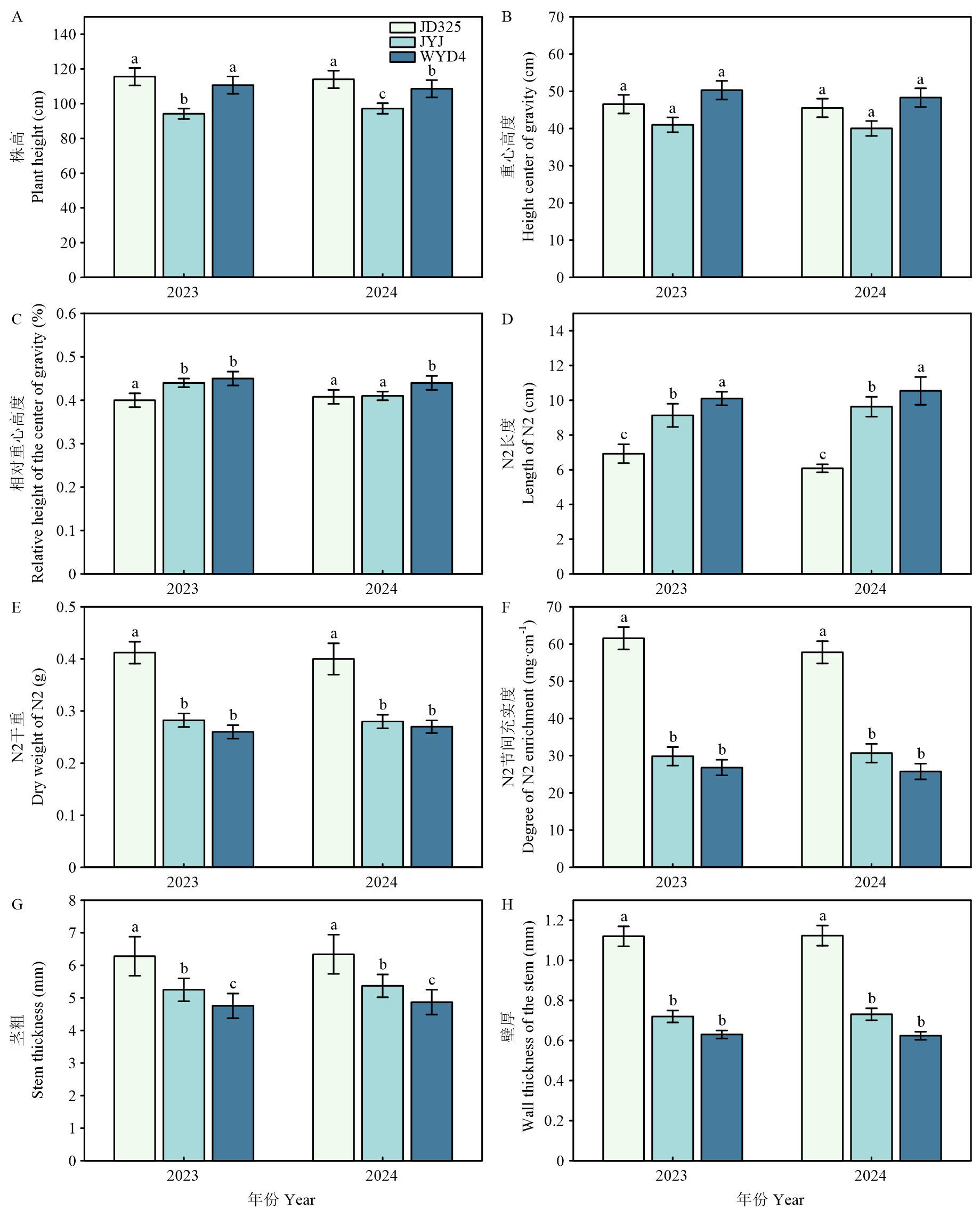
图5
不同抗倒伏能力粳稻形态特征差异 JD325:九稻325;JYJ:吉玉粳;WYD4:五优稻4号。下同"
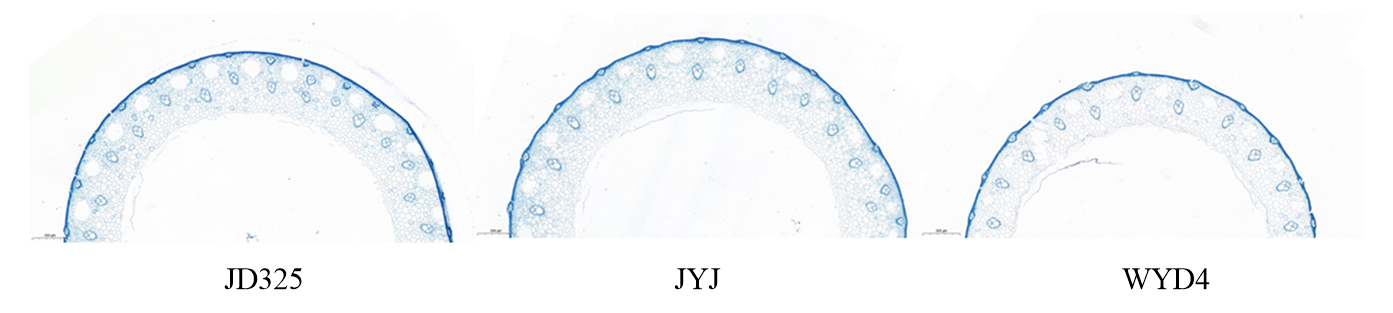
图6
不同抗倒性粳稻茎秆解剖结构图"
表6
不同抗倒伏能力粳稻茎秆解剖结构特征"
| 品种 Variety | 大维管束面积 Large vascular bundle area (μm2) | 小维管束面积 Small vascular bundle area (μm2) | 大维管束个数 Number of large vascular bundles | 小维管束个数 Number of small vascular bundles | 皮层厚度 Cortical thickness (μm) |
|---|---|---|---|---|---|
| 九稻325 JD325 | 22987.67±238a | 7140.50±52a | 31.00±0.91a | 27.62±0.36a | 38.56±0.72a |
| 吉玉粳 JYJ | 20367.60±298b | 7196.25±27a | 29.00±0.82b | 24.67±0.73b | 37.83±0.28a |
| 五优稻4号 WYD4 | 19068.40±435b | 6835.50±107b | 27.00±0.71c | 23.03±0.62b | 33.52±0.27b |
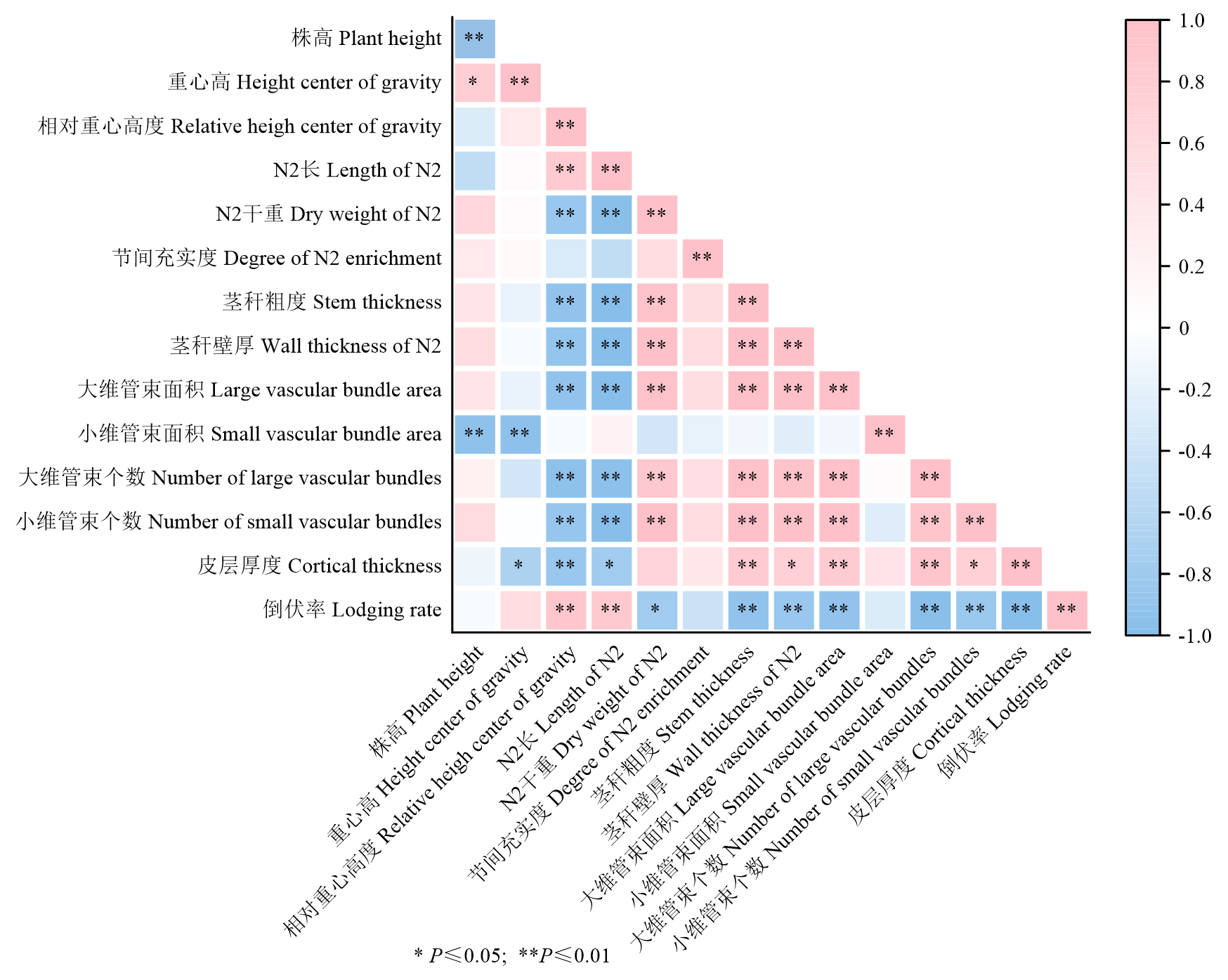
图7
不同抗倒性粳稻物理特性相关性分析"
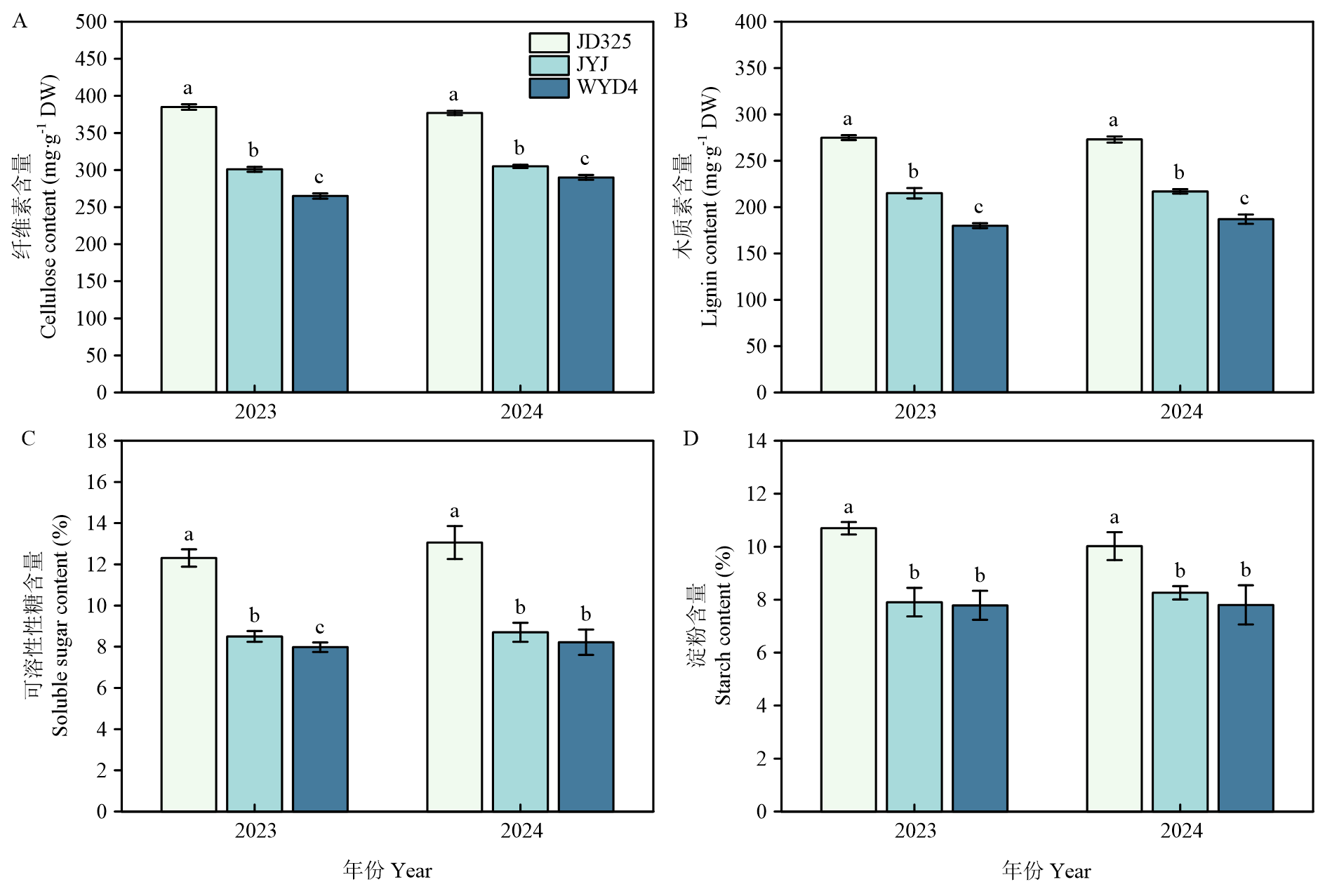
图8
不同抗倒伏能力粳稻化学组分差异"
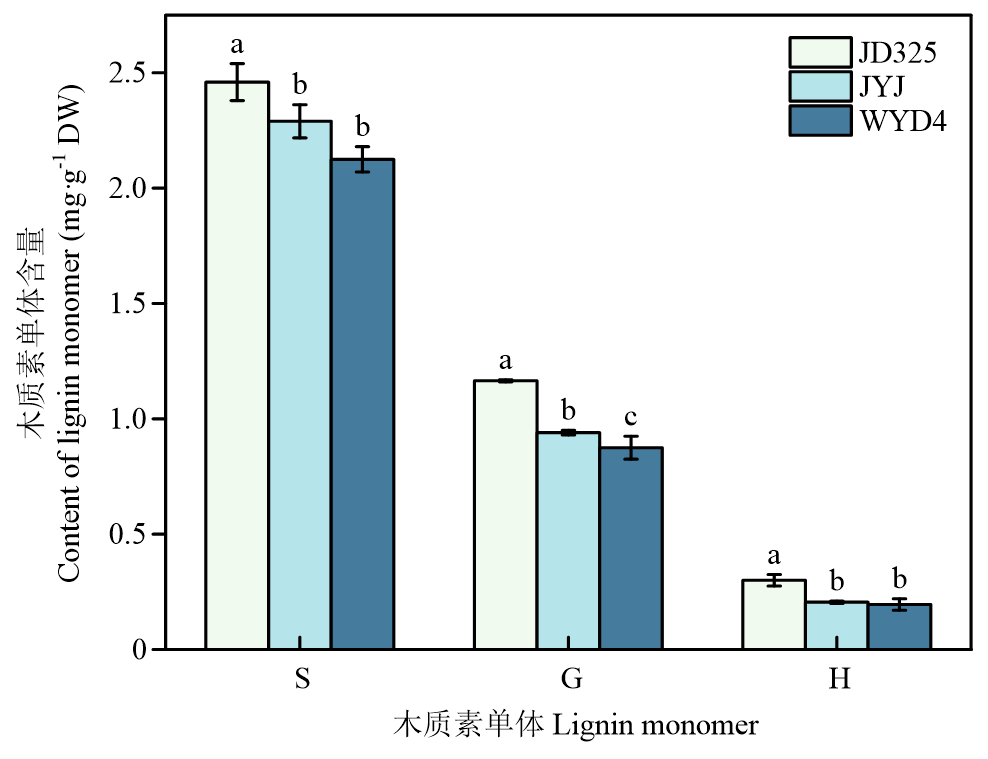
图9
不同抗倒伏能力粳稻木质素单体含量 S:紫丁香基木质素;G:愈创木基木质素;H:对羟基苯基木质素"
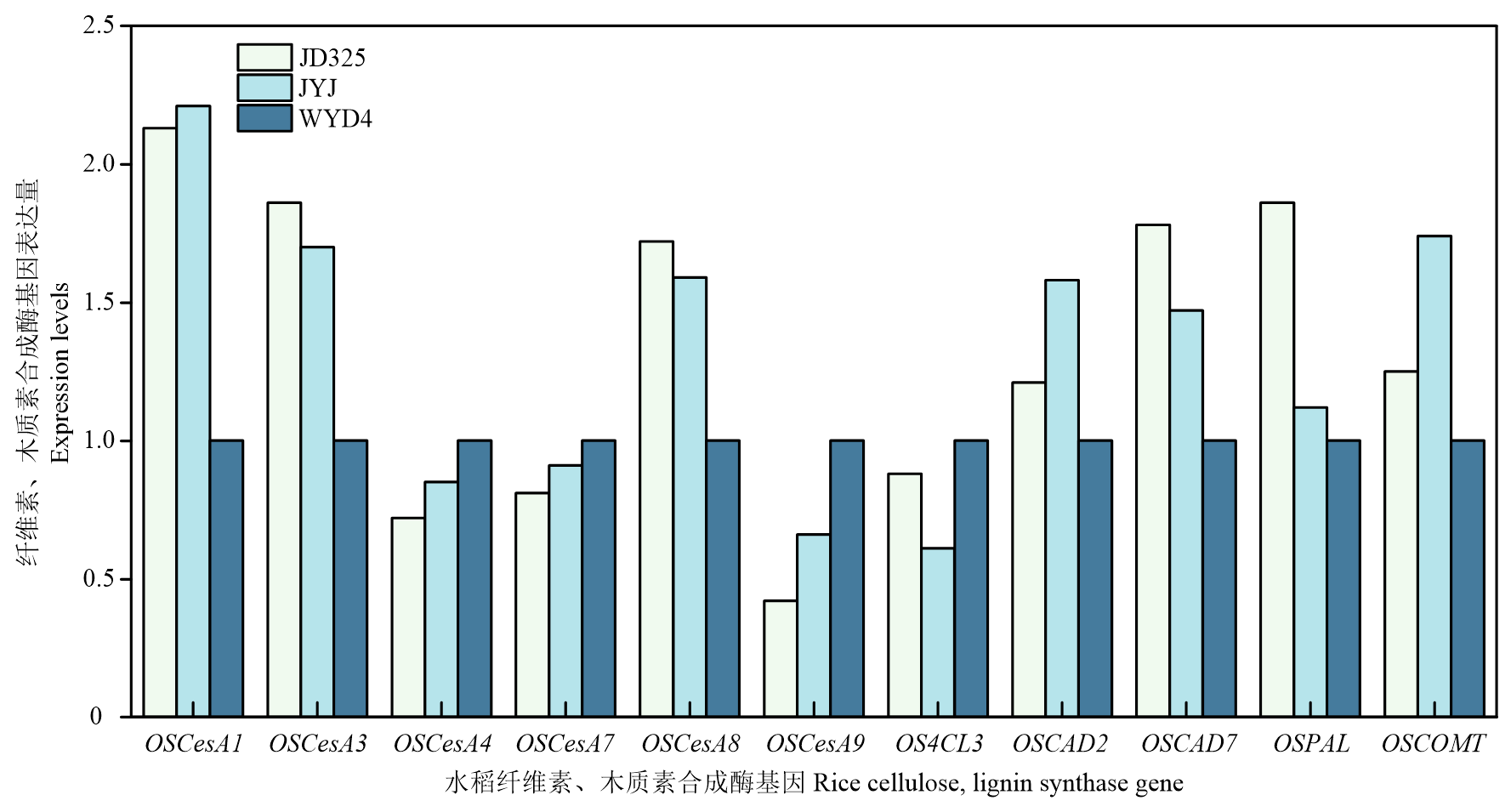
图10
不同抗倒伏能力粳稻纤维素、木质素合成基因表达量"
| [1] |
doi: 10.34133/plantphenomics.0058 |
| [2] |
黄欣乐, 郑百龙. 产量及面积视角的中国水稻生产变动. 江苏农业科学, 2020, 48(2): 311-316.
|
|
|
|
| [3] |
中华人民共和国国家统计局. 2024年粮食产量数据公告. https://www.stats.gov.cn/sj/zxfb/202412/t20241213_1957744.html.
|
|
National Bureau of Statistics of China. Announcement on Grain Production Data for 2024. https://www.stats.gov.cn/sj/zxfb/202412/t20241213_1957744.html. (in Chinese)
|
|
| [4] |
doi: 10.1016/S0378-4290(96)01058-1 |
| [5] |
doi: 10.1016/j.rsci.2024.08.002 |
| [6] |
doi: 10.29244/jtcs.4.2.70-77 |
| [7] |
doi: 10.1007/s11707-019-0803-7 |
| [8] |
doi: 10.3390/plants14182863 |
| [9] |
doi: 10.1007/s11032-020-01161-5 |
| [10] |
doi: 10.3390/ijms20174211 |
| [11] |
doi: 10.3923/ajps.2008.569.573 |
| [12] |
张忠旭, 陈温福, 杨振玉, 华泽田, 高日玲, 高勇, 赵迎春. 水稻抗倒伏能力与茎秆物理性状的关系及其对产量的影响. 沈阳农业大学学报, 1999, 30(2): 81-85.
|
|
|
|
| [13] |
doi: 10.2134/agronj1958.00021962005000100013x |
| [14] |
华泽田, 郝宪彬, 沈枫, 张忠旭, 王岩, 王彦荣, 马秀芳. 东北地区超级杂交粳稻倒伏性状的研究. 沈阳农业大学学报, 2003, 34(3): 161-164.
|
|
|
|
| [15] |
doi: 10.1626/jcs.61.380 |
| [16] |
doi: 10.1080/03650340.2022.2046266 |
| [17] |
|
| [18] |
罗肖郧, 郑兴飞, 彭宣国, 余启芝, 董华林, 殷得所, 王红波, 胡建林, 薛莲, 胡鹏, 徐得泽. 水稻抗倒伏研究: 现状、挑战与未来方向. 中国水稻科学, 2026, 40(2): 181-195.
|
|
|
|
| [19] |
doi: 10.1002/csc2.v62.3 |
| [20] |
马德志. 寒地抗倒玉米品种鉴定评价及其差异分析[D]. 哈尔滨: 东北农业大学, 2020.
|
|
|
|
| [21] |
魏文婧. 不同春甘蓝品种耐低温性鉴定[D]. 杨凌: 西北农林科技大学, 2023.
|
|
|
|
| [22] |
王一凡, 牟金猛, 党昆, 邵玺文, 耿艳秋, 张强, 于林田, 郭丽颖. 吉林省水稻种子萌发期耐苏打盐碱鉴定. 江苏农业科学, 2024, 52(15): 112-122.
|
|
|
|
| [23] |
刘莹. 耐混合盐碱谷子品种的筛选及其生理生化适应机制研究[D]. 大庆: 黑龙江八一农垦大学, 2024.
|
|
|
|
| [24] |
doi: 10.1626/jcs.61.419 |
| [25] |
|
| [26] |
蒋俊朋. 水稻糖分含量全基组关联分析及同化物合成相关性状QTLs验证[D]. 武汉: 华中农业大学, 2017.
|
|
|
|
| [27] |
doi: 10.1016/s0003-2697(69)80009-6 pmid: 5361396 |
| [28] |
pmid: 5029974 |
| [29] |
doi: 10.1021/jf9808776 pmid: 10563943 |
| [30] |
|
| [31] |
|
| [32] |
doi: 10.1038/s41598-025-85641-8 |
| [33] |
doi: 10.1007/s10722-015-0241-7 |
| [34] |
唐桂梅, 李卫东, 周宇霞, 孔佑涵, 肖晓玲, 彭颖姝, 张力, 符红艳, 刘洋, 黄国林. 基于表型性状分析蕙兰种质资源遗传多样性. 中国农业科学, 2025, 58(2): 339-354. doi:10.3864/j.issn.0578-1752.2025.02.010.
|
|
|
|
| [35] |
张江妹, 李艺含, 陈子茁, 李凤, 马小河, 黄丽萍, 王敏, 朱悦, 荀志丽, 赵旗峰. 324份葡萄种质果实性状多样性分析及综合评价. 植物遗传资源学报, 2025, 26(10): 1967-1981.
|
|
|
|
| [36] |
何贤彪, 吴晓华, 马义虎. 台州沿海台风所致水稻倒伏对产量的影响. 中国稻米, 2015, 21(2): 28-29.
doi: 10.3969/j.issn.1006-8082.2015.02.008 |
|
|
|
| [37] |
源朝政, 郑明燕, 鞠乐, 阴志刚, 高小峰, 王虹. 50个月季品种表型多样性分析及综合评价. 天津农业科学, 2022, 28(10): 19-23.
|
|
|
|
| [38] |
吉乃喆, 华莹, 赵世伟, 崔荣峰, 周燕. 藤本月季表型分析与综合评价. 分子植物育种, 2023, 21(4): 1294-1305.
|
|
|
|
| [39] |
doi: 10.1007/s10265-017-0943-3 pmid: 28451936 |
| [40] |
孟军, 陈温福, 王嘉宇. 基于三维模型的水稻叶片对穗重贡献率研究. 河南农业科学, 2008(10): 37-40.
doi: 10.3969/j.issn.1004-3268.2008.10.009 |
|
|
|
| [41] |
doi: 10.1016/j.cj.2019.05.005 |
| [42] |
吴海洋, 姜钦龙, 李云, 黎江陵, 阴云伙, 徐晓明, 吴帅, 曲姗姗, 周卫营. 多效唑对万象优华占茎秆及产量性状的影响. 杂交水稻, 2020, 35(6): 57-59.
|
|
|
|
| [43] |
doi: 10.1016/j.plantsci.2025.112555 |
| [44] |
doi: 10.1038/srep46596 pmid: 28422161 |
| [45] |
范永义, 杨国涛, 陈敬, 蒋芬,
|
|
|
|
| [46] |
doi: 10.1186/s40529-022-00356-7 |
| [47] |
doi: 10.17221/720/2015-PSE |
| [48] |
doi: 10.1016/j.fcr.2006.12.002 |
| [49] |
doi: 10.3390/agriculture12060779 |
| [50] |
doi: 10.1626/jcs.76.262 |
| [51] |
佘恒志, 聂姣, 李英双, 刘星贝, 胡丹, 马珊, 次仁卓嘎, 汪灿, 吴东倩, 阮仁武, 易泽林. 不同抗倒伏能力甜荞品种茎秆木质素及其单体合成特征. 中国农业科学, 2017, 50(7): 1202-1209. doi:10.3864/j.issn.0578-1752.2017.07.003.
|
|
|
|
| [52] |
|
| [53] |
胡炜晨, 张同, 胡振, 王令强. 禾本科植物细胞壁合成调控研究进展. 江苏农业学报, 2018, 34(2): 472-480.
|
|
|
|
| [54] |
doi: 10.1007/s00425-015-2295-3 |
| [55] |
|
| [56] |
doi: 10.1104/pp.111.178301 |
| [57] |
doi: 10.1007/s00299-011-1142-7 |
| [58] |
doi: 10.1093/jxb/erp132 |
| [1] | 罗海琴, 罗仁林, 刘廷辉, 郭伟龙, 曾子贤, 朱博. 禾本科作物抗倒伏研究进展、瓶颈与应对策略[J]. 中国农业科学, 2026, 59(8): 1587-1607. |
| [2] | 王小玮, 杜佛力, 闫红财, 郎正东, 党志娟, 李葆春, 汪军成, 马小乐, 王化俊, 张宏, 姚立蓉. 396份春小麦灌浆期和成熟期抗旱性评价[J]. 中国农业科学, 2026, 59(8): 1608-1621. |
| [3] | 马兆惠, 全成哲, 程海涛, 杨衎劼, 李欣蕊, 吕文彦. 中科发5号背景下东北粳稻育种目标与策略的思考[J]. 中国农业科学, 2026, 59(5): 927-936. |
| [4] | 李思源, 李鸿萍, 常洪庆, 张森焱, 栗思佳, 崔欣飞, 乔泼, 曾波, 刘桂珍, 刘天学, 汤继华, 李潮海. 增密对不同株高玉米品种产量和农艺性状动态变化的影响[J]. 中国农业科学, 2026, 59(5): 967-984. |
| [5] | 郝琨, 陈洪德, 张威, 钟韵, 党美荣, 朱士江, 黄志坤, 金英. 基于柑橘产量、品质及水氮利用的涌泉根灌水氮综合评价[J]. 中国农业科学, 2026, 59(4): 862-873. |
| [6] | 田磊, 邵鑫, 周一民, 苗秀珍, 纪楠, 王浩, 石明帅, 张悦忠. 多因素管理下大兴安岭南麓玉米种植密度及耐密抗倒品种选择[J]. 中国农业科学, 2025, 58(24): 5143-5155. |
| [7] | 高春华, 赵海军, 赵逢涛, 孔玮琳, 巨飞燕, 李宗新, 石德杨, 刘苹. 生长调节剂对玉米大豆带状间作下夏玉米茎秆特性与产量的影响[J]. 中国农业科学, 2025, 58(23): 4920-4935. |
| [8] | 陈天晓, 曹榕, 宋倩楠, 胡亮亮, 王素华, 王丽侠, 程须珍, 陈红霖. 小豆种质资源苗期耐盐性综合评价及耐盐种质筛选[J]. 中国农业科学, 2025, 58(21): 4317-4332. |
| [9] | 唐桂梅, 李卫东, 周宇霞, 孔佑涵, 肖晓玲, 彭颖姝, 张力, 符红艳, 刘洋, 黄国林. 基于表型性状分析蕙兰种质资源遗传多样性[J]. 中国农业科学, 2025, 58(2): 339-354. |
| [10] | 包明芳, 秦燕, 陈彩锦, 张尚沛, 张国辉, 沙晓弟. 111份紫花苜蓿种质资源苗期表型抗旱性鉴定评价[J]. 中国农业科学, 2025, 58(19): 3825-3836. |
| [11] | 赵甜甜, 袁剑龙, 卓峰琦, 唐振三, 徐杰, 张峰. 马铃薯全粉品质综合评价及品种筛选[J]. 中国农业科学, 2025, 58(13): 2522-2537. |
| [12] | 王睿智, 李涛, 钱相玲, 张丫, 杨晓琢, 李光彦, 魏海燕, 张洪程, 刘国栋. 氮素穗肥对南方香粳稻南粳9108产量、品质和香气的影响[J]. 中国农业科学, 2025, 58(12): 2316-2332. |
| [13] | 周宇, 孙童, 张艳红, 汝艳, 苏坦, 王帅, 朱金燕, 胡金龙, 熊强强, 张洪程, 周年兵. 施氮量对不同源库类型粳稻物质积累与氮素吸收的影响[J]. 中国农业科学, 2025, 58(11): 2096-2117. |
| [14] | 陈彩锦, 马琳, 包明芳, 张国辉, 蒋庆雪, 杨天辉, 王川, 王晓春, 高婷, 王学敏, 刘文辉. 111份紫花苜蓿种质资源萌发期抗旱性鉴定评价[J]. 中国农业科学, 2025, 58(10): 1896-1907. |
| [15] | 李培松, 陆永迪, 郭郁, 张启鹏, 刘韬奋, 王天合, 杨明凤, 向导, 田景山, 张旺锋. 基于棉花公证检验数据的新疆原棉品质区域分布规律[J]. 中国农业科学, 2025, 58(1): 58-74. |
|
||
