






中国农业科学 ›› 2026, Vol. 59 ›› Issue (7): 1400-1419.doi: 10.3864/j.issn.0578-1752.2026.07.003
鲁雪莉1,2,3( ), Syeda Wajeeha Gillani1(), 孟晨1,2,3, 李晓彬2,4, 宋奕汝1,5, 柏雨1,5, 王菊英2, 冯晓菲2, 刘晨晨2, 李义强1,2,3(), 徐宗昌1,2()
收稿日期:2025-09-11
接受日期:2025-12-01
出版日期:2026-04-08
发布日期:2026-04-08
通信作者:
联系方式:
鲁雪莉,E-mail:luxl100@163.com。Syeda Wajeeha Gillani,E-mail:swajiha230@163.com。鲁雪莉和Syeda Wajeeha Gillani为同等贡献作者。
基金资助:
LU XueLi1,2,3(), GILLANI SyedaWajeeha1(), MENG Chen1,2,3, LI XiaoBin2,4, SONG YiRu1,5, BAI Yu1,5, WANG JuYing2, FENG XiaoFei2, LIU ChenChen2, LI YiQiang1,2,3(), XU ZongChang1,2()
Received:2025-09-11
Accepted:2025-12-01
Published:2026-04-08
Online:2026-04-08
摘要:
【目的】探究不同类型及浓度盐胁迫对狼尾草种子萌发的影响,解析Na+浓度对种子萌发“低促高抑”的分子机制,为盐碱地狼尾草种植及耐盐品种培育提供理论依据。【方法】以观饲两用型狼尾草品系狼烟1号种子为材料,设置NaCl、MgSO4、NaHCO₃、KCl、Na2SO4及混合盐(NaHCO3﹕NaCl﹕Na2SO4=1﹕15﹕84)的不同浓度处理,通过测定种子发芽势、发芽率、芽长、根长等萌发指标,分析不同处理对种子萌发的影响。对CK、10和100 mmol·L-1 NaCl处理3 d的狼尾草种子进行逆境生理指标检测和转录组测序,挖掘低浓度Na+促进萌发的代谢通路与候选基因,以及解析高浓度Na+抑制萌发的分子机理,并采用qRT-PCR技术进行数据验证。【结果】低浓度NaCl(10—25 mmol·L-1)与Na2SO4(10 mmol·L-1)可促进种子萌发,发芽势、发芽率显著高于对照,相对盐害率为0;高浓度盐(≥100 mmol·L-1)抑制萌发,且NaHCO3抑制作用最强(200 mmol·L-1时种子完全不萌发)。在逆境生理指标层面,低浓度NaCl胁迫显著提高过氧化物歧化酶(SOD)和过氧化氢酶(CAT)活性,以及脯氨酸(Pro)含量,而高浓度NaCl胁迫则显著诱导丙二醛(MDA)生成。经转录组分析,共鉴定到14 259个差异表达基因(DEGs),与低浓度NaCl胁迫促进种子萌发相关的DEGs主要富集在氧化磷酸化通路,该通路中的Pyrophosphatase(PPA)、ATPase H+ transporting vacuolar V1 subunit D(ATPeV1D)等基因表达量与发芽指标显著正相关,ATP synthase F0 subunit A(ATPeF0A)、NADH dehydrogenase subunit 1(ND1)等基因表达量则与相对盐害率、MDA含量显著正相关;高浓度Na+对种子萌发的抑制作用,主要通过下调促进种子萌发相关激素合成途径的基因表达,同时上调抑制种子萌发相关激素合成途径的基因表达实现。qRT-PCR验证表明,转录组数据可靠。【结论】盐胁迫下,狼尾草种子萌发存在Na+浓度“低促高抑”效应,低浓度中性钠盐(NaCl、Na2SO4)可促进萌发,高浓度盐(尤其是碱性盐NaHCO3)抑制萌发;其耐盐机制与抗氧化酶活性调控、脯氨酸积累、氧化磷酸化和植物激素等通路基因表达相关。
鲁雪莉, Syeda Wajeeha Gillani, 孟晨, 李晓彬, 宋奕汝, 柏雨, 王菊英, 冯晓菲, 刘晨晨, 李义强, 徐宗昌. 不同类型盐胁迫对狼尾草种子萌发的影响及钠调控转录组研究[J]. 中国农业科学, 2026, 59(7): 1400-1419.
LU XueLi, GILLANI SyedaWajeeha, MENG Chen, LI XiaoBin, SONG YiRu, BAI Yu, WANG JuYing, FENG XiaoFei, LIU ChenChen, LI YiQiang, XU ZongChang. Effects of Different Types of Salt Stress on Seed Germination of Pennisetum alopecuroides and Study on Sodium-Regulated Transcriptome[J]. Scientia Agricultura Sinica, 2026, 59(7): 1400-1419.

表1
本研究所需qRT-PCR引物"
| 基因Gene | 引物序列Primer sequence (5′-3′) | 产物长度Product length (bp) |
|---|---|---|
| ACTIN2 | F:AGCACCAGAAGAGCATCCAGTT | 138 |
| R:AGTGAAAGGACCGCTTGAATAG | ||
| Alcohol Dehydrogenase 1 (ADH1) | F:ATCGAGGAGGTGGAGGTTG | 102 |
| R:CTTGGCCTCCCAGAAGTAGA | ||
| Plasma membrane ATPase 1 (PMA1) | F:GATCTACCTTGTCACCTCCATG | 123 |
| R:TCAGAGTGAGCGTTGTCGTAA | ||
| ATP synthase F1 subunit alpha (ATPeF1A) | F:GCCCTTCCCATCATTGAGA | 132 |
| R:GTTAATGGCGGGACGGAT | ||
| Pyrophosphatase (PPA) | F:ATCCCGAGTACCGCCACTA | 117 |
| R:CGTCTACAGCCACTTCTTTG | ||
| Cytochrome c Oxidase Subunit 6A (COX6A) | F:TTGGATTGCCGACAACGA | 107 |
| R:AGGGAATGACAGCGAAGATC | ||
| ATP synthase F1 subunit delta (ATPF1D) | F:CCTCAAGACGCAGCTCAAC | 118 |
| R:CTCTGATGCGATCTCCTCAAT | ||
| ATP synthase F0 subunit D (ATPeF0D) | F:GACCGTTGACTTCTCCCACTAC | 111 |
| R:TGGCGGCTGACATCGTA | ||
| ATP synthase F1 subunit beta (ATPeF1B) | F:GTCTCAACCTTTCGCTGTCG | 121 |
| R:TTCGGGCAAAGCATCGT |
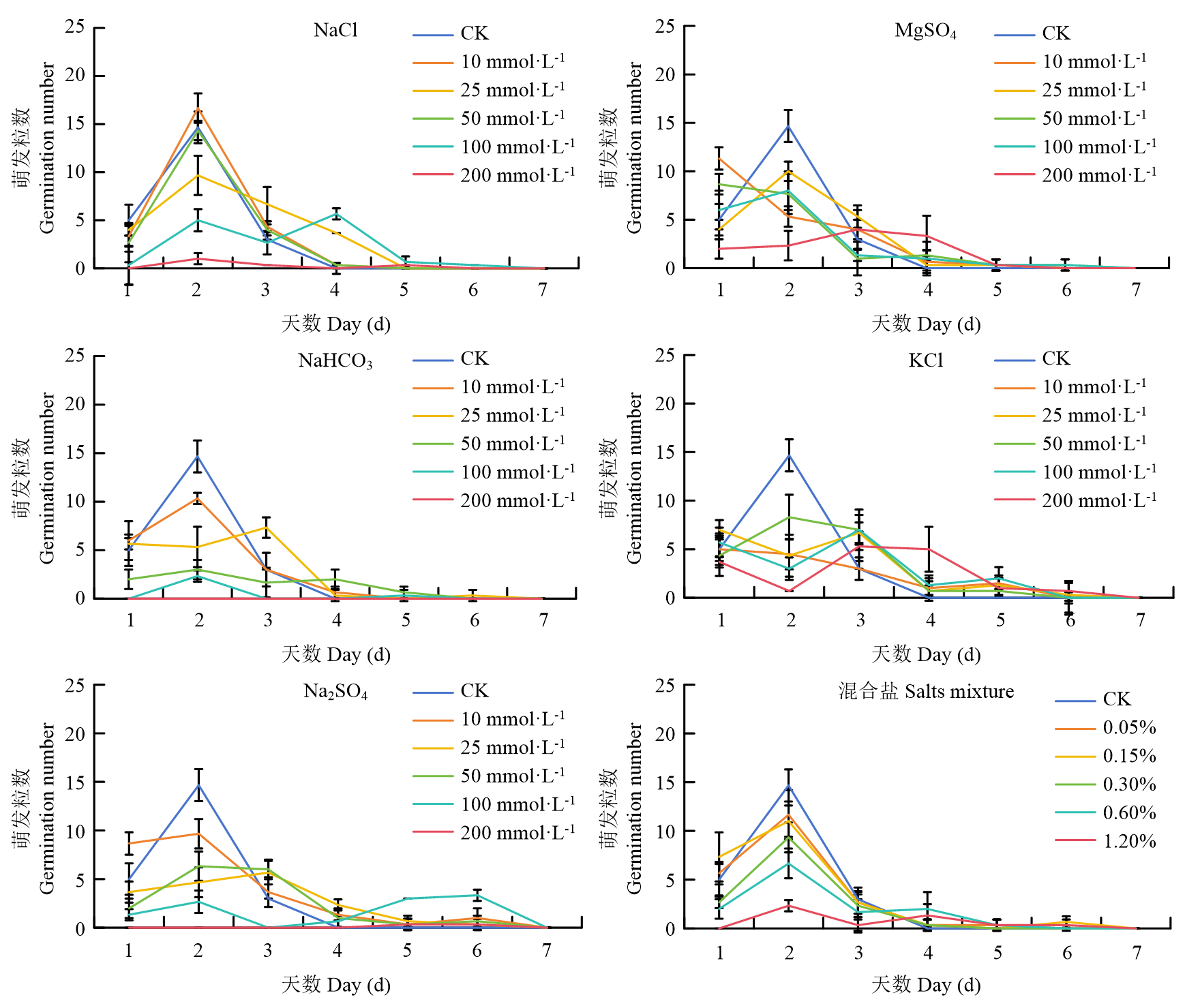
图1
不同类型和浓度盐胁迫下狼烟1号种子逐日萌发统计图"
表2
不同类型和浓度盐胁迫处理对狼烟1号种子萌发指标的影响"
| 指标 Index | 处理 Treatments | NaCl | MgSO4 | NaHCO3 | KCl | Na2SO4 | 混合盐 Salt mixtures |
|---|---|---|---|---|---|---|---|
| 发芽势 Germination energy (%) | CK | 75.56±0.08b | 75.56±0.08a | 75.56±0.08a | 75.56±0.08a | 75.56±0.08a | 75.56±0.08a |
| 1 | 82.22±0.05a | 71.11±0.13ab | 66.67±0.09b | 66.67±0.07ab | 77.78±0.02a | 71.11±0.10a | |
| 2 | 80.00±0.00a | 65.56±0.02b | 62.22±0.05b | 65.56±0.07b | 61.11±0.02b | 68.89±0.05ab | |
| 3 | 71.11±0.15b | 62.22±0.13b | 28.89±0.11c | 61.11±0.05b | 51.11±0.12bc | 67.78±0.04ab | |
| 4 | 44.44±0.02c | 54.44±0.14c | 7.78±0.02d | 57.78±0.05bc | 15.56±0.07c | 41.11±0.13c | |
| 5 | 4.44±0.08d | 38.89±0.15d | 0.00±0.00d | 23.33±0.10c | 0.00±0.00d | 13.33±0.06d | |
| 发芽率 Germination rate (%) | CK | 75.56±0.08b | 75.56±0.08a | 75.56±0.08a | 75.56±0.08a | 75.56±0.08b | 75.56±0.08a |
| 1 | 82.22±0.05a | 72.22±0.12a | 66.67±0.09b | 70.00±0.03ab | 82.22±0.04a | 68.89±0.05b | |
| 2 | 80.00±0.00a | 66.67±0.03ab | 63.33±0.06b | 67.78±0.10b | 64.44±0.02bc | 73.33±0.12a | |
| 3 | 71.11±0.15b | 64.44±0.15b | 31.11±0.10c | 64.44±0.04b | 54.44±0.10c | 68.89±0.05b | |
| 4 | 47.78±0.04c | 56.67±0.12bc | 8.89±0.02d | 58.89±0.04bc | 36.67±0.09d | 42.22±0.12c | |
| 5 | 5.56±0.10d | 40.00±0.13c | 0.00±0.00d | 33.33±0.09c | 2.22±0.04e | 15.56±0.08d | |
| 相对盐害率 Relative salt injury rate | 1 | 0(1) | 0.04(3) | 0.12(8) | 0.07(5) | 0.00(1) | 0.09(6) |
| 2 | 0(1) | 0.12(8) | 0.16(10) | 0.10(7) | 0.15(9) | 0.03(2) | |
| 3 | 0.06(4) | 0.15(9) | 0.59(19) | 0.15(9) | 0.28(13) | 0.09(6) | |
| 4 | 0.37(14) | 0.25(12) | 0.88(21) | 0.22(11) | 0.51(17) | 0.44(15) | |
| 5 | 0.93(22) | 0.47(16) | 1.00(24) | 0.56(18) | 0.97(23) | 0.79(20) |
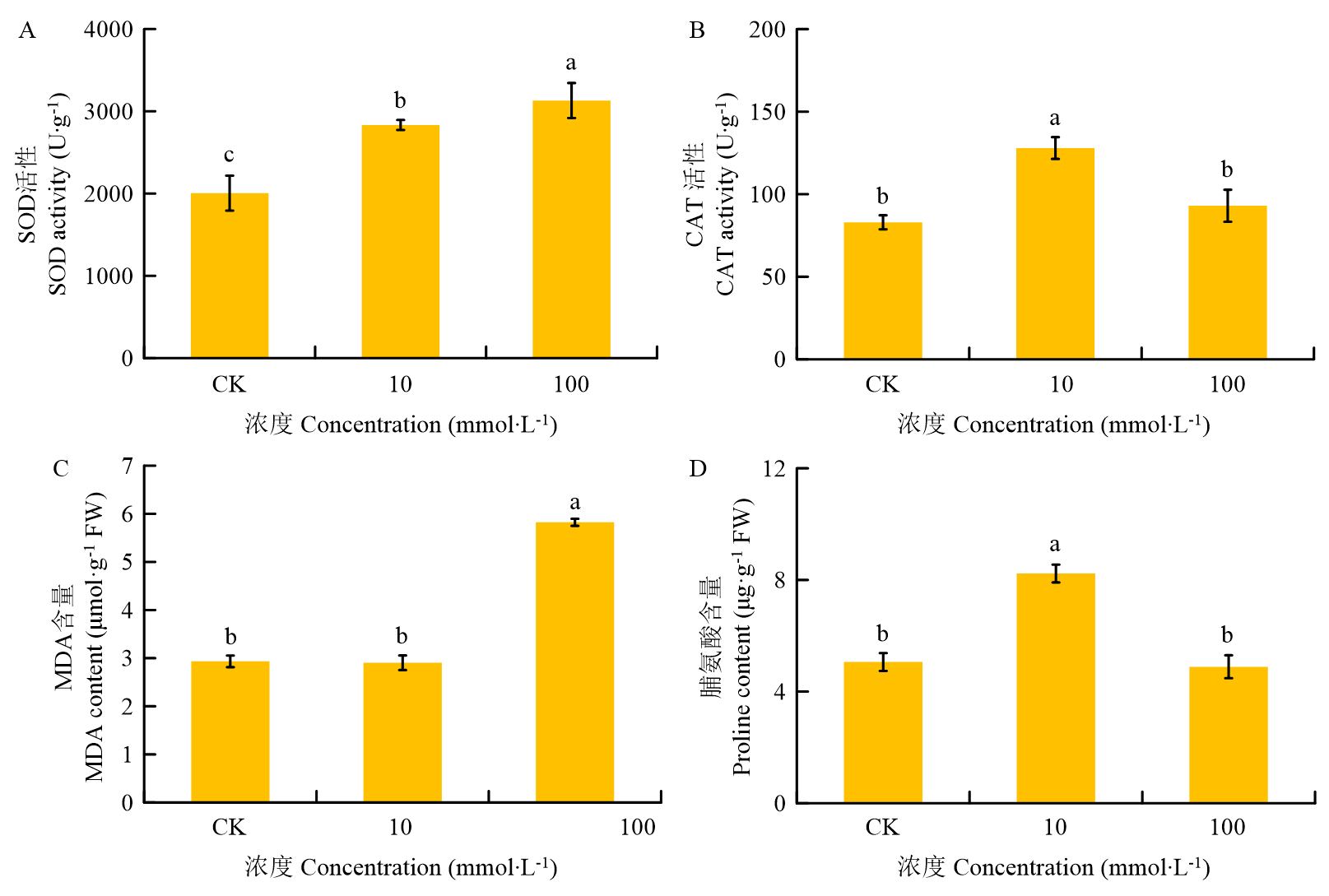
图2
不同浓度NaCl胁迫处理对狼烟1号种子生理指标的影响"
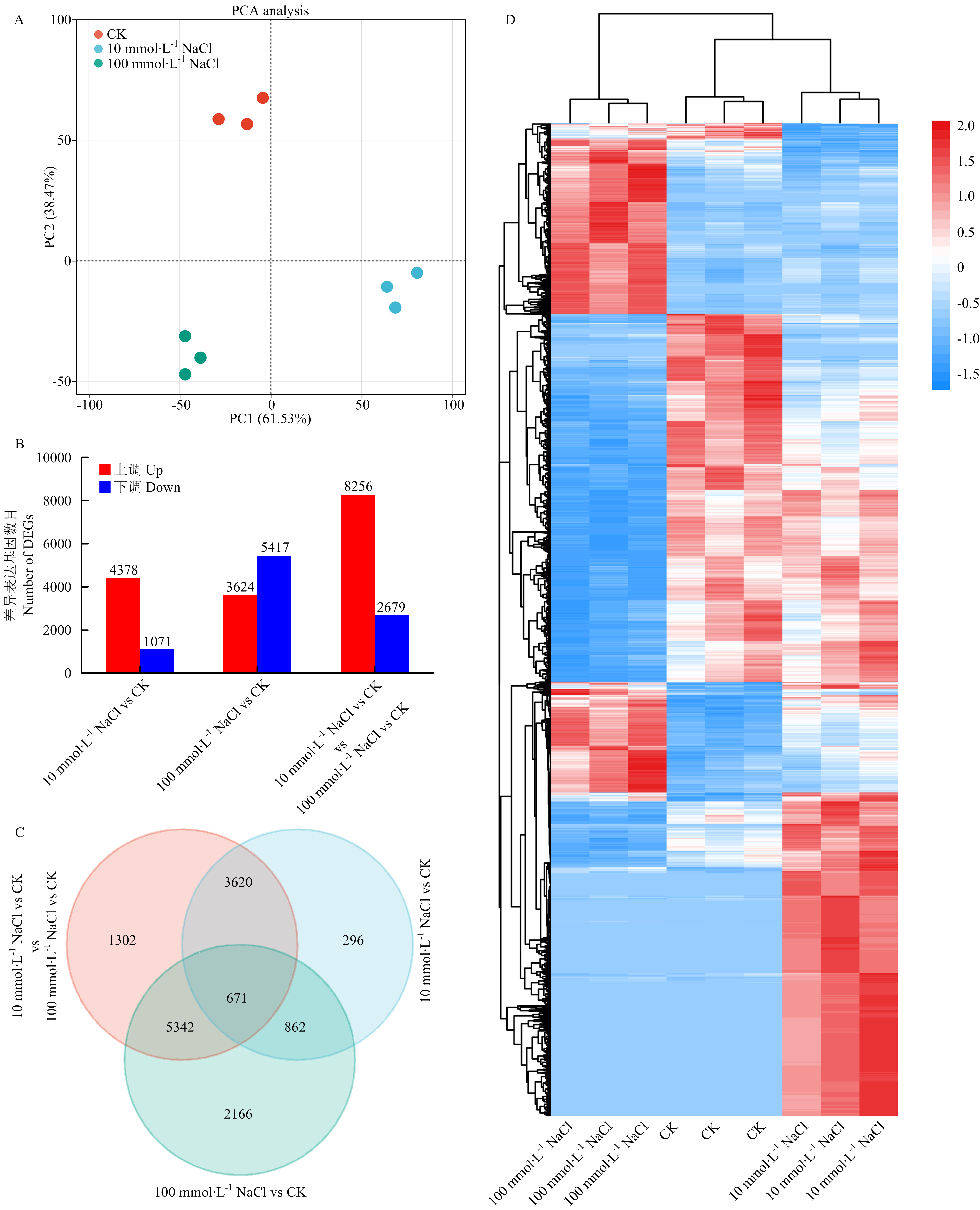
图3
不同浓度NaCl胁迫处理3 d的狼尾草样品转录组数据分析 A:PCA分析;B:差异表达基因上下调数量统计;C:韦恩图分析;D:差异表达基因聚类分析"
表3
逆境响应生理指标相关差异表达基因表达量以及与逆境响应生理指标相关性分析"
| 基因编号 Gene ID | 基因 Gene | 基因表达量(FPKM) Gene expression level | 逆境响应指标 Stress response indicators | 相关性 Correlation | ||
|---|---|---|---|---|---|---|
| CK | 10 mmol·L-1 NaCl | 100 mmol·L-1 NaCl | ||||
| TRINITY_DN5743_c1_g1 | Catalase isozyme 3 | 116.24 | 377.01 | 213.03 | CAT | 0.9871** |
| TRINITY_DN9351_c0_g1 | Catalase 1 | 88.02 | 145.15 | 103.17 | CAT | 0.9992** |
| TRINITY_DN1109_c0_g1 | Superoxide dismutase 1.1 | 89.32 | 136.52 | 130.71 | SOD | 0.9865** |
| TRINITY_DN45156_c0_g1 | Superoxide dismutase 2 | 159.32 | 321.35 | 287.34 | SOD | 0.9686** |
| TRINITY_DN42450_c0_g1 | Superoxide dismutase 7 | 7.55 | 17.68 | 20.45 | SOD | 0.9883** |
| TRINITY_DN30550_c0_g1 | Superoxide dismutase 22 | 72.34 | 108.59 | 98.32 | SOD | 0.9461** |
| TRINITY_DN21193_c0_g1 | Superoxide dismutase 35 | 18.34 | 37.62 | 30.34 | SOD | 0.9066** |
| TRINITY_DN10919_c0_g1 | Glutathione S-transferase 2 | 808.61 | 813.16 | 391.12 | MDA | 0.6322* |
| TRINITY_DN190_c0_g2 | Glutathione S-transferase GSTU1 | 105.13 | 105.84 | 31.42 | MDA | -0.9999** |
| TRINITY_DN5710_c0_g1 | Glutathione S-transferase 4 | 124.79 | 65.09 | 17.51 | MDA | -0.8268** |
| TRINITY_DN4196_c0_g1 | Glutathione S-transferase 3 | 34.67 | 41.25 | 117.54 | MDA | 0.9968** |
| TRINITY_DN11259_c0_g1 | Glutathione S-transferase GSTF1 | 63.09 | 71.37 | 8.68 | MDA | -0.9936** |
| TRINITY_DN17343_c0_g1 | Glutathione S-transferase GSTU6 | 21.36 | 31.66 | 70.26 | MDA | 0.9781** |
| TRINITY_DN7740_c0_g3 | Glutathione synthetase isoform X2 | 55.69 | 51.87 | 5.87 | MDA | -0.9969** |
| TRINITY_DN7032_c0_g1 | Glutathione S-transferase 10 | 3.94 | 5.03 | 2.12 | MDA | -0.9319** |
| TRINITY_DN9190_c0_g1 | Proline dehydrogenase 2 | 71.01 | 54.10 | 123.09 | Pro | -0.7231* |
| TRINITY_DN2129_c0_g1 | Proline transporter 1 | 90.42 | 120.04 | 67.14 | Pro | 0.9173** |
| TRINITY_DN17973_c0_g1 | Proline transporter 7 | 10.09 | 14.65 | 7.66 | Pro | 0.9544** |

图4
差异表达基因GO与KEGG通路富集分析"

图5
氧化磷酸化通路差异表达基因的表达模式分析"

图6
候选促萌发基因与农艺生理指标相关性分析"

图7
植物激素信号转导途径差异表达基因的表达模式分析"
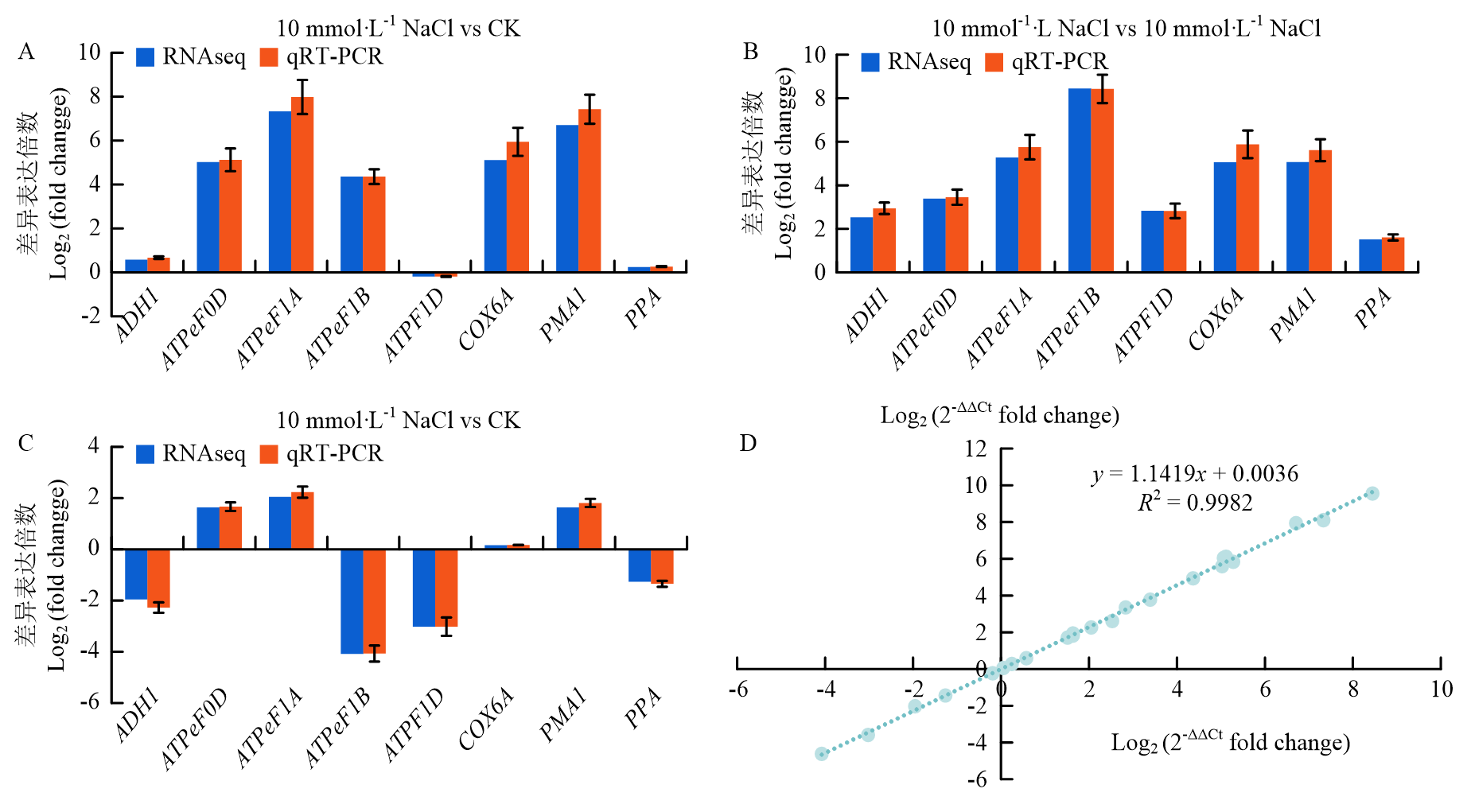
图8
qRT-PCR验证基因表达模式"
| [1] |
于思佳, 于太飞, 孙现军, 王世佳, 武书羽, 姜雪敏, 胡正, 常玉洁, 武晶, 陈锐, 等. 菜豆响应盐胁迫的转录组分析. 植物遗传资源学报, 2025, 26(7): 1398-1415.
|
|
|
|
| [2] |
doi: 10.1016/j.jgg.2023.08.007 |
| [3] |
FAO. Global map of salt-affected soils (GSASmap v1.0). Rome: Food and Agriculture Organization of the United Nations, 2021.
|
| [4] |
李兴龙, 田国庆, 张晨, 高方超, 王智, 刘庆坡. 高粱在盐胁迫下的适应性生理分子机制及耐盐种质创新策略. 植物遗传资源学报, 2025, 26(11): 2073-2084.
|
|
|
|
| [5] |
陈兆伟, 黄小云, 黄秀声, 黄勤楼. 狼尾草属牧草青贮饲料的研究进展、应用现状及发展前景. 动物营养学报, 2025, 37(6): 3606-3617.
doi: 10.12418/CJAN2025.297 |
|
|
|
| [6] |
田宏, 党志强, 张鹤山, 熊军波, 陆姣云, 吴新江, 刘洋. 31份狼尾草种质资源的表型性状多样性分析和观赏性综合评价. 江苏农业学报, 2025, 41(7): 11270-1279.
|
|
|
|
| [7] |
缪珊, 夏振平, 李志强. NaCl胁迫对三种狼尾草生长及生理特性的影响. 黑龙江农业科学, 2019(6): 132-136.
|
|
|
|
| [8] |
陈志彤, 黄勤楼, 潘伟彬, 黄毅斌. 狼尾草属牧草rDNA的ITS序列分析. 草业学报, 2010, 19(4): 135-141.
|
|
|
|
| [9] |
王利民, 黄东风, 林琼, 李昱, 栗方亮, 何春梅, 张青. 番茄作物抗盐性研究进展. 福建农业学报, 2015, 30(10): 1019-1026.
|
|
|
|
| [10] |
马小红, 焦慧, 虎志瑞, 马海霞, 摆福红, 刘文娟, 王晓敏. 番茄种质种子萌发期耐盐性综合评价及关键指标筛选. 云南大学学报(自然科学版), 2025, 47(6): 1176-1184.
|
|
|
|
| [11] |
朱广龙, 武启迪, 钱寅森, 张网定, 任志强, 周桂生. 盐分胁迫对高粱生长与生理特征的影响及耐盐调控机理研究进展. 江苏农业科学, 2023, 51(14): 49-57.
|
|
|
|
| [12] |
张新草, 薛项潇, 姜深, 王延峰, 曹永策. 大豆种质发芽期耐盐碱性鉴定及指标筛选. 西北农业学报, 2020, 29(3): 374-381.
|
|
|
|
| [13] |
刘欣玥, 郭潇阳, 王欣茹, 辛大伟, 关荣霞, 邱丽娟. 大豆萌发期耐盐性鉴定方法建立及耐盐大豆资源筛选. 作物学报, 2024, 50(8): 2122-2130.
doi: 10.3724/SP.J.1006.2024.44006 |
|
doi: 10.3724/SP.J.1006.2024.44006 |
|
| [14] |
王勇攀. 棉花萌发期耐盐种质筛选及盐胁迫响应的转录组分析[D]. 乌鲁木齐: 新疆农业大学, 2024.
|
|
|
|
| [15] |
陈一酉. 大麦耐盐种质筛选及萌发期盐胁迫响应机理研究[D]. 兰州: 甘肃农业大学, 2024.
|
|
|
|
| [16] |
陈甜, 蒋锦鹏, 张志飞. 不同来源野生狼尾草种子生活力和抗盐性鉴定. 作物研究, 2012, 26(S1): 25-29.
|
|
|
|
| [17] |
孙焕荣, 李静, 封晓辉, 张秀梅, 昝凤桐. 盐胁迫对荷兰菊、千屈菜及狼尾草生长的影响. 河北林业科技, 2020(2): 13-16.
|
|
|
|
| [18] |
慈华聪, 田晓明, 张楚涵, 王鹏山, 王振宇, 张清. 不同盐分处理对狼尾草和大油芒发芽与幼苗生长的影响. 生态学杂志, 2013, 32(5): 1168-1174.
|
|
|
|
| [19] |
|
| [20] |
孟晨, 鲁雪莉, 王菊英, 魏云冲, 张成省, 李义强, 徐宗昌. 不同类型盐胁迫对小黑麦种子萌发的影响. 草业学报, 2023, 32(12): 171-180.
doi: 10.11686/cyxb2023068 |
|
|
|
| [21] |
李合生. 植物生理生化实验原理和技术. 北京: 高等教育出版社, 2000: 134-137.
|
|
|
|
| [22] |
付海奇, 刘晓, 宋姝, 吕婉嘉, 杨永青. 次生代谢物调控植物抵抗盐碱胁迫的机制. 植物生理学报, 2023, 59(4): 727-740.
|
|
|
|
| [23] |
康志峰, 曹衡, 宋昌龙, 韩梦云, 李志军, 王瑞清. NaHCO3胁迫对小黑麦种子萌发的影响. 种子, 2014(7): 75-78.
|
|
|
|
| [24] |
吉小敏, 雷春英, 刘畅, 姜黎. 四种钠盐对盐桦种子萌发特性的影响. 中国野生植物资源, 2022, 41(4): 22-26.
|
|
|
|
| [25] |
doi: 10.3390/ijms19113570 |
| [26] |
doi: 10.1038/s41586-024-07445-6 |
| [27] |
doi: 10.1093/jxb/erac078 |
| [28] |
黄清荣, 祁琳, 柏新富. 根环境供氧状况对盐胁迫下棉花幼苗光合及离子吸收的影响. 生态学报, 2018, 38(2): 528-536.
|
|
|
|
| [29] |
刘晓威, 杨秀艳, 武海雯, 支晓蓉, 朱建峰, 张华新. NaCl胁迫对红砂萌发的影响及萌发期耐盐性评价. 生物技术通报, 2019(1): 27-34.
doi: 10.13560/j.cnki.biotech.bull.1985.2018-0686 |
|
|
|
| [30] |
戴魏真, 杨永瑞, 郭家乐, 孙倩倩, 项晶, 毕亚玲. NaCl 胁迫对马唐种子萌发及幼苗生理特性的影响. 安徽农业大学学报, 2024, 51(2): 217-222.
|
|
|
|
| [31] |
doi: 10.1007/s11104-022-05827-1 |
| [32] |
冯建行, 刘伟伟, 杨思怡, 蔡泽坪, 罗灿, 于旭东. 木棉嫁接愈合过程组织解剖与生理生化特性研究. 热带生物学报(中英文), 2025, 16(5): 743-754.
|
|
|
|
| [33] |
doi: 10.1111/pbi.14566 pmid: 39783132 |
| [34] |
闫艳华, 曾慧琳, 杨阳. 油菜素内酯浸种对盐胁迫下曼陀罗种子萌发的影响及其生理机制. 江苏农业学报, 2025, 41(2): 355-361.
|
|
|
|
| [35] |
张留双, 韩佳祺, 谢徽, 杨金清, 何怡, 保志娟. 外源脱落酸对镉胁迫下烟草抗氧化特性及镉积累的影响. 云南农业大学学报(自然科学), 2024, 39(6): 106-112.
|
|
|
|
| [36] |
李敖, 郑旭, 吴承勖, 聂瑞宁, 姬新颖, 唐佳莉, 张俊佩. 丛枝菌根真菌对盐胁迫下核桃幼苗生长及生理的影响. 园艺学报, 2025, 52(2): 423-438.
doi: 10.16420/j.issn.0513-353x.2024-0348 |
|
doi: 10.16420/j.issn.0513-353x.2024-0348 |
|
| [37] |
|
| [38] |
白江平, 王晓斌, 高慧娟, 胡开明, 张俊莲, 王蒂. 干旱和盐胁迫对马铃薯试管苗亚细胞结构及生理生化指标的影响. 西北植物学报, 2016, 36(11): 2233-2240.
|
|
|
|
| [39] |
doi: 10.1016/j.plaphy.2024.108352 |
| [1] | 张志林, 刘荣, 宗绪晓, 郝晓鹏, 杨涛. 蚕豆多时期耐盐性综合评价与衣康酸缓解萌发期盐胁迫研究[J]. 中国农业科学, 2026, 59(6): 1172-1188. |
| [2] | 陈敏, 焦紫岚, 乔承彬, 许昊, 张碧, 马东花, 孔维儒, 王敬文, 宋佳伟, 罗成科, 李培富, 田蕾. 不同亚种水稻种质资源对盐胁迫的形态生理响应及适应策略[J]. 中国农业科学, 2026, 59(4): 705-722. |
| [3] | 廖婷璐, 石亚飞, 肖东浩, 舍杨梦斐, 郭富城, 杨九菊, 唐海江, 罗成科. 外源硝普钠对碱胁迫下水稻幼苗糖代谢的影响[J]. 中国农业科学, 2026, 59(2): 265-277. |
| [4] | 王思琪, 邹利人, 白瑞雯, 闫可, 王思洋, 齐晓光, 申海林, 温景辉. 赤霉素调控‘蜜汁’葡萄穗轴硬化关键基因的挖掘[J]. 中国农业科学, 2026, 59(1): 179-189. |
| [5] | 滕梦鑫, 徐亚, 何静, 汪奇, 乔飞, 李敬阳, 李新国. 香蕉Ca2+-ATPase基因家族的鉴定及功能分析[J]. 中国农业科学, 2025, 58(7): 1418-1433. |
| [6] | 吕缓缓, 李如月, 刘青松, 许蕾, 徐嫣然, 于浩洁, 郭长虹, 龙瑞才. 紫花苜蓿MsKTI3基因克隆及耐盐功能分析[J]. 中国农业科学, 2025, 58(21): 4497-4511. |
| [7] | 李琼玮, 毕言亮, 闫宁, 邹晓霞, 司彤. 氧化石墨烯提高花生种子萌发率和幼苗耐盐性的生理机制[J]. 中国农业科学, 2025, 58(15): 2993-3006. |
| [8] | 邓立成, 李程, 赫磊, 安红强, 王才林, 张亚东, 赵长江, 路凯. 耐盐南粳品种苗期盐胁迫应答的生理特性及其耐盐相关基因分析[J]. 中国农业科学, 2025, 58(12): 2275-2290. |
| [9] | 戚仁洁, 宁宇, 刘静, 刘之洋, 徐海, 罗志丹, 陈龙正. 基于转录组测序的苦瓜皂苷合成相关基因的鉴定和分析[J]. 中国农业科学, 2024, 57(9): 1779-1793. |
| [10] | 裴书瑶, 曹红霞, 张泽宇, 赵方洋, 李志军. 盆栽番茄对NaCl和Na2SO4微咸水灌溉的生理响应[J]. 中国农业科学, 2024, 57(3): 570-583. |
| [11] | 邵嘉朱, 吕雯, 廖鑫琳, 袁歆瑜, 宋振, 蒋冬花. 大豆根际促生菌的分离、鉴定及其耐盐促生作用[J]. 中国农业科学, 2024, 57(21): 4248-4263. |
| [12] | 代瑛姿, 郭宏扬, 杨志峰, 王宪璞, 许丽丽. 葡萄转录因子VvERF2耐盐功能鉴定[J]. 中国农业科学, 2024, 57(2): 336-348. |
| [13] | 尹军良, 李婧怡, 韩硕, 杨培华, 马佳伟, 刘奕清, 胡海骏, 朱永兴. 生姜NHX基因家族成员鉴定及其在硅缓解盐胁迫中的表达特征[J]. 中国农业科学, 2024, 57(19): 3848-3869. |
| [14] | 李慧, 张雨峰, 李晓刚, 王中华, 蔺经, 常有宏. 全基因组DNA甲基化和转录组联合分析鉴定杜梨耐盐相关转录因子[J]. 中国农业科学, 2023, 56(7): 1377-1390. |
| [15] | 渠清, 刘宁, 邹金鹏, 张雅璇, 贾慧, 孙蔓莉, 曹志艳, 董金皋. 拟轮枝镰孢与玉米籽粒互作的差异基因筛选及代谢通路分析[J]. 中国农业科学, 2023, 56(6): 1086-1101. |
|
||
