






中国农业科学 ›› 2026, Vol. 59 ›› Issue (1): 179-189.doi: 10.3864/j.issn.0578-1752.2026.01.013
王思琪1( ), 邹利人2, 白瑞雯2, 闫可2, 王思洋1, 齐晓光2, 申海林2,*(), 温景辉2,*()
收稿日期:2025-06-09
接受日期:2025-08-04
出版日期:2026-01-01
发布日期:2026-01-07
通信作者:
联系方式:
王思琪,E-mail:1061950492@qq.com。
基金资助:
WANG SiQi1(), ZOU LiRen2, BAI RuiWen2, YAN Ke2, WANG SiYang1, QI XiaoGuang2, SHEN HaiLin2,*(), WEN JingHui2,*()
Received:2025-06-09
Accepted:2025-08-04
Published:2026-01-01
Online:2026-01-07
摘要:
【目的】赤霉素处理通常会导致葡萄穗轴硬度增加,研究穗轴形态变化、转录组成分差异和相关功能基因表达,明确影响葡萄穗轴硬化的关键调控因子,为生产上葡萄穗轴软化技术措施的实施提供理论依据。【方法】以‘蜜汁’葡萄为试材,于花期进行赤霉素处理,以清水处理为对照,采集处理后15 d的穗轴中段,进行形态观察和转录组学分析,筛选木质素合成相关差异表达基因(DEGs),并进行qRT-PCR表达验证,测定其对应的酶活性和木质素含量,将表型指标、关键差异基因、相关酶活性和木质素含量进行相关性分析,最终确定穗轴硬化的关键基因。【结果】处理后穗轴木质部与形成层之间无“空隙结构”,表皮、韧皮部和髓部出现较为密集的纤维素结构;差异表达基因(DEGs)共有4 459个,其中26个DEGs参与苯丙烷生物合成(木质素合成的重要通路);筛选出4个木质素合成关键差异表达基因F6HNF5(Vitvi13g00622)、D7SYR4(Vitvi01g00658)、F6H218(Vitvi19g00186)和F6GS10(Vitvi17g00898)的qRT-PCR表达情况与转录组测定结果趋势一致,其所调控的苯丙氨酸解氨酶(PAL)和肉桂醇脱氢酶(CAD)活性显著上升,木质素含量显著增加,说明筛选的4个木质素合成基因是引起穗轴硬化的关键基因。【结论】赤霉素处理引起穗轴形态结构发生明显变化,F6HNF5、D7SYR4、F6H218和F6GS10是影响‘蜜汁’葡萄穗轴硬化的关键基因。
王思琪, 邹利人, 白瑞雯, 闫可, 王思洋, 齐晓光, 申海林, 温景辉. 赤霉素调控‘蜜汁’葡萄穗轴硬化关键基因的挖掘[J]. 中国农业科学, 2026, 59(1): 179-189.
WANG SiQi, ZOU LiRen, BAI RuiWen, YAN Ke, WANG SiYang, QI XiaoGuang, SHEN HaiLin, WEN JingHui. Screening of Key Genes Related to Gibberellic Acid Regulation of Rachis Hardening in Honey Grapes[J]. Scientia Agricultura Sinica, 2026, 59(1): 179-189.
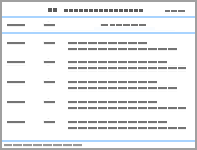
表1
引物序列及目的基因片段大小"
| Ensemble名称 Ensemble name | 基因 Gene | 引物序列 Primer sequence (5′-3′) | 目的片段大小 Target fragment size (bp) |
|---|---|---|---|
| Vitvi01g00658 | D7STR4 | F:ATGTTGTTGCACTGGCAGATG R:CTTTGGATGAAATGACCTTGCCC | 229 |
| Vitvi19g00186 | F6H218 | F:GCTGAGAACGGGCCTGATAC R:GAGGAAGACCCGAAGTTGGG | 226 |
| Vitvi13g00622 | F6HNF5 | F:CTGGATGAGGTGAAGCGGATG R:GCACCGAAACCTGTGGTCAC | 227 |
| Vitvi17g00898 | F6GSI0 | F:CGTCTTGCTGCATTGGAGATGATTC R:GCAGGTTTGAGCCCTTGTCATG | 258 |
| UBQ-1 | F:AGTAGATGACTGGATTGGAGGT R:TGGTGGTATTATTGAGCCATCCTT | 80 |
表2
赤霉素处理后的穗轴表型变化"
| 样品 Type | 长度 Length (cm) | 粗度 Width (cm) | 硬度 Hardening (N) |
|---|---|---|---|
| 对照CK | 2.91±0.22b | 0.43±0.03b | 11.54±0.86b |
| 处理S1 | 4.23±0.70a | 0.62±0.10a | 31.60±0.65a |

图1
葡萄穗轴石蜡切片(横切面) CK:对照组,S1:处理组。下同。a:髓部;b:木质部;c:形成层;d:韧皮部;e:皮层;f:表皮。显微镜放大倍数为4×"

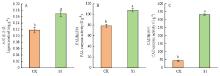
图2
葡萄穗轴木质素含量及其相关酶活 A:木质素含量;B:苯丙氨酸解氨酶活性;C:肉桂醇脱氢酶活性。小写字母表示处理间的差异显著性(P<0.05)。下同"
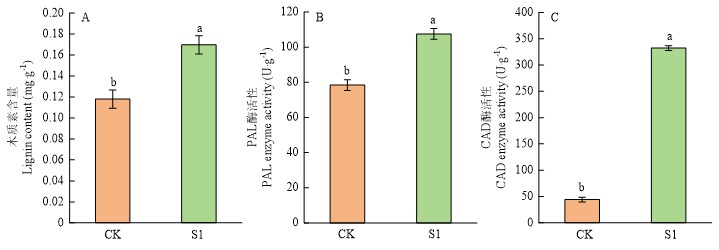

图3
赤霉素处理后样本间基因表达水平相关系数热图和表达情况柱形图 A:样本间基因表达水平相关系数热图;B:基因表达情况柱形图"

图4
赤霉素处理后样本间差异表达基因GO富集分类柱状图"
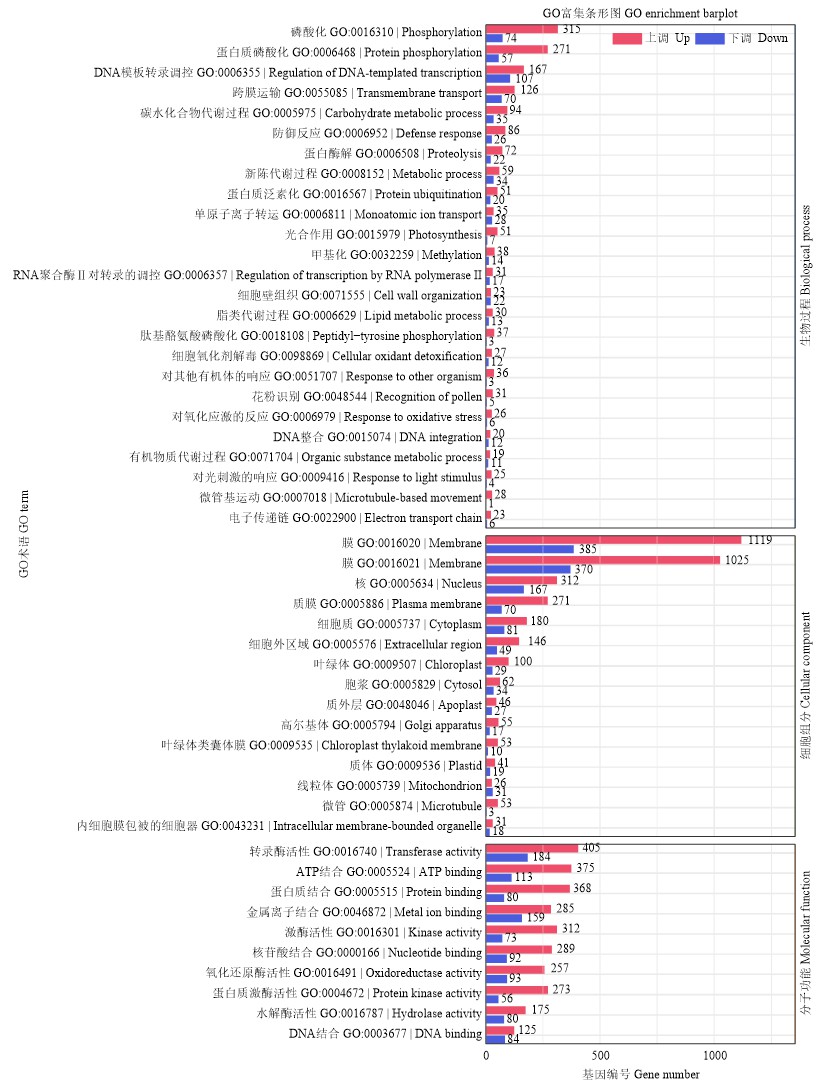

图5
赤霉素处理后样本间差异表达基因KEGG富集Top20柱状图"
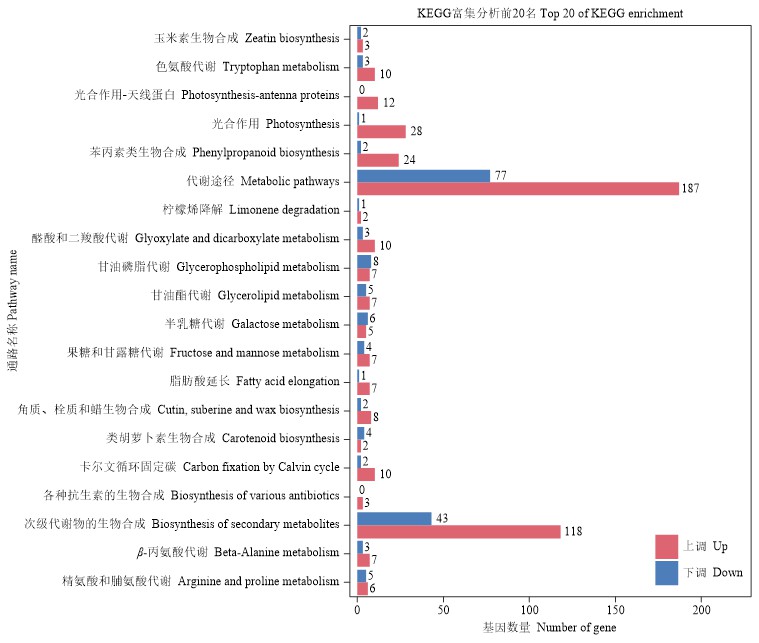

图6
苯丙氨酸代谢通路标色图 显著上调基因标为红色,颜色越深,log2(FC)越大;显著下调基因标为绿色,颜色越深,log2(FC)越小"


图7
苯丙氨酸代谢通路4个关键基因的qRT-PCR验证 A:FPKM表达情况;B:4个关键基因实时荧光定量验证。*:P≤0.05;**:P≤0.01;***:P≤0.001"
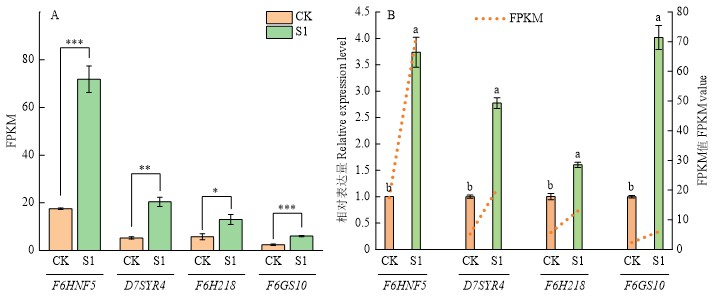
表3
穗轴硬度相关性分析"
| 指标 Indicators | F6HNF5 | D7SYR4 | F6H218 | F6GS10 | 苯丙氨酸解氨酶 PAL | 肉桂醇脱氢酶 CAD | 木质素 Lignin | 穗轴硬度 Rhachis hardening |
|---|---|---|---|---|---|---|---|---|
| F6HNF5 | 1 | |||||||
| D7SYR4 | 0.960** | 1 | ||||||
| F6H218 | 0.906* | 0.773 | 1 | |||||
| F6GS10 | 0.981** | 0.975** | 0.859* | 1 | ||||
| 苯丙氨酸解氨酶 PAL | 0.975** | 0.913* | 0.942** | 0.973** | 1 | |||
| 肉桂醇脱氢酶 CAD | 0.964** | 0.874* | 0.899* | 0.931** | 0.942** | 1 | ||
| 木质素 Lignin | 0.940** | 0.941** | 0.764 | 0.899* | 0.867* | 0.872* | 1 | |
| 穗轴硬度 Rhachis hardening | 0.978** | 0.967** | 0.831* | 0.977** | 0.931** | 0.953** | 0.907* | 1 |
| [1] |
陈烨锜, 庞柳, 陈小央, 郑婷, 向江, 魏灵珠, 吴江, 徐凯, 程建徽. 基于不同方法综合评价浙北平原地区101份鲜食葡萄果实品质. 果树学报, 2024, 41(12): 2377-2388.
|
|
|
|
| [2] |
罗国光. 中国葡萄产业面临的历史任务: 加快由数量型向质量型转变. 果树学报, 2010, 27(3): 431-435.
|
|
|
|
| [3] |
doi: 10.1007/s00344-024-11288-w |
| [4] |
唐玄嗣. 赤霉素和氯吡脲处理对葡萄果实维管束结构及功能的影响[D]. 扬州: 扬州大学, 2024.
|
|
|
|
| [5] |
刘佳, 刘晓, 陈建. 四川地区赤霉素和链霉素处理对巨峰葡萄无核化及果实发育的影响. 西南农业学报, 2011, 24(1): 220-224.
|
|
|
|
| [6] |
陶建敏, 韩传光, 耿其芳, 章镇. GA3与GA4+7对京亚葡萄无核化处理果实发育的影响. 中国南方果树, 2004, 33(1): 52-53.
|
|
|
|
| [7] |
郭光生, 曾炳山, 范春节, 裘珍飞. 外施GA3对巨桉木质部发育的影响. 分子植物育种, 2018, 16(2): 602-606.
|
|
|
|
| [8] |
李哲馨, 钮世辉, 高琼, 李伟. 赤霉素调控木质部发育的细胞学研究. 北京林业大学学报, 2014, 36(2): 68-73.
|
|
|
|
| [9] |
doi: 10.1016/j.ijbiomac.2024.139371 |
| [10] |
doi: 10.1105/tpc.111.084020 |
| [11] |
doi: 10.3390/ijms160922960 |
| [12] |
NICKOLAS A ANDERSON AB Y T C. Manipulation of guaiacyl and syringyl monomer biosynthesis in an Arabidopsis cinnamyl alcohol dehydrogenase mutant results in atypical lignin biosynthesis and modified cell wall structure. The Plant Cell, 2015, 27(8): 2195-2209.
doi: 10.1105/tpc.15.00373 |
| [13] |
doi: 10.1111/jipb.v64.9 |
| [14] |
doi: 10.1016/j.plaphy.2023.108254 |
| [15] |
doi: 10.3389/fgene.2024.1375488 |
| [16] |
陈潇. 生长调节剂对‘阳光玫瑰’葡萄无核化及果实品质的影响[D]. 广州: 华南农业大学, 2020.
|
|
|
|
| [17] |
doi: 10.1080/01478885.2024.2397989 |
| [18] |
doi: 10.1038/77355 pmid: 10888850 |
| [19] |
doi: 10.3389/fpls.2018.01391 pmid: 30294339 |
| [20] |
doi: 10.1104/pp.103.036988 pmid: 15122040 |
| [21] |
doi: 10.1111/tpj.2005.44.issue-3 |
| [22] |
|
| [23] |
doi: 10.1111/tpj.2009.58.issue-6 |
| [24] |
doi: 10.1093/plcell/koac107 |
| [25] |
doi: 10.1007/s00425-012-1613-2 |
| [26] |
doi: 10.1371/journal.pone.0016416 |
| [27] |
doi: 10.1016/j.scienta.2014.07.038 |
| [28] |
胡杰, 吴伟杰, 房祥军, 刘瑞玲, 陈慧芝, 张红印, 陈杭君, 郜海燕. 雷笋采后木纤化及调控基因差异表达研究. 中国食品学报, 2024, 24(3): 183-190.
|
|
|
|
| [29] |
doi: 10.1080/17429145.2018.1455904 |
| [30] |
|
| [31] |
doi: 10.1016/j.jplph.2023.154052 |
| [32] |
doi: 10.1186/s12870-023-04586-0 |
| [33] |
doi: 10.1111/ppl.v176.4 |
| [34] |
doi: 10.3390/ijms23020642 |
| [35] |
doi: 10.1111/tpj.15350 pmid: 34022096 |
| [36] |
钟明志. 酪氨酸转氨酶基因在丹酚酸生物合成中的功能及调控机制研究[D]. 雅安: 四川农业大学, 2024.
|
|
|
| [1] | 王忠妮, 雷月, 李佳丽, 宫彦龙, 朱速松. ABC转运蛋白OsARG1调控水稻抽穗期的功能[J]. 中国农业科学, 2026, 59(1): 1-16. |
| [2] | 冯伟晴, 倪媛蒨, 费腾, 李有梅, 谢兆森. 不同果形葡萄果实维管束形态结构、分布特征及其水分运输功能差异[J]. 中国农业科学, 2026, 59(1): 161-178. |
| [3] | 张义茹, 韩雪, 姚鑫杰, 冯军, 魏爱丽, 李文超, 张彬, 韩渊怀, 李红英. 基于多组学解析谷子后熟米色变化的分子机制[J]. 中国农业科学, 2025, 58(9): 1702-1718. |
| [4] | 谭西北, 兰徐颖, 刘崇怀, 樊秀彩, 姜建福, 孙磊, 李鹏, 余书鑫, 张颖. 不同抗性葡萄响应白腐病侵染的次生代谢物变化[J]. 中国农业科学, 2025, 58(9): 1767-1778. |
| [5] | 陈龙云, 胡俊强, 何灿, 史建荣, 徐剑宏, 王刚. 利用大孔吸附树脂与高速逆流色谱纯化脱氧雪腐镰刀菌烯醇-3-葡萄糖苷[J]. 中国农业科学, 2025, 58(8): 1627-1637. |
| [6] | 汤学燊, 党仕卓, 周娟, 李佳豪, 李梅花, 胡豪, 张亚红. 基于红蓝光调控分析VvBES1-1参与‘红地球’葡萄花芽的分化[J]. 中国农业科学, 2025, 58(8): 1650-1662. |
| [7] | 杨彩丽, 李永洲, 贺亮亮, 宋银花, 章鹏, 刘肇先, 李鹏慧, 刘三军. 葡萄TPS基因家族全基因组鉴定及VvTPS4在单萜形成中的功能验证[J]. 中国农业科学, 2025, 58(7): 1397-1417. |
| [8] | 邹晓威, 夏蕾, 朱晓敏, 孙辉, 周琦, 齐霁, 张亚封, 郑岩, 姜兆远. 基于转录组测序的玉米瘤黑粉菌UM01240过表达菌株诱导玉米抗病性分析[J]. 中国农业科学, 2025, 58(6): 1116-1130. |
| [9] | 孙萍, 朱文灿, 林贤锐, 吴嘉颀, 曹译文, 陈辰斐, 王轶, 朱建锡, 贾惠娟, 钱敏杰, 沈建生. 基于代谢组和转录组解析多雨寡照对桃果皮着色和类黄酮积累的影响[J]. 中国农业科学, 2025, 58(6): 1173-1194. |
| [10] | 谢露露, 李福, 张思远, 高建昌. 基于跨物种转录组解析影响不定根发生的保守基因[J]. 中国农业科学, 2025, 58(6): 1195-1209. |
| [11] | 高岩浩, 王婷婷, 白卫卫, 杜兴杰, 刘贤, 秦本源, 付彤, 孙宇, 高腾云, 张天留. 脂质组与转录组联合揭示南阳牛不同肌肉组织脂质特征的差异表达模式[J]. 中国农业科学, 2025, 58(6): 1239-1258. |
| [12] | 张天雨, 李白, 藏金萍, 曹宏哲, 董金皋, 邢继红, 张康. 灰葡萄孢HMG家族基因的全基因组鉴定与表达规律分析[J]. 中国农业科学, 2025, 58(4): 704-718. |
| [13] | 郭奥琳, 林俊璇, 赖恭梯, 贺丽媛, 车建美, 潘若, 杨方学, 黄玉吉, 陈桂信, 赖呈纯. 过表达VdF3′5′H2对刺葡萄细胞花青素组分积累的影响[J]. 中国农业科学, 2025, 58(4): 802-818. |
| [14] | 从琪琪, 张静怡, 孟祥龙, 戴蓬博, 李波, 胡同乐, 王树桐, 曹克强, 王亚南. 我国苹果轮纹病弱毒菌株中病毒的鉴定及其携带情况的检测[J]. 中国农业科学, 2025, 58(3): 478-492. |
| [15] | 张向昆, 李佳莹, 乔如梦, 何静蕾, 王莉, 师校欣, 杜国强. 不同锌水平下GFabV对‘阳光玫瑰’葡萄光合效率及光合相关基因表达的影响[J]. 中国农业科学, 2025, 58(24): 5190-5200. |
|
||
