






中国农业科学 ›› 2026, Vol. 59 ›› Issue (7): 1380-1399.doi: 10.3864/j.issn.0578-1752.2026.07.002
李元晶( ), 袁瑞祥(), 李永泰, 孙天歌, 刘峰, 李艳军, 张新宇()
收稿日期:2025-08-29
接受日期:2025-10-27
出版日期:2026-04-08
发布日期:2026-04-08
通信作者:
联系方式:
李元晶,E-mail:20232012017@stu.shzu.edu.cn。袁瑞祥,E-mail:2369974923@qq.com。李元晶和袁瑞祥为同等贡献作者。
基金资助:
LI YuanJing(), YUAN RuiXiang(), LI YongTai, SUN TianGe, LIU Feng, LI YanJun, ZHANG XinYu()
Received:2025-08-29
Accepted:2025-10-27
Published:2026-04-08
Online:2026-04-08
摘要:
【目的】大丽轮枝菌(Verticillium dahliae)是一种重要的土传病原真菌,可侵染200多种植物,引致黄萎病,对全球农业生产造成严重经济损失。细胞壁降解酶(CWDEs)在病原真菌致病过程中发挥关键作用,鉴定棉花黄萎病菌中的β-葡萄糖苷酶基因并探究其功能,为棉花抗病育种提供新的分子靶点。【方法】通过生物信息学分析,从大丽轮枝菌全基因组鉴定β-葡萄糖苷酶基因,并对其进化关系、保守结构域和表达模式进行系统分析。利用寄主诱导的基因沉默(HIGS)技术在棉花中沉默Vdbg4和Vdbg6,评估其对棉花抗病性的影响。设计靶向Vdbg4(asiR1364)和Vdbg6(asiR1444)的asiRNAs分别与V. dahliae共培养,对共培养V. dahliae的生长发育、碳源利用和胁迫响应能力,以及致病力等进行调查。通过酵母信号肽诱捕试验验证Vdbg6的分泌活性,并利用农杆菌介导的烟草瞬时表达试验检测其是否触发植物免疫反应。【结果】从大丽轮枝菌全基因组中共鉴定18个β-葡萄糖苷酶基因,其中,Vdbg4和Vdbg6受感病棉花品种根系分泌物诱导后显著上调表达。利用HIGS技术分别沉默Vdbg4或Vdbg6,以及同时沉默2个基因,均能显著减轻棉花的发病症状,降低病情指数和真菌生物量。靶向Vdbg4和Vdbg6的asiRNAs(asiR1364、asiR1444和asiR1364+1444)能够抑制病原菌的菌落和菌丝生长,降低产孢和孢子萌发率、碳源利用和胁迫响应的能力以及致病力。Vdbg6具有分泌活性,但它不能引起烟草细胞程序性坏死,也不能抑制由BAX诱导的烟草细胞程序性坏死。【结论】Vdbg4和Vdbg6均参与大丽轮枝菌的生长发育、碳源利用、胁迫响应和致病过程。
李元晶, 袁瑞祥, 李永泰, 孙天歌, 刘峰, 李艳军, 张新宇. 棉花黄萎病菌β-葡萄糖苷酶基因的鉴定及其在致病中的功能[J]. 中国农业科学, 2026, 59(7): 1380-1399.
LI YuanJing, YUAN RuiXiang, LI YongTai, SUN TianGe, LIU Feng, LI YanJun, ZHANG XinYu. Identification and Functional Characterization of β-Glucosidase Genes in Verticillium dahliae for Pathogenicity on Cotton[J]. Scientia Agricultura Sinica, 2026, 59(7): 1380-1399.

表1
设计靶向Vdbg4和Vdbg6的asiRNAs"
| 基因 Gene | asiRNA | 正义链 Sense strand (5′-3′) | 反义链 Antisense strand (5′-3′) |
|---|---|---|---|
| Vdbg4 | asiR1364 | GGCUGAAGAUCACAACCAATT | UUGGUUGUGAUCUUCAGCCTT |
| Vdbg6 | asiR1444 | CGAUUGUGGUCUUCCAUAATT | UUAUGGAAGACCACAAUCGTT |
表2
大丽轮枝菌中β-葡萄糖苷酶基因的鉴定"
| 基因ID ID gene | 基因 名称 Gene name | CDS长度 CDS length (bp) | 蛋白长度 Protein length (aa) | 染色体Chromosome | 分子量 Molecular weight (kDa) | 理论 等电点Isoelectric point | 跨膜结构 域数量Transmembrane domain number | 亚细胞定位预测Subcellular localization prediction | 基因描述 Gene description |
|---|---|---|---|---|---|---|---|---|---|
| VDAG_00134 | Vdbg1 | 2878 | 813 | 2 | 87.54 | 6.34 | 1 | 质膜 Plasma membrane | β-葡萄糖苷酶Beta-glucosidase |
| VDAG_01062 | Vdbg2 | 3076 | 897 | 1 | 98.58 | 5.41 | 0 | 细胞质 Cytosol | 耐热β-葡萄糖苷酶Thermostable Beta-glucosidase |
| VDAG_01263 | Vdbg3 | 1886 | 611 | 1 | 66.56 | 6.28 | 0 | 细胞质 Cytosol | β-葡萄糖苷酶Beta-glucosidase |
| VDAG_02542 | Vdbg4 | 2796 | 798 | 3 | 86.19 | 5.67 | 0 | 线粒体Mitochondrion | 耐热β-葡萄糖苷酶Thermostable Beta-glucosidase |
| VDAG_05580 | Vdbg5 | 2489 | 774 | 2 | 85.27 | 4.98 | 0 | 细胞质 Cytosol | β-葡萄糖苷酶Beta-glucosidase |
| VDAG_06279 | Vdbg6 | 2758 | 683 | 8 | 74.29 | 5.54 | 0 | 细胞外 Extracellular | β-葡萄糖苷酶Beta-glucosidase |
| VDAG_08139 | Vdbg7 | 2500 | 816 | 6 | 87.91 | 4.69 | 0 | 细胞外 Extracellular | β-葡萄糖苷酶Beta-glucosidase |
| VDAG_09280 | Vdbg8 | 2605 | 823 | 4 | 89.29 | 5.93 | 0 | 细胞质 Cytosol | 耐热β-葡萄糖苷酶Thermostable Beta-glucosidase |
| VDAG_09750 | Vdbg9 | 3169 | 876 | 3 | 94.85 | 4.78 | 0 | 细胞外 Extracellular | β-葡萄糖苷酶Beta-glucosidase |
| VDAG_09393 | Vdbg10 | 1943 | 609 | 4 | 67.13 | 4.88 | 0 | 细胞外 Extracellular | 周质β-葡萄糖苷酶Periplasmic Beta-glucosidase |
| VDAG_05611 | Vdbg11 | 2676 | 833 | 2 | 91.40 | 5.61 | 0 | 细胞质 Cytosol | β-葡萄糖苷酶Beta-glucosidase |
| VDAG_03973 | Vdbg12 | 2598 | 803 | 3 | 104.64 | 5.51 | 0 | 细胞外 Extracellular | β-葡萄糖苷酶Beta-glucosidase |
| VDAG_02717 | Vdbg13 | 2942 | 955 | 3 | 86.67 | 5.24 | 1 | 细胞质 Cytosol | β-葡萄糖苷酶Beta-glucosidase |
| VDAG_08263 | Vdbg14 | 2313 | 746 | 6 | 78.45 | 4.77 | 0 | 细胞外 Extracellular | 耐热β-葡萄糖苷酶Thermostable Beta-glucosidase |
| VDAG_08240 | Vdbg15 | 2632 | 836 | 6 | 89.78 | 5.41 | 0 | 细胞质 Cytosol | 耐热β-葡萄糖苷酶Thermostable Beta-glucosidase |
| VDAG_06333 | Vdbg16 | 1995 | 476 | 8 | 53.78 | 4.87 | 0 | 细胞质 Cytosol | β-葡萄糖苷酶Beta-glucosidase |
| VDAG_02175 | Vdbg17 | 2420 | 781 | 7 | 84.91 | 5.39 | 0 | 细胞外 Extracellular | β-葡萄糖苷酶Beta-glucosidase |
| VDAG_03143 | Vdbg18 | 648 | 215 | 6 | 23.10 | 4.88 | 0 | 细胞质 Cytosol | β-葡萄糖苷酶Beta-glucosidase |

图1
β-葡萄糖苷酶基因的保守结构域和进化树分析"
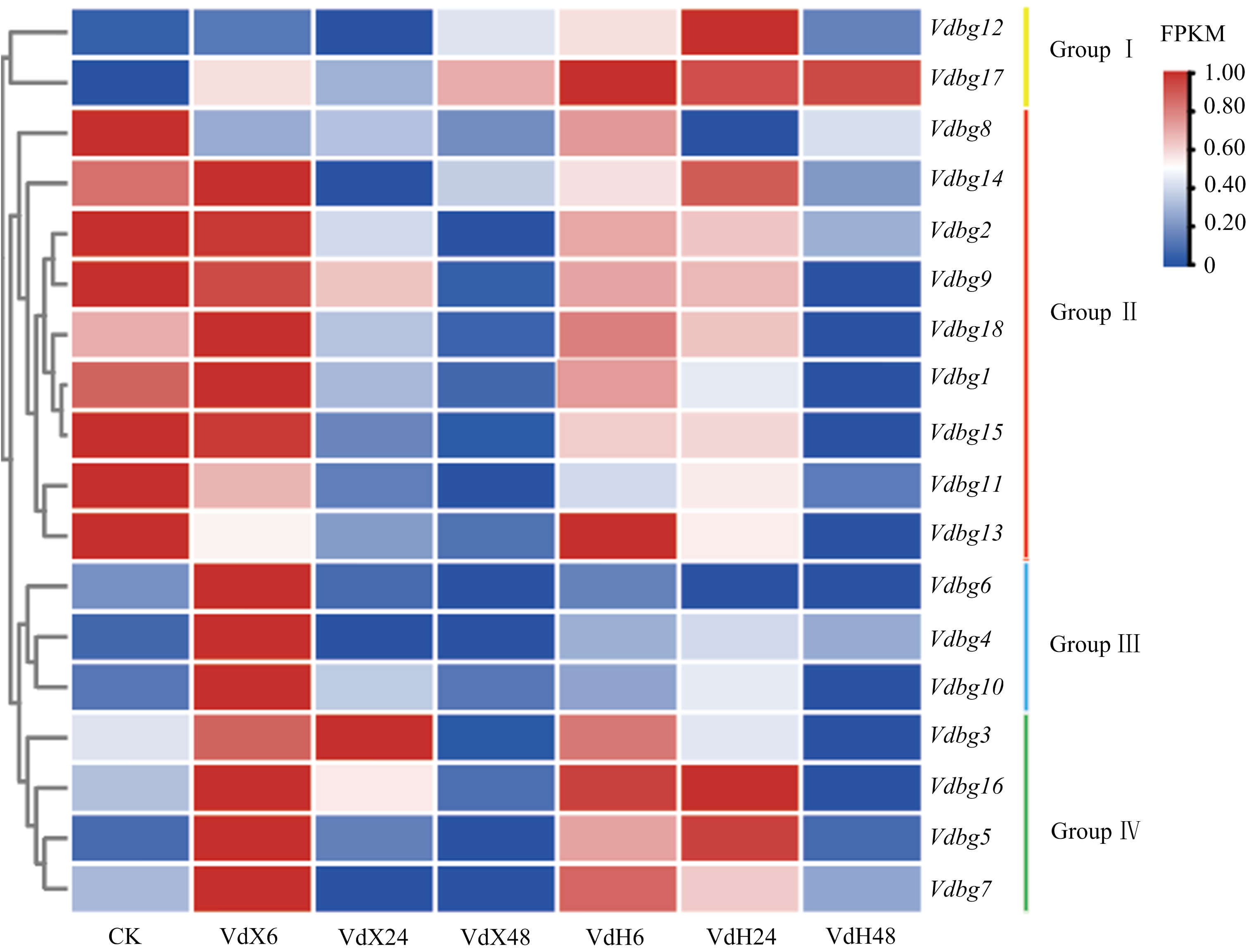
图2
Vdbgs受不同棉花品种根系分泌物诱导后的表达模式分析 VdX:新陆早7号;VdH:海7124,品种后面的数字表示根系分泌物处理不同时间点(6、24和48 h)"

图3
基于TRV-HIGS技术分析Vdbg4和Vdbg6在大丽轮枝菌致病过程中的功能 A:发病症状;B:茎部纵切图;C:茎段中菌的恢复情况;D:根、茎和叶中的真菌生物量;E:病情指数;F:目的基因的表达水平;G:除目的基因外GH3家族其他Vdbgs基因的表达水平。*:P<0.05;**:P<0.01;***:P<0.001。下同"

图4
靶向Vdbg4和Vdbg6的asiRNAs对大丽轮枝菌生长的影响 A:菌落形态;B:菌丝形态;C:菌落直径;D:孢子萌发率;E:产孢量动态变化;F:Vdbg4的表达水平;G:Vdbg6的表达水平;H:β-葡萄糖苷酶活力分析。CK:未处理的野生型Vd991;NC:线虫asiRNA处理的阴性对照。不同字母表示在P<0.05水平差异显著。下同"

图5
Vdbg4和Vdbg6对大丽轮枝菌碳源利用的影响 A:菌落形态;B:菌落直径"

图6
Vdbg4和Vdbg6对大丽轮枝菌逆境胁迫响应的影响 A:菌落形态;B:菌落生长抑制率"

图7
靶向Vdbg4和Vdbg6处理的asiRNAs对大丽轮枝菌致病性的影响 A:发病症状;B:茎部纵切图;C:茎段菌的恢复情况;D:根和茎中的真菌生物量;E:病情指数统计;F:目的基因相对表达量"

图8
Vdbg6的信号肽预测、功能验证及细胞死亡诱导活性检测 A:Vdbg6信号肽预测;B:Vdbg4信号肽预测;C:Vdbg6信号肽的功能验证;Avr1bsp:阳性对照;Vdbg6Δsp:阴性对照;D:Vdbg6在本氏烟中的细胞死亡诱导活性检测"
| [1] |
|
| [2] |
doi: 10.3389/fpls.2021.759245 |
| [3] |
doi: 10.1094/MPMI-11-19-0320-A |
| [4] |
doi: 10.1094/PHYTO-09-14-0259-R |
| [5] |
doi: 10.1111/mpp.v23.6 |
| [6] |
doi: 10.1111/mpp.2006.7.issue-2 |
| [7] |
康立茹, 刘燕, 杨永峰, 王永, 王黎胜, 刘湘萍, 付崇毅, 狄洁增, 廉勇, 高婧. 大丽轮枝菌及其致病机制的研究进展. 现代农业, 2022, 47(3): 49-51.
|
|
|
|
| [8] |
doi: 10.1016/j.fgb.2017.09.002 |
| [9] |
doi: 10.1016/j.tplants.2008.09.002 pmid: 18824396 |
| [10] |
doi: 10.1146/annurev-phyto-102313-045831 pmid: 25001456 |
| [11] |
doi: 10.3389/fpls.2018.01271 |
| [12] |
|
| [13] |
doi: 10.1094/MPMI-06-17-0136-R |
| [14] |
doi: 10.1093/plphys/kiab274 |
| [15] |
doi: 10.1007/s12033-011-9392-8 |
| [16] |
doi: 10.1111/emi.2017.19.issue-5 |
| [17] |
王艺潼, 李海博, 王雨晴, 吴志宏, 高贻宙. 层出镰刀菌分泌蛋白阿魏酸酯酶(FpESD)的鉴定及功能研究. 农业生物技术学报, 2025, 33(2): 386-399.
|
|
|
|
| [18] |
邢启凯, 王欣芳, 彭军波, 张玮, 燕继晔, 李永华. 可可毛色二孢菌全基因组非经典分泌蛋白的预测及致病相关性分析. 植物病理学报, 2024, 54(1): 102-115.
doi: 10.13926/j.cnki.apps.001625 |
|
|
|
| [19] |
郑菲. 真菌第五家族纤维素酶的基因挖掘与分子改良研究[D]. 北京: 北京林业大学, 2019.
|
|
|
|
| [20] |
徐金涛. 瑞氏木霉β-葡萄糖苷酶在纤维素酶诱导表达过程中作用机制的研究[D]. 济南: 山东大学, 2014.
|
|
|
|
| [21] |
doi: 10.3390/ijms252313191 |
| [22] |
林文细. 内生真菌Microsphaeropsis sp. S59 β-葡萄糖苷酶Bgl812酶学性质及其生物转化人参皂苷[D]. 南昌: 江西科技师范大学, 2024.
|
|
|
|
| [23] |
邱萍. 基于多组学解析棉花与大丽轮枝菌的互作机制[D]. 武汉: 华中农业大学, 2023.
|
|
|
|
| [24] |
|
| [25] |
doi: 10.1111/mpp.2018.19.issue-6 |
| [26] |
doi: 10.1186/s12864-020-6448-9 |
| [27] |
张小雪. 黄萎病菌VdxyL3和VdITP1基因对棉花的抗病性影响[D]. 石河子: 石河子大学, 2021.
|
|
|
|
| [28] |
doi: 10.3389/fpls.2020.01045 |
| [29] |
doi: 10.1111/emi.v23.4 |
| [30] |
doi: 10.3390/ijms25010294 |
| [31] |
doi: 10.1006/meth.2001.1262 |
| [32] |
陈丽华. 棉花黄萎病菌糖代谢相关基因VdST和VdPT1的功能及RNAi研究[D]. 石河子: 石河子大学, 2023.
|
|
|
|
| [33] |
李聪, 王允. 棘孢木霉糖苷水解酶3基因家族的生物信息学及表达模式分析. 微生物学通报, 2023, 50(1): 1-12.
|
|
|
|
| [34] |
吕峻元. 大丽轮枝菌M35家族金属蛋白酶VdM35-1和VdASPF2的功能研究[D]. 北京: 中国农业科学院, 2023.
|
|
|
|
| [35] |
doi: 10.1105/tpc.107.056093 |
| [36] |
doi: 10.1093/plcell/koab221 |
| [37] |
doi: 10.3389/fpls.2025.1552926 |
| [38] |
doi: 10.3389/fpls.2012.00280 pmid: 23248636 |
| [39] |
doi: 10.1186/s13068-016-0428-y |
| [40] |
宁淑杰. 大丽轮枝菌内切葡聚糖酶基因沉默与分析[D]. 重庆: 西南大学, 2014.
|
|
|
|
| [41] |
doi: 10.1146/annurev-phyto-080614-120106 pmid: 28617654 |
| [42] |
doi: 10.1007/s12155-013-9382-8 |
| [43] |
doi: 10.1104/pp.124.4.1515 pmid: 11115868 |
| [44] |
doi: 10.1007/s00253-016-7342-x |
| [45] |
doi: 10.1105/tpc.15.00390 |
| [46] |
doi: 10.1016/j.enzmictec.2015.05.006 |
| [47] |
|
| [48] |
doi: 10.1007/s11703-008-0079-2 |
| [49] |
凌海春. VdNRPSl1在大丽轮枝菌生长发育及致病宿主过程中的功能研究[D]. 重庆: 西南大学, 2022.
|
|
|
|
| [50] |
doi: 10.3389/fpls.2023.1123523 |
| [51] |
doi: 10.1186/s42397-025-00215-3 |
| [52] |
doi: 10.1016/j.gene.2013.06.089 |
| [53] |
doi: 10.1094/MPMI-09-09-0217 |
| [54] |
doi: 10.1111/mpp.2018.19.issue-4 |
| [55] |
陈星州. 果生刺盘孢效应蛋白CFEP15调控油茶免疫的分子机制研究[D]. 长沙: 中南林业科技大学, 2025.
|
|
|
|
| [56] |
doi: 10.3389/fpls.2019.00433 |
| [57] |
doi: 10.1038/nplants.2016.151 pmid: 27643635 |
| [58] |
doi: 10.1111/mpp.2018.19.issue-1 |
| [59] |
doi: 10.1038/nbt.2969 pmid: 25038773 |
| [1] | 延廷霖, 杜娅丹, 胡笑涛, 王贺, 李晓雁, 王玉明, 牛文全, 谷晓博. 加气滴灌下氮肥有机替代对亏缺灌溉棉花产量和水分利用效率的影响[J]. 中国农业科学, 2026, 59(3): 602-618. |
| [2] | 郭晨荔, 刘扬, 陈燕, 胡伟, 王友华, 周治国, 赵文青. 减氮条件下适当磷肥后移对滴灌棉花产量和磷肥利用效率的影响[J]. 中国农业科学, 2025, 58(9): 1749-1766. |
| [3] | 汪炜檬, 魏云晓, 唐云霓, 刘苗苗, 陈全家, 邓晓娟, 张锐. 棉花发根农杆菌转化体系的建立及生根优化[J]. 中国农业科学, 2025, 58(8): 1479-1493. |
| [4] | 赵宇萱, 苗纪元, 胡伟, 周治国. 苗期低温对棉花花芽分化和棉株产量的影响[J]. 中国农业科学, 2025, 58(7): 1311-1320. |
| [5] | 田立文, 娄善伟, 张鹏忠, 杜明伟, 罗宏海, 李杰, 帕尔哈提·买买提, 马腾飞, 张立祯. 绿色高效生产模式下新疆棉花单产提升面临问题与途径分析[J]. 中国农业科学, 2025, 58(6): 1102-1115. |
| [6] | 唐朝元, 刘韬奋, 吴艳琴, 张启鹏, 李自良, 陈云瑞, 雷长英, 张亚黎, 张旺锋, 杜明伟, 杨明凤, 田景山. 陆地棉与海岛棉铃形态特征与纤维及籽仁品质的关系[J]. 中国农业科学, 2025, 58(15): 2980-2992. |
| [7] | 文晋, 宁艳芳, 秦欣, 刘圆, 张晓玲, 朱永红, 田时敏, 马燕斌. 抗虫与耐草甘膦转基因棉花株系的抗性评价与遗传稳定分析[J]. 中国农业科学, 2025, 58(12): 2291-2302. |
| [8] | 董明, 祁虹, 张谦, 王燕, 王树林, 冯国艺, 梁青龙, 郭宝生. 播种方式对种子萌发环境及棉花出苗、生长的影响[J]. 中国农业科学, 2025, 58(12): 2346-2357. |
| [9] | 张艳军, 代建龙, 董合忠. 论棉花多目标协同栽培[J]. 中国农业科学, 2025, 58(10): 1908-1916. |
| [10] | 吴玉珍, 黄龙雨, 周大云, 黄义文, 付守阳, 彭军, 匡猛. 中国棉花审定品种SSR指纹库的构建与综合评价[J]. 中国农业科学, 2024, 57(8): 1430-1443. |
| [11] | 雷建峰, 尤扬子, 张锦恩, 代培红, 于莉, 杜正阳, 李月, 刘晓东. 靶向敲除棉花GhAGL16高效sgRNA的筛选[J]. 中国农业科学, 2024, 57(6): 1023-1033. |
| [12] | 张永莉, 张宁, 徐姣, 许豆豆, 成芳, 张成龙, 吴碧波, 巩养仓, 贺云新, 魏尚职, 屠小菊, 刘爱玉, 周仲华. 不同带状间作模式对棉花生长发育和生产力的影响[J]. 中国农业科学, 2024, 57(22): 4444-4458. |
| [13] | 何静, 王振华, 刘健, 马占利, 温越. 灌溉水温与施氮量对滴灌棉田土壤水热及棉花生长和产量的影响[J]. 中国农业科学, 2024, 57(2): 319-335. |
| [14] | 白冰楠, 乔丹, 葛群, 栾玉娟, 刘小芳, 卢全伟, 牛皓, 龚举武, 巩万奎, ELAMEER ELSAMMAN, 闫浩亮, 李俊文, 刘爱英, 石玉真, 王海泽, 袁有禄. 陆地棉棉籽相关性状的QTN挖掘及候选基因筛选[J]. 中国农业科学, 2024, 57(15): 2901-2913. |
| [15] | 赵卫松, 郭庆港, 崔钠淇, 鹿秀云, 李社增, 马平. 外源添加L-脯氨酸对棉花黄萎病发生及其根际土壤微生物群落的影响[J]. 中国农业科学, 2024, 57(11): 2143-2160. |
|
||
