






中国农业科学 ›› 2026, Vol. 59 ›› Issue (7): 1361-1379.doi: 10.3864/j.issn.0578-1752.2026.07.001
彭廷燊1( ), 陆久焱1, 吴美林1, 严雨欣1, 刘宏周1, 南文斌1, 秦小健1, 李明1, 龚俊义2, 梁永书1()
收稿日期:2025-08-26
接受日期:2025-10-13
出版日期:2026-04-08
发布日期:2026-04-08
通信作者:
联系方式:
彭廷燊,E-mail:pengtingshen@163.com。
基金资助:
PENG TingShen1(), LU JiuYan1, WU MeiLin1, YAN YuXin1, LIU HongZhou1, NAN WenBin1, QIN XiaoJian1, LI Ming1, GONG JunYi2, LIANG YongShu1()
Received:2025-08-26
Accepted:2025-10-13
Published:2026-04-08
Online:2026-04-08
摘要:
【目的】分析多年生水稻产量相关性状的QTL,为产量性状基因的精细定位、克隆及功能研究奠定基础。同时,也为揭示多年生水稻产量相关性状的遗传机理和培育多年生水稻新品种提供技术支撑。【方法】以2份多年生水稻黄糯2号(HN2#)和长白7号(CB7#)及其构建的2套半同胞(黄糯2号/协青早B和长白7号/协青早B)F2群体为试验材料,在2024年正季与再生季调查分析了2份多年生水稻的抽穗期、株高和千粒重等16个产量相关性状,以及2套半同胞群体及其双亲的株高、单株有效穗数和千粒重等15个产量相关性状,并进行QTL分析。【结果】2024年正季与再生季,黄糯2号的抽穗期、株高和千粒重等7个性状呈显著性差异(P<0.05);长白7号的株高、穗粒密度和单穗重呈显著性差异。相关性分析发现,HN2#-群体15个性状共检测到34对显著性正相关;CB7#-群体15个性状共检测到39对显著性正相关。利用QTL IciMapping 4.10软件进行QTL复合区间作图,在HN2#-群体共检测到29个QTL,解释2.61%—29.41%的表型。13个QTL为前人未报道的QTL,其中,7个QTL增效位点来自黄糯2号,6个QTL增效位点来自协青早B。检测到5个同时影响2个及以上产量性状的QTL标记区间。在CB7#-群体共检测到22个QTL,解释2.77%—27.94%的表型。10个QTL为前人未报道的QTL,其中,6个QTL增效位点来自长白7号,4个QTL增效位点来自协青早B。检测到5个同时控制2个及以上产量性状的QTL标记区间,分布在第1、2、6和7染色体上。【结论】检测到的新QTL和“一因多效”QTL为多年生水稻黄糯2号和长白7号所特有,在今后研究中予以重点关注。
彭廷燊, 陆久焱, 吴美林, 严雨欣, 刘宏周, 南文斌, 秦小健, 李明, 龚俊义, 梁永书. 多年生水稻黄糯2号和长白7号产量相关性状的QTL分析[J]. 中国农业科学, 2026, 59(7): 1361-1379.
PENG TingShen, LU JiuYan, WU MeiLin, YAN YuXin, LIU HongZhou, NAN WenBin, QIN XiaoJian, LI Ming, GONG JunYi, LIANG YongShu. QTL Analysis of Yield-Related Traits in Both Huangnuo2# and Changbai7# of Perennial Chinese Rice[J]. Scientia Agricultura Sinica, 2026, 59(7): 1361-1379.

图1
多年生水稻黄糯2号和长白7号的田间表型(2024年4月) A—D:黄糯2号;E—H:长白7号"

图2
黄糯2号和长白7号在2024年正季与再生季的田间表型及产量性状 A—E:黄糯2号在2024年正季的田间表型及产量性状;F—J:黄糯2号在2024年再生季的田间表型及产量性状;K—O:长白7号在2024年正季的田间表型及产量性状;P—T:长白7号在2024年再生季的田间表型及产量性状"

表1
黄糯2号和长白7号16个产量相关性状在2024年正季与再生季的表型"
| 性状 Traits | 黄糯2号HN2# | 长白7号CB7# | ||||
|---|---|---|---|---|---|---|
| 正季 MC | 再生季 RC | t测验值 t test value | 正季 MC | 再生季 RC | t测验值 t test value | |
| 抽穗期HD (d) | 124.00 | 131.00 | 12.40** | 95.00 | 94.00 | 0.00 |
| 株高PH (cm) | 103.60 | 110.40 | 2.38* | 107.20 | 116.20 | 6.07** |
| 单株有效穗数EPP | 14.80 | 17.80 | 1.26 | 18.60 | 33.60 | 1.63 |
| 穗长PL (cm) | 23.84 | 23.90 | 0.03 | 19.72 | 20.82 | 0.10 |
| 穗实粒数FGP | 120.60 | 107.00 | 1.43 | 174.00 | 234.40 | 2.42 |
| 穗空粒数UGP | 23.20 | 46.00 | 1.37 | 25.40 | 26.60 | 0.29 |
| 穗粒数SP | 143.80 | 153.00 | 0.53 | 199.40 | 261.00 | 2.43 |
| 结实率SSR (%) | 84.00 | 72.05 | 1.41 | 87.10 | 90.12 | 1.27 |
| 穗粒密度SSD | 6.04 | 6.37 | 1.03 | 10.11 | 12.45 | 3.31* |
| 单穗重GWP (g) | 3.17 | 2.31 | 6.53** | 3.97 | 4.72 | 2.82* |
| 单株产量GYP (g) | 32.26 | 24.42 | 3.28* | 49.41 | 91.93 | 1.70 |
| 粒长GL (mm) | 7.36 | 8.17 | 6.24** | 7.13 | 7.06 | 0.82 |
| 粒宽GW (mm) | 3.56 | 3.37 | 1.44 | 3.33 | 3.42 | 1.08 |
| 粒厚GT (mm) | 2.47 | 2.28 | 2.13 | 2.14 | 2.13 | 0.27 |
| 粒长宽比 LWR | 2.07 | 2.44 | 3.72* | 2.14 | 2.07 | 1.26 |
| 千粒重TGW (g) | 26.66 | 20.76 | 3.10* | 22.14 | 22.40 | 0.47 |
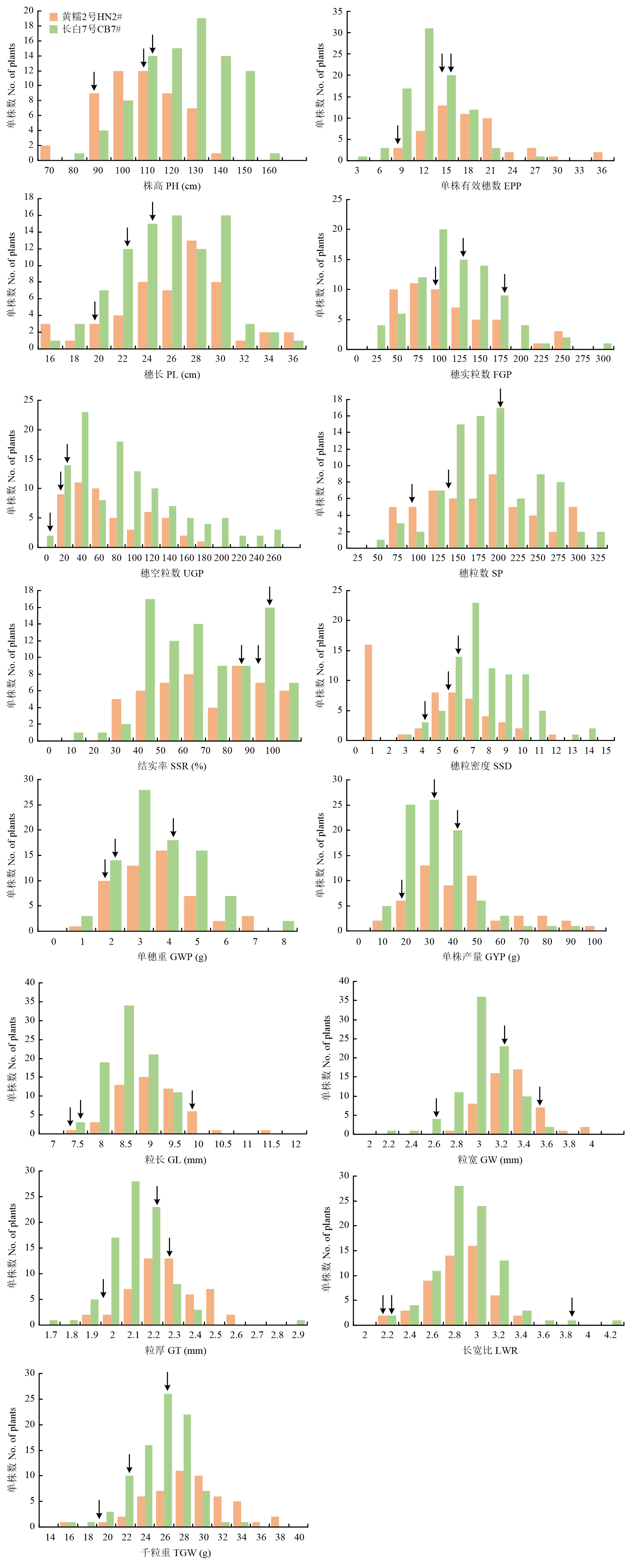
图3
HN2#-群体和CB7#-群体15个产量及其相关性状的频率分布"
表2
黄糯2号、长白7号、协青早B和F2群体15个产量相关性状表型"
| 性状 Traits | 亲本Parents | HN2#-群体HN2#-population | CB7#-群体CB7#-population | ||||||||
|---|---|---|---|---|---|---|---|---|---|---|---|
| 黄糯2号 HN2# | 长白7号 CB7# | 协青早B XQZB | 黄糯2号- 协青早B HN2#-XQZB | 平均值± 标准差 Means±SD | 变幅 Variation | 变异 系数 CV (%) | 长白7号- 协青早B CB7#-XQZB | 平均值± 标准差 Means±SD | 变幅 Variation | 变异 系数 CV (%) | |
| 株高 PH (cm) | 109.20 | 107.40 | 82.40 | 11.84** | 103.33±14.50 | 68.00-132.50 | 14.04 | 12.28** | 120.45±17.48 | 77.00-152.00 | 14.52 |
| 单株有 效穗数 EPP | 16.40 | 9.00 | 13.20 | 2.81* | 17.18±5.98 | 7.00-36.00 | 34.81 | 6.33** | 12.06±3.71 | 3.00-25.00 | 30.79 |
| 穗长 PL (cm) | 24.32 | 20.20 | 22.04 | 2.21 | 25.21±4.69 | 14.50-34.80 | 18.61 | 2.36 | 24.78±3.97 | 15.00-35.00 | 16.01 |
| 穗实粒数 FGP | 136.00 | 186.00 | 96.60 | 4.24** | 97.37±55.10 | 29.00-246.00 | 56.59 | 4.53** | 108.95±51.83 | 8.00-282.00 | 47.57 |
| 穗空粒数 UGP | 25.00 | 17.80 | 10.00 | 2.43 | 67.73±45.28 | 5.00-170.00 | 66.85 | 1.37 | 71.88±49.46 | 5.00-241.00 | 68.82 |
| 穗粒数 SP | 161.00 | 203.80 | 106.60 | 3.96* | 165.06±64.47 | 59.00-285.00 | 39.06 | 4.22** | 180.59±57.47 | 49.00-322.00 | 31.82 |
| 结实率 SSR (%) | 85.00 | 92.00 | 90.88 | 1.83 | 6.00±22.00 | 21.00-97.00 | 36.77 | 0.24 | 60.00±0.22 | 0.09-97.00 | 35.92 |
| 穗粒密度 SSD | 6.64 | 6.50 | 4.83 | 3.17* | 4.28±3.19 | 0.07-11.51 | 74.51 | 5.40** | 3.50±0.05 | 0.07-4.90 | 14.29 |
| 单穗重 GWP (g) | 2.55 | 4.43 | 2.71 | 0.66 | 3.20±1.33 | 0.90-6.61 | 41.64 | 4.02* | 3.21±1.33 | 0.81-7.41 | 41.43 |
| 单株产量 GYP (g) | 34.91 | 31.46 | 24.27 | 3.41* | 38.24±20.84 | 5.85-99.30 | 54.48 | 2.89* | 27.85±14.54 | 5.34-82.53 | 52.20 |
| 粒长 GL (mm) | 7.91 | 6.92 | 9.80 | 10.62** | 8.82±0.65 | 7.36-11.10 | 7.40 | 13.28** | 8.34±0.51 | 7.32-9.48 | 6.12 |
| 粒宽 GW (mm) | 3.58 | 3.04 | 2.58 | 10.73** | 3.23±0.23 | 2.78-3.88 | 7.16 | 4.79* | 2.97±0.24 | 2.04-3.47 | 7.97 |
| 粒厚 GT (mm) | 2.23 | 2.23 | 2.07 | 2.67* | 2.22±0.16 | 1.85-2.55 | 7.13 | 3.59* | 2.09±0.18 | 1.67-3.12 | 8.84 |
| 粒长宽比 LWR | 2.21 | 2.28 | 3.81 | 15.58** | 2.75±0.26 | 2.18-3.39 | 9.44 | 14.51** | 2.83±0.29 | 2.19-4.13 | 10.35 |
| 千粒重 TGW (g) | 20.60 | 22.7 | 26.80 | 3.92* | 27.70±4.30 | 15.30-38.00 | 15.51 | 3.27* | 24.9±3.00 | 1.44-32.80 | 12.05 |
表3
HN2#-群体和CB7#-群体15个产量相关性状的相关性"
| 性状 Trait | 株高 PH | 单株有 效穗数 EPP | 穗长 PL | 穗实 粒数 FGP | 穗空 粒数 UGP | 穗粒数 SP | 结实率 SSR | 穗粒 密度 SSD | 单穗重 GWP | 单株 产量 GYP | 粒长 GL | 粒宽 GW | 粒厚 GT | 粒长 宽比 LWR | 千粒重 TGW |
|---|---|---|---|---|---|---|---|---|---|---|---|---|---|---|---|
| 株高PH | 1.00 | 0.00 | 0.51** | 0.36** | 0.22** | 0.52** | 0.10 | 0.37** | 0.46** | 0.50** | 0.03 | 0.23* | -0.04 | -0.17* | 0.13 |
| 单株有 效穗数 EPP | -0.07 | 1.00 | -0.10 | -0.11 | -0.04 | -0.13 | -0.10 | -0.10 | -0.20** | 0.19* | -0.01 | -0.03 | -0.15* | 0.00 | -0.04 |
| 穗长PL | 0.39** | 0.04 | 1.00 | 0.19* | 0.47** | 0.56** | -0.16* | 0.10 | 0.22** | 0.25** | -0.12 | -0.02 | -0.05 | -0.06 | -0.04 |
| 穗实粒数 FGP | 0.22** | -0.13 | 0.33** | 1.00 | -0.35** | 0.60** | 0.75** | 0.65** | 0.88** | 0.71** | 0.11 | 0.00 | -0.17* | 0.04 | 0.04 |
| 穗空粒数 UGP | 0.31** | 0.05 | 0.49** | -0.22** | 1.00 | 0.54** | -0.81** | 0.32** | -0.23** | -0.16* | -0.25** | 0.06 | 0.17* | -0.19* | -0.20** |
| 穗粒数 SP | 0.41** | -0.08 | 0.63** | 0.72** | 0.53** | 1.00 | -0.01 | 0.86** | 0.60** | 0.50** | -0.11 | 0.06 | -0.01 | -0.13 | -0.13 |
| 结实率 SSR | -0.12 | -0.21** | -0.23** | 0.60** | -0.84** | -0.07 | 1.00 | 0.14 | 0.62** | 0.47** | 0.22** | -0.03 | -0.20** | 0.12 | 0.18* |
| 穗粒密度 SSD | -0.21** | -0.03 | 0.06 | 0.36** | -0.21** | 0.16* | 0.27** | 1.00 | 0.60** | 0.49** | -0.08 | 0.08 | 0.01 | -0.13 | -0.13 |
| 单穗重 GWP | 0.22** | -0.14 | 0.46** | 0.85** | -0.13 | 0.65** | 0.51** | 0.34** | 1.00 | 0.69** | 0.16* | 0.11 | -0.06 | -0.02 | 0.27** |
| 单株产量 GYP | 0.36** | 0.31** | 0.44** | 0.73** | -0.07 | 0.59** | 0.36** | 0.26** | 0.77** | 1.00 | 0.13 | -0.01 | -0.17* | 0.06 | 0.14 |
| 粒长GL | 0.01 | 0.07 | 0.04 | -0.19* | -0.08 | -0.22** | -0.11 | 0.14 | -0.07 | -0.04 | 1.00 | 0.04 | 0.05 | 0.55** | 0.45** |
| 粒宽GW | -0.15* | 0.08 | 0.15* | -0.17* | 0.08 | -0.09 | -0.06 | -0.01 | -0.02 | -0.08 | 0.09 | 1.00 | 0.19* | -0.80** | 0.40** |
| 粒厚GT | -0.23** | 0.05 | 0.11 | -0.27* | 0.08 | -0.17* | -0.19* | -0.06 | -0.25** | -0.35** | -0.02 | 0.55** | 1.00 | -0.06 | 0.20** |
| 粒长宽比 LWR | 0.12 | 0.00 | -0.07 | -0.02 | -0.10 | -0.09 | -0.05 | 0.13 | -0.04 | 0.04 | 0.70** | -0.65** | -0.41** | 1.00 | -0.07 |
| 千粒重 TGW | -0.14 | -0.05 | -0.03 | -0.16* | -0.24** | -0.31** | 0.14 | 0.17* | 0.03 | -0.08 | 0.52** | 0.40** | 0.30** | 0.12 | 1.00 |

图4
HN2#-群体和CB7#-群体15个产量及其相关性状QTL的染色体分布 HN2#-图:HN2#-群体15个产量性状QTL的染色体分布;CB7#-图:CB7#-群体15个产量性状QTL的染色体分布"
表4
HN2#-群体15个产量相关性状QTL分析"
| 性状 Traits | QTL | 染色体 Chromosome | 物理位置 Genomic position (bp) | 标记区间 Marker interval | LOD值 LOD value | 贡献率 Variation (%) | 加性效应 Additive effect | 有利等位基因来源 Favorable allele sources |
|---|---|---|---|---|---|---|---|---|
| 株高PH | qPH7 | 7 | 3141181-4418197 | RM3484-RM5711 | 4.05 | 26.95 | 4.98 | 黄糯2号 HN2# |
| qPH12 | 12 | 23443441-27305223 | RM7376-RM1227 | 3.38 | 19.02 | 1.24 | 黄糯2号 HN2# | |
| 单株有效穗数 EPP | qEPP1 | 1 | 330698-4052895 | RM3426-RM1287 | 3.31 | 3.86 | 5.71 | 黄糯2号 HN2# |
| qEPP2a | 2 | 15894177-20800963 | RM5812-RM262 | 3.63 | 3.41 | 5.13 | 黄糯2号 HN2# | |
| qEPP2b | 2 | 16390789-20800963 | RM262-RM5651 | 3.47 | 3.53 | 6.22 | 黄糯2号 HN2# | |
| qEPP3 | 3 | 13933574-14507885 | RM6080-RM6959 | 2.98 | 2.61 | 8.44 | 黄糯2号 HN2# | |
| qEPP6 | 6 | 6230185-11767249 | RM276-RM564 | 3.51 | 3.36 | 8.96 | 黄糯2号 HN2# | |
| 穗长PL | qPL1 | 1 | 39720126-43370870 | RM3482-RM3362 | 3.46 | 13.13 | 2.94 | 黄糯2号 HN2# |
| qPL7 | 7 | 3141181-16200067 | RM5711-RM5481 | 3.39 | 15.78 | 2.70 | 黄糯2号 HN2# | |
| 穗实粒数FGP | qFGP6 | 6 | 5960201-6998987 | RM7488-RM2615 | 2.84 | 23.94 | 2.38 | 黄糯2号 HN2# |
| 穗空粒数 UGP | qUGP1 | 1 | 330698-4052895 | RM3426-RM1287 | 3.69 | 13.35 | -26.52 | 协青早B XQZB |
| qUGP7 | 7 | 16932001-17489638 | RM1135-RM5793 | 2.52 | 3.36 | 17.11 | 黄糯2号 HN2# | |
| qUGP11 | 11 | 11763775-21979491 | RM7120-RM206 | 2.91 | 12.15 | 47.05 | 黄糯2号 HN2# | |
| qUGP12 | 12 | 3201708-19903791 | RM6296-RM519 | 3.00 | 11.53 | 11.44 | 黄糯2号 HN2# | |
| 穗粒数 SP | qSP3 | 3 | 9734810-10169054 | RM232-RM4321 | 2.76 | 11.99 | -34.30 | 协青早B XQZB |
| qSP5 | 5 | 17752245-17956065 | RM6024-RM1237 | 2.82 | 15.13 | -37.38 | 协青早B XQZB | |
| qSP7 | 7 | 3141181-4418197 | RM3484-RM5711 | 3.92 | 24.37 | 8.59 | 黄糯2号 HN2# | |
| 结实率 SSR | qSSR6 | 6 | 5960201-6230185 | RM2615-RM276 | 4.21 | 26.02 | 0.01 | 黄糯2号 HN2# |
| qSSR7 | 7 | 4660490-18132231 | RM418-RM6872 | 2.80 | 14.69 | -0.10 | 协青早B XQZB | |
| 穗粒密度 SSD | qSSD4 | 4 | 15742285-20584454 | RM5687-RM5979 | 2.95 | 6.52 | -0.99 | 协青早B XQZB |
| qSSD11 | 11 | 11763775-21979491 | RM7120-RM206 | 2.75 | 6.66 | -1.17 | 协青早B XQZB | |
| 粒长 GL | qGL1 | 1 | 15118625-18999662 | RM7075-RM8004 | 3.92 | 21.67 | -0.47 | 协青早B XQZB |
| qGL8 | 8 | 5850563-8385395 | RM6429-RM6838 | 2.86 | 15.59 | -0.01 | 协青早B XQZB | |
| 粒宽 GW | qGW2 | 2 | 5477492-7664143 | RM6378-RM7636 | 2.65 | 13.40 | 0.20 | 黄糯2号 HN2# |
| qGW4 | 4 | 13059580-13154172 | RM401-RM5633 | 2.54 | 10.93 | 0.20 | 黄糯2号 HN2# | |
| qGW10 | 10 | 2722348-9439397 | RM3882-RM1126 | 2.71 | 7.45 | 0.13 | 黄糯2号 HN2# | |
| 粒厚GT | qGT2 | 2 | 5477492-7664143 | RM6378-RM7636 | 3.88 | 29.41 | 0.14 | 黄糯2号 HN2# |
| 粒长宽比 LWR | qLWR1 | 1 | 15118625-18999662 | RM7075-RM8004 | 2.53 | 11.20 | -0.11 | 协青早B XQZB |
| qLWR10 | 10 | 2722348-9439397 | RM3882-RM1126 | 4.14 | 23.39 | -0.18 | 协青早B XQZB |
表5
CB7#-群体15个产量相关性状QTL分析"
| 性状 Traits | QTL | 染色体 Chromosome | 物理位置 Genomic position (bp) | 标记区间 Marker interval | LOD值 LOD value | 贡献率 Variation (%) | 加性效应 Additive effect | 有利等位基因来源 Favorable allele sources |
|---|---|---|---|---|---|---|---|---|
| 株高PH | qPH1 | 1 | 34902085-37261443 | RM3738-RM8084 | 2.59 | 13.39 | 6.39 | 长白7号 CB7# |
| 穗长PL | qPL8 | 8 | 4773752-5850563 | RM6838-RM1111 | 2.57 | 10.05 | 0.20 | 长白7号 CB7# |
| qPL12 | 12 | 2304378-3201708 | RM6296-RM3747 | 2.89 | 15.40 | -0.61 | 协青早B XQZB | |
| 穗实粒数FGP | qFGP6 | 6 | 6998987-8070717 | RM7488-RM19720 | 4.11 | 27.94 | -9.43 | 协青早B XQZB |
| 穗空粒数UGP | qUGP2 | 2 | 4407860-7664143 | RM3732-RM7636 | 5.02 | 23.56 | 27.54 | 长白7号 CB7# |
| qUGP6 | 6 | 5960201-6230185 | RM276-RM2615 | 4.73 | 10.65 | 18.26 | 长白7号 CB7# | |
| qUGP7 | 7 | 4418197-16200067 | RM5481-RM3484 | 3.74 | 8.81 | 25.66 | 长白7号 CB7# | |
| 穗粒数SP | qSP1 | 1 | 39720126-41167834 | RM5536-RM3482 | 2.64 | 15.07 | 26.98 | 长白7号 CB7# |
| 结实率SSR | qSSR2a | 2 | 4407860-7664143 | RM3732-RM7636 | 2.79 | 13.36 | -0.07 | 协青早B XQZB |
| qSSR2b | 2 | 15894177-20495111 | RM5812-RM2634 | 2.52 | 8.37 | -0.09 | 协青早B XQZB | |
| qSSR6 | 6 | 5960201-6230185 | RM276-RM2615 | 7.88 | 24.73 | -0.04 | 协青早B XQZB | |
| 穗粒密度SSD | qSSD1 | 1 | 39720126-41167834 | RM5536-RM3482 | 3.00 | 17.33 | 0.96 | 长白7号 CB7# |
| 单穗重GWP | qGWP6 | 6 | 6998987-8070717 | RM7488-RM19720 | 3.86 | 6.10 | -0.14 | 协青早B XQZB |
| qGWP11 | 11 | 5477676-19184001 | RM4504-RM5349 | 2.65 | 10.65 | 0.78 | 长白7号 CB7# | |
| 单株产量GYP | qGYP1 | 1 | 39720126-41167834 | RM5536-RM3482 | 2.83 | 9.26 | 6.51 | 长白7号 CB7# |
| qGYP6 | 6 | 8070717-10822809 | RM19720-RM19835 | 5.46 | 21.66 | -5.69 | 协青早B XQZB | |
| 粒长GL | qGL3 | 3 | 17694161-1871497 | RM15283-RM2346 | 6.01 | 22.97 | -0.31 | 协青早B XQZB |
| qGL6 | 6 | 5960201-6230185 | RM276-RM2615 | 3.52 | 10.78 | 0.03 | 长白7号 CB7# | |
| qGL7 | 7 | 16200067-16932001 | RM1135-RM5481 | 2.73 | 8.30 | -0.05 | 协青早B XQZB | |
| 粒宽GW | qGW5 | 5 | 17752245-26174809 | RM3790-RM6024 | 2.79 | 14.17 | 0.10 | 长白7号 CB7# |
| 粒厚GT | qGT3 | 3 | 3285730-6078216 | RM7576-RM6849 | 5.57 | 10.69 | 0.46 | 长白7号 CB7# |
| qGT7 | 7 | 4418197-16200067 | RM5481-RM3484 | 2.85 | 2.77 | 0.10 | 长白7号 CB7# |
| [1] |
徐春春, 纪龙, 陈中督, 方福平. 2022年我国水稻产业发展分析及2023年展望. 中国稻米, 2023, 29(2): 1-4.
doi: 10.3969/j.issn.1006-8082.2023.02.001 |
|
doi: 10.3969/j.issn.1006-8082.2023.02.001 |
|
| [2] |
doi: 10.1007/s11111-011-0134-4 |
| [3] |
|
| [4] |
doi: 10.1038/s41893-022-00997-3 |
| [5] |
doi: 10.1038/335721a0 |
| [6] |
doi: 10.1038/nature01518 |
| [7] |
doi: S1674-2052(20)30071-X pmid: 32222483 |
| [8] |
|
| [9] |
doi: 10.1105/tpc.105.038455 |
| [10] |
doi: 10.1126/science.1113373 pmid: 15976269 |
| [11] |
|
| [12] |
doi: 10.1038/ng.143 |
| [13] |
doi: 10.1111/pbi.2019.17.issue-2 |
| [14] |
doi: 10.1038/ng.591 |
| [15] |
doi: 10.1371/journal.pgen.1006386 |
| [16] |
doi: 10.1038/s41467-023-37175-8 |
| [17] |
|
| [18] |
doi: 10.1038/ng.3346 |
| [19] |
doi: 10.1038/ng.3518 |
| [20] |
doi: 10.1038/ng2014 |
| [21] |
doi: 10.1038/s41598-021-81291-8 |
| [22] |
doi: 10.1007/s10681-022-03044-6 |
| [23] |
申宗坦. 作物育种学实验. 北京: 中国农业出版社, 1995: 102-107.
|
|
|
|
| [24] |
彭廷燊, 陆久焱, 严雨欣, 谭霖, 南文斌, 秦小健, 李明, 龚俊义, 梁永书. 多年生水稻分子图谱的构建与分析. 遗传, 2025, 47(9): 1042-1056.
|
|
|
|
| [25] |
doi: 10.1016/j.cj.2015.01.001 |
| [26] |
doi: 10.1007/BF00273666 pmid: 24232389 |
| [27] | |
|
Guangdong Academy of Agricultural Sciences. Main experience of rice dwarf breeding in Guangdong. Scientia Agricultura Sinica, 1965, 6(1): 19-24. doi: 10.3864/j.issn.0578-1752.1965-06-01-19-24. (in Chinese)
|
|
| [28] |
袁隆平. 水稻的雄性不孕性. 科学通报, 1966, 4: 185-188.
|
|
|
|
| [29] |
石明松, 邓景扬. 湖北光感核不育水稻的发现、鉴定及其利用途径. 遗传学报, 1986, 13(2): 107-112.
|
|
|
|
| [30] |
阳峰萍, 胡志萍, 刘海林, 颜春龙, 黄蓉芬, 柳美南, 姚志坚, 王可可. 籼型杂交水稻恢复系的选育研究进展. 杂交水稻, 2007, 22(2): 6-10.
|
|
|
|
| [31] |
doi: 10.1111/tpj.2006.46.issue-5 |
| [32] |
doi: 10.1126/science.270.5243.1804 |
| [33] |
doi: 10.1016/j.cell.2025.04.011 pmid: 40311617 |
| [34] |
doi: 10.1016/j.fcr.2019.107556 |
| [35] |
韩雷锋, 周燃, 周涛, 林翠香, 甘泉, 倪大虎, 石英尧, 宋丰顺. 水稻抗倒伏和产量性状的相关性分析及QTLs定位. 生物学杂志, 2023, 40(2): 65-70.
|
|
|
|
| [36] |
doi: 10.1007/s001220100536 |
| [37] |
doi: 10.1007/s00122-003-1270-8 |
| [38] |
doi: 10.1007/s001220051616 |
| [39] |
doi: 10.1007/s00122-003-1388-8 |
| [40] |
doi: 10.1007/s001220050628 |
| [41] |
doi: 10.1186/1471-2156-6-33 |
| [42] |
谭震波, 沈利爽, 袁祚廉, 陆朝福, 陈英, 周开达, 朱立煌. 水稻再生能力和头季稻产量性状的QTL定位及其遗传效应分析. 作物学报, 1997, 23(3): 289-295.
|
|
|
|
| [43] |
涂夯. 水稻单株有效穗数、每穗实粒数及千粒重QTL定位与分析[D]. 南昌: 江西农业大学, 2023.
|
|
|
|
| [44] |
doi: 10.1007/BF00224031 |
| [45] |
doi: 10.1007/s00122-003-1269-1 |
| [46] |
doi: 10.1111/j.1469-8137.2005.01647.x pmid: 16539615 |
| [47] |
|
| [48] |
闫超, 郑剑, 段文静, 南文斌, 秦小健, 张汉马, 梁永书. 越冬栽培稻产量性状相关QTL定位. 作物学报, 2019, 45(4): 522-537.
doi: 10.3724/SP.J.1006.2019.82045 |
|
doi: 10.3724/SP.J.1006.2019.82045 |
|
| [49] |
doi: 10.1007/BF00223380 pmid: 24166172 |
| [50] |
|
| [51] |
张应洲, 罗荣剑, 圣忠华, 焦桂爱, 唐绍清, 胡培松, 魏祥进. 日本晴/中嘉早17重组自交系产量性状QTL定位. 中国农业科学, 2017, 50(19): 3640-3651. doi: 10.3864/j.issn.0578-1752.2017.19.002.
|
|
|
|
| [52] |
|
| [53] |
沈希宏, 曹立勇, 陈深广, 占小登, 吴伟明, 程式华. 超级杂交稻协优9308重组自交系群体的穗部性状QTL分析. 中国水稻科学, 2009, 23(4): 354-362.
doi: 10.3969/j.issn.1001-7216.2009.04.04 |
|
doi: 10.3969/j.issn.1001-7216.2009.04.04 |
|
| [54] |
胡大维, 圣忠华, 陈炜, 李潜龙, 魏祥进, 邵高能, 焦桂爱, 王建龙, 胡培松, 谢黎虹, 等. 超级稻品种中嘉早17高产相关性状的QTL定位. 作物学报, 2017, 43(10): 1434-1447.
|
|
doi: 10.3724/SP.J.1006.2017.01434 |
|
| [55] |
|
| [56] |
doi: 10.1007/s00122-005-1976-x pmid: 15809851 |
| [57] |
doi: 10.1139/g04-029 |
| [58] |
doi: 10.1007/s001220051549 |
| [1] | 吴媛媛, 吕书文, 张子君, 王涛, 张逸鸣, 卜令超, 邹庆道, 姜晶. 番茄果实果脐大小性状主基因+多基因遗传分析[J]. 中国农业科学, 2026, 59(5): 1060-1069. |
| [2] | 杨永庆, 胡朋举, 宋亚辉, 金欣欣, 苏俏, 王瑾. 超高油花生种质SW9721-3品质性状的QTL定位[J]. 中国农业科学, 2025, 58(4): 635-646. |
| [3] | 刘泽厚, 王琴, 叶美金, 万洪深, 杨宁, 杨漫宇, 杨武云, 李俊. 人工合成小麦和地方品种穗发芽抗性育种利用效率[J]. 中国农业科学, 2024, 57(7): 1255-1266. |
| [4] | 罗江陶, 郑建敏, 邓清燕, 刘培勋, 蒲宗君. 2000—2020年四川小麦育成品种产量增益分析[J]. 中国农业科学, 2024, 57(20): 3945-3956. |
| [5] | 叶雪莲, 陈靖雯, 姚祥坦, 权新华, 黄鹂. 不结球白菜叶片皱缩性状的遗传分析[J]. 中国农业科学, 2024, 57(18): 3684-3694. |
| [6] | 王凯,张海亮,董祎鑫,陈少侃,郭刚,刘林,王雅春. 基于牧场管理数据的奶牛健康性状定义及遗传参数估计[J]. 中国农业科学, 2022, 55(6): 1227-1240. |
| [7] | 郝静,李秀坤,崔顺立,邓洪涛,侯名语,刘盈茹,杨鑫雷,穆国俊,刘立峰. 花生每荚种子数相关性状QTL的定位[J]. 中国农业科学, 2022, 55(13): 2500-2508. |
| [8] | 龙卫华,浦惠明,高建芹,胡茂龙,张洁夫,陈松. 油菜高油酸种质的创建及高油酸性状遗传与生理特性的分析[J]. 中国农业科学, 2021, 54(2): 261-270. |
| [9] | 王岭,才羿,王桂超,王迪,盛云燕. 甜瓜SLAF图谱构建及果实相关性状QTL分析[J]. 中国农业科学, 2021, 54(19): 4196-4206. |
| [10] | 段有厚,卢峰. 早熟矮秆高粱不育系P03A生育期和株高性状的遗传分析[J]. 中国农业科学, 2020, 53(14): 2828-2839. |
| [11] | 龚成胜, 赵胜杰, 路绪强, 何楠, 朱红菊, 豆峻岭, 袁平丽, 李兵兵, 刘文革. 西瓜果实表皮蜡粉的化学成分与基因定位[J]. 中国农业科学, 2019, 52(9): 1587-1600. |
| [12] | 周佳琴,朱俊兆,杨思学,诸周洁,姚婕,郑文娟,朱世华,丁沃娜. 水稻根系发育基因OsKSR7 的克隆与功能分析[J]. 中国农业科学, 2019, 52(5): 777-785. |
| [13] | 宋稀, 蒲定福, 田露申, 余青青, 杨玉恒, 代兵兵, 赵昌斌, 黄成云, 邓武明. 甘蓝型油菜半矮秆突变体dw-1的遗传分析与激素响应特性[J]. 中国农业科学, 2019, 52(10): 1667-1677. |
| [14] | 赵倩茹,钟兴华,张飞,房伟民,陈发棣,滕年军. 切花小菊绿心性状杂种优势与混合遗传分析[J]. 中国农业科学, 2018, 51(5): 964-976. |
| [15] | 张孝波,谢佳,张晓琼,田维江,何沛龙,刘思岑,何光华,钟秉强,桑贤春. 水稻矮化剑叶卷曲突变体dcfl1的鉴定与基因精细定位[J]. 中国农业科学, 2017, 50(9): 1551-1558. |
|
||
