






中国农业科学 ›› 2026, Vol. 59 ›› Issue (4): 874-886.doi: 10.3864/j.issn.0578-1752.2026.04.013
李赛亚1( ), 徐雅萍2(), 郑佳兴1, 郑杨1, 于嘉慧1, 李永强1,3, 蒲首丞1,3, 杨莉1,3(), 郭卫东1,3()
收稿日期:2025-08-25
出版日期:2026-02-10
发布日期:2026-02-10
通信作者:
联系方式:
李赛亚,E-mail:15157676305@163.com。徐雅萍,E-mail:1198215880@qq.com。李赛亚和徐雅萍为同等贡献作者。
基金资助:
LI SaiYa1(), XU YaPing2(), ZHENG JiaXing1, ZHENG Yang1, YU JiaHui1, LI YongQiang1,3, PU ShouCheng1,3, YANG Li1,3(), GUO WeiDong1,3()
Received:2025-08-25
Published:2026-02-10
Online:2026-02-10
摘要:
【目的】越橘属植物(Vaccinium spp.)叶片是栽培过程中的主要副产物,富含多酚类活性物质,但其资源价值尚未被充分开发利用。本研究旨在系统探究34种(包括野生资源与商业品种)越橘属植物在不同物候期叶片中的多酚组分积累规律及其抗氧化活性,筛选兼具高营养价值和新颖性状的优异种质资源,为越橘叶片的高值化利用和功能性产品开发提供理论依据。【方法】以34种越橘植物的春季幼嫩叶片(嫩叶)、冬季成熟叶片(成熟叶)和衰老叶片(老叶)为试验材料,检测总黄酮、槲皮素、花色苷和原花青素等多酚类组分水平,并采用羟自由基(·OH)清除率、ABTS自由基清除率和铁离子还原抗氧化能力(FRAP)3种体外模型综合评价其抗氧化活性。运用相关性分析和主成分分析探究多酚组分与抗氧化活性之间的内在联系。【结果】越橘属植物叶片中的主要多酚含量与抗氧化能力整体水平较高,且在不同种类、品种和叶片成熟度间存在显著差异。34份种质嫩叶、成熟叶及老叶的平均总黄酮含量分别为189.92、89.05和99.51 mg·g-1 DW,其中云南越橘(V. duclouxii,YNY316)嫩叶中总黄酮含量最高,达561.43 mg·g-1 DW;平均槲皮素含量为4.51、12.56和8.95 mg·g-1 DW,江南越橘(V. mandarinorum,MFH4)成熟叶中槲皮素含量最高(38.85 mg·g-1 DW);平均花色苷含量分别为0.83、1.41和1.70 mg·g-1 DW;平均原花青素含量分别为36.52、38.45和44.42 mg·g-1 DW。抗氧化活性评价显示,越橘属植物老叶的·OH清除率(65.14%)和FRAP值(1.23)最高,而成熟叶的ABTS自由基清除率最高(33.66%)。相关性分析表明,成熟叶和老叶中槲皮素含量与FRAP值、ABTS自由基清除率显著正相关(P<0.01),是越橘叶片抗氧化活性的关键贡献组分。云南越橘、刺毛越橘(V. trichophyllum)和江南越橘等野生资源,以及‘优瑞卡'‘贝姬蓝'和‘普林'等栽培蓝莓品种在不同指标上均表现出优越性。【结论】野生越橘种质及部分优良栽培品种叶片中富含多酚类活性成分,尤其以黄酮及原花青素含量丰富,具有较高的抗氧化活性。研究明确了不同功能成分的适宜采收物候期(如获取黄酮宜采收嫩叶,获取槲皮素宜采收成熟叶),所筛选出的特色种质可为高多酚含量蓝莓品种选育和越橘叶片的资源化利用提供理论参考。
李赛亚, 徐雅萍, 郑佳兴, 郑杨, 于嘉慧, 李永强, 蒲首丞, 杨莉, 郭卫东. 34种越橘属植物叶片主要多酚组成及抗氧化能力评价[J]. 中国农业科学, 2026, 59(4): 874-886.
LI SaiYa, XU YaPing, ZHENG JiaXing, ZHENG Yang, YU JiaHui, LI YongQiang, PU ShouCheng, YANG Li, GUO WeiDong. Bioactive Polyphenolic Composition and Antioxidant Activities in Leaves of 34 Vaccinium Species[J]. Scientia Agricultura Sinica, 2026, 59(4): 874-886.
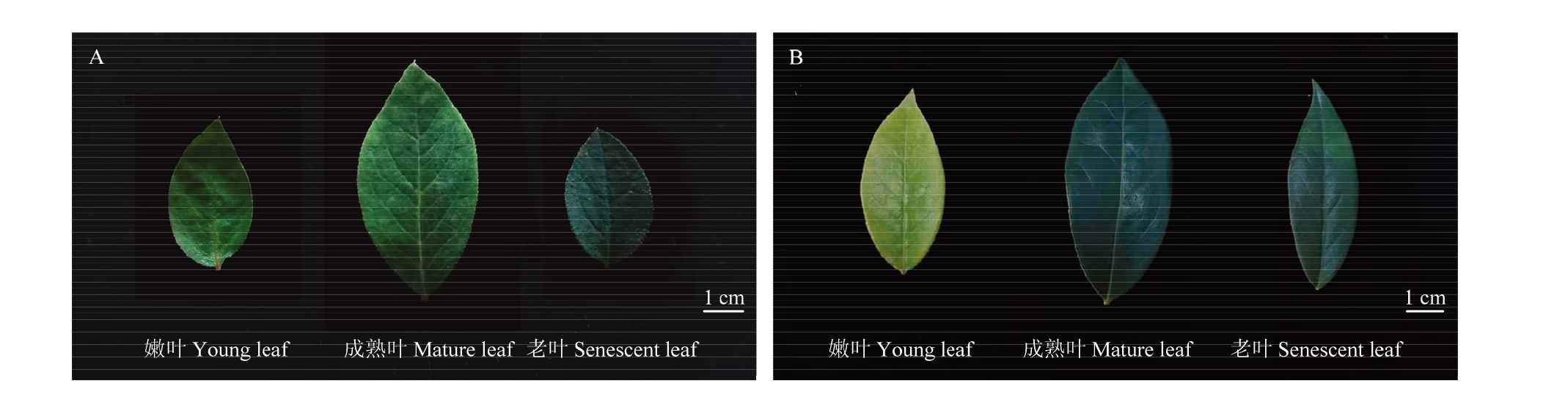
图1
越橘属栽培和野生种质叶片成熟度的标准分类 A:栽培种‘优瑞卡'叶片Cultivated ‘Eureka' leaf;B:野生种质江南越橘叶片Wild V. mandarinorum leaf"
表1
34种越橘属植物叶片的总黄酮、槲皮素、花色苷和原花青素含量"
| 品种/种质 Cultivar/germplasm | 代码 Sample code | 总黄酮含量 Total flavonoid content (mg·g-1 DW) | 槲皮素含量 Quercetin content (mg·g-1 DW) | ||||
|---|---|---|---|---|---|---|---|
| 嫩叶 Young leaf | 成熟叶 Mature leaf | 老叶 Senescent leaf | 嫩叶 Young leaf | 成熟叶 Mature leaf | 老叶 Senescent leaf | ||
| 南高丛蓝莓,栽培品种Southern highbush blueberry (V. corymbosum), cultivar | |||||||
| 蓝雨Bluerain | BLR | 156.06±1.73 | 74.85±0.78 | 177.18±4.21 | 1.64±0.77 | 18.31±0.67 | 18.31±0.51 |
| 库珀Cooper | CPR | 276.12±2.64 | 167.65±1.15 | 82.33±3.00 | 10.34±0.29 | 22.29±0.53 | 5.20±0.39 |
| 艾美瑞Emerald | EMD | 121.46±3.60 | 35.80±0.78 | 52.11±1.01 | 6.15±0.29 | 21.56±0.90 | 1.54±0.78 |
| 佐治亚宝石Georgiagerm | GGM | 69.20±1.73 | 109.95±3.46 | 80.99±2.84 | 5.10±0.88 | 4.47±0.25 | 7.82±0.53 |
| 珠宝Jewel | JUE | 372.17±2.99 | 14.33±0.34 | 50.56±5.32 | 5.21±0.53 | 2.06±0.29 | 15.58±0.82 |
| 密斯提Misty | MST | 118.63±0.99 | 125.84±1.60 | 143.49±2.33 | 2.80±0.78 | 0.91±0.29 | 10.24±0.97 |
| 奥尼尔O'Neal | ONL | 198.44±6.23 | 73.72±5.42 | 51.83±2.16 | 7.20±0.78 | 22.50±0.53 | 10.34±0.78 |
| 夏普蓝Sharpblue | SHP | 132.05±1.99 | 54.23±2.94 | 127.04±1.41 | 3.74±0.64 | 37.17±0.92 | 3.11±0.97 |
| 普林Springhigh | SPR | 477.39±2.64 | 66.73±1.63 | 37.07±2.52 | 2.17±0.59 | 16.42±0.44 | 14.74±0.39 |
| 明星Star | STR | 116.52±5.56 | 31.70±3.89 | 79.86±2.52 | 8.77±0.59 | 17.36±0.67 | 8.14±0.39 |
| 优瑞卡Eureka | URK | 366.52±2.64 | 67.15±4.49 | 94.83±2.56 | 4.27±0.53 | 2.27±0.67 | 12.12±0.29 |
| 兔眼蓝莓,栽培品种Rabbiteye blueberry (V. ashei), cultivar | |||||||
| 巴尔德温Baldwin | BDW | 216.09±7.99 | 91.94±2.16 | 98.58±5.79 | 3.53±0.25 | 11.81±0.39 | 3.63±0.14 |
| 贝姬蓝Beckyblue | BKB | 252.11±2.64 | 167.29±1.82 | 130.07±5.36 | 5.42±0.92 | 1.64±0.44 | 14.01±0.59 |
| 灿烂Brightwell | BRW | 101.69±5.28 | 82.83±2.02 | 68.56±5.57 | 2.59±0.00 | 31.30±0.82 | 14.11±0.29 |
| 园蓝Garden Blue | GDB | 97.45±4.35 | 97.24±2.11 | 121.04±1.38 | 4.58±0.90 | 22.19±0.78 | 2.27±0.67 |
| 杰兔Premier | PRM | 82.62±6.07 | 74.07±2.03 | 134.52±4.35 | 0.49±0.29 | 10.34±0.53 | 1.01±0.25 |
| 蓝宝石Saphire | SPH | 90.39±1.73 | 31.20±4.91 | 35.16±2.30 | 0.81±0.59 | 22.71±0.67 | 12.33±0.25 |
| 乌达德Woodard | WDD | 205.50±1.99 | 99.85±4.39 | 132.62±4.35 | 5.94±0.64 | 4.89±0.90 | 11.81±0.39 |
| 北高丛蓝莓,栽培品种Northern highbush blueberry (V. corymbosum), cultivar | |||||||
| 钱德勒Chandler | CHD | 129.93±0.99 | 57.48±5.40 | 105.92±2.69 | 1.44±0.82 | 15.48±0.92 | 11.07±0.88 |
| 德雷伯Draper | DRP | 76.26±4.35 | 56.91±2.76 | 68.35±2.37 | 0.91±0.14 | 12.54±0.74 | 14.74±0.82 |
| 杜克Duke | DUK | 116.52±2.64 | 137.42±0.86 | 68.7±2.04 | 2.06±0.53 | 2.06±0.29 | 12.65±0.44 |
| 早蓝Earlyblue | ELB | 156.06±2.99 | 89.54±4.81 | 99.85±5.021 | 3.74±0.39 | 3.74±0.39 | 5.83±0.97 |
| 莱格西Legacy | LGC | 161.71±5.56 | 193.49±2.64 | 80.99±1.40 | 2.27±0.25 | 0.91±0.14 | 1.85±0.29 |
| 野生越橘Wild species | |||||||
| 江南越橘 V. mandarinorum | MFH1 | 112.28±3.60 | 28.17±1.22 | 93.92±3.99 | 5.10±0.44 | 22.92±0.97 | 17.78±0.53 |
| MFH2 | 158.89±1.99 | 168.78±4.57 | 127.81±4.35 | 8.67±0.14 | 6.25±0.53 | 2.06±0.39 | |
| MFH3 | 351.69±2.64 | 151.83±5.19 | 132.62±3.88 | 4.37±0.82 | 4.16±0.25 | 8.77±0.53 | |
| MFH4 | 263.41±1.99 | 39.19±0.72 | 143.70±4.31 | 2.17±0.14 | 38.85±0.39 | 3.21±0.51 | |
| MFH5 | 201.26±4.35 | 65.88±4.18 | 120.61±3.83 | 0.28±0.33 | 12.54±0.14 | 14.53±0.92 | |
| 云南越橘 V. duclouxii | YNY | 146.18±1.99 | 109.95±4.94 | 98.15±3.81 | 7.41±0.39 | 5.83±0.59 | 2.37±0.39 |
| YNY316 | 561.43±3.60 | 43.92±4.71 | 130.15±3.04 | 17.26±0.78 | 1.33±0.51 | 15.58±0.59 | |
| 乌饭树 V. bracteatum | WFS1 | 9.17±2.64 | 11.85±3.33 | 32.48±0.78 | 1.96±0.25 | 2.27±0.51 | 10.00±0.39 |
| WFS6 | — | 75.56±2.71 | 11.43±3.51 | — | 5.10±0.67 | 3.11±0.90 | |
| 刺毛越橘V. trichocladum | CMY | 251.40±3.45 | 242.93±1.73 | 221.74±3.46 | 8.04±0.29 | 2.37±0.39 | 8.66±0.39 |
| 乌鸦果V. fragile | WYG1 | 120.75±2.64 | 88.55±4.96 | 149.00±2.44 | 2.38±0.53 | 20.19±0.51 | 5.41±0.51 |
| 品种/种质 Cultivar/germplasm | 代码 Sample code | 花色苷含量 Anthocyanin content (mg·g-1 DW) | 原花青素含量 Proanthocyanidin content (mg·g-1 DW) | ||||
| 嫩叶 Young leaf | 成熟叶 Mature leaf | 老叶 Senescent leaf | 嫩叶 Young leaf | 成熟叶 Mature leaf | 老叶 Senescent leaf | ||
| 南高丛蓝莓,栽培品种Southern highbush blueberry (V. corymbosum), cultivar | |||||||
| 蓝雨Bluerain | BLR | 0.21±0.01 | 5.79±0.15 | 1.87±0.21 | 25.91±0.63 | 29.80±0.08 | 33.53±0.04 |
| 库珀Cooper | CPR | 1.08±0.03 | 1.27±0.02 | 1.19±0.16 | 67.76±0.22 | 59.63±0.08 | 37.86±0.05 |
| 艾美瑞Emerald | EMD | 0.53±0.01 | 0.08±0.01 | 1.52±0.09 | 12.93±0.92 | 15.14±0.03 | 41.94±0.03 |
| 佐治亚宝石Georgiagerm | GGM | 0.41±0.01 | 0.82±0.02 | 3.06±0.11 | 14.12±1.69 | 61.17±0.78 | 34.03±0.15 |
| 珠宝Jewel | JUE | 0.35±0.04 | 1.91±0.08 | 1.06±0.03 | 70.27±0.59 | 16.13±0.10 | 23.31±0.32 |
| 密斯提Misty | MST | 0.80±0.01 | 1.89±0.10 | 1.96±0.11 | 13.27±1.35 | 28.37±0.07 | 42.77±0.53 |
| 奥尼尔O'Neal | ONL | 0.47±0.04 | 5.07±0.16 | 1.25±0.12 | 17.42±0.41 | 23.20±0.32 | 44.30±0.20 |
| 夏普蓝Sharpblue | SHP | 0.84±0.03 | 1.55±0.08 | 2.18±0.12 | 16.80±0.51 | 20.97±0.11 | 34.56±0.81 |
| 普林Springhigh | SPR | 0.57±0.03 | 0.33±0.04 | 1.58±0.05 | 67.10±0.78 | 28.36±0.10 | 30.90±0.58 |
| 明星Star | STR | 0.69±0.05 | 0.11±0.01 | 2.18±0.06 | 14.10±1.65 | 18.68±0.27 | 48.07±0.72 |
| 优瑞卡Eureka | URK | 0.67±0.02 | 0.28±0.02 | 3.10±0.02 | 80.24±3.04 | 31.97±0.60 | 42.31±0.45 |
| 兔眼蓝莓,栽培品种Rabbiteye blueberry (V. ashei), cultivar | |||||||
| 巴尔德温Baldwin | BDW | 0.37±0.01 | 0.29±0.03 | 0.53±0.05 | 27.67±0.23 | 38.51±0.07 | 33.45±0.04 |
| 贝姬蓝Beckyblue | BKB | 0.06±0.01 | 4.14±0.17 | 2.86±0.18 | 62.48±1.79 | 96.67±0.11 | 71.85±0.13 |
| 灿烂Brightwell | BRW | 0.50±0.02 | 3.45±0.15 | 2.34±0.18 | 20.85±1.40 | 22.97±0.01 | 26.11±0.01 |
| 园蓝Garden Blue | GDB | 0.08±0.01 | 0.09±0.01 | 1.25±0.11 | 12.86±1.69 | 26.03±0.19 | 45.92±0.03 |
| 杰兔Premier | PRM | 0.16±0.01 | 1.25±0.06 | 3.36±0.10 | 9.11±0.85 | 70.06±0.71 | 83.07±1.07 |
| 蓝宝石Saphire | SPH | 0.90±0.06 | 0.93±0.12 | 0.44±0.04 | 12.90±1.78 | 10.05±0.13 | 25.80±0.18 |
| 乌达德Woodard | WDD | 0.94±0.04 | 0.86±0.05 | 0.97±0.07 | 65.63±2.37 | 56.92±0.55 | 60.99±0.60 |
| 北高丛蓝莓,栽培品种Northern highbush blueberry (V. corymbosum), cultivar | |||||||
| 钱德勒Chandler | CHD | 0.40±0.01 | 2.23±0.17 | 0.86±0.06 | 40.97±0.85 | 28.95±0.05 | 50.97±0.17 |
| 德雷伯Draper | DRP | 0.12±0.01 | 1.44±0.03 | 2.70±0.18 | 13.33±1.15 | 23.12±0.19 | 40.85±0.04 |
| 杜克Duke | DUK | 1.00±0.01 | 2.28±0.05 | 3.03±0.13 | 12.81±0.15 | 74.56±0.18 | 50.13±0.13 |
| 早蓝Earlyblue | ELB | 0.25±0.02 | 1.04±0.10 | 2.18±0.05 | 64.74±2.19 | 27.63±0.08 | 60.76±0.03 |
| 莱格西Legacy | LGC | 0.49±0.05 | 2.03±0.07 | 2.06±0.15 | 23.12±1.41 | 62.85±0.30 | 31.57±0.46 |
| 野生越橘Wild species | |||||||
| 江南越橘 V. mandarinorum | MFH1 | 0.60±0.01 | 0.39±0.03 | 0.11±0.01 | 14.41±1.51 | 23.30±0.32 | 38.24±0.26 |
| MFH2 | 1.93±0.09 | 0.08±0.01 | 1.43±0.05 | 12.75±0.22 | 39.65±0.93 | 51.48±0.51 | |
| MFH3 | 1.83±0.13 | 0.09±0.01 | 2.23±0.11 | 66.40±1.30 | 78.24±0.13 | 42.16±0.75 | |
| MFH4 | 0.78±0.03 | 2.94±0.13 | 0.10±0.01 | 58.98±1.00 | 15.08±0.37 | 73.53±0.91 | |
| MFH5 | 0.43±0.02 | 2.29±0.06 | 2.92±0.06 | 80.07±1.97 | 16.42±0.41 | 45.84±0.40 | |
| 云南越橘 V. duclouxii | YNY | 0.33±0.04 | 0.35±0.04 | 0.57±0.04 | 29.95±0.14 | 43.09±0.52 | 46.52±0.89 |
| YNY316 | 4.77±0.17 | 1.13±0.12 | 2.50±0.21 | 135.56±4.45 | 51.99±0.91 | 55.16±0.64 | |
| 乌饭树 V. bracteatum | WFS1 | 0.06±0.01 | 0.09±0.01 | 0.10±0.01 | 27.67±0.23 | 31.29±0.65 | 54.65±0.66 |
| WFS6 | — | 0.26±0.01 | 2.12±0.11 | — | 49.79±0.60 | 21.50±0.17 | |
| 刺毛越橘V. trichocladum | CMY | 1.21±0.04 | 0.08±0.01 | 0.66±0.02 | 24.38±0.38 | 60.85±0.08 | 67.42±0.02 |
| 乌鸦果V. fragile | WYG1 | 3.59±0.17 | 1.27±0.12 | 1.42±0.03 | 25.23±0.93 | 25.95±0.44 | 18.71±0.21 |

图2
越橘属植物叶片·OH清除率(A)、ABTS清除能力(B)及FRAP值(C) 横坐标下方代码对应越橘种质信息参见表1。S、R、N和W分别代表南高丛、兔眼、北高丛蓝莓品种群和野生越橘种质。以各种质嫩叶为对照,比较其与成熟叶和老叶间抗氧化指标的差异"
表2
越橘属植物叶片多酚组分及其抗氧化活性指标统计分析"
| 参数 Parameter | 总黄酮含量 Total flavonoid content (mg·g-1 DW) | 槲皮素含量 Quercetin content (mg·g-1 DW) | 花色苷含量 Anthocyanin content (mg·g-1 DW) | 原花青素含量Proanthocyanidin content (mg·g-1 DW) | ·OH清除率 ·OH scavenging rate (%) | ABTS自由基清除率 ABTS radical scavenging rate (%) | FRAP值 FRAP value |
|---|---|---|---|---|---|---|---|
| 嫩叶Young leaf | |||||||
| 最小值Min. | 9.17 | 0.28 | 0.06 | 9.11 | 17.08 | 1.71 | 0.02 |
| 最大值Max. | 561.43 | 17.26 | 4.77 | 135.56 | 60.85 | 57.45 | 1.85 |
| 均值Mean | 189.92 | 4.51 | 0.83 | 37.63 | 41.98 | 14.01 | 0.44 |
| 标准偏差Std. | 121.84 | 3.48 | 0.98 | 29.71 | 10.96 | 12.87 | 0.60 |
| 变异系数CV (%) | 64.74 | 75.98 | 116.57 | 79.25 | 26.53 | 89.57 | 139.00 |
| 成熟叶Mature leaf | |||||||
| 最小值Min. | 11.85 | 0.91 | 0.08 | 10.05 | 32.52 | 12.36 | 0.02 |
| 最大值Max. | 242.93 | 38.85 | 5.79 | 96.67 | 80.08 | 68.18 | 1.92 |
| 均值Mean | 89.05 | 12.56 | 1.41 | 38.45 | 55.48 | 33.66 | 0.80 |
| 标准偏差Std. | 54.16 | 10.78 | 1.45 | 21.61 | 12.55 | 12.18 | 0.57 |
| 变异系数CV (%) | 60.83 | 85.87 | 103.09 | 56.21 | 22.63 | 36.21 | 71.64 |
| 老叶Senescent leaf | |||||||
| 最小值Min. | 11.43 | 1.02 | 0.10 | 18.71 | 22.51 | 4.91 | 0.03 |
| 最大值Max. | 221.74 | 18.31 | 3.36 | 83.07 | 90.18 | 89.27 | 7.51 |
| 均值Mean | 99.51 | 8.95 | 1.70 | 44.42 | 65.14 | 30.28 | 1.23 |
| 标准偏差Std. | 44.92 | 5.30 | 0.95 | 15.32 | 18.93 | 17.06 | 1.56 |
| 变异系数CV (%) | 45.15 | 59.28 | 56.25 | 34.49 | 29.07 | 56.35 | 127.45 |

图3
越橘属植物叶片多酚组分及其抗氧化指标相关性分析 A:嫩叶Young leaf;B:成熟叶Mature leaf;C:老叶Senescent leaf。*:P<0.05;**:P<0.01;***:P<0.001"
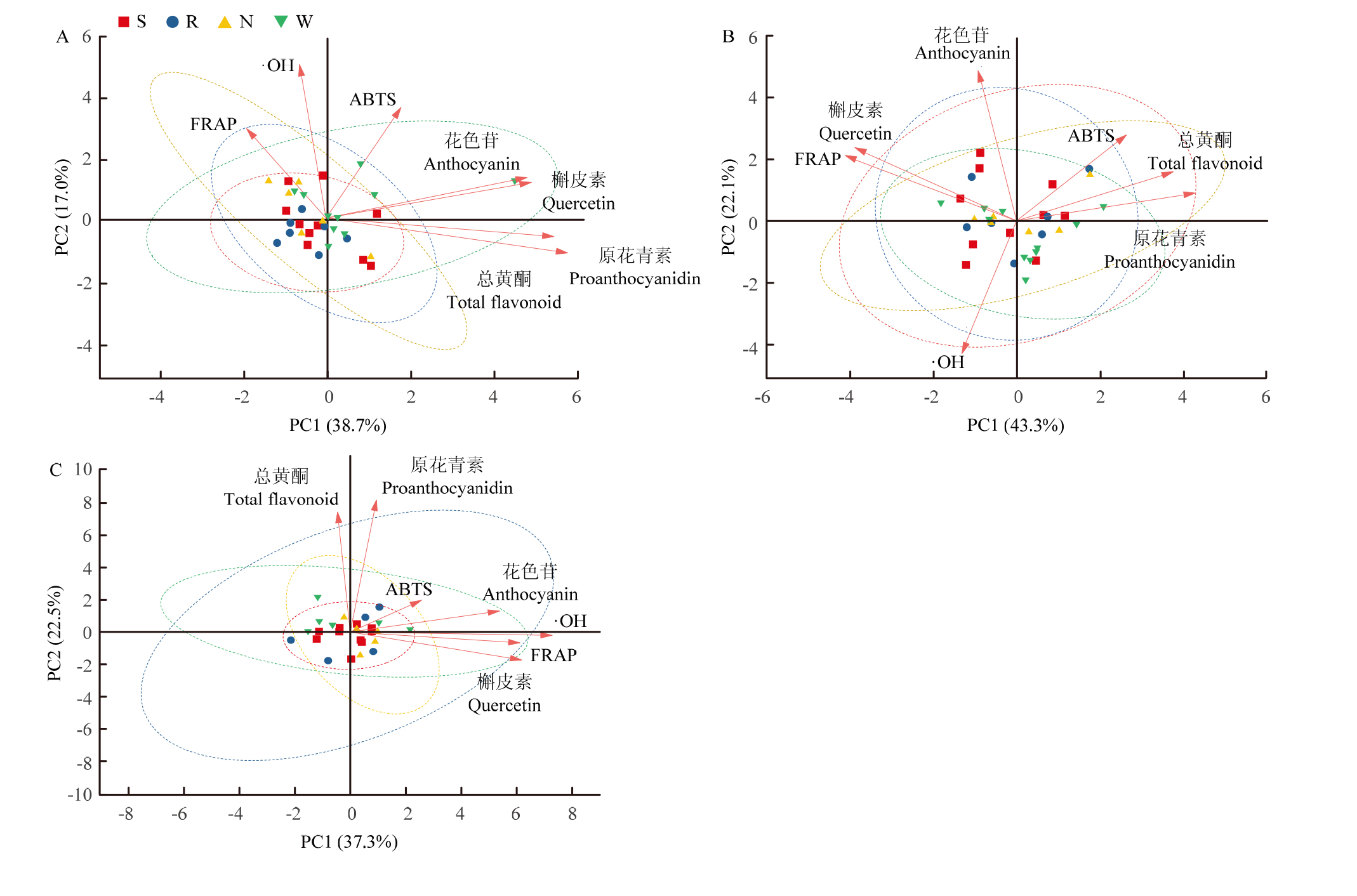
图4
越橘属植物叶片多酚组分及其抗氧化指标的主成分分析 A:嫩叶Young leaf;B:成熟叶Mature leaf;C:老叶Senescent leaf。S、R、N和W分别代表南高丛、兔眼、北高丛蓝莓品种群和野生越橘种质S, R, N and W represent southern highbush, rabbiteye, northern highbush blueberry, and wild Vaccinium germplasm, respectively"
| [1] |
doi: 10.1186/s12870-025-06721-5 pmid: 40448243 |
| [2] |
doi: 10.1016/j.foodres.2025.116110 |
| [3] |
|
| [4] |
|
| [5] |
周勤文, 孙力军, 卢蓓蓓, 侯北伟, 李楠楠, 张锋伦, 姚正颖. 小浆果多酚生物活性功效研究进展. 中国野生植物资源, 2023, 42(2): 94-97, 102.
|
|
|
|
| [6] |
doi: 10.1016/j.biopha.2019.108999 |
| [7] |
doi: 10.1016/j.foodhyd.2019.105448 |
| [8] |
doi: 10.1016/j.foodres.2023.113412 |
| [9] |
谭西北, 兰徐颖, 刘崇怀, 樊秀彩, 姜建福, 孙磊, 李鹏, 余书鑫, 张颖. 不同抗性葡萄响应白腐病侵染的次生代谢物变化. 中国农业科学, 2025, 58(9): 1767-1778. doi: 10.3864/j.issn.0578-1752.2025.09.007.
|
|
|
|
| [10] |
doi: S0963-9969(19)30325-4 pmid: 31229110 |
| [11] |
苏上, 王丽金, 吴杰, 李冰, 王伟伟, 王亮生. 笃斯越桔化学成分及其功能活性的研究进展. 植物学报, 2016, 51(5): 691-704.
doi: 10.11983/CBB15172 |
|
|
|
| [12] |
公旭彤, 杜乾慧, 刘桂婷, 卢雅妮, 李雨彤, 宋清秋, 吕梓茜, 王楠, 张文基, 王贺新, 赵丽娜, 刘国玲, 徐国辉. 近30年世界蓝莓新品种资源及育种趋势分析. 植物遗传资源学报, 2025, 26(2): 218-236.
|
|
|
|
| [13] |
李亚东, 刘成, 魏鑫, 刘佳欣, 郝佳, 陈丽, 孙海悦. 2024年中国蓝莓产业发展报告. 吉林农业大学学报, 2025, 47(1): 1-14.
|
|
|
|
| [14] |
王利枝. 蓝莓叶活性成分及体外保健功能研究[D]. 金华: 浙江师范大学, 2018.
|
|
|
|
| [15] |
doi: 10.3390/molecules24213900 |
| [16] |
doi: 10.1016/j.jff.2015.02.041 |
| [17] |
doi: 10.3390/separations8090137 |
| [18] |
pmid: 16385975 |
| [19] |
doi: 10.1248/jhs.49.45 |
| [20] |
doi: 10.1080/13880209.2016.1266668 |
| [21] |
|
| [22] |
doi: 10.1016/j.foodchem.2015.05.030 |
| [23] |
doi: 10.3390/ph16071020 |
| [24] |
胡雅馨, 李京, 惠伯棣. 蓝莓果实中主要营养及花青素成分的研究. 食品科学, 2006, 27(10): 600-603.
|
|
|
|
| [25] |
苏全胜, 王爽, 孙玉强, 梅俊, 柯丽萍. 植物原花青素生物合成及调控研究进展. 中国细胞生物学学报, 2021, 43(1): 219-229.
|
|
|
|
| [26] |
doi: 10.1016/j.foodchem.2008.06.066 |
| [27] |
doi: 10.1016/j.jff.2015.04.027 |
| [28] |
doi: 10.3390/plants9091193 |
| [29] |
|
| [30] |
doi: 10.3390/molecules24234310 |
| [31] |
doi: 10.1007/s00468-016-1393-6 |
| [32] |
doi: 10.3390/plants12040948 |
| [33] |
|
| [34] |
doi: 10.1016/j.foodchem.2014.04.114 |
| [35] |
doi: 10.1016/j.foodchem.2019.125617 |
| [36] |
|
| [37] |
doi: 10.3390/antiox8120649 |
| [38] |
赵慧芳, 吴文龙, 黄正金, 赵俸艺, 闾连飞, 李维林. 34个蓝莓品种果实品质评价. 植物资源与环境学报, 2023, 32(4): 44-53, 72.
|
|
|
|
| [39] |
doi: 10.4236/as.2018.91007 |
| [40] |
doi: 10.3390/plants12183200 |
| [1] | 岳丽昕, 王清华, 王振宝, 尼玛琼吉, 刘泽洲, 孔素萍, 张立峰, 高莉敏. 基于广靶代谢组学分析藏葱和细香葱营养品质及黄酮类代谢产物差异[J]. 中国农业科学, 2026, 59(5): 1070-1086. |
| [2] | 罗自舒, 张怡嘉, 周瑢, 张艳欣, 周婷, 游均, 王林海. 芝麻叶片抗氧化活性的特征及优异抗氧化种质的筛选[J]. 中国农业科学, 2025, 58(19): 3814-3824. |
| [3] | 辛朗, 宋嘉雯, 付媛媛, 唐茂淞, 敬凌琨, 王兴鹏. 咸淡水轮灌对设施番茄光合特性及叶片超微结构的影响[J]. 中国农业科学, 2024, 57(19): 3784-3798. |
| [4] | 叶雪莲, 陈靖雯, 姚祥坦, 权新华, 黄鹂. 不结球白菜叶片皱缩性状的遗传分析[J]. 中国农业科学, 2024, 57(18): 3684-3694. |
| [5] | 郑文燕, 常源升, 何平, 何晓文, 王森, 高文胜, 李林光, 王海波. ‘鲁丽’ב红1#’苹果杂交群体全基因组KASP标记开发及验证[J]. 中国农业科学, 2023, 56(5): 935-950. |
| [6] | 姚轶俊, 鞠兴荣, 王立峰. 荞麦多酚干预对高脂膳食诱导小鼠的降脂作用及其调控机制[J]. 中国农业科学, 2023, 56(5): 981-994. |
| [7] | 赵建涛, 杨开鑫, 王旭哲, 马春晖, 张前兵. 施磷对苜蓿叶片生理参数及抗氧化能力的影响[J]. 中国农业科学, 2023, 56(3): 453-465. |
| [8] | 高静, 陈吉玉, 谭先明, 吴雨珊, 杨文钰, 杨峰. 光强对苗期大豆叶片水力导度及叶脉性状的影响[J]. 中国农业科学, 2023, 56(22): 4417-4427. |
| [9] | 司雨凡, 李辉, 李子好, 姜翠霞, 郭昊南, 杨培志, 席杰军, 闫瑞瑞, 乌仁其其格, 山丹, 辛晓平. 草甸草原关键物种功能性状对长期放牧和停牧恢复的响应[J]. 中国农业科学, 2023, 56(18): 3693-3708. |
| [10] | 李易玲, 彭西红, 陈平, 杜青, 任俊波, 杨雪丽, 雷鹿, 雍太文, 杨文钰. 减量施氮对套作玉米大豆叶片持绿、光合特性和系统产量的影响[J]. 中国农业科学, 2022, 55(9): 1749-1762. |
| [11] | 郭燕, 张树航, 李颖, 张馨方, 王广鹏. 中国板栗36个叶片表型性状的多样性[J]. 中国农业科学, 2022, 55(5): 991-1009. |
| [12] | 武翠卿,孙静鑫,郭平毅,王宏富,武新慧. 农艺措施对谷子产量及抗倒伏力学性能的影响[J]. 中国农业科学, 2021, 54(6): 1127-1142. |
| [13] | 马银花,莫凯琴,刘璐,李萍芳,金晨钟,杨芳. 过量表达OsRRK1对水稻叶片发育的影响[J]. 中国农业科学, 2021, 54(5): 877-886. |
| [14] | 徐浩聪, 姚波, 王权, 陈婷婷, 朱铁忠, 何海兵, 柯健, 尤翠翠, 吴小文, 郭爽爽, 武立权. 基于叶片反射光谱估测水稻氮营养指数[J]. 中国农业科学, 2021, 54(21): 4525-4538. |
| [15] | 王诗雅,郑殿峰,项洪涛,冯乃杰,刘雅,刘美玲,靳丹,牟保民. 初花期淹水胁迫对大豆叶片AsA-GSH循环的损伤及烯效唑的缓解效应[J]. 中国农业科学, 2021, 54(2): 271-285. |
|
||
