






中国农业科学 ›› 2026, Vol. 59 ›› Issue (4): 834-849.doi: 10.3864/j.issn.0578-1752.2026.04.010
温玉斌1,2( ), 白珊珊1,2, 蔡泽江3(), 孙楠3, 徐明岗1,2()
收稿日期:2025-04-08
出版日期:2026-02-10
发布日期:2026-02-10
通信作者:
联系方式:
温玉斌,E-mail:wenyubin415@163.com。
基金资助:
WEN YuBin1,2(), BAI ShanShan1,2, CAI ZeJiang3(), SUN Nan3, XU MingGang1,2()
Received:2025-04-08
Published:2026-02-10
Online:2026-02-10
摘要:
【目的】探究长期施用有机物料对土壤pH、微生物量和微生物熵的影响,为耕地质量提升提供科学依据。【方法】基于meta分析方法,整合全球224篇文献的1 296组数据,综合分析有机物料施用措施(类型、施用量和施用年限)、气候(年均温、降水量)、土壤初始性质(pH、有机碳含量)条件下,土壤pH和微生物量碳(MBC)、氮(MBN)含量和微生物熵碳(qMBC)、氮(qMBN)的差异。【结果】有机物料施用后,土壤pH显著提高了0.23个单位,增加了4.0%,MBC、MBN、qMBC和qMBN分别增加46.8%、54.0%、16.4%和14.9%。相比与化肥配施,单施有机物料土壤pH、MBC、MBN、qMBC和qMBN分别提高5.9%、53.4%、13.2%、79.9%和38.2%。粪肥施用量>10 t∙hm-2∙a-1,且施用年限超过10年,土壤pH提高的效果最佳;而施肥量>40 t∙hm-2∙a-1,且需要施用年限为3—10年,土壤微生物量指标显著提高。年均温>16 ℃,且年降水>1 200 mm的气候条件下,施用有机物料后土壤pH提高效果更好,特别是在初始土壤pH4.5—5.5,且有机碳(SOC)含量>12 g∙kg-1的土壤;而年均温8—16 ℃、年降水<600 mm的气候条件下,施用有机物料对SOC含量≤12 g∙kg-1的弱碱性土壤(pH>7.5)的MBC、MBN、qMBC和qMBN提高效果更佳。随机森林模型表明,施用有机物料对土壤pH、MBC、MBN与微生物熵的影响,分别受土壤初始pH、SOC、有机物料施用措施、气候条件的影响。偏最小二乘路径模型进一步证明,有机物料施用措施、气候条件及初始土壤性质,通过调控pH来影响微生物量及微生物熵。【结论】施用有机物料对初始有机质含量较高(>12 g∙kg-1)的酸性(pH≤5.5)土壤pH提高的效果最佳,而微生物量碳、氮及微生物熵碳的提高效果以有机质含量低的碱性土壤(SOC≤12 g∙kg-1、初始pH>7.5)更为显著。有机物料对土壤pH,微生物量碳、氮,微生物熵碳、氮的调控效应分别主要受土壤初始性质、有机物料施用措施和气候条件的影响。
温玉斌, 白珊珊, 蔡泽江, 孙楠, 徐明岗. 有机物料对土壤微生物量的影响及其酸度调节机理[J]. 中国农业科学, 2026, 59(4): 834-849.
WEN YuBin, BAI ShanShan, CAI ZeJiang, SUN Nan, XU MingGang. Effects of Organic Materials on Soil Microbial Biomass and Its Acidity Regulation Mechanism[J]. Scientia Agricultura Sinica, 2026, 59(4): 834-849.
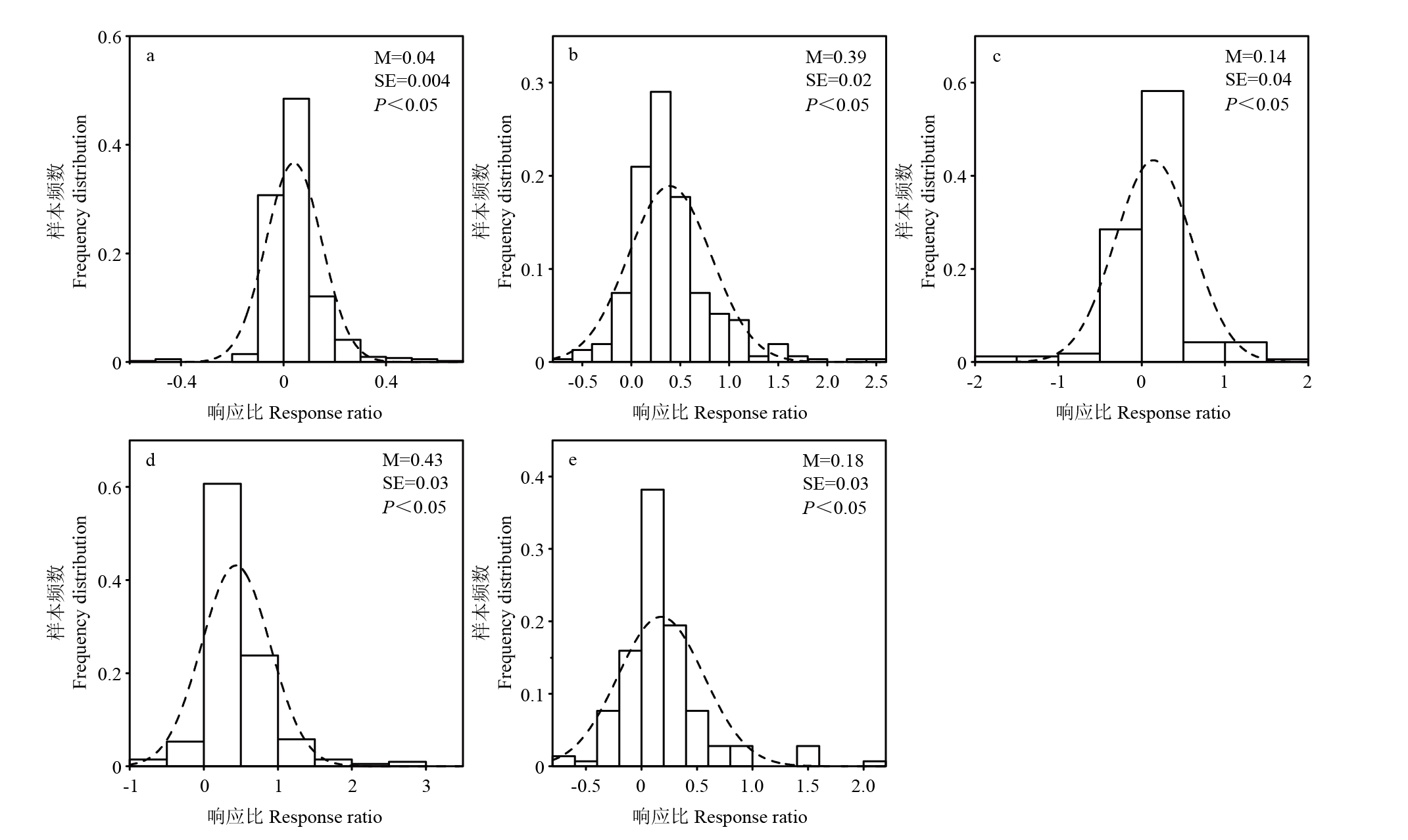
图1
土壤pH(a)、土壤微生物量碳(b)、微生物量氮(c)、微生物熵碳(d)和微生物熵氮(e)响应比分布 M和SE分别表示变化响应比的平均值和标准误"

图2
有机物料施用对土壤pH(a)的总效应和不同施用方法(b)、土壤性质和气候条件(c)下施用有机物料对土壤pH的影响 图a括号内数值分别为施用有机物料后各指标的提高幅度和样本数量。图b和c括号内数值为各指标的样本量,虚线表示效应值为0。红色圆圈代表正效应,蓝色圆圈代表负效应,白色圆圈代表效应不显著。下同"
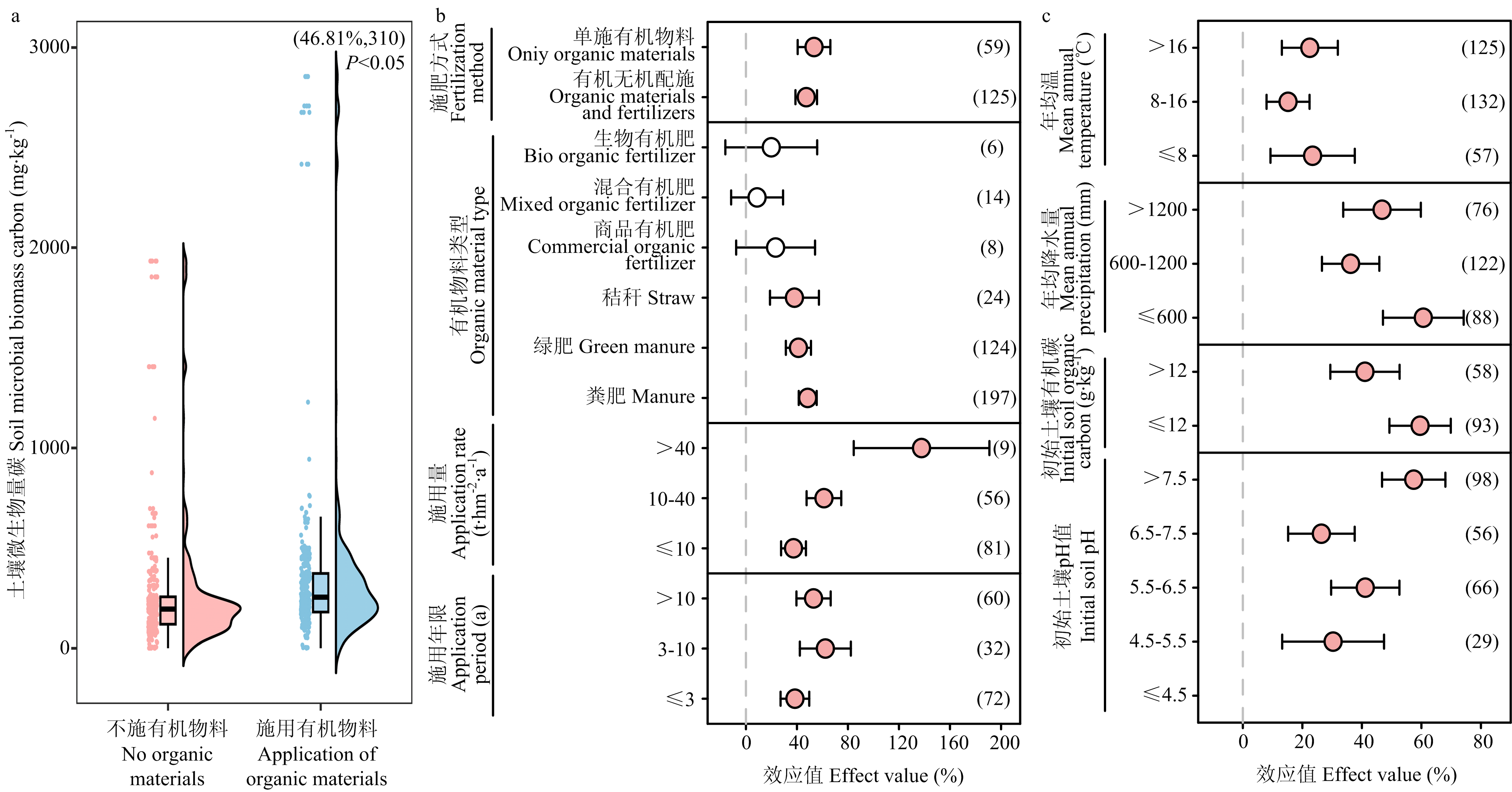
图3
有机物料施用对土壤微生物量碳(a)的总效应和不同施用方法(b)、土壤性质和气候条件(c)下施用有机物料对土壤微生物量碳的影响"

图4
有机物料施用对土壤微生物熵碳(a)的总效应和不同施用方法(b)、土壤性质和气候条件(c)下施用有机物料对土壤微生物熵碳的影响"
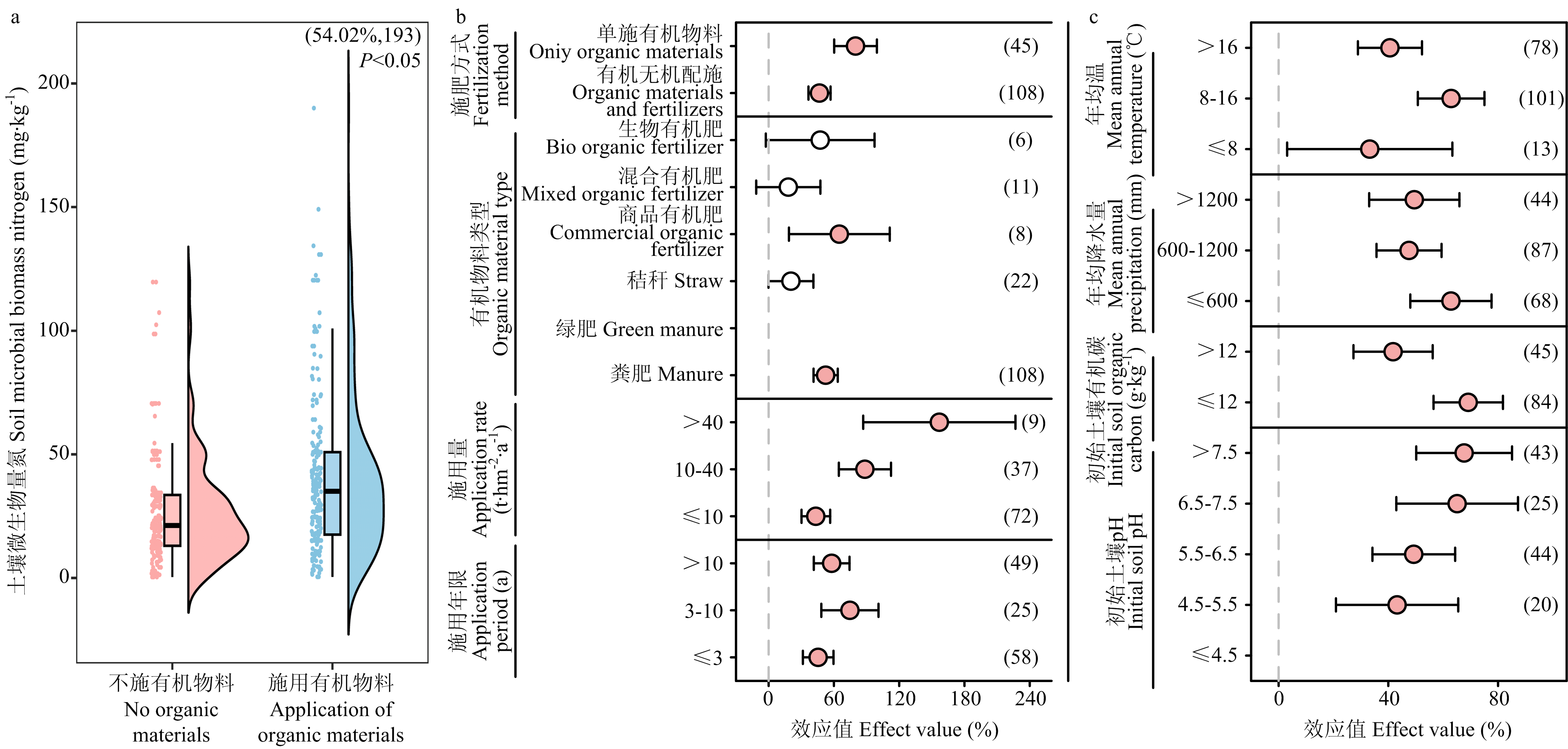
图5
有机物料施用对土壤微生物量氮(a)的总效应和不同施用方法(b)、土壤性质和气候条件(c)下施用有机物料对土壤微生物量氮的影响"
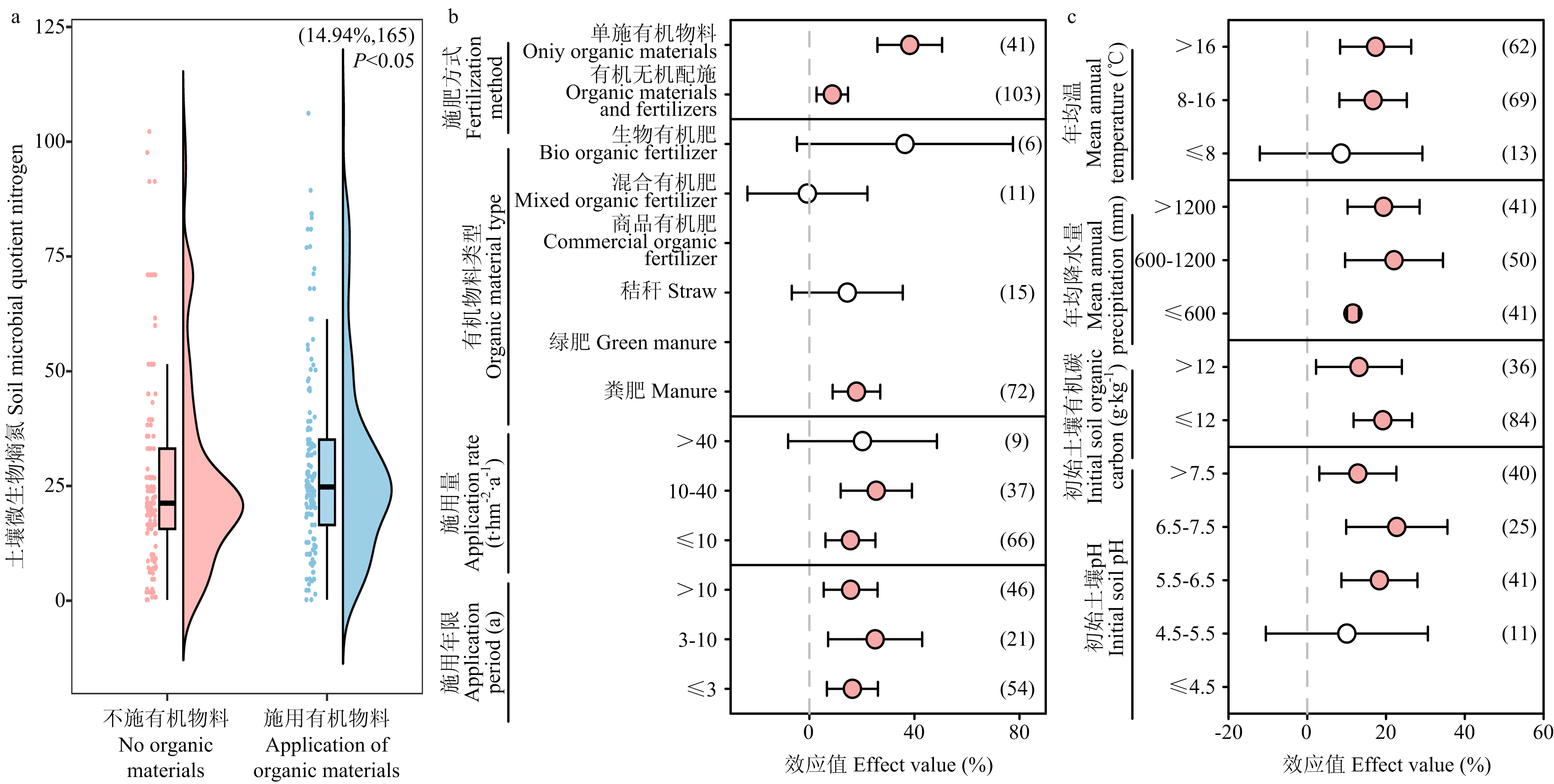
图6
有机物料施用对土壤微生物熵氮(a)的总效应和不同施用方法(b)、土壤性质和气候条件(c)下施用有机物料对土壤微生物熵氮的影响"
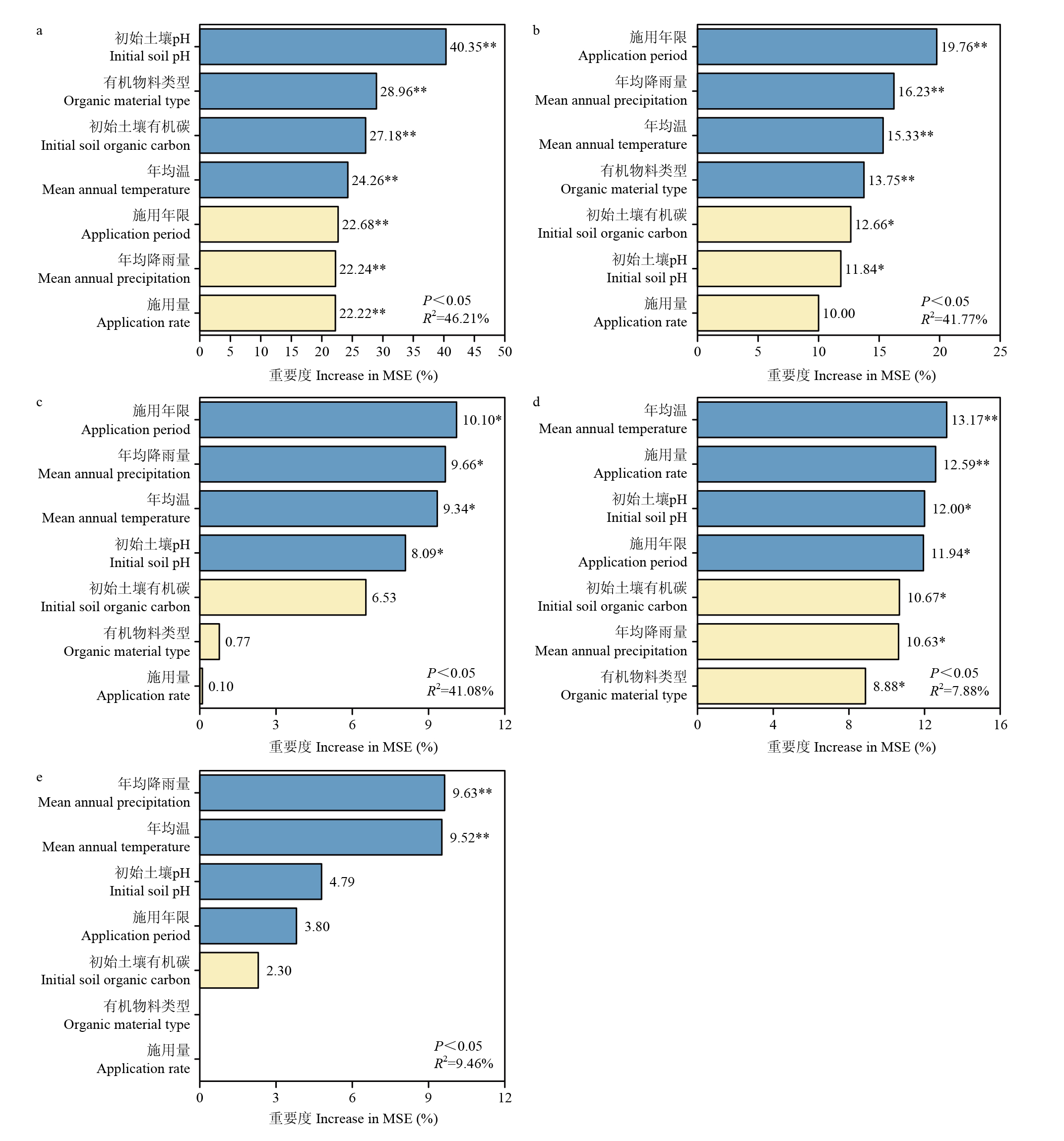
图7
有机物料施用后各影响因素对pH(a),微生物量碳(b)、氮(d)和微生物熵碳(c)、氮(e)的贡献率 图中R2表示模型所解释的方差占总方差的比例,*和**表示相关性达到0.05、0.01显著水平"

图8
偏最小二乘法路径模型(PLS-PM)分析各因素对土壤pH和微生物量(a)、微生物熵(b)的影响 该模型探讨了有机物料施用措施、气候条件、初始土壤性质对土壤pH、土壤微生物量和微生物熵效应的影响,以及土壤pH效应对土壤微生物量和微生物熵效应的路径。红线和蓝线分别表示正向和负向显著关系,虚线表示关系不显著;线的粗细表示因果关系的强度,并辅以标准化路径系数。GOF表示整个模型的拟合优度。*:P<0.05;**:P<0.01;***:P<0.001"
| [1] |
|
| [2] |
doi: 10.1111/gcb.v29.24 |
| [3] |
doi: 10.1016/j.agee.2020.106837 |
| [4] |
宋长青, 吴金水, 陆雅海, 沈其荣, 贺纪正, 黄巧云, 贾仲君, 冷疏影, 朱永官. 中国土壤微生物学研究10年回顾. 地球科学进展, 2013, 28(10): 1087-1105.
doi: 10.11867/j.issn.1001-8166.2013.10.1087 |
|
doi: 10.11867/j.issn.1001-8166.2013.10.1087 |
|
| [5] |
doi: 10.1007/s11104-009-9988-y |
| [6] |
doi: 10.1016/j.still.2019.06.008 |
| [7] |
doi: 10.1007/s44378-025-00037-4 |
| [8] |
毛妍婷, 刘宏斌, 陈安强, 杜彩艳, 郭树芳, 雷宝坤. 长期施用有机肥对减缓菜田耕层土壤酸化的影响. 生态环境学报, 2020, 29(9): 1784-1791.
doi: 10.16258/j.cnki.1674-5906.2020.09.010 |
|
|
|
| [9] |
冶赓康, 俄胜哲, 袁金华, 赵天鑫, 路港滨, 张鹏, 刘雅娜. 施用不同有机物料对作物产量及灌漠土磷组分的影响. 干旱地区农业研究, 2025, 43(1): 91-102.
|
|
|
|
| [10] |
doi: 10.1007/s13762-023-05189-w |
| [11] |
宋鉴恒, 黄婧宇, 郭欣玉, 宋佳杰, 黄禹铭, 王晨瑜, 冯永忠, 任广鑫, 王兴. 秸秆还田与化肥配施对冬小麦土壤微生物量及化学计量特征和微生物熵的影响. 环境科学, 2025, 46(6): 3957-3964.
|
|
doi: 10.1021/es204007t |
|
| [12] |
doi: 10.1016/j.jenvman.2024.122063 |
| [13] |
唐海明, 李超, 肖小平, 汤文光, 程凯凯, 潘孝晨, 汪柯. 有机肥氮投入比例对双季稻田根际土壤微生物生物量碳、氮和微生物熵的影响. 应用生态学报, 2019, 30(4): 1335-1343.
doi: 10.13287/j.1001-9332.201904.014 |
|
doi: 10.13287/j.1001-9332.201904.014 |
|
| [14] |
doi: 10.1016/j.ejsobi.2009.02.005 |
| [15] |
doi: 10.1111/gcb.v28.1 |
| [16] |
doi: 10.1016/0038-0717(95)00082-P |
| [17] |
doi: 10.1097/00010694-193008000-00002 |
| [18] |
doi: 10.15244/pjoes/61549 |
| [19] |
张冠华, 牛俊, 易亮, 孙宝洋, 李建明, 肖海. 不同植茶年限土壤-微生物生物量碳氮磷化学计量特征. 应用生态学报, 2023, 34(4): 969-976.
doi: 10.13287/j.1001-9332.202304.015 |
|
doi: 10.13287/j.1001-9332.202304.015 |
|
| [20] |
李圆宾, 李鹏, 王舒华, 徐璐瑶, 邓建军, 焦加国. 稻麦轮作体系下有机肥施用对作物产量和土壤性质影响的整合分析. 应用生态学报, 2021, 32(9): 3231-3239.
doi: 10.13287/j.1001-9332.202109.024 |
|
|
|
| [21] |
韩天富, 柳开楼, 赵彦锋, 陈杰. Meta分析评估无机改良剂对酸性农田土壤pH的影响. 土壤与作物, 2025, 14(1): 25-33.
|
|
|
|
| [22] |
doi: 10.1111/gcb.16613 pmid: 36751727 |
| [23] |
doi: 10.1016/j.agwat.2022.107617 |
| [24] |
doi: 10.1890/0012-9658(1999)080[1150:TMAORR]2.0.CO;2 |
| [25] |
doi: 10.1007/s004420050381 |
| [26] |
doi: 10.1016/S1002-0160(11)60185-9 |
| [27] |
郭慧婷, 王晋峰, 孙楠, 蒯雁, 范志勇, 徐明岗. 云南省南涧县植烟土壤pH和有效磷的时空变化特征. 中国土壤与肥料, 2023(11): 9-15.
|
|
|
|
| [28] |
申梦雪, 郝芮, 刘新伟, 危万浩, 操云飞, 舒胡佳, 郝宗宇, 王沪玉, 王玲, 史志华. 化肥减量配施秸秆和有机肥对酸化土壤改良及侵蚀阻控的影响. 水土保持学报, 2024, 38(6): 333-342.
|
|
doi: 10.1080/00224561.1983.12436315 |
|
| [29] |
李文芳, 卜晓英, 黄美娥, 田春莲. 土壤腐殖质的降解及其结构. 安徽农业科学, 2005, 33(3): 494-495.
|
|
|
|
| [30] |
赵彤, 闫浩, 蒋跃利, 黄懿梅, 安韶山. 黄土丘陵区植被类型对土壤微生物量碳氮磷的影响. 生态学报, 2013, 33(18): 5615-5622.
|
|
doi: 10.5846/stxb |
|
| [31] |
赵彤, 蒋跃利, 闫浩, 黄懿梅. 土壤氨化过程中微生物作用研究进展. 应用与环境生物学报, 2014, 20(2): 315-321.
|
|
doi: 10.3724/SP.J.1145.2014.00315 |
|
| [32] |
王梦洁, 蒋文婷, 徐有祥, 刘玉学, 吕豪豪, 汪玉瑛, 杨生茂, 何莉莉, 蔡延江. 长期生物炭添加对稻田土壤细菌和真菌反硝化N2O排放的影响. 环境科学, 2024, 45(8): 4923-4931.
|
|
|
|
| [33] |
doi: 10.1016/S1002-0160(15)60052-2 |
| [34] |
doi: 10.1038/nature16069 |
| [35] |
莫艳芳, 申云鑫, 贺彪, 施竹凤, 唐加菜, 杨童雨, 翟恒, 韩天华, 陈齐斌, 杨佩文. 基于整合分析土壤微生物量碳、氮含量对有机肥施用的响应特征. 中国土壤与肥料, 2024(6): 89-101.
|
|
|
|
| [36] |
臧逸飞, 郝明德, 张丽琼, 张昊青. 26年长期施肥对土壤微生物量碳、氮及土壤呼吸的影响. 生态学报, 2015, 35(5): 1445-1451.
|
|
|
|
| [37] |
田小明, 李俊华, 王成, 褚贵新, 危常州, 郑倩, 邓世伟. 连续3年施用生物有机肥对土壤养分、微生物生物量及酶活性的影响. 土壤, 2014, 46(3): 481-488.
|
|
|
|
| [38] |
乔洁, 任秀艳. 草炭对设施土壤有机碳、氮及土壤微生物生物量的影响. 西南农业学报, 2012, 25(5): 1777-1780.
|
|
|
|
| [39] |
王翠萍. 不同土壤微生物量碳与有机碳矿化的关系研究. 广东农业科学, 2013, 40(11): 52-54.
|
|
|
|
| [40] |
doi: 10.1038/ngeo2925 |
| [41] |
曹亚静, 赵美丞, 郑春燕, 朱峰. 根际微生物介导的植物响应干旱胁迫机制研究进展. 中国生态农业学报(中英文), 2023, 31(8): 1330-1342.
|
|
|
|
| [42] |
doi: 10.3724/SP.J.1011.2011.01283 |
| [43] |
doi: 10.1038/s41522-022-00277-0 pmid: 35365687 |
| [44] |
张蕤, 王欢欢, 赵园园, 程玉渊, 吴疆, 史宏志. 不同碳源有机物料对植烟土壤碳氮及细菌群落的影响. 河南农业科学, 2022, 51(3): 84-94.
|
|
|
|
| [45] |
黄颖博, 罗凡, 龚雪蛟, 王迎春, 李兰英, 刘东娜, 尧渝. 有机肥对土壤微生物群落特征影响的研究进展. 中国农学通报, 2023, 39(3): 88-96.
doi: 10.11924/j.issn.1000-6850.casb2022-0167 |
|
doi: 10.11924/j.issn.1000-6850.casb2022-0167 |
|
| [46] |
胡诚, 曹志平, 罗艳蕊, 马永良. 长期施用生物有机肥对土壤肥力及微生物生物量碳的影响. 中国生态农业学报, 2007, 15(3): 48-51.
|
|
|
|
| [47] |
doi: 10.1016/j.geoderma.2021.115121 |
| [48] |
王威雁, 沈鹏飞, 张侯平, 莫非, 温晓霞, 廖允成. 长期保护性耕作下土壤团聚体全氮与氮功能微生物关系研究. 土壤学报, 2024, 61(6): 1653-1667.
|
|
|
|
| [49] |
胡可, 李华兴, 卢维盛, 刘远金, 王利宾. 生物有机肥对土壤微生物活性的影响. 中国生态农业学报, 2010, 18(2): 303-306.
|
|
doi: 10.3724/SP.J.1011.2010.00303 |
|
| [50] |
王淑平, 周广胜, 孙长占, 姜亦梅, 姜岩, 刘孝义. 土壤微生物量氮的动态及其生物有效性研究. 植物营养与肥料学报, 2003, 9(1): 87-90.
|
|
|
|
| [51] |
沈心涛, 涂保华, 刘朝阳, 赵远, 丁骥贤, 梁玉婷. 酸性逆境土壤中根际微生物调控植物根系构型的作用机制. 环境科学, 2025, 46(1): 570-578.
|
|
doi: 10.1021/es204049x |
|
| [52] |
doi: 10.1016/j.soilbio.2020.107928 |
| [53] |
doi: 10.1111/gcb.v31.4 |
| [54] |
doi: 10.1038/s41579-023-00980-5 pmid: 37863969 |
| [1] | 佘文婷, 孙蕊卿, 党海燕, 李文虎, 张丰, 田怡, 徐隽峰, 丁玉兰, 王朝辉. 我国主要麦区农户小麦籽粒硫的含量、分布及影响因素[J]. 中国农业科学, 2025, 58(5): 956-974. |
| [2] | 吴文琪, 焦阳, 惠家祯, 王绪锋, 郭博森, 沈玉芳. 不同有机物料配施化肥对土壤肥力和玉米产量的影响[J]. 中国农业科学, 2025, 58(23): 4966-4978. |
| [3] | 韩哲群, 苏莹, 高奇奇, 刘美英, 贾昂元, 张海睿, 南珊珊, 徐勤政, 王强, 王利军, 武雪萍. 智能滴灌水肥耦合模式实现土壤节水控盐与向日葵产量品质协同提升[J]. 中国农业科学, 2025, 58(20): 4158-4177. |
| [4] | 孙蕊卿, 党海燕, 佘文婷, 王星舒, 褚宏欣, 王涛, 丁玉兰, 罗一诺, 徐隽峰, 李小涵, 王朝辉. 影响我国主要麦区小麦籽粒和面粉锌含量的产量构成要素与土壤肥力因素[J]. 中国农业科学, 2025, 58(2): 291-306. |
| [5] | 冀建华, 吕真真, 刘淑珍, 侯红乾, 刘益仁, 刘秀梅, 李絮花, 蓝贤瑾. 长期施用化肥对南方稻田土壤酸化和盐基离子损失的影响[J]. 中国农业科学, 2024, 57(13): 2599-2611. |
| [6] | 董秀, 张燕, MUNYAMPIRWA Tito, 陶海宁, 沈禹颖. 长期保护性耕作对黄土高原旱作农田土壤碳含量及转化酶活性的影响[J]. 中国农业科学, 2023, 56(5): 907-919. |
| [7] | 张灵菲, 马垒, 李玉东, 郑福丽, 魏建林, 谭德水, 崔秀敏, 李燕. 有机物料与化肥长期配施对小麦玉米轮作潮土细菌群落和酶活性的影响[J]. 中国农业科学, 2023, 56(19): 3843-3855. |
| [8] | 徐菊祯, 张梦璐, 何文清, 隋鹏, 陈源泉, 崔吉晓. 中国马铃薯地膜覆盖增产效应及其影响因素的Meta分析[J]. 中国农业科学, 2023, 56(15): 2895-2906. |
| [9] | 马佳玉, 王涛, 刘小利, 王丽, 张学成, 王文涛, 孔繁盛, 黄学郡, 王子怡, 王彦东, 甄文超. 覆盖作物对我国粮食作物的产量效应及影响因素的Meta分析[J]. 中国农业科学, 2023, 56(10): 1871-1880. |
| [10] | 刘玉颖, 沈丰, 杨劲峰, 蔡芳芳, 付时丰, 罗培宇, 李娜, 戴健, 韩晓日. 长期施肥棕壤大豆产量的演变及土壤氮素分布特征[J]. 中国农业科学, 2023, 56(10): 1920-1934. |
| [11] | 秦羽青,程宏波,柴雨葳,马建涛,李瑞,李亚伟,常磊,柴守玺. 中国北方地区小麦覆盖栽培增产效应的荟萃(Meta)分析[J]. 中国农业科学, 2022, 55(6): 1095-1109. |
| [12] | 朱长伟,孟威威,石柯,牛润芝,姜桂英,申凤敏,刘芳,刘世亮. 不同轮耕模式下小麦各生育时期土壤养分及酶活性变化特征[J]. 中国农业科学, 2022, 55(21): 4237-4251. |
| [13] | 李帅帅, 郭俊杰, 刘文波, 韩春龙, 贾海飞, 凌宁, 郭世伟. 不同施肥模式下轮作制度引起的土壤磷素有效性变化及其影响因素[J]. 中国农业科学, 2022, 55(1): 96-110. |
| [14] | 刘彦伶,李渝,张艳,张雅蓉,黄兴成,张萌,张文安,蒋太明. 长期施用磷肥和有机肥黄壤微生物量磷特征[J]. 中国农业科学, 2021, 54(6): 1188-1198. |
| [15] | 刘凯,刘佳,陈晓芬,李委涛,江春玉,吴萌,樊剑波,李忠佩,刘明. 长期施用磷肥水稻土微生物量磷的季节变化特征与差异[J]. 中国农业科学, 2020, 53(7): 1411-1418. |
|
||
