






中国农业科学 ›› 2025, Vol. 58 ›› Issue (23): 4966-4978.doi: 10.3864/j.issn.0578-1752.2025.23.012
吴文琪1,2( ), 焦阳1,2, 惠家祯1,2, 王绪锋1,2, 郭博森1,2, 沈玉芳2,*()
收稿日期:2024-11-28
接受日期:2025-02-11
出版日期:2025-12-01
发布日期:2025-12-09
通信作者:
联系方式:
吴文琪,E-mail:wwq18709915855@163.com。
基金资助:
WU WenQi1,2(), JIAO Yang1,2, XI JiaZhen1,2, WANG XuFeng1,2, GUO BoSen1,2, SHEN YuFang2,*()
Received:2024-11-28
Accepted:2025-02-11
Published:2025-12-01
Online:2025-12-09
摘要:
【目的】 探究不同有机物料配施化肥对中低产田作物产量和农田土壤肥力的影响,为选择最佳的有机培肥措施提供科学依据。【方法】 以黄土高原中低产田为研究对象,于2022和2023年,连续两年进行玉米田间试验。设置秸秆还田配施化肥(SF)、生物炭配施化肥(B)、有机肥配施化肥(M)和生物有机肥配施化肥(EM)4个处理,以单施化肥(F)为对照,通过测定不同处理的玉米产量和土壤物理、化学和生物指标,采用相关性分析和主成分分析等方法建立评价指标最小数据集,并利用模糊数学法对土壤肥力进行评价。【结果】 与F处理相比,SF和B处理土壤水稳性大团聚体(R>0.25)百分比显著提高了19.8%和17.8%,<0.053 mm团聚体百分比显著降低了17.2%和14.0%,土壤水分显著提高了7.6%和13.0%。M和EM处理同样提高了土壤水稳性大团聚体和表层土壤水分,但差异不显著。有机物料配施化肥提高了土壤团聚体的几何平均直径和平均重量直径,其中SF处理显著高于F处理,但与B、M处理差异不显著。与F处理相比,不同有机物料处理土壤有机质和土壤有效磷含量分别显著提高了16.1%—28.5%和23.1%—195.4%;SF处理的可溶性有机碳和M处理的可溶性有机氮含量增加最显著。EM处理的土壤微生物量碳、微生物量磷含量和M处理的微生物量氮含量最高,分别较F处理显著增加了36.9%、216.4%和63.3%。与F处理相比,SF、M、EM处理的土壤β-葡萄糖苷酶、N-乙酰葡萄糖苷酶和亮氨酸氨基肽酶活性分别显著提高了13.3%—57.0%、21.4%—22.0%和24.3%—35.1%,B处理的β-葡萄糖苷酶活性显著增加,但N-乙酰葡萄糖苷酶和亮氨酸氨基肽酶活性增加不显著;土壤总体酶活性(TEI)表现为EM>M>SF>B>F处理,其中EM处理显著高于SF、B和F处理。化肥配施有机物料通过改善土壤团聚体结构、提升土壤有机质及养分含量、增强土壤酶活性,从而提高了土壤肥力指数(IFI),提升幅度在0.6%—36.9%,其中EM、M和B处理增加显著。试验两年化肥配施有机肥和生物有机肥玉米产量较单施化肥显著提高了13.4%—18.5%,且显著高于秸秆配施化肥处理。【结论】 有机物料配施化肥能够改善土壤结构、提高土壤肥力,从而增加玉米产量,其中有机肥和生物有机肥配施化肥的效果最好。
吴文琪, 焦阳, 惠家祯, 王绪锋, 郭博森, 沈玉芳. 不同有机物料配施化肥对土壤肥力和玉米产量的影响[J]. 中国农业科学, 2025, 58(23): 4966-4978.
WU WenQi, JIAO Yang, XI JiaZhen, WANG XuFeng, GUO BoSen, SHEN YuFang. Effects of Different Organic Materials Combined with Chemical Fertilizer on Soil Fertility and Maize Grain Yield[J]. Scientia Agricultura Sinica, 2025, 58(23): 4966-4978.
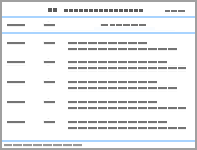
表1
不同有机物料碳、氮、磷含量"
| 有机物料 Organic material | 含碳量 Carbon content (%) | 全氮含量 Total nitrogen content (%) | 全磷含量 Total phosphorus content (%) |
|---|---|---|---|
| 玉米秸秆 Maize straw | 40.3 | 0.8 | 0.2 |
| 生物炭 Biochar | 59.2 | 0.8 | 0.1 |
| 牛粪有机肥 Manure organic fertilizer | 25.8 | 1.3 | 0.3 |
| 生物有机肥Biological organic fertilizer | 23.2 | 1.1 | 1.2 |
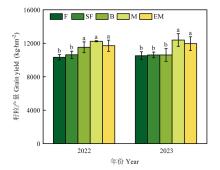
图1
不同处理对2022年和2023年玉米籽粒产量的影响 F为单施化肥处理;SF为秸秆还田配施化肥处理;B为生物炭配施化肥处理;M为有机肥配施化肥处理;EM为生物有机肥配施化肥处理。下同。不同小写字母表示不同处理间在P<0.05水平差异显著"

表2
不同处理对土壤物理性质的影响"
| 处理 Treatment | 容重 BD (g·cm-3) | 总孔隙度 SP (%) | 土壤水分 SWC (%) | >0.25 mm团聚体百分比 R>0.25 (%) | <0.053团聚体百分比 R<0.053 (%) |
|---|---|---|---|---|---|
| F | 1.35±0.08a | 49.14±2.95a | 18.45±0.36c | 36.68±3.20b | 46.86±1.34a |
| SF | 1.35±0.07a | 49.20±3.06a | 19.86±0.94ab | 43.96±3.01a | 38.79±0.46c |
| B | 1.30±0.03a | 50.84±1.12a | 20.84±0.02a | 43.21±3.18a | 40.30±4.58bc |
| M | 1.33±0.07a | 49.73±2.83a | 19.02±0.41bc | 39.23±2.84ab | 45.60±3.91ab |
| EM | 1.30±0.02a | 50.89±0.56a | 19.37±0.58bc | 37.19±1.14b | 42.61±1.55abc |
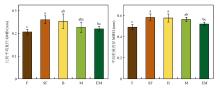
图2
不同处理对土壤水稳性团聚体几何平均直径和平均重量直径的影响"
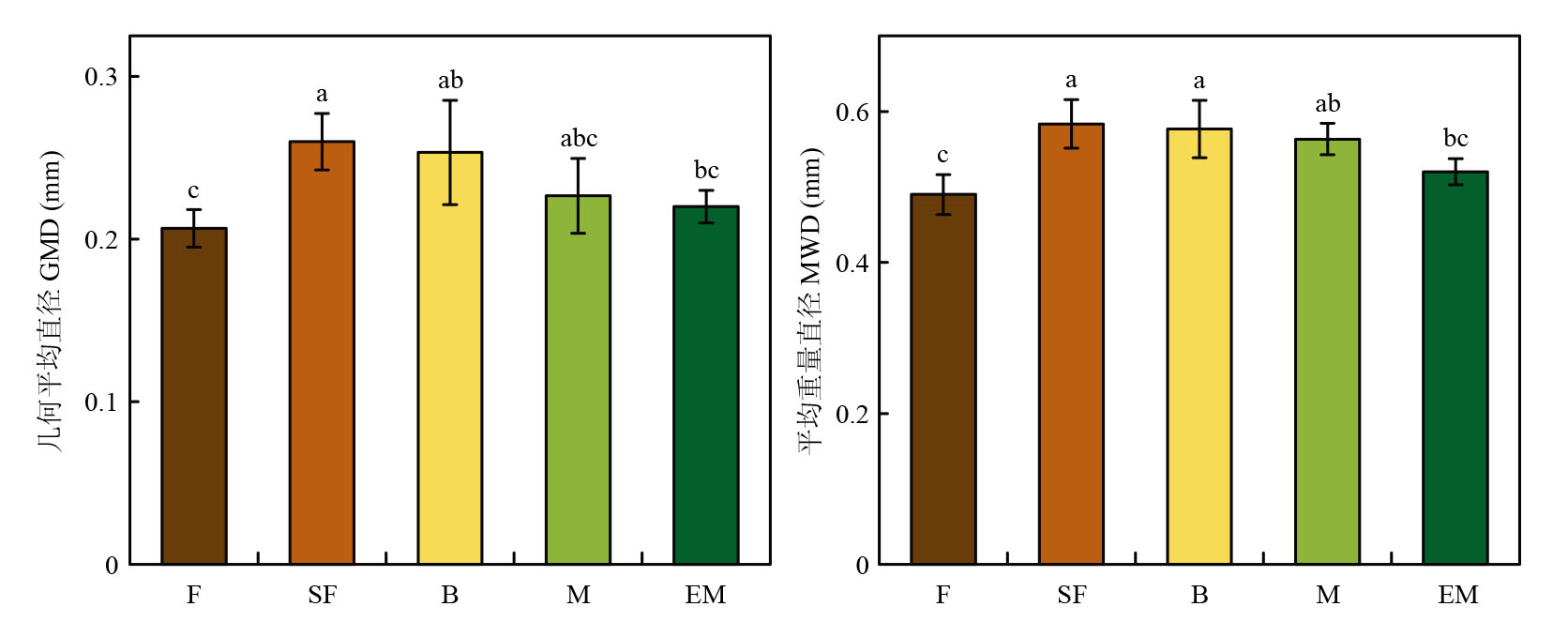
表3
不同处理对土壤化学性质的影响"
| 处理 Treatment | pH | 土壤有机质 SOM (g·kg-1) | 全氮 TN (g·kg-1) | 全磷 TP (g·kg-1) | 硝态氮 NO3--N (mg·kg-1) | 有效磷 Olsen-P (mg·kg-1) | 可溶性有机碳DOC (mg·kg-1) | 可溶性有机氮 DON (mg·kg-1) |
|---|---|---|---|---|---|---|---|---|
| F | 8.07±0.03a | 10.50±0.56c | 0.49±0.06a | 0.61±0.05a | 7.88±0.51a | 5.27±0.45e | 30.13±1.84c | 20.68±0.95c |
| SF | 8.10±0.03a | 12.19±0.43b | 0.53±0.02a | 0.62±0.01a | 6.98±0.31b | 6.49±0.20d | 39.39±0.33a | 24.28±2.82bc |
| B | 8.00±0.03a | 13.49±0.53a | 0.52±0.02a | 0.63±0.03a | 7.05±0.53ab | 11.79±0.58c | 36.68±0.72a | 23.27±2.61bc |
| M | 8.02±0.06a | 12.51±0.72ab | 0.55±0.05a | 0.62±0.05a | 7.85±0.47a | 14.04±0.72b | 35.62±4.35ab | 28.73±1.22a |
| EM | 8.07±0.03a | 13.48±0.36a | 0.54±0.02a | 0.64±0.02a | 7.83±0.27a | 15.57±0.51a | 32.41±0.88bc | 24.99±2.50b |
图3
不同处理对土壤微生物量碳、氮、磷含量的影响"
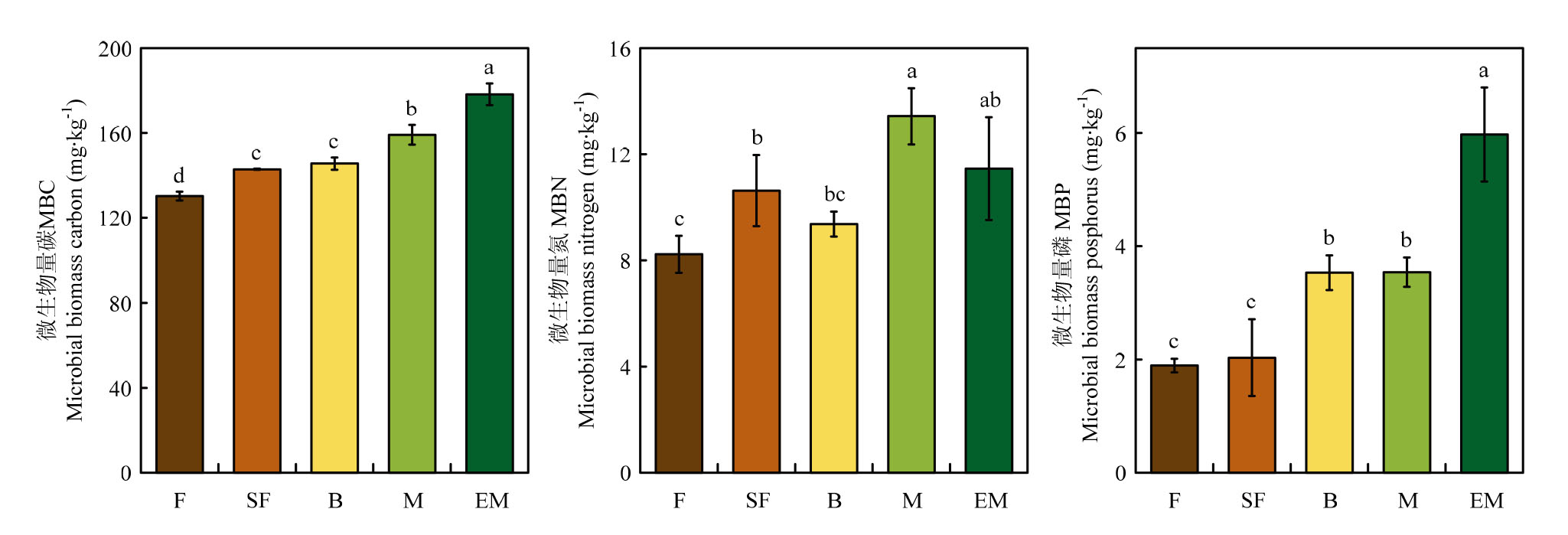
图4
不同处理对土壤碳、氮、磷获取酶活性的影响 BG为β-葡萄糖苷酶;CBH为纤维二糖水解酶;LAP为亮氨酸氨基肽酶;NAG为N-乙酰葡萄糖苷酶;AP为磷酸酶;TEI为土壤总体酶活性参数"
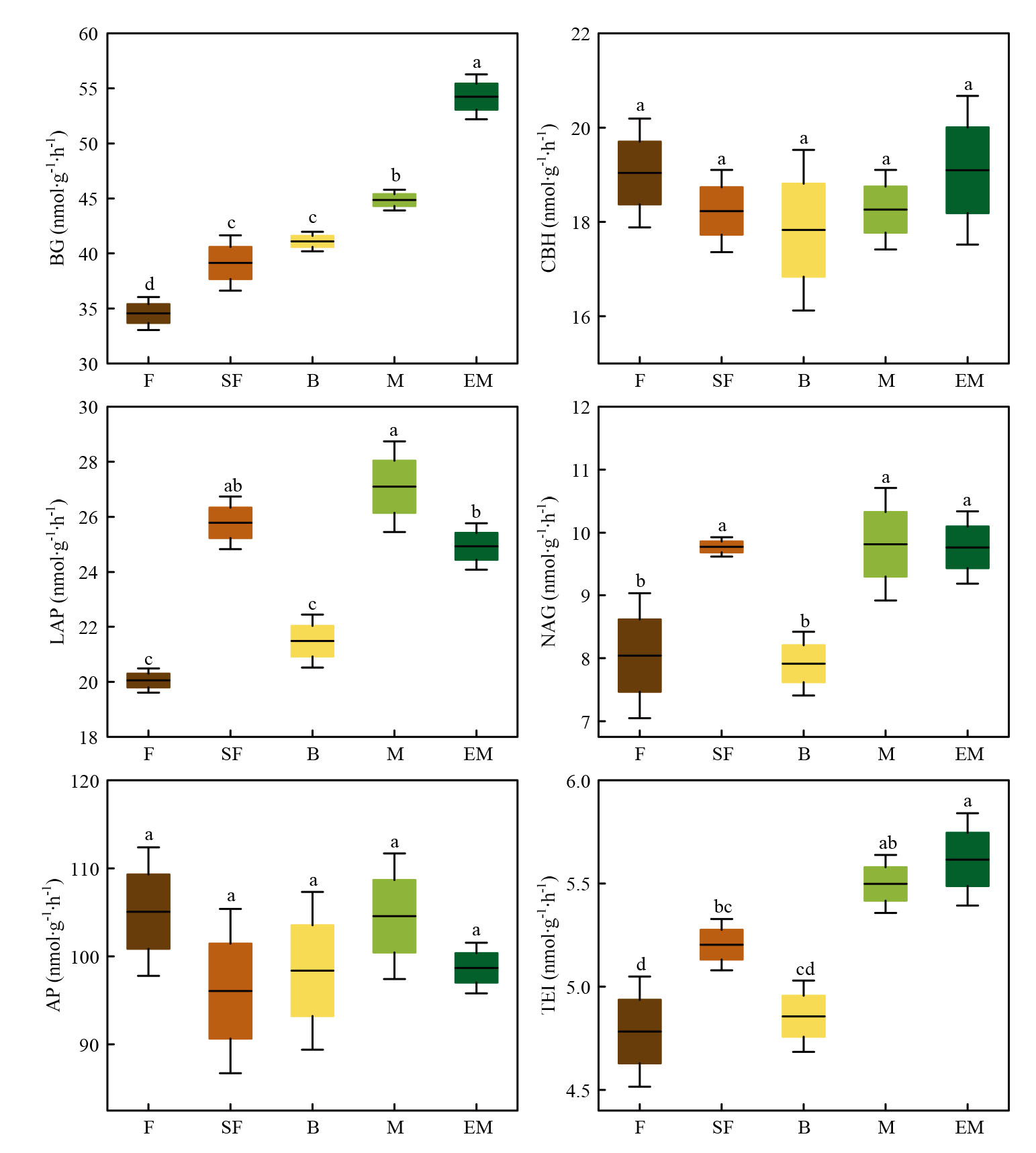
表4
土壤肥力指标主成分分析"
| 指标 Index | 主成分Principal component | 公因子方差 Common factor variance | ||
|---|---|---|---|---|
| PC1 | PC2 | PC3 | ||
| 硝态氮 NO3--N | 0.380 | 0.216 | 0.691 | 0.669 |
| 可溶性有机氮DON | 0.745 | 0.421 | -0.272 | 0.807 |
| 有效磷 Olsen-P | 0.864 | -0.310 | 0.099 | 0.853 |
| 微生物量碳 MBC | 0.932 | -0.327 | 0.013 | 0.975 |
| 微生物量氮 MBN | 0.836 | 0.432 | -0.193 | 0.922 |
| 微生物量磷 MBP | 0.791 | -0.480 | 0.252 | 0.920 |
| 碳获取酶活性 Carbon-acquiring enzyme, CAE | 0.900 | -0.353 | 0.075 | 0.941 |
| 氮获取酶活性 Nitrogen-acquiring enzyme, NAE | 0.745 | 0.387 | -0.397 | 0.862 |
| 磷获取酶活性 Phosphorus-acquiring enzyme, PAE | 0.032 | 0.552 | 0.692 | 0.784 |
| 总体酶活性参数 TEI | 0.928 | 0.224 | 0.011 | 0.912 |
| 特征值 Eigenvalue | 5.867 | 1.473 | 1.304 | |
| 方差贡献率 Variance contribution rate (%) | 58.670 | 14.733 | 13.042 | |
| 累积贡献率 Cumulative contribution rate (%) | 58.670 | 73.403 | 86.444 | |
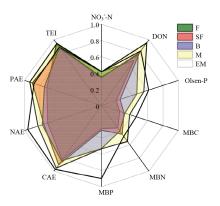
图5
土壤各指标隶属度雷达图"
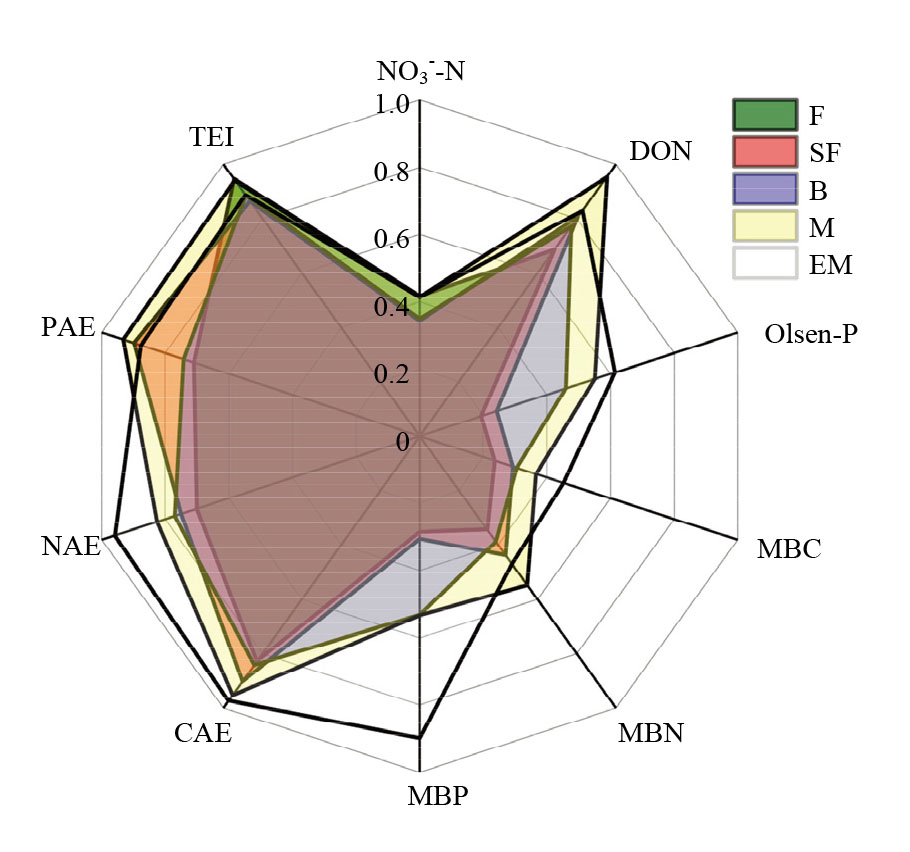
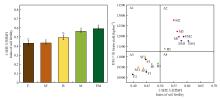
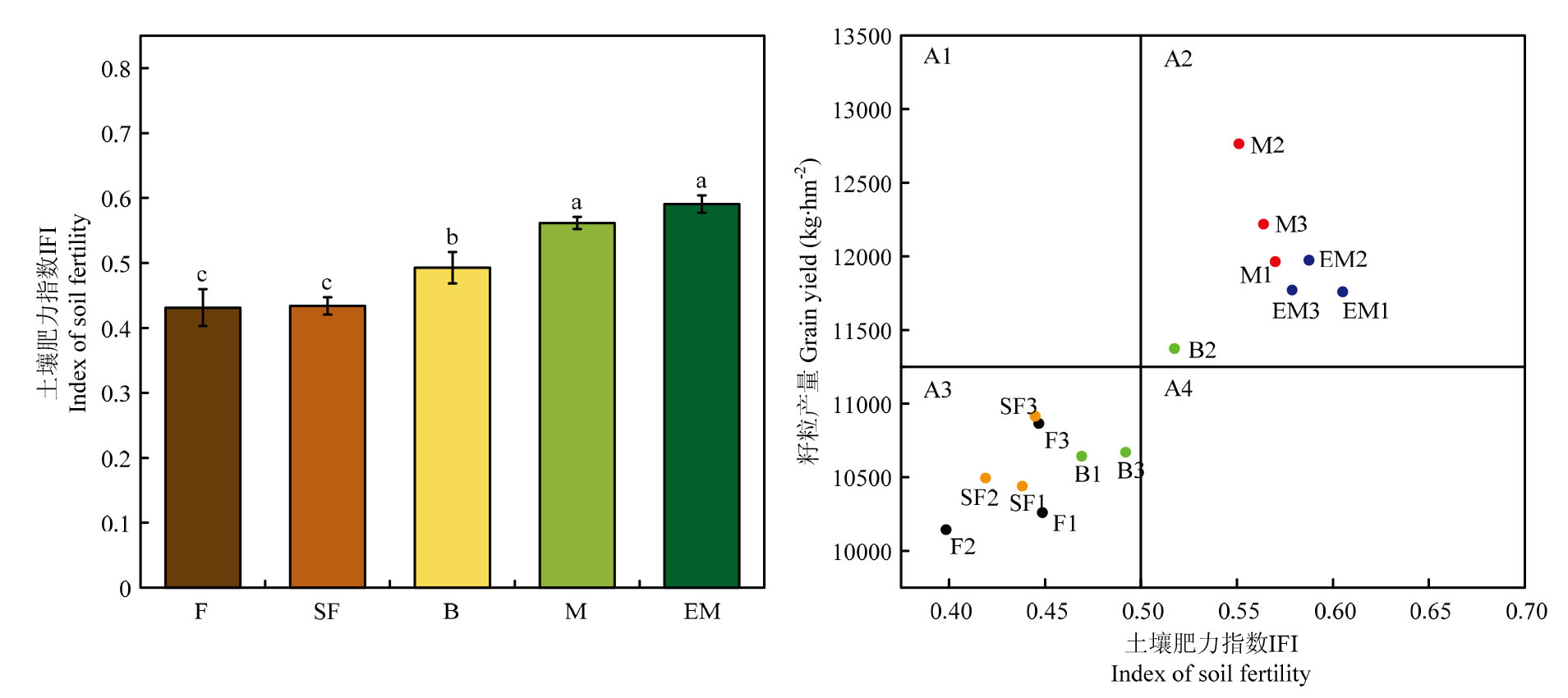
图6
土壤肥力评价与玉米籽粒产量关系图 F1、F2、F3代表F处理的3个重复样本;SF1、SF2、SF3代表SF处理的3个重复样本;B1、B2、B3代表B处理的3个重复样本;M1、M2、M3代表M处理的3个重复样本;EM1、EM2、EM3代表EM处理的3个重复样本"
| [1] |
doi: 10.1016/j.geosus.2020.03.001 |
| [2] |
中华人民共和国农业农村部. 2019年全国耕地质量等级情况公报(农业农村部公报[2020]1号).
|
|
Ministry of Agriculture and Rural Affairs of the People’s Republic of China. Announcement of national arable land quality grading in 2019. (in Chinese)
|
|
| [3] |
可艳军, 张雨萌, 郭艳杰, 张丽娟, 张子涛, 吉艳芝. 生物有机肥配合深松对农田土壤肥力和作物产量的影响. 中国农业科技导报, 2023, 25(4): 157-166.
doi: 10.13304/j.nykjdb.2022.0203 |
|
doi: 10.13304/j.nykjdb.2022.0203 |
|
| [4] |
赵士诚, 魏美艳, 仇少君, 何萍. 氮肥管理对秸秆还田下土壤氮素供应和冬小麦生长的影响. 中国土壤与肥料, 2017(2): 20-25.
|
|
|
|
| [5] |
doi: 10.1016/j.apsoil.2022.104492 |
| [6] |
王学敏, 刘兴, 郝丽英, 解宏图, 张广娜, 陈振华, 张玉兰. 秸秆还田结合氮肥减施对玉米产量和土壤性质的影响. 生态学杂志, 2020, 39(2): 507-516.
|
|
|
|
| [7] |
丁艳宏. 生物炭及微生物菌剂对果园土壤增碳培肥与产能提升机制研究[D]. 杨凌: 西北农林科技大学, 2024.
|
|
|
|
| [8] |
温馨, 红梅, 张月鲜, 裴志福, 赵卉鑫, 陈晨. 有机物添加对碱化土壤有机碳库及土壤质量的影响. 中国草地学报, 2022, 44(1): 39-49.
|
|
|
|
| [9] |
董博. 有机物料添加对黄土高原新修梯田土壤肥力的影响研究[D]. 兰州: 甘肃农业大学, 2022.
|
|
|
|
| [10] |
doi: 10.1016/j.still.2024.106433 |
| [11] |
王艺霖, 梁尧, 蔡红光, 徐康宁, 张水梅, 张畅, 范围, 袁静超, 刘剑钊, 任军. 基于最小数据集的不同有机物料还田黑土土壤质量评价. 土壤通报, 2024, 55(1): 68-75.
|
|
|
|
| [12] |
曹雪莹, 谭长银, 杨佳, 赵信林, 张培育, 马军. 有机物料对农田土壤肥力及镉有效性的影响. 土壤, 2024, 56(2): 367-374.
|
|
|
|
| [13] |
doi: 10.1016/j.ecolind.2024.112375 |
| [14] |
马群, 刘铭, 周玉玲, 王渝庆, 叶成渝, 杨平平, 李绍兴, 王龙昌. 生物炭与有机无机肥配施对土壤质量的影响. 西南大学学报(自然科学版), 2024, 46(7): 115-126.
|
|
|
|
| [15] |
朱永官, 彭静静, 韦中, 沈其荣, 张福锁. 土壤微生物组与土壤健康. 中国科学: 生命科学, 2021, 51(1): 1-11.
|
|
|
|
| [16] |
doi: 10.11648/j.bio.20210906.14 |
| [17] |
doi: 10.1016/j.eja.2024.127429 |
| [18] |
韩紫璇, 房静静, 武雪萍, 姜宇, 宋霄君, 刘晓彤. 长期秸秆配施化肥下土壤团聚体碳氮分布、微生物量与小麦产量的协同效应. 中国农业科学, 2023, 56(8): 1503-1514. doi: 10.3864/j.issn.0578-1752.2023.08.007.
|
|
|
|
| [19] |
doi: 10.1016/j.scitotenv.2024.177379 |
| [20] |
doi: 10.3389/fenvs.2022.1058071 |
| [21] |
张倩倩, 付增朋, 綦兰兰, 刘珍, 韦青, 梁华, 梁传勤, 张玉, 苏芳芳, 马高升. 生物有机肥对设施番茄产量、品质以及土壤理化性状的影响. 肥料与健康, 2023, 50(5): 23-28, 76.
|
|
|
|
| [22] |
芦燕, 魏倩倩, 徐青山, 张耿苗, 赵钰杰, 伍少福, 张均华, 朱春权. 化肥减量配施生物有机肥对水稻产量、土壤结构和土壤固碳增汇能力的影响. 中国土壤与肥料, 2024(11): 114-121.
|
|
|
|
| [23] |
|
| [24] |
doi: 10.1111/ejss.v73.4 |
| [25] |
高宏哲, 吴景贵, 李建明, 刘文利, 耿玉辉. 不同有机培肥措施对盐碱土水稳性团聚体组成及特征的影响. 吉林农业大学学报, 2024, 46(5): 878-885.
|
|
|
|
| [26] |
doi: 10.2136/sssaj2008.0405 |
| [27] |
徐国鑫, 王子芳, 高明, 田冬, 黄容, 刘江, 黎嘉成. 秸秆与生物炭还田对土壤团聚体及固碳特征的影响. 环境科学, 2018, 39(1): 355-362.
|
|
doi: 10.1021/es035328h |
|
| [28] |
王超, 姜坤, 卢瑛, 唐贤, 阳洋, 欧锦琼, 黄伟濠. 不同有机物料施用对砖红壤团聚体组成和稳定性的影响. 土壤通报, 2019, 50(6): 1328-1334.
|
|
|
|
| [29] |
孙娇, 周涛, 郭鑫年, 梁锦秀. 添加秸秆及生物质炭对风沙土有机碳及其活性组分的影响. 土壤, 2021, 53(4): 802-808.
|
|
|
|
| [30] |
doi: 10.1016/j.still.2019.104382 |
| [31] |
梁晓红, 曹雄, 黄敏佳, 张瑞栋, 刘静, 南怀林, 王颂宇. 有机无机肥配施对连作高粱产量、养分利用及土壤理化性状的影响. 干旱地区农业研究, 2024, 42(6): 261-275.
|
|
|
|
| [32] |
doi: 10.1016/j.agee.2016.11.016 |
| [33] |
doi: 10.1016/j.jclepro.2018.08.004 |
| [34] |
张东旭, 胡丹珠, 闫金龙, 冯丽云, 邬志远, 李岩华, 闫海丽, 程永明, 张俊灵. 有机肥替代化肥对小麦生长及土壤养分的影响. 生态学杂志, 2024, 43(11): 3383-3393.
|
|
doi: 10.13292/j.1000-4890.202411.004 |
|
| [35] |
doi: 10.1080/10643389.2023.2221155 |
| [36] |
doi: 10.1111/geb.12029 |
| [37] |
doi: 10.1016/j.jhazmat.2023.131205 |
| [38] |
邓亚琴, 徐智, 张勇, 王宇蕴. 土壤微生物生物量氮对不同腐熟度有机肥的响应及对土壤矿质氮的调控作用. 应用生态学报, 2023, 34(1): 137-144.
doi: 10.13287/j.1001-9332.202301.018 |
|
|
|
| [39] |
|
| [40] |
王静, 王磊, 刘耀斌, 章欢, 张辉, 汪吉东, 吴建燕, 张永春. 长期施氮肥对黄棕壤微生物生物性状的影响及其调控因素. 中国生态农业学报(中英文), 2021, 29(5): 833-843.
|
|
|
|
| [41] |
|
| [42] |
李俊杰, 邹洪琴, 许发辉, 张水清, 岳克, 徐明岗, 段英华. 土壤微生物量氮对小麦各生育期氮素形态的调控. 植物营养与肥料学报, 2021, 27(8): 1321-1329.
|
|
|
|
| [43] |
doi: 10.1016/j.scitotenv.2017.12.343 |
| [44] |
李雨晨, 熊翱宇, 平原, 澹腾辉, 曾建辉, 陈新, 郭忠录. 基于最小数据集的宁都县不同整地方式下果园土壤质量评价. 水土保持学报, 2023, 37(4): 342-350.
|
|
|
|
| [45] |
doi: 10.1002/jsfa.v104.5 |
| [46] |
徐洁章, 韩科峰, 吴良欢. 长期外源有机物料添加对双季稻产量、土壤肥力及土壤质量的影响. 中国农业大学学报, 2024, 29(12): 23-32.
|
|
|
|
| [47] |
doi: 10.1016/j.fcr.2024.109395 |
| [48] |
doi: 10.1016/j.soilbio.2015.02.008 |
| [49] |
宋佳杰, 徐郗阳, 白金泽, 于琦, 程伯豪, 冯永忠, 任广鑫. 秸秆还田配施化肥对土壤养分及冬小麦产量的影响. 环境科学, 2022, 43(9): 4839-4847.
|
|
|
| [1] | 李绍兴, 宋稳锋, 魏泽煜, 周玉玲, 宋李霞, 任可, 马群, 王龙昌. 秸秆与紫云英覆盖对土壤肥力及甘薯产量的影响[J]. 中国农业科学, 2025, 58(8): 1591-1603. |
| [2] | 张方方, 宋启龙, 高娜, 白炬, 李阳, 岳善超, 李世清. 长期覆盖对黄土高原春玉米产量、土壤碳氮组分和碳氮库相关指数的影响[J]. 中国农业科学, 2025, 58(3): 507-519. |
| [3] | 韩哲群, 苏莹, 高奇奇, 刘美英, 贾昂元, 张海睿, 南珊珊, 徐勤政, 王强, 王利军, 武雪萍. 智能滴灌水肥耦合模式实现土壤节水控盐与向日葵产量品质协同提升[J]. 中国农业科学, 2025, 58(20): 4158-4177. |
| [4] | 张海睿, 贾昂元, 高奇奇, 韩哲群, 南珊珊, 段碧华, 武雪萍. 生物炭配施黄腐酸对滨海盐碱地土壤理化性质、酶活性和多功能性的影响[J]. 中国农业科学, 2025, 58(20): 4178-4188. |
| [5] | 吴勇, 文雪, 王天舒, 黄炎炎, 孟熠黎, 姜红宇, 毕利东, 吴会军, 尧水红. 黑土区坡耕地地形因子和垄作方式对土壤养分和肥力指数的影响[J]. 中国农业科学, 2025, 58(18): 3676-3689. |
| [6] | 董云棋, 黄建, 柴以潇, 杨世超, 王敏, 孟旭升, 郭世伟. 不同施肥模式稻油轮作周年产量及土壤肥力的变化[J]. 中国农业科学, 2025, 58(16): 3201-3219. |
| [7] | 宣泽鹏, 冯慧瑶, 陈美淇, 徐基胜, 刘梦璇, 赵炳梓, 张佳宝. 秸秆还田配施化肥对土壤生态系统多功能性的影响[J]. 中国农业科学, 2025, 58(14): 2821-2837. |
| [8] | 高娅菲, 赵媛博, 徐玲, 孙嘉悦, 夏煜轩, 薛丹, 武海雯, 宁航, 吴安驰, 吴林. 冷浸田改种泥炭藓显著增加土壤有机碳含量且降低胞外酶活性[J]. 中国农业科学, 2024, 57(8): 1533-1546. |
| [9] | 刘雅杰, 张天娇, 张向前, 路战远, 刘战勇, 程玉臣, 武迪, 李金龙. 秸秆还田下耕作方式对黑土活性有机碳组分及碳库管理指数的影响[J]. 中国农业科学, 2024, 57(17): 3408-3423. |
| [10] | 栗海鹏, 杜武焰, 吴涵茜, 张杰, 孟会生, 洪坚平, 徐明岗, 郝鲜俊, 高文俊. 不同有机肥对煤矿复垦区土壤养分及细菌群落结构的影响[J]. 中国农业科学, 2024, 57(16): 3207-3219. |
| [11] | 董秀, 张燕, MUNYAMPIRWA Tito, 陶海宁, 沈禹颖. 长期保护性耕作对黄土高原旱作农田土壤碳含量及转化酶活性的影响[J]. 中国农业科学, 2023, 56(5): 907-919. |
| [12] | 申桐, 王恒飞, 杜文波, 周怀平, 王瑞, 张建杰, 靳东升, 徐明岗. 褐土区典型县域耕地土壤肥力时空演变特征及主控因素[J]. 中国农业科学, 2023, 56(21): 4259-4271. |
| [13] | 张灵菲, 马垒, 李玉东, 郑福丽, 魏建林, 谭德水, 崔秀敏, 李燕. 有机物料与化肥长期配施对小麦玉米轮作潮土细菌群落和酶活性的影响[J]. 中国农业科学, 2023, 56(19): 3843-3855. |
| [14] | 李金, 任立军, 李晓宇, 毕润学, 金鑫鑫, 虞娜, 张玉玲, 邹洪涛, 张玉龙. 不同秸秆还田方式对玉米农田土壤CO2排放量和碳平衡的影响[J]. 中国农业科学, 2023, 56(14): 2738-2750. |
| [15] | 李佳燕,孙良杰,马南,王丰,汪景宽. 不同肥力棕壤玉米根茬和茎叶残体碳氮的固定特征[J]. 中国农业科学, 2022, 55(23): 4664-4677. |
|
||
