






中国农业科学 ›› 2026, Vol. 59 ›› Issue (8): 1760-1774.doi: 10.3864/j.issn.0578-1752.2026.08.012
姚林1,2,3( ), 彭律文1,2,3, 阳虹1,2,3, 饶佳怡1,2,3, 高浩然1,2,3, 陶芊伊1,2,3, 谢念祠2, 陈莹玉2, 李赛君2(), 刘硕谦1,3(), 黄飞毅2,3,4()
收稿日期:2025-12-01
接受日期:2026-01-27
出版日期:2026-04-21
发布日期:2026-04-21
通信作者:
联系方式:
姚林,E-mail:2476295857@qq.com。
基金资助:
YAO Lin1,2,3(), PENG LüWen1,2,3, YANG Hong1,2,3, RAO JiaYi1,2,3, GAO HaoRan1,2,3, TAO QianYi1,2,3, XIE NianCi2, CHEN YingYu2, LI SaiJun2(), LIU ShuoQian1,3(), HUANG FeiYi2,3,4()
Received:2025-12-01
Accepted:2026-01-27
Published:2026-04-21
Online:2026-04-21
摘要:
【目的】探究不同茶树亲本和F1子代多酚类物质的遗传多样性,以及不同杂交组合多酚类物质的差异性和基因型的群体结构、亲缘关系,为亲本选配和品质改良的杂交育种提供参考。【方法】以12份不同亲本和87份F1子代茶树资源为试验材料,于2024—2025年测定12个多酚类物质指标,运用系统聚类、杂交组合差异分析、群体结构分析等方法进行多维度评价。【结果】多酚类物质变异系数为14.50%—89.34%,其中,小木麻黄素(STR)、1,2,6-三没食子酰基葡萄糖(1,2,6-TGG)、表儿茶素3-O-(3-O-甲基)没食子酸酯(EGCG3"Me)、没食子儿茶素没食子酸酯(GCG)和儿茶素没食子酸酯(CG)的变异系数较高,分别为89.34%、66.45%、64.22%、59.34%和58.12%。香农维纳指数为1.86—4.57,其中,表没食子儿茶素没食子酸酯(EGCG)、三没食子酰基奎宁酸(TH)和没食子儿茶素没食子酸酯(GCG)的香农维纳指数较高,分别为4.57、4.45和4.23。多酚类物质的差异性分析中,‘保靖黄金茶1号’和‘安徽1号’F1子代的儿茶素没食子酸酯(CG)和三没食子酰基奎宁酸(TH)的含量均高于双亲,且表儿茶素3-O-(3-O-甲基)没食子酸酯(EGCG3"Me)与亲本趋势较为一致。通过多酚类物质聚类分析,将99份资源分为5个类群,第Ⅰ类群含49份资源,第Ⅱ类群含26份资源,第Ⅲ类群含20份资源,第Ⅳ类群和第Ⅴ类群各含2份资源。基于SNP位点的群体结构分析,将12份亲本和87份F1子代分为3个类群,类群Ⅰ包含46份资源,类群Ⅱ包含31份资源,类群Ⅲ包含22份资源,其中,类群Ⅰ全部由亲本‘保靖黄金茶1号’及其为父本(♂)的F1子代组成。3个类群的遗传多样性水平接近。亲缘关系分析结果显示,F1子代与其父本(♂)的亲缘关系更近。【结论】99份茶树资源具有丰富的遗传多样性;CG和TH可能存在超亲的杂种优势,EGCG3"Me在亲本与子代间的含量较为一致;生化成分聚类可将99份茶树资源分为5个类群,基于SNP的群体结构将其分为3个类群且遗传水平接近;在基因组水平上,多数杂交组合的F1子代与其父本表现出更高的相似性。
姚林, 彭律文, 阳虹, 饶佳怡, 高浩然, 陶芊伊, 谢念祠, 陈莹玉, 李赛君, 刘硕谦, 黄飞毅. 茶树不同亲本及F1子代多酚类成分多样性和基因型分析[J]. 中国农业科学, 2026, 59(8): 1760-1774.
YAO Lin, PENG LüWen, YANG Hong, RAO JiaYi, GAO HaoRan, TAO QianYi, XIE NianCi, CHEN YingYu, LI SaiJun, LIU ShuoQian, HUANG FeiYi. Polyphenolic Diversity and Genotypic Analysis of Tea Plants with Different Parents and Their F1 Progeny[J]. Scientia Agricultura Sinica, 2026, 59(8): 1760-1774.
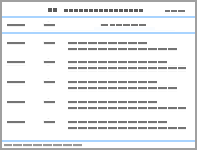
表1
茶树种质资源多酚类物质统计和遗传多样性分析"
| 生化成分 Biochemical components | 最小值 Min | 最大值 Max | 平均值 Mean | 标准差 SD | 变异系数 CV (%) | 香农维纳指数 H' |
|---|---|---|---|---|---|---|
| 没食子儿茶素GC (mg·g-1) | 1.00 | 4.90 | 2.16 | 0.74 | 37.05 | 3.91 |
| 表没食子儿茶素EGC (mg·g-1) | 1.23 | 32.75 | 14.13 | 5.56 | 44.33 | 4.12 |
| 儿茶素C (mg·g-1) | 0.29 | 2.75 | 1.29 | 0.45 | 32.15 | 3.88 |
| 表儿茶素EC (mg·g-1) | 2.99 | 11.72 | 5.61 | 1.59 | 31.20 | 4.01 |
| 表没食子儿茶素没食子酸酯EGCG (mg·g-1) | 62.50 | 129.13 | 93.10 | 13.92 | 16.28 | 4.57 |
| 没食子儿茶素没食子酸酯GCG (mg·g-1) | 1.47 | 28.60 | 11.67 | 7.06 | 59.34 | 4.23 |
| 表儿茶素没食子酸酯ECG (mg·g-1) | 14.70 | 39.64 | 28.22 | 5.49 | 24.50 | 4.18 |
| 儿茶素没食子酸酯CG (mg·g-1) | 0.09 | 2.98 | 1.04 | 0.63 | 58.12 | 3.26 |
| 小木麻黄STR (mg·g-1) | 0.70 | 18.03 | 6.24 | 4.35 | 89.34 | 3.57 |
| 三没食子酰基奎宁酸TH (mg·g-1) | 27.94 | 93.01 | 60.65 | 13.16 | 20.18 | 4.45 |
| 1,2,6-三没食子酰基葡萄糖1,2,6-TGG (mg·g-1) | 0.02 | 5.28 | 0.87 | 0.66 | 66.45 | 2.99 |
| 表儿茶素3-O-(3-O-甲基)没食子酸酯EGCG3"Me (mg·g-1) | 0.30 | 6.53 | 2.19 | 1.27 | 64.22 | 3.35 |
| 酯型儿茶素Ester catechins (mg·g-1) | 101.20 | 176.21 | 133.92 | 17.11 | 15.00 | 2.18 |
| 非酯型儿茶素Non-ester catechins (mg·g-1) | 8.75 | 49.82 | 23.78 | 7.84 | 33.33 | 1.86 |
| 儿茶素总量Total catechins (mg·g-1) | 118.85 | 200.52 | 157.56 | 19.12 | 14.50 | 2.20 |
| 平均值Mean | 40.40 | 3.52 |
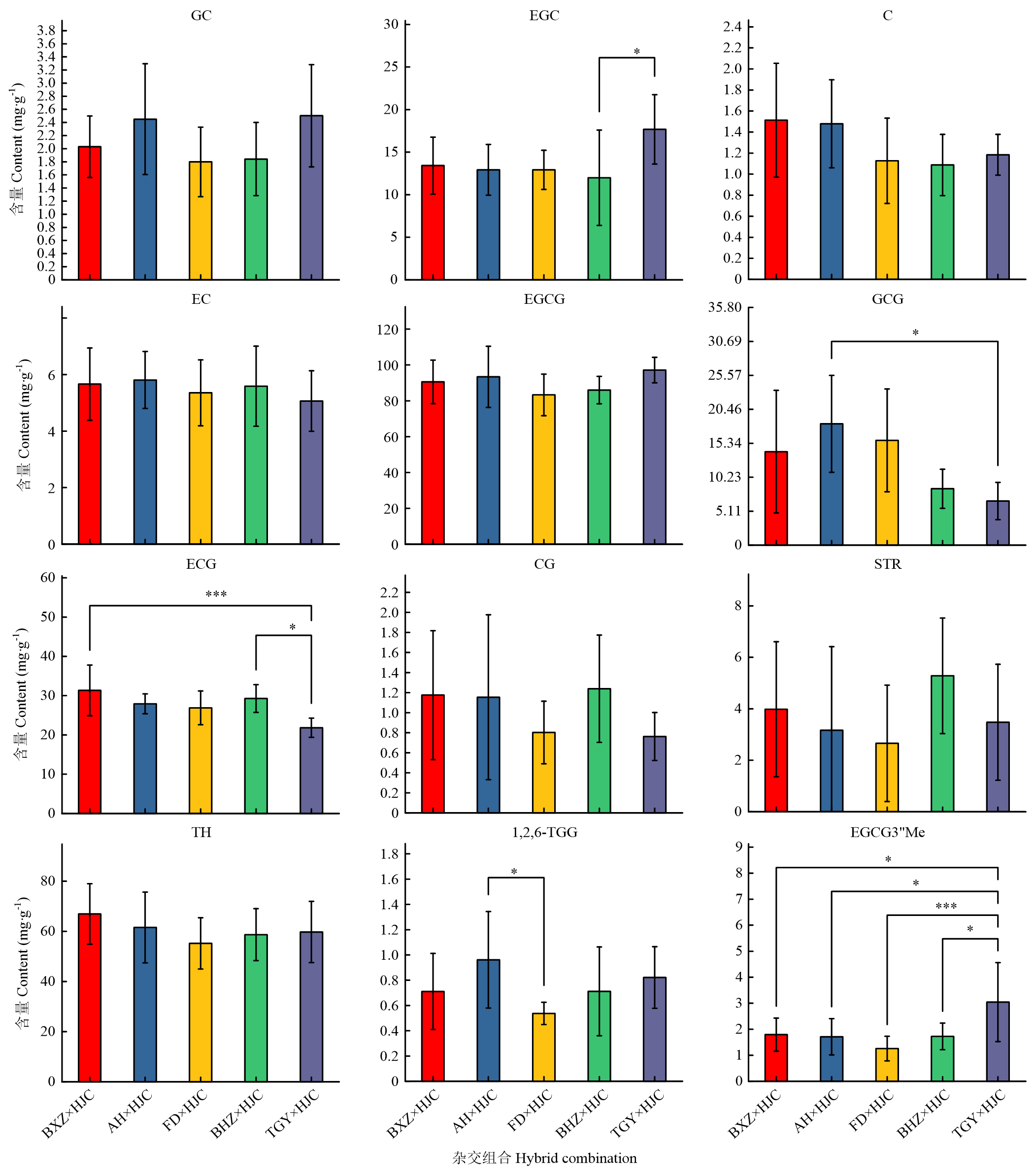
图1
以‘保靖黄金茶1号’为父本和不同母本杂交F1子代的多酚类物质分析 *:P<0.05;**:P<0.01;***:P<0.001。下同"
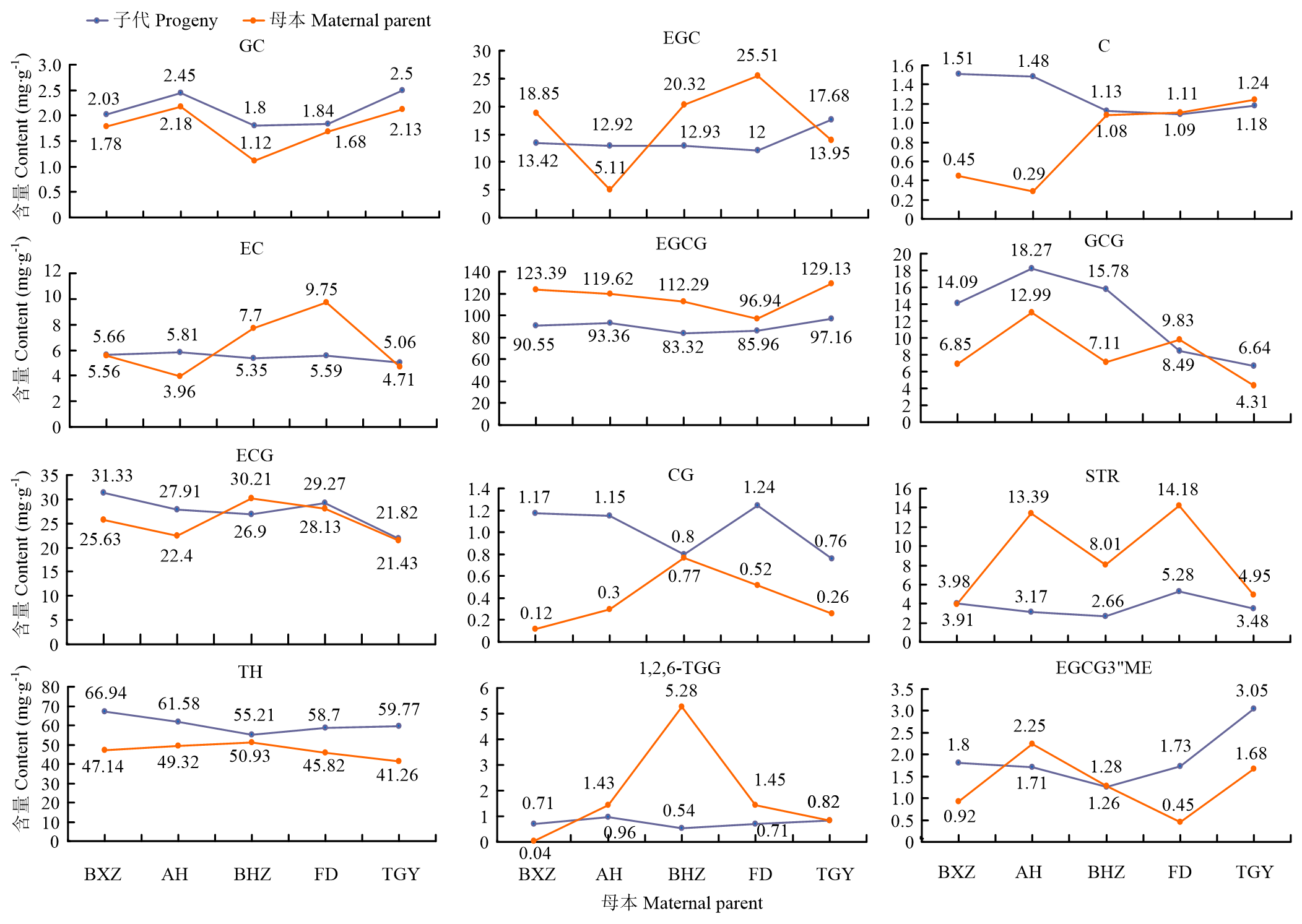
图2
以‘保靖黄金茶1’为父本和不同母本杂交F1子代多酚类物质的趋势图"
表2
以‘保靖黄金茶1’为父本和不同母本杂交F1子代的多酚类物质分析"
| 生化成分 Biochemical components | 父本 Paternal parent HJC (♂) | 母本Maternal parent (♀) | 杂交组合Hybrid combination (♀×♂) | |||||||||
|---|---|---|---|---|---|---|---|---|---|---|---|---|
| BXZ | AH | FD | BHZ | TGY | BXZ×HJC | AH×HJC | FD×HJC | BHZ×HJC | TGY×HJC | |||
| 没食子儿茶素GC (mg·g-1) | 1.91 | 1.78 | 2.18 | 1.12 | 1.68 | 2.13 | 2.03 | 2.45 | 1.80 | 1.84 | 2.50 | |
| 表没食子儿茶素EGC (mg·g-1) | 32.75 | 18.85 | 5.11 | 20.32 | 25.51 | 13.95 | 13.42 | 12.94 | 12.93 | 12.00 | 17.68 | |
| 儿茶素C (mg·g-1) | 1.46 | 0.45 | 0.29 | 1.08 | 1.11 | 1.24 | 1.51 | 1.48 | 1.13 | 1.09 | 1.18 | |
| 表儿茶素EC (mg·g-1) | 8.64 | 5.56 | 3.96 | 7.70 | 9.75 | 4.71 | 5.66 | 5.81 | 5.35 | 5.59 | 5.06 | |
| 表没食子儿茶素没食子酸酯 EGCG (mg·g-1) | 98.52 | 123.39 | 119.62 | 112.29 | 96.94 | 129.13 | 90.55 | 93.36 | 83.32 | 85.96 | 97.16 | |
| 没食子儿茶素没食子酸酯 GCG (mg·g-1) | 11.10 | 6.85 | 12.99 | 7.11 | 9.83 | 4.31 | 14.09 | 18.27 | 15.78 | 8.49 | 6.64 | |
| 表儿茶素没食子酸酯ECG (mg·g-1) | 26.54 | 25.63 | 22.4 | 30.21 | 28.13 | 21.43 | 31.33 | 27.91 | 26.90 | 29.27 | 21.82 | |
| 儿茶素没食子酸酯CG (mg·g-1) | 0.30 | 0.12 | 0.30 | 0.77 | 0.52 | 0.26 | 1.17 | 1.15 | 0.80 | 1.24 | 0.76 | |
| 小木麻黄素STR (mg·g-1) | 1.23 | 3.91 | 13.39 | 8.01 | 14.18 | 4.95 | 3.98 | 3.17 | 2.66 | 5.28 | 3.48 | |
| 三没食子酰基奎宁酸TH (mg·g-1) | 41.43 | 47.14 | 49.32 | 50.93 | 45.82 | 41.26 | 66.94 | 61.58 | 55.21 | 58.70 | 59.77 | |
| 1,2,6-三没食子酰基葡萄糖1,2,6-TGG (mg·g-1) | 2.12 | 0.04 | 1.43 | 5.28 | 1.45 | 0.82 | 0.71 | 0.96 | 0.54 | 0.71 | 0.82 | |
| 表儿茶素3-O-(3-O-甲基) 没食子酸酯EGCG3"Me (mg·g-1) | 0.89 | 0.92 | 2.25 | 1.28 | 0.45 | 1.70 | 1.80 | 1.71 | 1.26 | 1.73 | 3.05 | |
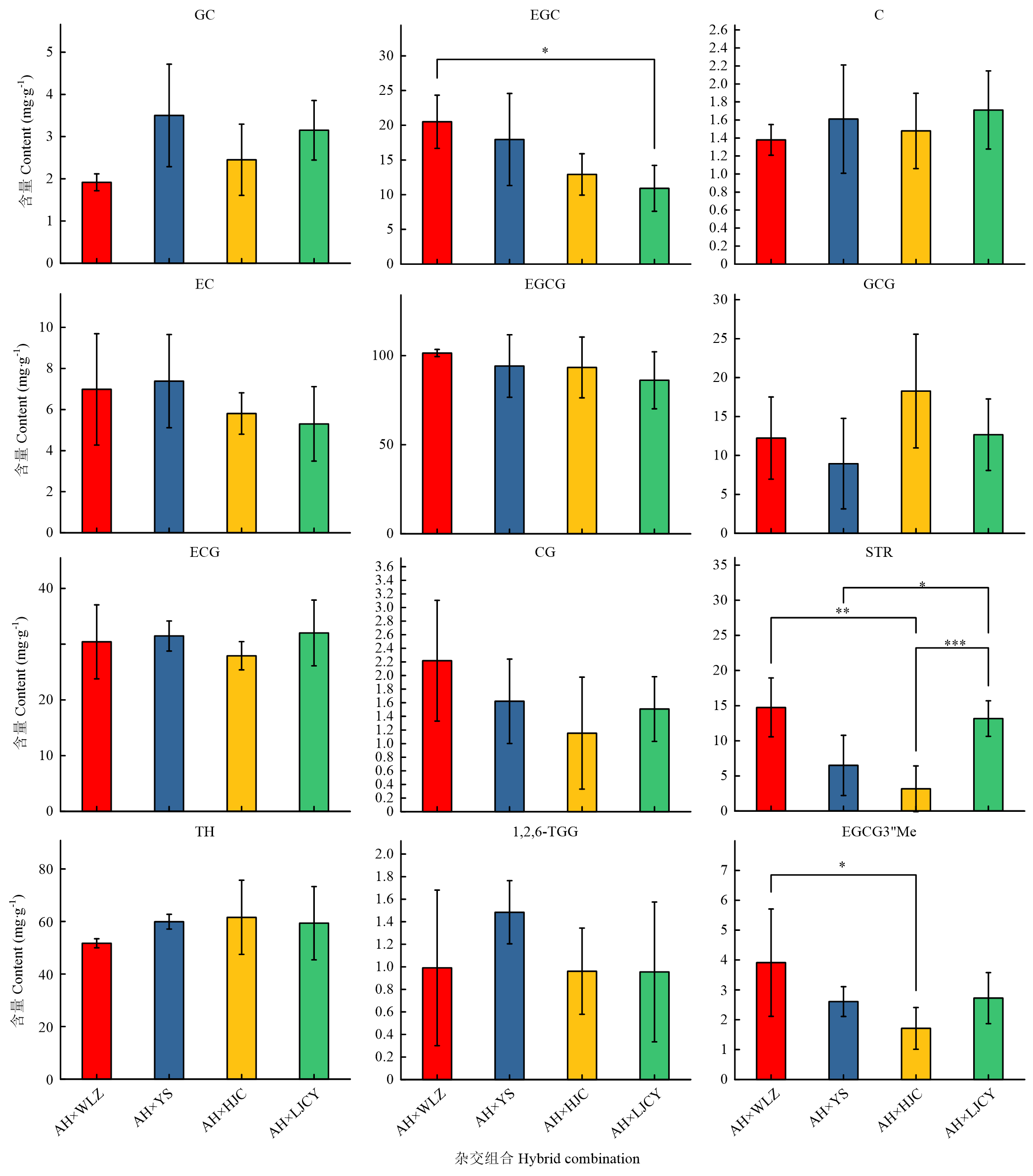
图3
以‘安徽1号’为母本和不同父本杂交F1子代的多酚类物质分析"
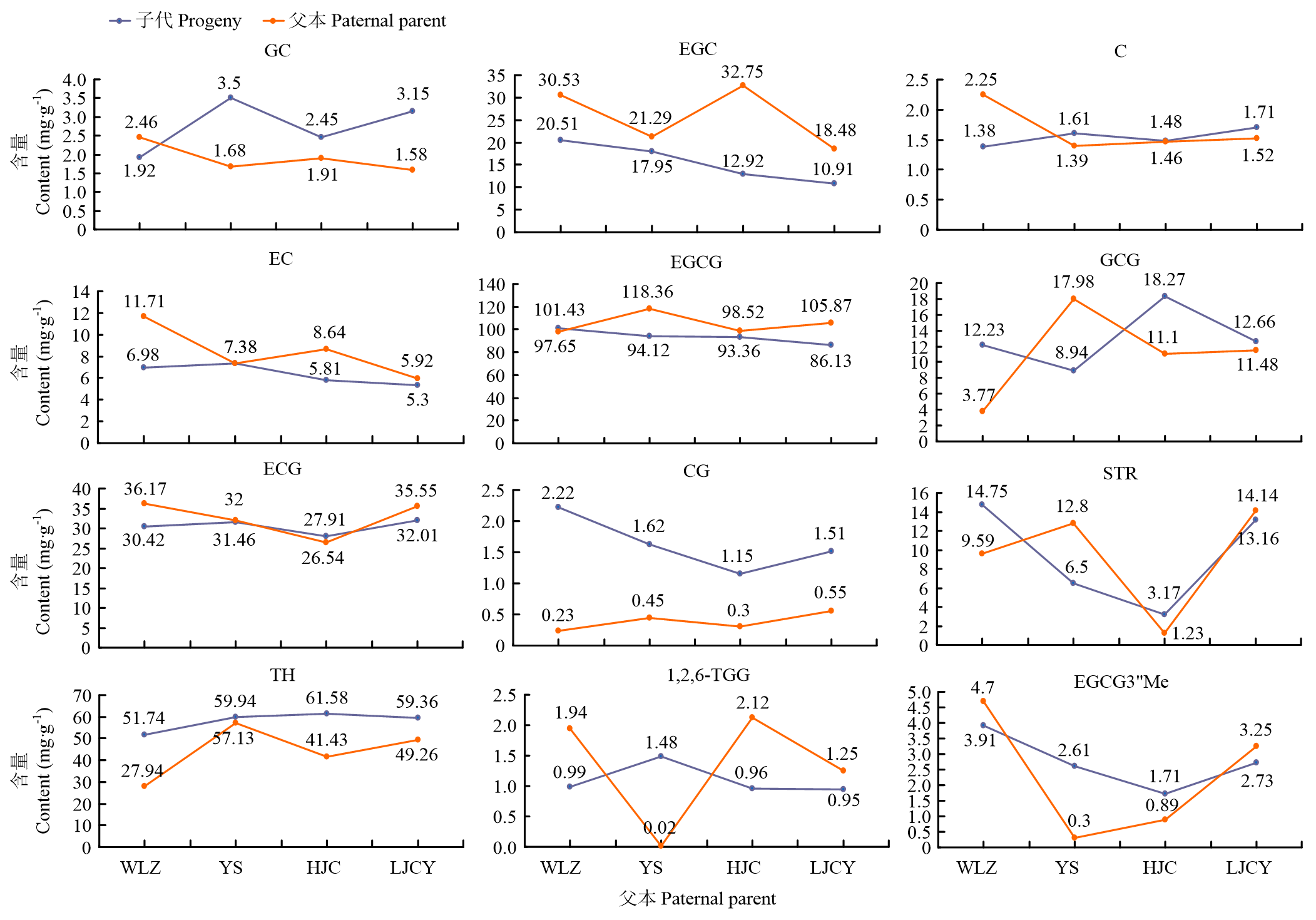
图4
以‘安徽1号’为母本和不同父本杂交F1子代多酚类物质的趋势图"
表3
以‘安徽1号’为母本和不同父本杂交F1子代的多酚类物质分析"
| 生化成分 Biochemical components | 母本 Maternal parent AH (♀) | 父本Paternal parent (♂) | 杂交组合Hybrid combination (♀×♂) | |||||||
|---|---|---|---|---|---|---|---|---|---|---|
| WLZ | YS | HJC | LJCY | AH×WLZ | AH×YS | AH×HJC | AH×LJCY | |||
| 没食子儿茶素GC (mg·g-1) | 2.18 | 2.46 | 1.68 | 1.91 | 1.58 | 1.92 | 3.50 | 2.45 | 3.15 | |
| 表没食子儿茶素EGC (mg·g-1) | 5.11 | 30.53 | 21.29 | 32.75 | 18.48 | 20.51 | 17.95 | 12.92 | 10.91 | |
| 儿茶素C (mg·g-1) | 0.29 | 2.25 | 1.39 | 1.46 | 1.52 | 1.38 | 1.61 | 1.48 | 1.71 | |
| 表儿茶素EC (mg·g-1) | 3.96 | 11.71 | 7.38 | 8.64 | 5.92 | 6.98 | 7.38 | 5.81 | 5.30 | |
| 表没食子儿茶素没食子酸酯EGCG (mg·g-1) | 119.62 | 97.65 | 118.36 | 98.52 | 105.87 | 101.43 | 94.12 | 93.36 | 86.13 | |
| 没食子儿茶素没食子酸酯GCG (mg·g-1) | 12.99 | 3.77 | 17.98 | 11.10 | 11.48 | 12.23 | 8.94 | 18.27 | 12.66 | |
| 表儿茶素没食子酸酯ECG (mg·g-1) | 22.40 | 36.17 | 32.00 | 26.54 | 35.55 | 30.42 | 31.46 | 27.91 | 32.01 | |
| 儿茶素没食子酸酯CG (mg·g-1) | 0.30 | 0.23 | 0.45 | 0.30 | 0.55 | 2.22 | 1.62 | 1.15 | 1.51 | |
| 小木麻黄素STR (mg·g-1) | 13.39 | 9.59 | 12.80 | 1.23 | 14.14 | 14.75 | 6.50 | 3.17 | 13.16 | |
| 三没食子酰基奎宁酸TH (mg·g-1) | 49.32 | 27.94 | 57.13 | 41.43 | 49.26 | 51.74 | 59.94 | 61.58 | 59.36 | |
| 1,2,6-三没食子酰基葡萄糖 1,2,6-TGG (mg·g-1) | 1.43 | 1.94 | 0.02 | 2.12 | 1.25 | 0.99 | 1.48 | 0.96 | 0.95 | |
| 表儿茶素3-O-(3-O-甲基)没食子酸酯EGCG3"Me (mg·g-1) | 2.25 | 4.70 | 0.30 | 0.89 | 3.25 | 3.91 | 2.61 | 1.71 | 2.73 | |
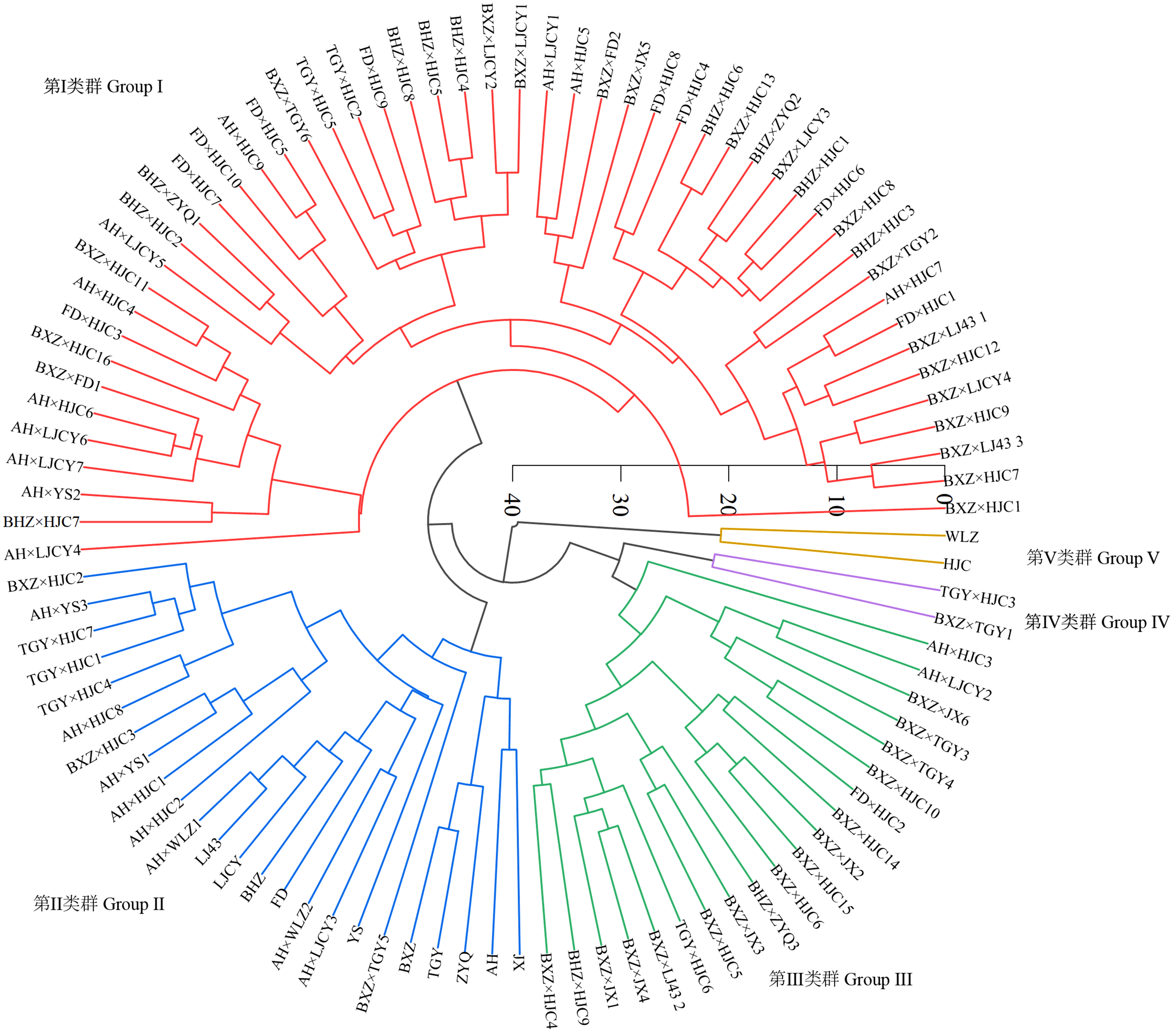
图5
12份亲本和87份F1子代的聚类分析 图上品种名称同附表1"
表4
不同类群间多酚类物质的比较"
| 生化成分 Biochemical components | 第Ⅰ类群Group Ⅰ | 变异系数CV (%) | 第Ⅱ类群Group Ⅱ | 变异系数CV (%) | 第Ⅲ类群Group Ⅲ | 变异系数CV (%) | 第Ⅳ类群Group Ⅳ | 变异系数CV (%) | 第Ⅴ类群Group Ⅴ | 变异系数CV (%) |
|---|---|---|---|---|---|---|---|---|---|---|
| 没食子儿茶素GC (mg·g-1) | 2.01±0.69 | 38.31 | 2.30±0.84 | 36.02 | 2.27±0.68 | 29.15 | 3.03±0.46 | 15.13 | 2.19±0.39 | 17.75 |
| 表没食子儿茶素 EGC (mg·g-1) | 12.07±3.78 | 37.53 | 16.41±6.03 | 37.71 | 14.84±4.80 | 34.91 | 10.60±2.09 | 19.68 | 31.64±1.57 | 4.95 |
| 儿茶素C (mg·g-1) | 1.21±0.42 | 34.92 | 1.22±0.40 | 34.88 | 1.47±0.51 | 34.23 | 1.50±0.36 | 24.13 | 1.85±0.56 | 30.26 |
| 表儿茶素EC (mg·g-1) | 5.37±1.31 | 28.28 | 5.85±1.55 | 30.51 | 5.52±1.64 | 31.02 | 4.66±0.28 | 6.07 | 10.18±2.18 | 21.43 |
| 表没食子儿茶素没食子酸酯EGCG* (mg·g-1) | 83.35±9.28 | 14.99 | 106.41±10.65 | 10.96 | 98.24±10.26 | 11.52 | 102.43±3.81 | 3.72 | 98.08±0.62 | 0.63 |
| 没食子儿茶素没食子酸酯 GCG (mg·g-1) | 27.75±5.24 | 60.93 | 27.61±5.12 | 67.86 | 29.34±6.56 | 65.41 | 33.34±2.05 | 24.08 | 31.35±6.18 | 69.60 |
| 表儿茶素没食子酸酯 ECG (mg·g-1) | 11.68±5.88 | 19.25 | 10.23±6.50 | 19.91 | 11.69±7.07 | 21.74 | 34.46±8.30 | 6.15 | 7.44±5.18 | 21.74 |
| 儿茶素没食子酸酯 CG (mg·g-1) | 1.17±0.64 | 59.13 | 0.75±0.61 | 82.35 | 1.17±0.53 | 54.31 | 1.31±0.07 | 5.00 | 0.26±0.05 | 18.24 |
| 小木麻黄素STR (mg·g-1) | 5.78±4.09 | 69.91 | 6.97±5.22 | 68.38 | 6.97±3.65 | 56.91 | 1.35±0.67 | 49.45 | 5.41±5.91 | 109.43 |
| 三没食子酰基奎宁酸 TH* (mg·g-1) | 56.39±8.65 | 18.55 | 54.67±7.03 | 13.40 | 78.42±6.17 | 9.22 | 90.94±3.93 | 3.22 | 34.68±9.53 | 27.49 |
| 1,2,6-三没食子酰基葡萄糖 1,2,6-TGG* (mg·g-1) | 0.73±0.41 | 61.73 | 1.17±1.01 | 100.00 | 0.72±0.31 | 42.47 | 0.77±0.26 | 33.84 | 2.03±0.13 | 6.39 |
| 表儿茶素3-O-(3-O-甲基) 没食子酸酯 EGCG3"Me (mg·g-1) | 2.15±1.19 | 49.78 | 2.20±1.40 | 61.33 | 2.26±1.33 | 55.36 | 1.69±0.08 | 4.94 | 2.79±2.69 | 94.40 |
| 酯型儿茶素 Ester catechins* (mg·g-1) | 123.94±11.52 | 9.26 | 145.00±13.74 | 9.47 | 140.44±15.22 | 10.84 | 171.54±6.60 | 3.85 | 137.14±0.69 | 0.50 |
| 非酯型儿茶素 Non-ester catechins (mg·g-1) | 20.66±5.23 | 25.41 | 25.78±7.38 | 28.63 | 24.10±6.72 | 27.88 | 19.79±3.19 | 16.12 | 45.86±1.10 | 2.40 |
| 儿茶素总量 Total catechins* (mg·g-1) | 144.61±13.49 | 9.31 | 170.79±15.91 | 9.31 | 164.54±17.07 | 10.37 | 191.33±3.42 | 1.79 | 183.00±1.79 | 0.98 |
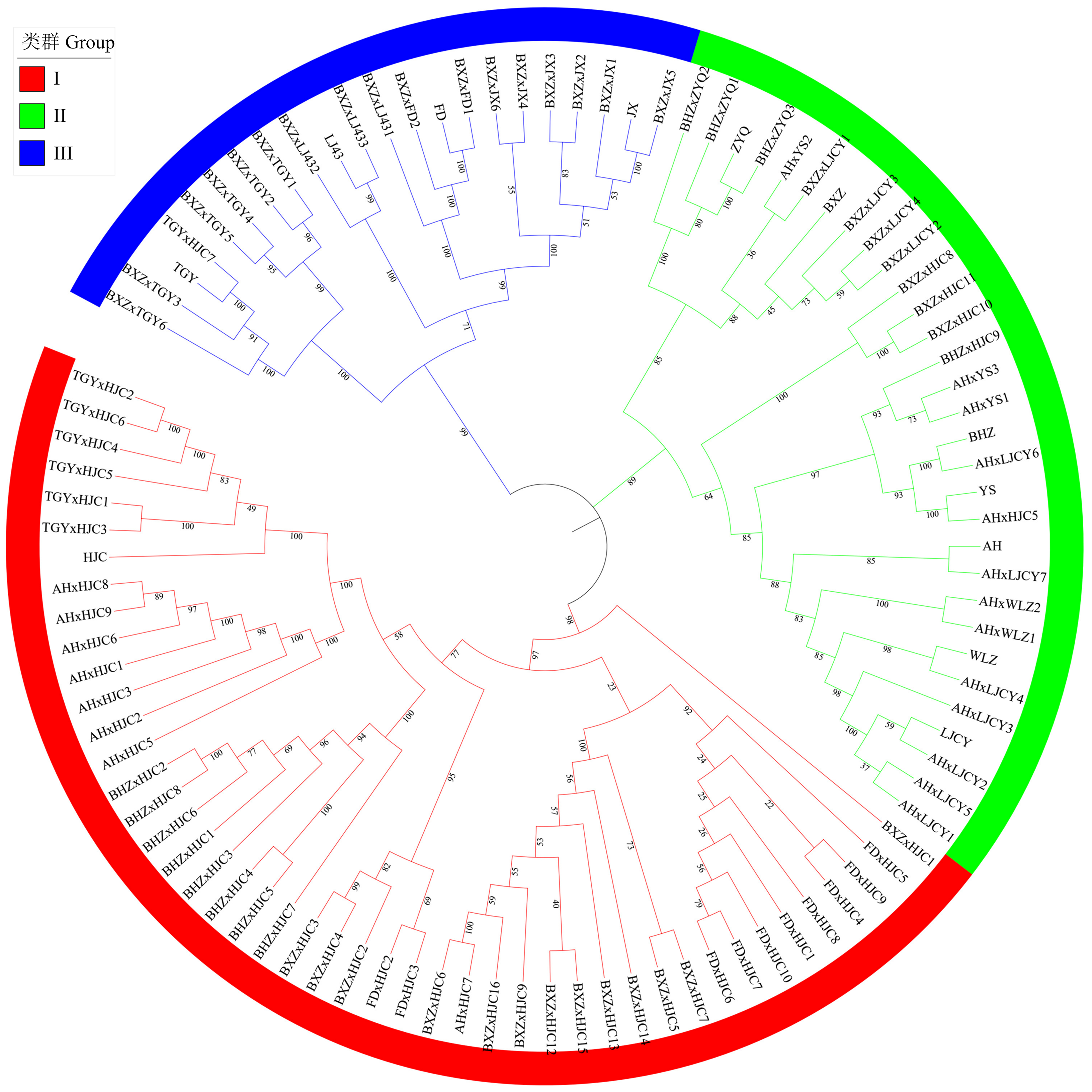
图6
99份茶树种质的系统发育树"
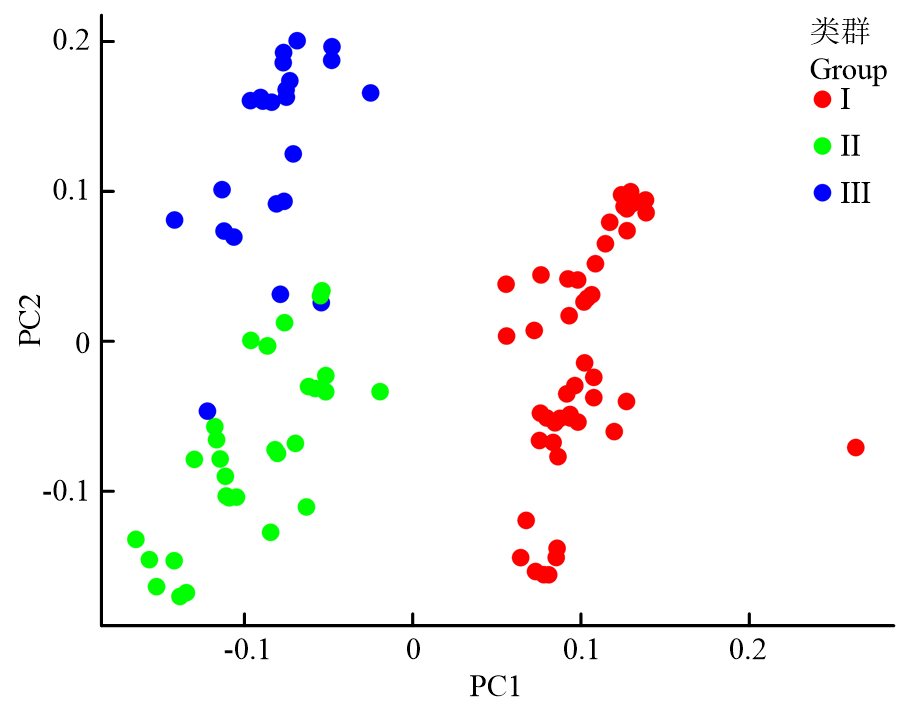
图7
基于聚类分析的PCA图"
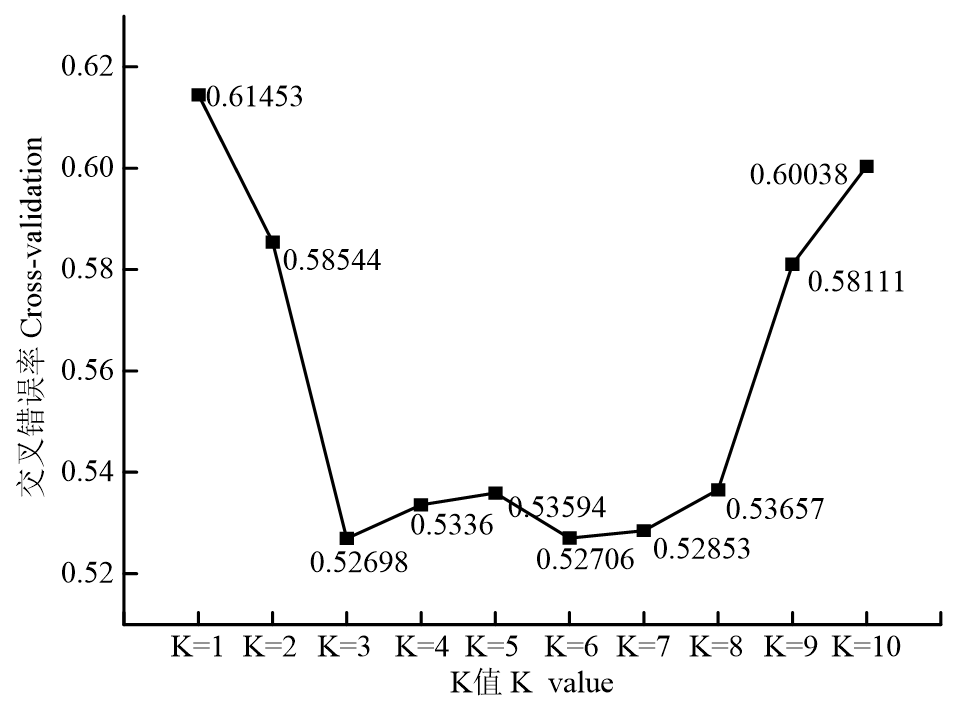
图8
不同K值交叉验证误差结果图"
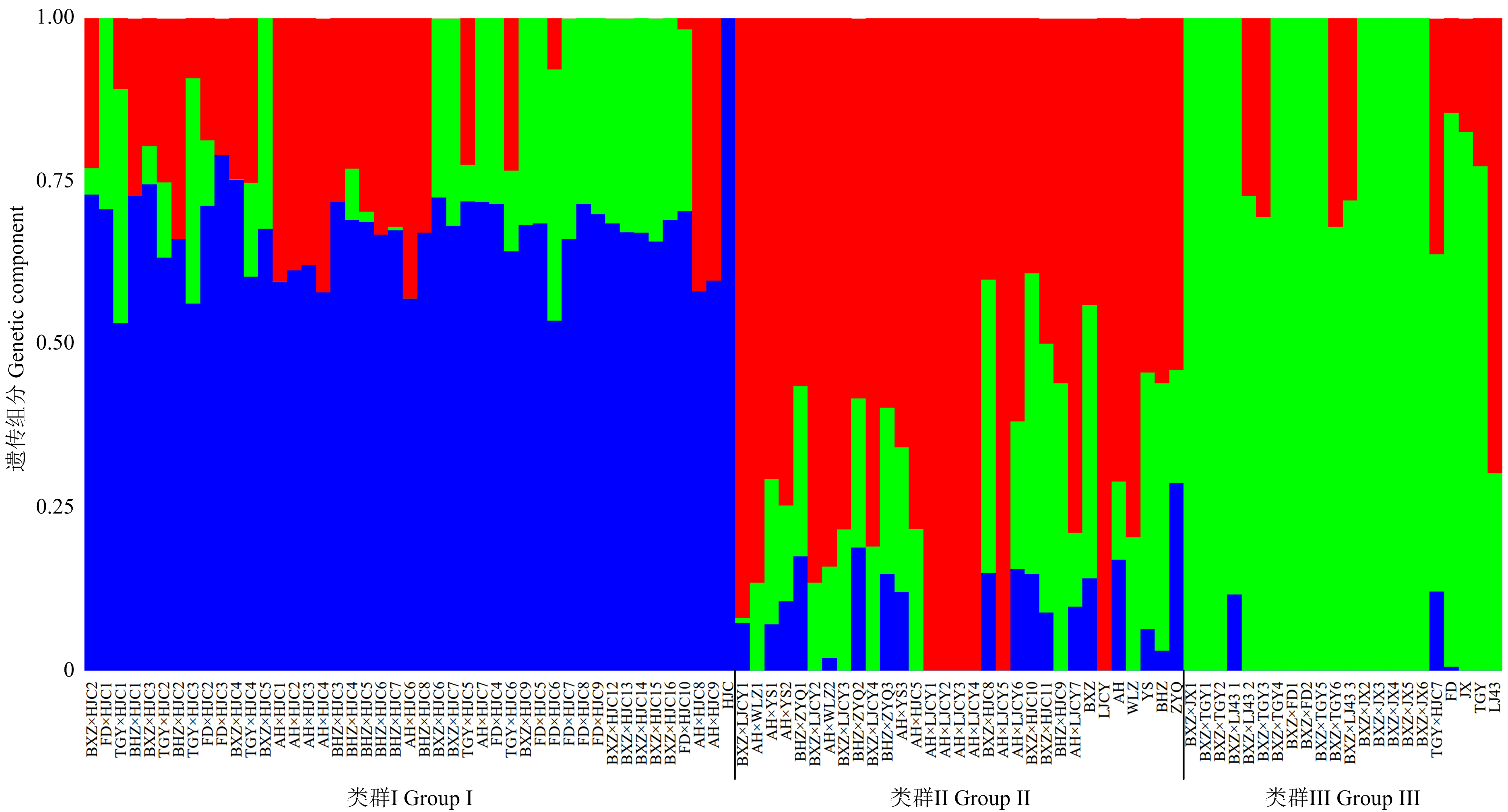
图9
99份茶树种质的群体遗传图片(K=3)"
表5
基于系统进化树和PCA分析的群体遗传分析"
| 群体Group | 统计值Statistical value | 观测杂合度Ho | 核苷酸多样性Pi | 次要等位基因频率MAF | Tajima D |
|---|---|---|---|---|---|
| 类群I GroupⅠ | 均值Mean | 0.3593 | 0.3347 | 0.2438 | 1.4076 |
| 范围Scope | 0.2722-0.4682 | 0.0217-0.5072 | 0.0109-0.4891 | 1.7320-4.1697 | |
| 标准差Standard deviation | 0.0366 | 0.1479 | 0.1398 | 1.0458 | |
| 类群Ⅱ GroupⅡ | 均值Mean | 0.333 | 0.3567 | 0.2601 | 1.4692 |
| 范围Scope | 0.2222-0.4575 | 0.0323-0.5128 | 0.0161-0.4839 | 1.6765-3.7968 | |
| 标准差Standard deviation | 0.0458 | 0.1384 | 0.1352 | 0.9778 | |
| 类群Ⅲ GroupⅢ | 均值Mean | 0.3514 | 0.3612 | 0.2605 | 1.3231 |
| 范围Scope | 0.2813-0.4039 | 0.0455-0.5185 | 0.0227-0.4773 | 1.9984-3.5123 | |
| 标准差Standard deviation | 0.0313 | 0.1395 | 0.1345 | 0.9295 |
表6
不同杂交组合的亲缘关系"
| 亲本 Progenitor | 杂交组合Hybrid combination (♀×♂) | |||||||
|---|---|---|---|---|---|---|---|---|
| BXZ×HJC | FD×HJC | TGY×HJC | BHZ×HJC | AH×HJC | AH×WLZ | AH×YS | AH×LJCY | |
| HJC | 0.212605 | 0.23019 | 0.293631 | 0.172983 | 0.236611 | -0.28373 | -0.21252 | -0.27177 |
| BXZ | 0.015267 | 0.054041 | -0.1455 | -0.14531 | -0.16359 | -0.04902 | 0.029275 | -0.06216 |
| FD | -0.04485 | 0.168739 | -0.28169 | -0.06509 | -0.22244 | -0.00501 | -0.01567 | -0.02824 |
| TGY | -0.17103 | -0.18002 | 0.227238 | -0.1377 | -0.12389 | 0.051176 | -0.00375 | 0.057699 |
| BHZ | -0.12608 | -0.04959 | -0.19383 | 0.196244 | -0.15651 | 0.189376 | 0.128366 | 0.074549 |
| AH | -0.07723 | -0.11747 | -0.03005 | -0.10445 | 0.122742 | 0.175107 | 0.100038 | 0.20454 |
| WLZ | -0.1396 | -0.13541 | -0.07616 | -0.07392 | -0.01897 | 0.308916 | 0.146261 | 0.222057 |
| YS | -0.09951 | -0.06611 | -0.12021 | 0.04361 | -0.06821 | 0.081748 | 0.119565 | 0.066444 |
| LJCY | -0.16854 | -0.16633 | -0.10071 | -0.10107 | -0.0772 | 0.147376 | 0.069976 | 0.446203 |
| [1] |
陈亮, 杨亚军, 虞富莲. 中国茶树种质资源研究的主要进展和展望. 植物遗传资源学报, 2004, 5(4): 389-392.
|
|
|
|
| [2] |
雷雨, 李赛君, 罗意, 黄飞毅, 段继华, 康彦凯, 陈莹玉, 丁玎, 董丽娟. 特早生优质茶树新品种'金栀'选育报告. 茶叶通讯, 2022, 49(4): 458-463.
|
|
|
|
| [3] |
李赛君, 段继华, 康彦凯, 雷雨, 黄飞毅, 罗意, 丁玎, 陈莹玉, 董丽娟. 特早生抗寒茶树新品种‘玉叶’选育报告. 茶叶通讯, 2023, 50(1): 32-37.
|
|
|
|
| [4] |
李赛君, 罗意, 雷雨, 段继华, 黄飞毅, 康彦凯, 陈莹玉, 丁玎, 董丽娟. 高产高抗型茶树新品种‘渐荣齐’选育报告. 茶叶通讯, 2023, 50(3): 305-311.
|
|
|
|
| [5] |
雷雨, 李赛君, 段继华, 黄飞毅, 罗意, 康彦凯, 陈莹玉, 丁玎, 董丽娟. 高香型红绿茶兼制茶树新品种'湘茶研18号'选育报告. 茶叶通讯, 2023, 50(4): 454-459.
|
|
|
|
| [6] |
姜毅, 陈洁宇, 龚涵, 李楠昕, 郭鑫淼, 袁迎春, 胡观兴, 龚文芳. 油茶种间杂交F1代枝叶性状及花期分析. 林业科学研究, 2025, 38(2): 127-136.
|
|
|
|
| [7] |
王雪敏, 马建强, 金基强, 马春雷, 姚明哲, 陈亮. 茶树杂交一代儿茶素类和生物碱的遗传变异分析. 茶叶科学, 2013, 33(5): 397-404.
|
|
|
|
| [8] |
黄飞毅, 陈宇宏, 刘伟, 丁玎, 雷雨, 段继华, 邓晶, 康彦凯, 罗意, 张秀军, 等. 湖南莽山茶树种质资源调查与品质性状的遗传多样性分析. 植物遗传资源学报, 2021, 22(2): 328-337.
doi: 10.13430/j.cnki.jpgr.20200807001 |
|
|
|
| [9] |
doi: 10.1038/s41598-020-62518-6 pmid: 32221398 |
| [10] |
doi: 10.1186/s12951-025-03533-5 pmid: 40605004 |
| [11] |
梅飘, 刘丁丁, 叶圆圆, 张晨禹, 丁诗琦, 李亚奇, 王培鑫, 梅菊芬, 马春雷. 基于茶树液相功能芯片的白化茶树资源遗传多样性分析. 作物学报, 2025, 51(9): 2358-2370.
doi: 10.3724/SP.J.1006.2025.54043 |
|
doi: 10.3724/SP.J.1006.2025.54043 |
|
| [12] |
刘庆帅, 璩馥榕, 魏梦园, 钟红, 王熠, 陈亮, 金基强. 基于UPLC技术解析金萱×紫娟F1分离群体代谢物的遗传变异. 茶叶科学, 2022, 42(1): 29-40.
|
|
|
|
| [13] |
张海平, 房伟民, 陈发棣, 丁跃生, 崔娜欣, 顾俊杰. 部分睡莲属植物形态性状的多样性分析. 南京农业大学学报, 2009, 32(4): 47-52.
|
|
|
|
| [14] |
宋科峰, 邢远航, 赵慧玲, 张传量, 李月月, 宋鹏博, 赵文莎, 张傲琰, 简俊涛, 孙道杰. 普通小麦产量相关农艺性状的全基因组关联分析. 麦类作物学报, 2026, 46(1): 32-43.
|
|
|
|
| [15] |
徐云碧, 杨泉女, 郑洪建, 许彦芬, 桑志勤, 郭子锋, 彭海, 张丛, 蓝昊发, 王蕴波, 等. 靶向测序基因型检测(GBTS)技术及其应用. 中国农业科学, 2020, 53(15): 2983-3004. doi: 10.3864/j.issn.0578-1752.2020.15.001.
|
|
|
|
| [16] |
doi: 10.1101/gr.094052.109 pmid: 19648217 |
| [17] |
|
| [18] |
doi: 10.1093/bioinformatics/btr330 pmid: 21653522 |
| [19] |
王盼乔, 吕梦瑶, 连珠, 李纪锁, 李继德, 胡建斌, 贾芝琪. 西葫芦主要农艺性状的全基因组关联分析. 河南农业大学学报, 2025, 57(2): 1-16.
|
|
|
|
| [20] |
doi: 10.1021/acs.jafc.1c08248 |
| [21] |
罗莉. 茶树远缘杂交叶片表型和主要生化成分遗传变异的研究[D]. 广州: 华南农业大学, 2020.
|
|
|
|
| [22] |
doi: 10.1016/j.molp.2017.04.002 |
| [23] |
doi: S1674-2052(20)30134-9 pmid: 32353625 |
| [24] |
doi: 10.1038/s41467-020-17498-6 pmid: 32709943 |
| [25] |
doi: 10.1038/s41467-020-18228-8 pmid: 32895382 |
| [26] |
doi: 10.1038/s41588-021-00895-y |
| [27] |
doi: 10.1016/j.molp.2020.04.009 |
| [28] |
doi: 10.1038/s41438-021-00542-x pmid: 33931633 |
| [29] |
doi: 10.1186/s12870-019-1917-5 |
| [30] |
doi: 10.1371/journal.pone.0151424 |
| [31] |
doi: 10.1016/j.ygeno.2020.11.028 |
| [1] | 葛玉彬, 贺春贵, 王宁, 张国琴, 张正英, 吕鑫. 基于表型性状的热带高粱种质资源遗传多样性分析与创新利用[J]. 中国农业科学, 2026, 59(8): 1622-1638. |
| [2] | 孙亚玲, 王清华, 舒锐, 岳丽昕, 王振宝, 李朝霞, 高莉敏, 程鸿, 付在秋, 霍雨猛. 大葱和青甘韭种间杂种的获得及其特性[J]. 中国农业科学, 2026, 59(3): 619-636. |
| [3] | 吕文彦, 程海涛, 马兆惠, 田淑华. 育种新时代水稻杂交育种技术与策略探讨[J]. 中国农业科学, 2026, 59(2): 233-238. |
| [4] | 何治霖, 孙翠霞, 岳红丽, 谈月霞, 张耀海, 王福生, 刘思涛, 江东. 基于重测序枸橼、柠檬类种质资源的遗传多样性分析和别罗勒烯的全基因组关联分析[J]. 中国农业科学, 2026, 59(2): 386-401. |
| [5] | 沈英姿, 李朵姣, 江丽, 胡新荣, 陈斌, 郑寨生, 袁名安. CsGPDH在茶籽油脂积累中的功能分析[J]. 中国农业科学, 2026, 59(2): 402-412. |
| [6] | 何娇萍, 韩梦, 周挺, 顾钢, 赖宇飞, 赖荣泉. 野外种群杂交和室外种群锻炼对烟蚜茧蜂寄生及生长发育相关酶的影响[J]. 中国农业科学, 2025, 58(7): 1344-1354. |
| [7] | 郑雅琴, 刘雪晴, 吴思文, 唐小燕, 杨丹妮, 汪永康, Ahmad Aftab, Khna Afrsyab, 汪承刚, 陈国户. 乌菜BcDET2的克隆及其抽薹开花调控功能[J]. 中国农业科学, 2025, 58(5): 991-1003. |
| [8] | 许玉娟, 张捷, 王天译, 陈浩洋, 赵佳佳, 武棒棒, 郝宇琼, 李晓华, 郑兴卫, 左静静, 郑军. 山西小麦低分子量麦谷蛋白Glu-A3和Glu-B3位点多样性鉴定及其对品质的影响[J]. 中国农业科学, 2025, 58(24): 5110-5127. |
| [9] | 贾文庆, 和亚琳, 段慧琳, 于迎月, 王政, 赵国栋, 郭英姿, 王二强, 穆金艳, 张焱, 王艳丽, 何松林. 基于转录组和代谢组分析‘凤丹’×大花黄牡丹远缘杂交受精前障碍发生机制[J]. 中国农业科学, 2025, 58(23): 5013-5030. |
| [10] | 陈彩锦, 马琳, 蒋庆雪, 刘金晖, 苗童, 张志鹏, 孟翔, 马晓冉, 周昕越, 张建, 刘文辉, 王学敏. 244份饲用燕麦种质资源表型性状遗传多样性分析[J]. 中国农业科学, 2025, 58(23): 4825-4836. |
| [11] | 田先先, 冯韶芳, 王青, 潘晨东, 李波, 方开星, 吴华玲, 秦丹丹. 连南大叶茶树种质资源生化特性分析与适制性评价[J]. 中国农业科学, 2025, 58(22): 4797-4812. |
| [12] | 魏益民, 周美亮, 唐宇. 荞麦的起源、进化与传播[J]. 中国农业科学, 2025, 58(21): 4305-4316. |
| [13] | 刘晓旭, 钟泽鑫, 邱佳仁, 杨春晓, 张永军, 谢文, 张友军, 潘慧鹏. 豆大蓟马不同地理种群线粒体CO1的遗传多样性[J]. 中国农业科学, 2025, 58(21): 4361-4371. |
| [14] | 曲海悦, 韩洁楠, 李冉, 张泽, 刘倩倩, 郝转芳, 翁建峰, 张德贵, 周志强, 许振南, 荣子国, 王菊英, 雍洪军, 李明顺. 新育中单系列玉米杂交种与亲本自交系的耐盐性评价[J]. 中国农业科学, 2025, 58(20): 4100-4116. |
| [15] | 唐桂梅, 李卫东, 周宇霞, 孔佑涵, 肖晓玲, 彭颖姝, 张力, 符红艳, 刘洋, 黄国林. 基于表型性状分析蕙兰种质资源遗传多样性[J]. 中国农业科学, 2025, 58(2): 339-354. |
|
||
