






中国农业科学 ›› 2026, Vol. 59 ›› Issue (8): 1775-1796.doi: 10.3864/j.issn.0578-1752.2026.08.013
岳楠栋1( ), 蒋丙婷1, 聂景贵1, 方越1, 唐军荣1, 乐振声1, 周莹2, 李能波2, 何霞红1(), 张雪春1()
收稿日期:2025-10-02
接受日期:2026-02-02
出版日期:2026-04-21
发布日期:2026-04-21
通信作者:
联系方式:
岳楠栋,E-mail:1623845252@qq.com。
基金资助:
YUE NanDong1(), JIANG BingTing1, NIE JingGui1, FANG Yue1, TANG JunRong1, YUE ZhenSheng1, ZHOU Ying2, LI NengBo2, HE XiaHong1(), ZHANG XueChun1()
Received:2025-10-02
Accepted:2026-02-02
Published:2026-04-21
Online:2026-04-21
摘要:
【目的】评价紫皮石斛茎、叶、花提取物的化学成分、体外抗氧化及降血糖活性,并基于代谢组学揭示其活性差异的物质基础,为紫皮石斛资源的高值化开发和功能食品制备提供理论依据。【方法】以紫皮石斛的茎、叶和花为材料,采用不同浓度乙醇(0、60%、100%)进行提取,测定其总糖、总酚、总黄酮含量,并评估DPPH、ABTS+清除能力、铁还原能力(FRAP)及α-葡萄糖苷酶抑制活性。利用高效液相色谱(HPLC)定量分析酚类成分,结合非靶向代谢组学技术比较不同部位代谢物组成,通过偏最小二乘判别分析(PLS-DA)和KEGG通路富集分析筛选关键差异代谢物及代谢通路。【结果】紫皮石斛茎提取物中总糖含量最高,而花提取物总酚、总黄酮含量及抗氧化活性均显著高于茎和叶。60%乙醇提取物的总黄酮含量和ABTS+清除能力、FRAP值最强,100%乙醇提取物的总酚含量和DPPH清除能力最高。花和叶的α-葡萄糖苷酶抑制能力优于茎。HPLC分析共鉴定出11种酚类化合物,其中60%乙醇提取物中种类最多、含量最高。代谢组学共鉴定出1 859种代谢物,其中1 051种为差异代谢物,脂质、有机酸及其衍生物等类别的代谢物与抗氧化和降血糖活性显著相关。【结论】紫皮石斛茎、叶、花均具有显著的抗氧化和降血糖活性,其活性差异与提取溶剂及部位密切相关。花表现出最优的综合生物活性。
岳楠栋, 蒋丙婷, 聂景贵, 方越, 唐军荣, 乐振声, 周莹, 李能波, 何霞红, 张雪春. 紫皮石斛茎、叶、花的成分和功能活性分析及代谢组学研究[J]. 中国农业科学, 2026, 59(8): 1775-1796.
YUE NanDong, JIANG BingTing, NIE JingGui, FANG Yue, TANG JunRong, YUE ZhenSheng, ZHOU Ying, LI NengBo, HE XiaHong, ZHANG XueChun. Analysis of Chemical Components, Functional Activities and Metabolomics of Stems, Leaves and Flowers of Dendrobium devonianum Paxt.[J]. Scientia Agricultura Sinica, 2026, 59(8): 1775-1796.
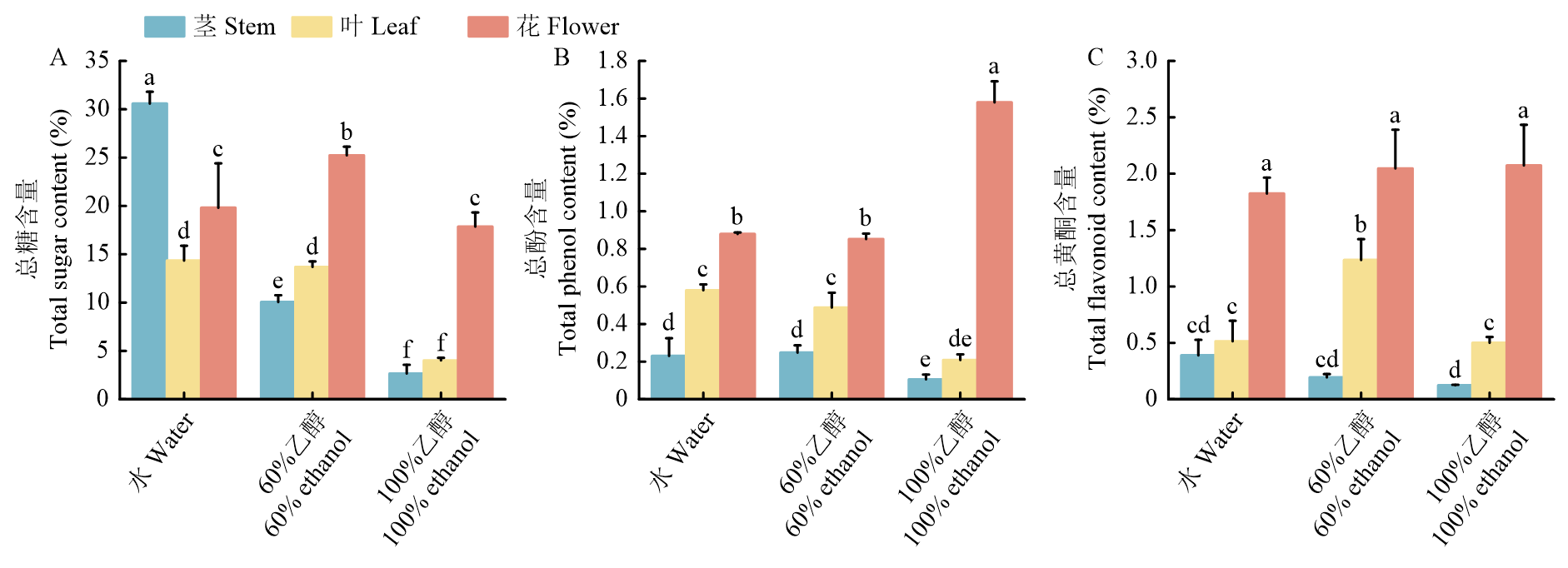
图1
紫皮石斛不同部位乙醇提取物中总糖(A)、总酚(B)和总黄酮(C)含量 不同小写字母表示不同组间存在显著差异(P<0.05)。下同"
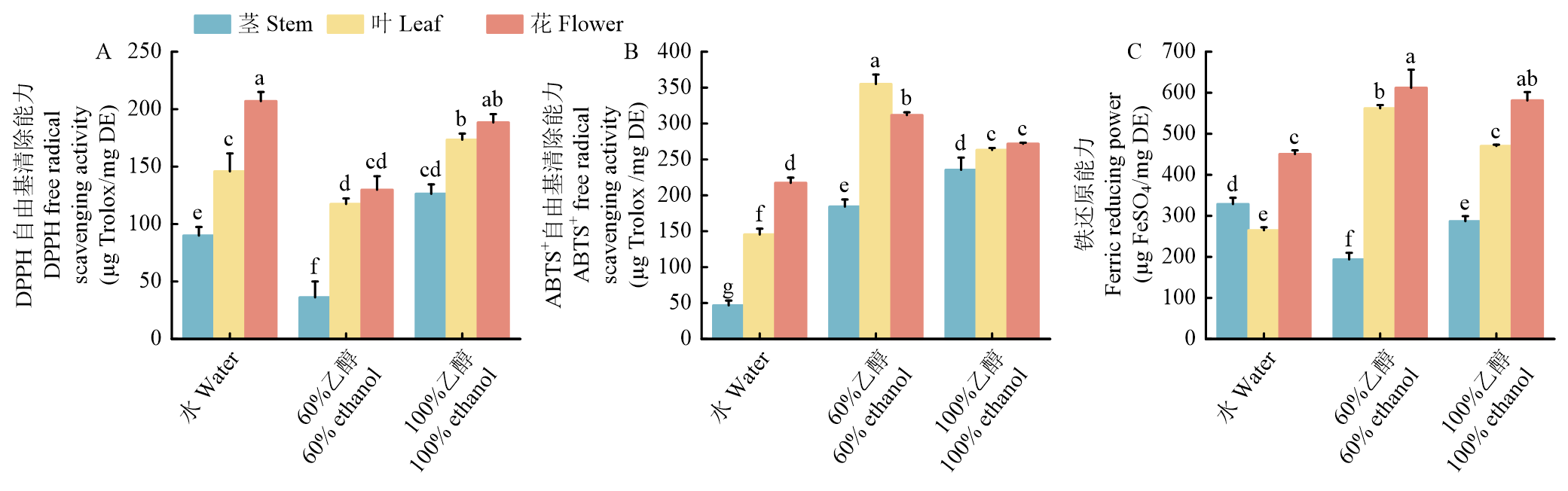
图2
紫皮石斛不同部位乙醇提取物的抗氧化活性"
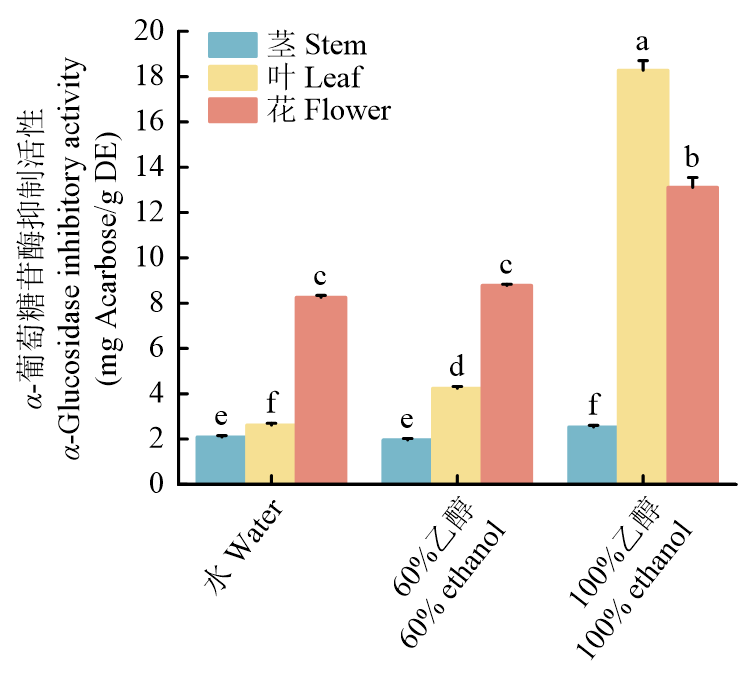
图3
紫皮石斛不同部位乙醇提取物的α-葡萄糖苷酶抑制能力"
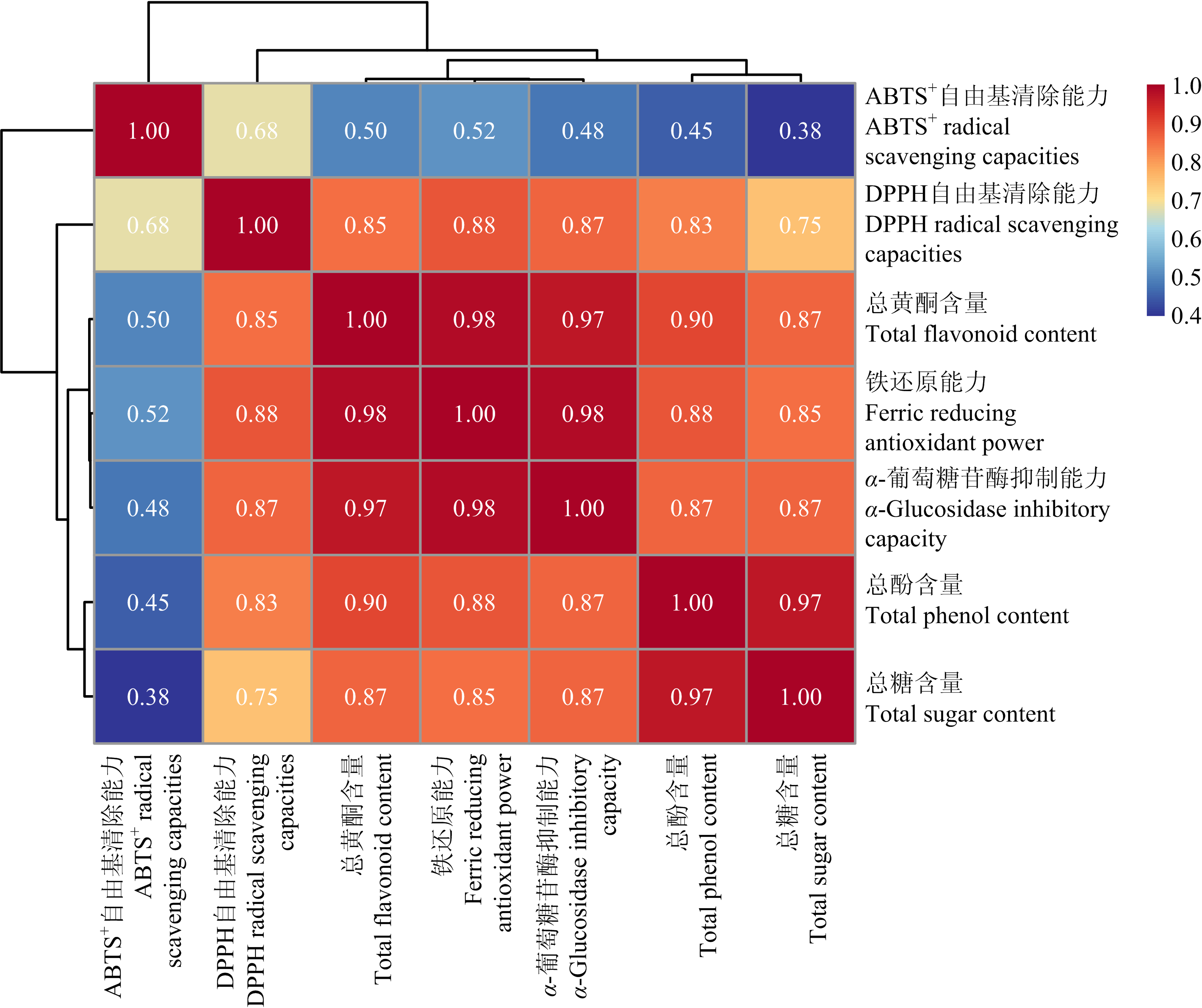
图4
紫皮石斛各活性成分含量与抗氧化、α-葡萄糖苷酶抑制能力之间的相关性热图"
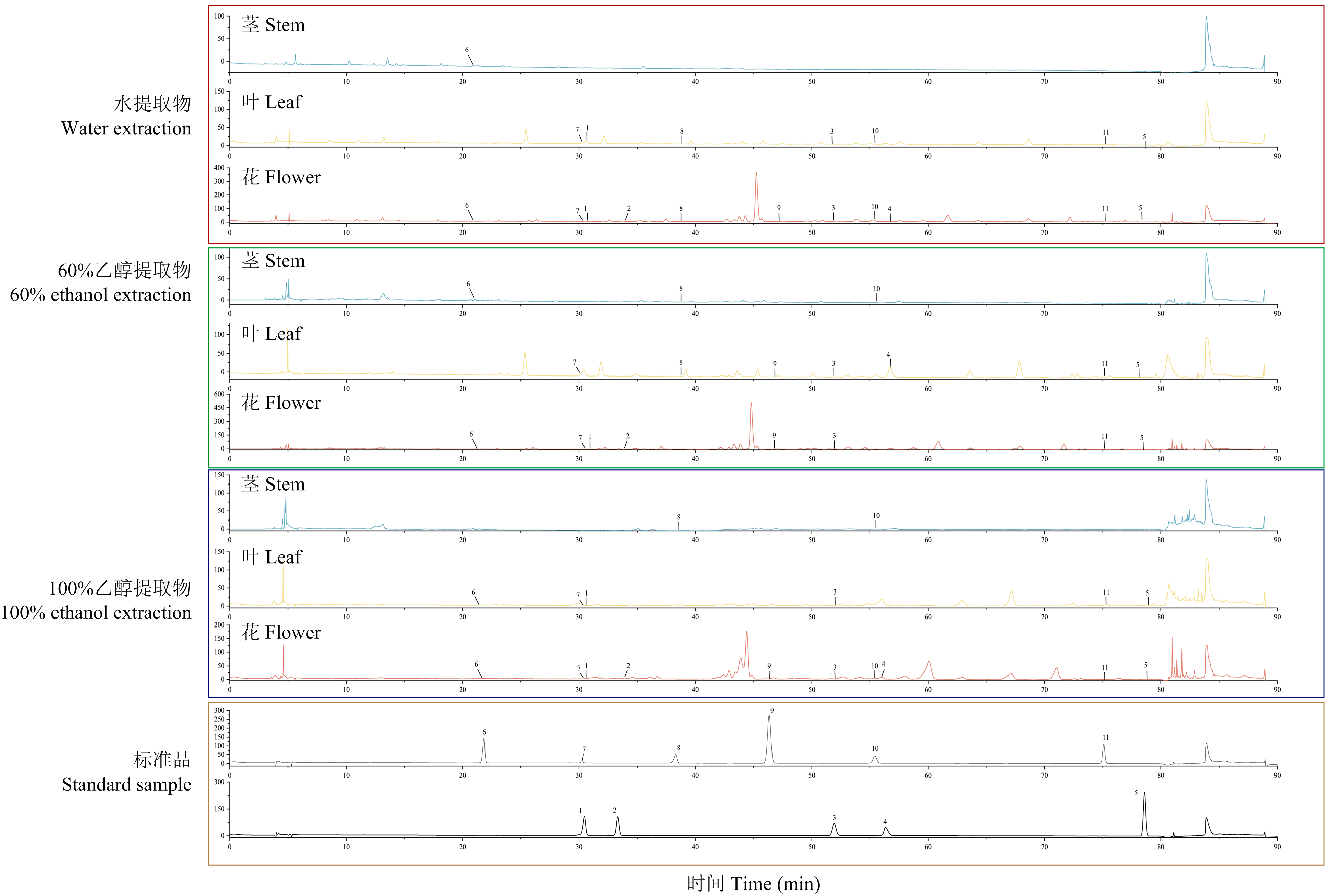
图5
紫皮石斛不同部位乙醇提取物的HPLC色谱图 图中色谱峰1—11分别对应2, 5-二羟基苯甲酸、香草酸、芥子酸、鞣花酸、白藜芦醇、原儿茶酸、绿原酸、表儿茶素、对香豆酸、芦丁和杨梅素"

表1
紫皮石斛不同部位乙醇提取物的酚类化合物含量"
| 名称 Name | 分类 Category | 保留时间Retention time (min) | 纯水提取物 Water extraction | 60%乙醇提取物 60% ethanol extraction | 100%乙醇提取物 100% ethanol extraction | ||||||
|---|---|---|---|---|---|---|---|---|---|---|---|
| 茎 Stem | 叶 Leaf | 花 Flower | 茎 Stem | 叶 Leaf | 花 Flower | 茎 Stem | 叶 Leaf | 花 Flower | |||
| 原儿茶酸 Protocatechuic acid | 酚酸 Phenolic acid | 21.852 | 0.18±0.05 | - | 0.31±0.01 | 0.28±0.12 | - | 0.21±0.17 | - | 0.36±0.17 | 0.19±0.02 |
| 表儿茶素 Epicatechin | 黄烷醇 Flavonol | 38.302 | - | 1.46±0.02 | 1.46±0.56 | 0.48±0.20 | 2.79±0.49 | - | 0.279±0.20 | - | - |
| 杨梅素 Myricetin | 黄酮醇 Flavonol | 75.074 | - | 0.53±0.12 | 0.58±0.03 | - | - | 0.79±0.24 | 1.15±0.61 | ||
| 绿原酸 Chlorogenic acid | 酚酸 Phenolic acid | 30.478 | - | 1.33±0.96 | 1.33±0.08 | - | 2.45±1.38 | 0.69±0.08 | - | 1.35±0.57 | 1.93±1.03 |
| 对香豆酸 P-coumaric acid | 酚酸 Phenolic acid | 46.339 | - | - | 0.34±0.09 | - | 0.37±0.05 | 0.29±0.23 | - | - | 0.28±0.05 |
| 2,5-二羟基苯甲酸 2,5-Dihydroxybenzoic acid | 酚酸 Phenolic acid | 30.253 | 12.51±2.56 | 2.51±1.03 | - | - | 12.64±3.46 | - | 6.61±2.46 | 21.68±5.62 | - |
| 芦丁 Rutin | 黄酮苷 Flavonoid glycoside | 55.423 | - | 2.57±0.89 | 0.57±0.15 | 2.13±1.73 | - | - | 1.20±1.03 | - | 4.68±1.68 |
| 香草酸 Vanillic acid | 酚酸 Phenolic acid | 33.332 | - | - | 1.86±1.30 | - | - | 0.48±0.17 | - | - | 0.15±0.05 |
| 芥子酸 Sinapic acid | 酚酸 Phenolic acid | 51.933 | - | 0.34±0.93 | 0.34±0.10 | - | 0.68±0.32 | 3.32±1.32 | - | 0.33±0.02 | 1.67±0.59 |
| 鞣花酸 Ellagic acid | 酚酸 Phenolic acid | 56.331 | - | - | 2.95±0.65 | - | 4.06±1.58 | - | - | - | 4.02±2.06 |
| 白藜芦醇 Resveratrol | 芪类 Stilbenoid | 80.958 | - | 0.11±0.04 | 0.11±0.02 | - | 0.28±0.19 | 0.06±0.01 | - | 0.19±0.03 | 0.04±0.01 |
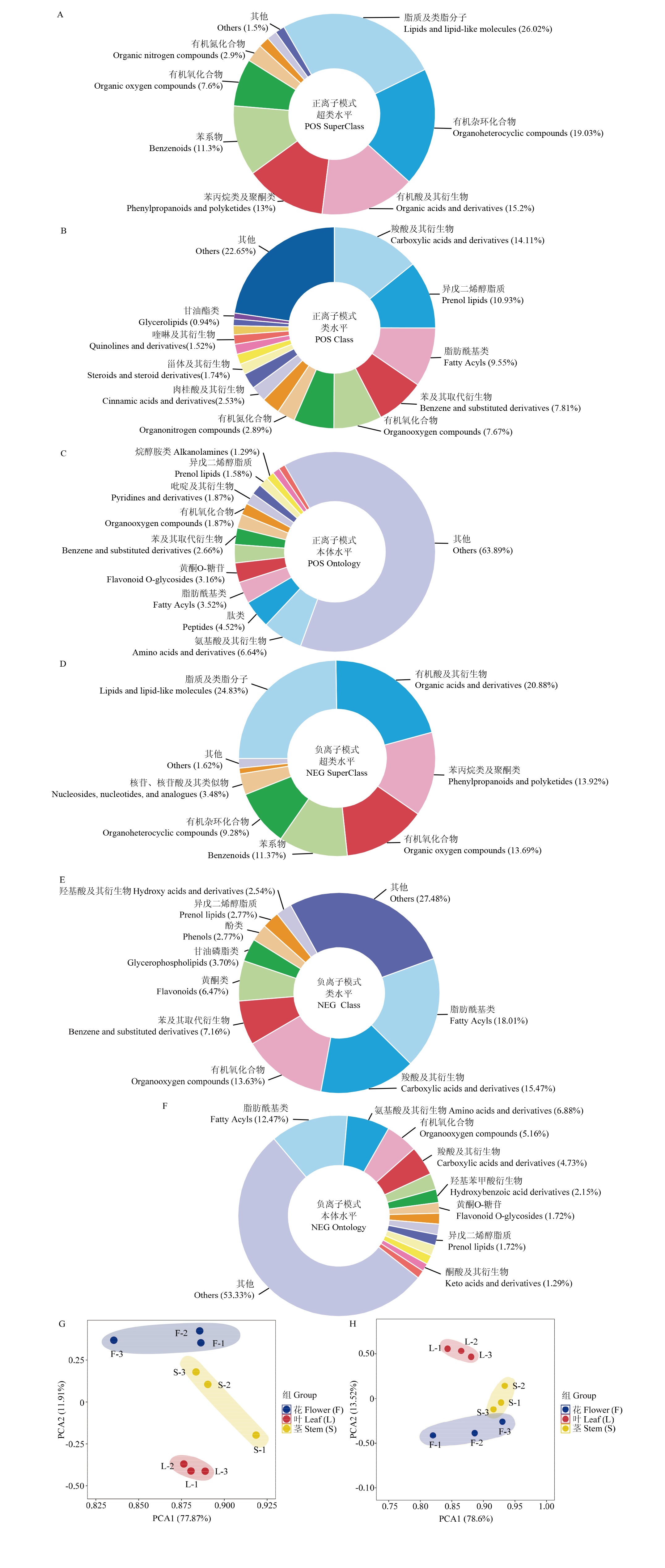
图6
紫皮石斛总代谢物分类及不同部位代谢物的PCA分析 A—C:正离子模式下总代谢物在超类、类、本体水平的组成;D—F:负离子模式下相应分类组成;G—H:茎、叶与花在正、负离子模式下的PCA得分图"

图7
紫皮石斛不同部位差异代谢物的聚类热图及差异代谢物与功能活性指标的相关性热图"
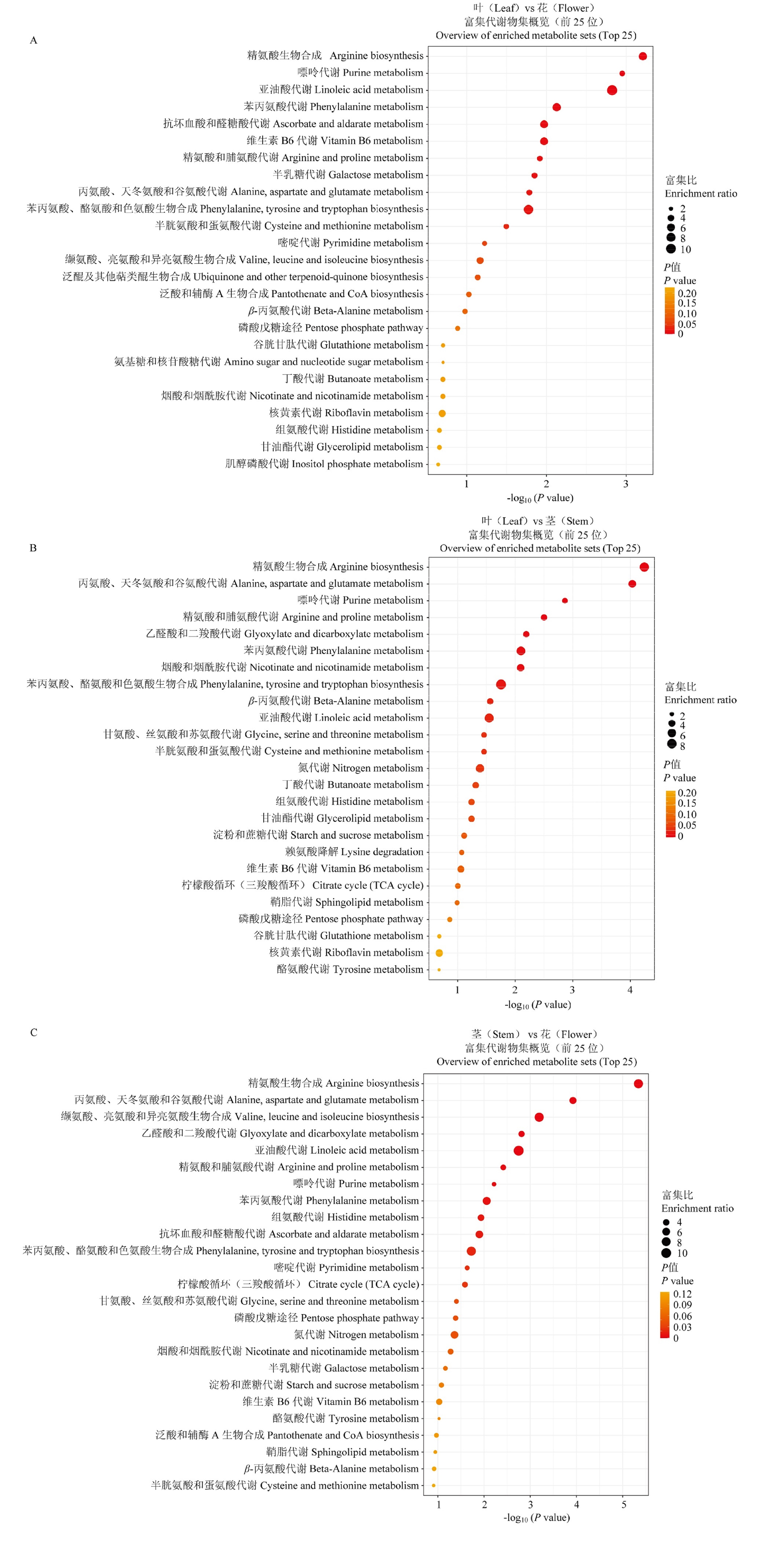
图8
不同部分之间差异代谢物的前20条KEGG富集通路图"
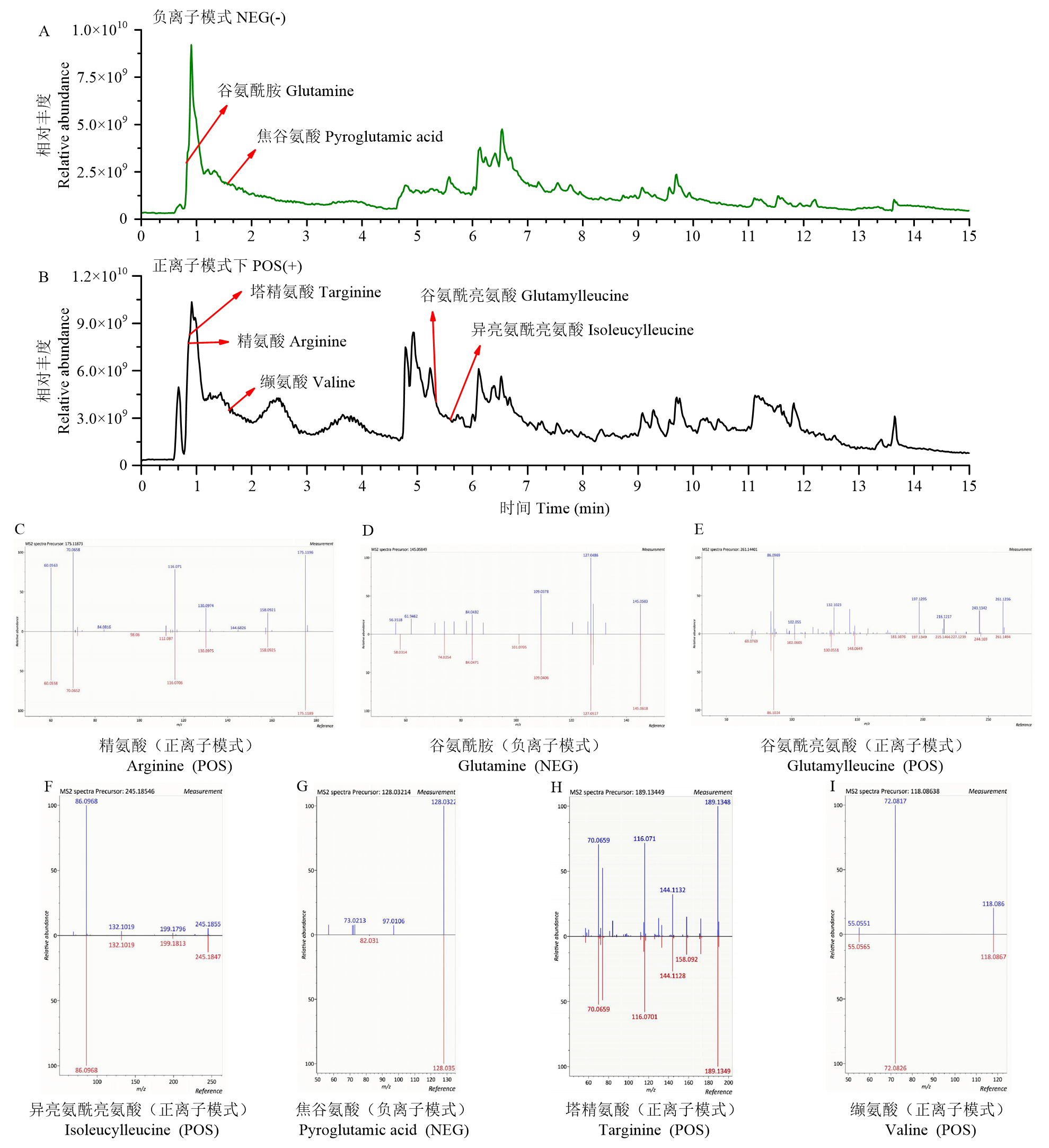
图9
正负离子模式下的总离子图和关键代谢物的二级质谱图"
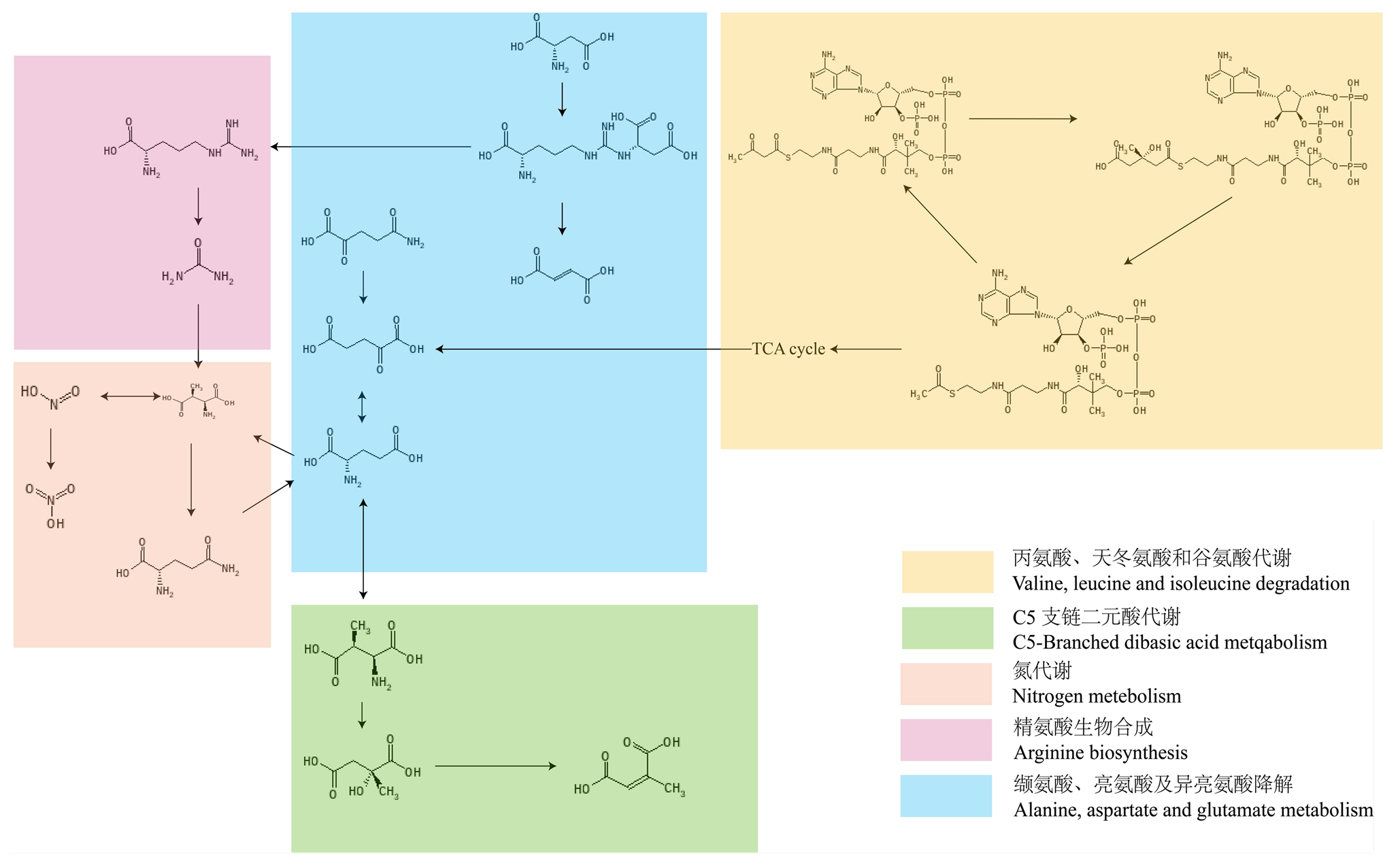
图10
5个主要富集代谢通路中关键代谢物的推测转化关系图"
| [1] |
吴蓓丽, 赵铮蓉, 刘骅, 焦冬, 吴月国. 紫皮石斛研究进展. 中成药, 2020, 42(11): 2990-2998.
|
|
|
|
| [2] |
冉懋雄, 刘家保. 云南龙陵紫皮石斛产业发展的思考与建议. 中国现代中药, 2010, 12(2): 11-13.
|
|
|
|
| [3] |
明兴加, 刘家保, 钟国跃, 伍淳操, 段兴恩, 张明学. 珍稀齿瓣石斛的生物学特性及其野生资源保护. 中国野生植物资源, 2011, 30(6): 24-27, 43.
|
|
|
|
| [4] |
doi: 10.32604/phyton.2025.072062 |
| [5] |
doi: 10.1016/j.jff.2017.04.024 |
| [6] |
严静, 蔡易熹, 陈燕兰, 张慧莹, 杜冰. 铁皮石斛茎、叶、花的活性成分及综合利用研究进展. 食品与发酵工业, 2021, 47(17): 299-306.
doi: 10.13995/j.cnki.11-1802/ts.026336 |
|
|
|
| [7] |
doi: 10.3389/fphar.2021.726528 |
| [8] |
孙苗苗, 丁晴, 李龙囡. 龙陵产紫皮石斛不同加工方式有效成分比较分析. 海峡药学, 2022, 34(2): 42-44.
|
|
|
|
| [9] |
doi: 10.1016/j.jep.2023.116382 |
| [10] |
尚明越, 王嘉乐, 周莹, 张满常, 刘颖琳, 段宝忠. 濒危紫皮石斛叶绿体基因组结构及系统发育分析. 中草药, 2023, 54(19): 6424-6433.
|
|
|
|
| [11] |
董寿堂, 任远, 张旭强, 王怀斌, 鲁静, 胡燕. 紫皮石斛花总黄酮提取工艺优化及抗氧化活性研究. 农产品加工, 2023(9): 27-32, 36.
|
|
|
|
| [12] |
廖娴, 谢镇山, 梁芷韵, 周楚娟, 黄月纯, 魏刚. 齿瓣石斛中5种黄酮苷类成分的含量测定. 中药材, 2018, 41(12): 2863-2865.
|
|
|
|
| [13] |
罗慧, 刘倩葶, 范家坤, 李崇萍, 赵菊润, 赵明. 紫皮石斛花营养成分测定分析. 中国野生植物资源, 2021, 40(9): 18-22.
|
|
|
|
| [14] |
李帆, 金传高, 任仙樱, 费璇, 赵祺, 潘晓军, 吴志刚, 姜程曦. 基于UPLC-MS/MS代谢组学技术分析不同栽培模式下铁皮石斛类黄酮化合物差异性. 中草药, 2022, 53(4): 1156-1162.
|
|
|
|
| [15] |
李芳, 魏云, 陈艳杰. 铁皮石斛茎、叶、花中黄酮含量及其体外抗氧化活性研究. 中医学报, 2019, 34(5): 1020-1023.
|
|
|
|
| [16] |
张望舒, 杨立志, 刘真, 汪庆昊. 基于代谢组学的铁皮石斛生物活性物质比较分析. 广西植物, 2025, 45(10): 1799-1810.
|
|
|
|
| [17] |
doi: 10.3390/separations9050108 |
| [18] |
doi: 10.1016/j.fbio.2025.106714 |
| [19] |
黄秋凌, 雷婷, 何子昕, 宁娜, 陈新阳, 林瑞珍, 党蕾. 苯酚-硫酸法测定消渴丸中多糖含量. 中西医结合研究, 2023, 15(5): 308-310, 327.
|
|
|
|
| [20] |
刘晓海, 茹月蓉, 张雪春, 周旭红, 何霞红, 王振兴. 103种药食两用植物化学成分分析及功能活性评价. 中国食品学报, 2024, 24(8): 385-402.
|
|
|
|
| [21] |
黄鑫, 刘晓海, 张雪春, 王振兴, 孙健, 王希文, 周旭红, 方越. 墨红玫瑰营养和化学成分、体外抗氧化和护肤活性研究. 食品与发酵工业, 2025, 51(4): 205-213.
doi: 10.13995/j.cnki.11-1802/ts.039510 |
|
doi: 10.13995/j.cnki.11-1802/ts.039510 |
|
| [22] |
doi: 10.1155/omcl.v2016.1 |
| [23] |
doi: 10.1016/j.indcrop.2018.08.087 |
| [24] |
doi: 10.3390/molecules15107313 pmid: 20966876 |
| [25] |
doi: 10.1016/j.fbio.2021.101026 |
| [26] |
doi: 10.3389/fnut.2022.1013971 |
| [27] |
doi: 10.1016/j.foodchem.2024.141177 |
| [28] |
杨晓娜, 徐玲, 赵昶灵, 尹卓平. 龙陵紫皮石斛花色苷色素抑菌作用初探. 科学技术与工程, 2015, 15(14): 139-143.
|
|
|
|
| [29] |
|
| [30] |
doi: 10.1016/j.tiv.2022.105393 |
| [31] |
doi: 10.1016/j.jpba.2021.114294 |
| [32] |
doi: 10.1016/j.phytol.2021.10.006 |
| [33] |
doi: S0882-4010(18)30633-8 pmid: 30120992 |
| [34] |
doi: 10.1016/j.lwt.2025.117656 |
| [35] |
谢克英, 娄芳慧, 孙瑞琳, 钱志伟. 桑叶中1-脱氧野尻霉素研究进展. 河南农业, 2021(18): 33-35.
|
|
|
|
| [36] |
徐明月. 外源谷氨酰胺对杨树生长及氮素利用的影响[D]. 南京: 南京林业大学, 2022.
|
|
|
|
| [37] |
昝永锋, 宋科官, 刘玉达. 谷氨酰胺对激素诱导骨微血管内皮细胞凋亡的影响. 中国组织工程研究, 2026, 30(12): 2965-2974.
|
|
|
|
| [38] |
冯颖, 王子鑫, 王卓, 张建伟, 董鑫. 精氨酸修饰壳聚糖用于中药青蒿水提液的分离纯化研究. 现代化工, 2025, 45(11): 148-153.
doi: 10.16606/j.cnki.issn0253-4320.2025.11.026 |
|
doi: 10.16606/j.cnki.issn0253-4320.2025.11.026 |
|
| [39] |
黄彪, 何伟, 吴建鸿, 王红梅, 李巍. UPLC-MS/MS同时测定铁皮石斛茎、叶、花中酚类组分的含量. 食品科学, 2021, 42(10): 262-268.
|
|
|
|
| [40] |
邵尉. 铁皮石斛含量检测及其茎、叶、花多糖和黄酮类成分抗氧化活性研究[D]. 济南: 山东中医药大学, 2018.
|
|
|
|
| [41] |
唐文文, 夏俊丽, 陈垣. 铁皮石斛茎、叶、花功能性成分、抗氧化活性及其相关性. 食品与机械, 2021, 37(7): 45-50.
|
|
|
|
| [42] |
单恬恬, 代钰, 徐筱莹, 王宏勋, 王丽梅. 14种香辛料提取物的多酚、黄酮含量及抗氧化活性比较研究. 中国调味品, 2019, 44(4): 80-83, 88.
|
|
|
|
| [43] |
李彤玉, 余有祥, 闫宇潇, 闫道良. 铁皮石斛不同部位活性成分及加工利用研究进展. 食品与机械, 2025, 41(4): 206-213.
|
|
|
|
| [44] |
梁蓉蓉, 贾振斌, 罗辉, 李文杰, 李宁. DPPH在抗氧化活性评价中的应用. 广东化工, 2014, 41(20): 57-58.
|
|
|
|
| [45] |
赵金荣, 李宝鑫, 薛晓霞, 孙健, 柳嘉欣, 杨书彬. 新型绿色溶剂在中药提取中的应用概述. 药学研究, 2023, 42(2): 130-135.
|
|
|
|
| [46] |
张海燕, 康三江, 袁晶, 苟丽娜, 宋娟. 不同菌种发酵苹果酵素抗氧化性的动态变化及其品质研究. 寒旱农业科学, 2025, 4(6): 555-561.
|
|
|
|
| [47] |
杨婷文. 谷氨酰胺氨基转移酶对水稻生长发育的影响[D]. 南京: 南京农业大学, 2021.
|
|
|
|
| [48] |
孙敏红, 吴炼, 谢深喜. 铵硝营养对枳橙幼苗谷氨酰胺合成酶活性及相关基因表达的影响. 植物生理学报, 2018, 54(11): 1703-1710.
|
|
|
|
| [49] |
廖承锐. 速生桉纯林及其与豆科树种混交林土壤酚酸物质的积累机制[D]. 南宁: 广西大学, 2014.
|
|
|
|
| [50] |
韦开萍, 杨茜, 和润喜, 段成波, 石卓功, 蒙进芳. 腾冲红花油茶花芽分化及雌配子体发育的形态学观察. 经济林研究, 2023, 41(3): 244-251.
|
|
|
|
| [51] |
李菲, 齐红, 杜德峰, 陈明月, 张超. 不同采收时间蒺藜果、茎、叶活性成分分析与评价. 山东中医药大学学报, 2025, 49(5): 643-655, 677.
|
|
|
|
| [52] |
钟雪松. 基于UPLC-Q-TOF-MS分析桑葚发酵过程黄酮和酚类成分变化及其抗氧化作用机制[D]. 沈阳: 沈阳农业大学, 2025.
|
|
|
|
| [53] |
蔡欣茹, 杨一山, 邹蓉, 唐健民, 蒋运生, 丁涛, 韦霄. 药用植物合柱金莲木不同部位化学成分及生理活性物质分析. 广西科学院学报, 2025, 41(3): 354-362.
|
|
|
| [1] | 罗朝丹, 冯春梅, 李建强, 黎新荣, 韦勇, 杨李益, 刘筱瑾, 谭和, 任二芳, 罗小杰. 基于GC-MS非靶向代谢组学分析不同成熟度‘台农一号’芒果香气物质[J]. 中国农业科学, 2025, 58(3): 564-581. |
| [2] | 罗钦, 陈谢勇, 徐玉英, 韦航, 黄彪, 姚清华, 叶乃兴, 郑德勇, 颜明娟. 基于非挥发性代谢物特征的福安大白茶产地溯源[J]. 中国农业科学, 2025, 58(22): 4757-4770. |
| [3] | 罗自舒, 张怡嘉, 周瑢, 张艳欣, 周婷, 游均, 王林海. 芝麻叶片抗氧化活性的特征及优异抗氧化种质的筛选[J]. 中国农业科学, 2025, 58(19): 3814-3824. |
| [4] | 余静, 朱大伟, 郑欣, 徐清宇, 董会颖, 陈铭学, 邵雅芳. 糙米淀粉消化特征及降糖活性[J]. 中国农业科学, 2025, 58(12): 2439-2452. |
| [5] | 马雨禾, 蒲媛媛, 王晋雄, 武军艳, 杨刚, 赵彩霞, 马骊, 刘丽君, 王旺田, 缪纯庆, 关周博, 范婷婷, 王兴荣, 马蕊, 廉荫涛, 孙万仓. 白菜型油菜硫苷含量与组分分析[J]. 中国农业科学, 2024, 57(21): 4308-4327. |
| [6] | 吴思惠, 朱欢欢, 张俊卫, 包满珠, 张杰. 梅花不同花色品种及开花阶段类黄酮代谢物测定与分析[J]. 中国农业科学, 2023, 56(9): 1760-1774. |
| [7] | 闫乐乐,卜璐璐,牛良,曾文芳,鲁振华,崔国朝,苗玉乐,潘磊,王志强. 广泛靶向代谢组学解析桃蚜危害对桃树次生代谢产物的影响[J]. 中国农业科学, 2022, 55(6): 1149-1158. |
| [8] | 韩晓, 杨航宇, 陈为凯, 王军, 何非. 不同砧木对欧亚种葡萄‘丹娜’果实类黄酮物质的影响[J]. 中国农业科学, 2022, 55(10): 2013-2025. |
| [9] | 白雪,惠腾,王振宇,曹云刚,张德权. 高效液相色谱-荧光检测法检测烤肉制品中5种硝基多环芳烃[J]. 中国农业科学, 2021, 54(5): 1055-1062. |
| [10] | 侯成立,黄彩燕,郑晓春,刘维华,杨奇,张德权. 宰后不同时间滩羊肉抗氧化活性的变化及可能机制[J]. 中国农业科学, 2021, 54(23): 5110-5124. |
| [11] | 赵珊,仲伶俐,秦琳,黄世群,李曦,郑幸果,雷欣宇,雷绍荣,郭灵安,冯俊彦. 不同干燥方式对甘薯叶功能成分及抗氧化活性的影响[J]. 中国农业科学, 2021, 54(21): 4650-4663. |
| [12] | 赵珊,仲伶俐,周虹,李曦,雷欣宇,黄世群,郑幸果,冯俊彦,雷绍荣,郭灵安. 超高效液相色谱-串联质谱法鉴定和分析稻米中 酚酸类化合物的组成及分布[J]. 中国农业科学, 2020, 53(3): 612-631. |
| [13] | 李杰,贾栩超,张瑞芬,刘磊,池建伟,黄菲,董丽红,张名位. 黑芝麻黑色素的分离纯化、结构表征及体外抗氧化活性[J]. 中国农业科学, 2020, 53(12): 2477-2492. |
| [14] | 马雯,刘娇,张学尧,申国华,秦雪梅,张建琴. 飞蝗LmGSTS2的酶学特性及其对马拉硫磷、 p,p’-DDT的代谢分析[J]. 中国农业科学, 2019, 52(8): 1389-1399. |
| [15] | 于静,张卫星,马兰婷,胥保华. 饲粮α-亚麻酸水平对意大利蜜蜂工蜂幼虫生理机能的影响[J]. 中国农业科学, 2019, 52(13): 2368-2378. |
|
||
