






中国农业科学 ›› 2026, Vol. 59 ›› Issue (8): 1748-1759.doi: 10.3864/j.issn.0578-1752.2026.08.011
管书萍1( ), 李可1(), 解凯东1, 段耀园1, 王婷婷1, 周志虎2, 伍小萌1, 郭文武1()
收稿日期:2025-11-19
接受日期:2026-01-14
出版日期:2026-04-21
发布日期:2026-04-21
通信作者:
联系方式:
管书萍,E-mail:gsp954@126.com。李可,E-mail:3157659021@qq.com。管书萍和李可为同等贡献作者。
基金资助:
GUAN ShuPing1(), LI Ke1(), XIE KaiDong1, DUAN YaoYuan1, WANG TingTing1, ZHOU ZhiHu2, WU XiaoMeng1, GUO WenWu1()
Received:2025-11-19
Accepted:2026-01-14
Published:2026-04-21
Online:2026-04-21
摘要:
【目的】以原生质体融合技术创制的‘温州蜜柑+桃叶橙’胞质杂种(G1+TYC)及其叶肉亲本桃叶橙(TYC)为材料,探究G1+TYC果实增大的生理原因并鉴定关键基因,为柑橘果实大小的分子机理研究提供理论依据。【方法】以G1+TYC和TYC不同发育时期的子房或果肉为材料,通过对不同发育时期(包括成熟期)果实大小、果实糖酸与内源激素含量测定,以及转录组分析,明确G1+TYC果实增大的生理原因,并挖掘控制果实大小的关键基因。【结果】果实大小动态监测结果显示,G1+TYC果实横径和纵径分别于花后75和105 d时显著大于TYC,差异持续至果实成熟(花后240 d)。以2022年数据为例,花后240 d时,G1+TYC的果实横径、纵径分别为79.14和66.75 mm,而同期TYC的果实横径、纵径仅为56.02和53.20 mm,直观反映G1+TYC果实相较于TYC显著增大。G1+TYC成熟果实单果质量、囊瓣宽度、单汁胞重量和面积显著大于TYC,表明汁胞体积增大引起囊瓣宽度增加,是导致G1+TYC体积增大的原因。糖酸含量测定表明,花后90—240 d,G1+TYC果肉中果糖、葡萄糖、蔗糖含量均显著高于TYC,而柠檬酸和总酸含量则显著低于TYC,奎宁酸和苹果酸含量差异无明显规律。内源激素含量测定表明,花后30—60 d,G1+TYC果肉中吲哚-3-乙酸(IAA)含量显著高于TYC,赤霉酸(GA3)含量仅在花后0 d显著高于桃叶橙,玉米素(ZT)含量两年间重复性差,脱落酸(ABA)含量在花后90 d迅速增加,且G1+TYC果肉ABA含量在花后180 d显著高于TYC。结合转录组数据和GO功能富集分析,筛选出5个与IAA代谢相关的基因,在G1+TYC和TYC花后30—60 d果肉中差异表达,可能是决定G1+TYC果实增大的关键候选基因。【结论】明确了汁胞体积增大和果实发育早期果肉中IAA含量升高与G1+TYC果实增大密切相关,基于转录组分析发掘了G1+TYC果实增大相关候选基因。
管书萍, 李可, 解凯东, 段耀园, 王婷婷, 周志虎, 伍小萌, 郭文武. ‘温州蜜柑+桃叶橙’胞质杂种果实增大的生理基础及相关基因发掘[J]. 中国农业科学, 2026, 59(8): 1748-1759.
GUAN ShuPing, LI Ke, XIE KaiDong, DUAN YaoYuan, WANG TingTing, ZHOU ZhiHu, WU XiaoMeng, GUO WenWu. Physiological Mechanism and Relevant Gene Identification for Fruit Enlargement in Satsuma mandarin+Taoye sweet orange Somatic Cybrid[J]. Scientia Agricultura Sinica, 2026, 59(8): 1748-1759.
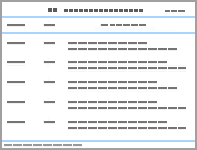
表1
不同植物内源激素的质谱参数"
| 激素种类 Hormones type | 保留时间 Retention time (min) | 母离子 Parent ions (m·z-1) | 子离子 Sub ion(m·z-1) | 离子模式 Ionic mode |
|---|---|---|---|---|
| 吲哚-3-乙酸 IAA | 8.6 | 174 | 128 | 负离子Negative |
| 赤霉素 GA3 | 7.7 | 345 | 239 | 负离子Negative |
| 玉米素 Zeatin | 4.8 | 220 | 136 | 正离子Positive |
| 脱落酸 ABA | 8.9 | 263 | 153 | 负离子Negative |
表2
引物序列"
| 引物名称 Primer name | 正向引物 Forward primer (5′-3′) | 反向引物 Reverse primer (5′-3′) | |
|---|---|---|---|
| 核基因组引物 Nuclear genome primer | TAA15 | GAAAGGGTTACTTGACCAGGC | CTTCCCAGCTGCACAAGC |
| 线粒体基因组引物 Mitochondrial genome primer | G1 | ACGCTTTGGTTAGGCTTGG | GGCTCGAATGCCTTTACG |
| HB | CCCGCCCTTAGGAGATTG | TCCCTCGGACTCGGAAAG | |
| 叶绿体基因组引物 Chloroplast genome primer | M | ACTCGATATTTCAACCCATCC | CACAATTCCGATCCAGAGC |
| NTCP9 | CTTCCAAGCTAACGATGC | CTGTCCTATCCATTAGACAATG | |
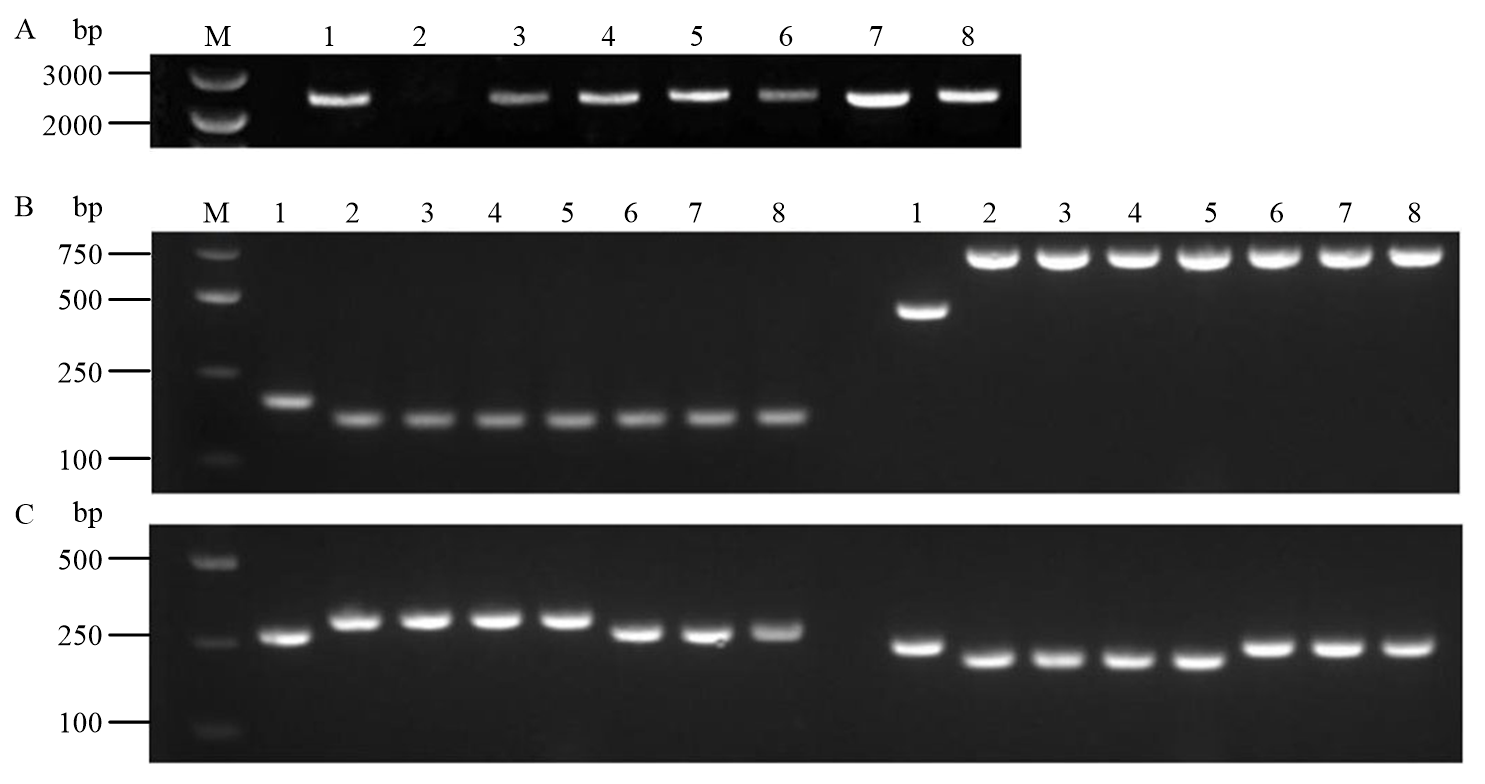
图1
‘温州蜜柑+桃叶橙’胞质杂种(G1+TYC)细胞核与细胞质基因组遗传来源鉴定 A:细胞核基因组(TAA15);B:线粒体基因组(左:G1,右:HB);C:叶绿体基因组(左:M,右:NTCP9)。M:DNA marker;1:‘桃叶橙’;2:‘国庆1号’温州蜜柑;3—8:‘温州蜜柑+桃叶橙’胞质杂种"
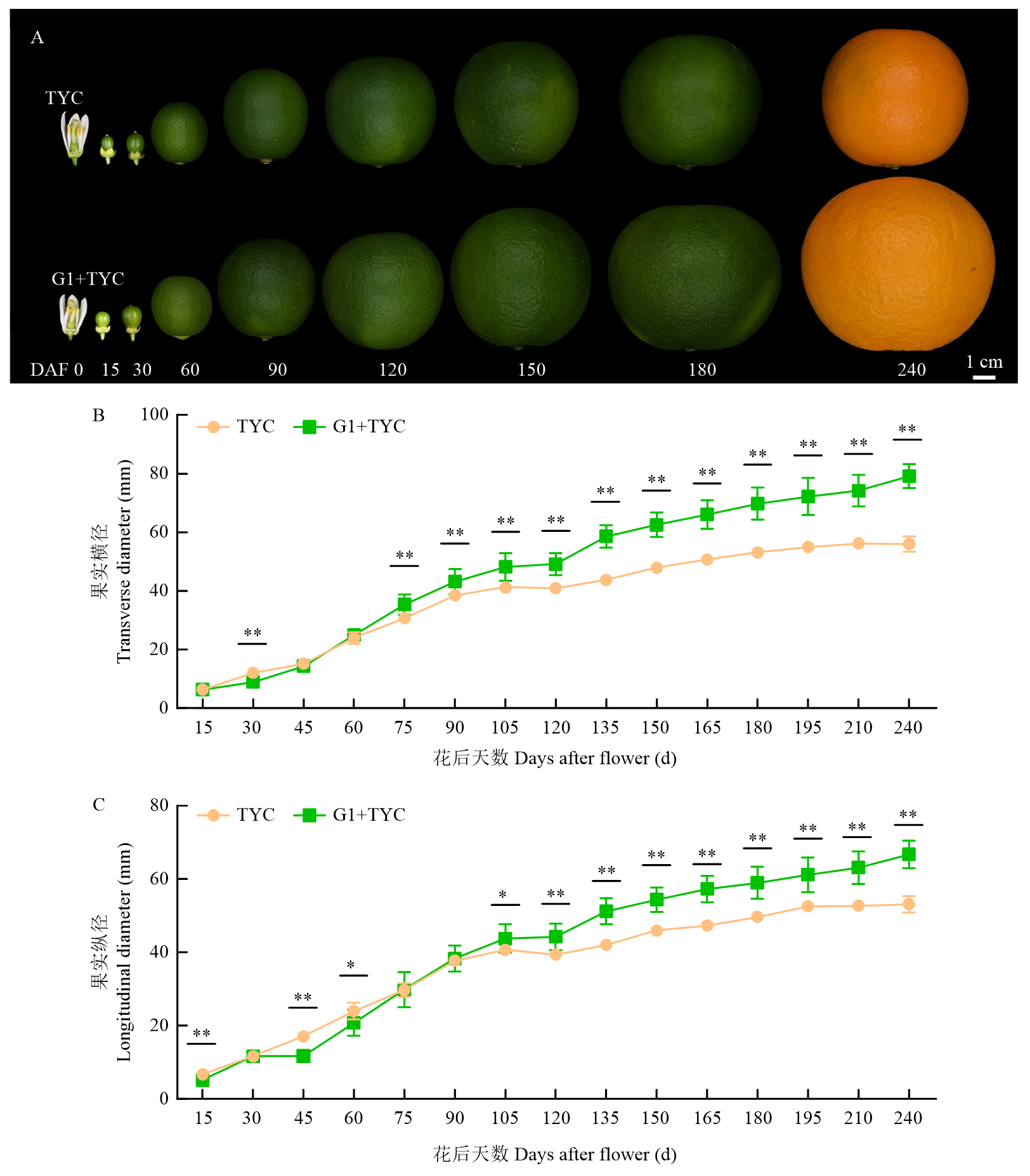
图2
‘温州蜜柑+桃叶橙’胞质杂种(G1+TYC)和‘桃叶橙’(TYC)不同发育时期果实及其生长曲线 A:G1+TYC和TYC不同发育时期(花后15—240 d)果实;B:G1+TYC和TYC果实横径生长曲线;C:G1+TYC和TYC果实纵径生长曲线。DAF:花后天数。*和**分别表示在P<0.05和P<0.01水平差异显著。下同"
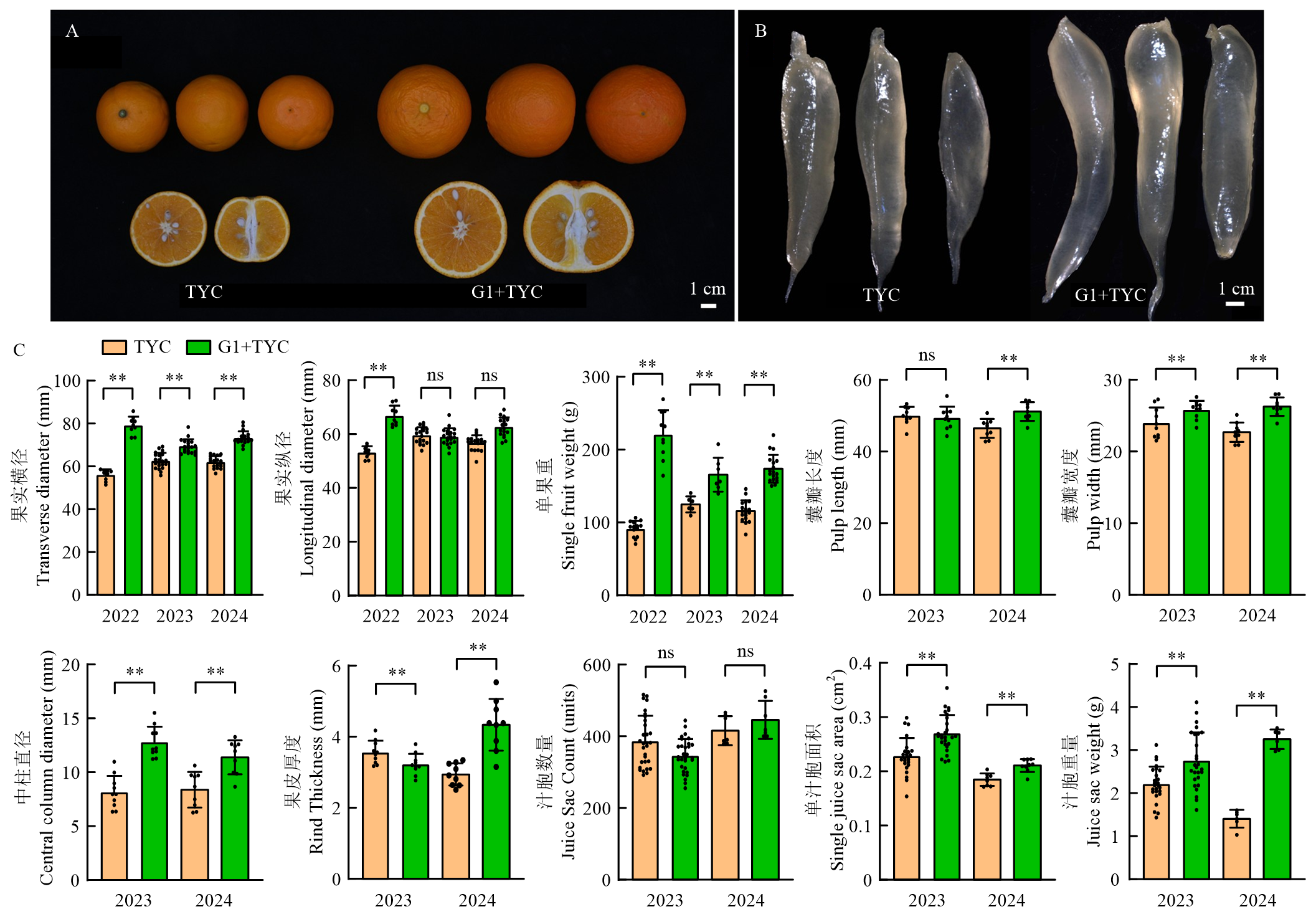
图3
‘温州蜜柑+桃叶橙’胞质杂种(G1+TYC)和‘桃叶橙’(TYC)果实大小及果实各组织表型统计 A:G1+TYC和TYC成熟期果实对比;B:G1+TYC和TYC成熟汁胞对比;C:G1+TYC和TYC果实其他表型统计"
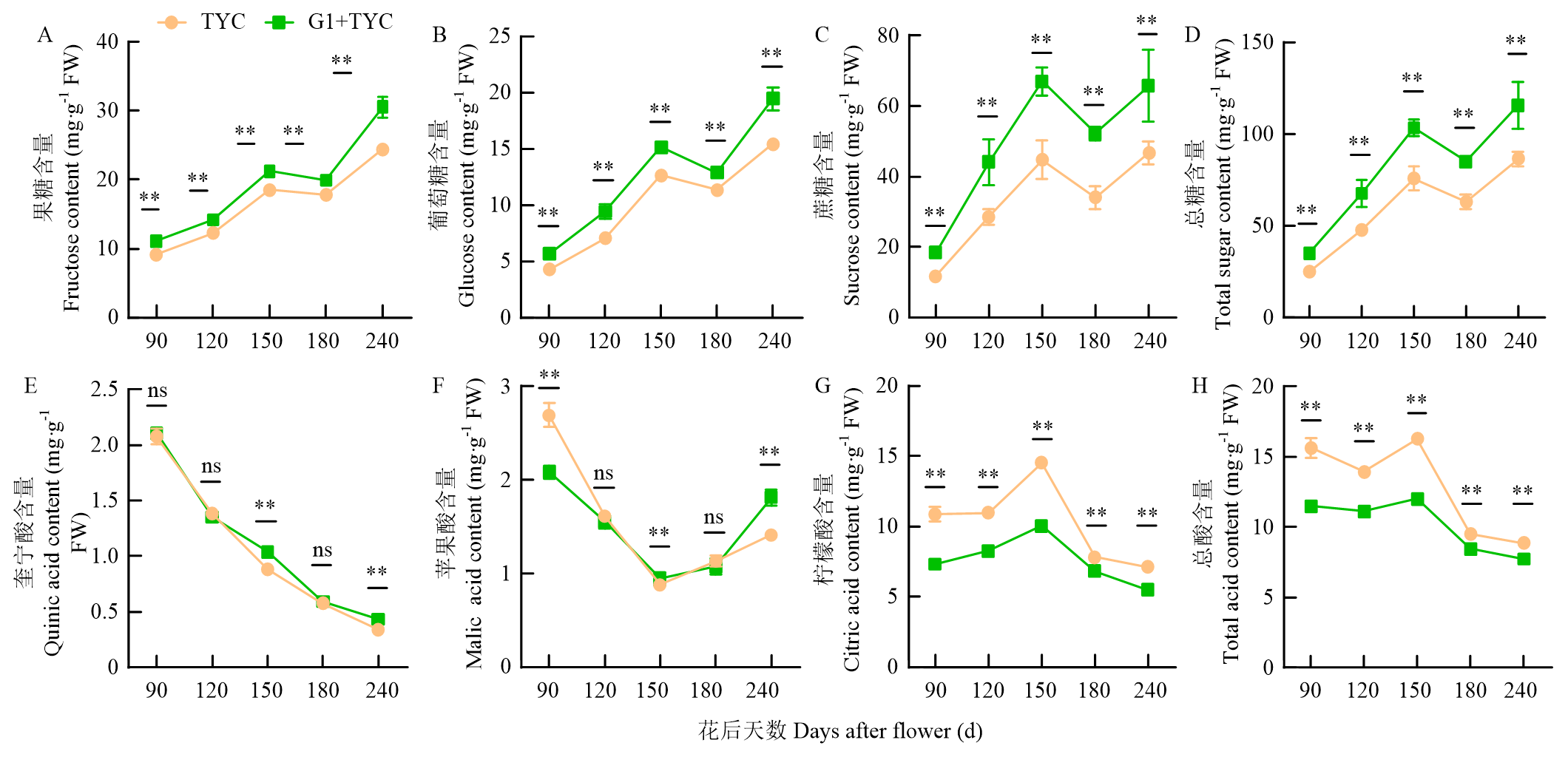
图4
2023年‘温州蜜柑+桃叶橙’胞质杂种(G1+TYC)和‘桃叶橙’(TYC)果肉不同发育时期可溶性糖与有机酸含量统计"
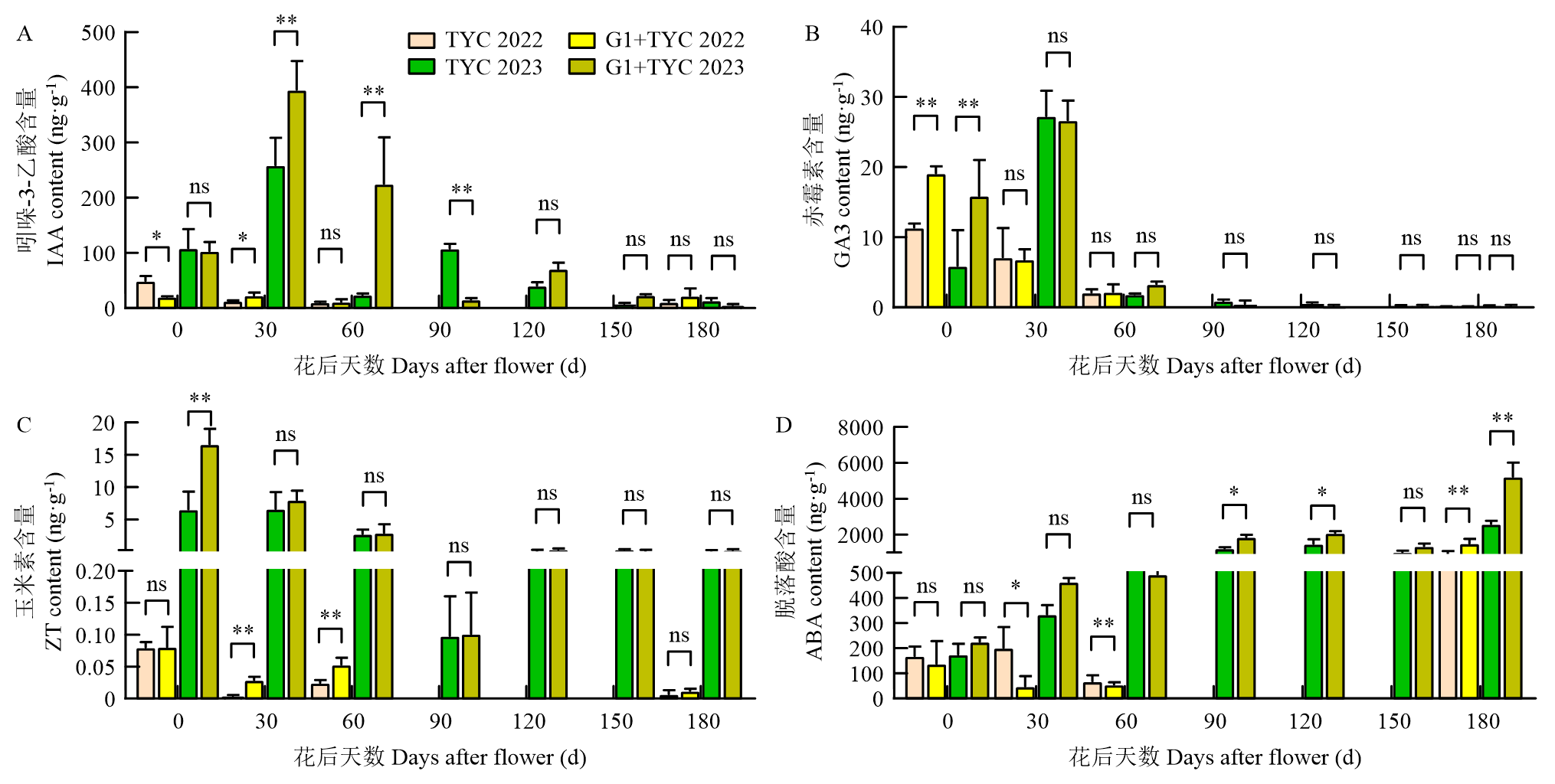
图5
2022和2023年‘温州蜜柑+桃叶橙’胞质杂种(G1+TYC)和‘桃叶橙’(TYC)果肉激素含量测定"
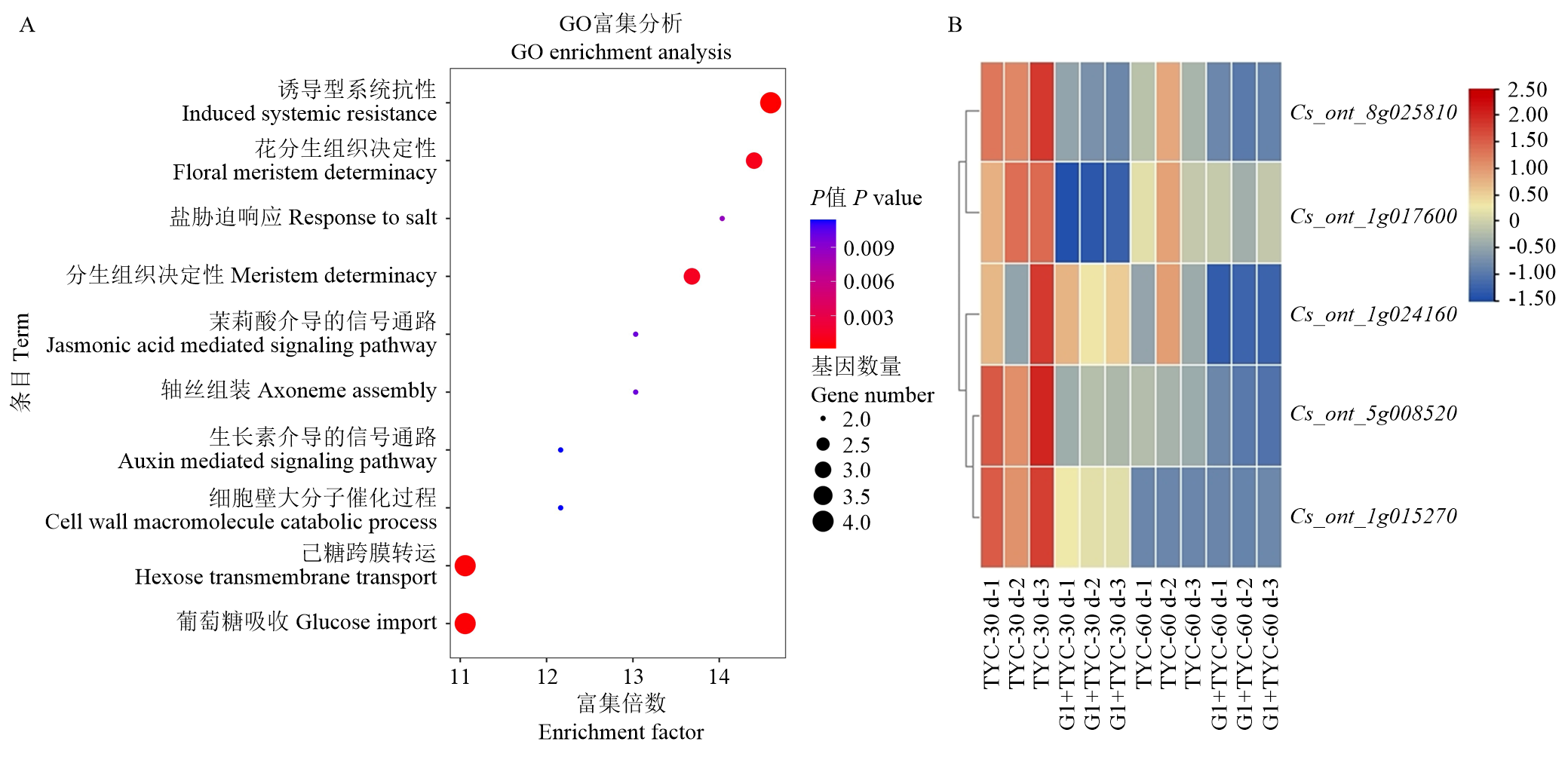
图6
‘温州蜜柑+桃叶橙’胞质杂种(G1+TYC)和‘桃叶橙’(TYC)差异基因通路富集分析与候选基因鉴定 A:G1+TYC和TYC花后60 d差异基因通路富集分析;B:5个IAA通路差异表达基因在G1+TYC和TYC花后30和60 d果肉中的TPM值聚类热图"
| [1] |
郭文武, 叶俊丽, 邓秀新. 新中国果树科学研究70年: 柑橘. 果树学报, 2019, 36(10): 1264-1272.
|
|
|
|
| [2] |
doi: 10.1080/07352689.2017.1402850 |
| [3] |
doi: 10.1016/j.xplc.2020.100138 |
| [4] |
doi: 10.1016/j.scienta.2018.07.015 |
| [5] |
鲍江峰, 夏仁学, 彭抒昂. 生态因子对柑桔果实品质的影响. 应用生态学报, 2004, 15(8): 1477-1480.
|
|
|
|
| [6] |
李杰, 罗奕, 张琪悦, 潘腾飞, 于远, 佘文琴, 潘东明, 潘鹤立. 调控果实大小相关基因的研究进展. 福建农业科技, 2023, 54(5): 28-36.
|
|
|
|
| [7] |
黄礼森, 李树玲, 丛佩华. 梨多倍体与二倍体性状比较. 中国果树, 1990(3): 30-31, 20.
|
|
|
|
| [8] |
doi: 10.1007/s00122-012-1832-8 pmid: 22406954 |
| [9] |
doi: 10.1126/science.289.5476.85 pmid: 10884229 |
| [10] |
韩洪强. 控制茄子果型相关性状关键基因的克隆及功能研究[D]. 上海: 上海交通大学, 2014.
|
|
|
|
| [11] |
罗艾, 龚桂芝, 彭祝春, 杨程, 常珍珍, 洪棋斌. 柑橘果实大小与质量的遗传分析和数量性状位点定位. 浙江大学学报(农业与生命科学版), 2021, 47(6): 719-728.
|
|
|
|
| [12] |
doi: 10.1093/plphys/kiad592 |
| [13] |
肖诗鑫. 柑橘胞质杂种创制及原生质体再生过程的细胞学研究[D]. 武汉: 华中农业大学, 2014,
|
|
|
|
| [14] |
管书萍, 王婷婷, 周阳广, 朱虹娴, 伍小萌, 龙春瑞, 高俊燕, 郭文武, 解凯东. 柑橘2个三倍体有性后代群体果实品质性状的遗传特点. 果树学报, 2024, 41(3): 369-378.
|
|
|
|
| [15] |
王婷婷, 周阳广, 朱虹娴, 张苗, 段耀园, 曹惠祥, 管书萍, 解凯东, 伍小萌, 龙春瑞, 等. 2个柑橘三倍体有性群体果实糖酸性状遗传评价. 果树学报, 2022, 39(7): 1147-1156.
|
|
|
|
| [16] |
doi: 10.1038/nprot.2010.37 pmid: 20448544 |
| [17] |
doi: 10.1007/BF02774246 |
| [18] |
doi: 10.1007/s001220050468 |
| [19] |
李超超. 基于柑橘核质基因组演化揭示雄性不育遗传基础[D]. 武汉: 华中农业大学, 2023.
|
|
|
|
| [20] |
doi: 10.1007/s001220051306 |
| [21] |
谢善鹏, 解凯东, 夏强明, 周锐, 张成磊, 郑浩, 伍小萌, 郭文武. 柑橘6个地方品种资源四倍体高效发掘及分子鉴定. 果树学报, 2022, 39(1): 1-9.
|
|
|
|
| [22] |
doi: 10.1093/bioinformatics/btu170 pmid: 24695404 |
| [23] |
doi: 10.1038/nmeth.3317 pmid: 25751142 |
| [24] |
doi: 10.1038/nbt.3122 pmid: 25690850 |
| [25] |
|
| [26] |
doi: 10.1016/j.scienta.2024.113624 |
| [27] |
doi: 10.21273/JASHS.132.5.697 |
| [28] |
doi: 10.1371/journal.pgen.1006930 |
| [29] |
doi: 10.1093/jxb/erq134 |
| [30] |
|
| [31] |
doi: 10.1111/nph.v243.5 |
| [32] |
doi: 10.1111/nph.12176 pmid: 23425297 |
| [33] |
doi: 10.1016/j.plantsci.2020.110544 |
| [34] |
|
| [35] |
doi: 10.1093/oxfordjournals.pcp.a079236 |
| [36] |
doi: 10.1104/pp.84.2.491 |
| [37] |
|
| [38] |
doi: 10.1038/s41598-019-55400-7 |
| [39] |
doi: 10.1105/tpc.104.026690 |
| [40] |
|
| [41] |
doi: 10.1046/j.1365-313X.2003.01973.x |
| [42] |
|
| [1] | 郝琨, 陈洪德, 张威, 钟韵, 党美荣, 朱士江, 黄志坤, 金英. 基于柑橘产量、品质及水氮利用的涌泉根灌水氮综合评价[J]. 中国农业科学, 2026, 59(4): 862-873. |
| [2] | 申丽琼, 何林丽, 刘倪, 陆俊杏, 朱波, 张涛. 钾营养水平对油菜苗期抗湿害能力及内源激素平衡的影响[J]. 中国农业科学, 2026, 59(3): 528-542. |
| [3] | 王忠妮, 雷月, 李佳丽, 宫彦龙, 朱速松. ABC转运蛋白OsARG1调控水稻抽穗期的功能[J]. 中国农业科学, 2026, 59(1): 1-16. |
| [4] | 王思琪, 邹利人, 白瑞雯, 闫可, 王思洋, 齐晓光, 申海林, 温景辉. 赤霉素调控‘蜜汁’葡萄穗轴硬化关键基因的挖掘[J]. 中国农业科学, 2026, 59(1): 179-189. |
| [5] | 张义茹, 韩雪, 姚鑫杰, 冯军, 魏爱丽, 李文超, 张彬, 韩渊怀, 李红英. 基于多组学解析谷子后熟米色变化的分子机制[J]. 中国农业科学, 2025, 58(9): 1702-1718. |
| [6] | 刘婕, 侯瑞, 周泽华, 易图永. 聚六亚甲基胍对柑橘溃疡病菌的抑菌活性[J]. 中国农业科学, 2025, 58(9): 1779-1790. |
| [7] | 赵宇萱, 苗纪元, 胡伟, 周治国. 苗期低温对棉花花芽分化和棉株产量的影响[J]. 中国农业科学, 2025, 58(7): 1311-1320. |
| [8] | 邹晓威, 夏蕾, 朱晓敏, 孙辉, 周琦, 齐霁, 张亚封, 郑岩, 姜兆远. 基于转录组测序的玉米瘤黑粉菌UM01240过表达菌株诱导玉米抗病性分析[J]. 中国农业科学, 2025, 58(6): 1116-1130. |
| [9] | 孙萍, 朱文灿, 林贤锐, 吴嘉颀, 曹译文, 陈辰斐, 王轶, 朱建锡, 贾惠娟, 钱敏杰, 沈建生. 基于代谢组和转录组解析多雨寡照对桃果皮着色和类黄酮积累的影响[J]. 中国农业科学, 2025, 58(6): 1173-1194. |
| [10] | 谢露露, 李福, 张思远, 高建昌. 基于跨物种转录组解析影响不定根发生的保守基因[J]. 中国农业科学, 2025, 58(6): 1195-1209. |
| [11] | 高岩浩, 王婷婷, 白卫卫, 杜兴杰, 刘贤, 秦本源, 付彤, 孙宇, 高腾云, 张天留. 脂质组与转录组联合揭示南阳牛不同肌肉组织脂质特征的差异表达模式[J]. 中国农业科学, 2025, 58(6): 1239-1258. |
| [12] | 姚莉, 邓春秀, 唐彪, 王宏, 吴月颖, 张奇, 李源洪, 刘忠友, 卢昌艾, 林超文. 基于最大熵模型(MaxEnt)和地理信息系统(GIS)的四川省眉山市东坡区晚熟柑橘适宜性评价[J]. 中国农业科学, 2025, 58(4): 748-758. |
| [13] | 覃璐, 谌丹丹, 江晓丽, 谢合平, 敖义俊, 杨阳, 朱峰, 许让伟, 廖文月, 程运江. 水分状态对连阴雨天气采收柑橘果实贮藏性能的影响[J]. 中国农业科学, 2025, 58(24): 5259-5273. |
| [14] | 王凡, 刘陈玮, 陆红臣, 徐仁超, 卞晓春. 蚕豆响应交链格孢侵染的转录组分析及VfPR4的抗病功能验证[J]. 中国农业科学, 2025, 58(22): 4656-4672. |
| [15] | 穆赢通, 路景诗, 张雨桐, 石凤翎. 基于转录组和WGCNA的直立型花苜蓿抗旱关键基因识别[J]. 中国农业科学, 2025, 58(21): 4528-4543. |
|
||
