






中国农业科学 ›› 2026, Vol. 59 ›› Issue (3): 619-636.doi: 10.3864/j.issn.0578-1752.2026.03.011
孙亚玲1( ), 王清华1, 舒锐1, 岳丽昕1, 王振宝1, 李朝霞1, 高莉敏1, 程鸿2, 付在秋1(), 霍雨猛1()
收稿日期:2025-06-22
接受日期:2025-08-18
出版日期:2026-02-01
发布日期:2026-01-31
通信作者:
联系方式:
孙亚玲,Tel:0531-66659215;E-mail:ylsun2022@163.com。
基金资助:
SUN YaLing1(), WANG QingHua1, SHU Rui1, YUE LiXin1, WANG ZhenBao1, LI ZhaoXia1, GAO LiMin1, CHENG Hong2, FU ZaiQiu1(), HUO YuMeng1()
Received:2025-06-22
Accepted:2025-08-18
Published:2026-02-01
Online:2026-01-31
摘要:
【目的】通过远缘杂交获得大葱与青甘韭的种间杂交种,分析杂交种的植物学特征,为葱属野生资源高效利用提供参考。【方法】以章丘大梧桐大葱和青甘韭为试材,对两亲本进行开花诱导和正反杂交,利用子房培养获得杂交种F1植株;利用叶绿体基因组测序、流式细胞仪检测、核型分析、ITS分析和表型特征鉴定杂交种F1的真伪;在苗期、营养生长期和抽薹开花期观察杂交种的植物学特征;调查花粉有无和自交鉴定分析杂交种植株的育性;通过感官评价分析产品的颜色、质地和味道,进而评估其作为一种新兴蔬菜的潜力;利用广泛靶向代谢组学分析杂交种与亲本的差异代谢物。【结果】大葱与青甘韭正反交成苗差异明显,正交组合子房正常膨大,反交组合子房不膨大,并萎蔫变干。正交组合授粉10 d后,子房停止膨大,逐渐变为灰白色,质地松软,干瘪死亡,而通过子房培养后获得F1杂交种36株,产芽率为46.25%,成苗率为22.50%。杂交种F1-16叶绿体基因组序列与母本大葱一致,为母性遗传,染色体荧光强度峰值位于两亲本之间,为32.90×10⁵,染色体核型公式为2n=2x=16=16m(1SAT),属于1A型。ITS序列单倍型包含2种,分别与两亲本相同。开发了一个分子标记MAPI_1,检测结果显示,母本大葱仅有一条带,为124 bp,父本青甘韭仅有一条带,为289 bp,36株杂交种F1均扩增出上述2条带。F1杂交种植株具有明显的杂种优势,特别是分蘖数,平均为17.50个,且单分蘖群生物学产量为387.52 g,显著高于双亲。F1杂交种均无花粉,表现为雄性不育,但可通过分蘖和气生鳞芽繁殖。代谢组分析检测两亲本及杂交种F1-16代谢物共1 208种,F1-16与两亲本均存在显著差异的代谢物153种,其中,比两亲本均上调代谢物97种,均下调代谢物56种,且产生新代谢物1种,为根皮苷(phloretin-2'-O-glucoside (phlorizin)),具有极高的医疗保健价值。【结论】利用子房培养技术获得章丘大梧桐大葱与青甘韭的种间杂交种F1,F1表现出明显的杂种优势——雄性不育;设计验证了一种鉴定远缘杂交种的分子标记开发方法。
孙亚玲, 王清华, 舒锐, 岳丽昕, 王振宝, 李朝霞, 高莉敏, 程鸿, 付在秋, 霍雨猛. 大葱和青甘韭种间杂种的获得及其特性[J]. 中国农业科学, 2026, 59(3): 619-636.
SUN YaLing, WANG QingHua, SHU Rui, YUE LiXin, WANG ZhenBao, LI ZhaoXia, GAO LiMin, CHENG Hong, FU ZaiQiu, HUO YuMeng. Production and Characterization of Interspecific Hybrids Between Allium fistulosum and Allium przewalskianum Regel[J]. Scientia Agricultura Sinica, 2026, 59(3): 619-636.
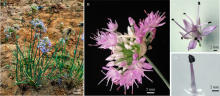
图1
野生种青甘韭(ys)的形态特征 A:植株;B:花序;C:小花;D:花药"
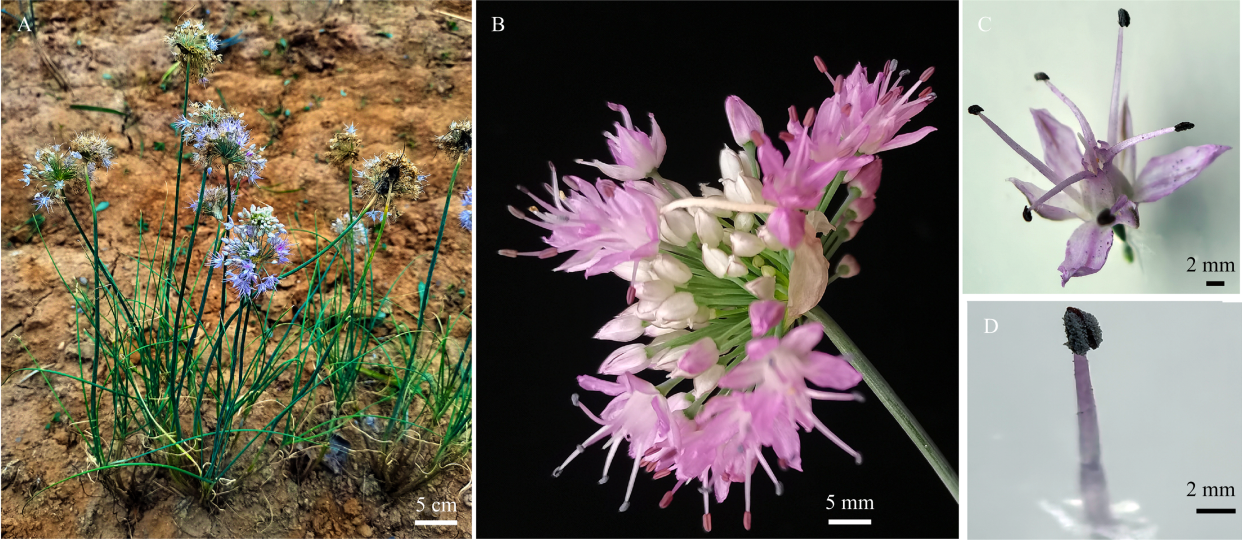
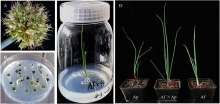
图2
大葱×青甘韭F1植株子房培养及杂交种苗 A:授粉后的子房,箭头所示为干瘪的子房;B:子房培养及发芽;C:F1植株及生根培养;D:亲本及F1杂交种苗(Ap=A. przewalskianum;Af=A. fistulosum),箭头所示为紫红色假茎。下同"

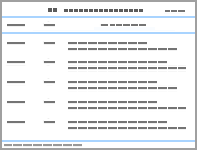
表1
子房诱导培养和胚的萌发"
| 种间杂交 Interspecific combination (♀×♂) | 接种子房数 No. of ovary culture | 成芽数 No. of embryo germinated | 成苗数 No. of developed plants | 成苗率 Rate of developed plants (%) |
|---|---|---|---|---|
| Af×Ap | 160 | 74 | 36 | 22.50 |
| Ap×Af | 100 | 0 | 0 | 0 |
表2
大葱、青甘韭及F1-16叶绿体基因组及ITS的统计信息"
| 样本 Sample | Reads总数 Total number of reads | 碱基总数 Total number of bases | 叶绿体基因组 Chloroplast genome size | ITS单倍型数目 No. of ITS haploid genotype | ITS单倍型 ITS haploid genotype |
|---|---|---|---|---|---|
| Ap | 39989800 | 5998470000 | 153479 | 1 | Ap |
| Af | 8255274 | 1238291100 | 153162 | 1 | Af |
| F1-16 | 40205264 | 6030789600 | 153162 | 2 | Af+Ap |
图3
亲本和F1杂交种ITS序列比对分析 箭头所示为MAPI_1标记引物的结合位点;灰色、红色、蓝色下划线区域分别为ITS1、5.8S、ITS2;A. fistulosum、A. przewalskianum、F1_NODE_1、F1_NODE_2为大葱、青甘韭、2种单倍型的ITS序列"
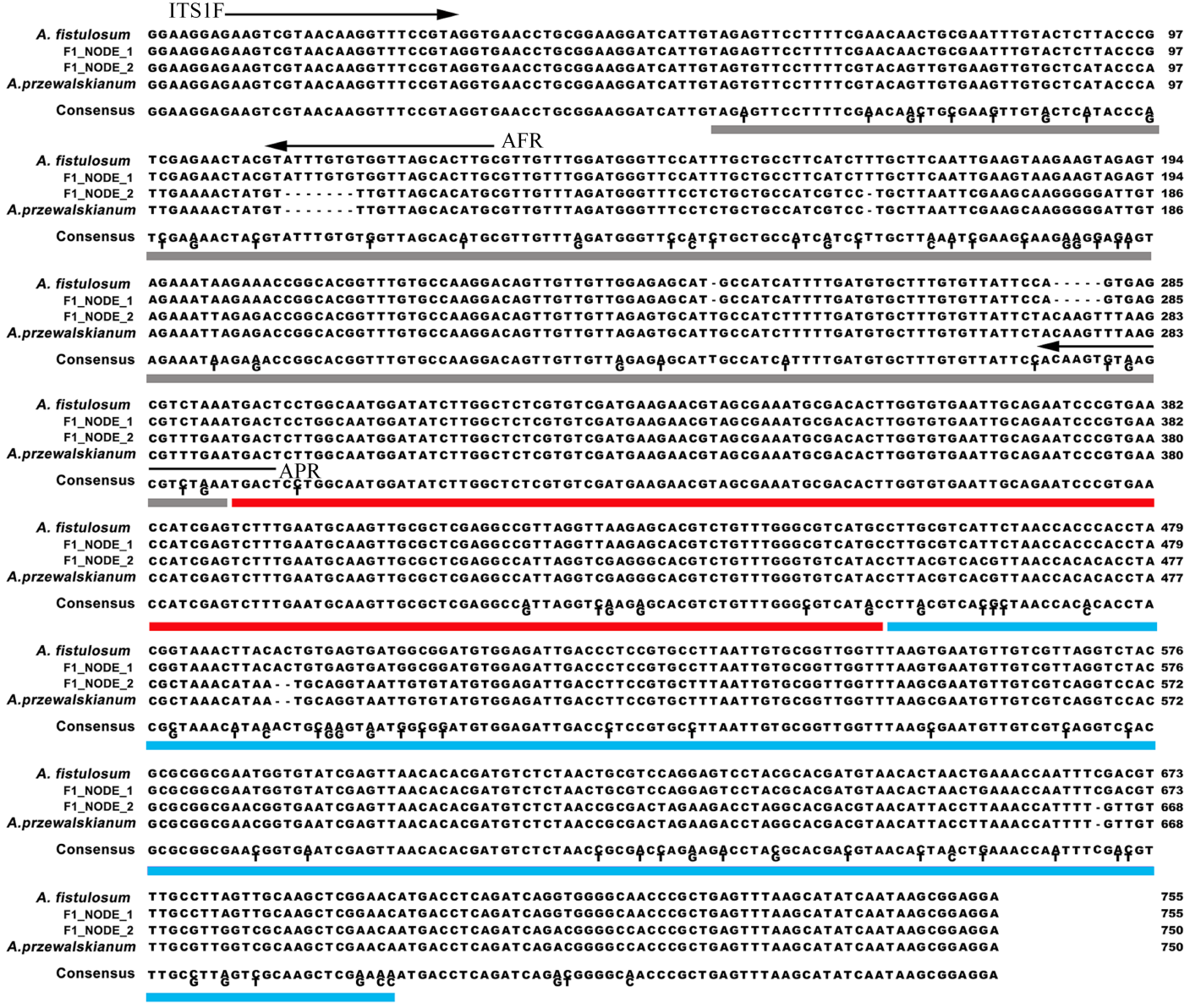
表3
2种ITS单倍型DNA序列(Ap和Af)的多态性分析"
| 参数Parameter | ITS1 | 5.8S | ITS2 | ITS1-5.8S-ITS2 |
|---|---|---|---|---|
| 长度Length (bp) | 245 | 160 | 242 | 647 |
| 多态性位点数No.of polymorphic sites (S) | 40 | 7 | 39 | 86 |
| 突变总数Total number of mutations (Eta) | 40 | 7 | 39 | 86 |
| 每个位点核苷酸多样性Nucleotide diversity per site (Pi) | 0.17316 | 0.04375 | 0.16318 | 0.13651 |
| 插入缺失位点总数Total number of InDel sites | 14 | 0 | 3 | 17 |
| 每个位点的插入缺失多样性InDel diversity per site Pi(i) | 0.01633 | 0 | 0.00826 | 0.00927 |
图4
MAPI_1标记鉴定F1杂交种 P1和P2是母本大葱和父本青甘韭;1—36分别为36个F1杂交种"
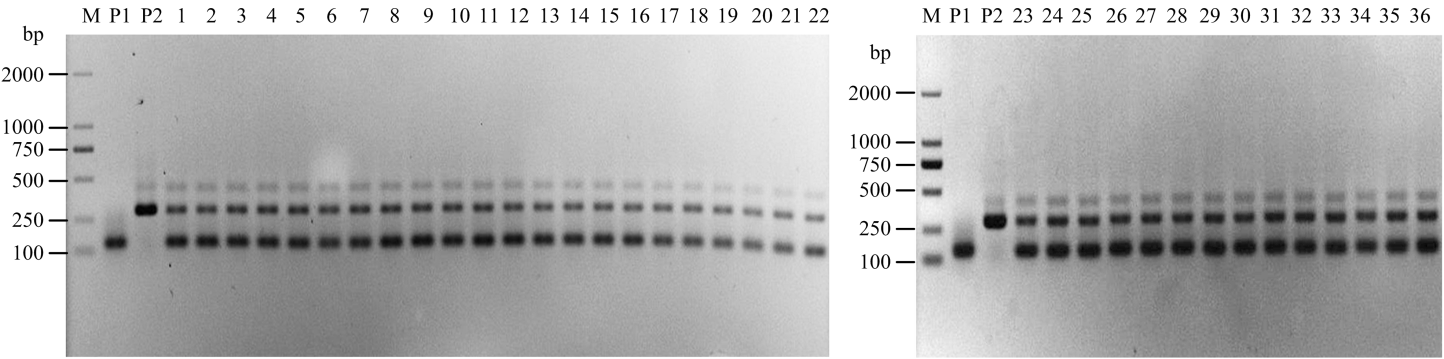
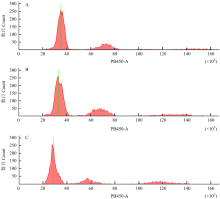
图5
双亲及杂交种F1-16 DNA相对含量的流式细胞分析 A:大葱;B:杂交种F1-16;C:青甘韭;PB450-A:PB450-A荧光通道"
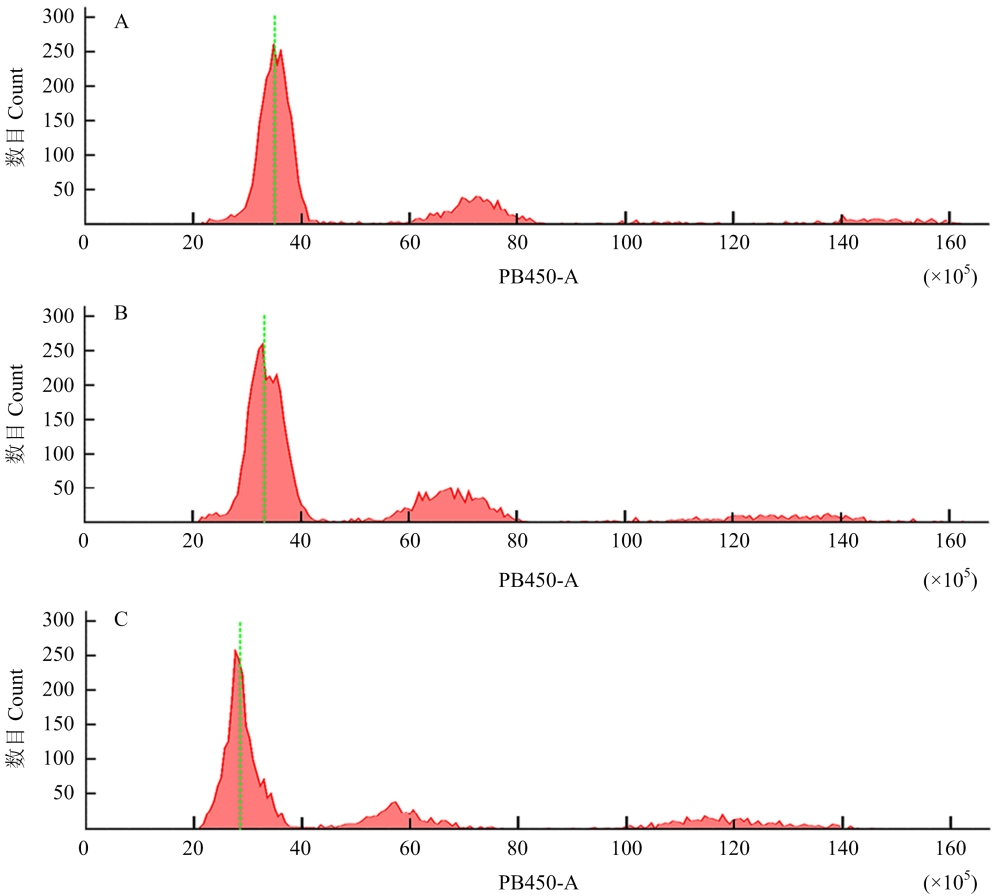
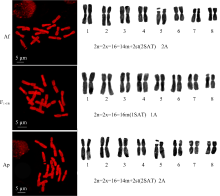
图6
双亲及杂交种F1-16染色体的核型分析"
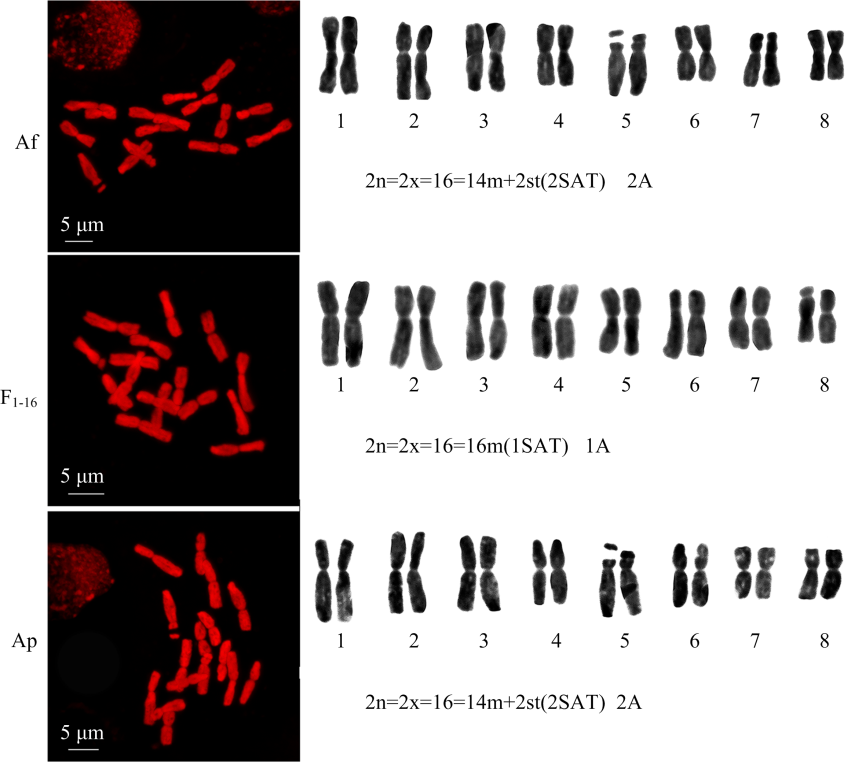
表4
F1植株形态特征"
| 性状 Characteristics | 营养生长期Vegetative growth stage | 抽薹开花期Bolting and flowering stage | ||||
|---|---|---|---|---|---|---|
| Af | Ap | Af×Ap | Af | Ap | Af×Ap | |
| 株高Height (cm) | 68.28±6.60a | 36.18±2.91b | 68.05±6.70a | 70.18±4.23a | 37.82±3.85b | 70.65±5.09a |
| 平均分蘖数Average tiller number | 1.60±0.52c | 5.70±1.95b | 10.80±4.94a | 1.60±0.52c | 8.60±2.22b | 17.50±9.97a |
| 叶片最大直径Leaf maximum diameter (cm) | 1.69±0.35a | 0.18±0.04c | 0.39±0.06b | 2.04±0.60a | 0.26±0.12b | 0.50±0.35b |
| 假茎长Pseudostem length (cm) | 26.15±3.52a | 15.95±2.75c | 22.04±4.35b | 30.01±6.40a | 16.35±3.34c | 25.04±3.97b |
| 假茎粗Pseudostem diameter (cm) | 2.06±0.37a | 0.23±0.12c | 1.62±0.37b | 2.11±0.45a | 0.26±0.11c | 1.63±0.34b |
| 单分蘖群重Single tiller group weight (g) | 234.62±35.94a | 33.32±4.75b | 226.32±16.91a | 277.42±25.54b | 36.32±4.82c | 387.52±62.60a |
| 最大薹高Maximum bolt height (cm) | / | / | / | 82.39±9.50a | 35.34±6.38b | 77.02±4.22a |
| 最大薹粗Maximum bolt diameter (cm) | / | / | / | 1.98±0.49a | 0.28±0.04c | 0.66±0.11b |
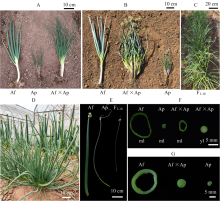
图7
双亲及F1植株的形态特征 A:营养生长期大葱、青甘韭和F1杂交种形态;B:抽薹开花期大葱、F1杂交种和青甘韭形态;C:F1-16无性系抽薹;D:单个F1-16分蘖群;E:大葱、F1杂交种和青甘韭的薹;F:实心和空心的叶片,ml:成熟叶片,yl:幼嫩叶片;G:实心和空心的薹"

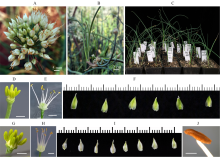
图8
杂交种F1花器官形态及气生鳞芽 A:杂交种F1花序;B:次级薹和气生鳞芽;C:移栽的气生鳞芽苗;D—F:6枚雄蕊与花被;G—I:8枚雄蕊与花被;J:花药"

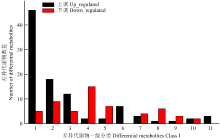
图9
F1与双亲显著异差代谢物分类统计 1:黄酮;2:酚酸类;3:木脂素和香豆素;4:生物碱;5:脂质;6:核苷酸及其衍生物;7:萜类;8:氨基酸及其衍生物;9:有机酸;10:醌类;11:其他类"
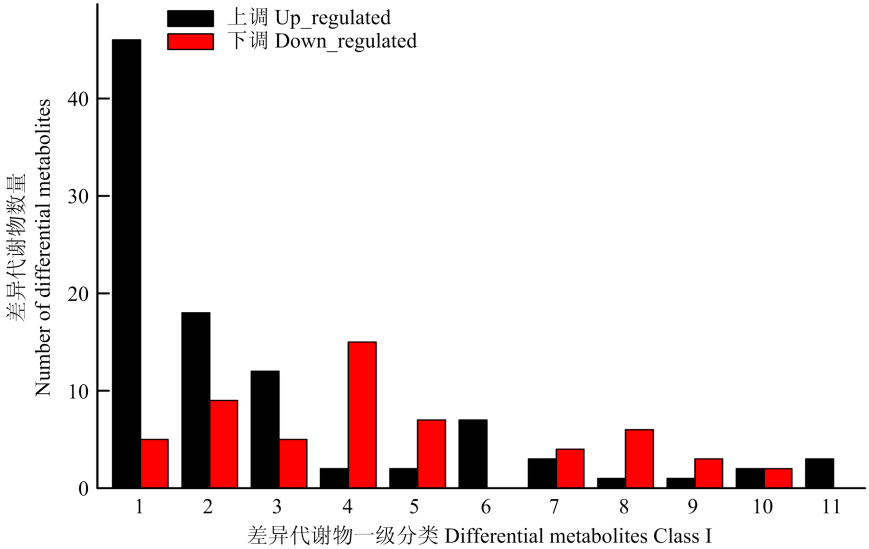
表5
杂交种F1获得与丢失代谢物分类分析表"
| 代谢物索引 Metabolite index | 物质 Compounds | 一级分类 Class I | 获得/丢失+/- |
|---|---|---|---|
| mws2118 | 根皮苷Phloretin-2'-O-glucoside (Phlorizin) | 黄酮Flavonoids | + |
| mws0629 | L-天冬氨酰-L-苯丙氨酸 L-Aspartyl-L-Phenylalanine | 氨基酸及其衍生物 Amino acids and derivatives | - |
| Wafn002874 | 4-O-(4'-O-α-D-吡喃葡萄糖基)咖啡酰奎尼酸 4-O-(4'-O-alpha-D-Glucopyranosyl) caffeoylquinic acid | 酚酸类 Phenolic acids | - |
| MWS1830 | 水杨酸乙酯Ethyl salicylate | 酚酸类Phenolic acids | - |
| Zmcp004218 | 矢车菊素-3-O-(6''-O-阿魏酰)槐糖苷-5-O-葡萄糖苷 Cyanogenin-3-O-(6''-O-feruloyl) sophorosine-5-O-glucoside | 黄酮Flavone | - |
| Lacn007285 | 6'''-O-乙酰基去氢黄柏苷 6'''- O-Acetyl dehydroquercetin | 黄酮Flavone | - |
| Wasn003353 | 葡萄糖基6-羟基-2,6-二甲基-2E,7-辛二烯酸 Glucosyl 6-hydroxy-2,6-dimethyl-2E, 7-octadienoic acid | 其他类 Others | - |
| Qagp006800 | 枸杞酰胺B Goji berry amide B | 生物碱Alkaloid | - |
| Zbsp007466 | N-反式-桂皮酸酰对羟基苯乙胺 N-trans cinnamoyl p-hydroxyphenylethylamine | 生物碱Alkaloid | - |
| Wagp007639 | N-(4-羟基苯乙基)肉桂酰胺 N-(4-hydroxyphenethyl) cinnamamide | 生物碱Alkaloid | - |
| Wcjp001278 | 6-Hydroxycrinamidine | 生物碱Alkaloid | - |
| MWSslk217 | 苦蒿素Blinin | 萜类Terpenoids | - |
| pmp001054 | 异栀子苷Isogeniposide | 萜类Terpenoids | - |
| Cmqn004417 | 7(R)-正丁基莫罗忍冬苷 7(R)-n-butyl Moro honeysuckle glycoside | 萜类Terpenoids | - |
| pmn001505 | 齐墩果酸-3-O-木糖基(1→3)葡萄糖醛酸苷 Oleanolic acid-3-O-xylosyl (1→3) glucuronide | 萜类Terpenoids | - |
| Cmyp003257 | 淫羊藿次苷B1 Epimedium glycoside B1 | 萜类Terpenoids | - |
| Wacn005438 | 羟基十五碳烯酸葡萄糖苷 Hydroxypentadecenoic acid glucoside | 脂质Lipid | - |
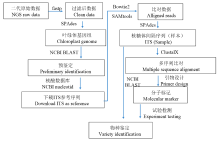
图10
物种及杂交种鉴定分子标记的开发流程"
| [1] |
doi: 10.1093/aob/mcq177 |
| [2] |
The Angiosperm Phylogeny Group. An update of the Angiosperm Phylogeny Group classification for the orders and families of flowering plants: APG IV. Botanical Journal of the Linnean Society, 2016, 181(1): 1-20.
doi: 10.1111/boj.2016.181.issue-1 |
| [3] |
岳丽昕, 王清华, 刘泽洲, 孔素萍, 高莉敏. 大葱雄性不育花药败育的形态学特征和细胞学研究. 中国蔬菜, 2023(9): 58-68.
|
|
|
|
| [4] |
doi: 10.1186/s12870-022-03993-z |
| [5] |
doi: 10.3389/fpls.2023.1124277 |
| [6] |
doi: 10.1002/cbdv.v8.4 |
| [7] |
朗杰, 王陆州, 关志华, 德庆措姆, 王忠红. 青甘韭花叶开发利用现状与营养品质分析. 植物遗传资源学报, 2018, 19(1): 96-102.
doi: 10.13430/j.cnki.jpgr.2018.01.011 |
|
doi: 10.13430/j.cnki.jpgr.2018.01.011 |
|
| [8] |
中国科学院中国植物志编辑委员会. 中国植物志:第十四卷. 北京: 科学出版社, 1980.
|
|
Editorial Committee of the Flora of China of Chinese Academy of Sciences. Flora Reipublicae Popularis Sinicae: Volume 14. Beijing: Science Press, 1980. (in Chinese)
|
|
| [9] |
崔勰奎. 青甘韭的细胞和分子地理学研究[D]. 兰州: 兰州大学, 2008.
|
|
|
|
| [10] |
姚步青. 盐芥和青甘韭表型可塑性研究[D]. 兰州: 兰州大学, 2011.
|
|
|
|
| [11] |
吴青君, 于毅, 谷希树, 刘峰, 宋敦伦, 魏国树, 贺敏, 刘长仲, 许国庆, 张友军. 韭菜根蛆的发生危害及综合防治技术研究——公益性行业(农业)科研专项“作物根蛆类害虫综合防治技术研究与示范”进展. 应用昆虫学报, 2016, 53(6): 1165-1173.
|
|
|
|
| [12] |
doi: 10.1007/s10722-021-01283-5 |
| [13] |
|
| [14] |
|
| [15] |
doi: 10.1007/s13237-015-0153-0 |
| [16] |
|
| [17] |
|
| [18] |
|
| [19] |
pmid: 12835927 |
| [20] |
doi: 10.1007/s11240-006-9167-2 |
| [21] |
doi: 10.1007/BF00223688 |
| [22] |
doi: 10.1007/s001220050003 |
| [23] |
doi: 10.1139/g90-129 |
| [24] |
doi: 10.21273/JASHS.111.1.126 |
| [25] |
doi: 10.1007/BF00223796 |
| [26] |
doi: 10.1023/A:1009296826942 |
| [27] |
doi: 10.1007/BF00222449 |
| [28] |
doi: 10.1007/BF00222143 |
| [29] |
doi: 10.1007/BF00037938 |
| [30] |
doi: 10.1023/A:1002914225154 |
| [31] |
doi: 10.3390/plants8020036 |
| [32] |
doi: 10.1007/s10681-015-1601-2 |
| [33] |
doi: 10.1111/pbr.1990.105.issue-2 |
| [34] |
doi: 10.1007/s10681-007-9383-9 |
| [35] |
doi: 10.1186/s12870-016-0879-0 |
| [36] |
VAN DER MEER Q P,
doi: 10.1007/BF00040359 |
| [37] |
doi: 10.1007/s001220050017 |
| [38] |
doi: 10.1007/s001220050702 |
| [39] |
田保华, 梁毅, 陈丽, 王永勤, 裴雁曦. 洋葱大葱种间杂种鉴定方法建立与应用. 植物遗传资源学报, 2011, 12(4): 657-661.
doi: 10.13430/j.cnki.jpgr.2011.04.029 |
|
|
|
| [40] |
王永勤, 田保华, 梁毅. 大葱和洋葱种间杂种的获得及其特性. 中国农业科学, 2010, 43(10): 2115-2121. doi: 10.3864/j.issn.0578-1752.2010.10.018.
|
|
|
|
| [41] |
杨天慧, 魏佑营, 王超, 王馨笙, 刘莎莎, 段曦. 大葱、洋葱远缘杂交后代及其亲本挥发性成分分析. 山东农业科学, 2010(6): 35-39.
|
|
|
|
| [42] |
杨天慧, 魏佑营, 王馨笙, 刘莎莎, 段曦, 武文君. 大葱、洋葱远缘杂交后代植物学性状、品质研究. 山东农业大学学报(自然科学版), 2010, 41(2): 181-185, 208.
|
|
|
|
| [43] |
doi: 10.5642/aliso |
| [44] |
doi: 10.1038/s41598-019-48708-x |
| [45] |
|
| [46] |
doi: 10.3732/ajb.1200641 |
| [47] |
doi: 10.1007/BF02672076 |
| [48] |
|
| [49] |
doi: 10.1089/cmb.2012.0021 pmid: 22506599 |
| [50] |
doi: 10.1038/nmeth.1923 pmid: 22388286 |
| [51] |
|
| [52] |
|
| [53] |
doi: 10.1093/molbev/msx248 pmid: 29029172 |
| [54] |
doi: 10.1093/bioinformatics/btp033 |
| [55] |
doi: 10.1093/nar/gks596 |
| [56] |
王海平, 李锡香. 葱种质资源描述规范和数据标准. 北京: 中国农业出版社, 2008.
|
|
|
|
| [57] |
|
| [58] |
doi: 10.1111/j.1601-5223.1964.tb01953.x |
| [59] |
|
| [60] |
刘雪莹, 李君平, 范双喜, 韩莹琰. 不同品种叶用莴苣感官品质评价. 中国蔬菜, 2016(3): 26-30.
|
|
|
|
| [61] |
doi: 10.1016/j.ympev.2015.11.004 |
| [62] |
doi: 10.1186/s12864-016-3474-8 |
| [63] |
doi: 10.3389/fpls.2017.01225 |
| [64] |
doi: 10.3390/agronomy10091400 |
| [65] |
原小燕, 符明联, 张云云, 刘珏, 铁朝良, 李燕, 王绍能. 油菜和甘芥杂交后代薹花期耐旱性鉴定. 中国油料作物学报, 2018, 40(1): 84-93.
|
|
|
|
| [66] |
候林慧, 郑赟, 荣二花, 吴玉香. 陆地棉与瑟伯氏棉远缘杂交后代性状鉴定与遗传分析. 生物技术通报, 2023, 39(12): 128-135.
doi: 10.13560/j.cnki.biotech.bull.1985.2023-0539 |
|
|
|
| [67] |
薛金燕, 刘益勇, 吴隽香, 徐照璨, 张宇, 成玉富, 杨旭. 栽培茄 (Solanum melongena L.)与喀西茄 (Solanum khasianum C.B.Clarke) F1杂交种的获得与鉴定. 中国蔬菜, 2020, 1(10): 62-67.
|
|
|
|
| [68] |
doi: 10.1007/BF00023272 |
| [69] |
孙亚玲, 李瑞平, 王振宝, 张庶, 刘冰江, 霍雨猛. 洋葱种子消毒和无菌苗培养新方法. 生物技术通报, 2023, 39(4): 212-220.
doi: 10.13560/j.cnki.biotech.bull.1985.2022-0983 |
|
|
|
| [70] |
doi: 10.1007/BF02190620 |
| [71] |
doi: 10.1111/pbr.1987.98.issue-4 |
| [72] |
|
| [73] |
doi: 10.1038/s41586-022-05640-x |
| [74] |
doi: 10.2307/2399880 |
| [75] |
doi: 10.1186/s12870-017-1194-0 |
| [76] |
doi: 10.1007/s001220051088 |
| [77] |
doi: 10.1007/s00606-007-0596-0 |
| [78] |
|
| [79] |
doi: 10.1111/j.1095-8339.2004.00394.x |
| [80] |
doi: 10.1007/s10342-014-0839-x |
| [81] |
doi: 10.1126/science.81.2094.161 |
| [82] |
邓衍明, 贾新平, 梁丽建. 观赏植物远缘杂交后代的鉴定方法. 核农学报, 2016, 30(7): 1308-1315.
doi: 10.11869/j.issn.100-8551.2016.07.1308 |
|
doi: 10.11869/j.issn.100-8551.2016.07.1308 |
|
| [83] |
doi: 10.1007/BF00272064 |
| [84] |
doi: 10.1007/s11010-021-04213-2 |
| [85] |
doi: 10.1038/s41467-022-34491-3 |
| [86] |
doi: 10.3389/fnut.2022.1000271 |
| [87] |
doi: 10.1016/j.ygeno.2021.05.005 pmid: 33991618 |
| [88] |
doi: 10.1080/10408398.2022.2131726 |
| [89] |
doi: 10.1007/s10681-005-9029-8 |
| [90] |
路梦, 苏刚, 程菊, 陈建军, 周涛, 赵君利, 王静, 张莎莎, 马青龙, 谢小冬. 黄酮类化合物抗肿瘤活性及机制的研究进展. 华西药学杂志, 2023, 38(2): 236-240.
|
|
|
|
| [91] |
钟宜科, 吴迪, 花晓丹, 赵彤, 王永霞. 黄酮类化合物抑菌作用研究进展. 中国食品添加剂, 2019, 30(8): 166-171.
|
|
|
|
| [92] |
马琮鉴, 高健美, 孔浩, 徐应淑. 根皮苷药理作用研究进展. 医药导报, 2020, 39(3): 360-364.
doi: 10.3870/j.issn.1004-0781.2020.03.019 |
|
doi: 10.3870/j.issn.1004-0781.2020.03.019 |
| [1] | 宁若云, 银煜祺, 沈建国, 章淑玲, 龚梅芳, 高芳銮. 辣椒轻斑驳病毒的谱系地理历史[J]. 中国农业科学, 2026, 59(3): 543-555. |
| [2] | 王佳美, 徐奉奇, 周慧, 胡向东. 我国农业社会化服务发展现状、地区性特征及国际经验镜鉴[J]. 中国农业科学, 2026, 59(2): 459-474. |
| [3] | 陈桂平, 韦金贵, 郭瑶, 李盼, 王菲儿, 仇海龙, 冯福学, 殷文. 宽窄行与增密对绿洲灌区玉米光合特性及资源利用的协同效应[J]. 中国农业科学, 2026, 59(2): 278-291. |
| [4] | 吕旭东, 孙世媛, 李亚楠, 刘玉龙, 王艳群, 付鑫, 张佳英, 宁鹏, 彭正萍. 智能机械化分层施肥对麦田根-土养分分布和小麦产量的影响[J]. 中国农业科学, 2026, 59(1): 129-146. |
| [5] | 费耀莹, 王迪, 唐伟杰, 郭彩丽, 张小虎, 邱小雷, 程涛, 姚霞, 江冲亚, 朱艳, 曹卫星, 郑恒彪. 基于无人机多源影像融合的水稻籽粒蛋白质含量估测[J]. 中国农业科学, 2026, 59(1): 41-56. |
| [6] | 唐华俊, 吴文斌, 余强毅, 史云, 段玉林, 李文娟, 钱建平, 宋茜, 夏浪, 李会宾, 苏宝峰, 范蓓蕾, 胡琼, 叶剑秋, 张帅. 基于形态指纹特征的耕地遥感监测轻量化大模型构建[J]. 中国农业科学, 2026, 59(1): 78-89. |
| [7] | 王爱冬, 李瑞杰, 冯向前, 洪卫源, 李子秋, 张晓果, 王丹英, 陈松. 基于多角度成像与机器学习的水稻叶面积精确估算[J]. 中国农业科学, 2025, 58(9): 1719-1734. |
| [8] | 岳润清, 李文兰, 丁照华, 孟昭东. 转基因复合抗虫耐除草剂玉米LD05的分子特征及抗性评价[J]. 中国农业科学, 2025, 58(7): 1269-1283. |
| [9] | 王彬, 吴朋浩, 鲁剑巍, 任涛, 丛日环, 陆志峰, 李小坤. 长江中游地区水稻-油菜轮作体系需水特征[J]. 中国农业科学, 2025, 58(7): 1355-1365. |
| [10] | 尹波, 于爱忠, 王鹏飞, 杨学慧, 王玉珑, 尚永盼, 张冬玲, 刘亚龙, 李悦, 王凤. 绿肥还田结合氮肥减施对干旱灌区麦田土壤水热特征及小麦产量的影响[J]. 中国农业科学, 2025, 58(7): 1366-1380. |
| [11] | 宋岩, 柴明堂, 李王成, 孙利英, 吾连恩·赛尔奴, 杜天择. 基于RGB和纹理特征的土壤表层水盐信息反演方法[J]. 中国农业科学, 2025, 58(6): 1159-1172. |
| [12] | 吴立东, 林淑婷, 邱胤晖, 刘亚婷, 张锐, 李永清, 尚伟, 钟柳青. 不同干燥方式辣椒品质的差异性分析[J]. 中国农业科学, 2025, 58(3): 582-599. |
| [13] | 陈均权, 马驰远, 胡鑫, 李朵, 郭艳琦, 刘灿, 周凯, 郑太辉. 有机无机肥配施调控红壤稻田土壤肥力、生态化学计量特征及产量[J]. 中国农业科学, 2025, 58(23): 4952-4966. |
| [14] | 李明丽, 温彩运, 马东豪, 李存军, 王宇文, 康璐, 陆苗. 基于土壤高光谱特征波段优选的盐分预测模型构建[J]. 中国农业科学, 2025, 58(20): 4054-4069. |
| [15] | 张斯佳, 杨杰, 赵帅, 李莉威, 王贵彦. 华北平原多样化作物与小麦-玉米轮作对土壤质量的影响[J]. 中国农业科学, 2025, 58(2): 238-251. |
|
||
